 Ask ChatGPT

Eric Ries argues that “best practices” and standard corporate structures quietly create “financial gravity” that drives companies toward corruption, value destruction, and eventual collapse. He claims the legal default in Delaware C-corps effectively prioritizes maximizing shareholder value, enabling “killer acquisitions” that shut down R&D. He proposes an “incorruptible organization” blueprint focused on purpose (fiduciary priorities), coherence (aligning resources with that purpose), and structural integrity (mission-protective governance).
Eric Ries is the bestselling author of The Lean Startup and other influential business books. He has worked with hundreds/thousands of companies as a consultant/author/speaker and has advocated financial-system reform through the Long-Term Stock Exchange.
Institutional weakness, not just individual bad actors, explains scandals; exceptional companies endure via governance “fortresses.” Founders must act early because “too early” becomes “too late.” Mission statements aren’t enough; purpose must be written into charters and governance.
Saul Price/FedMart vs Costco (governance fortress); Silicon Valley Bank (mission statement vs “any lawful act or activity”); Google “Don’t be evil” atrophy; Whole Foods forced sale to Amazon; Polaroid R&D evisceration; Boeing/FTX/Wells Fargo/SVB as “same story.”
Written by AI. May contain mistakes.
Explore how standard business practices can undermine companies.
“They are designed to make you lose control of your company by force or by corruption.”
Discuss the transitions in business strategies and philosophies over time.
“You know, the first book my mom and dad ever bought me around entrepreneurial things and stuff was The Lean Startup.”
Learn about the underlying forces that impact organizational integrity.
“You know, at the time that book came out, I wish it wasn't so.”
Hear the tale of Saul Price and the rise and fall of FedMart.
“But these types of companies can very easily, to my amazement, get destroyed within days, within weeks.”
Discover how Costco emerged from the lessons learned in business failures.
“But of course, it's not limited to retail.”
Learn about Costco's unique governance that protects its business model from Wall Street pressures.
“I used to think, like I think a lot of people do, well, Costco is so big,$400 billion, maybe they're too big for Wall Street to mess with.”
Explore the complex dynamics of blame in corporate collapses and who is truly at fault.
“So the way that forces work, there's always somebody who is to blame because someone was the proximate cause of the collapse.”
Discover the concept of 'financial gravity' and its impact on company longevity.
“eventually the water gets in and the thing collapses.”
Gain insights into practical techniques for founders to build resilient companies.
“We say, oh, they had the luxury to do the right thing because they're so successful.”
Learn about industrial foundations and their role in ensuring mission-driven companies.
“But I promise you, my book has like 100 pages of footnotes.”
Learn about the concept of industrial foundations and their unique corporate structures.
“This is companies where the corporate structure has a mission guardian, a separate entity that has the responsibility of making sure the company stays on track.”
Discover how conventional company structures can mislead founders about fiduciary duties.
“So how come you're learning about that for me.”
Explore the importance of establishing a clear corporate mission and its implications.
“The formula is the Acme Corporation is hereby established to pursue, and it's like a mad lib, there's a blank line and you can write in whatever you want as the corporate purpose.”
Understand the significance of a company's ethos and structural integrity for success.
“If founders listening, they want to create the ethos and the structure.”
Learn how to establish a fiduciary priority that benefits customers and communities over shareholders.
“Most companies I know have a mission statement.”
Get practical advice on how founders can protect their mission and values in business.
“To what degree is every resource the company touches directed towards that purpose, towards making those fiduciary commitments?”
Learn how to effectively communicate with lawyers and investors while addressing challenges founders face.
“So I have a whole section of the book called how to talk to your lawyer about these ideas.”
Understand the importance of treating company governance as a continuous, lifelong practice.
“I'll never become, I guess I can eat all the Cheetos I want then.”
Explore the defensibility of companies like Anthropic in a competitive landscape and the importance of strength.
“if you create something that is highly trusted, that builds these kind of deep and profound relationships with customers and employees and investors for that matter, you are like Saul Price.”
Challenge conventional wisdom on best practices and discover unique strategies for success.
“Anthropic has that two-tiered governance structure like we've been talking about.”
Learn practical steps for founders to take action, even when they think it's too late for their company.
“Hopefully not too many having a heart attack, but hopefully many, many are.”
Discover the rise and fall of Polaroid and the significance of innovation and leadership in business.
“And I can just imagine the scene where legal counsel comes in.”
Explore the history of Polaroid and the consequences of leadership changes.
“It's not just the name of an instant camera.”
Discuss the importance of succession planning to maintain a company's ethos.
“But when I talk about Edward Land, Edward Land was already at retirement age.”
Learn about basic yet often overlooked practices for business success.
“You know, I've interviewed a lot of founders and thousands of founders over the years.”
Eric Ries shares his current projects and future aspirations in business.
“and it sounds all gloomy, but it's very basic.”

Get the gist, explore an idea or ask about something said.
 Claude
On BIG IDEAS BY NEW ECONOMIES, what are the key points of this episode?
Searching your listeningAutomatic transcript. May contain errors.
0:00Best practices. They are designed to make you lose control of your company by force or by corruption. Either way, it's the same to you. This company will betray you eventually. We spend so much energy as leaders focused on the surface characteristics of organizations, but also worthy of our attention are the underlying forces that shape organizations. This fiduciary duty to maximize returns for shareholders is now considered to be so strong acquisitions with the intent to destroy the acquired company and shut down its R &D. This is happening like all over our economy. This is many, many ways people have figured out to make money by destroying value.
0:37And if the dominant phenomenon of our time from an organizational perspective is corruption, what does it mean to build an incorruptible organization? This is Eric Ries, the bestselling author behind some of the most influential business books of our generation. And today he's revealing why standard best practices are quietly sabotaging founders and the exact three-step blueprint you need to build an incorruptible company that survives for the next 50 years. There is a form of what I call financial gravity that operates on these companies. And the ones that collapse, the ones that erupt in scandal, they're all the same story.
1:10The legal community has played a trick on the world. Because in America, this has been standardized. We always use the same formula. We don't have to, but we do. The formula is the Acme Corporation is hereby established to pursue, we've been all trained to write in any lawful act or activity. People are like, well, it doesn't sound that bad. It sounds pretty open-ended, but wrong. Whenever you see any lawful act or activity, the courts have decided that actually that means maximize shareholder value. And if you don't make special efforts to avoid this, by default, you will get an incorporation system that holds that your organization is just a financial instrument meant to enrich shareholders.
1:43If you don't want to be a cautionary tale, I can give you the exact techniques to follow. There's a couple of very simple things companies can do, certainly in the early days. These are called mission protective provisions. One. Welcome to New Economies.
2:08Hey, Eric, welcome to New Economies. Thank you so much for joining us. Thanks for having me. So this is really a full circle moment. You know, the first book my mom and dad ever bought me around entrepreneurial things and stuff was The Lean Startup. your book which you published 15 years ago fast forward 15 years later where we are today you have just published your latest book why now and why do you want to go down this rabbit hole of you know writing another book tell me about it this was a long a very long and drawn out process for me very difficult book to write mostly because i'm trying to write about something that we all experience and understand viscerally but we don't have words for so it's actually very challenging to figure out how to get the ideas in the right order, what to call things, how to name them.
2:55And I wish I could say I had great foresight and I understood that the issue of public corruption was going to be on everybody's minds. You know, at the time that book came out, I wish it wasn't so. I definitely did not anticipate that. But I think the timing has kind of worked out serendipitously that it took me such a long time to write the book that it accidentally came out at the perfect time. So maybe all things were meant to be. incorruptible you know we are some people will say we are in a strange time some people will say we're in a very exciting time but the way companies are being built are very different to previous generations when you look at the lean startup versus incorruptible your latest book are there any differences in how startups are being built today and how people are actually building well Well, if you've ever been on Reddit, you will have encountered the meme Anakin and Padme.
3:47And for those that have never seen it, I'm sure you can link to it in the show notes too. It goes like this. Anakin says, I'm going to change the world. Padme in the second frame says, for the better, right? In the third frame, Anakin says, nothing at all. And in the fourth frame, Padme says, for the better, right? And I used to think that was the funniest joke on the internet. And boy, do I not find it funny anymore. because I feel like that's the parable we've all been living through. Like this whole new generation of entrepreneurs created these companies with world shaking power. And when they're raising money, we all say, you know, rah, rah, I'm a world beater.
4:26I will destroy all that I see. You know, I am become death. And then it's like, Oh really, you're going to change the whole world. Do you bear some moral responsibility for the consequences of your actions? Oh no, I'm just a little database company. You know, I don't know what you're talking about. So I feel like this duality of people, leaders seeking power and riches without really specifying what that is all for has gotten us into a lot of trouble. And look, I know we don't need another manifesto about economic bad actors or whatever. I feel like we're drowning in such things that the critiques are everywhere and quite obvious.
5:01To me, the question was, what do we do about it? And I came to the realization through my work, you know, helping hundreds or gosh, probably at this point, thousands of companies get started. Big companies, small companies, you know, governments. I've been everywhere that you can go as a consultant, as an author, as a speaker, as a so-called expert. So I've seen it up close. And so like part of it came from that. Part of it came from my work building things at the long-term stock exchange, trying to advocate for and drive reform into our financial system. that we spend so much energy as leaders focused on the surface characteristics of organizations.
5:36And why not? Those are the fun things. Strategy, product, business model, culture, values, even vision. The stuff you can control and taste and touch. But also worthy of our attention are the underlying forces that shape organizations that can, if we're not careful, warp them unconsciously. And that really was my experience over all these years is I felt like I was wrestling with a force that I could not name. In the book, I call it the force that no one controls, but everyone obeys. And I just, I wanted to bring it into the light and say, okay, let's try to understand this force and how it operates.
6:13And let's study the people and the organizations that have figured out how to defy it and even to wield it to their own ends. That's really what the book is about. I love that so much. you when you're saying the underlying forces, the types of companies which are being built today, they're becoming incredibly impactful, very powerful, and very quickly compared to companies which were born 10, 15 years ago, right? But these types of companies can very easily, to my amazement, get destroyed within days, within weeks. Why do so many of these companies get destroyed? And what are some of those characteristics that you've observed over your decades of working with founders?
6:57Let's start with a story. Because this can all seem very abstract. We're talking about powers and forces and destruction and corruption. It's complicated. But it's actually very tangible. And I would say the main difference between modern companies and the ones we have in the historical record is just that we are speed running this process now, but it's the same underlying dynamic. So in the book, I have case studies of this phenomenon going back to 1800, but I think an easy one to follow and one that I kind of like is one of the early ones in the book. And I like it for our conversation to hear because it's one of the few tragic stories that has a happy ending is the story of the great Saul Price.
7:34So for those of your audience that don't know, Saul Price is widely considered to be the inventor, like the originator of American retail. So the discount big box retail concept, Saul invented it. And to get a sense of how influential Saul was, all you have to know is that when Sam Walton was thinking about getting into retail, he decided to name his company Walmart as an intentional tribute to Saul's first company, FedMart. So Saul had started FedMart in the 1950s, a discount warehouse store for members only that if you walked into a FedMart, it would feel eerily familiar. You'd be like, oh yeah, of course I know what this is.
8:12But in the 1950s, this was a revolutionary concept. Saul had trained as a lawyer before he became an entrepreneur. And so he had a very particular philosophy of business. He believed in what he called capped margins. He would not mark up an item more than 14%. He believed in paying above market wages to get the best talent. He believed as a lawyer, he had been trained that he was a fiduciary to his client, meaning he had to put the client's interest before his own. And he brought this ethos to retail. As a retailer, he said, the customer is my client. I am a fiduciary to the customer. So for example, if competitors tried to undercut him on price, he would never deviate from his 14 % markup.
8:54He would just put up signs in his store that says, hey, everybody, don't buy this product from me. You can get it cheaper here down the street. He would send customers wherever the lowest price was, he didn't care. And as a result, customers trusted him. They trusted in FedMart. They were incredibly loyal. Employees loved working there. Salt was a big believer in hiring and promoting from within. It was just everything you want out of a company, FedMart embodied. So the company grew fast. Of course it did. Customers are driving miles out of their way to shop at FedMart because at every other retailer, they kind of have that sinking feeling that they're probably being taken advantage of, but they knew they could trust FedMart.
9:31So he took the company public. He became a wealthy man. He made absolutely gargantuan amounts of money for all of his investors. And yet they were never, ever satisfied. Now, even though investors claim they understand that being contrarian is the only way to generate returns, every time a company does something truly original, they feel this gravitational pressure to conform to the so-called best practices. And FedMart was no exception. Through the 60s and 70s, for more than 20 years, Saul battled his investors. And he would actually periodically get new investors to buy out the old investors in the hopes that the new investors would understand what made FedMart special.
10:13And yet gravity is not a matter of personality. It is a force, one of the fundamental forces of our economic reality. So each new set of investors was captured by those same incentives. and so all this culminated in a dark day in 1975. Saul comes to work, takes the key, tries to put it into the lock in his office, but he cannot enter, he cannot open the door because he does not work there anymore. They have changed the locks on the door in the night. Saul is summarily dismissed. His life work is taken from him. It's rare in business that we get like a truly natural A-B experiment for one philosophy of business versus another, but here you have the perfect controlled experiment.
10:55Because the investors won. They got Sol out, and they were very quickly able to convert FedMart to a faster growth, more profitable, higher ROI way of working. And thanks to this massive investment, they actually invested a bunch of money to do this conversion. By 1982, within just seven years of firing Sol, the company had been completely liquidated. It is so much easier to destroy than to create, and they managed to destroy in seven years is what it had taken saw more than 20 to build. This story is not unusual or even unique. It's not unique in retail. If you know the story of Circuit City or Sears or tons of other companies that have had this exact same thing happen to them.
11:33But of course, it's not limited to retail. We see it in every sector and every industry. Since the book has come out, I've become people's favorite corruption stories guy. So people send me their stories. So I got an Italian fashion company yesterday. Two days ago, it was tortillas. Five days ago, it was eggs. I could bake the most bizarre cake out of all the ingredients of companies that have been corrupted that people send me. But I said the story has a happy ending, so let me deliver on that promise. Because Saul was not your average entrepreneur. He had his life's work taken from him. Now remember, he had been a late-in-life entrepreneur.
12:06He's retirement age now. He could easily have said, you know what, to hell with all this. He's a wealthy man. He could just retire and enjoy the spoils of, no, no, no, no, no. Saul took a two-week break, just two weeks, and then he was back. He leased the office upstairs from FedMart, and he started again. He created a company that he called the Price Club. When I was a kid growing up in Southern California, that's where my family shopped. I didn't even know it was named after a guy. I didn't even know there was a guy named Saul Price. His name was literally Saul Price. I didn't know that. I just thought it was the Low Price Club, the place you go to get low prices.
12:40So I knew Saul Price only through his ethos, through his company. I never met him. But growing up, I could feel what he stood for. Now, today, most people have not heard of the Price Club unless you grew up like me in that place. And that's because of something else that happened right around the same time. See, when Saul was fired from Fedmark, a bunch of employees of Fedmark quit in protest because they understood the outrageous injustice of this. One of those guys had worked his way up from stock boy to senior executive. And after working with Saul at Price Club for a few years, decided to strike out on his own and build his own company, again, using the same ethos of the capped margins and the investments and employees, the whole thing.
13:22And in fact, a few years after that, his company and Saul's company were to merge, forming a combined company that they called Price Costco. But of course, we just call Costco. So for some of your listeners who already know this story, they can enjoy going along. some of you don't realize we've just done the deep cut origin story of Costco, which today is a$400 billion public company. And so to answer your question now, what have I noticed? What have I observed between the companies that get corrupted and the companies that resist? This gives us a really interesting question we can ask. Why was FedMart destroyed, but Costco endures?
13:58Costco is going on 40 years now with the$1.50 hot dog and the cap margins and the whole thing. Why? I used to think, like I think a lot of people do, well, Costco is so big,$400 billion, maybe they're too big for Wall Street to mess with. Oh, no. Oh, no. There ain't nothing that is too big for Wall Street to mess with. Have you thought that? You are horribly naive, just like me. Welcome to the club. No. Costco endures because it is protected by what I call a governance fortress, a series of interlocking protections that allows the management and directors of Costco to conceive of their job differently than how most corporate directors do.
14:37They see themselves not as agents of the will of Wall Street, but as a bulwark against that pressure. And you think that pressure doesn't come? You are very naive, my friend. Every few years, there is a campaign by Wall Street to try to change Costco and get it to conform to best practices. Governance ratings agencies routinely give it the worst possible governance score. One of my favorite quotes in the whole book is from a Wall Street analyst who says something to the effect of, Costco is a company that takes money that rightfully belongs to shareholders and instead invests it in the customer experience.
15:11As if that was a criticism. So the really deep philosophical disagreement about whether companies exist to extract value from the engine that turns from customers in their communities, or should be engines of reinvestment. This is erupting. This is causing a chasm all through our civilization. And if we don't get on the right side of this question, the collapse that we've started to see, read the newspaper every day, we are living in a time of institutional collapse. It's going to get a lot worse unless we turn this around. And obviously with AI, it's about to get, I mentioned speed run. We're now going to do hyper speed run.
15:47So we better get this right. I absolutely love the Costco story. And that's just one, right? in recent years we've had the likes of we work i think that's a good example you know you have one incredible founder obviously very ambitious very hyperactive which i think is very good in some respects and then your life's creation after 10 years okay you're in a frothy market things are not always going according to plan you basically have to leave and get out of your own company there have been others there have been the likes of Farinos you know you have one incredible visionary the technology clearly doesn't work according to reports but my point here is you spend if it's Costco if it's WeWork FTX Farinos there are a whole bunch of others it just takes one moment for something to happen for it to come to an end whose fault is it when that comes to an And is there someone responsible?
16:50Is it the investors? So the way that forces work, there's always somebody who is to blame because someone was the proximate cause of the collapse. So yes, it's always somebody's fault. And look, you named a bunch of borderline fraudulent or outright fraudulent cases where we can blame the founder. I mean, I obviously advocate a lot for founders to be cherished and protected in this book, but there are bad founders who do bad things. Absolutely, for sure. But it can also be the investors. You know, if people who know the story of Sears, One of their investors took Sears over and managed to extract like billions of dollars in profits for himself while the company lost tons of money and drove it into bankruptcy.
17:26This was not like people like, oh, whatever happened to Sears? I guess they like didn't adapt with the times. No, the marrow was sucked out of the bones and then the thing collapsed. This happens all the time. But I think this blame game really causes us to miss a deeper question. In the book, I tell so many stories like this, you know, Whole Foods and its forced sale to Amazon, Polaroid, and its scientific research engine, utterly eviscerated. I don't, you know, SAIC, one of the largest employee-owned companies in the United States, utterly is now a shell of its former self. In all of these cases, there are villains.
18:01But the way the press tells the story is kind of like, who's to blame more? Naive or delusional founder or greedy investor? you know, fight like we're playing Mortal Kombat. Who will win? But I think a deeper question is actually operating here. Because in all of these cases, when we look only at the collapse itself, we can see the proximate cause. But in a lot of these cases, we have to ask ourselves, why was the organization built in such a flimsy way in the first place? These are mostly stories of institutional weakness. And so like, imagine a bridge collapses. Okay, imagine you own a bridge and it collapses and you ask me, your engineer friend, to come help you diagnose the problem.
18:44What happened? Whose fault is it? And I come over and I look at the wreckage of the bridge in the valley and I look at all the pieces and I say, ah, I can tell you what happened here. Gravity. If not for gravity, your bridge would still be standing. And you're like, man, that is a very unsatisfying answer, right? It's like, but first of all, like gravity affects every bridge. Well, why did this one collapse? You're like, okay, I see what you're saying. Well, was there a train going across the bridge at the time? Yeah. Who was driving that train? If he hadn't driven the train, probably this wouldn't have happened.
19:22Or like, oh, look at this. Did your private equity firm who bought the bridge from you start repairing it with inferior materials? Ah, they are to blame, right? So it's easy to find approximate cause. But none of those answers really satisfy because throughout all this story, you could be like, yeah, I hear you, but my friend's bridge in the other valley, it didn't collapse. And they also have investors and they also drive, like all the things that we did, they did and they're going strong. And in the modern economy, we have these exceptional companies kind of hidden in plain sight everywhere you look.
19:59Many of which are 40, 50, 75, 100 years old. and that don't seem to be exhibiting signs of this corruption. So when we look at it that way, we start to realize that there is a form of what I call financial gravity that operates on these companies. And the ones that collapse, the ones that erupt in scandal, whether I'm talking about Boeing or FTX or Wells Fargo, Silicon Valley Bank, it doesn't matter. They're all the same story. The story is, think of it like a submarine or a spaceship with a weak hull. eventually the water gets in and the thing collapses. The question is not, so it's like, well, is the water to blame?
20:38When a submarine sinks, is it the water's fault? Like, yeah, in a certain sense, yes. But why did you take a submarine down with a hole in it? You know, like the better question is, who designed this submarine? Why was it built in this way? And when we start to open our aperture of understanding to these deeper forces, it allows us to ask this question. If the dominant phenomenon of our time from an organizational perspective is corruption, What does it mean to build an incorruptible organization? I like this term financial gravity. And actually, this is not talked about enough, especially also as you start thinking about building companies as a founder.
21:16You don't want to become a failure. You want to become a success. You want to look after friends. You want to look after families and so on. when you think about the financial gravity and the water is starting to leak around the edge of some of these companies how should founders think about protecting the future proof of that company so things don't end in disaster yeah so although we've been talking kind of like manifesto style so far i promise that the majority of this book is actually about the blueprint of exactly what to do. If you don't want to be a cautionary tale in some future version of this book, I can give you the exact techniques to follow.
21:59Now, I promise you, every technique in the book has three things in common. One, it is something with long established precedent. These are not like random ideas that I just came up with one day. These are all things that you can do right now. They're all legal in all modern countries. They're like things that are within your grasp. You don't need special permission today are things that are doable. So I know there's a lot of books that are like after the revolution then. Okay, this is not that kind of book. This is something you could do today. Second, every technique is backed by a lot of evidence.
22:30We have actually in many cases very strong academic evidence because there's whole branches of academia that study today's so-called best practices and find them terribly wanting. And they have developed all kinds of alternative practices that really work. So we have the evidence that not only are they better from a mission longevity point of view, they're also better from a financial performance point of view. And third, we have case studies of every technique where you can study, here's a real, honest-to-God, actual company that is doing this. So you can copy the details. You can just say, look, here's exactly what a real, normal human being did.
23:02Now, the challenge is, I will say this up front, a very common reaction we get from these exceptional companies is people look at them and say, gosh, they're not really relatable to me. So I had someone on Twitter come at me and they were like, for example, one of the techniques in the book is called becoming a public benefit corporation or PBC. One of the easiest techniques in the book, if you're listening to me and you're an entrepreneur, if you've never heard of that, shame on your lawyers for not telling you about it. You should look it up and you should do it. I'll get you a better lawyer.
23:29Get in touch if you don't have one. PBC. So someone comes at me, a Twitter troll was like, hey, I appreciate you advocating for this, but it'll never work. VCs will never go for it. And then they were like, well, I guess if some venture-backed company is really successful who does this, maybe then VCs will buy into it. and I was like, you know, I know you're not supposed to feed the trolls, but I couldn't help myself. I was like, excuse me, but with all respect, is Anthropic not successful enough for you? And they were like, well, they're too successful. I don't find them relatable. It's like, okay, I get that reaction all the time with many of the case studies that I do.
24:04People say that about Costco. People say that about Nova Nordic. People say that about Patagonia. People say that about Vanguard. All these companies were like, well, they're just too, but notice Notice how we get the causality backwards here. We say, oh, they had the luxury to do the right thing because they're so successful. That's already conceding the dominant problem that we're all talking about. Maybe, maybe, maybe there's a possibility you could consider. It's that they didn't have the luxury to do the right thing like Saul Price. They started out doing the right thing, and that was the engine of their extraordinary success.
24:39So I think a lot of the problems here, the challenges and obstacles to doing this are mental. We have been indoctrinated to think that mission orientation, ethics, longevity, these things that we crave as founders, quality, design, beauty, that these are lesser or secondary attributes. In fact, in some cases, we should be embarrassed about it because if we're building a for-profit company, we should be all about the money. But this is backwards. If you care about any extra financial principle whatsoever, beauty, design, anything, if you care about that, you are a business revolutionary whether you admit it or not, whether you want to be or not.
25:17because we live in the era of what is called shareholder privacy, which holds that this is all organizations are literally under the law today. If you don't make special efforts to avoid this, by default, you will get an incorporation system that holds that your organization is just a financial instrument meant to enrich shareholders. That's all it is. Oh, you thought it was a vital living, beautiful thing designed to create quality products for your customers and make their lives better. Ha ha ha. You're the sucker. Okay. That's not what you signed. And I can't tell you how many founders I've done this exercise with who look at me like, no, my lawyer would never have done that to me.
25:54They said I had the best practice documents. I say, call them up, call them and ask them if what I say is true. And they call me back and they're like, Eric, you won't believe this. He said he was doing me a favor, but now Philip Morris could just buy my company and I can't do anything about it, I'm like, welcome to best practices. They are designed to make you lose control of your company by force or by corruption. Either way, it's the same to you. And I'm sick of it. I just, I'm tired of helping people create these incredible companies only to lose their soul. Why are we doing this? Who benefits?
26:26Who is it for? So if we as entrepreneurs, if we just say enough, this can end. And I think it's time. If you're enjoying today's episodes, hit subscribe at the bottom of your screen. the guests on the show are getting bigger and bigger and we need your help to grow this channel so if you're enjoying today's guests or any previous episodes hit subscribe and it prompts you it'll be worth it now back to today's episode that's so fascinating you know around the different types of protection use cases that just founders don't know about i mean this is just like it It should be basic stuff, right? Why aren't founders reading the small print?
27:07Why aren't they looking under the hood? Well, I'll tell you exactly why. Yeah, this is a question I want everybody, every leader who's listening to you right now needs to grapple with this question. So I'm going to introduce some things that you have never heard of, okay? And as we go on this podcast, you're going to be like, wait, that can't be right. Wait, that can't be right. But I promise you, my book has like 100 pages of footnotes. I really did my homework here. And in the old days, you would have had to like go read the footnotes and check it. Just, you can have Claude do it for you. We live in an era where if you want to check these references, you can do so en masse.
27:37I promise you, I spent a lot of time on the fact checking for this book to get it exactly right. So the question you have to grapple with is, why are you learning about this from me? Not the army of high paid lawyers and advisors and bankers and investors that you employ. They're supposed to be the ones to tell you. So for example, let's take one remarkable fact that almost no one's ever heard of. There's a whole academic discipline that studies what are called industrial foundations. This is companies where the corporate structure has a mission guardian, a separate entity that has the responsibility of making sure the company stays on track.
28:14You have bought products from companies like this many times in your life without knowing it. If you've ever shopped at Ikea or eaten a Hershey chocolate bar, congratulations, you've experienced an industrial foundation. Maybe the most famous one is Nova Nordisk, which is a multi-hundred billion dollar public company, yet it is wholly owned by a nonprofit foundation. This doesn't prevent it from having a for-profit. It doesn't prevent it from taking investments or trading on the New York Stock Exchange, none of those things, but it has this mission guardian. So companies that have this structure, the industrial foundation structure, are five times, I'm talking about 500 % more likely to live to year 50 compared to conventional companies.
28:54Isn't that odd? They outperform in many, many financial metrics, including Tobin's Q, if you remember that from a few years ago. They invest counter-cyclically. They invest more in R &D. They're just better in basically every way that we can measure in spite of being owned by a nonprofit. And the reason why it's not some mystery. This is like something we worked on in political philosophy many years ago, checks and balances work. You might've heard of it. Yeah. So how come you're learning about that for me. Isn't that strange? So there's a bunch of these techniques that your lawyer would never have offered to you.
29:29When you chose to become a Delaware C Corp shareholder primacy, maximize shareholder value kind of company, nobody told you that was a choice you were making, but it is. And you said, why don't founders read the fine print? Well, I'm sorry to say, first of all, they mostly don't. But even the ones that do are easily misled because there's some sleight of hand going on here. The legal community has played a trick on the world that I think they should be ashamed of, frankly, and that this is something that we as a democratic body politic ought to reverse. Here's how it works. When I have a room full of entrepreneurs, I've done quite a few of these events because I've been on book tour and oftentimes it's like incubators or startup organizations that invite me to speak.
30:07So I'll have a room full of 50, 100 entrepreneurs in a room. Okay. I'll say, everyone raise your hand if you have an incorporated company. Everyone raise your hand. I say, great. Everyone signed the paperwork themselves to file all the Delaware C-Corp papers. Yeah, everyone did. Great. Who can tell me what it says? Pop quiz. Anyone in here? And occasionally I get a couple of hands that go up and I say, wait, before you put your hand up, if I call you in front of all these people, pop quiz style, and I ask you what the first sentence of your own corporate charter is, you can tell me? And they're all like, nah, not so sure, right?
30:36Hands go down. Well, guess what? I can tell you because in America, since the mid 20th century, this has been standardized. We always use the same formula. We don't have to, but we do. The formula is the Acme Corporation is hereby established to pursue, and it's like a mad lib, there's a blank line and you can write in whatever you want as the corporate purpose. We've been all trained to write in any lawful act or activity. So when founders do read the fine print, they're like, any lawful act or activity, that sounds all right. They haven't thought it through too much. I'm like, really? Any lawful act or activity?
31:11Truly any? There's nothing you can rule out. But even that, people are like, well, it doesn't sound that bad. It sounds pretty open-ended, but wrong. Since 1986 in the United States, whenever you see any lawful act or activity, the courts have decided that actually that means maximize shareholder value. You didn't know. It doesn't say maximize shareholder value anywhere in your charter. And yet, unless you would make an affirmative statement otherwise, this is what you are guaranteed to get. This fiduciary duty to maximize returns for shareholders is now considered to be so strong. This is the duty that forced the board of Twitter to sue Elon, to force him to consummate the transaction that they didn't even want him to do because they felt it was their duty they had to do it.
31:52In the book, I tell the story, the really tragic story of Vectora, a healthcare company that made inhaled therapeutics, forcibly taken over by Philip Morris. Philip Morris, of all things, and utterly destroyed. One of many companies in the book, Murdered in the Name of Profit. Philip Morris took like a$650 million write-down like a couple of years later and sold it for peace parts. Like it was just a complete destruction. Something like 5 % of all pharmaceutical acquisitions, by the way, we know from the academic literature are what are called killer acquisitions. Acquisitions with the intent to destroy the acquired company and shut down its R &D.
32:25So this is happening like all over our economy. And I think it is not an exaggeration to call it corruption, okay? This is many, many ways people have figured out to make money by destroying value. And I just think we shouldn't tolerate it. So that's what these techniques are about. And broadly speaking, the techniques have two categories. Like if you're a founder right now, someone's listening to this right now, I'm like, okay, what do I do? What is the blueprint? Broadly speaking, the blueprint is about ethos, meaning what do I stand for? What is the character of my company? The operational discipline of running a company that can make and keep promises.
32:58And about structure, about integrity, building a company that's strong enough to stand up to both temptation and pressure. to betray those promises. If we get those two things right, an incredible magic can happen for companies. If founders listening, they want to create the ethos and the structure. What is the simplest way to do this? And the reason why I ask this is, I mean, like I've probably met thousands of founders over the years. I don't think they think about any of this. They definitely don't think about the ethos that are strong enough. We should also talk about the mission. what actually is a mission in today's environment.
33:35How should you just think about the e-force and the structure? Simplest way. Yeah, so especially if it's early, you have a lot more freedom early than you do later. Later, it gets more difficult. Not impossible, but more difficult. So one of the principles in the book is it's always too early until it's too late. So next time you're talking to your lawyers or your investors, if someone tells you like, oh, don't worry about that, it's too early. I want you, every time you hear the word too early, it means right now. Write the F now. Do not put this off. It gets so much more difficult later. and I know many founders, I've literally been in the room when founders make the horrifying realization that it's too late and they can no longer do what they want it to do.
34:08They can no longer run the company the way they want it to run it. Life is too short to run a company that's not the one you actually want. Everyone who tells you that you need to do this to get rich, okay, even if that's true, which I don't think it is, but even if it was, how many rich and miserable people do you need to see on social media having a mental breakdown before you start to see it like a cautionary tale? Trust me, I know these people. You do not envy them. Do not envy them. Okay. So that's the when, but now for the what. I would say the simple things are this. First, you have to understand the difference between a mission statement and a mission.
34:39Okay. Most companies I know have a mission statement. It's very lofty. In the book, I give the example of Silicon Valley Bank. That was my bank before it collapsed. Okay. I had like quite a lot of money on deposit through my various companies in Silicon Valley Bank. When it collapsed, I had a very stressful weekend wondering if that money was all gone. Before the collapse, Silicon Valley Bank had a really cool mission statement. It was something like to move the innovation economy forward or something like that. It was super cool. And I was like, I love being their customer. I was like, yeah, that's what I believe in.
35:06We're aligned. As a result of the company lobbying the government for permission to take my deposits and use them to make risky interest rates bets, they had to lobby the government to make it possible for them to shoot themselves in the foot. That's considered good governance by standard governance rules. As a result of that, the bank collapsed. and after the collapse, I was curious, like, well, if that was the mission statement, what was the actual mission? And so I looked up their charter. I looked it up. Bank charters in America are a matter of public record. Turns out the purpose of the Silicon Valley Bank Corporation was, you guessed it, to pursue any lawful act or activity.
35:42They had no mission. There was no mission at all. The whole thing was a scam. And the way you know it was a scam is think about these risky interest rates bets that they made. Even if the bets had paid off, look, they blew up in their face and it was catastrophic. But even if they had worked somehow, would that have helped them advance the innovation economy? No. The purpose of the bets was just to take my deposits to make more money for their investors. They wouldn't have benefited me or any of their other customers in any way. That's shareholder primacy in action. So step one, we have to establish a different fiduciary priority.
36:16Just like Saul Price, remember with the fiduciary to the customer? He said, I have a threefold priority list. Customers first, employees second, shareholders last. The great Peter Drucker said that actually, no, it's supposed to be, he got it backwards. It should be employees first, customers second, shareholders last. The famous Johnson & Johnson Our Credo document still inscribed in granite walls on the lobby of Johnson & Johnson. It says first priority is doctors, patients, and nurses. Second, employees. Third, communities. Shareholders last. Are you seeing the pattern? You have to decide who would you rather die than betray.
36:52And if you tell me it's shareholders only, okay, good luck. Go have a sociopathic company, enjoy your life. I can't help you. But if you tell me it's anything else, like I said, customers, employees, communities, design, beauty, anything, efficiency, I don't care if you have any other priority. You need to write it down. You need to write it into the corporate charter. It needs to be part of your hiring and promotions. It needs to be integrated into every decision you make. We call that the dimension of purpose. The second thing you need to do is work on what I call coherence. To what degree is every resource the company touches directed towards that purpose, towards making those fiduciary commitments?
37:29Most companies, as they get bigger, the apparatus, the controls start to shift towards financial topics and away from mission. So remember, don't be evil? in the book I talk about the atrophying of don't be evil at Google and I quote many many many long time Google employees who have written about their anguish about what happened to the company because they love that company they love working there they believed in leadership they didn't they didn't think there were any villains involved at all and yet they watched it happen someone wrote I quote him in the book decisions went from being made first and the early days in the interest of customers that later in the interest of Google and finally in the interest of whoever was making the decision.
38:10And so the moral compass was lost. Now, if you look at it, I walked an ex-Google employee through this exercise and I include it in the book. Why is it so much more likely that Google will file its quarterly reports on time than that it will abide by the don't be evil pledge? Like, why do we understand that one is as certain as the sun will rise and the other one we're like, well, I really hope so. Look at the apparatus. Google employs thousands of people and spends millions or billions of dollars to make sure their financial controls are right. And don't be evil was like one sentence at the end of the employee handbook.
38:45If you want to understand what a corporation or any organization values, look for what it invests in. Look where it spends its time and money. So that's the dimension of coherence. If you are incoherent, if you fracture, you don't know what the company is going to do. You may say it has a beautiful mission, but it's like having a tumor growing inside you. You don't know what's going to happen in that part of the world. And then on this integrity thing, there's a couple of very simple things companies can do, certainly in the early days. I would say at a minimum, three things. One, become a public benefit court or PBC.
39:15It is a two-page legal filing, very easy to do in Delaware and 44 other states and many countries around the world have adopted this system where you can just write your actual corporate purpose into your corporate charter. Not a big deal. Second, your board of directors, again, in Delaware are governed by what's called the business judgment rule, meaning that if the board spontaneously decides to betray your mission, as long as they can make a reasonable case that they are acting in line with the business's best interests, they can pretty much do whatever they want. You cannot bind them unless you make them take some kind of pledge or oath not to do this.
39:49So I call it the director's oath by analogy to the Hippocratic oath. I think it's very simple. You write it to your corporate charter that in order to be a director of your company, you have to take the oath, take the pledge. You have to. We have really good evidence, by the way, that pledges and oaths work. The Hippocratic Oath is very effective. And we use oaths and pledges in all kinds of professions where ethics are required, not just lawyers, but not just policymakers and civil servants. We use it for architects. We use it for civil engineers. If oaths don't work, you sure you want your bridge design someone who refused to take it?
40:21They work. Okay, third thing. We need a mission guardian. Now, some companies, the mission guardian is the founder themselves using founder control provisions. In the early days, I think that's fine. If you don't have at least that, at least get that. But I don't think emperor for life is actually the most stable political system you might have heard. So you really want to have a mission guardian entity, something like the Nova Nordisk Foundation or an employee ownership trust or a purpose trust that they have at Patagonia. There's like 12 different varieties of how this can be done. So the details, of course, depend on your jurisdiction and your industry and your goals.
40:54but you want to insist that you have some kind of mission guardian. Now, if you take these three things, establishing a purpose, operationally working on coherence and structural integrity stuff, mission guardian in the law, if you talk to your lawyer, these are called mission protective provisions. Like that's the category of things that they are. So if you go talk to your lawyer right now and say, Hey, I heard this guy, Eric on this podcast is awesome podcast. You should like, and subscribe by the way. Anyway, just mentioning, and he said, I should have mission protective provisions. I almost guarantee you, your lawyer will be like, oh, that's so nice, but it's too early to worry about that.
41:32Why don't you go get product market fit first? And remember what I said, as soon as someone says too early at you, that has to be a red flag that you're like, wait a minute, too early. And just ask him, well, when would be the right time? And then go meet founders who are at that time. He'll be like, oh, do it at the series A. But if you go meet series A founders and ask them, hey, what happened when you asked for mission protected? They're like, oh, let's do it in the growth round. Oh, let's do it at the IPO. Let's do it after the IPO. In other words, never. So you have to be courageous in finding vendors.
41:59Remember the lawyer works for you. So I have a whole section of the book called how to talk to your lawyer about these ideas. I have a separate section called how to talk to your investor about it. And I have yet another third section called how to deal with people who are passive aggressively, just asking questions about these ideas. Every one of these sections are verbatim quotes from actual people that companies that I've helped establish these protections have encountered and how the company responded. So I promise you the book is very practical. It will navigate, walk you through each of the individual steps you need here.
42:31If the audience listening, if you haven't bought Aria's book, you should now definitely go and buy it. You know, these three very, very simple things, right? PPC, take the oath, and just have that mission guardian foundation. So simple. So simple. They're not hard to set up at all. To make the founders really do this, it takes what, maybe a month to have all this set up? Oh, not even, yeah. Yeah, some of the things are literally a matter of days. Some of them are more complicated. Some of them are more complicated because we make them complicated. You know, it doesn't have to be complicated. You don't have to do it in the complicated way.
43:07But of course, like any product, like I think if I could make one shift in the mindset of the people listening, if you just treat this like a product design problem, like because your company is not separate from your product. Branceschi once told me that the greatest product that Steve Jobs ever designed was Apple computers. The company. The design of this organization is your life's work. So take it as seriously as you would any product or strategy question. And I think for a lot of founders, governance topics are like, oh, I outsource that to my lawyers and bankers. And they fuss over it. And they don't pay attention.
43:41And believe me, later they have a lot of regret. So, yeah, this is a matter of a few weeks extra work at the beginning. But I will say the one thing also is if you walk this path, it is kind of a lifetime commitment. Because just like your body, like imagine you met like an Olympic athlete. And you're like, I want to be an Olympic athlete just like you. What should I do? Do I need to learn the shot put? Do I need to spend time on the javelin throw? Like what would you recommend? And the Olympic athlete is going to take one look at you and be like, okay, before we get to the shot put, you got to hit the gym.
44:14You got to eat right. okay and so now imagine you were like oh okay once i become an olympic athlete then i have to go to the gym he'd be like no dude no you got to do that right now today and every day for the rest of your life you're like oh if i go to the gym one time now i'm an olympic athlete no you gotta do it every day oh you guarantee me that if i eat right then i don't nothing is guaranteed but i know for sure if you don't do it you won't get there and a lot of people when they're like oh man i I guess it's impossible. I'll never become, I guess I can eat all the Cheetos I want then. It's like, no, man, you want to live a healthy life?
44:50You got to do this thing as a lifetime discipline. When you meet a founder of a company that you truly admire, they're like our Olympic athletes. The Olympic athletes of business are these legendary people. And they're telling you what you need to do. They tell it all the time. You got to do the business equivalent of going to the gym and eating right. And you can't just be like, okay, like I meet people all the time. They're like, I went to the gym one time. Now I'm healthy. I'm on a new diet. How long have you been on it? One day. I'm doing great. It's like, that's not impressive. So yes, I've mentioned a few things you can do at the start, and they're very easy to do.
45:21That's like going to the gym one time. You should definitely do it. It'd be better to go to the gym one time than zero times. But you will have to practice what you preach and defend what you have gained every day of the rest of your life. Because one thing I wish someone had told me when I was younger, the more successful a company becomes, the more valuable it becomes as a target. If you create something valuable, if you create something that is highly trusted, that builds these kind of deep and profound relationships with customers and employees and investors for that matter, you are like Saul Price.
45:56People will be salivating over the opportunity to steal what you have built. You must make that impossible. And for that, you need strength more than anything else. That's such a good point. You know, we're seeing now two, maybe three of the biggest AI models, right, competing for each other. I know you've spent some time with Dario. We'd love to hear that story. But that's on a different spectrum, right? But just thinking about that defensibility and how to handle that immense pressure when people are trying to take you down. This is business. You mentioned some great examples earlier. the smoking company right buying a inhaler company whereas the complete polar opposites people would do anything to fuck you over they sure will and boy do i have the scars to prove it okay so i have i have lived this myself through many many many iterations and yeah okay so take anthropic and look i want to be super clear right at the outset i am not taking credit for anthropic success.
47:00Okay. I played only a very bit part in the story. And furthermore, I don't want responsibility for the things that they do. Okay. Like Anthropik is a complicated company with a lot of things going on. Okay. But one thing that is undeniable about Anthropik, it is strong. It is a strong company. Meaning when people try to bully Anthropik, they do not give in. And they so far have been very resistant to the temptations that have felled already some of their competitors, which has led to them gaining massive commercial advantages, which I think is really interesting. People talk about ethics like it's an impediment to business success, but here it is clearly an accelerant.
47:35I could get story. I mean, people follow the news. You will know these stories. And by the time this podcast comes out, probably 10 more crazy things will have happened to that company. It's really wild. Now, are they strong enough to withstand the level of pressure of this particular technology and this particular geopolitical moment? We shall see. Nobody really knows. I hope so. But it's worked pretty well so far because they were intentional about it from the beginning. Anthropic has that two-tiered governance structure like we've been talking about. They are governed by what's called the long-term benefit trust, a set of outside trustees who have the ability to appoint the directors to the for-profit board.
48:08That is such a powerful intervention for a technology like this that is so intrinsically dangerous. And competitors that lack this particular protection have done a lot of bad things. And there's a reason why enterprises trust Anthropic more than their competitors. Part of it is they believe that they actually will do what they say. They will keep their promises. Who thinks that about their competitors? Nobody. So it's a major commercial thing. So yeah, we have a lot of these examples in the book of companies that have done this. And it's very important that we study them. What do they have in common?
48:42And really, I mean, think about it. If you take Anthropic and Costco, what do they have in common? Add Patagonia and Nova Nordisk to that myth. What do they have in common? Add Vanguard or REI. What do they have in common? They don't have anything in common. Add Mondragon in Spain, the employee cooperative. Add John Lewis Partnership in the UK. Now we have a very diverse, very strange set of founders and companies and values. Different missions, different philosophy. Like Mondragon was founded by a Catholic priest in the post-war era, you know, preaching a very particular version of Catholic social doctrine.
49:16Is that the key to their success in a certain way? But then obviously like a vanguard is very different. So which is it? Which is the right strategy, the right vision, the right values, the right culture? None of those things. There's no such thing as the right culture. There's only the right one for you. What these companies do have in common, though, is something deeper. Every single one of them defy our modern best practices about how companies should be built and structured. That's it. They have developed their own practices that modern governance ratings agencies would say are the worst of the worst.
49:48Yet the data shows are the best of the best. so I have to train founders that when you're in a board meeting you're going to hear the phrase best practices all the time and every time you hear that phrase you got to run for the hills you got to be like be on your guard is it a best practice? like for who? best for whom? and often it is not for you this is such a good point best practices we've talked about the PPC we've talked about the Oath and Mission Foundation there can be some founders potentially listening to this and freaking out? Hopefully not too many having a heart attack, but hopefully many, many are.
50:27A little freak out would be good because yeah, you're living this reality right now. I know it. Yeah. When is it too late if some of them have a leaking bucket? Yeah, yeah, yeah. Oh no, I'm really glad you asked me this question because I'm going to be really straight with you, okay? I'm going to be super honest. I promise never sugarcoat things for entrepreneurs. There's no way to know if it's too late, okay? I can't say, oh, if this has happened, it's too late. There's only one way to find out. The only way you find out if it's too late is by trying it. And you can't put your toe in the water.
50:58I get calls now because the book has come out. I get calls like almost every day from founders. We're like, hey, can you help me do this? And so I've been helping people. And they call me and they're like, here's what I'm thinking. Here's my plan. I read your book. I'm all on board with the stuff. I think I'm going to call a few investors and ask them like, oh, excuse me, Mr. Investor. Would it be okay if I dip my toe in the water here? That's not going to get it done. Can you imagine if you were like, I know what strategy this company needs. I know the business model. I'm going to call my investors and beg them for permission to do it.
51:23That's not how it works. If you believe in something, you got to call them and you got to say it with conviction and say, listen, and I give this magic phrase in the book, you have to practice this. It is my judgment as the founder of this company that it is essential to our strategy that we win the trust of some person. And in order to do that, we adopt some technique. It is a strategic necessity for business reasons, not for moral reasons or ethical reasons or environmental reasons. That could come later. But it is our essential business strategy. And the key to this phrase is this key sentence.
51:57It forces people to tell you what they object to. Because if you meet people who are conventional thinkers, you tell them you want to do anything unconventional, their initial reaction would be like, I don't know. People might not like it. They don't ever say, I don't like it. They're always like, I don't know. The market might not like it. Well, they might not like it. Are you saying they might like it? Like, don't tell me might. This is my life we're talking about. I need to know. So by making them be specific, you're like, what do you disagree with? You say I'm not the founder? You're saying it's not my call to make?
52:23You're saying it's not our strategy? You think trust is not important? You think this technique won't work? Whatever the objection is, we now have the evidence to show them that they're wrong. Easy. Piece of cake. So I'll give you an example to inspire some hope that it's never too late in a lot of cases. There's a company called Viva Systems that makes SaaS software for the life sciences industry. Super mission-driven company. Really cool founder. I think they have something like a$40 billion valuation, public company, you know, huge, huge success, monster success. And the CEO had this epiphany after they had already gone public.
52:55He said, it never felt right to me that our charter said any lawful act or activity. Like, it never felt good about it. He heard about the public benefit court. And he's like, I think we should do that. And it's like, everyone thinks, oh, if you're a public company, you can't do these things. But he was like, well, why not exactly? So he called his board and they talked about it and they talked about it and they talked about it. I think this is important. It's important to me. And they brought in their legal counsel. And I can just imagine the scene where legal counsel comes in. They're like, I don't know.
53:22The market might not like it. And they're like, yeah, they might not, but they might. So what do we act like? Why can't we do it exactly? And the lawyer is like, well, you're a public company. You would have to win a shareholder vote to do this. most companies hear that phrase and they're like oh my god they run for the hills and they don't do it but viva was like okay that doesn't sound that hard our investors love us we make a lot of money for our investors maybe they'd go along with this if we explained it to them so they spent a year doing investor relations making sure everyone was comfortable understood what they were doing and why and if you read their investor relations it's very clear they're like we view this as an essential part of our strategy that's going to make you a lot of money that's how we've made you all this money today.
54:01That's what we do. They won 90 % of the investor vote for the PBC conversion. So I would have said, oh, if you're a$40 billion public company, it's too late for you. Nope. Turns out you could do it. In fact, in most companies, there's at most 25 people that need to consent to anything like this. If you think about the top executives plus the board of directors plus the top couple of investors, I don't care how small or big your company is. If that group of people as a whole are on the same page about anything at all, it can be done. So if you want to know if it's too late, first step, get those 25 people in a room and be like, hi, I really think this is important to me.
54:39Can we do it? And make them be specific about why not. Now, look, maybe you're already screwed. Maybe you've lost control of your company. Maybe those 25 people wouldn't agree. Maybe you're already, I can't promise you it will always work, but if it's not going to work, you deserve to know because this company will betray you eventually so you can like do something about it now and you're not an indentured servant yeah we've all seen it we've all lived through this so if it hasn't happened to you give it time it will and I just think that's very sad every time this happens we have to treat it like a tragedy that we should be trying to prevent if you could have saved any company who has been through this process let's maybe take a notable company which most of us have hopefully heard of, which company would you have liked to have saved?
55:30And what would you have done differently? That's too hard. I mean, it's everywhere. God, it's everywhere. I can think of certain restaurants that I'm like, oh, I love that restaurant. I wish it hadn't happened to them. There's so many products that I personally use in my life where the product sucks now. I feel bad naming a specific company. You know, I mentioned Polaroid before and Polaroids are really interesting. example. So today, most people only know Polaroid as an instant camera company. If that, people are like, wait, Polaroid was the name of a company? Yeah, it was. It's not just the name of an instant camera.
56:02Yeah, yeah. But before the instant camera and all the things, Polaroid was like a mega scientific research R &D company. It employed thousands of scientists. It was one of the largest R &D companies in America, run by a guy named Edwin Land. He ran the company until his 70s. It was quite old, I think, when he was finally fired. And to get a sense of Polaroid at its heyday, because I'm too young to remember Polaroid in its heyday, but this is one of the companies that Steve Jobs admired the most. He called Edwin Land a national treasure. He was so inspired by the integration of science, engineering, and design into one coherent organization.
56:43And while Edwin Land was running the company, it was a sign of a research company, So they would have all these breakthroughs. Now, I can't remember the timeline now exactly. So I'm going to get the details a little bit wrong. Someone will probably correct me in the comments. That's fine. You already read the book. It's in the book. But I haven't looked at the story in a little while. As he was getting on in years, the board was increasingly eager to get rid of him. And they needed him to make a mistake so they could oust him. And he did. He spent a lot of time working on a very early precursor to online video.
57:15It was way too early. Okay, like we're talking about, you know, it was sort of like in the 1980s, like way ahead of its time technology thing. He was going to have like interactive televisions and online video stuff. And it didn't work. He spent a lot of money on it. It did not work. It was a big flop. Now, it didn't mean like the company was going bankrupt or anything. It was just embarrassing. And as happens so often, the board was like, aha, finally, we can get this guy out. So they fire him and get rid of him. And in so many of these cases, I have a bunch of these stories in the book where it's like the company, there is a need for accountability.
57:44I think accountability is fine. Okay. So they're like, we got to hold this person accountable, get them out. But then they don't actually think through the next steps. Okay, you got rid of the founder. Congratulations. Now what? Same as what happened to Saul Price. After Edwin Land was fired from Polaroid, it never invented another thing ever again, ever in its history. So they didn't just fire the founder. They murdered the whole ethos of the company. Eventually it became a shell of its former self. So I just feel like there's companies like that where you're like, gosh, what would have happened?
58:14You know, what might have been invented if they had been able to maintain their institutional longevity? Maybe something really extraordinary. Like I even think about this today, you know, imagine if Steve Jobs was never fired and he was still around today, what would he be doing? Maybe not the best example, because he's doing different things now, but Adam Neumann, if he was still building WeWork, you know, what would that become? I don't know. I don't know. I don't know. Exactly. Like, listen, it's a thin line between vision and fraud. So I'm not here to say that founders should always get their way.
58:46But when I talk about Edward Land, Edward Land was already at retirement age. So it's not like he could run, if he had not been fired, it's not like he would be running Polaroid today. He's long since passed away. What I mourn in these companies is that they never established a succession plan. They could keep the ethos alive over long periods of time, the way Novo Nord. Novo Nord is 100 years old now, still has scientific research at its center. and we have evidence. There's like stories in the book of times when people tried to destroy Nova Nordisk in the way that they were able to fight back.
59:17There's a case in the book. This is going to sound like an exaggeration, but I promise if you read the book, I make good on this promise. This is not exaggeration. This is literally the truth. There was an episode in Nova Nordisk history where the directors of the for-profit subsidiary wanted to do something that the trustees of the foundation objected to and they had a big fight and the trustees had to intervene to stop them from doing something bad. And as a result, the nonprofit trustees created for the shareholders of Novo Nordisk more than$500 billion of shareholder value. So these things are sometimes very consequential choices.
59:56And just having that mission guardian on hand can sometimes make the difference. So what if Polaroid or any of these companies had been governed by a scientific research trust that was able to maintain its integrity to the current day might have been extraordinary. You know, I've interviewed a lot of founders and thousands of founders over the years. A lot what you're saying, very honestly, I'd never heard properly before. How to just future-proof, how to protect yourself, how to look after your team and making sure that the ship doesn't sink right. and it sounds all gloomy, but it's very basic.
1:00:32Just do it. It's very basic. It's very simple. And it's a shame that people are having to learn about it from me. Like I'm happy to be the person evangelizing these things, but you have to realize that this is an open secret. I'm not like, I didn't discover any of this. I just had the courage to say it out loud. And if you say it out loud too, who knows what might happen? Who knows what might happen? Zooming out, apart from the book, what are you really excited about? what are you getting up to and what's keeping your creative juices flowing? The book is keeping me very busy. Of course, I'm very excited to be speaking about it and just the incredible energy, like the number of universities that are adopting the book into their curriculum has been really phenomenal.
1:01:12So many professors asked me to come speak to their class, speak to the university. That's been awesome. And I'm excited how many people are starting to build new organizations around the ideas in the book. So for example, I helped start a law firm called Virgil. You can check it out at tryvirgil.com, an AI-enabled, super inexpensive law firm designed for early-stage companies. You will not believe how inexpensively we can do the things that we're talking about in this call, but also can do all kinds of the drudgery back-office stuff that everybody hates dealing with, like payroll and taxes and accounting and just absolutely everything completely integrated.
1:01:46You're going to check it out. There's a consulting company that has formed to try to bring these ideas into larger organizations called Escape Velocity. You can learn more at escapevelocity.co. I have my own community that I've been running, which you can access via QR code in the book, or you can find it at community.incorruptible.co. And if you want to get a sense of what I've been up to, I actually run a website called howisincorruptiblegoing.com, where you can see all the reader comments, all the places it's been reviewed, podcast interviews, just the incredible outpouring of support the book has received.
1:02:16Claude Code and I diligently keep it up to date every day, which is very handy to keep track of. And then, yeah, I do a lot of AI stuff too. Like obviously, I'm a co-founder of an AI research lab called Answer AI. And we have some pretty cool stuff cooking there too. So yeah, I keep plenty busy. You know what I think will be incredible to do at some point? Longshore and podcast show. Talk about all of these companies which have died or may the comeback and talk about all these theories. Yeah, yeah, I'll add it to my to-do list. No, I think it's important because there's so many incredible companies.
1:02:48And yeah, I got to partner with a journalist maybe who would tell the story in a more documentary style way. But I think that could be really fun. Exactly. Well, Eric, I've been a massive fan of you for so long. I'm so glad we finally managed to meet. And thank you so much for coming on the show. This has been so useful and so enlightening as well. Founders who are listening, if you've got to this end, go and buy Erisberg. Go and just do those three things. If it takes less than a month to go and do it, just freaking do it. Because as we say in the UK, it could save your bacon. Thank you so much.
1:03:20Thank you so much. I really appreciate it.
Subscribe to stay ahead of technology trends. Never miss future editions.
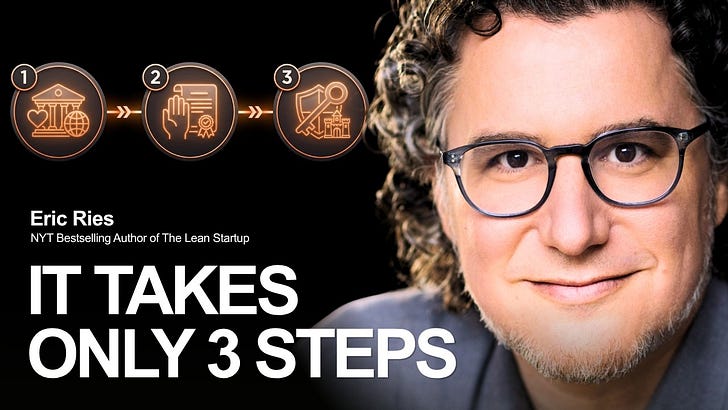
Eric Ries, creator of The Lean Startup and author of Incorruptible, joins us to explain why “financial gravity” pulls even the best companies away from their mission. He explains why the standard best practices founders are handed “are designed to make you lose control of your company.”
Eric published The Lean Startup 15 years ago and went on to found the Long-Term Stock Exchange. He co-founded the AI research lab Answer.AI and helped start Virgil, an AI-enabled law firm for early-stage companies. In his latest book, Incorruptible, he studies the companies that have resisted this force, from Costco to Novo Nordisk to Anthropic.
In our in-depth episode, we discuss:
* How the default “any lawful act or activity” clause in a Delaware charter quietly commits founders to maximizing shareholder value, and why lawyers rarely tell them
* The story of Sol Price, FedMart and the origins of Costco, and the “governance fortress” that has protected Costco’s $1.50 hot dog for 40 years
* The three mission protective provisions every founder can set up in a matter of weeks: becoming a PBC, adopting a director’s oath, and appointing a mission guardian
* The difference between a mission statement and a mission, and what Silicon Valley Bank’s charter revealed after its collapse
* Why “it’s always too early until it’s too late,” how to win over the roughly 25 people who must agree to a change, and why Anthropic’s Long-Term Benefit Trust has become a commercial advantage
Watch or listen now across YouTube, Apple Podcasts, Spotify, and X
Download the transcript 👇
Timestamps
(0:00) Meet Eric Ries(2:14) Eric’s New Book(3:30) How Startups Are Built Today(6:20) Why Companies Self-Destruct(16:37) Who’s to Blame When Companies Fail(21:25) The Blueprint for a High-Performing Company(26:52) How Companies Protect Themselves(33:13) Building Company Ethos and Structure(46:05) Why Companies Get Bullied(50:32) When Is It Too Late to Save a Company?(55:15) The Company Eric Would Have Saved(1:00:05) What Eric Is Excited About Next
Lessons from this episode with Eric
1. Why great companies are destroyed by financial gravityEric explains why blaming a greedy investor or a reckless founder misses the real cause of most corporate collapses.
* “There is a form of what I call financial gravity that operates on these companies. The ones that collapse, the ones that erupt in scandal, whether I’m talking about Boeing or FTX or Wells Fargo or Silicon Valley Bank, they’re all the same story.”
* He compares it to a submarine with a weak hull. Asking whether the water is to blame is the wrong question. The right question is who designed the submarine.
* Gravity acts on every company, yet some have lasted 50, 75 or even 500 years. Studying the ones that never collapse is how you learn to build differently.
2. How the firing of Sol Price led to the founding of CostcoSol Price capped his markups at 14% and treated customers as clients he owed a fiduciary duty to. His investors fought him for 20 years, then changed the locks on his office overnight.
* “It is so much easier to destroy than to create. They managed to destroy in seven years what had taken Sol more than 20 to build.”
* Within seven years of firing him, the investors had completely liquidated FedMart. Two weeks after his dismissal, Sol leased the office upstairs and started the Price Club, which later merged into Costco.
* Costco has survived for 40 years because of what Eric calls a governance fortress. That structure lets its directors act as a bulwark against Wall Street pressure.
3. The six words in your charter that hand your company to shareholdersMost founders have never read the first sentence of their own corporate charter. Eric says that sentence decides who the company really serves.
* “Since 1986 in the United States, whenever you see ‘any lawful act or activity,’ the courts have decided that actually means maximize shareholder value.”
* The phrase sounds open-ended. Legally, it makes your company a financial instrument whose job is to enrich shareholders.
* The same duty forced Twitter’s board to sue Elon to complete his deal. It also let Philip Morris take over an inhaled therapeutics company and destroy it.
4. Three mission protective provisions that take weeks, not yearsEric gives founders a short list of protections they can put in place early. Some take only days.
* “Welcome to best practices. They are designed to make you lose control of your company by force or by corruption.”
* First, become a public benefit corporation, a two-page filing in Delaware. Second, require every director to take an oath to protect the mission, much like the Hippocratic oath. Third, set up a mission guardian, such as a foundation or a purpose trust.
* Companies owned by an industrial foundation, such as Novo Nordisk, are five times more likely to reach year 50. Eric’s explanation: “Checks and balances work.”
5. A mission statement is not a missionEric’s own deposits were at Silicon Valley Bank when it collapsed. Afterwards, he looked up what the bank had legally committed to.
* “They had no mission at all. The whole thing was a scam.”
* The bank’s mission statement promised to move the innovation economy forward. Its charter said “any lawful act or activity.” Even if its interest rate bets had paid off, they would have done nothing for customers.
* His test: Google spends billions to make sure its quarterly reports are on time, while “Don’t be evil” was one sentence in the employee handbook. What a company invests in shows what it values.
6. It’s always too early until it’s too lateLawyers and investors often tell founders to deal with governance after product-market fit. Eric says that advice really means never.
* “In most companies, there are at most 25 people that need to consent to anything like this.”
* Veeva Systems became a public benefit corporation after it was already a $40 billion public company. It spent a year on investor relations and won 90% of the shareholder vote.
* Eric’s line for pitching a change to investors: “It is my judgment as the founder of this company that it is essential to our strategy that we win the trust of [some group].” Framing it this way forces people to say exactly what they object to.
7. Why ethics is an accelerantEric uses Anthropic to show that integrity can be a source of commercial strength.
* “People talk about ethics like it’s an impediment to business success, but here it is clearly an accelerant.”
* Anthropic is governed by the Long-Term Benefit Trust, which appoints directors to its for-profit board. Eric argues this structure is a big part of why enterprises trust it more than its competitors.
* Costco, Patagonia, Vanguard, Mondragon and Anthropic have different missions and cultures. The one thing they share is that each rejected the standard best practices for how a company should be structured.
Where to connect with us
Follow Ollie on X: https://x.com/ollieforsythFollow Eric on X: https://x.com/ericriesEric's new book - Incorruptible: https://www.incorruptible.co
Previous episodes include
See all previous episodes here 👉
Our partners:
Harmonic: Your go-to startup database. Visit Harmonic to learn more.
Prelint: Keeps every decision reviewed, recorded, and traceable. Head over to Prelint to learn more.
VCX: The public ticker for private tech. Head over to GetVCX.com to learn more.