 Ask ChatGPT

Recursive AI and “The Eureka Machine” thesis: AI will accelerate scientific discovery by expanding from scaling models to building scientific systems, especially in biology—moving toward virtual cells/tissues/twins to cure diseases. Aging is framed as the hardest ultimate medical challenge; near-term wins are expected in rare single-genome diseases (12–24 months), with broader disease/aging progress over decades. The episode also covers AI timelines, job disruption vs productivity, and China vs U.S. advantages (novelty vs scaling/manufacturing).
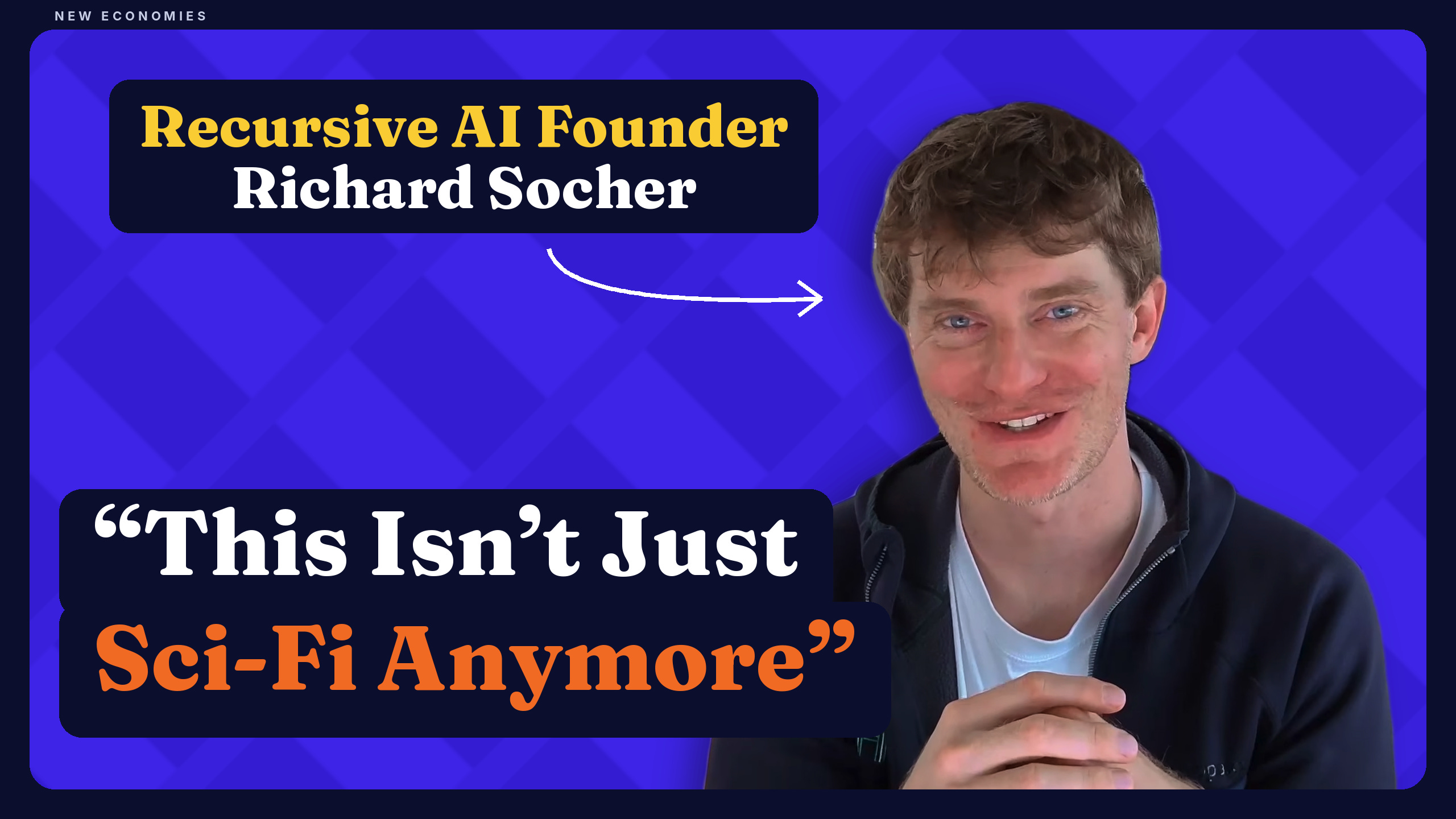
Richard Soker, founder of You.com and Recursive; scaled You.com to ~$1.5B valuation; raised ~$600M+ to build self-improving superintelligence; author of The Eureka Machine.
Biology lacks enough data for “large-model” breakthroughs like in NLP; virtual biology requires massive data collection and robotics-enabled data gathering. Clinical trials for aging will take decades due to multi-organ complexity and long-term risk bars. AI will make intelligence cheaper, enabling broader access to tools like personal assistants.
cures for rare genetic diseases; “babies cured” cases; HIV progress; protein language models; virtual cell/tissue/twin roadmap; Flint coding model (local, faster/more accurate; mixture-of-experts).
Written by AI. May contain mistakes.
Discussion on how AI will enable new treatments for diseases, especially aging.
“and what superintelligence unlocks next.”
Exploring the differences between U.S. and Chinese approaches to AI advancement.
“AI is in a state where we've developed enough things that now it's just about scaling them, making them faster, better, cheaper.”
Richard discusses his book and the potential of AI in scientific innovation.
“So you have just published your first book.”
The conversation revolves around AI's role in addressing significant human challenges.
“but I actually feel like it came out right at the right time.”
Discussing the potential of AI to cure genetic diseases and the progress made.
“Who gets to solve more math problems, more hard math problems before anyone else does?”
Exploring aging as a complex challenge in medicine and potential AI solutions.
“We were just chatting before we came online.”
Predicting how AI might impact longevity and the choices around living longer.
“But then aging is also incredibly hard because every organ in our body ages differently at different speeds and different people have varying aspects of it.”
Explores the multifaceted nature of aging and the challenges in drug development.
“So it's interesting when I'm talking to the really bullish people in AI, I'm usually the one who's like, actually it's going to take longer.”
Discusses how technology can create equality by making advancements accessible to everyone.
“But I'm cautiously optimistic that we'll get there in a few decades.”
Analyzes the economic implications of longevity drugs as they transition from expensive to affordable.
“Because if you just figure out one rare, uncommon disease and you cure it, or you help people stay alive for a little bit longer, that's a billion dollar plus company.”
Questions if AI development is progressing too quickly and the implications of that pace.
“Four years ago when GBT and all these AI models were just kind of emerging, we all thought this is going to be crazy, AI is going to take over our jobs.”
Examines how the benefits of AI and superintelligence may not be equally distributed across society.
“Do you think from a timeline perspective we are on a very short timeline for all of us and the ecosystem to be fully native to the superintelligence new era?”
Discusses the varying impact of AI on different industries and societal functions.
“Those will massively flourish or in some, depending on who you ask, like change or get disrupted or be destroyed.”
Learn how different cultures value craftsmanship amidst advancing AI technologies.
“all the things that came out of research.”
Explore how industries can adapt as AI changes job landscapes and skill requirements.
“There is still quite a large amount of people who still either don't just use AI, like the paid per hour workers.”
Discover potential opportunities for AI to enhance convenience in daily life.
“products that people ultimately want to buy?”
Understand how advancements in transportation technology may impact jobs and safety.
“And just like so much of this is about convenience, right?”
Learn about the hurdles faced by new startups in the AI landscape dominated by big companies.
“So I think the future is complicated and it requires a lot of foresight.”
Examine how big tech companies affect innovation and opportunities for smaller firms.
“Yeah, I wish I had a perfect answer for all industries and all software and stuff for that.”
Delve into the competitive landscape of AI development between China and the U.S.
“that like the boringness, the border like of certain industries are a mode too.”
Explore the impact of China's advancements in open source technology and soft power.
“Everyone is moving up and down the stack very quickly, and I think countries are going to try to do that too.”
Learn about the recently launched Flint coding model and its unique features.
“still on a laptop, like a beefy MacBook Pro.”
Understand the balance between speed and intelligence in AI model development.
“And this model is just the first artifact on our journey to this.”
Insights on managing consensus among multiple co-founders in a startup.
“Obviously, we also have quite substantial resources.”
Discuss strategies for managing time and focus while leading multiple companies.
“and suggests a certain amount of ownership and so on.”
Explore the challenges and synergies of running multiple companies simultaneously.
“and do the right things and have the right level of trust and control and management there.”
Predictions on AI advancements and their implications for health and society.
“on just like making sure people feel like this is still like everything is important like you love your children and equally to some degree.”
Explore the potential advancements and societal impacts of AI technology.
“And that will be, I think, interesting and exciting.”
Discuss the need for positive storytelling around AI to inspire future generations.
“Like they're asking the heartthrobs in soap operas to also be an engineer from time to time who's a little bit awkward, but can still be kind of good looking and nice.”

Get the gist, explore an idea or ask about something said.
 Claude
On BIG IDEAS BY NEW ECONOMIES, what are the key points of this episode?
Searching your listeningAutomatic transcript. May contain errors.
0:00This isn't just sci-fi anymore. This will happen. Single genome are kinds of diseases that will be curable in the next 12 to 24 months. And the time is ripe to actually expand the use of AI into the sciences. I think the ultimate final enemy in medicine will be aging. But that will take a while to arrive in biology because unlike the Internet, we have not collected enough biology data. But once we have enough data, that is absolutely possible. Is this 12 to 18 months away for this to actually start happening? This is Richard Soker, founder of You.com and Recursive. He's scaled You.com into a$1.5 billion valuation and has just raised over$600 million to build self-improving superintelligence.
0:44And now he's breaking down how AI is cracking the biggest bottlenecks in biology and what superintelligence unlocks next. A lot of people think the future is kind of this prediction exercise, but it's often a construction exercise. We need to actually build these things. And so we need to collect a lot more data to be able to build, for instance, a complete virtual cell, then a virtual tissue, and then a fully sort of virtual twin of multi-organ systems and ultimately like full people. And that is just not possible right now. But like, I'm cautiously optimistic that we'll get there in a few decades.
1:16AI is in a state where we've developed enough things that now it's just about scaling them, making them faster, better, cheaper. And that is something that China is very good at. It's very obvious that the U.S. is better at coming up with truly novel ideas and really pushing the frontier. China is better at taking ideas from the West and making them faster, better, cheaper and manufacturing more quickly. And so they're doing like better marketing for the future in China. And I think that's something that we need more of in the West. Who do you think is going to win in this AI race, China or the U.S.?
1:47Yeah, so welcome to New Economies.
2:03Richard, welcome to New Economies. Thank you so much for joining us. Thanks for having me. Excited to chat. So you have just published your first book. What is the biggest opportunity we are having right now when so much is happening in AI? You know, you talk a lot about the biology side of things and what that can do for the future of humanity. What is the book all about and why did you decide to write it now? The book is called The Eureka Machine. It's about how AI will usher in this new era of scientific discoveries. In many ways, people think of AI as this potential disruptive force that could automate or replace or enhance different kinds of jobs.
2:52But I think the most interesting thing humanity has done with our intellect is understanding our past and modifying our future through inventions and better theories and better explanations. And so I think when we invent new technologies, it usually creates a lot of jobs. We can, of course, lament all the people like carrying and selling candles, but we can also acknowledge that electricity has brought in more jobs than candle industry and fire and coal industry and so on has had. And so I think there is just a ton of potential. And so in the book, I'm going through basically from the micro and physics, chemistry, biology, to neuroscience, understanding our brain better finally, to economics and to astrophysics.
3:43And so I think that is one of the biggest opportunities. And the reason I wrote it was partially personal. I just had a lot of pent-up energy thinking about superintelligence that I wanted to channel and spend a lot of my nights and weekends on. And then part of it was also that it felt to me like the field of AI was a little bit stuck in just saying, oh, we're just going to take this and use more internet data and scale up these existing models. when I think the time was ripe to actually expand the use of AI into the sciences. And first, I was worried that the book was going to be too slow, but I actually feel like it came out right at the right time.
4:23So I did have to rewrite several chapters from someone should build a virtual cell to the Chan Zuckerberg Foundation started a virtual cell. And so some of the ideas that would have been very novel when I started writing a book two and a half years ago and even more novel when I finished it a year ago and submitted it to the publisher, like, are not as novel anymore. But still, I think very timely. When you were writing The Yuga Machine or you initially had the idea, that's all like, why did it take you so long? I mean, I know AI is changing so quickly, but, you know, a couple of years to write a book is like pretty long.
4:59Yeah, I mean, I'm not an author. You know, I mostly run companies and a venture fund. And so it was just like the occasional nights and many weekends, but sometimes I would have to work on weekends too. So it's also not every weekend and so on. So it's just a passion project in many ways. And that's why it took so long. When you're describing AI as potentially the key unlock for this whole abundance of opportunities we have, especially creating and solving problems for diseases, when you were writing a book, was anything that you learned that became very, your thesis was very clear around, actually, this is like a potential huge opportunity.
5:40In many ways, there are abundant opportunities in every field right now. I actually love the fact that right now, so many people are charging hard after who gets to solve hard, meaty problems for humanity first. You know, and in some ways there's this joke, it's like that very sort of successful people say, the only thing worse than me saving the world is other people saving the world faster or better than I do or something silly like that. But it is a bit of a race. Who gets to solve more math problems, more hard math problems before anyone else does? Which AI model can do that? Or I think there will be a race to curing all the meaty and interesting and important and hard and debilitating diseases out there.
6:25And so that, I think, is a major opportunity. But then, of course, if you really improve fusion, if you really build much, much cheaper batteries to store energy, if you can harness energy way more efficiently from way more sources, fission or fusion, and then solar panel chemistry and all of these things, I think there's also a lot there. But biology just has this sort of built-in mechanism where if you develop an interesting molecule, you can also make a lot of money. And sometimes in the past, I used to struggle with this. Like, why should medicine make people that wealthy? But then in many ways, you want more smart people to be attracted to medicine, no matter why and how.
7:09Ideally, just to help humanity. But in practice, if you make a lot of money in it and you have a lot of smart kids from Princeton, Harvard and so on, they need to pay off their student debts. They're just going to go in high paying jobs that used to be consulting. And now it's really AI and startup tech and so on, big tech. but I'd rather have more people go into medicine because they make more money. Why should people selling ads make more money than people curing diseases? So in many ways, I'm excited for AI kind of really making incredible progress. And this isn't just hypothetical. Sure, cancer is a particularly tricky set of diseases, but there are certain diseases, for instance, single genome kinds of diseases that will be curable in the next 12 to 24 months.
7:54and those have fewer people. But in aggregate, there are actually a lot of people who have individually different rare diseases that are often based on one single genome having been wrong in their DNA, and that can become fixable. So I think this isn't just sci-fi anymore. This will happen. And this was also about AI, right? We were just chatting before we came online. AI is moving so fast. People are concerned it's going to change jobs forever. That's true. But people who have some form of disease I think they're probably super excited about the opportunity that's unlocked, right? Because they want some form of cure for these diseases that are happening in the world.
8:33Have there been any diseases that you've been surprised about that have started to be cured? And where do you think we are on that timeline for that to become fully unlocked? Yeah, so rare genetic diseases, I know several people are working on and have already cures that they're being submitted and so on. So those are the most common ones. that I think have a fix and a way to deliver the fix and so on to people. And we have seen some first versions where babies were born with a genetic disease that would have not helped them or would have prevented them from leading long, healthy lives were cured.
9:13And I think we'll see a little more of that. I think that would be the first set. And then HIV made a lot of progress already without AI. It used to be a death sentence. And, you know, for some countries, it was like 50 % of all their deaths were from HIV. Already, there are a lot of ways to improve it. But HIV is such a tricky disease is probably going to take longer than many others. Is there a disease that you think is going to be just very hard to solve with the current technology advancements that are currently available? I think the ultimate sort of final enemy in medicine will be aging.
9:55And I think in the next few decades, as we cure more and more diseases, which will require us to collect more and more data so that biology can learn the bitter lesson that we've learned in natural language processing, where a lot of times people are like, you have no idea about how complex biology is. and I fully acknowledge how complex biology is, but language is pretty complicated too. And if you asked all the experts in natural language processing 10, 20 years ago, if we have one model you can just have any conversation with and I'll just always give you a reasonable answer and help you work through any problem and do all your homework and so on, I would have been like, no, that language is too complex.
10:33You have no idea how language works and blah, blah. And I happened to study a lot of linguistics and I did know a lot of things, but I also knew that indeed I could never manually write out all the rules as an expert of doing that. And so that is what we're seeing now. But that bitter lesson of large models with a lot of data, being able to learn incredibly complex things will take a while to arrive in biology because unlike the internet, we have not collected enough biology data just sort of naturally and billions of people kind of collaborating on that. But once we have enough data, then we will be able to cure more and more diseases.
11:08And then I think the ultimate hardest one will arrive at the end that will get us all is aging. But then aging is also incredibly hard because every organ in our body ages differently at different speeds and different people have varying aspects of it. There's a lot of lifestyle factors that come in and so on. So that will probably be the hardest one. So here's a world question. if you weren't building your companies and you wanted to solve aging, is there a particular area of focus you would like to really double down on to maybe help us all live longer? Are we going to be in the world in 50, 60, 100 years where we all live past 100?
11:51Maybe we start living to 120. This is just crazy, right? But maybe is this going to be available and possible in the future? Yeah, I mean, generally, life expectancy has improved already massively. And so I think we'll continue seeing that trend. I think there is a built in mechanism where many people also lose the will to live. And I think you need to have a special mindset to even want to live beyond a certain time and keep fixing, like working on really hard health issues that arise as you get older. but if you have the will to live, I think, I hopefully think it'll become more and more of a choice for how long you want to live and can sort of in a healthy way.
12:32Obviously no one wants to be like a vegetable for another 50 years or just like vegetate and bed. But like, I think that that is absolutely possible. At the same time, you know, the future, a lot of people think the future is kind of this prediction exercise, but it's often a construction exercise. We need to actually build these things. And so if I was to do something else, it would probably try to help in automating the data collection that will then allow AI to actually get a virtual cell model, for instance, because anything we can model, simulate, or verify quickly and efficiently in a computer will be able to allow AI to then experiment very large scales.
13:10And so that is just not possible right now. We don't have enough data that we've collected in biology. We did collect a lot of proteins, and so we're able to build a language model for proteins. And now we can generate new kinds of proteins that have certain antibacterial properties and so on. I think we need to collect a lot more data to be able to build, for instance, a complete virtual cell and then a virtual tissue and then a fully sort of virtual twin of multi-organ systems and ultimately like full people. And I think there are a lot of exciting mixtures of robotics and biology companies that are going to be possible and necessary in the next few years.
13:52Do you think we are on a very short timeline for this to become possible? Is this 12 to 18 months away for this to actually start happening? No, unfortunately. So it's interesting when I'm talking to the really bullish people in AI, I'm usually the one who's like, actually it's going to take longer. But compared to the normal people, I'm extremely optimistic at the same time. But the problem with biology is that even let's say we had this magical molecule that our AI told us with very high accuracy is probably going to cure like, there's no single aging, right? Aging is this like multi-organ process and your eyes age differently to your hair and to your like liver and your kidney and your heart and like your bones and your skin and all these different things, right?
14:39They're all aged differently. So let's assume we have like 10 different molecules that would help reverse aging or reduce aging in 10 different organs. you'd still have to go through clinical trials. And so those clinical trials, just by virtue of the FDA and so on, take several years. And then you want to know long-term risks, especially if you want to think about taking drugs for healthy people. The interesting thing is the bar is obviously lower if there's a drug, and without the drug, you're in late stage lung cancer, and you're going to die in three months. So if the drug gives you sort of 10 years later another cancer, you just don't care because you'd be dead anyway without the drug, right?
15:24And so you could take a certain medication if you're really, really sick already, even if it has bad long-term consequences. But for aging, if you were to take a drug when you're healthy, the bar is even higher. So you'd want to have very long-term studies to really rule out all the complexities. And it will take a while for your eye to have enough data to be able to make all of those predictions. So it will take a few decades to really cure all the diseases and all of aging and all of that. But I'm cautiously optimistic that we'll get there in a few decades. And there's also the other side, right?
15:59You mentioned that around the consumers being a little bit conscious about taking these drugs, which are yet to be fully proven. But then there's also the medical professors, right? The doctors and professors, people who study this stuff all the time. They don't even know the consequences yet. there's obviously a huge cost production to this, especially for the consumers. If it's a very expensive drug, if it's around helping you live slightly longer, if you've got lung cancer, which you alluded to, this is going to potentially be super expensive. It's interesting. I feel like everyone across the political spectrum could and should be pro-technology scaling because as technology scales, it makes the world more equal.
16:43It used to be that certain people could afford communication devices, right? Like the first big brick cell phones, like they're just like old school ads and only like the really fancy, expensive managers could carry their big brick phones. Now, whether you're a billionaire or a normal middle class teenager, you can afford pretty much the same iPhone. It's actually kind of incredible if you think about it. Like, what are other goods and services that currently only billionaires have access to? It's personalized healthcare advice. It's a personal assistant. It's a personal tutor for your kids. These are all expensive and there's a bottleneck on intelligence.
17:25As we make intelligence cheaper and cheaper, more and more people will have access to those things. And that should be an aspiration for, I think, anyone on the political spectrum. So yes, I think if you just have a new longevity drug out, probably in the first few years, it's going to be very expensive. And then if there's enough demand for it, and this is probably if there was a longevity drug, the single most, you would be a multi-trillion dollar company if you just figure that out. Because if you just figure out one rare, uncommon disease and you cure it, or you help people stay alive for a little bit longer, that's a billion dollar plus company.
18:00So if you could have one drug that has basically everyone on the planet be a potential user or customer of it, it would be extremely valuable. But initially, it would be quite expensive. And then it scales and the patents for medications will run out. And then there will be normal generic versions of that drug. And then you basically will give more and more people access to it. And that's been the case for almost all different technologies. Once we can scale, more people will get access to it. So I'm not too worried. It's obviously something that once we make a technological breakthrough, we should try and do our best as a company or as a society really to then distribute those benefits to everyone.
18:49But I think sometimes some people want to sort of not have anyone benefit from it because not everyone can benefit from it right away. And I feel like that's clearly not how technology and progress works either. If we look at the progress just in the last two years, what the ecosystem has developed is pretty insane. Now we're talking about superintelligence. Four years ago when GBT and all these AI models were just kind of emerging, we all thought this is going to be crazy, AI is going to take over our jobs. And now if we just look at the progression, it's been incredible and insane to see, right?
19:26Do you think, though, we are moving too quickly? And to highlight for the audience, a few weeks ago, Dario, Elon, and Sam from OpenAI, they all kind of came to the conclusion and alluded to around, we are moving too quickly, we need to slow down. Do you think we are moving too quickly? And how would you like to see things slow down, if so? I think if my agents and my company was committing a lot of felony charges, I would probably say, hey, guys, we, as in my company, are moving too quickly and we need to rein this in and make it work better and safer and aligned with our values and not reward hack.
20:10But to extrapolate from two companies' failures to develop things well, which is bad, but also has not really hurt anyone, really. Not all felony charges are the same. And in these cases, no one really got charged with anything because there was not really any damage. Hugging Face was like, that was bad, but it's just weird. They aren't like, oh my God. But Hugging Face had this major issue and we lost billions of dollars of revenue or any revenue, really. So they were sort of bad, but clearly not bad enough for anyone to get sued over it. And so to then say the whole community in the world should pause is, one, highly unrealistic.
21:02I don't think there's a worldwide government that has control over every single person's GPUs. And also, obviously, if they wanted to slow down, they could have slowed down, but then they just released more better models the next week. And so it's a little bit unclear what they really mean by a slowdown, and it's mostly probably other people should slow down so they can keep a pole position. It seems more like what they're trying to accomplish, same way as many trying to outlaw open source, because that also is not good for their business model. Do you think from a timeline perspective we are on a very short timeline for all of us and the ecosystem to be fully native to the superintelligence new era?
21:48There's a lot to unpack there and trying to define timelines and what kinds of timelines and for which kinds of industries and so on. I think in many ways the future is already here but it's not equally distributed as the famous saying and that is true for a lot of things in automation and intelligence. Like there are already people who run their like companies with just a ton of agents. And there are also still people sending fax machines, sending fax machines and sending actual faxes, right? Like to each other. There are also people who still do manual labor on the planet and work with like cows, like pulling, you know, carts and stuff like in some countries of the world.
22:25And so, you know, the, like, I think when people have this like sort of hard takeoff scenario in mind, they're often a little too optimistic. And then sometimes that optimism can also switch over to extreme pessimism. If you think next year you need no more radiologists, no one should study radiology anymore, and AI will do every single job, then maybe from that, it's kind of the horseshoe theory of politics, but maybe apply it to AI. Maybe someone should come up with the horseshoe theory of AI optimism and dumerism. it's maybe closer to one another, then you're also very worried all of a sudden that maybe AI could kill us all the next day after it took all our jobs.
23:08But the truth is that even as an extremely optimistic AI researcher and entrepreneur, you have to be realistic about not every industry will massively benefit from 1 ,000x cheaper intelligence. People will still want to travel. And sure, travel will be more efficient in terms of organizing your trips and finding interesting locations and finding cheaper flights and having a personal assistant, which I predicted over the last few years. And now I think with news and others, that is coming more and more to fruition. But people still want to see the pyramids in person, whether AI could generate an image of the pyramids or not.
23:48It doesn't fundamentally change. Travel is not going to 1000x because of cheaper intelligence. A cow isn't going to magically make 1 ,000x more milk because of more intelligence. You're not going to grow wheat 1 ,000x faster in fields. You're not going to change the luxury handbag status symboling of luxury goods by 1 ,000x. People, whether AI is amazing or not, want to show that I can afford this expensive handbag, even though an AI could maybe 3D print a similar kind of object better and better. They want the original, they want a status symbol, and the AI is not going to change it. So there are lots of different industries inside the GDP that will, to the most bullish AI people, be surprisingly unchanged or just changed in the periphery.
24:37And so then, of course, there are major industries and the industries that do require more and more intelligence. Those will massively flourish or in some, depending on who you ask, like change or get disrupted or be destroyed. But I would argue that computing or math is just going to sit at a much higher level of abstraction and people will be able to ultimately get more done. And then you ask again, coming to your first question, which industry do people love getting the most done? And it's research because it's not zero sum. It's not about replacing jobs, but creating new inventions, finding new explanations for different phenomena.
25:15And that has progressed humanity forward more than anything else we've done. When we do look at this like super intelligence, I agree, you know, you're still going to want your luxury handbag. You're still going to want to go to, you know, on nice holidays and buy your house and so on. But you want to become a lot more productive. And I think if you look at just like the timeline, what we have had in the last few years on just how more productive we are and the opportunity for us to become wealthier, I think is huge. When we do look at that timeline from a productivity standpoint, all of us want to become wealthier, right?
25:48What are some of those huge unlocking opportunities that you think superintelligence will have for us to become part of our ecosystem? I think in the best scenario for the future, AI can become a strong force for entrepreneurship. Because if you care about just producing more outputs per unit of time that you work, you love AI. and if you own some equity in that increased output you also love AI and so every entrepreneur who just cares about making their company successful loves AI because it's just more likely you can get more done you are much more productive if you're just getting paid by the hour and you have no equity in making things faster, better, cheaper then AI is just eventually probably going to come after whatever data you're producing and your job.
26:46And so I think we need to teach people more entrepreneurship and we need to enable them to participate in this new kind of market and these new kinds of economics. That is how everyone can and should participate in that. Now, the only industry where I think there are maybe two industries I can think of where most people agree that the output of that industry is what matters. No one wants to go into a hospital and say, oh, you know, it'd be great if there are 10 more administrative assistants in this hospital, so I can pay 10x more on my medical bill, and we can have more jobs in medicine. Most people will just be like, actually, I just want to be in the hospital for as short as possible, and be as healthy as possible afterwards, and pay as little as possible.
27:31And the vast majority of people agree that that is the goal for medicine, and hence sort of the upstream tasks of biological research, which leads me to another industry, which is general sort of research and development of new technologies. Most people don't say, you know, it'd be great if we had thousands more of PhD students and even more professors and like 100x the universities. I think that would be amazing. But like most normal people would just be like, but they do love a good innovation. They love that they have electricity now and they love to have ACs and heaters and the internet and like all the things that came out of research.
28:05People do appreciate all their new abilities and luxuries that technology could afford them. And so that, to me, makes those two industries particularly well-suited for everyone to be able to get behind AI. And it also, again, is up to us to actually work on those two industries so that people can see the benefit. If you're enjoying today's episode, hit subscribe at the bottom of your screen. The guests on the show are getting bigger and bigger, and we need your help to grow this channel. So if you're enjoying today's guests or any previous episodes, hit subscribe and I promise you it'll be worth it.
28:44Now back to today's episode. There is still quite a large amount of people who still either don't just use AI, like the paid per hour workers. They're all amazing. They all want to just earn a living and do what they like. But if AI does ultimately come after what they are good at, What advice would you have for those people who get paid by the hour? I mean, obviously, hourly jobs are very broad, right? Like there are a lot of different jobs and some require you to be in school for eight years. And if you want to be like a brain surgeon, right, and others don't require any degree. And some countries also have different standards for them.
29:31Like in Germany, becoming a construction worker does require a degree. and becoming an electrician and a plumber and so on. They have, you know, different mindset. Japanese are even further on that where if you're in construction worker or in pottery or whatever, it might be a handicraft. People have a very strong sense of perfecting their craft. Even though some people might think of this as like a boring medial job, they still take pride in craftsmanship. In Japan, it seems like across many different industries, And that might be a good path for the future too. The Japanese are more pro robots.
30:08There's a lot of complexity, I guess, with immigration and so on and an aging society. But they are generally pro robots, but they still love craftsmanship and they still love handmade things. And I think handmade will continue to be a thing. Sure, we already see this, right? You could have a sweater that's just made automatically with weaving machines. And you can have pottery that is just automatically made. People love handmade pottery things like bowls and stuff. And so there's all these things that will stay. I think in terms of general advice is think about your industry. Think about what are the bottlenecks that your industry faces that are due to intelligence being extremely expensive and knowing that intelligence will get cheaper.
30:58how could you then unlock those bottlenecks in your industry and find clever ways of building products that people ultimately want to buy? I think depending on the age, I understand that that's harder and harder. If you're just before retirement by a few years, you might not have the energy or desire or so on to learn a job. I do think depending on the industry and the country and their ability to have a surplus and to build social systems. I think it's up to countries to some degree to help their population in learning new skills. And, you know, Germany, there's a thing called Volkshochschule, like the people's higher ed, like sort of university where you can, even after you, you know, like had a job for many years, you can still learn new kinds of skills there.
31:52I think that will be a thing. And then again, there are jobs that I think are going to be immune to AI in entertainment. I think entertainment, people could see AI do all the sports and probably I could come up with some crazy mechanism to just shoot a soccer ball faster than the speed of sound into some goal a mile away, but it's not going to be that interesting. People are going to want to see other people doing sports and perfecting their craft in that way. So entertainment, sports, travel, all these things will continue to exist. Luxury stuff will continue to exist. And then even in SaaS and in software, there would be pockets that were somewhat immune to AI.
32:32Any software that has a marketplace or some other kind of network effect is very hard to vibe code into existence. Sure, you can vibe code an Instagram app, but then it's just you and a couple of your friends on it, not a billion other people. And then you have brands and data modes that will continue to exist. So I'll pause there and I could talk about hours for how different jobs will be impacted and what hourly workers can do in different industries and how to think about it. And just like so much of this is about convenience, right? You know, in this kind of ecosystem, we talk to all these people every day.
33:08You know, if you look at just like an SF with Waymos now, you know, you no longer need the driver behind the car. This is going to be replicated across farming. I think farmers don't want to spend hours cutting their crops, sitting behind a tractor. You can have machines do that for you now. The same with trucking. And that's just one industry, right? Where do you see the biggest opportunities for superintelligence outside of research to make the lives of us consumers just so much more enjoyable and convenient? Okay, so in terms of enjoyable and convenience, I think the trick to predict the future is to look at wealthy people again.
33:46and just see what the goods and services are that they have access to that are bottlenecked on intelligence and hence are going to be accessible for everyone. I think a personal assistant is something like that. I've mentioned for the last few years when asked this question, and we're now seeing it. I think Muse is becoming like a personal assistant. I think there'll be many others. There are lots of startups that are working on that, and I think DOTS or DOT from OpenAI. You'll see more and more sort of proactive assistants. Those eventually will be connected to robots, And then, you know, people will come home to a clean apartment.
34:18There's, you know, kind of takes kind of take a while. Everything in hardware is slower and wetware is even slower. But I think life will be more enjoyable once everyone can afford a personal assistant. And then you're right. Like the interesting bit with self-driving is, and this is like tough to describe or explain too, but like not every objective improvement for humanity is always good for jobs. There are a lot of jobs that are dependent on people having accidents. There are the people who tow away the broken cars from the highway. There are the people in the emergency room working from all the traffic deaths and maimings and injuries and so on.
34:57There are the injury lawyers who then can help and try to sue someone over a fender bender. And there are the car mechanics jobs. I mean, there's so many jobs that depend on people hurting themselves in traffic. and with cars that they might hate AI again. But most people should agree that it's better if there are fewer accidents and fewer teenagers dying and so on in cars. So I think the future is complicated and it requires a lot of foresight. And then in many cases, different stakeholders collaborating as the job landscape changes. You just mentioned news and thoughts. you know meta hasn't really changed in five ten years from like a grand scheme of things do you think if meta didn't release muse or some form of agent do you think it would still be relevant what do you think about that kind of you know opportunity i mean you have to give it to meta i guess like sure people use facebook less than less now but they use instagram a ton right like So there are, like they, and WhatsApp, people use WhatsApp a lot.
36:07So there are, you know, they stay extremely relevant through some of those acquisitions. And then Muse was developed in-house. So that's been really impressive too. And when we're looking at like so many, you know, opportunities with founders, if it's, you know, building new agents or you look at the likes of all these AI models are doing, I kind of feel sorry for a lot of these early stage founders. they want to build a note-taking tool app or an agent that Muse now does and one of these large companies with massive distribution can copy them overnight. What is the role these large companies have in creating technologies but also allowing these amazing founders, which we both speak to on a daily basis, very early stage founders, to actually go and create the thing that they want to do and have a chance of also becoming the next metas and open AIs?
36:59Yeah, I wish I had a perfect answer for all industries and all software and stuff for that. But I don't think, I mean, these big companies are going to try to maximize their profits. That's partially their job. And it is easier now to build something, but it's also easier to copy whatever someone's built. And now with decompiling, even other software that was compiled like Photoshop and people used to buy can just be decompiled, re-implemented by an AI, and then boom, all the features are there and you have a much cheaper free version of it. I think it's kind of like, in a weird way, I think China has kind of shown the future there because in China, labor has been so cheap for so long that China never developed a deep SaaS ecosystem.
37:43If you are going to spend like a couple million dollars on a software, you just hire a couple people for like 10 ,000 bucks a year and have them re-implement that software. And so now the US kind of catches up to China where it's so cheap to build things, not because we have more people and they're getting paid less, but because they were so expensive, we have now AI that builds it. And so there's a lot of things where that can be true for manufacturing too. It was too expensive to do in the US, so a lot of manufacturing moved overseas. Now with robots, it might become cheap enough to then come back to the US.
38:21And in some ways, international trade is a force for peace, but it's also good, I guess, to be able to manufacture things everywhere you want them to. And so I don't know if I have a perfect answer for every startup and how they need to react to this. But I think generally, again, network effects, brand marketing, and data modes are continuing to be powerful. And then there's also a funny mode that I would call the mode of boring. I don't know, maybe I need to come up with a better name, but the boredom mode, where people at Anthropic are not that excited about automating taxes. It doesn't feel like, oh, we're one step closer to AGI because we automated taxes, right?
39:05It feels cool when you can say, oh, I proved this theorem and it's unproven for a decade or longer. But it doesn't seem that cool to be like, oh, in Alabama, you're like this income tax, blah, blah, blah. We found this reward hack niche where it's just like solve this like zero tax problem better. And so my hunch is that kind of, that like the boringness, the border like of certain industries are a mode too. There's not enough people want to get into that. So that is another way to get away from these really large model companies. And then I think, you know, in some ways, if you can build in a niche that is true, that's kind of standard startup stuff, right?
39:49You find a niche that is too small for people to care about, but then somehow you're able to grow very quickly from that niche such that it's hard for other companies to catch up. And I think that's what is still possible in lots of different pockets of software. From a Geo standpoint, I feel the US has always been far ahead in what AI can accomplish. Now we're obviously seeing a lot happening in China and a few other countries. When you compare China and the U.S. together, we're going to probably get some hate in the comments, but this is okay. Who do you think is going to win in this AI race, China or the U.S.?
40:29I mean, it's very obvious that the U.S. is better at coming up with truly novel ideas and really pushing the frontier. Arguably, AI is also in a state where we've developed enough things and enough innovations and ideas that now it's just about scaling them, making them faster, better, cheaper. And that is something that China is very good at, taking ideas from the West and making them faster, better, cheaper and manufacturing more quickly. And so that's one aspect of it. Of course, intelligence is a very large concept. We can go into how to define it. But at a high level, it has many different spaces of intelligence.
41:09And it's also arguably like China is better at physical manifestations, like robots than any other country right now, certainly in manufacturing them at scale. But the robots need the brains. So a lot of times right now, people feel like the brains of the robots are going to come out of Silicon Valley, but the physical robots and drones and whatnot will come out of China at scale. So that there's hopefully a lot of good collaboration and practice, you know, probably a lot of competition. And right now it seems like all the country, all the companies are moving up and down the stack. If you're a model company, you're building up the stack more and more real end-user software products on top.
41:56If you're a cloud, you want to build a model and inference. If you're an inference provider, you want to own some of your own GPUs and build your own compute substrates like the big ones like Microsoft and OpenAI and so on. Everyone is moving up and down the stack very quickly, and I think countries are going to try to do that too. Obviously, China is ahead when it comes to open source. We're going to change that. I don't know when this podcast will come out, but hopefully it'll come out after we've already released a model that is optimal in its class. And it's the best model and better than any Chinese model in its class.
42:26And so we're very excited about that. But yeah, in general, China has pushed open source a lot, which is kind of similar to Hollywood. It's a lot of soft power over the world because you can basically nudge people in certain directions on how you want them to think. And that soft power is something that the U.S. is currently retreating from in the world stage. But China is like massively stepping into that role. And trading is obviously continues to be a really important aspect to everything. And so I don't know if I have a definitive answer of who will win the iRace. I also don't think as long as you do something i, I don't think it's a winner take all.
43:05And certainly if there's open source, then that, again, equalizes a lot of the access. capabilities and potential in different regions to participate with AI. You just mentioned one of your latest models. What can users be expecting? About two weeks ago, we released Flint, which is the best coding model that people can run still on a laptop, like a beefy MacBook Pro. And we're really excited about it because it's much faster and more accurate than any other model in this class, like mixture of experts that are fast and run locally on lots of different machines. And that basically enables everyone to be able to have an AI that can code all kinds of projects for them.
43:48So this is just our first model, but we think it's a really important step in the direction of more people having access to this technology and have kind kind of unmetered and fully private AI. When you guys were thinking about launching Flint, there are so many coding agents already available. Do we really need another coding agent? I mean, this would have been a question you and your team would have been thinking about, right? Do we need another one? And how do you really define becoming that number one player, ideally? Yeah, so you can define this based on a ton of different benchmarks. And then you can kind of look at, on the y-axis, the average score on all the benchmarks and on the x-axis just how fast the models can actually produce something because obviously if you had a super fat amazing model but it only produces like one token per second you'd have to wait a year before it would program like a simple like app or website for you so you want it to be fast but then the faster it is usually the less smart it is and And then on local machines especially, it's such a trade-off where the top models are just not that useful yet.
44:59And we felt like we could push them just beyond that stage where they're actually useful enough to be a daily driver to be able to do a lot of things. And then, of course, because AI is code and now AI can code, this is also a really important milestone for us towards full recursive self-improving superintelligence. intelligence. And this model is just the first artifact on our journey to this. And what was beautiful here is that we've done that entire model in just a few months, like three and a half months or so from scratch. We've never had a model, like never developed a model. The company just started earlier this year and we worked on like other things before that.
45:38And so it was just in some ways a showcase also of what our Eureka machine can do and sort of our version of, you know, the full Eureka machine I described in the book. Wow, in three months, this is what you've created. Yeah, from scratch. And so if you think now from standing start to full, like now we're running up and running, you'll see that the amount of intelligence per dollar that people will have access to is going to continue to go up. It's going to be pretty amazing. When you think about launching tools, just a curious question, does it matter? Does it have to be 100 % perfect? to build this type of tool in three months is awesome.
46:20But also I'm sure there are things you still need to fix, right? Can founders just launch and build and ship fast and just put something out and see what users actually think? Can founders do that? Yeah, of course. I mean, we're doing it. Existence proof exists. Obviously, we also have quite substantial resources. We raised$670 million. We had access to tiny amounts of compute compared to the big guys, but lots of compute compared to an individual hobbyist. And so that was important because it wasn't just us doing it. We had to have an incredible team of really, really smart researchers and engineers that we assembled at Recursive.
47:04But it's still a fairly small team. And so the majority of the inventions and so on came from them working with the Eureka machine that then automated the ideation, implementation, and validation of all these different ideas that led to this model being faster and better and still. that come out with your laptop. This is your latest company, Recursive. You mentioned over$600 million raised. You have an incredible roster of co-founders. Everyone from Google DeepMind, all of the amazing AI companies we hear about on a daily basis. When you have so many co-founders, how do you all come to a consensus to agree with each other?
47:45I just had Lin Xiao, she's the co-founder of Fireworks on the show, who also has six, seven co-founders. that's a lot of co-founders to work alongside, which is awesome because of how fast AI is moving. But at some point, you've also just got to all come to a sensible conclusion on, we both would agree, right? Yes. Co-founders, in some ways, the co-founder title does not mean you're automatically a board member. You don't have to automatically equal votes. And if you have eight now, you could be in a deadlock of 4v4 or anything like that. So we still have a CEO of me. And as such, we also have a board.
48:27Not all the co-founders are on the board and all of that. So a company could have 1 ,000 co-founders, but 999 of them are just individual contributors. So in some ways, it's a title that obviously carries a certain weight and suggests a certain amount of ownership and so on. and impact on the organization that you assume those people have. And we're certainly seeing co-founders having incredible impact on the organization, but they all have different qualities and also knowledge that they contribute. You raised this mega round$500 million earlier this year. How long did that round take you? I guess it depends on how you define.
49:16and there's not an official you shoot the gun and everyone starts sprinting. There's just conversations here and there and then you're like, oh, you know, and then we add another co-founder and they're like, oh, do we restart the clock now? But I don't know, a few weeks. That's insane. When you think about managing your time, you're building you.com, which is actually how I first initially heard about you guys four or five years ago when this whole generative AI ecosystem was coming together, you.com was initially such and then obviously now, your latest company and you've got your funds. How do you think about just managing your time when building three different companies?
49:55It helps to work a lot, like 80, 100 hour work weeks. So you can squeeze in a lot. Also, it is extremely important to work on what really matters. Thinking about the bottlenecks, sometimes the dumpster fires, sometimes just the most important things for each organization. And then it's extremely, I think, important to be motivated and excited about what you're building, which I am. Surround yourself with the people, understand your strengths and weaknesses and find people and hire people for your weaknesses. and then give them also enough freedom to have the right impact and do the right things and have the right level of trust and control and management there.
50:39And when you really surround yourself with incredible people, it gets a little bit easier. How do you navigate putting out those dumpster fires? Yeah, not too many dumpster fires. I mean, part of it is you don't get the license to do that if everything was a dumpster fire. things have to be in a pretty good state for your board to be like, okay, we're okay with you doing something else. And so things are going well. And then, again, mostly I said important issues and just as the occasional dumpster fire. But at a high level, you just start spending a lot more time on it. You start double-clicking into all the details.
51:17And then you collect all the data, get all the advice, and you make a decision, and then you fix it and you move on. in some ways that's a sort of at that level for all the different kinds of issues that come up with is kind of how you have to approach it but yeah they're all kinds of different people issues, technology issues go to market issues and each of them have lots of interesting different facets to how you solve them As founders we get told every day just focus on one thing and do it really well but then you see the likes of you've got Elon Musk who's doing 9-10 different companies And should founders, if they are capable of doing so, obviously it takes a different skill set, if they can work on one or two projects at the same time, should they?
52:03It's interesting. In a weird way, on the one hand, the CEO is really important. At the same time, the CTO, for instance, is hard. So I already would say founders in plural. Actually, it doesn't work. CTOs have unlimited work at all times. It's really, really hard for a CTO to do multiple things, which sounds weird but I think is the case. I've never seen a CTO do it. So I just say like founders who are also CEOs obviously it would be hypocritical of me to discourage anyone from doing that. But maybe just word of warning it is very, very hard. You just deal with a lot of different questions around like how you spend your time and like you're spending a lot of cycles on just like making sure people feel like this is still like everything is important like you love your children and equally to some degree.
52:52And everything has to work well. I feel like you can't do what Elon does if all his companies were a dumpster fire and were on the edge of bankruptcy. So it's a right to do multiple things and that right can disappear very quickly and basically you have to constantly work on keeping it. So it is a lot of extra stress too and a lot of extra work. But also there are synergies. Every agent company needs search, including recursive. There are ways that these companies can work together. There's a lot of positive lessons also and learnings that I have that I apply to the other companies and try to make sure everyone benefits.
53:34What's been your biggest lesson in running three different types of companies? You've got recursive, you've got you, and then you've got your fund. Is there a lesson you've learned over the last 12 months in running three different companies at the same time? There are so many lessons. I haven't really given talks yet on my top three. So I do think overall, the most important thing is the talent that you can attract into an organization. And then setting the right goals with the team and knowing when you do need to go all the way down into the last detail. work out the main issues and when to just let people cook and let them do a job, have built that trust and knowing this thing with that person is going to get done because you can trust them.
54:23I think that's extremely important. And then just the general idea of working on the right things and thinking about the strategy, that part never really changes, but becomes even more important because you can only do so many things in each organization. I feel like the awesome thing about being an AI is the opportunities are so huge. Everything keeps changing every five minutes, almost like an iPhone update. It just happens every, like, you know, a new update is like every two months in this kind of AI ecosystem we're living in. As we think about 27 as we're nearly entering that year, what are some of the things you think we should be expecting for superintelligence over the next, you know, 12, 14 months?
55:05I think we will see the first single genome diseases be cured. I think that will be really exciting. I think we will see more people having access to personal assistance the way only millionaires had until a few months ago. I think we will continue to see the price of intelligence go down, and that will unlock more and more new use cases. I'll just give you a simple example. Our sales team can now write these beautiful summary dashboard websites for one account. It's like a$100 ,000,$500 ,000 account. It would have been like before, no one would have spent the time and built this beautiful dashboard with all the different moving pieces for one complex sales process.
55:55But now anyone can do that. And so I think we're going to see more and more one-time use apps or one group of people apps. And that will be, I think, interesting and exciting. and then we're going to see just the proliferation of the technologies that already exist but aren't yet expensive. Waymo and Tesla and others will continue to have more self-driving range and more cities will open up to it. And then I hope Brian Johnson and others will continue to push the Overton window into more health and trying to help people stay healthy for longer. I think that will be hopefully a positive thing. I think we'll also see on the negative side, like more and more people fearing AI.
56:42And like, it's just so enticing for storytellers to tell dystopian stories. It's so obvious that like, when you say, look, people might die over there. Like everyone's like going to look over there. And if they're like, you might die. They're like, well, I definitely need to click on that now. Right. And so it's just so easy for journalists and storytellers to tell dystopian stories and and just kind of scare people because that creates more clicks, you know, if it bleeds, it leads or something as a phrase like, and so I, I hope that there's a little bit of, of learning from China where they do, and it's kind of weird to say it, but like, obviously like propaganda has this really negative connotation, but they're doing like better marketing for the future in China.
57:29Like they're asking the heartthrobs in soap operas to also be an engineer from time to time who's a little bit awkward, but can still be kind of good looking and nice. They're making their top act stands with robots on stage. So kids are like, ooh, that's fun. They're doing the Robot Olympics. They're working on putting billboards of famous scientists up so that everyone, like the kids can walk around and be like, wow, I want to be a famous scientist one day. They're doing better marketing for the future. And I think that's something that we need more of in the West too to inspire kids to be like, wow, I can invent new things with AI.
58:05I'm going to make cool things that people want to use. And just the people being excited about progress and saying, oh yeah, maybe I'll learn a new skill in this new cool future. The world is changing like crazy. I need to adapt also versus just preferring this status quo of nothing must change. And then, of course, maybe the governments need to help too in getting people into this new world and into these changes. Yeah, I agree. AI just needs better storytelling, a much bigger impact, and hopefully it just needs much more positivity around us and huge things ahead. That's exactly right, yeah.
58:47Awesome. Well, hey, Richard, thank you so much for coming on the show. Thanks for having me. And yeah, that was a really fun conversation, great questions, and thanks everyone for listening.
59:03Thank you.
Subscribe to stay ahead of technology trends. Never miss future editions.
You.com founder Richard Socher builds self-improving superintelligence
For the past few years, the AI race has been about bigger models trained on more internet data. Our latest guest thinks that playbook is running out of road. As he puts it, a lot of people think the future is “kind of this prediction exercise, but it’s often a construction exercise.”
Meet Richard Socher, co-founder and CEO of Recursive and founder of You.com. He joined us to explain why AI’s biggest opportunity is speeding up scientific discovery, why some rare genetic diseases could be curable within the next 12 to 24 months, and why aging will be medicine’s “ultimate final enemy.”
You might not know this, but Richard was one of the researchers behind ImageNet and co-authored GloVe, two building blocks of modern AI. His first startup, MetaMind, was acquired by Salesforce, where he went on to serve as Chief Scientist. He then founded You.com, which reached a $1.5 billion valuation in 2025, and co-founded AIX Ventures. His new book, The Eureka Machine, argues that AI is the key to a new era of scientific breakthroughs. He wrote it over two and a half years of nights and weekends.
Recursive came out of stealth in May with $650 million raised at a $4.65 billion valuation. The round was led by GV and Greycroft, and Nvidia. Richard leads a team of seven co-founders who previously worked at Meta FAIR, Google DeepMind and OpenAI.
In our episode, we learn:
* Why biology is AI’s next frontier. Why single-gene diseases are close to fixable, why biology still has to learn the “bitter lesson” that language AI already learned, and why the path runs through a virtual cell, then a virtual tissue, and eventually a full digital twin of a person
* Why curing aging will take decades, not months. Every organ ages at a different speed, and clinical trials take years. The bar is far higher for drugs given to healthy people. Richard also explains why a longevity drug could create a multi-trillion-dollar company, and why scaling eventually makes every technology more equal
* Why he isn’t buying calls to pause AI. He sees a “horseshoe theory” of AI optimism and doomerism, and explains why travel, farming and luxury handbags won’t change much with a thousand-times cheaper intelligence. He also covers why owning equity, and learning entrepreneurship, decides who wins from AI
* Where startups can still win. Network effects, brand, data moats and what he calls “the moat of boring.” He explains why AI is turning the US into China’s no-SaaS market, and why China’s lead in open source works as soft power, much like Hollywood
* Inside Recursive. How the team built Flint, a coding model that runs on a laptop, from scratch in three and a half months using its own “Eureka machine.” He also covers why eight co-founders still need one CEO, how he runs three organizations on 80-to-100-hour weeks, and why the West needs “better marketing for the future”
Watch or listen now across YouTube, Apple Podcasts, Spotify, and X
Download the transcript 👇
Timestamps
(0:00) Meet Richard Socher(2:02) Richard’s new book(5:17) Who solves humanity’s biggest problems first?(8:12) How close are we to curing disease?(11:30) How Richard would solve aging(15:57) The opportunity in new drugs(19:04) Is AI moving too fast?(21:36) The superintelligence timeline(25:40) How we all get wealthier(28:45) Advice for hourly workers(33:00) The biggest superintelligence opportunities(35:32) Was Muse essential for Meta?(36:20) Will big tech wipe out startups?(40:05) US vs China: who wins?(43:16) Meet Flint, the new coding agent(46:10) Should founders just launch?(47:23) Raising $500M+ and managing multiple co-founders(49:29) How Richard manages his time(51:42) Should founders focus on one company?(54:40) Superintelligence in the next 12 months
Inside Recursive, Richard Socher’s $650M Bet on AI That Improves Itself
Some Rare Diseases Could Be Curable Within Two Years. Aging Will Take Decades.
Recursive is building self-improving superintelligence: AI that can come up with, test and ship its own improvements. It was founded by Richard Socher, who worked on ImageNet, co-authored GloVe, sold his first startup MetaMind to Salesforce, and then became Salesforce’s Chief Scientist. He went on to found You.com, now valued at $1.5 billion, and co-founded AIX Ventures. His new book, The Eureka Machine, argues that AI is the key to a new era of scientific discovery.
Recursive came out of stealth in May with $650 million raised at a $4.65 billion valuation. GV and Greycroft led the round, with Nvidia. Richard leads a team of eight co-founders who previously worked at Meta FAIR, Google DeepMind and OpenAI.
Why He Wrote The Eureka Machine
Richard wrote the book over two and a half years of nights and weekends. Part of the reason was frustration with where AI research had settled.
“It felt to me like the field of AI was a little bit stuck in just saying, ‘Oh, we’re just going to take this and use more internet data and scale up these existing models,’ when I think the time was ripe to actually expand the use of AI into the sciences.”
The field moved fast while he wrote. He had to rewrite chapters that said “someone should build a virtual cell” once major research groups started building one.
He also pushes back on the idea that AI mostly destroys jobs. We can lament the people who sold candles, he says, but electricity created more jobs than the candle industry ever had.
Rare Diseases First, Aging Last
Richard thinks diseases caused by a single faulty gene will be curable within 12 to 24 months. Each one is rare, but together they affect a lot of people.
“This isn’t just sci-fi anymore. This will happen.”
Babies born with genetic diseases have already been cured. Aging, he says, will be medicine’s “ultimate final enemy.” The reason is data. Large language models learned language from text that billions of people wrote online. Nothing like that exists for biology yet. Richard’s path forward runs from a virtual cell to a virtual tissue, and eventually to a full digital twin of a person.
“A lot of people think the future is kind of this prediction exercise, but it’s often a construction exercise. We need to actually build these things.”
If he weren’t running companies, he says, he would work on automating biological data collection.
Why Longevity Will Take Decades
Even with a perfect molecule, aging isn’t one problem. Every organ ages at its own speed. The bar for approval is also much higher for drugs given to healthy people. A late-stage cancer patient will accept long-term risks, but a healthy 40-year-old taking a longevity drug won’t.
Richard thinks whoever cracks longevity would build “a multi-trillion-dollar company.” He isn’t worried about the drug starting out expensive. Patents run out and generics follow, just as brick phones gave way to an iPhone that billionaires and teenagers both carry.
“What are other goods and services that currently only billionaires have access to? It’s personalized healthcare advice, it’s a personal assistant, it’s a personal tutor for your kids… they’re bottlenecked on intelligence.”
Subscribe to stay ahead of technology trends. Never miss future editions.
Why He Isn’t Buying the Pause
When we asked about recent calls from AI leaders to slow down, Richard was blunt.
“I think if the agents at my company were committing a lot of felonies, I would probably say, ‘Hey guys, we, as in my company, are moving too quickly.’”
To him, a global pause is unrealistic, and suspicious coming from labs that kept releasing new models the next week. It looks more like a way for those labs to “keep pole position.”
He proposes a “horseshoe theory” of AI: extreme optimism and extreme doomerism end up closer to each other than they look. In his view, many industries won’t change much even with a thousand-times cheaper intelligence:
Travel: people still want to see the pyramids in person.
Farming: a cow won’t make a thousand times mor…