 Ask ChatGPT
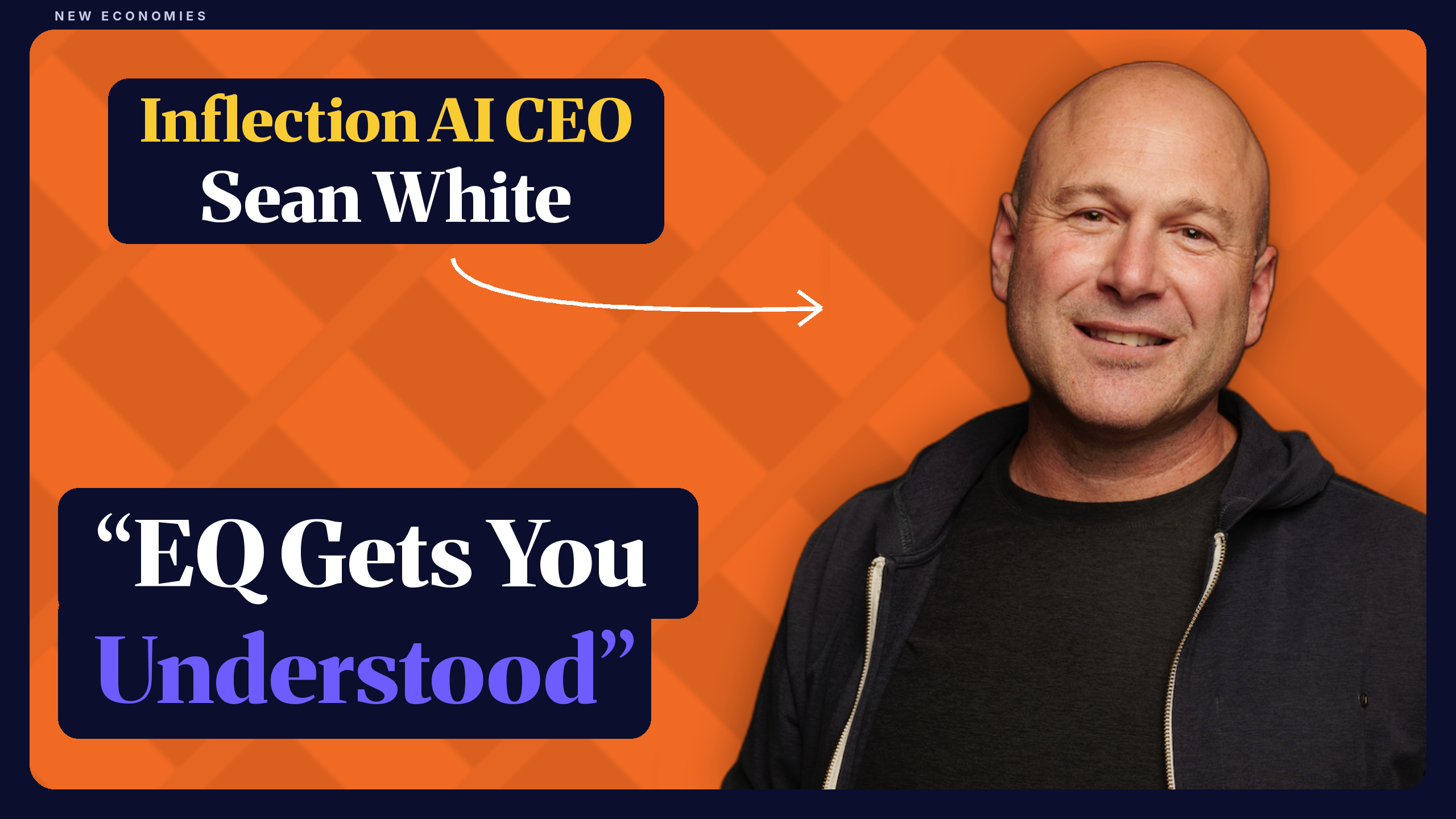

Mika Korfman (Fiverr CEO) discusses how AI changes work, why “easy” tasks are being automated, and what freelancers/talent must do to survive—focusing on judgment, accountability, and deep AI deployment (not just “out-of-the-box” tools). He uses a “dinosaur vs. asteroid” analogy: old professional DNA won’t survive unchanged; it must morph.
Mika Korfman is founder and CEO of Fiverr, building a global freelance marketplace over 17 years connecting millions of professionals worldwide.
AI flips the work split (software now handles much of the “80%” routine), but the remaining “20%” judgment is infinitely important. AI lacks accountability; humans must own decisions. “Using AI” is ambiguous—success depends on context, integration, and supervised deployment. Basic design/copy work will commoditize; above-average outcomes require taste and differentiation (“X factor”). Each person is responsible for their own growth.
AI coding accelerates but often produces “shit code” due to statistical learning from low-quality open source; AI design interfaces favor verbal users over visual designers.
Written by AI. May contain mistakes.
Explore the transformation in work dynamics due to AI advancements.
“If you've been doing something as a professional for more than five years, you are a dinosaur.”
Discuss the changing definitions of work culture in the face of AI.
“Then COVID with everything, you know, with the idea of remote work and the idea of digital nomads and a very different scenery in how organizations, how companies are actually structured.”
Understanding the implications of AI on jobs and professional roles.
“The consensus seems to be, from all the guests I'm having on the show, this year, January 26, was really the breakthrough year for AI.”
Mika discusses the memo he sent regarding AI's impact on business.
“And it's about this, some parts of this DNA sequences morphing into, into different beings.”
Insights on effectively using AI in organizations while maintaining judgment.
“we're less high tech technicians and we're more builders creators so it was a tough year but it was a good year in that sense when you sent out the memo I can even remember people commenting online.”
Understanding the challenges and nuances of AI deployment in organizations.
“that want to exercise high level of judgment.”
Exploring how AI impacts the nature of work, particularly in design.
“I'm glad I'm not the only one who's impatient.”
Discussing the changing landscape for freelancers and the need for adaptation.
“There was one thing I wanted it to be removed, one thing adjusted.”
Learn about personal responsibility in professional growth and talent development.
“I actually, you know, pitched this to my team years ago.”
Explore how platforms can support talent while emphasizing self-initiative.
“Not better human beings and not better professionals, not better husbands and wives, not better parents.”
Understand the implications of AI on coding quality and the developer's role.
“We promote those who are actually on the cutting edge of what the world needs right now.”
Discuss the evolving landscape of coding, AI integration, and the need for adaptability.
“You repurpose shitty code, not secured, not optimized, inefficient, full of bugs, full of backdoors and weaknesses and doesn't deal well with edge cases.”
Learn about the importance of purpose and accountability in organizational success.
“My sense is we're post the asteroid hitting Earth, but the skies are not clear yet.”
Explore the challenges faced by CEOs in balancing long-term visions with short-term market pressures.
“If this is going to be the mode and companies can help people get there, amazing, right?”
Explore the challenges of balancing long-term business vision with short-term financial pressures.
“When you think about, you know, PMs in hedge funds, they get measured in a quarter.”
Discuss the importance of a proactive mindset in entrepreneurship and the excitement of growth.
“And we're moving so much faster with a smaller team, tighter, a lean organization that does 2, 3x easily of what we've done 12 months ago.”

Get the gist, explore an idea or ask about something said.
 Claude
On BIG IDEAS BY NEW ECONOMIES, what are the key points of this episode?
Searching your listeningAutomatic transcript. May contain errors.
0:00If you've been doing something as a professional for more than five years, you are a dinosaur. Up until AI, human beings were doing 80 % of the work and software was doing about 20. And now it flipped. The 80 doesn't get you anywhere. It eliminates simple stuff that requires help. But here's the interesting stuff. The 20 % are not 20 % important. They're infinitely important. This is a moment where everybody is trying to figure out what does it mean for our species? The species that existed five years ago would probably not survive in its current shape and form. That transformation from the old to a version of the new is a lot of what the next 12 months are going to be.
0:48And this is where... This is Mika Korfman, founder and CEO of Fiverr. Over the last 17 years, he built a global freelance empire connecting millions of professionals worldwide. And today he's revealing how to survive the AI shift and what talent and founders must focus on in the next 12 months to keep from going extinct. AI out of the box is not very powerful. You need to give it context. You need the technology to know you intimately, not to know everybody. Knowing everybody just makes everybody more average. There is an ongoing risk of outsourcing judgment to machines and assuming AI does great work for everyone.
1:29Where's the advantage? Because everybody has it. Some people have it in them and they can drive change and they can drive the above average thing. And some are not. And this is where agile people, people that are adaptive, people that are curious, people that can learn fast but also unlearn will have an advantage. If I'm not going to learn how to be a maker myself in this new reality, I'm going to be out of a job. This is the X factor. Eventually, it all boils down to this, which is... Welcome to New Economies.
2:17hey mika welcome to new economies thank you so much for joining us thanks for having me so you know this year is the 100th year since the nine-to-five work culture was created but boy we are living in different times what does the nine-to-five work culture actually mean in today's environment and is it even a thing anymore very little to be honest and what gets what i'm mostly curious about is how the next 100 years are going to look like because i think that we're in a pivot moment where a lot of how then you know the next decades are going to look like and uh maybe the The first push into changing this was 2010 when millennials started getting into the workforce and then Gen Zers.
3:09Then COVID with everything, you know, with the idea of remote work and the idea of digital nomads and a very different scenery in how organizations, how companies are actually structured. And obviously AI. Which really was a much bigger Black Swan event than COVID, for sure. So I'm really curious. I think what makes me not just curious but excited is that I think that we're dealing with coming up with the ideas that are going to shape the next 100 years. which is a really interesting vantage point. We may get it right. We may get it totally wrong. But at least we have a way of actually shaping some of this, which is actually pretty hard right now because of timing.
4:14And I don't know, even if you try and go 100 years back, The first years of industrial revolution, of assembly lines, of all of this weren't stable. And we're in many senses, we're in an unstable period of time right now where things are not clear. They're murky, they're undefined. And but these are the most exciting times. So, I mean, we can we can dive into all of this. But this is really a one-of-a-kind event that doesn't usually happen, even in 100 years. The consensus seems to be, from all the guests I'm having on the show, this year, January 26, was really the breakthrough year for AI. All of the easy jobs, which were easy, now AI can do.
5:10The hard jobs have become easy. And then the super hard jobs have still become hard, but they're becoming easier, right? We'll come back to this in a second, but it's almost a year today when I saw your name going viral on my X feed because you sent this internal memo to the team, which I thought actually was probably needed. I think Toby from Spotify also did the same thing, something similar, where basically you gave a very blunt, direct insight into AI is going to change our jobs forever. One year on, has anything changed that you didn't anticipate? And maybe just help the viewers give a glimpse why you wrote that memo in the first place?
5:49So maybe start with the why. I'm going to give an analogy, which may or may not be a good one. If you started your business more than five years ago, if you have a running business that started more than five years ago, if you've been doing something as a professional for more than five years, you are a dinosaur. And you are a dinosaur at the moment of impact of an asteroid. So that's my analogy. And I'll try to make it a little bit clearer or at least continue down that path. What I mean is if we compare it to a meteor hitting Earth, obviously the area of the crater is where everything gets annihilated.
6:43And that's fine. But as a result, there's a lot of debris going into the atmosphere, which makes everything dark and the air polluted and not great for breathing. Then temperatures drop. Then there's the ice age. Then there's food scarcity and a lot of confusion because it's dark. And this is a moment where different species get extinct and others actually flourish. Now, if you take this to biology, what you understand is that it's about DNA survival and transformation. And it's not about species either, you know, getting extinct or continuing because everything morphed into something else biologically.
7:39It's not about evolution. Evolution takes, you know, hundreds of thousands of years, millions of years. It's about morphing. And it's about this, some parts of this DNA sequences morphing into, into different beings. And this is a moment where everybody is trying to figure out. In many ways, this started boiling in me when I witnessed the meteor hitting Earth. And what does it mean? And so the memo was a wake-up call for this quest of understanding what does it mean? What does it mean for our species? species, the species that existed five years ago and would probably not survive in its current shape and form.
8:38It doesn't mean that life ends. It just means that it needs to change. And the old existence would not continue. And so the idea was this very open sharing of concern or view of reality to wake up people. And in many ways, not just, I don't think that people were sleeping and not noticing this or living on the rock. It was more about this sense of urgency and a sense of validation that what they're sensing, their discomfort, their fears are validated by me. which again doesn't mean that just the fact that I acknowledge something makes it right. But because I think that we're operating together and I'm trying to lead in this environment, I wanted to create a reference point, a new north.
9:48And you start by asking, so how does it look a year after? This has actually surprised me in a good way. Along the way, we had to make changes that we as a company are responsible for in how a corporate is organized. How do we operate? How do we communicate? How do we create organizational structure and processes and all of this? But it also required people to sign in for it. Not just to sign in for what we do as a company, but to sign up for what they do as professionals. And some people signed out of it, which I think is fine. I think people are signing out of high tech in some ways. Some of it is by behavior or complacence.
10:50but those who boarded the train are now doing two, three X more than they used to do a year ago. And because of this process, what you also gain out of it is you increase talent density in the organization substantially. So if I need to give you the net net, I'm much happier, but what I'm seeing I actually think that we're able to find more joy in the process of building making, creating than we used to we're less high tech technicians and we're more builders creators so it was a tough year but it was a good year in that sense when you sent out the memo I can even remember people commenting online.
11:52People were freaking out. People were then I think a few other CEOs did something similar. But honestly, like even a year or now, I think the consensus is clear. If you're not using AI internally, then you're not hiring. And those who are using AI are hiring a lot more than previously anticipated. If we were to go inside the Fiverr culture and inside the Fiverr company? Well, this actually changed in the last 12 months that you were very happy about. And what are you still least happy about? When you say using AI, I think that this is, it's a key phrase, but it's a very ambiguous. It's a very broad term.
12:37There's using AI and there's using AI, which is really key and really where I think some of the frustration is coming from. The usage of AI depends in how you integrate it, how you deploy it. It's about knowing the limitations. It's about knowing the fact that it's not just upside, there's downside to it. It's the constant dealing with the fear that the people outsource too much into it and practice too little judgment on what they're getting. It's about the concern that inadvertently you're giving your alpha to AI constantly, even though as a corporate, you sign contracts as saying that AI cannot be trained.
13:41But there's still a fear and concerns that I think are right about it. And again, if you do this in a process of increasing your talent density, you offset some of these concerns. Because by definition, you work with people that want to exercise high level of judgment. And this is really something that I realized, which I think is really interesting. And some people, including companies, don't understand. There's something really interesting in this human and machine interaction. And the things that we want or allow AI to do and the things that we think we should do, professionals should, human beings should do.
14:30And what I realized is that there's something really interesting in the fact that the one thing that AI lacks is accountability. There's a lawsuit against OpenAI because ChatGPT recommended to about 20 people to end their lives. but at the chat window, when it recommends you to end your life, it says, I'm AI and I make my mistakes. Like it's, this is, this is the sum. This is, this sums up the lack of accountability. And human beings are all about accountability. And there's a, there's an interesting question of why. And I think you can sum it up by saying that the reason is the fact that we're mortal.
15:26And since we're not going to live forever, our reputation is the most precious asset that we have. And maintaining it requires accountability. When people talk about human in the loop, which are passwords that say nothing, eventually it all boils down to this to judgment and accountability and again like if we go back to an organization when you deploy ai the risk is that some people start outsourcing accountability to non-accountable software or you know or technology and so deployment is super complex because AI out of the box is not very powerful in a personal environment and a company is a personal case.
16:28You need to give it context. You need the technology to know you intimately, not to know everybody. Knowing everybody just makes everybody more average. That takes time. And for dinosaurs like us, we have a company that is 17 years old. Deploying AI is a thousand times more complex than starting a new company based on like building everything on top of AI. And I'm not going to go into the technical stuff of like, you know, high tech has been going for microservices and whatever. And now everybody's going to single repos and whatever, because AI is really bad at microservices, but it's really good at single repos because you have the context window is complex.
17:22And so this is hard. This is frustrating, but we're dealing with it. It's not a blind spot for us. It just takes time, which, you know, I'm an entrepreneur, so I'm generally an impatient person. I want everything to happen now, immediately. So being patient is not one of my virtues. So that's hard. But the organization right now is so much more efficient and so much more sharp and can deal with so much more, which is amazing. But it comes with a price and it's really tough. It's really tough to make this transformation as a complete organization. It's tough as an individual, as an organization, a thousand times tougher.
18:33I'm glad I'm not the only one who's impatient. So glad we have something in common there. I want things done pretty soon. It's interesting, you mentioned the huge judgment. We've had founders and CEOs from Webflow, Replit, Base44, also from Israel Company, on the show in the last few weeks. And they've all said the same thing. One thing I think, though, is has AI made us more lazy? Because do we actually work anymore? You know, like my friends, okay, they're not founders. they have a nine to five and that's it like when we're doing 19 hour days seven days a week i just think like have we just lost have we lost what work working hard actually means so this is exactly what i meant when i said that there is there's a ongoing risk of outsourcing judgment to machines.
19:27When you do this, you basically outsource everything. If you outsource everything, then you're not working at all. And, you know, the big difference in my view is if we go 25 years ago to a time where accountants were still doing balancing on paper with a pencil, And then we had Lotus Notes and then we had Excel. And then we had these funky models that do whatever. Up until AI, I think the balance was mostly human beings were doing 80 % of the work and software was doing about 20. And now it flipped. But here's the interesting stuff. The 80 doesn't get you anywhere. It just gets you faster. It does a lot of things that you used to do manually.
20:23It eliminates simple stuff that requires help, but now it doesn't. But the 20 % are not 20 % important. They're infinitely important. But the risk is you start outsourcing that 20%. And I agree. I think that when you start letting go and think that things can completely be automated, And these are the dystopic views of what the world could, dystopic or fantasies of what a world without work might look like, which I don't think that's the case. And I may be wrong. The other thing is that the way right now, the way the interface with AI is set up is super hard for some people because it is a definitely a heaven for highly verbal people.
21:28and it's a nightmare for visual people. For designers, a lot of designers, the really good ones, the pixel perfect, the people that created the breakthroughs of design, this is a living nightmare. They don't want to write stuff. They want to show. They want to experiment. So, yeah, there's this tension. But I think I said this many times before, it forced us to discover our humanity again and what makes you and I and others unique. I mean, it doesn't matter. I mean, there's a fable. Oh, it's the end of that. It's not. It's as good as what you give it and how you interact with it. So if you give it garbage, it's garbage in, garbage out.
22:23And if you talk back to it, it would constantly say, oh, you're right. I missed that. Oh, that's a good point. Yeah. But the user interface is tough. It's just verbal or voice. So people that are less verbal are having a really hard time. Plus, it's tiring. It's chatting all day long. It's tough. It's really tough. Some people find it to be impossible. I do agree. I had this experience yesterday, right? Doing a super complex graph. There was one thing I wanted it to be removed, one thing adjusted. Had to prompt it like 20, 30 times until I kind of got something and it was just easier to do it myself, right?
23:05But I think what we can agree on, hopefully, is even in the last 12 months, if you want a basic design, some of these AI models are pretty good at that now, right? And I'd love to get your take here a little bit. You know, there's obviously this big debate, right? and fivers, the freelancers. First of all, we should actually chat around, should they even be called freelancers anymore? Why isn't there a colder term for freelancers? But the main question here is around the freelancers which can do basic designs. What happens to them? Because really, AI can now do it, if not better, if not cheaper, if not in the moment.
23:50They need to find a new profession. What does that look like? Landscaping, or that could be doing more complex, high-end work in design that requires deep human judgment, a sense of taste, a special eye for things, an extreme understanding of human behavior. because you create this design to inspire people, to make people react to it. There is no thing as a good design. How do you measure a good design? The fact that you like how... No, if this is in a business context, this should generate an action. This would generate a response, a reaction. And so they either grow to that level of professionalism, if they have it in them, or they find something else to do.
24:54Again, that's fine. If you were driving a horse carriage and now nobody used them, you need to find something else. If you automated coal mining, so now you need to know how to man a machine. or you find yourself out of the job market and need to find other ways of making a living. It is what it is. But this is like, if I'm not going to learn how to be an entrepreneur, a company leader, and a maker myself in this new reality, I'm going to be out of a job. That is getting back to my memo. It's a decision. The bar is just going up. But again, like if you think about, you said basic design, I don't know what that means.
25:46But if everybody has access to AI that can design things, and assuming AI does great work for everyone. So where's the advantage? Like everything looks great, but there's just more great things, which is whatever it can spit out is the average because everybody has it. How do you become above the average? The fact that something looks slick doesn't mean that it's going to work. The bar is just going up. And this is how human beings are. You give them these amazing devices and they get used to it and they want them to do more. Like, why can't it? Yeah, go create it. Like everything becomes a standard like this.
26:41How do you get above the bar? How do you get above the average? Some people have it in them and they can drive change and they can drive the above average thing. and some are not. If I prompt Gemini, Cloud Design, and you prompt Cloud Design, we're not going to get the same results. Why? Some of it is just random because it's statistics and it gives you random stuff. But maybe I'm a better, I have a better design attitude. I have better understanding what works, why it doesn't. So I'm going to win. That's it. But it's not cloud design. It's me. This is the X factor. So yeah, professions are going away.
27:34That's not, like I'm not, let's let go of it. Like we shouldn't resist. And by the way, no, we shouldn't call freelancers by a name. I don't call you a full timer. So like, and definitely, I mean, there's about 50 % of the U.S. workforce that are freelancing in some capacity. So why do you call half of the workforce by name and you don't call the other half by name? They're just talent. That's it. I actually, you know, pitched this to my team years ago. And they said, we don't think that the world is ready for it. The construct of how they work has some characteristics that are different than full-timers.
28:21But these are getting blurry anyway. Right? Like, if you don't work from the office, if you work on vacation, part-time, it's like, what does it make you? And who cares? Like, who cares why people need to be defined by a word? It doesn't define them. If anything, what defines them is a talent at something. But that's true for all means of work or interaction. What do your talent fivers think of what's happening? Are they concerned? Whose responsibility actually is it to help them become even better at what they are at today? First and foremost, it's their responsibility. And this might like, I might get bashed on this, but I said the same to my, to my team.
29:20I said, guys, look, I love you to death. We have an amazing culture. I love every person in the company, but I told them, look, it's not my job to make you better. Not better human beings and not better professionals, not better husbands and wives, not better parents. it's your job to do it if you're not motivated i'm not gonna drug you it's not it's not i sorry i don't think it's anyone's job to make me better it's not the board's job it's not the market's job it's it's my job take responsibility now as a platform and as a as a as a movement as a culture, and this is how we view our relationship with the talent community, and by the way, with our clients as well.
30:17I would do anything to help those who help themselves. If you ask me about these basic services that people like graphic design, let's assume those are not on demand anymore. There's no need. Should I educate all of the graphic designers in the world to become better at what they do it? Can I? Is it even reasonable? The answer is no. If people are taking actions, by the way, and if they want pointers, some guidance, some, we will do everything. But if they do the transformation, our job is to make sure that we expose them. We put a spotlight on them. We promote those who are actually on the cutting edge of what the world needs right now.
31:09That is our responsibility. But this is also where the alignment of interest is. Like, my interest is that as many people on our platform are going to do as much money as possible. And if they do it, we're a good company. We created value and we're getting some value out of it. It's a fair trade. So I want them to succeed. I don't want them to fail. And I want as many of them to succeed. But we need not to confuse this with who's responsible for what. First and foremost, each person, myself included, are responsible for ourselves. then as a community we can empower each other to to grow together that that's kind of the entire goal so we're seeing in companies almost all code is now written by ai developers have a ton of support with all of these amazing ai tools which domain do you think comes next to be turbocharged by AI or potentially, I'm, I guess, in backlash for this, irrelevant.
32:27Since you mentioned coding, let me just give you my sense of where we are there. Coding is getting written in blazing speed, but the majority of it is shit code. It's terrible. Here's one main reason why. AI is a statistical model. So basically you give it a corpus of information. It learns from it. And it looks for high distribution within the corpus. So if you ask it for a task, it looks for where do I have the most amount of information that answers this request. In the case of code, that's open source. here's the catch the vast majority of open source is terrible it's just terrible that's a reality how many amazing developers are out there not a ton so if you take this code and you repurpose it You repurpose shitty code, not secured, not optimized, inefficient, full of bugs, full of backdoors and weaknesses and doesn't deal well with edge cases.
33:49And so, sure, I mean, when you think about what was the what was the job of a developer five years ago? I would say that about 60 % to 70 % was just copy-pasting from open source anyway. Because from an efficiency standpoint, you don't want to rewrite stuff that was written. But there's some judgment going through repos and understanding and reading what the community said and what other contributors and looking for the right fork and whatever. But then you embed code and you write the code that you can't copy paste because that requires some non-linear thinking about how to solve a thing that wasn't solved before.
34:37You remember the 2080 or the 8020? Sure. The copy pasting from open source is being done by AI. Great. Developers didn't like that part anyway. You're a technician. you're not writing your beautiful code. So you either outsource to AI completely. It can handle basic stuff decently. It's not going to be amazing. But that's just today, right? It's going to get better and better. And then maybe you'll need less people, but you need really amazing people that can challenge the next things and can build the next things. And then AI will take some of that as well and open up new frontiers of, and maybe eventually nothing gets left.
35:34I don't know. I don't know where the sequence is going. Because again, from my experience, the more things are created and you see them, the more you want the next thing. You know, you and I, we were living in the most fascinating time for humanity, right? So computers and the internet and then, you know, mobile, then cloud. And then, like, it's amazing, but we always want more. So we, and we can't imagine what's going to be the more before we see what's possible. So, yeah, it is changing stuff really rapidly, but it opens up other things. And remember my analogy about the dinosaur and the asteroid.
36:27My sense is we're post the asteroid hitting Earth, but the skies are not clear yet. There's still debris and there's scarcity of food and resources. And the air is full of dust and it's hard to see clearly. And you don't know how things are going to land and stabilize again. So we're trying to make projections of possible futures and assign probability to each. But it's guesswork. It's your guesswork. It's mine. It's Elon's guesswork. It's Sam Altman's. It's Dario's. Nobody knows. Nobody knows. We're trying to project and we're assigning probability for things. So you mentioned coding. there's design, there's marketing.
37:27But obviously we're talking about things that language models can do. We're still before the physical manifestation of things. Physical AI is years back when you compare it to language models. So it's going to appear in many aspects of our lives, And it will force us to, because it will free more of our time and maybe reduce some demand for our current skills. It will open up new skills, which we can't imagine. Much like in 1940, nobody had software developer in their resume because it didn't exist. Like no one could anticipate that. So trying to guess is to me is just guessing. It changes every three months.
38:28We're probably going to agree, right? Yeah, it changes like... But that's fine. And this is where agile people adopt, you know, people that are adaptive, people that are curious, people that can learn fast, but also unlearn will have an advantage. What about the other people that wouldn't? They would have to shift to other stuff. Maybe if you can't adapt to digital change, you need to do physical stuff. But that's fine. I mean, it's not that different than 100 years ago. It's different in the pace, in the impact. But this is like, it's adapting. There's a whole consensus around human taste and judgment.
39:18This is going to be the biggest moat I think any individual can have. And what comes next? TPC. But this is the two most important. This to me is our purpose. Like when I think about this and not that I think that in the large context of things, fiber is in the center of the universe. But since we're touching this area and we're set up in a very unique way over the past 17 years of understanding why do people talk to each other? Like, why do people interact? What is the core of what they're trying to get out of that interaction? And looking as someone who's been running companies for 25 years, why do I hire people?
40:11What do I expect out of them? Because I have over the years, I have more and more tools at my disposal. I have more technology. I have more. Now I have digital agents. So my team is like biological agents. This is the interesting thing. And if we have anything to offer, it's that purpose of understanding that this accountability, this judgment is what we have to offer as a platform. It is so much more important than the actual technology. Because this is the missing part. This is what makes a generic technology outperform when it works on your problem. Okay? That delta is the key for everything.
41:06If this is going to be the mode and companies can help people get there, amazing, right? I want to ask you one question around, there's obviously, being a public market CEO today in today's environment is probably super fuzzy. which you kind of mentioned earlier, right? The word fuzzy is a good way to sum it up. What is the hardest challenge for you right now that keeps you up at night in this environment? Being a public company and definitely being in an area where there's a lot of uncertainty and misunderstanding and maybe contrarian views, and probably lack of patience is the toughest thing.
41:56And I don't blame the public market. When you think about, you know, PMs in hedge funds, they get measured in a quarter. They either make money or they go home. It's very hard to bridge long-term thinking that involves and prioritize long-term shareholder value with the goals of someone who thinks quarter by quarter. So I think that this is challenging, period. But it is what it is. Like, I need to do my thing. Everybody else needs to do their thing. And that's fine. The job is not to fight it. The job is to build a massive business that generates an upside for shareholders over time. And I always, I've been doing this for 17 years.
42:51I want, you know, our company to be around in 20, 30 years and be a giant company that can define the next 100 years. It requires patience. And we already established this. I'm an inpatient person. First and foremost, by the way, I encourage inpatient around my team. And I said, the framework is, it starts from being impatient with yourself. And then you can demand being patient with others. And I encourage people to be impatient with me when they come to me for a decision. And I say, okay, I'll think about it. That's not a good answer. When? When do I get an answer? And if this is, I don't know, a few days from now, that's not well defined enough.
43:38And if it's a week, why not tomorrow? Can we talk about this tonight? Like being patient with me, I'll be impatient with myself and with others. But some things you should progress with inpatient, but you also need to understand that you can't define 100 years in a day. It takes time. Humanity is not ready for it. It takes time for people to understand. There's a lot of talk about AI deployment. We've talked about this a little bit. AI deployment, deep deployment, is really what makes companies or individuals use AI. Just giving your employees child GPT or CLO is not using AI. But deploying AI is so complex.
44:30It is so complex. And this is where in the realization that it is tough and you probably need help. and you probably need some guidance and you need to calibrate this and you need to make it supervised and you need to make it very deep so that you can actually extract a lot of benefits because it's not free. It comes with a cost. AI is not free. It's actually pretty expensive. It's a realization that started yesterday. But if you were six months ago, you're impatient. Like, why is it not happening? You can't rewire humanity in the speed you want it to happen. These are social changes. It just takes time.
45:19Next 12 months, 18 years, you'll be 18 years old by then. What's the next 12 months looking like? A lot of what we've learned over the course of the past few years have shaped our thinking about the direction into the future. As you said, everything changes every three days. So divide 12 months by three days. That's a lot of change. It's really hard to project. But it is about going into the fundamental truths, the first principle thinking and extrapolating from that. on what is the big changes that need to happen in the way we're organized, in what our platform has to offer, the type of interaction that clients can expect.
46:14Are we going to find ourselves in an environment where half of our clients are actually agents, digital agents that are just doing stuff for other human agents that are telling them what to do. So that transformation from the old to a version of the new is a lot of what the next 12 months are going to be. And it's exciting and it's fun and it's really hard work. It's like 20 hours a day, seven days a week, which is what I like to do. I hate playing defense. I'm not a defense person. If you're an entrepreneur, if you're a founder, you're all about offense. You're all about building and moving forward and betting on the upside, not the downside.
47:08Not protecting the downside as your main function, but actually building the upside. So that's our focus. And we're moving so much faster with a smaller team, tighter, a lean organization that does 2, 3x easily of what we've done 12 months ago. And it will continue to grow the rate. And it's fun because if you like building, you like building more and faster. You decrease the cost of error because you need to invest less in creating and testing new things. Some are going to fail. Some are going to succeed magnificently. So it's fun. As much as it's a tough period for many aspects, it's also really, really fun.
48:01And it's really exciting. Well, come back in 12 months. Thank you for being so patient with me on this episode. I know the British accent sometimes can be impatient for some people and next time we'll have to do a Joe Rogan episode longer than an hour but I appreciate you and thank you so much for your time
48:18Micha Kaufman: Thank you for having me again
Subscribe to stay ahead of technology trends. Never miss future editions.
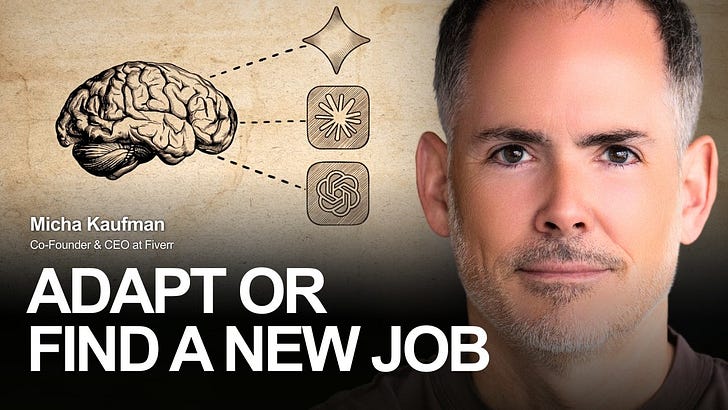
Micha Kaufman, co-founder and CEO of Fiverr, joins us to explain why anyone who has worked in their profession for more than five years is now “a dinosaur.”
He has spent 17 years building Fiverr into a global marketplace connecting millions of freelancers with businesses, and took it public on the New York Stock Exchange in 2019. His internal memo warning staff about AI went viral a year ago, and he says the employees who embraced it are now doing two to three times more than before.
Micha also shares why AI has flipped the 80/20 split between human and software work, why an AI that knows everybody “just makes everybody more average,” and why human judgment and accountability will be the biggest moat any professional can have.
In our in-depth episode, we discuss:
* The asteroid analogy behind Micha’s viral AI memo, and what changed inside Fiverr in the 12 months after he sent it
* Why the 20% of work AI can’t do is “infinitely important,” and the risk of outsourcing judgment to machines
* Why most AI-generated code is built on poor-quality open source, and what that means for developers whose job was 60–70% copy-pasting
* Why Micha wants to stop calling freelancers “freelancers,” and why he believes getting better is each person’s own responsibility
* How Micha runs a public company through a period of uncertainty by encouraging impatience, and whether half of Fiverr’s clients could soon be AI agents
Watch or listen now across YouTube, Apple Podcasts, Spotify, and X
Download the transcript 👇
Timestamps
(00:00) Meet Micha Kaufman (02:17) Is the 9-to-5 dead?(05:20) The viral AI memo(05:50) The dinosaur and the asteroid(12:25) Using AI vs really using AI(14:33) The one thing AI lacks: accountability(18:55) Has AI made us lazy?(19:33) How AI flipped the 80/20 of work(21:02) Why AI is a nightmare for designers(23:23) What happens to freelancers doing basic work?(27:32) Why "freelancer" is the wrong word(28:38) Whose job is it to get better?(32:04) Why most AI-generated code is bad(38:32) Why adaptability wins(41:10) Running a public company in uncertain times(43:06) Why Micha encourages impatience(44:02) The hard part of deploying AI(45:19) Fiverr's next 12 months
Lessons from this episode with Micha
1. Why every experienced professional is now a dinosaurMicha’s viral memo started with one analogy. He explains why anyone with more than five years in their profession is living through an extinction event, and why the outcome is transformation, not the end.
* “If you’ve been doing something as a professional for more than five years, you are a dinosaur. And you are a dinosaur at the moment an asteroid makes impact.”
* The crater is only the start. The debris, the darkness, the ice age and the food scarcity that follow are what decide which species survive.
* Survival is not about evolution, which takes millions of years. It is about morphing into something new, and some species flourish while others go extinct.
[0:05:57 – 0:07:20]
2. The one thing AI will never haveMicha argues that the real line between humans and machines is not intelligence. It is accountability, and he traces the reason back to our mortality.
* When ChatGPT gives harmful advice, the chat window still says, “I’m AI and I make many mistakes.” That line sums up AI’s lack of accountability.
* Humans are accountable because we are mortal. Reputation is our most precious asset, and keeping it requires accountability.
* “Human in the loop” is a buzzword. What it really comes down to is judgment and accountability, and the risk is that people start outsourcing both to software.
[0:14:33 – 0:15:57]
3. How AI flipped the 80/20 of workBefore AI, humans did most of the work and software did the rest. Micha explains why that ratio has reversed, and why the part left to humans matters more than ever.
* Up until AI, humans did about 80% of the work and software did about 20%. Now it has flipped.
* The 80% that AI handles “doesn’t get you anywhere. It just gets you faster.”
* The 20% left to humans “is not 20% important. It’s infinitely important.” The danger is starting to outsource that 20% as well.
[0:19:36 – 0:21:02]
4. The X factor: why the same AI gives different resultsIf everyone has the same AI tools, where does the advantage come from? Micha argues it comes from the person using them.
* Whatever AI produces is the average, because everybody has access to it. Something looking slick doesn’t mean it will work.
* “If I prompt Claude Design and you prompt Claude Design, we’re not going to get the same results.”
* The difference is design taste and knowing what works. “It’s not Claude Design. It’s me. This is the X factor.”
[0:26:10 – 0:27:32]
5. It’s not your CEO’s job to make you betterMicha shares the message he gave his own team, one he admits he might get criticized for.
* “Look, it’s not my job to make you better. Not better human beings, not better professionals, not better husbands and wives, not better parents. It’s your job.”
* He holds himself to the same rule: it’s not the board’s job or the market’s job to make him better. It’s his own.
* Fiverr’s role is to help those who help themselves. “I would do anything to help those who help themselves.”
[0:29:05 – 0:30:22]
6. Why most AI-generated code is badCode is being written at blazing speed, but Micha says most of it is poor quality. The reason is built into how AI models learn.
* AI is a statistical model. It answers a request from wherever it has the most data, and for code, that is open source.
* “The vast majority of open source is terrible.” Repurposing it means code that is insecure, inefficient, full of bugs and weak on edge cases.
* Five years ago, about 60 to 70% of a developer’s job was already copy-pasting from open source. AI now does that part.
[0:32:35 – 0:34:05]
7. Why Micha encourages impatience with the CEORunning a public company takes long-term patience, but Micha pushes his team to be impatient, including with him.
* The framework starts with being impatient with yourself. Only then can you demand the same of others.
* If Micha says, “Okay, I’ll think about it,” that’s not a good answer. If he says a week, his team should ask: why not tomorrow? Can we talk about this tonight?
* The balance: push hard on what can move fast, but “you can’t define 100 years in a day. It takes time.”
[0:42:50 – 0:44:02]
Where to connect with us
Follow Ollie on X: https://x.com/ollieforsythFollow Micha on X: https://x.com/michakaufmanVisit Fiverr: http://fiverr.comOur partner for today's episode is Harmonic, your go-to startup database: https://harmonic.ai
Previous episodes include
See all previous episodes here 👉