 Ask ChatGPT

Alan Treffler, founder of Pegasystems, argues that enterprise AI should be implemented sustainably by using AI “design time” to create reliable, workflow-based “recipes,” then running at predictable cost at “runtime.” He criticizes token-based pricing opacity, warns that token costs can be uncontrolled due to hidden reasoning/sub-agent token generation, and claims Pega can offer “no token cost” to customers by shifting heavy AI use upfront. He also discusses Pega’s 40-year evolution, going public early (1996), and staying “froth-adjacent” rather than chasing hype.
Alan Treffler founded Pegasystems; scaled it into a ~$6B enterprise automating complex workflows for global enterprises. He previously consulted for Wall Street banks and started Pega at age 26. Pega’s early clients included Citibank and Bank of America (live since 1984).
workflows provide transparency, reliability, and predictable outcomes; CPU workflow execution is far more efficient than GPU reasoning; AI should be fungible/commoditized and integrated via retrieval-augmented generation.
Citibank/Bank of America longevity; Pega running in Netscape (SEC S1); “no token cost” button; restaurant recipe analogy; vector database/RAG; competitors’ “prompt studio” and “thousands of agents” approach.
Written by AI. May contain mistakes.
Explore the misleading aspects of token costs in AI and their implications.
“And if you go listen to some companies, they talk about how you're going to have 6 ,000 or 10 ,000 or 20 ,000 agents.”
Learn about the inception of Pegasystems and its journey over four decades.
“Alan, it's so good to have you on the show.”
Discover the importance of trust and long-term relationships in business.
“way you designed workflow systems in banks, insurance companies, and other firms.”
Alan shares insights gained from Pegasystems' early IPO experience.
“You know, something which we haven't touched upon yet is you've actually also been a public company for 30 years.”
Discuss the challenges and dynamics of the current AI market landscape.
“The first year of going public, what did that look like?”
Understand how Pegasystems adapts to changing tech landscapes for sustained success.
“And candidly, we're happy to be froth adjacent, but I really wouldn't want Pega to be in the middle of this vortex.”
Learn how to focus on long-term value amid market volatility.
“And when a lot of these tech stocks are down 40%, 50%, does it keep you up at night?”
Discover the importance of evolving business practices in tech.
“years, says something really about our ability to evolve.”
Explore how perceptions of technology have shifted over the years.
“how much we would have to build for change, given the massive shifts that we experienced in the technology and that we're still all seeing.”
Understand the integration of AI into powerful workflow systems.
“if people wanted to apply for a loan or if you wanted to onboard a customer, it was just a great system to put the controls and the management and the intelligence about how to do that.”
Learn about effective strategies for using AI in business.
“We had sort of expected that thing might be out in 10 years, but it was there.”
Discuss the implications of AI token costs on business models.
“you figure out if you can dip into the recipe box, pull it out and actually do something.”
Examine how AI companies navigate pricing and cost management.
“full power of AI, but to use it upfront and then very selectively.”
Explore the evolving landscape of AI competition and partnerships.
“And those are the ones that are getting whipsawed.”
Discussing the competitive landscape of AI companies and partnerships.
“I had Reid Hoffman on the show a couple of weeks ago, and we got talking around, you know, A, the IPO gold rush, but actually the number of companies which are coming up who are potentially going to win in this space.”
Exploring the use of vector databases to enhance AI workflows.
“So I think it's important that we treat the AI models with a level of fungibility.”
Examining retrieval augmented generation and its implications for business.
“A vector database allows you to organize data by similarity.”
Analyzing the impact of AI on SaaS companies and the ongoing industry challenges.
“make good business decisions, but that also maximize the technology.”
Discussing the importance of trust in long-standing software companies.
“You know, if you go back a number of years, open source was going to drive all the software companies out of business.”
Highlighting Pega's architecture and its advantages with AI integration.
“And that hooking it up to the AI the way we have really plays well to this idea of no token cost.”
Discussing how AI can simplify operations and broaden Pega's market reach.
“Now, they're massive, and we get enormous satisfaction, and they power a pretty material business.”
Exploring the need for modernization of tools in enterprise software.
“Is that a concern or is that a great opportunity companies should be thinking about?”
Explore the changing landscape of skills needed for AI talent in organizations.
“They're going to have 50 or 100 agent managers.”
Learn about the shift in hiring strategies and the roles needed today.
“What types of new roles are you hiring for now, which may have been different 24 months ago?”
Understand the importance of succession planning and team diversity in leadership.
“So I just thought it was funny when you brought that out in that interview that you did.”
Discover the varied responsibilities and experiences of a company leader.
“When you can work with terrific people solving problems for very sophisticated customers, and you get the chance to play on the leading edge of technology, that's about as much fun as I could think of.”
Gain insights into the preparation and execution of earnings calls.
“And we do a board meeting that week, usually, and the board of directors.”
Learn about initiatives in public education and community health outreach.
“Ustream is the type of person where you actually like to get involved in everything that's going on inside the company.”
Explore the vision for legacy and the importance of customer and staff satisfaction.
“Well, I've been married 33 years, which has been wonderful.”
Learn about the importance of customer and staff satisfaction as a legacy.
“and especially for companies which have been going for 40 years.”
Hear the hosts express gratitude and anticipation for future discussions.
“And we can't wait to see where Peggy goes next.”

Get the gist, explore an idea or ask about something said.
 Claude
On BIG IDEAS BY NEW ECONOMIES, what are the key points of this episode?
Searching your listeningAutomatic transcript. May contain errors.
0:00Alan Trefler: And if you go listen to some companies, they talk about how you're going to have 6 ,000 or 10 ,000 or 20 ,000 agents. This is madness. They're talking about spending billions of dollars on data centers. They're going to want to get paid for this. By the way, the fact that they call it tokens is just an example of the BS that's going on. A token is 0.7 of a word. They could have called it words, but it's part of how they make this all kind of illusory and mysterious. Originally, you could see what you put in and you could see what you put out. And so you at least knew what you'd be paying for. Today, you don't see any of this till the bill comes.
0:36People need to understand it's not even like token costs are in their control. The thing you can control is when you use it. And there are styles of usage which let you apply AI as a business. And to do it in an extremely cost-effective fashion, the key is figuring out how to.
0:52Alan Trefler: This is Alan Treffler, founder of Pegasystems. He scaled his company into a$6 billion enterprise that automates complex workflows for global giants. And today, he's revealing what AI companies won't tell you and what you need to do to implement AI sustainably. I don't know if you can see my little button here. It says no token cost. We run with such enormous cost effectiveness that we were able to go to our customers and say, nope, you don't have to pay for tokens. We took the approach that we primarily wanted to use AI to be able to really rigorously understand problems, be able to then design solutions of how you wanted to handle the different functions of your business.
1:29You want workflows that describe your business. You want agents that are capable of running any workflow. It both gives you better reliability, but critically, it gives you predictability and the predictable cost. They're actually thousands of times more efficient to run a workflow on a CPU than to run a reasoning session on a GPU. In the enterprise software space, you need to be able to change the way you handle situations.
1:54Alan Trefler: As circumstances change. And all of that requires a level of visibility and transparency that is not typical of vibe coding type systems. And those are the problems that sink business. What builds trust and what builds true relationships is... Welcome to New Economies.
2:24Alan Trefler: Alan, it's so good to have you on the show. Welcome to New Economies. You know, I've been wanting to have you on the show for so long. So we finally managed to make it happen. Thank you so much for being here. Well, thank you. I'm looking forward to it. You know, PECA is kind of one of those companies where, to be honest, it's kind of been under the radar for the last few years and maybe not as many people know about it. What is the PECA journey? And take us back to the origins. Well, the origin story goes back more than four decades, I'd say. It actually goes back to work I was doing right out of school as a consultant working for large New York banks doing software architecture work.
3:05And when I took a look at the way we did things, you know, it seemed like we were just working really hard to get the business people and the IT the solutions they need. And I went and I visited with some of my friends who were in the manufacturing industry, which we all thought of as much less sophisticated and glamorous than banking. And what they were doing was so much more advanced than what we were doing. They were using this stuff called CAD CAM, computer-aided design, computer-aided manufacturing, to really rethink the way that they actually designed physical products. And I took a look at that and I said to my boss, I said, why can't we do something similar to this for the parts of banking?
3:43To which he instructed me that we were a consulting firm and should stay a consulting firm, and I should just go do the project. But a couple of years later, when the company was bought and I had to decide what to do next, I decided to branch out and see if I could build a system that would bring a lot of the principles of computer-aided design to the way you designed workflow systems in banks, insurance companies, and other firms. And that was what started the PEGA journey. And if you want to fast forward through 40 years, I would say the thing that as a company that we're proudest of is that our first two clients who went live in 1984, if you can believe that, are not just customers to this day.
4:28There's Citibank and Bank of America, but they're massive clients of ours. And we're doing dramatic things for them and exciting new things across what's been five complete generational shifts in technology.
4:41Alan Trefler: When you were starting out, you know, 1984, and you went to these big banks, you were 20-something, right? I was 26 when I started it. The good news is I had worked for a couple of large Wall Street banks and had developed a bit of a reputation as somebody who could actually deliver. Nonetheless, I didn't realize until way later. I mean, it really took me years to fully appreciate how much of a risk those first people who said yes was to this little startup that was going to actually do something pretty important in their business. You know, I think so much about building a company is about relationships.
5:23Alan Trefler: You're 26 and I'm actually 28 now. So hopefully this is going to be a great relationship, right? But even things like, you know, building great companies, all about trust and relationships. What do you think has been some of your biggest lessons in building those trust and relationships over, you know, the last four or five decades? Yeah, I think what builds trust and what builds true relationships is to make sure you invest time in them when there's not an immediate return. You know, the difference between somebody who thinks that they're building a relationship and somebody who thinks they're in a transactional environment is that the people in the transactional environments only show up when there's a transaction.
6:03And sadly, the software business is full of people and organizations who are painfully transactional. And you can see that both in terms of the engagement, but you can also see that in the way that those relationships develop. So having organizations that we value, that we've been with and that have stuck with us for long periods of time, I think really gives us good perspective, which you temper with the fact that everything is changing so fast.
6:32Alan Trefler: You know, something which we haven't touched upon yet is you've actually also been a public company for 30 years. What's been your biggest lesson? It's probably a wide number of them. But 30 years is a long time to take a company since this company's been public. Don't go public too early would be my initial lesson. We went public very, very early. And to be honest, I think we would have done a better job all around if we'd waited another five years. But the opportunity was there. It was 1996, and the internet bubble was brewing. When we went public, we were so advanced with our use of technology that when we went public, there was a color picture on what's called the S1, which is the document you file with the SEC, that showed Pega running in a Netscape browser.
7:26The reason it had to be Netscape is, of course, Internet Explorer didn't exist back then. And the whole idea of running in a browser was kind of like, oh, my God, how is that even possible? Everybody was running on these big, fat IBM mainframe screens. So, you know, we were able to put on a pretty good show, but we hadn't yet gotten the depth of business and breadth of business and depth of management that I would recommend today that somebody get before they go public.
7:59Alan Trefler: The state of companies going public back then, 1986, was very different, right? The first year of going public, what did that look like? And you were still pretty young, 30s, right? I was mid-30s. It was a pretty wild and dynamic time. What basically happened is that some other companies were sort of in our space. So we were in the customer management space. We were in the workflow automation space. And some other companies, people will probably not remember these names because they're all dead. Companies like FileNet and a company called Siebel and a company called Scopus, now all sucked up into Salesforce and Oracle.
8:41Several of those had gone public. And I went to my board of directors and I said, you know, should we consider doing something like this? And they said, well, why don't you go down to Wall Street? You know, you spend a lot of time there. Meet with Morgan Stanley and Goldman Sachs and see what they say. And I walked in thinking that we would get some advice on how to do something in a couple of years. And they saw something they could bring public immediately. So, you know, by the middle of that year, we were public. And it was a bit of a heady ride. On one hand, it's an enormous affirmation. We had three of the world's premier investment banks vying to take us out.
9:23So we had Goldman and a company called Montgomery Securities, which is part of Bank of America, and Cowan. And it was just unbelievable. But frankly, when you're very small, you don't necessarily have the full perspective. Our total revenue that year was$32 million on a trailing 12-month basis. And when you're that small, everything is constantly up in the air. So in hindsight, I do think some of this rush to massive growth and adopting massive funding, I know blitzscaling is a thing, but I would tell you, I think for most companies, it doesn't work out very well. And for us, we were able to navigate it, but it led to very hard times.
10:11Alan Trefler: As back then, right,$30 million in revenue, if you compare that to today's market, I mean, that's nothing right. You have AI companies adding$100 million in annual current revenue every quarter. Well, some of what's going on in very small sectors of the market. People need to understand that there's kind of a frothy sector, and then there's the mainstream business market. And I think you need to decide if you want to position yourself in the froth or if you want to position yourself in kind of a more marathon-like sort of trajectory. And candidly, we're happy to be froth adjacent, but I really wouldn't want Pega to be in the middle of this vortex.
10:59There's so much that's going on that, look, we've built, we'll do close to$2 billion of revenue this year. We've got over 5 ,000 staff. We've been able to do great things for some pretty amazing customers and build those longstanding relationships with them. Running for the froth, I think, also means that the froth can leave too. And some of what you see going on in the market, you look at the whipsaw events. This morning, there were massive declines in semiconductor stocks that four weeks ago were considered to be the only thing that mattered in the market here. I'd rather try to pick a product.
11:41We're a product company and we like delivering products that are going to have sustainable value and that are going to be able to operate in, I would say, a more understandable and rational way and let us develop that sense of accomplishment and pride that comes from that.
11:57Alan Trefler: Yeah. Let's talk about this frothy market. It's a boy as hard out there, no? Being a public company, even running one of these big AI companies today, I would not want to be Dario or Sam or AMD CEO right now. Well, maybe you wouldn't, but boy, they sure look like it's exactly what they want to do. I think certain personalities are drawn to that sort of vortex of attention. And candidly, they both are drawn to it and then the things they do feed it. And, you know, the media and the podcasters, they all seek to amplify it. So you get to hear it. I think the real question is going to be, how does this settle out in three years?
12:41Alan Trefler: How does it settle out, do you think? I think, you know, the reality is that a bunch of what we're seeing is, I would describe as bubblicious behavior. And so there is going to need to be some reallocation and there will be corrections. the core value proposition of AI is very, very, very strong. It is on one hand magical, but not magic. So a lot of the beliefs that people are putting forward about how this is going to just destroy employment, et cetera, there's a lot of self-serving behavior that's going on. I loved when Jensen Wang told everybody that if you weren't spending a quarter million dollar a year on tokens, that you weren't taking advantage of your good engineers.
13:34You know, and that now, you know, he's obviously, they've obviously got enormous self-interest in that happening. And I think as people grow a little more familiar, they'll be able to make a little more reasoned assessments of how to use the goodness that's here and how to organize it in a way that makes sense. I mean, that's been the basis of what we've tried to do as a business.
14:00Alan Trefler: How do you balance the immense frothiness happening in the market? And when a lot of these tech stocks are down 40%, 50%, does it keep you up at night? Or do you just focus on building the company? I focus on building the company. When the stock jumps massively, I think anybody who overly celebrates is just setting themselves up for the subsequent disappointment when it goes down. The real question is, can you provide long-term value for customers? Can you build relationships that are going to persist? And can you then deliver product that evolves with the massive changes that happen in the technology market?
14:42I mean, candidly, the fact that we've survived and actually done pretty darn well all these years, says something really about our ability to evolve. And I think it's kind of ironic that 35 years ago, when we chose a tagline for the company, we were thinking of a tagline that would make sense to our customers. What is the trademarked way that we want them to think of Pega? And what we came up with was the phrase, build for change, that we wanted to tell organizations that writing in code, you know, yeah, you can write stuff in code, but if you write things in code, you're not really set up to evolve it very well.
15:27But if you do things using the sorts of rule-driven workflows that Pega does, things that let business people and technologists come together and implement change at a crisp and evolving rate, that you, Mr. Customer, will be able to build for change. I don't think I realized at that time how much we would have to build for change, given the massive shifts that we experienced in the technology and that we're still all seeing.
15:58Alan Trefler: And just the massive shifts in the last four years, right? GBT is about to turn four years old this year, four or five years old. Yeah, it was interesting because we had been involved in, I'll tell you just the funniest aside, when I was in university, obviously a long time ago, neural networks were considered a failed technology. We experimented with them. We played with them. We tried to get them to do character recognition. But it was only in the 2014 time period that this idea of being able to to build these generative capable systems even began to really catch hold. But in 2010, we decided that we had a super powerful workflow system that could, you know, if people wanted to apply for a loan or if you wanted to onboard a customer, it was just a great system to put the controls and the management and the intelligence about how to do that.
16:57We decided we wanted to add AI to it. I had been personally very involved with AI because early in my college career, I taught computers to play chess. That was something that I had gotten involved in. But we went and we actually acquired a company that was a leader in statistical AI. That's what we used to call machine learning, where you would actually look at patterns in numbers and decide how you could use that to do future steps, future pieces of work. And from 2011 on, we built very powerful statistical AI into our workflows, which led to great stuff. When we saw GPT come out, and as you said, just four years ago, it was kind of mind-blowing because it was so much more advanced than what we had kind of expected.
17:51We had sort of expected that thing might be out in 10 years, but it was there. and we saw a real opportunity to apply it for our customers. But we were also a little nervous about where this was going to go and what it might mean from a cost perspective and also wanted to make sure we applied it right because lots of times you can have a really shiny new technology and easy to apply in ways that might not be the optimal. So we took a very contrary approach. to how to use it compared to, for example, Microsoft or Salesforce or ServiceNow. We took the approach that we primarily wanted to use AI to be able to really rigorously understand problems, be able to then design them, design solutions, sort of build the recipe of how you wanted to handle the different functions of your business.
18:51and do that at a design time effort, which is a real collaboration with AI. But at runtime, as much as possible, try to revert to workflows because we have this enormously powerful workflow engine. And we said workflows are reliable. You trust them. You can understand what they're going to do before they do it, not just after. And they massively scale. And they don't kill entire forests of trees by eating up too much electricity. They're actually thousands of times more efficient to run a workflow on a CPU than to run a reasoning session on a GPU. So we said, let's burn those reasoning tokens when we really need it.
19:37But once we figure something out, let's record it. Let's put it in our recipe box. And then when a customer wants to do something, you figure out if you can dip into the recipe box, pull it out and actually do something. You've already figured out how to optimize. And I think that is the absolute right way to tackle this problem. And it's really quite different.
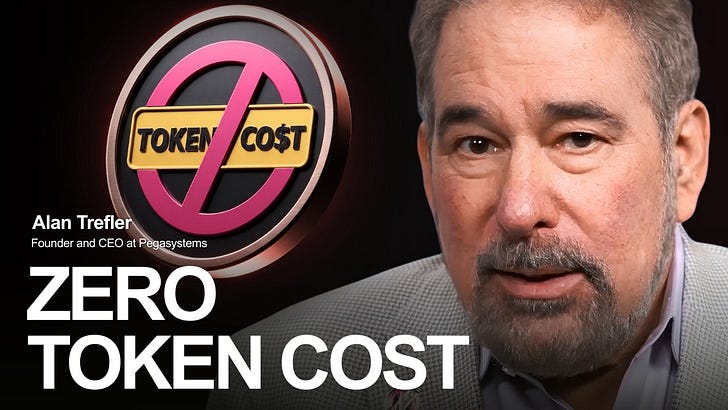
20:00Alan Trefler: You know, it's all final of these companies saying, we've adopted AI, we're going to change, we're speeding up processes, we're enhancing, you know, our talent and so on. But at the end of the day, the cost of computing these tokens, the biggest question and debate in the tech world now is they're crazy high. How do you think about the use of AI that obviously eats up the profit margin? How do you think about that? Well, you know, it's interesting. I don't know if you can see my little button here. It's great. It says no token cost. We announced at PegaWorld in June that our uses of AI for our customers, the customers don't pay for tokens.
20:41because let me give you the analogy. Let's say you wanted to open a restaurant. You might go and hire a great chef. You might create a test kitchen. You might go into that test kitchen and you might create the collection of recipes and then decide what you want to put on your menu. When a customer comes in, they're going to order off the menu. You might tune it up a little, but basically you're able to scale and know what you're doing. That's our philosophy with AI. We want to be able to use the tokens, and we do use a lot of tokens, to do the design, to figure out how to make the best dishes.
21:22But then when you then serve those dishes 10 ,000, 100 ,000, a million, 10 million times, you're not reimagining how you want Veal Scalabini to be. You're actually using something that's already been determined. It both gives you better reliability, but critically, it gives you predictability. The predictable outcome you'll get by doing something that you've had a chance to exercise in advance and the predictable cost. We run with such enormous cost effectiveness that we were able to go to our customers and say, nope, you don't have to pay for tokens. We got that covered. And the reason we have that covered is because of the way we architected this to use the full power of AI, but to use it upfront and then very selectively.
22:17We do need to use Summit Runtime, but we don't use it to re-envision everything you're trying to do. We just use it to summarize or to do a little translation. And the main heavy lifting comes out of what you did at Design Time.
22:31Alan Trefler: Super interesting. Interesting. I also think a big part of these AI companies today is, A, how do you stay relevant? But also, secondly, at some point, these companies need to figure out how they're going to stay ahead of the noise, right, and be the number one player. Why was the decision for you guys to absorb the token cost off your own balance sheet versus hand it over to the customer? It was interesting because when we saw what OpenAI was doing and they were kind of giving it away and then you got Anthropic and, you know, maybe it's$20 a month, which doesn't remotely cover anything meaningful.
23:08But, you know, it struck me that these guys were a little bit like drug dealers. They were out there, you know, passing out packets of tokens and getting people hooked on the very cool stuff. And inevitably, when you have an abundance of supply and no consideration of cost, you make decisions that take advantage of the supply. And people got sucked in. They went hook, line, and sinker. And we did a little bit of math, and we said, my God, they're talking about spending billions of dollars on data centers. Now, that was before they began talking about tens of billions and hundreds of billions and now a trillion dollars on data.
23:56They're going to want to get paid for this. They're going to have to get paid for this. And we said, so how do we make sure we use this as if it was paid for? To tell you the truth, and I think about things that I think we did well, I think that style of decision making, yeah, let's use it. Let's use it assertively. But let's use it as if we were already paying for it. and lots of organizations didn't do that. And those are the ones that are getting whipsawed. And candidly, it's just going to get worse. What a lot of people don't realize is that when you originally asked ChatGPT a question, give it a question and give you an answer, you could see the number of tokens you used to ask the question and the number of tokens that came out.
24:41By the way, the fact that they call it tokens is just an example of the BS that's going on. They could have called it words. A token is 0.7 of a word pretty much on average. They could have done it in words, but then people would understand it. Instead, they call it tokens. They create a level of abstraction. It's part of how they make this all kind of illusory and mysterious. But anyway, words, tokens, they're all just units of counting of the size of the text. Originally, you could see what you put in and you could see what you put out. And so you at least knew what you'd be paying for. Today, all these foundational models, including the ones we use, they take reasoning steps.
25:27So you'll see them thinking or sometimes they'll tell you that they're frolicking or they're reasoning. And what's happening then is those models are generating tokens to themselves. And then sometimes they'll spin off sub-agents that go and do pieces of a piece of work. And they talk to those sub-agents with tokens. And those sub-agents talk back to the parent agent with tokens. And sometimes you don't see any of this until the bill comes. So people need to understand it's not even like token costs are in their control. The thing you can control is when you use it. But I think there's going to be a lot of pain in this area before it settles down.
26:17There's going to be a lot of people chasing fantastical next models, you know, where the Chinese open weight models somehow make it all cost effective. The reality is there are use cases for which this is already incredibly cost effective. And there are styles of usage which let you apply AI as a business, in our case, apply AI to your workflows as a business, which, you know, when I look at businesses, I see reams and reams of workflows that describe what they do. and to do it in an extremely cost-effective fashion, which we've chosen to take the mystery out of it by saying, hey, there won't be token charges.
26:58Alan Trefler: You know, at the end of the day, these tokens are generating these companies, AI models, AI companies, a lot of cash, right? Do you think at some point, is there going to be a cost cap on these tokens that the governments are going to implement? I don't see how they would do that. You know, I think it would be pretty radical for the government to step in and influence private companies' pricing models. I think the thing that really influences pricing models better than anything is competition and judgment. And I do think that competition and judgment will prevail. That will be how people put some of these genies back in the bottle.
27:43Alan Trefler: If you're enjoying today's episode, hit subscribe at the bottom of your screen. The guests on the show are getting bigger and bigger, and we need your help to grow this channel. So if you're enjoying today's guests or any previous episodes, hit subscribe, and I promise you it'll be worth it. Now back to today's episode. It's interesting. I had Reid Hoffman on the show a couple of weeks ago, and we got talking around, you know, A, the IPO gold rush, but actually the number of companies which are coming up who are potentially going to win in this space. Maybe 12 months ago, it was OpenAI and Froboich Gemini were cropping up.
28:19Alan Trefler: Now it's going to probably be 10, 15 companies. What do you make of all of the competition actually happening? And as a company of the size you guys are today, how do you actually think about partnering with these AI models? So I think it's important that we treat the AI models with a level of fungibility. Both because it's not clear who's going to win, but also very much because there's not going to be a winner. I think to some degree, this stuff is going to become increasingly commoditized, like a utility, I would say. And so you're going to want to be able to use the ones that make the most sense, that meet your privacy and security concerns, that meet your cost concerns.
29:07And we want to give our customers a reasonable number of choices. And I think one of the best decisions we made in the beginning of 2023, we were experimenting a little, thinking a little, is we decided not to build our own foundation-style model. we decided that we would use a language model technology called a vector database to take our intellectual property, all the years we have been building workflows, automating customers, et cetera, not putting any of their customer-specific information in, but put our best practices in what's called vector database. A vector database allows you to organize data by similarity.
29:52So if you're looking to solve a problem, you can say, hey, what are the problems have I solved that are a little bit similar to this? And then you can use the language model to distill those similarities down with what you're trying to do and propose a better workflow. That's what we do when we're in our heavy token usage mode here as well. So we use the language model technology. But much as we do for our end customers, when we use it, we use it in a way that you pay for the vector database token use at design time. You don't pay for it every single time you run a transaction. And so by making that choice, this is sometimes referred to as a form of RAG.
30:37It's called retrieval augmented generation. It's a way you go and retrieve information so that when you use the LLM, you can bring really relevant context to it. It's turned out, I think, to be the perfect choice. It lets us move between foundation models. And today, we support OpenAI, we support Cloud, we support Gemini, and we get good results from all of them. And I think there are ways you can design this so that you as a business person can make good business decisions, but that also maximize the technology.
31:15Alan Trefler: You know, there's a huge debate right now, the SaaS apocalypse. What should we take on this whole genre and debate? Because it's fundamentally changing our SaaS company's price. I think just the marketing of it is taking a staggering amount of my and other people's stock prices. But the reality is here that Pega and lots of other software companies have always competed against people writing things themselves. You know, when we came to market with a product, the alternative was somebody would write it themselves. And the reality is now that some of the tooling to write it yourself has gotten spiffy and, you know, a lot of press and, you know, vibe coding your way and all the other types of things.
32:08However, what we find gratifying for us is that the types of systems that people tend to build with our technology tend to be pretty large, sophisticated, complex, and can be a little hard to fathom if you're just looking at reams and reams of code. And by the way, these language models, when they generate code, they generate lots and lots of code. So if you want to go back, the key is not just to get a system up, but the key is to be able to go back six months, 12 months, four, five, 10 years later and say, I want to evolve this system to do something a little different or maybe to do something very different.
32:49And being able to use a system like ours, which lets you visually understand the workflow and that has metaphors that let you understand what stages and steps in a workflow are and what service levels are and how you want to operate, that creates a collaborative environment that you just don't get looking at reams of code. So competing against code, I think, is a valid problem for a lot of software companies. For us, I think it's much less so. And so I feel good about that. Having said that, the market is going to have to figure this out. And they're still in the early stages of it. You know, the publicity around the SaaSpocalypse, which has been fanned by these foundational model vendors, deciding they were going to attack their customers.
33:40You know, it's really interesting. You see Claude now announcing they're in the Figma design business, right? You know, you've got these guys saying, well, we can just do it all. Well, to be honest, I think they can do a lot of things. But I think there are lots of SaaS companies or software companies that are going to survive and prosper. Remember, this is not the first attack on the industry. You know, if you go back a number of years, open source was going to drive all the software companies out of business. Right? Did for some, far, far from having happened. Then, you know, people were going to use cheap fingers in India and China, and they were just going to, you know, program it themselves using those less expensive resources.
34:27And this, I think, will end up as just another chapter in that continuing saga of, you know, really not close to dead yet.
34:36Alan Trefler: I feel like these companies and 18, 19-year-olds who are trying to build the next sales force, yes, they can compete on code, but they can't compete on trust. People who say they're going to try and build the next sales force or rebuild sales force, maybe rebuild some parts of PECA, they can, but they can't build the trust rights. You guys are 40 years old. They can't do that. Yeah, the downside of that, of course, is that some people assume that any company that's been around this long, obviously, must have missed the boat. And I think it's up to us to really prove that wrong every week. Look, anybody who looks at our technology, takes a look at our Gartner ratings, sees what happens, has got to say, boy, these guys, not only have they been current for a long time, they're current in the moment.
35:25And I feel very comfortable, that we have a culture that really provokes us to think about where this stuff is going and how do we make sure we can take our customers there.
35:37Alan Trefler: If we go inside Pega, what are you most comfortable with right now across the company? And where do you think the real opportunity is where maybe Pega hasn't yet cracked? So what I'm most comfortable with is that the architecture sure we have settled into, which is creating a metadata-driven workflow engine that's able of handling enormous scale, able to be simple, but also become really, really rich and complex is an incredible asset. And that hooking it up to the AI the way we have really plays well to this idea of no token cost. And this one says no prompts. Now, obviously, we use prompts. But the reality is my competitors like Microsoft, they have something called a prompt studio.
36:30And they would have you go in and draft these long English language prompts that describe what work you want done. And then that creates an agent that follows that prompt to execute. And who knows? That agent may call another agent powered by another prompt. And if you go listen to some companies, they talk about how you're going to have 6 ,000 or 10 ,000 or 20 ,000 agents. We think this is madness. You want workflows that describe your business. You want agents that are capable of running any workflow reliably, predictably. And that is the architecture we've taken that I'm extremely comfortable with.
37:14The thing which we've been slow to do as a company, and we're working right now to massively change, is we were extremely selective in who we did business with. We only have about 800 customers after all these years. Now, they're massive, and we get enormous satisfaction, and they power a pretty material business. But particularly with the AI, the AI has really opened a door to simplifying the way you build in PEGA and to reduce what historically was a pretty long learning curve, in some ways minutes, to make it so you can vibe code in PEGA changes. You don't actually do code. You basically just tell the system, I want to do the workflow differently, and it comes back and proposes to you what it would do.
38:09Being able to do this, we think, will allow us to massively open the aperture on who we're able to do business with. And contemporaneously with this, we've been going out to our partners, and we have some just terrific partners, some of the biggest companies like Cognizant and Accenture and TCS and Capgemini that are meaningful partners of ours. We've gone out and we've allowed them to take their intellectual property and put it into a vector database, our vector database, which they own. We give it to them. We can't even look at it. And give them a branded version with their company name on top of how to design and reimagine their business using this technology we call Blueprint, which has been the real revolutionary thing for us in the last, I would say, 12, 15 months.
39:05So we think we're going to be able to really broaden our reach a lot. And I think that could be very exciting.
39:14Alan Trefler: You know, we were talking about earlier, before we came on around, this company Wix.com, and they acquired this company called Base44, another Vibe coding tool. And what's incredible, just about the story, and we'll come back to why this relates, is when they bought the company$80 million all cash, the Vive coding tool had only been going 12 months or something, it now does$150 million in additional annual grant revenue to Wix's balance sheet. When you see those types of tools and your latest tool blueprints, that basically replaces and potentially does more revenue than all of the products that PEC has done for the last 40 years.
39:49Alan Trefler: Is that a concern or is that a great opportunity companies should be thinking about? almost replacing legacy tools with new tools, the innovation of technology? Well, I think everybody always needs to be looking at how do they modernize their tooling and modernize their portfolio. You know, we have to constantly be looking at what's going on in the market, what's happening, are we doing the right stuff? Because otherwise you won't retain customers and you won't grow a successful business. I think there's an awful lot of this sort of burst of growth around code writing that exists because, you know, we use the AI to write code too with our engineers.
40:34But we've really experienced, and I think most people after they do it for a while, experience that the key is not just writing it. The key is figuring out how to evolve it. And that's one of the things. Now, that's not always true. I mean, if you're building some little tracking system or you're building sort of a one-off, you might not care. You know, if you decide you want to evolve it, you might decide you can just throw it away and rewrite it from scratch.
41:00Alan Trefler: But in the enterprise software space, which is where, you know, very happy to live, the ability to both have things whose outcomes you can predict. You know, you have to be able to tell a regulator how you're going to handle the situation. and just telling the regular, I'm going to let the LLM decide, I think that's pretty unsatisfactory. And you need to be able to change the way you handle situations as circumstances change. And all of that requires, I think, a level of visibility and transparency that is not typical of vibe coding type systems, which, once again, I think are fine for things of a certain scale.
41:39But once you start generating reams and reams of code, you've got a problem. You've got a maintenance problem. You've got an evolution problem. And those are the problems that sink business.
41:51Alan Trefler: I talk to a lot of these heads of AI and founders running all these AI companies. And the clear trend, especially from a talent point of view next, is a lot of these new types of talents are going to be agent managers. They're going to get up every day. They're going to have 50 or 100 agent managers. You may have a different view here. I'd love to get your take. How do you think about that as we think about hiring the next wave of AI talent? I think conceptual skills are still very important. Being able to understand how you want a job done, being able to understand what is quality, just like a manager needs to be able to provide advice to its staff about what types of things need to be done a little differently.
42:33That's super important, whether you're dealing with people or whether you're dealing with, you know, quote, agents, unquote. There are going to be massive shifts in the composition of technical development teams. They're going to be much smaller because a lot of the sort of grunt work that you used to have to do, you cannot just delegate off to the machine. It's going to be a lot more about thinking and planning up front and then validating and verifying afterwards than big chunks of the execution. But, you know, the idea that you're going to have people and they're just going to be orchestrating agents, those people are going to have to have a lot of skill.
43:15It's just not going to be the same skill they had when they had to know how to write a complex sort routine in C++. It's a different skill. You have to understand when you want to use that routine and how you want to do it. But some of that skill profile is going to change very much for the better. You know, it's really going to lead to much more of a democratization of concepts where a lot more people will feel comfortable that they can participate.
43:46Alan Trefler: What types of new roles are you hiring for now, which may have been different 24 months ago? Yeah, well, we used to hire for people to, for example, implement our software. who had really, really rigorous training in our software. We had a whole variety of certifications, certifications for people to be what we call the system architect, and then you'd have something called a senior system architect, and someone called a lead system architect. And don't get me wrong, I still think understanding a lot of that stuff is very, very important. But it's no longer a requirement to get the things done.
44:32We're really talking in terms of hiring now just two profiles where we would have historically hired five or six. We're talking about hiring a profile that's a designer, somebody who really understands the business and knows how to sort of map those concepts to, in our case, workflows is what we do, to workflows and decisions and work with the blueprint technology to be able to have it do the heavy lifting about laying out that detailed design. And then somebody we call a builder, which actually, right now, the technology is doing a lot of building itself. But it was funny, in one of your other podcasts, somebody used the phrase, software that writes your software.
45:16If you go back to our website from 30 years ago, we actually own that phrase, software that writes your software. I could get Sean to send you a link. So I just thought it was funny when you brought that out in that interview that you did. But that idea of having the software constructed has always been a part of what our technology enabled. But now it just goes so much further. And so it really means the people who are builders, you're mostly thinking about how this fits into the customer environment as opposed to having to worry about doing the heavy lifting to build it out. you've been running this company 40 years now what does the next 10 years succession planning how do you think about all of that we have a great management team and we have a lot of people including other people who've been you know with the company close to as long as i have in we've married them up with people who are you know brand new so you get this real sort of diversity of ideas.
46:23You get the intermixing of new thinking and the value from the traditional ways of thinking. So I feel we've got a really good mix. I've said on occasion that I think my exit strategy is going to be a pine box. I like what I do. When you can work with terrific people solving problems for very sophisticated customers, and you get the chance to play on the leading edge of technology, that's about as much fun as I could think of. I've never been a golfer, so I don't have that sort of pull at all. So we're still all in on this.
47:05Alan Trefler: One of the questions I'd love to ask in all of these episodes is, if I was to join as your chief of staff for a week, what would that week look like and what would we be doing together? A lot of it would depend on the week. I mean, weeks I'm traveling, it would be the customer meeting after customer meeting. I really like getting out in front of customers and then, you know, meet with my geographically local staff. You know, I think it's very important to have an environment where the people in the company feel comfortable. We all these sessions we call Ask Us Anything. And the senior team of the company just gets on and we just take freewheeling questions.
47:44And people don't always like the answers, but they always get the answers. And everyone likes that. And I think that's really, really good. If it was a week when I was involved with software design, because I still spend a good amount of time working with the engineers to understand how they're thinking about the problem and to make sure that matches up with the product leadership and where it should go. You'd be in a whole bunch of demonstrations and design meetings and reviews, and that happens every month to some number of days. If it's one of the weeks, four weeks a year, we issue our earnings, you'd be in a discussion with the happy legal people and the accountants.
48:37And we do a board meeting that week, usually, and the board of directors. So the weeks are highly varied. I think that's one of the things that keeps it interesting for me.
48:46Alan Trefler: I'd love to know, a week before a earnings call, what does that look like, the week running out of it? You know, we've gotten the closing of our books so baked. You know, years ago, if you go back to when we began and we were, as I said, we weren't really ready to go public. It was always like a little bit of, oh, my God, how do we make this by the deadline? How do we close all the numbers? How do we get the auditors all happy? All of that. Now, I hate to say it, but we release our earnings ahead of most of our competitors. And what's interesting about that is we will not release our earnings announcement until the audit or review of that quarter is completed so that we can be absolutely confident that what we're saying is going to be the case.
49:38So I would say that it's remarkably peaceful. There are discussions, of course, about what we want to say about how we did and what we want to say about what we're doing. But I know in some companies, because we were one of them, it can be a pretty hectic moment. But by the time you get to a week before earnings, the quarter is closed. The work is done. All you have to do is be able to enumerate it. And we've got that down pretty big.
50:06Alan Trefler: Ustream is the type of person where you actually like to get involved in everything that's going on inside the company. You mentioned the product demos, getting out there to meet customers, which I think is actually really interesting to see at a company size as bigger. Well, you know, what I'll tell you, I think it was this writer Hayakawa years ago who said this, is that he said that to really understand things you need to be able to operate at multiple levels of abstraction. And a lot of times I think people get this wrong. They either spend all their time in the detail or all their time high level.
50:45What he meant by the multiple levels of abstraction is you need to be able to understand and contemplate and be able to explain what the conceptual framework is. But the only way you really understand it is if you selectively drill down and find great examples that illustrate how that's being achieved or not achieved and what's happening. So I think having the capacity as an organization to operate with a vision, but also to say, no, no, we're not afraid of drilling into this, asking the hard questions. I think that's really important. I also hate the sort of self-congratulatory culture that you see in some parts of organizations, you know, because people who, you know, basically want to set goals so they can beat them, or you go into a meeting and you get a 27 slide PowerPoint deck explaining how brilliant the group is that is making the presentation.
51:59Those things, I don't have a lot of patience for that. I think that just shows a lack of real ability to introspect and to find opportunities. And so we really work actively to discourage that. Some of what you can do with reinforcement and candidly, some of what you can only do with hiring you know not just hire people we're going to look things you know we want people to have sort of a self-critical eye as they evaluate what's going on i love that outside of all of
52:29Alan Trefler: this again you try me as you're just always kind of on it as you kind of said and i'll paraphrase that you know you just want to keep going until the time comes when you know you're no longer working right what would you actually like to do outside of work what does personal time look like Well, I've been married 33 years, which has been wonderful. And we have a foundation my wife runs that when we went public, one of the things we did is put some money into the foundation and we have some real interesting practices. My wife was an investment banker, actually, who quit her job and went back to get a degree in education.
53:08So she actually taught in the Dorchester Public Schools. Dorchester is a very poor community in Boston, and Dorchester High is a particularly interesting place to be a teacher. And she did great things there, and we work a lot with that community and some other communities around trying to promote public school education there. there's an organization called Year Up, which if you haven't heard of, it's worth looking up, which basically takes kids who are graduating from high school, a lot of those the same types of kids that we would have worked with in Dorchester, and puts them into, in effect, intern and training programs so they can learn what it's like to work in a business.
53:53Because when you've got a 17, 18-year-old graduating from high school in the inner city, They have no idea how to go into an office and meet somebody and talk to them, et cetera. And these guys do a fabulous job of introducing these people to the workplace. And they've got relationships with major, major banks, insurance companies, other sorts of firms who will take those kids on as interns and actually give them that real-life experience. So we try to do a lot of work around education. And also we're interested in doing screening of sort of at-risk populations, many of whom don't do things like the sort of blood pressure testing or colon cancer screening that you'd want them to do.
54:43How do you bring some of those key preventative care facilities into communities where either because of economic or cultural reasons, they're reluctant to do it? And it's been really gratifying seeing that sort of takeoff.
55:04Alan Trefler: Fascinating. You know, I feel like, A, there are so many opportunities, right? And there are so many people you can learn from. And again, one of the questions we love to ask on the show is, especially for publicly listed companies, right, or big companies who are going through kind of the skyrocket stage. If it was one person you would like to have on your board, who you would like to learn from, who would you pick and what would you like to learn from that person? Interesting. I mean, I've had the chance to meet Satya from Microsoft, and I think he's a pretty incredible leader. He's never going to be on our board because we compete with him.
55:44Never know. When you take a look at what it takes to turn a ship like Microsoft, I think that's enormously, enormously impressive.
55:57Alan Trefler: I agree. There are so many incredible opportunities now, and especially for companies which have been going for 40 years. It is amazing you're still here, because as you said earlier, A lot of the companies who started the same era, they're no longer here or they've been swooped up right. What do you want your legacy to be if we look in the next 10, 20 years? I want to be happy customers and happy staff. That's ultimately why I keep coming to work every day. It's such an incredible story. A is also so cool to see Peggy in the light. You need to keep coming on more podcast shows. Well, thank you for the chance.
56:36Alan Trefler: I'm back in 12 months. Love to have you back on. But this has been awesome, Alan. Thank you so much for your time. What a cool story. And we can't wait to see where Peggy goes next. Excellent. Well, we're working on it. So we'll try to give you something in 12 months.
Subscribe to stay ahead of technology trends. Never miss future editions.
Alan Trefler, Founder and CEO of Pegasystems, joins us to unpack how a 40-year-old, $6 billion public company is thinking about AI, why he refuses to charge customers for tokens, and what it actually takes to survive five generational shifts in technology without losing your edge.
You might not know this about Alan, but Pega’s first two clients, Citibank and Bank of America, signed on in 1984 and are still customers today. He shared why he thinks the real risk in enterprise AI isn’t the technology, it’s the incentive: “These guys are a little bit like drug dealers… passing out packets of tokens and getting people hooked.”
About PegasystemsPega is an enterprise workflow automation company Alan founded in 1983 on the tagline “build for change.” The company has been public for 30 years, does close to $2 billion in annual revenue with over 5,000 employees, and serves roughly 800 of the world’s largest enterprises, including four decades of continuous relationships with the same banks it started with.
Throughout this episode, we also cover why Pega put a literal “no token cost” badge on stage at Pega World and how it can actually afford that promise, the vector database strategy Pega chose over building its own foundation model so it can move freely between OpenAI, Claude, and Gemini, why Alan thinks the “cost cap on tokens” debate misses the point because competition, not government, is what brings prices down, and the math behind why a workflow running on a CPU is thousands of times cheaper than a reasoning session on a GPU.
As the SaaS apocalypse debate rages on, we asked Alan directly whether AI coding tools are about to eat Pega’s forty-year business. We learn why he thinks the real moat was never the code, “they can compete on code, but they can’t compete on trust” - why his succession plan is basically “I’m not leaving” (his words: “my exit strategy is going to be a pine box”), and much more.
Available everywhere you listen to podcasts: YouTube, Apple Podcasts, Spotify, and X
Download the transcript 👇
Timestamps
(0:00) Meet Alan Trefler(2:23) What Is Pegasystems?(5:26) How to Build Trust Today?(6:32) Being Public for 30 Years(7:59) The First Year of Going Public(11:56) Navigating the Frothy AI Market (?)(14:00) Stock Price Ups and Downs(20:00) Measuring the Cost of AI Compute(22:30) Why Absorb the Cost of Tokens for Customers?(26:57) Will There Be a Cost Cap on Tokens?(28:02) Treating AI Models with Fungibility(31:14) The SaaS Apocalypse(34:35) Does AI Replace Trust?(35:37) Inside Pega's Opportunities & Challenges(39:14) New Tools Outpacing Entire Revenue Streams(41:50) AI Talent & Agent Managers(43:46) New Roles Being Hired Today(45:46) Succession Planning(47:04) Ollie Joins Alan as Chief of Staff(48:45) Preparing for an Earnings Call(50:05) Being a Hands-On Leader(52:28) What Alan Does Outside of Work (55:03) One Board Member You Would Have on Your Board (56:11) Alan's Legacy
Lessons from this episode with Alan
1. Customers do not need to pay for tokens Alan’s explanation for why Pega doesn’t charge customers for tokens: design the recipe once in the test kitchen, serve it a million times, no need to reinvent the dish every order. Concrete framing of design-time vs. runtime AI cost.
2. “A token is just an example of the BS that’s going on”The token-vs-words rant, why calling it “tokens” instead of “words” obscures cost on purpose.
3. Bubblicious behavior "I think the reality is that a bunch of what we're seeing is I would describe as bubblicious behavior. And so there is going to need to be some reallocation and there will be corrections."
4. “My exit strategy is going to be a pine box”Some founders just keep going until the end of life and Alan said he is one of those.
5. The 27-slide self-congratulatory deckHis take on organizational culture and why he actively discourages “brilliant group” presentations.
6. Don’t go public too earlyPega was so advanced but also very early in their journey when they decided to go public. Looking back, Alan says - ‘‘Don’t go public too early’’
7. Trust vs. transactional relationships“The people in transactional environments only show up when there’s a transaction.”
Links
Follow Ollie on LinkedIn: https://www.linkedin.com/in/ollieforsyth
Follow Alan on LinkedIn: https://www.linkedin.com/in/alantrefler
Visit Pegasystems: https://www.pega.com
Episode Partner - Discover Harmonic, your go-to startup database: https://harmonic.ai
Previous episodes include
See all previous episodes here 👉
If you enjoyed this episode, support our work by clicking ❤️ and 🔄 at the top of this post.