 Ask ChatGPT

Thumbtack’s marketplace for home services, and how generative AI/LLMs are changing matching, customer/pro experience, and distribution beyond Google—especially via integrations with ChatGPT/Claude and other AI assistants.
Marco Zappacosta, co-founder of Thumbtack. He scaled the home-services marketplace to a reported $3.2B valuation in a sector where most startups failed; he’s been at the company nearly 20 years.
A Murphy bed installation scoping flow where LLMs ask the right follow-up questions (electrical, finishes, cabinet integration) to improve confidence and match the right pro.
Written by AI. May contain mistakes.
Explore how AI models like ChatGPT are reshaping user interactions and market dynamics.
“Google searches have re-accelerated and are at their highest point ever now, post the launch of ChatGPT.”
Discover the founding vision of Thumbtack and the challenges faced in its growth.
“I have been a massive Thumbtack fan for a while.”
Understand the differences in consumer behavior across various marketplace models.
“And so that motivates me to kind of keep trying, keep pushing.”
Delve into the unique difficulties associated with launching marketplace startups.
“Are there some DNA characteristics behind them?”
Reflect on the early struggles and strategies that defined Thumbtack's first year.
“You have the kind of public company, A &Gs and Yelps that have been at it even longer than we have, and then very few, almost none of the startups made it.”
Examine the current landscape of marketplace startups compared to past conditions.
“And yeah, I feel fortunate that Thumbtack actually started in that environment as opposed to kind of the current one, which is like the noise is turned up to 11.”
Learn how generative AI is transforming Thumbtack and the marketplace model.
“I mean, the most recent marketplaces that have emerged are, I would say, these kind of like prediction markets, the Kalshies, those folks.”
Discover the opportunities for Thumbtack through integration with AI models.
“And yet I think all of these will evolve.”
Learn how AI models like ChatGPT are changing customer acquisition in service industries.
“This is really powerful for us because it gives us exposure to a new customer.”
Understand who Thumbtack's target customers are and their challenges.
“Who is the ideal customer profile for Thumbtack today?”
Explore the challenges faced by new homeowners in today's complex environment.
“If it was painting, it was like a light bulb or something just needed fixing.”
Discuss the societal implications of rising housing costs and their impact on individuals.
“Do you think home ownership is still the ultimate dream for people in today's society?”
Learn about the expectations and challenges faced by service professionals in today's market.
“And ultimately, it's something we can choose to fix.”
Learn how AI can streamline communication and tasks for service professionals.
“So yeah, I think AI is increasingly going to address the kind of menial and rote questions and sort of tasks that pros had to do.”
Explore the challenges of offline communication in service marketplaces and user trust.
“things that create real value, not just everyday education question answering.”
Understand the difficulties in customizing services and how AI can help.
“But all of these projects are often pretty niche when you get drilled down to exactly what you need.”
Discover how AI can enhance job opportunities and support business expansion.
“all of that has been rebuilt with kind of LMs at their core.”
Discuss the historical resistance to technology adoption among service professionals.
“why you tend to invest more in it, not less.”
Learn about the importance of strategic investment decisions in a dynamic market.
“as sort of a feedback point we heard from pros.”
Explore Thumbtack's vision for becoming the leading platform for homeowners and pros.
“And we think there's still some pretty incredible opportunities there to go chase.”
Learn about the company's aspirations to be the leading marketplace for homeowners and pros.
“You know, you've been there nearly 20 years now.”
Explore how to manage a large organization and the importance of strategic objectives.
“You know, if you look at some of the similar consumer marketplace companies who are public, they're down some 50%, 60 % in the last 12, 24 months.”
Understand the impact of AI on management and operational efficiency.
“And then another huge chunk of my time is say, okay, how are these strategic objectives doing?”
Discuss the uncertainties in the market and how they impact decision-making.
“What else should you be spending your time on?”
Discover the potential of voice as an input and output method in technology.
“I think AI is going to play a huge part of that.”
Hear insights about favorite AI tools and their applications in daily life.
“will finally make these things realize their full potential awesome okay well rapid fire questions before we leave.”
Explore the evolution of how we interact with technology beyond keyboards.
“But yeah, it feels like a feature that's going to be everywhere.”
Reflecting on the discussion and expressing gratitude for the guest's insights.
“We'll learn an awesome story and we can't wait to see where you guys go next.”

Get the gist, explore an idea or ask about something said.
 Claude
On BIG IDEAS BY NEW ECONOMIES, what are the key points of this episode?
Searching your listeningAutomatic transcript. May contain errors.
0:00Google searches have re-accelerated and are at their highest point ever now, post the launch of ChatGPT. It is taking share from talking to humans.
0:08Marco Zappacosta: Have there been some key stats where a large number of new users are coming through these AI models? The volume is still low, though it is growing. But what's interesting, though, is the customers who come through are phenomenal. They're really qualified. They're very motivated. They're much deeper into the experience than a search customer. People are turning to Cloud or turning to ChatGPT for advice. And increasingly, we're showing up there. This is Marco Zappacosta, the co-founder of Thumbtack. He scaled his home services marketplace to a$3.2 billion valuation in a sector where almost every other startup failed.
0:46Marco Zappacosta: And now he's revealing the hidden opportunities in building marketplaces and how you can leverage AI to dominate them. On the spectrum of purchases, I think it's very different when you're talking about hiring a human. You're spending about$1 ,000 a purchase. There's a lot that could go wrong. So the cost of failure is even higher. But what mediates this purchase is actually certainty and confidence and peace of mind. Our biggest competitor is word of mouth. 80 % of demand flows through a call to a neighbor, a text to a friend, a post in a neighborhood group chat. But if they're instead going to ChatGPT, that's somebody I can meet and educate and hopefully convince to use Thumbtack.
1:24So we've had basically half of the product development team working on this. And with that, it sort of lets us reimagine an even better solution and marketplace. One of the amazing things you can use LMS for is...
1:40Marco Zappacosta: Welcome to New Economies.
1:54Marco Zappacosta: Marco, welcome to New Economies. Thanks, Ali. It's great to be here. I have been a massive Thumbtack fan for a while. And you know, it's hard to believe nearly 20 years old. Yeah, we've been at this for a long time. And I'll tell you, you know, what inspired Thumbtack in the very beginning, this sort of observation that the world is broken, that it should be radically easier to find and hire great pros and for great pros to turn their time and talent into money. That's still what animates us today. We've gotten the furthest in solving this problem, but it's not cracked. It's not been solved as well as mobility or delivery or e-commerce or travel or these other verticals.
2:34And so that motivates me to kind of keep trying, keep pushing. And what's fun is that, you know, almost 20 years in, LLMs and generative AI emerged as this incredible new tool that we can apply to effectively everything we do and how we operate. And with that, it sort of like lets us reimagine an even better kind of solution and marketplace for our customers and pros. So that keeps me going.
3:01Marco Zappacosta: You know, if we look at marketplaces, likes of Uber in Southeast Asia here, we have, you know, similar types of platforms of food delivery if you're moving house and so on. But the marketplaces where you find experts seem to just take a little bit longer to have a gigantic success. Why do you think they just take longer to succeed? Are there some DNA characteristics behind them? Yeah, I think so. It's the right observation. The way I'd characterize it is what's emerged to date and sort of in order has been first kind of traditional e-commerce, you know, things you could buy from Amazon or any other kind of retailer.
3:39Then we got sort of like travel and that category got eaten. More recently, we've got sort of local, primarily through delivery of restaurants and mobility in terms of transportation. On the spectrum of purchases, these all skew much more to the commodity end. I would guess that the average basket, average purchase across those marketplaces is sub$50. And whether it's a tennis racket, a ride to the airport, a pizza for dinner, these are higher frequency commodity purchases where what mediates you as a buyer deciding who to use and when to use it is speed, price, and consistency, reliability. I think it's very different when you're talking about hiring a human.
4:31This exchange of human capital is one that's just much more subtle, non-commodity, personalized. It also, in our category, happens to be very high ticket. You're spending about$1 ,000 a purchase, and there's a lot that could go wrong. So the cost of failure is even higher. What this means is that, yes, you want things to be easy and convenient. You know, we're still lazy at our core. But what mediates this purchase is actually certainty and confidence and peace of mind. And that's actually a harder plane to achieve. And there's more dimensions that go into that. And that's what we've been kind of working towards in various ways over all these years.
5:13And when you think about it, AI, I think is uniquely well suited to addressing those kinds of questions.
5:20Marco Zappacosta: When I speak to founders and they say they're starting a marketplaces company, I'm like, do you really want to do this? Normally, there's a two-sided marketplace. Sometimes, there's a three-sided marketplace. Honestly, I think founders get too much flack for building marketplaces. Why do you think they do get so many critiques when building marketplaces? Is it really as bad as people seem to be? They're very hard to get going in terms of sort of the jump-starting of them. I think it is uniquely challenging. It's why in our sector, despite the almost trillion dollars of spend, there's very few startups left at this point.
6:00You have the kind of public company, A &Gs and Yelps that have been at it even longer than we have, and then very few, almost none of the startups made it. And so, yeah, these marketplaces are hard to get going and they really winnow out a lot of the competition. On the flip side, if you're able to be one of those marketplaces that does achieve scale and does achieve kind of compounding growth, that's kind of the best place to be. And so the prize is what motivates people to try, despite the challenge being what it is.
6:30Marco Zappacosta: I always think the most interesting and exciting times in the company is the first year, the fifth year, the 10th year and the 15th year, right? almost like every five years. If we were to go back to the first year, I'm joining as your first employee. What does that first 12 months look like? Take us back in time. I mean, Thumbtack started three weeks before Lehman Brothers went out of business. So that's not a great time. No, it was so bad that I remember my co-founder and I at the time being like, well, you know, at least we have this, you know, we should just stay focused on it because we're not going to get different jobs right now.
7:06And it actually let us kind of hunker down. Our first employee was on, you know, whatever the consulting firms called it when they sort of had too much talent. And so they paid them half time not to work, basically. And he was at Oliver Wyman. And he said, Hey, I'm getting paid half time not to work. I'm excited about what you guys are doing. Can I hang out? And so that was the environment of the first 12 months. And it let us be super scrappy, keep costs sort of radically low and just grind on the problem and keep exploring kind of what these homeowners need, what these pros need, how to reach them, how to convince them.
7:45And yeah, I feel fortunate that Thumbtack actually started in that environment as opposed to kind of the current one, which is like the noise is turned up to 11. Everything, you know, seems to be happening instantly. There's sort of like aggressive FOMO like I've never seen among sort of the investor base. And yeah, it's it was different. It was radically different.
8:07Marco Zappacosta: Do you think it's harder to build a marketplace company today or back in 2008? I don't think it's any harder. I mean, the most recent marketplaces that have emerged are, I would say, these kind of like prediction markets, the Kalshies, those folks. And it took them four or five years of sort of dredging through nothing before it started to sort of click. And yet, as it's gotten going, it's gotten huge instantly. So, look, I think there are very few natural marketplaces to be built in sort of the world or what it needs. Competition for those very hard and also just like getting the mechanics going such that you build liquidity in a compounding way is just hard to get right.
8:53So lots of people try, but there are ultimately very few winners.
8:57Marco Zappacosta: What do you think has changed in the last 12 months for building marketplaces? As you say, the AI era is clearly here. Marketplaces, how they operate is very different. Will this change for you and Fumtac in the last 12 months to operate differently? I'd answer the question sort of differently if you're asking what it means for our experience and what we're building and kind of what we're delivering to market versus kind of how we're operating. I'd say our vision for our homeowners and pros has been expanded radically by sort of generative AI. though that price started two and a half years ago now in its earliest kind of experiments and forms and it's something that what's happening now is it's coming to fruition and so the evolution from thumbtack kind of a search product to thumbtack a matchmaker one that's powered by llm such that it really can personalize the experience for you for what we know for your project for your needs and wants.
9:58And with that for pros also give them a much more natural way to express their preferences. You know, today Thumbtack works via, you know, a lot of machine learning applied to a lot of metadata. And that's been incredibly powerful, but it has not had the subtlety with which, you know, LLMs can bring up until now. There's sort of a way for us to both understand sort of free-form texts and to draw insight from kind of who is best for whom. And it also just gives us an interface where pros and customers can just speak to us in natural language. They can just like tell us in words what they want. And we can reason about that and use that and reflect that.
10:50And so, yeah, I think this era of keyword search will end. And if you think about marketplaces, they're really verticalized search products around commercial queries, around commercial search. Amazon is that. Uber is that. Airbnb and booking are that. And yet I think all of these will evolve. um now because those are more on the commodity end i think lms are actually a bit less suited for kind of revolutionizing those searches right if it's just tennis racket you're just going to type tennis racket and go from there it's not more complicated as opposed to the leak in your ceiling we don't really know what it is you know it's a problem and you just want to take a picture or talk about it.
11:35But I do think that the chat interface is too slow for commerce and will not be the main paradigm. However, the subtlety and the personalization that LLMs can bring, how they can contextualize matches, historically, machine learning systems were terribly opaque to their users and really suffered from explainability. They were very effective, but you couldn't really say in plain English why. One of the amazing things you can use LLMs for is explaining ML models and sort of AI models back to users in natural language. And that's just a fancy way of saying merchandising. It's like, why are we showing you this pro and not this other pro?
12:19Why do we think this is the best match for your project? And LLMs are incredible at doing that. So yeah, I think marketplaces are not going to be eaten by the kind of consumer AI companies themselves. They will sort of integrate. And I think even more, they will leverage the same technology inside of their own kind of walls to improve of what they're doing.
12:45Marco Zappacosta: How do you think about that? Like when I was thinking about some of the questions for today's show, I was actually thinking, actually, is there a really interesting opportunity for PhamTech where you can maybe be integrated into the likes of Claude OpenAI? If already it's called a leak in his ceiling and he just wants the closest expert to come and have a look. This is the picture. This is what's happening. Is there a big opportunity there for you to get integrated into these AI models? Oh, absolutely. We already are, for what it's worth. Integrated into OpenAI, into Cloud, into Alexa, into Perplexity's offering, Gemini's on its way.
13:20So, yes, and I think what that highlights is all these consumer AI companies aspire to more than just delivering informational answers to their users, but help them ultimately take action and complete tasks. Commerce is certainly part of that equation. But to deliver on that, what's clear is that they don't want to have the merchant relationship themselves. They can't. It's an enormous amount of work. It's an enormous breadth and it's super fragmented. So they're going to work through partners, a Shopify, an Etsy, an Uber, an Instacart, a thumbtack to provide last mile fulfillment for commercial kind of fulfillment.
14:02This is really powerful for us because it gives us exposure to a new customer. And this is someone who historically likely would have asked another human for advice. So if we think about where these queries are coming from on ChatGPT or Cloud or wherever, they're not actually coming from what otherwise would have gone to Google. Google searches have re-accelerated and are at their highest point ever now, post the launch of ChatGPT. And so in fact, this is all incremental. And really what it's taking share from, I think, is just talking to humans. If you look at ChatGPT's reports on its own usage, their primary category is like, you know, personal and professional advice.
14:48It's talking to a doctor, a lawyer, a therapist, a trainer, a friend, a lover, a teammate, a coach, whatever, right? Like it is taking share from talking to humans. And with that bringing online are like something that used to be offline. Um, our biggest competitors word of mouth, 80 % of demand flows through a call to a neighbor, a text to a friend, a post in a neighborhood group chat. And that's all valid. And I get why people do it. But those are hard customers for me to meet and sort of like, sort of, yeah, say, hey, we got a better way for you. But if they're instead going to ChatGPT, that's somebody I can meet and educate and hopefully convince to use Thumbtack.
15:35So yeah, both the onsite experience of what LLMs enable, as well as this sort of new partner, new channel for us that is opening up is really additive, is really a tailwind for us.
15:47Marco Zappacosta: Have there been some key stats that you're already seeing where a large number of new users are coming through these AI models? Yeah, I think this is something that you hear from a lot of people is the volume is still low, though it is growing, but the total volume is still low. What's interesting, though, is the customers who come through are phenomenal. They're really qualified. They're very motivated. They're much deeper into the sort of experience than a search customer. And they're more like one of our embedded partners, you know, like, you know, you can use us and find us on Nextdoor and OfferUp and Redfin soon.
16:28And so it looks more like an integrated partner than just a search visitor, which is great and highlights that, yeah, people are turning to Claude or turning to ChatGPT for advice. Often that is my advice is, hey, you should hire a pro. and, you know, increasingly we're showing up there. So yeah, it's a whole new partner, whole new channel. And I think something that is going to help provide a real tailwind to the business.
16:55Marco Zappacosta: Today's episode is partnered with Hostinger. Hostinger are the perfect tool for builders like you and I to turn these crazy ideas we have into reality. Hostinger provides everything we could possibly want to get going. They provide web, email, cloud hosting. And even in today's environment, We need that perfect vibe coding tool to turn these crazy ideas we have into reality. Now, Hostinger providing our audience with 10 % off. All you need to do is head over to hostinger.com forward slash new economies or enter code new economies. Hostinger is trusted by millions of builders and they provide everything at affordable prices.
17:28Marco Zappacosta: And it's time for you to get building. I promise you it'll be worth it. Go and do it. Now, back to today's episode. Who is the ideal customer profile for Thumbtack today? It's a millennial homeowner. It's that first time homeowner. They've got a couple of kids, they've got a dog, and they just made the biggest purchase of their entire lives. And someone hands them the keys. They walk in and they're like, oh my God, now what? We have to maintain this thing. We have to fix it when it breaks. We have to improve it over time. We have to be smart. Otherwise we won't maximize its value or some emergency catastrophe could happen.
18:07and we have to spend a ton of money fixing things. And it's like, I think a feeling that often happens as people become adults, which is like, wait, there's no kind of manual for this. There's no one's gonna tell me how to do this. I just have to go figure it out. And home ownership, I think is a wild example of that where people make the largest single purchase of their life, often the single biggest investment they make and are then responsible for the most complicated object in their life. And millennials are not super handy anymore. They're not like their grandparents. And these buildings and homes are more complicated than ever.
18:50They have more systems in them. They're bigger. They're more expensive. They're older, all of which makes it harder to kind of maintain and repair effectively. So we want to be the anecdote to that anxiety and that uncertainty. And we want to be the relief so that a homeowner can be confident addressing whatever comes their way or, yeah, the everyday stuff.
19:19Marco Zappacosta: That's such a good point around, you know, our parents or grandparents generation, right? They just did everything themselves. If it was painting, it was like a light bulb or something just needed fixing. same. There was also no electronics in anything. Everything was mechanical. So like if you had a wrench and you had a screwdriver that like got you pretty far. Now you go to your HVAC system, you go to your boiler, it's got a computer screen on it. It has a bunch of electronics. It has an error code that you don't even know what it means. You can't just fidget with the thing, you know, cars are similar.
19:51Repairability has become much harder as these sort of systems have become more complicated and more kind of electronically controlled.
20:01Marco Zappacosta: Is this a good thing or bad thing, do you think, for society? And the reason why I bring this up, we just posted some stats earlier around like all of these things we used to do, you know, we used to write letters to our loved ones. We used to go and buy DVDs. We used to go to, you know, read a newspaper. Just all of these things we used to do has now gone, especially in emerging markets or maybe in the US. All of these handy type of projects we just don't want to do anymore we just want to make it as painless as possible right look i think it's a reflection of the world we live in which is relatively certainly relative to our grandparents more time poor and cash rich and when you have some money in your bank account a you may not be capable of doing something but you also you might prefer it done really well by a professional so that yeah you could paint your house it's not hard it's work, but you could do it, but it will be nowhere near as good as a professional painting crew coming through and doing it.
21:01And yeah, that costs you money, but you're going to live in this thing every day. Wouldn't you rather that paint look flawless and look great makes you happy every day as opposed to walking in and being like, damn, we really missed that spot or oof, we should have done another code. I knew it. So yeah, I, I think it's just a reflection of the world we live in. People's means have increased. People's desires have increased. And you know, the home is something that I think will continue to receive a disproportionate share of investment. It's like where you lay your head. It's where your family resides.
21:32It's going to be one of the places where as people have extra money, they're going to prioritize putting it there, whether for comfort or for pleasure, or simply because they get excited about making their house a certain way. So yeah, I think it is neither good nor bad, but just a reflection of what people want.
21:51Marco Zappacosta: Do you think home ownership is still the ultimate dream for people in today's society? It's becoming so expensive. And I'll give you an example. I'm 28, right? So many of my peer group, if you live in London where I used to live, it's going to cost you a million dollars to buy a two-bedroom apartment. People can't afford that anymore. It's embarrassing that the Western world and the developed world has let housing become as expensive as it is. despite it being a technology that we understand. You know, it costs a million dollars to build a home in London or here in San Francisco, not because of the wood and the bricks and the cement.
22:30It's because of the land and the regulation. And that's a choice that these people and these citizens have made. So I think we can do better. I do believe there is a nesting instinct in us and certainly in American culture that motivates people to have a permanent space of their own. I think renting is great and makes sense and it's totally appropriate and is never going away. But I do think there is a drive that pushes people towards saying, hey, I just want certainty. I want security. I want sort of, yeah, confidence in where I'm going to be. And that I don't think is going anywhere. You know, the challenge is for all of American history, people moved to where there was opportunity.
23:18It was a nation of movers and that frontier changed and where opportunity was changed and people got up and went there and that improved their lot in life. the problem is now where there is opportunity is in and around these these cities right new york san francisco la which are the most london the most expensive and broken housing markets where no longer makes sense to move to for opportunity particularly for people who aren't as technical or educated or sort of high income and that to me is uh yeah a real deep flaw of our modern world. And ultimately, it's something we can choose to fix. It's like not a technology problem.
24:03It's not climate where it's like, shit, we don't know how to make carbon-free cement or steel. We know how to make more houses.
24:10Marco Zappacosta: It's almost like a society problem, right? But also I imagine for experts, okay, they hopefully are still pretty busy and they earn not bad. But for them, as houses become so expensive, they get pushed out pricing becomes more increased right it's a society problem 100 i saw a terrible statistic in san francisco which is losing population among those with all educational statuses below a postgraduate education so even people with a college degree are exiting san francisco because doesn't make sense. It costs too much to kind of rent and buy, and it's not worth it. Even though your wage is much higher, the housing eats it all up.
25:01Marco Zappacosta: It's bad. But for these experts on these marketplaces, what is the hardest challenge we're looking after them? They're always wanting a little bit more of the rev share. They want more flexibility. What is the hardest challenge looking after experts today? They rightfully have very high expectations. They want the money they spend to be a worthwhile investment, the time that they put into it to have a good return. And they also want it to be worth their while in terms of us having the volume that they need and expect. Those aren't new. And I don't think sort of AI or, you know, these last few years has changed that in any way.
25:42But AI does let us deliver on those promises even better. We talked about how it's bringing more volume, but it's also helping us do better for our pros. An example being there's times where there's a mismatch, where the customer is looking for something where the pro can't do that or doesn't have the capability. It's not even wants or choice. It's just, hey, I don't have a license. I don't have a truck. I don't have the ladder that goes that high. I don't have that machine. I don't do that finish. And these are things that historically we didn't always know or foresee or could sort of reason about.
26:20But now, because LLMs are so good at extracting sort of information from unstructured conversations, we can actually ascertain it and both sort of refund that pro and say, hey, there was a mismatch here. You couldn't earn this. And also, do you want to create a rule such that going forward, you can simply say, yeah, I don't do this type of job because of such and such reason. I won't travel to this state to do work. I only travel in these parts of town. So, yeah, magical.
26:56Marco Zappacosta: It's almost like you just need to, if you have amazing experts, amazing pros, you have great, you know, fanatical fans. At the end of the day, the thing that's in the middle is all about trust, right? confidence trust and just amazing experience how do you balance the all of that between both the parties ultimately they're they want similar things the pro wants to get hired the customer's trying to find the right pro to hire and yeah there's like affordance there also pros recognize that these are big jobs that either require an on-site estimate or at the very least some price discovery, project scope discovery, and they're very willing to kind of participate in that.
27:41That's historically what they've always had to do. Now, I think what they're seeing is that AI and Thumbtack can do more of that for them, such that they don't have to answer a basic question and sort of educate the customer. And sometimes that education leads to the customer saying, oh, you know what? I don't want to do this. That is too expensive, or it's going to take too long, or that's not actually going to address my need here. The more we can do that for the pros upfront, the more time we save them and let them focus that time and energy into someone who has had those questions answered and is excited to hire and does want to kind of like get them out to the house.
28:19So yeah, I think AI is increasingly going to address the kind of menial and rote questions and sort of tasks that pros had to do. the typical question they get from someone who calls them is not complicated. Hey, can you travel here? Are you free at this time? Do you do this job? How much is it going to cost if I need this or that? Those are all things increasingly we're going to be able to handle for them. And again, that lets them use their time to serve the customers that they have that have hired them to do the work, to apply the trade, to help mentor and support their crews, you know, things that create real value, not just everyday education question answering.
29:05Marco Zappacosta: One question I've always been curious around with marketplaces, if you find an amazing expert, Marco comes to Oli's house. I love Marco. He does such a great job. Oli asks on Marco's number, then all of our communication goes offline. And then numbers start getting shared around the ecosystem. Is that something you worry about, communication going offline, where Thumbtack might be missing out on potential upsides? Yes and no. Our categories have fairly low natural recurrence to them. You know, you just hire a plumber or a painter or an electrician, not that often. And in as much as we can find you somebody that you want to use forever, great.
29:42We want to help you do that. We have no qualms with that. Our business model and sort of the way we kind of assess our charge is meant to sort of align with the fact that we create the most value upon introduction. And after that, we don't police things like you don't have to only stay on Thumbtack. Now, increasingly, we have Thumbtack numbers that customers and pros are using to communicate such that whether they text, call, use the app, all of that conversation is kept in one place. Homeowners have the privacy of not having to give out their phone numbers before they want to. They have all the facts and history and contracts, PDFs, all in one place.
30:27And this is, I think, motivating people to keep things on platform. Payments will help with that. Insurance and things will add in the future will help with that. But you can't force it. You have to motivate it. And it's because this person's coming to your house and they could hand you a business card or leave a fridge magnet on the fridge. And there's no way we can police that. We don't want to. Like we want our customers and pros to work and collaborate as sort of easily and best they can.
30:54Marco Zappacosta: You know, you've been there 20 years now. You must have one frustration which still, you know, keeps you up at night about these marketplaces. Yeah, I mean, a big one that we're in the midst of fixing with AI. So marketplaces work by helping kind of systematize experiences, structuring them, helping create kind of clarity and sort of convenience and getting people through these funnels. The tension for us has been that there's sort of infinite depth of detail to these project types. You know, literally one I was putting in last night and talking through with my wife is we want to make a Murphy bed in our guest bedroom so that we can use it as an office when we don't have guests or we can pull down a bed if somebody is in town.
31:42Historically, Thumbtack would have applied a sort of generic question set to that project simply because we hadn't spent the time to customize everything for Murphy bed installation, given that it's fairly niche, right, at the end of the day. But all of these projects are often pretty niche when you get drilled down to exactly what you need. And therefore, personalization, customization, just like reflecting the nuance and subtleties of these categories and needs has been sort of an infinite challenge for us. we've thrown a lot of humans and a lot of IQ points at it, but now we can throw LLMs at it.
32:20And LLMs are magical. And, you know, for this Murphy bed example, it knew exactly the follow up questions to ask. It knew the trade-offs we had to make. And it gave me way more confidence of like, okay, A, I've understood some of the like questions we have to ask. Is this part of sort of a bigger cabinets built out of the whole wall? What do we want the finishes to be? Is there electrical back there? Is there light back there? And at the end of that, I felt like, okay, great. We've scoped this. Now let's go find the right pro to get it done. So yeah, historically, the pain point was that there was not always a perfect fit between our questions and the needs of our and wants of our customers, that the questions were customized per category and per project but not per user and now with lms we can customize it sort of maximally how difficult has
33:14Marco Zappacosta: it been to integrate ai into a very complex marketplace setup in the last 12 to 24 months it's been a ton of work we've had basically half of the product development team working on this and it because it covers everything it covers core matching infrastructure covers the whole customer experience, the pro experience, all of the pricing and refund and sort of monetization, all of that has been rebuilt with kind of LMs at their core. And yeah, it will have taken us two years to like fully turn over the marketplace with LLMs, but it's sort of finishing now. We've been working on it for two years.
34:00So it's all coming out. And what's amazing is that it's just better. It's better for pros, better for customers, better for us, and clearly kind of going to unlock just a ton more growth and opportunity because we're launching v1 of all these things. You can imagine even sort of deeper, richer experiences from here.
34:18Marco Zappacosta: How big is the Funtag team today? 800 in North America, about half of which is R &D. You know, 12, 24 months ago, maybe 18 months ago, when all of this AI wave was coming along. People were freaking out. We're going to lose our jobs. AI is going to take over the world. But I think now the consensus with most AI leaders is actually it's going to be a partner. And there was a really interesting stat, which we'll put on the screen now, is companies that adopt AI are actually hiring more people and growing faster versus the ones who don't adopt AI are not hiring at all. It's been a pretty interesting change and advancement, right?
35:04Marco Zappacosta: Do you agree with that? Yeah, though, I never thought these things were going to take all the jobs. It made no sense to me. And really, I think, came from the lab self-aggrandizing by playing up the superpowers that they had. And look, that worked. And I maybe would have done the same thing if I was in their shoes, but I don't think it was an accurate or the likely outcome. I think people too often see the technology as a substitute to what we're currently doing and fail to see how it's a compliment to all sorts of things we can do in the future and the possibility that it opens up. Internally, it's quite clear that as you gain more leverage and something has a higher ROI, why you tend to invest more in it, not less.
35:55So yeah, when it comes to kind of software development, sort of product development, we see the speed up. It's very meaningful. It's sort of increasing the scope of ambition of what we can go after in a given period or the speed of what we can realize something. And I'll tell you, it's making me excited about hiring more engineers and more designers, more PMs. You know, the ratios are changing, the operating norms are changing, the cadences are changing, and there's a lot of tooling that needs to be kind of like invested in. These sort of agentic systems require a sort of context to operate effectively, and then B, very consistently applied kind of design principles.
36:38They don't do as well in heterogeneous environments. And you can imagine a code base that's sort of 18 years old has a lot of states of migrating. And there's a lot of work now to kind of get the substrate sort of in a place where agents can be maximally effective. So yeah, there's a ton of stuff going on, but I'll tell you as far as technology companies go, if they think that this technology will only lead to kind of job cuts and sort of reductions, say they have no vision and no ambition for what could and should be done for their user and industry and somebody else will. And somebody will invest those people and time and effort and they'll be the winner.
37:24So yeah, I, um, never made sense to me. I'm glad that the narrative is turning. I also, I think the other thing is I've seen how slow technologies are to be adopted. I don't know exactly when it stopped, but for a long time, when we started Thumbtack, I would talk to pros who would say, Hey, you know what, this internet thing, it's not for me. And, you know, we're talking about like 2010, 2012, like not some long ago time. And they weren't wrong, right? They were sort of the end of their career. Their businesses were fine. People were still calling them on the phone. They had a website sort of like, but they didn't really need or want to do anything else.
38:09And, you know, it took another decade for that to go away as sort of a feedback point we heard from pros. So, you know, businesses, small businesses, technology diffusion takes time. And again, the pronouncements that have come from these AI labs, I think have been sort of marketing for themselves and a way to self-aggrandize and sort of raise a bunch of money and attract a bunch of great talent, all of which is valid and fair and reasonable, but not necessarily who we should trust for macroeconomic projections on this stuff.
38:43Marco Zappacosta: You know, now things have become slightly clearer where the horizon is going and the technology opportunities. I think the biggest challenge actually for a lot of these companies, and maybe for the likes of Thumbtack, is, okay, you have resources. But where do you place your bets? Looking for the next 12, 18 months, how do you think about placing bets in a really systematic way? Yeah, I think about that a lot. I think it's one of the core responsibilities that I have. And something I sort of reflect hard on is that it's easy to be distracted by good ideas. But there are actually very few great ideas and things that truly create sort of outsized return and can compound and have leverage, etc.
39:32And trying to kind of differentiate between what's in one bucket versus another, I think is hard, but really critical. And so what I try to do is help paint a medium-term picture, call it over the next couple of years, as to what is most critical and why. The last few years, it's been about this AI transformation of our marketplace. And that's why half of our team has been invested in that over the last few years and to great success. I think it's going to power us for years and years to come. As we look forward, there's really sort of an expanding ambition on the pro side, you know, still in service of this sort of marketplace effort of helping homeowners find and hire.
40:19But to continue to deliver on that and go even deeper and even further, we need a more complete coverage or sort of interaction and integration with pros back offices. And we have that via API, via sort of the back offices that they're out there, but they're still, you know, the majority of the market of our pros is using no back office software. Maybe even 80 % of pros use no back office software. Wow. They use Google or Apple as like a mail docs type of suite. And then they use QuickBooks for accounting, bookkeeping and tax filing ultimately, and nothing in between.
41:01Marco Zappacosta: Is there a bet in the last 18 months, first of all, you've made that perhaps didn't work? I think over the last few months, last few years, no. If you look in the few years before that, we definitely made some bets that didn't have the sort of return that we had expected. I think we learned a lot about how to expand the value prop beyond helping you hire to helping you care for your home. And we think there's still some pretty incredible opportunities there to go chase. But what we brought to market was not as sort of dramatically impactful as we had hoped or expected. So, yeah, it's not like we've we bat a thousand on these bets.
41:37And it's hard organizationally to kind of like go all in on something and commit to it and then have it not pan out fully. At the same time, when you do commit something and it does connect and that propels the whole business forward because you've not just done something well, but you've done something that has great inherent leverage. and sort of ROI to it well, and that then makes everything better. So, yeah. You got a swing?
42:04Marco Zappacosta: You got a try? You know, you've been there nearly 20 years now. When a company gets to 20 years, potential opportunities do arise to take the company even to, you know, greater heights. What does the next few years look like? What is actually, you know, the big goal? I think the big goals are going to be to be the best matchmaker for homeowners. who are looking to find and hire pros. We are well on our way to that, but there's a lot more to do. And that's really still what's missing in this market. And we want to ensure that we win that and deliver that. Increasingly though, on top of that, we want to help our pros not just grow, but run their businesses and be kind of a business in a box for them.
42:51Marco Zappacosta: You know, there are also, when the companies get to this size, There are obviously opportunities maybe to go public or go in like different opportunities. Is that maybe a goal at some stage? It's definitely an eventuality that I want to get to. But I also want to take advantage of the fact that my competitors are public and, you know, have to work within those constraints. We are still private. it. It lets us reinvent ourselves and reimagine this experience, I think, faster and more nimbly, more thoroughly. And again, this market has not been won yet, has not been cracked. And being able to continue to sort of invent and reinvent ourselves is worth a lot.
43:35So yeah, we will absolutely do it when the time is right. But we most of all want to emerge the winner.
43:42Marco Zappacosta: And that is what we're prioritizing. You know, if you look at some of the similar consumer marketplace companies who are public, they're down some 50%, 60 % in the last 12, 24 months. It's not easy. No, no, no. I mean, SaaS is down a ton. The whole world is very choppy right now. And look, I think that's appropriate. There's big question marks around what is AI going to do? Who's a winner? Who's a loser? What does it mean for future cash flows? SaaS was once thought to be sort of unassailable, now feels very disruptible. I think marketplaces, people thought were going to be disrupted. I think as they've gotten smarter, I think the thinking is increasingly not that.
44:24But yeah, there's a lot of turbulence. And I'm glad that we're kind of like immune to that for a second.
44:30Marco Zappacosta: You know, one of the questions I love to ask on the show is actually getting inside these companies. How do you run an organization of 800 people? And we have another 500 people in operations as well. So I think about the company in sort of two domains. There's the kind of like who we are and the talent we have, and that's the functional view. And I have functional direct reports. And with them, we're focused on talent density, on recruiting, on retention, on rewards, team building, et cetera. And then I have a series of eight strategic objectives, which are... the goals, the sort of outcomes we're driving to, the things we believe are important for our customers, for our pros, for us, that we are prioritizing.
45:18Those are staffed cross-functionally and are led by a C-suite leader. And when it comes to strategy, tactics, et cetera, all of that happens not through functions, but through these strategic objectives. And we have lanes on that. And so my time goes to a combination of those two things. I still spend a bunch of time recruiting for my team and helping interview senior leaders across the business. I care a lot about kind of what we're doing to invest in talent and retention and recruiting and all that. And then another huge chunk of my time is say, okay, how are these strategic objectives doing?
45:55Where are we behind? What's gating? Where can I kind of push or help bring focus? And so, yeah, I think I'm still involved in a lot of that. I think the benefit of having been at the company the whole time is I have a lot of context on all of it and I can kind of be useful across the board. But I've also had to learn how to not get involved in things and be smart about where I can help the most and where I'm actually getting in the way and can be a distraction or, and really the right time of a project's life cycle to get involved, I think is really the big thing. So yeah, I've sort of refined all of that over the years, but this overall I like to think about it as an honest matrix.
46:40I think every org is matrix. They just don't admit it. And they try to pretend that they're either kind of divisional and business oriented or functional and sort of talent oriented. But somewhere below, they are sort of doing this cross team matrixing. And we've tried to make that really explicit. And with that, it's helped me sort of clarify where my time should go and what it should go on. And yeah.
47:07Marco Zappacosta: And how many direct reports do you have now? I have eight. Okay. That's actually not too bad. I was maybe thinking a lot more than that. Yeah. It's, it is a totally good number. I don't have a preconceived notion as to what it should be. I think it'll probably keep going up for a bit slowly. I don't think I'm going to get to jensen's 60 anytime soon or whatever he's at yeah it's really crazy but i i see the power in it and i think there's there's real leverage that comes from that i also don't have no interest in sort of one two or three reports and trying to do everything through people and just being less connected to the work that feels slow and inefficient so i want fewer layers not more which means that i need to have a good number of direct reports to me you know when companies get to this kind of side is some founders want to know everything that's going on the company some founders just want to know the rough kind of high level where do you draw the line personally in getting to know exactly what's going on inside the company i definitely lean towards wanting more but this is also i think one of my superpowers is being able to absorb a lot of context and retain it and put it together so look i want to read all the docs and be sent the things i don't need to be in all the meetings.
48:27But it's actually one of the things that I think AI is really powerful is, you know, a lot of middle management work is context gathering and sharing. That's overhead, though it's important because that's routing context across the business and things in ways that you need. And I think AI is enabling us to do that both more systematically, and also to provide more self serve sort of question and answer. So that's been fun to see emerge and has sated sort of my Infovor's sort of need for context on things. But yeah, look, I tend to believe that particularly founders, CEOs should be involved in the details of things, not of all things necessarily, but in the things that matter most, the things that are most pressing, the things that are most gating to the business, achieving its success, the biggest risks.
49:16Yeah. What else should you be spending your time on?
49:20Marco Zappacosta: I guess one of the luxuries when you get to this size, maybe you don't need to be at this, you know, 20 hours a day, seven days a week, like it probably was back in 2008. What is your schedule? Are you doing this five, six days a week? You have like one or two days of family stuff? Yeah. I mean, look, it's for sure not as crazy as it was in the early days. But the big thing that changes is like momentum. Day one, you have no momentum. So literally, if you don't work, nothing happens. The business does not move forward. Today, I cannot work for a day and we will have grown and we could all go on vacation and we would still grow.
49:54And that is what
49:55Marco Zappacosta: changes and what makes it different than the very earliest days, that positive forward momentum. I really believe in the power of virtual work to be more efficient for people. No wasted time commuting. I think people are more diligent when they're not distracted. And so I'd benefit from that certainly it also gives me flexibility like i have breakfast with my kids i have four kids and then i walk 10 feet and i can be on a podcast with you sort of right away so yeah i'm i'm a big believer in virtual work as a way to drive productivity in a business to retain great talent and ultimately as a more kind of flexible work mode for knowledge workers who want to have families.
50:46I think it's really, really important. It's fun though. I like it. You know, I'm, I'm scheduled kind of all day, every day and sort of goes from morning to evening, couple dinners of work stuff a week, but I love the stuff like is what I like doing.
51:01Marco Zappacosta: So I feel lucky. It's not a burden. What do you think as a company you have still not yet achieved, but you're egging towards hopefully in the next, you know, 12, 18 months? I think we have not addressed enough of people's uncertainty to give them peace of mind to make every decision through us. And there's more we need to do. I think AI is going to play a huge part of that. I think having a deeper pro kind of integration and awareness is going to drive a big part of that. There's a lot we need to do around pricing and helping you kind of scope things that is still missing and really hard. But yeah, I just don't think we or anybody else has fully cracked it.
51:47And that's why 80 % of the market is still going through word of mouth and friends. And that will change. it's still the same set of thumbs that uses instacart and doordash and airbnb and amazon wants to use a marketplace to get pros just as much but they care even more about finding the right pro paying the right price ensuring that they're not taking an undue risk that they're being smart with their money and we have to address all those needs to win them every single time
52:15Marco Zappacosta: you've been at this nearly 20 years i'm super excited for you guys it feels like you're just getting going right so hopefully in the next 20 years it's going to be even more greater and who knows where it's going to go i appreciate that yeah look i think human capital marketplaces have yet to really hit their stride and i think ai and lms are in going to enable it in a way that will finally make these things realize their full potential awesome okay well rapid fire questions before we leave. There are so many amazing people out there. When you have a great board meeting, there's maybe one person missing.
52:55Marco Zappacosta: If someone was to join your board today, who would you like that person to be? And what would you like to learn from them? I love my board. I have a great board. It's missing a technologist and like a real product kind of thinker technologist type person. I don't know him. I don't think he would actually necessarily be a great board member, But Evan Spiegel is probably who I admire most as a product oriented leader. I think what Snapchat has built is really incredible and a testament to their product chops and Evan's product chops. So yeah, he'd be high on my list. I'm always thinking about what the board needs to help me and the business solve all of our kind of challenges.
53:42And, you know, we have a great former CFO, former great CEO, former COO, but, you know, hiring a former kind of CTO, CPO would be great.
53:52Marco Zappacosta: There you go. Start the podcast, Marco. Invite everyone onto the show. Then invite him onto your board. Easy. I think he's busy. He's rightfully focused on his. What is the one thing in the last 12 months you have changed your mind on and why? I would say less of a mind-changing, more I didn't think hard about this, but voice as an input and voice as an output, I think is revolutionary for our population. And I think it gets lost in sort of the magic of AI a little bit, but just being able to talk naturally back and forth between you and your phone or your computer and have that be the interface rather than a screen, I think is wildly useful for who we serve.
54:41And yeah, may not be as useful in other areas, but I can't wait to kind of bring more of that into our experience and really for our pros. So, yeah, I historically was someone who just typed. I'd never dictated. I, you know, found it pretty awkward, actually, to talk to my computer by myself. I don't know if you've started dictating stuff, but at first you're just like, you're kind of like whispering. You're like, is someone going to walk in and hear me talk to my computer? This is all weird. And then as soon as you get over that, you're like, oh, this is so natural that I can now converse with this app or whatever.
55:18and yeah, there's magic in that. So it's something that I feel like I'm waking up to over the last year and think hard about how it can help our pros and our experience.
55:29Marco Zappacosta: Do you have a favorite AI voice tool? Whisper Flow is probably where I started. I feel like they're getting better. It's like becoming sort of a product that's just embedded everywhere. My kids and I use voice mode on ChatGPT a ton And it's really fun to have them have fidelity with like a supercomputer without knowing how to type or how to spell everything. And there's still pretty little, but they can talk. And then I've played around with some local versions for privacy and speed reasons, but those haven't stuck as much. But yeah, it feels like a feature that's going to be everywhere. and in whatever x years from now we're all going to be speaking to screens and computers and agents and and whatever very naturally and often and not think twice about it and i'm excited about it the death of the keyboard we actually just had tonight they found a whisper flow on the show so oh yeah episode coming soon yeah yeah i'm still paying you money so it's all it's good death of the keyboard that that yeah hits a little heart my parents were um peripherals founders back in the day um i don't think it'll be the death of the keyboard i think it'll just be even more input tokens that we put into our machines and we'll still type but we're going to speak a bunch too and they're going to take pictures of us and listen to us and then watch us and yeah there's ever more input going their way hopefully marco this has been amazing thank Thank you so much for coming on the show.
57:03Marco Zappacosta: We'll learn an awesome story and we can't wait to see where you guys go next. Yeah, Ali, thanks for having me. It's been a lot of fun.
Subscribe to stay ahead of technology trends. Never miss future editions.
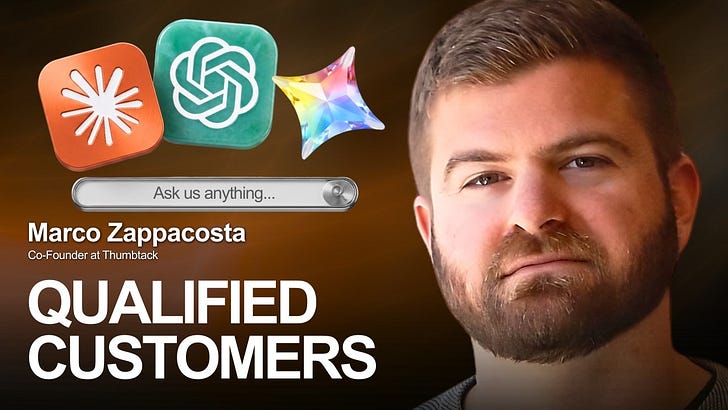
Marco Zappacosta, co-founder and CEO of Thumbtack, joins NEW ECONOMIES to explain why Google search volume has reaccelerated to an all-time high post-ChatGPT, why the customers now converting through AI chat are more qualified and further into their decision than any channel Thumbtack has seen before, and why marketplaces for hiring humans, unlike commodity marketplaces such as Uber or food delivery, are mediated by certainty and confidence rather than speed and price.
About Thumbtack
Thumbtack is a technology company helping millions of people confidently care for and improve their homes. Every day in every county of the U.S., people turn to Thumbtack to complete small fixes, routine maintenance, and major improvements. With over 12 million 5-star projects and counting, they help homeowners and home professionals accomplish more.
Watch Now: Marco Zappacosta - co-founder of Thumbtack
We also cover why word of mouth, not a competitor, is Thumbtack’s biggest threat, capturing 80% of home-services demand through calls to neighbors and posts in group chats, and how LLMs are finally solving a personalization problem Thumbtack couldn’t crack in 20 years, replacing one generic question set per category with fully bespoke, project-specific questioning, using Marco’s own Murphy bed installation as the test case. We get into why almost no startup has survived in a marketplace category with close to a trillion dollars of spend, and what half the Thumbtack product team is now rebuilding around AI.
We close on the interface shift Marco almost missed, voice, not text, the board seat he still wants to fill, and where he expects human-capital marketplaces to go over the next 20 years.
This was a fascinating episode! Available everywhere you listen to podcasts.
Watch or listen now across YouTube, Apple Podcasts, Spotify, and X
Download the transcript 👇
Timestamps
(0:00) Meet Marco Zappacosta(1:57) Thumbtack Turns Nearly 20(3:00) Why Marketplaces Are Challenging(6:30) Thumbtack's First 12 Months(8:57) How Thumbtack Uses AI Today(17:34) The Ideal Customer Profile(19:18) How Homeownership Is Changing(24:09) Why Experts Have High Expectations(26:55) Building Trust With Users in Today's Environment(29:03) Experts Communicating Offline(30:54) Tensions With Marketplaces(33:12) Integrating AI Into Thumbtack's Complex Stack(38:42) Where and How to Place Bets(42:04) The Next Big Opportunity(44:29) How Marco Runs Thumbtack(51:02) What Is Still Yet to Be Achieved?(52:14) Rapid Fire
Our notes from this conversation
1. AI customers convert better than search customers ever did.
Post-ChatGPT, Google search volume for Thumbtack-relevant categories has reaccelerated to its highest point ever, but the more telling shift is on the AI side: users arriving via ChatGPT or Claude are more qualified, more motivated, and further into the decision than a typical search customer. Volume is still low, but Marco is treating it as the leading indicator for how discovery gets rebuilt.
2. Word of mouth, not a competitor, is Thumbtack’s real adversary.
80% of home-services demand still flows through a call to a neighbor or a post in a group chat. Marco sees the AI moment as the first real chance to intercept that demand before it disappears into an informal network Thumbtack can’t see or monetize.
3. Hiring a human is not a commodity purchase.
Marketplaces like Uber and food delivery compete on speed and price because the average basket is under $50. Home services average around $1,000 per purchase with real consequences for getting it wrong, so the decision is mediated by certainty and peace of mind, not convenience.
4. Marketplaces are brutal to bootstrap — and that difficulty is the moat.
Despite near-trillion-dollar category spend, almost no home-services startup has survived alongside incumbents like Angi and Yelp. The same friction that kills most entrants is what protects the few that break through to compounding scale.
5. LLMs are solving a 20-year personalization problem overnight.
Thumbtack historically applied one generic question set per project category, fine for common jobs, useless for anything niche. Marco’s own Murphy bed installation became the test case: an LLM asked the right follow-up questions instantly, something no static form could match at that level of specificity.
6. Half the product team is now rebuilding around AI.
Marco describes the integration as touching everything, core matching, the customer and pro experience, pricing, refunds, monetization. It’s a ground-up rebuild, not a feature bolted on top.
7. Voice is the interface shift he almost missed.
Asked what he’s changed his mind on in the past year, Marco points to voice as input and output, not because it’s novel, but because it removes typing entirely for how his kids and Thumbtack’s pros interact with technology. He doesn’t think it kills the keyboard, but expects it to sit alongside it as a default mode.
The board seat he still wants to fill: a technologist.
His current board covers CFO, CEO, and COO backgrounds, but he’s missing a product-obsessed technologist, someone in the mold of Snap’s Evan Spiegel, to pressure-test where AI takes the product next.
Links
Follow Ollie on X - https://x.com/ollieforsyth.
Follow Marco on X - https://x.com/mlz.
Visit Thumbtack - http://thumbtack.com.
Partnership: Harmonic is the go-to startup database - https://harmonic.ai.
Partnership: Hostinger is as a go-to tool for builders. Subscribers receive 10% off here - https://hostinger.com/neweconomies.
Previous episodes include
See all previous episode here 👉
If you enjoyed this episode, help sustain our work by clicking ❤️ and 🔄 at the top of this post.