Ask ChatGPT

 Brand Master Podcast
10 Aug 2026 · 53m · 20 chapters
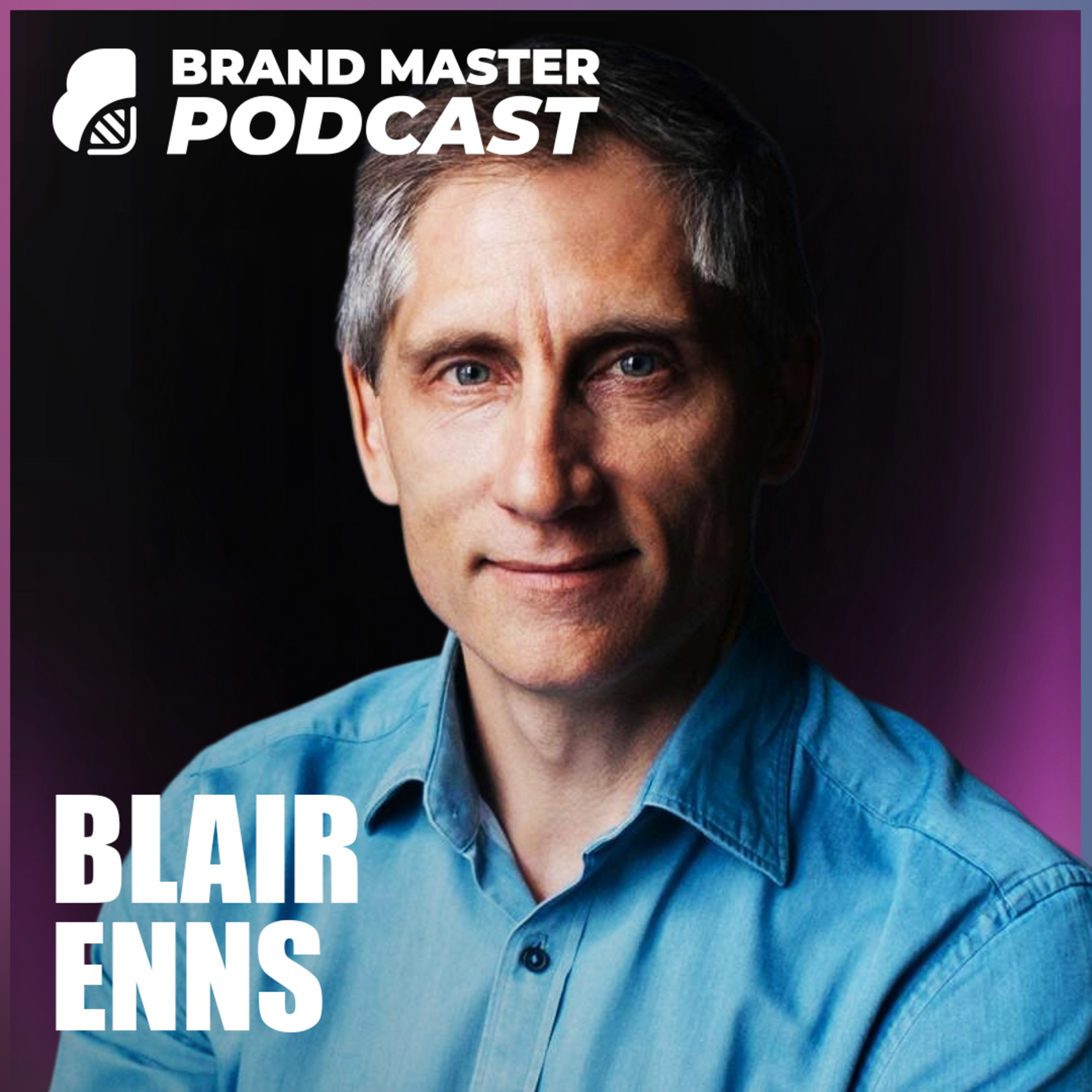
How to stop “selling” and instead be perceived as an expert (not a vendor) before pricing. Blair Enns argues that in expertise sales, the sale itself is a sample of the engagement, so authority and restraint must be demonstrated early. He outlines a four-conversation model (probative, qualifying, value/pricing, closing) and claims effective closing is offering 3–4 options with pros/cons, not one take-it-or-leave-it proposal.
clients decide vendor vs expert before price; neediness repels; authority comes from reputation-building; confidence comes from options or deeply held beliefs; lead-gen should “climb the ladder” from sales outreach to marketing to educating content.
Blair Enns, author of Win Without Pitching (2010), and Pricing/related works; runs training/workshops on selling expertise.
doctor analogy (don’t act needy or pre-sell treatment); “say what you’re thinking” malpractice example; handwritten mailed outreach beating AI/automation; “limit capacity” to force confidence via occasional “no.”
Written by AI. May contain mistakes.
Discover how the landscape of creative firms has shifted towards specialization and the implications for professionals.
Explore the importance of authority and restraint in sales conversations and how they affect client perception.
“And then you have the undifferentiated generalist who is still living by the old rules from an older time.”
Understand the dynamics of being perceived as a vendor versus an expert in client interactions.
“And that kind of blew my mind when it came to the offer because I spent so much time trying to convince and sell the value of what we did, the processes.”
Learn about the four conversations framework that helps in establishing authority and guiding client engagement.
“So if you're going to sell that way, then prepare yourself to occupy that place in the relationship.”
Learn how to effectively embody expertise during client engagements.
“And then while you're following the framework, you simply embody the principles.”
Understand the four essential conversations in the sales process.
“So it's about what you do in advance, and then it's about how you show up in the moment.”
Discover the importance of positioning and lead generation in sales.
“come back and say, listen, I've got three different ways we can do this at three different price points.”
Explore the different levels of lead generation and their effectiveness.
“Where are you going to play and how are you going to win?”
Learn strategies for effective and respectful lead generation.
“Write the definitive book on your area of expertise.”
Learn how to approach lead generation as a daily practice rather than a campaign.
Discover how classic stories illustrate the importance of methodical work over efficiency.
Explore how authority and confidence can influence sales conversations.
Learn how creating an alter ego can help assert authority in sales.
“What would be some of the best ways to assert that authority quickly?”
Understand the four statements that can shift your mindset to become an expert.
Learn how to invoke a sense of mission in sales to gain moral authority.
“We can only do it for short periods of time, but we can all do it.”
Discover the sources of confidence and how to develop deeply held beliefs.
“I said, you take strength from a different aspect of your life and you borrow that strength.”
Explore the sources of confidence and how to utilize options in business.
“I'll call you back and tell you why you're wrong.”
Discussion on mindset before client calls and the importance of authority.
Insights into how to conduct qualifying conversations effectively.
“Qualifying questions or a technique within the idea of giving them the sample of what we do.”
Blair shares where listeners can find more information and upcoming workshops.
“There's been so much value dropped in this.”

Get the gist, explore an idea or ask about something said.
 Claude
On Brand Master Podcast, what are the key points of this episode?
Searching your listeningAutomatic transcript. May contain errors.
0:00Blair Enns: There are only two roles that you can occupy with a client, vendor or expert, and the client decides which one you are before you've said a word about the price. Now, if you get that wrong, no amount of positioning work changes the fee. In this episode of the Brandmaster Podcast, I sit down with the one and only Blair Enns. Now, 16 years ago, he wrote the Win Without Pitching Manifesto, and that book gave an entire generation of creatives and strategists, myself included, permission to stop pitching and chasing now of course he's also gone on to write pricing creativity and more recently for conversations and in our chat today we dive into why you're either seen as the expert or just another vendor and why there's no useful in between the sale is the sample principle and why how you sell predicts exactly how the engagement will go the four-line mantra to shift the perception from vendor to expert before the price is even mentioned and why the two real sources of confidence are options and deeply held beliefs and what to do if you're missing both of them so if you want to get clients to see you as the expert within the first five minutes from the man who wrote the pricing book that the world still measures itself against then don't miss this episode of the brand master podcast thank you so much for taking the time to join us today that's my pleasure happy to see everybody um so look i'm i'm just going to to jump straight into it now obviously you wrote win without pitching quite some time ago now um 2010 2010 so that's 16 years now i bet i bet you didn't feel those years going in did you
1:47Blair Enns: there's obviously a lot that's changed in the past especially in the past three to four years what are you seeing from your side since you've wrote the win without pitching manifesto because there's a there's so many fundamentals in there that are just psychology they don't change but what have you seen changed in the market over the past few years well if we take the first proclamation first of 12 we will specialize i think at the time that was um it wasn't novel but it was a it was a message that um excuse me it was a message that um maybe there was some resistance to and maybe for some people it was the um it was the first time they had heard that and now i would say the world of creative firms is fully bifurcated excuse me i was just saying it's 7 a.m here so i still have my half cup of coffee morning voice i would say the creative world is fully bifurcated in that you um on one side you have highly specialized firms that in some ways we've had this convergence of um design consulting and software engineering into these really niche businesses and now you add ai to that really really niche so it's this ecosystem of highly fragmented niche businesses that that um as soon as google search came out it was pretty obvious this is everything was going going to go and then you have on the other side you have typically larger ad agencies you have typically larger larger ad agencies um but other creative businesses that are uh not specialized at all and i was um reading a post and comments my uh friend and podcast co-host david c baker was commenting on some ad person's uh comments about free pitching and how agencies suck at pitching and there's this big discourse on how agencies could get better at pitching and and i was watching the comments like he he was obviously weighing in on not not on my behalf but kind of on the from the win without pitching point of view like what are you what are you doing trying to cajoling agencies trying to get better at free pitching the best of bad practices are still bad practices as i'm fond of saying um so i see this fully bifurcated world where you know 16 years later you have highly specialized firms many of whom most of whom have this power they're not They're not caught up in free pitching.
4:22They're not giving their thinking away for free. And then you have the undifferentiated generalist who is still living by the old rules from an older time. I think that's the most pronounced difference.
4:33Blair Enns: Yeah. Yeah. I do see, as I mentioned before, we had David Seabaker on the podcast quite some time ago. And I do see his comments pop up in LinkedIn. I love the way he just goes in gloves off and just mixes it up. It's, it's, I call him the last, he's the last human on LinkedIn. He's the last one who is like an actual human showing up as his actual self. If you look at the content on LinkedIn now, you can see almost all of it is either been created by or edited by run through AI. That's so funny. I actually came across a post the other day and I had to repost this. So it was a post about not using AI because it removes authenticity.
5:26Blair Enns: And it was clearly written by AI because it had all the cues. And all of the comments were agreeing that you shouldn't use AI and they were clearly written by AI. And it's just mind blowing. That's where we've gone at the moment. But yeah, David is a breath of fresh air in there. He holds no punches and he's quite entertaining. As you know, only too well, Blair. Yeah. Now, one of the things that I absolutely love everything got to do with psychology when it comes to our field. And one of the things that really stuck with me was just how important the idea of both authority and restraint is in the sales conversation.
6:19Blair Enns: And that kind of blew my mind when it came to the offer because I spent so much time trying to convince and sell the value of what we did, the processes. just how important is that authority and restraint and how much weight would you put on that versus the offer well starting with authority i'll make a generalization as i do in my latest book the four conversations i say there they're only two occupy two roles that you might occupy in your relationships with your clients and your prospects and that is you're either seen as a vendor just another vendor or you're seen as the expert now that's a that's a general what i think is the healthy or a helpful generalization really those are two different endpoints on a spectrum but i think we benefit from thinking of it in binary terms we are either if we're not seen as the expert then we're seen as just another vendor and so that's the authority that you speak to and in in that i don't mean to keep plugging this book but it's um in that book the four conversations a new model for selling expertise i ask what is it about the sale of expertise that requires a model that's different from selling um uh products or or goods or transactional services and the answer is in any sale of expertise the sale is the sample of the engagement to follow so the sale is where the roles are established and the client tries on what it would be like to work with you the roles are established and again back to the roles there are only two roles you can occupy if we think of it this way you either establish yourself in the sale as a just another vendor with very little power in the buy sell relationship or you establish yourself as the expert and you start to take control of the engagement in the sale itself there's this fallacy that you know the way i was taught to do we didn't even call it sales it was new business the way i was taught to do new business in my agency career to the extent that i was taught at all was to give all my power away for free and lean on passion and enthusiasm and communicate my neediness give all the power to the client and it's just so with the benefit of hindsight It's just such a horrible mistake to make.
8:46So if you're going to sell that way, then prepare yourself to occupy that place in the relationship. That's why authority is important. And restraint is kind of tied to that. Authorities, experts, they're not overly effusive. If you go in to see, let's say you've got a serious medical condition and you're looking for a new doctor and you go into a first meeting with the doctor. And you imagine the doctor says, oh, I'm really, I'm so glad you're here. I'm really, really passionate about your health. I'm really, really looking forward to helping you. What's your reaction? It's an unfortunate truth that human beings are repulsed by neediness.
9:32It's sad, but it's true. So when we show up needy, even overly enthusiastic, we put the client back on their heels.
9:42Blair Enns: Yeah. I love the analogy of the doctor and the idea that a doctor would pre-sell you a treatment before they've even discovered what's wrong with you. And that's what so many of us do. And, yeah, I had the same experience with you as you in sales because I used to be in direct sales and I was very good at it. However, if I had have had a consultancy approach, a curiosity approach and kind of reduce the neediness, I would have been so much more successful. And I saw that in hindsight because I didn't understand why my experience in sales didn't translate into the consultancy world because it didn't.
10:32Blair Enns: All I did was communicate that neediness. Coming back to what you said before, if you're not seen as the expert, then you're just seen as a vendor. For everybody in the room and everybody listening, the question is obviously, well, how do we do that? Yeah, how do you? so first of all there's the work that you do in advance of the first conversation so i'll come back to this model it's and it's what we teach in all of our training the four conversations is that what yes okay so the the idea is that you view the sale as a series of four linear and discrete conversations now as somebody famously said all models are wrong some are useful so i'm not saying the sale happens in a series of four linear and discrete conversation i'm saying it can be helpful to think of it that way okay so the first conversation i call the probative conversation and that's really a construct of a conversation it's the conversation that happens between you and your prospect through your agents you don't have it directly it's the conversation that happens without you present through your agents typically of thought leadership and referrers i missed the name i missed the name of it the probative conversation and so probative it's about proof it's about proving your ex so the every conversation each conversation has an objective yeah and each conversation has a framework or a set of frameworks for navigating to that objective okay again the probative conversation it's this construct of a conversation it's it's your agents of reputation building that precede you and they accomplish the objective of the conversation for you without you talking directly to the client.
12:21The objective is to move in the mind of the client from that position of powerless vendor to that of the expert. So how do we show up with authority and restraint? First, we build authority through all of the usual mechanisms of reputation building. So that's typically proving your expertise in the public domain in some way, creating content, having your clients say good things about you. And there are other things you can do, but those are the two main ones. And then once you're into the sale, you're into the second conversation, the first person-to-person conversation. Now, this is the qualifying conversation.
13:03This is the vetting. So in the qualifying conversation, you're qualifying the client to see if there's a good fit here. the client's qualifying you to see if there's a good fit on their end if you've had a probative conversation and that objective has been reached then you're already largely qualified they will still have questions for you but how you how you behave how you navigate to that objective of qualifying the client to determine if there's a fit here suitable enough to take the next step how you do that that's the second part of authority and restraint and so you do that by following a pretty simple framework but you also embody certain principles so it's a model of frameworks and principles for conversations each conversation has its own objective you use a each conversation has its own framework for navigating to that objective how do i do this How do I vet the client to see if there's a bit here?
14:02And then while you're following the framework, you simply embody the principles. And most of the principles are the principles of how any expert should show up in any engagement. And because the sale is the sample, then therefore how they should show up in the sale. I'll give you an example of one principle. Say what you're thinking. so if you're if you are um service oriented that's not a bad thing but um you don't get hired for service you get fired for lack of service so if you're certain if you see yourself as in the service sector and you recite to yourself the service sector mantra that the customer is always right then your focus is in the wrong place because you're not in the service sector, you're in the expertise sector, and the customer is usually wrong.
14:57Or at least your default assumption, when the client comes to you, self-diagnosed and self-prescribed, and they have a solution that's highly specified, they say, here's what our problem is, here's what the solution is we're looking for, here are the details in the solution. You should be suspicious. Like if you went to your doctor and said, I have this pain in my chest, I need quadruple bypass surgery right the doctor might think well it's just angina it's probably just angina but you're the customer and the customer's always right lie down i'll catch you open there's a word for that it's called malpractice so say what you're thinking is in that moment when you're you have you're embodying the service sector mantra and you know you're doing it because the client's talking and you have a smile plastered on your face and you're nodding yes while thinking, this is the stupidest thing I've ever heard.
15:52But your face is nodding. Why are you, and you're thinking, why am I nodding like an idiot and smiling like an idiot? Because you want the business so bad. So in that moment, the principle is say what you're thinking. You should remember that just like the doctor, you have a professional obligation to this person. So if they say, I think my problem is X and my solution is why, and you find yourself nodding, you need to stop and find a way to politely push back and say what you are really thinking, because that's what the client really wants from you. So that's an example of one principle that you would try to embody.
16:29And doing that, in addition to having a meaningful probative conversation earlier on, that combination is pretty powerful. So it's about what you do in advance, and then it's about how you show up in the moment.
16:46Blair Enns: And what would that, what's the name? So that's the fourth, that's the fourth conversation is how you show up. I've got probative qualifier, person-to-person qualifier principles. And then the - No, so the principles are part of, principles are throughout. So throughout you have every conversation, you have principles and you have a framework for navigating to the objective. Yep. And then you have principles that you embody as you're using the framework to navigate to the conversation's objective. So the four conversations, the first is the probative conversation. The objective is to prove your expertise and move in the mind of the client from this powerless position of just another vendor to that of the expert.
17:29And again, that's the conversation that happens without you present. So a probative conversation does not always happen. Sometimes you'll get an inbound lead, so you'll have a qualifying conversation. the second conversation, where the probative hasn't happened. Probative conversation hasn't happened. So this second conversation, we just talked about the qualifying conversation. It's the first person-to-person conversation. That's the vetting conversation. You're vetting the lead to see if an opportunity exists and determine the next steps. The third conversation is the value conversation. That's where you begin to talk about price.
18:06so you're beginning the pricing discussion and you're setting a broad price range you're not setting prices specifically you're beginning to talk in price range a big range and you're setting those prices the ends of the range based on the value to be created irrespective of any solutions that's the third conversation the key to the value conversation is you're starting to talk price without allowing yourself to talk about or even think deeply about solutions. So if the client says, well, what would you do for that? The answer is, I don't know. I haven't thought about it yet. I'm really trying to get a sense of what it is that you want to accomplish, the value that you want to create, and then how much you might pay for that value.
18:53What would you be willing to invest for us to help you create that value? And then you go away and construct your proposal and refine your prices, and you come back with the fourth conversation, which is the closing conversation. And our model for the closing conversation is a little bit different. You come back with three or four options. So your job in the closing conversation is not to close, it's not to convince, it's not to persuade. Because the sale is the sample. Should you be persuading your client of anything? I think in most situations, You should be laying out what the client's options are, and you should be talking about the pros and cons of each option.
19:36And then making sure they're informed so that they make an informed decision. Therefore, that's how you should close. You don't come back with a take it or leave it proposal where it's like one solution, one price. Pay me or don't pay me. Take it or leave it. You have to think more creatively and expansively. come back and say, listen, I've got three different ways we can do this at three different price points. And one of those price points is your budget that you gave me, the number that you said you wanted to hit. The other two tend to be higher than that. Let me walk you through the pros and cons, the details of each option.
20:13We can discuss the pros and cons. And then you tell me which of these, if any, seems to be the best fit for you. Now think of that as a way to close. That is not your father's closing conversation. That's not your direct sales closing conversation, is it?
20:30Blair Enns: No, it's absolutely not. The authority and the calmness and the restraint of that is so hugely important. And I do love the interviewer-interviewee analogy that you are qualifying whether they are a good enough fit or not for you. And to communicate that you are vetting them just as much as they are vetting you. I find that so powerful. And for the close not to be part of the first conversation as well. The separation of that, the timing of that to let everything settle so that you're not pushing that sales. It's a completely different close. On the probative conversation, although it doesn't always happen with every process, positioning does so much of that heavy lifting, doesn't it?
21:30Yes, positioning and lead generation. So business strategy, what business are you in? Where are you going to play and how are you going to win? positioning, how do you communicate your, how you're positioned relative to those who also play in that space. And then lead generation, specifically what I mean by that is you proving your expertise in a public domain, not solving people's specific problems for free on LinkedIn or something, but just putting content out there. That usually means the development of some IP or at least a strong point of view.
22:03Blair Enns: Are there any techniques that you like that can help us to elevate our profile in the lead up to that qualifier conversation. Of course, everything you said there, the content in the market, the kind of legwork that you do. But in terms of getting somebody to make that booking and to book that call, is there anything that you've seen that really kind of puts you in the best position to go into that qualifier call? Well, just think of all of the things that you could do to position yourself as the authority in your space and then rank them. And we have a model for this. It's called the ladder of lead generation.
22:46So you can take all your lead generation activities and you can rank, you can put them on one of three rungs. So at the bottom of the ladder of lead generation would be sales-based activities, direct outreach. It's at the bottom, but it's not the worst. It's just, it's the lowest status In a sales call or a DM, I can make any claim of expertise. In the middle, you have the marketing activities. So it's typically paid messages of one-to-many. So now you're making a public claim of expertise, and that's more valid than making a private claim of expertise. and at the top you have the educating based activities content marketing etc where you're proving your expertise in the public domain or you've got some sort of endorsement of your expertise so the idea is if you are an expert you should strive to climb that ladder of lead generation over time now we'll talk about what's at the top of that list the top of the ladder but everything comes with a trade-off the activities at the top take a long time so you sacrifice immediacy that's why you're not just always up here you have this blend um i think respectful outbound lead generation is i think there's a massive opportunity for it right now because we are all being inundated with crap messages generated by crap ai that crap ai is going to get better it's i mean it's getting better quickly i think the net effect is we will quit responding to these inbound messages um but i think we can break through so at the bottom i think there's a way for to do that respectively respectfully but if i get back to your question what are the things that we can do to kind of position ourselves as the expert at the top of that list, what would that be?
24:41Give a TED Talk. Write the definitive book on your area of expertise. Speak at that conference. You know that one conference where all your most highly coveted clients go to. Maybe it is a TED Talk. Publish a book. Launch a podcast. Speak on stages. Speak on other people's podcasts. Write blog posts. All of these things of position authority
25:08Blair Enns: building and and that's that's a brand builder's bread and butter um you know so so that's that's kind of everything that's that's in our lane of of expertise um in terms of i i found it interesting what you said about ai because we're all feeling it we all experience what's going on we can all see the messages and it's it's hard to know what's real and what's not and those lines are going to blur even further um when you mentioned there's a there's a kind of way to do that respectfully or a way to kind of take advantage of all of the slop that's in front of us is there something specific that you're seeing or that you have an insight that's working right now other than be real be authentic be yourself look at your inbox so there's all the crap right and the volume of crap is growing and then every once in a while you get somebody that says hey steven been following you for a while i really like these things and they're not cursory things that were just scraped from your linkedin profile like you get that all day long right um uh i saw you i i heard your podcast blah blah blah and i did this and blah blah blah you know It's like detail that is not made up, is not generated by AI.
26:36First of all, thank you. Thank you for the good work, et cetera. And then at some point, a respectful, hey, here's what I do. And here's why I thought it might be appropriate to reach out to you. If you think there's a good fit and this is what we do, this is how we help people like you. If you think there's a good fit here and you're willing to explore it, let me know. i'm happy to set up a conversation or continue the conversation and if it isn't a good fit um just i i that that's fine let me know too i just want to know you're appreciated something to that effect um i've had in our client community we've done some little experimenting on this one individual did that with email linkedin messages mailed messages and uh handwritten fountain pen personalized stationary mailed messages and guess guess what guess what won guess what shattered everything else it's the handwritten mailed messages yeah he actually batched them sent them to countries and then had them mailed individually um so and and most people look at that and go that's too much work i know this guy i have five people in my inbox today who say that they can get me 10 leads a day by using these tools of scale today it's ai yesterday it was mark just regular old marketing automation all these promises of you know so most of us are falling for the quick fix instead of here's the the nut of it and i got it from this one client i'm doing a lot on it these days is like we think of lead generation as a campaign we should think of it as a not just a habit like a practice a devotion a ritual i think it should be one message a day five days a week where you take like up to half an hour to craft one message for one person and the act itself is the reward where it's like and so you're you're putting gratitude and dedication out into the world and if you get no business from it you still keep going because you are bettering yourself and you're bettering the world through these messages
29:13Blair Enns: yeah absolutely there's uh there's a lot to be learned from the old messages i the the old strategy sorry i actually posted something uh this i don't know if i've posted it yet or it's it's it's pending but i i still read my my girls uh books in the evening and And last week I read The Three Little Pigs and the whole concept of building the house of straw and doing things for the sake of efficiency as opposed to doing things in the right way. is just so applicable today because people are using efficiency to try and get to where they want to go and ending up somewhere completely different rather than you know doing things in the right way slowly methodically um you know to get to to where people want to get to to where they want to go and everything you've said about the cutting through the noise and that that sense of appreciation i don't know if you were thinking about my outreach as you were talking about the messages but i definitely noticed how much you appreciated the outreach when it came um so it says that that that kind of um outreach is still working it can still work um we we spoke earlier about taking control of the the the conversation um and obviously there's a lot in your book i can tell sorry before we go on and i'm sure we'll circle back to it later what is the name of your book for anybody listening and is it available at the moment to buy yeah it came out in december of it's it's been out for just over a year so last year december of 2024 i think okay it's called the four conversations a new model for selling expertise so if you've read the win without pitching manifesto this would be the 16 year 15 year later here's how to follow up right the vintage the vintage one um well it's the detail like the the manifesto is a yes you can book this is a here's how to book right right well clearly there's just based on the the overview you've given us there in the four um conversations there's there's so much um so much value to be had in those so it'll be definitely uh taking a closer look at that in terms of of authority which i i know from from experience the difference a conversation um the difference on a conversation that that kind of authority uh and taking control of that conversation compared to the neediness and the chasing what have you found are the the top let's say one two three ways that you can assert that authority even if let's say you're low on confidence let's say you don't have let's say you're just somebody who struggles with confidence you might be an expert you might have have you might know your your your craft you might know how to do what you're doing you might just have low confidence?
32:20What would be some of the best ways to assert that authority quickly? Okay, I'll give you two ways. So the first one came from a client of ours in training. And I talked about this in a podcast, a two bobs episode called you contain multitudes. And so I was leading a training session talking about some specific approach to navigating through the sale and if you're um this is an approach to bring your expert self to the sale and drop your salesperson persona but if you've been if you have a history of behaving like a vendor you try on some of these approaches some of these techniques or ideas and you think oh i can't do that because and that's simply the conflict with how you've you know this is how any expert would behave this is how you should i i would ask you to behave in the moment and if your pattern of previous behavior is your is more vendor like you might have a hard time with it so we had a woman in um in our training session and she said um she said i can't do that she she said i'm midwest nice that's a u.s thing i don't know what the uk equivalent is of being like oh i'm from i'm from this place we're really polite she said but chuck finley can do that and i said who's chuck finley she said he's the alter ego i created for moments like this i can't do that but chuck finley can so she brings forward this personality this chuck finley now you don't have to go so far as to create an alter ego um people will sometimes say to me when we're talking about a technique or a way to a way to ask or a question to ask even as simple as that somebody might say to me i can't do that that's not me and my my answer is bullshit it's all you we you if if i got to know any one of you i would get to see eventually i would see all these different facets of you like a diamond right but there's one facet of you there's one version of you that is the dominant version that steps forward most of the time in certain situations but you you might be the tough business person but the caring parent the challenging friend i have a friend once um we're having a conversation and she's a business acquaintance we're having a conversation and she stopped me she said sorry can i she said i have a question who do you need me to be right now like do you want me to be a friend where a shoulder you can cry on or do you want me to be a coach do you want do you want me to challenge what you're saying it was really an interesting question and it just illuminates for me this idea that you contain multitudes there are multiple versions of you and this idea that that's not me that's just garbage that's not the dominant version of you all of us can have that dominant version move to the side and have another version of ourselves step forward we do this all the time in our life and have that person, have that version of a step forward.
35:29Now, what we can't do, what we shouldn't try to do, what it's unfair for anyone to ask us to do is to be that person all the time. Because that is energy depleting. We can only do it for short periods of time, but we can all do it. So that's the first thing. That authority person, that expert, that confident person that people want to follow that person is in you and you the person steps forward in different places and the second so on top of that in the book there's the description of the expert's mantra and it's four lines that you say to yourself it's the first principle of navigating the sale is it all starts with your mindset so if you've been behaving poorly and there's this dissonance between what the model says you might do in the situation and what you're comfortable doing it's because you have to get yourself out of that vendor mindset so you repeat these four lines to yourself and i've done podcasts on this it's in the it's in the book um i'm often asked often open speeches with it every conference organizer wants me to talk about it four lines you say to yourself before you go into that meeting i am the expert i am the prize i'm on a mission to help i can only do that if you let me lead i accept that all will not follow so we could unpack each of those four statements we can't do go deep we don't have much time here but i am the expert i am the prize recognize that if the client hires you they will be better off too if you don't see yourself as the prize to be won they will not see you as the prize to be won and that language i am the prize that comes from a great book called pitch anything says the wind without pitching guy written by oren clough so i am the expert i'm the prize i'm a deeply there we go yeah yeah yeah um so recognize the value that you bring to this engagement recognize that you are the prize to be won.
37:44If you are a narrowly focused expert, you have more alternative sources of money than the client has alternative sources of expertise, then you are in the power position. I'm on a mission to help. That's you tapping into a bigger mission purpose cause. Like the Simon Sinek thing, why do you do what you do? And if we unpacked your why, your why would be about, we all have the same why with multiple, with different variations. your why is going to be some version of personal growth through the transformation of others for reasons i don't fully understand we don't see personal growth alone as meaningful enough we have to do it by helping to grow or transform others so the variations are what do i mean about personal growth to me what do i mean about transformation for others who are those others and how do I bring about that transformation?
38:41So I'm the expert. I'm the prize. I'm on a mission to help. I'm tapping into something bigger. I like to say I'm on a mission to change the way creative services are bought and sold the world over. And in that moment, this also comes from Ormond Claff. These are the two things I've taken from that book directly. If you can tap into a sense of mission in the sale or just before the sale, you give yourself moral authority. You claim the moral high ground and it allows you to transcend the transaction, to rise above the need to sell anybody anything. Because you think of the mission as bigger. And then the third line is about detachment.
39:25So, sorry, the fourth line is. The third line is about leadership. I can't do that if you let me lead. I will not be allowed to accomplish my mission. You will not be a part of this mission if you do not let me lead. And again, the sale is the sample. If you are not allowed to lead in the sale, you will not be allowed to lead in the engagement. You can still win, but you'll do so at a higher cost of sale, lower profit margin, and with you positioned to have less impact on their client's business. So I'm the expert. I'm the prize. I'm on a mission to help. I can only do that if you let me lead.
40:00And then the fourth line is all about detachment. I accept it all will not follow. you might not be a part of this mission this might not be a good fit and that's fine i'm going to focus on the process that i'll just follow the framework and let the chips fall where they may so say those four lines to yourself before any meeting and that should move you from this vendor mindset to the expert mindset well absolutely love that there's so many applicable
40:30Blair Enns: things in there um and it actually it's right up the alley of of one of our community members phil phil winning who uh who who wrote in about that idea of kind of self-belief um is is question i think i'll ask this question now just to see if there's anything to add there but you've certainly given uh so much value in in that passage there what do you see is the one key opportunity to silence the noise so he's talking here about the internal noise and that idea of self-belief so you've given uh so many examples there of what we can do but i've imagined you've come across people who typically struggle with self-belief um it would there be anything to add to the layers that you've just given us there with somebody specifically who struggles with confidence or self-belief yeah one day david baker was driving through nebraska in a snowstorm i love stories like this any uh he pulled over he had a revelation and he pulled over and he phoned me and he said where does confidence come from and i had an answer so david and i are competitive with each other.
41:49I said, you take strength from a different aspect of your life and you borrow that strength. He said, no, that's wrong. He said, confidence comes from only two places, options or deeply held beliefs. I said, interesting. Let me think about it. I'll call you back and tell you why you're wrong. A year later, in another conversation, I said, I cannot, this is, it's brilliant. It's, that's the source of confidence. There are two sources, options and deeply held beliefs. So what do you do if you do not have those deeply held beliefs? If your parents failed you, your genes failed you, whatever, whatever life threw at you, you do not have that deeply held belief.
42:36And if you're male, you have a, you have an advantage. It's called testosterone. a biologist friend of mine jokes about this he's like loser men get up in the morning look in the mirror and and think let's go let's go win the day champion and it's the advantage of testosterone um so what are your options how do you how do you use options to increase confidence okay money in the bank gives you options, allows you to say no. A healthy lead pipeline gives you options. Now, here's a big one for the creative firms. And again, this comes from David C. Baker. Most of you shape your businesses so that you never have to say no to any new client.
43:30And what that means is you have more capacity than you do opportunity. Therefore, you're always looking for the next client and quite nervous about it. And what you should do is you should limit your capacity so that when a really good client comes to you and wants to hire you, you have to force yourself to say no from time to time and say, oh, you guys would be a great fit. We'd really love to work with you. but we are booked for the next four months so if you can wait four or five months great but if you can't i'm sorry i'm gonna have to refer you to somebody else now just try that on for a minute most of us are horrified of that so there's something about creativity that's like you don't want to say no to a bad you want to say yes to everything
44:27but you should shape your business to restrain yourself so if you struggle with confidence you should force yourself you should you can increase your confidence by limiting your capacity
44:42Blair Enns: nice does that make sense yeah i i really like that and it's it's it kind of aligns with the idea that you know if you make yourself small promises every day and keep them that builds the idea of self-esteem and that that's a great way to do that on a professional level so it it kind of forces that constraint i love your little anecdote about david pulling over in the middle of his drive and that you guys have this dynamic of back and forth it's uh it's it's uh it's brilliant um i'm i'm gonna go to uh the group because i know um uh more than likely we've got uh some some kind of questions sitting on the side so whoever has a question guys put your hand up there um and you'll have the opportunity to uh to to jump in and ask it um ask Blair directly um just on the the the sale uh sorry the what we spoke about before uh with mindset and you know you are the expert and you are the prize and then going into that qualifying uh call with that mentality um and you you want to give them a sample of of the work typically that that would come in in the form of questions and you know you would you would tend to have these these questions that uh are more potent than others do you have kind of question types or kind of any techniques within what you've spoken about there that we could apply directly?
46:19So the qualifying questions?
46:22Blair Enns: Qualifying questions or a technique within the idea of giving them the sample of what we do. Of course, we're all consultants. We ask them questions. We diagnose. But is there anything particular in there that we can kind of do to communicate that authority through the cues or through the process itself? Yeah, there can be a danger of overplaying this, of trying to over-communicate your authority. Is your doctor or lawyer trying to communicate their authority to you? No. They're clinical. They have their questions. So you have a meeting, they've got a framework that they're using, they have questions that they ask, and in a very business-like manner, they ask the questions.
47:09so that's how you can communicate authority you build like you demonstrate your work by showing it on your website right so you position yourself they've already seen your work they've already checked the box that says your work is good now at the end of a qualifying conversation so our framework is a framework for qualifying the client it's not a framework for being qualified and if you think of most creatives would not think of a qualifying conversation as a as them qualifying They would think of it as them being, they want to qualify for the client. Therefore, the term they use for this conversation is a credentials meeting.
47:46What does that tell you? It means you're going in trying to communicate why the client, trying to qualify for the client. That work should be largely done through the probative conversation. Then you ask your qualifying questions. And then if you decide there's a good fit here and they're qualified in, you would say something like, I think this is a pretty good fit here. But before we move to the next step, what do you need to know about us that you don't already know to know that there's a good fit on your end? And that client might say, well, I'm glad you asked. I have a list of questions. And what you should not do in response to those questions is pull up your keynote deck and go into presentation mode.
48:29It's going to be really tempting.
48:31Blair Enns: That's the trap. now there are two things that you it makes sense to show in that second half of the qualifying conversation and you will want to show them this visually but you'll want to be careful about how you do it and the first thing you'll want to show is any formalized methodology that you have for doing what you do so if you've codified how you do what you do there's a lot of value in that some people are quite dismissive of it and they're dismissive of it because most creative firms have the same four-step process the steps all start with the same letter the letters usually t um so it's like yeah it's the same as everybody but the four steps are basically diagnose prescribe apply and ongoing reapplication is necessary so everybody follows those four steps but then there's differences within that but when you can show so the client will ask a question about like, how does this work?
49:28You want to be able to answer this with, well, let me show you how it works. Here's a model of like, here's a visualization of the journey that we will go on together. And then they might want to talk about specific outcomes that you've achieved. And then the second thing it might make sense to show is case studies. And the important thing is if you can take your before and after case studies and if you can cut them up and reassemble them in a way that they mirror or follow your four-step process or whatever the steps are. That is highly reassuring to the client. Because everybody can show their model that they made up.
50:10But when your case studies prove that you actually work this way, there's a message that you communicate that the client infers. and that is little variability in process equals little variability in outcome. Do you actually work this way? Okay, I can see the consistency of your approach leads to consistent outcomes. That is highly reassuring. And that is a principle that's poorly understood.
50:36Blair Enns: Blair, it's been an absolute blast. There's been so much value dropped in this. and where can people find out more about you other than the usual channels, LinkedIn? And do you have anything coming up at the moment that we can share a link to? Yeah, thanks. So I'm on LinkedIn. I've been pretty quiet so far in 2026. I'm not sure the jury's out on. I'm always there. I'm just a little quiet. WinWithoutPitching.com. I have some training coming up. we're doing a two-day workshop so we have our fundamental training is the win without pitching workshop it's delivered um online in person and online like asynchronously we have a online workshop march 3rd to 6th and we have in london a two-day workshop february 25th and 26th and i run a monthly kind of light snackable training if you've read the book and you want to get some training directly from me um every month it's called the the conversation it's the first wednesday of every month you can learn more about it it's the conversation on selling expertise every month it's a different conversation next month it's on lead generation you can learn more on winwithoutpitching.com i've really enjoyed this steven and everybody thank you thank you for your questions i'm sorry we didn't get to more of them but enjoy the chat it's been an absolute the value has been second to none really um and like we we've spoken to some some greats on the show uh this has been truly valuable thank you so much for uh for taking the time to uh to join us and uh we will see you in the feed yeah great thanks everybody cheers thanks blair thanks everybody we really hope you enjoyed today's episode thanks so much for listening if you want to learn more brand strategy techniques to level up your skills make sure you check out brandmaster academy.com there's plenty of free resources and premium content for you to download and get you going if you enjoyed this content please be sure to give us an honest review on itunes stitcher or wherever you listened and make sure you tune in for the next episode of the brand master podcast
Selling expertise is changing. Blair Enns reveals why traditional sales tactics, free pitching, and proving your value can actually weaken your position—and why the sale itself should be a sample of the client relationship to come.
You’ll learn: