In short
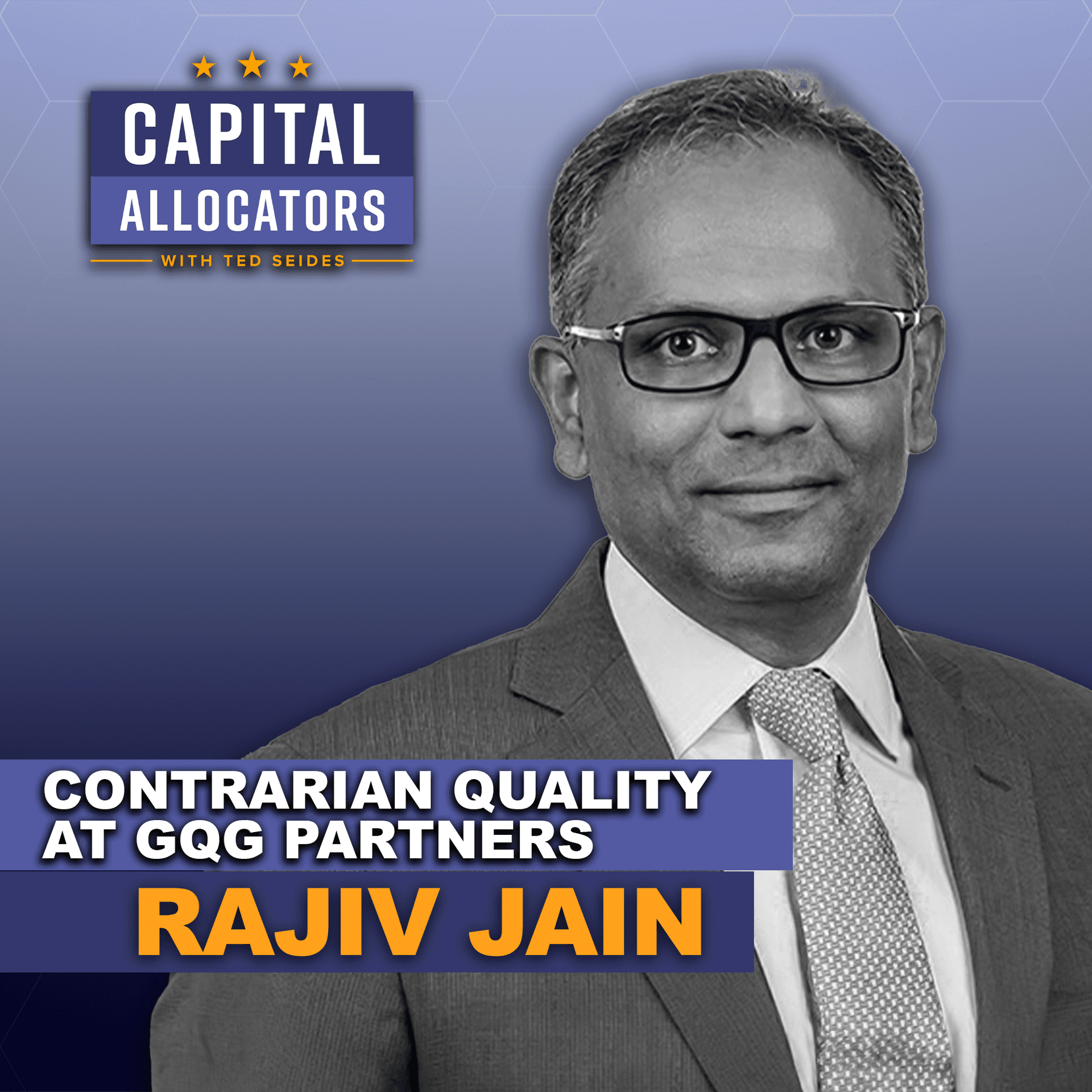
Rajiv Jain, chairman/CIO of GQG Partners, argues that “quality” is defined by barriers to entry and forward-looking durability, and that today’s AI “MAG” economics are lopsided: massive capex with weak free-cash-flow and pricing power.
Guest background
Rajiv Jain is the founder (2016) and CIO of GQG Partners, a global equity manager. He previously spent years at Vontobel (portfolio manager/CIO for emerging markets) and built his process through repeated crises (Tequila, Asian crisis, dot-com, 2008). GQG grew to about $160B AUM.
Key claims
Top-down macro should be a risk-management “switch off,” not a “switch on.” GQG hires “journalists” (ex-investigative journalists) to take the opposite view by default. Quality = high barriers to entry (steel, energy infrastructure, tobacco) and forward-looking barriers, not low-barrier software/semis. AI compute is subsidized and time is not a friend; returns on AI capex should be lower than expected.
Notable examples
Google (2004) cited as high free-cash-flow/operating margins; OpenAI/Anthropic/X.AI described as low revenue vs huge investment; energy/LNG and utilities framed as underinvested with high yields; mistakes include exiting semiconductors in Oct 2022 and airlines during early COVID.
Written by AI. May contain mistakes. Listen to the episode to check what was said.
Chapters
Tap a time to open that second in VOAI Market Analysis and Capital Expenditure
0:00 to 1:10
Learn about the staggering capex in AI and its financial implications.
“The cumulative capex of all these MAG companies in their history is$1.5 trillion.”
Podcast Dynamics and Fairweather Fans
1:42 to 3:38
Discover insights on team support dynamics and the role of podcast guests.
“his definition of quality, team dynamics, and portfolio construction to avoid losses.”
Podcast Dynamics and Fairweather Fans
4:25 to 5:48
Discover insights on team support dynamics and the role of podcast guests.
“Expert calls have always been one of the most powerful ways to build conviction.”
Rajiv Jain's Early Career Influences
6:48 to 10:01
Understand Rajiv's early experiences that shaped his investment career.
“I'd love you to take me back on your early influences that got you involved in business.”
Investment Philosophy Evolution
10:01 to 11:36
Learn about Rajiv's evolving investment style and strategies.
“and report because there was no internet, no email in those days.”
Resurrection of the Fund
11:36 to 14:00
Discover the challenges Rajiv faced and how he turned around the fund.
“One crisis after the other, as I've evolved over the years, it's become where top-down is a risk management tool and we use it heavily.”
Resurrecting the Ship: Investment Challenges
14:00 to 17:34
Learn about the strategies employed to recover from significant asset losses.
“What do you think at that point in time?”
Lessons from 2008: Mistakes and Adaptations
17:34 to 19:15
Discover key lessons from the 2008 financial crisis and their impact on portfolio management.
“How did the various challenging times impact how you adapted thinking about managing the portfolio?”
Building GQG: A New Investment Approach
19:15 to 22:50
Explore the motivations and strategies behind founding GQG Partners.
“You learn a lot in living through one crisis after the other.”
Defining Quality in Investments
22:50 to 24:25
Understand the concept of quality as it relates to barriers to entry in investments.
“The last one was separation of management of the business versus managing the investments because I was co-CEO at Montevideo at the end and CEO is a different job.”
Show all 30 chapters
Navigating Cyclicality in Different Industries
24:25 to 28:00
Learn how cyclical nature influences investment decisions across various sectors.
“Chinese are coming in a very aggressive way, including into semi-cap site, equipment site, memory site, the ramping up capacity.”
Evaluating Market Dynamics and Technology Investments
28:00 to 33:31
Learn about the challenges and opportunities in technology investments and the evolving market dynamics faced by major tech companies.
“Significant energy exposure from time to time.”
Diverse Perspectives in Investment Strategy
35:00 to 38:53
Explore how diversity of thought within investment teams influences decision-making and addresses current market challenges.
“Under the idea of making sure you have diversity of thought on the team, that's a sufficiently contrarian thought for a quality growth investor.”
Identifying Investment Opportunities Amidst Market Changes
38:53 to 42:00
Examine potential investment opportunities in energy and utilities while reflecting on past investment decisions.
“Our view is that the risk is far greater, but there's also opened up opportunities in other areas which are absurdly cheap for growing businesses.”
Navigating Market Uncertainty
42:00 to 43:10
Learn how market events influence investment decisions and risk management.
“And like few percentage points of the company level.”
The Art of Adjusting Investment Strategies
43:10 to 44:30
Discover the importance of adapting strategies and being open to mistakes.
“Some of this learned behavior in terms of not anchoring to your past as much.”
Decision-Making in Investment Teams
44:30 to 46:00
Explore how collaborative decision-making shapes investment outcomes.
“The users hate them, but they keep raising prices.”
Encouraging Diverse Perspectives
46:00 to 47:30
Understand the value of promoting differing views within investment teams.
“We go wherever we feel we can get high single, low double, cumulative return, even if the multiples sort of come down to historical normalized levels.”
The Role of Transparency in Investment Performance
47:30 to 49:10
Learn how transparency and accountability contribute to investment success.
“Otherwise, they won't because people learn quickly by observing.”
Risk Management and Position Sizing
49:10 to 50:50
Gain insights into effective risk management and determining position sizes.
“So two PM may say, we're completely out of this name.”
Investing in Emerging Markets
50:50 to 52:40
Discover the opportunities and challenges in emerging market investments.
“This business is fine long-term, we'll all be okay.”
Evolution of Investment Philosophy
52:40 to 54:40
Explore how personal experiences shape investment beliefs and practices.
“If you take a long-term view, there's quite attractive set of stuff.”
Building a Successful Investment Firm
54:40 to 56:00
Learn key strategies for growing an investment firm in a competitive landscape.
“That's assumes oil is 75 bucks, not 120 bucks.”
Building a Performance-Oriented Culture
56:00 to 57:10
Learn how a focus on performance and client service drives success.
“We do have a fairly performance-oriented culture.”
The Decision to Go Public
57:10 to 58:49
Understand the benefits and challenges of transitioning to a public company.
“If you look at historically or my career, the periods of crisis have helped propel us to the next level.”
Navigating Size and Market Position
58:49 to 1:00:50
Explore how size affects investment strategy and decision-making.
“It's funny because we had a good familiarity with Australia.”
The Importance of Above-Average Performance
1:00:50 to 1:02:31
Discover why delivering superior investment performance is essential.
“There was a big hedge fund boom in the late 60s.”
Managing Client Relationships and Expectations
1:02:31 to 1:04:24
Learn how to handle client communications during volatile market periods.
“There's no question that stress builds up.”
Lessons from Cyclical Businesses
1:04:24 to 1:05:21
Examine the risks of investing in cyclical companies and maintaining discipline.
“we'll do okay if the bad times do happen.”
Final Reflections and Personal Insights
1:05:40 to 1:08:04
Gain insights into personal growth and investment philosophy.
“What was your first paid job and what'd you learn from it?”
Transcript
Automatic transcript. May contain errors.0:00The cumulative capex of all these MAG companies in their history is$1.5 trillion. Think about it. Now they're talking about$3 trillion in just three years. So these businesses are created with not much capital. You're spending$1 trillion a year and the revenue on AI talk about maybe$70,$80 billion. When Google went public, I remember it was 2004, they were worth$50 billion market cap, but they're generating$700 million of free cash flow. Very cash-generated business. 20 % plus operating margins. If you look at OpenAI, Anthropic, SpaceX, the whole different league, As the numbers start coming out, then the realization happened that how lopsided markets are and positioning.
0:33If you look at the profitability of the area that they're growing, it's far lower. Half or more of revenue is coming from OpenAI slash Anthropic. How in the world OpenAI would invest a trillion dollars when your revenue is maybe 20 billion? X.AI, cash losses were given to double legit billions, 12 to 15. And their capacity relation on the Colossus was 11%. Now they're selling the capacity to Anthropic. Our view is that this is a powerful technology, but the economics are really bad. And time is not a friend.
1:10I'm Ted Seides, and this is Capital Allocators. My guest on today's show is Rajiv Jain, the chairman and CIO of GQG Partners, a global equity manager he founded in 2016 that soared to$160 billion in assets, rebuffing the challenging decade for active managers. Our conversation covers Rajiv's path from trading in India to his long tenure at Vauntable and founding of GQG. We discussed the periodic crisis lessons that shaped his approach, his definition of quality, team dynamics, and portfolio construction to avoid losses. We then turned to Rajiv's contrarian views, including current significant positions in energy, utilities, steel, tobacco, and emerging markets, avoidance of hyperscalers and semiconductors, and nimbleness to change his mind.
2:08Before we get going, for the first time since 1999, the Knicks are in the NBA Finals. 27 years sounds like a long time. My twins are 20, and that feels like a full lifetime of parenting. 27 years is also half of my life. Or if you're counting, a little bit less than half. But sometimes it seems like just yesterday. 1999 was the year I graduated business school alongside some amazing past guests, like Rodrigo Bittar, Matt Botin, Rodney Comagies, Meredith Jenkins, David Lyon, Rick Heitzman, Alex Sasserdote, and Matt Spielman. When I see any of them, 27 years feels like yesterday. But there's another dynamic worth talking about.
2:56In nine years of doing the podcast, I've never once mentioned the Knicks. The Yankees roll off my tongue. But mentioning these Knicks now easily puts me in the bucket of a Fairweather fan. A Fairweather fan is one who only pays attention when their team is winning. And who doesn't love this team? They're up-tempo, team-oriented, and deep. I'm hoping they pull off a victory, even if it means both my sons get their wish of being part of a raucous celebration. A fair weather fan is often seen as momentum-driven and negative. But it's not always the case. There's no better place to be a fair weather fan than of capital allocators.
3:36Thanks to our amazing guests, we get to be part of a winning team every week. So while you're watching the NBA Finals, or for all of next year's NBA season for that matter, why not tell the person next to you to join the bandwagon and become a fan of capital allocators? Thanks so much for spreading the word. Two important points to note. In the interview, Rajiv refers to journalists. In this context, he's referring to former investigative journalists who GQG employs as non-traditional investment analysts as a part of its research team. Rajiv also states that GQG does not allow personal trading.
4:13More precisely, GQG does not permit single stock investing, though employees may personally invest in certain mutual funds, including GQG managed funds. Capital Allocators is brought to you by AlphaSense. Expert calls have always been one of the most powerful ways to build conviction. But today, investors are asked to cover more companies and move faster with leaner teams. With AlphaSense's AI-led expert calls, their Tegas call service team sources experts based on your research criteria and lets the AI interviewer get to work. Then they take it one step further. Your call transcripts flow natively into your AlphaSense experience and become searchable and comparable, so your primary insights plug directly into your earnings, diligence, and pitch book workflows with no tool switching.
5:01AI for coverage and efficiency, humans for complexity and conviction. Sounds like just the right mix to create a scalable institutional edge without growing headcount. For hedge funds, this means validating thesis assumptions before earnings across dozens of experts instead of a handful. For private equity, it means faster pre-IOI scans and deeper commercial diligence. And for asset managers, it means pulling real operators' perspectives straight into models without disconnected tools or manual handoffs. All of this lives inside the AlphaSense platform, turning raw conversations into comparable auditable insight.
5:40The first to see wins, the rest follow. Learn more at alpha-cents.com slash capital. Capital Allocators is also brought to you by SRS Aquium. Want to make sure your M &A processes aren't stuck in the past? Partner with a company that's been defining the future of dealmaking for nearly two decades instead. When it comes to M &A innovation, SRS Aquium has reshaped the way that deals get done, streamlining processes for maximum efficiency and minimum headaches. Professional shareholder representation, online M &A payments, digital stockholder solicitation, SRS Aquium pioneered each and continues to set the bar for game-changing innovation.
6:29So leave the days of disjointed deal management behind and define your future with SRSAquium, the smartest way to run a deal. Learn more at srsaquium.com. That's S-R-S-A-C-Q-U-I-O-M.com. Please enjoy my conversation with Rajiv Jain. Rajiv, thanks so much for doing this. Thanks for having me, Ted. I'd love you to take me back on your early influences that got you involved in business. The earliest one was in high school. During one of the summers, the 80s, there was a lot of those things to keep you busy. And I was in India. My dad was trying to keep me busy. In those days, you get physical certificates, stock certificates.
7:13He had his portfolio and a few names. You get a dividend in mail check. Problem is sometimes they didn't come in. So how do you match? That's how I started tracking these things. I started trading in high school, classic punting, basically. Not much thought, but trading. How'd you go from that to learning what these things were behind the pieces of paper? In college, I got heavily engaged. Ended up doing my undergrad and grad fairly quickly. I was 20 when I'd done my master's. I was very busy in trading in college. You had to go physically to a broker. I remember everybody was maybe 55, 60. The broker said, I need to talk to a dad.
7:50What the hell are you doing here? Do you see people around you? That's when I started reading and learning the tricks of the trade. What was the impetus for going through school that quickly? I was keen on getting into the business. It almost was a nuisance factor. I need to do this because otherwise nobody would hire me. So that was more the driver rather than anything else. How did you take that and turn it into a professional career? There was no industry as such in India at that point. I was in Delhi working for an export-oriented firm, doing the paperwork for them, which was an interesting experience because if you're doing documents for exports, you learn the drudgery of what proper paperwork means.
8:26I'm going to do dozens and dozens of bill of lading. You can't have any mistake. And you fill out precisely. And the bank will reject for any given reason. Which was one of the biggest learning experiences you forget as an analyst is that things have to be in a little more precise manner than simply putting in a model. Or you grow at 15 % next five years and we all live happily ever after. That's when I thought about coming to US. Because there was no real industry at that point in India. What was your first break? The first break was after I graduated from University of Miami. I didn't know anybody in New York in the industry.
8:58Nobody in my family had come here to U.S. In fact, that's the second time I sat on a plane when I came to U.S. I picked up the CFA director and started cold calling people. I used to call senior people because I thought mid-level folks have no time for this. I was seeing a 24, 25-year-old kid. It was to Malcolm Klinger at Swiss Bank Corporation, CIO. He picked up the call and he said, nobody calls me, so what's your story? I said, I'm seeking advice. He said, okay, come over, I'll meet you. I said, okay, there might be an opportunity. So that's for the first break. But I called literally, I would call hundreds of people.
9:32What gave you the tenacity to do that? It's hard to say. When I'm pushed in the corner, I get more fighting spirit. It was difficult. You had to buy a fax machine. You talk to people. Anybody somewhat interested, I'd have a spreadsheet. You say, interested, chase up next. Not interested, root, don't point calling again. Difficult circumstances force you into that position. You just need a little bit of grit to keep pushing. What was your first role in the industry? It was a classic V-set analyst, doing modeling, calling up companies to get the and report because there was no internet, no email in those days.
10:06Kind of basic blocking and tackling stuff. Then building model and recommending stocks. What was your path from there to learning how to invest? I've always been a very active investor personally. I've read enough by that to literally anything, everything on investing I would read, even during college. I knew enough lingo. So now you appreciate you didn't really know much, but you knew the lingo. Well, there for a couple of years, then there was this opportunity. One of my bosses left and went to Montauble. And he said, you want to come over, which I thought was interesting in a context of it was a much smaller firm.
10:37Nobody knew the place. Three people on investment side and 15 total. What I learned once I went there was they didn't even have a trader. It was learning while on the job. I became a portfolio manager fairly early in 94, within two and a half years. Small pool, to be clear. How would you describe your style back then? It's evolved multiple times because I did not know where to start. I had a little bit of quantitative inclination. My feeling is that you're always good to have some guardrails so it keeps you out of stupid stuff. I started with building quant screens, what literature was around then.
11:08There was one element which I was going to go on, which was top-down models. I was to vouch for that, how wonderful those models are. One of the best countries and look at the best stocks quantitatively. Martin Zouye, Ned Davis type of stuff. Then came 96, 97, the Asian crisis. I was co-managing EM fund. What I found was the top-down didn't work. The reason why it was okay performance-wise was because the bottom of the balance sheet kept me alive. Fundamentals were fine, but the top-down didn't work at all. I became a 100 % bottom-up investor after that. One crisis after the other, as I've evolved over the years, it's become where top-down is a risk management tool and we use it heavily.
11:46It's a switch off, not switch on. It should help you reduce risk, but not add risk. In other words, if Chinese growth is good and inflation is good, you don't buy China because of that. You still need valuations and corporate earnings. If there's a macro event, the war is a big one today. Maybe you want to be careful about the risk. If interest rates are going up, inflation is going up, what are the implications of that? Back test it, see if there's any empirical evidence. We do have a heavy reliance on that quantitative element. If you don't understand that basic math, it'll be a roadkill. I have a strong belief in that.
12:17Once you had that lens, what did you found you gravitated to bottom-up? In the late 90s, because it came from the quantitative side, what works and doesn't work. The classic stuff, Buffett and Peter Lynch, you sort of grasp that that bottom-up understanding of business does matter. That becomes the core of it. The top-down element became heavy to nothing to maybe it should be a risk-off rather than on and off switch. That trajectory at Von Tobel, you start with 15 people. Some years later, it's much bigger than that. What was your path along the way? I became a portfolio manager for emerging markets in 1997, then co-manager for others in 1997.
12:58The timing was interesting because this was Jan 197. As you know, Asian crisis was six months later. Which, by the way, for some reason, I always had that interesting way of starting because when I joined Vontobel as a co-PM for emerging market, that was October 31st, 1994. A month and a half later, it was tequila crisis. I didn't really know what the hell was going on because the banks melted, they disappeared, and we had exposure. Then came the dot-com bubble. We didn't fare well on some of the international and global book. EM did better. My boss left after the dot-com bubble burst. I became CIO in January 2002, and quickly 75 % of clients fired us.
13:35The quantitative came to my rescue in a way that what fundamentally quantitative look attractive. I remember 2002, we ended up making a big bet on South Korea because there were so many of these companies selling five times earnings, like cosmetic companies and Amore Pacific and Lotte Confection, Lotte Chilsung in beverages, because it took four or five years after the Asian crisis and the earnings had come through. The business had restructured, but they were very cheap. There were these kind of bets, but the business went down from a billion, billion and a half to almost$250,$300 million. What do you think at that point in time?
14:06Your boss leaves, assets are flooding out. probably doesn't look very good. That's quite an understatement because most of the clients said, how long will it take to mend the ship? I remember one specific client out of Pennsylvania. That was the 70 % of remaining assets. So it was an important meeting. Peter asked me, how much time do you need? I said, a year and a half, two years. He said, look, we don't have that much time. You probably have six months. I've always had this issue that if pushing the corner, my view is like, let's see if there's something and roll up the sleeves and get more active in.
14:34That fighting spirits always keeps me going. It was a challenging period. What did you do in the subsequent couple of years to resurrect the ship? It's interesting because of the emerging market and Far East Tech Japan were the two products at that point. This is the early days of the Asian bull market. They had reasonably good performance, which I was running going into that. So we got a lot of traction in those after I became the PM. Almost two-thirds of business in the next couple of years was Asian emerging markets, particularly Asia. Asia was more than half of our book. That sort of gave the ability to basically pay the bills.
15:05Some of the clients would joke around that you have more products than analysts. There were two analysts and we had to restructure the team because we couldn't afford the prior ones. I remember one instance where we had shortlisted a couple of people to replace and one of the other folks who were involved in the hiring process said, who would you hire within two? I said, answer is simple. Who's the cheaper one? Because that was a reality. Gave us the first leg of growth. That gave the first base. Pulkheads came from European clients, banks, et cetera, fund-to-fund business. Then institutions came later in US.
15:35Then slowly international took hold as the performance turned around and global. There was one product after the other, which had different cycles. From 2002 to 2016, somewhere along the way, you hit 2008. What happened in that particularly difficult period of time? You always learn from mistakes. We had significant banking exposure from 2002. Fannie Mae, Freddie Mac, AIG in Europe, Anglo-Irish Bank, and all the large positions. I got nervous in early 2007. So we had exited all our banking exposure and financial exposure. However, we had a lot of energy. So very bullish on energy and commodity.
16:09The whole thesis about decoupling didn't connect the dots at all. Come September, markets sold off almost double digits post-leaven. Within two weeks, it had fully recovered. I had too much energy exposure and that became a disaster because that melted by October. I remember Shuramiji was down more than half in a matter of like weeks. I've used it at the end of the day. relative is fine in an up market, but over the long run, if you don't have absolute returns, nobody needs you. You don't pay bills with relative performance. In a bull market, everybody thinks a relative, but if you want a long-term survival, you need an absolute orientation.
16:41That was an unhappy setup because I recognized the financial issues, but didn't connect the dots on the energy side that how significant impact would be across everywhere else. We obviously lost a lot of assets and we continue to grow from there on. It was a huge lesson in terms of how it'll ripple through. For example, if you look at today, one thing is fascinating is that cyclical parts of markets have done the best. I wouldn't have predicted that Caterpillar would be selling at higher multiples than Intuitous Surgical. Abbott Lab is selling at 14 times earnings and SAP is 14, 15 times earnings and have Siemens at 28 times earnings.
17:21High rising inflation. On top of that, you have the biggest oil crisis almost ever. How much do you want to connect the dots? You could be very early. It's better to be early than trying to time it. Once things find a catalyst, it happens. If you're running any size and scale, you won't be able to exit in a timely manner. How did the various challenging times impact how you adapted thinking about managing the portfolio? You want to make sure that there's enough diversity of thinking in the team. You're never on a team that agrees with you 100%. Huge mistake. Because it simply will cheerlead you.
17:54That allows you to at least have the other. Reverse, in my opinion, it's the uncomfortable other. The biggest lesson in 2008 was, there are plenty of articles in the press about the mortgage crisis. Remember, there's a Business Week article, how toxic is a mortgage a year and a half before the crisis happened. It's the cover of Business Week. There are plenty of articles of mortgage bubble. Wall Street was in complete la-la land. AIG went under, and the lesson was, let's talk to the analysts or journalists who are predicting this, which was the starting point of hiring journalists. Now we have an equal amount of journalists and traditional analysts.
18:28Their job is to take the opposite view by default. Journalists are pretty good at that. I've learned a lot hanging around with journalists. Half the team is journalists who basically criticize everything we do and their compensation is structured that way. Otherwise, if you structure the comp where they agree, it's wonderful, it works, guess what will happen? They'll agree with you. You want to structure the compensation where actually by default, they cannot agree with you. They simply measured based on their calls over the long run. That was the biggest lesson. And since 2010, in Montoya or here, we hired a group of people who essentially take the opposite side.
19:00By the way, it makes everybody very uncomfortable still to this day. If you're bullish on a name and the other side says these are the negatives, they would operate in context of former employees or regulators, former regulators. As you rebuilt this from these difficult times, what led you to leave and start GQG? You learn a lot in living through one crisis after the other. I didn't think that way, but I feel that way more now that I was fortunate. I learned to live through a lot of crisis in the early days. If you're running a US book in 90s, it was one way speed till 2000 came along. If you're emerging in 90s, it's one disaster after the other.
19:3594 tequila crisis, and there was a mini Brazilian crisis in 95, then Turkish crisis, then Russian collapse, Asian crisis, one after the other. You learn a lot. I'd build a team there. Business was fine. but there's always the desire to do something different. Number one is what would I do to build something afresh? It was not motivated by money, nothing wrong with that. Can I do different, something better? I'm a classic stock junkie. People ask me about hobbies. I don't have any hobbies. I don't golf. I never had a boat. It's just a lot of fun. It's a puzzle. Can we do something afresh with a clean slate?
20:08Because when we start a client, say, what would you do different? And I said, these are the positives that I would keep, but these are the negatives that I will try to address. What were those? Positive or fine, right, in terms of core structure of the process. But for example, if you look at on the team side, I build out the team of fresh young folks and train them. Well, there's one negative of that. If the team has grown just with you, they're gonna think like you. What are the chances somebody's lived with you 15 years is gonna disagree with you? None. So when we launched, I said, you're gonna hire, that's why I don't wanna hire the same team again.
20:39First of all, I wanna preserve their business because I felt like I built a cathedral, I don't wanna burn it down. From a client perspective, is a little bit unfair because why should clients be impacted? And a lot of clients actually thanked, they said like it was poorly separation. So their business did fine for multiple years. I did tell my successor there, you'll kick my ass or I'll kick your ass, but it'll be fun competing. I don't want to bring anybody else. The team side, when we hired, we hired a lot of folks from the long short world, particularly folks who had experienced 10, 15 years.
21:08Why? Because I thought, what was the chance they will agree with me? None. First, they're coming from a hedge fund world. Number two is their 10, 15-year experience. That was one of the biggest differences. Second thing was, we don't allow any personal trading here. Everybody has significant skin in the game. And I understand people have sometimes different views. I've had almost all of my net worth out-value GQG in the products that clients would consume. Same exact vehicles. There were a bunch of other things in terms of alignment, how we thought about fees. For example, fees, I think what's the biggest problem in hedge funds?
21:40They charge too much. There's only so much juice in the game. These are efficient markets. This is not like 70s. Buffett can do whatever sitting, reading Moody's manual and pick up stock two times earnings. Those are long gone. Fee should be below median because that ultimately impacts the net performance, which is what determines whether we survive or don't survive. Focus on performance only and do everything to enhance performance. And that means lower the fees because it's very hard to cut down fees later on because the organization is structured that way. It's kind of like a Costco model. Manage with lower income rather than having the income that you can't cut it afterwards.
22:13On the team side, which is the biggest change in terms of structuring the team, I'll give you another example. The journalist, what I found was that they were super helpful, but once you left the country, you need cultural context. You can't have an American journalist cover Brazil or China. We need to make sure we hire to cover those markets too. Somebody who has left, who has lived there, but have an American true independent journalism. because a lot of these countries don't have independent journalism. So you're getting kind of nuanced stuff. But I think the big thing was building the team afresh, massive alignment, no personal trading, keep the costs low and keep the team small.
22:50The last one was separation of management of the business versus managing the investments because I was co-CEO at Montevideo at the end and CEO is a different job. I'm fortunate I have somebody Tim's caliber. I love to say that I have 20 people reporting to me and he has 220. So he runs the whole business, which I think is the important part of just to make sure. So those are some of the lessons. So you named the firm GQG, Global Quality Growth. What does quality mean to you as an investor? Quality is barriers to entry. If you look at this building here, there's no real barriers to entry. The restaurant across the street can be taken down and new high-rise can come.
23:27But if this building was on the beach here, there are no commercial office space in Fort Nordale on the beach. That'd be extremely valuable. So it becomes a high barrier to entry business. We are happy to own anything which has high barriers to entry. It could be steel in Europe. Cyclicality is not bad quality. Every business can have somewhat cyclicality. You go through regular cycles. In our opinion, barriers to entry is what truly differentiates what can you earn over the return on capital over the full cycle. The second part of quality is it should be forward-looking quality, not backward-looking quality.
Read the full transcript
23:59If you look at the energy business, it has become far higher barriers to business than it used to be. If you look at the pipelines, how long does it take to get any approvals? You don't have to go into Keystone, but any other pipeline. It's a much higher barrier to entry business than it used to be. The tolls can last a lot longer than it used to be. Whereas if you look at software, the barriers to entry, generally speaking, are very low. Semiconductor industry, the barriers to entry are getting lower, not higher. Chinese are coming in a very aggressive way, including into semi-cap site, equipment site, memory site, the ramping up capacity.
24:32that's a far lower barrier to entry business than what people think. One of the big lessons in investing is if Chinese are a competitor, be very careful because they will overproduce and kill you. How do you marry the notion of quality as barriers to entry in something like energy, which is also notoriously cyclical? Depending on the assets. Some of these are irreplaceable assets. If you have a big footprint in Brazil like Petrobras, those are not replaceable assets. They are profitable at$75,$80 oil with a decent production growth of 2 % to 3%. You can't replicate those assets. Energy and commodities are particularly those where it doesn't matter till it matters.
25:16If you're one middle battle short, that's the only thing you think of. You don't think of semiconductor that way. There's lower barrier to entry business too. In shale, there are a bunch of companies which don't have that high quality assets. shale depletes very rapidly, toward 20 to 30%. So not everything would be high barrier to entry. The business that have long enough tail of producing at low enough cost could be attractive proposition versus something which is like software. If you look at it, how many companies have survived in software business over 30 plus years? Microsoft is an exception and maybe Oracle.
25:53It's a low barrier to business. Semiconductors used to be, in our opinion, it is not as high quality as it used to be because everybody is getting into the game. How does management factor into your assessment? If you go back to the energy industry, even if you have an irreplaceable asset, there's a big price fluctuation. And in the boom times, you have to trust management to reinvest capital the right way, which has created all these booms and busts over time. Over the years, we've begun to appreciate how difficult it is to assess management quality. I probably meet a lot less management than I used to because I found that I'm not very good at it.
26:30You sort of a very good, but you're riding the tailwind. Let the record talk. Others meet. So we have started to differentiate again. And you don't want to have everybody in the same meeting and everybody in the same Kool-Aid. If I've not met them, chances are I'll be more critical. When people say, oh, I met the CEO and oh, he's so wonderful. Okay. That should be the base. If he's a good salesperson, you probably should be in agreement with whatever the CEO was saying. Management quality matters, but at the end of the day, numbers should still be the defining factor. What are some of the areas where you've gravitated to as quality growth that other people might not put names in the same bucket?
27:08There's a laundry list of them. It's fascinating about semiconductors who would have predicted that the whole industry would be 12, 30, 10 forward revenue. In 2022, we wrote a paper, is software the new shale? In last month, we put almost$10 billion to work in software. If you look at from the lens of what are the barriers to entry and is the outlook improving? If you look at steel, steel has become much more high barrier to entry business everywhere. Try to set up a new steel plant in Europe. Good luck. Coal, very difficult. You won't get approval. Your grandkids might get approval. We are a truly equal opportunity investor.
27:40Almost everything is fair game unless there are client restrictions depending on the barriers to entry and forward quality. Today, for example, in 12 months now, we have almost nothing in semiconductors. We have almost nothing in tech. In last month or so, we began to get excited about enterprise software. Everybody feels that the HR system would be wide-coded. Good luck with that. Significant energy exposure from time to time. And for 10 years, we didn't have any exposure for energy. Very opportunistic in that context in terms of, because the barriers into some areas are actually going up and some areas are actually gone down dramatically.
28:14If you look at capital cycles, it tells you where the longer return should be. So we let it drive that. There are a few people with a moniker of quality growth that aren't invested in some way in some subset of the Mag7 today. We'd love to hear your rationale for moving away from that in the last couple of years and what has been the golden age for AI. It's been painful last 12 months. We had significant exposure over the years. Media has been the single biggest winner in GQG's history in terms of absolute profits. The problem we see is that the Mac 7 exception is Apple. I'm meeting the Waterloo.
28:53Number one, they're forced to invest in CapEx when they never had to. Google last score had$10 billion free cash flow, clean. That's it. That's without the share buyback, by the way. These two buy$50,$60 billion, that's out of window. They have no free cash to buy. The CapEx is running at higher pace than the cloud revenue. And cloud is a very low quality business now. There are 200 plus new cloud providers. I'm coming now as a business owner. We have checked prices and we have begun to shift to other public cloud because it's cheaper. Everybody has two cloud. Public cloud is 90 % plus penetrated for large enterprises.
29:30So people say 17, 18 % which Amazon says, I don't know what numbers you're looking at. If you're going to develop markets, who's not on cloud? The second thing is the capex is going through the roof. There's no free cashflow. So the business quality is going lower, but you're forced to invest in CapEx. Number three is that if you look at the advertising-driven model, you're running close to saturation. So you talked to, for example, a couple of largest consumer staple companies in the last few weeks, and they said, look, our digital advertising is almost 9 ,500 % penetrated. We're not going to increase.
29:57In fact, we're going to shift to point of sales more, like Walmart-type stuff, advertising. This trend has lasted a long time. Digital is almost 75 % plus of the total advertising pool. These companies are 90 % plus of that. And I don't think so it's going to go to 100. Massive CapEx, no free cash flow. Free cash flow multiples are like 100 times plus. The stock-based compensation, a huge issue. So they have to buy back stock. If you look at NVIDIA, which reported, the clean free cash flow was$25 billion. How do we get to that? Well, they invested$25 billion in new startups and other investments.
30:34Instead of CapEx, that is their CapEx. NVIDIA invests in over 50 plus of their customers in the last six, nine months. Nothing wrong with that, but the free cash flow is a lot lower. It's a fantastic company with great management. That's a classic. It's a true visionary. There's no question about it. And we're big fans of NVIDIA. However, the free cash flow is now going down because you are forced to spend this money to keep the demand going. How do you think about the potential for return on those CapEx investments? It has to be lower than what people think. Because if you look at the tokens, they're currently, everybody's bleeding.
31:10If you look at the pricing on GPU rentals, it's barely covers the cost of GPUs, by the way, let alone everything else. And everything else has gone up too. Returns will be good, but you have no pricing power, which is completely opposite what used to be the case. Apple is a unique animal. So let's leave Apple aside. But if you look at the returns on these, it has to be lower because before they were capitalized businesses, not compute heavy. If you look at Google, if they had not changed the depreciation policy, the margin would be high single digits, operating margin. The margin went from 7, 8%, 23 % after they changed the depreciation policy three years ago.
31:45The question is, now this is debated, how long they last, who knows? These are far lower return on capital businesses. And Amazon, for example, their return on AI data centers far lower. On one side, you're getting maturity on their core businesses. On the other side, you're getting much more capital intensive business. The cumulative capex of all these MAG companies in their history is$1.5 trillion. Think about it. Now they're talking about$3 trillion in just three years. So these businesses are created with not much capital. You're spending$1 trillion a year and the revenue on AI talk about maybe$70,$80 billion.
32:20That's the revenue. When Google went public, I remember it was 2004, they were worth$50 billion market cap, but they're generating$700 million of free cash flow. Very cash-generated business. 20 % plus operating margins. If you look at OpenAI, Anthropic, SpaceX, a whole different league, as the numbers start coming out, then the realization will happen that how lopsided markets are and positioning. If you look at the profitability of the area that they're growing is far lower. Half or more of revenue is coming from OpenAI slash Anthropic. How in the world OpenAI would invest a trillion dollars when your revenue is maybe 20 billion?
32:57X.AI, cash losses were given to double legit billions. 12 to 15, and their capacity relation on the Colossus was 11%. Now they're selling the capacity to Anthropic. Our view is that this is a powerful technology, but the economics are really bad. And time is not a friend. So if you're trading here, different matter. But the economics are not good economics. We're going to take a quick break in the action to tell you about BipSync. One pattern I hear consistently in conversations with allocators and managers is that research and diligence workflows tend to outgrow general-purpose productivity tools.
33:38Shared drives, spreadsheets, even traditional CRMs work for a while, but they weren't built for the nuances of an institutional investment process. Trinity Church in New York is a good example of a firm that addressed that head-on. They've been stewarding capital for over 300 years, and like many long-standing institutions, they're deliberate about the partners they choose. Trinity Church sought a platform that could keep pace with their investment process and found that in BipSync. What Trinity Church and a growing number of their peers have found is that capturing and using a team's collective intelligence at scale requires a system designed for that purpose.
34:20BipSync is a system of action for investment intelligence, structured, searchable, and secure. Every insight gets captured and every decision is traceable. It's built for institutional investment teams and trusted by asset owners and managers overseeing$4 trillion in assets. The workflows, integrations, and support are all shaped by the specific demands of institutional investing, not adapted from tools built for a different industry. Learn how organizations like Trinity Church in New York are modernizing their investment research process at bibsync.com slash capital allocators. And now back to the show.
35:03Under the idea of making sure you have diversity of thought on the team, that's a sufficiently contrarian thought for a quality growth investor. I imagine you have some people on the team that don't agree with that main thesis. What's the dialogue like inside? It's been partly debated and the debate has been around a few different things. Number one is the cloud, the data isn't there. Is that runway still there or not? Now we're getting more clarity that more than half of the backlog, hence probably the revenue too, is coming from basically Anthropic slash OpenAI. If you look at Google and Microsoft, there's more than half OpenAI.
35:37Amazon is more than half. So they invest with OpenAI, but they essentially give them compute credits, which are then utilized at Amazon. We don't know for sure, but that's what really is going on. The debate has been around how durable is that? And can this become a more profitable business. The third is around as the pricing of tokens begin to go up, which it has. Does the demand sustain? Because the whole issue compute shortage, kind of a non-starter. If Starbucks starts selling coffee at 25 cents, there'll be shortage of Starbucks coffee. When you're underpricing everything, if you look at CoreV and EBS, they're bleeding heavily.
36:10That means they're not covering the cost. The real test of shortage is when you price appropriately. It's a capitalistic system. So when you subsidize something, there will be shortage. There should be shortage. Those are things that there's a lot of debate on. But I don't think there's that much debate on longer term aid from a technology perspective. Also in context of that, would it end tomorrow or last two more years? How do you think about when you might reenter some of those names? We exited 2021 extremely underweight technology. Our view is that industry was overrunning, if you look at semiconductor, et cetera.
36:45That turned out to be the right call. We re-entered as we saw the impact of ChatGPT in early days. So in 2023, we started entering some of these names again. So we have no issues getting back into these names. The question, is there a true killer app? Number two is, would enterprise truly shift to AI? Everybody's trying it. But trying it doesn't mean there's a true killer app because the real problem of hallucinations, that is not a small issue. These are probabilistic systems. That hence they're called language models. In an enterprise world, you can't use a probabilistic system. As I think it was Lloyd Blankfein, in an article in Fortune, he said at Goldman, they would run parallel systems for years because these are real numbers.
37:27You can't say, oh, it may be 80%. And they're still running at 80, 85%. You can't get to that. And we have a whole team on that. And we still find the same thing. It is not as tight. Even on the programming side, finding a lot of hallucination problem. You have to sell a lot of guardrails to make sure you get to it. You're not a believer that it's going to destroy the world as much as folks are saying. If you look at the enterprise software, the companies are doing fine. They try to sell and position themselves as AI. I get that to appease Wall Street. Last quarter of 2021, we wrote about Adobe specifically, which is funny now because that's kind of a poster child of disruption.
38:02And we were simply talking about valuations at 50 times earnings or something. And here we are. It's on a clean adjusted basis, 10 times earnings and the business growing double digits. When we do anecdotal work, most of the enterprises say we can't get rid of this because there's regulatory issues, there's compliance issues, there's SOX issues. If somebody can lose their license, if there's a problem, for example, if you're an architect, you have no choice. You have to use Autodesk products in the narrow niche. You can't white code that stuff and say it's out there in public domain. There's a benefit of hype because it allows you to raise cheap capital to the system.
38:35But as an investor, you don't have to own them. is painful, but the lesson always is you're better off leaving early if you're running ASIs because it's hard to exit on the other side, particularly when there's so much of concentration, not only in public equities, private equity, private credit, you name it, every which way, it's lumped us together. Our view is that the risk is far greater, but there's also opened up opportunities in other areas which are absurdly cheap for growing businesses. What else are you seeing you're excited about? I think energy is a fantastic space because even if Hormuz opens tomorrow, it's going to take some time.
39:10If you look at Qatar, they've already said that 20 % of their abouts of their LNG facilities are down. They'll take three to five years to fix them. That means that you can buy companies at double-digit free cash for yield at$75,$80 oil. We don't see how it goes back to$70 and stays there. We don't need$150 oil. At$110,$120 oil, you're looking at 15 % to 20 % free cash for yields. There are no managers who wants to increase capacity. It has nothing to do with the outcome of the war. But even if you assume they're open tomorrow, most of the models are still assuming 75 bucks. The physical is trading at 110, 120.
39:45We talked to so many oil companies that our realizations are running 10 to$20 in a lot of cases above what is trading in the futures market. If you look at jet fuel in Singapore, it's consistently traded at$150. Somebody's going to make a lot of money. What are some of the other areas you're excited about? Utilities. Not simply because the AI, but the world has woefully underinvested in power infrastructure. Unregulated ones, they've done very well. We used to own them, we don't own them. But the regulated utilities, we've got Brazil, US, Europe, Asia, everybody excluding China has underinvested.
40:18The demand continues to rise on the upside. You're getting 6 % to 8%, some cases 9%, 10%. You can buy utilities in the US, but they'll be giving you 5 % to 10 % year visibility of 8 % to 10 % EPS growth. That's faster than S &P. Last decade, S &P grew at 8%. And that was a very good period. I'm now excluding the recent spike in memory prices leading to S &P earnings upgrades. That won't last memories as cyclical as they come. Every cycle, people say, oh, this time is different. But look at the Chinese plans and the price demand destruction that's already beginning to take hold. If you can buy 17, 18 times with a 3, 3.5 % dividend yield, you can compound it double digits.
40:59For a company that has highly visible 8 % EPS growth, When you're looking at places where the market's not necessarily agreeing with what you're seeing, what's an example where you've done that and made a mistake? In summer of 2022, we started buying semiconductors and we had no exposures. I felt like, great job. We walk on water. In October, this whole thing heated up between US and China. The restrictions and the stocks went free fall. They got very nervous. We sold out. We must have sold literally at the lows. So we booked loss and sold out. And with 10, 15 % of the book was nothing. Semiconductors were not liked at that point.
41:37We went against that and we booked the loss. And turned out this was weeks before the chat GPT came along and he's talking to golf. So we went back into them in March, April and he said, no, no, no, the data is turning. So we need to go back in. That's one. The second one probably would be that I've not been a big fan of airlines. We weren't a few here and there, nothing major at all in a long time. We start buying airlines in December of 2019. And like few percentage points of the company level. I remember one of our analysts who covered China actually said, oh, there's this virus in China, which is spreading and it's dismissive.
42:11Then it spread a little more in Asia. I said, look, what if this is like SARS? So we started cutting back and we had to book our loss because it was going to turn in November, December. In January, I said, I don't know how bad this is. Who knew this was going to be? We cut our losses quickly on the airlines, Delta specifically. We bought energy and airlines because oil stocks, we had not owned for 10 plus years. At that point, they'd begun to show well on screens. The cash costs gone down from 100 break-even to 30, some of these names. They're selling attractive valuations. Little did I know, that was literally six milliliter oil would be negative.
42:44So it caught our loss. But that allowed us to flip around quickly in late 2020, early 21, because you've already done the work. There is a benefit because you only learn if you own a stock. We can talk whole day about how wonderful the business is, But once you own it, and once you're underwater in that name, it sharpens your thinking quickly. How do you counter the difficult behavioral biases that come from endowment effect to things when you own the name, sell it, and then that ability to flip and come back in? Some of this learned behavior in terms of not anchoring to your past as much. If I look at my long-term record, there's not an area that I've not lost money in.
43:18You name it every area. Over time, you also learn that there's a benefit of if you lost money before, you're probably better endless now on that name. it becomes ingrained over time. So I don't have an issue flipping around at all. If I look at the long-term track record, I used to have a higher hit rate. The reason we consciously try to lower the hit rate in last decade or so, in GQG particularly, versus one total. Even if one total, you begin to change that. The reason was because when you have a high hit rate, the problem is you have a high bar on what comes in. So you also miss a lot of multi-baggers for that reason.
43:49You actually lower the hit rate because then you have a small position. You know it is not just like all the box and everything. Yeah, that's wonderful. But you also would miss the best ideas the one way there's more doubt. That means if I have doubt, the world has doubt too. So if you lower the hatred, that means you're also taking more chances. It's that early stage investing. If you're an angel investor, there's much more risk, but you'd probably have more home runs. Multi-baggers potential. The payoff would be greater, but you can't have a large position in that. Look at software today. We feel that it's a very intriguing area, these established businesses, but 10, 12 times earnings and folks feel they're completely going out of business.
44:24There's no sign of that. Not only that, they're growing 20 % in some cases. And you can't get rid of them even if you wanted to. We have some of the software companies. I would love to get rid of them. The users hate them, but they keep raising prices. We try to train an analyst. If you feel the data points are changing, bring it up. You can always go back in, which is why you only operate in large liquid names. We make too many mistakes, allows us to change our mind. When you have as wide of a lens as you could on what constitutes quality, they get too excited. How do you filter into what you want to spend your time looking at?
44:59First of all, we don't have any specialists, even in the traditional analyst pool, which is a classic buy side and the non-traditional, non-traditional journalists basically. And they go wherever. On the traditional side, I'm not a big fan of specialists because specialists at major inflection points are usually wrong. If you're not able to compare, you don't know what good or bad is. Our view is we look at multiple screens. There's a heavy quant element to that. how do we get double digit expected on high single, low double digit? Nine to 11 % is my rule of thumb. If you do the math, which is what we did in Adobe at 50 times earnings, if at five years out, multiple is 20 times and be growing at 15%, you're not going to make any money.
45:39Now it's a double digit free cashflow yield at 10 times earnings. If you know multiple expansion, you're going to compound at 10, 11 % and business probably would be around. You invest in tobacco in a big way. Cigarette volume has been declining at seven, 8 % in US. And guess for the last five years, Altria has outperformed Mera. I think now Microsoft and Amazon last five years. The cash generation matters. We go wherever we feel we can get high single, low double, cumulative return, even if the multiples sort of come down to historical normalized levels. That's why we don't own any US banks. If you look at large Wall Street money center banks, they're all trading at some of the highest valuations on a price to book or price to revenue in some 25 years.
46:20Each of these things you talked about sounds far more contrarian than consensus. I'm curious how you've worked with the people on your team to get them to think differently from others. I don't like contrarism as such. I joke around that contrarian is a deer that gets hunted first. It's overrated. But at extremes, you have to lean away. I think for the team, there are a number of ways you could do it. But one of the ways that are useful for me is allow people to make mistakes, allow people to have different views from you. Usually there's a tendency to clamping down the different views. If folks feel that you're comfortable with getting different views or almost promoting, it's like, yeah, yeah, that's fine.
47:05Let's flip the whole argument. Over time, people become comfortable. We don't try to criticize investment mistakes. Most of the time, you can see it. So we don't penalize too much as long as you recognize and change your mind of whatever different way. You don't want to beat up people simply because they're an investment law or something. I do enough investment mistakes on my own. If you accept how they think, particularly if they're thinking differently, I think it brings the different opinion. Otherwise, they won't because people learn quickly by observing. It doesn't matter what I say, they'll observe.
47:36I would love to hear what you go through in your analysis to get conviction in something the market is telling you. is quite different from your view. In a different decision-making perspective, we have a team of four portfolio managers. I have equal vote. I don't have an XT super vote. I have a veto, but I'd rarely use that veto. We don't need consensus. One PM likes it and the analysts like it. It could be in the name. Obviously, we have to voice our concerns and it gets documented. So we track anything and everything. Tim would know how's my stock picking been last 12, 18 months versus others.
48:09So a lot of transparency in the system. What we try to see is who has a good record in that specific area. For example, somebody would be very good at Spanish banks, but for some reason, a very bad record in Brazilian banks or US banks. There's a difference. We track everything, and we spend a lot of time and effort building up the whole system, and we keep refining that. Then it's just the debates. We debate, debate, and more debate. Is every PM operates like a full-time analyst, including me? The analyst has equal weight, and we debate the hell out of every name, and then see what is the weight of evidence and what the journalists are saying.
48:42The journalists are extremely bearish on the AI stuff. Their view is there are a lot of similarities with the mortgage crisis in terms of the amount of leverage involved, even more bearish than traditional analysts. And they talk to a grassroots, a complete grassroots. So we just debate it out and see, okay, this makes sense to have this name and this name. It's all one-on-one conversations. There's only one meeting we have a week. I'm not a big fan of having these big meetings. So pick up the phone, call me, and I call them. How do you go about making decisions? At the PM, we meet and we hash out what makes sense, doesn't make sense, or on a phone call.
49:12So two PM may say, we're completely out of this name. And the other two may decide, okay, we both love this name and the analysts love this name. So it'll get tracked based on their positioning. It'll be this size in the book. How do you figure out those position sizes? This is a cemented process part. What you're talking about is the sizing should be based on how a credit analyst would think. You can't have a very large position in monoline business, which operates a very narrow niche. Can't do it. So if you think about how does S &P would give AAA, it would never give AAA to an ENP company. It just can't.
49:47No diversity of their asset base, geographically, business lines, but Exxon can get AAA. So the small company or even a large company, even Monoline, can never be a large position. The top sizing always has to be, as a credit analyst will look at it, can it be AAA? So it is not based on purely on the conviction, but much more on stability of the business so you don't blow up. Everything you try to do is just don't blow up. What is not acceptable is market down 40 and we're down 43, we outperform. We think more like long short in a way. We can have very large position in Exxon. We can't have Oxy, which we really like, but we can't have our same size position because Oxy is much more narrow operation, much more risk.
50:33How does the concept of thinking like a hedge fund that more absolute than relative return play its way into how you manage the portfolio? We do cut losses quickly. Shorting is difficult to make money off, but it's a good discipline. In the long-only world, and I operate in the long-only world, is to become lazy. This business is fine long-term, we'll all be okay. Because you can always find facts that support your opinion at that point. If the market is telling you you're wrong, you got to think about it. If you look at the last 12 months, our view has been, yes, we have underperformed across all the books.
51:06And I've run up for more than this over my career. So this is not the first rodeo as a site. But we haven't lost money. So we still compound in mid-teens. Real crisis when you start losing money in down markets. Because you need to be able to compound at a higher base. It should permeate everything to reduce the risk of a blow-up. Take more relative risk, which we do. We don't try to take a lot of absolute risk. How concentrated the portfolio is? There's a long tail. But if you look at the US book, it's typically around 30, 35 names. The top 10 would make up just about half of the book. That's true for global and others too.
51:41I'd love your perspective on emerging markets where you started out. I'm probably one of the longest surviving managers now because I became a copy of a 1994, so it's 30 plus years. Emerging markets are a massive category, which is underappreciated. The indices are completely lopsided. I mean, the four names now make up almost third of the index. If you look at emerging market index, that's like a leveraged version of semiconductor. You would not have 20 % in memory names in US, but you do have that in emerging market index. This is fascinating what's happening. Otherwise, if you look at some of these markets, they become large economies on their own.
52:17If you look at Brazil, it's larger than Italy. These are huge systems now. So there's a more G7 focused, but the action in the other markets, if you look at from a G20 versus G7, is shifted away to G13. And not just China, But with India, it's almost a$4.5 trillion GDP. It's a large system, Indonesia large system. And some of the larger banks in Indonesia are larger than European banks now. Nobody talks about them anymore. But there's a lot of action. If you take a long-term view, there's quite attractive set of stuff. Very bullish in Brazil. I mean, you can still find names. Like Itao is still seven, eight times earning the 7 % dividend yield.
52:57And that's the only bank I know which has not earned 15 % real return equity for 30 years. I don't know of any other bank. Family owned. It's almost 100 billion market cap. It's not a micro cap. So you still find these kind of opportunities. Petrobras, which we owned in a big way in the last five years, when we bought it, it was 35 % dividend deal. Today, it's 12 % dividend deal. A 75-door oil is six times earnings. Why would you own Samsung, which is as classic as it gets? Now, everybody's ramping up capacity. They never ring a bell in semiconductor industry. And China is adding capacity in a big way.
53:31Just to be clear, in August, everybody thought there's a massive glut. Since six months have gone from massive glut to we sold out for years, we'll find out. There are a lot of stuff in emerging markets, which is quite interesting, outside of this tech world. There's a real alpha opportunity and absolute compounding that can take place in emerging markets. What's changed in how you think about investing from your early days in the business? The biggest thing is that you begin to appreciate how little you know. You become humbler because the conviction level actually goes down. I begin to appreciate a lot more of having, making sure that folks are constantly poking holes and have different opinion and debate.
54:11That's a must. If you want to survive anybody in the business, if you can internally, that's part of risk management. If you ask me, that's probably the biggest realization. Avoid deep ideologies. We've had a biggest promotion AI. Maybe we'll have it again. The valuations don't make any sense. Plus there are far better risk return opportunities. Exxon is almost similar market cap as AMD, depending on the oil prices. This year they generate probably 50 billion of clean free cash flow. AMD will be lucky if they generate nine. I'm sure it's going to change the world. But this is going to do nine and 50.
54:43That's assumes oil is 75 bucks, not 120 bucks. At 120 bucks, be careful AMD. AMD is a fantastic business management and everything else. But the math is just not working in some of these. We're dogmatic about the math rather than dogmatic about our views as such. but with a forward quality. Deep embedded ideologies is what is the most dangerous. I have to think that big teams and super specialists is what is needed and they'll do better. We're 180 degree opposite view. We are total PM slash invest. Everybody included like seven teams and we're earning$160 billion. We want some turnover. Stability is fine, but you want some turnover.
55:21You want fresh thinking from time to time. Small teams is where alpha is going to be. No PM should outsource a super specialist. It's a bad idea if you have too many specials. Large teams, it's just not conducive to good alphas. You mentioned being 160 billion today, 10 years in from launching this. I'd love to learn about how you did that in a world where active management, generally speaking, has been under pressure to go from a new launch to significant scale in such a short period of time. It's been a complete surprise. People used to ask me, I said, we have enough cash to survive for three to four years.
55:58So who knew? A few things that have helped us quite a bit. We do have a fairly performance-oriented culture. There's quite a bit of passion everywhere you look at. We spend quite a bit of time building distribution, which is to Tim's credit, from Australia to Europe to other places, because the whole notion that we have great track record and people will come, that doesn't work that bad. A lot of money managers don't have client servicing aspect in that. We bend over backwards from a client servicing perspective. That's just part of what we do. All of the things have probably held besides the performance and core ethos of alignment, et cetera.
56:31The absolute orientation, it doesn't appeal to everybody. We don't launch multiple products, four core products, same process, same team. It's a tight-knit group. All those things that help, it's hard to say what exactly worked. I'd love you to take me through what that distribution path looked like. We got a lot of support from consultants. I was pleasantly surprised because a lot of them had not underwritten before. They were the early adopters, particularly endowment foundations. And some of the consultants got new clients, not the former clients. That built the business initially. Then our wholesale slash retail business took over.
57:10If you look at historically or my career, the periods of crisis have helped propel us to the next level. Because that helps us differentiate. COVID helped us quite a bit because we navigated COVID okay. the differentiated positioning allowed us to stand out from the crowd from time to time. There was a lot of client servicing. That is essentially the ingredient of, can the clients reach out and talk to us? Talk to me. I do that all the time. Within months, some of the young analysts would have client meetings. Why? Because it forced them to learn, this is who we are servicing. It's not some sitting on a high horse and we outperform and that's wonderful.
57:45And when performance is not good, they get beaten up. That's part of the learning that they need to have too. Somewhere along the way, you decided to go public. Love to hear that story and the benefits and drawbacks. The obvious negatives are going public, but I thought when you're in private partnership, there's one tool missing of having a good structure in terms of compensation. If you look at the negatives of larger listed pairs, it's because there's a little insider ownership. So you held hostage to whatever the flavor is in Wall Street. That is not true in our case. 75 was known by insiders, number one.
58:15Number two is that it gave us effective tools for structuring compensation because if you look at the long-only world, one of the drawbacks of having private partnership is the senior partners who are the rainmakers don't leave. How do you infuse new blood? Because the income goes to zero as soon as you partage the wall, right? And you can structure it different ways, but this allows us to have our cake and eat it too because if somebody leaves, they take their equity, they can sell it in the market if they want it or not. In the meantime, it allows us to structure, components in so many meaningful ways.
58:43So transition to the next generation, if we have to transition equity next generation, it's easy to structure this way. So I thought it solved a lot of different things. Why Australia? It's funny because we had a good familiarity with Australia. Some of the earliest clients came from Australia. They were the same institutions. One of the reasons was they only report twice a year. I said, that'll be a lot less work. It's going over here now. But I actually like that. Quarterly reporting doesn't do much good. Transparency is fine, but it multiplies the work. Six-month reporting is good enough, in my opinion.
59:10I'm talking about as an investor. Because most of the world had six months anyway. Australia made it easy because we knew a lot of client base who are also possible investors. So we listed in 2021. How has that gone relative to your expectations? It's done its job because it gave us a currency. Stock will do what it'll do. But what we didn't want to do was give a lot of equity at every level. Senior level, yes, but not at younger levels or folks who just joined the company. Because you don't want everybody looking at stock price. Cash, which is cash. We were pretty thoughtful in terms of not making equity oriented.
59:44Then if the stock price goes down, then we say, oh, what's happening in the business? It shouldn't move the needle. It has been super helpful in structuring compensations over the long run. How have you thought about the benefits and drawbacks of the size of your asset base in managing capital? First of all, size is always an anchor. There's no reason to believe otherwise. However, we have a wide open space. If you look at the peers' underperformance, it wasn't because we couldn't move. It's a conscious decision to not own tech. It's not we ended up being underperforming. There's a big difference.
1:00:17It's a conscious decision to avoid semiconductors after being very big. 40 % plus was tech not that long ago. So size is always an anchor, but it's ability to find right spots. And we operate in large cap space. These are large liquid names. mostly growth managers would not operate with that sort of wide landscape. Question is, are you moving enough on right space where the alpha opportunity is? If you've narrowly pegged in one area, you just can't outperform the full cycles. Because what if this is like 70s? What if you get a 10-year bull market on energy and commodities? You have no game left.
1:00:50There was a big hedge fund boom in the late 60s. Most of them didn't survive in the 70s because the game was on electronics and tech world and 50-50s, that didn't survive. Our view is that we need to have enough tools in the toolkit because the question is do you want to move? And maybe you make the wrong moves, but do you have the ability and the willingness to move? Where do you want to take it all from here? Long-term vision is only one thing, kick-ass performance. That's what makes this fun. We want to attract people who are passionate about investing. If we deliver that, I think it will be fine.
1:01:16If we don't deliver that, we have no reason to exist. This is the only business where you don't need an average. Somebody needs an average phone. Somebody needs an average car. You do not need an average manager. Vanguard is happy to do it for two basements. It's the above average anyway. If you can't deliver above average performance, it's not needed. It should permeate everywhere. Everything you do is simply on performance. It's exciting because you're setting up an environment where you know that long-terms will not be good. Maybe one year is good, two years, but the math is very powerful. The longer you go out, the return profile from these valuations and where interest rates are.
1:01:54And people forget in 2010, you started with 10 times earnings from 25 times earnings, maybe 30 depending on what value you look at, 2000, 2010, you lost two thirds of Microsoft. It's getting into fertile ground because everybody owns the same stuff from index to private equity to private credit, mostly hedge funds too. Private world is worse in a way. And if you look at the valuation of some of those, and I'll give you the example of Figma, which was hotly contested asset. Adobe wanted it. If you look at the chart, it's gone straight line down. 80, 90 % decline once it's listed. SpaceX is wonderful, but 18 billion revenue and 5 billion loss.
1:02:27The value of over$100 trillion is more power to you. When you were having conversations with your clients and have a view so different from the market that for at least a period of time now hasn't been in sync with what's been moving, where do you feel the pressures from those conversations, both on you and the organization? There's no question that stress builds up. And maybe the stress is not a bad thing sometimes. You need a little bit of stress. Vast majority of our clients understand what they're buying into. And it's our job to ensure that they understand that we do take a lot of relative risk.
1:03:02We try not to take absolute risk. In last six odd ones, we've had some redemptions. We still had net new money last year, the ninth year. But we don't measure success by asset growth. When we went public, in my first letter as the largest shareholder of the company, I specifically wrote two things. We will never have AUM targets and we never have margin targets so that nobody's confused. You can grow in the short run by doing other things, but you also start reducing the alpha opportunity in terms of how people think and behave. It's my job to make sure that we stick to our core ethos, which is why we're doing what we're doing and that somebody's retirement is at stake.
1:03:43Some of your kids are not going to college. I'll tell you a story. There was a firm I knew. I went to see them in 2003 and they won't let me go up to the fifth floor. I said, like, I can go up. I said, no, no, you have to wait. They said, armed guards. I asked the guards, why do you have armed guards? He said, during the dot-com, they lost so much money, they get death threats. There's an element of not blowing up somebody's retirement. As long as we stick to that, we're fine. We'll have asset outflows, inflows, all of that, that's ebb and flow of any business. There's cycles in everything. Hopefully we attract the right kind of clients who think about it the same way.
1:04:11And we should be able to explain what we do too. That binds the organization together. quite a bit of camaraderie in terms of fighting spirits, because this is why we're doing what we're doing. This is what we feel the markets are missing. This is what we've done. And this is why we'll do okay if the bad times do happen. Flip side is we'll underperform. Underperform is less of a problem than losing a shirt. The odds are stacking up of when cyclical businesses are selling at valuations, which are even difficult to sustain from compounders. If I go back to dot The biggest lesson was some of the biggest losses that came in my book were the names that were cyclicals and we paid high multiples on peak margins.
1:04:52I remember Japanese names, which went from 5 % operating margin to 25 % margin, and we paid 50 times earnings for that. Guess what? They went back to 5 % margins and market want to pay eight, nine times for that. You lose a shirt. There's a laundry list of names which are selling at high multiples. Good businesses, but they're cyclical. And the cycle is always there. Ajeev, I want to make sure I get a chance to ask you a couple of closing questions. Before we get to the closing questions, I want to tell you about one of our strategic investments. We've made a few, and each are working on a product or service we think will be valuable to our community.
1:05:27One is Oldwell Labs, or OWL. OWL is the very best software I've seen for allocators to find and track managers, and I've seen a lot of them. Trust me, it'll be worth the look. There's a link in the show notes so you can learn more. And here are those closing questions. What was your first paid job and what'd you learn from it? My first paid job was working for a textile company which used to export to New Delhi. I used to help doing the export documentation. Oh boy, that is drudgery because you have dozens of documents and this is India. So complexity increases. But I think just sitting down, filling out the documents, taking you to the bank and who criticizes you, there's a lot to be learned from doing those early days versus doing something which is exciting Obviously, I hated it then, just to be clear.
1:06:13Trying to implement that in some of the early folks who come here, making sure they go through a little bit of drudgery. It's just the context of how the world operates. It's not simply build a model or 20 % growth forever and be all happy live after. What's one thing you find interesting about you that most people don't know? I'm happy to seek counsel of almost anybody. I do feel that folks usually underappreciate wisdom that comes with age. For example, I talked to my dad who's 87, at least two to three times a week. He doesn't understand our business. But some of the obvious stuff, he gets it with age.
1:06:45For example, he was completely unhappy with me starting this business. Why would he start that? Perfect job, perfect everything, good record. Why would he do that? So we don't agree all the time, but there's quite a bit of set about senior counsel. I would highly recommend anybody to talk to somebody who has some gray hair. Some things you only learn with age. You do not learn with anything else. What's your biggest investment pet peeve? Dogmatism, deep ideologies. Growth will always work. Cheap being will always work. Deep ideologies are dangerous. I try to avoid those people because I know they'll convince me with facts, right?
1:07:19Because they know all the facts. So you got to be careful. We try not to hire folks who are dogmatic. One thing is we like folks to say, oh, you know what, this way I'm wrong and I changed my mind. Year-end review, we always ask, okay, what are the areas where you change your mind? Obviously, it's a good thing to say, change your mind and make money. Admitting mistakes, this is where I change my mind. It's critical for long-term survival. Harajit, last one. How's your life turned out differently from how you expected it to? I've been extremely fortunate. I didn't expect that. Not just financially, but I get to paint the picture the way I want it.
1:07:48Even at Montauville, I have freedom to paint the picture. I enjoy this game. To be able to do something that you truly enjoy and have fun with, it's quite a privilege. It comes with the trials and tribulations, frustration and underperformance and all of that it comes with territory. But if there was no stress, life would be too dull. If there's nothing that pushes you, it's actually not a good life because your failures would define you ultimately in terms of making strife or something. I feel very fortunate that I've had the ability to do this, which I truly enjoy and spend the time with, which is unusual and uncommon.
1:08:19So I'm grateful that I had that ability. I wouldn't have predicted a million years. Rajiv, thanks so much for spending the time. We appreciate it. Thank you. It was great fun. Thanks for listening to the show. If you like what you heard, hop on our website at capitalallocators.com where you can access past shows, join our mailing list, and sign up for premium content. Have a good one and see you next time.
1:08:57Rajiv Jain:or podcast guests may maintain positions and securities discussed on this podcast.
From the publisher
Rajiv Jain is the Chairman and CIO of GQG Partners, a global equity manager he founded in 2016 that has soared to $160 billion in assets, rebuffing the challenging decade for active managers.
Our conversation covers Rajiv's path from trading in India to his long tenure at Vontobel and founding of GQG. We discuss the periodic crisis lessons that shaped his approach, his definition of quality, team dynamics, and portfolio construction to avoid losses. We then turn to Rajiv's contrarian views, including current significant positions in energy, utilities, steel, tobacco, and emerging markets, avoidance of hyperscalers and semiconductors, and nimbleness to change his mind.
Learn More
Follow Ted on Twitter at @tseides or LinkedIn
Subscribe to the mailing list
Access Transcript with Premium Membership