In short
How economic growth, governance, and capital allocation should be approached amid crises, geopolitical shifts, AI disruption, and energy/natural-resource constraints; plus how Dambisa Moyo’s family office (Altered Trajectory) structures long-term investing.
Guest
Baroness Dambisa Moyo, global economist, author, and investor. UK House of Lords member; board roles at Chevron, Starbucks, Condé Nast; serves on Oxford University’s Investment Committee; chair of the Economic Club of New York; oversees Altered Trajectory with husband Jared Smith (Qualtrics sale in 2018).
Key claims
“Anything can happen” in boardrooms; effective boards seek judgment and avoid ideology; boards must debate risk/AI structure and stay adaptable; investors should not overpay in expensive markets; economic growth depends on factors like reliable/cheap energy and critical resources; emerging-market investing is hard due to structural constraints and ideology.
Notable examples
SAB Miller CEO died in office; SAB Miller fell from ~$60 to ~$7 per share, yet was later acquired by Anheuser-Busch (after taking the “biggest bond ever”); board culture differences between Chevron (engineering/IQ) and Starbucks (consumer/EQ); family-office shift from “endowment model” to reducing managers (47 to ~15) and balancing macro convictions with moonshots (tech/healthcare/energy).
Written by AI. May contain mistakes. Listen to the episode to check what was said.
Chapters
Tap a time to open that second in VOLessons from Board Experience
0:00 to 1:06
Dambisa shares lessons learned from her board experiences, emphasizing the unpredictability of business events.
“The best piece of advice I got when I joined my first board about 15 years ago now was you have to internalize that anything can happen.”
Dambisa's Journey and Insights
1:48 to 2:22
A discussion about Dambisa's experiences across countries and their impact on her views on economic growth.
“We discussed how her experiences across more than 80 countries and on the boards of four global companies shaped her judgment on economic growth, governance, and decision-making.”
The Call to Adventure
2:22 to 2:51
Ted shares his personal journey and invites listeners to engage in a transformative experience.
“Along the way, we discussed the challenge of investing through structural change while avoiding ideological thinking.”
The Call to Adventure
3:40 to 4:53
Ted shares his personal journey and invites listeners to engage in a transformative experience.
“Most AI tools today are very good at sounding right.”
The Call to Adventure
4:58 to 5:51
Ted shares his personal journey and invites listeners to engage in a transformative experience.
“Back in April on episode 497, I sat down with Randall Stutman, the executive coach behind Admired Leadership, who's advised more than 500 CEOs, including some of the most respected names in asset management.”
Dambisa's Multifaceted Role
5:51 to 7:20
Dambisa explains her roles across public policy, corporate governance, and investment, and their interconnectedness.
“Please enjoy my conversation with Baroness Dambisa Moyo.”
Growing Up in Emerging Markets
7:20 to 8:34
Dambisa reflects on her upbringing in Zambia and its influence on her worldview and career.
“Walk me through your path from early days to how this all came about.”
Exploring Macroeconomic Issues
8:34 to 11:22
Dambisa discusses her exploration of macroeconomic issues shaped by her diverse background.
“As such, I've now had the opportunity to travel to over 80 countries around the world, rich, poor, democratic, non-democratic.”
Challenges of Economic Growth
11:22 to 14:00
A discussion on the complexities and challenges surrounding economic growth and development.
“Very fortunate to have been born in the household I was born in.”
Lessons from Global Experiences
14:00 to 17:00
Explore how Dambisa Moyo's diverse global experiences shape her views on economic growth.
“As we're seeing in the United States, there might be some societal costs that weren't priced in initially, inequality or questions around the climate.”
Show all 27 chapters
The Complexity of Board Dynamics
17:00 to 21:00
Understand the intricate dynamics and lessons from various board experiences.
“from the various roles of board work and governance?”
Challenges in Capital Allocation
21:00 to 24:40
Discuss the hurdles companies face in capital allocation decisions amidst societal pressures.
“Giving people wide berth is very important.”
Adapting to Change in Business
24:40 to 28:00
Learn about the importance of flexibility and adaptability in corporate governance.
“That would be my most vexing thing for every single business I've been in.”
Navigating Capital in a Globalized World
28:00 to 29:48
Learn how CEOs should adapt to sudden changes in capital costs and geopolitical shifts.
“You're hired to be the CEO of Company X when the world is globalized and the U.S.”
Navigating Capital in a Globalized World
29:56 to 30:08
Learn how CEOs should adapt to sudden changes in capital costs and geopolitical shifts.
Lessons from Condé Nast and AI Disruption
30:16 to 31:39
Explore the human elements that remain essential in the face of AI disruption in media.
“Radio, television, black and white, live events.”
Understanding LPs and Their Perspectives
31:49 to 35:16
Gain insight into the importance of relationship building between GPs and LPs.
“One other thing I would say with the money manager, I understand the tension of their short-term goal.”
Investment Goals and the Journey of Capital Allocation
35:16 to 38:43
Learn how personal backgrounds influence investment goals and strategies over time.
“to spend time with the families to understand what they're trying to achieve.”
Adapting the Endowment Model for Family Offices
38:43 to 41:20
Discover how the endowment model can be tailored for effective family office management.
“allocation point of view, we ended up with 47 managers, way too many, overlapping theses, 13 Fs.”
Tech-Focused Investment Strategies
41:20 to 42:00
Examine how a tech-heavy portfolio can capitalize on current market opportunities.
“is great for being part of this new structural story.”
Investment Strategies and AI Insights
42:00 to 43:27
Learn about investment strategies in tech and healthcare with a focus on AI.
“We're in some food chain type companies and we're in other types of investments that give us exposure to a range of other sectors.”
Natural Resources and Economic Growth
43:27 to 45:45
Discover the importance of energy and natural resources in economic success.
“Jared, broaden a lot of discipline around OKRs, objectives and key results, common in how tech companies run themselves.”
Market Challenges and Investment Discipline
45:45 to 47:46
Understand the challenges of investing in high-growth markets and maintaining discipline.
“The USPs around energy, arable land, ideas, deep capital markets, unreplicated anywhere else.”
Building Relationships and Opportunities
47:46 to 49:58
Explore how relationships drive investment opportunities in Silicon Valley.
“The companies that I've been involved with have been good at instilling that discipline.”
Investment Committee Insights at Oxford
49:58 to 52:16
Gain insights into the differing agendas of investment committees at institutions.
“Not getting too carried away with tech, tech light or tech adjacent.”
Debating Ideologies in the House of Lords
52:16 to 53:16
Engage with the discussion on the value of competing ideologies in governance.
“It goes back to this idea of the theme in my life of competing ideologies, competing views about what works and what doesn't work.”
Embracing the Transition from Becoming to Being
56:00 to 56:50
Discusses the importance of transitioning from striving towards achieving one's identity.
“Thinking about building a body of work, you have to keep at it.”
Transcript
Automatic transcript. May contain errors.0:00The best piece of advice I got when I joined my first board about 15 years ago now was you have to internalize that anything can happen. My own board career, it's been bookended by pandemic, financial crisis. Also, a lot of unique things that have happened to the companies. I had a CEO die in office at SAP Miller. We've had companies that when I joined were trading at$60 a share go down to$7. Was this company going to go away? I was on the board of a company, second largest in the sector. It was S.A.B. Miller. Everyone told us there's no way you're going to get bought by Anheuser-Busch. It's impossible.
0:37They have to take out the biggest bond ever in history to do this. All the conflicts of interest, a laundry list of why it wasn't going to be possible. And guess what happened? We got bought. They did do the biggest bond. Anything can happen. Something that people breeze over is that joining as a board member, you're coming in in the middle of a movie. Your job is to quickly figure out who's the protagonist, who's the martyr, what's the plot.
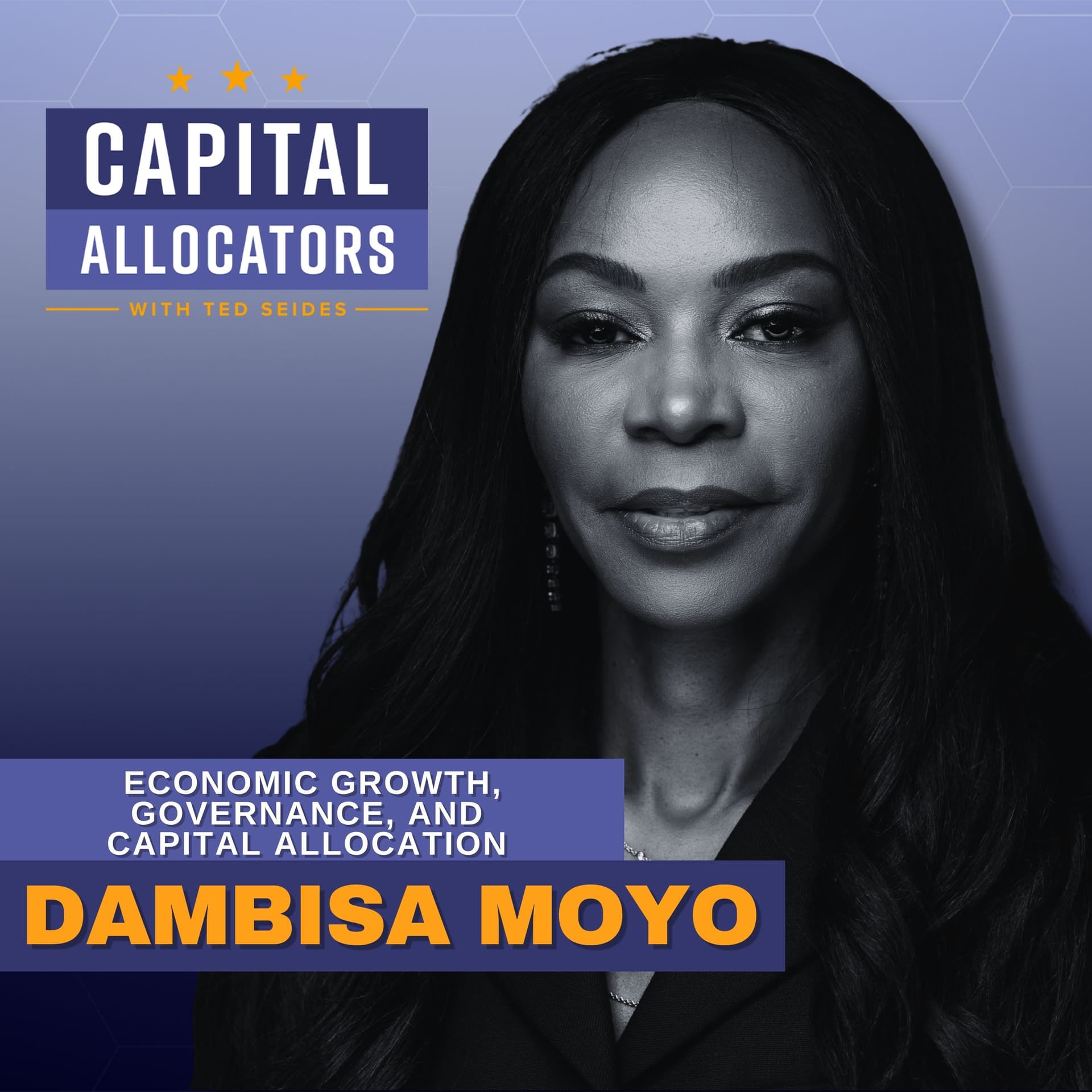
1:06Dambisa Moyo:I'm Ted Seides, and this is Capital Allocators. My guest on today's show is Baroness Dambisa Moyo, global economist, author, board member, and investor who sits at the intersection of public policy, corporate governance, and capital allocation. Dambisa serves in the UK House of Lords, sits on the boards of Chevron, Starbucks, Condé Nast, and Oxford University's Investment Committee, is chair of the Economic Club of New York, and oversees Altered Trajectory alongside her husband, Jared Smith, the family office formed after his sale of Qualtrics in 2018. Our conversation traces Dambisa's journey from growing up in Zambia development, and governance.
1:55Dambisa Moyo:We discussed how her experiences across more than 80 countries and on the boards of four global companies shaped her judgment on economic growth, governance, and decision-making. We then turned to the application of those lessons at altered trajectory, including the evolution away from an endowment-style portfolio, balancing Dembees' macro convictions with Jared's moonshot investing style, and positioning for long-term themes. Along the way, we discussed the challenge of investing through structural change while avoiding ideological thinking. Before we get going, long-time listeners might remember my discussion of the lived experience of Joseph Campbell's hero's journey, created by Michael Mervosch and described in episode 402 two years ago.
2:43Dambisa Moyo:Well, after an eight-year sabbatical, I'll soon return to the mountains of West Virginia for my next journey. I'll take leave of my familiar surroundings and electronic devices to go on a week-long adventure, meeting allies, facing ordeals, and encountering the so-called belly of the beast. After which, I'll return transformed by the experience. Like my past journeys, I have no idea what I'll find or learn once I arrive. And that is the essence and beauty of the experience. If you also feel the call to adventure, there's still time to engage and sign up. Hop on heroesjourneyfoundation.org to learn more about the upcoming journey.
3:28Dambisa Moyo:Hope to see you on the mountain. And thanks for spreading the word about the hero's journey and Capital Allocators. Capital Allocators is brought to you by AlphaSense. Here's something for you. Most AI tools today are very good at sounding right. But can you actually trace it back to a filing, transcript, or specific passage that drove the answer? Or are you just trusting the confidence of the output? For allocators, that's not a minor concern. A missed filing, incorrect source, or context that gets lost somewhere in a retrieval chain aren't edge cases. They're how decisions go wrong. AlphaSense is the AI platform built specifically for this.
4:16Dambisa Moyo:They own the content, over 500 million curated documents from broker research and expert transcripts to filings and earnings calls. And they own the retrieval layer on top of it. That means every answer can link back to an exact verifiable source. Because the answer is only as good as what's underneath it. And with AlphaSense, you know exactly what that is. See it for yourself. Try a free trial at alpha-sense.com slash capital. That's alpha-sense.com with a hyphen in the middle slash capital. Capital Allocators is also brought to you by Admired Leadership. Back in April on episode 497, I sat down with Randall Stutman, the executive coach behind Admired Leadership, who's advised more than 500 CEOs, including some of the most respected names in asset management.
5:14Dambisa Moyo:Randall introduced me to Alex, an AI leadership coach's team built on 40 years of proprietary research into what the best leaders actually do. For investment professionals, that means your entire team gets on-demand coaching grounded in the behaviors that drive results and build the kind of followership that retains your top talent. We use Alex and our team at Capital Allocators swears by it. Try Alex for yourself at the link in our show notes, tryalex.admiredleadership.com. Please enjoy my conversation with Baroness Dambisa Moyo. Dambisa, thanks so much for doing this. Thank you for hosting me.
6:00Dambisa Moyo:I'd love you to start with how you describe what you do now. Go backwards from there. The best description is I live at the intersection of public policy because of my House of Lords seat, capital allocation from a corporate space because I sit on large global complex organizations on the boards of those companies. The third piece is looking through the lens of investment through our family office, which is the proceeds of the sale of Qualtrics in 2018. I have feet in different audiences, in different pockets, but we're all dealing with the same things in terms of economic growth. We are all dealing with capital allocation, thinking about returns, headwinds, everything from AI technology and the risk of a jobless, underclass, global demographic shifts, quality and quantity of the workforce.
6:55we're thinking about natural resources. How should we be thinking about critical minerals, water, land, arable land? These different portals think a lot about not just the tactics, where's the interest rate today, what did non-front payrolls number come out as, but thinking about strategic changes in the global economy, geopolitics, and in finance. I think of it less as having a title and more addressing the world's biggest shifts geopolitically, socially, and economically, looking at it from different perspectives.
7:36Dambisa Moyo:Walk me through your path from early days to how this all came about. At a high level, I was born and raised in the emerging markets. I was born in Africa. I'm grateful for that experience because it is a place that there's questions around the systemic patterns of society and culture that persist. It's fascinating to me in the emerging markets where 90 % of the world's population lives, that a lot of the things we worry about in the West, AIs are going to get rid of jobs, somehow can pass these societies by. If I think about my own background, I feel very lucky because I didn't grow up in an ideological society.
8:18Nobody was either a Democrat or Republican or Black or white or between 25 and 35. Those types of allocations, you either were free marketeer or you're Keynesian. I didn't grow up in that world. Everything is in your face, is a clear reality. As such, I've now had the opportunity to travel to over 80 countries around the world, rich, poor, democratic, non-democratic. I don't harbor or carry ideological views. That has driven the rest of my career. I'm eternally curious, genuinely interested in long-term progress, expanding growth, improvements in living standards. After 250 years of Adam Smith, I don't think anybody has an answer.
9:04We swing back from more Karl Marx, more Keynes, more Hayek, more Smith. But when it comes down to we don't know what creates economic growth, we have some semblance of countries that are more successful than others. The United States is in the crucible because it's so amazing what has been accomplished in 250 years. At the same time, the reason ideologues win is that there's always some disappointment with an economic system, as in the case of the U.S. capitalist system, we've got inequities, externalities from climate, etc. The reason I'm here today is because I was fortunate enough to be born in a place where there's good reason to be skeptical of all models that are in the books.
9:48Dambisa Moyo:How did you get from that in-your-face reality growing up to being so globally aware of the different systems that exist? It's because superficially there's a lot of things that people think are wrong in a place like Africa. They say the population is skewed young. That's supposed to be net good. They have a lot of arable land, critical minerals, energy. Why is this place not growing at 10 % a year? People come into the continent from all around the world, especially the developed world, with their opinions of not only an assessment of what's wrong, but they come with their own solutions. Aid is the obvious one.
10:29Even more recently, the Chinese approach into Africa has not been an aid-driven approach. It's more of investment. Both of these models have their problems. Being on a continent, which is a recipient of competitive ideas, there's more openness to trial and error. There's perpetual tug of war where there are a lot of costs. People from outside who try these things, more China, more U.S., more democracy, less democracy, would say it's easy to try your theories in a place where there's relatively low growth, where the regulatory and oversight governance issues generally remain weak. You can go and trial new drugs in a country without a lot of oversight.
11:16Dambisa Moyo:How did you find your way into exploring some of these macroeconomic issues? Very fortunate to have been born in the household I was born in. I grew up in a household where everything was debated. Politics, economics, social trends. We would have massive battles. I grew up at a time where throwing rocks because the subsidies had been removed by the Zambian government. It's all funny now. I was with my PhD supervisor, Paul Collier, not too long ago. I remember meeting him because as a young student, we were pro-subsidies. You're super left when you're 20s. And then reality kicks in later. The point just being our household was fever pitch with competitive ideas.
11:59My parents grew up in the colonial era. There was a lot of communism in Africa back in the day. Glasnost and perestroika and democratic push after the fall of the wall. Berlin, I was surrounded by competitive ideas in our household. I was fortunate to be able to go to school in Zambia. There's no drink the Kool-Aid about democracy being so wonderful and having no cost.
12:24Dambisa Moyo:And what were your steps to leaving Africa? Oddly enough, it's not for good reasons. I believed I was going to be in Zambia, marry a Zambian, have children in Zambia, have the middle-class life my parents had envisaged for us, having gone through the colonial period and then through independence. We had a coup. It was an attempt to overthrow the Zambian government. I was a third-year student at university. I happened to be the only girl in my science class, very fortuitously got a scholarship to come to the United States. My father had already been here, I did a PhD here, but we'd gone back to Africa.
12:57So my formative years were in Africa, primary, secondary, part of university. Because of this disruption of the attempted coup, the university was shut down. I ended up coming to the United States, initially to American University, because it was middle of the school year. It was not on my bingo card.
13:15Dambisa Moyo:How did you take what you saw and evolve it into your interests and passions professionally? I would like to think that my career and my experiences have generated more humility about the challenge and the complexity of questions around economic growth and development. There are lots of big books, Adam Smith's Wealth of Nations, David Landy's, lots of Nobel Prizes have been given for people arguing that they've cracked the case as to why some societies grow, others don't. That's been an open question for me. I learned early that there was no specific answer. It had to be tailor-made and also it had to be something that wasn't one and done.
14:00It had to constantly evolve. As we're seeing in the United States, there might be some societal costs that weren't priced in initially, inequality or questions around the climate. Those just weren't seen. Adam Smith didn't write a treaty that said, oh, by the way, if we do all this great stuff and it's a great free market with some constraints and some regulation, potentially we need to think about these societal costs that come from climate change. He didn't talk about that. He didn't even see the Industrial Revolution. A lot of the questioning comes from not being raised in an ideological environment.
14:33That's helped me in my corporate board work. It's helped me being on the Oxford University endowment with our family office. We've even made some mistakes. I would say I was the reason for those mistakes, if I'm quite candid. Being in the early innings of this AI super cycle makes me think about looking back on data on rates of returns. Where are the big wins? Where do they come from? How should I be thinking about that and not be hamstrung into the ideological view of the world?
15:03Dambisa Moyo:What do you see having been around 80 different countries that the people that you're around that haven't had that experience may not see? The biggest things are assumptions about why one place works and another one doesn't. I was just in Bhutan, which was a shock for me. It's a place that's top of the happiness index. People leave there with certain assumptions about how they could create economic growth in a place like this. It's got a small population. You just need to go in, dump in a lot of money. They discount local culture. They discount the systemic issues around how countries gel, different aspects of government, private sector, not-for-profits, individuals.
15:51It's as true as the difference between the U.S. and China or the U.S. and Bhutan as it is the U.S. and Britain. People think that Western countries are the same. They're really not. The manner in which people behave and their appetite for risk and their attitudes towards certain behaviors or policies, it's extremely different in a place like Europe. The mistake people make is that they think they understand, they assume there's a question about human nature. Are humans the same? How do they react to greed, incentives and costs? they think they understand the problem. They also think they therefore understand the solution.
16:31They're like, well, if you just do these one, two, and three things, it's going to be fine. Where the mistake is, is that not only are human beings extremely complex, more critically, there's a lot of systemic aspects of different countries that perpetuate for long periods of time. Britain's a great example of that.
16:50Dambisa Moyo:Translate that idea of the importance of people to the various governance seats you've sat on. What are some of the lessons you've learned and some of the stories that embody those lessons from the various roles of board work and governance? The best piece of advice I got when I joined my first board about 15 years ago now was you have to internalize that anything can happen. My own board career, it's been bookended by pandemic, financial crisis. Also a lot of unique things that have happened to the companies. I had a CEO die in office at SAB Miller. We've had companies that when I joined were trading at$60 a share go down to$7.
17:30Was this company going to go away? I was on the board of a company, the second largest in the sector, this was SAB Miller. Everyone told us there's no way you're going to get bought by Anheuser-Busch. It's impossible. They have to take out the biggest bond ever in history to do this. all the conflicts of interest, a laundry list of why it wasn't going to be possible. And guess what happened? We got bought. They did do the biggest bond. Anything can happen. Something that people breeze over is that joining as a board member, you're coming in in the middle of a movie. Your job is to quickly figure out who's the protagonist, who's the martyr, what's the plot.
18:06The cultures are different. I love the companies where I serve on the board. They're incredibly different. Chevron is an engineering company for good reasons. A lot of strictures. The board largely reflects that. We've got a lot of engineers, a lot of technical people. That's a reflection of the way that the organization has worked and grown. Starbucks is a completely opposite end. If Chevron is all IQ, Starbucks is largely EQ. The board is made up of people who were running Domino's Pizza, Nike. So understand the consumer in a much more innate level that permeates into how the companies run. They've both been phenomenally successful.
18:49There's room for everyone. If you read a book like Outsiders by William Thorndike, I'm often interested in, does this apply to both a Chevron and a Starbucks or to any other company where I've served on the board, Barclays Bank, which has been around over 300 years? It does. There There are similarities, notwithstanding the cultural piece that I've just alluded to.
19:09Dambisa Moyo:What are the similarities in being effective for you as a board member and then for the board as a whole serving the purpose of the organization? I would like to think that these companies are looking for judgment. Notwithstanding Kahneman's great book, Think Fast and Slow, I don't know whether you can teach judgment. You hope people have had enough life experience to not be too ideological, which is the other piece. Most of the boards I've been on, they've had enough life experiences to say, these are all a balancing act. The candidates that add value to our boards, it's people who are not ideological, who show good judgment.
19:51There are things that happen that we just hadn't seen before the pandemic. You want to know that your colleagues are not ideological and have good judgment.
19:59Dambisa Moyo:How about dynamics of a board that functions effectively? It's having the leaders on the board, lead director, for example, or even chair in the case of Britain, where there's a separated role, not leading with their opinion. My Maya Khan, who's now passed away, he was brilliant. Whenever there was a massive deal, hiring a CEO, M &A transaction, some big issue that company is being affected by, he would go around the table. What's your thought? It sounds trivial, making sure everybody is on record voicing their assessment and their best judgment of what an issue might be. Too often, when people are in leadership roles, there's a risk that they lead with their opinion.
20:49Oh, I think we should do the deal. Now, does anybody else have any comment? Those are the places where companies end up with problems. group think, the lead director is saying this, I must fall in line. Giving people wide berth is very important.
21:03Dambisa Moyo:Any other dynamics or tips that you've seen? If you think about risk mitigation and questions of investing as being this balancing act, the question is for something, and I'll give an example of AI, is that a full board issue to be debated or should it be seconded to a committee where a committee gets into a deep dive and then sends recommendations to the full board. I don't think there's a settled answer on this. I've been on boards where they had a separate risk committee. Other boards say, no, no, no, risk is part of audit because of controls and processes. The most important thing is making sure that the organization and certainly the board doesn't become so rigid that it's unable to evolve itself if it needs to.
21:49We've just lived through the business roundtable changes in 2019, companies had to be willing to adapt and not just the larger organizations' operations, but the board itself had to be able to say, from the board, we need to think about how we're going to reevaluate compensation or hiring or picking the CEO or risk mitigation for the company as a whole.
22:12Dambisa Moyo:What have you seen as some of the key differences between for-profit board work and not-for-profit board work? Everybody wants to be on the board of some$4 trillion juggernaut, Sure. I, over time, have placed a higher premium on people who have spent time on the board of their kids' school or hospital. I'm on the board of National Geographic. There are lots of different stakeholders that matter. Importantly, it's not as easy as having just one bottom line, are you making money or not? It's much harder being on the board of a not-for-profit. But have they been in a situation where they're competing needs, having to make the decision that one is of superior need to another in a constrained budget environment?
22:54These are all very important lessons.
22:57Dambisa Moyo:If you look at these different experiences you're currently having, which I were on Starbucks, Conde Nast, what's the most vexing challenge that the various companies are facing that you see at the board level? There's a narrative that has seeped into the discourse. In the United States in particular, it's quite surprising that these companies are there doing bad stuff, whatever it may be. They're bad partners. They're not supporting the community. They are on the wrong side of societal issues. Because I've been on the board of Chevron for 10 years, Barclays Bank has been around for 300 plus years.
23:35I've been on these boards. I know that the companies are made up of tens of thousands of people who have their heart in the right place. To face a wrath at annual meetings that somehow there's a dubious agenda that's going on is the biggest, most vexing thing for the organizations I work for. There are big issues that need to be addressed. Energy is the obvious one, delivering clean, affordable, reliable energy. You've still got about a billion two people who have no access to that around the world. It's such a key catalyst for economic growth. But the fact that people don't have that, there are companies that are working to try and do that.
24:15A management team has to really focus on that. Then also the share price goes down. Those types of consequences just didn't happen to us, thankfully. But then the industry as a whole stops investing in innovation because they can't afford to. They're knock-on effects or they get kicked out because they don't satisfy ESG requirements. And then all of a sudden the shareholders who are buying it are not only buying it at a cheap discount, but they then don't have the best interests for society at hand. That would be my most vexing thing for every single business I've been in. Consumer, energy, banking, this increasing voice that companies are doing bad or are inherently evil is the big issue.
Read the full transcript
24:56Dambisa Moyo:If you look at that on the lens of, say, Chevron, there's the easy high level poke at dirty energy in a world trying to make the transition to cleaner energy. How do you think about those capital allocation decisions of generating cash flow from the assets that have been around for a long time and then trying to move the world through company in a better direction? The immediate answer is we want to be around. We need companies. We want them to be growing concerns. We're not in the business of doing stuff that's bad, that's going to take us out of business. That would be absurd. Taking advantage of technology, for example, to revisit those assets and think about how we can do it in a clean way is absolutely the center of what we're doing.
25:40Beyond that, it's an industry-wide thing. We've restructured the business models. In the case of Chevron, but it's true for other competitors. We now have a bigger footprint that's looking at renewables. The whole range of them, wind, solar, geothermal, nuclear, starting to revisit that because we want to be around. We want to be part of the solution. We have knowledge over hundreds of years of what creates energy. How do you get carbon, hydrogen, oxygen together to create energy, but also think about new forms of energy that require investment. Questions around scaling. How do you scale solar across the world?
26:15We're in the business of finding those solutions. A lot of the structural changes that have happened, not just from the market reaction or from greater voices from government and also communities, what we've been trying to do in terms of restructuring how the company is set up operationally and how we think about allocating money heavily reflects this idea of leaning into the future. It's a very practical way.
26:39Dambisa Moyo:If you look at Starbucks over many years, one of the things that's changed are the direction of the company based on leadership. And we'd love to get your sense of how do you go about assessing people with the lens of seeing how different it can be within the context of the same company? The important thing that most people who've been involved in any sort of organization, public policy with government, the United Kingdom has had seven prime ministers in 10 years, anything to do with human management. The key important takeaway around how you think about finding the right people, I've learned in 15 years on boards, but being in the House of Lords, trying to ask questions that are outside of checkboxy.
27:29At Starbucks, I haven't been there that long. I wasn't there for all the changes in leadership. Barclays Bank, we had four CEOs in seven years. I'm very familiar with high pace of change. Most of the time when we've had an issue, it was we didn't ask a question outside of the box. We asked whether people had run teams. We talked about whether or not they've had challenges or what financial returns they had, all the obvious stuff. We just didn't ask them how they deal with changes in the environment. You're hired to be the CEO of Company X when the world is globalized and the U.S. and China get along.
28:06There's no pandemic. How do you react if all of a sudden the cost of capital has trebled? We don't ask those black swan questions. We tend to ask questions that fall in a particular remit. If there's one takeaway in 15 years on board, anybody who is going to be in front of me as a board member is qualified. I don't need them to necessarily relate to me how they built a team or generated returns. The fact that they're there tells me that they've done that. What I'm interested in is how do they calibrate for or think about navigating through things that seem implausible but could happen? How do you think about operating a business in a deglobalized world?
28:55You've gone from a world where you can borrow cheap capital in New York and London, invest in Brazil or Thailand and generate returns and repatriate. That world is broken in terms of procurement, in terms of your hiring. How would you think about that? If you talk to somebody 15 years ago, they'd be like, why are you asking me this question? Now it seems like it's an obvious question.
29:17Dambisa Moyo:We're going to take a quick break in the action to tell you about Morgan Stanley Investment Management. The best allocator-manager relationships aren't transactional. They're built over market cycles, through difficult conversations, and around a shared understanding of what an institution's trying to accomplish. Morgan Stanley Investment Management has partnered with institutions for four decades across equity, fixed income, alternatives, and custom solutions with$1.9 trillion in assets worldwide. Learn more at morganstanley.com slash im slash solutions. Morgan Stanley Investment Management is the asset management division of Morgan Stanley.
30:00Dambisa Moyo:Statistics as of December 31st, 2025. All investing involves risk of loss. Views are subject to change. Not investment advice or a recommendation. Copyright 2026 Morgan Stanley. All rights reserved. And now, back to the show. If you take that lens and put it over to your current third board of Condé Nast, a content company with that black swan of AI, being at the board of a company in the space that for sure is thinking about those questions of AI disruption, what have you learned from seeing that experience? Condé Nast was established in 1909. What an eternity. So much has happened. Radio, television, black and white, live events.
30:48Tons have happened. Condé Nast, as a privately held family business, has taught me one thing that is pronounced and how I even think about AI, which is when everything is stripped away, what are the human aspects and elements that remain? We own Vogue. We own Vanity Fair. New York, it reflects human tastes. I don't think that necessarily goes away. How it's distributed, how it's produced. Is it in video? Is it in writing? All those things ebb and flow and they can even change in a very disruptive, revolutionary way. It's not losing sight of what ultimately the business is doing. That's the big driver.
31:30We're not immune or ignorant to the changes that are happening around us and what that might mean for how we operate as a company, the types of people we hire, who gets hired where. The danger is there's so much change, geopolitical, economic, financial, that you lose sight of what you actually do. One other thing I would say with the money manager, I understand the tension of their short-term goal. It's a competitive environment. They're trying to generate returns above the cost of capital. Maybe the mist's secret sauce is trying to understand what your end user, your LP is trying to do. Because do I want more returns?
32:09Yeah, of course. It's not at any cost. We have our own goals. We have our own aspirations for what capital can do. Myself and Jared, we're quite different in terms of our background. That materially influences how we think about operations, capital allocation, views on returns, when they show up, how big they should be. We may agree that we want to do more health and education. How those returns show up is different. If the GPs don't know us, they might just think we only care about return without understanding. Maybe we have more appetite for delayed returns, or maybe not. There's not enough time maybe spent with the LPs to understand what they're trying to get at.
32:52Dambisa Moyo:From the GP's perspective that have a variety of different LPs, How have you seen someone who does that well either cater or do things slightly differently because of what they're hearing from their LPs? It's exhausting work because they essentially have to get into the minds of the LP. And the only way they can do that is by spending time with the LPs. There are gatherings, annual presentations. This is what our returns have been. This is our cost. This is how the J-curve is working. You have to understand that we have our own J-curve. the thing about AI. We're no longer going to rely on the GPs or our money managers to tell us how the J-curve is operating.
33:31I can now look through our own portfolio and see where that J-curve is. It's one small example. If they understood us, it's hard because if you have a lot of LPs, who's got the time to talk to 400 LPs or whatever it may be? For institutional investors, maybe the LP is here today and gone tomorrow. That would be my slight. I wish they knew more about us, what drives us, what we care about, what we believe is possible.
33:56Dambisa Moyo:How much of that do you think is time and listening as compared to them? They're going to go back to their office and maybe go about what they're doing the same way, but just making sure that you're heard. I'm optimistic that they'll hear us more because the role of family offices. It's only grown. Their importance in being part of markets, because it's growing and changing, people care more about what does an LP think. I'm also not ignorant to the challenges that they face, they as money managers, because yeah, sure, they can sit here and say, okay, well, Dambisa cares about structural growth and long term.
34:36She's less concerned about the immediate inflation in the near term because of Straits of Hormuz. She's more interested in the questions have gone deflation longer term, what does this do for the fiscal? Great. They still have to go and work and live in a competitive world where they're competing against people who haven't spoken to me or maybe discount my view. Maybe they think, well, we're not really macro traders. We're in the here and now and we're building a portfolio. I'm not trying to at all say they're wrong, but I do think that it would enhance their effectiveness, particularly those who take LP money from family offices.
35:11I do get the institutional investor thing is quite different. There's different horizons. If you're taking family office money, it's probably in your interest to spend time with the families to understand what they're trying to achieve.
35:23Dambisa Moyo:I'd love to turn to how all of these different lessons in governance, in growth of economies, and capital allocation have informed how, Jared and you, thought about investing in the family office over the last eight years. Where did you start determining the goal of the investment challenge in front of you? We're incredibly fortunate. Jared and I have been together just over 10 years now. When we met, I was doing my thing, which is public policy and investing and being more in the debate around economic growth. He was deep tech, ex-Google, but also founded Qualtrics. Neither of us had anticipated that we would be called upon to think about how to manage a portfolio of capital, also to think about how we could best be impactful for the things that were really important to us.
36:23It's been a journey. It's ongoing. When we first started out, this was 2018 when the company was sold. It was a cash transaction. We went from doing our own thing to, okay, what do we want in this life? We don't have children, but we both come from poor backgrounds. My family background is not impoverished, but I grew up in a poor environment, broadly speaking. Jared is quite similar. He comes from a small town in Utah. We both had seen poverty and we'd seen a lot of structural problems that we thought we could contribute to help fix. We come from different backgrounds. I'm more macroeconomics.
36:59I'd worked at Goldman Sachs for nearly a decade. I came with a bigger view in terms of making economic bets. I was excited about China, for example, back in the day. Now, not so much. It's underperformed. Jared is more of a moonshot person. He grew up in tech. He believed if you put bets onto one big thing, penicillin, as an example, can be incredibly transformative. The reason I say it's a journey is that the first thing out of the gate is I had my long list of money managers, my friends who are running hedge funds from TCI to the Tiger Cubs. We called them immediately and said, oh, my gosh, this is what's happened.
37:38Can you help us? It's been great to go through this learning experience. The good news is that we haven't blown up the principle. We also were lucky early on to sign up Scott Malpass, who was running the Notre Dame endowment. and he was leaving and somebody at Sequoia said, oh, call Scott Malpass, he can really help you. He brought in this idea of we should be thinking about an endowment model. We knew we're going to give it all away. We named it, the endowment, the altered trajectory, because we both believed that we wanted to alter the trajectory of other people. At a very macro level, Jared and I had believed that health and education were the two key pillars we were destined to work on.
38:20We felt that that had been hugely beneficiary to both of us in our experiences. Then the pandemic hit. We were in Provo. There was a lot of food insecurity. So those are best laid plans. Anything can happen because we went from we can do education and we can do health care to food emergency in our backyard. This is an evolving thing. From a capital allocation point of view, we ended up with 47 managers, way too many, overlapping theses, 13 Fs. There was massive correlation. We did take a big exposure in China. I own it because I was a big believer in systemic change and China already had a record of that.
39:03They have underperformed in the certain positions that we've been in. We've been a little bit disappointed there. We're big believers in risk-taking over, let's just do bonds. We had initially private credit positions. The rule of thumb for family offices is a third, a third, a third, a third in equities, third in real estate. It used to be a third in art. Our own experience is we probably have more private equity than we thought we would. A lot of people are in those positions because many people are in SpaceX and now it's this huge valuation is 50 % of your position. We're more equity loving.
39:36We're not big on bonds. Anything that's on the leverage side is not exciting for us.
39:42Dambisa Moyo:So you had some of these details where you had 47 managers that felt like it was too much, the macro perspective, the moonshot perspective. How did you put structure around this pool of assets? That's the discipline that comes from Scott Malpass, also the passage of time. We all know the rule of 72 heuristics around where returns come from. Cliff Esna said 80 % of returns come from like four stocks. If I'm critical of what we've done, the funds are growing, we're happy with the positioning. We did not think about coming from this idea of the endowment model, some of the aspects of churn in positions, for example, long short funds, a lot of institutional investors who were co-investing with us, they weren't suffering the costs of position churns.
40:32Some of it sounds like, how would you not know that? It became a big reality, particularly with the sell-off after the pandemic, coming back, trying to figure out what does an endowment model look like for a family office? That's where we started to get a lot of structure. We have the CIO. We got the financial metrics that we're trying to attain better articulated. It is a live document. Somebody from Sequoia said, oh, you guys don't want to be in money management business. I think they're probably right. Jared loves his deep tech. I love being at the interim section of investing in boards, public policy.
41:07We also have a responsibility, which is what we've taken on, to oversee it and make sure that it's doing the best that it can. We went from 47 down to around 15. It feels better. It's hard to get out of some positions. It takes a bit of time. I was keen in the beginning, oh, we've got to do China. China's important for diversification. is great for being part of this new structural story. Returns have just not panned out. You can't miss the AI aspects and opportunities to invest and be part of an important super cycle.
41:36Dambisa Moyo:If you look through that group of managers, how do you think about what you own? China, not so much. There's a super cycle you want exposure to. There's moonshots related to that or other things that Jared would want to invest in. How do you think about the portfolio as a whole? It skews quite heavily to tech, particularly in the venture part of the portfolio, probably around 30 to 35%. We do a buyout. We're in some food chain type companies and we're in other types of investments that give us exposure to a range of other sectors. Most of it is skewed to tech. It's more on the equity side, in both private and public equities.
42:19It does capture that Jared aspect. It's more US focused. We have a CIO now, Jay Sheth, who's amazing. He was at Tepper for a long time, ex-Goldman as well. He has done brilliantly outperforming the market. He's good at looking beyond AI means Mag7. He understands the tentacles of where the second order effects and benefits will come from. We have a big position in healthcare stocks that have done well. We have some positioning and energy that's outside of direct AI trades. That's been incredibly helpful.
42:57Dambisa Moyo:With a relatively small team and deep knowledge of tech, curious how you thought about AI, both use cases for the office and then on the investing side. Jared is reflective on how you can go from a great idea, the execution to actually seeing the returns, it's quite a journey. That's the externally facing piece. Where should we be investing? There's a bit more maturity on what might be feasible and when. We can all get returns, but hopefully we're still alive when they come in. Jared, broaden a lot of discipline around OKRs, objectives and key results, common in how tech companies run themselves.
43:39bringing that discipline and financial management into the family office has been transformative.
43:46Dambisa Moyo:I'd love to ask you about some of the important themes, a few of which you've touched on here and there at the onset, natural resources. How have you thought about integrating that into the investment program? That's where I bring in my more fundamental view that no country ever in history has achieved economic success without having cheap energy. I think a lot about reliability, the cleanliness aspect, critical minerals, water, arable land. The energy piece has become interesting. Without tripping up on the fact that I sit on the board of Chevron, it has gone from a sector that people understood and valued and was in the index of about 20 % to one that fell out of favor.
44:29There was some reset. There's a lot of messaging work that needed to get done, and it did. Coming out of 2022 into a world where, as price takers, you see a massive demand that was not priced in from AI. It's brought that sector back into play in a way that requires a lot of innovation, a lot of smarts, because the backdrop is the geopolitics have eroded quite a bit. We have positions in natural resources. The obvious stuff is thinking about the chain, exploration, development, production, thinking about the suppliers into delivering on that chain. The more tip of the spear stuff in the family offices, nuclear fusion.
45:14It's interesting because with my public policy hat, I hear a lot of people say, oh, it's close. It's three to five years. Then I go and look at some of the stocks that are trading publicly. And I'm like, really? they? They're not going to get earnings anytime soon. We want to be innovative. I still am driven by the growth story. Which country is going to grow? The record, even just the past, since 2008, the financial crisis, United States and Europe were about the same size. The United States is almost two times as big. It's always hard to bet against America. The USPs around energy, arable land, ideas, deep capital markets, unreplicated anywhere else.
45:53You've got to go for tech. It seems to me this is the first time from an economic lens we've had a super cycle in 40 years. We had women coming into the workforce and brought new consumers in the 1940s and 50s. Then we had the fall of the wall in 1989. It brought in the globalization trade. We had the financial crisis and pandemic, which were all negative drag. Here we are at the early innings of the next super cycle, which is AI and the energy transition. We want to be part of that. We make a big effort spending time in Palo Alto and Silicon Valley.
46:27Dambisa Moyo:I'm curious how you go about implementing in that in the sense that some of those big drivers are known and at times very expensive. How have you balanced the difference between the growth opportunity and the pricing of the growth in the current markets? It's hard. One of the challenges we have is even though we're fortunate to be ventures, series AB investors, we still see a lot of the stuff as being expensive when it comes to stuff in the public market. We're looking for that upside. Our most important thing is making sure that we don't lose money. The discipline of our CIO is one where he doesn't like to overpay.
47:10Expensive markets are expensive markets, no matter what is promised. The specific example, we love our Teslas. We love using Starlink. It's pretty heavy. We are in SpaceX from the venture exposure. You start to look at where these things are trading, completely delinked from 16 times PE average over the past decades or so. It's just hard to justify. At the same time, we want to be optimistic. Can we have data centers in the sky? If that's possible, then we want to play in that. But we don't want to do it at a place where it's just so expensive. It's a discipline that comes from my boards. We don't want to overpay.
47:47The companies that I've been involved with have been good at instilling that discipline. Things look attractive. There's lots of competition. There's a lot of money. We've been in an era of sovereign wealth funds, money coming from all over the world. You don't want to overpay. Same for how we run the family office. we don't want to be the dumb money that's overpaying.
48:03Dambisa Moyo:Where are you finding opportunities you're excited about? Silicon Valley. Seems like a flippant answer because then it sounds like you're just doing what everybody else is doing. Doing the graft of being there, listening to what people are saying, trying to understand those second order effects. What does this mean for the sectors that have not traditionally been affected by technology, education, healthcare? I think it's an AEI chart, which shows the industries where prices have only gone up versus the ones where they've come down. Food production, telecommunications, technologies have contributed to a decline and deflation in prices.
48:41Education, healthcare, housing, prices have only gone up. Will AI be the technology that will break that? That's a lot of the conversation I'm hearing.
48:51Dambisa Moyo:Curious how you've gone about accessing opportunities in the Valley. There were a lot of capacity-constrained opportunities, a lot of money sloshing around trying to find the next great trillion-dollar company. It largely drives relationships. Great investors who invested in Qualtrics. We've subsequently gone back in with them. They've been fantastic. From my years at Goldman Sachs, I brought a lot of macro traders. Unfortunately, that's where we ended up with a are the tax elements that family office are uniquely challenged by. Relationship building, for both of us, it's been because of our careers.
49:31Jared in Silicon Valley, he's been part of the discourse. It got him seats at the table. My side is all the macro hedge funds. I covered them when I was at Goldman. I'm still good friends with people like Dan Loeb from Third Point. I grew up at the time when they were building their hedge funds.
49:47Dambisa Moyo:What are the risks and headwinds that you're worried about and staying away from in the portfolio? Concentration is a big risk that we manage actively. Not getting too carried away with tech, tech light or tech adjacent. There's a lot of opportunity in what I would call bog standard elements of human existence, food, pharmaceuticals, healthcare, not getting too seduced by the, oh, what could it might be from the tech spiel. The other risk we mitigate for more and more now is not trying to be too clever about diversification or returns from emerging markets, some of them bigger industrial countries.
50:30It's hard. I now have come to the realization that it's a hard perch, high hurdle to leave the U.S., take my one marginal dollar and invest in country X in the emerging markets and expect a competitive risk-adjusted return. It has to be compelling because the structural issues of creating sustained economic growth, now that I'm a woman of a certain age, it's much more obvious to me that it's extremely hard, even for developed countries in other places where I always point to the UK. It's 40 cents a kilowatt hour is the energy price versus China where it's 8 cents or the US where it's between 12 and 16 cents.
51:11It's such a massive headwind and constraint. Does it outweigh all the good stuff, the language, rule of law? It's harder to get people excited about investing in countries where there's a lot of ideology that seeps in.
51:28Dambisa Moyo:When you bring together all of these different lenses you've experienced all the way down to the investor level, what does that look like when you sit on the investment committee at Oxford? They have a different agenda because they're funding scholarships, capital projects, research and development. They need to have things that are more liquid. They also are an organization that's going to outlive us all. They have more appetite and more willingness to take the longer China bet than we might because we're going to die at some point and somebody else is going to be responsible for the endowment.
52:03We wanted to leave it in a good stead. We're in a lot of the same things. We don't have the sort of capital projects and scholarship challenges and demands that a traditional university endowment would have.
52:15Dambisa Moyo:What is it like being in the House of Lords? I absolutely love it. I'm going into my fifth year. I pinch myself all the time. It's a second bite at the apple from being in university, even first year of university, where you are buzzing with people with lots of different ideas who are trying to address the same issue, whether it's assisted dying or Ukraine or the budget. It goes back to this idea of the theme in my life of competing ideologies, competing views about what works and what doesn't work. What I love the most is being in a room where you think one thing and you're pretty certain that you're broadly right and somebody stands up and delivers a speech or an argument on the same issue that's completely different.
53:06Something like immigration. As an immigrant, I'm a big believer in immigration. I think it's a net positive sort of society. Yes, of course, there may be challenges of assimilation, but fundamentally, it's a good thing. Hearing people say, well, here's a list of where it can be problematic. And these are not people who are sort of behind a dark courage and saying we hate immigrants. It's people who are like, how do we think about education and assimilation, language adoption? It starts to get much more layered than just it's economically net good because we are more workers and those workers are producing a tax base is much more element to the debate on all the issues that we cover.
53:43Dambisa Moyo:David, so I want to make sure I get a chance to ask you a couple of fun closing questions. Before we get to the closing questions, I want to tell you about one of our strategic investments. We've made a few and each are working on a product or service we think will be valuable to our community. One is Oldwell Labs or OWL. OWL is the very best software I've seen for allocators to find and track managers. And I've seen a lot of them. Trust me, it'll be worth the look. There's a link in the show notes so you can learn more. And here are those closing questions. What's your favorite hobby or activity outside of work and family?
54:18Dambisa Moyo:I love working out. Now that I'm older, I've tried everything. I've done boxing. I've run four marathons, hot yoga, et cetera. I've settled on weight training and I do a lot on a trampoline and I've been doing that for about five years. So I do love working out. I'm quite obsessed. What's one thing most people don't know about you that you find interesting? I love murder mysteries. Everything from Agatha Christie to Columbo. I could spend hours watching murder mysteries. There's no rhyme or reason. In Columbo's case, a 1970s actor, you know who did it from the very opening scene. I've watched rerun after rerun.
54:58There's still something smart and captivating about watching the whole thing to figure out whodunit or how they did it. I'm a big lover of Poirot and a lot of the characters out of Agatha Christie. But one other thing about Columbo that I didn't realize was that a lot of the screenwriters at the time, it was 1970s, inequality was a big issue then also. All the scripts and all the episodes were basically tackling inequality because Columbo was this crumpled guy who complained about paying 50 cents for a cup of coffee. All the villains were wealthy, elite, connected political class. I only figured this out a few years ago.
55:38Somebody told me and I was like, oh my God, how did I miss that? I had to go back and watch all of them again. Murder mysteries, I could spend a lot of time talking about them.
55:46Dambisa Moyo:What's the best advice you ever received? No doesn't mean never. It means not now. The young generation, they're seduced by shortcuts. This idea that, oh, I can do it quickly. I don't know if it's an artifact of the technology space. Thinking about building a body of work, you have to keep at it. There's a graft required and there are no shortcuts has been great advice for me. If the next five years are a chapter in your life, what's that chapter about? A friend of mine is a historian. He said, it's the moment where you go from becoming to being. I quite like that. If I think of my life up to now, in many aspects of it are still striving and you're working, doing all this stuff.
56:29At some point, you have to start being, not becoming. I like that phraseology. I don't know what it means necessarily on a practical level because I do love working. There's something about making sure that you exist as the person that you thought you were working to be for the past 40 years.
56:50Dambisa Moyo:Dembisa, thanks so much. Thank you for hosting me. I appreciate being here. Thanks for listening to the show. If you like what you heard, hop on our website at capitalallocators.com where you can access past shows, join our mailing list, and sign up for premium content. Have a good one and see you next time.
57:19as a basis for investment decisions. Clients of capital allocators or podcast guests may maintain positions in securities discussed on this podcast.
From the publisher
Baroness Dambisa Moyo is a global economist, author, board member, and investor who sits at the intersection of public policy, corporate governance, and capital allocation. Dambisa serves in the U.K. House of Lords, sits on the boards of Chevron, Starbucks, Condé Nast, and Oxford University's investment committee, is Chair of the Economic Club of New York, and oversees Altered Trajectory alongside her husband, Jared Smith, the family office formed after his sale of Qualtrics in 2018.
Our conversation traces Dambisa's journey from growing up in Zambia to becoming a leading voice on global economic development and governance. We discuss how her experiences across more than 80 countries and on the boards of four global companies shaped her judgment on economic growth, governance, and decision-making.
We then turn to the application of those lessons at Altered Trajectory, including the evolution away from an endowment-style portfolio, balancing Dambisa's macro convictions with Jared's moonshot investing style, and positioning for long-term themes. Along the way, we discuss the challenge of investing through structural change while avoiding ideological thinking.
Learn More
Follow Ted on Twitter at @tseides or LinkedIn
Subscribe to the mailing list
Access Transcript with Premium Membership
Editing and post-production work for this episode was provided by The Podcast Consultant (https://thepodcastconsultant.com)