In short
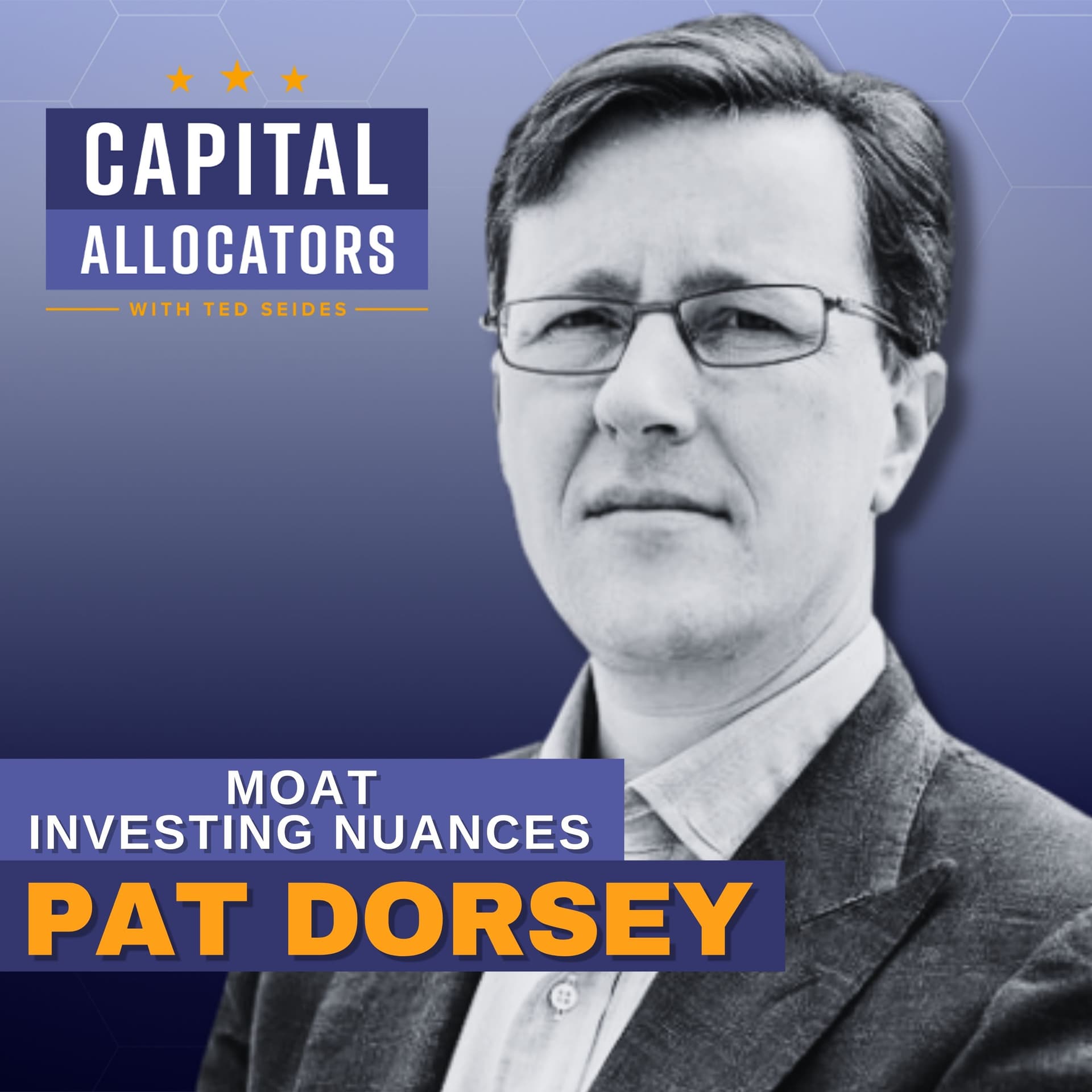
Pat Dorsey explains “moat investing nuances,” arguing that durable competitive advantages come from specific foundational attributes (switching costs, network effects, brands, scale economies, government approvals, cost advantages) and that moats can degrade. He emphasizes qualitative analysis, pattern recognition from studying many companies, and the importance of management quality, alignment, and capital allocation. He also covers how Dorsey Asset Management applies moat research to a concentrated portfolio and how to think about valuation and misconceptions.
Guest background
Pat Dorsey is founder of Dorsey Asset Management (about $1.7B global public equity). He created Morningstar’s Moat Research Framework and led equity research there for ~12 years before launching his firm in 2014.
Key claims
High switching costs can also limit growth; network effects aren’t always permanent; brands can reduce search costs but require “care and feeding”; management matters mainly to avoid “left-tail” outcomes (hubris, refusal to listen). Alignment is assessed via humility, “I vs we” language, incentives, and capital allocation behavior.
Notable examples
Western Union (radial network), Costco and Medline (scale economies passed to customers), Adobe (pricing aggressiveness possibly affecting AI switching), CoStar (repeated competitive execution and founder alignment concerns), eBay/European marketplaces (network effects after scale), Theranos/Wirecard/Enron (listening failures), ASML (non-U.S. moat), Safran/Rolls (aerospace franchise).
Written by AI. May contain mistakes. Listen to the episode to check what was said.
Chapters
Tap a time to open that second in VOUnderstanding Competitive Advantages
0:00 to 1:23
Learn about the complexities of competitive advantages in investing.
“Switching costs can cut both ways because if you have high customer switching costs, then probably your competitors do too.”
Hero's Journey Announcement
2:09 to 3:21
Discover Ted Seides' upcoming adventure and its significance.
“including concentration, global scope, position sizing, decision-making, and lessons learned.”
Hero's Journey Announcement
3:31 to 4:39
Discover Ted Seides' upcoming adventure and its significance.
“Most AI tools today are very good at sounding right.”
Pat Dorsey's Early Influences
6:28 to 7:39
Explore the background and influences that shaped Pat Dorsey's career.
“I'd love you to take me back to the early influences in your life that led you down this path to investing.”
Developing Investment Beliefs at Morningstar
7:39 to 10:05
Learn how Pat Dorsey developed his investment framework at Morningstar.
“One was with a newsletter, one in a brokerage firm.”
The Moat Framework
10:05 to 12:10
Understand the moat framework developed by Pat Dorsey and its implications.
“We had data back to the 60s and looked at every company that had done more than 15 % returns on capital for more than 15 years.”
Quantitative vs. Qualitative Metrics
12:10 to 14:00
Discover the importance of both quantitative and qualitative metrics in investment.
“The data we were looking at from the 60s through the late 90s, software companies were not yet a big part of the investment universe.”
Understanding Moats and Competitive Advantage
14:00 to 15:30
Learn about the qualitative aspects of company moats and pricing power.
“Free cashflow may not be the best metric.”
The Importance of Customer Feedback
15:30 to 17:20
Explore how paying attention to customer needs affects pricing power and business success.
“The great traders that you read about in Money Masters, they develop pattern recognition.”
The Role of Brands in Moats
17:20 to 19:30
Discover how brand recognition impacts consumer choices and company value.
“If you're taking five in price and adding zero in value, over time that catches up with you, I think.”
Show all 31 chapters
Evaluating Management Quality
19:30 to 21:40
Understand the evolution of assessing management's role in business success.
“Are there other applications of brands beyond that easier for choice and then this network signaling effect?”
Assessing Management Alignment and Humility
21:40 to 23:20
Learn how to gauge management's alignment with shareholder interests and humility.
“unlikely to blow up than who are likely to do amazing things.”
The Founder vs. Non-Founder Debate
23:20 to 27:40
Explore the differences between founder-led and non-founder-led businesses in terms of management.
“If they're willing to let things slide in that way, what else is happening underneath the hood?”
Managerial Styles and Investment Risks
27:40 to 28:00
Examine how different managerial styles affect investment risks and outcomes.
“field and not privilege someone or give them the benefit of the doubt because they're a founder.”
Capital Allocation Challenges for CEOs
28:00 to 34:07
Explore the difficulties CEOs face in capital allocation and the risks involved.
“As an investor, you're betting on the person as much as you are betting on the business.”
Capital Allocation Challenges for CEOs
34:14 to 34:35
Explore the difficulties CEOs face in capital allocation and the risks involved.
“Morgan Stanley Investment Management is the asset management division of Morgan Stanley.”
Misconceptions About Moats in Investments
34:38 to 42:01
Dorsey discusses common misconceptions about evaluating business moats.
“What are some of your favorite misconceptions about people who think about moats and analyzing moats in businesses?”
Evaluating Industry Attractiveness
42:01 to 43:14
Learn how to assess whether an industry is structurally attractive for investments.
“That 1 ,700 included utilities and oil and gas and life insurance and auto parts and auto OEMs, which are all not good businesses.”
Understanding Global Market Nuances
43:14 to 44:33
Explore the challenges of investing in non-U.S. companies and the importance of local knowledge.
“where we're likely to be the patsy at the table, which is not a fun place to be.”
U.S. Companies vs. Non-U.S. Companies
44:33 to 46:33
Discover the advantages that U.S. companies have over their international counterparts.
“You've got a higher level of confidence that there's not related party transactions or off balance sheet who are going on.”
Research Process for Investment Decisions
46:33 to 48:54
Understand the step-by-step research process for evaluating potential investments.
“It's more that these tend to be global businesses that we're looking at that happen to not be listed in the U.S.”
Valuation Strategies in Investing
48:54 to 50:46
Learn how to approach valuation of businesses, balancing techniques and market perceptions.
“You've had next to no mention of valuation.”
Position Sizing and Portfolio Management
50:46 to 53:18
Explore strategies for position sizing and managing a concentrated investment portfolio.
“progressed along the way you thought and probably in some cases not progressed the way you thought they were going to.”
Confidence vs. Humility in Investment Decisions
53:18 to 56:00
Delve into the balance between confidence and humility when making investment choices.
“Most things will start closer to 6 or 7 just to give us dry powder.”
The Importance of Confidence in Decision Making
56:00 to 57:00
Understanding the role of confidence and business growth potential in investment decisions.
“They can have everything lined up correctly.”
Lessons Learned from Sell Decisions
57:00 to 59:00
Exploring the key drivers and insights from past sell decisions in investing.
“as opposed to having to continually buy things at 10X and sell them at 15.”
Setting High Standards in Investing
59:00 to 1:02:40
The importance of maintaining high standards for business quality and management teams.
“When the good idea is staring you right in the face, you should take that.”
Transparency and Trust with Clients
1:02:40 to 1:04:40
How transparency in communication fosters trust in client-manager relationships.
“have this impact on what you communicate with clients and what they understand your methodology and story to be.”
Adapting Investment Strategies
1:04:40 to 1:06:00
The need for flexibility in holding periods based on changing investment theses.
“When you've given all that transparency, where have you seen disconnects in how you're thinking and what the expectations of your investors have been?”
Unexpected Career Journey
1:06:00 to 1:10:05
Pat Dorsey's unexpected path to becoming a successful investor and lessons learned along the way.
“If that's forever, great, you're a genius.”
Unexpected Journey in Investing
1:10:05 to 1:10:23
Learn about personal experiences in the investment world and the unexpected nature of the journey.
“There are people who grow up around entrepreneurs.”
Transcript
Automatic transcript. May contain errors.0:00Switching costs can cut both ways because if you have high customer switching costs, then probably your competitors do too. It's hard to get people to switch. You have trouble growing in the high switching cost industries a lot of times. Network effects are often held up as the end-all be-all of modes, but network effects can degrade. People leave the network, the value of the community diminishes, the distinction between radial networks like Western Union or nodal networks. It's complicated. And that's honestly one of the fun things about it is that over time, you start to, like everything in investing, develop pattern recognition.
0:34The great traders that you read about in Money Masters, they develop pattern recognition. I've seen this macro story before, and here's how it usually plays out. So I'm going to make this bet. Analyzing competitive advantage is the same thing. The more companies you look at, the more likely you are to say, OK, I think there's something here. Then you try to think through why. Is it a government approval? Is it a switching cost? Is it scale economies? There's some foundational attribute that enables the company to withstand competition, defy the laws of economic gravity, sustain high returns on capital in a competitive world where both in theory and empirically, most companies don't do that.
1:14Most companies do revert over time to cost capital.
1:23I'm Ted Seides, and this is Capital Allocators. My guest on today's show is Pat Dorsey, the founder of Dorsey Asset Management, a$1.7 billion global public equity manager focused on companies with competitive advantages and long investment runways. Pat created Morningstar's Moat Research Framework and led its equity research efforts for a dozen years before launching his firm in 2014. Our conversation covers the nuances of investing in businesses with wide moats across quantitative analysis, switching costs, network effects, brands, management, alignment, capital allocation, and reinvestment runways.
2:08We then turn to Pat's application of moat analysis to his investment, including concentration, global scope, position sizing, decision-making, and lessons learned. Before we get going, long-time listeners might remember my discussion of the lived experience of Joseph Campbell's hero's journey, created by Michael Mervash and described in episode 402 two years ago. Well, after an eight-year sabbatical, I'll soon return to the mountains of West Virginia for my next journey. I'll take leave of my familiar surroundings and electronic devices to go on a week-long adventure, meeting allies, facing ordeals, and encountering the so-called belly of the beast, after which I'll return transformed by the experience.
2:57Like my past journeys, I have no idea what I'll find or learn once I arrive, and that is the essence and beauty of the experience. If you also feel the call to adventure, there's still time to engage and sign up. Hop on heroesjourneyfoundation.org to learn more about the upcoming journey. Hope to see you on the mountain. And thanks for spreading the word about the hero's journey and Capital Allocators. Capital Allocators is brought to you by AlphaSense. Here's something for you. Most AI tools today are very good at sounding right. But can you actually trace it back to a filing, transcript, or specific passage that drove the answer?
3:45Or are you just trusting the confidence of the output? For allocators, that's not a minor concern. A missed filing, incorrect source, or context that gets lost somewhere in a retrieval chain aren't edge cases. They're how decisions go wrong. AlphaSense is the AI platform built specifically for this. They own the content, over 500 million curated documents from broker research and expert transcripts to filings and earnings calls. And they own the retrieval layer on top of it. That means every answer can link back to an exact verifiable source. Because the answer is only as good as what's underneath it.
4:28And with AlphaSense, you know exactly what that is. See it for yourself. Try a free trial at alpha-sense.com slash capital. That's alpha-sense.com with a hyphen in the middle slash capital. Capital Allocators is also brought to you by Long Angle. I spend my days talking with people allocating serious capital. What I've found is that even the most sophisticated investors want a place to compare notes privately with peers at the same stage. That's Long Angle, a vetted community of 8 ,000 high net worth individuals. Members have committed over$420 million across private equity, venture, real estate, energy, search funds, and litigation finance.
5:16Institutional offerings with full diligence materials on every opportunity. No membership fees, and you can apply at longangle.com slash capital. Capital Allocators is also brought to you by Admired Leadership. Back in April on episode 497, I sat down with Randall Stutman, the executive coach behind Admired Leadership, who's advised more than 500 CEOs, including some of the most respected names in asset management. Randall introduced me to Alex, an AI leadership coach's team built on 40 years of proprietary research into what the best leaders actually do. For investment professionals, that means your entire team gets on-demand coaching grounded in the behaviors that drive results and build the kind of followership that retains your top talent.
6:14We use Alex, and our team at Capital Allocators swears by it. Try Alex for yourself at the link in our show notes, tryalex.admiredleadership.com. Please enjoy my conversation with Pat Dorsey. Pat, thanks so much for joining me. Thanks for having me. I'd love you to take me back to the early influences in your life that led you down this path to investing. I'm not sure there were any. My father was a bureaucrat with the Food and Drug Administration. My mom taught nursery school. My grandfather did a lot of investing, which showed me the mutual fund honor roll in the journal or Forbes. I wasn't one of these people who was reading Buffett's letters when they were in elementary school.
7:04Those kinds of people freak me out a bit. Where did that academic path take you through school? My undergrad was in political science, a subdiscipline called comparative politics. We were studying how different political systems evolve and trying to draw conclusions from that. Look at a dozen countries that have transitioned from dictatorship to democracy and say, hey, can we observe any patterns? Which turned out to be unknowingly good training for what we do as investors, because you're looking at different businesses, understanding them in a deep manner, developing pattern recognition. I didn't know that at the time.
7:38After undergrad, I had a couple crappy jobs in finance just to pay the bills. One was with a newsletter, one in a brokerage firm. Both parts of our industry that are focused on making money off of clients and making money for clients didn't really sit well with me. So I went back to graduate school to get a PhD in poli-sci. I discovered there are no jobs for PhDs in poli-sci, which they don't tell you if you apply. At that point, I was in Chicago. I'd met the woman who is now my wife and didn't want to leave. Morningstar was here. They had a reputation for being on the investor's side, which sat well with me, being willing to take a chance on liberal arts dudes like me.
8:20I wound up at Morningstar around the time when they were starting up coverage of individual equities. How did you find your way into developing your investment beliefs at Morningstar? When I landed at Morningstar, I thought stocks were little blinking things with charts attached to them. Nobody had ever introduced me to fundamental investing. Like the first day at Morningstar, my boss dropped a bunch of books on my desk. Letters of Warren Buffett, Phil Fisher, and John Trains Money Masters, the usuals. That was my first introduction into a business as a functioning, breathing entity that has complexity and ecosystems and is analyzable in the same way you would look at a political system.
9:03That was the spark that started everything. The idea that every business is different, but they're all trying to do the same thing, which is generate a profit. There's thousands of different solutions to the exact same problem. So then studying how businesses solve that problem in different ways was utterly fascinating. Unfortunately, at that time, you had Buffett's letters on what makes good businesses and the Michael Porter work on the five forces. But Porter was a consultant. His goal was to say, hey, dude, you run a widget company. How do you make your widget company better than the other widget company?
9:40He never answers the question, are widgets even a decent business? which as investors is what we're most interested in because we don't have to invest in the widget company. We can invest in anything we want. I'd never found anything that gave a rubric for figuring that out. It was a cool intellectual problem to solve and also I thought would be a useful tool for investors as I was building out the platform at Morningstar. What was that initial rubric that you built? We had data back to the 60s and looked at every company that had done more than 15 % returns on capital for more than 15 years. Totally arbitrary numbers.
10:16The idea was, instead of theorizing, let's just get the data. Let's get the companies that have done this and generated sustainably high returns on capital and see if we can observe patterns. Most of the companies that had done that could be sourced to some kind of intangible asset, like a brand or a patent or a government approval, high customer switching costs, like you see with databases, network effects, or scale advantages, cost advantages. Most of them fit in one of those buckets. And it was like, well, that's what the data says. Let's use that framework going forward. Once you had those ideas, how did you then distill it into an analytical tool?
10:56Modes were the lens through which we looked at every business at Morningstar. It was partially because we felt like it was a useful framing for individual investors who are most of our clients. It was partially also because, frankly, we had a business problem, which was differentiating our research. To be totally blunt, equity research is a commodity. You take the logo off the top and you don't know who wrote it. Morningstar was known for mutual funds. What, you guys cover stocks? What is this? I was scratching the intellectual itch, but also solving a problem, which was how do you differentiate the research that you're producing so people know that it's from you and not from somebody else?
11:31We decided that instead of trying to be all things to all people, I would argue most sell-side research is, that we would just have a point of view the same way any buy-side manager does. And the point of view was that moats matter. Not that you have to invest in a business with a moat, but knowing whether a company does or doesn't have one is probably useful in some way, shape or form. We looked through every company through that lens and tried to help the customers, which were mainly early on investment advisors, RIAs, and individuals understand whether this was a business that had durable competitive advantage or not.
12:05Doesn't mean it's better, doesn't mean it's worse, but it probably means you want to think about it differently as an investor. When you went through the quantitative part of the analysis, what were the most important metrics that you used? The data we were looking at from the 60s through the late 90s, software companies were not yet a big part of the investment universe. We had Microsoft, you had Oracle, and that was it. We had a simple return on invested capital metric. Today, I would argue return on capital is less useful as a touchstone for does a company have competitive advantage? Because if you don't have any capital and your denominator is nothing, it's pretty easy to generate a high ratio.
12:43It's just math. There's lots of cruddy software companies with high returns on capital. It's not as useful a metric because value creation in society has trended away from capitalized assets and is often created from expensed assets. Building a brand, you expense that. Hiring a bunch of developers and writing code, that's expensed. It's not capitalized, which is silly when you think about it because it's not as if every bit of code that say Amazon writes is useless after December 31st, which is the definition of what you expense. And that's just patently absurd. But if you gave companies all this leeway on what to capitalize, what not in their code base, all hell breaks loose.
13:27Are there other important quantitative metrics beyond the original ROIC that you look at when you're trying to figure out if a company has a good mode. No, I find it's best to stay away from that because you go down the route of, oh, it should have high margins. What about a distributor? Distributors are often beautiful businesses. They have relatively low margins, but they don't have a lot of capital employed, but they're great companies. So, okay, we can't use profit margins. It really comes down to free cashflow. Okay, fine. But what if they're reinvesting? What if they're putting capital back into high return projects that have a high NPV?
14:01Free cashflow may not be the best metric. Obviously, if a company has gone a decade with cruddy financial metrics, there's probably nothing much there. But the point is that the bulk of it is qualitative. Understanding what kind of price the company can take if it has pricing power or whether, in some examples, there's what the nomad guys call scale economies shared, where the benefit is not taking price, but passing scale benefits along to customers. Costco is one of the canonical examples. Medline, which recently came public, is another great example of passing on scale benefits to customers.
14:39They're even saying, oh, gee, moats are all about pricing power. Well, no, they often are. It's squishy. And that's why the qualitative angle is more useful than a quantitative metric. What are some of the other important qualitative angles that you look at? It's going to depend on the business. Switching costs can cut both ways because if you have high customer switching costs, then probably your competitors do too. It's hard to get people to switch. You have trouble growing in the high switching cost industries a lot of times. Network effects are often held up as the end-all be-all of modes, but network effects can degrade.
15:17People leave the network, the value of the community diminishes, the distinction between radial networks like Western Union or nodal networks. It's complicated. And that's honestly one of the fun things about it is that over time you start to, like everything in investing, develop pattern recognition. The great traders that you read about in Money Masters, they develop pattern recognition. I've seen this macro story before and here's how it usually plays out. So I'm going to make this bet. But analyzing competitive advantage is the same thing. The more companies you look at, the more likely you are to say, OK, I think there's something here.
15:52Then you try to think through why is it a government approval? Is it a switching cost? Is it scale economies? there's some foundational attribute that enables the company to withstand competition, defy the laws of economic gravity, sustain high returns on capital in a competitive world where both in theory and empirically, most companies don't do that. Most companies do revert over time to cost capital. As you looked at those businesses and that historical analysis that sustained that advantage, those high returns, compared to those who had it for a while and then lost it. What are the distinguishing features that you saw in those two groups?
16:37One commonality is what the lean community calls voice of the customer, always paying attention to the customer and adapting to their needs. That's where pricing power can become abusive. What they do is they enlarge the profit pool. That then says, oh, gee, this might be more attractive for somebody to come in and try and take part of those profits because by overpricing, you've said there's more money here to be garnered. You're seeing this right now with Adobe. There's an AI problem here. Had they not been so aggressive in pricing over time, would the customers be as willing to switch to new AI tools?
17:18It's an interesting counterfactual to think about. Those companies that have done well in riding through changes in their industries and ecosystems have generally listened to the customer, attempted to not add more than they've taken, but at least if they're taking five in price, adding three in value. If you're taking five in price and adding zero in value, over time that catches up with you, I think. How do you think about the power of brands when it comes to Moats? That's a lot of early investors, certainly mine. Initial introduction to what is a moat from Buffett's letters a long time ago.
17:55I'm talking about the inevitables with Gillette and Coke and whatnot. I've historically invested less in consumer-facing businesses because I don't have a good feel for what a good brand is. But it's useful to kind of distinguish brands in terms of the classic Coke or Gillette, lowering your search costs. You go to the shelf and you see the label. It's what you want. You don't have to spend a whole bunch of time thinking, what do I want? You just grab it. The consumer can decide to defect with no cost to you. If you say, I would rather try President's Choice Cola than Coke, you can do that. And if you don't like it, you go back.
18:28Big deal. If you think about a luxury brand, that's more consensual. I'm not wearing a Rolex because it tells time better. It's because I want people to know I have money. I'm signaling something. But that signal value is only useful if everybody else agrees that a Rolex has signal value. If I decide one day to say I'm going to wear some no-name watch that nobody's ever heard of that cost$100 ,000 because I want to signal my wealth, if nobody's ever heard of it, I don't achieve that. We all have to agree. If I defect, there's a cost to me. If I defect out of that luxury positioning ecosystem, the cost is nobody gets the signal value because they've never seen the hurt of the watch.
19:07That tends to make the luxury modes durable. Luxury hasn't done well recently, but I think a lot of that's because you've had a demand source in China drying up and alternative luxury brands being developed in China. The value of RMA is the same as it was two decades ago, which is signaling wealth and signaling, I suppose, taste as well, of which I have little, so I've never understood brands that well. Are there other applications of brands beyond that easier for choice and then this network signaling effect? There's the stamp of approval. If I went up and started out Pat's bond rating agency tomorrow, I'm not sure anybody would care.
19:48Whereas, of course, Moody's and S &P, there's a value to that that's been developed over time. If people see that Moody's is rated the bond, that S &P is rated the bond, they'll pay a lower interest rate than if the bond is rated by Pat's rating service. or TEDS rating service. If you want to start up that as a capital allocators adjunct, that signaling value is high. And that's another interesting, it's a little bit more like a luxury brand where if I defect out of that ecosystem and say, I would rather use somebody else's stamp of approval, I'd rather use Pat's bond rating. Nobody cares. You're not going to get the benefit of the rating.
20:20I'd love to ask you about the impact of management. You start with the Warren Buffett line that you want a business so great that any idiot can run it because eventually someone will. How do you think about the importance of management with moats? That's been the biggest evolution in me as an investor over the past decade. When Dorsey Asset launched in 2014, I was probably 60, 70 moat and 30 management. So you want to weight things. And I'm probably the reverse today. That's largely because I've seen just how poorly people can behave and how much damage they can do to even a great business. We only need 12 stocks, so why suffer with the people who don't know what they're doing when you can partner with people who do know what they're doing?
21:07Management is hugely important. That phrase from Buffett has probably done more harm than good over time to a lot of investors in not interrogating the quality of management or underweighting signals that maybe capital allocation is poor, that management's incentives aren't aligned because they're so hyper-focused on the business. My attitude is, why not have both good management and the great business? How do you go about assessing management? Gosh, talk about moats being squishy. This is even squishier. My biggest goal is to look for humility because it's easier to find management teams who are unlikely to blow up than who are likely to do amazing things.
21:50I'm mainly focused on avoiding that left tail. If you go back and read Theranos or Wirecard or a lot of the great corporate frauds or corporate hubris, like in the case of Enron, one of the common attributes is people who aren't willing to listen. When the company begins to head down a non-value creating path and there are voices in the room saying this is not a good idea, they don't listen. When I meet with management, I ask a lot of questions about what's a do-over. I used to use mistake, but then people get their hackles up. What's a do-over? What's something that you might have done differently in the past?
22:24Which board member gives you the best advice? Which of your immediate reports is the one you least hate to lose? And you can see how do people talk about their team? How do they talk about the people around them? How do they self-reflect on what might have gone differently? Or do they just think they're amazing and the business couldn't survive without them? Which is probably not true. is probably a bad signal. That's one huge thing. Another one, which is less common in the U.S., but more common outside the U.S., is conflating the business and the person. There's an amazing Australian business I looked at many years ago where the CEO owned the headquarters and leased it back to the company.
23:04That was an artifact of how the company had started when it was a startup. Once you grow up, you don't need to do that anymore. It's economically immaterial given the size that the company had become, but it indicates that someone is at the margin not making choices that benefit outsiders over themselves. If they're willing to let things slide in that way, what else is happening underneath the hood? What other choices are being made inside the organization that you don't know about and you will never know about that could be leading the company down a path with left-tail results? You mentioned alignment, and that's a great example of misalignment.
23:41Curious how you assess alignment at a deep level? I versus we is one thing. If managers talk about the company as if it's them, as if they own the company instead of owning a half a percent of it via options, which is usually the case, that's usually a bad sign because that means they're more aligned with themselves than with external shareholders. Looking at incentive plans and corporate actions, are they aligning themselves with creating value for customers and shareholders or creating value for themselves. I've seen companies where they're domiciled somewhere. There's a large corporate headquarters and new management comes in and they decide to move it to somewhere sunny and warm.
24:22You're prioritizing yourself over all those people who work for you who are going to have to either uproot their lives or find a new job. It's a tough one. It at least co-varies with humility, even if they're not exactly the same thing. The Venn diagrams do overlap. By looking for a willingness to listen, a willingness to take outside counsel from either their management team or the board, a willing to reflect on their decisions and the path not taken, those generally take you down the path of alignment versus not. It's important because look at the example of CoStar. They killed it in commercial real estate data, then they killed it again in apartments.
25:02The pattern recognition as well, when they go into competing with Zillow, they're going to kill it again. We spent a bunch of time analyzing the business and management. Our guess was that they wouldn't shut down spend, even if it wasn't working, because they'd never experienced failure. They'd never had to pull back. The CEO, in that case, was successful. But for a founder, he largely had sold stock along the way. So he didn't retain a large ownership stake in the company. If all that spend and competing with Zillow didn't work out, shareholders were probably going to suffer more than him because he'd been cashing out along the way.
25:36That fact pattern said, well, I'm not sure that the alignment is there. That's probably not somewhere we want to play. There are a couple of dynamics you touched on with a founder CEO. That's one in CoStar, the I versus we, you can imagine getting conflated. How have you thought about founder-run businesses? I don't think they're any better than non-founder-run businesses. It's an outgrowth of the degree to which Silicon Valley likes to self-promote. on venture capitalists who are at heart promoters. We put founders on a pedestal. You remember when the Chesky founder mode talk or whatever it was went viral?
Read the full transcript
26:13I hate that. It's terrible. The skill set of a founder is very different than the skill set of a manager. A founder comes up with an idea and then needs to inspire people to give them capital and inspire early employees to work for them for probably relatively low immediate economics, to believe in something, to believe in a dream and something that's going to happen. That's a different skill set than managing 5 ,000 employee organization earning several hundred million in revenue. There's complexity that goes with that that does not apply at the startup level. It's not that starting a business is not easy.
26:47It's not. But it's a different set of skills. You've seen some founders, Zuckerberg is a big example, who've evolved. They had that skill set with the founder, and they evolved to become good managers as well. But not everyone's going to. I've seen plenty of founders who you're like, well, this person should be alive. They own lots of stock, whatever. And they do the dumbest things because they don't listen to anybody because they won the lottery. They became generationally wealthy from an idea they had and more power to them. That doesn't mean they're well-suited to run a$50 billion company. They might be, they might not.
27:23You got to assess it on a level playing field. Look at Larry Culp, GE. Did he found GE? I don't think so. Has he done one of the most phenomenal corporate turnaround jobs in history? Yeah. Some non-founders are hired hands and that's not good. Some founders are terrible managers. You've got to interrogate them on a level playing field and not privilege someone or give them the benefit of the doubt because they're a founder. That is a huge mistake a lot of people make. It's one that I've certainly made and I've tried to learn from. How have you thought about managerial style as a lens at looking in the success of someone running one of these businesses?
28:00There's a subset of managers who are in the trust me category. As an investor, you're betting on the person as much as you are betting on the business. You're betting this person's second act. They've had a successful business, they've sold it, now they're starting another one. Because this person is, quote unquote, a moneymaker, you're willing to maybe overlook some related party stuff or some excessive compensation. And that's totally reasonable. That is a style of manager that history has shown can create a lot of value for shareholders. It is not a style of manager we tend to gravitate towards.
28:36That's just personal choice. It's a chocolate versus vanilla thing. I don't think they're good or bad. I do think they have greater risk of left-tail outcomes, of not listening or taking the company down a path that destroys value and not changing course when things are observably not going well. Especially in a concentrated portfolio, we have to think about that left-tail risk differently than if we ran 50 stocks. If you run 50 stocks, okay, fine. I'll take a 3 % bet on somebody who might be the most amazing manager of all time, but there's a little some of that left-tail risk. 12 stocks, it's a little harder.
29:12It hurts. How do you think about capital allocation as a skill of the leader of one of these businesses? Rare. How does someone get to be the CEO of a Fortune 500 company or a Euro Stocks 50 company? By demonstrating skill as a capital allocator all through their career? That's a giant pile of hooey. They do it by being a good self-promoter, a good corporate politician. skilled at whatever their job is, running Division A or Division B. It's not because they're allocating capital. It's almost weird that people rise within the ranks, get thrown into the CEO seat, and then you're like, you're supposed to allocate capital.
29:52It's like, well, they've never had to do that. It's a little weird to think about it. It's founders versus non-founders. Believe nothing and trust but verify. Maybe they're a good capital allocator, maybe not, but you can't assume anything. The evidence shows most are not. There have been large academic studies of corporate buybacks, the favorable interpretation of the evidence is that they've neither created nor destroyed value. The less favorable interpretation of the evidence is they've on balance destroyed value. You look at some of the larger McKinsey studies of acquisitions, generally pretty bad.
30:26Acquiring companies in the way of a Danaher or a Transdime or a Constellation, it's a learned skill. You iterate, you go back and say, okay, what were our deal assumptions and How did they work out? What did we learn from that? What did we lean into? What did we change? Most companies don't approach acquisitions that way. For most companies, it's a large deal that's often defensive in nature, is something that's done infrequently, often because some investment banker shows up and says, this company is for sale. Are you interested? Generally approach it with skepticism. and the evidence is usually in buybacks, deals that have not gone well and how do they talk about them and do they write them down?
31:08The evidence is there, you just got to look for it. With a base rate that doesn't sound like it's all that good for the leaders of these businesses, how do you protect against moving towards the left tail in your assessment of one of these companies? One is you look at the M &A history, what's worked, what hasn't. Did the deal make sense strategically and would they pay for it? Then what are the hurdle rates? I encounter companies where the goal of our acquisitions is to beat cost of capital by year three. Ooh, wow, that sounds great. Sign me up. But no, that is not an uncommon target. If that's the bar that management is measuring themselves against, they may think they're being successful in these deals.
31:56That's their prerogative. My prerogative is to walk away and look for a different business. What bar they're setting in terms of, I think it's a super important question for companies that are acquistive. Like what's your hurdle rate? How do you measure that hurdle rate? How often do you not meet the hurdle rate? And what have you learned from that? Those are important questions. Simple things like when companies issue stock or buy back stock, there are also big tells looking at companies where when times are less successful for them, they build cash and they sit on it. Then times are great. Of course, when times are great, the stock's probably up a lot.
32:31But now we have excess cash, let's buy back some stock. Probably not exactly the right behavior you want to see. But I would argue pretty common behavior too. Being thoughtful in terms of how they buy back stock and how they allocate capital. We buy back just to sop up our SBC dilution. Great. That's exciting. You're giving with one hand and taking with the other. It's not going to get me out of bed in the morning. That's where meeting with management and asking them some of these simple questions, like how do you think about buybacks? How do you think about dilution? What's your hurdle rate in M &A?
33:05That kind of stuff is not in quarterly calls, but the answers can be revealing in terms of A, what the answer is, and B, have they even thought about it? I would argue there's more than a few companies where all this capital allocation stuff, purchasing stock or issuing equity, it's this afterthought. The CFO says, well, we should probably do this. And then managers go, okay. But is it core to how they think about it, how they run the business? That's a tiny minority of companies, I would argue. We're going to take a quick break in the action to tell you about Morgan Stanley Investment Management.
33:42The best allocator-manager relationships aren't transactional. They're built over market cycles, through difficult conversations, and around a shared understanding of what an institution's trying to accomplish. Morgan Stanley Investment Management has partnered with institutions for four decades across equity, fixed income, alternatives, and custom solutions, with$1.9 trillion in assets worldwide. Learn more at morganstanley.com slash im slash solutions. Morgan Stanley Investment Management is the asset management division of Morgan Stanley. Statistics as of December 31st, 2025. All investing involves risk of loss.
34:25Views are subject to change. Not investment advice or a recommendation. Copyright 2026 Morgan Stanley. All rights reserved. And now, back to the show. What are some of your favorite misconceptions about people who think about moats and analyzing moats in businesses? One is privileging some moats above others. You often see network effects put on a pedestal. I see write-ups. This company has a network effect, as if you've just said, this company will be a 30-bagger. Maybe. Let's unpack that network effect, see whether it has anywhere to grow. Marketplaces have great network effects. The trouble is, and you've seen this with eBay, you see this with some of the European online listings companies.
35:09Once you get that market, now what? It's a great moat, but if you don't have anywhere to put the cash, maybe something with less of a durable moat but more places to expand is going to be the better investment. You can't say, I want the widest moat possible. Then the company may not grow. That may not be great for your portfolio. That's one misconception. Another one is, I see this a lot in write-ups where they say this brand is strong. Clothing or restaurants where the switching cost is low. Early in my career, Abercrombie & Fitch was the stock. I never understood why is it. I have no fashion sense.
35:46Why would you go there versus somewhere else? Abercrombie & Fitch had a great run and then eventually the brand faded. Non-luxury brands require care and feeding. They require constant maintenance. Just say this company has a brand. And okay, let's unpack that. Those are a couple that come to mind. I'd love to turn this back to your path. You're doing all this work for a long time at Morningstar. At some point in time, you decide to start Dorsey. So take me through that trajectory. We became a victim of our own success at Morningstar, or at least I did. In that our original clients, because it was Morningstar's core audience, were fee-only RIAs and individuals.
36:23As we were covering more companies, we began getting inbounds from mutual funds and institutional investors saying, hey, I like this longer term mindset you guys take relative to the cell side. I like this mode framework because it's interesting. I'd like to subscribe to your research. We were writing 500 word tear sheety things for RAs and they wanted more, which is reasonable. They wanted analyst access and access to our valuation models just like you would for cell side. We had to build out a whole product for that. I was sowing the seeds of my own destruction, but it was also immensely gratifying because the people I'd grown up learning from as investors were now getting some value out of a service that I'd helped create, which was cool.
37:02But those folks are much higher touch. And I was the one doing the touching. I was the one on the road with the salespeople. I was the one visiting clients. I was the one doing talks. I wasn't in the office very much. The last 15 people we hired while I was at Morningstar, I never even interviewed. They literally couldn't get me on the schedule. I began to feel like a talking head, like a pundit, where I was repeating what other people were saying without having any hand in the creation of it. Being put out to intellectual pasture at age 40 is not a good thing. I was like, look, I need to be in the office more.
37:36I can't be on the road as much. I said, this is not the best path for me over the next 15, 20 years. I left Morningstar in 2012. A couple of our clients, we'd talked about me going to work for a big 40 act somewhere and starting up my own fund. I didn't know the rest of the investing world. Morningstar is this one little corner of investing that deals with mutual funds. There's an entire world of types of vehicles and types of investing and types of clients that I had never spent any time thinking about or interacting with. I figured if I'm going to make a decision for the next 15, 20 years, I should learn a little bit before I do that.
38:11I spent a couple of years working for a small high net worth firm while I figured out what the next 30 years was going to look like. That's when I became more aware of the endowment and foundation community as one that not only doesn't fear concentration, but also is generally more willing to take a bet on people early in their careers because they realize often when you're smaller, that's when the best returns show up. In a mutual fund world, you need to have a 15-year track record. I was like, it might be the best route to go down because I might get a client in the first 10 years, which would be good.
38:43That was the journey to launching Dorsey as a concentrated firm focused on the ENF community in 2014. When you took these years of research into moats and how to think about them as great investments into an investment fund, what did you decide you wanted to do as an investment strategy? Concentrated, because that was something I hadn't had the opportunity to do at Morningstar, because we covered 1 ,700, 1 ,800 companies. You can't get that in-depth on any of them. Because moats are qualitative, you can have more confidence in the non-obvious ones when you are able to have the time to do the work, to talk to customers, to talk to former employees, to go to the trade shows, all the usual true leather stuff that we know about.
39:28You can't do that in a 50-stock portfolio without some gigantic team, which I didn't want. Concentrated was the only way to go in terms of the structure. We were long only because I'd never shorted a stock in my life. I would be dangerous shorting. That was never on the table. What did you decide were your favorite moats to identify? We've certainly leaned away from consumer-oriented moats, consumer brands, CPG, luxury, because I don't know that I have as good of a pattern recognition there. And I don't know that I'm going to have the confidence in those modes to stick with the business when the chips are down.
40:06B2B businesses, you can talk to a dozen customers. And if you get a similar story about the value of the product or service, you can be confident that you're going down the right track. Consumers, you would need to do larger surveys, larger sample sets, and that's technically complicated. Big picture, it's when the company has the ability to reinvest back into the moat that we find most interesting. Because then that whole capital allocation conundrum that we discussed earlier becomes moot. You don't have to worry what will they do with the money they're generating because there's an obvious thing to do, which is put it back into the business.
40:41And it's often at a higher rate of return. How many money managers have done 20 % returns on capital over a decade? Not a lot. But there are tons of businesses with 20 % returns on capital. If I've got a choice between company A, that is constantly giving me back the money, and then I need to go reinvest it in a super competitive public equity market, or company B, which can plow it back into a 20 % return on capital internal project, the math is obvious. Which one I ought to be choosing? Not only am I getting better returns with B, I'm also taking risk off the table because they're less likely to go out and do a dumb acquisition or buy back stock at the wrong time because they have an obvious place to put the money.
41:23That reinvestment runway is something we look at a lot. It helps, A, keep us out of trouble, and B, it leads you more down the path of the companies that are in growing markets where there's often less competition because if the pie is growing, you're not fighting as much for every scrap that's available, and where you've got that ability to reinvest. When you had a universe of 1 ,700 companies you're following to get to 12, what filters have you used to narrow that lens? To be clear, we had to cover the waterfront at Morningstar. That 1 ,700 included utilities and oil and gas and life insurance and auto parts and auto OEMs, which are all not good businesses.
42:09Those are easy ones to just throw out. Step A is, is the industry structurally attractive or not? This is one of the hard truths that early investors have to learn is that some industries are tough. You got to respect the managers who are in them and got to respect CEOs who try to make money there. Making money as an airline is hard. Making money as an auto parts company or a life insurance company or an oil and gas, you're a price taker. Huge parts of your future are not under your control. You can invest in these businesses and do well with them if you develop pattern recognition and understand that world.
42:41They're not conducive to creating modes. Those are areas that we largely ignore. The second is, can we understand it? We are global. Historically, about 30, 40 % of our portfolio is spent outside the U.S., but we're a bunch of folks raised in the U.S. sitting in Chicago. There's smart investors in Sao Paulo who are going to understand a local drugstore chain a lot better than we are. You have to not get over your skis in thinking you can understand things on the ground better than somebody who's lived in that culture all their lives. We definitely avoid stories where the moat is based on local tastes or local regulation, where we're likely to be the patsy at the table, which is not a fun place to be.
43:25That shrinks the universe down pretty quick. Liquidity matters too. We're about a billion and a half. And with 12 stocks, you can do the math on what kind of liquidity we need. That shrinks the world quick. There's probably 300, 400 companies in our universe of companies that are investable for us. How do you think about the relative merits of a company inside the U.S. where you understand the structure, understand the culture and businesses outside the U.S.? There are two benefits that U.S. companies enjoy that non-U.S. companies do not. One is called the SEC, which is the nastiest securities regulator on the planet, which is great for us as investors.
44:03If you see a company that had a choice to invest, anytime you look at a software company and it's listed in London and maybe it's not a super UK-centric company, I got to ask, why didn't you choose to list in the US? Why would you not list here and get the higher valuation and access to talent? You saw this with what, BaFin and Wirecard? Good Lord. Unbelievable oversight by the regulators. If something's listed in the US, you're probably going to get better disclosure. You've got a higher level of confidence that there's not related party transactions or off balance sheet who are going on. That's a great thing for us as investors.
44:42The second is on balance, as overpaid as they are, and 99.9 % of American CEOs are overpaid relative to the value they create. They're generally better managers and they're generally better at capital allocation than you see outside the U.S. You don't tend to see a U.S. company buying back stock and paying a dividend. That's weird. I see that all the time outside the U.S. because dividends are sacrosanct in other investing cultures. You see buybacks happening as well. It doesn't make any sense. Some of that also is, generally speaking, corporate talent comes to the U.S. because they get paid a hell of a lot more.
45:18If you're a good manager in any industry, running a U.S. company, you're probably going to make 5X. What you would make even running a sizable European company. That doesn't mean that we don't have idiot managers in the U.S. We do. That doesn't mean that there aren't talented executives in Europe, but there are. On balance, I've found that I've had fewer head-scratching meetings with management in the U.S. than I have outside the U.S. As you walk through this, it sure sounds like non-U.S. could be in the Buffett too hard pile. What does it take for a non-U.S. business to get you excited? It's got to be a phenomenal business, and they do exist.
45:56Our largest position right now is ASML, a monopoly and a key part of the semiconductor value chain. That's hard to overlook. They're managed, in fairness. It's not like they have this great monopoly. They've been good capital allocators and disciplined over time. We've done a lot of work on the aerospace ecosystem with Safran and Rolls. You can argue about management at Safran to some extent. The disclosure is not so good. But at the end of the day, they've got one half of the CFM56 franchise. That is on a lot of 737s, and it ain't going away. I don't want to say that the bar is higher. It's more that these tend to be global businesses that we're looking at that happen to not be listed in the U.S.
46:41It's important to keep an open aperture because I do see mispricings a lot where the U.S. listed analog might be trading four or five turns higher than the European analog because there's large pools of capital in the U.S. that don't invest in non-ADR securities. Building the operational infrastructure to enable you to own local common, even if that's only two out of 10 opportunities that you participate in, that's two you wouldn't have had if you hadn't bothered to do that. It's about keeping an open aperture but not lowering the bar. I'd love you to take me through your research process. There's so many nuances you describe in how you like thinking about these businesses and management teams.
47:27How does that play out within the organization? Everything starts with the creatively named quick idea. It could be a few sentences. It could be a page. What's interesting about this business? What does it look like the mode is? And what could the opportunity be? Super easy. Maybe a third of those, a green light for a first pass memo, another creative naming, which is about a week's worth of work where we try to look at critically the vector of the mode. Is the competitive advantage widening or shrinking? What are the key debates? What are the areas where we might have a variant perception on this business?
48:01What's the runway for growth? Because that thing we prioritize and what we look at. Any red flags on management and kind of a scratch valuation. That gets posted to our internal research system. People ask offline Q &A and then we meet on it. We tend to do a lot of offline Q &A on memos because I find that it makes the meeting more robust and more discursive and more of a back and forth because you're not asking, oh, I didn't see what segment margins are for that thing. What was that write-off in 2014? We take care of that offline. It makes for a more robust conversation. And it's about, is this the droid we're looking for?
48:34If it is, we try to figure out what the correct research vectors are. Is it talking to formers? Is it interrogating clients? Is it understanding their supplier base? It's different for every company. You have to not approach every company with a template, but say, okay, now that we've understood what is likely to be important for the thesis, how do we answer the key questions? Then go out and do that. You've had next to no mention of valuation. There's still a scratch here and there. How do you think about valuation of these businesses? Coming on a Morningstar, which is a little bit more of an academic flavor to it, I was canonically focused on demotor and style DCF.
49:14That wasn't good because people have used multiples for a long time to great success. There's a reason for that. Today, we tend to use multiples as our primary touchstone and do a three-stage DCF as a backup to see where there are differences. The thing that a DCF is quite poor at, even though people think it's long-term oriented, is that mathematically, a DCF assumes that the multiple fades. It assumes that returns on capital fade to cost capital. But if we're looking for Moti businesses and we're trying to only own businesses that are likely to quote-unquote beat the fade and sustainably have high returns on capital, the DCF may not be the best tool because it might undervalue the business.
49:57And so you wind up suffering an opportunity cost because you don't invest in things you should have. It's important to be Catholic can mean not just the church, but Catholic in terms of open-minded in valuation. Commercially, how has the market historically looked at this company? Is it EVBITDA? Is it EVBIT? Is it free cash leave? So empirically, that's what people seem to care about. Let's not fight city hall. Look at that and make sure that we understand where the multiple is on that in that framing, but then back that up with a very thorough three-stage DCF so we understand that those two are far apart.
50:31If they are far apart, you've probably got a problem. They should be in the same neighborhood. When you bring this work together, what goes on in your head when you're deciding to bring a new name into your portfolio? The first thing is opportunity cost. You've got a set of things that you own where the theses have, hopefully in many cases, progressed along the way you thought and probably in some cases not progressed the way you thought they were going to. You've got expected returns for all of them. You're expecting to make Z per year out of companies A, B, C, and D in your portfolio. The hardest thing is to be careful about endowment bias.
51:06There's a lot of empirically demonstrated behavioral finance evidence that we overvalue what we own. The famous coffee mug study. It's easy to do with your portfolio as well. We're familiar with this company. We've owned it for a while. You don't put it in a level playing field with the thing that you don't own, but that you have done a lot of work on. Low turnover sometimes gets put on a pedestal. The platonic ideal of the investor is you buy a few stocks that are wonderful and compound, and then you sit around reading annual reports for 10 years and watch the money roll in. The reality is, of course, very different.
51:38It's hard to admit to clients, well, we were wrong about this, or we found a better opportunity over here because you might look indecisive, your turnover numbers might go up. If you have taxable clients, they don't like that. For us, it's does the thing that we don't own offer better returns or portfolio diversification characteristics that improves the portfolio. You shouldn't change the portfolio unless you make it better. Making it better could mean a higher return. That's a good thing. It could mean introducing factor diversification. That's a good thing too. swapping out something that has a slightly lower expected return, but offers good factor diversification, or is acyclical, so that will be available as a funding source when everyone decides the world's going to pot.
52:24That's valuable. You've made the portfolio better. How have you thought about position sizing? Our max size is 15. There's no magic to that number. That means that maxed out, we'd be about eight stocks. We've historically owned between 10 and 15. 15 is a hard number. one in, one out. Being a little bit concentrated is being a little bit pregnant. You either are or you aren't. You see a lot of people as more capital comes in, they become less concentrated over time. And we've made a promise to our investors, we won't do that. Max is 15, and that would be a business where we think management's an A +, we think the mode is phenomenal, and there's a runway for reinvestment.
53:01And the expected return is exciting, well above our 15 % hurdle rate. Otherwise, you shouldn't own a very large position. Even if management's great, the mode's great, and the runway's great, if it's priced appropriately, we either shouldn't own it or it should be a smaller position. That's pretty simple. We've started some things more closer to the 9 or 10 level. Most things will start closer to 6 or 7 just to give us dry powder. If, as does happen, things don't go the way you expect, you need average down. You mentioned earlier on that the most important aspect of a CEO of a portfolio company is humility.
53:38I'm curious about the lens of balancing the confidence and conviction you need to have concentrated positions with the humility that you might be wrong. The line between confidence and stubbornness in our industry is thin. You have to have confidence to own equities at all. It's a residual security. We're the lowest guy on the capital stack. Everybody gets paid before the equity holder. It's a wonderful book by Elroy Dimson called Triumph of the Optimists about the history of equity returns. That title is telling because it's Triumph of the Optimists. It was the optimists who believed the future would be better than the past and owned equities as opposed to owning bonds or something with more security.
54:13You have to be an optimist. You also have to be willing to listen to disconfirming information and be humble enough to say, OK, I was wrong. That original hypothesis I had, the weight of the evidence says, no, that's not the way the world's going to play out. That is a decision better made sooner than later in most cases. One thing that helps with that for us is that we have a team-based environment. You are less likely to miss a valuable perspective if you invite debate. If you listen to the people around you, if you actively solicit their opinion. If they know that opinion is valued, if you ask them and then never act on that, then it's an empty ask.
54:58Framing conversations as truth-seeking helps as well in staying humble. A lot of times debates can be about who's right and who's wrong. That's a dangerous way to approach a conversation investing. Because the goal is not to be right or wrong, it's to iterate closer to the truth, which is probably unknowable. framing it as every debate being truth-seeking in the service of making a better decision for the client, as opposed to proving somebody right or wrong so that you score political points or they get more of the P &L, structurally enables a bit more self-reflection and humility. What ends up being the difference between something that's in your portfolio and something that is really close, doesn't quite make it in?
55:42Sometimes it's the personal comfort level, because at the end of the day, when the numbers are flashing red and the news is bad, I've got to make a decision. That's my job. If I don't have a good feeling about the business, if there's something nagging at me about it, whether it's management or the business model, the analyst can do all the work. They can be confident. They can have everything lined up correctly. But if I'm likely to make the wrong decision when making the right decision is valuable, we should know. It's almost a personality aspect. The PM's got to be comfortable with everything in the portfolio.
56:20That often can be a little bit of an edge case. Another one can be confidence in the runway, things where the business is unlikely to grow a lot, but might have a great moat and a great valuation, because then I'm going to have to do something with a capital. Once it re-rates and we've made our nut, now I've got to put the money somewhere else. That relative to a business that has reinvestment opportunities and is more likely to be able to find incremental things to do with its capital, that's probably a better place to put our capital because we're likely to own it for longer. And we're likely to not have to replace it in X amount of time once it re-rates, which then frees up research resources to find more businesses like that, as opposed to having to continually buy things at 10X and sell them at 15.
57:05If you look back over your history, what have been the drivers of your sell decisions? Being wrong, probably the biggest. The sell decisions when the stock gets wildly overvalued, you probably made money along the way. That's not a bad thing. We haven't had a lot of those. The longest standing position in our portfolio is Meta, which we first bought in 2015. It's never gotten wildly overvalued. It certainly got wildly undervalued at one point in late 22 when it was nine times EBIT. I don't think it's ever traded above low 20s EBIT. There's some reasons for that. It's a less predictable business than some because it has to follow different trends in social media and how people like to consume their social content.
57:48So it's had to evolve over time. And so it's not inevitable in that sense. We've never had to sell that on valuation. Most of our sales have come because we got it wrong. The thesis was wrong. Managements did something we didn't expect, or we thought they were better capital allocators than they turned out to be. The bulk of our sales have been driven by errors that we needed to correct. In this dozen or so years, you've been managing money under your own umbrella. What have been the biggest lessons that you've learned from what you knew when you started? The biggest one is you can never set the bar too high in terms of the quality of the business or the quality of the management team.
58:26Most of our errors have come from compromising on one of those two. That either we thought this was an A business and it turned out to be a B minus business, or we thought this was a phenomenal management team. And I would say early on, I definitely fell into that founder mindset of giving founders a pass. That's resulted in some errors. You can never set the bar too high because especially in a concentrated portfolio, you don't need that many ideas. Why compromise? Definitely have in the past, and that's resulted in some errors over time. You can't set the bar too high. That's the biggest one.
59:00How about any others? Weird is definitely not wonderful. I learned that early on. When the good idea is staring you right in the face, you should take that. Selling sooner than later is another biggie. It's hard to admit an error. As humans, we don't like to do that. You have to write about it. You have to talk about it with clients. What that means is that people often wind up hanging on to positions where the thesis is not going the way they expected for too long because it's psychologically hard. You have to admit you're wrong. You have to talk about the error. Our history shows, certainly our history does, the history of most portfolios shows that when you think the thesis isn't going right, when the weight of the evidence says this is not going to work out the way you expected, as opposed to hoping it changes or hoping an activist shows up and saves your bacon, admit the error and move on.
59:47Because there's other ideas. There's lots of other things you can do. Why not iterate towards something you're more confident in than something that has probably gotten cheaper because the thesis is not going the way you expected? but where the likely vector is negative. Admit the error, take your 12, 15, 20 % law and find something else. It's hard to do because you've probably written about the stock and you've expressed confidence in it with clients when you first bought it. Now you're saying, whoops, screwed up. But you have to. That's another big lesson. Recognizing errors, underwriting errors sooner than later, staying on the right side of that confidence and stubbornness line.
1:00:26Can you talk more about that weird isn't wonderful? That's a lesson from our early years where we launched with a whopping 3 million in assets under management. It wasn't much. We got a couple of institutional investors relatively early, but we were still pretty small. My thinking is, hey, we're really small. We can buy smaller businesses that are not well-known and undervalued. Power can generate great returns. The risk with that way of thinking is that sometimes businesses are small because they've never succeeded. There's a reason why they're small. There's a psychological aspect of you're a newer manager and you're trying to sound different.
1:01:04You're trying to add value for the client and say, oh, I own all these things nobody else owns. Isn't that neat? I'm going to be a diversifier in your portfolio or I'm not going to own a lot of NVIDIA or whatever it might be. All that matters over the long run is returns. That's all that matters. If you've got the weird off-the-run business that's going to require some leaps of faith and maybe not offer you great liquidity, and you've got an amazing mega cap staring you straight in the face at some screamingly cheap valuation, it doesn't matter if everybody's heard of it. That's where you're going to generate the returns.
1:01:35Put the money there. That was a wake-up call I had. So our first couple of years were okay, but not great. In early 16, I wrote an internal memo called Better. It was just basically, we can be better. We are unconstrained. We have a couple of wonderful clients who trust us. We don't need to be doing weird things just because they're weird. If the best way to generate returns for clients is obvious, we don't sound cool talking about it because we didn't have to get on a plane for eight hours and go talk to a company in some weird domicile, so what? The goal is to make money. Unusual ideas often get privileged in our industry.
1:02:15If it's unusual, if it's hard to understand, if you had to do all this detective work on the balance sheet to find out the value of this hidden asset, that is a sexier pitch for the client than mega cap X at 12 times earnings. That might be the better route to making money. So both with those unusual ideas and the idea of selling or selling earlier, have this impact on what you communicate with clients and what they understand your methodology and story to be. What have you learned about the business of investing and relating to your clients so that they can be with you for the long term? You can never be too transparent.
1:02:59That's the biggest lesson. I've met investors who won't write about positions. You have to pry information out of them about the companies that they own. Clients don't like that. Somebody investing with you as a manager, they have a harder job than you do investing in equities. When I invest in a company, I have years of audited financials. I can talk to customers. I can talk to suppliers. I can talk to performers. When someone invests with us or with any other manager, they're betting on the person as much as anything else. There's a lot that goes on in that person's head they don't know. The more you can be transparent about why you're making decisions, what decisions that you're making, it engenders a huge amount of trust.
1:03:38Enormous amount of trust. Because it's rarer than it needs to be in our industry. We don't play in long short world, but most of our clients have SMAs. They can see everything we're doing on a daily basis. Great, fine. Doesn't bother me. I've talked to investors who are like, I would never allow an SMA. Now the clients can see what I'm trading. Why does that matter? Transparency goes a long way to creating trust. The other one is, and this goes back to our pricing power conversation earlier, not pricing in an abusive manner. We started with SMAs, and then we launched a fund. We were writing out the fund docs, and the lawyer was like, so yeah, what expenses are you going to run through?
1:04:18And I was like, what? You couldn't have the clients pay for your blueberry? Really? That's ridiculous. That's what the management fee is for. You see that all the time. What that communicates is we're together rowing in a boat to generate returns for you, my client. We're sharing in the risks and rewards in an equitable fashion. When you do it in a less than equitable fashion, like running too many expenses through the P &L or whatever it might be, again, it doesn't engender trust and alignment. When you've given all that transparency, where have you seen disconnects in how you're thinking and what the expectations of your investors have been?
1:04:58Certainly, because I'm more prone to talk about my mistakes in a meeting and I'm more prone to help people understand where things have gone wrong and then how we've tried to improve our process or my thinking as a result. I've had at least one client say, we have to always calibrate when you come to talk to us. Because you leave and then everyone says, why are we invested with this guy?
1:05:21And he has to remind the team that, hang on, everyone's making the same number of mistakes that he is. They just don't talk about it. So there is some calibration that has to happen on that front. I've tried to get better about this. You're helping clients realize that we're going to do the decision that is best for them, not that makes us look the best. Sometimes there's an incentive to overweight patients because great investors are supposed to be patient. My favorite holding period is forever. Famous quote from Mr. Buffett. In a changing world, especially if you're investing in growing industries, because growth usually is accompanied by change.
1:05:56I'm not sure your favorite holding period should be forever. Your favorite holding period should be as long as the thesis holds up. If that's forever, great, you're a genius. Good for you. But it may not be. Your favorite holding period should stop as soon as your underwriting assumptions cease being valid. Your holding period should stop right then. We canonize this ideal of the guy sitting around reading annual reports, watching the companies compound and not changing the portfolio at all. Some people can do that. I can think of investors who've had low turnover and have generated great numbers.
1:06:33They've made some great choices beyond building a great portfolio. So it's certainly a valid way to invest, but there are biases around the starting point. What was the market environment at the time you started your investing? And that can lead to lower turnover because you just had a great opportunity set then. Could also just be maybe those folks are in the half of 1 % and I'm in the top 20%. You don't want to damage the client by trying to be someone you're not. By striving to be that canonical super low turnover investor, if that means you ignore data or underweight data and don't sell when you should, you're not doing any of any favors.
1:07:10After having done this for a dozen years, what are you hoping to achieve in the next dozen? I'd like us to be a slightly bigger, only slightly, and better version of what we are right now. it's that simple some of the things i've learned since our big drawdown in 22 give me some confidence that the next decade might look even better than the past because i'm a better investor today than i was in 2014 we've got a good structure investing is a craft it's not a profession it's like woodworking or glassblowing there is no perfection you're always getting a little bit better at what you're doing every time you make a decision every year try and get a little bit better at who we are and what we're doing.
1:07:52Hopefully 12 years from now, I'm 12 units better than I am right now. Pat, I want to make sure I ask you a couple of closing questions. What was your first paid job and what'd you learn from it? Slinging pizza at a Sbarro in the mall. I remember vividly wearing my boat shoes. They had these white soles. Those are the nicest shoes I had. I remember going for the interview in the food court of the mall and being nervous. I wound up slinging pizza for a couple of years there. If you're going to work fast food, pizza's pretty good because there's no grease. I had friends who worked at McDonald's. It just got into their pores.
1:08:26It's just awful. What's the best advice you ever received? I was sitting down with another investor in 2013 in Omaha at Mr. Toad's. I remember exactly where it was. And he said, Pat, why haven't you launched yet? That was the best advice I ever received was get off your tail and launch. What's your biggest pet peeve? In general, rudeness, people who are so self-involved or self-centered that they don't think about the people around them and are rude. Life is too short. Don't let the doors hang on my face. Hold it open for me. Or do the same for the person behind you. Those tiny things make life more pleasant and enjoyable.
1:09:05And investing is probably some of the parts valuations. They're absurd. If it's a company that's clearly articulated, hey, we're going to break up or we're going to sell off this division or whatever. But if it's a company that has given no evidence that these disparate parts will be separated, you can howl at the moon all you want. But it's never going to get realized by the market. I've just never understood those. And if you're an activist, sure. And you can fight to get on the board and break up the company, great. But as a passive minority investor who might own one-tenth and one percent of the company, why does the world care that you think some of the parts is X and the stock's trading at Y?
1:09:45All right, Pat, last one. How has your life turned out differently from how you expected it to? Completely and utterly. I didn't grow up in a family of entrepreneurs. I didn't grow up in a family of investors. I didn't know this profession existed until I was out of college. There was absolutely no way I would have predicted where I am today 20 years ago. No way at all. There are people who grow up around entrepreneurs. They grow up around investors or they go to college and everyone's going into iBanking or private equity or whatever. And so they have a feel for what this looks like, I had no idea.
1:10:17It's all been unexpected and learning on the fly in a lot of ways. Pat, thanks so much for taking the time to share all your wisdom about moats. Thanks, Ted. Thanks for having me. Appreciate it. Thanks for listening to the show. If you like what you heard, hop on our website at capitalallocators.com, where you can access past shows, join our mailing list, and sign up for premium content. Have a good one and see you next time.
1:10:43Pat Dorsey:All opinions expressed by TED and podcast guests are solely their own opinions and do not reflect the opinion of capital allocators or their firms. This podcast is for informational purposes only and should not be relied upon as a basis for investment decisions. Clients of capital allocators or podcast guests may maintain positions in securities discussed on this podcast.
From the publisher
Pat Dorsey is the Founder of Dorsey Asset Management, a $1.7 billion global public equity manager focused on companies with competitive advantages and long investment runways. Pat created Morningstar's moat research framework and led its equity research efforts for a dozen years before launching his firm in 2014.
Our conversation covers the nuances of investing in businesses with wide moats across quantitative analysis, switching costs, network effects, brands, management, alignment, capital allocation, and reinvestment runways. We then turn to Pat's application of moat analysis to his investing, including concentration, global scope, position sizing, decision making, and lessons learned.
Learn More
Follow Ted on Twitter at @tseides or LinkedIn
Subscribe to the mailing list
Access Transcript with Premium Membership
Editing and post-production work for this episode was provided by The Podcast Consultant (https://thepodcastconsultant.com)