In short
Change Makers Podcast Episode Summary
Episode Title
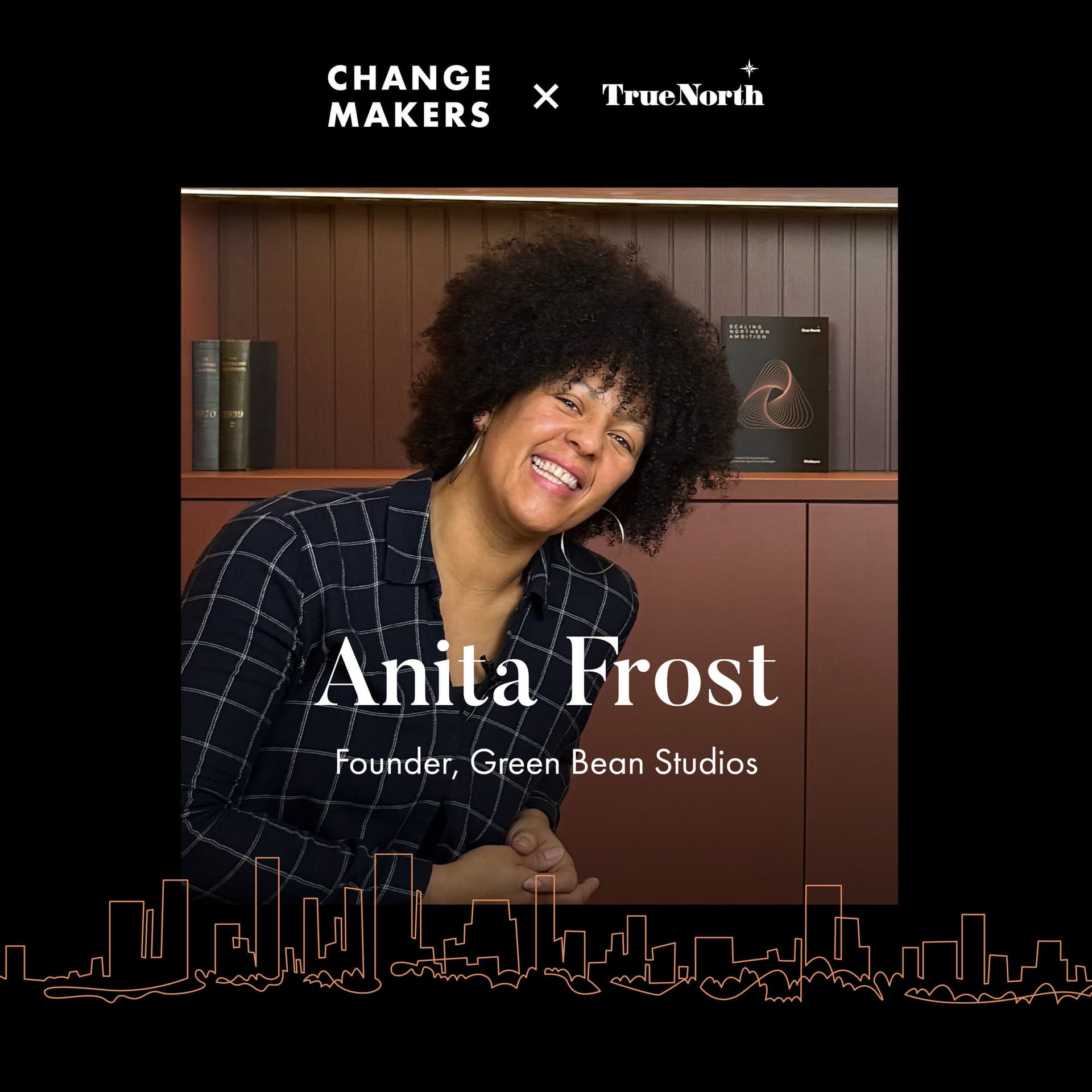
188: Making the Difference: The True North Conversations | Anita Frost, Green Bean Studios
Podcast Overview The podcast "Change Makers" examines bold ideas and the lives of leaders creating positive change in their communities. Host Michael Hayman interviews entrepreneurs and business leaders, focusing on their impact, stories, and the driving forces behind their missions.
Episode Description In this episode, Michael Hayman speaks with Anita Frost, the founder of Green Bean Studios, a Manchester-based children's entertainment and intellectual property brand. The discussion centers on how Green Bean aids children's learning and development in an increasingly screen-dominated world, alongside Frost's personal journey as an entrepreneur, her experiences with dyslexia, and her recognition as a recipient of KPMG’s Black Entrepreneurs Award.
---
Key Themes and Insights
Introduction to Green Bean Studios
- Character Focus: Green Bean, the main character, aims to help children learn, play, and foster readiness for school.
- Business Intersection: Green Bean Studios operates at the vital intersection of early childhood education and entertainment, similar to well-known characters like Peppa Pig and Bluey.
- Market Gap: Highlighting a significant decline in children's outdoor play and learning due to increasing technology use.
Entrepreneurial Journey
- Background: Anita Frost has over 20 years in child development and has personal experience with dyslexia, which she identifies as a pivotal element in her entrepreneurial mindset.
- Aha Moment: The realization that she could create a children's brand occurred after navigating an unexpected journey into self-employment, marked by a strong desire to innovate within children's education.
Challenges and Resilience
- Pandemic Impact: Frost discusses the difficulty of starting a business during the pandemic and how this experience shaped her resilience.
- Recognition and Growth: Winning the KPMG Award marked a significant shift, providing not just validation but also resources and support to propel Green Bean Studios forward.
Investment and Community Support
- Investment Goals: Frost shares her current goal of raising £850,000 to expand her reach, with a focus on children’s subscriptions and licensing.
- Creative Industry Potential: She emphasizes the profitability of the creative industry for societal good, contrasting it with traditional sectors like oil and auto.
- Support for Female Founders: The conversation touches upon the challenges female entrepreneurs, especially women of color, face in securing investment and the need for more supportive ecosystems.
Future Directions
- Vision for Green Bean Studios: The core mission revolves around creating a circular economy focused on kids, community, and the earth. Frost is committed to using sustainable materials and practices in her brand.
- Call to Action for Investors: Frost encourages investors to recognize the long-term value of supporting creative ventures that foster community and innovation.
---
Key Takeaways
- Importance of Play: The need for children to engage in play and learning beyond screens is critical for their development.
- Dyslexia as a Superpower: Frost’s personal experience with dyslexia illustrates how challenges can be reframed as strengths in entrepreneurship.
- Ecosystem Support: Building a supportive network for female founders and creatives can lead to greater innovation and economic resilience.
- Investment in Future Generations: Supporting businesses that prioritize community and environmental responsibility is essential for sustainable growth.
Closing Remarks Anita Frost’s journey with Green Bean Studios is not only a story of personal success but also a call for a collective effort to nurture future generations in a rapidly changing world. The episode encapsulates the essence of innovation, community impact, and the need for sustainable practices in children's entertainment.
---
This episode serves as an inspiring reminder of the potential for change when passion, purpose, and creativity unite within entrepreneurial endeavors.
Written by AI. May contain mistakes. Listen to the episode to check what was said.
Transcript
Automatic transcript. May contain errors.0:01Welcome to Making the Difference, the True North Conversations, powered by the purpose-led independent law firm, Rabner's. I'm Michael Heyman, and over the course of six episodes, I'll be speaking to entrepreneurs and business leaders from across the North, each providing incredible insights, stories, and a commitment to people, communities, and the Northern economy. It's bold ideas for change, from a constellation of Northern stars, doing things differently, and making the difference. I'm joined today by Anita Frost, founder of the Manchester-based children's entertainment and IP brand, Green Bean Studios.
0:38and you. Anita, welcome to the True North Conversations. Absolute pleasure to see you. Green Bean Studios. Here is Green Bean. Here is Green Bean. Tell us about him. Hello and welcome. Yes. You can't do the ventriloquist. No, absolutely not. That's not my gifting. But yeah, Green Bean is here today. My name's Anita Frost from Green Bean Studios and Green Bean is our main IP character. that leads Green Bean Studios forward. And Green Bean is here to help children to play, to learn, to go on fun adventures and just really set the tone for under fives in that school readiness space. Fantastic. I mean, let's get into it because, I mean, award-winning business, fantastic story at a really important intersection, right?
1:30You know, those early years with kids, but a business. Yes, absolutely. Yeah, introduce it to us. Yeah, really, if we think about IP, what is IP right now in regards to children and that space? We'll think of those four running characters, your Peppa Pig, your Bluey, and they commercially have been founded to do the most incredible storytelling in a home for a moment for a child to sit down and watch an episode or a family to get together and have some joy. I'm being taken right back. I mean, I've got two daughters, 14 and 12, so I'm back in my CBeebies phase. I mean, it's like Mr. Tumble next.
2:07Absolutely, Mr. Tumble. And they are the moments that cause families to sit together and enjoy. But also there's a business attached to each one of those IPs going forward. So we know there's space for it and we know that we enjoy it. But what we've seen is that there's a huge, dire fall in our kids being able to learn, to play, to go outside and explore the world. because technology has been introduced and our world continues to change. So we need a superhero character to come in to help our children to play, to learn, to go on fun adventures, but to be commercially really attractive. Practically, that means books, eco toys, games, television, content licensing.
2:53Yes. Is that about it? Is that the scope of the business? Absolutely. And that's a 360 world, isn't it? A place that all things can happen from your media to your retail to adventure spaces. Yeah. And of course, at this sort of most important of issues, which is children's mental health, ecology, emotional and social development. I mean, take us back to the, I suppose, like the aha moment in terms of actually thinking we could do something about this, not as a kind of charity, but as a business. Yeah, really great question. So my background is over 20 years of child development. So I understand children.
3:38I understand the core of who they are. I understand that whole EYFS, which is that early years framework of how children should learn. I also understand special educational needs as a woman who has got dyslexia and struggled in the academic space to be able to learn and retain. But one thing that was very apparent about who I am is I'm an entrepreneur, but I didn't know that. When did you realize, funnily enough, there's a big, big connection between dyslexia and entrepreneurship. A lot of very successful entrepreneurs will say that dyslexia is their superpower. It helps them see around corners.
4:15Absolutely. And that was my dynamite. So very much when I left school, I knew I wanted to work with kids, but there wasn't going to be an introduction of like, you can have a children's brand. That wasn't on the table. It was be a nursery nurse, be a nanny. And there's nothing wrong with those roles. So when I was studying in those fields, I'd go in, I'd be super disruptive, want to turn things around, change things. Let's go bigger. Let's go bolder. And I actually had managers who would support that. So a lot of the disruptive traits were in. Yeah, which is entrepreneurial. Were in. and say your dad was a technology engineer.
4:47Yes. Where do you think it comes from? I mean, is it something you've, has it come through experience or do you think it was more ingrained than that? It's ingrained. So my bloodline is rich in creativity, rich in small businesses, rich in disruptiveness, clotheslines, technology, building things from wood. So very, very rich bloodline in regards to creating, making, and also the care, Yeah. Nursing, midwifery, that's very strong as well. And I also grew up in a home where we always had space to unleash those things. So my parents were very much like, there is a space for you to do what you need to do.
5:27Go and do those things. I sense that momentum might be important to you as well. Being on the move, actually, which is another part of the entrepreneurial journey, I think. Absolutely. So going back to that space of learning early years and being in uni, being in college, I very much went to all those different spaces. And most people would look at that and think, she can't really settle and she doesn't know what she's doing. But actually all those spaces helped get to where Green Bean is because I then got made redundant in the voluntary sector and was my first time going into self-employment.
5:58And I'd go into rooms networking as a self-employed person with business owners. And then they'd ask me questions or they'd talk about something and I knew how to unlock things for their businesses. And I was like, how do I know this? I mean, I'm thinking about your journey and I want to take you to the end of 2024. Yeah. You're going on stage at the KPMG Black Entrepreneurs Awards to receive their most promising medium-sized business. Yes. And I want you to compare and contrast that moment with founding a business in the depths of a pandemic where the whole world is dislocated. Everything's on Zoom.
6:42We'd have been doing this on Zoom. And then that moment of, wow, this is recognized, receiving more than just a gong, right? This is investment. Absolutely. Give us the contrast. Yeah, the contrast is I'm not the same person. The other contrast is we've achieved great things in regards to green beans supports children's behaviour to be modified. But what is that for a northern female founder of colour in the north? That's a load of grit. That's a load of pushing through. And that deserves to be unpacked, right? Because in terms of the journey that you've been on, in terms of actually how those things have become your power.
7:27Yeah. Right. Tell us a little bit about that. Yeah. It's overcoming. It's resilience. it's rejection it's um hardship you know all those things pushed alongside opportunity and passion has shaped green beans foundation for green bean studios it changes the way that you think and see the world and it's created opportunity for job creation but also i think it shaped you hasn't it yeah absolutely absolutely so if i could wave a magic wand and allow you to advise yourself in those first days of startups what would you tell yourself now in terms of what what what's the what's the lesson you'd share yeah i think the lesson is that it's all learning and you've got to have grace for yourself it's okay it's okay because you know you was talking about 24 and starting, the economy has completely changed.
8:23That's a force alongside a person that you can't control. So you can work on the inner of you, which is get better at your leadership, get better at these things that help the business lead forward. But how the heck do you lead forward with something that's completely out of your control when the whole world shuts down in different levels? So you learn resilience. And governments change. You learn real resilience, I guess. Yeah, yeah. Yeah. But you learn how to pivot. Yeah. When the economy doesn't know what it's doing, you learn to still find opportunity and make it work. Right. Let's bring it up to date.
8:57You've had angel investment in the business. Yeah. But you also want to have further investment in the business. And I suppose you're going to have to show up again in an environment where for all of those, I suppose, cornerstone parts of your identity, you're going to face an investment community that doesn't show up pretty well in that environment. In terms of actually, what's the message to investors that are listening? Yeah, the message is that the creative industry is so misunderstood, but it's so profitable, but it's profitable for good. it supersedes oil it supersedes auto and it's a place that's got longevity in regards to returns job creation and then let's go to back to that bit like you said you remember sitting down with your kids and having those wholesome moments that's what entertainment does absolutely and that makes us human right yes and it's where the imagination flourishes yeah have you found building that business in manchester i mean is that is that a part of the is that a part of the creative mix for you yeah my heart has always been that i'd love for this brand to be owned invested in built in in the uk and then it went out and did what it needs to do so ultimately when kpmg gave us that award and cash investment and that um approval stamp to say we're on board not just for this we're here to advise you we're here to champion you that changed everything because that's no longer me in my lane that's actually us in the north in our lane together because i was gonna ask because you said the uk and i and i wanted zoning on the north it says well what does what does that give you because presumably you could be building this business in shoreditch or yeah somewhere i mean what what's what's the manchester mix for you in this yeah well when i say uk manchester is the core of where we are media city it's that that i want that to be our ecosystem that was operating a circular economy that got green beans started so that we can then go media city is a wonderful example isn't it like you know you bring the bbc into the mix you bring you know you bring a good university into the mix you bring lots of different things and before you know you've got an ecosystem and yeah and businesses like yours can can start and flourish and there's something wonderful about that and actually all those i was i sometimes think about that when you see those offices where there's nobody in there yet and you think well actually who's coming next?
11:23There might be Anita, the next Anita. Yeah, green beans coming. Green beans, green beans. Well, I mean, let's, let's talk about the what's next for green beans. You know, you've, you've, you've had an amazing start to the business. I mean, where, where do you take it? And actually, how does, how does your entrepreneurial style help drive that? Yeah, great question. So right now we are raising investment. We're seeking 850k and we're asking for 250k as the first tranche. It's like we're doing Dragon's Den now. Dragon's Den right now, right now. And that's to kind of move us forward to get more reach to the children, subscription, licensing.
12:02Well, let's do a Dragon's Den for a minute. I mean, you know, if I'm going to sell you, I'm in or I'm out. I mean, what's the reasons to be in? The reasons to be in is because we're modifying children's behaviour for good. Green Bean helps children who are mute to start speaking. combats anxiety and actually helps children to switch off from technology and become our future workforce you're investing not in just a brand you're investing in the future workforce and that needs to be an investor who cares yeah who cares about the future as well as profiting so if you want to make a difference yeah yeah yeah i guess the other thing is is that a lot of investors back founders they back entrepreneurs they back they they it's a people-led type of in of industry And I mean, you have a phenomenal energy in each minute.
12:49I mean, I don't know if it's coming off on the camera, but there is a you get that sense of urgency and of passion for the project, I guess. But how how does that work in an environment where you've got to scale that magic, where we're actually you need to build quite a lot of people with the same sort of get out of get out of bed and jump to it type mentality? Absolutely. For founders, it's all about knocking on doors, isn't it? But let's go back to the ecosystem. There's genuinely businesses right now that do care beyond profit. They care about doing generation. They care about longevity. They care about sowing into good things.
13:28So they're the people that we want to be a part of connecting with, a part of our ecosystem. And have we done that in the North? Yes, we have. But have we got all the cash in that we need from the North? No, we've not. Do you ever get any pushback in terms of the social mission mixing alongside a for-profit identity? No, that's a great question. So actually we don't. Everyone's on board with the mission of what Green Bean is. But there's an issue with being on board with me as a founder, because you said it, people back the founder and they're hesitant because I'm unfamiliar. And I'm not to judge anybody for that, but that's because collectively in the North, have we done a great job of supporting female founders, female founders of colour and seeing them go right the way through.
14:16So unpack the unfamiliarity for us in terms of actually the lived experience of that. Talk about how it manifests. Yeah. So I'd go into a room, you get invited to go and pitch and to go and bring Green Bean in because of the accolades, because of the great wins that we're doing. But then I go into an audience that have never been around what green bean is or ever invested in a creative entrepreneur. So we're talking investors. We're talking investors. Is it just that you just innately feel it or is it that you experience it in some way? Because it's not an uncommon observation that actually capital is not necessarily questioning enough in terms of finding great ideas to back.
15:00I mean, I'm just interested in how you've experienced it personally. Yeah, absolutely. The obvious one is you go with a panel of six and you're all pitching. And then out of the six, everyone else has got some sort of feedback or they've got a follow up with some investors and you come away with nothing. The other obvious is spending a lot of time in the north and you know all the investor networks. I don't necessarily know all the angel investors. That's definitely been a weakness for us. But the one thing that's apparent is that the investor networks don't know what to do with Greenbean. They love us.
15:30They cheer us on. They'll invite us to pitch. But because it isn't getting that return, they don't then know how do we problem solve this? How do we unlock it? And they'll introduce to a few other networks, but it's still not necessarily getting the traction that it needs. Do you think you've got sufficiently good answers yourself about how this business scales and goes to the next step? Because I would say that many of the things that you've talked about as the challenges of being unfamiliar, if you're looking at investment committees right now, they'll be talking about, bring me another Anita right now.
16:06In terms of like there's a lot of people looking to connect with business leaders that have got social purpose, that are delivering something incredible and also have got a profile themselves that I guess ticks all of their boxes. But in terms of actually how you turn that beyond the kind of, well, OK, great. This is going to be a world class business. How do you see this? How do you see the commercial scalability? Yeah, great question. Again, it's that risk. We are not really great in the North on taking risk. We love the triumph. We love the overcoming. We love doing that. But in the UK, will we take the risk on some person and a brand that's not been done, that's not familiar?
16:50But if we actually look through the North, you've got like your Danger Mouse, Fifi the Flower Pot. Now, they were done and they were founded. Even Peppa Pig, that was a Welsh broadcaster that took the risk. So actually, are we taking risk in female founders? I think that's a great, great answer, right? Because I think the risk appetite is a big part of what the next stage looks like. I mean, I've just got back from a two-week business trip to the States and, you know, hang out in Austin and like you're in the bars and you can hear people talking about the business plans. I mean, there is an entrepreneurial culture, but also an inherent risk-taking attitude, which is that, you know, in many ways, there is a bet on the table to take, right?
17:34You know, that actually not every investment is going to succeed. But I suppose equally, how the entrepreneur turns himself from being more than just a kind of a bet to being a kind of sure thing is a big part of what investors want to sort of have the confidence that they're not providing a social answer they're providing a commercial answer so what I'm suppose what I'm getting at is what's the responsibility on you as the entrepreneur to sort of like say I've got some answers here yeah I've definitely got some answers here and a big tick box that I don't think we get on in regards to pitching right now is is those female founders who have overcome the pandemic government changes they're still going they're still making sales they're still making traction They're still building social impact.
18:20The ecosystem is getting bigger. That actually outweighs a lot of what's next. They've not had the capital yet to show what they can do with it. Yeah. I mean, you kind of talked about the entrepreneurial culture. And obviously we are we are looking about we're looking at businesses across the north of England at the moment. But in terms of what the North does have, what you'd like it to have, what the next step might be in terms of what it needs to, I guess, unleash the energy that you've been, you know, talking about in this interview. What's the advice pieces you'd give to, I guess, the policymakers, the investors, others in terms of actually how the North can get its own act together in this space?
19:04Absolutely. I think something that really stood out to me recently is when I was actually invited into Liverpool and I went to an invest event there, that they run programs where they actually put investment into the business to allow the founders not only to be able to learn, but be able to not be distracted from thinking, I need to do this program while I'm still trying to get the sales up and do everything. So almost like they do a buffer of like 10K. So a founder can sit and do the network, net worth, the learning program and breathe. Right. We're not very good in the North. We offer lots of resources.
19:42Not all of that comes with quality workmanship. And we then ask the founder to continue. Run your business, run hard, run the time through. And the infrastructure that you could put. Yeah. Interesting. I mean, last question. and sad to have to ask the last question. I enjoyed our car time together. But just thinking about, you know, congratulations on becoming one of our Northern Stars. And I guess that idea of the Northern Star, it's a true North point. It's a sense of direction for you personally. So I know Green Bean is listening to your answer. But in terms of actually how you see your journey and the next step, in terms of that kind of onward quest, that onward northern style.
20:28Give us a sense of actually that journey. Absolutely. So our core foundation at Greenbean Studios is kids, community, earth. The community is our future workforce. It's our workforce for now. So we want to do more job creation. We're a circular economy brand. In regards to kids, let's get our kids learning and playing. It's awful, the stats right now for our kids in school. Technology is here. It's not going to go away, but we want to embrace our kids being just alert and ready and passionate and the entrepreneurialism to come out. And in regards to the earth itself, we use vegetable starch, cornstarch.
21:06There's so much experimental stuff that we can do for good, you know, bamboo, all these materials that we can experiment with. So we innovate. So we're just going to continue to do in that. and we're going to continue to do it greatly and be disruptive and invent and continue to lead forward as a circular economy brand. Brilliant. I've got to say, Anita, it's been like a vitamin shot of positivity. And I'm going to say, Green Bean, I mean, I've enjoyed meeting you also. Anita, thank you very much for joining us on the True North Conversations. Thank you for coming and congratulations on becoming one of our Northern stars.
21:41Thank you so much.
From the publisher
In this episode, Entrepreneur and early-years specialist Anita Frost shares how her under-fives character Green Bean is helping children learn, play and switch off from screens. She reflects on building an IP brand from Manchester during the pandemic, the power of dyslexia in her entrepreneurial journey, and winning KPMG’s Black Entrepreneurs Award.