In short
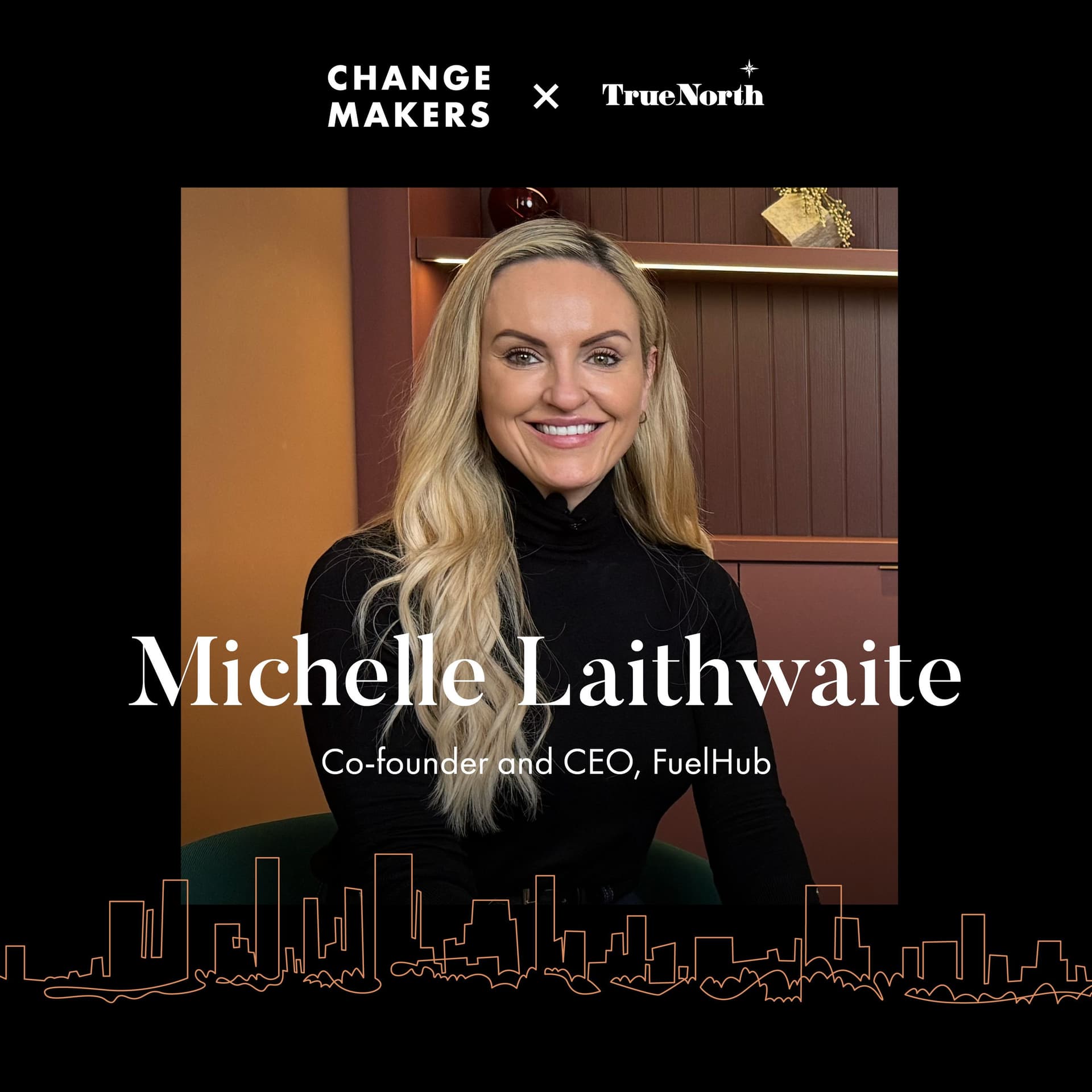
Podcast Summary: Change Makers - Episode 189: Making the Difference: The True North Conversations | Michelle Laithwaite, FuelHub
Podcast Overview Title: Change Makers: Leadership, Good Business, Ideas and Innovation Description: This podcast, hosted by Michael Hayman, focuses on leaders making significant contributions during extraordinary times. The series emphasizes optimism, entrepreneurial endeavors, and change-making through innovative ideas.
Episode Overview Episode Title: 189: Making the Difference: The True North Conversations Guest: Michelle Laithwaite, Co-founder and CEO of FuelHub Description: Michael Hayman interviews Michelle Laithwaite about her journey in establishing FuelHub, a meal prep delivery service that focuses on providing clean, high-protein meals.
Key Themes and Discussions
Introduction to FuelHub
- Origins:
- Founded by Michelle and her husband, James, inspired by their need for clean, convenient meals.
- Launched in August 2019 while Michelle was eight months pregnant.
- Product Offering:
- Provides subscription-based weekly boxes of high-protein, premium meal prep.
- Distinction from competitors: FuelHub focuses on clean ingredients without ultra-processed elements.
Entrepreneurial Journey
- Early Challenges:
- Michelle and James faced significant personal and professional challenges, including Michelle giving birth just days after launching the business.
- The COVID-19 pandemic created a surge in demand for their products.
- Team Dynamics:
- Michelle and James have complementary skill sets, with James focusing on operations and Michelle on the strategic vision of the company.
- Their strong relationship and shared experience contribute to the resilience needed to navigate entrepreneurship.
Market Insights and Strategies
- Identifying Market Needs:
- The couple recognized a gap in the market for healthy, convenient meals, particularly focusing on high-protein diets.
- Their brand is built on trust, with endorsements from athletes and a commitment to quality.
- Growth and Success:
- FuelHub has experienced substantial growth, highlighting a 300% increase year-on-year.
- Key partnerships, such as with Warrington Wolves and upcoming collaborations with Manchester City, enhance brand credibility.
Personal Reflections and Future Aspirations
- Resilience and Mindset:
- Michelle speaks about her working-class background and the drive instilled in her from a young age, which fuels her entrepreneurial spirit.
- There is an emphasis on the importance of a supportive network and the need for more female entrepreneurs to connect and share experiences.
- Vision for the Future:
- Michelle aspires for FuelHub to become the UK's most trusted meal prep brand, with plans for product diversification and sustained innovation.
- The company maintains a commitment to sustainability and community involvement.
Key Takeaways
- Authenticity and Trust: Building a brand centered on authentic storytelling and community trust is vital for customer loyalty.
- Support Structures: The importance of having a supportive partner and network is crucial in tackling the challenges of entrepreneurship.
- Innovation as a Core Value: Constantly seeking customer feedback and innovating products keeps the brand relevant and in demand.
- Future Opportunities: The food prep industry is positioned for substantial growth, driven by consumer awareness of health and convenience.
Conclusion Michelle Laithwaite's journey with FuelHub exemplifies the power of resilience, innovation, and authentic brand storytelling in the dynamic landscape of entrepreneurship. The episode serves as both an inspiring narrative and a practical guide for aspiring entrepreneurs.
Written by AI. May contain mistakes. Listen to the episode to check what was said.
Transcript
Automatic transcript. May contain errors.0:01Welcome to Making the Difference, the True North Conversations, powered by the purpose-led independent law firm Rabner's. I'm Michael Heyman, and over the course of six episodes, I'll be speaking to entrepreneurs and business leaders from across the North, each providing incredible insights, stories, and a commitment to people, communities, and the Northern economy. It's bold ideas for change, from a constellation of Northern stars, doing things differently, and making the difference. I'm speaking with Michelle Lathwaite, co-founder and CEO of the premium meal prep delivery service, Fuel Hub.
0:42Michelle, welcome to the True North Conversations. Great to see you. Thank you. Great reading about Fuel Hub. I mean, it's brought out the inner athlete in me in terms of the business. Tell us a little bit about it. Yeah, so thank you. Great to be here. We are Fuel Hub. So we're a Warrinton-based meal prep company. We deliver nationwide, so proud of our northern roots. But we do have a very big business across the country. And yeah, we deliver by a subscription weekly boxes of high protein premium meal prep, which is essentially a ready meal, but super healthy. So not like the ones that you would see in the supermarket, which tend to contain a lot of ultra processed ingredients, chemicals that you can't necessarily pronounce in the ingredients.
1:32Ours are very clean. And a real reputation, though, I mean, I was being slightly flippant about the athletes, but I mean, loved by a lot of high performance people. So was that always baked in in terms of the early days of the business? Or is that something you've come along to as you've gone further into it? Well, I think that my husband and co-founder, James, was a professional rugby player. So he played for Warrings and Wolves, our local club, obviously, for a long time. And so he's been an athlete. He understands the importance of nutrition and not just training, but recovery. So there was always this element of, you know, to be a trusted brand, which is massively important to us.
2:14What is the, you know, the most trusted kind of ambassador you can get when it comes to nutrition? And that is athletes. So it was very much a part of our strategy from the start. And we were lucky enough straight away to get a contract with Warrington Wolves, one that we still have today. We've been having a lot of interviews today and we've had sisters, we've had fathers and daughters and now we have wives and husbands. So let's talk about the relationship in terms of being that kind of team, that kind of dynamic and actually how you got going as an entrepreneurial double act. Well, I mean, James and I are really lucky to be in this together because we do have a fantastic relationship.
2:53We're very different, which I think works. How so? Well, James is our COO and I operate as our CEO. So, of course, I'm kind of working now more on the business as opposed to in it. So, you know, I think you've got to take that step back to step forward, haven't you, in that kind of role. James is very operational, very granular in the day to day. So I feel like the dynamic is great between us. But we are quite different. Some people call us good cop, bad cop, as a joke, I think. but um it works so well you know um to go through this that we've been through together um because it's just all consuming as you've probably you know spoken about today a lot of the time it's it never ends right it's intense you know and to have somebody that thoroughly understands exactly what you're going through when you go home at the end of the day and it continues through the night you know we operate seven days a week we start at four you know we're until sort of 10, it's never ends.
3:53So it's that support that we can give one another, which is massively important. And going back to the early days, the aha moment, you mentioned obviously James' role as a professional sports player, but in terms of the real drive to understand, well, actually, there's a gap in the market. We could build a business here. I mean, was this the sort of the kitchen table moment, right, in terms of actually, I'm thinking about the early days, the start-up days. How did it happen? It literally was. It was a case of James was injured quite a lot. He was played with injury, unfortunately. I mean, he's had four broken legs, all on the same leg.
4:33And actually, the first time that I watched James play, he invited me along to a game, which was at the AJ Bell Stadium, and he broke his neck in front of me. He was fine. It wasn't a severe break, but it was quite enough to make him realise, actually probably isn't for me and also I actually thought I might be a bad omen so I'm surprised I got invited again but I did and it's funny because actually you know we always we always sort of laugh because it was at the AJ Bell Stadium and Andy Bell became an investor of ours so it's quite a quite a poignant thing but um so I think he was interested in nutrition um I was working in fashion at the time so I was traveling a lot I was doing a lot of international travel we were super super busy but we both wanted healthy convenient food right and it was a problem for us um and we tried a lot of meal kit companies which are great they have their place but you still have to cook it you still have to clean um you know and it still takes you a long time we were time poor we had you know at the time my son Stanley who's six now wasn't here but my eldest son Alfie was um and we were traveling you know training and it was like you know how could we get ready meals that are healthy for us.
5:40But I think sometimes in kind of when you listen to entrepreneurial stories is that it all sounds like and one success followed another. Yeah. But actually even just crossing that Rubicon of actually saying we are going to give up my career in fashion, give up my career in sport and we're going to go for this. In terms of that kind of I suppose that sense of risk that sense of journey how did that how did that sort of show up for you in terms I mean what was ever a consideration was there ever worry yeah of course there was I mean for me me and James are very similar I've always been a person that you know I'm from Tildesley and Greater Manchester you know very working class family we didn't have much when we were kids I don't have any education really I wasn't very I was a bit of a rebel at school if you like but I was always very confident and very strong, strong-willed.
6:32You know, if there's something I wanted to do, I was doing it. Same with James. He's a rugby player. You know, you need that mentality as well. And when we... So resilient characters. Resilience. Very much so the two of us together. And you put us both together and that's obviously, you know, a very, very strong thing for two people that are very similar. And we just identified this problem for us. And we were like, we should build the product that solves our problem, but solves all our friends' problems and their friends' problems. And this was 2019, of course, because this is pre-COVID. But people were getting very, very, very much, you know, they were focused on health and fitness, high protein.
7:06We all know now in the past five years, everybody's turned to high protein diets because we now understand there's more education and science around it. But we were quite nearly adapted to that. Well, and I can see that. And I mean, you've really got this business going, right? And in terms of actually when, I mean, like 300 % year on year growth, I mean, it's a great success story. And when did you first get the sense that we're really onto something here? Was there a kind of like, whoa, this is happening? I mean, yeah, I mean, it was COVID. COVID, right. I mean, we launched the business in August 2019 and I was eight months pregnant at the time.
7:50and we'd rented a small space in Warrington, 900 square feet. We'd got our equipment together. We'd invested in 20K in there, invested in building this kitchen. And the weekend that we launched, we spent about£1 ,000 on a website. And the weekend that we launched, I went into labour early and gave birth on the day we launched the business. You've certainly given yourself a series of challenges. So straight away, we were like, OK, this is going to be a challenge. So four days after Stanley was born. New business, new child, new pandemic. So new baby and the business baby. So four days later, after giving birth, Stanley was in with me at work.
8:31So it kind of was just head down. And then as we sort of approached 2020, the early start of the year, we decided to go from being an e-com website, just where you came on and placed an order to a subscription. So we built a second website because we built a lot of traction and we got this contract with Warrington Wolves. And that in itself had kind of resulted in other teams coming on board. So the B2B side of the business was strong. So it strikes me that early on, there were some very important, whether you would call them support structures or belief structures around you. So whether that was investors, early customers, all the things I suppose were proof of concept type moments.
9:12I mean, I'm just sort of thinking about entrepreneurs that might be watching this and they might be saying, well, this is a really rarefied story because, you know, AJ Bell Stadium leads you to your investor, your customer. Is there a learnable lesson, do you think, for other entrepreneurs in terms of actually how to get that early phase right in terms of setting the conditions for success well? Definitely. I think for us, I worked with brands for many, many years in fashion. So from Nike to Versace and Diesel back in the day when that was big brands. I mean, hundreds and hundreds of brands. So for me, James brought the nutrition expertise and the sporting background.
9:50I brought that kind of brand and business acumen. And I'd had a couple of businesses myself before. so I understood about building something that customers would relate to and trust and also identifying a gap in the market you know there were other people in our space well how are we going to be different why would a customer that wants this product choose us over somebody else and that was a strong brand those athletes that you know the endorsement by you know athletes and also you know having that just the trust element of it and I think underpinning that I I mean, just reading a little bit about the business is a real skill at storytelling, which might be that all those things might add up to it.
10:32Right. But I mean, at the end of the day, the reputation is in front of you, isn't it? Because people get the story and that and they're coming to you with their custom. That's it. And I think, you know, nowadays people want to see the founders of a business. You know, if somebody is spending£70 a week with you for you to send them a box of food, you know, they want to know where it's being made, where the HQ is, which we show quite often on our social channels. Everything's manufactured in-house. And they want to know the team, who the founders are, what's their story, why did they build this business?
11:06And we were solving our own problem to begin with. And we want to now solve the problems that other people have. Right. So Warrington, HQ, right at the heart of a northern business, right? you know let's talk about identity let's talk about i i guess provenance of where where you're from in terms of actually the sort of business that you've built yeah i mean james is warrington born and bred i'm from tools he worked in manchester for a long time warrington's a great place um and you know the kind of the position that we're in is an amazing location many of our competitors are based down south we're the only one in the north i believe and apart from gusto or obviously meal kit we're just around the corner from us and basically it gives us this fantastic location of being right near all the main hubs for the couriers so we have a dpd depot right near us huge you know breaks where we get some of our produce from fantastic local suppliers and cheshire on the doorstep for produce it's a great place for us to be and i'm really proud of our northern routes going to the routes a bit i mean those are really compelling I suppose sort of like functional and factual reasons about why a business like this is well placed but what about what about the what about the attitude that you get do you think there's anything in that oh 100 % you know northerners are built on grit right and resilience and you know my working class background and I was brought up to be taught that you work hard whatever you do that's what I was what I grew up with and you know I didn't go to college or uni I was straight into the workplace and I just basically had this you know kind of mindset of whatever I do I've got to make the best out of it.
12:49You mentioned that a couple of times that in terms of in terms of not doing that how do you interpret that do you do you interpret that as opportunity or regret I guess? Opportunity. Opportunity. To talk us through what the opportunity I mean obviously you've built a fantastic business but presumably it's given you other other opportunities as well yeah i think it just gives you um i just think it gives you fire in your in your belly really and it gives you this you know ultimately you know i come from a place of of working hard strong work ethic i think a lot of the people that you know i grew up with were exactly the same and it it gave me a different drive i think it gave james james a different drive and i just feel like it's that kind of northern spirit that really gets us you know gets us up in the morning yeah and i and i get that and and also though i think that you know you you're also somebody who speaks your mind i mean so i was i was looking at your uh latest um post on on ambition and motherhood and you know i mean these these are other other factors that are part of part of your mix right i mean tell us a little bit about you know what what you're thinking about michelle in terms of that particular issue as it pertains to business Yeah, I think, you know, for me, I'm 43.
14:01I have two boys, one at six, one at nearly 14. So I'm navigating all those challenges that you would at that age. And there's a lot going on. And I feel like, you know, I do have a voice. I have a strong voice. I'm quite, you know, I've got quite a lot of opinions on that side of things. So I do sort of vocalise it. I've always been that way. But you've got a frustration on this issue, haven't you? Yeah, I guess a little bit in terms of, you know, it is tougher for women, I feel. I think that a lot of the time I'll always say, I've been sat in board meetings and Stanley's fallen over at school and hurt himself and immediately the school ring mum because mum is just, and I feel like the females do tend to have, I mean James is amazing, very progressive household in terms of we share everything, but I think mums still get, and women still get the brunt of everything and it's hard, it's hard, very challenging.
14:54Right. I mean, and I suppose in terms of how you move the dial on for future entrepreneurs, because a big opportunity is for more women entrepreneurs to do better, set up more businesses, go further, go faster. But that's not going to be done unless the conditions are right, the support structures are right. I mean, are there, I mean, we're talking, it's a platform or are there things you'd share in terms of actually what could be done, let's say, in a localized setting like in the north? I think that for me, I've often tried to find and source, you know, groups of women that are like me that I can go and sit with and share and talk and encourage one another.
15:37I can't find anything. So I can't find a group anywhere of women CEOs. So the connectivity. Connectivity. Yeah. 100%, you know. You know, where is that? Where is that sense of? And I feel like, you know, that would be massively important. You know, I've got friends and family that I can speak to, but I don't really have anybody that's a female CEO and founder like me who's going through these things that I could actually bounce off properly. So I think that's really important. I tend to get this interview out. There might be a few people picking up the phone. Hopefully. But I think it's a good question for entrepreneurs, which is kind of like at the apex of a business, everybody expects that you've got the answers.
16:14but how you stay innovative where you find your learnings is a is a really interesting question I think because actually everybody's got a slightly different answer for it some people actually plateau and they kind of they kind of just repeat repeat yeah other people have this kind of quest to to get better all of the time and I I kind of sense that in your businesses that there's a performance aspect all of its own it's not just about supplying athletes with high performance diets there's a high performance business here how do you maintain the innovation culture well yeah i mean we we're constantly innovating we're constantly looking at how we can better we are very very close to our customers so our subscribers we speak to we ask them what they want from us and you know it's important to responsiveness absolutely and it's it's important to sort of say that we don't just supply athletes and fitness goers we um cater for what we call an everyday high performer and that can be anything from an athlete right down to a school teacher or a mum that's at home busy families people that we want to feel to be the best that they can be to perform the best at the day and that whipples through the team and we're on 40 staff now really high performing team most of which have come through the ranks with us and I think innovation is something that we're developing new ranges so we've got our main fuel hub range We're just about to launch a children's range so that we can support families, which is really important.
17:42And that coincides with a new... And an enormous marketplace. An enormous market. I'm just thinking about the rise of Strava, other sorts of businesses in this space. I mean, do you sense this is one of those sectors where we've hardly got going yet? Or are the conditions for it already established? I think both. I think there's some great brands that have come through. I think convenience, healthy eating, I feel like, you know, everybody is on to it, basically. I mean, our growth has been phenomenal. I mean, you know, next year we'll be touching, you know, surpassing the 10 million revenue mark.
18:17And that is literally from a kitchen table idea six years ago to being at that revenue. And then that really does compound. There's a real excitement around our industry. and I think we have a really sustainable attitude as well in terms of a zero waste model. We have sustainable packaging. We do quite a lot in the community. We've actually just signed a deal with Man City to provide food for all of their soccer schools for Man City and the community. So we're trying to become more of a family business, if you like, as well, which is amazing. And, you know, we are constantly innovating. Yeah, I mean, it's brilliant.
18:57I mean, it's just such a journey for you. And, you know, it brings us to being able to say congratulations on becoming one of our northern stars. And I think just this final question we've been asking all of all the interviews is kind of like this idea that a true north is is also a directional point in terms of somewhere you want to get to. And, you know, the journey that you and James have gone on has been an incredible one of actually these these waypoints of success where you've taken the brand from a startup to actually surviving a pandemic to suddenly becoming the choice of these incredible world class brands.
19:34Where does it go for you personally? I think we want to take this as far as we can go. We want to be the UK's most trusted meal prep brand. um we want to diversify product there's different opportunities that have come to us which are super exciting and we're looking into all everything that comes to us but you know we're really proud of what we've achieved and you know we've got amazing partnerships with matt true meddy hearne you know man city now and all these amazing things and um we just have to focus on our mission and keep the product exceptionally premium um and built it on you You know, keep building the brand based on trust, premium quality, and just keep going and going and take it as far as we can.
20:16We'd love to be a household brand in the UK and who knows where else in the future. Would you do it differently if you could start again? Never. I have honestly loved every single moment of it. And you know what? What I would always say is, just to finish on, is we have never at any point not believed in what we were doing or ever thought when we couldn't pay staff or we were just you know you know crying from exhaustion we never ever ever had any doubt that we would make this work so and that's a testament to our whole team our customers you know and our team past and present there's been people that we've you know had work for us over the years aren't here anymore because the business is different they're different but they're a part of the journey and you know everybody's had their part to play it's not just about me and James it's about the whole team and our customers as well so Michelle what a master class in conviction passion entrepreneurship it's been brilliant thank you for sharing the story of fuel hub with us on the true north conversation thank you
From the publisher
Michelle Laithwaite built FuelHub with her husband James to solve a problem in their own home: clean, high-protein meals without the prep. She talks about launching while eight months pregnant, the huge COVID-driven surge, earning trust from elite athletes and fans nationwide, and why authenticity, provenance and Northern identity are central to the brand’s success.