 Ask ChatGPT


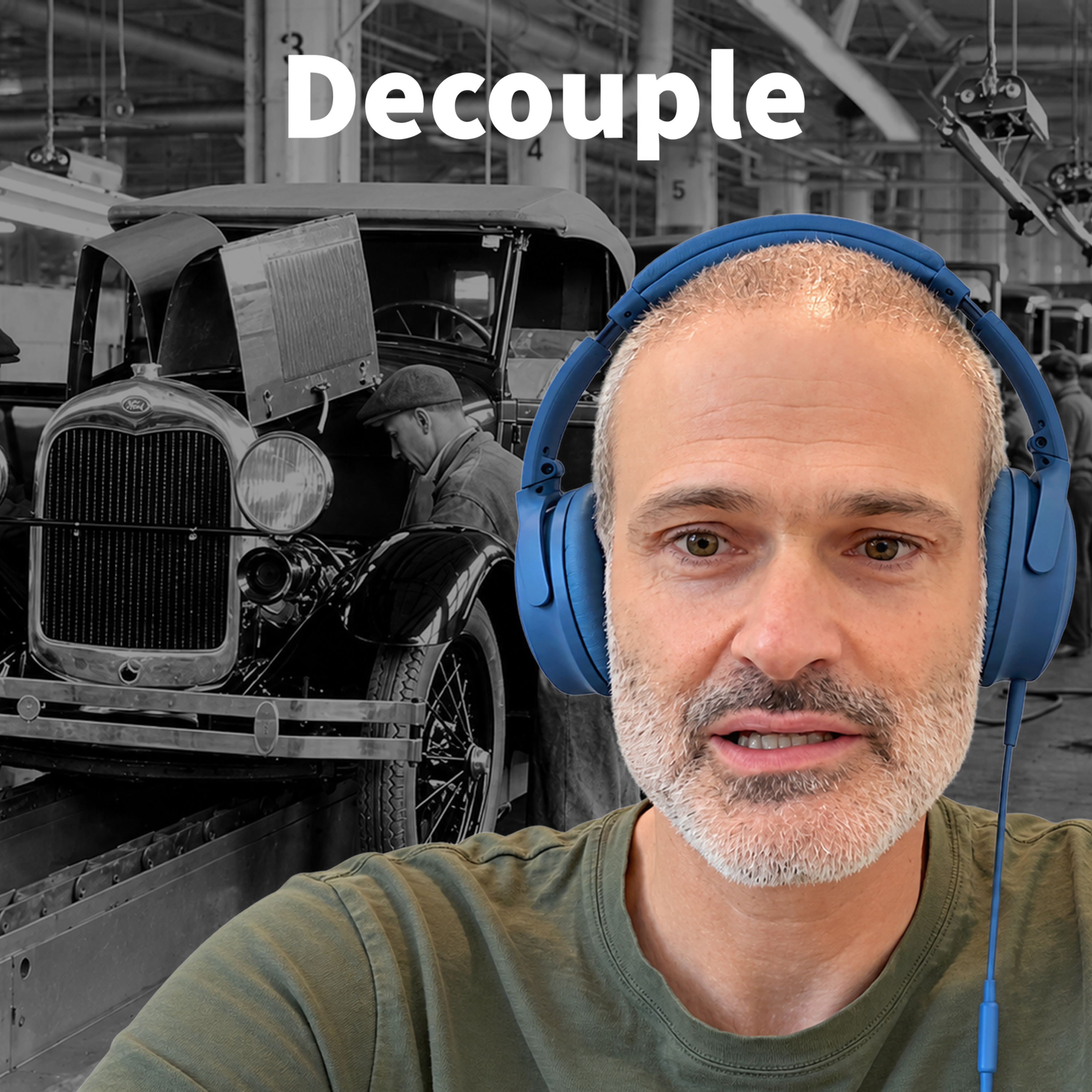
How wood shaped human evolution, economies, and empires—starting with tree biology (cellulose/hemicellulose/lignin), then fire-driven land use, wood as the dominant pre-industrial fuel, medieval deforestation via incentives and monastic land clearing, charcoal’s limits on iron production, and finally Baltic wood/“naval stores” enabling British naval power and the strategic control of the Danish straits.
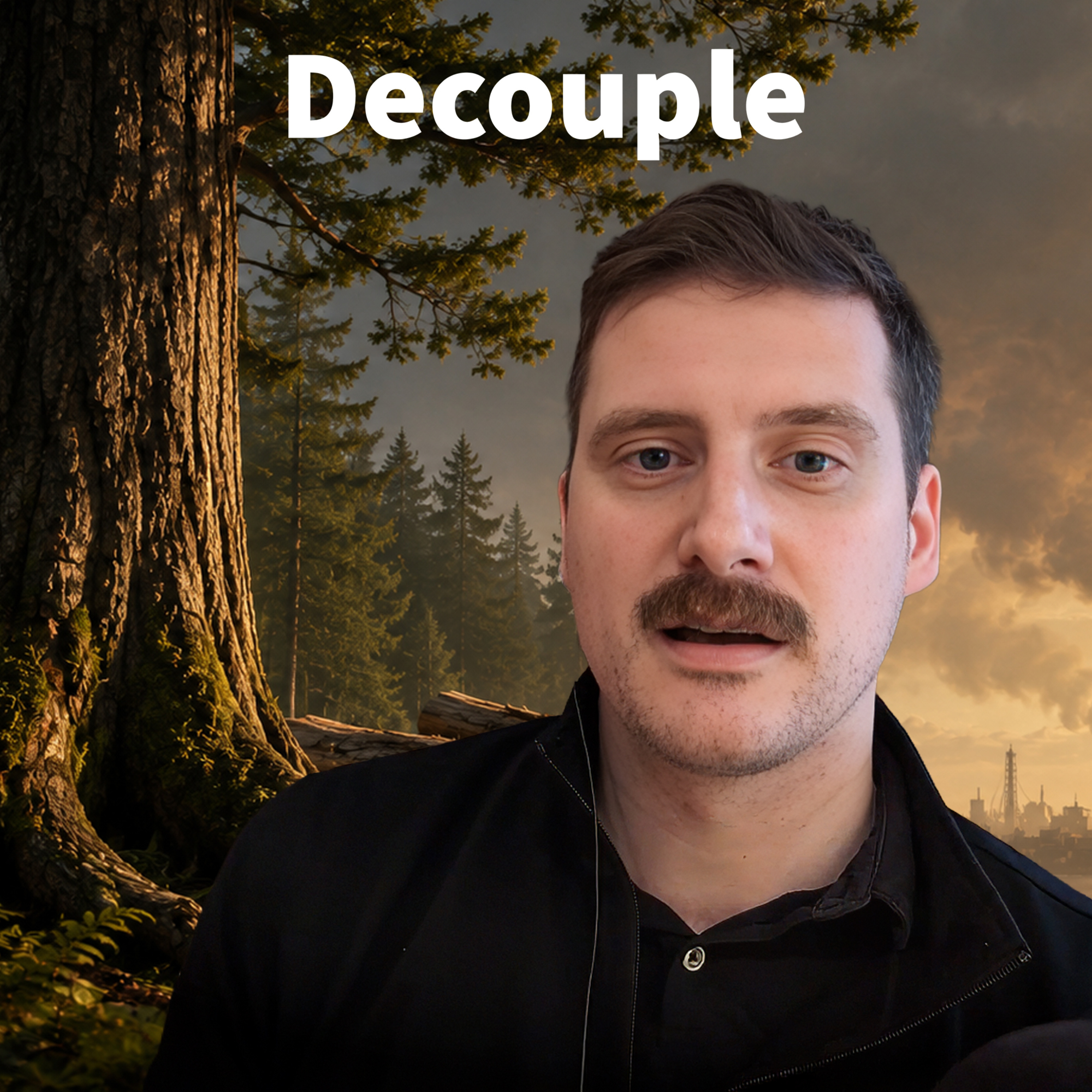
Mark Nelson is a long-time host/guest on Decouple (about 20 episodes previously). He researched deforestation for Michael Schellenberger’s Apocalypse Never and wrote/mentioned Deforesting the Earth.
Trees are “biological composite” carbon storage; lignin enables durable structure and makes wood valuable as fuel (charcoal). Fire was central to hunting and agriculture, including forest elimination in places like New Zealand. Medieval Cistercians and rulers aligned ideology + technology + climate incentives to convert forests to taxable farmland. Charcoal production and photosynthesis-limited forest area constrained iron output. Britain relied on Baltic timber and naval stores; strategic chokepoints (Danish straits) drove naval conflict.
Moa extinction after human arrival on New Zealand’s North Island; Egyptian cedar trade (Byblos/Nile); Cistercian expansion across Europe; Fontenay ironworks; 74-gun ship requiring ~50 acres of mature oak; British control of the Øresund/Straits of Hormuz-style “choke point” around 1800.
Written by AI. May contain mistakes.
Explore the paradoxical nature of forests throughout human history.
“For most of human existence, the forest has been something to be feared, something to hide, the thing that's going to eat you or catch you.”
Discussion of wood as a fundamental resource and its historical significance.
“So, Mark, I'm really excited about today's conversation.”
Examine the relationship between human evolution and the use of fire and trees.
“Today, as you're seeing, we're going to be discussing the role of wood as a building material, as fuel, up until the Industrial Revolution and the discovery and use of fossil fuels.”
Delve into the biological and chemical makeup of trees.
“Very important to be able to judge distances between branches when the consequence of falling a few meters was a broken limb.”
Insight into the photosynthesis process and how tree structure supports life.
“So plants using chlorophyll, that's a chemical that is a pigment, absorbs wavelengths sort of calibrated to our star.”
Discuss the evolution and early types of trees and their ecological impact.
“So the cellulose string is knitted together with other cellulose strings by the use of hemicellulose.”
Explore the effects of environmental shifts on human evolution and adaptation.
“You also have to use some of that material to grab the ground.”
Explore how fire influenced early human behavior and agriculture.
“Okay, so getting back into a little bit of prehistory as we sort of work our way through sequentially, we talked about our sort of origins, like living in the trees and how that shaped our morphology.”
Learn about the significance of wood trade in the Nile region and its impact on settlements.
“But generally speaking, wood has been this kind of universal pre-industrial fuel.”
Discuss the early concerns about environmental degradation in ancient Mediterranean societies.
“We know that a relatively small amount was gathered compared to the material culture going on every day in Egypt, and it was used for special things and came from a long distance and was not available locally.”
Explore the debated environmental effects of historical iron smelting and societal collapse.
“It's not clear that that was a great drive of environmental disaster and societal collapse through deforestation and silting up.”
Discover how Cistercian monks transformed agriculture and forest management in medieval Europe.
“God, we've got a medieval times down the road for me.”
Examine the relationship between iron production, forest management, and sunlight in medieval times.
“The Cistercians, and I love your enthusiasm for this order because it combines so many of the things we're interested in.”
Learn how forestry management was essential for historical iron production.
“and you harvest them in a rotating manner, you're able to feed even the largest iron furnaces at the time and keep them busy.”
Explore the constraints of charcoal and the historical demand for iron.
“One question that sort of comes up is, well, why not just haul that charcoal a longer distance and then you could grow the amount of iron production?”
Understand the relationship between wood resources and shipbuilding for maritime powers.
“up to and including the brittleness of charcoal.”
Discover the significance of the Baltic lumber trade in Britain's empire-building efforts.
“All of these were a nearly inexhaustible, and even today, somewhat inexhaustible, as we'll get to in our next episode, supply of wood and forest products.”
Learn about the historical significance of naval control and resources in global trade.
“that the Ottomans were able to do or the Byzantines, it was enough that the worry became an obsession and an item where if you lost control, you couldn't be sure that you would have a global fleet.”
Explore personal experiences that reveal the historical impact of land use and forestry.
“I wanted to maybe get close to closing here with a story from my life.”
Understand how human perspectives on forests have changed over time and their implications.
“The reason I'm mentioning this in these long runs through New Hampshire is we've always been messing with the forest.”
Discuss the potential for sustainable forest management and its role in society.
“And I think that that's something we should get into for next episode.”

Get the gist, explore an idea or ask about something said.
 Claude
On Decouple, what are the key points of this episode?
Searching your listeningAutomatic transcript. May contain errors.
0:00For most of human existence, the forest has been something to be feared, something to hide, the thing that's going to eat you or catch you. Unproductive land, wasteland, depending on the religion or the ideology of a time, a place where law, either of God or man, doesn't go into the forest. The clearing of the forest itself was not just a godly act, but it's one that economically secured your existence or the existence of those taxing you. We've come back around to maybe an extreme other view where those of us who were raised on very intense and terrifying anti-forestry, anti-logging messages are really caught in the rebound from another time.
0:50Chris Keefer: Warm welcome back to Decouple. Today, I'm joined by Mark Nelson, who has been on a hiatus, I think approaching more than 12 months, as has been attested to by some of our technical difficulties getting this episode going. This is take number three and sure to be an excellent episode in our masterclass series with Mark Nelson. We've, of course, covered natural gas in the eponymous natural gas masterclass. We have addressed oil. We've addressed uranium. Mark, I think you're up to about 20 episodes in the decoupled discography. a fan favorite. People have been clamoring. Where is your body double, your doppelganger?
1:27Chris Keefer: Mark, welcome back. It's been far too long. Good to be back, Chris. So, Mark, I'm really excited about today's conversation. You proposed this a while ago. You did research for Michael Schellenberger's book, Apocalypse Never, on the deforestation chapter. And you mentioned this book, Deforesting the Earth. And I've been fascinated in my journey in the last six years as a bit of an energy material determinist looking at various sources of energy, but wood is obviously where it all started. So today we're going to be talking about this OG building material fuel source for obvious things like cooking, for space heating, but also for pre-industrial process heat.
2:11Chris Keefer: We're going to go through a variety of things. I'm just going to list a few of them off, but things in my prep that I found fascinating. We're going to talk about the E equals MC squared of the pre-industrial economy, the equation which looks at the land area and growth rate, which basically explains the steady state economics prior to the discovery and use of fossil fuels. We're going to talk about a monastic order during the medieval warming period, which was the social vehicle for this rapid deforestation and land conversion in Europe at this moment of explosive population growth. We're going to talk about the brittleness problem of charcoal and how it limited metallurgy again prior to the use of coking coal.
2:52Chris Keefer: And I think most fascinating of all and most timely of all, we're going to talk about a very interesting episode, the Battle of Copenhagen, in which everybody's favorite admiral, another Nelson, as it is, fought to keep the pre-industrial Straits of Hormuz open to ensure that the British Empire had access to Baltic forestry products and hemp to keep their navy sailing and dominance over the empire upon which the sun never set. This is going to be a two-parter. Today, as you're seeing, we're going to be discussing the role of wood as a building material, as fuel, up until the Industrial Revolution and the discovery and use of fossil fuels.
3:34Chris Keefer: And we'll have a second episode coming up, probably released in August. So Mark, I'm super, super excited about this. It's been a long time coming, and it's great to have you here. Good to be back. So, Mark, I think like nerding out on this, I like to take these, you know, vast, expansive timeframes and really try and understand things in as multifactorial a way as possible. You know, I've referred to Homo sapiens as Homo ignis, the fire ape. Our short guts, our small jaws, our big brains are enabled by our ability to use fire to cook food. We're not the first hominid that's used fire. It goes back to probably Homo erectus about a million years ago.
4:16Chris Keefer: But even going back further in terms of understanding the ways in which not just fire, but trees have shaped us. And the specialist of trees, if we go back into our phylogenetic order, if we work our way back from species into genus, into family, into order, the primates. I mean, we are derived of an arboreal species. There's fish whose morphology is determined by swimming through water. There's amphibians who have made that bridge. There's birds that fly in the sky and they all have adaptations that flow as a result of this. But primates are cool little guys that hung out in trees, developed grasping, often opposable thumbs, very complex binocular vision.
4:59Chris Keefer: Very important to be able to judge distances between branches when the consequence of falling a few meters was a broken limb. And before we had, you know, primate hospitals, that usually meant death. um trichromatic vision being able to spot you know red fruit amongst a green backdrop of foliage so there's so much about the human experience which is determined by this relationship with trees um and we're gonna deep dive all of that today so maybe as a way to get started um let's nerd out a little more and talk about just what the heck is a tree because to me it's like this way to store photosynthetic energy beyond just these annual yearly cycles it's it's kind a special kind of plant.
5:38Chris Keefer: Let's take it away with that one, Mark. So plants using chlorophyll, that's a chemical that is a pigment, absorbs wavelengths sort of calibrated to our star. So our star is putting out wavelengths of light. Energy is coming out from fusion in the sun. that energy hits the earth and over a long period of time organisms develop to well you could say use the energy but organisms developed that dissipated heat these little things starting with single cells or even less were just ways of dissipating heat so other episodes have talked about life more let's get straight to trees chlorophyll is a pigment that came from before trees, and it absorbs sunlight, and it doesn't absorb the green.
6:35So green bounces around, or the light that we see as green is just bouncing around the cell and comes back out to us. So that's nice. But it's absorbing other wavelengths, and it's using that to capture energy in the form of sugar, glucose. So what's actually happening is you have carbon dioxide from the air, CO2 from the air, water from the environment, light from the sun, fixing the carbon, fixing a little bit of the hydrogen. Most of the water is just passing through on a journey, fixing some of the oxygen and releasing the byproducts. So the byproducts, being heat, water going away, oxygen going away, and what you have is sugar molecule.
7:26And this sugar, glucose, starts being strung together, polymerized into a giant chain. That chain is cellulose. Now, a lot of things can make cellulose on our planet that don't turn into trees. What's special about a tree is that the cellulose, which you can think of like the rebar in reinforced concrete, or the carbon fiber, and literally cellulose is a carbon fiber, well, maybe not fiber, but a carbon string that can be spun into fiber, like carbon fiber in modern composites. So the cellulose string is knitted together with other cellulose strings by the use of hemicellulose. And what hemicellulose is, it's a less ordered cellulose strand that connects and sort of just ties the lines of cellulose together.
8:27Then you have the magic that makes trees trees. Lignin. From sugar to cellulose plus hemicellulose. And you can go further from there because trees, You didn't mention this in your intro, but trees are not just mechanical engineering feat, shall we say, of evolution. It's also chemical engineering. Trees are the great bioreactor of the naval age, you could say. Why is that? Because lignin, which is a compound form of complex sugars and alcohol particles that comes together in a giant, ungainly mess. It's like the glue. It's the cement itself that surrounds the rebar and the rebar ties. So lignin makes up, depending on the tree species, anywhere from, say, 15 % to 30 % of trees by mass.
9:26The lignin is the glue that fills the cell walls, the cell walls made of cellulose. and these strings as tied together with the hemicellulose filled with lignin creates this strong composite structure. Cellulose is strong in tension but if you press it it's like pressing a string but if one cellulose weak, mini cellulose strong and wrapped together, tied together with the hemicellulose to allow it to have structural integrity side to side then semen together, glued together with the lignin, now you have the structure that can grow not one foot, 10 feet, 50 feet, or for most of our global audience out there, five meters, 15 meters.
10:17Now you have a biological living composite material that can go 100 meters or more into the air. the earliest forests had trees that were um you don't want to judge uh past evolution without giving it a fair chance but they were really weird looking so that the forests that mostly made up the great coal beds uh that we used to free the forest but that's skipping ahead a few hundred million years there the earliest trees which we mean uh using lignin combined androcellulose to go high in the air, were basically giant mosses on stems or big ferns, overgrown ferns, overgrown mosses, relatively few species made up this tens of millions of year period, 360 million years ago and forward, that effectively terraformed this tropical ancient earth with roots that anchored, because just because you're strong in the air doesn't mean you get a right to stay up.
11:22You also have to use some of that material to grab the ground. Well, grabbing the ground breaks up rock, helps make the conditions that made soil possible. So trees needing to go up help break the earth below them down, which also changed the flow of rivers and made landscapes that we would recognize today possible, even if the earliest trees themselves would be a little bit weird and alien looking to us today. So these are trees that would have spread by spores, which is a, you know, little cell that needs to hit wet. And that turns into the, I guess, the sexual organism that has the sperm and egg that then can reproduce into another giant club moss tree or a giant fern tree.
12:08So that was the start of trees. The structure is quite important because a lot of the magic that comes later and the interaction with man comes from lignin. Everything from the nice to have the fun stuff of the lignin burning and the various alcohols coming out and being the flavor of smoke at a barbecue, but also providing the substances that it's not just the structure of the tree that's being protected by lignin. It's also substances that help resist rot and degradation. So lignin is that key thing added to cellulose by evolution and structured with hemicellulose that gives us the tree. And then the tree, as I know you wanted me to get here, the tree captures sunlight.
12:59There's only so much sunlight in a given area. That's going to confront the tree. it's going to confront the solar panel installer. There's only so much sun coming down permitted by the location on planet Earth, by the orbit of the Earth and its rotation, and by weather and angle. So trees have evolved to capture their share of that, hopefully with as little waste material as possible, though the bigger you get, the more you block out sun from a competing tree, species or otherwise. And the tree is therefore capturing its share of sunlight available over the course of a year. Trees in tropical areas barely have growth rings or maybe only from wet dry seasons.
13:50They have to evolve to resist rot, to resist heat, and to be very strong and durable Because of that, trees in northern climates are a little bit, in general, more specialized towards fast growth to make use of a short growing season.
14:09Chris Keefer: Okay, so getting back into a little bit of prehistory as we sort of work our way through sequentially, we talked about our sort of origins, like living in the trees and how that shaped our morphology. But, you know, we kind of broke up with the trees or the trees broke up with us. It's fascinating, again, the way the geology shapes the evolution of species. but many forces contributed to this, but the aridification of Eastern Africa, where Homo sapiens and Homo erectus and others emerge, our early hominid ancestors, there's a rain shadow and less water means that the forest kind of break up into this patchwork.
14:42Chris Keefer: We come down, we walk around, eventually we start using fire. And I think one of the earliest uses of fire was, hey, we're, you know, maybe Homo pyromaniacus or something, this kind of fire agriculture. And basically, you know, we have a lot of ideas, particularly in the mythology around North America of, you know, an untouched ecosystem and human beings sort of living like animals and in harmony. Of course, that would mean dying in harmony. So there's no growth. But, you know, these these big open woodlands without any scrub brush that you could drive a carriage through. this really goes back to the use of fire to ecosystem engineer a habitat that is more conducive to what humans want.
15:27Chris Keefer: I guess big game animals, if you're having lots of burning, you get lots of fresh fertilized grass and maybe snakes are driving away the snakes with all the fire. So there's this early period. I think this is probably one of the first uses of fire beyond proto-cooking and things like that. I don't think we need to dwell on that very much, but I think that's kind of an important stage. We should touch on something you might have just slightly skipped past because fire for agriculture is one thing, and I don't know if you explicitly meant this, but fire for hunting, especially fire for hunting extremely large mammals left over from the last ice age.
16:05So this is an important issue and one of the most interesting examples we have of this, we got to observe, we have very strong record of this happening in action in, interestingly, the North Island of New Zealand. So what's important about the North Island of New Zealand is you had a population arrive there at a fairly known time, about 800. And then over the next few hundred years, almost all forests was eliminated, and the population of 16-foot-tall flightless birds called the Moa. This is important not because we're blaming them and saying these were bad indigenous settlers. No, it's just they did what humans did 10 ,000 to 12 ,000 years ago in many other places, which is the use of fire in forests for hunting.
17:00The record isn't clear that we were strong enough to spear these large, large, large animals without successfully moving them into a position of disadvantage. And that leaves us with evidence, for example, in Central America of fruit trees, fruit bearing trees that are today very important to us, like avocado, that appear to have evolved, co-evolved with extremely large mammals to eat and poop these seeds, but with no large mammals left, but with increasingly large amounts of evidence that it was fire that was suddenly able to help us do the overkilling, not some crazy difference in hunting ability specifically or extra fast climate change itself after the tens of millions of years that allowed these creatures to evolve in more temperate climates not directly touched by the glacial periods.
17:54So what happened in, for example, in New Zealand was that fires were able to push large game towards certain areas while denying them escape, denying them habitat and might even kill them. And so this was an important precursor because while you've got huge amounts of easy protein from forests on fire, it's a little bit difficult to make the adaptations to agriculture, especially before the accumulation of advantages that's given us even early modern agriculture. So that would mean crop rotation that doesn't exhaust fields quickly or plowing methods that produce much more produce per unit land and especially seeds that have been improved over thousands of years to give us radically more or an order of magnitude or more produce per unit area.
18:48And that's all before getting to the dropping, the actual dropping labor demands of the modern time. We're just talking about agriculture was really marginal for quite a while and would have been one of a number of gradual things that were added to human existence once you changed the relationship with the large forest and you were no longer able to, as a small band of fire users, just hunt using it. So agriculture from fire, very easy thing to see coming along from hunting by fire. And what this basically means, and we've seen it, I mean, explorers who found societies using this remarked on it very negatively, like, oh, they're just burning their lands.
19:34How awful. We improve our lands. They're burning their lands. But in fact, this was where all of our journey started. So burning, as you mentioned, clears off undergrowth. It selects for certain trees, and it allows easy, reliable control of the ecosystem. this in conjunction with a certain amount of small agriculture especially where burning gives a quick fertilization to fields and allows some amount of growth before moving on was a staple of agriculture in the neolithic and in for example you mentioned new england it would have been one of the most important ways that very large areas of forest were used for well say growing through firing the underbush, growing the brushy berries that then would create large populations of deer.
20:28It was not to the exclusion of land clearing. In fact, there was extensive land clearing up and down the Atlantic coast as commented on by settlers who arrived, many of whom stepped into recently cleared land that was starting to return to shrub land after millions of indigenous people died of the diseases introduced even earlier. So fire went from being the tool of eating and the tool of hunting to being the tool of agriculture.
20:58Chris Keefer: Okay, well, let's jump right into that agricultural revolution because there's this, paradox is probably the wrong word for it, but as you have a settled population, which, you know, whose reliance is basic, I mean, people burn dung and there's a few other things it might burn for, again, for cooking or the heating or basic needs. But generally speaking, wood has been this kind of universal pre-industrial fuel. And if you have a large settled population enabled by agriculture, you end up consuming in unsustainable ways the wood around that area. And so to my understanding, this leads to wood being one of the first or maybe the first long distance traded commodities.
21:35Chris Keefer: Let's talk a little bit about that because I think that's pretty interesting. It's heavy. Luckily, it floats. But there's some interesting examples from around the world. And I know you love Egypt in particular, and Egyptian history. But let's just give an example of that, because this is going to be echoed into the future. We're foreshadowing, again, I think where we're going to end our episode today, which is Admiral Nelson forcing open the Urusund, the Straits of Hormuz of the year 1800 over British access to this really important traded commodity. So let's look at the agricultural revolution era trade in wood and how important that was.
22:16So Nile River Valley is one of the most advanced early civilizations from maybe a tiny bit of borrowed species and technologies. A great ferment happened in the Valley of the Nile. I've touched on this in some other episodes, but basically extreme regularity of floodwaters coming from extremely far distance away meant that sunlight, water, and nutrients combined to allow extremely long duration, high regularity fertility, which meant that you could grow, if you did some work to prepare a field, trapped some of the floodwaters, as those receded, plant directly into the mud, walk away, stuff grows, you can harvest it year after year after year after year.
23:04This meant that stability plus population increasing, plus few other things to do with your time and energy, if I'm going to be a little cheeky about it, led to a courtly culture that rose on top of reed boat traffic going up and down the Nile. So to go on the ocean, you quickly run into the limits of reed boats. The actual trees and wood available in the Nile was relatively short, relatively scrubby, and it was not enough to make extremely large or, well, large, beautiful, useful wooden things. The Egyptians were, as far as we can see, one of the earliest, if not the earliest, culture than to rely directly on large trees in the hills of what's today Lebanon.
23:56Biblos was the port that's very famous in many times and cultures for being an export point for the cedars of Lebanon. Cedarwood had many properties the Egyptians loved. Smelled good. Not saying that other cultures don't like good smells, but a lot of the aesthetic drive in courtly culture in Egypt, which because of their stock of people, grain, peace, and stability, meant that if you liked something, you could really go get it. There were a lot of resources, there was a lot of planning you could do, and a lot of extra people and food you could use to make your visions come true. So the aroma of cedarwood, along with its resistance to rot, and then its sheer amount of supply of large logs that could be brought down from the hills to the side of the Mediterranean meant that boat traffic started up between the Nile courtly culture and Bublos as, I mean, it was going very strong by the time of the age of the Great Pyramids, about 2500 BC.
25:00One of the most famous examples of this, one of the most extraordinary archaeological finds ever, is the solar boat of Khufu, the great boat of Khufu, the pharaoh for whom the great pyramid, the biggest pyramid, largest stone block structure of all time was created in a pit next to the pyramid. Archaeologists found this extremely carefully deconstructed, almost like it's a kit,
25:25Chris Keefer: like it's a modular construction. Unlike in later times where you had a rigid boat with pegs, Egyptian boats, even when they had access to the cedars of Lebanon, these big beams were close analogs of the technology they developed out of reed boats, where these were kind of slightly flexible boats that were had systems of holes on the inside of the wood and were knitted together with ropes. What this meant was you could undo the ropes, carry the planks, reassemble the boat. And I would imagine that in a stable culture like that, they probably had it down pat and could take it apart and bring it to another ocean pretty quickly.
26:06Certainly there was boat traffic where the cedars of Lebanon were formed into beams for these large ocean-going boats, traveled overland from the Nile River Valley to ports on the Red Sea. We have direct evidence of all this. Reassembled on the Red Sea and could go looking for other beautiful objects, smells, skins, other aspects of elite courtly culture that the Egyptians esteem so much. So I know you wanted to urge me to tell at least one Egypt story in this episode, and I hope you appreciate it. It was never fundamental to the maintenance of life in the Nile River Valley. It was one of the nice to have rather than urgent to have.
26:45And we don't have evidence that these boats were used for war, for conflict, and whatever, if you can call it trade, the evidence isn't clear under what terms Egyptians gathered up these logs from either the people leaving there or harvesting it themselves. We know that a relatively small amount was gathered compared to the material culture going on every day in Egypt, and it was used for special things and came from a long distance and was not available locally.
27:12Chris Keefer: Right, right, right. And this endured for, I believe, thousands of years. Can I just say one thing about classical, the classical Mediterranean? Oh, yes. Okay. The classical Mediterranean world was, compared to other times and places, very chatty. We've got lots of written records, and they've taken central hold on the imagination of the elite West for a long time. And through there, they've filtered out to the ideas that are just out and about in society. Writers in ancient Greek and ancient Rome did comment on environmental degradation from trees being cut down to, well, fuel society. As far as we can tell, this was a very early concern that did not necessarily match the reality.
27:58Certainly, a large settlement like Athens was going to see fuel wood retreat from far away. but it's not clear at all that either the demands of iron smelting, metal smelting at the scale that was undergoing at the great centers of production like Lorion or shipbuilding even for those big wars with all the triremes ramming into each other. It's not clear that that was a great drive of environmental disaster and societal collapse through deforestation and silting up. In fact, There's been a scholarly correction, it seems, in recent years where people are looking at it and saying, that might have been a little strongly worded.
28:37There was certainly environmental degradation that could lead to strains on society. But in a lot of ways, Mediterranean was at the whims of climate changes itself. and the classical world did take place in a time period of relative damp and mild climate and abundance of growing things of all types and the scrubby, desiccated environment we see today in the Mediterranean that allow us to connect back to earlier literature talking about deforestation. That's something a little bit more modern. It's not the medieval you're trying to get me to go through, but it's, you know, 1700s and past is the combination of the drier, colder temperatures in the Little Ice Age combined with explosion of population and severe cutting and a drier, hotter Mediterranean.
29:28Since then, a lot of that is going to be what we would now look at and then connect back to the literature, the literature examples we have of people bemoaning the loss of trees. Not to say there wasn't cutting and probably some erosion events and environmental degradation. There almost certainly was. It's just not clear that that was a major aspect of, say, collapse of society as has been posted, mooted by scholars worried about deforestation in modern times.
30:01Chris Keefer: Independent analysis only works if it's independently funded. If Decouple provides you with energy literacy on demand, please consider supporting it. Become a paid subscriber on Substack or make a tax-deductible donation on our website, decouple.media. Join the community. Keep the lights on. Preferably nuclear. Now, back to the show. Okay, well, let's move from the Mediterranean anecdote up into the medieval times. God, we've got a medieval times down the road for me. It's pretty tacky. Into the Middle Ages. This, I think, is really fascinating, again, in terms of tying together a number of really interesting tendencies, geologic, a solar maxima, in part responsible for this medieval warming period, which was not a global warming event.
30:48Chris Keefer: regional Europe, North Atlantic sort of got the most and the best out of this. Warmer temperatures, more conducive to European crops and animals that led to the Vikings being able to make their way through Iceland, Greenland, over actually to Newfoundland, Canada, potentially into the St. Lawrence. But in Europe, a really massive population explosion after a pretty steady state as the growing season expanded, I think three to four weeks and lands that had not been conducive to agriculture opened up. There were famously vineyards in England. There's a monastic order which emerges and becomes sort of the protagonist of European land transformation at this time, the Cistercian monks.
31:33Chris Keefer: And I just found this absolutely fascinating, like almost in terms of the organization, sort of like a bee colony or ant colonies spreading out. And I believe, again, within 100 years from a small town in France to essentially the entire modern European Union from Poland to Ireland to Portugal to Sweden to Sicily. In 100 years, there's little monasteries chopping down trees. Tell us about the Cistercians because I think this is just freaking cool stuff. Sure. But as I often do, to get to the Cistercians, I want to underline a few aspects that came together here. So first of all, the breakdown of the Roman Empire left this big area where large farms with moderately or extensively deforested land.
32:21So clearing was the way you took forest and turned it to agriculture, right? What happened from, say, the breakdown of the Roman order was loss of the ability to consistently protect over long periods of time, these investments in farming estates. And that would have been one aspect that reduced the natural spread of farming and therefore the clear cutting of trees to make farming possible. Several hundred years later, we have, as you mentioned, the improving climate, but also a few things have to come together. The opportunities for agriculture provided by the environment combined with human technological change, that was something that allowed the population to increase and to be nutritionally strong enough to withstand repeated ways of disease.
33:13So there's a cluster of things that have to come together. Now, you mentioned the Cistercians. Well, here we have a situation where you have ideology that helps create a social order conducive to the full gathering and spreading of this class of technologies, which itself required a certain amount of upfront cost or investment and cooperation to get these higher yields out of farming land. And that meant that the value of the land under forest suddenly is much higher than before if and only if you can clear the forest and farm the land. So the Cistercians were, I mean, it's weird to say, like a modern corporation, but like legally, the laws and even you might even say ideology in some ways of modern cooperative joint ventures that are not themselves the ultimate violent power of the state utilize?
34:18Well, this is the world that comes out of the world of monasteries, of bookkeeping, of record keeping, of preparing and planning investments that in this climate, this climate, like literal climate, not just ideological, but I mean, the weather that you described made consistent returns that allowed you to directly connect the actions you took this year to great benefits several years down the line. Rulers in Europe were able to easily see the advantages of getting people to go clear forest and turn it into agricultural land. They saw that if you got more agriculture cleared, a combination of the metal plow, horse-drawn plowing, and finally the three-field rotation system that meant that the amount of land left empty at any given time was about one-third as opposed to 50 % under the previous method, along with the increasing nutrition that people had planting alternate crops that restored the health of the soil and grew proteins for human consumption.
35:36All of this was a magic mix that caused rulers to invite, say, the Cistercian orders or invite other monastic orders into their territories as one of the organizing powers that would clear the forest and eventually raise taxable wealth. Now, the Cistercians, like many monastic orders, had sort of an uneasy ideological, well, let's see, the piety of hard work. Hard work itself was something that was good for the soul, but under these organizing conditions also led to an enormous boom in value from the land itself. These two things went together. But beyond the monasteries themselves, the rulers of medieval Europe, went to great lengths to promote settlement in forested lands.
36:24They would give special taxation rules. So they would say, in this land, in my domain, if people come here, settle it and clear it, for this period of time, there will be no taxes. And there's all the different ways that rulers applied taxes, and they would provide freedom from many of these in order to get people to come cut the land. So what this was is an incredible alignment of incentives during this wonderful climactic period that allowed people to take more of the sweat of their own brow, to cut the trees, which in a mature forest, say a hundred-year-old forest, might take several man years of effort in an acre of land to clear.
37:11I mean, this was a huge investment of time and energy that pre-modern agriculture barely justified, barely justified, right? And certainly not at this positive feedback scale that led to this massive boom of population. It's estimated that in some countries like France, half of forest land could have been lost in this time. Just enormous amount of the landscape that we see as modern would have been forest initially cleared during this time period, even if many of these fields returned to forest in the Black Death and the several centuries of war, worse climate, disease that followed this medieval war period.
37:50The Cistercians, and I love your enthusiasm for this order because it combines so many of the things we're interested in. Mental technology, physical technology, exotic ways of cooperating, ideology, And all of it combined to take advantage of an energetic system that, at least in the time period, maximized the conversion of sunlight into stored value and social order. Yeah.
38:20Chris Keefer: Yeah. No, it's, it's nuts again. And that a hundred year period for this idea, this intellectual contagion and, um, the organization, which, which it fostered to spread so far. I mean, you mentioned the Roman infrastructure, like these, uh, abbots would have little daughter colonies every year. I believe all the abbots would get together all across this vast, you know, basically the modern EU type territory using, I guess the Roman road network. and again this idea because i was like how does a you know french monastic order set up shop in so many different countries around the world and obviously there's kind of local recruits to this but just the network of monasteries and as you mentioned the incentives that that rulers had to basically use this form of social organization to enhance productivity and power within within their regions and and it was just the ingredients that just came together perfectly around this unique climactic anomaly which as we just said kind of came to an end with the little ice age.
39:16Chris Keefer: One of the things beyond just boring old sort of land clearing and crop tending and sheep farming that we start to see here, I mean, Iron Age is much older than this, but is an iron industry run by monks. There was a forge at Fontenay, which is I think really the largest surviving structure, something like 30 meters by 50 meters stonework. There's a water wheel powering a water hammer and this iron mill. Obviously, this was constrained. We talked about this in the intro, this equation of the pre-industrial era. It's not E equals MC squared, but energy equals land area times growth rate. Talk about that in terms of how the availability of the fuel for these forges and the reducing agent, the charcoal for these forges limited the degree to which, you know, how much iron you could produce essentially.
40:09I also want to connect it to, I don't want to say the protection of forests so much as the management of forests. So one of the early medieval protections on forests that would have happened during this explosion of productivity and population would be elites protecting forests for hunting, which meant way more to them than just the meat gathered, because you could raise animals on your land. It was socially important, and therefore forest land, one of the extractions in the social process that gave the barons the Magna Carta in England. So one of the basis of human rights today, one of the demands of the nobles was the ability to kick the peasants of the land out of forests, keeping them available for hunting instead of this constant search for fuel, for heating.
40:59Or, I mean, under land ownership tenure, this wouldn't have been the main problem, but clearing for farming, illegal clearing for farming was a major beef that barons brought to King John and forcing him to sign the Magna Carta. So it's interesting that the investment needed, the effort to set up these iron furnaces led to local management of trees. The main way that this happened was you take trees that are growing, you cut them at the base, and you let them grow again over the course of another 5, 10, 15, 20, 50 years. And as long as you know that these stumps will not be cleared for farming, and you know you can protect them, then you know you're going to get another tree of certain size over a period of time.
41:50And you wanted me to connect this to the sunlight. So yeah, sunlight hits this area of land, can grow only so much tree. So as long as you control a certain area of these trees, and you harvest them in a rotating manner, you're able to feed even the largest iron furnaces at the time and keep them busy. Now, there's the rub. That's the largest of the time. It made a constraint. Photosynthesis ended up being the constraint on quantities of iron that could come out of the society. There was a direct link between metal production and the sun. the role of the trees themselves is that you need to make charcoal.
42:36So you take the tree with its complex of sugars and various carbohydrates and the compounds and the lignin, you want to break it down to as close to just carbon as possible. So instead of carbon, hydrogen, oxygen, all these other things, what this means is you use pyrolysis. This was heating the wood in the absence of oxygen to drive off volatile organic compounds and try to reduce the tree pieces, the limbs, the trunk, down to just as close to just the carbon as possible. The purer the carbon, the more pure the steel, the iron and the steel you'll make. So trees were the source of this carbon and so a round of iron works you would have both a huge area of the trees that needed to be harvested, but also the charcoal burners.
43:33These would be earthen piles where you start the fire and you use the heat to drive off the volatiles in the covered wood. So this is going to be the direct connection between forestry management for energy over long periods of time and producing the still small amounts of iron or early steel that was required on a world that was still utterly limited by the biological constraints of the time. Sun hitting, field fertility, and what you could gather or take within your reach.
44:09Chris Keefer: So around this ironworks, let's say we divide up the forested land into sort of 20 lots, because with this coppicing, with cutting the base, letting the shoots grow, and then chopping those every 20 years, you can get this sort of steady state production of the wood required to make the charcoal. One question that sort of comes up is, well, why not just haul that charcoal a longer distance and then you could grow the amount of iron production? What's the constraint there? It takes energy to haul. You have to have access, rights to the material. And in the end, the material itself is heavy compared to how much of it ends up in the value of the metal.
44:48There's just a fundamental limit. It's soft, depending on how organized your society was. And certainly, there were pre-modern societies like, say, China that produced amounts of iron that were only, by, say, 900, that were only exceeded in Europe 900 years later, at the cusp of the Industrial Revolution itself. Now, China also, quite famously, had immense, immense destructions of its forests. So even though today China is one of the great forestry countries, I would say, forestry rather than forested, the amount of loss of trees was massive. I mean, partly it comes down to the ability of getting logs or wood to waterways, but also that it was just easier to make charcoal locally to your forest.
45:42And it meant that as a controlled economic system, you really needed a certain distance between the ironworks and the viable, let's say the viable area of gathering of the charcoal in order to run the thing.
45:57Chris Keefer: One thing I heard, I'm not sure if it's accurate or not, was that charcoal is just pretty brittle and breaks apart. And so if you're hauling it by horse and cart, jostling over rudimentary roads, you just turn it into powder and then it's not that useful. And that sort of determined how far away you could haul it in from it. I thought that was kind of interesting. We'll have to check on that one because certainly you can burn powder at much higher rates if you increase the surface area of your particles. So we'll check on that. One thing I did note, Chris, in exploring this topic, there's a lot of, I don't want to say cultural detritus, but there's a lot of mythology around forests serving various purposes at various times.
46:40And I'm not even saying it's bad. So, for example, I know that I was traumatized as a kid by the various anti-logging and anti-forestry even material like Smokey the Bear saying don't burn when we just discussed the vital role that fires played in the evolution of human societies. Or, say, the Lorax where every single tree is cut down and that destroys their source of natural fibers, I suppose. Or even Ferngully, which I've been surprised to hear when studying for this episode. Ferngully is not something that's on a lot of people's mind, but that was an early 90s cartoon coming out of Australia that showed a literal embodiment of evil, an evil spirit coming out of a tree released by loggers that wanted a spirit of pollution that wanted to cut every tree and destroy every natural thing.
47:30and I think that one of the things that you bring up is that it may be that there were other constraints. There were societal constraints. There was a limit to the demand for iron. There's only so many things you could do with it depending on, well, ironically, how much is available at what price. There's a limit on the consumption and certainly China produced amounts of iron that we didn't see in Europe until a few decades into the Industrial Revolution depending on when you want to draw that arbitrary line, yet they didn't conquer the world and take over everything, right? So there's only so much need for this stuff.
48:09So we'll come back to that. I'll check on that. And we'll at least briefly touch on those limitations in the context of our next episode when the Industrial Revolution removes us from whatever these constraints up to and including the brittleness of charcoal.
48:24Chris Keefer: So suffice it to say that you need a certain forest area, and that's going to determine how much iron you can make. I think that's going to be a nice bridge into our next stop on this historical journey. A lot of iron was imported from the Baltics, from Sweden, from Russia, from areas where they had a lot of forest in order to produce the charcoal. And that brings us to the Straits of Hormuz of the year 1800. But first, you probably need to take a stop there, talking a little bit about the use of wood for shipbuilding and empire. I know we're both big fans of, I forget the name of the author, but the cutaway books where you can, you know, look at various - Stephen Beastie's incredible cross sections.
49:07Chris Keefer: And there's great ones, I believe of, you know, a ship of the line. But let's talk a little bit about that because I think wood is a material for shipbuilding. We touched on it a bit with the Egyptians, but things get a lot more sophisticated. And, you know, maritime powers have been so important throughout history. We didn't talk about the Peloponnesian War and the Athenians and the Spartans and the kind of Bosphorus version of the Strait of Hormuz back then. But let's talk about some shipbuilding. And, you know, of course, it relates again to the trade of global commodities, whether that's wood or wood-aligned products like iron from the Baltics, Russia, Sweden, et cetera.
49:44Well, recalling our conversation about wood as a fiber composite, it's strong in given directions. and it, depending on which species, wood mostly floats. It rots, which is not amazing, and it burns, which is extra not amazing, but if you can get enough wood together and align the fibers, the directions, the boards, the beams, you can make surprisingly strong and lightweight structures, which is what's required to make large ocean-going vessels. So to make a, say, large ship of the line, let's say a 74-gun ship, would require just in the, not so much in the smelting and armaments, but let's just look at the wood and the beams that make up the ship, would have required about 50 acres of mature oak woodlands.
50:31And it's not just quantity of lumber you want. You do see an advantage with oak, especially old oak trees, where the tree itself naturally curves and therefore has aligned the fibers and the cellulose and the hemicellulose tied together by the, you know, cemented together by the lignin in the correct direction for taking loads on the ship. So there was plenty of oak that England, one of the rising naval powers of Europe, could get from trade. The old Hanseatic network that the free trading cities of the Hans League that stretched across northern Europe from 1100s onwards until losing its independence to various ocean-going empires like the Dutch.
51:19This was a league that stretched from London on one end to Great Novgorod over in Russia on the other end. In general, products of the forest went towards the west and products of, I don't want to say factories, proto-factories went west to east along with wool. So wool from Britain was one of the key things. Fabric from the low countries made out of that wool was another anchor of the western end of this trade network.
51:50Chris Keefer: Settlers of Catan, Mark. Settlers of Catan. Yeah, okay. So it's the world that inspired that beautiful game for binding together friends and family. And the products of the forest were not just the wood. It were the so-called naval stores that made sailing possible even after you made your ship and stocked it with able semen. What is that? That's the various things you get from trees when you chop them, boil them, burn them, heat them. So tar and rosin and pitch, all of these things helped seal against water and protect against microbial and microbial degradation of ships. And another thing was replacement beams for inside ships to make repairs.
52:41And finally, masks. So masks, you needed very strong, straight aligned fibers as tall as possible with few defects. So naval stores, even if you could build the ships in your own shipyard, the ability to sail around the world and reliably sail back means that you've got to have the supplies that make those repairs, the fibers, the natural protectants and sealants that also come from trees. These were things that came out of the forested world of Eastern Europe. But everything I said about the massive amount of clear cutting and settling that happened, the entrepreneurial clearing of the land for agriculture and the medieval, the great medieval deforesting of Europe, there just was not enough people and not enough forest to take down the stores of the Baltic lumber trade.
53:29So the Baltic lumber, the Baltic forest trade would have included the trees, both deciduous and evergreen, of Sweden, of Finland, of the Lithuanian Commonwealth, the countries like Estonia, Lithuania, Latvia, today, Poland, Belarus, Russia itself. All of these were a nearly inexhaustible, and even today, somewhat inexhaustible, as we'll get to in our next episode, supply of wood and forest products. Well, England was one of many countries that in the 1500s and 1600s had an increasing awareness in elite circles, obviously in peasant circles because it's your everyday life, but in elite circles of the relationship between the declining forest supplies and possible limits on political independence or power.
54:17And Britain never ran out of trees for its ships. but it was clear that the quantity of ships they were making was more than the supplies at home could sustain for any period of time. Britain was a heavily deforested country by the dawn of the age of empire. What this meant was an enormous amount of the products that England could easily afford due to its position on the trade routes and what it had to supply, the all-important wool, England could easily afford these naval stores. They could easily afford the price of this Baltic lumber. And it's never clear that these lumber supplies or firewood ever got near and dear in London enough to truly represent an actual material shortage.
55:07but and here's the parallel I think you're making to the Straits of Hormuz another situation where we're still yet to see whether the concerns about the cutoff were as severe were as let's say matching the actual loss of supplies, we're still, there's a lot of debate out there about how we survive that cutoff of supplies to the world without high prices well, Britain was clearly aware that to keep up the quantity of ships in the future, to keep the quantity of fuel and other things coming in with the price low. There was never a material shortage, but there was a choke point for the whole Baltic lumber trade coming through, well, the straits that pass through Denmark.
55:49Only a few kilometers of water separate the land on either side, Sweden and Denmark. And although it wasn't quite close enough to stretch a chain across, like in the Golden Horn or the Straits of the Bosporus down in Istanbul that the Ottomans were able to do or the Byzantines, it was enough that the worry became an obsession and an item where if you lost control, you couldn't be sure that you would have a global fleet. That led to a battle. And although I can't claim descent from Nelson, in fact, my Nelson is on the other side. It comes from Sweden and Nielsen. And I've got British ancestry. It's just not Nelson.
56:33Nelson took control of the straits to ensure that the Baltic lumber trade would keep flowing.
56:38Chris Keefer: And I mean, I just love this term. I guess it was Tsar Paul, if I'm not getting it wrong, the League of Arm Neutrality. You know, there's been, I guess, many times in European naval history where there's been, you know, a bit of a naval race. Obviously, the Napoleonic Wars were about to get underway, and there was constant fighting back and forth between the English and French, and the English wanted more boats in the water, and they wanted to also use that naval dominance to prevent France trading for some of its needs with some of these Baltic powers, with Russia, etc. And so the League of Armed Neutrality, I just think, is so cool.
57:16Chris Keefer: And this threat of, we're going to close the strait. We're going to close, I guess it's called the Oro-Sund, if I'm pronouncing that properly. Um, and we have some Nelson gunboat diplomacy, um, bashing it open. Um, but, uh, I think, you know, just as we see with the Straits of Hormuz, there's a sense of, well, we don't want to be overly reliant on, on one geopolitical, um, choke point. Um, we better get some wood from, from the Canada's and, and that's where these big white pines, uh, from my birthplace in Nova Scotia and the Maritimes, uh, and in Quebec come into play. I mean, these one meter diameter, 30 meter tall, you know, straight as a knitting needle mass for these British ships of the line.
57:56Chris Keefer: It's an extraordinary story of this, again, really globally traded commodity at this point. I mean, the attempt to insure naval stores was one of the, call it overreaches, where shortages at home was both a driver of and secure of empire. If you had to secure new forested land overseas to make sure you had the ships in order to secure, there's a little bit of a chicken and egg problem. I wanted to maybe get close to closing here with a story from my life. I went to boarding school for a year up in the woods of New England. so in southern New Hampshire. And I would go running. I was a runner back in the day, and I would go running across miles and miles of landscape.
58:40And very quickly, as you got to the edge of town, the farms, the cleared areas stopped, and forested lands would begin. And there were some of these big parks where you would be running through forest, and you would get to walls, a big wall running, maybe not too big, a meter high, of loose stone wall just running through the forest. And it was interesting. A wall in a forest, okay, it doesn't seem like it would separate much, just go over, go through. Well, what I was seeing was the remains of a time when this whole landscape, that whole landscape in New Hampshire and almost all of New England was completely cleared.
59:20From the park-like ambiance that was created by burning over hundreds of years, thousands of years by indigenous populations that then collapsed as settlers moved in. So scrubby, scrubby secondary forests would come back. I think one of the lessons here is there's almost no, quote unquote, primary forest out there. Everything, including the tropics, Congo Basin, Amazon, has been heavily modified by humans and responded in some way or responded together with the humans to mostly burning-based agriculture. that cleared out smaller things and allowed a concentration of larger trees to grow. Well, that then turned into a landscape of growing shrubby undergrowth that then was completely cleared totally by farmers in the late 1600s, 1700s with species like white pine that made those masks that you described being specifically reserved at different times by the crown, by England, in ways that would be seen as an intrusion on local rights.
1:00:24Especially if those were the pines that were used as the masts on the ships that would come and force the local rights, you could see how there'd be a little bit of a... It'd be easy to tie those things together and start to get irritated by it as a package of causes that eventually led to the Revolutionary War and the split with England. The reason I'm mentioning this in these long runs through New Hampshire is we've always been messing with the forest. Forest comes back, mostly. worries at different times that cutting the forest would stop the rains or stop utterly change the climate it's not clear that those are strongly strongly backed by modern science it may be more clear in some cases that the climate is the thing that makes the forest and allows the forest to be there the biggest reason that humans have ever cut forest is for agricultural land.
1:01:22The strongest way to permanently degrade land that we know of is to cut it and then to overgraze. That means that any soil that would have been retained by small plants that grow up in the absence of trees would also be lost. So that's one of the main ways that humans can permanently degrade land. But otherwise, there's a reason why some of the great structures of world archaeology had to be uncovered from immense jungles. We didn't mention Southeast Asia and Angkor Wat, but that's an example of an extraordinary temple center of what had been a vast agricultural civilization that was entirely covered up by jungle.
1:02:05Jungle finds a way, nature finds a way if we let it. And I guess what I would want to leave people with in this episode is that for most of human existence, the forest has been something to be feared, something to hide, the thing that's going to eat you or catch you, unproductive land, wasteland. Depending on the religion or the ideology of a time, a place where law, either of God or man, doesn't go into the forest. The clearing of the forest itself was not just a godly act, but it's one that economically secured your existence or the existence of those taxing you. We've come back around to maybe an extreme other view where those of us say, I don't know, I'm a millennial, those of us who were raised on very intense and terrifying anti-forestry, anti-logging messages are really caught in the rebound from another time when it may be that extremely intense management of forests is not just about, say, protecting damaging wildfires that grow out of control because of insufficient clearing, but also does something for letting us alter the carbon composition of the atmosphere in the other way.
1:03:31Certainly, the FAO, Food and Agriculture Organization of the UN, puts out reports calling for much more intensive consumption of forested products, products that come from the forest into our economic systems. And I think that that's something we should get into for next episode. Okay, so we're emerging from the Dark Ages where you clear-cut everything in order to extend your territory and God's territory. We're emerging from, say, a time where we imagine that there was forest was peopled by perfect, pristine savages who would show us the spiritual way back to the woods. I don't know if Avatar is a good example of that.
1:04:15But where's the middle ground that determines where forest should not be altered or is being altered today with losses that I think we could all agree upon? What is the state of the human population if we lose more forest? Are we likely to gain or lose forest in the future? And what can we do with the wood if we decide to incorporate more of it into our lives? That's episode two.
1:04:41Chris Keefer: Coming up in part two. Absolutely. Yeah, and I think what we're hinging on in terms of where we're leaving this is the discovery of what have been called the subterranean phantom forests of coal, which are these 300 million year old relics of the Carboniferous period, which in some ways kind of liberate us from those dependencies on growth times land area. but don't necessarily save save the trees but certainly provide this other source and and i think something is just absolutely fascinating you mentioned you know we started with this photosynthesis process about one percent efficient in converting that sunlight into carbohydrates and if we think about turning it into charcoal huge efficiency losses there right down the chain i feel it's worth mentioning then before the end 100%, let's say 100 % sunlight hitting the surface of a plot of land or of an area.
1:05:38Let's say that sunlight hits a tree, a mature, let's say a mature oak. That oak will absorb about 1 % of that using its chlorophyll or absorbing as heat. Of that 1%, about a little bit under half is going to be lost as just like actual respiration. So like cellular respiration of our cells utilizing energy. So about half that energy is lost for the cells of the tree to live, to repair right there. The other half of that, so about half a percent, is going to turn into woody biomass. of that some percentage is going to be lost and some of it is going to be stored year on year so from our 100 incident sun which could be of course an order of almost an order of magnitude difference between poles and tropical regions then one percent gets used by the tree of which about half of that or a little bit less turns into material where that actually is kind of interesting in, say, the pre-modern agricultural system, if you want to call it that, of, say, eastern USA woodland Indians.
1:06:54Imagine you have a chestnut tree. Chestnuts have been mostly destroyed by disease in North America, but it's likely that a major problem would have come if pre-modern populations of Indians, let's say millions on the eastern seaboard and the forest behind it who heavily depended on the stored solar energy going into the chestnut, not so much for eating the chestnuts themselves, but because these woodlands with huge chestnuts provided enormous amounts of food for herbivores and for bears and then the herbivores for the bears. You just had an enormous amount of the woodlands covered by these massive trees.
1:07:35Each, you know, a big mature, a big mature chestnut tree could provide hundreds if not in the low thousands of pounds of high quality nutrition in a big year and chestnuts have a more stable production of nuts again the stored sugars proteins fats coming from the the building blocks of the saccharides that that trees make for just making themselves well this was part of the call it the parkland the the nature reserve, not reserve, but the wildlife husbandry of the Indians. And this is something that just can't compete with modern farming, which gets to the opportunity, tragedy, whatever you want to call it, the modern world, which is, and this will set us up for our next episode for sure, just when the pressure on trees as fuel and material is relieved by the underground forests of the deep past, the coal beds, is when those same technologies allow us to get radically more value out of the land that we can clear for ourselves of forest much more easily than ever before.
1:08:49Chris Keefer: Okay. I want to leave this with one mental image, and it's with a Kentucky coal miner who's chipping away with his pickaxe deep underground in the Appalachians, strikes a large chunk, maybe a cylindrical piece of coal, it falls off the ceiling and kills him. And it is the trunk of a tree, 300 million years old that grew in the Carboniferous, um, that suspended in time, um, in this buried mineral deposit falls on him and ends the poor man's life. You know, I, we have, we have some wind storms around here occasionally and someone will sometimes be killed by a falling branch. And I always think it's such a tragedy to die such a meaningless death in the modern world.
1:09:24Chris Keefer: Um, but, uh, that seemed just poetic when I was, when I was reading about that, obviously a tragedy and this guy was, you know, making energy, harvesting energy for the use of a broader society. But anyway, I'll leave you with that mental image and we will connect again probably in two or three weeks for a part two and we'll run through the rest of this Biomass Masterclass. Thank you so much, Mark, for joining us. Thanks for having me, Chris. And folks, if you want to support the podcast and you want to get some space repetition, some space study, it's a lot to take in. a lot of depth in an hour, jump over to the sub stack where we have written summaries of each of the podcasts and standalone essays that go beyond materials here.
1:10:07Chris Keefer: It's a great way to support the work that I do. So go and become a subscriber. Link below. Today's episode was made possible through a generous donation from the Xerxes Foundation and from listeners like you making pledges on our sub stack. If you'd like to join the tribe, please do head over to our sub stack, smash that pledge button, or if you would like a tax deductible receipt, you can hit the donate button and make a contribution through our fiscal sponsor. We genuinely appreciate your support. It is only through your generosity that we are able to continue to offer energy literacy on demand.
For almost the whole of human history, wood was the main act. It was the fuel that cooked food and smelted iron, the material that framed every house and hull, and the first bulk commodity ever moved at scale over long distances. In this episode Chris Keefer talks with energy analyst Mark Nelson about a material we almost entirely take for granted, starting with a fact hiding in plain sight: the grasping hands, binocular vision, and colour sight that define us were all built by an ancestry lived in the trees. From there the conversation turns to why wood, of all the products of photosynthesis, became civilization's battery, storing a century of sunlight in a form that can be felled and hauled away.
That storage came with a hard ceiling, because the energy available to any pre-industrial society was set by its land area multiplied by how fast the sun could regrow a forest. Chris and Mark trace that single constraint through the iron furnaces that each needed a forest standing behind them to the oak fleets that turned a Baltic chokepoint into the 19th century equivalent of the Straits of Hormuz.
Listen to Decouple on:
• Spotify: https://open.spotify.com/show/6PNr3ml8nEQotWWavE9kQz
• Apple Podcasts: https://podcasts.apple.com/us/podcast/decouple/id1516526694?uo=4
• Overcast: https://overcast.fm/itunes1516526694/decouple
• Pocket Casts: https://pca.st/ehbfrn44
• RSS: https://anchor.fm/s/23775178/podcast/rss
Website: https://www.decouple.media