Ask ChatGPT

 Decouple
6 Aug 2026 · 1h 26m · 29 chapters
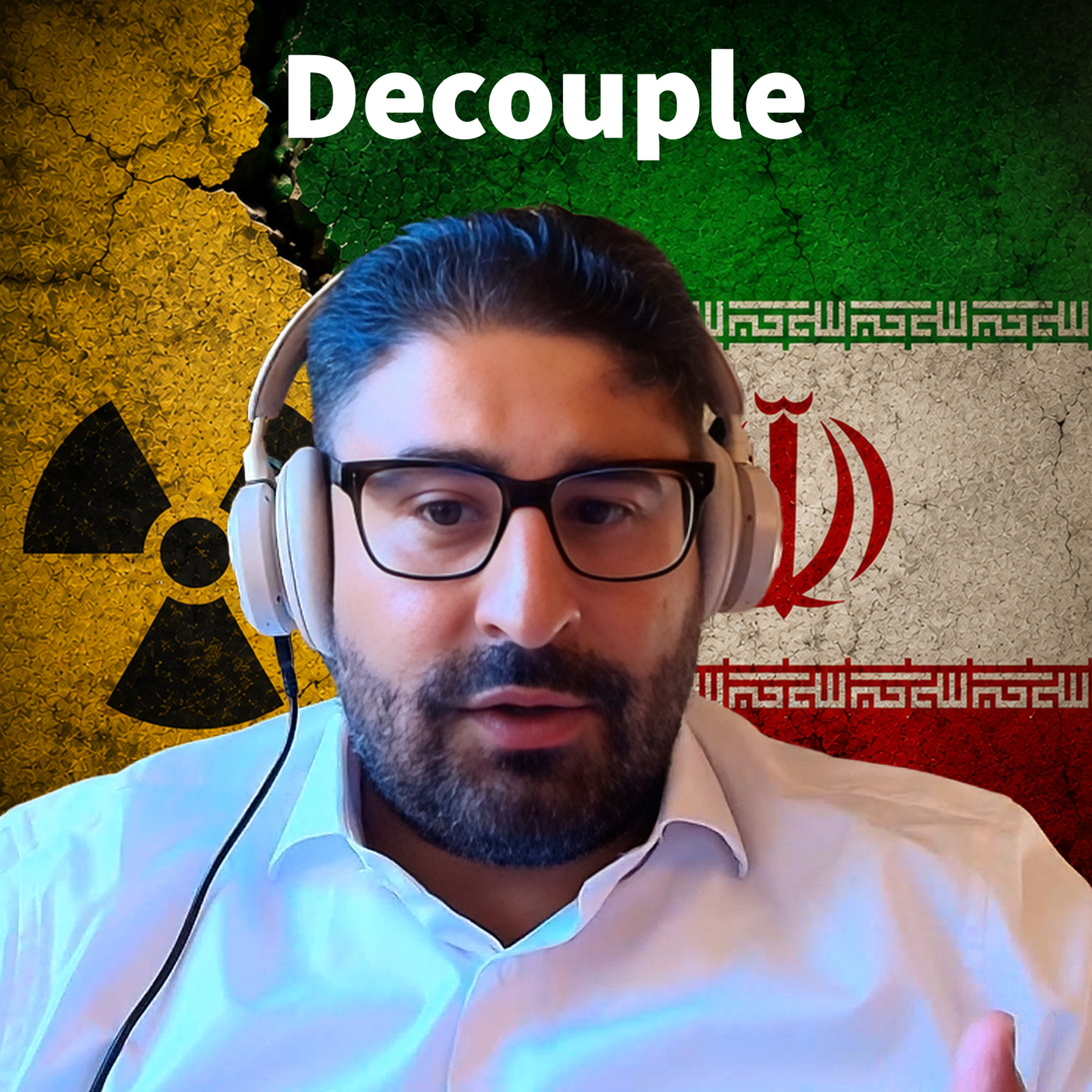
The episode explains how Iran’s nuclear program evolved from a Shah-era, oil-price-driven energy and technology project into a post-1979, war- and isolation-driven “nuclear option,” including enrichment, missile integration, and weapons design work. It also argues that sanctions and “diminishing returns” shaped incentives over time.
Farzan Sabet, historian and Iran specialist at the Geneva Graduate Institute. Research focuses on Iran’s nuclear history, sanctions, nonproliferation, and U.S.-Iran relations. He held a nuclear security fellowship at Stanford’s Center for International Security and Cooperation and previously worked with the UN Institute for Disarmament Research on a Middle East WMD-free zone.
Written by AI. May contain mistakes.
Discussing the economic impact of sanctions on Iran's nuclear program.
“While I was at the UN, separately from my UN work, I wrote a paper with two colleagues in the political science department of MIT.”
Exploring the historical context and motivations behind Iran's nuclear ambitions.
“So listen, I think like many people around the world, I'm trying to make sense of and get my head around the current conflict in Iran right now.”
Detailing the beginnings of Iran's nuclear program during the Shah's reign.
“So happy to talk about it both in a historical context, as well as a contemporary one.”
Analyzing the Shah's ambitions for nuclear energy and the challenges faced.
“So in this context, 1974 and with, you know, flush with funding and cash, you know, getting greater control of the oil industry and the kind of quadrupling of oil crisis during during the kind of oil crisis.”
Discussing the strategic implications of Iran's potential nuclear weapons program.
“You know, they start this program, master's program with MIT.”
Discussion on Iran's nuclear ambitions and regional security concerns.
“So it's really not beneficial for us to pursue nuclear weapons.”
Exploration of Iran's nuclear program history and international negotiations.
“So basically the dramatic increase in the price of oil in 73 basically gives a lot of capital to play with.”
Analysis of the Shah's nuclear program and its connection to economic independence.
“They're looking to have these high kind of big earning kind of exports, which will bring in, you know, millions, hundreds of millions, billions of dollars potentially for them.”
Examination of the drastic shifts in Iran's nuclear program after the revolution.
“Well, let's move a little forward through history into a pretty dramatic change in tides or reversal, I think, towards attitudes of the new Islamic Republic of Iran towards nuclear.”
Learn about the evolving attitudes towards Iran's nuclear investments following the revolution.
“So can you explain this radical, radical transformation and the changing attitudes and what happened to this enormous nuclear investment, the human resources, etc.”
Explore how the traumas of the Iran-Iraq War influenced Iran's nuclear ambitions.
“reluctantly or not so reluctantly backing Saddam.”
Learn about the complexities and shifts in Iran's nuclear weapons doctrine and international relations.
“But there's a parallel effort within the Ministry of Defense to develop nuclear weapons doctrine, right?”
Explore Iran's nuclear ambitions post-Iran-Iraq war and the impact of international diplomacy.
“But I would say this, but they're all kind of there, right?”
Understand the technical and strategic developments of Iran's nuclear weapons program and the internal challenges faced.
“in the Iran-Iraq war, basically after the U.S.”
Delve into the strategic considerations of Iran's leadership regarding its nuclear program and deterrence.
“Ali Khamenei, uh, from 1989 until he was assassinated this year.”
Analyze the dynamics of Iran's nuclear negotiations and how internal and external pressures shape strategy.
“its missile program, the next thing on the line would be its proxy program.”
Exploration of the impact of sanctions on Iran's economy and negotiations.
“And actually the shift to permitting some level of Iranian enrichment, whether it's symbolic or not, actually that door to that is opened during the second term of the Bush administration.”
Discussion on the effectiveness of different political coalitions in Iran's nuclear negotiations.
“Minister, obviously that team was a better implementer of that consensus, and also within internal politics, they're able to push the boundaries of concessions a bit more than a hardline government would have been.”
Analysis of Iran's nuclear program and the strategic implications of deterrence.
“without all the costs of actually acquiring nuclear weapons would entail, right?”
Examination of the economic costs incurred by Iran due to sanctions related to its nuclear program.
“And so now that Iran's position around the nuclear issues to some extent characterizes one of nuclear ambiguity, but there's a very heated debate inside both the elite as well as the country about which way to proceed.”
Speculation on future negotiations and the strategic needs of Iran's regime.
“And that's not only for the nuclear program.”
Discussion on the JCPOA and its implications for regional security and future negotiations.
“We see North Korea enduring in part because of its nuclear weapons and in part because of having a massive conventional artillery pointed at Seoul.”
Learn about the various pressures affecting the Iran nuclear deal from both Iranian and regional perspectives.
“One is that, you know, on the Iranian side, and this is by that point, I was starting to work more.”
Explore the internal support for the Iran nuclear deal amidst external pressures and political dynamics in the U.S.
“Between the missile and drone programs being incorporated into these proxy groups, right?”
Understand how Trump's personal views on Iran may have shaped U.S. foreign policy and the nuclear deal.
“is one of the principles or genuine ideological pillars for Donald Trump personally.”
Examine the current state of Iran's military capabilities and the implications for regional security.
“The missile program is the one that remains, and the drone programs are the ones that are the most intact, the most robust, and likely to persist.”
Discuss the potential future paths for Iran's nuclear program and the strategic implications for the region.
“My view is, and I think this is backed by a lot of data that we have out there, that from a deterrence perspective, the value is quite limited.”
Explore the complexities and risks surrounding Iran's nuclear ambitions and military options.
“And that was one of the reasons that the Clinton and Bush administrations were hesitant about undertaking a military option against North Korea.”
The host expresses appreciation for the insightful conversation and learning experience.
“Listen, we could talk all day, but I understand then you've got a busy evening ahead of you.”

Get the gist, explore an idea or ask about something said.
 Claude
On Decouple, what are the key points of this episode?
Searching your listeningAutomatic transcript. May contain errors.
0:00Decouple Hosts: While I was at the UN, separately from my UN work, I wrote a paper with two colleagues in the political science department of MIT. We found that the economic cost of the sanctions Iran endured from when the major nuclear sanctions really ramp up, which is roughly from 2010, it was equivalent to the economic cost of the Iran-Iran war.
0:22Farzan Sabet: A warm welcome back to Decouple. Today I'm joined by Farzan Sabet. Farzan is a historian and Iran specialist at the Geneva Graduate Institute. His research focuses on Iran's nuclear history, sanctions, nonproliferation, and U.S.-Iran relations. He's held a nuclear security fellowship at Stanford Center for International Security and Cooperation and previously worked with the UN Institute of Disarmament Research on efforts to establish a Middle East free of weapons of mass destruction. Farzan, thank you so much for making the time to come on Decouple.
0:53Decouple Hosts: Thanks for having me on, Chris. Really appreciate it.
0:55Farzan Sabet: So listen, I think like many people around the world, I'm trying to make sense of and get my head around the current conflict in Iran right now. I have a deep abiding interest in nuclear technology, and that's been the focus of much of this podcast. And when I started to look a little bit at the Iran situation through that nuclear lens, I was really surprised at some of the things that I uncovered. You know, this almost 70-year history in terms of a nuclear program in Iran dating back to the atmosphere peace era, the time of the Shah, which I understand your doctoral thesis was quite a deep dive of.
1:32Farzan Sabet: And moving right on through, you know, Iran's first nuclear reactor, which was provided by the U.S. with highly enriched uranium fuel load. interesting turns and twists with the Kraftwerk Union of Germany beginning construction on a nuclear reactor, ultimately finished by the Russians, in this case, a power reactor, and obviously the fuel cycle investments, maybe to put it euphemistically, that Iran has made over the years. There's a really rich context here. And there's been really an enormous investment of capital, of material resources, of human resources over these last seven decades by Iran.
2:11Farzan Sabet: And, you know, in looking at your resume and trying to find the best guest to talk about this subject, I've been really intrigued and trying to get my head inside of contemporary Iranian decision makers and I guess past Iranian decision makers to get a sense again of why Iran has made such enormous sacrifices with in some ways so little to show for it in terms of actual, you know, commercial nuclear power being generated or medical isotopes being generated. Obviously, there's a nuclear weapons latency capability. And in some ways, this sort of autarchy in terms of developing these capabilities is quite impressive.
2:44Farzan Sabet: But really excited to have you on to deep dive these topics. So again, thanks again for setting aside a few hours of your very busy schedule.
2:54Decouple Hosts: Thank you. I'm glad to be on. And I think it's an important topic. So happy to talk about it both in a historical context, as well as a contemporary one.
3:01Farzan Sabet: Awesome. Well, let's dive into a little bit of that historical context and talk a little bit about the origins of the Iranian nuclear program. Interested in just getting a sense, I guess, of the atmosphere in which the Shah, Mohammad Reza Pahlavi, started to pursue this advanced technology in the 60s and 70s.
3:25Decouple Hosts: You know, as you mentioned, the Iranian nuclear program originates under President Y.D. Eisenhower's Atoms for Peace program. Iran in particular launches its cooperation with the U.S. in 1955, with some negotiations happening after 1953 when that program is launched, you know, leading up to 1955. But the program, you know, really between 1955 and 1973, 1974 is really a sideshow. It's kind of a series of small infrastructure projects and science experiments, building up technological know-how, you know, getting Iranians familiar with the science and engineering related to nuclear power and the nuclear industry.
4:10Decouple Hosts: But it's really quite small and has minimal funding. The real game changer is the 1973 oil crisis, which has preceded by a decade during which, you know, Iran, you know, is kind of gaining greater control over its energy industry, which was previously under very strong kind of British and later consortium of kind of Western companies control. role as Iran gains greater share in its oil industry, has greater revenues to invest and play around with, and is able to kind of get a greater and greater share over time. Slowly starting in the 50s, after the failure of the oil nationalization movement, accelerating the 1960s, and really with the 1973 oil crisis, you know, linked to the Yom Kippur War and some of the geopolitics of the Middle East.
5:04Decouple Hosts: It gains significant new resources. Now, the shot for his part had been interested in nuclear energy. And, you know, in some of my work at the UN, I found that, for example, what becomes this initiative around nuclear weapons free zone in the Middle East, you know, he's really some of that that initiative starts in 1974. But he's talking about it as early as the late 1960s. And so obviously, nuclear issues are on his mind, He in the archives, you can find it here and there where he's talking about nuclear weapons, nuclear energy, Iran's own nuclear program, whether it's with his own officials or with others.
5:40Decouple Hosts: But in 1974, you know, with the backing of a study that's done by kind of one of these U.S. consultancies, which kind of suggests that Iran could benefit from a large scale nuclear program with, you know, with the economics of the time kind of pointing to as oil prices go up, there's this idea that nuclear energy, it's the energy of the future. The kind of price per unit cost of nuclear energy is going to come down and it's going to be eventually lower than oil. So there's this idea that as these kind of price points approach each other and get past each other, oil will be too precious to burn and Iran will want to kind of refine that into kind of intermediate and advanced industries or just export it as kind of more expensive oil.
6:23Decouple Hosts: Meanwhile, nuclear energy will be more cost effective as a as kind of the baseload for Iran's nuclear energy grid. Right. So in this context, 1974 and with, you know, flush with funding and cash, you know, getting greater control of the oil industry and the kind of quadrupling of oil crisis during during the kind of oil crisis. The Shah, kind of with the backs of Atomar, who is broadly considered the father of Iran's nuclear program, to launch what is quite an ambitious nuclear program. They're going to build something like 20 to 24 nuclear reactors as part of several nuclear power plants with the goal of producing 20 ,000 megawatts.
7:09Decouple Hosts: and there's a whole set of other kind of industries that there's this idea that will develop alongside this energy program. And I'm happy to get into kind of some of the reasoning, but it seems like at least on the surface that the Shah's primary goal is to kind of bring in this advanced technology, invest in the future, and meet this projected energy need kind of moving forward into the 1990s. So the idea is they'll start in the mid-70s, that this kind of plan for several nuclear power plants with the 20-plus reactors will be done by the mid-90s. And the idea is that by that point, it will meet something like a third of Iran's energy needs.
7:52Decouple Hosts: Additionally, there's this idea that this will have several ancillary benefits besides kind of helping advance Iran's scientific and engineering and technology base. For example, Iran is negotiating and kind of reaching agreements with European countries to build experimental kind of research reactors, more advanced ones, which in the future hopes to export. The same with the UK. There's this idea that they'll cooperate on building a certain number of reactors, which will be for Iran. But then whatever model is developed and whatever commercial work is done, that'll result in a nuclear power plant and reactor model that will then be exported.
8:35Decouple Hosts: So you see this across a whole range of other things. For example, there's this idea that Iran has a lot of desert space, which is broadly uninhabited. So there's negotiations, I believe it's with Austria, to have specialized sites designated for nuclear disposal, right? Since there's little life in those areas, as long as kind of safe and secure disposal sites can be buried, that's an additional kind of nuclear service that Iran can provide with the world. At the same time, Iran is cognizant that when it comes to raw nuclear resources like uranium, it does not have a large reserve of uranium.
9:10Decouple Hosts: So the Shah goes to work in Akberatamad, this newly established atomic energy organization of Iran, goes to work basically buying up uranium reserves all over the world, including in southern Africa. Yeah, there's one particular, I believe it's an interview that I found with Akbar Atamad, where he says that effectively much of the Iranian foreign policy in what was then called the third world is given over to the Atomic Energy Organization to pursue these kinds of deals with the idea that Iran's not only positioning itself for kind of this energy independence and kind of winning itself off of reliance on burning oil for its domestic needs.
9:55Decouple Hosts: But this is an industry of the future, which will eventually become a major source of exports for it. Right. And so they want to corner the market in uranium. So, you know, I haven't looked at the documents in a long time. I believe there's in Zambia, right? There's agreements they reach to own some of those reserves and set up kind of mining operations there. On the enrichment side, Iran becomes a partner in this French, I believe it's a French-Swedish consortium, EuroDiff and Sofidiff, with the idea that it'll have a share of those. And of course, beyond contracts for reactors, for raw uranium, for enriched uranium, it's also negotiating with the U.S.
10:35Decouple Hosts: and with others to get access to various forms of enrichment and potentially reprocessing technology, including what was then kind of considered more advanced forms of laser enrichment. So actually, when you start to peel back what the Shah is doing in really a short period of time, right from 1974 to 1979, it's quite an ambitious nuclear program. One source that I found said that the Atomic Energy Organization around becomes the third kind of biggest entity within the state. So you have the oil company, which is the major source of kind of oil production revenues, refining that sort of thing.
11:10Decouple Hosts: Then you have the armed forces. And then the nuclear program is not far behind. It has something like 7 ,000 employees, I think, at its height, including many foreign contractors. When it comes to recruiting Iranians, they actually have to create a special class for salaries because they're trying to kind of poach the top-level talent, scientific engineering talent inside of Iran, and civil servant salaries won't do for those people. So they actually have to kind of do away with normal government salary caps to attract the top-level Iranian talent. You know, they start this program, master's program with MIT.
11:46Decouple Hosts: I think they actually have trouble recruiting students who meet some of the minimum requirements to undergo that master's degree. But eventually that program kind of gets going and it's able to start producing graduates for the program. But it's quite an ambitious project. There's probably also an element of techno-nationalism, which I think is, you know, I think all societies have to some extent, but in Iranian society, which is kind of has a very deep and long history of kind of education, learning, study, science, there's this obsession with kind of not only indigeneity, but also getting, achieving advanced technology.
12:27Decouple Hosts: and so I think for the Shah himself there's also this symbolic element but the kind of third element which I'll put on the table is that probably in the back of his mind the Shah also has this idea of at least having the option to build a nuclear weapon and there's in both the US documentation as well as interviews that I did with and that I found with Iranian officials at the time as well as US officials at the time, you know it's clear that this is something the Shah is thinking about, he makes several public comments. Akbar Etima, the father of the Iranian nuclear program, at one point claims to come right out and ask the Shah.
13:02Decouple Hosts: He says, listen, the kind of program we're building, it's great for energy, for industrial applications, science, engineering. It's not necessarily ideal for a weapons program. If we want a weapons program, we have to go about it. And so what the Shah kind of says to him, or Akbar Etima claims the Shah says to him, is that, well, you know, Well, right now we're building very advanced armed forces. The Iranian claim is that it's kind of the fifth largest and kind of most advanced army in the world. Maybe not quite that, but it is it is becoming quite advanced armed forces. It's growing quite rapidly, acquiring really cutting edge technology, which, you know, other countries, even close allies like Israel at the time didn't have access to.
13:42Decouple Hosts: Right. For example, the F-14 Tomcat. And so he says, we're building this advanced military, and we're also building this advanced nuclear industry. If we pursue nuclear weapons, it's very likely we'll become, he doesn't call it sanctions, right? But what he's kind of implying is we'll get sanctioned, and our ability to continue to get advanced technology and to continue to do things like technology transfer, joint production, which they're doing a lot of, you know, which is kind of indigenizing a lot of that knowledge and tech. We're going to lose access to that. So it's really not beneficial for us to pursue nuclear weapons.
14:16Decouple Hosts: But should another, you know, we're building this advanced military, which will deter our adversaries, but should another small country in the region, and he might specifically mention Iraq or Libya, or maybe that's the implication that Etamad took away, acquire nuclear weapons or get quite close, will want the option to build a nuclear weapon because that adversary is a nuclear weapon. And he's thinking about it both in the context of kind of pan-Arabism as well as in the context of kind of Soviet communism and the types of regimes that Soviet communism is supporting in the region. You know, that will undermine our conventional superiority.
14:52Decouple Hosts: And so we should at the very least have the option available. I'll add one last thing, which is the conclusion I've come to is that there was probably a compartmentalized nuclear weapons effort under the oversight of somebody like General St. Tufanian, who's in one of the sensitive sectors of the Iranian Armed Forces and who's quite involved with acquisition, has good relations with Israel, and is actually pursuing several joint projects to be involved with Israel. it's likely that the effort, the compartmentalized effort to explore that option would have been separate from the Atomic Energy Organization and more under the oversight of the armed forces, maybe somebody like Tufanian.
15:36Decouple Hosts: And something that I found, and right now I'm working to acquire the documents, but this was kind of an interview that I obtained towards the end of my PhD, was that everyone attributes, and a lot of the literature attributes, this collapse in the U.S.-Iran nuclear cooperation negotiations, where this agreement for Iran to start getting nuclear reactors from the U.S. and maybe some nuclear fuel cycle technologies from the U.S., people attribute that just to the talks sputtering out and the revolution. What I found is that it's likely that that was a convenient excuse to quietly put those talks to the side, but the U.S.
16:15Decouple Hosts: intelligence community had discovered some what they would consider kind of disturbing activities during the time of the Carter administration, which could have become an obstacle to the completion of those talks and could have raised further U.S. objections regarding the Iranian program in the future. So my sense is that nuclear option was not necessarily the first objective. There is quite a genuine authentic kind of economic vision, even if maybe that economic vision is out of touch with where the nuclear economics is emerging towards the end of the 70s compared to the optimism of 50s, 60s, even in the early 70s, right?
16:51Decouple Hosts: So that the The economic side and technological side is probable. I would put that up front. But there is also in the back of the shot's head at least the optionality to build a nuclear weapon should that become necessary. Okay.
17:04Farzan Sabet: So this is really interesting. So basically the dramatic increase in the price of oil in 73 basically gives a lot of capital to play with. And a lot of themes that we're seeing now in terms of Gulf countries wanting to diversify economically, the UAE has obviously developed a nuclear program and is interested in expanding into other services within the nuclear industry. So there's that kind of a vision. My understanding is that the infrastructure that gets created beyond this enormous investment in human resources. And, you know, I had the pleasure of sitting down with Ernie Moniz last week and, you know, his Iranian counterpart, Ali Salahi, was an MIT trained, one of these students that you mentioned that qualified and was trained over there.
17:45Farzan Sabet: But, you know, in the Canadian nuclear sector, I have lots and lots of Iranian friends that work here and I think trace some of their professional academic development back to those days. But in terms of the actual infrastructure that is built, again, we have that Tehran research reactor, a pool-type 5-megawatt thermal reactor, not given, but acquired as part of the Atoms for Peace initiative. And then I think you mentioned there was some negotiation back and forth for transfer of power reactor technology to Iran from the US, but the only reactor that ends up getting at least partially built in this period is Boucher, which is with the Germans.
18:22Farzan Sabet: And my understanding is that some of the reason behind maybe that moving forward more quickly than cooperation with the US was because Europe was a little less picky about these questions of Iran's ambitions under its nuclear nonproliferation treaty agreement to be able to involve itself in the whole fuel cycle, which of course gives you access to enrichment and reprocessing, which of course is important if you're interested in having a weapons program. Is that broadly accurate?
18:50Decouple Hosts: Yeah, I would say so. Maybe one or two caveats. The first is that Alec Barsali, who becomes later on the head of the Atomic Energy Organization of Iran and Iranian foreign minister, he's actually not part of that master's program. To get students through that master's program, they actually have to kind of lower the standards a little bit for the students who are kind of going at the time. He actually is able to get into, I think, a PhD program completely on his own merit and completely separately. So my sense is that while there's a lot happening with Iran and MIT, and Iran is similar to what a lot of the GCC countries or a lot of other countries are doing, setting up kind of satellite campuses inside Iran as well as programs for Iranians to go study in the U.S.
19:31Decouple Hosts: But so Asali, I think he reaches that separately. And the program that the Shah is building for his program, I think it's a master's program, if I'm not mistaken, if I recall correctly. but Sali maybe does a master's but he specifically does a PhD there so that's just a very small caveat but his story is a little bit separate from that but in terms of the infrastructure you're right there's a lot of other things smaller things that are happening for example trying to import and actually getting some equipment around laser enrichment and like this nuclear bureaucracy that's established under Shah is actually quite large and so not all those projects or not all those things are completed but a lot of it moves forward and is at various stages of completion.
20:16Decouple Hosts: In terms of nuclear reactor, I believe by the time of the revolution, it said something like 80 % completion. There's also the Darjoven nuclear power plant, which is being built by the French, and that's at much lower level. It might have been, again, I haven't, I tried to go quickly look through my PhD draft, which this was one of the main topics of the PhD, looking at kind of the evolution of the global nuclear order in the 1970s. But that might have been at maybe 20, 40 % level completion, certainly much less than Boucher, but it was moving along. And then other power plants were kind of in much earlier stages, whether it's design, kind of going in, finding the site.
20:59Decouple Hosts: I actually have a map in my dissertation, which has the designated sites for the various nuclear power plants as well. So they designate a lot of these sites, but there's a lot of complexities around actually building nuclear powerpoints. One other thing I'll add is that one of the journal articles I managed to squeeze out of my PhD before I had to kind of move on to the next project. But I'm still slowly working on a potential book project around the Shaw's nuclear program as well as journal articles. But one of the things I got out was about this thing called the Persepolis Conference, which is kind of a big nuclear conference that the Shaw is setting up.
21:35Decouple Hosts: And it kind of speaks to part of the Shah's political project, what he's trying to do in global kind of affairs and how the kind of some of the mood or dynamics around the nuclear issue or nuclear energy is shifting in the 1970s. You know, beginning with India's peaceful nuclear explosion, which is also in 1974, and was probably, exactly, which is, you know, a nuclear weapons explosion, all that name, right? And which probably, the Shah, there's a question about whether the Shah was aware of it and to what extent that could, might have accelerated his nuclear plans, right? But U.S. nuclear non-colaboration policy obviously becomes much more restrictive.
22:13Decouple Hosts: This is shortly after, you know, in 1968, the Nuclear Non-Colliporation Treaty is reached, comes into force in 1970. Iran was one of the first countries to kind of sign it, ratify it. But very quickly, you know, almost three, four years after the U.S., after it comes into force, the U.S. is already looking to have a much more restrictive interpretation of what that treaty will allow. And if he can't do that, they can't do that. Then the U.S. is trying to, in effect, limit what happens there. For example, by creating what later becomes the Nuclear Suppliers Group and other such for it, right? And the Shah is pushing back against that and wants nuclear transfer and technology transfer to kind of be much more free-flowing.
22:54Decouple Hosts: And so he tries to kind of form a coalition with other third-world countries, which are kind of friendly to its ideas and friendly to the U.S. It tries to work with European countries, which are, you know, during that period, especially after the oil shock, which has a very negative effect on their economies. They're looking to have these high kind of big earning kind of exports, which will bring in, you know, millions, hundreds of millions, billions of dollars potentially for them. So they're quite eager to become to kind of go in and export. And also U.S. nuclear industry, right, which is not necessarily fully on board with the increasingly restrictive policy, U.S.
23:34Decouple Hosts: non-colifacial policy, beginning with Nixon slowly and then accelerating under Ford and Carter. And so the name of the conference at Persepolis, which is kind of the ancient Iranian capital under the Akhenemite Empire, now it's kind of like historical ruins. It's in Iran's kind of farce or Persia province near the city of Shiraz. The conference is called the Persepolis Conference on the Transfer of Nuclear Technology. And so the Shah, I think, what I sense he's trying to do is form this coalition to push back against the increasingly restrictive U.S. policy and to assert greater agency and get more technology transfer there.
24:13Decouple Hosts: And this speaks to something that I would distinguish between the foreign policy of the Shah versus the foreign policy of the Zidane World War II, which is, you know, the Shah, especially soon after the 1953, with some term of coup, others see that as kind of a restoration, seeing the kind of Prime Minister Mohamed Mossadegh as having usurped and overstepped his constitutional boundary. So that's kind of a very sensitive historical debate. But in much of the literature, it's known as the 1953 coup. And, you know, Iran is essentially kind of a puppet regime and a client state of the U.S. afterwards.
24:50Decouple Hosts: But as the shock consolidates power after 1953, especially from 1962, 1963 onwards, he's consolidated power. He's pushed out a lot of his rivals within his own camp. And he's earning more and more money from oil exports. And as you mentioned, there's a lot of GCC countries which are launching vision programs or these kind of oil kind of economic independence or development or diversification programs. The Shah is doing that already in the 1970s, right? And this nuclear piece is just one part of it. But if you look at his industrialization and diversification, they're very, very ambitious and they touch virtually every sector of society.
25:31Decouple Hosts: But yeah, so the Shah is trying to assert greater agency and strategic autonomy from within the U.S. camp. So I would say that it's probably correct that in 1953, his regime is effectively a puppet state. Decade later, I would say the situation is different because he's, again, consolidated power, has greater financial independence, especially as you move into the 1970s. And by the 1970s, you see the U.S. clashing with the U.S., with the European countries. And rather than, you know, going to the camp of some of the Soviet countries or some of the pan-aerbist kind of revisionist states, he's trying to take kind of a middle ground.
26:12Decouple Hosts: In his domestic and foreign policy discourse, he's increasingly critical of the West and the U.S. But what he's trying to do, and it falls within what in the 70s was called the kind of a new international economic order, right? trying to get a lot more power for what were third world countries, trying to get technology, trying to get stable, even higher prices for the commodities they were exporting. So trying to kind of peg and find their place within the international order and create a pathway to climb up, which, you know, contrasts a lot with the Islamic Republic, which sees itself very much as part of the international order and goes out of its way to, for example, will show that it demonstrated in a lot of ways that it's acting, for example, within the boundaries of international treaties or international laws.
26:58Decouple Hosts: At the same time, within the kind of West Asia, or what we call the Middle East, is a revisionist state and it's pushing back against a U.S. dominated order and oftentimes acting very much outside of it. Right. So that's kind of an additional nuance I would add to what the Shah is trying to do. And I would say in terms of his broader development and industrialization and diversification effort, both at home, but also what he's trying to do within the international order. The nuclear program, I would say is a key, is really a key piece of that because it touches on energy, touches on technology, touches on industry.
27:31Decouple Hosts: Yeah. And so that's another thing I would kind of highlight.
27:36Farzan Sabet: Okay. Well, let's move a little forward through history into a pretty dramatic change in tides or reversal, I think, towards attitudes of the new Islamic Republic of Iran towards nuclear. I understand a lot of what the Shah was criticized for was this sort of extravagant spending and nuclear sort of maybe symbolized or epitomized some of that. There was a rejection of Westernization. So can you explain this radical, radical transformation and the changing attitudes and what happened to this enormous nuclear investment, the human resources, etc. I guess in the disorganization, but also this change of attitude towards nuclear technology in 1979.
28:21Decouple Hosts: No, it's a great question and very important kind of pivot point. So, you know, initially the revolutionary coalition that comes into power in 1979, which includes the Islamists under the Ayatollah Khomeini, Islamists under this group called the MEK, the Mojahidine People's Mojahidine Organization of Iran, leftists, as well as what I would classify as anti-imperialist nationals. There's really a big revolutionary coalition. And the revolution, even though there's a lot of differences between these groups, there's broader themes to the revolution. And so this critique of the Shah's kind of flagrant spending on things that were viewed as unnecessary is a big one.
29:00Decouple Hosts: And the nuclear program, alongside, for example, the spending on the military, is seen as kind of white elephant projects, importing things that are not required, right? But very quickly, actually, in 1979, views start to shift. With the military, it's maybe a little bit later on. It's in 1980 when Iraq invades. But with the nuclear program, it's much quicker. And this is due to those views changing. It's due to a number of factors. One is that the Iranian economy at the time under the Shah had grown quite rapidly, although So it probably would have experienced a contraction had his regime stayed in power.
29:37Decouple Hosts: And so, you know, a lot of these projects would have probably been clawed back to some extent. That's kind of my guess, looking at the economic trajectory roughly from 75, 76 through 79, right? It's possible there would have been a contraction. So it's, you know, it's not that the program would have fully materialized. They're initially looking to cut the program as a whole. But because of both the rapid growth of the country, great demand for energy, but also just disruptions caused by revolutionary chaos, there's energy shortages and brownouts and blackouts in the country. And so there's kind of this thinking, right, that, well, you know, this reactor that we were working on, we paid for it already, right?
30:19Decouple Hosts: The Shah was very good about paying for a lot of those things up front. So it's 80 % complete. So why not just get it done, right? And so this will help address some of those energy shortages for experience. Then very quickly in 1980, the Iraq invades. And so from some of the limited documentation and kind of interviews I've seen, actually, the idea about having a nuclear deterrent is actually right there in 1979. But it probably becomes a bigger factor in Iranian thinking, not as something that's achievable immediately, but as something to work towards because the Iranian goal during the war is to defeat Iraq and to conduct regime change in Baghdad.
30:58Decouple Hosts: Right. And they don't know how long this war is going to go. And so who knows, in a few years, they might be able to get achieved kind of a nuclear weapon. There's something similar around kind of the military, where initially they're canceling a lot of a lot of things. You know, the Shah's foreign policy and security framework had effectively deterred Iraq from from invading and from attacking. once the Islamic Republic is viewed as kind of a threat to regional regimes, including Saddam Hussein's Iraq with large shell population, and kind of the Iranian military starts to really collapse. I've read the exact number, but there's something like, for example, 20 % of Iran's officers deserve, you know, it's understood that, okay, maybe some of those things Assad was doing were helpful, and so we should reverse some of those policies.
31:42Decouple Hosts: So the Revolutionary Coalition is actually reversing policies across a whole range of areas, and that's something that you can see in a lot of, you know, in a lot of these big world historical moments, we see them as moments of fracture and discontinuity. There's often a lot more continuity than we kind of foresee that we expect, right? So with the nuclear program, this military dimension and the option of building a nuclear weapons, my sense is, from what I recall from the documents and interviews that I looked at, it's already on the minds of senior figures like Ayatollah Elieh, Akbar Hashimirov Sanjani, who becomes kind of the second man of the revolution in the 1980s and then later on.
32:17Decouple Hosts: that's an idea and a third factor which i think is probably underestimated is that while many people flee the country especially a lot of the people with high social capital right education things and they go abroad a lot of people out of uh revolutionary fervor or a lot of out of patriotism decide to stay and want to kind of build up the country in a post-revolutionary context the atomic energy organization of iran was a kind of a very high prestige organization under the shah and you know they were recruiting some of the best educated most talented tech personnel in the country. And so there's also this element of, let's say, like bureaucratic lobbying, right, where they're kind of there, they serve to function.
32:59Decouple Hosts: And so they kind of recast themselves in this new context. And they try to kind of re-justify the program for the Islamic Republic. And some of those people, you know, go on to become quite important both within the Atomic Energy Organization, but also through Iran's foreign policy establishment. For example, with Iran's, already under the Shah, Iran's ambassador to Vienna, to the Atomic Energy Organization in Vienna, or sorry, to the IEA, International Atomic Energy Agency, was appointed actually by Iran's Atomic Energy Organization. So it was not a foreign ministry person. And that continues under the Islamic Republic.
33:40Decouple Hosts: And so this element of continuity of personnel and them trying to justify themselves in this new context is also quite important for having a reconstituting the nuclear program in this in this new political setting
33:55Farzan Sabet: independent analysis only works if it's independently funded if decouple provides you with energy literacy on demand please consider supporting it become a paid subscriber on substack or make a tax-deductible donation on our website decouple.media join the community Keep the lights on, preferably nuclear. Now, back to the show.
34:41Farzan Sabet: finds itself very isolated, particularly once it crosses into Iraq. The Gulf countries are maybe reluctantly or not so reluctantly backing Saddam. The US obviously providing diplomatic cover for chemical weapons attacks, providing weapons, even the Soviet Union and the US kind of aligned here, both arming Saddam. And so in this context, it seems like there's a major sort of change in perception about the need for Iran to pursue this sort of ultimate form of deterrence as the international community and its norms and the UN have not sort of come to its aid or enforced any of those norms during this time.
35:19Farzan Sabet: And from what I understand, a much more aggressive approach is taken. Contexts are made with AQ Khan proliferation network and this Ahmad nuclear weapons program is launched probably, I guess, a few years after the resolution of the Iraq-Iran War. But maybe if you could speak a little bit to the trauma to the Iranian people of that horrible war and how that may have shifted priorities towards actually saying, okay, let's really focus on getting a weapon.
35:49Decouple Hosts: You're absolutely right. The Iran-Iraq war is a deeply traumatic experience for Iranian society. A large number of people are killed in the war. This is partly because the support system, diplomatically and militarily, that the Shah put in place, it collapses completely. And the new Islam Republic and the revolutionary kind of government faces effectively a situation of strategic loneliness and isolation, which to some extent persists to this day, right? Part of the reason it goes on to build what we call the Axe of Resistance is because of the strategic loneliness. Now, of course, you know, there are countries helping it on the military front with the missile program.
36:34Decouple Hosts: It received support from Hafez al-Assad Syria, Muammar Gaddafi's Libya. The Chinese, actually Chinese military industries, one of the reasons they're facing a period of austerity in China during the 1980s. You know, they're supposed to, they're now forced to go and kind of find their own customers to justify their existence. And so actually the Iran-Iraq war and arms shippings, including to Iran, are a big part of helping keep Chinese military industries alive during that period, but it's getting some support from China. And surprisingly for many, Israel is a supporter of Iran, kind of works with the U.S.
37:11Decouple Hosts: to send some weapons and spare parts to Iran, and coordinates with Iran, for example. During the war, Iran, the big Operation OSIRC against Iraqi nuclear power plants, there's some implications that Iran might have conducted kind of a large-scale diversionary attack, which then created a bigger window for the Israeli air force to get through and to strike OSERIC, which would have, you know, the OSERIC nuclear reactor in Iraq and the Iraqi nuclear program would have been a threat both to Iran and Israel. So there's some things that are confirmed, some things which are much more clandestine, and we still don't fully have the details, But besides those few cases and the U.S.
37:53Decouple Hosts: occasionally kind of putting its thumb on the scale for or against Iran, it's very isolated. The revolutionary regime, the way in which it also conducts the war, shifting away from the conventional military, the army or as we call it in Persian, because one, it doesn't trust the army. It sees it as being a legacy of the Shah's rule. And so there's always this fear of a coup. And second, just because the sale of supply for the kind of weapon systems on which the army's doctrine was built on is kind of gone with the revolution. So that's when the kind of revolutionary guards and besieger are created and they conduct military operations in an unconventional way.
38:36Decouple Hosts: But oftentimes there's kind of a lack of professionalism in which that's done, and the operations result in very high casualties. And additionally, you have Saddam Hussein's Iraq launching chemical weapons against Iraq. There's a period of kind of missile launches between the two countries where Iranian cities are being hit with missiles. so you know it's it's a it's a deeply traumatic experience for iran uh just that one small thing towards the end of the war uh it's a very politically difficult decision for the revolutionary leadership to end the war and part of it has to do with like the the promises that it's made to the kind of base of the regime uh this is part of the reason that the ayatollah rule al-khamenei who's the kind of the leader of the leading figure of the revolution and the supreme leader of the country at that time, compares accepting the ceasefire as drinking from a kind of chalice of poison, right?
39:32Decouple Hosts: It's because it's politically difficult for him to do it. The goal was regime change, and they've effectively failed to do that in Iraq. Part of the political process in getting that done is there's a letter by Moksen Rezaid, who at the time is the commander, the kind of chief commander of the Islam Revolution Guard Corps. And he's actually still a senior military figure today in Iran, following the large-scale assassinations that happened of Iran's security and military leadership. But he writes a letter where he's basically saying, if you want us to continue the war, here's what we need. And it's really, if you look at what he's asking for, it's kind of ridiculous.
40:08Decouple Hosts: It's like, we need hundreds of thousands of more troops. We need like thousands of more tanks. Oh, we need nuclear weapons. He throws that in there, right? So it plays a little, and obviously this list that is, my reading of that document, I want to expound to others who know the guards well, my reading is that the list is so ridiculous that it's essentially telling the kind of political leadership and allowing them to use this as kind of a justification in the internal bureaucratic ballots to say, listen, like what it would take to win the war, we materially, the conditions don't exist. And so we're better off accepting ceasefire.
40:41Decouple Hosts: So the small role kind of nuclear weapons plays in kind of ending the war on paper. Right. But as you mentioned, after the war, there's gradually a much more concerted effort. And I forget the great interview you did with former Secretary Ernest Moniz. I forget the wording he used. The Ahmad AMAD program?
41:02Farzan Sabet: I mean, is that what you're referring to?
41:04Decouple Hosts: It's the Ahmad program, but it's a U.S., I think, intelligence community term because they distinguish between the pre-2003 and post-2003 program. What I would say is that the pre-2003 program is much more concentrated and less compartmentalized and much more focused and driven towards achieving that nuclear weapons kind of option. and eventually actually building the bomb. There's also my understanding is that the Ministry of Defense, in parallel to the Ahmad program and to the technical effort, besides the kind of weapons-grade uranium, what are the other key elements of a nuclear weapon? This is a weapon design, so this is something the Ahmad program is working on, and you need to deliver a vehicle.
41:48Decouple Hosts: So the Shahab-3, which is a key platform in Iran's missile program, is being developed partially with the idea that it would be a platform, eventually on which a nuclear warhead could be deployed. But there's a parallel effort within the Ministry of Defense to develop nuclear weapons doctrine, right? Because if you build nuclear weapons, there's a lot of implications for your security doctrine. For example, you potentially become the target of a lot of nuclear weapons states when that would not have been the case if you hadn't had nuclear weapons, right? Something I've been told by former Iranian officials is that actually that doctrine effort to some extent ran counter to the weapons effort because of the implications it would have had for the country's armed forces and security doctrine.
42:37Decouple Hosts: I don't know if that's true. And that's a history that remains to be written, but just something interesting. But as you mentioned, the post-war and post-revolution program, it's much less internationalized in the sense that Iran's efforts to get international input and support in technology traffic falls off a cliff. For example, The Germans, as you mentioned, kind of refused to complete that project. Its share in Sofidif, Eurodif with the French and Swedes and others, it can't actually get access to low-enriched uranium. During the 1980s, there was actually an effort within the IEA where Iran kind of wants to secure through that technical agency a secure supply of low-enriched uranium.
43:18Decouple Hosts: But it's really the failure also to meet its civilian needs through international cooperation, as well as this thought that with the experience of the war and with this potentially adversarial relationship with the U.S. and later on Israel on the horizon, it might be good to at the very minimum have a nuclear weapons option and potentially to work towards building a weapon. That civilian element is still there, although it's a much smaller element. Oil is, you know, oil is the economics that we discussed, kind of oil's price point decreasing unit price of kind of nuclear energy. That's changed a lot by the 1990s.
43:56Decouple Hosts: And so what I would say is that while there still is a serious civilian program, the vision is really not the same. And I would say the nuclear weapons option, whereas before it would have been ranked like second or third in terms of the priorities under the Shah, it now comes much more on the forefront, even if the justification is a much more civil justification. But I would say this, but they're all kind of there, right? It's kind of a complex web of reasoning. But there is a concerted effort to build at least a nuclear weapons option. And, you know, Iran attempts to gain cooperation through Russia, with China, with Argentina and other countries.
44:34Decouple Hosts: It succeeds with Russia eventually on completing the Boucher power plant, but the other efforts are failures. And this is because the U.S. has quite an active diplomacy in the 1990s, trying to prevent those agreements from materializing. And it's not only on the nuclear program. It's also on the missile side and on the conventional military side. But the U.S. has probably one of its greatest successes from a non-proliferation perspective. is on the nuclear side. And so the program is less internationalized in one sense, but more internationalized than others, right? For example, the support that it receives from the AQ Khan, Adul Adar Khan, kind of Pakistani network.
45:10Decouple Hosts: And of course, this huge sanctions evasion network that's already built up during the kind of war, right? To meet Iran's military needs. And it's kind of put to use then, setting up front companies, and getting access to build supply chain for the nuclear program. And eventually, starting in the 1990s and then accelerating rapidly during the 2000s and then 2010s again, the nuclear industry, while it was quite sizable and important under the Shah, takes on a whole new kind of magnitude. It's really one of the Iran and Islamic Republic's biggest technical kind of industrial complexes and projects ever undertaken.
45:55Decouple Hosts: That's really something that gains steam after 2003. This nuclear weapons effort leading up to 2002, 2003 in the Iran-Iraq war, basically after the U.S. invasion occupation of Iraq and what happens there, there's this view of the Iranian leadership. Okay, the way that we were pursuing this is no longer viable. The option to pursue a nuclear weapon is continued, but now it's compartmentalized into what I would say is like three separate things, right? So the main thrust of the program focuses on enrichment and getting as close as possible, as fast as possible, to being able to develop weapons-grade uranium or something short of technically weapons-grade, which is 90%, but as Secretary of Money has mentioned, you could also have weapons designs, which use something in the 60-80 range, but to develop that capacity.
46:51Decouple Hosts: And that is ostensibly under a civilian cover, right? And interestingly, when the Iranian government reiterates its nuclear programs to justify why it needs such a large fuel cycle and such a large industrial base, it actually, the numbers it raises, 20 ,000 megawatts, the various, the Darf Levine, right? It's actually kind of regurgitating some of the Shah's plans and the Shah's top-line ambitions, right? So that becomes the civilian cover, and it goes to addressing one of the toughest parts of building a bomb, which is getting that weapons-grade uranium. And that part of the program advances quite quickly.
47:29Decouple Hosts: Iran's missile program also becomes a priority. And so a lot of the missile platforms which are being developed could potentially be suitable for a nuclear weapon, with the caveat that, you know, the missile that you want as a platform for your nuclear weapon will have some different characteristics. For example, let's say, you know, if the failure rate of Iranian missiles is like 10 to 20%, right? Or some, depending on the batch of missiles, both in terms of type and a specific production line, that numbers can vary. Some could be significantly higher. Some could be like closer to the 10 % range, right?
48:08Decouple Hosts: And then also keeping in mind that there's very active Israeli sabotage efforts, including during the recent conflicts around the missile program and the supply chain for that missile program. But 10 % for a platform for nuclear weapons doesn't quite cut it, right? So you want to get that closer to like that. I forget what it is for like the Soviet and US weapons arsenal, but probably closer to the 1 % to 5 % range. And then you also want the warhead design, which is much more like rugged, to be able to take a lot of that physics package within the weapon design to be able to take a lot of the pressures of re-entry from orbit of that missile, right?
48:47Decouple Hosts: But so that's pursued, that element is to some extent pursued with the development of the missile program, although it would take some additional work there. And then finally, the AMAD program is to some extent dismantled. And within the Ministry of defense, for example, you have, uh, I'm forgetting the name right now, but it's something like the, um, uh, like it's something like Iran's DARPA, right? It's like a research and research and innovation defense institute or center or something. I, it's something I should have looked up again before it came on. But, uh, so this, um, this entity, which is kind of, uh, title similar to what DARPA in the U.S.'s title, right, which is pursuing a set of, you know, experiments which go towards both being able to address that warhead design issue and that delivered platform issue, as well as the weapons design issue.
49:46Decouple Hosts: And there you have some very experienced technical kind of managers, including Mohsen Fakhrizadeh, who I believe he had the rank before his assassination by the Israelis in 2020 or the alleged assassination of the Israeli 2020 of, I think, a brigadier general. Maybe he was customously promoted. But he's an IRGC person who rises up within the hierarchy and kind of what I would kind of term him as the father of Iran's nuclear weapons option, right? And so that is ongoing. And we can kind of shift forward into a more contemporary setting. But, you know, that's kind of the new structure of the weapons program and a weapons option effort, which is the, really the, the, the main thrust of the program after, uh, after 89, sorry, after the Iran-Iraq war and after, you know, uh, the death of Ayatollah, uh, rule of Flamanian with the ascension of, uh, Supreme leader Ayatollah Ali Khamenei, uh, from 1989 until he was assassinated this year.
50:47Decouple Hosts: Um, that's really the thrust of the program with, you know, but after 2003, there's obviously a lot of other things
50:53Farzan Sabet: Yeah, I mean, I think what's interesting is, I mean, the fact that Mossad was able to basically get the archives of this weapons program, the Ahmad program out of a warehouse in Tehran, and then expose that to the world, I believe, in April of 2018. And, you know, there's a lot, obviously, that goes into making a weapon. You've talked about the delivery system, but in terms of the kind of simultaneous implosions that are required to initiate the reaction, you know, the neutron initiation, etc. And so some of that work is happening, obviously, in the 90s and 2000s. But to my understanding, what's missing at that point is the fissile material and the enrichment capabilities, which really start coming to the fore in the 2000s, with Ahmad being canceled as Iran's feeling the heat of both US occupations in Afghanistan and Iraq.
51:40Farzan Sabet: But you have, I think, some of the science of actually building the device figured out during those 1990s to early 2000s. And now we're into this moment of developing the fissile material. So the ingredients seem to sort of all be there. There is this latency, this breakout period, which is obviously much debated and which has been the source of a lot of the Israelis' advocacy for doing something such as the operations in June of last year. and obviously the war that we're currently in right now. I wanted to shift gears a little bit just to get inside, I guess, the strategic thinking of the Islamic Republic of Iran, its contemporary leadership.
52:22Farzan Sabet: In terms of, again, the enormous sacrifices that are being made, and obviously, you know, there is a supreme leader. There is, to some degree, electoral representation. There is some tension between, you know, the more conservative hardliners, the principalists and the reformists, which led to the JCPOA when the reformists kind of got a bit of the upper hand and the ability to try and use the enrichment capacity that Iran had as a negotiating tool to reduce sanctions. But suffice it to say, a really high cost has been paid in terms of the suffocation of the Iranian economy to move forward. I'm trying to imagine a world in which Iran gave up its right to enrichment.
53:03Farzan Sabet: But it just doesn't seem realistic in the context of its need to have deterrence in the situation in which regime change is so desired by the US and Israel. Because it would just be one domino, which would then, the next thing on the line would be its missile program, the next thing on the line would be its proxy program. And then it would really have sort of nothing in the bank as a deterrence against efforts, I guess, external efforts at regime change. So I wanted to understand that a little bit deeper, this game that Iran has been playing with the cancellation of the JCPOA, moving upwards and upwards on enrichment levels.
53:41Farzan Sabet: Help us understand, I guess, some of the strategic thinking behind those choices and its reluctance or refusal to give up on enrichment.
53:49Decouple Hosts: Just one small caveat. In the interview with Secretary Moniz, you know, he talked about, you know, the program, you know, the negotiations kind of being handed over to reformists or, you know, in any political context, it wasn't quite the reformist camp. It was a reformist plus the adjacent to so-called like a moderate kind of coalition, let's say. You know, that characterization is, I think, an oversimplification of nuclear politics in Iran. So the nuclear program, at least until recently, right? And this idea that we're going to massively build up this nuclear infrastructure and this fuel cycle infrastructure, we'll negotiate it on to some extent, but it's a strategic imperative, ideological imperative of this system to kind of hold onto it.
54:42Decouple Hosts: that wasn't and the willingness to negotiate and make concessions or not, right? I wouldn't really put that into the elevation of any particular figure or any particular faction, although that does make important differences on the margin. Nuclear program under the Islam probably, especially after 2003, is really the subject to consensus within the system. If you look at the back channel of Montauk's, as Secretary Moniz mentions, those begin already mid to late 2013, So this is, it's well before the Iranian presidential election campaign. And a lot of the groundwork for those negotiations are being done under the government of former President Mahmoud Abedin Hijad, who is recently in the headlines again.
55:33Decouple Hosts: And that's because really the consensus in the regime has shifted, right? And that's partially because of this very comprehensive sanctions effort, which is unlike the more contemporary one, much more globally coordinated and much more also subject to an international consensus within the UN Security Council and beyond, which is much less the case today, right? but also partially because there's a greater willingness on part of the obama administration to show flexibility so as much as there's this sanctions pressure which is at that point having a very devastating effect on the iranian economy and that situation is not necessarily sustainable also that's only a few years after these large-scale protests right so that's that's kind of one consideration another is that the obama administration is probably willing to be more conciliatory.
56:22Decouple Hosts: And actually the shift to permitting some level of Iranian enrichment, whether it's symbolic or not, actually that door to that is opened during the second term of the Bush administration. This is something that I found in some of my post-PhD, kind of my postdoc research, which focused much more on sanctions and the global nuclear order in a contemporary setting. um and so uh and finally kind of um uh yeah there's there's a third factor that i'm forgetting there but anyways that really the consensus in the regime shifts now when it comes to conducting those negotiations would a hardline team have been more effective and able to show greater flexibility but also a better position to kind of speak the lingo of the p5 plus one uh which was the kind of or e3 plus three depending on what you want to call it and the kind of that negotiating coalition, or would a so-called moderate coalition foreign policy team be better executors of that consensus?
57:18Decouple Hosts: Well, obviously, the government of Foreign President Hassan Rouhani, former Foreign Minister Mohamed Javad Zarif, as well as then-Deputy Foreign Minister Abu Sarraf, who's the current Foreign Minister, obviously that team was a better implementer of that consensus, and also within internal politics, they're able to push the boundaries of concessions a bit more than a hardline government would have been. That being said, you know, my view, and this is my view published in like a leading journal from 2010, is that the dominant actor within the Islamabad and the veto actor has been for a long time, especially during the rule of now deceased Supreme Leader, has been the Islamabad revolution guard court, right?
58:05Decouple Hosts: And they were part of that consensus and so that that kind of happened with their say so they were maybe unhappy with some of the things but ultimately they they'll have to go for it but so moving to the strategic picture that you wanted to highlight um you know especially after 2003 i think part of the idea that the islamic publicist has and part of the reason they defend the right to enrich so much. It doesn't come down purely to ideological imperatives, although again, that techno-nationalism is there. It's articulated itself in a slightly different form than the Shah would have done it, but it's certainly more prominent in what we would call the principlist or the kind of hardline conservative movement within the Islamic Republic.
58:52Decouple Hosts: So that's an element, but I would say that there's two actually more important elements. One is to have that option for a nuclear weapon, right? Right. And related to that, and we'll get into the deterrence piece later, but eventually in a lot of discussions within nuclear nuclear operation and nuclear weapons, academic and policy circles, you know, having such an advanced form of latency, what previously used to be called the Japanese option or the Japanese model, but now we can call it probably, we can call it the Iranian model, right? turn of the screw away from a bomb, right? Such an advanced latency that they could quickly.
59:27Decouple Hosts: It also potentially begins to give some of the benefits of deterrence without all the costs of actually acquiring nuclear weapons would entail, right? So that's probably a second element that starts to take shape starting later in the 2000s and especially in the 2010s until the early 2020s, until very recently. And then a third important element is that the Islamic Republic, uh it's a revisionist state which is kind of contesting uh domestically but also the regional order and ideally in its view the global order against the u.s at the same time it understands that you know it needs to contain that conflict uh and so it wants to try to find a way to bring down to kind of force the u.s to reconcile with its existence and to force the u.s not to pursue regime change efforts in the future.
1:00:19Decouple Hosts: Keeping in mind that, you know, when Muammar Gaddafi pursues that pathway, you know, his, you know, in the end, his end is not so great, right? So they're also quite suspicious of the West.
1:00:29Farzan Sabet: Rather undignified ending, yeah.
1:00:31Decouple Hosts: Rather, exactly. And so without giving up the fuel cycle and the option to build a nuclear weapon, at the same time, they're willing to give a sufficient set of concessions, which helps normalized the ties to some extent with the United States. And a key piece of that is obviously the diplomatic political piece. But another key piece of that is lifting sanctions. And so that's probably, you know, it's seen as a tool to force the U.S. to come to the table. And in that narrow sense, at least within the context of the Obama administration and the JCPOA, it does succeed, although later on that for various reasons we can can we can talk about it doesn't succeed it succeeds before it doesn't succeed and it's also not a particularly effective form of deterrence and so we that that brings us kind of to a more contemporary setting you know from the first term of the trump administration forward uh where you know that negotiating paradigm starts to fail and where that deterrence paradigm also, you know, I would say it wasn't a full pillar of deterrence, but it was a half pillar alongside two or three other elements of deterrence that also fails.
1:01:48Decouple Hosts: And so now that Iran's position around the nuclear issues to some extent characterizes one of nuclear ambiguity, but there's a very heated debate inside both the elite as well as the country about which way to proceed. And I'll say one final thing. while i was at the un separately from my un work i uh wrote a paper with two colleagues in the political science department of mit and there we were using this method uh and i believe it's in statistics they were the ones who were kind of applying it right of synthetic control and they wanted to kind of get uh put a put a macroeconomic and monetary cost on the price the country has paid for the nuclear program.
1:02:27Decouple Hosts: And we measured at that point the cost, the macroeconomic, along a whole set of macroeconomic indicators. We kind of tried to get this counterfactual scenario in which if sanctions hadn't been applied from 2010 to 2020, what would have the picture been like? And so the method basically builds a synthetic Iran statistically by mixing in other countries that don't have sanctions on them. And so there you compare synthetic Iran's macro and key macro indicators alongside the real Iran. And so you get this kind of macro sets and kind of a cost figure. right um and then second uh or this methodology was actually i think originally applied the original paper where i think was a set of stanford professors and they applied to the case of west germany and gdp per capita if germany hadn't unified unified right and obviously west germany would have had a much better gdp per capita but so what that we found that that that along the set of macroeconomic indicators that we were uh measuring the the economic cost of the sanctions Iran endured from when the major nuclear sanctions really ramp up, which is roughly from 2010, although there's obviously sanctions before, but these are really, until 2020, it was equivalent to the economic cost of the Iran-Rap War.
1:03:53Decouple Hosts: And in monetary figures, I forget the exact number, but it wasn't, I think it wasn't quite a trillion, but it was in the hundreds of billions of dollars. Right now, I don't actually remember. I couldn't finish. We submitted to a journal. we got a kind of um it got uh got to revise and resubmit but then due to some developments in my personal life as well as just how time consuming my work at the un was i had to kind of step back and we we have it as a working paper i have to see if my colleagues have it up on their pages at mit if not maybe i have it up on my page or i'll put it up the draft that the final draft we submitted we kind of produced for that but yeah so keep so think about it you know the iran now today after massive investment and sacrifice, you know, enduring economic pain equivalent to the Iran-Iraq war.
1:04:43Decouple Hosts: And that's not only for the nuclear program. That's also, you know, you have some counterterrorism and missile related and human rights sanctions, but the bulk of it was for the nuclear program, the most damaging sanctions. Equivalent to, you know, sanctions or economic pain macroeconomically equivalent to the Iran-Iraq war and in the hundreds of billions. And the country has neither meaningful nuclear energy or a nuclear deterrent to show for it. Right. Yeah. No, it's extraordinary.
1:05:10Farzan Sabet: It's extraordinary. Listen, we just have a few minutes left and I'm hesitant to ask too big of a question here, but it does seem. Well, yeah, I mean, there was the JCPOA moment where I think there was this idea that potentially, as Ernie was, Secretary Moniz was suggesting, you know, this was the first step in a step away series of negotiations. And maybe there was a way to sort of appeal to the better angels of the Islamic Republic of Iran and try and pacify them and bring them a little bit back more into the international order, entice them in with, you know, I think what a lot of the people of Iran are hungry for, which is just an end to so much sacrifice.
1:05:46Farzan Sabet: for deterrence and for some of the maybe foreign affairs objectives of the Islamic Republic. Those days seem well behind us now. And really, it seems like this is an existential thing. It's hard to imagine good faith negotiations in the context, again, of a couple of surprise attacks during negotiations, even with Trump's abrupt walk away from the JCPOA. And so it really feels like it's a do or die thing in terms of either regime change or the survival of this regime. It's going to require significant deterrence. We see North Korea enduring in part because of its nuclear weapons and in part because of having a massive conventional artillery pointed at Seoul.
1:06:30Farzan Sabet: Iran will, if this regime is to endure, is going to require some form of deterrent. The Strait of Hormuz certainly has entered the conversation, but there's ways to bypass that in terms of other pipelines. And so I'm not sure what the question is here, but it seems like that risk of proliferation and developing a bomb is pretty serious and raised. What are your thoughts sort of going forward if the Islamic Republic is able to survive this? I'm not sure, are they in a more solid position? The sacred defense war, I hear that was the label for the Iran-Iraq war, and You hear it in the little Lego videos.
1:07:10Farzan Sabet: Again, sacred defense, again, is being invoked as a way to shore up the regime. I'm sorry for the very meandering question, but if you're able to take that and run with it, I'd appreciate it.
1:07:18Decouple Hosts: So just quickly on the JCPOA piece, you know, I was cautiously optimistic about the prospects of the JCPOA when it first happened. in Geneva, Lausanne, and Vienna, I would join kind of the press pool with other analysts and, you know, get some of the tidbits that we got, some kind of an inside view of how the negotiations were going. You know, I wasn't as inside, I didn't have as much of an inside view as some, but maybe more than others. But after, you know, right after that, I kind of moved to D.C. around that time and was kind of in the U.S. And being in D.C. and then later at the kind of national security center that I was at and kind of interacting with U.S.
1:08:03Decouple Hosts: policymakers, you know, Israeli policymakers, Arab policymakers, you know, across the national political divides. My sense was that while the goal, the JCPOA and its architecture, had a strong logic to it. It was more vulnerable than I think more people believed. Not as vulnerable as it ended up being, right? But more than what many believed. That part of the idea of the Trump administration is something that Secretary Moniz said yesterday was that this would kind of address this big high-level strategic nuclear issue, which was really a concern for the P5 plus one and let's say for the broader international community, right?
1:08:44Decouple Hosts: Because of, for example, the potential for a nuclear exchange between Iran and Israel, which is the unacknowledged kind of nuclear state in the region because of the prospect for a nuclear proliferation cascade in the region. The strategic level issue was addressed, but there was an idea that this would lay the foundations and build trust for further talks potentially on regional security and maybe the missile issue and maybe the proxy issue in potentially a much, much better environment. On the Iranian side, if I'm not mistaken, both former Supreme Leader Khamenei as the father and then former president Rouhani made comments to the effect that, you know, this is a promising platform.
1:09:26Decouple Hosts: Let's see how implementation goes. Let's see how sanctions relief goes. And if we have a positive experience, then, you know, I think Rouhani's terminology might have been, you know, JCPOA and Persia's bad job. He said we're going to have other bad jobs, other, you know, other agreements on other issues. And I think there was the hint of a similar openness with a much more hard line, former Aitola Khomeini, right? So this was kind of the architecture of it. We're addressing this big level strategic issue, which is what the P5 plus one really cared about anyway, right? But it's creating the architecture and trust to do more.
1:10:02Decouple Hosts: But almost immediately, the deal comes under pressure from a number of directions, which I think have kind of culminated to today, right? One is that, you know, on the Iranian side, and this is by that point, I was starting to work more. I was finishing my PhD and working more on the sanctions issue. The sanctions relief is meaningful. But by 2016, 2017, the Iranians aren't really a lot of the promise of sanctions relief hasn't materialized. And a lot of that has to do with the remaining sanctions, but also just bad political risk and commercial risk conditions inside of Iran. Right. I remember when interviewing a lot of country heads for a lot of big multinationals, they would say that, well, yeah, when we meet with Iranian government officials, we'll raise sanctions as an excuse.
1:10:46Decouple Hosts: But really, our problem is like protectionism by this industry association or the instability in currency markets or this or that. But the other thing is that from the perspective of regional states, which are the key U.S. allies, and these are the GCC countries in Israel, right? Sure, the U.S. has addressed this strategic level issue, which is also a concern for them. But their day-to-day issue is, one, Iran's missile and increasingly, and today, the drone program, and two, the acts of resistance in these militias. And these are things that, you know, they're facing kind of on a day-to-day basis.
1:11:18Decouple Hosts: And just as the deal is signed, around the time the GSBOA is kind of signed, right, in July, it's like the, you know, the anniversary this year, right? Iran, you know, the former Islamic Revolution Guards Corps, the Jerusalem force, the Houth force commander, Major General Osama Soleimani, he goes to Moscow, meets with Putin and organizes a large scale joint military intervention in Syria. right similarly in 2014 the houthis which are you know compared to a group like hezbollah much more independent and they kind of operate separately from iran uh but they stage a coup in sauna and despite the fact that the islam republic is not 100 on board with uh with the houthi coup in 2014 they start to surge in military support and they they start to become much more bigger actor in the civil war on yemen so already there's these two big civil wars happening in the region and the Iranians are a major player on one side in opposition to Israel and the GCC countries.
1:12:19Decouple Hosts: So already there's a lot of pressure and there's a lot of unhappiness because you've dealt with this big strategic issue, but this is not, our day-to-day threats are from the missile program, the drone program, the proxy program, or the proxy kind of groups and increasingly in kind of interlinkage, right? Between the missile and drone programs being incorporated into these proxy groups, right? and so what I wrote I think it was an interview in The Atlantic and I think it would have been in early 2016 was like I mentioned that people were talking about oh the deal is under pressure inside of Iran and the hard lines I said actually no and I wrote this before on WAPO and I kind of was reiterating it there's a strong consensus behind the deal inside of Iran and so I think from that perspective the deal is secure but I noted for example in the Republican Party and the more hawkish wing of the Democrats that the deal was more likely to be undone by the U.S.
1:13:12Decouple Hosts: side rather than the Iranian side. And there was two reasons there. One was even under a Democratic administration, and at that point it was the candidate Hillary Clinton, right? You know, both while I was at Georgetown as well as at CSAC at Stanford, I had a chance to meet members of the kind of transition teams, you know, should she have won, who would have filled up the top, like, national security rules, right? I met a lot of them. And my sense was that these other issues, which are outside of the nuclear issues, are such irritants and could become such big factors in U.S. foreign policy in the region that it's likely that some of those sanctions that were previously linked to the nuclear issue could be reimposed under the title of, now they're not nuclear sanctions, right?
1:13:57Decouple Hosts: Because we're really talking about the economic effect, right? Now they're missile sanctions or terrorism sanctions. And so that would become an irritant. But then, if a Republican administration was elected, those pressures would be much more intense, and the Republican administration would be much more receptive to undermining the deal, although I still didn't think the U.S. would leave it. And I brought up examples of people like Senator Tom Cotton at the time, because Trump hadn't quite reached the status that he had at the time. And what happened actually blew away everyone's expectations, I think, right, which is something that I think we realize now in the second term of the Trump administration, which I wasn't really aware of in the first time of the Trump administration.
1:14:37Decouple Hosts: This is actually a point highlighted in the new book. I think it's Jonathan Swan and Maggie Haberman from the New York Times who cover the White House, which is that being an Iran hop is one of the principles or genuine ideological pillars for Donald Trump personally. And it probably goes back to some of his formative experiences, the revolution of 1979 and the anti-Americanism, the hostage crisis, the sense of humiliation. And so people initially in the first time, I attributed a lot of the hawkishness of the administration to more conventional Republican personnel, you know, like the Pompeos or the Boltons.
1:15:17Decouple Hosts: But actually, Trump himself is an Iran hawk. And I think he's shown that, right? But on the flip side of that, what I would say is that Trump also has this dynamism and flexibility about him, where he's also kind of with, in the, if we imagine, kind of a Nixon and China thing, where he's also probably one of the few unique foreign policy or U.S. presidential figures who could come to a comprehensive accommodation with the Islamic Republic should they choose to go down that path. Now, the political cost of that internally would be high, as well as, you know, significantly restricting uh iran's uh foreign policy let's say um options right it would have to basically forego hostility to the u.s abstain from joining the china camp uh you know stop a lot of his activities but i think there's this duality to trump where he's a genuine iran hawk uh and this was a factor in addition to his personal animosity towards president obama and wanting to undo what was at the time seen as being President Obama's kind of signature foreign policy achievement.
1:16:26Decouple Hosts: But on the flip side, there is a potential for a nuclear deal as part of a broader deal that could really be transformational in terms of the domestic politics and foreign policy that is non-public as well as U.S.-around relations. I'll just try to squeeze a few more things in here if you don't mind. Sure, sure. On the strategic side, listen, the Iranian formula, deterrence formula, was based on kind of the the acts of resistance proxy network the missile program and increasingly drone program but we can put those under one package and then this 50 this kind of 0.5 of the nuclear advanced nuclear latency and then on the defense side uh not strictly deterrence but defense it's air defense network right these have been severely degraded or destroyed to varying degrees right The missile program is the one that remains, and the drone programs are the ones that are the most intact, the most robust, and likely to persist.
1:17:25Decouple Hosts: The proxies, I would put them second. Although, you know, the Bashar al-Assad regime collapsed, Iran's Syrian front never really materialized. Hezbollah significantly weakened, the Iraqis-Tiaan militias are significantly weakened and under pressure. Both of those fronts are under pressure for disarmament. Who knows if it'll happen, but they're under pressure. And of course, Hamas has also been severely degraded. And I would say it could become a guerrilla actor in a future like Israeli occupation scenario in Gaza. I don't see it being stood up again anytime soon in terms of the type of militant actor and proxy actor that it was before.
1:18:04Decouple Hosts: The Houthis are the ones that are probably the most robust, but even they are quite hesitant to enter the current conflict in a large way. And you've seen them, for example, during the last round of war, I think at one point they launched two missiles against Israel, but that was kind of it. They've also been taking enough damage economically and militarily. They'll join if push comes to shove, but they prefer to stay out, and they retain some flexibility to do that. um iran's air defense network you know you you see that iran is able to score hits on drones israelian u.s drones occasionally aircraft but the u.s can obtain air superiority where and when it wants right uh and they've shown that by decapitating dozens of what i would consider first-tier leadership figures and hundreds of second and third-tier uh leadership across iran's security sector, right?
1:19:03Decouple Hosts: So Iranian deterrence effectively collapsed. And the nuclear program, even that partial deterrence effect, right? The discussion before the wars was that Iran could potentially conduct a nuclear test for one or two weapons within like three to six months. That timeline has been set back. But there's a bigger problem, which is like one or two weapons don't make a nuclear deterrent, right? You're actually in a very dangerous space when you have one or two weapons because it invites either a large scale conventional attack or a nuclear strike. Israel's nuclear opacity has often been formulated as we will not be the first to introduce nuclear weapons into the region, right?
1:19:47Decouple Hosts: That means kind of openly come out with nuclear weapons. If Iran is the first to introduce nuclear weapons to the region and even test the weapon, in my mind, knowing, let's put it politely, the extent of freedom of action that Israel retains, if Iran does something like that, I would not rule out the possibility of at least a limited nuclear strike. um so actually the the timeline for building what we would consider a robust nuclear deterrent whereas what i would consider credible estimates was probably uh you know up to two years for serialized production of warheads and putting all those other pieces that we talked about together for that robust deterrence and then uh maybe even potentially building out a second strike capability right but that was at a minimum minimum two years not for the second strike but for the primary arsenal.
1:20:34Decouple Hosts: Now you got to push that out longer. So there's a heated debate. Iran has a very rich media ecosystem, despite the high level of suppression that happens. And if you watch the debate shows, this is one of the topics that's often discussed. I would say the pro-nuclear weapons side is very uninformed about the actual operationalization of a nuclear kind of arsenal. But that being said, listen, during the last war, the Islamabad was able to kind of perform better than it had in previous rounds of engagements, including the 12-day war. And closing the Strait of Hormuz and being able to hold hostage the GCC's critical energy infrastructure, that partially restored its deterrence.
1:21:21Decouple Hosts: My view is, and I think this is backed by a lot of data that we have out there, that from a deterrence perspective, the value is quite limited. it didn't deter once once iran tried to kind of hold on to control over the hormuz first of all the control over the hormuz once the mou was implemented that control slipped away iran several times at least once or twice made statements that the strait is closed ships didn't listen to it so it had to effectively restart a war to reimpose control so first of all doing that comes at a high cost and that didn't deter the u.s from attacking it right now you You know, this is not quite deterrence because Iran was the one initiating that round of engagement, right?
1:22:04Decouple Hosts: But I think the deterrence value goes down quite rapidly. And then without giving away numbers from some of the kind of private consulting work that I do, but between now and the end of this decade, both the share of crude oil, gas, and derivatives passing through the Strait of Hormuz will drop dramatically. but also because a lot of investment in the petroleum sector will be going to other regions the overall importance of the region will also decline as a percentage right so whereas you know the figure was like 15 or 20 of crude oil passes um passes through the strait that number will be dramatically lower and in order to derive in order to be able to get at some of those additional uh pathways and and uh pathways kind of out of the region uh iran will have to attack much more seriously and directly regional states including gcc which are in the process of both building up their defensive capacities which have been good but not quite sufficient and their offensive and coalitional capacities right so iran the hormuz card iran will derive as it continues, in my view, that was the real nuclear option in a real regime-threatening security, survival security, played that card, the smart play, in my view, and this is something I've written about, would have been then to trade that card in negotiations to end this conflict and get a sustainable pathway off, right?
1:23:36Decouple Hosts: It didn't do that. And it's prioritizing for the time being holding off the straight. The value will decrease over time, and the cost of playing that card, in my view, will increase. and so in the coming years you know iran will have to substitute for that especially if it remains on a conflict footing rather than finding a resolution and in my view that will make the option of uh nuclear in one sense it'll make the option of nuclear weapons much more attractive especially under conditions where iran might not necessarily have the funds to do a dramatic conventional buildup, but keeping in mind the dangers for a country which, you know, you mentioned the case of kind of North Korea and the conventional artillery over Seoul, right?
1:24:20Decouple Hosts: And that was one of the reasons that the Clinton and Bush administrations were hesitant about undertaking a military option against North Korea. I don't know of a case of a country successfully pursuing nuclear breakout or sneak out. You know, Iran's very penetrated from an intelligence perspective, when it's conventional deterrence is effectively broken. I think that would be quite dangerous to do. Certainly, that option has become more attractive and it's now just much more a part of the public discussion. I think those are the main things. There's probably one or two other things I wanted to say that I'm forgetting, but those are probably the main things that I want to address on that.
1:25:02Farzan Sabet: Yeah, no problem at all. Listen, we could talk all day, but I understand then you've got a busy evening ahead of you. Thank you so much for us. And this has been massively illuminating for me. Put quite a bit of time into prepping for this and I'm leaving much more educated. So thank you so much for your time.
1:25:18Decouple Hosts: Thank you. Great questions. And it was a pleasure to be here.
1:25:21Farzan Sabet: Thank you. Yeah, I look forward to connecting again in the future soon. Today's episode was made possible through a generous donation from the Xerxes Foundation and from listeners like you making pledges on our sub stack. If you'd like to join the tribe, please do head over to our sub stack, smash that pledge button or if you would like a tax-deductible receipt you can hit the donate button and make a contribution to our fiscal sponsor we genuinely appreciate your support is only through your generosity that we are able to continue to offer energy literacy on demand
Iran’s nuclear program is now more than seven decades old, stretching from the Shah’s ambitious Atoms for Peace-era plans to the Islamic Republic’s pursuit of enrichment, missile capability and nuclear latency. Iran historian Farzan Sabet joins Decouple to explain how energy development, techno-nationalism, the trauma of the Iran–Iraq War and a persistent sense of strategic isolation transformed a civilian nuclear project into an increasingly important national-security instrument.We trace the program through the Shah’s plans for 23,000MW of commercial nuclear power, the revolution, the AQ Khan network, the AMAD weapons effort, the JCPOA and the collapse of Iran’s traditional deterrence architecture. Farzan also examines the extraordinary price Iran has paid: sanctions-related economic damage measured in the hundreds of billions of dollars and, by one estimate, comparable to the economic cost of the Iran–Iraq War, yet with neither substantial nuclear power generation nor a nuclear deterrent to show for it.Listen to Decouple on:• Spotify: https://open.spotify.com/show/6PNr3ml8nEQotWWavE9kQz• Apple Podcasts: https://podcasts.apple.com/us/podcast/decouple/id1516526694?uo=4• Overcast: https://overcast.fm/itunes1516526694/decouple• Pocket Casts: https://pca.st/ehbfrn44• RSS: https://anchor.fm/s/23775178/podcast/rssWebsite: https://www.decouple.media