
In short
Self-mastery as an inner, spiritual practice; using psychology to meet adversity with dignity; and a “victory mindset” aimed at reversing ALS symptoms.
Guests and backgrounds
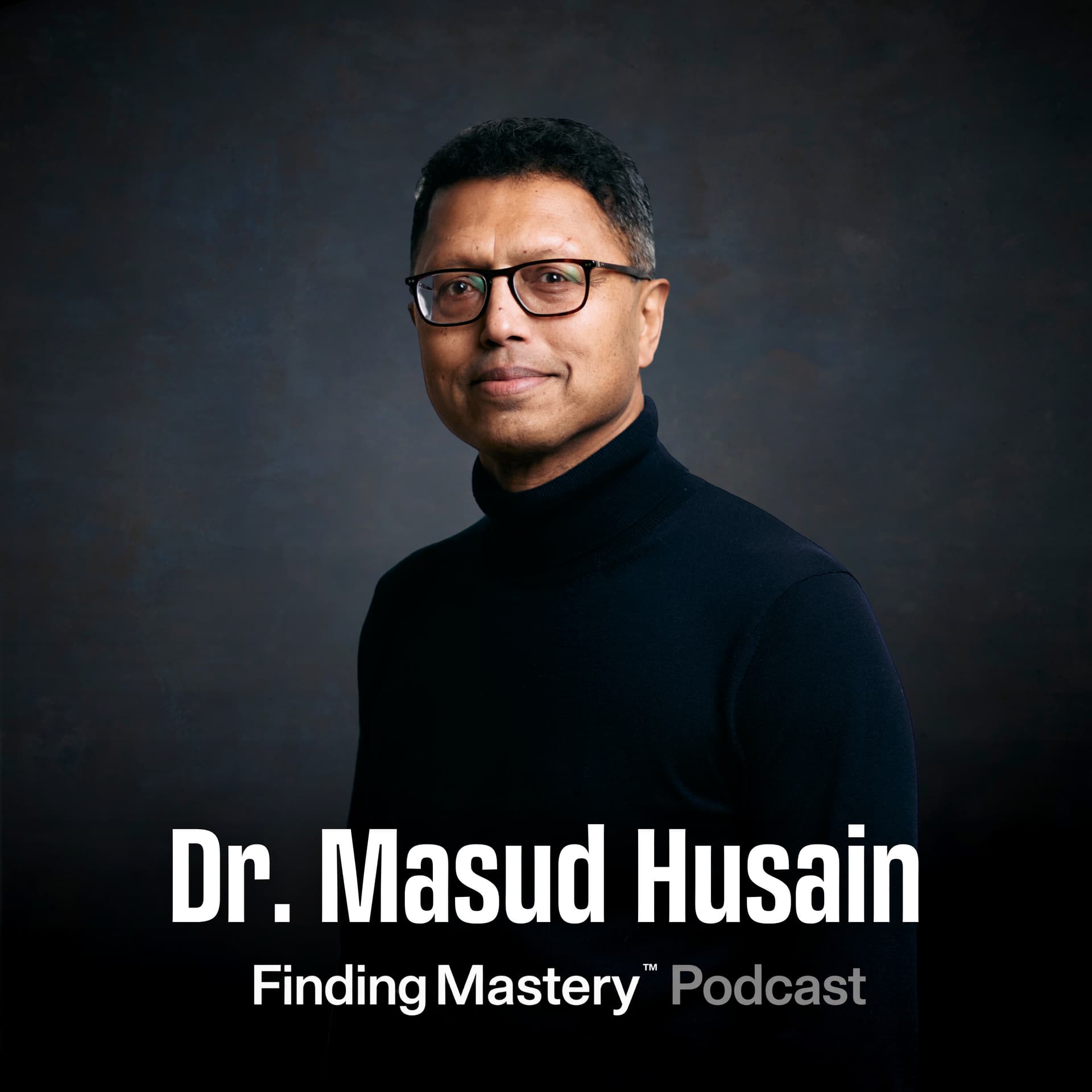
Aaron Lazar is a Broadway and television actor/singer/storyteller diagnosed with ALS. Dr. Michael Gervais is a performance psychologist/coach known for helping elite athletes and high performers develop mastery of self.
Key claims
Mastery of self matters more than mastery of craft; extraordinary performance comes from aligning thoughts, words, and actions from the inside out. High-performance “grind” can be dangerous when driven by fear and external validation. ALS forced Aaron to confront purpose and rebuild inner trust. “Beat” is the wrong verb—he frames healing/reversal as possible. Awareness is foundational; mindfulness/meditation, journaling, and wisdom-based conversations build it. Self-talk, breathing, and imagination/imagery are mental skills to regulate experience.
Notable examples
Aaron’s “prey to a predator” interpretation of ALS (German New Medicine), his shift from anger while doing dishes to disciplined enjoyment, and the 64-person reversal goal (referencing ALSreversals.org and an “impossible dream machine” using AI with ALS doctors).
Written by AI. May contain mistakes. Listen to the episode to check what was said.
Chapters
Tap a time to open that second in VOThe Path to Mastery
0:03 to 0:58
Dr. Gervais discusses the concept of mastery of self versus mastery of craft.
“Mastery because we know one great hire can change everything.”
The Path to Mastery
2:16 to 4:32
Dr. Gervais discusses the concept of mastery of self versus mastery of craft.
“Michael Gervais, welcome to Impossible Dream.”
Spirituality and Mastery
4:32 to 5:47
Exploration of how mastery of self can be viewed as a spiritual practice.
“eloquently, in even the most rugged and hostile of conditions.”
Facing Adversity
5:47 to 7:22
Discussing the importance of preparing for life's challenges through self-mastery.
“So we do need to work on the internal experience to be able to experience the riches of the external experience.”
The Role of Community
7:22 to 9:21
The significance of relationships and community support in overcoming challenges.
“This whole kind of thing is emotions and relationships are running the whole show.”
Mindset and Healing
9:21 to 12:18
Aaron shares insights on mindset and healing in the context of his ALS journey.
“And probably that training was not exactly everything you needed, but there's more to learn.”
Reflections on Mastery and Fear
12:18 to 14:00
Discussion on fear, self-identity, and the journey towards mastery.
“There's got to be something going on here.”
The Journey to Mastery vs. High Performance
14:00 to 16:43
Explore the contrast between true mastery and the hustle culture of high performance.
“Stop worrying about what people think of you.”
Redefining Success and Purpose
19:15 to 22:08
Discuss the evolving definitions of success and the role of purpose in life.
“I think that it's, I think the hustle hard, anxiety provoking narrative is still pervasive.”
Awareness and Operationalizing Excellence
22:08 to 28:01
Learn about the practices for achieving self-awareness and excellence in life.
“Do you think that what you're really talking about there is purpose?”
Show all 27 chapters
Understanding Thought Patterns
28:01 to 28:51
Explore the two types of thoughts and the importance of keeping an open mindset.
“you know, kind of low level thinking, shitty thinking, we call it in sport or, or like more beautiful, spacious type of thinking.”
Awareness and Operationalizing Excellence
30:52 to 31:07
Learn about the practices for achieving self-awareness and excellence in life.
“That's Proton, P-R-O-T-O-N, VPN.com slash mastery for 70 % off your two-year plan.”
The Power of Self-Talk
31:07 to 33:11
Learn how self-talk influences our thoughts and overall mindset.
“Yeah, self-talk is, let's call it a tool.”
Mindsets for Modern Living
33:11 to 35:33
Discuss the vital mindsets needed to thrive in today's world.
“And yeah, that sucks and that's difficult.”
Transforming Thoughts and Feelings
35:33 to 37:36
Explore the journey of changing thoughts and feelings for a better life.
“You know, you used the word being by yourself at home.”
Victory Mindset vs. Victim Mindset
37:36 to 40:14
Learn the difference between a victory mindset and a victim mindset, and the importance of the former.
“having as a reflective response to like, I don't know, spilt milk and or looking at yourself in the mirror.”
Possibility and Vision for Others
40:14 to 42:04
Discuss the importance of envisioning possibilities for oneself and others.
“And the doctors go, well, we've always wanted to, but there hasn't been the time and there hasn't been the money.”
Vision for Healing
42:58 to 43:10
Exploring the unreasonable visions we can hold for ourselves and others.
“for an additional 15 % off your 90 day starter kit.”
The Inner Game of Leadership
43:11 to 44:30
Discussing the importance of psychological skills for leadership and team dynamics.
“If you are leading a team right now, you already know that strategy, execution, priorities, accountability, those matter.”
Personal Journey with ALS
44:31 to 50:34
Aaron shares his personal journey and mindset in facing ALS.
“exploring you know i love that so much i first started i first spoke about this publicly almost two years ago.”
The Power of Team Support
50:35 to 55:10
Discussing the dynamics of team support and the importance of mutual advocacy.
“support and challenge each other every day to be our very best.”
Reflections on Identity and Relationships
55:11 to 56:00
Exploring the impact of personal challenges on identity and relationships.
“Our teams are bigger than we usually know.”
Reflections on Relationships and Identity
56:00 to 56:44
Explore the impact of relationships on personal identity and growth.
“I love you, but I can't be me around you.”
The Journey of Acceptance
56:44 to 57:40
Discuss the process of accepting one's circumstances and finding gratitude.
“To get this done, I know what I got to do.”
Embracing Help and Co-Creation with God
57:40 to 1:00:00
Learn about the importance of surrendering and co-creating with a higher power.
“This is a lot of work dealing with physical challenge.”
Practices for Mental and Emotional Resilience
1:00:00 to 1:02:41
Discover effective practices like meditation and gratitude to enhance resilience.
“This whole thing, Michael, this whole thing has been way beyond.”
Creating a Morning Mindset Routine
1:02:41 to 1:05:01
Find out how to set a positive mindset with a simple morning routine.
“I mean, I started to travel and speak about this because I needed to because it kept me in practice.”
Transcript
Automatic transcript. May contain errors.0:00Dr. Michael Gervais:Finding Mastery is brought to you by LinkedIn. We use LinkedIn Hiring Pro here at Finding Mastery because we know one great hire can change everything. One bad hire, it can cost you a lot, way more than time. It can cost you momentum and culture and real dollars. And that's why how you hire matters just as much as who you hire. And it's why I've become a big believer in the power of LinkedIn Hiring Pro. Here's what I appreciate about it. When you're running lean, you don't have hours to sift through a pile of resumes hoping to find the right person somewhere in the stack. Hiring Pro is built exactly for that reality.
0:32Dr. Michael Gervais:You describe the role and it screens candidates for you, surfacing the people who are a best fit so that you can spend your time and conversations with those folks rather than in the weeds of the applications. And the results back it up. Those hiring with LinkedIn are 24 % less likely to need to reopen a role within 12 months compared to the leading competitor. So join 2.7 million small businesses already using LinkedIn to hire. Host your job for free at linkedin.com slash mastery. Terms and conditions apply. Again, that's linkedin.com slash mastery to post your job for free. Welcome to a special Monday episode on the Finding Mastery channel.
1:08Dr. Michael Gervais:Every once in a while, we come across a story or a person that moves us in a profound way. And this is one of those moments. Recently, I was invited by Aaron Lazar to join him on his new podcast, Impossible Dream. Aaron is an incredible human. He's a Broadway and television actor. He's a singer and storyteller. And he's also facing ALS with extraordinary courage, with humor, and a sense of grace about him that is uncanny. He's also pushing toward an almost unthinkable goal to become the 64th person on record to ever reverse symptoms from ALS. I enjoyed this conversation so much that by the end, I knew I wanted to share it with you here on the Finding Mastery feed as well.
1:51Dr. Michael Gervais:I wanted to raise awareness and to also honor Aaron's message about purpose, connection, and resilience in the face of life's hardest challenges. So with that, here's my conversation with Aaron Lazar from Impossible Dream Podcast.
2:15Dr. Michael Gervais, welcome to Impossible Dream. I'm so excited to have you.
2:18Dr. Michael Gervais:I'm stoked to be here with you. Thank you for creating the space to make this happen for me. I appreciate that. Thank you. So you are, by not just my account, but the accounts of so many incredibly top performing elite athletes, humans, right? Not just elite performers in their fields, but performers as human beings. You are the master of helping all these people find mastery. How did that start for you? Very kind. First, I think that I would not accept the position of being a master. I'm on the path and I'm committed to the path of understanding mastery of self through mastery of craft. And so the craft is just this thing that somebody can do exceptionally well or they're really deeply interested in it, whatever it might be.
3:16Dr. Michael Gervais:And it's almost like I don't want to sound blasphemous to the communities I'm in, but I'm not that interested in the craft. I'm interested in the way that the person orientates their mind, orientates their relationships with others, orientates their relationship with experience to be able to pour in to something that looks really easy but is incredibly intricate and complicated to do. So I'm much more interested in mastery of self than mastery of craft. But you put the two together, you got something that's pretty special. I mean, I think that just leads me right back to, would you say that mastery of self is, is in essence, a spiritual practice?
3:57Dr. Michael Gervais:I think it can be. I think, um, when I think you'll recognize what I'm about to say here is that when you speak to people that are extraordinary in the way that they live their life, so they have a great life. It is, it's not something that is dictated by the external conditions. It's primarily dictated from the way that they work from the inside out. And when you talk about the spiritual path, this is the part I was going to say is that most of those extraordinaries, they talk about the same things. Most of the 11 world or all of the 11 world religions kind of talk about the same thing, you know, which is the deeper principles and working from those deep principles to line up your thoughts, your words, and your actions.
4:45Dr. Michael Gervais:eloquently, in even the most rugged and hostile of conditions. So we would never throw somebody to a hostile condition and say, you know, be your very best right now without training, how to line up thoughts, words, and actions in common environments, and then a little more stressful environment, and then even more stressful. And then you keep pushing it to one day you have this sense of full command or early on the path, kind of a haphazard command, but you still have a sense of like, how do I work? How does thought one and thought two work together with emotion A and emotion B? And until we become aware, I'm going to bring this back to spiritual, until we become aware of how our inner world works, we'll never really be able to be so settled and fully present to understand all of the gifts of life.
5:41Dr. Michael Gervais:And those gifts are relational. They're gifts with the experience. They're gifts with the sense of awe that Mother Nature can provide us. So we do need to work on the internal experience to be able to experience the riches of the external experience. You're just, I could not agree with you more. You're preaching to the choir. I have looked into this camera, or this camera many times, to say, I wish I could have learned everything that I've learned over the last couple of years without ALS. Maybe you can. And I think you've just said it in a much more. It got me emotional because what when you said you can't throw somebody into that crisis and then expect them to be an elite mindset performer.
6:26But that happens to people. It happened to me. although when I look back, I could go, oh, I see how, excuse me, I see how all of these moments or this particular experience was training for, you know, laying the foundational groundwork of mindset mastery that allowed me to then tap into my highest potential with this crisis in front of me and go, okay, I'm going to put all that to work for me. But what you're saying is, it it mean it's the heartfelt mission of why this podcast exists it's to say to people you have an opportunity hopefully most of you um have an opportunity before the incredible adversity uh to just start to be curious about self-mastery right now and it will always be there for you you're either in a storm or heading to it you know is a is a first principle for me yeah it's
7:28Dr. Michael Gervais:a first principle for me and it reminds me that somebody that i'm speaking with it seemingly seems okay could be in the middle of a storm or they're heading to a storm me too and so i want to be my very best in the most challenging of situations so that i can why okay so it begs the question like why there there's something about meeting a moment with eloquence meeting a moment with with dignity meeting a moment to be able to know that you're not in it alone but that you are an emblem and a lifeline and or a piece of hope for other people as well so nobody's in this thing alone it's too complicated and nobody certainly does the extraordinary alone it's way too complicated.
8:19Dr. Michael Gervais:So we need each other. This whole kind of thing is emotions and relationships are running the whole show. And oftentimes when we meet ourselves in a moment where we come up short or we come up in a way that we don't have a way through, you know, because we're, we're, we're feel like we've just fallen into a thousand pieces. And I don't know what it's like, of course, to get a diagnosis that fundamentally changes everything about my physiology, which is what you received. And I would imagine that you fall into a thousand pieces plenty of times and that you've also squared up with it. You've wrestled with that dragon and you're coming through it in a way like, look, there's some stuff I learned to be an elite performer.
9:01Dr. Michael Gervais:There's some things I learned and that has helped me a lot. I know how to work with stress. I know how to prepare my mind. I know how to be emotional in moments where other people might be overrun by their emotions, that you have a way to harness that. So you have trained in many ways, I would imagine that would help you. And probably that training was not exactly everything you needed, but there's more to learn. So I think you're really unique. When I was watching what you've been doing over the last handful of years, you're in a really unique situation to help point to the power of understanding how to use your psychology.
9:41Dr. Michael Gervais:And again, I'm stoked to sit here with you. It means so much coming from you. I appreciate that. And it certainly has felt that way. It's felt bigger than me, so to speak. But yeah, I mean, it's as simple as when you audition for 200 roles as an actor and get told no and keep insisting, right, that I'm going to keep going, keep going. That kind of, you know, it's a blessing and a curse. You talk about this. Wait, can I say that? When you first said, when I got diagnosed, I was like, all right, I'm going to be the one to kick its ass. I said, oh, yeah, he's I see. I see me in that. Like, I see most of the extraordinaries.
10:23Dr. Michael Gervais:They're unreasonable. It's unreasonable to think that you can be the one. It's unreasonable to think that you can be the one in anything. But somehow somebody is. And why not you? That's right. Yeah. Why not? Why not be the one that changes the narrative? Why not be the one that takes your family narrative forward or takes a community forward? Why not? You have to earn that right to be that radically unreasonable. Otherwise, you're just kind of like a kook. But when you said it, it was organic to you. Yeah. Are you still in that same frame that you're going to beat it or are you in a different – have you shifted that approach?
11:02Dr. Michael Gervais:And I'm not sure what beating it means, by the way. Yeah. Yeah. Well, and I wasn't, you know, I pretty early on, I was quoted as saying, I think, I think beat is the wrong verb. You know, it's to heal from it because there's so many ways to heal. And what are you, what am I going to war with? You know, and I really wanted it to be that verb as kind of like a former athlete, you know, guy who just wants, continually wants to be the best at whatever I do. And it's tough to go to war with an invisible thing that's doing a thing that you want to talk about unreasonable. I mean, the disease itself is totally unreasonable.
11:40I love the word. I used the word incomprehensible up to this point as a word that just – it doesn't make sense. Why would the body decide to kill itself while the mind remains – it doesn't make any sense. Although, you know, in reading all these books and doing all this research, German New Medicine gave me an incredibly powerful image. There was a doctor and his wife. They lost a child. And in the absence and the loss and the grief, he developed testicular cancer. She developed ovarian cancer. And they looked at each other and went, this can't just be random. There's got to be something going on here.
12:22And they psychologically determined for themselves that their bodies were trying to make another kid, right? And they looked at ALS and they started to create what's called German New Medicine. Robbie, you should probably check me on that because it's been a minute since I checked in with German New Medicine. But for ALS, I remember my mind being blown because it said ALS is a disease of the person feeling prey to a predator, either an event in life, a person in life, or life itself. And so the body plays dead. And I thought to myself, is that me? Despite all my success, has something caused me to feel like prey to life?
13:08And oh, hells, yes, it did. I had slowly eroded away my trust in myself, my belief in myself to accomplish the dreams that I had for myself and my family. And I had lost my trust in life to support me. So I was essentially propping up this hero's journey of leading man, good looking, great physique, but under the hood I was a mess. And I was just driven by a lot of fear. Depressed or anxious? Anxious.
13:42Dr. Michael Gervais:Yeah. So you abandoned the kind of dignity that you would hold within yourself for the approval and praise from others? You know, when I was looking at your book, which, correct me if I'm wrong, a couple years ago, First Rule of Mastery, fear of – Stop worrying about what people think of you. What people think of you. You know – You're going to fear people's opinions, FOPO, is a fun phrase. Yeah, I think it was very deeply psychological for me, meaning I can look back and know that my soul chose the theater thing. It just started as a kid. I want to ask you a little bit about when this all sort of – you were inspired to head down this path.
14:30But when you lose that, when you lose that faith and trust in the path and start going, you talk about this too, that true mastery is not what I did, which is pushing and pushing and pushing and just keep pushing, right, for more to get more, be more, do more, have more, because I'm afraid. I'm afraid that if this acting job ends and I won't be able to be the father to my kids or the provider to my kids I mean it was very very deeply critical of myself my self-worth as you like to talk about was tied to the validation of others I just didn't know it
15:06Dr. Michael Gervais:yeah right I mean I think I was not aware of that yeah I think that's the case for most of us you know so what you're describing you're right is not mastery a path of mastery that's like the path of high performance which is this idea that there's like this proverbial treadmill of high performance. Get on it, grind, grind, grind until you can't anymore. And eventually you'll have something from that, but you'll lack, I think, much more. You'll have some money, some whatever. It's a pretty well-seen recipe, that hustle hard, grind hard thing. And I'm not saying that work is not part of the process.
15:44Dr. Michael Gervais:I'm just saying that that sloppy proverbial treadmill for high performance is not what it's cracked up to be. And it's quite dangerous. You can achieve a lot from it. And especially if you happen to find your genetic codings matched with the environment that supports that thing. Like you for the voice and the smile and the charisma to be on stage. You know, like if you find that match, the high performance treadmill, you know, works a little bit more efficiently. But it's still, there's still a metallic feeling to the path of high performance versus the path of mastery. There's some warmth and contour to it.
16:21Dr. Michael Gervais:Both are equally difficult. You know, like both have equal challenges in there. I'm just more interested in the contour and the kind of more enduring principles that come with mastery. And I do think that they are more aligned with the 11 world religions more than they are with the hustle hard, get after it mentality. Finding Mastery is brought to you by Sunlighten. I'm really excited about a new partner of ours. Something that I've come back to again and again is when I invest in recovery with the same intention that I bring to my work, everything gets better. My energy, my focus, my ability to show up fully for the people that I'm with and the work that I care about.
17:02Dr. Michael Gervais:That's why I am so bought in on the Sunlighten M-Pulse Intelligent Sauna. I was first introduced to their team a few months ago and was so impressed by what they've created. This is one of the most advanced infrared saunas that they've built in over 25 years of pioneering this technology. That's right. They've been at this game for 25 years. I had one installed in my home a few months ago, and it's made a real difference. I feel more refreshed, more grounded, more relaxed, and it's become a consistent part of how I recover, how I reset every day. I'm using it to support muscle recovery, for improved oxygen delivery, and for nervous system recovery.
17:38Dr. Michael Gervais:And what I love most, I don't have to leave my home. They're offering the Finding Mastery community up to$2 ,100 off. Simply head to sunlighten.com and use the code mastery for this great discount. Again, that's sunlighten.com and use the code mastery for up to$2 ,100 off. Finding Mastery is brought to you by Lisa. We are serious about recovery. Sleep sits right at the center of that practice. I have been fortunate to work with some of the most extraordinary performers for the last two decades. And sleep and recovery are foundational. full stop. It's where the body and the brain repairs. And that's why finding a mattress that supports your recovery matters so much.
18:18Dr. Michael Gervais:A great mattress, it's not something that you stumble into. It is a choice. You find it on purpose, the same way that you'd approach anything that really matters in your life. We've worked with Lisa for a long time now because they get it. They build beautifully crafted mattresses tailored to how you actually sleep, your position, your feel, your preferences, all of it. You can take their sleep quiz and find your match in about two minutes. Premium material, serious comfort, full body support, no matter how you rest. One of our teammates here at Finding Mastery picked one up recently. Can't stop talking about it.
18:49Dr. Michael Gervais:Says it. They're waking up more rested than they have in years. Right now, they're having a July 4th sale. Go to lisa.com for 30 % off. Select mattresses. Plus, you get an extra$50 off with the promo code mastery. Exclusive for our listeners. That's lisa, L-E-E-S-A.com. And use the promo code Mastery for 30 % off select mattresses plus an extra$50 off when you use the code mastery. Since you've started this work, which is I think 20 plus years ago to today, have you seen a shift in that what is accepted as success, which I think used to be the hustle grind, and now more people's eyes, there's more curiosity about these, another way of doing it?
19:35Dr. Michael Gervais:I don't think so. I think that it's, I think the hustle hard, anxiety provoking narrative is still pervasive. And the value that comes from external is still the predominant value for most people, meaning that I'm okay if I've got money in the bank. I'm okay if people laugh at my jokes. I'm okay if I've got a position of power. I'm okay if I drive a nice car and have a nice watch. And there's nothing wrong with any of those. but when they are the primary source, like my father-in-law always says, he came, he came to the U S from Central America with a hundred dollars. His dad died when he was three years old.
20:12Dr. Michael Gervais:His mom came, came first when he was, I think, I think he was 12 and she came. So he was kind of left with some family members in a neighborhood that didn't have a whole lot. She saved a bunch of money from the U S sent it back. She didn't have papers. Okay, this was 50 years ago. And it's the American dream because he came by himself with 100 bucks in his name. 15 year old kid. My God. Right? And he came. And so something he reminds me of all the time. He's like, look, if you can afford three watches, buy three watches. It's awesome. But, and he looks at me, he's like, but what are you really doing here?
20:54Dr. Michael Gervais:I'm like, yeah, that's the right question. What am I really doing here? What am I, what do I really, really, really, really, really want in this spinning rock that we're on in this made up language that we're both using? You have your body. I have my body. Neither of us chose it. We're trying to do the best we possibly can with what we have. Like what do I really, really, really, really want? And I think that's a foundational question to wrestle with. And until you get clear on it, maybe yours, maybe I've heard you talk about the gift of ALS, which I find to be a remarkable perspective, that I think maybe the gift that you're referring to is that it forced me to answer that question, to get honest with that question.
21:34Like, holy shit, like, what was I doing?
21:38Dr. Michael Gervais:A little hollow, a little empty, you know, the anxiety that you're talking about? 100%. World-class talent, highly recognized. You walk into a room and people look at you and they're like, oh, fuck, there's Aaron. So it's not until we get to that place where some of us get forced to our knees, but at some point that we're like, wait, I need to square up with what am I really doing here. You and I don't know how much time we're going to have left. Nobody does. And that's meant to be inspirational, not desperation. A hundred percent. Do you think that what you're really talking about there is purpose?
22:15That's it. It's a hundred percent. So to try and just empathize with every viewer and listener, I was aware that my purpose was to become a Broadway star. I was also then aware that that wasn't affording me the life that I had dreamed of. So I needed to become a bigger star, which was let me become a TV star, which was way harder than I thought it was going to be. And then that wasn't enough either because it wasn't happening fast enough either. So now I needed to be a movie star in an age when movies were, you know, everything. It was sort of this pressure. Just kept putting all this pressure on myself.
22:52Dr. Michael Gervais:Aaron, those are goals, not purpose. They're correct. I thought they were purpose because I connected them to if I am going to be the father to my kids and the provider to my family that my father, you know, was, is to, you know, my dad, by the way, completely selfless, working. I mean, 73, still working almost seven days a week. Every single thing goes to his kids. You know, just that was the bar of like, I'm an actor. If I'm unemployed right now, that means I'm a schmuck. You know what I mean? Like, what am I doing? And so I just, again, I created this narrative. I created this story and I put all this pressure on myself.
23:33And I thought that was my purpose was to just, well, I lived the purpose of being the Broadway star. Now that's got to be a bigger thing. And so it's all just connected to a purpose of entertaining people, being creative and making this millionaire lifestyle for my family that I've always dreamed of. It was so void of purpose that I would often be in conflict with myself. I would feel like I'm on stage in a show. There's something missing here. I don't know what it is. I'm happy, right, when it's all going well. I'm a mess when it's not. And there's no consistency. There's no evenness and I don't know how to align my career with my values.
24:16And you talk about this in brilliant ways about how – like you've been saying, it's not about what's on the outside. You have to align with how to create sustained excellence I think I've read you talk about, which has nothing to do with more work, more work, more work, more work. It has everything to do with aligning with your true purpose and your values. How does somebody start to do that?
24:39Dr. Michael Gervais:first I operationalize excellence so for me excellence is being at home with myself wherever I am and so that sense of you know internal peace you know like to my best ability that's what I think excellence is so it's not the other thing which is like oh he hit just the right note there is excellence in that too you know but the deeper part of excellence for me that is 100 % under my control which puts me in a lever and a position of real power is like, I can control my inner experience. If I'm highly skilled, I'm really good at it. If I'm early on the path, I'm not so good at it. I've got all these thoughts happening, all these emotions that are flooding and I don't have the requisite skills to be able to manage them.
25:26But over time, one of the NFL teams
Read the full transcript
25:29Dr. Michael Gervais:I'm working with right now, one of the first principles is, there's a handful of first principles that I help NFL coaches and CEOs, you know, work through? Like, what are the first principles that you're going to share throughout your organization? And with this NFL team, I'll come back to first principles in a minute. With this NFL team, it's about stacking wins. We're not expected to be excellent right now. We are expected though to be, to bring our very best into this rep, whether it's in the gym or whether it's, you know, in film or it's on the field or whatever. Be your very best, whatever that is, strain, try, give yourself to it, be vulnerable, have the courage, like pour into it.
26:09Dr. Michael Gervais:And then you start stacking reps, start stacking wins, if you will. And so I think it's like this, I don't know, it's filling up the, your, your engine of your car, one thimble of oil at a time. It just takes time, you know, but so what are the things that you're, you said, what are the things we can do? The whole thing begins with awareness. Without awareness, there's three best practices for awareness. The first is mindfulness or meditation. That is a way to understand what's happening inside of you and outside of you without critique and judgment. So that's a best practice. And according to science, you know, eight minutes is kind of a minimum threshold to upwards 20 minutes a day is kind of a bit more optimized.
26:52Dr. Michael Gervais:But if my first teacher, you know, he was like, it was about 30 years ago. If he was listening to me say, count your minutes, he'd be like, oh my God, he missed the whole thing. But us Westerners kind of like some concrete - Give me the number. Give me the number, man. So eight to 20 minutes a day of that would be a really interesting investment. So mindfulness meditation for awareness, that's number one. Number two is journaling. So it's hard to fake yourself out when you're writing. It's hard to write and be honest. That's a difficult thing to do. It takes a real discipline to do it, but it does increase your awareness of what's happening.
27:26Dr. Michael Gervais:And then the third is conversations with people of wisdom, people that have lived compellingly interesting, introspective, discerning lives, that they have radical reference points. And they realize that, you know, one of the greatest gifts they can give the other person is to hold the mirror up and be deeply interested in what the mirror has to say. And when you have conversations with those folks, you change. They change too a little bit, but you change. and you become more aware of how your inner world is impacting your outer world and how the outer world, there's all types of tripwires that I have, how that my external world can trip me into, you know, kind of low level thinking, shitty thinking, we call it in sport or, or like more beautiful, spacious type of thinking.
28:14Dr. Michael Gervais:There's two types of thoughts. There's thoughts that constrict us and thoughts that open us up. Yep. You know, and I think one of our jobs, yours and mine, is to understand how that aperture works and keep the aperture as open and wide as we possibly can, even when our brain is saying, tighten up, get out of here. This is not okay. Sometimes it might be. Sometimes the best thing is to leave or to tighten up and brace, but not always, not with my loved, not with my wife, not with like a teammate of mine that, you know, I tripped on a anxiety wire around them or something like I got to keep that thing open.
28:50Yeah.
28:51Dr. Michael Gervais:Yeah. So anyways, those are the three best practices for awareness. Finding Master is brought to you by Magic Mind. I get to spend time with people who are relentless about training their minds. It's one of the things I love most about my profession. And for me, and those I work with, we are looking for ways to optimize our psychology and our brains. Magic Mind is a daily two ounce mental performance shot loaded with vitamins, amino acids, antioxidants, and clinically backed ingredients like turmeric, ashwagandha, and lion's mane. The ingredients are nano encapsulated for five times better absorption than traditional pills and powders.
29:24Dr. Michael Gervais:And I love the taste. I love what they're doing here. I use Magic Mind just about every mid morning. And what I noticed is that I think just a bit more clearly, my focus is definitely enhanced and I don't experience an afternoon drop. That's not a small thing when the quality of your thinking is one of your most valuable skills. So go to magicmind.com and get 50 % off your first order. You spend a lot of time sharpening your mind. It is worth fueling the brain behind it. Finding Master is brought to you by ProtonVPN. For so many in our community, travel is part of the rhythm of doing meaningful work.
29:58Dr. Michael Gervais:Boarding flights, hopping between cities, working out of hotel lobbies and coffee shops, it's all part of what it takes for some of us to lead and build at a high level. And one thing that's easy to overlook in that rhythm is digital security. Because the moment you connect to public Wi-Fi in a hotel or airport or cafe, your activity is suddenly a lot more exposed than most people realize. Logins, emails, financial information, sensitive work, it's all in the open. In a way that doesn't match the standards we hold for the rest of our lives. That's where ProtonVPN comes in. Proton VPN is a secure service designed for people who want to prioritize their digital privacy and security.
30:35Dr. Michael Gervais:It lets you access the internet the way it should work. Open, secure, and on your own terms. If you take your work seriously, take the conditions you work in seriously too. Right now, Proton VPN is offering you 70 % off a two-year plan when you go to protonvpn.com slash mastery. That's Proton, P-R-O-T-O-N, VPN.com slash mastery for 70 % off your two-year plan. Again, that's ProtonVPN.com slash mastery. Would you say that self-talk is somewhere in there? Yeah, self-talk is, let's call it a tool. so when you understand how you're speaking to yourself about yourself about another person about an experience about your future self like we are talking to ourselves a lot it's part of how we're making sense to ourselves so when you increase your awareness of how you speak to yourself then you can it's like you're going upstream a little bit to the rapids of life Like there's rapids coming, like we talked about earlier.
31:43Dr. Michael Gervais:But when you become aware of how you're speaking to yourself, then you get to optimize, you get to play, you get to change it. But if you're not aware, it feels like, like in the NFL, we talk about bang, bang plays. Like it happens real fast. Player one hits two people kind of at the same time, like bang, bang. And the whole thing is like over before you know it. And actually, if you slow down the tape, you would see that he put his right foot down first and then kind of scooped in a certain way and then was able to adjust to hit two people, two players at the same time. Like, wow, bang, bang, bang.
32:21Dr. Michael Gervais:And in life, it's the same way, which when you slow it down, when you go upstream and you're aware of how you speak to yourself, you get to play a different game. and that game in life is to choose the types of thoughts and to harvest the types of thoughts that you'd like to have later so if you think about gardening as a metaphor i'm with you on this one yeah so if you like if you and i are gonna gripe and complain and and critique we're harvesting we're watering the seeds of you know whatever those things are i just mentioned and And in a different way, if you and I choose to think about or talk about things that are of abundance and interesting and curious and hard to solve and like, what would it take for us to do this?
33:09Dr. Michael Gervais:And what are the resources we need? And yeah, that sucks and that's difficult. But wait, hold on. How do we actually embrace the da-da-da? So those, you can water and harvest the seeds so that they show up more naturally later. So it's harvesting the thoughts that you want to have, those seeds, if you will. And it's also if you're upstream in the rapids of life, then you can choose more eloquently the thoughts that you'd like to have. I just love both of those images. And both of them have been a part that's I would say probably unconsciously at first and then very consciously a part of my mindset throughout this journey.
33:50Right.
33:50Dr. Michael Gervais:What do you think the mindsets are that are required to live well in the modern world? And I'd love to know your take because your world five years ago probably was radically different and the mindsets were radically different. Like what have you come to learn about the most important mindsets that people can develop? It's so much of what you're talking about. It's that I used to look at people whose success I admired, people who I wish would have been mentors, right? People whose level of success I wanted to achieve and attain. And instead of having the maturity or the expansive consciousness to view these people and their lives from the lens of what does it feel like to be that person?
34:41What do they feel when they wake up in the morning? What do they feel when they're at work? What do they feel when they go to bed? I was just looking at it like, oh, when you make a movie like that as a movie star, you're doing great. And that house makes you feel great. And all the traps, which, I mean, I don't know how I fell hook, line, and sinker for it now that I'm on the other side going, oh, come on. I was smarter than that. But we all kind of are – I think the system is still one that educates young people into a society that values those things.
35:19Dr. Michael Gervais:Values performance and values external recognition rewards. A hundred percent, which is why I was hoping to hear a different answer from you that things have changed. And it's sad to me that they haven't. It also means, okay, there's more work to do and more conversations to be had. But what do I think the mindset is now? You know, you used the word being by yourself at home. You used the word peace. And that to me – Being at home with yourself. Being at – oh, okay, yes. So not being in a physical location, just that felt sense of being at home with yourself. Well, and for me, it's actually directly tied to home because whenever I had found myself prior to ALS, I mean, I literally almost asked God.
36:03I did ask God. I stood in my kitchen two weeks before muscle twitches started with this four and whatever years ago. And I said, God, I just want to know how to love myself as much as this partner that I had just broken up with in a relationship. because as soon as that breakup happened, I felt myself totally unable to be at home with myself at home. I was like, dude, it doesn't matter that you just had your first series record on a TV show. It doesn't matter that you just moved into an amazing place. It doesn't matter that your kids are doing great. You suck. You're a failure. What are you going to do?
36:33You need a relationship or you need a job. And so the fact that through transforming myself, being very aware from moment one, Okay, I'm going to beat this, which, you know, it became, I'm going to heal from this somehow. I had no idea that that healing meant change. But in changing— Change of what? Change of my thoughts, change of my feelings, change of my behavior, change of my beliefs, change of my disciplined practice of whatever became the patterns of my life that I had been unconscious of. I realized all of that was creating my life. It was my life.
37:18Dr. Michael Gervais:So you had something outside of you that forced you to examine your internal experience. And how have you gone through, I still want to come back to the mindsets, but how have you gone through changing your thoughts? I don't think you're changing your feelings, but changing the way you're working with your feelings, or maybe changing the types of feelings that you are having as a reflective response to like, I don't know, spilt milk and or looking at yourself in the mirror. Exactly. It was like, I use the example of, I would do the dishes and be so angry. And I'd be angry because I was unaware that, but I was judging myself as a failure that I wasn't making enough money in my job or I wasn't this, I wasn't enough.
38:00Dr. Michael Gervais:Pre-diagnosis. Yes, pre-diagnosis. And so I was unhappy with who I was and my life. And I couldn't get out of the tractor beam of that. No matter how hard I try, I knew I didn't want to feel that way. I didn't know how to stop feeling that way. It became a conscious sort of choice of like, all right, look, man, with whatever time I've got left, the number one thing is I want to enjoy my life. And so I've got to change these so that I'm doing – whether I'm doing dishes or sitting in a chair while my partner has to feed me because my hands don't work, I want to be the happiest guy in the world. Like I want to be not just surviving.
38:40I want to be thriving. And it's just disciplined practice of choosing, as you said just a few minutes ago, we get to choose over and over and over and over again to break the – to get off of those old train tracks and start new ones and trust that if I just keep going, I'll get there. There being to be in the moments of my life, enjoying every single one of them, regardless of what the destination is.
39:08Dr. Michael Gervais:It's possible. And you're resting on good science. Oh, well, that's good. Yeah, you're resting on good science. Tell me a little bit about that because I've been – I've just been preaching that it feels true, guys, but like, you know. Yeah. Well, before I drop into the science mode a little bit, what do you name that mindset? I would call it the victory mindset instead of the victim mindset. It's called victory. And then so it begs a question like, so I defined excellence earlier. Have you got to the place where you're able to define what victory means? Yes. Victory is for me staying on purpose, in belief that making a full reversal of this.
39:52And by the way, if I get a chance to mention it, I do. There are now 63 reversals of sporadic ALS, ALSreversals.org. that I can be, you know, at first it was 61, and then it was 62, and then it was 69. Now it's 64, whatever it is. I don't care what the number is.
40:08Dr. Michael Gervais:There's 64, there's 63 people that have reversed ALS. Yes, yes. And in fact, side note, you know, Brett, my buddy Brett Goldberg, my business partner, producer on the podcast, along with Robbie Shaw, Brett and I, after talking to Mark Cuban, who was on the show, and Mark said, okay, you want to know what I would do with AI to attack AL? Here's what I would do. So we now have what's called the impossible dream machine with a data science company, Mark's support, and two of the top ALS docs in the country, including the one at Duke, which is our alma mater, on the board of this, basically trying to use AI to look at these reversals and understand, and go, how has nobody ever done that?
40:56And the doctors go, well, we've always wanted to, but there hasn't been the time and there hasn't been the money. And so - Oh, this is pretty rad. It's pretty cool. But again, like if you told me this is where my life would be five years ago.
41:06Dr. Michael Gervais:But even that, yeah, right, 100%. Even that number though creates a different narrative of possibility. You know, like I wish it wasn't true for me. I wish that I didn't need some sort of confirmation that something can be done. But when I know that one other has done it, let alone 63, it does create a little bit more space for me to go, yeah, okay. hey, I wish, as I'm saying it out loud, I wish that I didn't need that. I wish I didn't either. Yeah, but I do. And that's why I need in my life people to keep pointing to what is possible. I'm constantly thinking about what is better than probable, like what is possible for me and for another person.
41:50Dr. Michael Gervais:I call it like, so it's an actual best practice for me is to sit with another person to get to know them a little bit and then go away, close my eyes and imagine what is possible for that person. What's the vision I can hold or cast for that person that is unreasonable, but just maybe if we thread this thing. Body Mastery is brought to you by Fatty 15. Did you know that Navy Dolphins helped unlock a secret to healthy aging? It's a wild story and it's the foundation for a product that I've come to really love, Fatty15. Fatty15 is built around C15, the first essential fatty acid discovered in over 90 years.
42:32Dr. Michael Gervais:And it was discovered by Dr. Stephanie Van Watson. She's the co-founder of Fatty15. While she was working with the US Navy and based on over 100 studies, we now know that C15 strengthens our cells and is foundational for healthy aging at the cellular level. Stephanie's been on the podcast and it was one of my favorite conversations. She's amazing. And what her and her team are building is something I'm really excited about. Head to fatty15.com slash finding mastery and use the code finding mastery for an additional 15 % off your 90 day starter kit. Again, that's fatty, F-A-T-T-Y, 15.com slash finding mastery.
43:07Dr. Michael Gervais:And the code is finding mastery. Okay, I wanna take a quick minute here to talk about finding mastery. If you are leading a team right now, you already know that strategy, execution, priorities, accountability, those matter. And what I've seen time and time again is that organizations don't rise or fall to the plan alone. Of course not. They rise and fall to the internal conditions of the people that are carrying the plan. That's the inner game that I'm pointing to. And the teams that invest in their psychological skills, they're the ones that are best prepared to navigate dynamic environments, like the one we're all living in right now.
43:42Dr. Michael Gervais:At Finding Mastery, we help leaders and teams build the mindsets and psychological skills that support sustainable high performance. And we do it inside the rhythm of business, not as one more thing, but as a practical way to operate when pressure is real and the stakes are high. We have partnered with teams at Microsoft and Salesforce, LinkedIn, New York Life, Marisk, Adidas, AIT, Waymo, and so many more, helping leaders lead through change, strengthen culture, and perform more consistently in high-stress and high-stakes environments. And you're not just kidding me, you're kidding a whole team that includes high-performance psychologists, performance strategists and olympians who know how to bring this work to life so if you want to really unlock the edges of your team's potential simply go to finding mastery.com slash inner game to learn more again that's finding mastery.com slash inner game let's keep pushing let's keep exploring you know i love that so much i first started i first spoke about this publicly almost two years ago.
44:46Dr. Michael Gervais:Your diagnosis? Yeah. And I had only told my kids about it just months before that. So for about a year and a half, I just said, I don't want anybody worrying about me. I am going to take this on. I'm going to go on a ride and I'm going to see what I learn and I'm going to see what I can do. And I'm going to do it. By the time I, by the time the story sort of came out very unintentionally and then the Broadway media started to put it out there and People magazine's calling me and it's like, they said, well, we'll pray for you. Everyone was saying, we'll pray for you. We'll pray for you. And out of nowhere, I just said, can I ask you a favor?
45:21Can that prayer for me, please be you envisioning and imagining me a hundred percent and filling that vision with your love and your magic, which is what you just said. What is possible for that person? And how, because that to me is the prayer. I don't need the fear. I don't want anyone's fear. I don't want anyone's pity. I know that's true with a lot of not just ALS patients, but other people dealing with disease. In order to change the game, we have to change the level of consciousness at which we are playing the game. And to me, that's one way to do it.
45:55Dr. Michael Gervais:You know, the second step in this, as I'm nodding my head to everything you're saying, is I think it's really important when I do that thing of using my imagination is really what I'm talking about and you're calling it consciousness. I'm talking about my imagination in this sense. And then to calibrate it with the other person, share it. So the way that I do this is let's say it's you and me and I go, Hey, listen, I'm going to go away and like really try to think about a compelling future that both of us sign up for. So I go away and I say, I want you to do the same and let's come back and talk about it.
46:30Dr. Michael Gervais:Like, okay, good. So I go away a couple of days later, we meet back up and I say, you want to go first? You want me to go first? Right. And sometimes they'll go, no, you go. I love this. I love it. Yeah. And then what I'm doing, if I'm sharing first or second, it doesn't much matter, but I'm looking for pupil dilation or constriction. I'm looking for body language. I want to see if I, did I just shock the system or did I shoot too low? So I want to - Which is which? Dilation is - So when we're interested, we're dilated. Okay. We're tightening up when we're constricted. And so let's say another more easy is like body language.
47:08Dr. Michael Gervais:Like if they kind of give the frontalis muscles and they squint their eyes a little bit like, that's all you see? Or the eyes come up like, whoa, you see that? So we're just looking for like micro expressions or full expressions. Not necessarily the language, but the connection between body and verbal language is what we're looking for, the connection. and that calibration has to be important because if I overshot and the person doesn't believe it's possible it's not going to happen and now I'm signing up for this weird game I got to try to pull somebody to I'm not into that game at all if I undershot and they go no way dude I might have undershot for you because I didn't know about reversals and I don't know if my if my imagination would have allowed me to go to a full reversal so the calibration is really important because let's say I say, I don't know, something, whatever it might be.
48:00Dr. Michael Gervais:And then you come back and you go, no, dude, like 64. Remember that number, Mike, 64. Maybe somebody beats me. Maybe I'm 65. I don't know, but that's what I'm shooting for. And on the journey for 65, 64, what number do you like better? Let's go with 64 right now. Let's go right forward. Let's go for it. Okay, good. I see you. Speed this up. So 64 is a number. Like as I'm going to 64, look, there's a way that I want to do my daily life. And so it's the, it's the, the, the, the process and the vision that we want to line up. And so your old process was I'm pissed off while I'm doing the dishes. Your new process sounds like it's something about, there's a graciousness and a gratitude about like the thing that you're doing.
48:43Dr. Michael Gervais:And there's a appreciation for the other people and like fill in the blanks. So that's where we start to get into the weeds and say, okay, so we're, we're both aligned on 64. for you go yeah yeah oh man are you sure yeah fuck that's awesome are you kidding me that gets my hair to stand by okay good all right so we're nodding our heads to it then we go look i'm gonna go on that i'm gonna go on this thing with you let's get a plan together and my job is to help you stay disciplined on the plan because this is not going to be easy you're going to need to be great with your inner language you're going to be great with your words you need to be world class with how you're lining those things up.
49:21Dr. Michael Gervais:Let's fucking see what we got here. Amen, brother. So that's where we build the plan. And that's where in elite sport, it is, there's such, there's lots of problems in elite sport. It's kind of unrealistic that most people would ever get the chance to do it at that level. So it kind of feels like this fishbowl, like these weird, you know, born talented people. Yeah, there's some genetic talent, But the discipline to train every day towards the edge of your capabilities when in front of your coach who decides if you play or not, in front of a teammate who's trying to take your position in the roster, in an exhausted, tired, messy state where you're making mistakes in front of everyone is not easy.
50:08Dr. Michael Gervais:This is not an easy path. And we miss all of that. We see them on Sunday. We see them on game day. and they look like these massive, amazing, artistic giants sometimes. And we miss all of the vulnerability and courage required each day and the discipline to not just be on time, but to be early, to not just take care of yourself, but be in service of your teammate being great. And you and I can use that same type of things in our lives, which is how do we go build a disciplined plan, support and challenge each other every day to be our very best. And that's when I say no one does it alone. World-class sport is a beautiful reminder of that.
50:48Can we just take a pause on that and just go? I mean, you just answered one of my questions, which was how does all of this, how does this apply not just to the professional, but to life, just life, just being a world-class human? And I think you just gave us so much insight to that, and I thank you for that. Yeah.
51:11Dr. Michael Gervais:So it's holding that vision. But then the process piece that I'm talking about is like, what are the values that are uncompromising for you? And how will you express those values in calm waters and rugged waters? And that requires mental skills training. So there's an awareness training that we're talking about. And then what sits on top of that are the mental skills to be about it. Yes. Self-talk is a mental skill. Breathing is a mental skill to regulate your intensity levels. Imagination, imagery, some people call it visualization, is a mental skill. Yes. And I could go on and on, but those are basic, basic mental skills to be great at.
51:48And, you know, first of all, we should play this game, guys, Sarah. We should definitely play this game. Sarah is like, you want to talk about, you know, the team analogy, right? I mean, everybody in this room is on my team. and somehow talking about this publicly, which I didn't plan on doing, it garnered a sort of amount of love and support from people. Everybody out there is on my team in a way. They've got a love, right? Like one of those values that has just become infinitely more important than anything else is just love. Can I go, can I hit you with something? Please do.
52:29Dr. Michael Gervais:Are you sure? Yeah. I'm looking forward to it. You're okay to be coach for a moment? You can literally hit me. What if it wasn't your team? Just get that right there. What if it wasn't your team? What if it's the team? This is our team. You've got a role, right? Sarah's got a role. And Brett's got a role. It's the team, not your team. Because your team hints at version whatever five years ago. Yeah. What if it's the team? You're the front person. You're the one that is kind of going through the unique physiological changes. Everyone in this room that's on the team has also changed their life in response to your condition.
53:16Dr. Michael Gervais:And they're supporting you. You have to support them. So support and challenge are two hinge ideas that are really important. And the ordering is foundational. Support then challenge, right? So they need to support you and challenge you. You need to support them and challenge them to be their very best because you're on the team together. So if it's just your team, you're taking the best of them. How about it? And I know I'm probably hitting on a couple of landmines in here. I was just going to say that the timing of what you just said is so divine in that I have found myself just recently over the last, I don't know, a couple of weeks, month.
53:58advocating for my team members, right? I think, Robbie, you felt me do this a lot. I think, Brett, you know, because we work on other things together, I hope you feel it for me. I've been advocating for my partner. I've been advocating for my caregiver. And recently, I've really had to learn how to advocate and support. When I say advocate, I mean support. To use your word, support versus challenge. Support my parents, who for them, This has been just an awful, awful experience. And I keep challenging them as much as I can to allow this to break them open in ways that make it extraordinary, not excruciating.
54:40And they are in such resistance and walking the line of how much do I challenge them versus yesterday in talking to my dad. I literally said to Sarah, he's so broken over this that I cannot challenge him right now. And I cannot challenge my mom. It's not the time to do it. I have to just somehow let go and love them for who they are, which today I go, that's supporting them. I have to support them because they're on the team.
55:09Dr. Michael Gervais:A hundred percent. Yeah. Our teams are bigger than we usually know. But there's like an inner circle and then a little bit of outer layer. And, you know, like, but I do like the idea of, I don't want it to be, and I'm speaking from personal, it's not pain, but like suffering. Sorry, this is the word I was looking for. Is that I nearly lost the love of my life, the relationship that we had. She said, I'm done with the relationship. and so because it was my team and I was the selfish self-absorbed self-focused the one that was like trying to figure out every little nuance I read every research article in the field like I was maniacal to obsessed to really understand how the mind works it has served me well but it almost cost me everything we we separated which is step one to a divorce like most people that separate don't.
56:06Dr. Michael Gervais:And we moved out of the house together. And she was so rad. She said, look, you're a good man. I love you, but I can't be me around you. Oh, Jesus. That was not her doing as much as it was my doing in the situation. It was a collision for the two of us. So I'm saying this, I just want to make sure I'm sharing my bias in that the trigger when you said my team. And I was like, it it didn't work out well for me now it has worked out well it's our team now you know and so that's shifting and we are teammates i i thank you so much for sharing that that hits deeply home i've been through a divorce yeah uh it was the beginning of just uh a loss complete loss of identity and um yeah i do have a uh there is something in me that goes like, to get this done, whatever this at the moment might be.
57:0564. Right. At this moment, it's 64. To get this done, I know what I got to do. And part of the process of surrendering to God, life, the creator, whatever you want to call it, over these last couple of years has been learning sometimes, most of the time, probably maybe all the time, I don't know shit. and it's a lot, it's a lot, it's easier. Aaron, five years ago, that's a lot of work, man. That's a lot of work holding all that up. This is a lot of work dealing with physical challenge. The work and discipline and practice of getting my mind to a place where now I cannot just live with this, but I can enjoy my life with this, that has happened.
57:54and I am infinitely grateful for getting there. And part of getting there was letting go of that. I know best necessarily for anything. And it was a lot of asking for help from people and God and staying open to things going in ways that I could never possibly imagine while still being super connected to that unreasonable thing. that's just like, look, look, I mean, God brought Michael into the studio today, man, for us to talk about. It's another, when just after a month of things physically getting really hard, like here's another breadcrumb keeping us on the path, you know? And, and you look at, I look at it all.
58:38It's all miracles now.
58:39Dr. Michael Gervais:Is God active or passive? Super active. incredibly well i should i should i think he's as active or she's it's as active as you believe it to be i used to i turned off my entire heart there's this amazing uh graphic it's uh i don't know if you know uh the energy healer david elliott but he has a book called healing and in in his book there's this graphic of silhouette of a man and there's a spiral coming out of the person's heart going to something he calls UEF, universal energy flow. And then this whole flow of life that happens, that's when you're in flow, when your heart is open and you're in flow.
59:19And then there's a line from the belly button down and it goes from fear all the way, through all the negative, lower vibrational, lower levels of conscience stuff to illness and death. And I looked at that and went, oh Jesus, I'm on the other line. I'm on the other line and I've got to open up that thing again. And as soon as I did that, I made a conscious choice to say, God, source energy, the universe, infinite consciousness, whatever you call it. It wasn't a religious thing. It was a deeply sort of spiritual cry for let's co-create together. Let's make this life together. I can't do it alone.
59:56I've been trying. It's not working. I'm on the other line. And so I think God is so active now. This whole thing, Michael, this whole thing has been way beyond. I'm answering a call that God has been like, oh, you're here. Welcome to the party, man. And now I'm going to help you. I've been here all along. You've just been tuned off. You turned the television station off. Yeah.
1:00:20Dr. Michael Gervais:Cool. What are some of the best practices you're using to be able to navigate, you know, the difficult parts of life? Because if you want me to go first, I'm happy to go first. Sure. But, like, I don't want to almost kind of taint the water, if you will. Okay. Well, then, I mean, meditation has been certainly one of them and all kinds of meditation. It started with I don't even know what meditation is. And by the way, I should say like leading up to symptoms of ALS, I had been invested in self-development, personal growth, spirituality for a decade. I just couldn't embody it. It was an intellectual pursuit.
1:01:02And I knew something was there and I was passionate about it. And my friends were sick of me trying to talk about it. It was just all woo-woo. And I would just go deeper and deep down these rabbit holes. And I never integrated. And then all of a sudden, you know, this turning point, which leads me to the, you know, I had a world-renowned medium on the show named Rebecca Rosen who basically said, Aaron, your soul chose this. even though you did your damnedest very ambitiously to probably break your nervous system with how you were living. It was going to happen because your soul is that ambitious and chose this thing.
1:01:41Now, I believe it. You don't have to, right? But to me, it speaks to a trust that there is a level of things going on here that I don't control and that I don't need to control, and I can just trust and let go. I mean, athletes say this all the time. You know, I'm a big Eagles fan. And A.J. Brown is a fascinating player and a spiritual dude who, after this weekend where he'd made this unbelievable play, he said, man, I just stuck my hand out there. God caught that ball. And I used to look at athletes and go, come on, man. You walk off the field. Thanks be to Jesus. Jesus won that game. And I didn't understand.
1:02:19I was like, no, dude, you won. But now I go, oh, yes, this is all thanks to God. Be grateful for all that. Sarah's dad, Rob Morgan, is an energy healer and has a beautiful phrase that's like, be grateful for all of it, not just the great stuff. So gratitude is another thing that helps. And it's, you know, I used to say this stuff. I mean, I started to travel and speak about this because I needed to because it kept me in practice. so as much as this podcast is for everyone out there listening it's also for me because it's creative and it helps me heal so it became this whole realization of like oh i'm a performer and if i get to do what i love to do and i can't get on stage in a musical anymore but i can this is something i use my voice i use my creativity we have these conversations you know and so part of it was one big tool was, was creativity.
1:03:19It led me to purpose, right? So meditation, uh, helped me find ideas that I'm a vessel for, right? Great athletes, great performers are a vessel for things. Um, and I just kind of let those things come, come through me. And then I just went, well, what happens if I share them? And, and, and I started to get that feedback that when you said, I wish I didn't need the number 64. Isn't it the same thing with all of our feedback in life? If I had tried to make an album and God made it awful every step of the way, like most of, not most, but a good chunk of my acting career was such pushing that rock up a hill, slamming doors down, cracking my head open on every rung of the ladder.
1:04:07This has been different. This has really been a co-creation, like you said earlier, They're planting seeds in the garden and watching the plants grow. We reap what we sow. This has really been God saying, you're in flow now. And it doesn't have to be perfect. And you don't have to be great at it, but just keep going. Yeah.
1:04:26Dr. Michael Gervais:I could talk about it for days. Yeah. You're on it. I think some folks are down the path like you are with training. They've got a meditation practice. They've got a gratitude practice. They've got, you know, something else they're doing for arousal regulation or mental imagery or, you know, keep going. I use both of those. Yeah. And so and there's other folks that are like, I don't know what you guys are talking about. That's mumbo jumbo. Yep. And one of the things that we developed and I think we've got it on your website or our website for you is just a very simple 60 second morning mindset routine.
1:05:02Dr. Michael Gervais:And it's before you get out of bed. And there's four steps to it. and I'll share the link for you guys to be able to do it. But it's an audio file that your folks can download. But it's four simple things, which is before you get out of bed, before you check your phone, before you do anything, you tune into one breath. It sends a signal to the brain that like, oh, I'm in charge of this thing. And there's no will to beast. There's no saber tooth. One long exhale resets the system that I'm in control and I'm going to move from a relaxed state rather than a tense state. I haven't even gotten out of bed yet.
1:05:35one breath, one thought of gratitude.
1:05:37Dr. Michael Gervais:And the gratitude is not like check the list I'm grateful for. It's an embodied feeling where it's like you bristle. There's like a mini kind of explosion, if you will, like, oh, I really feel. Okay. So that takes a little bit of time to get to that place. So you start with the checklist, but then you move in. And the third is an intention. You use your imagination to see how you want to show up at a particular time in your life today. Like, and so that means you got to kind of know what you're doing today. But how do you want to walk through a threshold? Roll through a threshold in your case.
1:06:12Dr. Michael Gervais:How do you want to move into a space? You know, and so that's a really important part of using your imagination. And then before you get out of bed is that you just take a moment to be wherever your body is. You know, and so just be there. You know, and so that's about practicing being fully present. Those four steps, we'll load you guys up with it. And I'll put it in the show notes or ask you to put in the show notes. But I think it's a great, simple little practice. Dr. Michael Gervais, you are such a cool dude. Thanks, man. I've been such a fan. And I'm not just now a fan of you and your work.
1:06:50I'm a fan of you. And I appreciate you so much. Thank you, Mike. Thank you. And I look forward to our next conversation. This is great. Yeah. Appreciate you. Thank you.
1:06:56Dr. Michael Gervais:Thank you. All right. Thank you so much for diving into another episode of Finding Mastery with us. Our team loves creating this podcast and sharing these conversations with you. We really appreciate you being part of this community. And if you're enjoying the show, the easiest no-cost way to support is to hit the subscribe or follow button wherever you're listening. Also, if you haven't already, please consider dropping us a review on Apple or Spotify. We are incredibly grateful for the support and feedback. If you're looking for even more insights, we have a newsletter we send out every Wednesday.
1:07:29Dr. Michael Gervais:punch over to finding mastery.com slash newsletter to sign up. The show wouldn't be possible without our sponsors. And we take our recommendations seriously. And the team is very thoughtful about making sure we love and endorse every product you hear on the show. If you want to check out any of our sponsor offers you heard about in this episode, you can find those deals at finding mastery.com slash sponsors. And remember, no one does it alone. The door here at Finding Mastery is always open to those looking to explore the edges and the reaches of their potential so that they can help others do the same.
1:08:05Dr. Michael Gervais:So join our community, share your favorite episode with a friend, and let us know how we can continue to show up for you. Lastly, as a quick reminder, information in this podcast and from any material on the Finding Mastery website and social channels is for information purposes only. If you're looking for meaningful support, which we all need, one of the best things you can do is to talk to a licensed professional. So seek assistance from your health care providers. Again, a sincere thank you for listening. Until next episode, be well, think well, keep exploring.
From the publisher
Welcome to a special Monday episode on the Finding Mastery channel.
Every once in a while, we come across a story or a person that moves us in a profound way — and this is one of those moments.
Recently, I was invited by Aaron Lazar to join him on his new podcast, Impossible Dreams. Aaron is an incredible human — a Broadway and television actor, singer, and storyteller — who’s facing ALS with extraordinary courage, humor, and grace. He’s also pushing toward an almost unthinkable goal: to become the 64th person on record to ever reverse symptoms from ALS.
I enjoyed the conversation so much that I knew I wanted to share it with you here on Finding Mastery — to raise awareness, and to honor Aaron’s message about purpose, connection, and resilience in the face of life’s hardest challenges.
Takeaways from this episode:
- Why mastery of self — not just mastery of craft — changes the way we meet adversity.
- How awareness, self-talk, and gratitude can shift what’s possible in any moment.
- What it means to move from “my team” to “the team.”
- How purpose and love become anchors when life feels uncertain.
- The small, daily practices that help us stay grounded, connected, and alive to what matters most.
Enjoy this conversation with Aaron and me, and let it remind you of the strength that lives inside all of us, even in the storm.
____________________________________________________
Links & Resources
Subscribe to our Youtube Channel for more conversations at the intersection of high performance, leadership, and wellbeing: https://www.youtube.com/c/FindingMastery
Get exclusive discounts and support our amazing sponsors!
Go to: https://findingmastery.com/sponsors/
Subscribe to the Finding Mastery newsletter for weekly high performance insights: https://www.findingmastery.com/newsletter
Download Dr. Mike's Morning Mindset Routine: findingmastery.com/morningmindset!
Follow on YouTube, Instagram, LinkedIn, and X
Aaron Lazar: http://www.aaronlazar.com and https://www.youtube.com/@ALImpossibleDreams
ALS: www.als.org
See Privacy Policy at https://art19.com/privacy and California Privacy Notice at https://art19.com/privacy#do-not-sell-my-info.