
In short
The episode explores what happens inside an NFL huddle and how its culture, timing, and nonverbal communication shape performance. Brandon Marshall argues the huddle is a “mystery box” where players spend more time than the ball is in play, and that correct execution (center/quarterback positioning, eye contact, snap count, protection, audibles) determines the next play.
Guests
Brandon Marshall, NFL All-Pro wide receiver; interviewed by Dr. Michael Gervais.
Key claims
Huddle setup is intentional (center’s back to the ball as a “wall” and communication point). Players must process rapidly (mic identification, clock, motion, protection, coverage reads) and reset after off-script moments.
Notable examples
“Shut up” respect for the quarterback’s huddle; George Kittle’s reset ritual; Super Bowl noise being manageable due to pro preparation. Marshall describes studying opponents and coordinators in three phases.
Written by AI. May contain mistakes. Listen to the episode to check what was said.
Chapters
Tap a time to open that second in VOUnderstanding the Huddle's Dynamics
0:45 to 4:50
Delve into the intentional design and communication within the huddle.
“Where the quarterback inserts himself after receiving a play is intentional.”
The Importance of Focus in the Huddle
4:50 to 7:30
Learn how players maintain focus and reset after plays in the huddle.
“You just might've had a 40 yard bomb that was amazing.”
Preparation and Game Day Process
7:30 to 11:48
Uncover how players prepare for games and study their opponents.
Coaching and Parenting Insights
11:48 to 14:00
Gain insights on effective leadership and coaching strategies.
“I got to a place where I was studying, uh, the, uh, the coordinators and their philosophy, right?”
Welcoming Brandon Marshall
14:00 to 14:30
Dr. Gervais expresses appreciation for Brandon Marshall's impact on mental health.
“and it starts with you brandon it is always a treat and a joy to spend time with you you speak from the heart, you speak from experience and you are a, you are the epitome of honesty.”
The Importance of Huddles in NFL
14:35 to 15:36
Discussion on how much time NFL teams spend in huddles and its implications.
“Okay, Copilot, how much time do NFL teams spend in the huddle in a game?”
Transcript
Automatic transcript. May contain errors.0:01Dr. Michael Gervais:The Super Bowl becomes everything. There is so much noise. You have three hours to tell everybody what you know about this game. The game is everywhere.
0:23Dr. Michael Gervais:The Huddle is one of football's great mystery boxes. Players actually spend more time in it than the ball is actually in play. And yet almost no one knows what really happens inside the Huddle. In this episode, NFL All-Pro Brandon Marshall and I go inside the Huddle. Not to talk strategy, but to reveal culture, to reveal its impact on the game. Before you can get to what's happening in the huddle, you got to understand, you know, the huddle, meaning the center, how far away he is from the ball and his back towards the ball is intentional. Where every player is is intentional. Where the quarterback inserts himself after receiving a play is intentional.
1:04Is he standing up? Is he kneeling down? the eye contact like we practice the huddle if you don't get the huddle right if you don't break
1:13Dr. Michael Gervais:the huddle right do it again okay let's start let's start at the beginning because why is the center have his back to the to the ball well first off we're trying to like that's where we're communicating right so we have to protect that huddle right and so his back is to the ball because now where he's a large human the defense is behind us so that's our wall right and so now we're about to get the information. We can't let them get the play. But also the reason why he's there too, it's like when we break the huddle, how quickly can we get to the ball? Can we get set? Can we start getting the information?
1:46Now that gets into all the other stuff. What did we receive in the huddle? And there's only seconds, 25 seconds, 30 seconds to now we have to identify the mic. We have to put the protection in place. We have to see where the clock is. We got to bring a guy in motion. The coach is in this guy's air. We're reading at the receiver position. I'm out here and I got my triangle. I'm looking at the corner. No, I'm not just listening. I got to feel that, but I got to look at my corner, my safety, and then I got my backer. That's going to tell me if it's cover three or cover two. And whatever they roll to, post not, determines how I run my route or if my route changes.
2:21But I also got to listen in here if the quarterback is going to audible. He's going to change something, right? And then the running back is in the backfield, and he has to determine if this guy comes off the edge, I got to go get this guy. I have to break off my route. So there's so much going on within these 20, 25, 30 seconds.
2:39Dr. Michael Gervais:And the other thing that happens is that a play breaks. Say it's a 20-yard bomb. Yeah. And then now the whole squad kind of has to catch up to where you just caught the ball. That's right. Okay. Now the clock has started. We have 40 seconds. On the sidelines, the offensive coordinator and head coach are kind of sorting out what play to get in. and then everyone's kind of scrumming around the ball and the quarterback is outside of the huddle that's right and then at that point the quarterback is listening for the play now these plays okay trips right let's go 11 personnel 11 personnel or don't forget your situation the situation right now you just got to the fringe area alert alert this right now there's alerts and the fringe remember 70 of the time they do x y z this is the conversation before they even get to the plate.
3:29This is all happening. And now let's go, now we're, I'm sending 11 personnel, 11 personnel, tell Brandon on this one, he goes to the Z, stays here. Okay, we can go trips right, Z, Zing. We're going to go scat protection. We're going to go, actually scratch that. Let's go 385. And then let's go Z, bingo, X, comeback. H, swing. On two, on two. And don't forget, don't forget, don't forget, remember the alert. Okay, okay, then you see the quarterbacks. I got, I got, I got, I got.
3:55Dr. Michael Gervais:now the quarterback has to remember all that and then there's another play they gave him too i just missed that like after they do that say okay this is your alert if they go here here's your second play okay so all that comes in and there's like is it three segments to a play there's like 14 front which is like communication to to the o-line okay and then there's a another one i'm not sure what the middle stuff and then there's the receivers have to listen to that end tag that's right and then there's the the the snap count but before you even get to that we personnel so personnel who's in the huddle that's right 11 personnel means one running back one tight end yep and then we go formation where everybody goes trips right okay then we got three receivers on the right hand side and if we have a motion we may say zzing but all this is formational stuff so that's all one phase like you're saying and then there's the protection right and then there's the play the play talks about the running backs receivers where you're going so in the huddle information is coming from you.
4:49Dr. Michael Gervais:You said be intentional. What I hear is, okay, you practice. We're going to get to that in a minute. And then I hear focused. You have to be locked on focus. You might've just made a mistake. You just might've had a 40 yard bomb that was amazing. And you've got to ready yourself to come back to great focus. That's right. Okay. Yeah. You got to read the quarterback's lips. It's loud. You can't hear, you lean it in, right? You got to, yeah, you got to hear everything. Yeah, and you've got to also believe that the quarterback understands what's happening. That's right. That's right. So all of this is happening.
5:22No, I don't have to believe that.
5:23Dr. Michael Gervais:Tell me more. That's not my job. Okay, tell me more. Whatever he says, I'm going to do. So I don't got what he, that's his job. He better learn all that. He got to learn all that. And you just really need to understand the last tag. Z nasty something something, right? You just got to understand. Receivers is breaking the huddle first most of the time. Once we get, I'm out of here. I got it. I'm going with that. I got it. You guys deal with the middle thing. Okay, I'm out of here. So then talk about how you practice it and how you practice breaking the huddle. Walk us through that just a little bit.
5:52I think the biggest thing on perfecting the huddle is it's almost like making your bid. First thing in the morning, it's like how you do one thing is how you do everything. How you start your day is how it's going to end. How you do small things is how you do all things. Yeah, it's like ready, break, we're all together, and it's loud, it's uniform, it's team.
6:08Dr. Michael Gervais:And the practice that I've seen is you are practicing to be in unison. That's right. And then there's like little things about it, you know, how far the center is from the ball. So he turns around, he's set there, where the quarterback inserted himself and the positions and all that. All that stuff matters. But the biggest thing about the huddle is like make it look good. It's like making your bed in the morning. There you go. Okay. So there's moments in the huddle that things are said off script. Yeah. Right? I love it. Yeah. So let's play the whole thing out. Like you just made an amazing catch.
6:41Dr. Michael Gervais:That's right. Okay. Teams running up to you. there's a lot of energy happening inside of you and around you. That's right. How do you calm yourself down so that you can focus properly? Oh, that's really good. Well, first, yeah, there is a lot happening. There's a lot happening in a huddle, which you say all script, but it's the quarterback's huddle. So a lot of times, whether it's good or bad, like, you know, that's the rule. You come in a huddle, shut up. Excuse my language. Sorry. be quiet I should say be quiet but that's the energy in the locker room is like you know that right and so if you're talking or if you're you know cheering still the quarterback is going to literally say that he's not going to say be quiet he's going to say shut up right and that's that respect and that understanding of that um what I love about the second part today is like how do you reset right a lot of uh people don't know how to reset or transition life is filled with filled with transition and how you handle the transition determines the quality of the thing that you're doing your life the product the game and so there's a player that I love George Kittle George Kittle used to have like this red Patrick someone's arm and he would hit it after a good player bad play and that just triggers something him that I'm resetting for me what I would do is I would take a deep breath and now I'm on to the next play and then I'll actually take two deep breath so it's like after the play reset right and then when I'm out there lined up right before the quarterback's about to say hi I just like kind of slow everything down it's like I got it I know so going from analytical into your body so going from like processing up here to processing in here yeah yeah like it's just like a relax like I'm relaxed I'm not tense I'm not fighting it's like it's fluid so that that that breath goes from okay i'm stuck at my feet position and then now i'm about to get into just like like like i'm about to get into almost like uh like a ballerina like a dancer you know it's like because i want my body to flow you know so i'm flowing and i can't do that tense so there's a lot of information as we talking about that's that's coming into you you ever break the huddle and be like damn what is my assignment what is my all the time no come on yeah i mean watch it you'll see it in super bowl you'll see how do we know what are we looking for if you see a guy especially outside wide like the receivers go to another guy like this they communicate yeah that's what i got what i got what i got what i got what i got what are you a lot of times we're checking yeah yeah sluggo you got no no you don't get the sluggo you got there i got the sluggo yeah right so there's a lot of that so when you see that even a running back to the quarterback a lot of times there's this that's just communication how it's supposed to flow we're checking with each other yeah but a lot of times that is like hey what i got are the quarterbacks saying hey don't forget you got that that that nickel that's right yeah you know so because you're going up the block you see on the defensive side what it looks like they break the huddle and it's out there and they do this what what i got they look at the safety what i got the the linebacker what i got so uh that's the tail on the defense side when those guys put their hands up they're like because they got to communicate hey i can't hear what is the call what's the call the thing about the super bowl is that the super bowls are not that loud but you played in one of the louder stadiums seattle seahawks um it's a handful for the defense but i don't think that the noise is probably not going to be an issue yeah uh on sunday's game yeah what do you think about that yeah both teams seattle patriots they both travel well so uh i think that uh there's going to be a lot of energy in the Super Bowl and both teams, they get loud.
10:18They get loud. But when you say, you know, you're a pro, that's not an issue. Yeah, right. It's not an issue. We practice those moments. Now we go nonverbal. It's loud. Okay, great.
10:34Dr. Michael Gervais:Yeah, right. Do you remember the process for you to study? Yeah. So that, can you clarify how you study to be able to prepare yourself to be automatic on game day? because right now in our world there's so much information coming in that we have to discern what's the important information lock into the stuff that's going to matter most so that when the test happens later we're well prepared what was your process my process started in the off season and this goes pete carroll conversation as well like i would take all the dbs that i was going to face and i would start breaking them down then and there were some guys i would skip over i'm like i right but for the most part i would have pages on every single guy.
11:14I got Darrell Rivas this year. I got Antonio Cromartie twice, right? And so I would start then. And I would just take my notes and watch all their stuff historically, right? And then once we got into the season, the week of, it started right after the game. So Sunday, we play against the Patriots. Next week, we got the Jets or whoever. And I'm immediately, I'm watching that game. I'm done with that. I have everything before we even talk about this as a team and I'm always already on to the next week. So I'm breaking down the corners, I'm breaking down the team, et cetera. But I was also studying the defensive coordinators.
11:49I got to a place where I was studying, uh, the, uh, the coordinators and their philosophy, right? What they do and their tendencies and all those things. Uh, so I would start with the coordinator, then I would go to the defense, then I would break down the individual matchup. So I broke it down into three phases and a lot of this was data right and then the other thing was watching film and then there's some feel that you get on film right it's like oh if i put my foot up like this he's gonna do and that's all i'm searching for when i'm watching film it's more data but
12:22Dr. Michael Gervais:you can see it if we knew what you knew how would we be better parents treat your kids like human beings and listen. Work with them. You're the boss, but you're not the boss. A lot of times parents, we just say, do this or we don't listen. We don't have a real relationship with them. And so I would actually, my advice would be to sit down, build a real relationship with your kids, listen to your kids. And then also be really intentional. You know, our job is to help unfold our kids. And and that's that takes time. And I take sitting back and trying to figure out, like, who are they? Where's their gifts?
13:12How can I help them unlock that?
13:15Dr. Michael Gervais:That is how the best coaches in the world have probably treated you. But I call them above the line coaches. They saw something special, wanted to figure out how to pull it out. The below the line coaches are the ones that don't take the time. Yeah. Yeah. They don't invest in the way they don't maybe even know what makes you special. They just see some physicality or whatever. So if we knew what you knew, how would we lead better? We would lead better and lead in confidence because we did the work ourselves. like if you do the work it's so much it's so easier to hire the people that you need to work with those people to meet them where they're at to lead them to serve them and it starts with you brandon it is always a treat and a joy to spend time with you you speak from the heart, you speak from experience and you are a, you are the epitome of honesty.
14:16Dr. Michael Gervais:Yeah. And so thank you for sharing your wisdom, your insights. And like, it's going to be awesome to watch this game and thank you for all that you do for mental health. Thank you for all that you do to invest in the inner world. So people can be their very best. That's right. That's right. And, you know, I really appreciate you. Thank you. Yeah. Okay, Copilot, how much time do NFL teams spend in the huddle in a game? So picture this. An NFL team generally runs around 60 to 65 offensive plays in a game. Now, every time they huddle up, that's about 15 to 25 seconds of regrouping, depending on how fast they're moving.
14:52Dr. Michael Gervais:And when you add it all up, the team might spend about 18 to 20 minutes of the game just in those huddles. Okay, so a team spends more time in the huddle than playing. Interestingly enough, in a full 60-minute game, the ball is only actually in play for about 11 minutes. Okay, so when I hear that, I hear that there's a massive competitive advantage to being great in the huddle. And that's why great teams invest time to be intentional with it. That is part of the game inside the games. The huddle is not unique to football. We all have them. They're the moments before the meeting starts, before the decision is made, the moment before we act.
15:30Dr. Michael Gervais:Those moments matter more than we think. They reveal culture. They reveal the strength of our relationships. And what happens inside the huddle often determines what happens next. I'm Dr. Michael Gervais. Thank you for joining us for the Game Inside the Games.
15:52All right.
15:53Dr. Michael Gervais:Thank you so much for diving into another episode of Finding Mastery with us. Our team loves creating this podcast and sharing these conversations with you. We really appreciate you being part of this community. And if you're enjoying the show, the easiest no-cost way to support is to hit the subscribe or follow button wherever you're listening. Also, if you haven't already, please consider dropping us a review on Apple or Spotify. We are incredibly grateful for the support and feedback. If you're looking for even more insights, we have a newsletter we send out every Wednesday. Punch over to findingmastery.com slash newsletter to sign up.
16:28Dr. Michael Gervais:The show wouldn't be possible without our sponsors and we take our recommendations seriously. And the team is very thoughtful about making sure we love and endorse every product you here on the show. If you want to check out any of our sponsor offers you heard about in this episode, you can find those deals at findingmastery.com slash sponsors. And remember, no one does it alone. The door here at Finding Mastery is always open to those looking to explore the edges and the reaches of their potential so that they can help others do the same. So join our community, share your favorite episode with a friend, and let us know how we can continue to show up for you.
17:04Dr. Michael Gervais:Lastly, as a quick reminder, information in this podcast and from any material on the Finding Mastery website and social channels is for information purposes only. If you're looking for meaningful support, which we all need, one of the best things you can do is to talk to a licensed professional. So seek assistance from your health care providers. Again, a sincere thank you for listening. Until next episode, be well, think well, keep exploring. Come on.
From the publisher
The huddle is one of the quietest moments in football—and one of the most revealing. Before the play is called, before anyone moves, a team comes together in a space where trust, tone, and connection matter more than words on a whiteboard.
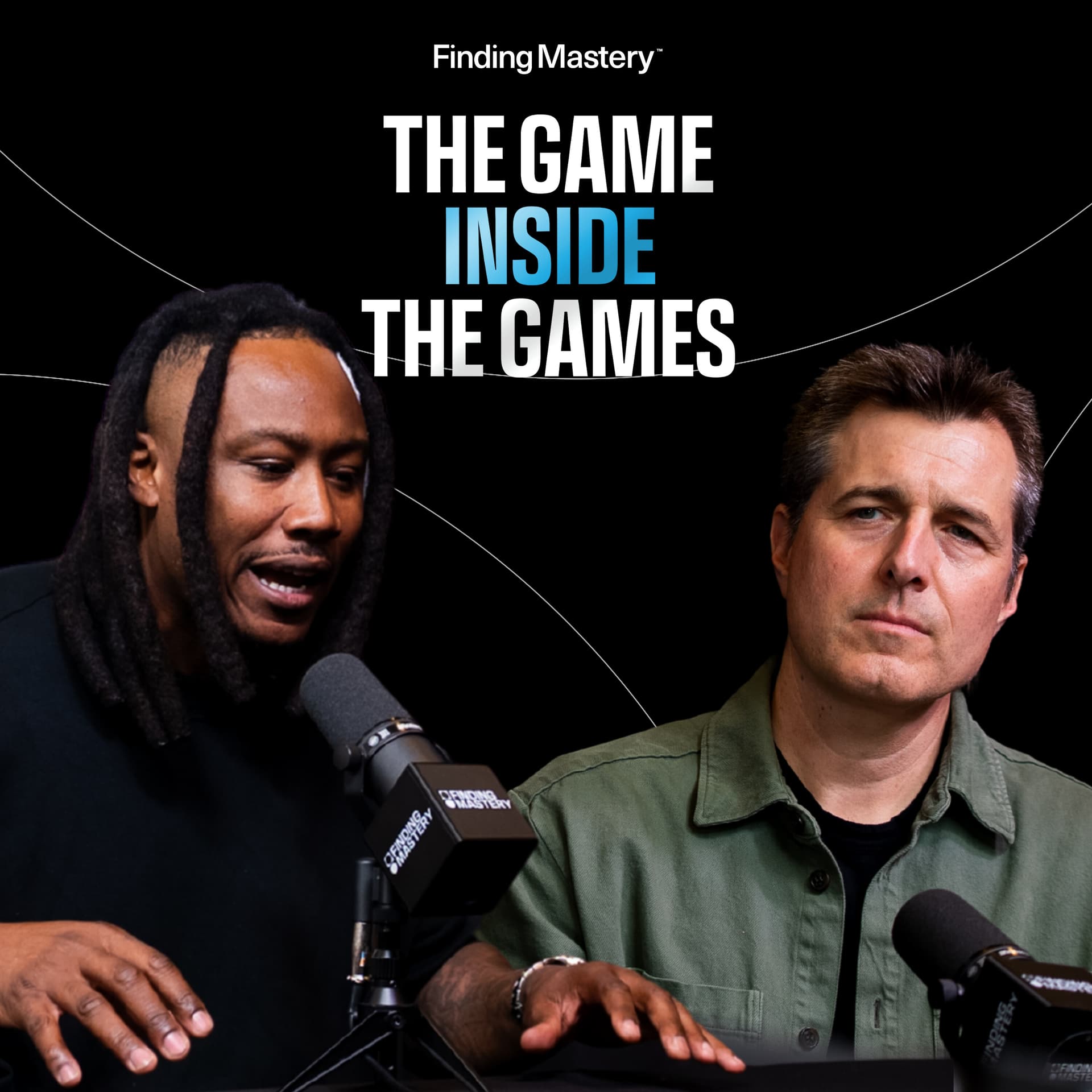
In this episode of The Game Inside the Games, Dr. Michael Gervais and All-Pro wide receiver Brandon Marshall go inside the huddle to explore what really happens in the moments before action. Rather than breaking down strategy or schemes, the conversation focuses on culture—how relationships show up under pressure and how teams signal belief, accountability, and presence when it counts.
Drawing on lived experience, Gervais and Marshall examine how the huddle becomes a mirror for a team’s inner life. Who speaks. Who listens. How people respond when the moment feels heavy. These subtle dynamics often shape what happens next, long before the ball is snapped.
This is a grounded, human conversation about connection, leadership, and shared responsibility. And while the stories come from the highest level of football, the insight applies far beyond the field—to meetings, decisions, and the moments we all face just before we act.
Follow Finding Mastery all week as The Game Inside the Games continues to unpack the inner game at global sporting events,, available on YouTube, Apple Podcasts, Spotify, or wherever you listen.
_____________
This episode is brought to you by CDW and Microsoft.
AI is revolutionizing how work gets done. CDW and Microsoft can play a vital role in unlocking the transformative potential of Microsoft Copilot. By leveraging this technology, organizations can achieve significant productivity gains, enhance innovation and streamline workflows.
Unlock opportunities to improve both employee and customer experiences when you partner with CDW to deploy your Copilot solutions. Our experts can help maximize the capabilities of Copilot, by building out roadmaps, use cases, and agent experiences that supercharge efficiency for your organization.
Learn more about CDW’s internal Copilot adoption story: CDW rolls out Microsoft 365 Copilot to 10,000 employees, reporting 85% productivity gains | Microsoft Customer Stories
See Privacy Policy at https://art19.com/privacy and California Privacy Notice at https://art19.com/privacy#do-not-sell-my-info.