
In short
How to live in the present by managing mental state—using language reframes (“I get to” vs “I have to”), cultivating play, and adding brief, non-self-focused “microdoses” (5–10 minutes) that reduce anxiety/depression and increase calm focus. Tim also describes practical pre-interview “state management” (cold plunge, caffeine/ketones) and a morning routine that blends breathing, gratitude, intention, imagery, and “softening” intensity behind the eyes.
Guests
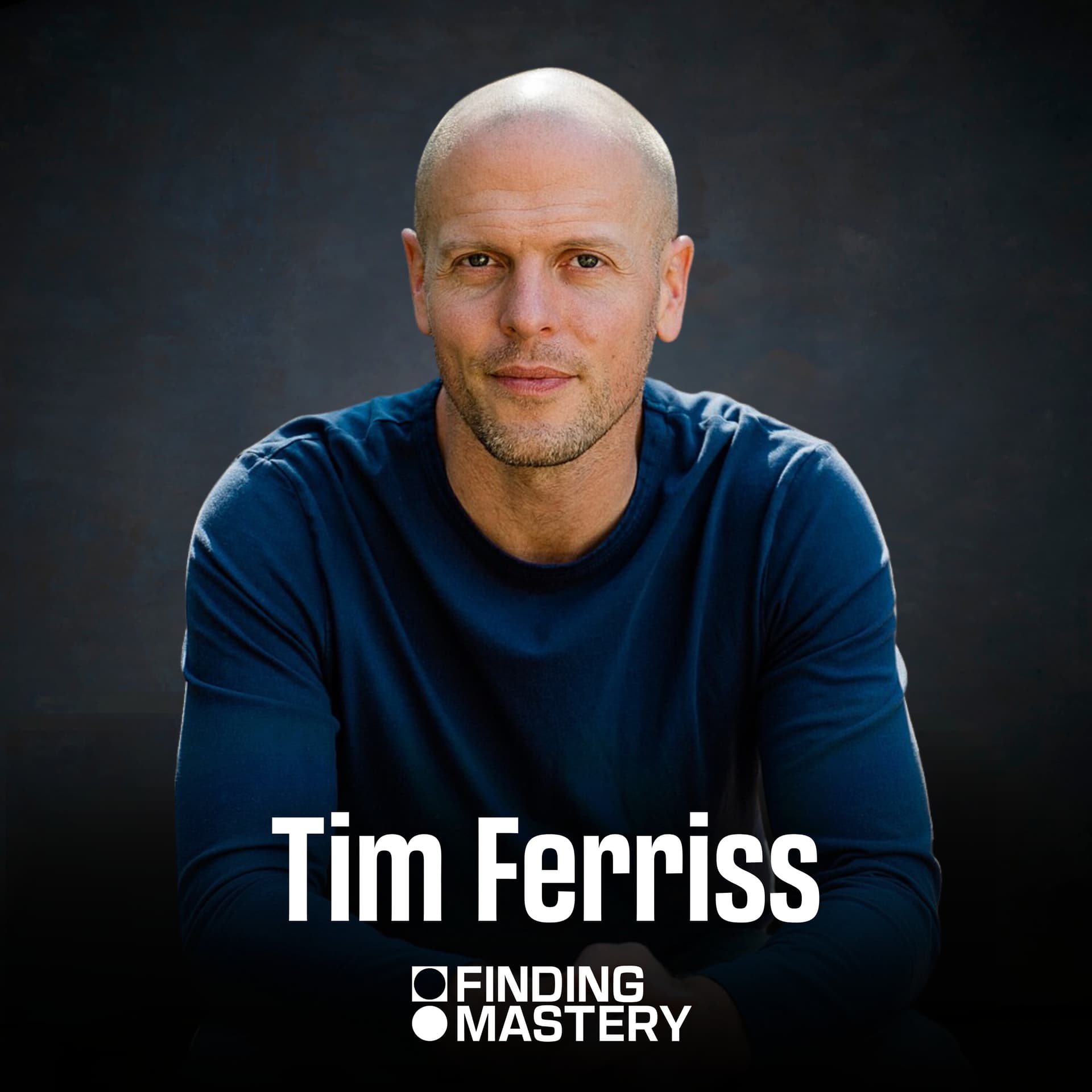
Tim Ferriss (author of The 4-Hour Workweek; host of The Tim Ferriss Show; tech angel investor; long-time experimenter in human performance). Host: Dr. Michael Gervais (high-performance psychologist; Finding Mastery podcast host).
Key claims
Social media increases self-focus (“I, me”) and comparison, worsening loneliness/anxiety/depression; play is a “recharging” deload that’s hard to access when anxious/tired; reframing “have to” reduces negative emotional valence; play and awe require vulnerability and quiet the vagus nerve; small doses of wonder/novelty help presence.
Notable examples
Tim’s “boot up sequence” before recording (45°C cold plunge ~10 minutes; coffee + ketone compounds); “play year” with his wife; using imagery and “energy behind the eyes”; creating the card game Coyote (with Exploding Kittens CEO/creator Alon Lee) as a group entrainment/reaction-speed game; NFL-style “awe tally” competition; reading graphic novels/meditation as principled mornings.
Written by AI. May contain mistakes. Listen to the episode to check what was said.
Chapters
Tap a time to open that second in VOOvercoming Social Media Addiction
0:00 to 0:39
Learn how to shift your focus away from self-centeredness.
“I do not have any social media apps on my phone.”
Tim Ferriss on Preparation and State Management
2:04 to 3:40
Explore Tim Ferriss's approach to mental preparation and state management.
“So I just want to start off by saying thank you.”
The Art of Conversation and Vulnerability
3:40 to 7:30
Discuss how to be present and vulnerable in conversations.
“If anything, it's going to be lower bound.”
Finding Balance Through Play
7:30 to 9:40
Understand the importance of play in maintaining balance and performance.
“The reason I wanted to start here with you, Tim, is because you have a lot of time and under tension being the interviewer and maybe less, maybe significantly less time.”
Integrating Play into Daily Life
9:40 to 13:11
Learn how to incorporate playful elements into your routine for better well-being.
“And I need to open the aperture just a bit more.”
The Power of Language in Mindset
15:43 to 19:34
Explore how language can shape our experiences and mindset.
“And it's hard to reach when you are feeling anxious, frustrated, intolerant, tired.”
Implementing Playfulness in Daily Life
19:34 to 23:08
Learn how to incorporate play into daily routines for better mental health.
“your teeth about that idea so what you're pointing to as you recognize is the the concept of cognitive distortions and there's a bunch of them you know according to research and one of them is the phraseology have to.”
The Art of Engagement and Listening
23:08 to 26:29
Understand the nuances of genuine engagement in conversations.
“And so the next thing I do is there's a way I can't explain it better than this, but it's a way that I hold my the energy behind my eyes.”
The Art of Engagement and Listening
26:32 to 27:43
Understand the nuances of genuine engagement in conversations.
“how to develop it for high performance, how it can be great in high stress conditions, and what helps it stay sharp over the long arc of life.”
Gaming for Group Flow
29:16 to 35:28
Discover how the card game Coyote promotes group flow and cognitive training.
“So, and I thought that this would be a nice segue because I felt that you were giving me all of the dignity that I would hope somebody would.”
Show all 31 chapters
The Importance of Play
35:28 to 41:48
Understand how play can combat anxiety and improve well-being.
“And in that entrainment with other people, the coyote is a perfect emblem because it's like there's a sly fox in there somewhere.”
Awe and Its Effects
41:48 to 42:00
Explore the science of awe and its impact on interpersonal relationships.
Exploring Awe in Everyday Life
42:00 to 48:00
Discover how moments of awe can enhance your daily experiences.
“and to be in nature cannot be underscored deeply enough.”
Lessons from a Guidance Counselor
50:34 to 56:01
Reflect on how external advice can shape aspirations and self-perception.
“I've got this idea that like people and experiences, you know, are fundamental in our shaping.”
Navigating Confusion and Self-Doubt
56:01 to 1:02:27
Exploring the journey through emotions of confusion and self-doubt and the importance of seeking help.
“Just, he's like, I think you can get in.”
Navigating Confusion and Self-Doubt
1:02:46 to 1:03:39
Exploring the journey through emotions of confusion and self-doubt and the importance of seeking help.
“What that means is it helps to slow biological aging by strengthening your cells, basically protecting them from damage.”
Identity and High Performance
1:03:40 to 1:04:08
Discussing the evolution of identity intertwined with high performance and the pressure of legacy.
“For me, it's a great way to switch on my mind, to ready myself to take on the day.”
Identity and High Performance
1:04:21 to 1:10:00
Discussing the evolution of identity intertwined with high performance and the pressure of legacy.
“I'm not making, I'm just going to be the one that never causes anyone to lose their stuff.”
Letting Go of Legacy Obsessions
1:10:00 to 1:11:25
Explore how the fixation on legacy can be burdensome and unproductive.
“And this might be controversial, but like loosening your hold on this fixation of legacy.”
The Nature of Depression and Anxiety
1:11:25 to 1:12:43
Understand the similarities between depression and anxiety and their impact on our focus.
“So this might sound a little esoteric, but it's that's all related to letting go of this identity as high performer.”
Living in the Present vs. Future Focus
1:12:43 to 1:14:20
Discuss the importance of being present rather than always focusing on future achievements.
“I mean, they're often, they have a certain type of rigidity, a certain type of repetition and thought loop associated.”
Practices for Present-Moment Awareness
1:14:20 to 1:16:36
Learn effective practices to enhance your presence in daily life.
“That's what we're talking about, but there's a good, a good reason to reminisce and to think of the past.”
Meditation Techniques and Their Benefits
1:16:36 to 1:19:12
Discover various meditation techniques and their practical applications in life.
“And then the thread continues with photos, reminiscing and new bonds made.”
Real-Life Applications of Mindfulness
1:19:12 to 1:23:54
Hear a personal story illustrating the practical impact of mindfulness techniques.
“And for me, it takes, it takes about a week or two.”
Practices for Managing Internal Chaos
1:24:00 to 1:25:20
Explore the importance of consistent practices like meditation and reading to navigate internal chaos and worry.
“It's a different life that you're having.”
Navigating Relationships and Intimacy
1:25:20 to 1:27:40
Understand the significance of tuning into relationships and the ongoing journey of developing relational skills.
“the easier you can shift and play with, dare I say, um, the way that you experience it.”
Tools for Healthy Relationships
1:27:40 to 1:31:40
Learn about practical tools and frameworks to enhance communication and manage conflict in intimate relationships.
“Number one is, and this is not in a ranked order, but there's a book called Fierce Intimacy by Terry Real.”
Innovations in Mental Health Treatments
1:31:40 to 1:36:40
Discover cutting-edge approaches and innovations in mental health treatment, focusing on nutritional and bioelectric interventions.
“So they're legendary for their research on relationships and they shared a handful of key components.”
Resources for Mental Health Support
1:36:40 to 1:38:00
Get insights into valuable resources and options available for mental health support and treatment.
“and then the bioelectric options from credible scientists.”
Resources for Mental Health
1:38:00 to 1:39:18
Learn about effective resources and technologies for mental health improvement.
“Appreciate you keep leading from the front.”
Reflections on Loss and Connection
1:39:18 to 1:39:38
Hear insights on the importance of reaching out and supporting each other during tough times.
“And I will make sure that we put all of that in our show notes as well as hotlines.”
Transcript
Automatic transcript. May contain errors.0:00Tim Ferriss:I do not have any social media apps on my phone. I have them for two to three years because it feeds the I, I, I, me, me, me disease. And if you want to experience these slivers of transcendence, you just need to do something that takes the focus off of yourself.
0:16Dr. Michael Gervais:What if reframing one simple word and one simple practice could reshape how you experience your life?
0:21Tim Ferriss:I think it's common for people to say, I have to do X. And there's a certain negative emotional valence to it. It's like, okay, instead of I have to, like, I get to. Like, this is actually something you get to do. And man, does that change your experience of things you might otherwise roll your eyes at, grind your teeth about.
0:39Dr. Michael Gervais:Welcome back. Or welcome to the Finding Mastery podcast, where we dive into the minds of the world's greatest thinkers and doers. I am your host, Dr. Michael Gervais, by trade and training a high-performance psychologist. The idea behind these conversations, it's simple. It's to sit with the extraordinaries and to learn, to really learn how they work from the inside out. Now, this week, I got to sit down with someone who's been shaping culture and performance for over two decades, Tim Ferriss. You likely know him as the bestselling author of The 4-Hour Workweek, host of The Tim Ferriss Show, tech angel investor, and a relentless experimenter in human potential.
1:12Tim Ferriss:So the idea that if I just work 20 % harder, I'm going to leave this indelible mark on the universe. I find that when it becomes kind of an obsession, like I need to change the world and leave my mark and leave a legacy. There's often an underlying fear of death and a grasping for permanence that just isn't very fruitful.
1:32Dr. Michael Gervais:In this conversation, we explore the states that help us show up fully. Being calm and focused, a playful awareness, deep presence. and how Tim cultivates those through practice, through language and life design.
1:43Tim Ferriss:I view something that seems as optional and squishy as play, basically like a recharging element that fuels the rest of the components of my life.
1:54Dr. Michael Gervais:So with that, let's drop into this week's conversation with my friend, Tim Ferriss.
2:03Dr. Michael Gervais:okay tim this is um this is a conversation i've been wanting to reconnect with you for a long time and so just let me just start by saying huge congrats on everything you've built the way you've designed your life the way you've impacted other people and i'd be remiss to say that you were one of the first movers that really inspired me to to push into the podcast space so you've taken up a big space for me as well. So I just want to start off by saying thank you.
2:32Tim Ferriss:Oh, thanks, man. It's really nice to reconnect. So I've been looking forward to this. I'm still looking forward to it. So I'm excited to see you do your thing and dance the dance.
2:41Dr. Michael Gervais:Yeah, there you go. So how do you prepare when you sit down? There's a preparation phase, there's a readiness phase, and then there's the actual conversation. Like, how do you prepare?
2:51Tim Ferriss:Well, it's a bit different if I'm in the interviewer chair or if I'm in the interviewee chair, since the interviewee is sort of return serve and the interviewer is server. But I would say if we're talking about in the return serve, return serve, then a lot of it is. State management. and what I mean by that is we were chatting a little bit before pressing record had a little bit of trouble sleeping last night unclear why that's the case who knows and woke up like okay I think it's time to do some state management especially since I'm tracking HRV these days and I looked at my HRV and I was like good god okay this this is not setting any upper bound records.
3:42Tim Ferriss:If anything, it's going to be lower bound. So pretty much immediately did cold exposure, probably overdid that slightly, but cold plunge 45 degrees for about 10 minutes. I think that was honestly probably slightly overdose, but good enough. And that'll interestingly for people who aren't really tracking, and this has been demonstrated in labs as well, probably mostly in animal models, but you go from really acute sympathetic nervous system activation. So fight or flight, but after a few minutes, you actually also simultaneously start to activate parasympathetic. And what I'm aiming for before sitting down for a conversation like this is a state of calm focus.
4:32Tim Ferriss:You can have a somewhat jittery focus if you say overdose on caffeine. So I had very, I had a combination then after the gold plunge of Pu-er-tee and separately, if you mix them, it's going to be disgusting, but coffee with a ketone diester and then about 11 milligrams of a ketone monoester. And for purposes of today, that was my boot up sequence for state management, because really this is improv jazz and I have to be able to react principally. So it's more of a state set up for responsiveness than it is preparation with content, if that makes any sense.
5:19Dr. Michael Gervais:Very cool. Like super thoughtful and also very nuanced about like what you're looking for. let me go up one level really quickly and think like open up how you think about being a return server and you know there's a huge range there which is like whatever i say it's good it's mine it's organic so let it rip or it's like this is people's time and i want to i have a sense of responsibility and i'm just giving you two two options then there's many many more of course
5:47Tim Ferriss:sure i would say it's it's more the latter than the former if i had to choose between those two, but also being reactive or responsive, I should say. For me, even if it's at a very high speed, benefits from not rushing, which is not going to surprise you. And I would imagine I've never played at this level, of course, but even at the highest levels of tennis, right? There's a very big difference, I would suspect, between being calmly fast and the participant, the player feeling rushed. So if I feel like I am rushing or if I feel like I have the need to rush, I'm not going to perform as well. That includes conversation, conversational parkour, hopping from one thing to the next.
6:39Tim Ferriss:and so as i think about returning a serve it's trying to maintain to the extent possible the complete relaxation before the strike as a bruce lee might for instance or just any high level boxer that that's what i'm thinking of and last but not least having fun with it which might sound superficial and might sound like a cliched add-on but in my personal experience. You have so much, you have such a library of experience with high performers, but in my own personal experience, if I'm enjoying it, that is an indicator of a lot of other ducks being in a row. So scratching that itch seems to be a proxy for a lot of other things that facilitate good conversation.
7:31Yeah.
7:32Dr. Michael Gervais:The reason I wanted to start here with you, Tim, is because you have a lot of time and under tension being the interviewer and maybe less, maybe significantly less time. I don't know. Definitely less. The interviewer. Yeah. And so not that you, you, you lack opportunity, but I think you're very precise with the opportunities that you take and you're doing in some form or fashion right now, what many people are terrified by, which is to be vulnerable, to make, make your thoughts and ideas and dreams and hopes and scar tissue vulnerable in a way that is in service of others. That's in service of what you're wanting to point people towards.
8:13Dr. Michael Gervais:And I do want to highlight both of those, but I don't get asked this question often, like how do I ready myself? And I, you know, I don't know if you have either. So I just wanted to understand how you, you do it. And I think I heard you say that your ideal, let's call it performance state is calm and intense. Is that right? There's a calm intensity and a calm focus.
8:39Tim Ferriss:It's a slightly diffuse focus as opposed to a pinpoint focus for me, at least, whether that's in sports or otherwise. So are you more playful or are you more intense?
8:51Dr. Michael Gervais:I know you to be pretty intense, but that's just one version of you. You know, there's, there's many sides to all of us. So the playful thing is really important. I'll just pause here for a minute because my community knows that the last couple of years, so at the beginning of every year, we don't do resolutions, but we do spend time here at Finding Mastery and otherwise to say like, what do I want this year to be about? And it's not goal setting, but how do I want to carry myself through all of the experiences that I'm going to have? So two years ago, it was the year of play. And I got to the end of the year and I thought, man, I need to run that back.
9:27Dr. Michael Gervais:And my wife looked at me and she was like, yeah, you do. I run pretty intense. And so this year is still, yeah. Okay. So this year is still the year of play and damn, I can get sucked in the intensity so quick. It serves me well. Yeah. It serves me really well. And I need to open the aperture just a bit more. And so when you added play to the end of that, can you teach like, how do you open the aperture? How do you how do you ready yourself with that playful attitude?
9:56Tim Ferriss:Oh, yeah, you can you can teach it. More importantly, you can you can instruct someone how to practice. It's not like anything else requires nurture and practice. if you happen to have maybe overdeveloped to your benefit certain gears like intensity, which I would say certainly is true for me, maybe true for a lot of people in the audience. And I'll just back up for a second and say in a session of say competition, if I'm talking about sports, often it will start with intensity and then segue into sort of a relaxed play once I have shaken off the cobwebs and feel in my element. So I'll often have both and they're combined in say competition or an interview or something like that, but you can teach it.
10:56Tim Ferriss:And I would say also this word play, right? Or if people hear fun, it's like, It seems pretty squishy and it can be very squishy. But what I would say is I pay so much attention to words and labels because that's the way we construct our reality. I mean, just look at kids pre-language versus post-language. Fundamentally very different experiences of the world. And when you're looking at, say, my friends and I will sometimes assign each other words for the year and we can say no, we can decline. but you can look at certain words for me for instance play has an energetic unlock so what what words if you think about how you put them into practice give you more energy than is subtracted and for me play is one of those things that is not compartmentalized so if you have a certain type of play it could be very minimal could be jumping on a rebounder in the morning which I sometimes do, which is a fancy way of saying what looks like a tiny kid's trampoline.
12:02Tim Ferriss:But if you want to use a very dignified term for it, for athletic performance, for the fitness and pay 10x for it, then rebounder. So it could be just a few minutes of that. That could qualify. It could be having a conversation with a friend in the morning, even if it's remote to just make stupid jokes and catch up and put you in that state. right that then fuels me for the rest of the day or at least for a few hours and there could be other things for instance i'm going to take a week off the grid starting next week with a number of friends for wilderness training at high altitude maybe not everyone's idea of fun but where there's also going to be a lot of joking around sitting around a campfire probably sipping some whiskey being idiots that week will fuel at least the next four to eight weeks so so i view something that seems as optional and as squishy as play, just to give one example, as basically like a deloading phase or a recharging element that fuels the rest of the components of my life, for sure.
13:24Dr. Michael Gervais:the momentum that stalls when that fit doesn't work. And that's the pressure of having to get it right while you're still running everything else. That's why I'm paying attention to LinkedIn Hiring Pro. It's built for the reality of hiring when you're operating lean. You describe the role in playing language and then Hiring Pro helps you draft the job post, surface the right candidates, and then narrow to a short list without turning hiring into another full-time job. And when applications start coming in, it doesn't leave you buried in resumes. It streamlines screening, including AI-powered interviews for initial conversations.
13:55Dr. Michael Gervais:How about that? So that you can spend less time searching and then more time connecting with the people who match what you need. With Hiring Pro, you can hire with confidence knowing you're getting the best talent for your business. In fact, those hiring with LinkedIn are 24 % less likely to need to reopen a role within 12 months when compared to their leading competitor. Join the 2.7 million small businesses using LinkedIn to hire. Get started by posting your job for free at linkedin.com slash mastery. Again, that's linkedin.com slash mastery. Terms and conditions apply. Finding Mastery is brought to you by David Protein.
14:30Dr. Michael Gervais:Travel a lot at Finding Mastery. And sometimes travel makes it tricky to eat well. Best intentions, and then you're at the airport. And then suddenly, the only options around you are the ones that you'd rarely choose at home. Something I come back to often is that discipline isn't really about willpower in the moment. It's often about choice architecture. setting up your environment ahead of time so that the easy choice and the good choice are the same one that's the role david plays for me on the road the gold bar it's their flagship high protein density great texture flavors that make it easy to stick with so when i throw a few in the bag before my trip i've already made the decision the hard moment later takes care of itself and the team here at finding mastery they love the bars as well they are ripping through them in the finding mastery lab salted peanut butter and fudge brownie seem to be the fan favorites right now.
15:15Dr. Michael Gervais:They have built something with real rigor in a crowded, sometimes ambiguous space like nutrition. That matters when it's something that you reach for again and again. David bars are now available in major retailers like Walmart and Target. And if you'd like to buy them directly and get a special offer for being a Finding Mastery listener, head to davidprotein.com slash finding mastery, where right now, if you buy four packs, you'll get the fifth one for free. Again, that's davidprotein.com slash finding mastery. so you're looking at state um as an important kind of um potential outcome to target um so that you can experience life in in the ways that you want but you're doing small little thin slice activities to increase your availability to be in that state and it sounds like you're doing blocks of time to increase a duration of a said state and then your your precision in language um language as you know for you for me as a psychologist as well is that it is one of the great tools yeah and so is micro expressions and body language like those are my tools i think they're your tools too and the the framing of like some some words constrict and tighten up you know in some words open up so play is one of those things that opens the aperture right yeah and then play is something that's always available.
16:36Dr. Michael Gervais:And it's hard to reach when you are feeling anxious, frustrated, intolerant, tired. Yeah.
16:42Tim Ferriss:And let me throw one more thing out there, which is maybe you're thinking, look, hey guys, love the idea of play, but like I've been, I've been in the Peloton trying to win the Tour de France for metaphorically speaking for like 30 years. I'm not sure what that even means. One of the words a friend assigned to me was goofy. He's like, that's your word for the next year. And I was like, okay, challenge accepted. He's like, because your friends see that, but most people don't see it. And furthermore, you just don't embrace that side of yourself enough. And fundamentally, I'm a pretty goofy person underneath it all.
17:19Tim Ferriss:And my sense of humor is completely absurd. And when I let that side show in any way, there's a little uptick of battery recharge, right? And I'll give just one example of language tweaking, which had a surprising impact on me. And I don't know if someone taught me this or if maybe I was just sitting there in the shower and thought of it. I'm not sure, but I think it's common for people to say, I have to do X. Well, I'd love to, but I have to do X or even in your mind, right? I have to do X. And there's a certain negative emotional valence to it. Like, ah, you know, I have to be in this meaning, ah, you know, and I have to manage this such and such issue or such and such employee or whatever it might be.
18:05Tim Ferriss:And if you're listening to this podcast, presumably a lot of people have cleared a few rungs on Maslow's hierarchy of needs, right? So not to minimize any of the challenges that we have, but for myself, because I can skew a little towards the dark and we could talk about why that's the case, at least my best guess. a lot of nurture, certainly in the family, a lot of glass half full kind of stuff, but there's more to it. In any case, I just started replacing every time I said I have to, I would say, you know what? Nix that. I get to, right? I get to, because chances are whatever you're referring to is such, it's such a quality problem compared to a lot of problems in the world.
18:51Tim Ferriss:so it's like okay instead of i have to like i get to like this is actually something you get to do which has this not over the top but slight positive valence and it just changes your experience even if it's changing at five percent like that five percent adds up over time when i think at least to myself how many times in a week i might use that phrase i have to do x ah you know i gotta do x and you just swap out and it takes a while for it to become reflexive man does that change your experience of things you might otherwise roll your eyes at or grind
19:34Dr. Michael Gervais:your teeth about that idea so what you're pointing to as you recognize is the the concept of cognitive distortions and there's a bunch of them you know according to research and one of them is the phraseology have to. And when you go to get to, it actually points to a little bit more gratitude as a framing, as opposed to like, I have to take out the trash. You do actually have to take out the trash or your house will be full on. So there are times, but the discipline, so I locked, I like almost eradicated to my best ability is still some room for the properness of what I'll say is, but have to got to must, I have almost eliminated those should, should have.
20:18Dr. Michael Gervais:And it's, it takes probably like, I don't know, three to four weeks to say, wait, hold on. What'd I just say? Good. Okay. How do I do it without the word should in it? How do I say that phrase? And that type of reframing. So reframing, as you would recognize as one of our great superpowers. Yeah. We can reframe in anything, any way we choose. Yeah. Anything, in any way. But we get locked into particular ways of thinking it's the right way to frame it as opposed to the way that serves us better.
20:48Tim Ferriss:So I have a question for you with your wife saying, yeah, let's roll that back. Let's revisit play. No, no. For me to roll back. No, exactly. She's like, let me plus one that for you. What are you going to do differently or what are you doing differently? So there was sort of play year one rehearsal and now there's play year two implementation. How are you thinking about that?
21:14Dr. Michael Gervais:One of the things that I help athletes or performers do is to identify their ideal performance mindset or their ideal competitive mindset. So there's like this bullseye that warmups are designed to help activate, right? So in warmups, you want to get your body loose. You want to get joints loose. You want to get kind of your mind right. So if you don't have a bullseye, it's really hard to get it. So the bullseyes play, you know, writ large. And of course, there's all these sub mindsets that are important for me to be focused and intense and calm. OK, but writ large play. So the way that I do that is I just knowing it, first of all, is not to be under assumed the potency in that.
21:54Dr. Michael Gervais:And then what I needed to do that I was not doing properly is I was not folding into my morning wake up kind of routine. Just like we ask athletes to wake up their mindset. I need to. So I'm activating that or being connected to it while I'm still in bed. So I've learned that once I get up, I uniquely am not good at setting up this structured routine. So I've got tools and things at my disposal. But I know that one thing can be really consistent is before I pull my sheets off, I can do something with my mind. So I do a little bit of breathing and I do a little gratitude work. And then I set my intention for the day and I don't have to be perfect with play every day because it might not be the thing I'm totally feeling, but I get some of that in to my imagery.
Read the full transcript
22:44Dr. Michael Gervais:So it was part of my imagery today with you is to be playful. And, you know, it's probably for you to determine as much as it is for me to determine, but that that's part of the way. So it's a simple little practice that's been well tested in sport and other high performing environments is just do a bit of imagery around it. So that's the mental part. The physical part is now I need to embody it. And so the next thing I do is there's a way I can't explain it better than this, but it's a way that I hold my the energy behind my eyes. And I know that sounded really woo woo as I said it, but it's something behind my eyes.
23:23Dr. Michael Gervais:When I greet people, there's either I'm coming from a playfulness or an intense or an inspected way or whatever it might be. So I need to like, there's a feeling behind my eyes. And when I'm connected in that way, I'm kind of embodying it rather than just imagining it. Yeah, that makes sense to me.
23:41Tim Ferriss:And I think sometimes maybe less obvious to me is tone and delivery and facial expressions. So sometimes I can come across way more intense than I intend to when I'm speaking to people because like my eyes are wide open and I'm staring at them like they have a lobster on their face or something. But really, in my mind, I'm just listening intently. But there's maybe to use your phrasing, like a little bit of hardness behind the eyes. and if I just pay attention to softening 20 % like that's the intensity is still there but it's not as tightly gripped if that makes any sense yeah and so two two things I want to
24:30Dr. Michael Gervais:kind of slide into and I'll start with what I think was really fun when you had me on your tv show I don't know if you remember but as I was saying something to you by the way I had a lot lot of fun. That was fun. Yeah. Yeah. Yeah. That was cool. When I was speaking to you or answering the questions you're asking, I don't know if you remember me telling you this, or maybe I just made it up because it was, you know, it was a while ago that you would say with me the words I was saying, but you were saying them privately and quietly to yourself. And I, the only way I could tell is because your lips were kind of moving to what I was saying.
25:05Dr. Michael Gervais:And I was like, that is awesome. like you are so intently focused on what I'm saying that you're, you're almost repeating exactly what I'm saying a fraction of a second after I'm saying it. Is that, is that something that you're consciously doing or is that? It is not something that I'm consciously doing.
25:23Tim Ferriss:I do remember this and it is something that comes up every once in a while and it's cool. It is cool. And I think I've definitely seen it in other people. And I think there's, I'll probably be technically using this term incorrectly, but only when you are relaxed, in my personal experience, does that type of spooky and very, I would just say beneficial entrainment happen where suddenly you're finishing, You can finish each other's sentences or mirror someone in that way. And that type of syncing can be applied in a million different contexts.
26:12Tim Ferriss:And it's not so much an NLP thing or anything like that. It's a very physiological thing. And I hadn't thought about that in a very long time. Yeah, since the TV show.
26:29Dr. Michael Gervais:Finding Master is brought to you by Momentus. I have spent my career studying the mind, how to develop it for high performance, how it can be great in high stress conditions, and what helps it stay sharp over the long arc of life. And one of the things I've learned is to pay close attention when science starts pointing somewhere new. Creatine is one of those places right now. We've known for decades what it does for the body, strength, power, recovery. It's about well studied as any supplement out there, but the work emerging on creatine in the brain is what has my attention. The brain runs on energy, the same currency a working muscle does.
27:03Dr. Michael Gervais:And creatine appears to support brain energy metabolism, helping working memory, easing mental fatigue under exactly the conditions so many of us operate in. Sustained demand, stress, not enough sleep. For something that's been around this long, that's a genuinely interesting frontier. So if I'm going to take something daily, the quality has to be unquestionable. That's why I use Momentus. They searched the globe for the highest quality creatine, then they built their own specification around it. Signature spec is what they call it. It's made in a pharmaceutical facility, six stages of testing, four independent agencies, and it's NSF certified for sport.
27:39Dr. Michael Gervais:When you take something every day, that level of quality compounds. Go to livemomentous.com slash findingmastery and use the code findingmastery for up to 35 % off your first order. That's live, L-I-V-E, momentous.com slash finding mastery with the code finding mastery. Finding Mastery is brought to you by Lisa. We are serious about recovery. Sleep sits right at the center of that practice. I have been fortunate to work with some of the most extraordinary performers for the last two decades. And sleep and recovery are foundational, full stop. It's where the body and the brain repairs. And that's why finding a mattress that supports your recovery matters so much.
28:19Dr. Michael Gervais:A great mattress, it's not something that you stumble into. It is a choice. You find it on purpose, the same way that you'd approach anything that really matters in your life. We've worked with Lisa for a long time now because they get it. They build beautifully crafted mattresses tailored to how you actually sleep. Your position, your feel, your preferences, all of it. You can take their sleep quiz and find your match in about two minutes. Premium material, serious comfort, full body support no matter how you rest. One of our teammates here at Finding Mastery picked one up recently. Can't stop talking about it.
28:50Dr. Michael Gervais:Says it. They're waking up more rested than they have in years. Right now, go to Lisa.com for 25 % off select mattresses. Plus, you get an extra$50 off when you use the promo code mastery. That's exclusive for our listeners. That's Lisa, L-E-E-S-A.com, promo code mastery for the 25 % off select mattresses, plus the extra$50 off when you use the code mastery. Yeah. Yeah. So, and I thought that this would be a nice segue because I felt that you were giving me all of the dignity that I would hope somebody would. You were so focused, but not inspective. And like your eyes weren't crinkled up, but you were so tuned that I felt the connection, like you were in it with me.
29:34Dr. Michael Gervais:And then, so this is going to almost sound like a cheesy slide in, but okay. Okay. So this was, this was kind of by design that I wanted to bring that up to bring this up. to talk about play, which is your, your new product, right? Which is a card game, Coyote, which is about in training. Yeah, yeah, it is very much. So I don't know if you were connected to the concept of group flow when you're designing it. Flow is obviously the most optimal state a human could be in. Group flow is when we're doing it together. It's like a swarm of birds that are kind of moving in harmony. And that's what this game is about for me.
30:10Dr. Michael Gervais:Yeah. So well done and And probably better with a little bit of whiskey. I don't know. I will say you'll definitely.
30:18Tim Ferriss:Well, I'm going to be packing this. Actually, my friend, Matt, I don't want to dox him, but yeah, former Olympic athlete. He said, don't forget to bring the game. He's coming on the trip and he was like, don't don't forget to pack the game. I'll tell you actually part of the origin story here, which is in brief. I'll just explain it is it is kind of an entrainment game where you also try to sabotage people. So imagine it as rock, paper, scissors on steroids with 20 different gestures and color coding where you have to synchronize different things. And like 10 year olds can play, you can learn it in a few minutes.
30:50Tim Ferriss:But I wanted to create something. It took two years with this company called Exploding Kittens and Alon Lee, who's a genius at game design and his team. Something that was very lightweight in terms of lift, very fun, that also as a Trojan horse had a lot of brain training, basically that's what i wanted to make and to your observation about the entrainment i haven't mentioned this to anybody so i'll mention it now but part of the reason the origin of this was i did a number of let's just call it one to three day sprints with alan lee who's the ceo of exploding kittens he worked on the original xbox halo he's done alternate reality games uh augmented reality games he's created a whole new genres of games the guy is a genius and a polymath.
31:40Tim Ferriss:We were talking and talking and talking and brainstorming over many months, collaborating, trying to create something. And we could have created a million different things. But the way this one came about is we were having a lot of coffee walking around a lake in Canada. And Ken, one of his top game designers who focuses on mechanics, was there at the same time. And through the bobbing and weaving of this conversation, We're stochastically bouncing all over the place. I brought up Rock, Paper, Scissors. I was kind of embarrassed to bring it up because it's so simple. It's viewed as kind of dumb by some people who are professional game designers.
32:20Tim Ferriss:And yet this game is everywhere. People play this game. And part of the reason that I have found Rock, Paper, Scissors so interesting, and I'm not saying there's any magic involved here. There must be an explanation. But sometimes when you play with friends and yes, a few drinks helps, these are smart friends, but you can get into a rhythm where one person wins like 30 times in a row. And it's okay, what is going on here? Like, they're just some very interesting interpersonal dynamics. So then the question became, could you create something like this in a group? And what does it look like with four or five people?
33:02Tim Ferriss:And then we basically just kind of jogged back to a kitchen table with blank cards and started prototyping it. And it took probably nine to 12 months to find the proper kernel of an idea to build upon. And then it was just thousands and thousands of rounds of playtesting and playtesting with families and so on and so forth. But it is fundamentally kind of a movement, social entrainment game where you are trying to win the game. So you can also sabotage your friends who are smug or really good at it. Mathematicians or people who are very good at math and musicians, both very, very good at this game because there's a lot of reaction speed and some kind of interference effect, which I mean, man, that applies to everything.
33:53Tim Ferriss:Right. So if you think about kind of patting your head and chewing gum and rubbing your belly at the same time, dealing with interference, whether it's professionally in a sports context, that is kind of at the crux of so many ceilings that people have in performance. so I'm hoping that this game will help people very much under the hood right it's got to just be like a silly fun game that you can play after dinner but under the hood I'm hoping it that it will help and I'm actually talking to some neuroscientists about potentially designing a study to look at this but have transference to a bunch of other stuff is kind of the idea you're going
34:38Dr. Michael Gervais:to crush a business you know or a financial vertical on this game you hit it and of course all of that hard work years of, and you know, the, the discipline to carry this through makes sense because I've talked to myself and my team a lot, like, man, we need to do like a game. You should, you should. Yeah. Like, oh my God. Well, like, and then as you described the three year arc and when I opened it up and I saw that, um, you know, brought to you by exploding kittens, which is a phenomenal game. I was like, of course, Tim partnered with them, you know, like, well Well done, mate. I'm rooting for you.
35:14Dr. Michael Gervais:I think this is one of those ones that has the potential to be around for a really, really, really, really long time. Maybe not as long as rock, paper, scissors. You know, it goes back to early China. Yeah, yeah, yeah. Thousands of years. Who knows? Thousands of years ago. And you don't need a card for it, but it's, you know, but you hit some really important, I think it's group flow. And in that entrainment with other people, the coyote is a perfect emblem because it's like there's a sly fox in there somewhere.
35:43Tim Ferriss:screw up the whole game trickster trickster god also trickster mythology at least and and i would also say that and i'm saying this to my younger self as much as i'm saying it to anyone else that play can also help you with all the serious stuff and like microdosing play can actually be as this game is designed to be right a trojan horse for a lot of other stuff so for instance, when I was competing seriously in collegiate wrestling and then also freestyle wrestling, a lot of like some of the top wrestlers still to this day, of course, are out of the former Soviet Union. And a lot of these teams, even though they competed and practiced in different weight classes, they would warm up by doing what?
36:31Tim Ferriss:Playing basketball. Right. And wrestlers, as you might guess, are not necessarily intrinsically great looking at basketball. They look kind of like cavemen. They're not really designed for basketball, but they're having fun. They're warming up physically, psychologically. There's teamwork involved. And trust me, the Soviets did not do things without a very good reason. I mean, the degree of study and observation and note-taking across disciplines is still to this day mind-boggling. Certainly China has sort of picked up that mantle.
37:12Dr. Michael Gervais:Yeah. And I think that, you know, notwithstanding the most obvious is that if you're in a playful state, that means you're not in an anxious state. You're not in a depressed state. So it's an inoculation to the more scratchy, difficult internal states that most of us want to minimize as opposed to maximize. So, you know, it's a nice antidote to it.
37:36Tim Ferriss:So, yeah, let me add one more thing to that, which is, and look, I could list off a bunch of other games that are kind of fast, casual. Monopoly Go is great. You know, the Taco Cat Go Cheese Pizza is great. Poetry for Neanderthals by Exploding Kittens is actually the game. I was testing dozens of games on my own. And that's the one my friends and I wanted to play again and again. And I was like, who made this? Exploding Kittens. Who are these people? Oh, okay. Let me try to find Lon Lee. Maybe I should interview him just to like, feel out how I feel about him and his expertise. And I was like, wow, this guy's awesome.
38:08Tim Ferriss:This is the greatest gift of a podcast, isn't it? Yeah. It's just like, it's just like the perfect context to have an awesome conversation. And the other aspect of Slay is that it is almost always non-self-focused. I've seen this in my audience and this is very well documented. I'm sure you've seen it and I've seen it in people firsthand, but also just through kind of the loose ties of tens of millions of people, anxiety, depression, loneliness, all on a huge upward ramp and social media platforms and so on. I haven't had social media apps on my phone and keeping in mind, like I work in tech, I invest in tons of tech startups and kind of like in the trenches when it comes to tech.
38:56Tim Ferriss:And I do not have any social media apps on my phone, haven't for two to three years, in part because it feeds the I, I, I, me, me, me disease, which in turn breeds these symptoms of depression, anxiety, loneliness, et cetera, this endless comparison, seeing people's highlight reels, doom scrolling. It's so self-focused. And if you want to experience these miniature moments, these slivers of transcendence, You just need to do something that takes the focus off of yourself. A lot of sports are great for that. You get punished immediately if you're focused on it. If you're daydreaming about your email or what you need to do tomorrow or some petty grievance, you get punished immediately, which is also why I love doing archery.
39:43Tim Ferriss:You have to be focused on what you are doing. And you might think that that's self-focused, but no, it is like process, target, biomechanics focused. but it's not the I, I, I, me, me, me. And so I would encourage people just to do anything, anything at all that, because every cultural and technological forces is sort of driving you to I, I, I, me, me, me, because that is the easiest way to sell you something and create needs that actually have no real basis. So whether it's something like coyote, whether it's playing any other game, playing music, figure out what it is that you can add into your life.
40:28Tim Ferriss:And the difference between like zero and 10 minutes is the biggest jump, right? That's the most critical piece is adding a dose no matter how small. It could be, for instance, just proving yourself, and I had to do this for myself, you're not the president of the universe. If you take five minutes to read a graphic novel or watch a TED talk in the morning, your entire life and all the people around you are not going to collapse. Everything's going to be fine. So, so finding just really looking for the options to just add five to 10 minutes of microdosing focus that is off of yourself. Again, this might sound very new agey.
41:20Tim Ferriss:It's not. It is not at all. There are studies on awe. There are studies on kind of engineering these experiences of wonder out of Johns Hopkins, for instance. And you got to do it. As we march into the AI age and everything else, you have to get to play social, interpersonal. You need to proactively add this into your life because all of the forces that be are going to squeeze it out.
41:48Dr. Michael Gervais:Amen. One of the, especially with the impending narrative that's taking place, not a narrative mandate of figuring out how to work well with AI, that this counterbalance to play and engagement with others and to be in nature cannot be underscored deeply enough. All that being said, I think you'll find this to be fun and playful, is the science of awe. so one of the signatures for awe it can be when your hair stands up and you're you've got that technically it's called piloerection so like there's an erection of your hair definitely going to use that again yes you want part of that one so so your hair comes up on end right and that can be from fear but there's a thin slice with awe.
42:33Dr. Michael Gervais:Like, wow. Okay. So, um, at, in the NFL with coaches, you know, it's on, it's intense. You get there, like the coach will get there around six in the morning, maybe earlier, and then doesn't leave till around 10 at night during the season. It is not realize those were the hours. Yeah. It's on, it's on. And so there's a, there's a cost to relationships. There's a potential cost to health. There's a, there's a cost. And when you, when you invest so much in this one thing, So what we would do is we would compete, this sounds counterintuitive, compete on how many moments of awe we can have in the facility.
43:10Dr. Michael Gervais:So you don't need to be, you know, in the high Sierra. You don't need to be on the beautiful lake. You can find it is maybe easier to find and be in awe in those experiences, but you can do it in the seemingly mundane as well. And so at the end of the day, we keep a tally how many moments. And it was a competition. it was fun. It was playful. And, you know, I won't tell you the number to, to, to not bias the average, but, um, it was a really nice, fun way to stay people connected to this feeling of being small and being, uh, the sense of like the magnitude of something like at the same time. Okay.
43:50Tim Ferriss:All right. I want to, I want to hop on, on this train for a second, because what you were describing it's super present for me and there are a few things i'll throw out that have helped me to not slow down necessarily from the standpoint of a video camera looking at what i'm doing but to slow down internally enough to have more of these moments that you were just describing right that's right okay so a few things that helped me one because this ties together what I said earlier is taking five to 10 minutes in the morning to do something that is not productivity focused could be again, reading a little bit of a novel with your coffee.
44:35Tim Ferriss:I just bought a ton of Frank Miller graphic novels to reread because that guy's a legend. He's one of the top five comic book artists and writers of all time. I mean, who does that? It's insane. So I have a bunch of them downstairs right now. It could be meditation, right? Using something like The Way Up by Henry Shookman or anything else. That just teaches you, hey, five, 10 minutes, everything's fine. In fact, everything might be better because you're not white knuckling psychologically through your entire day. You realize it's unnecessary and actually unhelpful. And then I'll just throw out a few resources that might click with people.
45:07Tim Ferriss:There's a book called Awareness by Anthony DeMello. I think the subtitle is The Perils and promises of reality. And they're effectively cleaned up transcribed lectures by this. He's been dead for at least a few decades, I want to say. But Anthony DeMello, Jesuit priest, based in India, also a psychotherapist. It is very much a collection of tools to help you do more of what you just described. So I would say, hey, those are just a few things, right? Very cool.
45:43Dr. Michael Gervais:You know what I'd add. So I'm going to check that out. And I don't know if you're familiar with the work of Dacher Keltner. He's awesome. Don't know that name, actually.
45:52Tim Ferriss:This is a new one. So I'm going to, this is why I take, I take notes. I've got my paper in my pen. Okay.
45:57Dr. Michael Gervais:He wrote the book, Awe, the new science of everyday wonder. And you spell it K-E-L-T-N-E-R, Dacher Keltner. And the first name is D-A-C-H-E-R. Dacher is out of Berkeley and he's got a bunch of science. He's got the, what's the name of his lab? The Greater Good, I think it is. The director of the Greater Good Science Center or something like that.
46:21Tim Ferriss:It's a good name to put at the top of your grant applications. It is.
46:24Dr. Michael Gervais:Yeah, it is. Right. And so he's got a book on this, on awe. And so he compiled the, I think is a pretty dearth in the literature around awe. And he put it together and put his lens on it. Yeah. Well done. He was on our podcast. He was amazing, really smart, switched on, very bright. And the thing that there's a through line between play and awe that I think we should probably just tie up, which is to be in awe, you must make yourself vulnerable to play. There is a vulnerability that's required because you think about the young line in the old line, right? So the young pup is rolling around on its back, soft belly exposed, no care in the world that there's a predator across the river or lake or whatever.
47:10Dr. Michael Gervais:No care in the world, just doing the play. And in the same point, when you're in this moment of wonder and awe, which is this radical gift of experience, like it quiets the vagus nerve, there's a lot of things that take place, that you are vulnerable to pray in that moment. So there is a luxury for awe. There is a luxury for play. And most of us do not step into that luxury because we're so keyed up on the dangers of the world. And most of those dangers are really not that. They're no longer as physical as they once were 200 ,000 years ago. They're more psychological. Yeah, no one's died from too many email, as far as I know.
47:56Tim Ferriss:I'll borrow that one too. Yeah, good.
48:01Dr. Michael Gervais:Finding Master is brought to you by Magic Mind. Something that I come back to often is the power of principled mornings. The performers who sustain excellence over decades, not just for a season, they almost all have one. A set of behaviors that they do not negotiate away because they understand that how you enter the day shapes how you move through it. For a long time, my mornings have been disciplined, but a little incomplete. I do all the practices for stillness and movement. But when I sat down for the first real hours of cognitive work, there was a ceiling that I kept noticing. Clarity that faded faster than I wanted to.
48:33Dr. Michael Gervais:And I told myself it was normal. Magic Mind is part of my mid-morning routine as a way to work with that. It's a daily two-ounce mental performance shot with clinically backed ingredients like lion's mane, ashwagandha, turmeric. Two seconds every morning. It's awesome. And I notice when I skip it. Sharper thinking, steadier focus, better energy through the back half of my day. I'm not wired. I'm just more consistently on. The formula is based over 10 years of research, nano encapsulated for five times better absorption than traditional pills and powders. Go to magicmind.com to get 50 % off your first order.
49:06Dr. Michael Gervais:Small routines done consistently are where excellence tends to live. This one might be worth adding. Finding Mastery is brought to you by our flagship mindset training course, Finding Your Best. Anytime you feel the pull to reset, to zoom out to refocus and ask, am I moving toward the person I want to become? It helps to remember this. Lasting change comes from training, not resolutions, not short-term sprints, but deliberate practice of the skills that shape how we show up in work, in relationships, and in the moments of great intensity as well. That's what finding your best is all about. It's a science-backed framework for training your mind.
49:41Dr. Michael Gervais:And it's the same set of tools that we've taught to Olympic athletes, top executives, elite military teams, and artists at the peak of their craft. In this course, you'll learn the foundational psychological skills to be your very best. Full stop. And the best part is you can start anytime. Right now, we're running a limited time offer on finding your best. Simply head to findingmastery.com slash course and use the code RENEW100 to get$100 off your registration. If you've been waiting for the right moment, this is a good one now to lean into. Spring and summer, they are powerful seasons of momentum.
50:13Dr. Michael Gervais:It's a great natural time to step into growth, to refocus, to recommit to who you want to become. And this discount will not be around for long. So go to findingmastery.com slash course code renew100 for$100 off today because your future is not shaped by what you intend. It's shaped by what you train. Okay, Tim, this is awesome. I've got this idea that like people and experiences, you know, are fundamental in our shaping. Yeah.
50:41Tim Ferriss:Yeah.
50:42Dr. Michael Gervais:We have to put the framing of those experiences, but who are the people? Can you help me understand who those people were, who the experiences were? One of those two that, that have led you to designing life, I'd say on in, in, in what is, seems to be very, very successful.
51:05Tim Ferriss:With the framing of your question, which was leading me to sort of design what people might consider of kind of an unorthodox life. And this was my guidance counselor in high school, who was specific. Let me be very specific. My college admissions kind of guidance counselor. and I had high aspirations as I often do as I still do and even if even if they've sort of lost their importance as the if I do this thing it'll solve all my problems like having external goals and very explicit ways you want to hit the bullseye right put points on the scoreboard they're still very helpful for creating structure and focus so I wanted to go to either say Princeton which had the best East Asian studies program, one of the best in the country.
52:03Tim Ferriss:Also one of the best neuroscience programs at the time, which was what I hoped to major in, which was in the psychology department or Stanford. Those are my top two choices for a lot of reasons. And this guidance counselor had asked each student the same thing. Create a list of your stretch schools. Those will be your A schools. These are the schools that will probably be tough or could be tough to get into. You're going to put those in the A category. Then your B schools are going to be, can probably get into still good schools. And then, then you have C schools as your safety schools. You absolutely should be able to get into these schools.
52:45Tim Ferriss:These are your backup. And I went into me with this guy and effectively he took my entire list. He said, forget about everything in the A. And he said, you should really take your safety schools and make those your B or A. And effectively asked me to rearrange the whole thing to aim as low as possible. And he gave me a bunch of reasons that seemed at least plausible. This guy's an adult. This is what he does all day. Presumably he knows what he's talking about. And then I'll I'll give another example. There's Reverend Richard Greenleaf, who was...
53:26Dr. Michael Gervais:Wait, wait, wait.
53:26Tim Ferriss:Stay with...
53:27Dr. Michael Gervais:No, no, no.
53:29Tim Ferriss:Well, they're interrelated. So what Richard pointed out to me and what I realized was he was, this was like hours later that I had this conversation with Richard Greenleaf, that incentives shape what we do. And what does this guidance counselor want to be able to say? He wants to be able to say, to get his raise or whatever, that X percent of my students got into their first choice colleges. What's the easiest way to do that? Is it to help lift them up to perform as well as possible, to create the best essays, the best presentation? No. The easiest way to do that is to have them aim as low as humanly possible.
54:10Tim Ferriss:And so I realized, wow, oh my God, I don't think this guy's evil. he's just reacting to incentives and that led me to wonder how much am i accepting at face value from adults who i hold in such high esteem or experts broadly speaking where what they're telling me doesn't actually it's not actually the best path they've been shaped by their incentives and their circumstances, and maybe they realize it, maybe they don't. But it called so much into question for me. So I owe that in some ways. It could have steered me in a very different direction, but I owe that below the line college admissions counselor, a debt of gratitude, because it just kind of blew the doors off my perception of adults and experts, broadly speaking.
55:06so that's the first one you yeah do you remember
55:12Dr. Michael Gervais:tragic story i mean not i don't know if this is traumatic or not so i don't i don't want to presume anything but can do you remember that the feeling that came with that or the age that you felt or the experience that you felt when you were in that moment with that with that particular
55:31Tim Ferriss:guidance counselor? Yeah. It was, I would say it was, and he gave me a bunch of reasons, right? I had spent a year abroad as an exchange student. He said, yeah, the credits aren't going to transfer. He's like, yeah, you switched schools once already. And whatever it was, the regents or blah, blah, blah from New York didn't transfer to New Hampshire. I would say it started with just confusion, right? I was like, wait a second. Like I have good grades. I've worked really hard. that's why I transferred schools was to go to a better school it was confusion and then it was feeling kind of crestfallen and I know these might not be emotions but a lot of self-doubt like how could I have been so off I think these are within reach and then thankfully I didn't really put the punchline on Reverend Greenleaf but he said are you kidding he's like what's the downside.
56:27Tim Ferriss:Just, he's like, I think you can get in. He's like, apply, apply, apply to the best schools you want to apply to. And he was like, I see you every day. He's like, I think you can get in. And I was like, okay, I just needed, I, but I mean, man, if he hadn't been there, different story would have unfolded. I think I didn't just jump up with complete resolute confidence to overcome this below the line mentor. Like it threw me into a washing machine of emotions and confusion. And I got very lucky. I got very lucky that I had someone literally mere hours later who was down the hall from my room who I walked into.
57:06Tim Ferriss:And I guess I had at least the proactivity to be like, Hey man, I'm really confused and having a very hard day. I don't know what the hell is going on. Which way is up? Like, what do you think about this situation?
57:20Dr. Michael Gervais:I think that that probably captures much of you pretty well let me see if i can play this out yeah yeah yeah is that one of your great resources is um uh your relationships with others and you had somebody to go to yeah and if you know modern times you're going away with a group of friends and you're going to experience something that's hard and wonderful and fun you know in in this uh this camping-esque hiking trip that you're going on. So they're still there today, but that was the great resource for you is that you were vulnerable enough to be a member of, you know, friends or colleagues or mentors.
58:01Dr. Michael Gervais:So like you went to somebody, so that was your great asset playing out. And probably the wound that's, that's kind of underneath stuff is what this seemingly innocuous, oh, let's just be adults here shithead said to you. Yeah. Right. Like, you know, by the way, all below the line, people are in it for themselves, not for you. They're in it for themselves. So, but the three things that you ticked on, which is like, yeah, you know, when I feel really confused, I don't like that. That feels scary to me. And when I have this idea that I'm press fallen, I have this, I can do a lot. I know that I've got some efficacy and some agency and I can, I can, I can see a better way oh shazam like whoa so that feeling is really unsettling and it leads to some self-doubt I would imagine that that self-doubt self-critique crestfallen confusing state is the thing that you are designing your life to avoid and yeah yeah I think that those came from somewhere where did those come from why are those so important to you well I mean I
59:02Tim Ferriss:I would say probably, and who knows, since I'm doing my best job to guess here, but I come from a family of people with not necessarily my media family, although some of it's pretty close, and also childhood with friends where there's a lot of addiction, people overdosing. I've had relatives overdose and die, alcohol, reduced cardiomyopathy. I mean, just a lot of, what's the right word to use? At least for a young kid, a feeling of unpredictability. And what does a kid do to try to create some semblance of agency and control? I mean, I guess kids control what they can control. And I was lucky that in my case, it didn't end up being something like an eating disorder.
59:57Tim Ferriss:In my case, it was schoolwork. I was like this, I can do my homework and I can ace tests if I work hard enough. Like this is something I can control. And I saw that as my ticket out of Long Island where I was like, I don't know what's out there, but there's got to be something better than this. No offense to Long Island. but uh there was a lot of mess around me and a lot of like and unfortunately not my family but a lot of families with also alcoholics and other issues and like the dad would beat the kids and beat the wife and i was like this just like i know that this isn't all that's out there and i didn't i wasn't going to be getting any uh nba contracts so it's like my ticket out as i saw it and my mom really emphasize this also to her credit, which was basically, and there's like, there's some truth to this.
1:00:51Tim Ferriss:It was enough truth that I think it was, it was good advice. If you, if you get great grades, like you can write your ticket, basically. Like if you, if you do really, really well, like you can, you can do whatever you want. And that became it. That was it. And so I think particularly track forward, right? Doing well in school was my ticket out. And I busted my ass and I took it very seriously. Going from a crappy public school to a very, very, very difficult six day a week, seated meal with coat and tie kind of situation and boarding school. That was my idea. It wasn't my parents' idea. And that's expensive.
1:01:36Tim Ferriss:I had to find scholarships and get money from extended family and do the whole thing. I did have a math teacher who was like, you got to get the hell out of here. So again, that would be more of an above the line example, but these little influences, right? Not necessarily someone I saw every day, but he's like, listen, you're good at this. But like right now you are a big fish in a very, very small pond. He's like, you got to get out of here. Um, and so then we flash forward, right? I've, I've done my best. I've made things deliberately harder for myself so I could prove that I could handle it and thrive in those environments.
1:02:11And then this guy's like, yeah, that's all cute,
1:02:14Tim Ferriss:but you need to make your safety schools, your stretch schools. And I'm like, what? Jesus, wild. And fortunately, I've had a bunch of above the line folks as well.
1:02:27Dr. Michael Gervais:Body Mastery is brought to you by Fatty 15. Okay. Let's talk about longevity. Longevity is much more than simply adding years. It's about maintaining health and a zest and a vitality and enhanced performance as you age. And that's why I'm excited about Fatty 15. It's an award-winning supplement. It's powered by C15, which is the first essential fatty acid discovered in over 90 years. Okay, so C15, it's a geroprotector. What that means is it helps to slow biological aging by strengthening your cells, basically protecting them from damage. You can think of it like kind of like a 401k for your health where you're investing in cellular quote unquote resilience.
1:03:07Dr. Michael Gervais:And I dug into the research on the relationship between C15 and heart health. I love what I saw. Fatty 15 is on a mission to optimize your C15 levels to help you live healthier longer. Get 15 % off your 90 day subscription starter kit by heading to fatty15.com slash finding mastery and use the code finding mastery at checkout. That's fatty, F-A-T-T-Y, 15.com slash finding mastery. Start investing in your long-term health today. I want to take a second here to tell you about a morning routine that I've been using for years. For me, it's a great way to switch on my mind, to ready myself to take on the day.
1:03:48Dr. Michael Gervais:So before I check my phone, my emails, market updates, or text threads, I choose how to start my morning. That's always in my control. That's always in your control too. This is the same morning mindset routine that some of the world's top performers across sport, business, and the arts are using. The best part? It only takes about 90 seconds to do. So just head over to FindingMastery.com slash morning to download the audio guide for free. Again, head to FindingMastery.com slash morning to get your morning mindset routine. Yeah. Just, I think for the community, you would likely know this, that when we have some sort of trauma in our childhood, it's pretty predictable that we, those folks that are navigating the young minds that are navigating adopt a persona.
1:04:40Dr. Michael Gervais:They're the angel. I'm not making, I'm just going to be the one that never causes anyone to lose their stuff. So I'm going to be the angel. there's the, there's the rebel. Oh yeah. That's how it's going to go. Screw you guys. Screw the whole thing, you know? And so that's how they gain control. There's the high performer, which is I think what you, what you were like, you, you adopt like through, through academics and there's like six or seven, let's call it an emblems of personality. Are you still, is your identity still fused with being a high performer or have you, is there a moment in time or a phase in your life that it feels like you have changed from that?
1:05:20Dr. Michael Gervais:I think I've changed.
1:05:22Tim Ferriss:I would say also, I don't know if this is one of the emblems, but I was probably a combination of high performer, right? This is my ticket out. And also maybe some kind of savior complex where I was like, okay, we weren't dirt poor, but we had money challenges, right? And there was a lot of talk about like, well, if we only had more money or it's not what you know, it's who you know. And a lot of things I took to be true that are just not true. You need money to make money. And I was like, wow, this money thing is really hard and it causes a lot of suffering. I mean, I didn't word it that way to myself as a kid necessarily, but I was like, wow, if you don't have money, you have a lot of problems.
1:06:05Tim Ferriss:And it seems like if you have money, you can just get rid of all those problems. So like I'm going to be a high performer and also like I'm going to make enough money that I can not only solve these for myself, but I can solve these for my family also. So those two were kind of hand in hand for a long time. And I think I still have a bit of the savior piece. Frankly, I am glad that I'm in a position to help my family and because there are a lot of people in my family who need the help. But that but that savior thing can also take on a martyrdom and a weight. And I should do X, Y and Z. That is really unhelpful, I think, ultimately.
1:06:50Tim Ferriss:So that on the productivity side, though, to answer that or the high performance side, I think that that has definitely changed. And I could point at a lot of different things. I could point at 4000 weeks. I could point at psychedelic assisted therapies, the related science of which I've been funding at the very earliest stages since 2015. I could point to, you know, cosmic insignificance therapy. All these things are kind of closely related. I could point to the podcast and writing the books. It's like when I've interviewed hundreds and hundreds of very, very high performing people who are at the top of their fields.
1:07:30Tim Ferriss:it's hard to take myself too seriously honestly i'm like okay for for any attribute that i could point to in myself where i'm like i think i am a high performer in x i can point to at least a dozen people who have three to ten times the capacity with seemingly with seemingly less effort. So when I, when I, it's, it becomes a bit harder for me to in any way, put myself on a pedestal and take that identity too seriously. I still strive for high performance for sure. But as you and I both know, there are mutants among us and it just ends up actually being very comical.
1:08:18Dr. Michael Gervais:It is like, you think, you think that you're a good basketball player and And then, you know, Michael Jordan tosses you the ball and you're like, oh, what have I been thinking? And that's in everything. So I don't know you to be humble, but that sounds like you have, I'm not saying that badly. I'm just saying that that's not a way that I think about you. But I hear the framing, like there's a humility and like, look, I've sat next to the Michael Jordans in multiple disciplines. And I'm reminded that I got a long way to go to get really, really, really good at stuff. But my question is more about your identity.
1:08:57Dr. Michael Gervais:And so maybe another way to into it is. How do you answer the question? Who am I?
1:09:04Tim Ferriss:Oh, man, we can get we can get we can go a lot of directions here. I won't get into the illusion of the self stuff. I'll let Sam Harris handle that and other people. But as far as who am I, I mean, I think it's, of course, constantly changing. And like who you are as a construction, too, as I've seen with people in my family with neurodegenerative disease. It's like when they start to lose their memory, like who they are changes. So it raises a lot of questions. But for me, I would say on some levels, I view myself as a learner and a teacher. And that's it. If somehow that makes a couple of lives outside of my own better along the way, then fantastic.
1:09:42Tim Ferriss:I'd say that's often how I view myself. I would say also part of the antidote to productivity slash high performer induced anxiety is letting go a little bit. And this might be controversial, but like loosening your hold on this fixation of legacy. I find that that when it becomes kind of an obsession, like I need to change the world and leave my mark and leave a legacy, that there's often an underlying fear of death and a grasping for permanence that just isn't very fruitful. And also, you know, I just like this. I have a coin, a very, very old coin I bought at some shop in New Orleans. I just thought it was awesome.
1:10:35Tim Ferriss:It's a very old coin with Alexander the Great on it. And I have that coin because it's a reminder of how few people could ever tell you anything about Alexander the Great, including his full name. So this is one of the greatest conquerors in the history of documented humankind. It's like, what's the guy's name? I have no idea. Right. So he was just great. The idea that, you know, if I just work 20 % harder at cracking YouTube to grow my podcast, like I'm going to leave this indelible mark on the universe. It's so hilarious when you start to peel it back that you can actually take this huge rock you've been carrying that's really heavy.
1:11:20Tim Ferriss:It's causing all this pain and just drop it like it's not heavy if you don't carry it. So this might sound a little esoteric, but it's that's all related to letting go of this identity as high performer.
1:11:35Dr. Michael Gervais:yeah i mean this is one of the longest distances to travel is from from our traumas micro or or large and um shedding the identity that was born from that trauma you know to be able to survive or navigate those complicated times or phases of our lives and i hear a lot of the zen traditions in your thinking. And I, I am nauseated personally by thinking about legacy. So I thought that would be something actually you would grasp or cling to, but it sounds, it sounds like you're not, it sounds like you are, you are on that trajectory to be like, you know, it's more about learning and teaching. And I, it feels like you need to also counterbalance that because those are both pretty active, engaging the doing and the being, it sounds like there's a counterbalance to you being more than just the doing part of you.
1:12:34Dr. Michael Gervais:Yeah. Yeah. Because the doing, the doing often has a future focus, right? And it's like it or an identity filling focus.
1:12:42Tim Ferriss:So if, if depression, I mean, depression, anxiety have very similar characteristics. I mean, they're often, they have a certain type of rigidity, a certain type of repetition and thought loop associated. I say this also as somebody who's really battled, and this is partly congenital, but who knows what else, battled with depression and anxiety and various things. Oh yeah, absolutely. And there's a rigidity and repetition to both. And sometimes depression is being caught in the past, like there's a revisitation, then anxiety is being caught in the future in a sense. And the simplistic way to put it, obviously in their different shades of gray, but the productivity, high performance, hyper focus, right?
1:13:31Tim Ferriss:Where you're too much of anything becomes its opposite and where it's, it's like the dose makes the poison. And now it's, it's, it's, there's collateral damage. A lot of that productivity, high performance focus has a future payoff, right? There's always a future payoff. And the rabbit around the Greyhound track is always just a hundred yards in front of you. It's always just a hundred yards away. And then it's a hundred yards away, but living that way is not really life. It's like you're imagining, you're living in your imagination. You're not actually soaking in what's around you. And that includes interpersonal relationships and the social bonds that really make us who we are evolved to be in a sense so i'm not sure if that's helpful to anybody but it's been it's been helpful to me i suppose there is an important skill of being able
1:14:27Dr. Michael Gervais:to reminisce yeah and to think of the past but when we're stuck in it and it frames our current experience in a negative, let's say, or sad or, or, or an anxious, whatever state for an, a long period of time, it feels like we can't really do anything to get out of it. This is what it feels like. That's what we're talking about, but there's a good, a good reason to reminisce and to think of the past. There's good reasons to think forward and plan, but when you're, we're stuck in it. So the counter rotation is like, what are you doing to be more present? Like what are your set of practices or exercises, if you will, to spend more time in the present moment?
1:15:08Tim Ferriss:First thing I do each year, one of the very first things I do a past year review and go through my whole calendar. This will get to the present question. But I basically I go through every week of my calendar and just make a list of kind of peak positive, peak negative experiences or like feeling of energized versus being depleted. and and you just you look for the most reliable triggers for these things could be people could be activities and then i'll book extended experiences with kind of the top 10 people who are energy givers that's always going to have a that's a strong that's going to have complete correlation to kind of present presence and experience of the present and then i book stuff.
1:15:59Tim Ferriss:So I have sunk cost working in my favor. So I'll book and pay for things. And not everybody can do that, but like a lot of things are surprisingly inexpensive. And then I'll invite my friends and I'll give three different sort of Christmas story, like ghost of Christmas past, present and future ways that this pays off because maybe a month out or two months out, I'll create a group WhatsApp thread and you have all of the payoff of anticipation, brainstorming and talking about this adventure you're going to have together. You have the experience. Let's say that's three days or a week. And then the thread continues with photos, reminiscing and new bonds made.
1:16:45Tim Ferriss:I love introducing friends to friends who have not yet become close friends. And my God, the payoff of that is huge. So on a macro level each year, that is one thing that without fail, I make a point to do. And I'll have three or four of these things. It doesn't need to be a week in the Himalayas. It could be all day barbecue with your friends. It doesn't need to be expensive. doesn't need to cost anything. And very cool. Yeah. And then on a daily, weekly basis, meditation, I, I, it's, it's, it, people have heard this so many times, a little is worth a lot. So whether that's transcendental meditation, TM, which was my first, my first successful attempt at meditation was with TM.
1:17:31Tim Ferriss:And I think a big part of that is because I had a teacher holding me accountable and we had follow-ups and I like to do well on my report card. I didn't want to be the ass who would show up and they'd be like, okay, how's your practice going? Like, yeah, I missed half of it. I didn't want to be that guy. Having the accountability really helps. And then the other, you know, you mentioned these touches of Zen is following Henry Shookman's work, S-H-E-U-K-M-A-N. He is a Zen master. I hate the term master, but that is the labeling that they use. And he would kind of laugh, chuckle about it as much as anybody else, but within the traditions in English, that's the word they use.
1:18:09Tim Ferriss:And I was very resistant to Zen, which might sound funny because I was an East Asian studies major and I've lived in Japan, lived in China, speak the languages, et cetera, et cetera. And yet I had a very strong resistance because I was like, these koans are just nonsense. I'm not convinced these do any, I'm not convinced these do anything. And sure, I can confuse someone into thinking I'm enlightened just by creating some riddle that makes no sense. I can do that too. But the more I dug into it and particularly after having, I suppose, a handful of transcendent, let's call them mystical experiences.
1:18:46Tim Ferriss:And yes, some of them were enhanced. When you start to stray into the ineffable and you can get this from the awe that we were talking about earlier, you realize that like the rational mind only has dominion over so much. And actually, like rationality has some very hard limits. Language has even more hard limits. And Zen plays with that a lot. And I've come to realize there's a lot of value in that, but fundamentally sitting down, whether it's through a Zen practice or transcendental meditation or Vipassana or something else, and simply observing what's happening as this self, the thoughts that are coming up, the movies that are playing, the radio that is playing, meaning the words that come into your mind, the breath, focusing externally, internally, and just becoming a keener and keener observer of these things bleeds over into the rest of your life.
1:19:44Tim Ferriss:And for me, it takes, it takes about a week or two. I would say you're going to feel like it's a complete waste of time. In the beginning, your monkey mind is going to go berserk. It's going to seem pointless. And as Sharon Saltzman, I think it was said to me long ago, she said, actually, that's the rep. Like when your mind wanders and you realize it's wandered, that's the bicep curl. That's actually the practice. The practice is not being perfect and pristine like a still lake. It's every time it wanders, reeling it back. And as you do that, for me, it takes about typically when I fall off the train, which often happens, takes about like seven to 14 days.
1:20:26Tim Ferriss:And then when you get there, you think to yourself, how could I ever not do this? And then life gets busy or you have a fight with your partner or there's some crisis at work and yeah, you fall off the train, then you get back on it.
1:20:40Dr. Michael Gervais:Very cool. And so that idea of when your mind actually does wander, it is actually, you can, you can play with the one more level, which is like, Oh, great. You know, like I'm aware. So you're now actually in the seat of awareness. Once you notice that you're away from the breath, the one thing, whatever. And then you, the rep just to be more clear is it's a rep of refocusing. So you gently, quickly, swiftly refocus back to what, what's ever happening in the present moment, whatever it is that you want to place your attention on. It's magical. like it's been around 2600 years like it's at least it's magical at least and there's a structured
1:21:19Tim Ferriss:way to approach it so the reason that i like for instance the introductory course on sam harris's waking up app the very first course he ever recorded 30 days the reason i like that and the reason i really like henry shookman's stuff is it is a sequential log logical progression of skill development. So each 10 minutes, I do 10 minutes, each 10 minutes sit will entail focusing on a particular aspect of experience. It could be the soundscape externally. It could be your breath and different facets of the breath. It could be just what's playing on the movie screen in your mind. And as you layer these skills, you actually do develop a toolkit and that can really help you.
1:22:05Tim Ferriss:I'll give you one example. It's so simple, but I took a trip with a number of friends. I'd always wanted to go to Mexico to experience day of the dead. Never had done it. I said this every year and then following my own advice, I was like, you know what, even if I don't go, I am going to pay for, I'm like, I'm going to book a hotel. And if I lose it, I lose it. So yeah, sunk cost fallacy. Yeah. The right, the right sunk costs and ended up going to Mexico and my first dinner, I was so excited to be there. And I was, I was at this restaurant and lo and behold, there's one other table of Americans.
1:22:40Tim Ferriss:It looked like a bachelorette party or something. And they're just drinking their faces off, cackling, kind of yelling in the restaurant. And I was getting so pissed off. I was getting so irritated. I'm like, I come all the way here and this is why Americans have a bad reputation. I mean, there are many reasons we might, But this is one like loud and obnoxious. What the hell? And I'm getting all wound up. And then I pulled from one of Henry's 10 minute sessions where he's looking at the hindrances to meditation or mindfulness. And each one is focused on a hindrance. And one of the hindrances is aversion.
1:23:20Tim Ferriss:And in Henry's 10 minute practice, you don't try to change anything. You don't try to quell your aversion. You don't try to like the thing that you're hitting. You just noted aversion. And I did that for like 30 seconds in this experience, having dinner in Mexico City where I was so pissed off and literally within a minute totally transformed my experience. And I can just go back to my dinner with my friends and enjoy it. Like that to me is concrete value for meditation. It's not some airy fairy thing. It is a it is so intensely practical. and doing doing something like 10 minutes twice a day which i think is kind of this there seems to be some critical mass with the twice a day whether it's tm or with henry's stuff or any other app it's like 10 minutes right when i wake up and then 10 minutes before before dinner or before bed but like don't skip it this is like brushing your teeth the twice a day and then combining that with some reading like Awareness by Anthony DeMello, like those really synergize nicely.
1:24:30Tim Ferriss:Without fail, if I'm just feeling lost in the murk of some nebulous cloud of worry and like all my problems seem to be blending together in some way that makes them really hard to tackle and I start one thing and then I get distracted and do another, whenever I'm in that type of chaos, which is all internally generated, two weeks like what I just described and it's, I'm a different person. It's a different life that you're having.
1:24:58Dr. Michael Gervais:I love the point that you just made about the practicality practice of, and that our states are, um, for the most part, internally driven. Yeah. And, you know, there's always external things that are taking place and, but the way we frame those and the way that we experience those is up really to us. And so the more connected you are to what's actually happening inside of you, the easier you can shift and play with, dare I say, um, the way that you experience it. So I didn't know that you had such a depth of a practice there. I figured, but, um, it makes perfect sense. And I could go on and on and on.
1:25:37Dr. Michael Gervais:I want to do two more things with you. Yeah. One is you were talking about relationships a lot. And I think it's one of the most significant mindsets is to tune to the relationships that we have with self and the relationships that we have with others. And, you know, I, I, I don't know about your love life and maybe that's because it's really private. Maybe it's because it's very painful. Maybe it's because it's wonderful. I don't know. Maybe all of the above. So at some point, hopefully all of us say all of the above, but Like, I don't know. Are you currently in an intimate relationship? Yeah, yeah.
1:26:16Dr. Michael Gervais:I'm dating. I'm dating a lovely woman at the moment. Yeah. And I'm not asking for anything public is what I'm saying. But how do you develop a tuning to being relational? What do you do to make sure that that's part of the forefront of all of the millions or thousands of thoughts that you could have every day that you are tuning to being relational?
1:26:38Tim Ferriss:This is still a work in progress. I've been trained very well like a hyperactive puppy by two or three exes who are very patient, still close to them. But I would say intimate relationships. I never had a model for this, first of all. There's a lot of yelling in my household. Never had a close model for what it looks like to have civilized, regulated conversation. So that this was, this had to be a learned, a learned skill. There are a few pieces. I'll, I'll throw out a number of things that have been very helpful to me. If people, I would say if there's any department where I would view myself definitely as still on training wheels, this would be the area.
1:27:26Tim Ferriss:But 10 years ago, I didn't even know what a bike was. So it's like, at least I'm on the bike and I'm peddling around and making progress. Yeah. Good framing. Good framing. Yeah. Yeah, I've made a lot of progress and a few things have been very helpful. Number one is, and this is not in a ranked order, but there's a book called Fierce Intimacy by Terry Real. I highly recommend his stuff. I've looked at so many different books and resources related to relationships and intimate relationships. I find some of them to be just too idealized and ridiculous. Whereas Terry will talk about things like he has a phrase, normal marital hatred, which I think is hilarious.
1:28:11Tim Ferriss:No, it's just like every once in a while. And he'll, you know, he was quoting this old therapist who'd worked for like 60 years, solving all these really, really tough couples challenges. And this couples therapist said, you know, there will come a time, maybe it's the next day after you get married. Maybe it's two or years later where you'll turn over and look at your partner or your wife or husband and think, I have made a terrible mistake. And that is the beginning of your marriage. Now, I know that can sound depressing, but even with my closest friends, certainly with intimate relationships, I think it's, if you spend a lot of time around someone else, you are going to have both sides of the coin.
1:28:52Tim Ferriss:So you need to learn how to contend with that. expecting it to be some troubadour's version of ultimate romantic love all the time is an invention. Just like Hallmark cards have invented a lot of holidays. It's not reality. Reality has a surprising level of detail and messiness. So there's that. I would say having shorthand shared language and I'm blanking on who it was. There are two different couples who have the last name Hendrix. Might be conscious loving those Hendrix. It could also be more along the lines of the sort of 15 commitments of conscious leadership, Hendrix as, as their mentors.
1:29:30Tim Ferriss:But the point being having agreeing upon shared language, such as, Hey, can we do a redo? If something that was said hurt your feelings and keeping it short, keeping it sweet, but having that as, as shared shorthand, man, does that save a lot of grief? being able to say also, as someone who grew up around at least one parent who was very conflict avoidant, having the ability and people might not expect it, but I'm very introverted and very sensitive just from a sensory perspective, like my hearing, my vision, everything is very, very sensitive. So I can feel overwhelmed easily and stonewall. I'm not a yeller.
1:30:13Tim Ferriss:I won't do that. I decided very early I wasn't going to do that, but I can just put up a block. And I've learned, and I think this is more shared language to be able to say, let's talk about this. I just don't feel resourced right now to have this conversation without getting super dysregulated or just not doing a great job. So let's come back to this like tomorrow afternoon, or let's decide tomorrow morning when we're going to talk about this. So that shared vocabulary, I think, is really important because if you look at and maybe I'm really talking about my pay grade, but if you look at the history of humankind, like a single couple, two people, husband and wife, let's just say, spending the degree to time together that seems expected in, say, modern coastal U.S.
1:31:04Tim Ferriss:society is a complete aberration. It is a complete aberration. If you look at any society, any culture that has been around much longer than the US has, and you just go back through time, it's very recent that we're expected to raise kids as a two-person couple and spend the amount of time together that seems to be the norm. So I do think you need new tools to handle that. If you were in communal living, if you had a lot of female only time for women and a lot of male only time for men i think it would be a different picture and a different map to navigate but i'll stop talking because that's quite a mouthful but those are some of the things that i think about no i appreciate it and it's the
1:31:48Dr. Michael Gervais:second time you've hinted on like the importance in modernity for new tools like with ai and with the duration of relationships we had the gotmans on i don't did you have yeah i've never spoken to
1:32:00Tim Ferriss:I definitely know I'm passing familiarity with their work.
1:32:05Dr. Michael Gervais:Yeah. So they're legendary for their research on relationships and they shared a handful of key components. And just for, I think you're going to enjoy this. It's like the first they call it, it's love maps, which is understand your partner's inner world, their hopes of dreams, scar tissues, like, so really be able to map, you know, and it's a very loving thing to do. That's, that's one. And then that haven't just like an admiration for what they carry, how they do what they do, admire them, like share that, how you feel about them more than you think you need to, you know, and then keep turning towards each other instead of away from each other.
1:32:44Dr. Michael Gervais:This is the third one. Turn towards. So your example, like I don't have the resources right now. I'm not pulling away, but I think if you kind of keep coming at me, all I want to do is, is pull away. I need some time away right now so that I can really stay tuned to you, which is a cool thing to do. And then make sure that you're managing conflict. Like, hey, I need like I'm not going to yell. I know that if I'm in a bad way, I'm just going to put up a blocker. I don't want to do that with you. Like I need help to manage conflict. Let's talk about it ahead of time. God bless us. Tim, you are awesome.
1:33:20Dr. Michael Gervais:Thank you. Thank you. Thank you for everything that you've done quietly without even knowing how you've impacted me. so and millions yeah like for sure thank you yeah and such a joy to be on with you and have
1:33:31Tim Ferriss:have this uh have this conversation man really really awesome yeah i hope we find some time
1:33:36Dr. Michael Gervais:you know at some point to enjoy some of the tequila that you let's do it that was very kind of you yeah that would be great yes and then one little parting gift for everybody you're you're great at seeing around corners like what are you thinking about no dissertation here but just like what are you thinking about? I know you've got an AI position. I know you've got a psychedelic position, but just like, where do you go when I say, what are you seeing around the corner? Yeah.
1:34:01Tim Ferriss:Where my head goes, just because I've seen so many people tortured from, let's call it broadly mental illness. Who knows what the PC term is now, but let's just, everybody gets what I'm talking about. Mental illness. You know, I've lost friends to suicide. I almost off myself in college. I mean, I've just seen a lot of darkness around me. And I would say that when I started my foundation way back in the day, Saisei Foundation, which means rebirth in Japanese, means a few things. It was all mental health therapeutic focused. And that's not exclusive to psychedelics. It's tool agnostic. So the most impressive things that I have seen and that I'm investigating, I would say include different types of brain stimulation, like accelerated TMS, transcranial magnetic stimulation, incredibly interesting for addressing treatment resistant psychiatric conditions, and then also metabolic psychiatry, which is actually not that new, but applications of mostly nutritional ketosis to conditions that would be heavily contraindicated for anything like psychedelics, which definitely carry real risks.
1:35:16Tim Ferriss:So schizophrenia, borderline personality disorder, certainly epilepsy, that goes back to the early 1900s. And I would say those three, so nutritional interventions for any type of mental disturbance or mental health disorder, in addition to that, bioelectric medicine. So bioelectric medicine could include something like accelerated TMS, ultrasound, focused ultrasound for a number of different things, possibly addiction, like hitting the nucleus accumbens, also for vagus nerve stimulation, which you alluded to earlier. So using focused ultrasound for vagus nerve stimulation and also the place of, and then I'll stop, anti-inflammation and modulating the immune system for impacting mental health.
1:36:07Tim Ferriss:All of this is integrally tied together. So if I'm very long nutritional intervention and case in point, we were talking about this before recording, but just experimenting with things like intermittent fasting. So I'm doing 16 hours off and then eating within an eight hour window, say from two to 10 or 12 to eight. It's astonishing what that can do for your insulin sensitivity and then mood regulation. And then guess what? your state of mind and function. It's really remarkable what can happen. So the nutritional interventions, which are, I'd say, one leg of the stool that I'm investigating right now, and then the bioelectric options from credible scientists.
1:36:50Tim Ferriss:There's a lot of nonsense floating around out there, but I'm very long the bioelectric interventions. And I think that a lot of the conditions, especially where I should say including autoimmune conditions like rheumatoid arthritis or Crohn's disease, irritable bowel syndrome, that these will be treated with electricity instead of drugs, at least as a frontline intervention within the next, hopefully five to 10 years. Because at least as far as I can tell in the literature so far, the risk and side effect profile is very very attractive compared to a lot of the medications that people would take as
1:37:30Dr. Michael Gervais:maintenance drugs i was part of a an early startup it was probably 15 years ago where we were the first to hit market on a portable eeg and i'm so into that science now there's a lot of toys on the market yeah waste your time and money on them there's some real tools and um i'm super interested in those as well. So very cool. Nutrition, biomodulation basically. And then it sounds like there's a lot that hangs off of that. Yeah. So very cool, mate. Appreciate you keep leading from the front. I hope you have enough time for, to dry off, you know, from the rapids of life. Oh yeah. So I appreciate you, man.
1:38:13Tim Ferriss:Yeah. Thanks so much. And I'll just say, lastly, just cause I always, there's somebody listening to this probably who's, who's suffering or knows someone suffering with mental illness, I would say, look up metabolic psychiatry. Chris Palmer at Harvard is a good resource. He has a book on this. And then on the accelerated TMS and things like that, Nolan Williams out of Stanford, look him up. And there are options out there. There are tools. I used to have three to four major depressive episodes a year, totally crippling. I mean, this is probably three to six months of my year. and now I have maybe one episode of two to three weeks every two to three years those are fundamentally two different experiences of life so there are tools out there that can help and if anybody out there suffering or you know someone who is this is very common you're not alone and there are actually some amazing technologies that are incredibly inexpensive in the case of say metabolic psychiatry that you can check out.
1:39:18Tim Ferriss:That's all I got.
1:39:18Dr. Michael Gervais:And I will make sure that we put all of that in our show notes as well as hotlines. You and I have both lost loved ones to suicide. It's tragic. And so reach out to your people and we'll provide some resources as well. Awesome. Thanks so much, Mike. Great to see you. See you, buddy. Let's break bread soon.
1:39:37Tim Ferriss:Ditto. I love it. Okay, bye.
1:39:40Dr. Michael Gervais:Next time on Finding Mastery, Simon Sinek is back for a conversation about the true value of friendship and why most of us are doing it badly. And how connection, trust, and optimism are our greatest tools in a world obsessed with metrics and AI. Join us on Wednesday, September 3rd, 9 a.m. Pacific here on Finding Mastery. All right, thank you so much for diving into another episode of Finding Mastery with us. Our team loves creating this podcast and sharing these conversations with you. We really appreciate you being part of this community. And if you're enjoying the show, the easiest no-cost way to support is to hit the subscribe or follow button wherever you're listening.
1:40:23Dr. Michael Gervais:Also, if you haven't already, please consider dropping us a review on Apple or Spotify. We are incredibly grateful for the support and feedback. If you're looking for even more insights, we have a newsletter we send out every Wednesday. Punch over to findingmastery.com slash newsletter to sign up. The show wouldn't be possible without our sponsors and we take our recommendations seriously. And the team is very thoughtful about making sure we love and endorse every product you hear on the show. If you want to check out any of our sponsor offers you heard about in this episode, you can find those deals at finding mastery dot com slash sponsors.
1:40:58Dr. Michael Gervais:And remember, no one does it alone. The door here at Finding Mastery is always open to those looking to explore the edges and the reaches of their potential so that they can help others do the same. So join our community, share your favorite episode with a friend, and let us know how we can continue to show up for you. Lastly, as a quick reminder, information in this podcast and from any material on the Finding Mastery website and social channels is for information purposes only. If you're looking for meaningful support, which we all need, one of the best things you can do is to talk to a licensed professional.
1:41:34Dr. Michael Gervais:So seek assistance from your health care providers. Again, a sincere thank you for listening. Until next episode, be well, think well, keep exploring.
From the publisher
What if reframing one simple word, and one simple practice, could reshape how you experience your life?
On today’s episode, we sit down with Tim Ferriss, bestselling author of The 4-Hour Workweek, host of The Tim Ferriss Show, angel investor, and relentless experimenter in human potential. Known for his curiosity and cultural impact, Tim opens up about the intentional practices that support calm, focus, playful awareness, and deep presence in his everyday life.
Tim explores how language shapes experience, why play is essential (not optional), and how to design your days for the states that matter most. He also shares the thinking behind Coyote, his new card game built to spark laughter, sync groups, and unlock connection, not just competition.
What you’ll learn in this episode:
- How a single word reframed can shift your nervous system and your day
- Practical ways Tim cultivates calm, focus, and presence
- Why play is essential to performance, creativity, and connection
- Designing for “states” vs. chasing outcomes
- The intention behind Coyote: syncing up, group flow, and joy
Tune in to learn how one of the world’s most prolific thinkers approaches mastery from the inside out—and what that might unlock in your own life.
------------------------------------------
Links & Resources
Subscribe to our Youtube Channel for more conversations at the intersection of high performance, leadership, and wellbeing: https://www.youtube.com/c/FindingMastery
Get exclusive discounts and support our amazing sponsors! Go to: https://findingmastery.com/sponsors/
Subscribe to the Finding Mastery newsletter for weekly high performance insights: https://www.findingmastery.com/newsletter
Download Dr. Mike's Morning Mindset Routine: findingmastery.com/morningmindset!
Follow on YouTube, Instagram, LinkedIn, and X
Extra Resources: 988 Suicide & Crisis Lifeline — call or text 988, or visit the website: https://988lifeline.org/
Full List of Crisis Hotlines and Resources — https://www.apa.org/topics/crisis-hotlines
See Privacy Policy at https://art19.com/privacy and California Privacy Notice at https://art19.com/privacy#do-not-sell-my-info.