
In short
How to build and repair love using Gottman research-based relationship skills; why couples struggle (lack of relationship “skills,” trauma “tripwires,” and comorbid issues) and how to prevent relationship collapse (the “four horsemen” and stonewalling/flooding).
Guest backgrounds
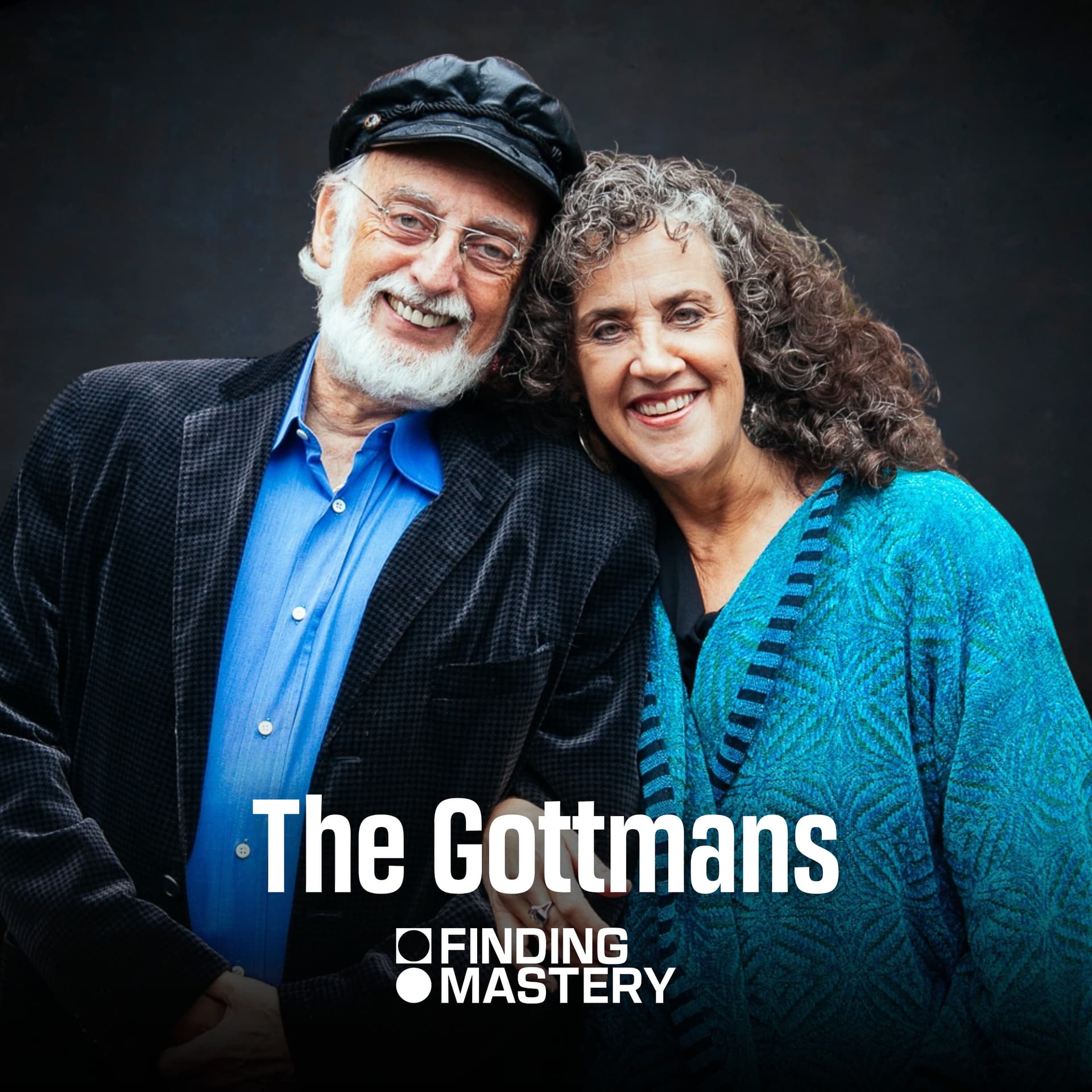
Dr. John Gottman and Dr. Julie Gottman are relationship scientists who studied love for over 50 years, including lab research with newlyweds (Apartment Lab) and long-term follow-ups (20 years) of couples’ outcomes.
Key claims
Many couples have additional problems (addiction, violence, depression). Most people never learned relationship skills growing up. Love can be improved quickly by noticing bids for connection and making repairs. Relationship demise predicts include criticism, defensiveness, contempt, and stonewalling; contempt predicts worse outcomes and even infectious illness. Stonewalling happens when one partner is flooded (physiologically overwhelmed), requiring a timed break and self-soothing.
Notable examples
A “split milk” door-lock conflict followed by playful eye contact during a workout as a repair. A role-play “turning toward a bid” example (bird-watching). A couple’s conversation derailed by criticism/defensiveness, then repaired via describing feelings, validation, and requesting needs.
Written by AI. May contain mistakes. Listen to the episode to check what was said.
Chapters
Tap a time to open that second in VOExploring the Science of Love
0:03 to 1:06
Delve into what fascinates the Gottmans about relationships and their challenges.
“One bad hire, it can cost you a lot, way more than time.”
Exploring the Science of Love
2:35 to 3:42
Delve into what fascinates the Gottmans about relationships and their challenges.
“So with that, let's jump into this week's conversation with the Gottmans.”
Understanding Relationship Complexities
3:42 to 4:49
Discuss the complex issues facing couples today, including external and internal factors.
“They're not sure what's going to give their life meaning and whether or not they really belong with this current partner.”
The Importance of Learning Relationship Skills
4:49 to 6:45
Understand why relationship skills are crucial and how they can be learned.
“And treating couples with all of those problems by the time they start therapy is a real challenge.”
Baggage and Its Impact on Relationships
6:45 to 8:01
Explore how personal baggage affects relationships and the importance of addressing it.
“My partner, my wife comes into the relationship as a young person with all the baggage.”
Deepening Connection Through Understanding
8:01 to 12:37
Learn about the significance of understanding each other's inner worlds in relationships.
“And there's all this non-conscious triggers, tripwires that are not brought to the surface readily that we're constantly tripping over those things.”
Deepening Connection Through Understanding
14:45 to 15:14
Learn about the significance of understanding each other's inner worlds in relationships.
“Spring and summer, they are powerful seasons of momentum.”
Understanding Emotional Connection in Relationships
15:14 to 16:47
Explore the importance of small moments of connection in relationships and how they impact emotional bonds.
“Everything you're saying, I'm like, yeah, that's, it's so good.”
The Role of Humor in Relationship Repairs
16:47 to 20:48
Discover how humor and vulnerability can serve as effective tools for mending conflicts in relationships.
“And one person's just trying to get their partner's attention or interest or have a conversation.”
Distinguishing Between Bids and Repairs
20:48 to 24:25
Learn the difference between bids for attention and repairs in communication during conflicts.
“Help me understand the bid for the repair.”
Show all 23 chapters
Navigating Focus and Attention in Relationships
24:25 to 28:00
Understand how to address issues of focus and attention between partners during conflicts.
“So bids for connection are much bigger than that.”
Navigating Communication in Relationships
28:00 to 33:39
Learn effective communication strategies to avoid defensiveness and criticism in conversations.
“And, you know, I'm writing right now or whatever.”
Understanding Relationship Dynamics
35:20 to 42:00
Explore the predictors of relationship demise and how to foster healthier connections.
“And with that, let's jump right back into our conversation.”
Understanding Defensiveness and Contempt in Relationships
42:00 to 45:39
Learn how defensiveness and contempt can predict relationship failure.
“And defensiveness is a way of warding off an attack, what feels like an attack, by either counterattacking, oh yeah, well, you haven't cleaned out the garage, counterattacking, or whining.”
The Impact of Relationship Stress on Health
45:48 to 47:12
Discover how relationship dynamics can affect physical health.
“And I want to come back to something a little more personal.”
Cultural Communication Styles in Relationships
48:31 to 54:36
Explore how different communication styles impact relationships.
“My wife and I, we come from loud families.”
Personal Reflections on Relationship Dynamics
54:36 to 56:01
Hear a personal account of navigating relationship challenges and repairs.
“And what I've done my early life, and I hope people listening can appreciate this earlier in my life, I didn't do well with criticism and like I just didn't have the skill.”
Navigating Relationship Repairs
56:01 to 57:35
Learn about the importance of making repairs after conflicts in relationships.
“And I looked and I was like, what, I'm halfway into the house.”
Understanding the Impact of 'Eight Dates'
57:35 to 1:00:10
Discover how the book 'Eight Dates' provides couples with essential conversations.
“And the sooner they did that, the better.”
The Roadmap of Essential Conversations
1:00:10 to 1:02:36
Explore the topics covered in 'Eight Dates' and their significance for couples.
“was because a study was done in the Sloan Center at UCLA of dual career couples in Los Angeles.”
Actionable Relationship Tips
1:02:36 to 1:04:56
Gain practical advice for appreciating your partner's actions and fostering positivity.
“Now, your second question, what can you and Lisa do tonight?”
Actionable Relationship Tips
1:05:02 to 1:05:15
Gain practical advice for appreciating your partner's actions and fostering positivity.
Defining Love and Its Application
1:05:15 to 1:07:10
Understand the hosts' perspective on love as an active choice and commitment.
“how to fight well, how to have great intimacy, etc.”
Transcript
Automatic transcript. May contain errors.0:00Dr. Michael Gervais:Finding Mastery is brought to you by LinkedIn. We use LinkedIn Hiring Pro here at Finding Mastery because we know one great hire can change everything. One bad hire, it can cost you a lot, way more than time. It can cost you momentum and culture and real dollars. And that's why how you hire matters just as much as who you hire. And it's why I've become a big believer in the power of LinkedIn Hiring Pro. Here's what I appreciate about it. When you're running lean, you don't have hours to sift through a pile of resumes hoping to find the right person somewhere in the stack. Hiring Pro is built exactly for that reality.
0:32Dr. Michael Gervais:You describe the role and it screens candidates for you, surfacing the people who are a best fit so that you can spend your time and conversations with those folks rather than in the weeds of the applications. And the results back it up. Those hiring with LinkedIn are 24 % less likely to need to reopen a role within 12 months compared to the leading competitor. So join 2.7 million small businesses already using LinkedIn to hire. Host your job for free at linkedin.com slash mastery. Terms and conditions apply. Again, that's linkedin.com slash mastery to post your job for free. The most powerful way to enter the new year is not with resolutions, rather a deeper understanding of how to connect with people who matter the most to you.
1:14Dr. Michael Gervais:Welcome back, or welcome to the Finding Mastery podcast, where we dive into the minds of the world's greatest thinkers and doers. I am your host, Dr. Michael Gervais, by trade and training a high-performance psychologist. The idea behind these conversations is simple. It's to sit with the extraordinaries and to learn, to really learn how they work from the inside out. This is not about hacks or shortcuts. It's about what they're searching for, how they organize their inner life, and the skills that they have used to shape their craft and themselves. As we close out the year, the Finding Mastery team is taking time to rest and recalibrate and reflect.
1:52Dr. Michael Gervais:reflect. Basically, we're using the same principles that we talk about on the podcast. We're practicing those. So today we're sharing a conversation from the Finding Mastery Vault with two legends in the science of relationships, Drs. John and Julie Gottman. In this episode, we explore the habits that strengthen love, the patterns that quietly erode it, and the small daily commitments that create trust, closeness, and lasting partnerships. It's a meaningful way to reflect on the year behind us and to set intention for the one ahead. So from the entire Finding Mastery team, we wish you and your loved ones a very happy, healthy new year.
2:35Dr. Michael Gervais:So with that, let's jump into this week's conversation with the Gottmans.
2:45Dr. Michael Gervais:Oh, I can't believe I'm sitting down with the Gottmans. And I just want to say thank you for the contribution you've made to the field and to my professional and personal life as well. And you've been in this for over 50 years and studying the science of love. You know, just as a general idea, what is still fascinating you about this science and particularly about the science of love? You know, I think what is fascinating me, Mike, is how to treat couples who have complicated lives, couples who may be seriously depressed or one partner may be struggling with an addiction. I have a lot of couples who are coming in, particularly after the pandemic, and so distressed, so unhappy.
3:42They may have lost their direction. They're not sure what's going to give their life meaning and whether or not they really belong with this current partner. and many times they don't have the tools to forge a bridge between them, particularly since they were crushed together during the pandemic and are just looking for space at this point. So it's challenging and particularly challenging as a result of what's outside their relationship as well as what's inside.
4:20Dr. John Gottman:Yeah, I would have to agree with Julie that we did a study with 40 ,000 couples about to start therapy, an international study with same-sex then and cross-sex couples, all kinds of couples. And Julie's right. You know, over 60 % of the time, couples had these additional problems, these comorbidities that went along with unhappiness in the relationship. They were struggling with addiction, violence, depression, all kinds of other things that really impinged on the relationship. And treating couples with all of those problems by the time they start therapy is a real challenge.
5:06Dr. Michael Gervais:Yeah, it's one of the more complicated parts of the psychological sciences about relationships. and there's, you know, I'd love your take on why you think it's so complicated or why, why I sense that it's so complicated. Maybe you, you value the complexity as well. And do you, do you have a bright line about why this part of the science is so complicated for so many of us? You know, I, I think Dr. Mike, it's a really, really good question. Um, and there's a very simple answer to it, which is nobody took relationships 101 in high school. Nobody learned the skills. Nobody typically saw modeled in their homes, the ideal relationship where people were really solving problems in a kind way, in a calm way.
6:03People may be getting flooded when they were growing up, meaning they would get so upset, they would be screaming and yelling at one another. So most of us didn't have role models on which to base our own relationship skills and intimacy later in life. So how are you supposed to learn these things? And if you haven't learned them, then on the presence of them, you're overwhelmed. it feels like oh my god it's so different it's so much to learn etc but actually it isn't all that complicated one just has to learn the skills that we teach as well as ways to really deeply connect with their partner to sustain a very good relationship in your new book the love prescription
7:04Dr. Michael Gervais:why did you write that now because what you just talked about i i'm nodding my head emphatically saying yeah the tools the skills to work which i i wasn't taught them um it was your work that introduced them to me and i also think i'll add one more layer of complexity that seems apparent to me um you might wave me off of this please do is that i came into the relationship as a young person with all of the baggage from my life. My partner, my wife comes into the relationship as a young person with all the baggage. We've been married for three plus years and her baggage and unique tripwires or triggers.
7:42Dr. Michael Gervais:And we are in an unsophisticated way trying to be in the best relationship we know how, but we don't have the ideal model. We have our models that we came from our parents. And so it's all this baggage, all these tripwires with a lack of tools and trying to do our very best. And I feel like that's most of my friends and most of the high performers I work with that the tools are wanting. And there's all this non-conscious triggers, tripwires that are not brought to the surface readily that we're constantly tripping over those things. So would you agree that that's part of the complication or do you say, no, it's just, it's really about skills?
8:25Dr. John Gottman:Well, you know, let me, let me try to answer that question. And the reason that we wrote this book is that a lot of times people feel so overwhelmed by the challenge of making a relationship work that they don't ever get started. And so, you know, we thought, But why don't we write a book where it's going to be really easy to get started and the principles are not really very complicated. And could we actually change a relationship in just a week? Could we give people a prescription that'll help them get started? And once they do these things for a week, they'll see that, in fact, it's not that complicated to have an intimate relationship that lasts.
9:14that was kind of my motivation uh there is a second part to your question that i want to address that is very important that's why i interrupted you normally i don't do that um baggage let's talk about baggage um nobody comes from an ideal childhood nobody does Everybody has, as you put it, tripwires in their adulthood that relate back to their childhood. And a lot of people, especially, unfortunately, men in our society are socially trained to not feel vulnerable, to not feel sad, to not breathe, to not feel afraid. yet many come from backgrounds where as kids they may have been traumatized they may have been hit they may have grown up in poverty they may have uh grown up in a stony cold tense environment including the treatment of themselves uh and there are ways in which even though we might do work to heal from those old wounds, typically they never fully heal.
10:41They're like scar tissue, and scar tissue tends to be very brittle. It's not elastic the way healthy tissue is. So when you poke it, what happens? It tears. And that's easily what can happen when, let's say, a couple is discussing whether or not to watch a particular TV show. And one of the partners is saying, I really don't want to watch this. The other partner is saying, I really do. And what the person who says, I do want to watch it doesn't know is that the other person is being reminded of a terrible incident that happened, let's say in her past, where somebody attacked her in a parking lot.
11:27And she's getting triggered and going into what we call a post-trauma state, where she's just zoning out, but desperately trying to push away what's triggering her, which is the TV show. But the other partner may not know that. So part of our work together is really to unearth what is deeply within each individual. So first of all, that people can know each other much better, what we call love mapping, they can really map out the partner's inner world, and share their own inner world. And secondly, people understand that the other partner, each of you may have scars that get tripped over every now and then that get triggered.
12:22And those really need to be revealed, talked about, and understood, which deepens the compassion between the partners and then make solving problems a lot easier.
12:37Dr. Michael Gervais:I'm going to pause the conversation here for just a few minutes to talk about our sponsors. Finding Mastery is brought to you by Rag & Bone. I've been a big fan of Rag & Bone for a number of years. I just love what they do. It's a go-to for me when I'm choosing clothes. I've been wearing their infused denim for a while now. They've done just a really nice job with this product. For me, I am really intentional about what I invest in. In clothing, it's no different. I want things that are well-made, that stand the test of time, that don't distract me, that support my focus on the things that matter most.
13:07Dr. Michael Gervais:And that's exactly why these deliver. And they look sharp, full stop. They've spent 20 years obsessed with getting this product right. And that kind of long-term commitment to craft, that's something we talk a lot about here at Finding Mastery. Quality compounds. The right inputs may consistently over time show up in everything. And you can feel that the moment you put these on. If you're ready to upgrade your denim with something that's genuinely built to last, it's time to upgrade your denim with rag and bone. For a limited time, our listeners get 20 % off their entire order with the code FindingMastery at rag-bone.com.
13:39Dr. Michael Gervais:That's 20 % off at rag-bone.com with the promo code Finding Mastery. And when they ask you where you heard about them, please support our community and this show and let them know that we sent you. Finding Mastery is brought to you by our flagship mindset training course, Finding Your Best. Anytime you feel the pull to reset, to zoom out, to refocus and ask, am I moving toward the person I want to become? It helps to remember this. Lasting change comes from training. Not resolutions, not short-term sprints, but deliberate practice of the skills that shape how we show up. In work, in relationships, and in the moments of great intensity as well.
14:15Dr. Michael Gervais:That's what finding your best is all about. It's a science-backed framework for training your mind. And it's the same set of tools that we've taught to Olympic athletes, top executives, elite military teams, and artists at the peak of their craft. In this course, you'll learn the foundational psychological skills to be your very best. Full stop. And the best part is, you can start anytime. Right now, we're running a limited time offer on finding your best. Simply head to findingmastery.com slash course and use the code RENEW100 to get$100 off your registration. If you've been waiting for the right moment, this is a good one now to lean into.
14:48Dr. Michael Gervais:Spring and summer, they are powerful seasons of momentum. It's a great natural time to step into growth, to refocus, to recommit to who you want to become. And this discount will not be around for long. So go to finding mastery.com slash course code renew 100 for$100 off today, because your future is not shaped by what you intend. It's shaped by what you train. Let's jump right back into the conversation. Everything you're saying, I'm like, yeah, that's, it's so good. And then it's so clear to you both. And I know you're working from research and evidence, and I feel like I can hear, I can hear my younger self going yeah nice okay right like that's how i'm gonna do this like i'm gonna sit and listen and and then i hear my i hear like we've been married 35 years right and i can hear my my current part like yeah that's so rich i want to just i need more of that i want to find the time and make sure that i create that space to do it like every day and you know whatever and so and i also hear it like this other part like that takes a trained professional men in respects to be able to do that work.
15:59And that's, in my estimate,
16:01Dr. Michael Gervais:that's what the book was to make it really simple. Like here's a prescription. And I don't want to be a cynic. I'm not a cynic in life. But then one of my tripwires in science was like, are there seven rules? I don't know. Is there really a prescription? I don't know. And I was wondering if like, I love the simplicity that you made and I really deeply respect the research foundation that you're coming from. So do you want to start us off with like what the prescription is or do you want to move into the mapping? Do you want to do you want to maybe start with like what the ideal loving relationship is?
16:37Dr. Michael Gervais:Like where do you where do you want to start to get into the into the applied stuff before we get into the into the things that absolutely tear down a relationship? Because I know we'll go there eventually. OK.
16:47Dr. John Gottman:Yeah. One of the things that was so interesting about the apartment lab that Julie and I designed, where we studied 130 couples right after their wedding, just a couple of months after their wedding, were these small moments that the camera operators noticed, where they're just hanging out in this apartment lab for 24 hours. And one person's just trying to get their partner's attention or interest or have a conversation. And a lot of times the other person just kind of blows it off, you know, really doesn't see that this is an important moment and turns away from that attempt to connect. And in that small moment, when people actually do connect, they really actually see this is a bid for attention or emotional connection.
17:40Dr. John Gottman:It has so much meaning. It really kind of builds this emotional bank account. So in these very small moments that seem almost trivial, unimportant, there lies a real mystery. And when people connect in those small moments, it turns out that the relationship really kind of gets lubricated in a way. So all the gears mesh easily, and it really gives them such amazing gifts as a sense of humor about themselves when they're disagreeing. It gives them a sense of affection, even when they're disagreeing. So those small moments really built. And, you know, so we wanted to tell people, you know, get started noticing the way your partner asks for what he or she needs.
18:34And if you attend to that, it's going to be an amazing thing.
18:39Dr. Michael Gervais:And so I want to make it uber concrete. One of my clients, they just had a massive exit, you know, unicorn type business exit. And he is full of fire and zest and a love for life. And they're like 35-ish and they have a newborn and they had this moment. Okay. So they've got all the resources, but it's brand new. All of this kind of new lifestyle that they have is brand new. So stress is high. They're trying to figure out this new life with all of these resources. It sounds like prince and princess problems, but it's like this is the condition. And it's a new way of governing and making decisions.
19:19Dr. Michael Gervais:Okay. And then something happens. It's like a spilt milk moment. It was actually the door wasn't locked and they had to have a conversation about having the door locked. And it was a safety tripwire for one of them. And they just had they had it out in the driveway. They're like pissed off. And they jump in the car because they had an appointment they were going to together. And it was a silent car ride. You know exactly what I'm talking about, right? You've had this. OK. So it's a silent car ride. They get to the place. And right before they're going to the meeting, they're going to go work out together.
19:51Dr. Michael Gervais:Neither of them at this point wanted to work out together. So they went kind of to the gym and they're working out separately. And I guess halfway through the workout, she runs over. And while he's working out, lifting heavy weights, kind of pissed off and agitated. And she runs in front of the mirror between him and the mirror and makes it this goofy face, you know, right? And so as he's lifting weights and he had a moment, either he goes like to himself, like, what the F are you doing? get out of my way or he gets gives into the goofy face that the you know the bid if you will do i have it right that that is like that took courage for her to do because she could have been dismissed right and there's vulnerability in that and it's like it's it's silly it doesn't always have to be silly right but this one was silly right the fun part that's what we call making a repair that's the repair yeah that's a repair so that was so that's not a bit that's not a bid And I'm not exactly not.
20:50Okay.
20:50Dr. Michael Gervais:So, oh, great. Help me understand the bid for the repair. If I have it.
20:54Dr. John Gottman:Well, let's find out how, how did it work for them?
20:57Dr. Michael Gervais:Oh yeah. So he's in mid mid set lifting weights and you know, he's straining. I would not recommend this because you know, it's like, you don't want to have an intimate conversation when you're at the mile, mile 19 of a marathon. That's not the time to do it. Right. And elevated heart rate, the whole thing of intensity and stress. And so he had the moment and he knew, and we talked about it. He could go either way. And he looked at her. He's like, this is the woman that is like, I love her. She's as goofy. She's trying God bless it. And he just laughed. He just like put the weight down, you know, and they just looked at each other.
21:31Dr. Michael Gervais:And then she's, she kind of like left, it was no hugging. There was no, right. But they made eye contact. Right. Like, right. And I go, I want more of those in my life. I want to be both of them in that. That's a successful repair. So here's the difference between a repair and a bid, though, of course, there's lots of overlap. A repair is an attempt to get back on track when a conversation or a conflict or something has gone wrong. Then the person does something to make it better, to take the tension out of the space between the partners, to repair what's gone wrong, you see. And she used humor and silliness to kind of crack through the ice between them.
22:33Dr. Michael Gervais:That's exactly right. So they had enough emotional money in the bank from bids being turned toward that he could laugh. Let me also just say, here's what a bid would look like. Okay, John and I can actually role play it. And there are three responses you can make to a bid. One is turning away, which means just ignoring it. Two means responding hostily to it. And three is turning toward your partner's beard. So we'll just role play those three. So, gosh, honey, look at that gorgeous bird out there. Isn't that amazing?
23:19Honey, look at the bird.
23:23Dr. John Gottman:Listen, I'm trying to read, and you keep interrupting me with these trivial things. It's really irritating, annoying.
23:34hey, look at that gorgeous bird out there. Wow. That's a blue jay, right? Yeah.
Read the full transcript
23:41Dr. John Gottman:Incredible. That's it. That's all it takes to turn towards a bid. So what I'm doing there, you saw John, when I first pointed out the bird, I was just looking to share a moment with him.
23:58Dr. Michael Gervais:And you're saying that's the bid? That was the bid. I've had this wrong for years. Okay. I'm so glad we had this go. Because I've been thinking the bid was, it took place as the first kind of entry into repair. I thought what she did was the bid, and then they're going to have a conversation later that was going to deepen the repair. And that's, I don't have it right. Okay. Awesome. So bids for connection are much bigger than that. So they include bids for shared interest in something. That's what I was doing just then. A bid may be making a request. Honey, would you please clean the counters in the kitchen?
24:45That's a bid. A bid also can be much deeper. Like, honey, I'm having a terrible time dealing with this relationship. I really need you to talk with me about it. Would you please? Can we make some time to do that? Is that okay? Yeah, that'd be fine. See, there you go. So those are all bids for connection.
25:11Dr. Michael Gervais:You have a second career waiting for you. Like you guys should take this on the road, which I know you have quite a bit. All right. So bids for attention, bids for connection. and really what we're looking for is a response right is that is that what we're turning toward we're looking for a particular kind of response that we call turning toward which is typically affirming of the other person so joining the other person if they're asking to share a moment where they're interested in something. It can be a response of, yes, sure, I'll do that. A positive response might even look like this. Honey, I don't have time to do this right now, but I promise you I'll get it done before the end of the day.
26:08Dr. Michael Gervais:You always say that. And honestly, I'm starting to think that you don't really want to do it. You're just saying that because you know that it's the nice thing to say. Okay. Well, I can understand you feeling that way because I've let you down many times. But right now, I really truthfully am saying, I promise to do this task you've asked me to do. So see what happens. You know, I'm really glad that you bring this up because honestly, I feel like every time I'm into something and I'm doing something that requires a lot of focus, it's like you're kind of needy. And it's like, I know we're doing the bid thing, but I think you're overbidding.
27:02Okay. So I'm going to step out of roll for a minute.
27:06Dr. Michael Gervais:Oh, come on. It was almost so good. It was almost there, Julie. That was a criticism. Yeah, that's right. It was a criticism. That's where I was going. I'll go back into role. So, you know, Mike, I'm feeling really defensive right now. Can you say what you want to say in another way? Okay. Well, I feel like when I am really trying to focus on something that I want to be there for you, but it feels like there's another game that's being played. and I'm really agitated by it. Can you help me understand what you mean by another game? It's like when I'm deeply into something, those are the times that I feel like you want my attention most.
27:54Dr. Michael Gervais:And I don't know, I just don't quite understand what's going on. Like, you know, I'm focusing. You know, I need to get this thing done. And, you know, I'm writing right now or whatever. And it's, I don't know, I just feel exhausted by it. Wow. So let me make sure I'm understanding you correctly. You're saying that it seems to you that when you are focusing the most on something, something that you are doing, it seems to you that I approach you particularly at those times to get your attention? Julie, that's the way it feels to me. Yep. Oh, God, what a drag. That must feel pretty crummy because you're divided between.
28:41Yeah, that's what I've been trying to tell you.
28:43Dr. Michael Gervais:That's what I've been trying. Like all this time, that's exactly what I've been saying. It's like, I want to spend time with you, but like, not now. home. Okay. So tell me what would be, um, what would be the ideal for you? If I have something that I am needing to share with you and at the same time, you're really focused on another task, what would work better for you? I think you got to be better at reading the cues. And I know you want me to say what I need, but like, I just need you to like, know when I'm, how about I do this when I put my headphones on it's like I'm in I'm trying to get in my zone you know that's perfect that'll be a great signal to me that this is a time just for you to be focused on what you're choosing to focus on and I should give you that space is that right that would be a great signal to tell me that cool that that was it's all pull out now Julie that that was like that feels like the normal kind of circular thing that could happen.
29:51Dr. Michael Gervais:Like I went to irritation, frustration, blaming, pointing finger, you know, criticism and defensiveness is what we're stuck in. And you pulled us out of it. And can you tell, can you, can you describe what you were doing to be able to do that? Yes. Because yeah, this is the takeaway, right? What you're about to say is, is going to be gold. And so if you explain this for folks, maybe silver, not quite. Okay. Actually, I think this is more, you guys know this. This is where people get stuck. Defensiveness, critique, defensive, and like it's the spiral snake eating its tail. And then it gets like, then frustration is part of it in a way that it's like, what are we doing?
30:30Dr. Michael Gervais:Why do we keep having this conversation? Right. Okay. Okay. So here are the, here are the steps that I took during that conversation to change the course of where it was going. First of all, when you spoke your first criticism of me, you're too needy, you know, basically, I took the feeling I had, which was ouch. And I turned it into, I'm feeling defensive. So rather than going defensive and getting angry about what you said, instead, I described what I was feeling. I'm feeling defensive. That's part of it. And then asked if you could rephrase what you said that wouldn't make me defensive, basically.
31:28That was the first. Then, let's see. Then I think you started getting frustrated and a little bit angry. And what I did then, I realized, wow, this is really a big deal for you. I could tell that from how you were feeling. And so I moved to another skill, which is to summarize what I heard you saying and not only summarize it, but give it some validation. There's gold number two. Validation means from your point of view, I could see how you feel that way. That makes sense to me. I step into your shoes. I empathize, try to, with what you may be feeling. And I think to myself, yeah, if I were him, I might feel the same way.
32:34So I say that to give you some validation. And validation is one of the biggest tools that calms down the conversation. And you might note, you calmed down after that. The frustration vanished. I checked it with you. Did I get it right? Make sure I heard it correctly. And then I asked you for what you needed. and that was my being open to you having needs not just me having needs but you having needs and sorting out um the nugget of what lay inside our difficulty connecting with one another when And you were focusing on something else. Okay.
33:34Dr. Michael Gervais:Quick pause here to share some of the sponsors of this conversation. Body Mastery is brought to you by Fatty 15. Did you know that Navy dolphins helped unlock a secret to healthy aging? It's a wild story. And it's the foundation for a product that I've come to really love. Fatty 15. Fatty 15 is built around C15. The first essential fatty acid discovered in over 90 years. And it was discovered by Dr. Stephanie Van Watson. She's the co-founder of Fatty15. While she was working with the U.S. Navy, and based on over 100 studies, we now know that C15 strengthens our cells and is foundational for healthy aging at the cellular level.
34:13Dr. Michael Gervais:Stephanie's been on the podcast, and it was one of my favorite conversations. She's amazing. And what her and her team are building is something I'm really excited about. Head to fatty15.com slash finding mastery and use the code finding mastery for an additional 15 % off your 90-day starter kit. Again, that's fatty, F-A-T-T-Y, 15.com slash finding mastery. And the code is finding mastery. I want to take a second here to tell you about a morning routine that I've been using for years. For me, it's a great way to switch on my mind, to ready myself, to take on the day. So before I check my phone, my emails, market updates, or text threads, I choose how to start my morning.
34:52Dr. Michael Gervais:That's always in my control. That's always in your control too. This is the same morning mindset routine that some of the world's top performers across sport, business, and the arts are using. The best part? It only takes about 90 seconds to do. So just head over to findingmastery.com slash morning to download the audio guide for free. Again, head to findingmastery.com slash morning to get your morning mindset routine.
35:20Dr. Michael Gervais:And with that, let's jump right back into our conversation. I'll double down, not silver, gold, like, like gold. And the reason it's so powerful to me is because like, I was acting like a child and you held the adult framing or the adult space, like, hold on, I don't need to get every one of my needs met. And I just got triggered by, you know, the ouch type of thing that you talked about when I was being critical. And you said, and, but what you did is you didn't respond from the emotion, but you made sure that you were acknowledging the emotion and then sharing the emotion rather than lashing out or retreating from.
35:59How long does it take to get not even great, but just good at this?
36:05Dr. Michael Gervais:Because emotions are so raw and big and overwhelming to so many of us. How long does it take to get good and how do we practice? That's a quick question. First of all, let me just note something that I want to correct. You said I started acting childish. So let me just say for your listeners that what you were expressing wasn't childlike at all. It wasn't childlike. You were, you know, we had uncovered something that was really frustrating. And yes, you are entitled to get your needs met. So am I. and sometimes we've got to work out how that's going to look so needs are not childlike wanting your needs to be fulfilled is not childlike uh it's normal it's human we all have needs every single one of us so how long does it take to learn to do what i was doing I don't know I think it depends on how much you practice
37:22Dr. John Gottman:Well we do it with guests and we do it with friends all the time Good point So we have those skills when a friend comes over and spills the wine all over your tablecloth you don't say get out, you ruined my tablecloth you say hey, that happens can I get you another glass of wine You know, we're kind and generous towards strangers and friends. And so I think we have the skills. It's a matter of really in the moment, just listening. You know, there's a let me give you just another very, very, very simple formula that encapsulates all of this, that people can just brand on their forehead. describe yourself don't describe your partner simple as that describe yourself just i i i describe your feelings describe your needs when you slip into describing your partner especially when you're upset or angry then you move into criticism you're so lazy you're so selfish.
38:36You're so needy. You, you. That's not going to work. So you start, if you want to bring up a problem with your partner, you describe yourself. I'm feeling what? I'm feeling frustrated. I'm feeling angry. About what? What's the situation? Not the character trait of your partner. What's the situation? I'm upset that the bills haven't been paid yet. That's the situation. Then you ask for what you need, the positive need, meaning how can your partner shine for you? It's not what you don't want them to do. You ask for what you do want them to do. awesome
39:25Dr. John Gottman:can I add something here the original idea of being a great listener was really flawed I think that's part of the problem so the original idea of being a great listener was to say I feel something when you do something so it turns it back on you So I say, I feel angry when you are too needy. So it turns out to be an attack. It's not really listening. And listening has to not have that attack in it. It has to say, you know, I really feel angry when I'm concentrating and, you know, I get interrupted by your needs. Right.
40:11Dr. Michael Gervais:I feel sad when you keep doing this. Yeah, that's not that. That is not the recipe here or the prescription.
40:20Dr. John Gottman:Exactly. Yeah. Right. Right. So taking your situation here would have been a way to say it right from the get go. I feel frustrated when I'm focusing on a task and something pulls me away from it. And I just want to stay focused on it. Cool. There's no attack, you see. There's no, yep. Right. What we found in our research were there were four big predictors of relationship demise over the years because we followed couples for as long as 20 years to see what would happen to their relationships and videotaped them. We took physiological measures like heart rate. We took how much they sweated in their palms and so on.
41:18And then we brought them back every few years to see what happened to their relationship. So we learned there were four big predictors. One, criticism. So criticism means blaming your partner, some character trait of your partner for the problem that exists between you. And there's where the words like lazy, selfish, mean, blah, blah, blah. You always. You always and you never. Those are also criticisms, interestingly enough, because they imply a personality trait. You always forget to do the dishes, you know, whatever. So that's criticism. The second one we saw, defensiveness. And defensiveness is a way of warding off an attack, what feels like an attack, by either counterattacking, oh yeah, well, you haven't cleaned out the garage, counterattacking, or whining.
42:25Oh, yeah? Well, I did the dishes last night. Right? That's defensiveness. The third is contempt. And Mike, that one is like sulfuric acid for a relationship. It's the very worst of the big predictors. What it is, is looking down on your partner from a place of superiority and treating them with a little disgust and scorn.
42:59Dr. Michael Gervais:And it can be a look. It can be a look of disdain. That's right.
43:05Dr. John Gottman:Rolling your eyes.
43:06Dr. Michael Gervais:You don't have to drop the F-bomb. You don't have to use the hate word. You can look at somebody cut right through every word of disdain and contempt. That's right. Yeah. Yeah. Is that, can it, when that happens, if that happens a lot, is that, is it like, probably should get a divorce if you guys can't figure this thing out? Like, is it, is it that? I think, but they need therapy. Correct. You know, um, people, uh, who were doing a lot of that are going to have a lot of emotional injuries in the relationship, a lot of pain, Lots and lots of pain. In fact, we found that the number of contempt expressions a partner hears in 15 minutes not only predicts how badly the relationship will go, it also correlates with how many infectious illnesses the listener will have in the coming year.
44:08Dr. Michael Gervais:Meaning... Oh, I've missed that bit of your research. That's phenomenal. Contains, destroys the immune system. How about that? Isn't that amazing? And just to be clear, it's not like you randomly would measure 15 minutes. You'd give them something to wrestle with. You give them something emotionally charging to think through. Mm-hmm. And talk about, try and solve. can talk about yeah and then inside of 15 minutes and like what kind of numbers are we talking about like is this four contempts experiences or is this like 14 sometimes it's even the way a conversation
44:48Dr. John Gottman:about how the day went begins i remember this one guy who said um why don't you talk about your day It won't take you very long. Oh, geez. Oh, my God.
45:03Dr. Michael Gervais:How do you guys keep it together? Honestly, I mean, I know like you've got to come from some real compassion, you know, because when somebody says like that, something like to me, I'm like, guys, like, do you actually think this is going to work? They're not thinking about what's going to work. You know, they're feeling bitter. They're feeling angry. Perhaps they've gone through a lot of attack within the relationship that's taken them to that place.
45:34Dr. John Gottman:Or they come from a family where there's a lot of contempt and disdain.
45:39Dr. Michael Gervais:And now, one final word from our sponsors. Finding Mastery is brought to you by LinkedIn. Earlier, I mentioned LinkedIn Hiring Pro. And I want to come back to something a little more personal. We talk a lot about the people who make extraordinary things possible. And I want to take a moment to acknowledge some of ours. Janelle, Taylor, Alex, Emma, and our newest teammate, Chelsea. Every single one of them came to us from LinkedIn. And every single one of them has raised the bar of how we operate here at Finding Mastery. Our relationship with LinkedIn, it also runs a lot deeper than just using their tools.
46:14Dr. Michael Gervais:We also work with their teams on the corporate side, helping them build the kind of high-performance culture where great people want to stay. They want to grow. I've been building businesses for over two decades now, and I'll tell you, the right team, that matters so much. It's the difference between grinding and flowing. So this partnership, I believe in from the inside out. When you hire through a platform like LinkedIn Hiring Pro that surfaces people who are genuinely aligned with what you're building, you get a different quality of candidate, not just in skills, but in fit and values, the kind of energy someone brings to a team.
46:49Dr. Michael Gervais:So if you're thinking about your next hire, I want to strongly encourage you to be intentional about where you look. The right person is out there and LinkedIn Hiring Pro helps you find them faster with a lot more confidence. Post your job for free at linkedin.com slash mastery. Terms and conditions apply. Again, that's linkedin.com slash mastery. Finding Mastery is brought to you by Sunlighten. I'm really excited about a new partner of ours. something that I've come back to again and again is when I invest in recovery with the same intention that I bring to my work, everything gets better. My energy, my focus, my ability to show up fully for the people that I'm with and the work that I care about.
47:31Dr. Michael Gervais:That's why I am so bought in on the Sunlighten M-Pulse Intelligent Sauna. I was first introduced to their team a few months ago and was so impressed by what they've created. This is one of the most advanced infrared saunas that they've built in over 25 years of pioneering this technology. That's right. They've been at this game for 25 years. I had one installed in my home a few months ago, and it's made a real difference. I feel more refreshed, more grounded, more relaxed, and it's become a consistent part of how I recover, how I reset every day. I'm using it to support muscle recovery, for improved oxygen delivery, and for nervous system recovery.
48:08Dr. Michael Gervais:And what I love most, I don't have to leave my home. They're offering the Fonny Mastery community up to$2 ,100 off. Simply head to sunlighten.com and use the code mastery for this great discount. Again, that's sunlighten.com and use the code mastery for up to$2 ,100 off.
48:28Dr. Michael Gervais:And with that, let's jump right back into our conversation. My wife and I, we come from loud families. My wife is Latin, Cuban, identifies most with her Cuban descent. and um i've got some irish italian uh i identify mostly with italian and so we'll get loud and like it's fiery and we almost like yeah it gets loud and then we can like we can look at each other but okay okay okay okay you know what and there's a there's a repair that takes place i think that's one of the reasons we've done well and we've done a lot of um relationship work ourselves um like with a radical therapist that just held us at the highest standard and was loving and warm and knew her stuff.
49:10Dr. Michael Gervais:I'm sure she knew your work intimately. And so what do you say to folks that get loud and have kind of that emotional flair? It's a cultural thing and it's also a style of communication. What do you say to those folks, me in particular? Okay. Well, so we address three of the four big predictors. The fourth one is called stonewalling. But let's talk about what stonewalling is and what's behind it, which relates to your question. So stonewalling means during the middle of a conversation, one partner gets so upset that they shut down, they withdraw, and they act like a stonewall. They don't give any responses, any facial expression, no eye connection, no words, nothing.
50:03There's just nothing there. And it's not for a few seconds, might be for a few minutes. That's stonewalling, which is very upsetting to the other partner. But what we discovered is that inside people who stonewalled, they were getting what we call flooded. And flooded means you're feeling so attacked that your heart rate is over 100 beats a minute, right? And you'd rather be, as John likes to say, you'd rather be on Pluto than in the room talking to your partner. And that is a state, actually, in which blood is moving out of the front of your brain back behind it to the part of the brain that controls movement, the motor cortex.
50:59And as a result, you can't hear well. You can't problem solve. You're going to feel attacked even if your partner lovingly says, honey, I really love you. You've got tunnel vision and tunnel hearing. Everything feels like an attack. And what you have to do then is ask your partner to take a break. Can we just take a break? And tell your partner, this is very important, when you will come back to talk again. So your partner isn't just left hanging, wondering if you will ever discuss this topic again. So you say when you'll come back. It shouldn't be any shorter than about 20 minutes to a half an hour, no longer than 24 hours.
51:52And during the break, you do not think about the fight. Do not. otherwise you'll stay physiologically aroused. What you have to do instead is something that's self-soothing. And that can be reading a book, reading a magazine, listening to music, going on YouTube. It might be going even for a run because there are different physical dynamics involved. Just something that really takes your mind off the fight and allows your body to metabolize the stress hormones you've released in your body so that you can calm down and then return at the time you said you would to continue in a calm state. Are you done?
52:40Dr. John Gottman:Can I say something here? I want to talk to that Irish-Italian-Cuban cultural thing. And, you know, before we did this research in the laboratory, therapists thought there was an ideal way to talk about conflict. And it involved staying calm, being rational, listening well, you know, low key. And that turned out to be completely wrong. In fact, you know, there are people who are very emotionally expressive and, you know, and that's fine. It works well, as long as you're not attacking your partner's character. You're not doing the four horsemen. And then there are some people who are really, you know, they're so laid back that, you know, they just don't get upset by anything.
53:31Dr. John Gottman:They're really, they avoid conflict whenever they can. And that's fine, too. That works also. And, you know, and there are people in between. So these cultural differences turn out to be unimportant. It's really the way you connect with one another and feeling like your partner is actually on your side. You're working on a problem together, like you're pushing the ball uphill together. And it doesn't matter if you do it calmly or you do it with a lot of emotion, as long as you're not enemies attacking one another.
54:11Dr. Michael Gervais:I, I, I love that you've added that because I'm just, I think my, my style and I, not, not that this is materially important in the conversation, but I, I'm, I'm really mellow, really mellow in intimate or fiery conversations. Like I just kind of, I have that ability. And then all of a sudden I feel like I get thrown off a cliff. Like I, like I lose my, and all of a sudden my voice gets up, but it's, it takes a long time. And what I've done my early life, and I hope people listening can appreciate this earlier in my life, I didn't do well with criticism and like I just didn't have the skill. And this is why I'm saying to you guys both, thank you, because like your work materially changed my life and probably what was definitely in the DNA of what saved my wife's and my relationship.
55:02Dr. Michael Gervais:And and now like that, it's the same style. It's like really slow. and then all of a sudden I get cranked up and she's not surprised by it. It's okay. You know, and then, but what I don't do is I don't talk about her. I talk about my experience and now she's not on her heels. We're pushing the ball uphill together. And I just want to tell you guys, um, I blew it this morning. I'm listening. I know your science. We, I, we jumped out of, um, Um, um, my son and I, uh, my, my wife, uh, myself and my son, we dropped them off at school. Uh, we get back to the house, our dog's in the car as well. And I was kind of rushing to get to my first meeting.
55:43Dr. Michael Gervais:And so I jumped out of the car and usually it's like, Hey babe, will you get, we grabbed the dog, you know, or it's like, Hey, I got the dog. Um, whatever. Like we're, we're just communicating on, I jumped out of the car, like a selfish, you know, whatever kind of ran into the house. Cause I wanted to get my stuff and get back out and get my car and take off to the office. And, uh, she said something under her breath and I go, Oh God, I'm in trouble. And I looked and I was like, what, I'm halfway into the house. I'm like, Oh my God, what am I doing? And so I said, I'm sorry. You know, like that.
56:11Dr. Michael Gervais:And she's still processing it. Like that was really rude. And she was right. And, and then, so I'm coming downstairs from grabbing my stuff and I look and she's grabbing, um, a dog bag to pick up the dog's mess. And I'm like, I really screwed this up. Not only is she like, literally she's having to pick up after the dog. And so I sent her an emoji once I got to the office. I didn't do the immediate repair bidding. And I sent an emoji of a panda bear. And that's our little code word. We're trying to be more like panda bears. They just play and they roll and they're fun and they're not threatened by stuff.
56:48Dr. Michael Gervais:They're just more playful and big. And so I got a heart emoji back. And so the repair worked. So the repair worked. But I literally was like. Oh, but you know what? You're a human being, Mike. Oh, yeah. How about it? And you're not selfish. You were maybe a little forgetful and you ran. And we all do stuff like that all the time. John and I do stuff like that as well as worse stuff. You know, we're always making mistakes. Everybody does. And that's why in our research, the biggest, biggest difference between couples who succeeded, couples who did not, was the successful ones made repairs. They made repairs after their mistakes.
57:38And the sooner they did that, the better. So look at you. You did everything right. Right? As soon as you got to the office, you made a repair. and she accepted the repair and boom, it's gone. So that's terrific. You cleared the channel between you. Nice job.
57:58Dr. Michael Gervais:So, okay. You guys are great. I love that you bring into the conversation, like, you know, you guys make all the mistakes as well. Minimizing the mistakes, yet not eliminating them necessarily. But like, I don't, when I say I'm sorry, like I didn't know really how to do it earlier. and I really, it's a promise that I'm making to not do that shit again. Whatever that thing is, I'm going to do my absolute best to not kind of step back into this pattern. And I'm not perfect there. Of course, nobody is. But I really mean it when I say it. So that's taken us a long way.
58:35Dr. John Gottman:Yeah, I think that's a very important thing. I mean, all the failures that I've seen in being a therapist, it always comes back to that, that, you know, the couples that fail, one person is really not willing to take any responsibility for their side in the miscommunications. And that invariably makes therapy fail, I think.
59:04Dr. Michael Gervais:Before we end, I mean, again, amazing. And I know you guys wrote the book, eight dates which interestingly enough um our producer of this podcast read it and um you know it it was the trigger for him to realize that he wasn't in the right relationship and um that's it was so powerful in in the in the mastery lab like you guys have made a dent here now. And so can you, can you just talk through like just quick high overview of eight dates? Cause I highly recommend it. I saw it work really in a powerful way for him. And so can you just quickly hit that? And, um, and then maybe like, what should Lisa and I do tonight?
59:53Dr. Michael Gervais:Like the repair is kind of done like a heart, you know, but like, so there's a two parter eight dates and then super actionable what Lisa and I can do as a proxy for what anyone that is wanting to be better in their relationships do tonight. Yeah.
1:00:09Dr. John Gottman:One of the reasons we wrote the Eight Dates book was because a study was done in the Sloan Center at UCLA of dual career couples in Los Angeles. And these were couples that had children and two careers. And what happened was that they just completely ignored the relationship. The relationships had devolved into just this long to-do list that they were getting through together. And they had neglected romance and fun and play and adventure and really kind of sitting down with one another and saying, hey baby, how's life treating you? How are you doing? And so we wanted to create these eight dates so we field tested these dates where people were prepared for the date and think about questions they wanted to ask their partner on the date to really get those conversations to have some meaning.
1:01:08So let me say a little more about eight dates and then the other question. So what eight dates is, is a roadmap for essential conversations couples might want to have, especially either newer couples or couples who've been together a really long time, but they haven't stayed close. They've gotten more distant from one another. And we had seen a zillion couples like that, which is why we wrote this book. So with each date, you are given a topic to think about, and then on the date, some questions to address with your partner to talk about. And their questions, each chapter is about a particular topic with questions to discuss pertaining to that topic.
1:02:05Some of the topics include things like trust, you know, what tells you that somebody is trustworthy. How do you like conflict to be handled? So conflict is another one. Not to have a conflict, but if there's a conflict, how do you want it to be handled? We talk about parenting. We talk about sex. uh there's also um play and adventure what ways you really like to play um let's see there's one on uh spirituality money and money right uh money is another biggie so each topic is really a way for couples to explore their values, their needs, their experiences, and share those with one another pertaining to each of those topics.
1:03:06That's eight dates. Now, your second question, what can you and Lisa do tonight? This is one thing that you can do, and it's part of our love prescription book. And that is go home and focus entirely on what your partner is doing right. Not what they're doing wrong. What are they doing right? Every single thing, whether it's doing the dishes, whether it's making coffee, whether it's It's helping your son with his homework, you know, whatever it is. And say thank you. Every time you partner, I'm on it.
1:03:53Dr. Michael Gervais:Thing right. You know, it'd be fun. And maybe you guys have done this. I just haven't seen it. It'd be fun if like we could pull our community together and like, and like do a worldwide kind of like catch what's good with your partner day or week and capture that in some way. you know, socially, like there's something here that would be, um, it would really move a needle. Um, but a great little experiment. That'd be beautiful. Yeah. You guys are awesome. Yeah, it is. Maybe we talk about it offline in some kind of way, but like you guys are awesome. Thank you for being so sound in your science and your research and making it applicable to, to all of us.
1:04:33Dr. Michael Gervais:And I just want to say, um, I can't wait to see what you guys do next. And I want to encourage folks that are, you know, part of the Finding Mastery community here to go get these books. And I don't know if your lectures are available to be purchased. I know that as a professional, I was able to be part of your trainings, but where do you want to drive people to? Sure. People can go to www.gotsman.com. That's G-O-T-T-M-A-N.com. And there's lots and lots and lots of stuff that they can find, including actually a software platform people can go to, to learn all the interventions, to hear little snippets of information and lectures about how to fight well, how to have great intimacy, etc.
1:05:29It's all there on that software platform. And last but not least, we've just finished a book that I think will be called Fight Right. And that'll be coming out in, I don't know, as long as it takes to print. Valentine's Day. Valentine's Day. Valentine's Day.
1:05:50Dr. Michael Gervais:That's awesome. Yeah. Good. Well, hopefully we can have you back on to learn those insights that you're sharing there as well. Thank you, Mike. Thank you. This was a great interview. It was very successful. Thank you. That's so good. You guys are great. Good job. Good job. So how about this? How's an ending? Before we go, in one sentence, maybe even a word, what is love? Well, first of all, we like to say love is a verb. It's not a noun. It's a verb. And it means placing your partner's feelings, needs, and dreams as either as important as your own or at times more important than your own and treating your partner accordingly.
1:06:40That is brilliant.
1:06:42Dr. Michael Gervais:Thank you. All right. So on to love, on to the next. And I'm wishing you guys absolutely the very best. again, thank you for making such a big dent. And John, like maybe I think I might have stepped on your words with the delay here. Did you want to add or did you?
1:06:58Dr. John Gottman:No, her definition was perfect.
1:07:01Dr. Michael Gervais:Yeah, it was, wasn't it? Okay. Thank you guys for making such a massive dent in the world. And I really appreciate it. Thank you, Mike. Thank you, Mike. It was a great interview. Next time on Finding Mastery, we're kicking off 2026 with Cal Newport, best-selling author of Deep Work and Slow Productivity, for a conversation that will completely change how you think about focus, busyness, and what real productivity looks like. Cal and Mike break down why doing less can lead to better work, how constant distraction is quietly draining us, and what it really takes to protect your attention in a noisy world.
1:07:40If you're ready to start the new year with more clarity, more focus, and a smarter way to work, this is the perfect place to begin. So join us Wednesday, January 7th at 9am Pacific and a happy new year from all of us here at Finding Mastery.
1:08:17Dr. Michael Gervais:If you haven't already, please consider dropping us a review on Apple or Spotify. We are incredibly grateful for the support and feedback. If you're looking for even more insights, we have a newsletter we send out every Wednesday. Punch over to findingmastery.com slash newsletter to sign up. The show wouldn't be possible without our sponsors and we take our recommendations seriously. And the team is very thoughtful about making sure we love and endorse every product you hear on the show. If you want to check out any of our sponsor offers you heard about in this episode, you can find those deals at finding mastery dot com slash sponsors.
1:08:52Dr. Michael Gervais:And remember, no one does it alone. The door here at Finding Mastery is always open to those looking to explore the edges and the reaches of their potential so that they can help others do the same. So join our community, share your favorite episode with a friend and let us know how we can continue to show up for you. Lastly, as a quick reminder, information in this podcast and from any material on the Finding Mastery website and social channels is for information purposes only. If you're looking for meaningful support, which we all need, one of the best things you can do is to talk to a licensed professional.
1:09:28Dr. Michael Gervais:So seek assistance from your health care providers. Again, a sincere thank you for listening. Until next episode, be well, think well, keep exploring. Come on.
From the publisher
The most powerful way to enter a new year is not with resolutions, but with a deeper understanding of how to connect with the people who matter most.
As we close out the year, the Finding Mastery team is taking time to rest, re-calibrate and reflect — practicing the same principles we talk about on this podcast.
So today, we’re sharing a conversation from the Finding Mastery Vault with two legends in the science of relationships: Drs. John and Julie Gottman.
Together, they’ve spent more than 50 years studying what makes love last — from small moments of connection to the hidden habits that quietly erode trust. In this conversation, we explore the daily rituals that deepen intimacy, how to repair after conflict, and why the best relationships aren’t perfect — they’re practiced.
In this episode, you’ll learn:
- How to turn conflict into closeness through repair
- The four behaviors that quietly destroy relationships (and how to replace them)
- Why “love is a verb” — and what that means in action
- The difference between bids for connection and real listening
- How to communicate needs without criticism or defensiveness
From the entire Finding Mastery team, we wish you and your loved ones a very happy, healthy New Year. We’ll see you in 2026! Enjoy this episode with The Gottmans.
________________________________________________________________
Links & Resources
Subscribe to our Youtube Channel for more conversations at the intersection of high performance, leadership, and wellbeing: https://www.youtube.com/c/FindingMastery
Get exclusive discounts and support our amazing sponsors!
Go to: https://findingmastery.com/sponsors/
Subscribe to the Finding Mastery newsletter for weekly high performance insights: https://www.findingmastery.com/newsletter
Download Dr. Mike's Morning Mindset Routine: findingmastery.com/morningmindset
Follow on YouTube, Instagram, LinkedIn, and X
See Privacy Policy at https://art19.com/privacy and California Privacy Notice at https://art19.com/privacy#do-not-sell-my-info.