
In short
How to “get unstuck” in life using loving-kindness meditation and love-as-an-ability to respond to isolation, division, and anger without becoming passive. It also addresses self-criticism, nonviolent activism, and how to practice connection in competitive environments.
Guest backgrounds
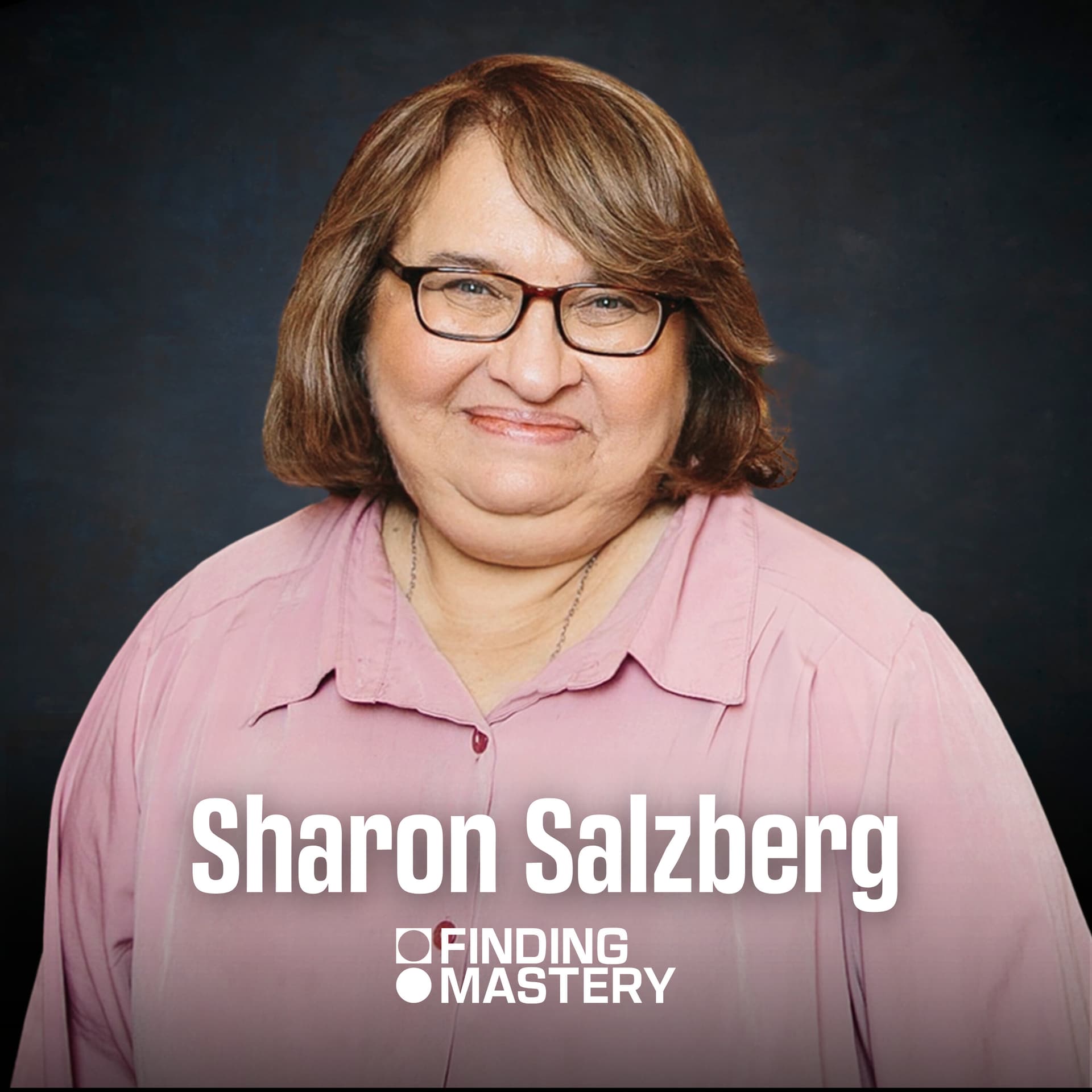
Sharon Salzberg is a leading teacher of wisdom, mindfulness, and loving-kindness meditation. She teaches loving-kindness meditation globally and has written books including Real Love and Real Change. She spent time isolated during COVID in Barre, Massachusetts, after health issues and retreat-center closures; she describes a long meditation journey beginning with training in Burma in 1985.
Key claims
Love is not merely a feeling but an ability you can cultivate from within. Hatred won’t cease by hatred; it ceases by love. Harsh self-criticism drains energy and undermines learning; kindness enables repair and success. Nonviolence is active, not passive, and anger can be “channeled” into action without reproducing hatred.
Notable examples
“May I be safe, may I be happy” phrase practice; blessing service workers in daily life; “pebble in the pond” metaphor (fill up with love, then share from heart to heart); activists learning to modulate anger; athletes/teams improving through connection rather than glory-hoarding.
Written by AI. May contain mistakes. Listen to the episode to check what was said.
Chapters
Tap a time to open that second in VOReintroducing Sharon Salzberg
0:03 to 1:05
Dr. Gervais welcomes Sharon Salzberg back to the podcast.
“Mastery because we know one great hire can change everything.”
Reintroducing Sharon Salzberg
2:24 to 2:55
Dr. Gervais welcomes Sharon Salzberg back to the podcast.
“With that, let's jump right into this week's conversation from the vault with Sharon Salzberg.”
Sharon's Insights on Love and the World
2:55 to 6:28
Sharon discusses her reflections on love and the current state of the world.
“And before we dive in, I'd just love to check in.”
Understanding Love as an Ability
6:28 to 9:00
Sharon shares her perspective on love as an ability rather than just a feeling.
“So you went in to say what is more true now than maybe I was available to understand before.”
Practicing Loving Kindness
9:00 to 13:14
Sharon and Dr. Gervais discuss the practice of loving kindness meditation.
“Was love or compassion really that stupid or saccharine or weakening?”
The Importance of Craft and Quality
14:02 to 15:15
Explore the dedication to craft and how quality compounds over time.
“a deeper understanding of how things work.”
The Duality of Activism: Pacifism vs. Anger
16:45 to 20:54
Exploration of pacifism versus aggressive activism in effecting change.
“effort and excellence that it's very confusing when you're in that culture to know, wait a minute, this is actually, this is not a standard of excellence.”
The Responsibility of Love in Action
20:54 to 24:28
Understanding how love can drive action and change without violence.
“And the editor of the manuscript said to me, you didn't finish the book.”
Channeling Outrage into Constructive Change
24:28 to 27:28
Strategies for transforming frustration into compassionate action.
“You've got 10 activists that are nonviolent, that are pacifists in approach, that are deeply trained in love and kindness.”
Practicing Loving Kindness Meditation
27:28 to 28:00
Learning about the classic loving kindness meditation technique.
Show all 25 chapters
Embracing Loving Kindness Meditation
28:00 to 30:24
Learn about a classic loving kindness meditation technique and its impact on self-perception.
“Can you share with me and the listener, like a best practice that you're really tuned to right now for loving kindness or connecting at a deeper level?”
Practicing Loving Kindness
32:06 to 34:02
Delve into the practical aspects of incorporating loving kindness into daily life.
“I mean, if I was sitting formally in a, you know, I wasn't at the supermarket or something like that, but I was in meditation, then I might sequentially offer some of those phrases to myself.”
Navigating Personal Challenges with Kindness
34:02 to 38:02
Understand the complexities of self-judgment and how loving kindness can help.
“of channels, paying attention to what we don't usually pay much attention to through the phrases, then we see what happens.”
The Inspiration Behind Real Life
38:02 to 41:11
Explore the motivations and themes behind Sharon Salzberg's book on interconnectedness and resilience.
“So let me just take it a little bit deeper for you here, which is for you, where does loving kindness come from?”
First Principles of Change
41:11 to 42:06
Discover the fundamental principles that guide personal and societal change.
“How are you thinking about some of the first principles that are most important to you?”
Exploring Personal Discernment and Gratitude
42:06 to 46:06
Learn how personal discernment can reshape perceptions of competition and gratitude.
“believing something because somebody impressive had said it.”
Mindfulness in Competitive Environments
46:07 to 49:55
Discover the role of mindfulness in fostering connection and cooperation among competitors.
“And let's just say there's 25 gals and you're going to talk to them and they want to be better.”
Mindfulness in Competitive Environments
51:04 to 51:14
Discover the role of mindfulness in fostering connection and cooperation among competitors.
“Again, that's sunlighten.com and use the code mastery for up to$2 ,100 off.”
Sharing Knowledge in Competitive Settings
51:15 to 56:00
Investigate how sharing knowledge can enhance personal and team success in competitive fields.
“And in a quarterback room, there's usually two quarterbacks.”
The Journey Back to Innocence
56:00 to 57:30
Exploring the importance of returning to a state of innocence and vulnerability in personal growth.
“So I'm mixing metaphors poorly, but I hope I'm driving the point home.”
Meditation and Embracing Vulnerability
57:30 to 59:50
Discussing how meditation practices can help embrace vulnerability and deal with fear.
“And if you can't get it right, there's a risk that you might have to sit for a while.”
Childhood Patterns and Present Reflections
59:50 to 1:02:00
Reflecting on childhood experiences and how they shape our responses to fear and uncertainty.
“I was living with my grandparents, my father's parents, whom I barely knew.”
Understanding Suffering and Its Dimensions
1:02:00 to 1:04:20
Examining the concept of suffering and its complexities in personal experiences.
“Because the initial pattern was to tighten up.”
The Power of Connection and Community
1:04:20 to 1:06:10
Discussing the potential for growth and community connection in addressing individual struggles.
“I would say, well, going back to real life, that sense of feeling trapped and feeling not just that the circumstances are difficult and not that it's only that I'm hurting, but it's hurting plus all that other stuff.”
Quick Hits: Insights from Sharon Salzberg
1:06:10 to 1:08:10
Rapid-fire questions and responses that provide insights into loving kindness and personal values.
Transcript
Automatic transcript. May contain errors.0:00Dr. Michael Gervais:Finding Mastery is brought to you by LinkedIn. We use LinkedIn Hiring Pro here at Finding Mastery because we know one great hire can change everything. One bad hire, it can cost you a lot, way more than time. It can cost you momentum and culture and real dollars. And that's why how you hire matters just as much as who you hire. And it's why I've become a big believer in the power of LinkedIn Hiring Pro. Here's what I appreciate about it. When you're running lean, you don't have hours to sift through a pile of resumes hoping to find the right person somewhere in the stack. Hiring Pro is built exactly for that reality.
0:32Dr. Michael Gervais:You describe the role and it screens candidates for you, surfacing the people who are a best fit so that you can spend your time and conversations with those folks rather than in the weeds of the applications. And the results back it up. Those hiring with LinkedIn are 24 % less likely to need to reopen a role within 12 months compared to the leading competitor. So join 2.7 million small businesses already using LinkedIn to hire. Host your job for free at linkedin.com slash mastery. Terms and conditions apply. Again, that's linkedin.com slash mastery to post your job for free. What if the greatest gift you could offer this season isn't something you buy, rather the way you choose to meet yourself and others with kindness?
1:13Dr. Michael Gervais:Welcome back, or welcome to the Finding Mastery podcast, where we dive into the minds of the world's greatest thinkers and doers. I'm your host, Dr. Michael Gervais. By trade and training, a high-performance psychologist. The idea behind these conversations is simple. It's to sit with the extraordinaries and to learn, to really learn how they work from the inside out. This is not about hacks or shortcuts. It's about what they're searching for, how they organize their inner life, and the skills they've used to shape their craft and themselves. As we pause new releases over the holidays, the Finding Mastery team, we're taking time to rest and reflect and to be with our loved ones.
1:53Dr. Michael Gervais:We believe that relationships are part of the practice of mastery itself. So today, we are re-releasing a powerful episode from the Finding Mastery Vault, a conversation with the Sharon Salzberg, one of the world's leading teachers of wisdom, mindfulness, and loving-kindness meditation. Her lessons are as relevant now as they were when we first shared this conversation, maybe even more so in a world that could use a lot more gentleness right now. So, happy holidays from all of us here at Finding Mastery. With that, let's jump right into this week's conversation from the vault with Sharon Salzberg.
2:36Dr. Michael Gervais:Sharon, I am so excited to have you back on the podcast. Our previous conversation is an audience favorite. And when people ask me, like, what is one of your favorite conversations? I definitely point to yours. And it was episode 101. one. And so I'm so excited to be back with you today. And before we dive in, I'd just love to check in. How are you? I'm really well. Thank you. I've spent the last four years fairly isolated, actually, because of various health issues. And I'm sort of in an emerging process. It's very Very interesting. Yeah, there you go. Okay. So it's been over six years since we last spoke.
3:22Dr. Michael Gervais:Wow. I was going to ask, what episode number are you up to now? Yeah, it's like we're in the 400s. Wow. I know, six years just flew by. So in our last conversation, we talked about being present. We talked about letting go. You went pretty deep on compassion. And a lot has happened since then. The world is now wrestling with very different challenges in some respects. What are you feeling? What are you experiencing when it comes to the state of the world right now? That's a complex question. Well, in March of 2020, I came up here to Barry, Massachusetts, where I am now. I'd spent February just traveling around teaching as I usually did.
4:13I went back to New York City where I was also living part-time. And the city was just in a very distressing state. People were getting sick. People's parents were getting sick. Anxiety was through the roof. And I had the thought, you know, I'll go up to Barry where I have a house and a retreat center for a couple of weeks. And I'll ride it out. And then it'll all be over. And I can just pick up my life as it had been. And some time later, I realized that was not going to happen. and the retreat center had to close down. And I was very strictly isolated and teaching only online. And everything was different.
4:52Expectations had been shattered and plans were changed. And the fundamental question I kept asking myself was, what's still true? Like, what am I counting on? In the midst of all of this change and disruption, what do I still trust? What do I believe is kind of an underlying truth? And I really looked deeply at that question. And part of my answer was, of course, my meditation practice, which I'm sure we'll get into. And also my belief, the way the Buddha said it, you know, later echoed by Martin Luther King Jr. and many sage people was hatred will never cease by hatred. Hatred will only cease by love.
5:36This is an eternal law. And in terms of the Buddha, I always thought, well, that's kind of weird because he talked so much about impermanence and change and like this is an eternal law. And not that I find that easy to access in every situation, but I really, really fundamentally believe it's true. And so as I look at the world now where hatred seems to be on the rise and there's so much division and distrust and people feeling so alone and all of that, I keep coming back to that, that maybe it's more love even though it sounds stupid in a way. It's not meant to be saccharine or covering over difficulty, but maybe that's really a path that needs to be followed.
6:28Dr. Michael Gervais:So you went in to say what is more true now than maybe I was available to understand before. And this idea that we're going to work with hatred through love, we're going to over-index on love to create the change that we want. Is that a fundamental truth for you that came up from you? Or is that something that you were inspired by and metabolized, inspired by the Buddha or Dr. King Jr., and then metabolized it kind of a top-down? Or was it a bottom-up? I think it was both, if something could be bi-directional in that way. I wrote a book some years ago called Real Love. and I teach, as I'm sure you know, a lot of loving kindness meditation.
7:18And I've had translators and scholars say to me, like, stop being so cutesy. Why call it loving kindness? Just call it love. That's what you mean. But that is such a complex term. Like, what do we mean when we say love? And one of the things I based the book on was this quotation from a movie called Dan in Real Life, which came out maybe like 12 years ago. And the line, one of the characters says is, love is not a feeling, it's an ability. Love is not a feeling, it's an ability. And of course, it is a feeling and maybe the feeling we long for. But I really pondered, what does it mean that love is an ability?
8:02And I realized that as long as I thought of it as certainly a narrow range of feeling. It was almost like a commodity, and it was also in the hands of someone else. They could give it to me. They could also take it away from me. And I would get this image of the UPS person standing at my doorstep with this package and looking down at the address and saying, I don't think so, and going somewhere else. I'd say, wait a minute. Then there's no love in my life. But if it's an ability, it's inside of me. Other people certainly may inspire it or ignite it or threaten it, but ultimately it is mine to nurture, to bring forth if I wanted to.
8:41And that was very important. And that matched my own experiences as I went deeper, looking at my own life, which is basically what one does in meditation and looking at what strength really is, not what maybe I've been taught it was, what success really was, maybe not what I've been taught it was. Was love or compassion really that stupid or saccharine or weakening? Was vengefulness really that strengthening? And all those things had come up in the course of meditation, and I found that line to be a perfect match. Okay.
9:20Dr. Michael Gervais:So there's so much in here to open up. One is, I think it makes sense for us to talk about how you practice. So I do want to give some space for that. I also want to just nod, like when I say loving kindness, and it is a foundational practice for me as well, that I find the word kindness allows me to say it more easily publicly. So I'm not sure that's what you experience necessarily. But when I say to a group of athletes or a group of executives, like, okay, look, what you just experienced, I usually give them an experience if I'm training and then explain it afterwards. And I'll say that kind of the ending bit was a loving kindness meditation.
10:07Dr. Michael Gervais:And the way that it just feels like people go, oh, I can do kindness for me. Wait, you want me to do love for others? All of a sudden it changes the tonality. Yes, I do. But first, maybe we need to eat, figure out how to get the vegetables in the palette. So is that kind of what you're pointing to when you were, why you liked to add kindness? And maybe some of your wisdom counsel said, can you just drop that? Yeah, well, loving kindness is a classical translation of words in Sanskrit, for example. So it's the common usage. My concern about kindness in itself could be better than loving kindness, but my concern about it is that the term loving kindness is not something we necessarily use or hear in casual conversation.
11:00And it might make the quality seem a little archaic or arcane or precious in the negative sense of the word. And there's already so much negativity around it. The word I tend to use is connection. And it's not necessarily an emotion of warmth, but it's a bone deep recognition of how connected all of our lives are. So my favorite question going into an organization or a company to teach is how many other people need to be doing their job well for you to do your job well? Because this moment often of like, oh, you know, I'm actually counting on, I'm relying on all these other people, some of them I never see maybe, and they may be relying on me and that we live in this interconnected universe and i think that brings people closer to an appreciation of what's really meant by loving kindness
11:58Dr. Michael Gervais:i'm nodding my head and to me those feel obviously all things are related in a relatedness as a first principle but that feels related but different for me let's just start with self kindness to self loving kindness to self love to self feels very different um well hold on there's a there's a experience there that um i'm not going to find the right words right now but there's an experience there that is felt and then when i extend that to other people kindness to another loving kindness to another or love to another that that feels very different than being connected like the being connected is rich.
12:46Dr. Michael Gervais:Another first principle of interconnectedness, I think we both nod our heads to it, but they feel different to me. I think they could be distinguished, for sure. Distinguished is a good word. I think that's a good distinction, but also related. Of course related, yeah. And so the kindness toward oneself in a way is also based on a deeper understanding of how do we achieve in a better way. We might think ferocious, endless, harsh self-criticism is the way to change a habit or make an improvement or learn a new skill. But I think either clarity of introspection or studies, research will show that it doesn't really work.
13:34It's such a tremendous drain and it's a diversion and we end up depleted and feeling demoralized. Whereas some kind of kindness toward ourselves, kind of giving ourselves a break. Yeah, yeah, I blew it. Now let me move on. Let me not spend this time in endless recrimination, calling myself a failure and so on. That's really the way to succeed in something. And so I think we can be emboldened and inspired to pursue that as a really almost like a kind of a deeper understanding of how things work.
14:40Dr. Michael Gervais:and they look sharp, full stop. They've spent 20 years obsessed with getting this product right. And that kind of long-term commitment to craft, that's something we talk a lot about here at Finding Mastery. Quality compounds. The right inputs may consistently over time show up in everything. And you can feel that the moment you put these on. If you're ready to upgrade your denim with something that's genuinely built to last, it's time to upgrade your denim with rag and bone. For a limited time, our listeners get 20 % off their entire order with the code finding mastery at rag-bone.com. That's 20 % off at rag-bone.com with the promo code Finding Mastery.
15:17Dr. Michael Gervais:And when they ask you where you heard about them, please support our community and this show and let them know that we sent you. Finding Mastery is brought to you by our flagship mindset training course, Finding Your Best. Anytime you feel the pull to reset, to zoom out, to refocus and ask, am I moving toward the person I want to become? It helps to remember this. Lasting change comes from training. Not resolutions, not short-term sprints, but deliberate practice of the skills that shape how we show up. In work, in relationships, and in the moments of great intensity as well. That's what finding your best is all about.
15:50Dr. Michael Gervais:It's a science-backed framework for training your mind. And it's the same set of tools that we've taught to Olympic athletes, top executives, elite military teams, and artists at the peak of their craft. In this course, you'll learn the foundational psychological skills to be your very best. Full stop. And the best part is, you can start anytime. Right now, we're running a limited time offer on finding your best. Simply head to findingmastery.com slash course and use the code RENEW100 to get$100 off your registration. If you've been waiting for the right moment, this is a good one now to lean into.
16:21Dr. Michael Gervais:Spring and summer, they are powerful seasons of momentum. It's a great natural time to step into growth, to refocus, to recommit to who you want to become. And this discount will not be around for long. So go to findingmastery.com slash course code renew100 for$100 off today because your future is not shaped by what you intend. It's shaped by what you train. In a transactional, performance-based, high-speed, competitive environment, there's enough anxiety and intolerance and masquerading as high effort and excellence that it's very confusing when you're in that culture to know, wait a minute, this is actually, this is not a standard of excellence.
17:13Dr. Michael Gervais:this is a standard of intolerance that that's not good enough versus we can go further we can do more there's more in you and look i'm not going to sugarcoat it you need to trust yourself you need to work harder you need to study more you so there's a difference it's a fine line that you can palpate quite clearly and i'd like to think i can but but the idea of as an inoculation or a hydration for people to flourish, even in these high-speed environments, it seems so counterintuitive to say, okay, everybody, in this high-speed world, we're going to take a moment and I see you smiling. We're going to take a moment and we're going to connect to our breath and we're going to do a loving kindness meditation so we're better teammates you know the looks that i get shared the looks that i get in these environments is like okay so i don't even tell them like hey listen we're gonna do some inner work uh we all understand that the inner part of the game is really important and you know psychology is a study of self so we're gonna we're gonna create some space so you can study and not critique and judge but just learn and then and then all of a sudden um you know we're like, I don't know, eight minutes in, I'm like, okay, fill up with loving kindness.
18:42And afterwards we were like, I didn't know how to do that.
18:45Dr. Michael Gervais:What did you mean? So I do want to ask like mechanically how you're teaching right now. Like, I don't want to butcher the spirit of all your wisdom, but I think it's a great service like mechanically, how do you walk people through creating enough space to be able to be connected, to use your language, or to fill up is the way I think about it with love and kindness so that you can be better. Now, before we get into the mechanics, though, I can't wait to see what you do with this thought. Okay. Dr. King Jr., amazing. Nelson Mandela, amazing. Okay. So I can go down the list of some really amazing people.
19:28Dr. Michael Gervais:And the pacifists, compared to the revolutionists that used anger and used violence and used weapons and used fill in the blanks. I think history would say that they got more change, but maybe not. But that change has led us to the state we're in now. And the pacifist, the loving kind, hey, I'm going to stand for something and I might die starving for it and I'm going to pound my fist saying that we're not going to use violence as a means, not violence in words, not violence in actions. I just think history says you don't get the change that you would hope for. And I would love for you to help me because that bangs around in my head.
20:25Dr. Michael Gervais:I take a, if there's a spider in my house, I pick it up and bring it outside. okay i'm no longer eating red meat because i want to pet cows and pigs okay i haven't done that with fish yet i'm just saying all right but anyway so i i'm i am a pacifist in approach but i um i struggle with the change that the pacifist approach um doesn't seem to get and so i can you help from a wise place well i find it a little bit puzzling that the two examples that you used of you know dr king jr and nelson mandela i mean they were pretty effective you know they were they were the big one they were the you know all these years later like the term pacifists i understand the way you're using it but it doesn't mean like placid you know like lying around waiting for change to happen from somebody else you know oh very active yeah and in fact you know when i wrote that book, Real Love, based on the statement, love is not a feeling, it's an ability.
21:31And I turned it in to the publisher. And the editor of the manuscript said to me, you didn't finish the book. And I said, what do you mean I didn't finish the book? Of course, I finished the book. That's why I turned it in. And she said, no, no, you told some story, and then you drifted off into nowhere. Like, you've got to finish the book. So I could not I finished that book and I struggled and struggled and struggled. And then something, you know, happened in the world. I was very concerned about and I finished the book in 15 minutes, which was basically my realizing if love is an ability, maybe it's my responsibility.
22:07And that emboldened by that responsibility, maybe I needed to take action, not from hatred and not from a sense of bitterness or, or vengefulness, but fueled by kind of a power of love because it's, very powerful, actually, in those two examples, at least at certain places in their life, and where Nelson Mandela came to. We're still talking about it today. And so, it doesn't mean being passive.
22:39Dr. Michael Gervais:No, not passive in approach. Yeah. Nonviolent is another word for pacifism, right? Yeah, between them or Gandhi or these people. I wouldn't say I had that much courage to protest in that way. But also, talking to activists. I spent quite a lot of my teaching, my meditation teaching, trying to work with caregivers, people who in some ways are on the front lines of suffering, trying to help either a family member or professionally, the way they work, the populations they work with. And one day I thought, who do they remind me of. And I thought, oh, activists, you know, really a very similar kind of dynamic, you know, helping others, often not feeling very comfortable receiving so much as giving, things like that.
23:35So I spent much more time, you know, listening to and talking to activists. And something that I really saw from a lot of people was that so much of their original motivation, maybe inevitably, was anger. It was outrage. They saw terrible, terrible things maybe in their community and they made a move. They weren't lying down. But as one woman said to me, she said, you know, the anger kind of got me up and I founded this organization and I worked. And then she said, and then it was killing me. She said, you know, nobody knew how to dial it down. Like my whole organization was full of backbiting and enmity and toward one another.
24:18And she said, I've got to learn how to modulate this so that it's not running me. And then she went off and became like a meditation teacher or whatever. So it's just fascinating to understand our motives and what really will strengthen us to make change.
24:36Dr. Michael Gervais:Scenario. You've got 10 activists that are nonviolent, that are pacifists in approach, that are deeply trained in love and kindness. And then you've got 10 activists that are whatever it takes. And I'm effing pissed. And if you knew what happened to my child, if you knew what happened to me when I was a child, you wouldn't operate the way you are. And we've got 10 of them. Okay. And they're like, we're changing. Those people are evil and bad. And we have to, we owe it to the next generation to take the hill and to get to eradicate this evil okay two very different philosophies both working to want a better life you had 10 on one side and 10 on the other who would you want to pick to create the change in the world well and certainly the pacifist because for all i know the other people would consider me the enemy right um that wouldn't be a very happy solution for me in terms of my abiding in a more peaceful world so i line up i i feel like i'm straddling the middle i like the energy of like no we got to get something done and i love the approach which is like wait hold on we need to work from benevolence and we need to see the good in people rather than the evil or the whatever like and i know I'm doing a non-duality here thing.
26:08So I get straddled between the energy of one,
26:12Dr. Michael Gervais:and what scares me is that that energy, if they are successful, what they know is hate and anger. So when they're at the top of the hill, they'll only know how to reproduce hate and anger. It's either a new hill or they turn on each other, right? Game of Thrones once they're in power. And the other is on the pacifist, which is I lean toward, which is, I don't know if we're just going to hold hands and we're going to be really nice to each other. Oh, well, yeah. I mean, I think I have another book I wrote, which I recommend to you, which is called Real Change, where I did spend a lot of time interviewing activists and people who were not just holding hands.
26:52People were working hard and fiercely, not just kind of like meekly, Like, please change, you know, but not violently and motivated by a sense of connection. And so I think I love that energy that you're describing. If we've got to get something done, you know, like let's channel that outrage and that frustration and impatience into action. That's tremendous. But I think one can get there from love and compassion. And I think there are many examples of people who have. so that's i'm let me resolve your problem let me resolve all of it do both but drop the anger
27:35Dr. Michael Gervais:yeah implant it with love yeah so i i want to see it i want to be the change and i want to see change and i'm tripled down on loving kindness as an approach and where i think myself and the listener might identify which is like but sometimes i get intolerant sometimes i'm impatient and sometimes like, you know, I just get frustrated and I don't want to, and I want to repair quickly, but it gets the best of me. So I got to keep working. Okay. So maybe that we can open the aperture. Can you share with me and the listener, like a best practice that you're really tuned to right now for loving kindness or connecting at a deeper level?
28:22Well, I actually like the very classic loving kindness meditation I learned in Burma in 1985, where I went there to do a three month intensive retreat. And it's basically settling one's attention on repeating certain phrases, usually silently, because the phrases are a way of paying attention differently. It's like at the end of the day, for example, with oneself, if you are in the habit of just going over and over and over and over all the mistakes you made and the words you flubbed and, you know, the ways you didn't show up in the way you had hoped to. And you just go over and over and over.
29:01It's like the same list usually, but again. And instead of doing that, we kind of change channels and for a few moments wish ourselves well. May I be safe, be happy. It's like offering a blessing or caring. It's almost like asking yourself, anything else happened today, you know, other than this litany of all my mistakes, all my flaws. So it's a way of paying attention differently to use these phrases or think of the many, many people we encounter in our lives who perform some kind of service, you know, checkout person in the supermarket or dry cleaner or somebody like that, that we tend to objectify.
Read the full transcript
29:41We tend to look through instead of look at. And so the challenge is not to try to create a phony emotion or fabricate anything, but to in effect look at them and see what happens when you silently repeat, may you be safe, be happy, may your life unfold in a better way or a good way or something like that silently. I mean, you're in the store. What does it mean?
30:09Dr. Michael Gervais:Oh, in the store. Yeah. So that's like a thin slice, quote unquote, mantra or framing or reminder, you know, and but the work, let's say you've got eight minutes of work that you're going to do or 20 minutes of work. So how do you structure that work? Body Mastery is brought to you by Fatty 15. Did you know that Navy Dolphins helped unlock a secret to healthy aging? It's a wild story. And it's the foundation for a product that I've come to really love. Fatty 15. Fatty 15 is built around C15, the first essential fatty acid discovered in over 90 years. And it was discovered by Dr. Stephanie Van Watson.
30:47Dr. Michael Gervais:She's the co-founder of Fatty 15 while she was working with the U.S. Navy. And based on over 100 studies, we now know that C15 strengthens our cells and is foundational for healthy aging at the cellular level. Stephanie's been on the podcast and it was one of my favorite conversations. She's amazing. And what her and her team are building is something I'm really excited about. Head to fatty15.com slash finding mastery and use the code finding mastery for an additional 15 % off your 90-day starter kit. Again, that's fatty, F-A-T-T-Y, 1-5.com slash finding mastery, and the code is finding mastery.
31:23Dr. Michael Gervais:I want to take a second here to tell you about a morning routine that I've been using for years. For me, it's a great way to switch on my mind, to ready myself to take on the day. So before I check my phone, my emails, market updates, or text threads, I choose how to start my morning. That's always in my control. That's always in your control too. This is the same morning mindset routine that some of the world's top performers across sport, business, and the arts are using. The best part? It only takes about 90 seconds to do. So just head over to FindingMastery.com slash morning to download the audio guide for free.
31:58Dr. Michael Gervais:Again, head to findingmastery.com slash morning to get your morning mindset routine. That's what I would do. I mean, if I was sitting formally in a, you know, I wasn't at the supermarket or something like that, but I was in meditation, then I might sequentially offer some of those phrases to myself. It's like having a sense of aspiration that's not blunted and a sense of blessing. and it is just changing channels and then seeing what happens um and then maybe uh someone who's okay sorry sorry to interrupt so you'll you'll start with some sort of grounding some sort of breathing to just settle in yeah right and that takes a couple moments that takes like 10 for me you know so okay quiet the system down and then you go into um the mantra that or the phraseology that you just talked to.
32:55Dr. Michael Gervais:Yeah, the phrase is for myself. And then maybe somebody I feel grateful to. And often we don't recognize these people much. You know, we take people for granted. But we call someone to mind that kind of lifts our spirits. They've helped us in some way, even if we've never met them. They're like an inspiration. And then maybe someone who's in trouble, you know, a friend of ours who's struggling. And then we usually end, this is eight minutes. This is the eight minute version. Yes, yes. You know, we might end with a couple of moments toward just thinking about the world and recognizing that force of interconnection, just wishing peace or harmony, whatever it is, for the world.
33:41And it's like an experiment, which is usually the way I describe it. You know, it doesn't feel good when it feels forced or coerced or you got to have a certain emotion and, you know, it's just too gooey. But when I conceptualize it and describe it as that kind of experiment, that switching of channels, paying attention to what we don't usually pay much attention to through the phrases, then we see what happens.
34:16Dr. Michael Gervais:okay i love the mini experimentation try it out try it and see and um i'd love for you to this is how i first learned it and i don't think i have a lot of variation to offer this conversation but i the way i first learned it this was like it was like 25 years ago and one of my mentors said he didn't tell me what we're doing this is my tactic that I learned from one of my mentors. And he says, he used this metaphor of pebble in the pond. He says, just fill up with love. I don't know how you do that, Mike. Close your eyes. You know, it was kind of tactical in this approach. He says, just take a moment and fill up with love.
34:57Dr. Michael Gervais:Maybe you're going to thank yourself. Maybe you're going to just kind of connect to a spiritual something, but just fill up however you do that. And he'd give me time and then I'd be distracted and I'd come back and get distracted. And then, you know, as I do it over and over again, meaning days at a time or whatever. I get more familiar with how to fill up. And then from that, call it all loving connection or as best as I possibly can. Then he says, why don't you share it with somebody, one person? I go, okay, cool. So this is a phrasing I use, from my heart to your heart. And so I got to be pretty concrete.
35:31Dr. Michael Gervais:From my heart to your heart. My eyes are closed. I'm not looking at a person. They don't need to be in the room, but from my heart to your heart. And then I'm trying to take that good stuff in me and pour into them. Okay. And then, and then I go to another person and another person and I get tired. I go, wait, that's right. Come on back. I go to another person and then the pebble. So that's my inner circle. Then the, the, the bigger circle, like in the middle of the external circles is like people that I feel burned by and boy, that's hard people that I, I, you know, I don't want to give love to right now, you know, and that's a really, I want to stop before I get to that ring or I want to skip over that one and get to like, let me just share love with the world.
36:14Dr. Michael Gervais:But that's the sticky one. Do you have a sticky one for you? And I'm not suggesting everyone do this. That might be too traumatizing, might be too fill the blanks for some folks, but that's the one I find to be really tricky for me. No, I think it's tricky for a lot of people. And the reason I, I mean, I appreciate the way you practiced. I think it's a great way of practicing loving kindness. And it's a little similar to my very first teacher who was S. N. Goenka in India, did something a little bit similar to that. It was only later that I had teachers who really emphasized things like phrases.
36:55And what strikes me is that, you know, for me, as self-judgmental as I was, which was really crazy, it was very hard for me you know like fill up with love I would think I'm not doing it right this isn't really love everyone else feels love I don't feel any love where's the love I am broken I'm broken I'm so bad you know so for me and people like me you know something like phrases which is very systematic I see it's structured and you know as you know of course people learn differently and flourish differently based on their relationship to those systems or methods and different ones are more appropriate.
37:41So I'd say the challenge for me was myself. I mean, not that enemies or difficult people were not challenging, but I'd say the biggest challenge was really myself.
37:52Dr. Michael Gervais:I'm this empty vessel, pushing so hard in this world and trying so hard that I don't know how to do this. Yeah. Is that? Yeah. Yeah. Okay. So let me just take it a little bit deeper for you here, which is for you, where does loving kindness come from? I think it's not, we say cultivation, but it's not cultivation in the ordinary sense. I think it's getting in touch with a capacity and ability within myself that certainly in My earlier life was very covered over. I was so frightened. And I'd had a very traumatic childhood. And I was very fragmented when I went to India. I felt very fragmented. And I kind of knit myself back together through the meditation and discovered these, I mean, you used the word resource earlier.
38:47You know, I discovered resources within myself. I discovered repositories of connection and care that I had no idea were really there. So I don't want to imply I'm in touch with them all the time, even 50 years of practice later. But I have a trust in that ability that I didn't used to have.
39:10Dr. Michael Gervais:In your new book, your most recent book, I should say, Real Life. I love the subtitle as well, The Journey from Isolation to Openness and Freedom. Well done. You talk about navigating different seasons of life. And can you point to why you wrote this book? Well, I wrote the book deep in my isolation because I ended up in Barry, Massachusetts, not just for two weeks, but for months and months and months. My first book was called Loving Kindness. And after that came out, somebody said to me, what do you write next if you want to keep writing? and your first book represented your life's work. And I said, well, I guess you have to go deeper.
40:02And so here I was with this time and the publisher had asked me if I wanted to write another book. And I thought, okay, what's deeper? You know, instead of just writing something and dashing it off. And I thought, well, really it is those fundamental questions of how do I create a life, you know, and not just feel I have no agency and that here I am, external circumstances could really dictate everything about how I feel, but it doesn't have to, even in this odd experience. And I did have a repository within me that I could bring forth. And physical isolation, I realized, did not have to mean at all a sense of being severed from caring.
40:54about kind of the bigger picture of life. And I belonged. I was a part of things. Everyone is. And that's been kind of a theme in everything I have written or cared about. And so I thought, okay, why not make it explicit instead of implicit and write a book about it?
41:11Dr. Michael Gervais:How are you thinking about some of the first principles that are most important to you? You've mentioned interconnectedness. We're all connected. um what are the other ones i think you mentioned i think if i have the language right um that we need to work from love as a first principle to create the change in the world we would want and then you know i don't want to put words in your mouth but i'm imagining that uh you would another first principle would be impermanence like all things are temporary um can you open this up a little bit to the most important first principles for you I think all of that.
41:52Thank you. And also some sense of discernment, like understanding, like we can understand for ourselves, which I found my first experience of meditation in India. I found breathtaking that it wasn't just following somebody else's ideas or, you know, believing something because somebody impressive had said it. But really, oh, I can take a look. I can look at what makes me feel stronger, what makes me, in fact, weaker, even if it was completely opposite from everything I've been taught my entire life. And we can look, we can understand. And so I think that that has been such a gift because when I see those repetitive patterns, you know, of my favorite kind of example is it's a dog-eat dog world.
42:47Like, don't help anybody else because they're not going to help you. The consequence of which is that we actually, of course, don't feel stronger. We feel incredibly lonely and competitive when we don't need to be and, you know, all of that. And so the idea that we can look, and I'll call it discernment, and we can discover for ourselves really where our greater happiness and flourishing can lie, I think is something I always go back to.
43:17Dr. Michael Gervais:So dog-eat-dog world, is the world safe or hostile for sharing? For me, I actually don't think in those terms. I don't call it safe, and it isn't necessarily hostile. Is it dangerous or safe? Sometimes. It's both? I mean, people say that that's, you know, our negativity bias to only fixate on the danger, the threat, you know, that's an evolutionary trait, but it's so limiting. I mean, that's why, you know, people think something like a gratitude practice is so ridiculous. And if you practice gratitude, you're going to be grateful for crumbs and you're not going to seek, you know, powerful change and all of that.
44:03But in talking to researchers, for example, which I've done from my own writing about gratitude, and they say, well, you know, it's really different. Like if you practice gratitude and you don't only fixate on the danger and what's wrong and what you're not getting and what you've lost, then first of all, you have a sense of resource. You're not so exhausted. And you can use that energy to try to make change. And also they said people who practice gratitude have a real desire to pay it forward. They want to see someone else get a break or do well. And so it's an activator, actually. It's not something that holds us back.
44:47But we have to really pay attention and make those experiments in order to see, oh, what is the result of obsessing in this way? And what's the result of just stepping out of my normal way of perceiving and looking from another angle?
45:06Do you think, like if you were in a locker room with a group of competitive athletes, and they're just kind of operating in a competitive way based on, let's say, the Western model of competition.
45:20Dr. Michael Gervais:And it's probably split, I don't know, 60-40. Maybe I'm being too nice here. 60 % are like, no, I'm trying to be my best. And 40%, I'm sorry, 60 % are saying, I'm trying to be the best. And 40 % are saying, no, I'm just trying to be my best. And I'm competing with myself, you know, in the long game of life. And I'm using the current phase I'm in right now of sport to unlock a deeper part of me and more committed part of me and how to be better connected to other people. So they're like in a highly competitive, quote unquote, dog eat dog world, but they're choosing maybe a counter rotation to give them a competitive advantage, but also they're playing the long game.
46:04Dr. Michael Gervais:They know that sport is limited in at least elite sport. And let's just say there's 25 gals and you're going to talk to them and they want to be better. how would you help them um understand the power of mindfulness would you go to discernment because i think it gets really tricky when you say listen the big game of life it's so impermanent all things are changing i want to help you get better with the unfolding present moment that you know that i i go there sometimes i don't go to um the non-duality approach i think for me, it's still a mind bender. And the interconnectedness seems too far of a leap to say we're actually connected to our competitors.
46:52Let's thank them for sharpening their sword or
46:57Dr. Michael Gervais:honing their craft if we're not going to use a military warframe or a martial term. So how would you walk into a room that's kind of split between the two and offer them something that will help them now and likely could help them later as well? Well, I might go the interconnected route, but not with the competitors. I think it's a challenge for so many to even have that sense of being part of a team, right? You would go interconnected with us in this room? Yeah, because then one also faces a lot of the feeling the need to claim all glory for oneself. But do you actually win that way? You know, and I'm assuming there's a fair amount of research on success within sports and feeling more part of a team and how it doesn't necessarily dull your sense of personal excellence.
47:51You know, you're not saying, yeah, the other guy is going to take care of it or the other woman is going to take care of it. You know, I don't have to continue to improve. It's not like that. And so I think the first thing to establish is that we all want the same thing, which is success and a real sense of kind of not compromising so much for success that we end up just in a way broken or not getting what we really want in the long term. Like, how do we sustain an effort? And I do think I would probably start with that sense of connection with one another.
48:53Dr. Michael Gervais:One of them has raised the bar of how we operate here at Finding Mastery. Our relationship with LinkedIn, it also runs a lot deeper than just using their tools. We also work with their teams on the corporate side, helping them build the kind of high-performance culture where great people want to stay. They want to grow. I've been building businesses for over two decades now, and I'll tell you, the right team, that matters so much. It's the difference between grinding and flowing. So this partnership, I believe in from the inside out. When you hire through a platform like LinkedIn Hiring Pro that surfaces people who are genuinely aligned with what you're building, you get a different quality of candidate.
49:30Dr. Michael Gervais:Not just in skills, but in fit and values. The kind of energy someone brings to a team. So if you're thinking about your next hire, I want to strongly encourage you to be intentional about where you look. The right person is out there and LinkedIn Hiring Pro helps you find them faster with a lot more confidence. Post your job for free at linkedin.com slash mastery. Terms and conditions apply. Again, that's linkedin.com slash mastery. Finding Mastery is brought to you by Sunlighten. I'm really excited about a new partner of ours. Something that I've come back to again and again is when I invest in recovery with the same intention that I bring to my work, everything gets better.
50:12Dr. Michael Gervais:My energy, my focus, my ability to show up fully for the people that I'm with and the work that I care about. That's why I am so bought in on the Sunlighten M-Pulse Intelligent Sauna. I was first introduced to their team a few months ago and was so impressed by what they've created. This is one of the most advanced infrared saunas that they've built in over 25 years of pioneering this technology. That's right. They've been at this game for 25 years. I had one installed in my home a few months ago, and it's made a real difference. I feel more refreshed, more grounded, more relaxed, and it's become a consistent part of how I recover, how I reset every day.
50:49Dr. Michael Gervais:I'm using it to support muscle recovery, for improved oxygen delivery, and for nervous system recovery. And what I love most, I don't have to leave my home. They're offering the Fonny Mastery community up to$2 ,100 off. Simply head to sunlighten.com and use the code mastery for this great discount. Again, that's sunlighten.com and use the code mastery for up to$2 ,100 off.
51:14Dr. Michael Gervais:If you, let's say, let's go to football, American football for a minute. And in a quarterback room, there's usually two quarterbacks. Sometimes there's three, but usually there's two quarterbacks. There's a starter and a backup. And then sometimes one more that's kind of waiting in the wings on what's called the practice team. So the starter is the starter. and that's the one getting paid a lot of money and is getting to do the thing at the highest level. And everyone else in that room is like really wanting that opportunity. So if your son or daughter in any case were the starter, would you suggest that they share their best practices with the two and the three?
52:01Dr. Michael Gervais:Would you suggest they help them study to be better so that if they were to go down or get hurt or not be able to get it done, that their teammate would be able to take their job and be better? Or would you suggest, look, you gotta be competitive now. Give some, but hold a little back so that you can ride this privileged position of being the starter. How would you approach something as material, as concrete that I think many of us can find ourselves in, in business, in sport, in the arts, you know, lots of different rooms, if you will. Well, I mean, you know, if I was working with discernment, I'd say, how does it feel when you hold, I mean, really just look, how does it feel when you have that sense of, I don't want you to take my glory, you know, so I'm going to hold on to this for as long as I can.
52:57How does it feel if you spend an afternoon kind of opening up and trying to bring someone else along? Because that's going to be the ultimate test, you know, if you end up, as many do, you know, incredibly alone feeling and holding on to something which is going to change. It's just not a very fulfilling. It's kind of a fear-filled life. and yeah but no one can tell you that it has to be your own perception how does it and the question
53:31Dr. Michael Gervais:is how does it feel yeah how does it feel when you hold back how does it feel when you give everything i think both can be fear-based um you know like if i give everything i'm afraid that they're going to use it against me i'm afraid that they're going to be better than me and take my job you know yeah but that you don't have to that's right of course you know that but But what if that was the challenge? I'm going to give them everything and I'm going to get even better. That's right. Because I've got such talent. And maybe that's the goad, not to in a bitter way or wrathful way, but like, okay, I've nurtured you, I've mentored you in this way, and now I'm going to vault even better.
54:17Dr. Michael Gervais:Yeah, right. Right. And actually what we do know is when you can teach somebody something, you have to have a better command of it. And the act of teaching gives you even more command, you know, because you have to explain it in a way that is clearly understood. You know, so it actually does give you an advantage when you're giving. So, okay, enough of the concreteness there. Thank you for that. Okay. Last time we spoke, you talked about committing, recommitting to innocence and returning to innocence. Do you remember that conversation? No, I don't. I'm so fascinated. Yeah. And it stuck with me for six years and you don't remember it, huh?
54:59Well, man, that's good because now I can be re-inspired by it. I think, what a beautiful thing. I'm going to recommit to innocence. It really was.
55:07Dr. Michael Gervais:It's like, my team will laugh, like things stick with me and a bunch just kind of washes over. And that one stuck with me. And I asked what you really want in life or what you're working on now. It was the question, what do you work on now? And you said returning to a sense of innocence. Wow. And I want that. But I also don't want to, what's the word? Like I don't want to be vulnerable in rooms that I don't want to be vulnerable in. And I've been working with this for six years now, okay? Okay. So this innocence and this doe, babe, deer type of thing has gotten a bit confusing when you're swimming or when you're fighting amongst wildebeest.
56:03Dr. Michael Gervais:So I'm mixing metaphors poorly, but I hope I'm driving the point home. I love that idea of returning to innocence. I'm going to adopt that again. Thank you so much for returning that to me. No, because I can feel it when I think about it or I feel into it. You know, it's like one of the things about success, you know, as I'm sure you know and have seen is that one can get kind of ossified and there's not that feeling of being a part of life and it's burgeoning change and opening. Like I remember my very first meditation retreat in January of 1971 in India and just settling my attention on the feeling of the breath.
56:42And it was like, wow, look at that. You could feel so much with a breath. And now I think we probably had the most boring conversations in the world. My in-breath was like trembling or whatever. But it was so exciting to be so full on and open. And we grow up and we get more sophisticated and maybe we're successful and holding an image. There are other people holding an image of us and we can lose that so easily. And I love that idea of just returning to that. And in terms of vulnerability, I think we are all enriched by allowing our vulnerability. That just means we have to express it in every room or in every relationship.
57:28I mean, there's some places where it just may not be appropriate, and we decide.
57:33Dr. Michael Gervais:Yeah. I also have such a high regard for the doers in the amphitheater, whatever it is, because they practice vulnerability risk-taking far more than most of us ever even think we want to and they practice it you know like elite athletes practice vulnerability every day and that i think that's hidden from plain sight because we see them on tv but we don't see them in practice in front of their coaches who determine if they're playing or not in front of their peers who are trying to take their job that they have to get to the edge of their capabilities make mistakes and be vulnerable to try again and to try in that messy edge again.
58:13Dr. Michael Gervais:And if you can't get it right, there's a risk that you might have to sit for a while. But that's the only way to get better, really, or progressively better. And that's one of the interesting things I've found about meditation practice, because in a way, you're doing the same thing again and again and again. Keep going. Yeah, keep going on that. If you're open, if you have that heart space of innocence, of vulnerability, then it's not rote. It's not repetitive. You always are on an edge. And you're exploring, and you're exploring different dimensions, and different things are opening up. And you're not just kind of saying the same words again.
58:52Or, oh, yeah, another breath. You're right. I've been here before. it is so vital and alive because of how we are approaching it, not because of the sheer repetition of the method.
59:05Dr. Michael Gervais:When you were a kid, let's go to like age six, and you heard you're in your room. Did you have a bedroom to yourself? Age six? No. No. Do you remember when you had a bedroom to yourself? Age nine. Nine. So at age nine, maybe it's a little easier at age nine anyway, and it's dark, it's 10 o 'clock at night, you're in bed, you're supposed to be asleep, but you're kind of awake, and you hear a sound, and you're not sure where it came from, but you think it was under your bed. Did you get really still and quiet did you throw the covers open and like pop your head under there and see what it was or did you run outside the door and go get help or something else i certainly didn't run outside to get help because i didn't think help was to be found and um i would get still and quiet but not in a sense of peace but because i was so scared exactly and felt so alone yeah how does those three pattern options and the one that you chose how does that show up in your life now and i'm going to tie this back to um loving kindness meditation in a minute i think i've come to see some of my you know deepest oldest patterns um as adaptive mechanisms you know things that made sense at the time when i was nine years old.
1:00:38My father had already left. My mother had died. I was living with my grandparents, my father's parents, whom I barely knew. I was really scared and I was very frozen. And so that's like my go-to place in uncertainty. But of course, 50 years of work later, um 50 years of meditation work and i'm not only 59 i'm older than that um but uh you know if i see that arise and i might you know it's it's not it's not sort of the only answer anymore by any means you know i can see it as a as a habit as a pattern and i think better of it you know in in cases it's not going to serve me or anybody else for me to like lie in that bed you know be frozen even though I will say the impulse may arise and I think we can be kind to ourselves in that regard instead of feeling you know so damaged or or those habits or you know we're born in being wrong or lazy or something like that they were often very smart at the time and in the circumstances in which we pick them up.
1:01:52But it's like, it's a lot of years later, I have a lot of options now, and I don't need to go there.
1:01:58Dr. Michael Gervais:And so in that optionality, that's what I'm wondering, when you get to that moment in meditation, when you could open the door, you could take your sheets off and go look, you know, that moment where you can get, when you go to explore an emotion or follow a thread and you know that there's something really deep, maybe scary, overwhelming right at the next breath or a couple breaths or however long it takes to follow this next felt emotion or thought pattern that you could fall into a thousand pieces, well up, whatever the thing might be that feels overwhelming. What do you do in those moments?
1:02:44Dr. Michael Gervais:Because the initial pattern was to tighten up. And by the way, that was mine as well. I wish I was saying i would jump out of bread jump out of bed and like be a dragon slayer at age nine that wasn't that just wasn't me so i i know the tightening up thing so i tighten up too sometimes when i'm at that moment to go explore the emotion um or not and so what do you do in that moment um i would probably pull up some some practice like just breathe just take a breath or uh I mean, there's so many ways in which we try to approach that fear, not calling it an enemy, feeling it in our body, surrounding it with a kind of kindness instead of feeling I'm so awful and I've got to get rid of this.
1:03:34I'm always still here. I've been meditating for 50 years. I've been in therapy forever. So mindfulness training, we say, look for the add-ons. It's hard enough to feel the fear and face the fear, but then we've got, this is going to last forever and I'm the only one who ever feels this and all the things we add on to it. And so I would really try to relinquish those add-ons, be with the feeling of fear, remember that it's maybe intense, but it's going to pass and try to be kind to myself anyway.
1:04:04Dr. Michael Gervais:Are you committed when you have that opening to take it? Or are you committed, but you don't take it as much as you would like? No, I feel like I'm committed because the ultimate answer is I don't really want to suffer. And how do you define suffering? I would say, well, going back to real life, that sense of feeling trapped and feeling not just that the circumstances are difficult and not that it's only that I'm hurting, but it's hurting plus all that other stuff. I'm the only one, it's going to last forever, this is all I'll ever feel. And it's just as things kind of condense, it becomes a pretty heavy burden to bear.
1:04:56Dr. Michael Gervais:What do you want for people? I want them to see how much ability they have, all of us, to grow and to change and to be happier, to love. And if we did that, how do you imagine the world or a community would be? I think it would be pretty different. You know, we wouldn't be so divided and that people would care about one another. And not in a fufu way, you know, wouldn't be fancy necessarily, but just a responsiveness to have a sense of we and really wanting happiness. Do you have that in your most intimate life and your most intimate community? Or is it something that feels elusive? I think we have it.
1:05:51I mean, I wouldn't say anyone's perfect, including myself. But I think it is a kind of, as you're saying, first principle. I think it's a common aspiration. And we come back to it. you know when we used the word i don't know if it's like recovery or return something earlier which i think is really the most important word return the returning to of innocence
1:06:14Dr. Michael Gervais:returning to innocence yeah um okay sharon this is awesome i would love to give you just a couple quick hits like some thought stems to see how you respond to them and it's kind of like a forcing function which maybe you maybe will be really hard you want to will not want to play but i'd love to i'd love to try it out it all comes down to awareness living the good life is marked by connection success is needs to be um explored i am happy my vision is to continue uh spreading this kind of possibility relationships are important yeah okay if you could sit with a master and ask that person one question who is it what's the question and where would you sit with them uh well i have had teachers you know for the last 50 years who i would consider masters and I had one woman teacher her name was Deepa Mauer Deepa's mother is kind of a nickname who was the person who told me to teach and at the time she told me I said I can't that's impossible I'll never be able to do that and she basically said to me a couple of things including you can do anything you want to do it's your thinking you can't do it that's going to stop you so I'd probably sit with her and say how did I do?
1:07:56Dr. Michael Gervais:mm that's something is there a word that you understand the most loving kindness it is yeah sharon thank you for how you showed up in this conversation how you continue to consistently show up in your writings and your teachings and um i just really appreciate the gift you gave me six years ago of a commitment to return to innocence. And thank you for your time today. It's awesome. Thank you so much. You actually literally returned the gift to me. And so now I'm carrying it in my heart. So it's beautiful. Yeah. What a gift back to me. All right, Sharon, thank you so much. And then we're going to obviously point people to your book.
1:08:44Dr. Michael Gervais:It's such an easy, good read. It's a delightful read, which I say for many of your books, some are more stimulating harder, but it's such a delightful, good read. And so where else can we point people to to check out your work or be part of what you're doing? Probably my website, which is just SharonSolisberg.com is the easiest. You got it. Sharon, I appreciate you. Thank you. Thank you.
1:09:14Dr. Michael Gervais:Next time on Finding Mastery. As we head toward the new year, we're sharing something meaningful from the Finding Mastery Vault. A conversation with Drs. John and Julie Gottman, two of the world's most respected researchers on love and lasting relationships. In this episode, they unpack the small daily habits that strengthen connection, the patterns that quietly erode it, and the science-backed practices that help us show up better for the people who matter most. It's a grounding, hopeful way to reflect on the year behind us and set intention for the one ahead. Join us Wednesday, December 31st at 9 a.m.
1:09:49Dr. Michael Gervais:Pacific for this From the Vault episode. And happy holidays from all of us here at Finding Mastery. All right. Thank you so much for diving into another episode of Finding Mastery with us. Our team loves creating this podcast and sharing these conversations with you. We really appreciate you being part of this community. And if you're enjoying the show, the easiest no-cost way to support is to hit the subscribe or follow button wherever you're listening. Also, if you haven't already, please consider dropping us a review on Apple or Spotify. We are incredibly grateful for the support and feedback.
1:10:23Dr. Michael Gervais:If you're looking for even more insights, we have a newsletter we send out every Wednesday. Punch over to findingmastery.com slash newsletter to sign up. This show wouldn't be possible without our sponsors, and we take our recommendations seriously. and the team is very thoughtful about making sure we love and endorse every product you hear on the show. If you want to check out any of our sponsor offers you heard about in this episode, you can find those deals at findingmastery.com slash sponsors. And remember, no one does it alone. The door here at Finding Mastery is always open to those looking to explore the edges and the reaches of their potential so that they can help others do the same.
1:11:03Dr. Michael Gervais:So join our community, Share your favorite episode with a friend and let us know how we can continue to show up for you. Lastly, as a quick reminder, information in this podcast and from any material on the Finding Mastery website and social channels is for information purposes only. If you're looking for meaningful support, which we all need, one of the best things you can do is to talk to a licensed professional. So seek assistance from your healthcare providers. Again, a sincere thank Thank you for listening until next episode. Be well, think well, keep exploring.
From the publisher
What if the greatest gift you could offer this season isn’t something you buy—but rather the way you choose to meet yourself and others—with kindness?
As we pause new releases over the holidays, the Finding Mastery team is taking time to rest, reflect, and be with our loved ones — because we believe relationships are part of the practice of mastery itself.
So today, we’re re-releasing a powerful, audio-only episode from the Finding Mastery Vault: a conversation with THE Sharon Salzberg, one of the world’s leading teachers of wisdom, mindfulness and loving-kindness meditation.
Sharon shares how love can be trained as an ability, why discernment and gratitude sharpen performance, and how to meet fear without hardening. She also walks us through a simple loving-kindness meditation you can use right away. Her lessons are as relevant now as they were when we first shared this conversation — maybe even more so in a world that could use a little more gentleness right now.
So, Happy Holidays from all of us here at Finding Mastery and with that, enjoy this week’s From The Vault conversation with Sharon Salzberg.
___________________________________________________________________
Links & Resources
Subscribe to our Youtube Channel for more conversations at the intersection of high performance, leadership, and wellbeing: https://www.youtube.com/c/FindingMastery
Get exclusive discounts and support our amazing sponsors!
Go to: https://findingmastery.com/sponsors/
Subscribe to the Finding Mastery newsletter for weekly high performance insights: https://www.findingmastery.com/newsletter
Download Dr. Mike's Morning Mindset Routine: findingmastery.com/morningmindset
Follow on YouTube, Instagram, LinkedIn, and X
See Privacy Policy at https://art19.com/privacy and California Privacy Notice at https://art19.com/privacy#do-not-sell-my-info.