
In short
The “good life” and happiness, arguing that human connection—not just diet/exercise—drives health and longevity. The episode explains how relationships get “into your body” via stress regulation, contrasts hedonic vs eudaimonic vs “psychologically rich” happiness, and introduces “social fitness” (ongoing relationship maintenance). It also covers loneliness as a health risk, vulnerability as facing relationship unpredictability, and practical ways to build connection (repeated encounters, shared activities, service).
Guest backgrounds
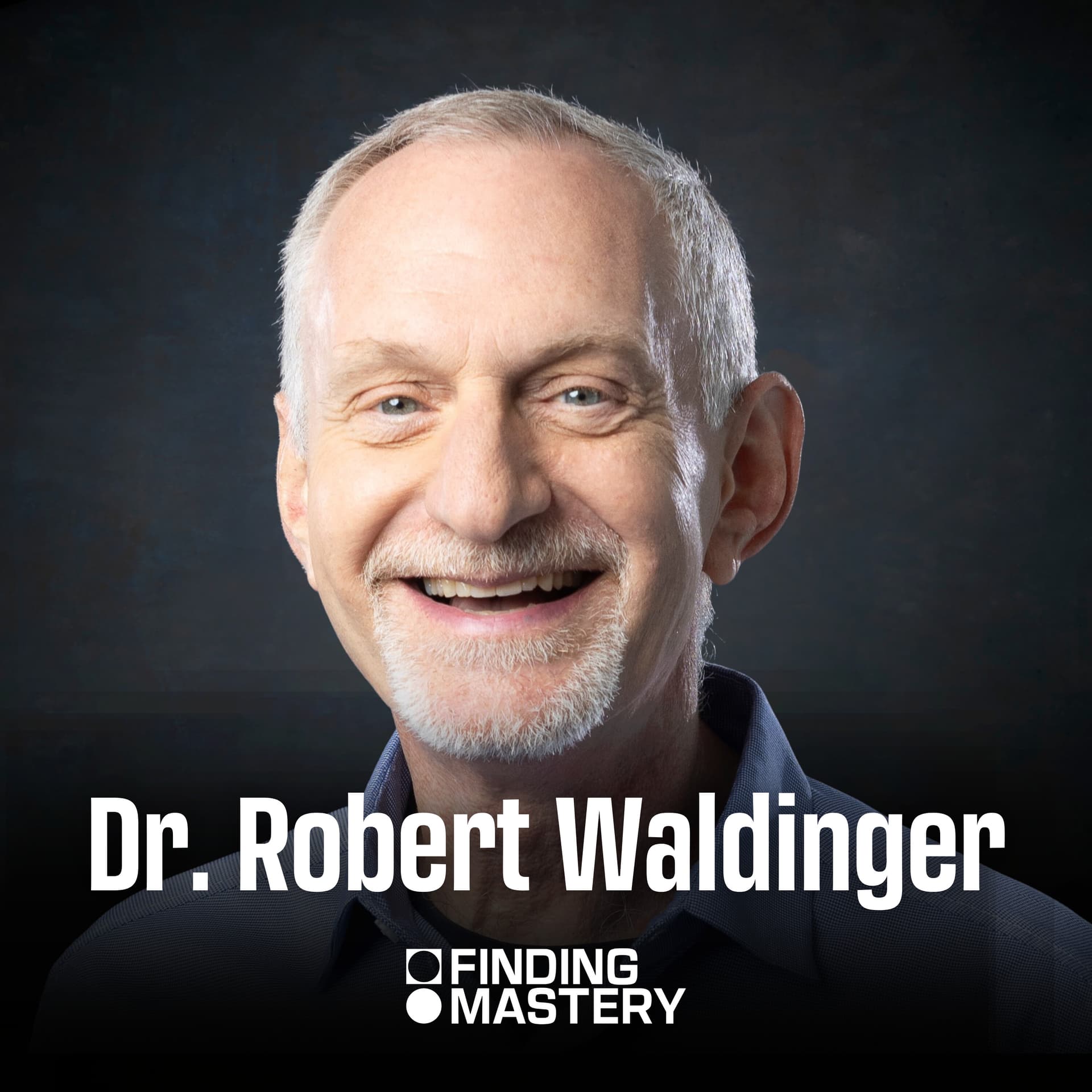
Dr. Robert Waldinger is a psychiatrist, Harvard professor, Zen master, and director of the world’s longest-running scientific study on happiness (Harvard study following people for ~85 years). Host Dr. Michael Gervais is a high-performance psychologist.
Key claims
Warm, maintained relationships predict happiness, healthier aging, and longer life; loneliness can be as dangerous as smoking; isolated people stay in chronic fight-or-flight, raising cortisol and inflammation; “social fitness” is like exercise—small repeated acts matter.
Notable examples
Contrasting two Harvard men—an achievement-focused lawyer vs a high school teacher who stayed happier through mentoring, marriage, family, and later time with grandchildren. A commuter-rail study where talking to strangers increased reported happiness versus routine phone/newspaper use. A “vibe” finding: lonely people give off signals that others interpret as “don’t come near.”
Written by AI. May contain mistakes. Listen to the episode to check what was said.
Chapters
Tap a time to open that second in VOThe Power of Relationships on Health
0:00 to 0:30
Learn how good relationships can influence physical health.
“We understand how good relationships can make you happier, but how could they get into your body and make it less likely that you'd get coronary artery disease or type 2 diabetes?”
Understanding the Good Life
1:00 to 2:00
Discuss the concept of the good life based on 85 years of study.
“Now, in this conversation, Robert and I get into the science of connection, how relationships literally get into our bodies, how they lower stress, improve our health, and expand our capacity to live well.”
The Science of Connection
2:00 to 3:30
Explore how relationships lower stress and improve health.
“This episode is timeless and a powerful reminder.”
Exploring Types of Happiness
3:30 to 6:30
Understand the different flavors of happiness: hedonic, eudaimonic, and psychologically rich.
“research tells us that happiness isn't just one flavor.”
The Range of Emotions in Happiness
6:30 to 8:45
Delve into the emotional depth and its importance in understanding happiness.
“And the pleasure-seeking principle in our brains is quite remarkable.”
The Role of Relationships in Health
8:45 to 10:40
Discuss the impact of relationships on longevity and well-being.
“Terrified of the range, terrified of the death.”
Origins of the Longitudinal Study
10:40 to 13:10
Learn about the beginnings of the 85-year study on happiness and relationships.
“health care, if you don't smoke, all that.”
Contrasting Groups in the Study
13:10 to 14:01
Discuss the contrasting groups studied in the long-term happiness research.
“And then if you could maybe break out the two groups that you primarily studied, and then to drive into relationship is the large rock that's in the container, and then the two that are quick follows behind it.”
Insights from Longitudinal Studies on Relationships
14:01 to 17:05
Learn about contrasting studies on relationships and the importance of social fitness.
“And so we're constantly having to explain to NIH why they should continue to fund us, which they do because we're the only thing like it.”
Insights from Longitudinal Studies on Relationships
17:10 to 18:14
Learn about contrasting studies on relationships and the importance of social fitness.
“Nearly 95 % of us are not getting enough fiber.”
Show all 34 chapters
Insights from Longitudinal Studies on Relationships
18:34 to 19:37
Learn about contrasting studies on relationships and the importance of social fitness.
“Mastery because we know one great hire can change everything.”
The Dynamics of Relationships and Self
19:38 to 28:00
Explore the interplay between self-perception and social relationships.
“Robin Dunbar, that deep insight about 150 relationships is about all we can manage.”
Exploring the Dynamics of Relationships
28:00 to 35:22
Discover how social connections impact our self-perception and relationships.
“That's probably more from my Zen life than it is from.”
Exploring the Dynamics of Relationships
37:29 to 37:56
Discover how social connections impact our self-perception and relationships.
“Spring and summer, they are powerful seasons of momentum.”
The Importance of Relationships in Life
37:56 to 42:04
Examine how relationships serve as a support system and their hidden benefits.
“Do you have any insights around, and this is a bit of a leap in from your research to a modern condition where there's a downgrading of the need for relationships?”
Contrasting Life Choices
42:04 to 43:18
Explore the contrasting life stories of a high school teacher and a lawyer and their definitions of success.
“The high school teacher was so much happier and more fulfilled in his life than the high-powered lawyer.”
Balancing Ambition and Relationships
43:18 to 44:31
Discuss the challenges of balancing ambition with the importance of relationships.
“And I think, if I remember, was this John and Leo?”
The Journey of Self-Improvement
44:31 to 46:08
Understand the ongoing nature of self-improvement and balancing life’s challenges.
“I wouldn't be the model now, but I am significantly better than I was.”
Gender Differences in Relationships
46:08 to 48:46
Examine the differences and similarities in how men and women approach relationships and regrets.
“And are there any differences that you have found?”
Fear of Others' Opinions
48:46 to 50:08
Discuss the fear of others' opinions and its impact on personal authenticity and relationships.
“Can you point me to, I don't think this is published.”
Emotional Leadership in Workplaces
50:08 to 51:09
Explore the importance of emotional leadership in fostering healthy workplace relationships.
“And that women are expected to get along, go along kind of in their manner.”
Prioritizing Relationships in Leadership
51:09 to 54:09
Learn how prioritizing relationships can improve work engagement and job satisfaction.
“And you've got one person in particular that you studied from, I'm assuming, early age that ended up becoming president of the United States of America.”
Prioritizing Relationships in Leadership
54:21 to 55:42
Learn how prioritizing relationships can improve work engagement and job satisfaction.
“Earlier, I mentioned LinkedIn Hiring Pro.”
Prioritizing Relationships in Leadership
55:49 to 56:54
Learn how prioritizing relationships can improve work engagement and job satisfaction.
“Days are longer, pace picks up, and there's this sense of momentum that comes with the season.”
Prioritizing Relationships in Leadership
56:58 to 57:13
Learn how prioritizing relationships can improve work engagement and job satisfaction.
“and a bottle of vitamin D3 plus K2 free in your welcome kit with your first AG1 subscription.”
Loneliness Among CEOs
57:13 to 58:03
Explore the loneliness experienced by CEOs and its impact on leadership.
“So then you've also found that one in three CEOs report to be lonely.”
Building Meaningful Relationships
58:03 to 1:00:05
Learn the importance of purpose and relationships in the workplace.
“As I'm sure you know, you can be coached to get better at it.”
The Role of Friendship at Work
1:00:05 to 1:02:36
Discuss the significance of workplace friendships and personal connections.
“Some people won't care about that, but you can help other people find different purposes.”
Intrinsic vs. Extrinsic Motivation
1:02:36 to 1:04:31
Understand the balance between intrinsic and extrinsic motivations for happiness.
“if you're getting something personal to you from people at work, from somebody at least at work, that's going to bind you there.”
Defining the Good Life
1:04:31 to 1:07:13
Explore what constitutes a good life through meaningful engagement and connections.
“They want to have a nice house, a nice car, a nice watch.”
The Importance of Mutual Relationships
1:07:13 to 1:10:02
Examine the need for mutual support in relationships for personal well-being.
“It feels good, but it doesn't feel good for that long.”
The Importance of Connection in Life
1:10:02 to 1:13:02
Dr. Waldinger discusses the significance of connection and kindness in living a fulfilling life.
“I'm absolutely delighted that I ended up making that choice, but that the hazard for me, the occupational hazard, is that I can be the person who listens to other people all the time and never talks about myself.”
The Importance of Connection in Life
1:13:03 to 1:13:32
Dr. Waldinger discusses the significance of connection and kindness in living a fulfilling life.
“For me, it's a great way to switch on my mind, to ready myself to take on the day.”
Concluding Thoughts and Resources
1:13:49 to 1:14:34
Dr. Waldinger shares where to find his work and expresses gratitude for the conversation.
“I can't wait for our community to be exposed for those who haven't already picked it up.”
Transcript
Automatic transcript. May contain errors.0:00We understand how good relationships can make you happier, but how could they get into your body and make it less likely that you'd get coronary artery disease or type 2 diabetes? Like, how is that even possible?
0:11Dr. Michael Gervais:What if the most powerful thing you can do for your health isn't diet or exercise, but it's investing in the people that you love? What I'm going to tell you is from a treasure trove of data. Basically, what we find, you know, when we look at these 85 years of studying the same people all the way through their lives, we find two big things. Welcome back, or welcome to the Finding Mastery podcast, where we dive into the minds of the world's greatest thinkers and doers. I'm your host, Dr. Michael Gervais, by trade and training a high-performance psychologist. The idea behind these conversations is simple.
0:42Dr. Michael Gervais:It's to sit with the extraordinaries and to learn, to really learn how they work from the inside out. Today's episode is from the Finding Mastery Vault with Dr. Robert Waldinger. He's a psychiatrist, Harvard professor, Zen master, and director of the world's longest-running scientific study on happiness. What we found was that the people who had the warmest connections with others and maintained those connections as they went through life, not just were happier, but stayed healthier and they lived longer. Now, in this conversation, Robert and I get into the science of connection, how relationships literally get into our bodies, how they lower stress, improve our health, and expand our capacity to live well.
1:20If I have something upsetting happen and I can go home and talk to my wife or I can call a friend, I can literally feel my body calm down as I share that stress with somebody else. We discuss how loneliness can be as dangerous as smoking. They did a study where they found lonely people give off a vibe without realizing it that says don't come near me.
1:41Dr. Michael Gervais:And how small acts of social fitness paired with the courage to be vulnerable and change the trajectory of your life. So we coined this phrase, social fitness, the analogy with physical fitness. You don't go to the gym today and come home and say, good, I worked out, I'm done, I don't ever have to do that again. Social fitness is a practice. This episode is timeless and a powerful reminder. No one does it alone. What we found was that the people who were the best at this and ultimately the happiest and healthiest were the people who were. With that, let's jump into this week's From the Vault conversation with Dr.
2:16Dr. Michael Gervais:Robert Waldinger.
2:22Dr. Michael Gervais:Bob, how are you? I'm good. I'm glad to be here. Oh, I'm so happy to be here with you as well. And on that note of happiness, you and your partner have written a seminal book on the good life. And you've nested it on 75 years, I think it is, or maybe it's plus. It's now 85. 85 years of research at Harvard. And it's an amazing, amazing compilation of insights that you've pulled together. And so as I'm reading that book, and we're talking about happiness right now, is that I think you and I agree that happiness is not the end all be all, which might be very surprising for a lot of people. And so can you start with your insight about what you're calling the good life, and then maybe string in it how you think about happiness as one of the variables of the good life.
3:14Well, what we found in this vast amount of data over 85 years is that human connection is a huge driver of a good life, of well-being, of happiness. But that said, research tells us that happiness isn't just one flavor. Actually, there are kind of two big flavors of happiness and maybe a third that research is beginning to show us. The research is showing that there is a kind of happiness that they call hedonic well-being. And it comes from hedonism. And it's like, am I having fun right now? Is this a good party? Is this a good meal? Am I enjoying myself? Right. And then the other kind of happiness is called eudaimonic well-being.
4:02It comes from Aristotle from the Greek. And it refers to that sense that life is good, that life is meaningful. And the best distinction between those two comes from a mom who's a friend of mine. And she said, you know, I read to my daughter before bed every night. And she always wants me to read the books again and again. So I'm there and I'm exhausted. And she's asking me to read Goodnight Moon for the seventh time. And am I having fun? No. Is it the most meaningful thing I could imagine doing with my time? Yes. And so the difference between hedonic well-being, having fun, and doing something that we care about, that's meaningful, are these two flavors.
4:47And I think what we know is that everybody wants some of both. Everybody wants some moment-to-moment happiness and some sense that life is basically good and my life has some meaning, but we prioritize it more or less depending on who we are. Some of us are real party animals. That's what we love. Some of us are much more, I'm going to defer that gratification because I'm aiming for this big, meaningful thing in my life. And there's one more flavor, which I'll add, comes out of Columbia University. They've been studying something they call a psychologically rich life. And that's different. It's kind of, I want to have interesting experiences.
5:29So I want to go to new places. I want new experiences. You know, I want to skydive. I want to, you know, not so much about meaning and purpose and not so much about moment to moment happiness, but about stimulation. And so again, different flavors of happiness. And I think each of us can take a little moment to discern, well, what are my preferences here? And how am I living my life? What am I prioritizing in terms of the types of happiness I aim for?
6:03Dr. Michael Gervais:I love the ability to be able to separate the three out. And then I'll add one bit of context is that my understanding is that the brain is really well designed for hedonic pleasures, for hedonic happiness, which is like, it's difficult to discern the joy later. It's easier to discern the danger later. And so, you know what? Let me experience the good now. And the pleasure-seeking principle in our brains is quite remarkable. And so, I understand why that one's easy. I really understand it. And I'm far more interested in the second and third, and I think most people are. But the third one about a psychologically rich experience in life, when people would say to me early in my career, I'd say, okay, what do you want?
6:52Dr. Michael Gervais:Above all, what do you want? And people kind of push back, you know, and they take a nice little long exhale and they say, you know, I want happiness. I want happiness for me and for other people, something like that. And then I would lean in appropriately. So, and I'd say, so when your grandmother dies, do you want to be happy? Well, well, you know what I mean? Yeah. You know what I mean? I go, no, I don't. You said you want to be happier, you know, above all else. And I guess we could get, you and I could get to a, I don't know, philosophical position that maybe you do want to be happy. You've got such a rich perspective about birth and death that you're able to find a piece of joy and excitement about what's coming next.
7:33Dr. Michael Gervais:But most people want to feel sad. They want to have depth. They want to feel the range of emotions. So where do you fit into those three models, the range of emotion and the depth of emotion? Is that on the third pillar, the psychological rich type of happiness? Well, certainly the range of emotion can be there in that kind of meaning and purpose type of happiness. The life is basically good, that life is hard right now, but I'm doing something I care about, right? You know, or life is sad, but it's meaningful to me. So I think that the hedonic kind, that's about moment to moment happiness, but the other two can have the full range of emotions.
8:18And that's, I think, why most of us don't just prioritize moment to moment happiness. Little kids do. Little kids are all about the moment, right? And actually, I miss that. I love watching little kids and how it's just like, is this fun or is it not fun? But as we grow older, I think all of us want a range, as you're saying, a range of emotion. That's what allows us to feel like we're alive, that there's richness here. Oh, and we're terrified.
8:50Dr. Michael Gervais:Let me speak for myself. Terrified of the range, terrified of the death. Can't I just be a little bit more numb? And of course, I don't want that, but that's oftentimes what we'll turn to when we're a bit overwhelmed. I just want to name this cartoon that I love. There are these two guys meditating on the cushion, and one is sitting there saying, I really do want to be in the moment, just not this moment.
9:22Dr. Michael Gervais:Exactly, right. I saw another meme. It was a cartoon. It was somebody reading a very large book, and the person was kind of buried in the book. You couldn't see, but just like me, the back third of their head. And the title was How to Live in the Present Moment. And then on the desk was a second very large book, which was how to live in the next moment. Because life is emerging. It's unfolding. It's unpredictable in so many ways. Okay, so let's get into the good life. This is the title of your book. It's the focus of your research. And how are you thinking about the good life? Well, again, we think about it from research.
10:00So one of my teachers once said, without data, I'm just another guy with a bunch of opinions. So what I'm going to tell you is from a treasure trove of data, right? And basically what we find, you know, when we look at these 85 years of studying the same people all the way through their lives, we find two big things. One is that taking care of your health really matters. Not a surprise, but important because the findings are so stark that you live healthier, you live longer if you get exercise, if you eat right, if you don't abuse alcohol or drugs, if you get preventive health care, if you don't smoke, all that.
10:43So no surprise. But the surprise for us was that the good life is built on relationships, that what we found was that the people who had the warmest connections with others and maintained those connections as they went through life, those are the people who not just were happier, but they stayed healthier and they lived longer. That was the surprise that we didn't even believe at first. That how could, and we understand how good relationships can make you happier, but how could they get into your body and make it less likely that you'd get coronary artery disease or type 2 diabetes? Like, how is that even possible?
11:29And then other studies began to find the same thing. And that's when we came to understand that this was a very solid, believable finding. So we've been spending the last 10 years in my lab looking for the mechanisms by which relationships do alter our physiology.
11:48Dr. Michael Gervais:It's a remarkable finding. And at the same time, it feels like my grandmother knew this insight, right? And your elders probably at some point knew and shared this with you when you're a kid. You know, like friends are important, you know, as like an early kind of beginnings of that. and make sure that you're choosing well on your partner in life. So relationships is one of the big emerging ideas like, okay, but I love the fact that you've got 85 years of research. Not you personally, but you've been sitting on it. And you've been at the helm for - 20 years. How many years? 20. 20 years. And so let's just, before we go into, I love this insight that two of my friends who reviewed your book, Angela Duckworth and Daniel Pink, friends are medicine.
12:34Dr. Michael Gervais:You know, their insight there, like friends are medicine. Like it's just, it's simple and it's concrete and it's like, got it. And then I would add to it, which I want to in a minute, which is that they're more than medicine because medicine is like self-serving. There's something generative to it as well. It's like when you and I have a good friendship and somebody else is watching, it's also medicine for others. So it's not just medicine for you and I, there's that bit of research maybe we can pull on. So let's just back up for one moment and talk about, just for a minute, the origin of why this study, this 85-year investigation started.
13:10Dr. Michael Gervais:And then if you could maybe break out the two groups that you primarily studied, and then to drive into relationship is the large rock that's in the container, and then the two that are quick follows behind it. So the study started as two studies that didn't know about each other. they started one started at harvard university health service it was a study of how young men go from adolescence into young adulthood taking good developmental paths and so they these were harvard college sophomores 19 year old guys recommended by their deans as fine upstanding young men and so if you want to study normal human development you study all white guys from harvard right?
13:57It sounds about wrong. It sounds about wrong. It's the most politically incorrect sample a researcher could ever have. And so we're constantly having to explain to NIH why they should continue to fund us, which they do because we're the only thing like it. So there was that part of the study. But there was also a study started at Harvard Law School by Sheldon Gluck, who was a law professor, and his wife Eleanor Gluck, who was a social worker. And they were interested in juvenile delinquency, but particularly in how some children from really disadvantaged and troubled families, how those kids managed to stay on good developmental paths, managed to stay out of trouble.
14:43So it was also a study of thriving, but in a very underprivileged sample, by contrast with our very privileged Harvard sample. And so my predecessor, George Valiant, brought the two studies together. And so let's look at them as contrasting groups.
15:01Dr. Michael Gervais:I love it. Okay, so when we drill down into relationships are the big aha, what are your findings that can help us be better in the relationships we have? How to think about the relationships is certainly one, and then how to behave inside of them or with them is certainly another opportunity to explore. And so there are no shortcuts here. Yeah. Right? Yeah, there are. But I should say there are no shortcuts. And what are some of the guiding insights that have been meaningful for you? Yeah. So one of the things we found was that the people who were the best at this and ultimately the happiest and healthiest were the people who were active, who were proactive in taking care of their relationship.
15:49So, you know, like when I was in my 20s, I thought, well, I've got my friends. They're my friends and they're always going to be there. But what we would see as we watch these lives is that perfectly good relationships would wither away from neglect. So the people who were particularly good at this in our study were the people who were taking care of their relationships, making sure they reached out to people, connected with friends, invited people over, made plans, right? So we coined this phrase social fitness and it was really because the analogy seemed so apt with physical fitness. You don't go to the gym today and come home and say, good, I worked out, I'm done, I don't ever have to do that again.
16:33We know that it's a kind of maintenance, it's a practice. and what we saw in our research is that social fitness is a practice and it can be small stuff right it doesn't have to be a herculean thing it could be just sending a text to your friend and saying hey just thinking of you wanted to say hello and if you do those things repeatedly and make plans to take a walk or have coffee whatever that those things keep relationships vibrant over time.
17:06Dr. Michael Gervais:Body Master is brought to you by Momentous Fiber Plus. Here's a stat that surprised me when I first came across it. Nearly 95 % of us are not getting enough fiber. And the thing is, most people think that they are. That used to be me. I eat well, I'm intentional about whole foods, and I still wasn't hitting it consistently. And fiber matters. It's one of those quiet, unglamorous fundamentals that shapes how the rest of your system runs. Your gut, your energy, how well you absorb, everything else you're putting in. So when Jeff Byers and the team at Momentus reached out about Fiber Plus, I paid attention.
17:38Dr. Michael Gervais:I've been using their products for years. And the reason I keep coming back to them, it's pretty simple. They don't chase trends. They go deep on the fundamentals and they build it to a high standard. And the same holds true for Fiber Plus. It's clean, no artificial flavors, no unnecessary additives. The cinnamon flavor uses real cinnamon bark powder and it tastes great. And I don't usually say that about Fiber supplements. I mean, they built this thing right. Like everything they make, Fiber Plus is NSF certified for sport, which is why it's trusted by over 200 professional teams and athletes.
18:08Dr. Michael Gervais:That's the Momentus standard. And that's why it's been part of my routine. If you want to upgrade one of the most overlooked foundations of your health, head to livemomentus.com slash finding mastery and use the code finding mastery for up to 35 % off your first order. Again, that's livemomentus.com slash finding mastery. The code is finding mastery for up to 35 % off. Finding Mastery is brought to you by LinkedIn. We use LinkedIn Hiring Pro here at Finding Mastery because we know one great hire can change everything. One bad hire, it can cost you a lot, way more than time. It can cost you momentum and culture and real dollars.
18:46Dr. Michael Gervais:And that's why how you hire matters just as much as who you hire. And it's why I've become a big believer in the power of LinkedIn Hiring Pro. Here's what I appreciate about it. When you're running lean, you don't have hours to sift through a pile of resumes hoping to find the right person somewhere in the stack. Hiring Pro is built exactly for that reality. You describe the role and it screens candidates for you, surfacing the people who are a best fit so that you can spend your time and conversations with those folks rather than in the weeds of the applications. And the results back it up. Those hiring with LinkedIn are 24 % less likely to need to reopen a role within 12 months compared to the leading competitor.
19:21Dr. Michael Gervais:So join 2.7 million small businesses already using LinkedIn to hire. Host your job for free at linkedin.com slash mastery. Terms and conditions apply. Again, that's linkedin.com slash mastery to post your job for free. Okay, so let's go again, range and depth for just a moment. Robin Dunbar, that deep insight about 150 relationships is about all we can manage. How do you think about range? I think of it very differently. I mean, maybe 150 is all we can manage, but we vary a lot in how many relationships we want and need in our lives. So think about all the people who are shy, who are introverted.
20:09Those people find lots of people in their lives stressful. There's nothing wrong with being shy. There's nothing abnormal about being shy. It just means that you want and need fewer people. as opposed to the party animals who might really want 150 people in their lives and keep up with those people. So I would say that it's highly variable, that we're all on a spectrum between introversion and extroversion, and that it is a matter of personal discernment what each of us needs.
20:41Dr. Michael Gervais:Okay. So when I think of Dunbar's magic number, I think of 150 as like the total that we can manage. And you're saying, which I think we're both agreeing. And then you're saying, right, but some people prefer to have far less. And I would agree with that a thousand percent. And when I think about introversion, extroversion, I typically think about how people gather energy. Do they gather energy from being in small groups of deeper conversation where they can listen and mull it over? And it doesn't mean they're not talking. It's just a different way of processing and gathering information. So is there a magic number that you came or that did not emerge?
21:18Dr. Michael Gervais:No, no magic number. When you study thousands of lives, what you realize is that one magic number never fits everybody. Never. So that's the point that in fact, some of those shy people will find 150 people incredibly stressful and it would break down their health. That's what I'm saying, that we have inborn temperamental styles that really vary widely. And therefore, the amount of social connection we need varies widely from person to person. Okay. So let's shrink the circle way down to an intimate few for just this part of the conversation. And on the intimate few, there are people in my life that I wonder this about, like their best friends are mom, dad, aunts, and sister.
22:10Dr. Michael Gervais:And that's their best, that's their circle and then a couple of external friends, but it's really the family of origin-ish that is their core. And of course, life partner. I throw in children as well. So it's like that outside of the immediate family, which are the best friends that this person has, the next layer is the family of origin. And would you say that counts, those relationships? It doesn't matter if it's a friend group or, because I've seen the research, like it's how important it is to have an external social group, a group of guys or a group of gals that you hang out with or even mixed.
22:47Dr. Michael Gervais:And so can you help like discern that a bit? It totally counts. I mean, I think what we, when we look at the mechanism, so how does this work, that can inform then who counts and who provides us with that benefit. So in the last 10 years, we've been studying and many other research groups have been studying how relationships get into our bodies and change them. And it seems to be about stress and stress regulation that loneliness and social isolation are stressful. You know, if I have something upsetting happen during the day, I can literally feel my body rev up. I can feel it go into fight or flight mode.
23:30My heart rate goes up. I might start to sweat. My blood pressure goes up, right? that's normal that's to be desired actually to meet a challenge but then when the stressor is removed the idea is we should go back to equilibrium to baseline what we think happens is that if i have something upsetting happen and i can go home and talk to my wife or i can call a friend i can literally feel my body calm down as i share that stress with somebody else people who are isolated people who are lonely we believe stay in a kind of chronic fight or flight mode and that there that means higher levels of circulating stress hormones like cortisol higher levels of inflammation and all of that gradually breaks down multiple body systems so then this is my long answer to your question because then the question is does it matter if it's your sister or your friend from elementary school or the friend you met two months ago.
24:33No. If that person has that effect on you, if that relationship has that stress-regulating property, it doesn't matter who it comes from.
Read the full transcript
24:44Dr. Michael Gervais:Okay. Double-click for just a moment. And let's just use loneliness for an example. For me, loneliness is actually the output. Like I don't feel connected to other people, even in a crowded room. Yeah. Okay. But the input is a way that I'm speaking to myself about myself, about others, about my future, about my past, that I am disconnected in a meaningful way that the output is that I feel lonely. And so I'm curious from your standpoint there about the relationship with self and the relationship with other. And so your findings are about the importance of relationship with other, in particular, warm relationships.
25:23Dr. Michael Gervais:And then as a psychiatrist and a psychologist, it sounds like a bad joke, the two of us talking here, that the relationship with self, others, nature, and machines is really important in that order for me. And so can you maybe, did you find anything about how the relationship of self is paramount or deeply influences relationship with others? Well, here my shrink hat is on, right? And yours is too. But the relationship with self is hugely important. And we had people who would tell us, I don't think people like me, or I don't think people want to be with me, or I feel like a failure. And that negative self-image was really impactful in keeping people away from others, in making people misinterpret reactions of other people.
26:19And so we know that there is, you know, there's a great deal that goes on inside that shapes how we behave and then other people react to us that way. So actually, they did a study where they found that lonely people give off a vibe without realizing it that says, don't come near me. And they also found that lonely people get lower quality care from their primary care providers in medicine. that there's something about the signals that lonely people give off that has people keep their distance many times. And so there's actually a whole field now of cognitive behavior therapy where they try to teach lonely people some of the skills to undo some of the dysfunctional beliefs.
27:10Oh my God, this is great. And then did you say it was a study on vibes? Did I hear you say that? Well, vibes is, you know, that's not the... Okay.
27:20Dr. Michael Gervais:I was going to love this. No, no, no, it wasn't. We need to get a study on vibes. It is a study. This comes out of a group at the University of Chicago. It's not my research. John Cassioppo and his wife, I believe her name is Jennifer Cassioppo, did some research on this. And so what I believe they find is that other people see lonely people as not wanting contact. but I would have to go back and look at those studies. So, uh, so I would suggest that our listeners go and look that up if they're interested, because I'm not sure how they measure it, but they did not measure vibes. No, I think, I think what I just took away from this is that, um, the great Dr.
28:02Dr. Michael Gervais:Waldinger talks about vibes. Well, I do. The science of vibes. Yeah. Right. Yeah. That's probably more from my Zen life than it is from. Yeah. That's good. That's awesome. Yeah. I want to, I definitely want to get to that. Okay. Um, But let's stay with relationships one more beat here. Is that chicken and egg? And is it your social environment helps with the relationship with self? Or is it, I should say, social emotional connections help with self? Or is it like a dynamic in a relationship with yourself impacts the external social? And I know what you're going to say. It's both. I know that going into it.
28:37Dr. Michael Gervais:Yeah, exactly. So but like if you had to get off the fence, which one would you say you would bet on? Or if you're working with somebody. What I would say, you know, if I'm working with somebody like a patient in therapy, I would say we start where we can, right? So I think it is both and I think that it is synergistic, right? But I would say let's start with what we can work with, which is the self, right? You, the person I'm working with, let's start with you and see if we alter this, if we alter how you come across to people. Let's see if people will then react to you differently. We can't control how other people behave toward you, but we can do some moving the needle on how you behave toward the world.
29:23So it's kind of impacting one side of that dynamic that always goes two ways.
29:31Dr. Michael Gervais:Yeah, I over-index on self. And then because of that lack of control, the directional nature, and then it always feels kind of cheap. And maybe you can course correct me when I say something like, in the back of my mind, I'm thinking that if this person had a deep relationship, they'd be great. But then introducing that into the conversation, it's like, yeah, thanks, doc. Yeah, I don't. Great. Way to pile on. Right, right. Yeah, exactly. But there are ways, you know, and I'm sure you know this, but research has shown there are behaviors that can make it more likely that we'll start to develop new relationships.
30:11Okay, break it down. Like, what kind of behaviors? Well, think of the water cooler at work. Okay. This iconic site where people kind of come because they need water or it might be the coffee machine or the snack bar, but, but basically where you encounter some of the same people over and over again, often it's at a workplace. And what they find is that when people encounter the same people over and over again, they strike up simple conversations, but then eventually over time, they can strike up deeper conversations. And some of those conversations may lead to ongoing connections and friendships.
30:51So what does that mean? Well, let's say you don't work at a place that has that or you work remotely. The research also shows that people can do things they care about alongside others. So let's say you love gardening, or let's say you love bowling, or you want to work to prevent climate change. You can volunteer in settings where the same people show up again and again, because what it means is that, first of all, there's something you immediately have in common, something you care about, and you have a natural place to start conversations. You know, like, how about these zinnias, you know, or whatever it might be.
31:37What the research shows is that if we put ourselves in those situations, we are more likely to make new friends, make new relationships. The other place that people can do this is finding ways to be of service. We often think, well, people don't want me around, particularly if you're lonely, if your self-talk is pretty negative. But when you find places where people need you, that's often a place where connection is easier and people are grateful for your help. It could be, you know, volunteering at a food pantry. It could be reading to children, tutoring kids who need and want the help. So there are various things that we can do, given our energy and our time, that will meet a need that other people have and in that way help us make new connections even when we're shy and feel like people don't want us.
32:36Dr. Michael Gervais:What did you learn is the great threat related to vulnerability or taking a relationship, whether it's a surface relationship a little bit deeper or extending the circle of potential conversations or an intimate relationship even deeper? Yeah. So we use the word vulnerability, but did your research point to what is so scary about that or challenging? Our research didn't, but I've seen some other research that points to this idea that relationships are unpredictable. and that so there are a whole lot of ways they can be unpredictable. So our fears could range from this person doesn't want me around.
33:15They're not going to like me. They don't like the way I look. They don't like the sound of my voice. It could be I'm going to talk to this person sitting next to me on the airplane and they're not going to shut up and I'm not going to have any peace and quiet on this six hour flight. Right. It could be so many ways that a conversation could not go well. And so I think what we're really dealing with is the unpredictability compared with being alone. So I'll quote you another study that I bet you know about. They did a study of people who were about to take the commuter rail in Chicago. And they assigned two random groups.
33:55They assigned one group to do what you normally do. You know, might be being on your phone, might be reading the newspaper, whatever you do, just do that. the other group was assigned to talk to a stranger and they asked people beforehand how much do you think you're gonna enjoy this and the people who were assigned to talk to a stranger said nah i'm not going to enjoy this and then afterwards they asked people again well how much did you like completing your assignment the people who talked to a stranger were much happier as a group than the people who did their usual thing on the commuter train.
34:30And what that tells us is we're kind of bad at predicting what's going to make us happy, particularly when it comes to making
34:39Dr. Michael Gervais:connections with other people. And is it because we're more interested in immediate temporal safety or pleasure or relief? Probably all that, particularly safety and predictability, because relationships are unpredictable. You know, even when you go home to your wife and you don't know what kind of mood she's going to be in or what kind of mood you're going to be in, right? I mean, that's unpredictable. And you guys know each other better than most pairs of people on the planet, right? So if that's unpredictable, what's it like to meet a stranger? What's it like to talk to a person at work who you've really never talked to before?
35:17It's a little scary. There's some inertia to be overcome there.
35:22Dr. Michael Gervais:Finding Mastery is brought to you by Sunlighten. I'm really excited about a new partner of ours. Something that I've come back to again and again is when I invest in recovery with the same intention that I bring to my work, everything gets better. My energy, my focus, my ability to show up fully for the people that I'm with and the work that I care about. That's why I am so bought in on the Sunlighten M-Pulse Intelligent Sauna. I was first introduced to their team a few months ago and was so impressed by what they've created. This is one of the most advanced infrared saunas that they've built in over 25 years of pioneering this technology.
35:57Dr. Michael Gervais:That's right. They've been at this game for 25 years. I had one installed in my home a few months ago, and it's made a real difference. I feel more refreshed, more grounded, more relaxed, and it's become a consistent part of how I recover, how I reset every day. I'm using it to support muscle recovery, for improved oxygen delivery, and for nervous system recovery. And what I love most, I don't have to leave my home. They're offering the Finding Mastery community up to$2 ,100 off. Simply head to sunlighten.com and use the code mastery for this great discount. Again, that's sunlighten.com and use the code mastery for up to$2 ,100 off.
36:36Dr. Michael Gervais:Finding Mastery is brought to you by our flagship mindset training course, Finding Your Best. Anytime you feel the pull to reset, to zoom out, to refocus and ask, am I moving toward the person I want to become? It helps to remember this. Lasting change comes from training. Not resolutions, not short-term sprints, but deliberate practice of the skills that shape how we show up. In work, in relationships, and in the moments of great intensity as well. That's what finding your best is all about. It's a science-backed framework for training your mind. And it's the same set of tools that we've taught to Olympic athletes, top executives, elite military teams, and artists at the peak of their craft.
37:10Dr. Michael Gervais:In this course, you'll learn the foundational psychological skills to be your very best. Full stop. And the best part is, you can start anytime. Right now, we're running a limited time offer on finding your best. Simply head to findingmastery.com slash course and use the code RENEW100 to get$100 off your registration. If you've been waiting for the right moment, this is a good one now to lean into. Spring and summer, they are powerful seasons of momentum. It's a great natural time to step into growth, to refocus, to recommit to who you want to become. And this discount will not be around for long.
37:44Dr. Michael Gervais:So go to finding mastery.com slash course code renew 100 for$100 off today because your future is not shaped by what you intend. It's shaped by what you train. Do you have any insights around, and this is a bit of a leap in from your research to a modern condition where there's a downgrading of the need for relationships? People, it's kind of born out of the 1980s where it was a self-help industry where it was just about helping oneself. and it's migrated or extended where people aren't really needing, feeling like they need somebody else to be okay. And so my responsibility is to take care of me and focus on me.
38:26And what
38:28Dr. Michael Gervais:you're saying is, right, what you need, what we need, or what we found, I should say, is relationships. It's a bit of a lifeboat for all of us. Yeah. And that it's a lifeboat in two ways. Relationships help us through the hard times. So if you think about it, like when something bad happens, in fact, we asked our guys, our initial subjects, at one point we asked them, who could you call in the middle of the night if you were sick or scared? And most of them could list several people. Some of them couldn't list anybody. And as far as we know, everybody needs at least one or two relationships where somebody has your back.
39:09And so relationships do that for us on the side of helping us manage hard times. But there's also so much energy that we can derive from relationships and so much help. You know, because this myth of the self-made man, and it's usually the man who thinks of himself as self-made, is a total myth. You know, the idea that we don't rely on anybody else, we don't stand on any other shoulders. Really, we're standing on other people's shoulders all the time with everything we do. And that when we acknowledge it and we leverage it, it's huge. I mean, the studies of like, how do you find your next job?
39:47You're much more likely to find your next job from people who are actually kind of peripheral to your life, but you just happen to know and connect with. There are all these ways in which the benefits of relationships are multiple and often hidden until we really focus on it and then say, oh yeah, that is how I found my last job. That is how I got through this big crisis.
40:11Dr. Michael Gervais:It's one of the big takeaways I speak about often is that nobody does it alone. Yeah. So we celebrate the extraordinaries on the podium. However, it's a full team. Yeah. And so that idea that none of us do it alone, I think has been really important. And one of the, let's call it the bright lights of the best in the world is that there's a bit of a narcissism that runs through them. However, there's a team that's supporting them, challenging them. Yeah. But we sell, you know, Americans sell each other this myth that there is a loner, you know, the Marlboro Man myth, right? That you're just kind of a loner and you're tough and you do it all yourself and you're independent.
40:52And that's just not the truth.
40:55Dr. Michael Gervais:So speaking of some of the participants in your study, you have some incredible stories. And I'd love to hear a few that, you know, rise to the surface for you that you've been inspired by. and everything from nothing to multi-billionaire, nothing in the account to multi-millionaire. And so can you maybe speak to a couple of the stories that were important for your personal development? Yeah, we talk about two men who we put next to each other and we contrast their lives. So they were both from Harvard, which is just helpful for comparison purposes. one was a super high achieving man who became a high-powered lawyer and seemed to have all the advantages made a lot of money won a lot of awards in his life the other was a guy who wanted to be a writer but he had to come home from world war ii and take care of his ailing mother so he became a high school teacher and he's he remained a high school teacher his whole life The high school teacher was so much happier and more fulfilled in his life than the high-powered lawyer.
42:11So both started out looking like they had their whole lives ahead of them and they were going to be winners. But the real winner was the high school teacher, the guy who didn't have a glamorous career at all, didn't make a lot of money, didn't win awards. But it turned out that he loved teaching kids. He loved mentoring kids. He liked his colleagues. He had a good marriage. He had three kids who he spent a lot of time with. And later on, lots of time building a sailboat with his grandchildren and a whole bunch of things. The high-powered lawyer was somebody who just always felt that his thing wasn't people.
42:54He didn't do well with people. He didn't prioritize people. He prioritized work, and he prioritized achievement. And he was pretty miserable, particularly toward the end of his life. And the two contrasting stories are really about what we invest in as we go through life.
43:13Dr. Michael Gervais:I want them both. I want the combination of those two. And I think, if I remember, was this John and Leo? Yeah, you got them. Good for you. Good for you. Oh, no, I loved your book. I think what you did was special, especially because you're standing on, you told stories, but are standing on mountains of research and findings. When I read about John and Leo, I wanted like some dash between them. I like, I want both. And I don't think I'm alone in that. And I didn't, I don't want what Leo had. Like, Like, for me, it's not enough. Right. And I know that almost might sound, oh, you agree. I agree.
43:48Dr. Michael Gervais:I'm surprised that you agree. Yeah, look, I'm a Harvard professor. And I'm talking to you, Mike, on this very fancy podcast. I mean, I'm not living a quiet life, right? So we're both. I feel better hearing that. I feel a lot better. I don't know why I needed you to go, yeah, you're not crazy. You're not crazy. Because you know where some of my greatest tension in life is? is I've got this big ambition, big motor, and I pour into it. And the greatest regret I have is the times that I missed in the relationships with my intimate loved ones. Yeah. And so managing that earlier was ridiculously hard.
44:29Dr. Michael Gervais:And I don't think I'm even doing, I wouldn't be the model now, but I am significantly better than I was. and so I haven't figured out how to be an outdoor cat you know that has claws and wants to go explore and at the same time following kind of the institutional nature of education my son is you know 14 so I'm we're not traveling the world as with a 14 year old at school no and right so it's been there's there's a challenge in it and I yeah I don't know I'll pause there I'm not looking for a silver bullet but that is I'm just sharing that that that's been one of my great challenges Well, and I'm so glad you shared that because there is no silver bullet.
45:10That's what my sense is. Both from studying all these lives, from working with people in psychotherapy, from sitting on a meditation cushion for years, right? Like what I find is that we never finally figure it out. You know, so some days I sit there thinking, I don't have a clue what I'm doing, you know? And I think that it is an endless process of working on it, of trying to find balance that we never fully achieve, but we get better. And then sometimes it gets worse again, and then we try to correct things and we get better. There are times when I feel like my wife and I are ships passing in the night, and then we correct that.
45:54But we never come to a final place where it's all good and it stays that way. That's my real sense of it. That's certainly what Zen has taught me too. Zen really teaches you never finally arrive anywhere. So I just want to say I'm with you.
46:11Dr. Michael Gervais:okay so the narcissist uses relationships for their own aim as currency they of course correct me if you see it differently but they're more interested in having their needs met than than others and i'm by no means suggesting that that is a path forward i'm suggesting in some respect that it's hard to balance all of it and i love the support that they my family provides me because it it does allow me to go explore and come back but making sure that i'm properly hydrating and feeding that relationship i don't know if i'm alone in that i don't know if other people are like yeah i hear what i hear what you're saying bob too is that like passengers or ships passing at night do you find that from your wife's perspective and i'm kind of bleeding into ideas here but from your wife's perspective and we could extrapolate women in general maybe that there's insights that are unique to women in your findings.
47:12Dr. Michael Gervais:And are there any differences that you have found? The differences weren't as great as we thought they would be. I mean, I think that I've been steeped in a lot of research and media about gender differences and the importance of gender differences. But when we looked at those gender differences, not just in our study, but in the whole literature, they weren't as great as we thought that relationships are important to men as well women are better at being socially connected i think because of their socialization they have been raised to value social connection women are more apt to confide in each other they're more apt to share with each other things about their private lives and their emotional lives men are more transactional and they do more stuff together.
48:04But what we find is that the gender differences aren't so great. One of the differences we found that was interesting is when we asked people what they regretted the most, but this was the World War II generation, that the men were more likely to say, I wish I hadn't spent so much time at work. I wish I had spent more time with the people I care about. And the women were more likely to say, I wish I hadn't worried so much about what other people thought. And so for women, it was about trying to be authentic in relationships. And for men, it was just trying to spend more time being in relationships.
48:45Oh my goodness.
48:46Dr. Michael Gervais:Okay. Can you point me to, I don't think this is published. I don't think you've published that have you no we haven't because we we we had to call it and code it and it took it was a really cumbersome thing and so we haven't we haven't really gotten it out there okay so i'm going to want to talk to you afterwards about an insight that i talk a lot about but it in the shorthand is i think one of the great constrictors of human potential is a pervasive fear of people's opinions. And we call it FOPO for fun. And what I think I just heard you say is that according to your research, women might have a higher degree or prevalence of FOPO.
49:35Dr. Michael Gervais:But I don't wanna make that leap without being able to really drill into it with you. Yeah, and I can't say that I have the hard and fast publishable data on that. So that may be, you know, it's a lot of lives, but it's still anecdotal. So let's not take this to the bank yet. But I think that, you know, you do hear women say, particularly in the workplace, that men are allowed more leeway in rocking the boat, in not being, I can't remember if there's a term for it, it's something like socially confluent or something. And that women are expected to get along, go along kind of in their manner. And that that's unfair.
50:15It's an unfair constraint on women. So there is a difference there. And certainly women in the workplace are talking about this.
50:21Dr. Michael Gervais:I think there's one of the things when we do work with senior leadership teams, one of the things that we're quick to point out is that like, what are the different types of leaders? And so who is the emotional leader, right? And it's not gender specific, but who's going to take care of the emotions from going deep enough that other people can work from incorporating emotions into decision making and to fold in the depth of relationships with an emotional tone to it so that they're not transactional and real. So we're always looking for the person that is a leader of emotion because there's plenty of transactional leaders, efficiency leaders.
51:02Dr. Michael Gervais:So who is going to hold that gravitas to make sure that we're being honest with each other? Now, okay, so as just a slight shift here, the study of sport psychology was really born on studying the exceptionals. Like, how do the extraordinaries do it? How do they work from the inside out? And you've got one person in particular that you studied from, I'm assuming, early age that ended up becoming president of the United States of America. Do I have that correct? Yeah. John F. Kennedy. Yeah. Okay, so what did you learn? And again, it's an N of one. It's a case study of one. But what did you learn about early psychological frameworks that he was working from that are important for the rest of us to understand?
51:47Yeah. I can't tell you because we promise confidence.
51:55Dr. Michael Gervais:What if I didn't say president? I just said, if you had an extraordinary. Damn it. Yeah, yeah, yeah. I can't tell you because we promise people to keep what they tell us confidential. And in fact, John F. Kennedy was advised by his political advisors to withdraw from the study when he ran for Senate from the state of Massachusetts because they felt that having his personal records and telling us personal information, having it on file somewhere wasn't a good thing to do. And that made sense. So his records are no longer with us. They're at the Kennedy Library at the University of Massachusetts.
52:39But even if they were with us, I couldn't tell you. Fair.
52:43Dr. Michael Gervais:I understand. Okay. So I would like to kind of switch gears a little bit and think about how you speak to leaders. And so right now, according to Gallup, if you think about the layers of experience people have, suffering, struggling, and thriving, some of their recent research is that 51 % of people are thriving. That means that 49 % are suffering and struggling, and that's a huge number. And so, yeah. So if a leader knew what you knew, and you could speak right into leaders of enterprise or people that are responsible for the quality of the work environment, what would you want them to know? And how would you help them act differently?
53:25Dr. Michael Gervais:I would say prioritize relationships. We don't have time for that. Yeah, right, right. Yes, you do. Because the Gallup survey of 15 million workers asks the question, do you have a best friend at work? Only 30 % of people have a best friend at work, but those people are more engaged with customers. They do higher quality work. They are less likely to leave for another job that makes a better offer. And the people who don't have a best friend at work, so 70%, only one in 12 say they feel engaged in their jobs. So 11 out of 12 of that 70 % are checked out, right? So if you're, okay, you can say, I don't have time for that.
54:08It's too expensive. It's too messy. But at your peril, Mr. or Ms. CEO, that's my argument. Okay, right.
54:19Dr. Michael Gervais:Finding Mastery is brought to you by LinkedIn. Earlier, I mentioned LinkedIn Hiring Pro. And I want to come back to something a little more personal. We talk a lot about the people who make extraordinary things possible. And I want to take a moment to acknowledge some of ours. Janelle, Taylor, Alex, Emma, and our newest teammate, Chelsea. Every single one of them came to us from LinkedIn. And every single one of them has raised the bar of how we operate here at Finding Mastery. Our relationship with LinkedIn, it also runs a lot deeper than just using their tools. We also work with their teams on the corporate side, helping them build the kind of high-performance culture where great people want to stay.
54:55Dr. Michael Gervais:They want to grow. I've been building businesses for over two decades now, and I'll tell you, the right team, that matters so much. It's the difference between grinding and flowing. So this partnership, I believe in from the inside out. When you hire through a platform like LinkedIn Hiring Pro that surfaces people who are genuinely aligned with what you're building, you get a different quality of candidate, not just in skills, but in fit and values, the kind of energy someone brings to a team. So if you're thinking about your next hire, I want to strongly encourage you to be intentional about where you look.
55:30Dr. Michael Gervais:The right person is out there and LinkedIn Hiring Pro helps you find them faster with a lot more confidence. Post your job for free at linkedin.com slash mastery. Terms and conditions apply. Again, that's linkedin.com slash mastery. Finding Mastery is brought to you by AG1. Summer is right around the corner, at least for those of us in the Northern Hemisphere. You can just feel it though. Days are longer, pace picks up, and there's this sense of momentum that comes with the season. For me, that also means more travel. It's more early mornings, more late nights, and it's just really a schedule that isn't consistent as I'd like it to be.
56:08Dr. Michael Gervais:That's exactly when having a simple, reliable, daily foundation, it matters. AG1 has been that foundation for me for over a decade now. One scoop and a glass of cold water in the morning, and I know I'm supporting my gut health, full stop. Filling the nutrient gaps that are hard to cover through food alone. And what ends up happening is I'm giving my body what it needs to keep showing up. And that really matters to me. What I love about AG1 is that it doesn't ask a lot of me. It's one habit, one scoop, and it travels easily. The AG1 travel packs are something I genuinely rely on this time of the year.
56:44Dr. Michael Gervais:I throw a few in my bag before a trip and the routine stays intact wherever I am. If you haven't tried AG1 yet, or you've been planning to think about getting back into it, now's a great time to start. Visit drinkag1.com slash finding mastery to get an AG1 flavor sampler and a bottle of vitamin D3 plus K2 free in your welcome kit with your first AG1 subscription. It's a$72 value. Again, that's drinkag1.com slash finding mastery. So then you've also found that one in three CEOs report to be lonely. Yep. Yep. And that's striking. Isn't that striking? And what we find is that the CEOs, you know, those emotional leaders, the CEOs who are tuned into the emotional climate of teams and of their workers are the people who over time get best results.
57:39What we know, and I think this is from some good business school studies, is that leaders who lead through fear get good results immediately and then they tail off. And then there's resentment, there's passive aggression, there's all kinds of stuff. So you can start out looking good if you're a leader who leads via fear, but otherwise it's those engaged galvanizing leaders that do much better. And if you're, let's say you're not the one to feel like you can do that? Well, first of all, you can be coached. As I'm sure you know, you can be coached to get better at it. And you can bring around you a team of people, some of whom have those skills and can really set up the workplace and model behaviors in ways that prioritize teamwork, connections, cooperation.
58:28Dr. Michael Gervais:Bob, would you start with deepening the relationships or a process or set of processes to deepen relationships? Or would you start with clarifying purpose so that there's a drinking fountain, a trough that we're gonna gather around, or there's a shared mission that we're gonna make sure that we are connecting to. And that's how we would accidentally create more meaningful relationships because the purpose matters so much. The mission is so big and bold and ambitious that of course we need each other. So which way would you start? I think I probably would start with purpose because for many people, for many workers, knowing why am I doing this is huge.
59:13And so I think having a purpose in an organization matters a lot. Actually, I worked with a big telecom company in Europe, and what they decided was that they were going to reconfigure their mission so that it was about human connection. So it's telecoms, right? So it's telephone and internet connections. But what they decided was, we really want people to know that they are helping people connect with each other. And when they did that, then they began to foster more connections among their workers. But it was with that overall umbrella of, and we're all trying to foster connections in our larger society.
59:55And so I think that having that North Star of a purpose for the organization, of a mission, is pretty valuable. That won't light up everybody. Some people won't care about that, but you can help other people find different purposes. Like I like my team. I like showing up for my team. I don't care what the overall purpose of the company is, but I like these guys. So I'm going to come back every day and I'm going to be involved because the team meetings matter to me. Right. So they're not everybody's going to get on board with a particular purpose, but a lot of people will.
1:00:30Dr. Michael Gervais:I like that you started there. That's, that's where I start as well. And then I quickly, like it's a fast follow is for each person to know their unique purpose and how they see it stitching to the shared purpose, the purpose of the company, and then for people to share that amongst the leadership team or the team that they're on. And there's a handful of other things, but it's like the blending and the merging between the enterprise purpose and my personal purpose and then understanding my partner's purposes and being able to hold that, tenderly hold that. I feel like it's like one-on-one is definitely something greater than it's like 11.
1:01:11Dr. Michael Gervais:And so, yeah. And then I just want to make sure that I'm thinking about this the way that you're thinking about it is that at business, it's striking to me that you think maybe it's important to have a best friend at work because that has not been my experience. I want to understand if I'm hearing that correctly, that you would say, no, I think that if you could lean into having great friendships at work, as opposed to being incredibly good with each other and have fun and be serious and support and challenge each other, but not necessarily hanging out on the weekends or after hours. Like I'm a little hazy in what you're suggesting.
1:01:47Okay. And that may be because the question was more general that they asked, that the Gallup organization asked in the survey. I see. I see. Okay. So it could be, I have a friend with whom I can talk about my personal life. Like if my kid is struggling and their grades are falling, it might be something I'd mention because I'm worried about it today. And there'd be somebody who I could talk to and would tell me about their life. Okay, so there's that part of friendship. But there's also having fun. This is the person who, you know, we all play basketball on a basketball team at work. We get a lot of different things from friendships.
1:02:23You know, we get material support. We get fun. We get emotional support. A lot of things. I don't know that the Gallup survey said what kind of support is crucial. They just said, if you're getting something personal to you from people at work, from somebody at least at work, that's going to bind you there. That's going to energize you. That's going to make you want to go to work, right? So it might be the basketball game. It might be being able to talk about your daughter's difficulty making friends in her new school. It might, you know, there's so many things we get from relationships okay i i told you this is where i think sport has
1:03:05Dr. Michael Gervais:completely dialed it in and unfortunately it hasn't been metabolized by the people inside of sport to the level that we would hope but sports purpose like the organization's purpose is very clear and so when people are inside of the environment they're they're very clear what the purpose is yeah and the better organizations make it less transactional you know more aspirational. But my point is that teammates, we don't talk about teammates in business the same way that we do in sport. And so like the depth of friendship, they want to call it family, which I have a reaction to on the teams that I'm supporting.
1:03:46Dr. Michael Gervais:But to the point that they're like, no, there is a brotherhood or a sisterhood, or there is a bond that we have with each other that is different than any other bonds in our lives. And I'm like, wow, that part of binding around a shared mission, because it's hard to do elite sport, is noted. And business is so transactional. People wouldn't choose necessarily to go to work. They're going to work to make money. And they're going to work to make money for another reason. And if we stop at number two, which is to make money, then there's problems. Absolutely. I mean, because money is empty. It's like, well, why?
1:04:28What do you want to do with money?
1:04:30Dr. Michael Gervais:But for many people, they want to look good. They want to have some security. They want to have a nice house, a nice car, a nice watch. And I think that we have over-scripted that that's not okay. But we wouldn't say to somebody who's gone through trauma to say, the coping skill that you have is not healthy. Hold on. I feel like I've got to put, talking to you, I got to put a lot more meat on the bone. But there's something that I'm agitated by that we're suggesting to people that it's not okay to have extrinsic motivations. Motivators. Yeah. Yeah. And I find it, it feels like it's condemning, not condemning, but condescending in some ways.
1:05:12Dr. Michael Gervais:So maybe you can help me out from a research standpoint about intrinsic and extrinsic. Well, it's a really good point because it can sound like, oh, it's all got to come from within and it's all got to be incredibly noble. No. One of the things you probably know about is Daniel Kahneman's famous study about how happiness goes up as you make more money. But he finds that as you get your needs met, happiness really goes up. what he finds is that the difference between$75 ,000 and$75 million isn't nearly as great as we thought. And now it's more complicated than that. But I think to your point, it's not that these things don't matter.
1:05:51It's that they ultimately aren't so nourishing. So if you spend your time amassing wealth so you can buy your third home and your second yacht, that what people find, basically is that it's kind of empty that they get bored right because ultimately once you get your basic needs met and you have some some nice things in your life that there are diminishing returns and going after more of that similarly it's it's getting awards like you know so i'm in academia where the coin of the realm is like you know professorships and and awards of various kinds, right? And what you find is that after a while, it just doesn't do it.
1:06:33Many people will say, oh my God, I worked for 30 years to become a professor and now here I am and nothing much has changed. So what we find is that it's not that doing these things isn't worthwhile and meaningful. It's that the badges of achievement, whether they're achievement in wealth or achievement in your profession or whatever, that the badges of achievement don't keep us warm at night. but the work itself does. So, you know, like for me, these ideas really matter to me. So it matters to me that I talk about this, that I talk with you, that I get these ideas out there, that I wrote this book.
1:07:10I want to do this because I care about it. I'm glad that it's become a bestseller. I'm glad, you know, that's nice. It feels good, but it doesn't feel good for that long. But when people say to me, this has made a difference in how I see my life, that's something I can take home, right? That doesn't fade so much, if that makes sense. So it's the work itself and the results of it rather than the badge of achievement that comes with it.
1:07:38Dr. Michael Gervais:Okay. So in summary, as a forcing function, as a reductionist type of question here, how do we live the good life? huh here's where i am going to be a guy with opinions but they are based somewhat on i mean i think for me the good life is being engaged in activities that i care about and being engaged with people who i care about and who care about me that those are kind of the big ticket items the third one threw me off the first one i was like oh yeah yeah the second one people i care about yeah yeah okay i got it the third one that care about me i was like oh if you could open that up because the response i had to it was it was an insight passed on from a mentor of mine which was i think it was research-based but i can't remember but it was one of the keys to life is having people to love yes and it's not having people love you so and i don't know where that came from maybe you could point me back to some original research around that, but maybe not.
1:08:51Dr. Michael Gervais:It's less important. But why that third variable there? One of the things I've found is that there are relationships that aren't very mutual, where people want me to listen to them, to take care of them, but they don't give a lot in return. And that can feel very depleting to me. So having relationships where there really is a genuine back and forth is the most energizing kind of connection I can have. You know, one of the things I find, and this is very personal, that I'm sure I selected myself to become a psychiatrist because I was good at listening to other people. And I kind of valued that role.
1:09:33Like people would confide in me and I enjoyed being in that role. But what I began to realized was that in my personal relationships, if that's what I create, where I'm the listener and everybody else is the person who gets listened to, that I don't get enough of my needs met and that I can err on that side. But I think that's because of the kind of person I am. And I think it's why I kind of wandered into mental health care, which I love, by the way. I'm absolutely delighted that I ended up making that choice, but that the hazard for me, the occupational hazard, is that I can be the person who listens to other people all the time and never talks about myself.
1:10:16I love it.
1:10:17Dr. Michael Gervais:And I explain the transactional limitation. I have one client a month that I spend time with. And so I explain the transactional nature. I said, this is like no other relationship. This is 100 % about you. And so they're like, oh, oh, that's right. And I say, so in some respects, this is not how it's supposed to be outside of this room, right? There's a lot of, a lot that's going to be light bulb moments inside, even the way it feels to be attended to and cared for. And like, this is not healthy in other parts. Okay. But really quickly, As we're wrapping up, can I give you some quick hits, like really fast answers to relatively large questions?
1:10:59Dr. Michael Gervais:To get my associations, just my like - Totally. Okay. Yes. All right. Okay, you ready? Okay. It all comes down to - Connection. I am - Endlessly fascinated by the experience of being alive. You've said that before. That was awesome. That was really cool. Okay. My vision is? My vision is staying engaged with life as long as I can. Money is? A means to end. It's not an end in itself. Nice people.
1:11:39Okay.
1:11:39Dr. Michael Gervais:The Dalai. I got you somehow. You got me. You got me because nice. So I've been accused of being too nice, right? Oh, I hit a nerve. The pejorative context of nice can be syrupy sweet and not being genuine. But if nice can be also kind, then kind people are the people we want to gravitate toward. The Dalai Lama said, my religion is kindness. Yeah, that's really cool. All right. Listen, I just want to say thank you. There's so much more I have that I want to understand from your research. Where are you going next? Well, I'm teaching a lot of Zen. Professionally, we're still collecting data on the children, on the second generation.
1:12:33And a lot of what I'm doing now is trying to bring this knowledge about lifespan development to people who can use it, rather than simply publishing in the academic journals that almost nobody reads. Because it seems to me like we know things from research that are really useful to people. And so my job is now to put it into language that makes sense to people and to bring it out to as many people as I can.
1:13:02Dr. Michael Gervais:I want to take a second here to tell you about a morning routine that I've been using for years. For me, it's a great way to switch on my mind, to ready myself to take on the day. So before I check my phone, my emails, market updates, or text threads, I choose how to start my morning. That's always in my control. That's always in your control too. This is the same morning mindset routine that some of the world's top performers across sport, business, and the arts are using. The best part, it only takes about 90 seconds to do. So just head over to findingmastery.com slash morning to download the audio guide for free.
1:13:38Dr. Michael Gervais:Again, head to findingmastery.com slash morning to get your morning mindset routine. But by the way, I have so enjoyed this. This has been a real pleasure to get to talk with you. Oh, thank you. Yeah, I really appreciate it. Yep. Thank you so much. And your work is meaningful. I can't wait for our community to be exposed for those who haven't already picked it up. and where would you like to drive people to? RobertWaldinger.com. And if people want to buy the book, thegoodlifebook.com. And if people want to hear Dharma talks from me, they're on Insight Timer. Awesome. So keep pushing, keep flowing.
1:14:20Dr. Michael Gervais:What you're doing is awesome. And so thank you for helping us live a better life and create in return a better world for many. And so I'm stoked to have you on and thank you so much for this conversation. Well, thank you. This conversation was a real treat.
1:14:59Dr. Michael Gervais:explore how courage, dignity, and everyday behavior shape the kind of leaders and humans we become. Join us Wednesday, December 3rd at 9am Pacific.
1:15:30Dr. Michael Gervais:Also, if you haven't already, please consider dropping us a review on Apple or Spotify. We are incredibly grateful for the support and feedback. If you're looking for even more insights, we have a newsletter we send out every Wednesday. Punch over to findingmastery.com slash newsletter to sign up. The show wouldn't be possible without our sponsors and we take our recommendations seriously. And the team is very thoughtful about making sure we love and endorse every product you hear on the show. If you want to check out any of our sponsor offers you heard about in this episode, you can find those deals at findingmastery.com slash sponsors.
1:16:06Dr. Michael Gervais:And remember, no one does it alone. The door here at Finding Mastery is always open to those looking to explore the edges and the reaches of their potential so that they can help others do the same. So join our community, share your favorite episode with a friend and let us know how we can continue to show up for you. Lastly, as a quick reminder, information in this podcast and from any material on the Finding Mastery website and social channels is for information purposes only. If you're looking for meaningful support, which we all need, one of the best things you can do is to talk to a licensed professional.
1:16:42Dr. Michael Gervais:So seek assistance from your health care providers. Again, a sincere thank you for listening. Until next episode, be well, think well, keep exploring. Come on.
From the publisher
What if the most powerful thing you can do for your health isn’t diet or exercise — but investing in the people you love?
Today’s episode is from the Finding Mastery Vault — a timeless conversation with Dr. Robert Waldinger, psychiatrist, Harvard professor, Zen master, and Director of the world’s longest-running scientific study on happiness.
In this conversation, we explore the science of connection — how relationships literally get into our bodies, lower stress, improve our health, and expand our capacity to live well. We also discuss why loneliness can be as dangerous as smoking, and how small acts of social fitness, paired with the courage to be vulnerable, can change the trajectory of your life.
You’ll learn:
- How to build “social fitness” and maintain meaningful relationships over time
- Why relationships get into our bodies and improve long-term health
- The science behind loneliness, stress, and emotional regulation
- What it means to live a psychologically rich and purposeful life
- How leaders can foster connection and belonging at work
This episode is timeless — and a powerful reminder: no one does it alone.
________________________________________________________________________
Links & Resources
Subscribe to our Youtube Channel for more conversations at the intersection of high performance, leadership, and wellbeing: https://www.youtube.com/c/FindingMastery
Get exclusive discounts and support our amazing sponsors!
Go to: https://findingmastery.com/sponsors/
Subscribe to the Finding Mastery newsletter for weekly high performance insights: https://www.findingmastery.com/newsletter
Download Dr. Mike's Morning Mindset Routine: findingmastery.com/morningmindset!
Follow on YouTube, Instagram, LinkedIn, and X
See Privacy Policy at https://art19.com/privacy and California Privacy Notice at https://art19.com/privacy#do-not-sell-my-info.