
In short
Brandon Marshall discusses deciding between “feel” and data in high-pressure moments, how film/side-sideline data can confirm or challenge intuition, and how to handle public failure and mental process. He connects these ideas to business metrics and AI adoption, arguing that success requires both instinct and measurable KPIs, plus a culture that supports learning and teamwork.
Guest backgrounds
Brandon Marshall is a former NFL wide receiver (played for teams including the Jets, Dolphins, Bears, and Seahawks). He also references working with coaches like Mike Shanahan and Jay Cutler. The host is Dr. Michael Gervais.
Key claims
Mastery requires both intuition and data; data can validate “feel” (e.g., route/tell recognition) and reduce noise. “Love failure” means process-focused recovery, not dwelling. Mental health support should be proactive. In business/AI, adoption fails when tech is bought but workflows aren’t redesigned.
Notable examples
Patriots film where he realizes they studied his “right foot up” and route tendencies; sideline printers sending black-and-white play sheets; “sluggo” (slant and go) called from feel and confirmed by tablets/slides; his 2018 public slump (dropped ~10 balls) followed by daily extra catching, leading to 118 catches the next year; Bears defense leaders high-fiving “next one” after offensive struggles; discussion of NFL fourth-down analytics being historically too conservative.
Written by AI. May contain mistakes. Listen to the episode to check what was said.
Chapters
Tap a time to open that second in VOThe Super Bowl's Overwhelming Noise
0:00 to 0:24
Exploring the immense pressure and attention surrounding the Super Bowl.
“You have three hours to tell everybody what you know about this game.”
From Feel to Data: A Player's Evolution
0:24 to 2:18
Brandon Marshall discusses his transition from an instinctual to a data-informed approach in football.
“Okay, Brandon, were you more of a feel player or a data player?”
Learning from the Patriots: A Turning Point
2:18 to 4:47
Marshall recounts a pivotal game against the Patriots that changed his perception of data and strategy.
“They have studied me, and they know my tails.”
The Balance Between Data and Intuition
4:47 to 7:34
Discussing the importance of both data insights and instinct in sports and business.
“And so when they come and it challenges your data, are you going to listen to them?”
Embracing Failure as a Learning Tool
7:34 to 11:51
Marshall explains how to handle public failure and the importance of resilience.
“He missed more shots than he took, right?”
Investing in Mental Processes
11:51 to 14:00
The significance of mental health and preparation in achieving performance goals.
“because they will hit, you get through it a little faster or you're going to be more efficient with it or you're not as lonely?”
The Importance of Team Culture
14:00 to 17:40
Explore the significance of being a great teammate within a high-performance culture.
“You've got to take care of yourself so you can be a great teammate.”
Navigating AI in Workflows
17:40 to 18:44
Learn how to effectively integrate AI into business workflows for better outcomes.
“There's so much information that's coming in.”
Decision-Making in NFL and Analytics
18:44 to 23:02
Understand how analytics influence decision-making in NFL coaching strategies.
“I had a great conversation with Insight CMO Hilary Kerner about the human side of AI adoption.”
Transcript
Automatic transcript. May contain errors.0:01Dr. Michael Gervais:The Super Bowl becomes everything. There is so much noise. You have three hours to tell everybody what you know about this game. The game is everywhere.
0:24Dr. Michael Gervais:Okay, Brandon, were you more of a feel player or a data player? I was a more, I'm a field guy. Like I go through life just feeling. And now I am embracing more data. When you played, how did you use data? Information that was objectively observable, that there was something that you could study to better inform yourself? Yeah, so phases throughout the career, NFL career. The biggest is film. collecting data there and that's a process that's a journey when i had my breakthrough moment when i would you know if i'm talking about film and the data around film was probably year nine year 10 and i'm watching the patriots and they were watching me and they saw if i had my right foot up and i was plus one yard from the numbers uh i would run a certain route and so that dictate how they played me and so i just saw how they were communicating the corner and the safety one game because I couldn't get off the line.
1:27It was just an average Joe type at corner. And he was strapping me up, meaning I couldn't catch the ball.
1:40Dr. Michael Gervais:He knew what you were doing because he studied you. So I was like, what is going on here? So I saw how they were communicating. They had everything down. And so at halftime, I do the opposite. And then after the game, I start watching film a little bit more. And I said, ah, here's my tails. They got my tails before I got my tails. And then the second game, because it was against the Patriots, we played them twice a year when I was with the Jets. The second game, I had it all down, and it was just an amazing game for myself and the offense. So that was real time. You were taking in a lot of information.
2:12Dr. Michael Gervais:You're struggling in the game. And then you figured out in that moment, like, they got me wired. Yes. They have studied me, and they know my tails. what about the film that would come to the sidelines and let's rewind like i don't know 10 years ago you see the coaches they'd be flipping through paper yeah there was a printer on the side do you remember yes there's a printer on the sideline well no i don't remember i'm not that old that was before my time i don't know no no no i never yes i was in a game when they had the papers and we look at the papers i didn't never i've never saw the printers on the side Yeah, there was a printer right in the back.
2:48That's how they got there. That's how they got there.
2:50Dr. Michael Gervais:So I remember the first time on the sidelines, I looked and there's a printer and I'm like, what is that for? And then I see this kind of janky black and white paper. So somebody was taking pictures from above, sending it to our printer, and then the coaches would grab it and like you would look at. So on that, that's data too. That's right. 100%. Would you use that data to help inform you? And if so, how was that data useful? Both are important. And that's why I said, you know, I was a field guy, field guy. I would go out there. I can just feel where everyone is at. And that's a different type of mastery physically and athletically, right?
3:26Where you can just feel the game. Your basketball, football IQ is through the roof, right? But if you really want to master the sport, then you have to collect all that. So for me, I would go out there and let's say I have a slant route and it's I'm on the right side. It's a five yards and you slant in. Okay. if I felt the guy leaning, I would go back to the quarterback and I would say, hey, we got our sluggo, which is five yards slant and then come back out. Touchdown.
3:54Dr. Michael Gervais:Explain a sluggo. A sluggo is a slant and go. And so I would feel that. And I would call that. And Coach Shanahan, Jay Cutler would listen to me. And it would be right. But now what happened, once we got those tablets on the field, on the sideline, now it would confirm. So it's like, oh, yeah, we see what you see, B. Quarterback coach is now communicating to the quarterback. Quarterback communicating to the offensive coordinator. No, listen to B. He's right. Look at the pitcher. Look at slide five. Slide five, he's inside. I can't throw that. So it might be a pick six. Let's go sluggle. B's right.
4:28Yeah. So data is confirming intuition in this case. Yeah. And I think mastery, though, the way we're talking about it, you have to have both. That's right. You have to have both. You can't just rely on field. and there's some coaches that get it wrong where they're all science. It's all data. No, you have to have a feel. And you have to know that great players have great feel. And so when they come and it challenges your data, are you going to listen to them? Hey, Coach, man, I'm telling you, let's go cover zero right now. I'm telling you. It's a tell. The center, his hand's twitching. Every time they do this, his hand's twitching.
5:04Listen to me, Coach.
5:06Dr. Michael Gervais:That's not going to get picked up on data. That's not going to get picked on film. That is a different type of information. So you're saying the instincts, the intuition, the awareness, the feel of the whole thing, and then also the information that was coming from an outside source. 100%. Data is everything. How do you use data right now in your business? I mean, key KPIs and metrics, right? You know, let's say on the media side, viewership, watch time, conversions, downloads, all that stuff matters. You're looking at it all the time. and you're in the people that are sponsoring the show or buying the show are looking and congratulations on your new show.
5:42Thank you so much.
5:43Dr. Michael Gervais:Yeah. Thank you so much. Can you take a minute and talk about how you're using data on that show? No, we'll come back to that. Cause I like where you just asked me, cause this is big. Cause there's a lot of business folks that watch finding mastery. Right. And so you have to, you have to lean into the numbers, but then also you You can walk in and you can like, I think the industry's going here. I don't think it's, I think it's YouTube. YouTube right now, they're changing a little bit. Maybe we go to Snap. And this is like getting ahead of it. This is breakthrough. This is innovation. This is disruption.
6:17Like if you're a conservative, don't go off of your field. Just go off the numbers. But if you're really trying to break through, you're really trying to capture more territory, more ground, you have to be able to have that gut. You have to be able to say,
6:30Dr. Michael Gervais:So let's go to there's two paths and we're talking about the interaction of the two. When we go, if we want to build that intuition, that feeling piece, what is the what are the skills to be better at that? And I'm going to ask the same question. We want to scrub and discern and like really understand data. What are those skills? Right. So on the field side, which is where I thrive. Yeah. But I need to go more data in this phase of my career on the field side. it's what you said earlier. You can't, you have to build a culture that's not afraid to fail. And you got to fail fast and you got to fail forward.
7:08Dr. Michael Gervais:That's easy to say. It's really hard to do. It's really hard. It's really hard. Let's go there. Talk about how do you work with failure? What can our community understand from one of the greats on how to deal with mistakes that are public? Oh, failure is the greatest teacher. That's your model. No, I love failure. No, no, no. No, I love failure. You got to love failure because you're going to fail. Like this quote, we all want to say, oh, Michael Jordan said, we see the numbers. He missed more shots than he took, right? Like, but he's the greatest. Okay. Baseball players, 300 is great. Like. 700 missing.
7:44Dr. Michael Gervais:300 hitting. Yeah. Right. So, but you and I were together at the Seattle Seahawks when I watched you. I watched you drop a ball that you needed to catch. Mm-hmm. And I watched you come from the far side of the field, come all the way back to the sidelines. And you had your head up. You were like, you were showing all the right stuff. Do you remember this in any respect? Well, my, yes, but my routine was always the same after. After a mistake. After a mistake. I would love for you to explain that. But I also watched, like, you didn't love that mistake. No. You didn't love that failure. I don't know if you wanted to crawl into a hole or like, but you fought through it.
8:24Yeah. And so there's a feeling behind this, really emotion. So when I say love failure, it's like, no, you have to work through it. You can't get trapped in that. You got to move through it the right way. Meaning if I drop that ball and then that feeling that you feel, you put your head down, you soak, you keep worrying about it. You're going to drop the next one. So you have to start working through it. and the way it looked for me is when I was with the Dolphins, that was 2018, 2011, I had one of my toughest years publicly, right? Like they were just signed me to the biggest deal at the wide receiver position in the history of the NFL, and they never had a thousand, they haven't had a thousand yard receiver in like 10 years.
9:07I did all of that, but I dropped like 10 balls, and I only had three or four touchdowns, and the media was just on me, on me, on me, and so what I did, I learned a lot in this season actually. So what I would do after every single practice, I would go home and I would just catch a thousand more balls. This is after being out in 100 degree weather, two hour practice, et cetera. Every everywhere I dropped the ball, like in every situation, I would mimic that at home. I had my coach, like another coach come and I would mimic that. What happened was nothing changed that season. The next year. I caught 118 balls, the most balls I ever caught.
9:45Look how I embraced failure. There you go. Yeah. And that was a big, there was two big lessons there for me, though. One good, one bad. I was like, damn. The reward came later. Didn't come in that moment. I wanted to catch the ball and have, like, the perfect hands that year. Yeah. It didn't happen. But because I was working, I was grinding in that moment, it came the next season. 118 balls, Mike. Are you listening to me? I couldn't drop a ball. I was catching balls like this. You were like a vacuum. We played against Richard Sherman and you guys. I came near. I had 165 catches. Yards, excuse me.
10:25You were hard to deal with. I couldn't drop a ball. You hear me? That's why you got signed. Now, here's the other part. Like, the bad part to that. What drove me to do that was that negative talk. I let it come in. Like what Cam Newton was saying. I let it come in.
10:46Dr. Michael Gervais:it was like festive now are you saying that's a good thing that was a bad thing but it drove you to more work see at the time i didn't understand all of this isn't like as far as like uh that failure was going to be a part of it i didn't understand that you're going to have to fight for your confidence at times even if you are michael jordan even if you are cam newton if you are tiger woods brandon marshall okay i didn't understand that yeah so me sitting here listen to that negative talk, it drove me to a place where I was overworking and how I felt while I was doing it. I mean, I was crying sometimes doing that.
11:27But if I understood that, hey, B, sometimes you're going to have a year like this or a season or a game like that. So just keep your process. What is your process? What's your routine? And then also be proactive. I didn't have a sports psychologists at the time. How about it? It's changing now. Why do I have to wait until I'm in one of those moments to then go get help or talk to somebody? Why wouldn't you already have that in place so when those moments hit, because they will hit, you get through it a little faster or you're going to be more efficient with it or you're not as lonely?
12:01Dr. Michael Gervais:You're speaking to what my hope is for people is that they'll hear you one of the most dominant receivers in the league at one time saying look invest in your mental process invest in your psychology invest in your inner life because you don't have to go through the same torture process that that i went through yeah and it could be a great joy for you man 70 000 people saw me drop this ball four or five million people watching on fox they're crushing me right now I'm gonna go work quietly no lights no cameras and when I get that opportunity again whenever it come this year, next year oh, they're gonna be talking so beautiful about me there's gonna be deals Gatorades, this is self talk too go back to that I can see it, I can feel it that's how I was as an athlete so now as a business person like you're converting all of those skills that you had into understanding data for you to be great.
13:12Dr. Michael Gervais:Right now we're in a world where there's so much information, there's so much data, there's so much for us to wrestle and discern with. How are you making that switch to work so well with your body and the social environment to work with data? And I'm sure you're not trained in it. I'm sure you're learning as it's going. Like, how are you managing that? Yeah, I have the fundamentals and I have the fundamentals down and it's all about routine. So every day we're looking at the key metrics and we're tracking it. It's great insight. And so I have a routine where I'm engaging with it. But here's the biggest part.
13:53My gift and my greatest contribution to my company is my feel, is my intuition. so who on my team has the gift of data data data data right who on my team has that so i don't need to be what i'm not i need to embrace that so now that gets us into another conversation of like how we work together and there is no weakness like let me do what i do great let me put some people around me that's great at that. So who on my team loves it?
14:30Dr. Michael Gervais:That's exactly where, if we point to winning cultures and let's point to the Seattle Seahawks right now as a culture of high performance, or maybe even said a culture that supports high performance is that it rests on being great teammates to each other. You've got to take care of yourself so you can be a great teammate. That's right. So that you can support and challenge them to be their very best. And then they're taking care of their stuff to support and challenge somebody else so this teaming bit do you remember experiences in playoff games in the season where you were not a good teammate do you remember situations where other people were great teammates to you can you bring some of that to life to like yeah help understand that part of the process there's so much there the first thing that uh came to mind was I dropped the ball or offense when I was in Chicago.
15:21Offensively, we weren't rolling, but defense was. And this is a very surface level one, right? This is the first thing that came to mind. And I was walking back to the sideline. This is when I first got to Chicago. And our defensive guys, our leaders, or pretty much the whole defense would come out. It was Brian Urlacher, Charles Peanut Tillman, Julius Peppers, Lance Briggs, Izzy. Like, everyone's coming out there, and they're like, get the next one, high five, and high five. I've never seen a culture like that. And so for me, offensively, or if it was myself that contribute to the bad series or the bad drives, my head was down.
16:00I'm not helping a team win right now. And I was down on myself. And they were like, no, no, next one, next one, next one, right? And so that was my first experience around like a winning culture and how they had each other's back. But there are so many times where, you know, I was the first four years of my career. I was a high performer, but I also was a challenge for the team and coaches because I was. So I wouldn't even call it selfish. I would call it it was just that's where I was in my journey it was more focused on yourself yeah but it's not coming from a selfish place it's coming from trauma it's coming from upbringing I come from a place where I gotta take care of myself I come from a place where I can't trust this guy or that person so we didn't build I wasn't in a thriving culture where we were cultivating and building those relationships.
17:05So it mattered when we were in those tough moments. So in those tough moments, what I would do is I would worry about me. I would focus on me, which means you're a bad team. You can't, if you're a selfish guy or if you're focused on yourself in that way. That's right. You're a bad teammate.
17:20Dr. Michael Gervais:Yeah, because you can't be there for somebody else. No, no. Yeah, I want you to do your job. Do your job. Bill Belichick, point that. Do your job. Because if you do your job, we're all good. But it can't be to the detriment of the team. Right. Brandon, there is so much information that's coming in. And what I love about this conversation, there's so much data. The technology world is exploding around us and underneath of our feet even. And there's so much happening that you're pointing to another source of data, which is the information that is available to you so that you can read a room, so that you can, the information to be connected to another person.
17:58Dr. Michael Gervais:There's so much information that's coming in. it's imperative that yes the computer superpowers need to crunch that data but we need to work with our information that's right so that we can be there for other people i love this conversation there's zero um confusion about why you were so good in the league and why um other people and how other people can use your process how to let go of mistakes how to be a great teammate how to speak to yourself well, so that they can work well in this wild world right now that we're in, where there's a lot of anxiety, a lot of confusion, a lot of uncertainty.
18:36Dr. Michael Gervais:But using the data from within is certainly going to be one of those paths forward. But using the data from within will certainly be one of those paths forward. 100%. I had a great conversation with Insight CMO Hilary Kerner about the human side of AI adoption. Insight is right on the front edge of this massive change that all of us are trying to sort out, which is how do we work with AI? Can you just take a moment and ground us and me on Insight and what you guys do and how you go about doing it? It's a really interesting moment to be in tech. You know, we've been through shifts like this before with cloud, mobile, social media.
19:18I have never seen one like this. It is happening to us so quickly. And it also feels very human because it interacts in natural language. So like the emotional stakes are a lot higher. But it's a really interesting moment for our company. We make some of this really innovative tech accessible to smaller midsize companies. We partner with amazing technology companies like Microsoft to make their AI more accessible to our customers.
19:46Dr. Michael Gervais:What is harder, getting people to spend net new money or to shift their thinking and behavior to adopt? Oh, it's such an interesting question. The hardest part is actually once they've bought the technology, helping them use it. A lot of companies make these big AI investments and they sit on the shelf because they haven't thought through the change management strategy that's really going to be necessary to take advantage of them. Or they haven't thought through the use cases. How do you help people navigate that piece with AI? So one of the things that Insight does that we've found helps our customers a lot is really helping them see how AI goes into the workflow.
20:25If you're just building an agent for yourself or you're doing this very surface level project, it's not going to have an impact. It's a lot of the reason that a lot of these companies kind of give up and abandon the agent and move on. You have to identify the workflow where you want the AI to actually work. There is a difference between taking an existing business process and plopping AI in it and actually rethinking what would this process look like now that I have AI. Maybe I would do it differently. And that is where we have seen our customers have the biggest success. For example, some of our best champions are sitting in finance.
21:00They're the ones who are going to tell you what the real and actual impactful use cases are going to be. So companies need to find who those people are and then organize them.
21:10Dr. Michael Gervais:Those are your allies. Yes. So they're early adopters. They like solving the problems that are going to naturally arise on the frontier. And those are the ones that you want to make sure understand what the technology can do. Exactly. Okay, Co-Pilot. What does the analytical research show about NFL fourth down decision making? Are NFL coaches generally making the right fourth down calls? or is there evidence that would suggest that there's a consistent bias? No, the data is pretty clear. For most of the modern analytics era, NFL coaches have been systematically too conservative on fourth down.
21:47Dr. Michael Gervais:They tended to punt or kick in situations where going for it would actually boost their odds of winning. Now, that bias has gotten smaller recently as more teams lean into analytics and go forward in the other situations, but it's still not completely gone. So that makes sense. The brain's primary job is to keep us safe, not just physically, but also socially. And that social preservation is always at play. What's happening is our brain is constantly scanning for threats, blame, judgment, critique, you know, the fallout of getting decision wrong. That's one of the great consequences when you're really going for it.
Read the full transcript
22:24Dr. Michael Gervais:And certainly when you're going for it in public settings. So in these high pressured moments, the wiring, the decision making happens really fast. And that's why we want to make sure ahead of time that we're really clear on what the mission is. So when a coach faces a fourth down call, the brain is not responding in ways like, okay, am I going to be okay if it goes wrong? Rather, what are the choices I need to make right now to put our team in the best situation? And so there's a culling of information to get to that choice. And there's a gating out of all of the noise. And some of that noise is the doubt and worry about if it goes wrong.
22:58Dr. Michael Gervais:I clearly understand why historically the bias has been what it is, which is to play it safe. But what we're seeing now is analytics has changed that narrative to address that bias, to say, look, the best probability is to put yourself in a situation where you have the highest chance to score the most points. I love that data is informing a radical shift in the league. And also what makes the greats great is that they also incorporate their intuition, the feel of what's happening. So it's both data and intuition as probably it should be. Thank you for joining us. I am Dr. Michael Gervais, and I have really enjoyed the learnings from the series.
23:36Dr. Michael Gervais:And my hope is that you will take these best practices and deploy them in your own life for you to be your very best as a person, for you to be your very best as a teammate with the people that matter most to you. I'm wishing you all the success in your life and go Hawks. next time on finding mastery we're joined by dr tim specter one of the world's leading experts on nutrition and the gut microbiome in this conversation tim and mike challenge some of the biggest stories we've been sold about food why calories and protein may be distracting us from what our bodies actually need and how a widespread lack of fiber is quietly driving inflammation metabolic issues and poor long-term health it's a powerful reframe on how to eat heal, and care for the ecosystem inside you.
24:22Dr. Michael Gervais:Join us Wednesday, February 11th at 9am Pacific, only on Finding Mastery. All right. Thank you so much for diving into another episode of Finding Mastery with us. Our team loves creating this podcast and sharing these conversations with you. We really appreciate you being part of this community. And if you're enjoying the show, the easiest no-cost way to support is to hit the subscribe or follow button wherever you're listening. Also, if you haven't already, please consider dropping us a review on Apple or Spotify. We are incredibly grateful for the support and feedback. If you're looking for even more insights, we have a newsletter we send out every Wednesday.
25:00Dr. Michael Gervais:Punch over to findingmastery.com slash newsletter to sign up. The show wouldn't be possible without our sponsors and we take our recommendations seriously. And the team is very thoughtful about making sure we love and endorse every product you hear on the show. If you want to check out any of our sponsor offers you heard about in this episode, you can find those deals at findingmastery.com slash sponsors. And remember, no one does it alone. The door here at Finding Mastery is always open to those looking to explore the edges and the reaches of their potential so that they can help others do the same.
25:35Dr. Michael Gervais:So join our community, share your favorite episode with a friend and let us know how we can continue to show up for you. Lastly, as a quick reminder, information in this podcast and from any material on the Finding Mastery website and social channels is for information purposes only. If you're looking for meaningful support, which we all need, one of the best things you can do is to talk to a licensed professional. So seek assistance from your health care providers. Again, a sincere thank you for listening. Until next episode, be well, think well, keep exploring. Come on.
From the publisher
Data on an NFL sideline is immediate. Decisions are filtered through fear, experience, and instinct.
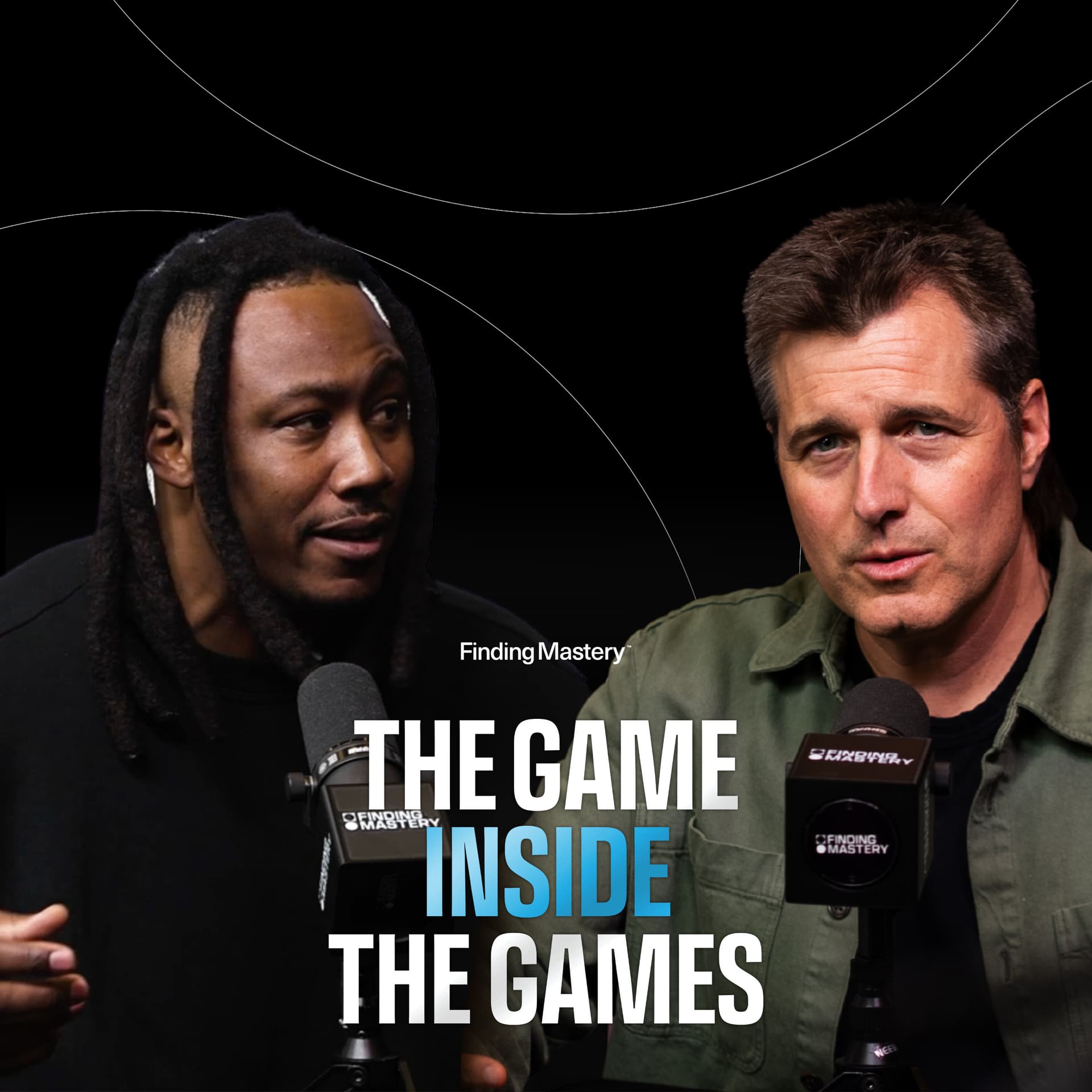
In this episode of The Game Inside the Games, Dr. Michael Gervais and NFL legend Brandon Marshall explore the tension between analytics and intuition—what happens when information is instant, comprehensive, and impossible to ignore. As technology reshapes decision-making on the NFL sideline, the real question becomes: when the moment arrives, what do you actually trust?
Gervais draws on his conversation with Hillary Kerner, CMO of Insight, to examine the human side of AI adoption and why more data doesn’t automatically lead to better choices. Using fourth-down decision-making as a case study, the episode reveals how fear of blame, social pressure, and the need to justify decisions often outweigh what the numbers clearly show.
This is a grounded look at how people make decisions under scrutiny—and why learning when to trust the data and when to trust yourself may be one of the most important skills in high-pressure environments.
Follow Finding Mastery all week as The Game Inside the Games continues to unpack the inner game at global sporting events,, available on YouTube, Apple Podcasts, Spotify, or wherever you listen.
🔥 Don’t miss this deep dive into the mind of an NFL mastermind.
🎧 Subscribe and follow along with Finding Mastery all week as we unlock championship‑level thinking from the biggest moments in sports. Watch The Game Inside The Games on YouTube, Apple, Spotify, or wherever you listen to podcasts.
___________________
This episode is brought to you by Insight and Microsoft.
Insight is redefining integration for the Agentic Era by closing the 65% execution gap currently leaving enterprise AI at a standstill. As a leading Solutions Integrator and top 1% Microsoft partner, we don’t just provision licenses; we build the high-performance infrastructure and secure data estates AI requires to thrive. By converging AI-optimized networking with our proprietary Radius™ Microsoft 365 Copilot framework, we solve the infrastructure-AI paradox. From silicon to skills, Insight leverages "Customer Zero" expertise to transform software into a high-yield autonomous enterprise—enabling seamless, secure collaboration between your people and your AI.
https://aka.ms/InsightMicrosoftCopilot
See Privacy Policy at https://art19.com/privacy and California Privacy Notice at https://art19.com/privacy#do-not-sell-my-info.