
In short
Jon Kabat-Zinn discusses “the psychology of awareness” through mindfulness and its role in medicine, personal well-being, and societal action. He argues the world’s crisis is fundamentally a crisis of awareness—greed, hatred, and delusion—requiring people to “wake up” in the present moment and act to minimize harm.
Guest backgrounds
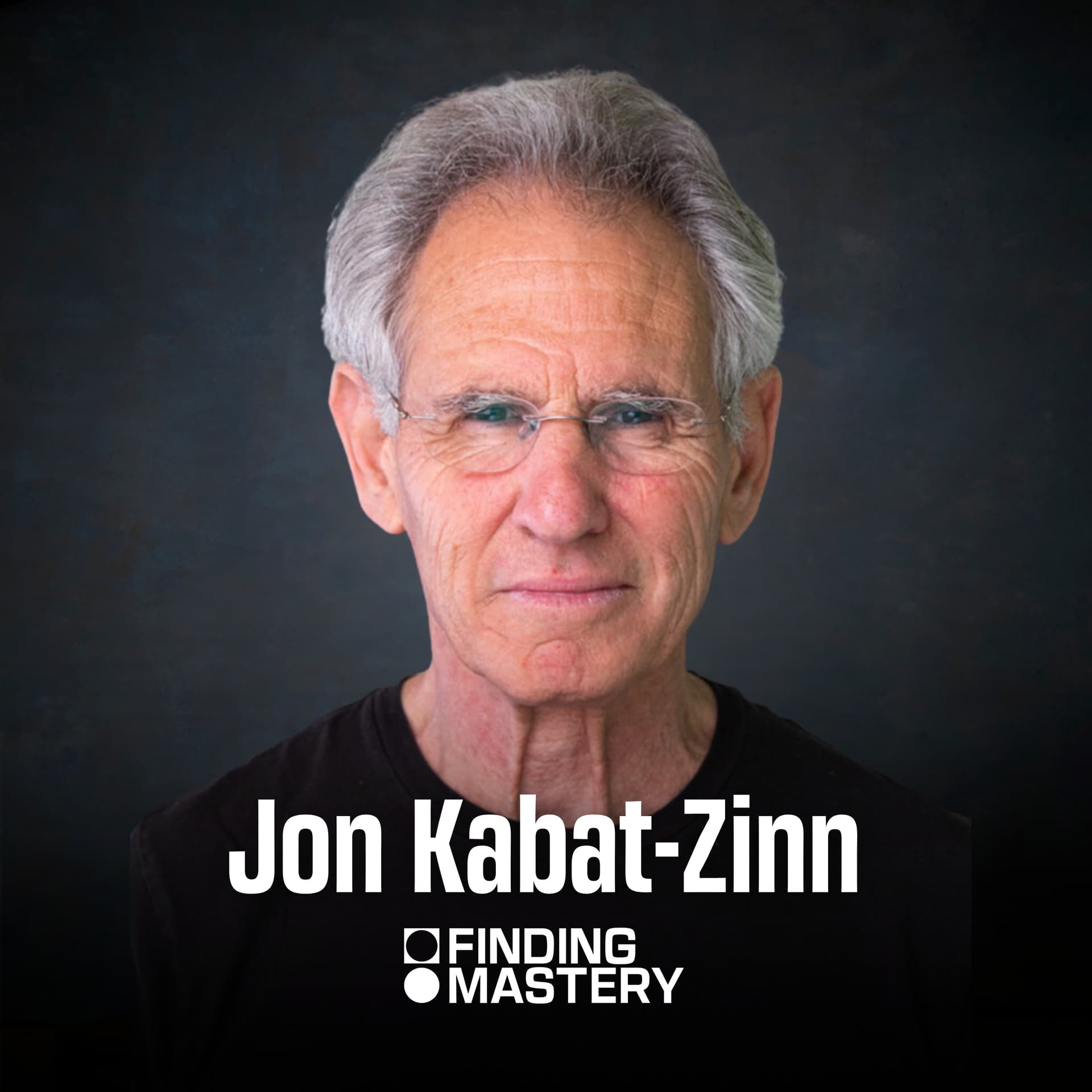
Jon Kabat-Zinn is a molecular biologist, professor emeritus at UMass Medical School, and founder of Mindfulness-Based Stress Reduction (MBSR). Host Michael Gervais frames Kabat-Zinn as a mentor and links mindfulness to high-performance psychology.
Key claims
Mindfulness is not escaping reality but waking up to it; awareness is a natural gift but hard to access when lost in thought/emotion. Compassion is inseparable from mindfulness (“two wings, one bird”). MBSR has documented clinical and MRI-backed benefits, often changing patients’ trajectories within eight weeks. Community (sangha) is necessary; action is essential, not passive acceptance.
Notable examples
Kabat-Zinn recalls leaving a retreat table during “noble silence” after hearing complaining; he cites a homeless-person encounter that reframed compassion; he references ICE detention conditions in Minneapolis; he mentions UN mindfulness initiatives and Thich Nhat Hanh (via student Brother Phap Blue).
Written by AI. May contain mistakes. Listen to the episode to check what was said.
Chapters
Tap a time to open that second in VOThe Impact of Presence and Mindfulness
0:03 to 0:58
Discussion on the significance of being present and its contagious nature.
“Mastery because we know one great hire can change everything.”
The Impact of Presence and Mindfulness
3:09 to 6:04
Discussion on the significance of being present and its contagious nature.
“Jon, I first just want to start, and I would imagine that you don't know how much I think about you.”
Reflections on a Previous Conversation
6:05 to 8:01
Exploration of past insights regarding global issues and personal growth.
“after the three or five days, I think it was three days.”
The Current State of Humanity
8:02 to 13:44
Jon Kabat-Zinn discusses the challenges facing humanity and the call for awareness.
“And you said, I'm fine with not being fine.”
Compassion in Society
13:45 to 14:01
A conversation on compassion and the challenges of societal indifference.
“our recognizing it or putting our heads in the sand and just pretending that life is going to go on just the way it always did.”
The Importance of Awakening to Humanity's Struggles
14:01 to 18:26
Explore the emotional impact of societal issues and the need for awareness and action.
“It's like we're living in a nightmare, frankly, and waking up, I think, to our common humanity is the only answer because it's not like whoever is doing this is not human.”
Understanding the Human Condition and Community
20:56 to 28:00
Delve into the complexities of human suffering, societal roles, and the need for collective responsibility.
“And then you could say, well, yeah, but they're just going to go out and buy a bottle of whiskey with it.”
Reclaiming Community and Mindfulness
28:00 to 34:28
The discussion emphasizes the importance of community and mindfulness as essential for health and well-being.
“But we have to reclaim that sense of community because we've othered ourselves so much that now we're nation states and we're competing.”
The Journey of Mindfulness and Performance
36:07 to 42:06
Exploring the nuances of mindfulness training and its impact on performance, both in sports and daily life.
“You subtly have introduced formal training and informal training.”
The Introduction to Mindfulness
42:06 to 43:52
Learn about the introduction of mindfulness in the NFL and its focus on optimal performance.
“And I get kind of sucked into that loop.”
Show all 22 chapters
Understanding Awareness
43:52 to 46:15
Explore the concept of awareness, its nature, and how it relates to our being.
“And I try never to say your awareness or my awareness, because who would be arrogant enough to claim it?”
Training Awareness Through Meditation
46:15 to 48:58
Discover how meditation can help cultivate awareness and non-judgmental presence in daily life.
“Because default mode, when you put people into scanners and just tell them, don't do anything, just lie there in an fMRI scanner.”
Applying Awareness to Performance
48:58 to 50:21
Learn how being present can enhance personal and professional performance.
“So it's like, you know, we're just building the story of me constantly, but the awareness doesn't have pronouns.”
Applying Awareness to Performance
50:24 to 51:05
Learn how being present can enhance personal and professional performance.
“And I want to come back to something a little more personal.”
The Intersection of Awareness and Mastery
53:03 to 56:00
Delve into how awareness supports personal mastery and wisdom in life.
“When I ask you this question, the listener has two minds.”
The Stakes of Humanity's Future
56:00 to 58:20
Explore the importance of restructuring work to benefit humanity and the planet.
“endless othering and trying to concentrate, you know, their own well-being at the expense of everybody else.”
Self-Discovery and Compassionate Action
58:20 to 1:01:54
Learn how self-reflection can lead to creativity and compassion in our interactions.
“And I don't know if you're going to base it on MBSR or something else.”
Lessons from Indigenous Wisdom
1:01:54 to 1:04:48
Understand the significance of indigenous practices in caring for the planet.
“and maybe this is kind of like the test.”
The Balance of Digital and Analog Life
1:04:48 to 1:07:08
Discuss the need for balance between digital advancements and inherent human potential.
“But basically the Earth is just hanging here at a certain distance from the sun.”
The Balance of Digital and Analog Life
1:07:35 to 1:08:36
Discuss the need for balance between digital advancements and inherent human potential.
“Nearly 95 % of us are not getting enough fiber.”
Expressing Gratitude and Reflection
1:10:08 to 1:10:59
The hosts reflect on their conversation and express gratitude towards each other.
“Again, that's protonvpn.com slash mastery.”
Upcoming Episode Preview with Dr. Lisa Miller
1:11:00 to 1:11:36
Introduction to the next episode featuring Dr. Lisa Miller discussing spirituality and mental health.
“Next time on Finding Mastery, we're joined by Dr.”
Transcript
Automatic transcript. May contain errors.0:00Dr. Michael Gervais:Finding Mastery is brought to you by LinkedIn. We use LinkedIn Hiring Pro here at Finding Mastery because we know one great hire can change everything. One bad hire, it can cost you a lot, way more than time. It can cost you momentum and culture and real dollars. And that's why how you hire matters just as much as who you hire. And it's why I've become a big believer in the power of LinkedIn Hiring Pro. Here's what I appreciate about it. When you're running lean, you don't have hours to sift through a pile of resumes hoping to find the right person somewhere in the stack. Hiring Pro is built exactly for that reality.
0:32Dr. Michael Gervais:You describe the role and it screens candidates for you, surfacing the people who are a best fit so that you can spend your time and conversations with those folks rather than in the weeds of the applications. And the results back it up. Those hiring with LinkedIn are 24 % less likely to need to reopen a role within 12 months compared to the leading competitor. So join 2.7 million small businesses already using LinkedIn to hire. Host your job for free at linkedin.com slash mastery. Terms and conditions apply. Again, that's linkedin.com slash mastery to post your job for free. If we were to write a diagnosis for humanity on planet Earth, the prognosis would be not good because greed, hatred, and delusion are running rampant.
1:15It's time for us to actually wake up as a species.
1:19Dr. Michael Gervais:What if the real crisis we're facing right now is not political or technological or even environmental, but it's a crisis of awareness? A lot of the time we're perpetually distracted. And so when we do show up and we are not driven by an agenda, it's kind of contagious. Welcome back or welcome to the Finding Mastery podcast, where we dive into the minds of the world's greatest thinkers and doers. I am your host, Dr. Michael Gervais. A high performance psychologist named Michael Gervais. Who head coach Mike McDonald and former head coach Pete Carroll brought into work with the Seahawks. Famous for his work with Felix Baumgartner when he jumped out of space in the Stratos Project.
1:55Olympic athletes depend on something more than just training and talent. They have to stay mentally tough.
2:02Dr. Michael Gervais:Today's guest is Jon Kabat-Zinn, molecular biologist, professor emeritus at the University of Massachusetts Medical School, founder of Mindfulness-Based Stress Reduction, and a mentor of mine whose way of living I deeply respect. His work has been fundamental in how we understand mindfulness in medicine, psychology, and everyday life. I've come to see it as a radical act of sanity to stop and drop into this moment because this is life. This moment is it. And everything else is either over or it's yet to come. In this conversation, we explore why mindfulness is not about escaping reality, but waking up to it.
2:37Dr. Michael Gervais:And why the skills of being present, connected, and compassionate are essential for the future. Being engaged rather than just sitting back at a distance is important. If you care about younger generations, then this is a critical moment again. I really do feel like mindfulness and heartfulness has the potential to unify everybody on planet Earth. With that, let's jump into this week's conversation with my friend, Jon Kabat-Zinn.
3:09Dr. Michael Gervais:Jon, I first just want to start, and I would imagine that you don't know how much I think about you. And so I just want to start with a thank you for how much space you've taken up in my life. And even though we don't speak often, just the gift that you've given in your presence and your interest and the way that you show up in the world has made a material difference in my life. So I just want to start with a thank you for that. I'm speechless, but deeply moved, of course, to hear that. And then I feel that resonance that you're referring to, that is kind of one of these very mysterious beyond time and space kind of resonances where, you know, we don't have to see each other or talk to each other for long stretches of time.
3:58But there's a certain kind of way in which I feel like our common interests and intentionality really overlap to a huge degree. I have a lot of confidence in that.
4:07Dr. Michael Gervais:What you've taught me by being around you and what you've taught me by what you've said to me and what you've said to others in my presence and the writings that you've written and the deep thinking, I've all been material, full stop. But I want to share a story with you before we get into how you're doing and how you're understanding the world right now. There was a moment. I was at one of your retreats. And I bet you don't even remember this, John. It might have been lunch. It was noble silence, but I think you broke the silence for lunch. for this meal. And people were talking about somebody else, a world thinker.
4:42Dr. Michael Gervais:And I looked down at you and you had your head down. You were listening and feeling what was happening. And you stood up and you compassionately left the table. And I remember thinking, oh, there was a residence. There was a vibe, if you will, that you did not want to be part of. because it was a little bit of a complaining about this global thinker. I'll keep the thinker's name out of it for now. And I looked over at you just seeing if you were picking up on that vibe because I don't like when people are talking bad about other people. I don't feel that, right? And I looked over at you and you're kind of nodding like, yeah, it's my time to leave.
5:20John, in that moment, you might have taught me
5:24Dr. Michael Gervais:more than everything else I just mentioned because you were into it, you were feeling it, you were gathering, you were sense being. and then there was no purpose for you to stay in that conversation and you didn't like it. So you got up and eloquently left. And I was like, okay, I really appreciated that little subtle moment, that little subtle teaching that was profound for me. Of course, I don't remember it at all, but I think we do that for each other. And I mean, most of us who are in relationships with other people tune to each other in that kind of a way that added benefits that we never really get to express to each other.
6:01Yeah.
6:02Dr. Michael Gervais:So fun that I get to say that to you now. Thank you. Thank you. Yeah. And my wife was on the retreat at the table with us and we talked about it after the retreat, after the three or five days, I think it was three days. And we talked about that moment and she noticed too. So there's two things in this. One is you take up a lot of space, not because you are demonstrative and big and like heavy in that way, but because you're, I don't know a better word right now than say energy, but I don't want to be like in this woo kind of space, right? I hear what you're saying. The word I would use would be just present.
6:37So it's nothing special in a way, but I think what you're pointing to, and this doesn't have anything to do with me, is that anybody who is more or less fully present in any kind of situation, that presence is felt by other people. And, you know, and it's not an accident. It's a kind of result in some sense of an intention to align one's life with the fact that we're only alive in this moment. And so when you show up in this moment 100%, say in your body and in your heart and in your mind, no matter what the circumstances are with other people by yourself, there's a certain energy that I think accretes to that, that I don't think about at all until you brought it up, but I'm trying to kind of explain what you experienced for myself.
7:29And that's what I would say, that, you know, it's like a lot of the time we're perpetually distracted. And so when we do show up and we are not driven by an agenda, you know, it's kind of contagious.
7:41Dr. Michael Gervais:It is. Both directions. Yeah. Yeah, both directions. Yeah. Right. The last time that we spoke on the podcast was right as the Russia-Ukraine war was beginning. And I would love to just take you back to what you said then. Would that be okay? Sure, sure. That's about four years ago now. Yeah, I started with just saying, like, how are you? And you said, I'm fine with not being fine. And then you spoke about minimizing ignorance and greed and hatred and optimizing love and compassion and non-harming. When you hear that framing in those words now, what still feels true to you and what has evolved in how you hold the world as it is right now?
8:30Dr. Michael Gervais:And, you know, we're in a different framing right now with a different war. I'm very touched that you're saying that. And there have been quite a number of wars that have gone on in the interim and, you know, accompanied by boundless horror. So that was four years ago. I would stand by what I said and multiply it by a factor of a million instantly at this particular moment in time. And I really do think, if you're asking me for my view of things, we are actually at a kind of critical moment on planet Earth for a lot of different reasons. They speak about the sort of polycrisis of, you know, sort of polluting the entire atmosphere, global warming, of course, and despoiling of the entire ecosystem.
9:20And, of course, wars create enormous damage to the ecosystem as well as to humanity. So you can't make more pollution than by exploding bombs and, you know, bomb after bomb after bomb. So I really feel like at this particular moment on planet Earth, and I think the astronauts, we can talk about that later, who recently went out around the moon, gave us a view that I think is a really positive sign, an uplifting moment in a way that has importance here, that humanity has reached the point where it's really capable of destroying everything that's been built, you know, in the past, you know, sort of history and prehistory, that the arc of human life and what we call, questionably, civilization, because this has been going on forever, but with increasingly powerful weapons.
10:16and now AGI, artificial general intelligence, which is a whole other element of this, including the weapons, that it's time for us to actually wake up as a species. And I say it in the frame of the name Linnaeus gave us as a species, Homo sapiens sapiens, which means literally in Latin, the species that is aware and is aware that it's aware. So mindfulness and then mindfulness again. And mindfulness also includes compassion. So they're not two separate things, as the Buddhists like to say, two wings, one bird, mindfulness and compassion, or heartfulness. And so I think on the UN held conference that I went to in Geneva, it was the kind of keynote speaker for in mid-December called United and Present, where they really were promoting this kind of perspective of greater mindfulness and bringing it into every aspect of the UN.
11:17and there were a lot of people there from the World Health Organization. There's so many people on planet Earth who were doing their best to heal the world. And yet, you know, if you think, well, how can the UN influence, say, what's going on in Ukraine? Obviously, it can't. You know, how can it influence what devastation that went on in Gaza? The UN could, it tried to do what it did, and it got attacked for actually bringing food there and so forth. And the same thing is true for what's going on now with Iran. I mean, the UN in some senses was all about not repeating a Second World War, a global war where everybody is at risk for annihilation.
12:04And then we're the country that dropped two nuclear weapons, two atomic bombs on cities that were not military targets. So if the diagnosis, If we were to write a diagnosis for humanity on planet Earth, the prognosis would be not good because greed, hatred and delusion are running rampant, which is the diagnosis that the Buddha offered 2600 years ago. And now you can see it in Silicon Valley. Greed, Bitcoin and all that kind of, you know, sort of cryptocurrency, which nobody understands, but it's like sucking the money out of the system. I don't want to go on about your question except to say that I'm perpetually optimistic that when our backs are to the wall, humanity will actually come through.
12:50And I feel this way very strongly about America, that we will actually wake up to being the species that is aware and is aware that it's aware. At least we're capable of that. And then rewrite our legal system, rewrite our planetary laws of engagement to actually maximize well-being for all and minimizing harm. and you know I think we're beginning to see that the body politic and the body of planet earth are the same and that these national wars of self-interest are just festers on the body of the planet and it can't afford any more of this we've already melted the glaciers practically we're melting the polarized caps so I won't go on and on about this but but I feel like that's the moment that we're in.
13:43And so everything that we do, in some sense, is either colored by our recognizing it or putting our heads in the sand and just pretending that life is going to go on just the way it always did. And hopefully nothing bad will happen. But that really is being blind to the people who are suffering most. Take, for example, what went on with ICE in Minneapolis or everywhere else that ICE is and what they're doing with, you know, these giant warehousing of people, you know, with no plumbing and no sanitation and, you know, imprisoning children without their parents. It's like we're living in a nightmare, frankly, and waking up, I think, to our common humanity is the only answer because it's not like whoever is doing this is not human.
14:27It's just that they're ignorant in a certain way.
14:31Dr. Michael Gervais:I had a friend that was visiting me. He's from New Zealand and we're in Los Angeles. We're just walking down kind of the boardwalk by the beach and there was a homeless person. And this is a homeless person that I've seen around lots. And he walked by and was struck by it. And I walked by as if it was a Tuesday. And he looked at me and he said, whoa, this must be a hard place to live for the compassionate. And I thought, oh my God, what, like, it just reframed me in that moment. And I'm hearing you in the same way, which is you are awake. You are able to sense and feel and have a take on how you're feeling in this world.
15:20Dr. Michael Gervais:You wrote the diagnosis and the prognosis, and then you said, we need to wake up. Yeah. That's the treatment plan. But that's the treatment plan, to wake up. But then I hear you say I'm optimistic and I go, okay, I want to understand that. But I just want to kind of float up maybe just wider for a minute, which is oftentimes in the contemplative practices and the communities that we both relish and regard, there's a passivity. There is an acceptance that waking up or seeing or being aware of the condition is the solution. But I hear a little fight in you. I hear like, we need to take action and change.
15:59Dr. Michael Gervais:And I don't want to put words in your mouth. I would just like to know what the emotional experience is for you as you are awake to the conditions of poor health that you're describing. It's very emotional for me because, you know, I have grandchildren. And the world that they are growing up in is terrifying on a lot of different levels. Just, you know, take what Jonathan Haidt's research is showing us in his book. the anxious generation, you know, and the fact that everybody is like walking around like this and nobody thinks that they should be put in mental institutions because if people were walking around like this 50 years ago in downtown LA or New York City, they'd be carted away.
16:43We're so lost in our micro worlds and addicted to them that, again, at a critical point here. Now, In terms of how we act, well, I think we saw a lot of very strong responses. We are seeing a lot of very strong responses. Every time there's a No Kings Day, I mean, it's like millions and millions of people are coming out. And they're getting more and more engaged. I mean, they're not just coming out for a demonstration, going home and forgetting about it. Their lives are changing the process. People are creating local groups and having conversations. And so a lot of that is going on. I bowed to Bruce Springsteen for the song, The Streets of Minneapolis.
17:24I mean, he produced that song in his home in three days, I think, and put it out there. And it was like, you know, one song can really galvanize people when it comes from the right person. And I think everybody has that potential to actually act. And of course, two people were shot acting in Minneapolis to do that. And so this is kind of the nature of the world we live in. But I feel like we do need to stand up and call a spade a spade, stand up to greed, hatred, and delusion in every way that we can. And since you mentioned the homeless person and, you know, somebody panhandling on the street, yeah, it's a really fabulous meditation practice to see what happens in that first moment of apprehension.
18:14You see the person. And very often it's a kind of shutting down, a turning away, like I pretend I didn't see. But awareness or mindfulness can actually catch you doing that.
18:26Dr. Michael Gervais:Bonnie Mastery is brought to you by Rag & Bone. I've been a big fan of Rag & Bone for a number of years. I just love what they do. It's a go-to for me when I'm choosing clothes. I've been wearing their infused denim for a while now. They've done just a really nice job with this product. For me, I am really intentional about what I invest in. In clothing, it's no different. I want things that are well-made, that stand the test of time, that don't distract me, that support my focus on the things that matter most. And that's exactly why these deliver. And they look sharp, full stop. They've spent 20 years obsessed with getting this product right.
18:56Dr. Michael Gervais:And that kind of long-term commitment to craft, that's something we talk a lot about here at Finding Mastery. Quality compounds. The right inputs may consistently over time show up in everything. And you can feel that the moment you put these on. If you're ready to upgrade your denim with something that's genuinely built to last, it's time to upgrade your denim with Rag and Bone. For a limited time, our listeners get 20 % off their entire order with the code FINDINGMASTERY at rag-bone.com. That's 20 % off at rag-bone.com with the promo code FINDINGMASTERY. And when they ask you where you heard about them, please support our community and this show and let them know that we sent you.
19:35Dr. Michael Gervais:Finding Mastery is brought to you by our flagship mindset training course, Finding Your Best. Anytime you feel the pull to reset, to zoom out, to refocus and ask, am I moving toward the person I want to become? It helps to remember this. Lasting change comes from training. Not resolutions, not short-term sprints, but deliberate practice of the skills that shape how we show up. Work and relationships and in the moments of great intensity as well. That's what finding your best is all about. It's a science-backed framework for training your mind. And it's the same set of tools that we've taught to Olympic athletes, top executives, elite military teams, and artists at the peak of their craft.
20:09Dr. Michael Gervais:In this course, you'll learn the foundational psychological skills to be your very best. Full stop. And the best part is you can start anytime. Right now, we're running a limited time offer on finding your best. Simply head to findingmastery.com slash course and use the code RENEW100 to get$100 off your registration. If you've been waiting for the right moment, this is a good one now to lean into. Spring and summer, they are powerful seasons of momentum. It's a great natural time to step into growth, to refocus, to recommit to who you want to become. And this discount will not be around for long.
20:44Dr. Michael Gervais:So go to findingmastery.com slash course code renew100 for$100 off today because your future is not shaped by what you intend. It's shaped by what you train. Usually most people, if you gave them$100, you would not really suffer. Okay. Or$10. or$5 or even$1. And then you could say, well, yeah, but they're just going to go out and buy a bottle of whiskey with it. Or, you know, there are all sorts of ways in which you can kind of... But in some sense, what we're doing in that moment is we're unwilling to apprehend the enormity or what I call the full catastrophe of the human condition. This person was a baby at one point and as cute as any other baby on the planet.
21:27And things happen. And what a society is supposed to be for, in very large measure, is taking care of its people. That's why we have states. That's why, you know, it's so that there's a government that can actually help people to be homed, you know, to be housed, to be taken care of, to have hospitals when they get sick or need care of some kind or other. And schools, why do we educate people even? It's like the body politic is in a certain way a kind of the biology of humans in society. You know, if you think about the body as opposed to the body politic, your body has like gazillions of cells, trillions of cells.
22:13Every single one needs an adequate blood supply, right? If you don't get a blood supply, even to your little toe, what's it going to do? It's going to necrose. And that little toe is going to, in some sense, run your life. I mean, it can get infected. It may need to be amputated. There are all sorts of things that can happen once you get that kind of initial infection. And so an adequate blood supply is necessary for every single cell and tissue in the body. Why not in the body politic, too? People talk about a universal basic income or giving people enough so that they can maybe self-start. So that person panhandling on the street or in Grand Central Station or whatever, what would it take to actually recognize that's still a human being?
23:00And not just somebody who's annoying me on my way to some important meeting that, you know, where the stakes are very high.
Read the full transcript
23:07Dr. Michael Gervais:What is the body politic? What I mean by the body politic is either the nation state, if you're talking about the United States, or the United Nations, or all nations in a certain way. You know, the body. The United Nations is meant to be a larger body that holds these individual nations. You could think of the nations as organ systems. And the world is like the body politic. And the organ systems have to all function effectively. and you don't want the liver going to war with the lungs because we like the way we look better or we want more oxygen than those people get because in the end, the whole thing would fall apart.
23:49And I think that's where the waking up comes, that we need to actually recognize as Thich Nhat Hanh, this great Vietnamese meditation teacher and practitioner, who, by the way, was molded by the horrors of the Vietnam War, which never needed to even happen. At least the U.S. involvement, just picking up on French colonialism. And then the Japanese invasion that happened before that. It was a choice. We made the choice. And it shaped Thich Nhat Hanh's life in such a way that, you know, he devoted his entire life to actually trying to bring what I'm talking about into the world in ways that would help us to govern ourselves in a different way.
24:34And that governance is what I'm using relating to the Buddhist term dharma, which means actually the actuality of things, what science would look at as the nature of things.
24:47Dr. Michael Gervais:I love that you bring up Thich Nhat Hanh. I'd never had the chance to meet him. I'm imagining you did. But he has been a teacher. I mean, his writings, his meditations, his sense of how humans work in this world has been profound for me as well. One of his students has a podcast. The Way Out is In is the name of the podcast. It's so good. Is that Brother Pat Blue? Who is that? Yeah, it is. Oh, he's an old Dharma buddy of mine. Oh, perfect. Well, I'm going to ask for an introduction. So yeah, he is amazing. He sounds just like Thich Nhat Hanh. Like he's really embodied a spirit. No, he's beautiful.
25:30And you couldn't really say that to him because he would say, well, that's true for everybody. And he's right. But they embody that. And in a certain way, that's why the monastics in that tradition and in all traditions, but particularly in that tradition, why they wear very plain robes that just cover everything. They're not fancy, although they do have fancy robes for special occasions. and, you know, the women wear headscarves. And so you don't actually see them as individuals, but they are part of some larger community or sangha of intentionality. Yeah, that's right.
26:07Dr. Michael Gervais:Sangha meaning the... Sangha means community. The community. Yeah. The community of people who love, who care, who practice, who have kind of enrolled in, so to speak, the adventure of loving what is. Right. But okay, let me paint a scenario. The person listening or watching is saying, okay, hold on a minute. I'm barely keeping myself together. I'm more stressed and more anxious and feeling more overwhelmed. And you want me to go into that and actually like get more in touch with my feelings because as soon as I flip open my phone or TV or a glass of wine or a nice meal, or I feel like I can just escape a little bit.
26:49Dr. Michael Gervais:And wait, John, you're asking me to actually tune into that more through a process of paying attention to my feelings or my thoughts. And I'm going to feel more. And I don't know if I have that kind of compassion. I don't know because I want to burst out in tears or crawl in a hole on a regular basis. Paint that scenario of that person, whether you see them as a parent, a grandparent, you see them as an operator of a business, whatever, wherever. Can you speak to that experience that so many of us are having? Yeah, well, there's no question that it's overwhelming. And to turn towards what you most want to run away from is kind of like, why would I possibly do that?
27:36And my short answer would be, well, how's it working for you by running away from it? Oh, God. You know, this is, again, to come back to the monastic community, this is why they are together. See, because you can't carry the burden of human suffering by yourself. We need a community. It turns out the community is all of humanity. But we have to reclaim that sense of community because we've othered ourselves so much that now we're nation states and we're competing. and now we're even disregarding the Europeans. They're no longer our friends. We've thrown the NATO alliance down the toilet, and it's every man, and I say that advisedly for himself.
28:22This is not a formula for health and well-being of any kind in any realm. And I think when one's practicing mindfulness, you're actually, although you may not realize it at first, and this is why you need effective teachers to kind of point things out to you. When you are taking your seat, let's say, in formal meditation, all by yourself in your own home, I've come to see it over the 50 years that I've been practicing. It's not one more thing I have to squeeze into my day or to eat vegetables or to change my lifestyle or run more or whatever. I've come to see it as a radical act of sanity. to stop and drop into this moment because this is life.
29:14This is the only moment anybody, whether you're listening now or you're listening later, the moment of listening, this moment is it, okay? And everything else is either over or it's yet to come. And of course, we create gigantic fictions about both what was over and what is yet to come. But very often, we don't know who's actually in this moment. And we don't even, a lot of the time, inhabit the body. We're so caught up in the mind, in the head, that we lose touch with the body and has vast repercussions in terms of stress, pain, illness, and health. So MBSR, for instance, where we, you know, sort of one of the things that I'm most known for of bringing meditative practices, mindfulness-based stress reduction into hospitals and medicine is to actually help people, you know, who are falling through the cracks of the healthcare system with chronic illnesses of all kind tap into their potential for learning, growing, and healing across the lifespan.
30:13And in eight weeks, very often the entire vector of their life changes. And we've documented this in multiple scientific studies and clinical studies and MRI studies and so forth. Really, what looks like nothing from the outside changes everything in no time in just this moment. So not only is it a radical act of sanity to, and I'm using take your seat metaphorically, because you can do it lying down, sitting, walking, standing on your head, hanging from your toes. I mean, the question is, can you be in this moment in your life? And it's not just a radical act of sanity. It's a radical act of love.
30:54It's a certain kind of statement that I belong, I am sufficient, and I am connected to everything else. And the proof is I need to take the next breath in. I'm not actually independent of this world I am one breath away from being dead and if I don't take this breath in and then let it out I'm gone so an appreciation of the breath and the fact that you know if I have like living next to some kind of power plant that's polluting then people who are living around there can't even breathe You know, the practice of mindfulness is really a way to affirm that you count, that you're important, that you're at least that one cell of the body of the whole planet, and every cell counts.
31:49And you belong, and then you also are in community with all the other cells around you, many of them like-minded. You may not even know your neighbors, but, you know, why not get to know your neighbors? This is the kind of thing where I think with what's going on in the country, a lot of people are beginning to actually know their neighbors and realize, no, this is really important. Local stuff is important. Being engaged rather than just sort of, you know, sort of sitting back at a distance is important. And as I said, if you care about younger generations, you know, if you have a kind of family investment just by being a father or mother or parent or grandparent, then this is a critical moment again.
32:34So acting is not a kind of luxury. It's an absolute necessity. That's the way I see it. That's a very existential position, so to speak. And I really do feel like mindfulness and heartfulness are one human discovery of potential that has the potential to unify everybody on planet Earth.
32:57Dr. Michael Gervais:What does that mean to you? Well, what it means is that we wake up to the fact that we're not only capable of destruction, destroying ourselves and each other through greed, hatred, and delusion, but we're also capable of embodying love in the present moment. And so when you practice in this way, then you realize very shortly the real meditation is not sitting on your cushion for some period of time trying to look like calm and collected. The real meditation is moment by moment, life itself, all of life. So how you show up in your relationships, how you say goodbye, how you say hello, how you hug.
33:37And when you're not doing it out of thinking, but you're doing it out of embodied wakefulness, it's an entirely different experience. And so that, in some sense, changes the trajectory of the world in small but not insignificant ways. And I feel like the fact that the UN is getting into mindfulness, that wasn't happening 50 years ago. The fact that the World Health Organization, that isn't happening. There's so many positive things that you can look to in the world that really are moving in this direction. We have to pour energy into those and call out the greed, hatred, and delusion wherever it is.
34:16It doesn't go by Republican or Democrat. Everybody's, you know, sort of like driven by self-interest. And what we need to do is redefine what it means to be a self in relationship.
34:28Dr. Michael Gervais:Body Mastery is brought to you by Fatty15. Did you know that Navy dolphins helped unlock a secret to healthy aging? It's a wild story. And it's the foundation for a product that I've come to really love, Fatty15. Fatty15 is built around C15, the first essential fatty acid discovered in over 90 years. And it was discovered by Dr. Stephanie Van Watson. She's the co-founder of Fatty15. While she was working with the U.S. Navy and based on over 100 studies, we now know that C15 strengthens our cells and is foundational for healthy aging at the cellular level. Stephanie has been on the podcast and it was one of my favorite conversations.
35:06Dr. Michael Gervais:She's amazing. And what her and her team are building is something I'm really excited about. Head to fatty15.com slash finding mastery and use the code finding mastery for an additional 15 % off your 90 day starter kit. Again, that's fatty, F-A-T-T-Y, one five dot com slash finding mastery. And the code is finding mastery. I want to take a second here to tell you about a morning routine that I've been using for years. For me, it's a great way to switch on my mind, to ready myself to take on the day. So before I check my phone, my emails, market updates, or text threads, I choose how to start my morning.
35:41Dr. Michael Gervais:That's always in my control. That's always in your control too. This is the same morning mindset routine that some of the world's top performers across sport, business, and the arts are using. The best part? It only takes about 90 seconds to do. So just head over to findingmastery.com slash morning to download the audio guide for free. Again, head to findingmastery.com slash morning to get your morning mindset routine. You subtly have introduced formal training and informal training. Formal training is when you create a structured amount of time and you are going to on purpose pay attention to maybe one thing, your breath, your inhale or exhale?
36:24We just learn to, say, take up residency and awareness for a period of time. And every time your mind wanders, which it's going to do infinitely, the awareness function actually recognizes sooner or later that you're lost in thought or carried away by some dream. And that awareness function is always functioning. So you're already back. And as you exercise that muscle, as you know from working with all these athletic teams, you exercise the muscle by working with, not against, a certain degree of resistance. So when the mind says, well, I don't want to sit anymore, I don't want to be present anymore, try stretching it out for one more in-breath and one more out-breath before you decide to get up.
37:09And in that way, you're actually embodying wakefulness in that moment and not falling into the lowest common denominator of your own self-soothing. And in doing that, you're actually learning, growing, healing, and transforming what might be possible for you in your life before you breathe in your last in-breath and out-breath. Is that making any sense to you, by the way, what I'm saying with it? It's really clear. I just want a reality check here because I'm asking a lot of us, but I feel if you ask a lot, and this was like true in MBSR, the first principle of MBSR, because we see people who medicine can't help anymore.
37:52I mean, that's why they're sent to stress reduction often. And our principle was, if you will ask a little of these people, give them some light rinky dink, a little relaxation, a little this, a little that. If you ask a little of people, the most you're going to get is the little you ask. If you ask a lot of people, first of all, they see that you believe that they are capable of that. If you ask a lot of people, there's no telling how they're going to respond because we love to be asked and seen as people who are capable of doing more than what we think we're capable of. I know you know that from all your work with professional sports teams.
38:31I mean, you know, it's all a matter of like, how do you get optimal performance? It's by letting go of the idea that you can't.
38:38Dr. Michael Gervais:And you really need to apply yourself at your edge. Exactly. And then to make a fundamental commitment in your life to do that as often as you possibly can. And that's what elite sport in plain view can teach us. There's a lot of problems with athletics, but there are a couple of things that are really important to understand is that those that are fundamentally committed to being their very best as a person and as a teammate need both of those. they organize their life and they've got a sangha. It's not in the same tone, but they've got a team of coaches and teammates that hold the standard, that help them hold the standard of one more breath, one more rep, you know, stay in it just a little bit longer.
39:21Dr. Michael Gervais:Can you, can you have a little bit more fun on the edge? Because that's going to extend us a little bit for, can you relish in the way it feels to work hard with each other? And that keeps extending what we now view we are capable of. It's like a new mountaintop. Oh, look, there's another horizon. I didn't even know that was there. You get to that new one and you're like, I didn't even realize there's another whole horizon behind it. And so in elite sport, just to pull on the thread a little bit more, it's the fundamental commitment that I just want to make sure sings in what I'm saying. And then what they do is they front load their physical training, their technical training, and their mental training.
39:58Dr. Michael Gervais:The world's best don't leave one of those up to chance. So they front load that training and they're trying to get to that messy edge as often as they can, because that's where the unlocks and the learnings and the insights take place. That's where the capacity building happens. And then they test themselves with other people that are equally as committed. And now we've got this kind of stepwise approach. And before you know it, like we're changing the way we understand what people are capable of. That's a beautiful metaphor for what we're talking about in the larger world is that, yeah, we are capable of that and we need each other and we can inspire each other and help each other and share practices together and have it be joyful rather than I'm only committed to this because I'm attached to some outcome.
40:46The highest performance is when you even give up being attached to the outcome. You're so in the moment that the outcome is almost assured by the fact that you're beyond clinging and grasping because that sucks your energy in certain ways that we often don't understand.
41:04Dr. Michael Gervais:Yeah, in sport, and you know the term as well as anybody, but athletes call it being in the zone. Musicians call it being in the pocket. The technical science term is flow state. and like what percentage, when I've asked this question for, I don't know, 25 years, what percentage of time do you experience that? Yeah. And, you know, the number comes back like somewhere between 5 % and 25%, somewhere in there, which begs the question, okay, the other 75 % of the time, how are you operating? Where's your mind? That's right. And the greats, the greats, they go, that's it, Mike. That's like, I am working.
41:42Dr. Michael Gervais:I'm working really hard with my thoughts to get over to this like open aperture of what could be. And I'm backing myself and I'm trying to find fun in the moment. And I'm working to refocus my mind in the present moment to what could become amazing. And when I'm not at my best, like it feels like I'm just tight and constricted and worried and anxious and overwhelmed. And I get kind of sucked into that loop. So the best are working underneath the surface to try to guide their mind to their best abilities. And that's when I first introduced mindfulness to the NFL. The wave of interest was not for enlightenment, wisdom, or deep insight.
42:23Dr. Michael Gervais:It was more - Optimal performance. Right. And I was trying to like, what do you do? Sneak the vegetables in with the fruit? Or what's that saying? Like you're just trying to get a little taste into the things that maybe people don't want. Yeah. Yeah, that's not the saying, but you know what I'm saying. And all of a sudden people are like, whoa, when I'm more aware, when I'm with awareness, and I'd love for you to explain the nuances between when I'm more aware or versus when I'm with awareness. But when I'm with awareness, I'm able to nap. I'm fully present. I can navigate. I'm kind of unfolding with the unfolding moment.
43:01Dr. Michael Gervais:And I have like everything is at my access. You have infinite degrees of freedom, or at least it feels like infinite degrees of freedom. And it's not your thinking mind. Your thinking mind can't work fast enough to decide whether to faint left or faint right. You have to trust the body's intrinsic wisdom in motion. That's right. Yeah, but it is a trainable skill. So that's meditation in action. I want to do two things. I want you to talk about awareness. And then I want you to talk about just the super mechanical, simple way to train meditation. and then like super, super. And then I want to get into the curricula of life.
43:39Dr. Michael Gervais:And I want to talk about if you were the president of the United States of America, like what would be some things you would do? And so let's kind of go in that order. Awareness, technical training, and then curricula to optionality. The way I talk about awareness is that awareness is not something you get. And I try never to say your awareness or my awareness, because who would be arrogant enough to claim it? It's a gift that we're born with. We don't understand it. Not even, no neuroscientist understands what awareness is or how it arises or whether it even is a property that arises out of the brain.
44:19I mean, but we have what's called sentience and human awareness and other animals and maybe plants also, you know, have some degree of sensitivity to something larger, the environment, because the trees are kind of breathing in carbon dioxide, let's not forget, and breathing out the oxygen that we're breathing in, and we're breathing out the carbon dioxide. So in a certain way, we're completely interrelated. So it's not my awareness. I would say not so much trying to be with awareness even, but to just be aware, to be awake. because it is a given for us. We have it as a property, although we can't claim it as mine, but what we don't have is easy access to it.
45:09We don't have awareness when we most need it because usually we're lost in thought and caught up in heavy-duty emotions of one kind or another. So if you just stop and see where's your mind at one moment or another, most of the time it's lost in thought, thinking this, that, or the other thing. A lot of time in the future, a lot of time in the past, that's called worrying, you know. But when you start to pay attention, you realize what your mind is doing, that's awareness. So the awareness can actually hold what's going on in the present moment, and then you don't inflate it with the story of me, that that's the full reality, because you're more awareness than you are what's happening to you.
45:57And this is like, we could call it one's true nature, is awareness itself in the form of you or in the form of me. So it's like phenomenal and a giant mystery. And so how do we learn to actually set that as our default mode, as the neuroscientists might say? Because default mode, when you put people into scanners and just tell them, don't do anything, just lie there in an fMRI scanner. This sort of midline region of the brain just goes crazy with activity. And when you interrogate people, well, what was going on in the scanner? They were making laundry lists of what I have to do when I get out of the scanner or taking care of the kids or whatever.
46:39It's just thinking, thinking, thinking and the emotion that's associated with thinking. But when they've trained in MBSR for eight weeks even, you see an attenuation of that activity. The story of me doesn't dominate as much. And instead, there's other activity in different regions of the brain, but it's more like there's simply awareness. I won't even say I'm here or I'm aware. There's simply awareing or awareness.
47:07Dr. Michael Gervais:And then when we slide into the concreteness of like formal practice, if you will, the way I think about it is like, okay, I'm going to set my intention to focus on my inhale. than my exhale with all of my might, with all of my essence that I possibly can. I'm just going to work right now. Okay. And then inevitably, you know, on the second inhale, my mind has kind of started to go somewhere. Including, this is stupid. Yeah, right. What am I doing? Whatever it is, right? Why should I be doing this? I got so much to do. Yeah. And then the moment that I go, oh, I'm not with my thought, or I'm with my thought, not my breath.
47:44Dr. Michael Gervais:Oh, I go, oh, that's That's the moment of awakening. That's it. I'm in it. That's awareness or awareness. And I used to, that's right. And John, like it was from your training. I used to go, oh man. And I go kind of into this negative state. Like, I am so not good at this thing. But there's one more instruction that you're gonna share with us right now. And what is it? Not to judge yourself. A hundred percent. And then, so, okay. So then I reckon, oh, well, and then watch this. Man, I am not good at this. Wow, I'm really judging myself. I'm not supposed to be judging myself. I know better than that.
48:18Dr. Michael Gervais:Come on, get yourself together, Mike. Like if this is your life, so quickly down the slide trap. And then I realized from you, John, I was like, wait a minute. I'm aware. I'm aware I'm in this state that I'm on this thought train. And then I started to celebrate. There I am. Here I am. Right. And then you build a story out of that. Or I refocus my mind back to the inhale. And you can just rest in awareness. That's right. Yeah. That's right. Either one of those two. That's the invitation is to actually, the way I say it is if like you only remember one thing I've ever said in my life, it would be don't take personally what's not personal.
48:59And it turns out none of it's personal. So it's like, you know, we're just building the story of me constantly, but the awareness doesn't have pronouns. It's just, oh. And there's something about it that's insanely beautiful, and you already feel complete, whole. And of course, you're still you, and of course, you still have your name and your age and everything else. But now, like in this moment, you're simply present, and you don't have to push the river or stay stuck in some narrative. And then you can apprehend reality much more clearly because your thinking is not obscuring everything and your emotional reactions to everything.
49:44If we were to do this on a level of society, then we would actually be in a much better position to minimize harm, recognize harm, minimize, you know, harm to whatever degree we could, and maximize well-being and create new laws that actually further that as opposed to laws that actually maximize. I mean, you know, sort of Citizens United is a beautiful case in point. Maximize greed, hatred, and delusion. And the concentration of wealth, you know, that you're given permission to just go for it.
50:21Dr. Michael Gervais:Finding Mastery is brought to you by LinkedIn. Earlier, I mentioned LinkedIn Hiring Pro. And I want to come back to something a little more personal. We talk a lot about the people who make extraordinary things possible. And I want to take a moment to acknowledge some of ours. Janelle, Taylor, Alex, Emma, and our newest teammate, Chelsea. Every single one of them came to us from LinkedIn. And every single one of them has raised the bar of how we operate here at Finding Mastery. Our relationship with LinkedIn, it also runs a lot deeper than just using their tools. We also work with their teams on the corporate side, helping them build the kind of high-performance culture where great people want to stay.
50:58Dr. Michael Gervais:They want to grow. I've been building businesses for over two decades now, and I'll tell you, the right team, that matters so much. It's the difference between grinding and flowing. So this partnership, I believe in from the inside out. When you hire through a platform like LinkedIn Hiring Pro that surfaces people who are genuinely aligned with what you're building, you get a different quality of candidate, not just in skills, but in fit and values, the kind of energy someone brings to a team. So if you're thinking about your next hire, I want to strongly encourage you to be intentional about where you look.
51:32Dr. Michael Gervais:The right person is out there and LinkedIn Hiring Pro helps you find them faster with a lot more confidence. Post your job for free at linkedin.com slash mastery. Terms and conditions apply. Again, that's linkedin.com slash mastery. Finding Mastery is brought to you by Sunlighten. I'm really excited about a new partner of ours. Something that I've come back to again and again is when I invest in recovery with the same intention that I bring to my work, everything gets better. My energy, my focus, my ability to show up fully for the people that I'm with and the work that I care about. That's why I am so bought in on the Sunlighten M-Pulse Intelligent Sauna.
52:12Dr. Michael Gervais:I was first introduced to their team a few months ago and was so impressed by what they've created. This is one of the most advanced infrared saunas that they've built in over 25 years of pioneering this technology. That's right. They've been at this game for 25 years. I had one installed in my home a few months ago and it's made a real difference. I feel more refreshed, more grounded, more relaxed, and it's become a consistent part of how I recover, how I reset every day. I'm using it to support muscle recovery, for improved oxygen delivery, and for nervous system recovery. And what I love most, I don't have to leave my home.
52:46Dr. Michael Gervais:They're offering the Fonny Mastery community up to$2 ,100 off. Simply head to sunlighten.com and use the code mastery for this great discount. Again, that's sunlighten.com and use the code mastery for up to$2 ,100 off. When I ask you this question, the listener has two minds. One is, okay, this is going to help me live better. I hear both of you and you're kind of drooling over the power and the importance of being with awareness. I hope not. Being awareness. Yeah. Okay, good. And then there's two minds. One is, how is this going to help me perform better in life? And the other is, how is this going to help me with wisdom or insight?
53:30Dr. Michael Gervais:There is a merging between the two. But could you speak to, let's go first with the person that is like, look, I want to perform really well in life. I want to be great as a father or as a mother. I want to be a great business person. I want to be a great community member. and speak to that performance-based, which is just a tick below this conversation in my mind about mastery and even enlightenment. But just talk to the performance aspect for just a moment. Well, what we're talking about is a way of being in relationship with experience. And there are ways of being that seem more driven than other ways of being that are, in some sense, prescriptions for suffering often than other ways of being.
54:17And that when you are simply present, then you can catch those impulses to go in one direction or another and realize maybe that's not where I need to go. And then you maybe can just be a little bit longer. And then what's so amazing, almost miraculous, is that sooner or later, you will have a kind of realization of where you belong, what you need in this moment, what you need to do. And when the doing comes out of this domain of being, it's an entirely different doing, much healthier, much more robust, and really undeflectable so that you have a kind of motivation that is enduring, so to speak, and goes across, you know, since I'm in my ninth decade, I can, you know, sort of speak that it really does go across the decades in a way that is quite extraordinary.
55:19And then you don't need to build a story around that. Other people are going to project as they always do onto everybody else, who they are, what they've done, how great they are in some cases, how horrible they are in other cases. But it's really important never to believe anybody else's projections or even your own story of who I am, but more just stay in the present moment and let the results speak for themselves. Then you are love. You don't have to be loving. You just love. You are present. You are caring. You are concerned. Everybody will be who they are, which will be unique and uniquely different, and yet will take some kind of real inspiration from the community of people who are engaging in this way rather than engaging in endless othering and trying to concentrate, you know, their own well-being at the expense of everybody else.
56:14That's my kind of orientation, but I understand that other people might think I'm absolutely out of my mind.
56:23Dr. Michael Gervais:I love the unreasonable ones. You know, the Army Corps of Engineers has a wonderful sayings is the difficult we do today, the impossible takes a little longer. And what we're talking about is the impossible. But the stakes are incredibly high for humanity. We either wake up or we're going to destroy ourselves sooner or later. Or make life so miserable. I mean, if you were working in a gold mine in South Africa, or if you're working in a gold mine in Brazil or any other, I mean, there's documented evidence and artistry around, you know, what many, many millions of people on Earth, their lives are like, and nobody in their right mind would want that.
57:09And they are desperate, and they do it because that's their only way to survive. We need to restructure the nature of work so that, yeah, I mean, and we're extracting everything from the Earth, you know, all the rare Earths that we need all of a sudden to build the technology and stuff like that. But our rare earth is in some sense being extracted and destroyed in the process, driven by endless factors that could be modulated with wisdom and compassion in ways that, yeah, we could still build stuff and at scale, but without all the harm that we're creating for people. Why not? If we can conceive it, why can't we do that?
57:53Dr. Michael Gervais:So if you had a position of power in the United States and you could institute an inspired curricula, and there's a listener right now that says, John, tell me, I'm in it. You know, tell me what to do when I wake up. Tell me, like, give me some milestones throughout my day for this curricula to be, you know, the fertile ground for living an amazing life where I can be a contributor to the whole in a meaningful way. How would you guide that curricula? Yeah. And I don't know if you're going to base it on MBSR or something else. I mean, I would say trust yourself. Ask yourself what you most love.
58:30Spend some time hanging out with yourself in a way that is really brave. Go places where you don't want to go. If you read Michael Pollan's latest book, A World Appears, the last chapter where Roshi Joan Halifax of the Upaya Zen Center, this is the last chapter in the whole book on understanding consciousness. and he goes to this Zen center, by a Zen center, and the Roshi there, Joan Halifax, has him go up, not sit in the monastery with all the other meditators, but to go up into a cave in the mountains for a couple of days by himself and just live with his own mind. And, you know, when we apprehend the nature of our own mind and we learn to actually befriend ourselves in this way, then human beings are capable of incredible creativity and compassion and a deep kind of respect for our relationship to the earth, to nature, that we're a part of, and then to our incredible precocity as a species where we can go around the moon and do stuff like that.
59:38And we need to do this in a way that, again, lets every single human and probably also environmental, you know, sort of ecosystem, have an adequate blood supply to be able to flourish because otherwise we have necrosis on planet earth.
59:58Dr. Michael Gervais:Are you familiar with the long body? No. Yeah. So it's the first people's idea that we came to learn up in the Northwest. And the idea is that we're all connected. This tribe, small or large, is all connected. Absolutely. And we are one body. And if one of us or some of us are hurting, the body is hurting. So we need to take care of each other. And it is a way that we introduce that to teaming and being great teammates. Like, look, we're all in this thing together. So and if one of us is hurting, it's not up to that person just to fix themselves. You know, like we need to surround to your language about blood flow, provide love, provide attention, you know, put out a hand, whatever it might take.
1:00:43Dr. Michael Gervais:Exactly. And yeah, and it was a really warm and very powerful way to think about the cutthroat nature sometimes of professional sports. And so. Well, indigenous people have lived in harmony with the planet for thousands and thousands of years. And since the Industrial Revolution just a couple hundred years ago, we're despoiling it to the point where, you know, we're destroying it, including all the indigenous habitats that are left. two of which are at least, or three or four of which are the lungs of planet Earth. So this is like we're committing suicide on a planetary scale. But, you know, the native peoples around the world knew how to live in harmony with nature for thousands and thousands of years.
1:01:31I'm not saying it was all peaches and cream, but there is something about our destroying what's left of their worlds that is really criminal. And we have a lot to learn from their relationship to the Earth as their mother or grandmother and the animals and the plants. And we're in our infancy as a species, and maybe this is kind of like the test. And, you know, they say, well, why aren't we getting signals from other planets, you know, elsewhere in the universe? We see all these exoplanets now everywhere. Why have we been looking for like 60 or 70 or 80 years for signals from outer space, intelligent life?
1:02:14And one theory is that it's very hard to get beyond the place where we're at now without destroying ourselves. And so maybe we're not getting any signals from other planets because in almost all cases, they reach a certain level of technological sophistication, then they destroy each other. They destroy themselves. Oh, God. I'm not joking. I mean, you know, serious people talk about this. And so this is kind of like, it's our final exam, so to speak, or even this is a pregnancy. And the question is, is there going to be a live birth? How about it?
1:02:52Dr. Michael Gervais:Okay. With your nine decades of investing in the quality of the human experience, the quality of life, full planet life and full human life. What do you want the next generation to know? And what do you want the parents of the next generation to do? I think that we are the result of 13.8 billion years of evolution and analog evolution. It's all been analog. And now we're moving into a digital universe with AI and then AGI. And what I would want them to know is don't give up on the 13.8 billion years of evolution that have resulted in you. It's not too shabby. It's got its own dimensions of intelligence that no machine intelligence is ever going to surpass.
1:03:45And we need to have a certain kind of faith in that and the kind of recognition that you are beautiful, that you are, your potential is infinite, that you belong, that you are okay as you are, and that you are loved by a loving community that has your back. And if we all did that for each other, then I feel that's what I want for, you know, the next generation. But we need elders, we need adults, we need teachers who actually teach that curriculum rather than just filling people's heads with how to code and things like that. I'm not knocking the digital world. It's here to stay and it's going like gangbusters.
1:04:30But I do feel like this is the big challenge for planet Earth is to find a way to accommodate the digital with the analog so that our own intrinsic genius isn't destroyed in the process. Yuval Noah Harari talks a lot about this in his latest book, Nexus, and he is a very, very serious and committed meditator. And I think that the meditation, mindfulness, what we've been talking about, the learning how to set awareness as our default mode, so to speak, and compassion as our default mode, it really is a possibility that can be enacted and embodied at an individual level, at a societal level, at a global level, and that we can create new laws and new ways of governing ourselves that outlaw certain degrees of greed, hatred, and amassing of wealth and minerals and everything else and maximize well-being, happiness, a sense of belonging, and a sense of wonder on the planet that we live in.
1:05:37You know, when the astronauts go out there and they look back, we are, we can't even say hanging because it's so unbelievably mind-blowing, but we simply are in the vastness of a universe that is incomprehensibly big and does have structure on multiple levels, including, you know, sort of chains of galaxies and stuff like that. But basically the Earth is just hanging here at a certain distance from the sun. We've got this beautiful moon going around there, which we absolutely need in order to have life on Earth function the way it does, in terms of the tides and everything else. And we need to recognize the beauty of that, the wonder of that, and that that planet has produced us.
1:06:28and that we are sentient beings, that we are capable of compassion, we are capable of caring for each other and for this planet, and that that's kind of like a fundamentally, I don't want to use the word religious because it has so many negative connotations, but it's a fundamentally religious feeling in the sense that it can, The word religion really means, religio means to link together, to bind. And what we're doing is we're learning how to see how the world is linked together. And we apprehend that in a way that includes our own beauty and our own genius. That's why the Native people will say, you know, often, may you walk in beauty.
1:07:14You know, of course, we do walk in beauty, but we have to realize that we're walking in beauty and that everybody is walking on the same mother.
1:07:24Dr. Michael Gervais:John, I could spend a lot more time with you and I'm looking forward to the next time we get to see each other in person. Body Master is brought to you by Momentous Fiber Plus. Here's a stat that surprised me when I first came across it. Nearly 95 % of us are not getting enough fiber. And the thing is, most people think that they are. That used to be me. I eat well, I'm intentional about whole foods and I still wasn't hitting it consistently. And fiber matters. It's one of those quiet, unglamorous fundamentals that shapes how the rest of your system runs. Your gut, your energy, how well you absorb, everything else you're putting in.
1:07:59Dr. Michael Gervais:So when Jeff Beyers and the team at Momentus reached out about Fiber Plus, I paid attention. I've been using their products for years. And the reason I keep coming back to them, it's pretty simple. They don't chase trends. They go deep on the fundamentals and they build it to a high standard. And the same holds true for Fiber Plus. It's clean, no artificial flavors, no unnecessary additives. The cinnamon flavor uses real cinnamon bark powder, and it tastes great. And I don't usually say that about fiber supplements. I mean, they built this thing right. Like everything they make, Fiber Plus is NSF certified for sport, which is why it's trusted by over 200 professional teams and athletes.
1:08:33Dr. Michael Gervais:That's the Momentus standard, and that's why it's been part of my routine. If you want to upgrade one of the most overlooked foundations of your health, head to livemomentus.com slash findingmastery and use the code findingmastery for up to 35 % off your first order. Again, that's livemomentous.com slash finding mastery. The code is finding mastery for up to 35 % off. Finding Mastery is brought to you by ProtonVPN. For so many in our community, travel is part of the rhythm of doing meaningful work. Boarding flights, hopping between cities, working out of hotel lobbies and coffee shops. It's all part of what it takes for some of us to lead and build at a high level.
1:09:13Dr. Michael Gervais:And one thing that's easy to overlook in that rhythm is digital security. because the moment you connect to public Wi-Fi in a hotel or airport or cafe, your activity is suddenly a lot more exposed than most people realize. Logins, emails, financial information, sensitive work, it's all in the open in a way that doesn't match the standards we hold for the rest of our lives. That's where ProtonVPN comes in. ProtonVPN is a secure service designed for people who want to prioritize their digital privacy and security. It lets you access the internet the way it should work, open, secure, and on your own terms.
1:09:47Dr. Michael Gervais:If you take your work seriously, take the conditions you work in seriously too. Right now, ProtonVPN is offering you 70 % off a two-year plan when you go to protonvpn.com slash mastery. That's proton, P-R-O-T-O-N-V-P-N.com slash mastery for 70 % off your two-year plan. Again, that's protonvpn.com slash mastery. Thanks for the conversation. You know, I hope some of it's made at least a little bit of sense. I mean, you know. No, you are a force of clarity and of conviction and of hope and of a future that is compelling that we need to work toward. And you're a breath of love and freshness in, you know, that we can renew again and again and again and again.
1:10:39Dr. Michael Gervais:And we just got to keep doing that to make contact with reality again and again and again and again. And thank you for being in my life in the way that you have. And thank you for making a difference in this community as well. They know you, even if they haven't met you or know your name, they know you through how I show up in the world. So again, thank you, John. Thank you. I'm very, very touched to be in conversation with you, Michael. More to come. All best. Next time on Finding Mastery, we're joined by Dr. Lisa Miller, clinical psychologist, professor at Columbia University and best-selling author of The Awakened Brain.
1:11:15Dr. Michael Gervais:In this conversation, Dr. Miller explores a surprising idea that spirituality doesn't necessarily mean religion, but rather an innate human capacity for connection, meaning, and purpose. One that may play an important role in protecting against anxiety, depression, and the growing mental health struggles facing young people today. So join us Wednesday, June 10th at 9am Pacific, only on Finding Mastery. All right. Thank you so much for diving into another episode of Finding Mastery with us. Our team loves creating this podcast and sharing these conversations with you. We really appreciate you being part of this community.
1:11:54Dr. Michael Gervais:And if you're enjoying the show, the easiest no-cost way to support is to hit the subscribe or follow button wherever you're listening. Also, if you haven't already, please consider dropping us a review on Apple or Spotify. We are incredibly grateful for the support and feedback. If you're looking for even more insights, we have a newsletter we send out every Wednesday. Punch over to findingmastery.com slash newsletter to sign up. The show wouldn't be possible without our sponsors and we take our recommendations seriously. And the team is very thoughtful about making sure we love and endorse every product you hear on the show.
1:12:28Dr. Michael Gervais:If you want to check out any of our sponsor offers you heard about in this episode, you can find those deals at findingmastery.com slash sponsors. And remember, no one does it alone. The door here at Finding Mastery is always open to those looking to explore the edges and the reaches of their potential so that they can help others do the same. So join our community, share your favorite episode with a friend and let us know how we can continue to show up for you. Lastly, as a quick reminder, information in this podcast and from any material on the Finding Mastery website and social channels is for information purposes only.
1:13:04Dr. Michael Gervais:If you're looking for meaningful support, which we all need, one of the best things you can do is to talk to a licensed professional. So seek assistance from your health care providers. Again, a sincere thank you for listening. Until next episode, be well, think well, keep exploring.
From the publisher
What if the real crisis we're facing right now isn't political or technological… but a crisis of attention?
Jon Kabat-Zinn is a molecular biologist, professor emeritus of medicine, and the founder of Mindfulness-Based Stress Reduction (MBSR), the program that helped move mindfulness from contemplative tradition into modern medicine, psychology, and high performance. The last time Jon joined Finding Mastery was four years ago, as the war in Ukraine was beginning. Four years on, the world hasn't gotten quieter. The crises have multiplied, AI has accelerated, and the same noise we worried about then has become the air we all breathe.
In this conversation with Dr. Michael Gervais, Jon argues that mindfulness is not a calming technique or a productivity tool. He calls it a radical act of sanity. A willingness to stop, drop into the body, and meet life as it actually is rather than the story running on top of it. The shift sounds small. Yet the implications are enormous. Health, relationships, performance, decision-making, and even how we treat each other as a society all live downstream of where our attention is.
Jon and Mike also dig into the surprising overlap between elite performance and contemplative practice. Why athletes call it the zone, musicians call it the pocket, and scientists call it flow, and why all of it lives downstream of the same thing: presence. Jon introduces the idea of the "body politic," his framing of nations as organ systems inside a single planetary body, and what it would mean to actually live, lead, and parent from that recognition. He reflects on his grandchildren, on the digital and analog tension shaping the next generation, and on what he wants young people to know in a world that is moving faster than ever. And in his ninth decade, he is still, by his own description, perpetually optimistic.
By the end, Jon and Mike land somewhere quietly powerful: presence is not something you achieve. It is something you remember. And remembering, even for one breath, changes the trajectory of the moment you are in.
In this conversation, we explore:
- Why mindfulness is a radical act of sanity, not a relaxation technique
- The difference between being aware and being with awareness
- How presence quietly shapes relationships, decisions, and health
- Why outcome attachment is one of the great hidden drains on performance
- What Jon means by the "body politic," and why it changes how we think about leadership
- Why mind wandering is the practice, not a failure
- The one instruction Jon hopes people remember: don't take personally what is not personal
If you've ever felt scattered, overwhelmed, or quietly disconnected from your own life, this conversation offers a science-backed, deeply human way back in.
Links & Resources;
This episode is brought to you in part by our partner, Sunlighten, the company that has pioneered infrared sauna technology. Go to https://findingmastery.com/sunlighten to see how you can save up to $2,100 on their mPulse Intelligent Sauna.
Subscribe to our Youtube Channel for more conversations at the intersection of high performance, leadership, and wellbeing: https://www.youtube.com/c/FindingMastery
Get exclusive discounts and support our amazing sponsors!
Go to: https://findingmastery.com/sponsors/
Subscribe to the Finding Mastery newsletter for weekly high performance insights: https://www.findingmastery.com/newsletter
Download Dr. Mike's Morning Mindset Routine: findingmastery.com/morningmindset
Follow on YouTube, Instagram, LinkedIn, and X
Jon Kabat-Zinn's Books: Full Catastrophe Living, Wherever You Go, There You Are, Coming to Our Senses, and many more: https://jonkabat-zinn.com
See Privacy Policy at https://art19.com/privacy and California Privacy Notice at https://art19.com/privacy#do-not-sell-my-info.