
In short
Nir Eyal explains how limiting beliefs shape perception, emotion, motivation, and performance, arguing beliefs are “tools, not truths” that can be revised with evidence. He contrasts limiting beliefs (reduce motivation/increase suffering) with liberating beliefs (increase motivation/decrease suffering) and describes a process for excavating and replacing them using first principles and “turnarounds.”
Guest background
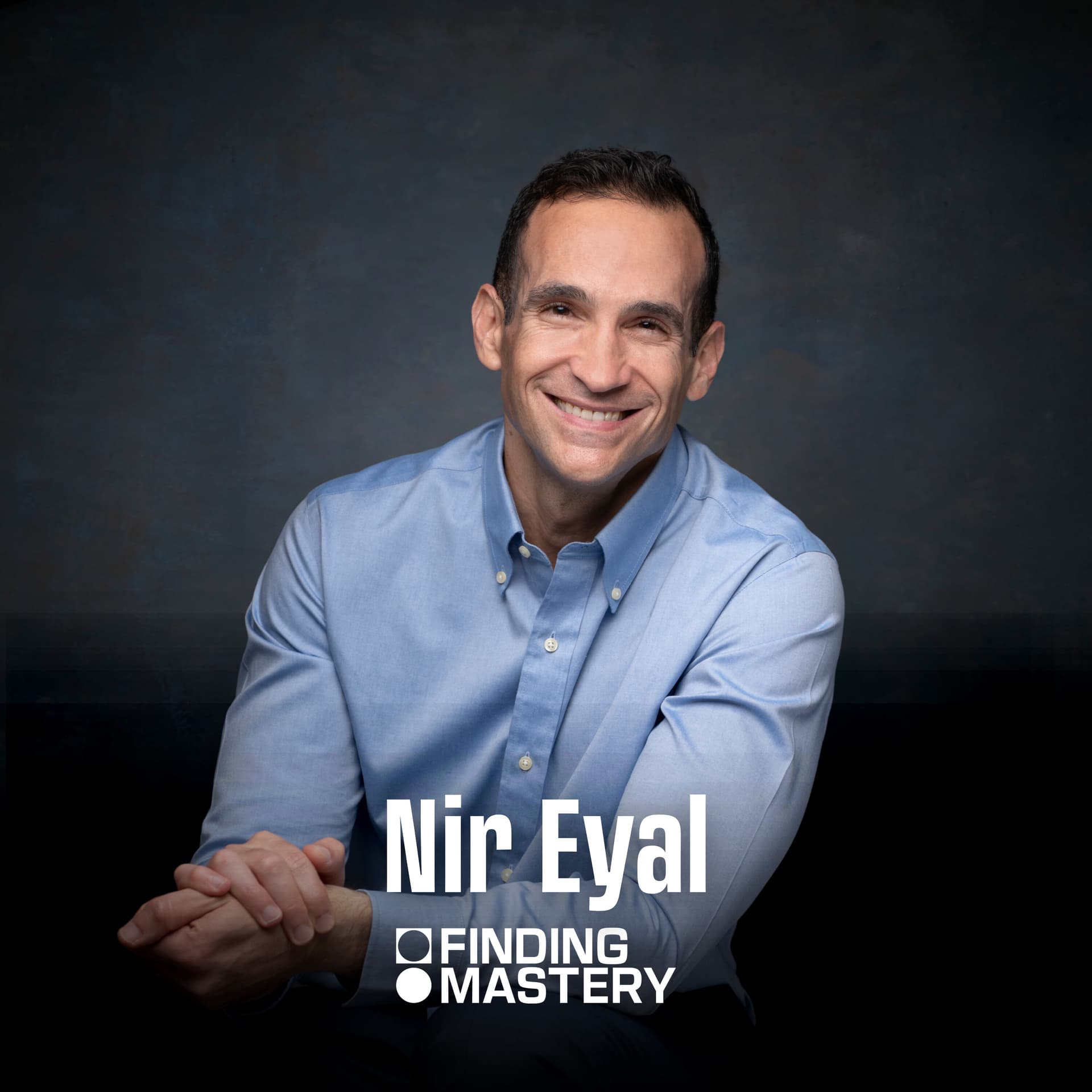
Nir Eyal is a bestselling author known for Hooked and Indistractable. He’s data-driven, cites peer-reviewed research, and runs weekly “office hours” with readers. Host is Dr. Michael Gervais, a high-performance psychologist who has worked with Pete Carroll (Seahawks) and Felix Baumgartner (Stratos).
Key claims
- Beliefs are convictions open to revision; they’re not facts or faith.
- Motivation isn’t a straight line; it’s sustained by beliefs that connect desired behavior to expected benefits.
- People default to passivity/hopefulness is learned; hope can unlock extreme persistence.
- Brains filter information via attention/prediction, so we don’t see reality directly—our interpretations do.
Notable examples
- Serena Williams at Wimbledon: a coach uses “selective deception” (statistics) to flip her belief and she wins.
- “Kurt Richter” rat study: hope/“salvation” conditioning reportedly increases swim persistence from ~15 minutes to ~60 hours.
- Learned helplessness vs hope (Seligman/Meyer): helplessness is treated as default; hope is learned.
- A relationship turnaround example: Eyal challenges “my mother is too judgmental/hard to please” using Byron Katie-style questions.
Written by AI. May contain mistakes. Listen to the episode to check what was said.
Chapters
Tap a time to open that second in VOUnderstanding Limiting Beliefs
0:03 to 0:59
Explore what limiting and liberating beliefs are and their impact.
“Mastery because we know one great hire can change everything.”
Understanding Limiting Beliefs
2:13 to 3:01
Explore what limiting and liberating beliefs are and their impact.
“hidden assumptions we carry shape what we see, what we feel, and what we're capable of achieving.”
The Triangle of Motivation
3:01 to 6:04
Nir discusses the relationship between belief, behavior, and motivation.
“And let's maybe start with why you wanted to go after beliefs.”
Nir's Personal Journey with Beliefs
6:04 to 7:40
Nir shares his experiences with beliefs and writing his books.
“I don't think has my best interests at heart.”
Defining Beliefs and First Principles
7:40 to 11:12
Discussion on defining beliefs and their role in personal development.
“Does that sound like why you wanted to write this book?”
The Power of Selective Deception
11:12 to 14:00
Nir tells a story about selective deception and its impact on beliefs.
“It's like a carpenter doesn't say, oh, the hammer, this is the one and only true tool.”
The Power of Beliefs
14:00 to 16:46
Explore how our beliefs shape reality and the concept of selective deception.
“which is what defines a belief, is that you can pick it as a tool.”
The Power of Beliefs
18:48 to 19:16
Explore how our beliefs shape reality and the concept of selective deception.
“Spring and summer, they are powerful seasons of momentum.”
Excavating Limiting Beliefs
19:16 to 21:40
Discuss the importance of identifying and transforming limiting beliefs into liberating ones.
“I don't know how to build a fresh system without removing the liberating beliefs.”
The Impact of Hope: Kurt Richter's Study
21:40 to 24:41
Examine the Kurt Richter rat study and its implications on belief and perseverance.
“I think it demonstrates kind of what you're saying.”
Show all 33 chapters
Challenging Helplessness: A New Perspective
24:41 to 28:00
Understand how the concept of learned helplessness has evolved and the importance of hope.
“And I do appreciate that it's like, that's a good example of exploring capability.”
Understanding Pain vs. Suffering
28:00 to 29:00
Learn how to differentiate between pain as a signal and suffering as an interpretation.
“If you can address that, I don't know if it's 240 times the resources that we think, but those rats certainly did.”
The Default State of Passivity
29:00 to 30:40
Discover why passivity is often our default state and how it relates to agency.
“And I think most of us don't realize that.”
Negativity Bias and Survival
30:40 to 33:00
Explore the concept of negativity bias and how it affects our perception of reality.
“I see a baby and an infant, and I see big eyes, wonder, and I see curiosity, and I see exploration, and I see risk-taking, and I see frustration when it doesn't go the way that I hope it would go.”
The Role of Beliefs in Interpretation
33:00 to 34:10
Understand how beliefs filter our interpretation of reality and influence our actions.
“So right now your brain is processing 11 million bits of information per second.”
Illustrating Bias with a Riddle
34:10 to 34:50
Learn how a well-known riddle reveals biases in perception and understanding.
“And you're saying that that interpretation rests on a set of beliefs.”
The Role of Beliefs in Interpretation
37:16 to 37:28
Understand how beliefs filter our interpretation of reality and influence our actions.
“Again, that's fatty15.com slash finding mastery.”
Exploring Potential and Calibration
38:11 to 42:00
Delve into the process of understanding and calibrating potential in oneself and others.
“It's one of the best practices I think that we do with the professional athletes and with people I work with is that there's an assignment.”
Exploring Limiting Beliefs Through Personal Stories
42:00 to 55:30
Learn how to identify and challenge limiting beliefs using personal anecdotes.
“It's not this is one truth, this is my truth, which truth is right.”
Exploring Limiting Beliefs Through Personal Stories
55:33 to 56:00
Learn how to identify and challenge limiting beliefs using personal anecdotes.
“and I want to come back to something a little more personal.”
Understanding Limiting Beliefs
58:09 to 1:01:54
Explore common limiting beliefs and their impact on identity and perception.
“And that alternative perspective, one, I like the agitation for a movement for discernment.”
Positive Views on Aging
1:01:54 to 1:05:35
Learn how positive beliefs about aging can significantly impact longevity.
“around these labels, which I think are similar to identities, but they're a little bit more nuanced in that many times they come from diagnoses.”
The Power of the Mind in Pain Management
1:05:35 to 1:09:35
Discover how belief systems can influence pain perception and management.
“And the text he sent was, remember to lift heavy things when you're on the road.”
Chronic Pain and the Fear Loop
1:09:35 to 1:10:01
Understand the fear-pain connection and how it affects chronic pain conditions.
“And that's how we can use it to block out suffering through the power of the mind, through the power of our beliefs.”
Understanding Chronic Pain and Placebos
1:10:01 to 1:14:54
Learn about the psychological aspects of chronic pain and the placebo effect.
“these belief effects, these expectation effects, they can influence the outcomes to an amazing degree.”
Understanding Chronic Pain and Placebos
1:15:05 to 1:16:00
Learn about the psychological aspects of chronic pain and the placebo effect.
“I eat well, I'm intentional about whole foods, and I still wasn't hitting it consistently.”
Understanding Chronic Pain and Placebos
1:17:22 to 1:17:37
Learn about the psychological aspects of chronic pain and the placebo effect.
“That's proton, P-R-O-T-O-N-V-P-N.com slash mastery for 70 % off your two-year plan.”
The Three A's of Belief and Pain
1:17:38 to 1:21:41
Discover how attention, anticipation, and agency affect pain perception.
“agency, which they get to choose, and they are chronically anticipating negative things, bad things, you know, things go wrong in their life.”
The Power of Secular Prayers
1:21:42 to 1:24:00
Explore how secular prayers can reshape beliefs and improve outcomes.
“Then I don't want to think about it again.”
Transforming Pain into Growth
1:24:00 to 1:25:19
Learn how to reinterpret discomfort as a sign of improvement.
“But I am conscious of my tendency towards the suffering around writing.”
The Value of Persistence and Failure
1:25:20 to 1:26:39
Understand why persistence and adaptability are key traits for success.
“And so by repeating those mantras, by repeating those secular prayers, it increases my pain tolerance.”
Unlocking Inner Motivation
1:26:40 to 1:27:38
Discover how beliefs influence motivation and self-agency.
“So the whole point here is how do we unlock this seemingly magic feature that we all have in our brains, just like those rats who went from 15 minutes to 60 hours, how do we unlock what's already within us?”
Looking Ahead: Upcoming Guests
1:27:42 to 1:28:36
Get a preview of the next episode featuring Sam Harris.
“and many, many more we didn't have time to discuss.”
Transcript
Automatic transcript. May contain errors.0:00Dr. Michael Gervais:Finding Mastery is brought to you by LinkedIn. We use LinkedIn Hiring Pro here at Finding Mastery because we know one great hire can change everything. One bad hire, it can cost you a lot, way more than time. It can cost you momentum and culture and real dollars. And that's why how you hire matters just as much as who you hire. And it's why I've become a big believer in the power of LinkedIn Hiring Pro. Here's what I appreciate about it. When you're running lean, you don't have hours to sift through a pile of resumes hoping to find the right person somewhere in the stack. Hiring Pro is built exactly for that reality.
0:32Dr. Michael Gervais:You describe the role and it screens candidates for you, surfacing the people who are a best fit so that you can spend your time and conversations with those folks rather than in the weeds of the applications. And the results back it up. Those hiring with LinkedIn are 24 % less likely to need to reopen a role within 12 months compared to the leading competitor. So join 2.7 million small businesses already using LinkedIn to hire. Host your job for free at linkedin.com slash mastery. Terms and conditions apply. Again, that's linkedin.com slash mastery to post your job for free.
1:29Nir Eyal:Two people are running a marathon and one says to themselves, I cannot do this. The other says, I think I can do this. Let's say they have the exact same physical ability. The belief is not a fact. The belief is just perception. Who are you going to bet on to win the race?
1:42Dr. Michael Gervais:Welcome back or welcome to the Finding Mastery podcast, where we dive into the minds of the world's greatest thinkers and doers. I'm your host, Dr. Michael Gervais.
1:51Nir Eyal:A high-performance psychologist named Michael Gervais.
1:54Dr. Michael Gervais:Who Pete Carroll brought in to work with the Seahawks. Famous for his work with Felix Baumgartner when he jumped out of space in the Stratos Project.
2:01Nir Eyal:Olympic athletes depend on something more than just training and talent. They have to stay mentally tough.
2:07Dr. Michael Gervais:Today's conversation is with Nir Eyal, bestselling author of Hooked and Indistractable. And in this episode, it centers on his new book, Beyond Belief, which explores how the hidden assumptions we carry shape what we see, what we feel, and what we're capable of achieving.
2:22Nir Eyal:A limiting belief is defined as a belief that either saps motivation or increases suffering. A liberating belief is a belief that supplies motivation or decreases suffering. It's very difficult to take out those limiting beliefs. It's even more difficult to flip them around into a liberating belief.
2:37Dr. Michael Gervais:But that's the process we have to go through. As you listen, consider this. Are your beliefs expanding your potential or quietly defining your limits?
2:45Nir Eyal:I can tell you how a belief that helps people live a much longer life, and this research blew my mind. This came out of Yale a few years ago.
2:51Dr. Michael Gervais:So with that, let's jump into this week's conversation with Nir Eyal.
3:01Dr. Michael Gervais:Nir, what a treat to sit with you. Thank you. This is a huge honor. I appreciate you having me. Oh, yeah, for sure. So I've loved all of your books. Thanks. Yeah. And this is number three in the stack.
3:11Nir Eyal:Number three.
3:12Dr. Michael Gervais:And let's maybe start with why you wanted to go after beliefs. And let's start at the ground floor. You know, like, what is a belief? But first, why did you want to understand beliefs?
3:23Nir Eyal:I think beliefs, it turns out, are the operating system, the software of our minds that we don't even realize we have this operating system running in the background. For me, it was a little bit of the frustration from my past two books. And here's what would happen. With Indistractable, you know, I spent five years writing it. I really wanted to dive into the psychology of distraction. I started with first principles. And every week I do these office hours where anybody can call me and we can talk about whatever they want to talk about. If they read one of my books, I love talking to readers.
3:51Dr. Michael Gervais:Oh, wow.
3:52Nir Eyal:Yeah, and so every single week. So I do an hour every week, 15 minutes of four calls. And maybe one out of every 20 calls would sound something like this. Somebody would call me and say, hey, Nir, I read Indistractable, great book. I really enjoyed it, but it didn't work. I'd say, oh, wow, tell me more. You know, changed my life. And I spent five years researching it, 30 pages of citations to peer-reviewed studies. And I really wanted to make sure it worked. Tell me what happened. Let's talk about step one. How did step one go for you? Well, you know, Nir, I read step one. I read it. I just didn't do that one.
4:24Nir Eyal:No problem. I'd say, you know, let's go to step two. How did step two go for you? Yeah, you know, I didn't get to that one either. I didn't do it. And at first, I was kind of offended. You know, I spent so much of my life writing this book about a problem that everybody says is so awful, is so insurmountable, the world is so distracting. Here you go on a silver platter. Here, here's the answer. Just do these four steps. It changed my life. Take you an hour and a half to read it. It'll change your life. And then I realized I do this too, that I have books on the shelf piling up that I haven't read, that I've talked to coaches and gurus and experts and heard their advice, but not acted on it.
5:01Nir Eyal:Why? Why is it, especially today, when we are drowning in information, we all basically know what to do. You know, if you want to get in shape for 99 % of the population, eat, write, and exercise. Not much has changed. If you want to have a, start a business, you have to do the things that other people don't want to do. If you want to have a great family and relationships, You have to be fully present with the ones you love. We know what to do. So why don't we do it? And what I realized is that it's not enough just to know, that you can have the behavior, know the benefit, but you still won't do it.
5:33Nir Eyal:You still will lose motivation to follow through. And I think it's because we have a fundamental misunderstanding of how motivation works. We think it's a straight line, right? Between here's what I want, and so here's what I have to do. Kind of classic economics. But motivation isn't a straight line. It's a triangle. And so this is where the inspiration for Beyond Belief came from. And what I discovered is that you not only have to have an understanding of the behavior. Here's what I have to do. You not only need to want the benefit, but holding the triangle together is the belief. For example, if I don't believe that I will get the benefit, maybe I work for a boss who I don't think has my best interests at heart.
6:11Nir Eyal:Well, then I don't believe I'm going to get that promotion or that raise. Much more common, and this leads into the limiting beliefs that we have in our life, if I don't believe that I can do the behavior, if I don't believe that I'm capable for whatever reason, I will self-sabotage and not do even when I know what I'm supposed to do. And so this was the big conclusion, that if we want to sustain motivation, which we know that perseverance is the number one most defined trait that leads to success, perseverance and adaptability, well, then what is the secret behind motivation? It's not good enough just to know what to do or why you want to do it.
6:43Nir Eyal:There's that missing piece of belief that we don't really explore.
6:45Dr. Michael Gervais:Well done. I think two things that I want to highlight. One is you are writing for yourself. Absolutely. Right? Because you didn't have an easy upbringing when it came to like the emotional part of your life. And so I would imagine that that scar tissue and feel free to share whatever part of this that you want to. I know you wrote about it in your book. So I'm just bringing chapter one forward, almost maybe paragraph one forward. And I would imagine because of that scar tissue and call it trauma or micro traumas that you're like, wait, hold on. I built some beliefs before I really had a formed understanding of what I was capable of.
7:23Dr. Michael Gervais:Before I had an understanding of how beliefs worked and how powerful they were. I adopted other people's beliefs. I kind of corrupted some ones that maybe were going to give me a good shot. I need to go excavate those, re-examine them, and repair and or rebuild a belief system. Does that sound like why you wanted to write this book?
7:43Nir Eyal:So for me, I don't write about what I know. I write about what I want to know. And that happens with all my books. So with Indistractable, when I found that I was constantly checking my phone as opposed to being fully present with my daughter, there was a problem here. I needed to figure out why. With Beyond Belief, same story. That before I was going to read another self-help book, I needed to figure out why I didn't implement all the other self-help books I've already read.
8:04Dr. Michael Gervais:And you thought that that was based on a belief system?
8:06Nir Eyal:Well, I went to first principles. I went to look, you know, I'm very data-driven. I don't want just platitudes. I need to see the studies. Show me what works.
8:14Dr. Michael Gervais:It's one of the reasons that I wanted you here is because you're first principle driven. And I talk about first principles a lot. They're really important to me. And I think that they are pretty effusive. I think they slip past people in life because we're onto doing things, being busy, if you will, taking actions, if you will, even if they're not the actions that will lead to our best potential outcomes.
8:41Nir Eyal:And the psychological immune system that we have to not want to change our beliefs. That when you go to first principles, it's a tactic we use in order to challenge our beliefs. But one of the things we learn is that we have these immunities to change. We hate changing our beliefs.
8:56Dr. Michael Gervais:That's right. Okay, so let's do a couple of things. I think we would benefit from defining a first principle, maybe even defining or articulating how you get to a first principle. I think it would benefit us to articulate your working definition of a belief. Of a belief, yeah. And how that belief sits in the stack of not the triangle of motivation you spoke of, but like where it sits in the stack of helping people be better in life. Sure. So let's go first principles, arrival of first principles, belief definition, and then how that fits.
9:26Nir Eyal:So when it comes to beliefs, I think the best way to understand what a belief is is to compare it to what it is not. And we often confuse these terms. So a belief is not a fact. A fact is an objective truth. There's something that is true whether you believe in it or not. The world is more like a sphere than it is flat. That's a fact. It doesn't care flat earthers. Sorry, it doesn't care what you think. On the other end of the spectrum from a fact is faith. Faith is a strongly held conviction that does not require evidence. What happens in the afterlife? God rewards the righteous. No evidence is required for something like that.
10:01Nir Eyal:In the middle between fact and faith is a belief. A belief is a conviction that is open to revision based on new evidence.
10:10Dr. Michael Gervais:I like what you just said. Can you say it one more time?
10:12Nir Eyal:The definition of belief? Yes. A belief is a conviction that is open to revision based on new evidence. So it's actually not that far from what's in the dictionary. That's where I got it from Merriam-Webster. There's more possible definitions, right? People, you know, it has multiple definitions, but that's the definition in the context of this psychology.
10:27Dr. Michael Gervais:What I like is though that you're adding a layer to it, which is open to revision. Exactly. That's the part that I think you're adding something to the mix that's important. Right. Because some people's belief systems are quite rigid.
10:41Nir Eyal:So that's exactly, that was my aha. That's what blew my mind is that because it is open to revision based on new evidence, it's not a fact, it's not faith, we can choose them. Which what blew my mind is that these beliefs that I had carried for my whole life, I could examine them. I could look at them and realize that they are not truths. Truth is the requirement for a fact. Beliefs are not necessarily truths. They are tools. Beliefs are tools, not truths. So what that means is that we can choose the ones that best serve us. It's like a carpenter doesn't say, oh, the hammer, this is the one and only true tool.
11:22Nir Eyal:No, when it's the right tool for the job, sometimes you use a saw, sometimes you use a wrench. But our beliefs, especially these hidden limiting beliefs, which we all have. I have yet to meet anybody who does not have a hidden limiting belief. We all have them. I still have them. And it turns out -
11:36Dr. Michael Gervais:This might be the first person. The first - You might be the first one. Yeah, right. I've got so many invisible limits and blind spots. We all do, right?
11:43Nir Eyal:What's amazing though, it's like our face in that you can't see your own face, right? You can see your hand, you can see your feet. You can't see your own face. What's amazing, and I can prove this, is that we can all see others limiting beliefs. Even though our limiting beliefs are hidden to us. Why? Because we think that our beliefs are facts. But we can all identify when it comes to other people in our life. Think about your closest people. You could probably think of at least one limiting belief that everybody you know has. But we can't see them in ourselves.
Read the full transcript
12:11Dr. Michael Gervais:This is what I think a great teammate does. And that teammate, I use that loosely. It could be a spouse. And I don't want to butcher the romance of a loving relationship. But just hold this idea for a minute. Like somebody, it could be a psychologist. It could be a head coach. It could be a lot of different roles. It could be a best friend. It could be a therapist. It could be a lot of roles. They hold up a mirror because they're really paying attention. And if they can do it non-judgmentally and sometimes thorny, sometimes, you know, warmly. Sometimes deceptively even. What does that mean?
12:48Nir Eyal:Do you know about this selective deception idea, the Serena Williams? Have you heard about this? No. So Serena Williams at Wimbledon, her coach, she was playing very badly and she was kind of psyching herself out and she wasn't going up to the net fast enough. She was hesitating. And you know that the milliseconds of hesitation can lose you a match. So her coach tells her, he pulls her aside. He says, hey, I have some new information here. You know, when you rush the net, you score 80 % of the points. She says, really? I thought I sucked at the net. And he says, well, you know, the statistics don't lie.
13:22Nir Eyal:I mean, look, that's what it says. 80 % of the time, you score a point when you rush the net. She says, okay, and guess what? She goes on to win Wimbledon. And what does he say? You know, when he says, he knows he lied to her. It was selective deception. And he says, yes, but guess what happened? She was already lying to herself. And this is what we all do. We think that we see reality as it is. We do not. We are already gaslighting ourself. We are already lying to ourselves. Serena was telling herself that she was bad at the net and she made that reality true. So what did he do? What did the good coach do?
13:53Nir Eyal:He knew what she was capable of. He flipped the script. He allowed her to crack open this possibility of another thing that is also true, which is what defines a belief, is that you can pick it as a tool. It's not a truth, it's a tool. And allowed her then to make the lie into reality.
14:10Dr. Michael Gervais:It's interesting. I did not know that story. I feel like I've heard it. Did you write about this? Yeah. Yeah, maybe you introduced it to me or I can't remember, but.
14:19Nir Eyal:I wasn't the first one to. Yeah, of course. Yeah, yeah.
14:22Dr. Michael Gervais:And I remember having a little bit of rash to it because this is the debate. One of my colleagues, Mark Aoyagi. What's up, Mark? He and I will talk about beliefs a lot. He and I have. And we also talk about the ethics and the position that you hold with people. And is there a duty to be honest? Is there a duty to stretch the truth in that respect? And I get a rash to placebo and nocebo. and what did you just call the tactic?
14:52Nir Eyal:Selective deception.
14:53Dr. Michael Gervais:Selective. I mean, it's a lie.
14:54Nir Eyal:Yeah, it's a lie. Clever, it's a fancy word for saying lying. Is it a lie? If you're lying to yourself already. Yeah. She was lying to herself already that she wasn't capable.
15:05Dr. Michael Gervais:What I would say the position, I get the tactic in that moment.
15:08Nir Eyal:And by the way, I don't know if I'm recommending this. I tell that story to show you how
15:13Dr. Michael Gervais:your beliefs can shape your reality. I believe I'm not good at the net. So I'm hesitating. I believe I'm getting burned. Yeah. And then if I do believe, if there's factual evidence that I am good at it, maybe I adopt a new belief that I can do special things at the net. So let me just rush into that. It's tricky. There's a lot of gray in this. I'll tell you where my rash is.
15:33Nir Eyal:Fake it till you make it, I think, is a flawed approach because we don't want anything fake.
15:38Dr. Michael Gervais:Right, right. And you know you're faking it. So what that coach did is didn't try to hype or whatever, wanted to ground it in false reality.
15:47Nir Eyal:Well, but only in that moment though, because he knew what she was, if fake it till you make it is, there's no evidence you can do this, but just fake it. What he knew is that she was capable and she was psyching herself out. I think that's the difference. And so the takeaway lesson for ourselves is not necessarily fake it. It's find the belief that serves you. that if you say to yourself, you know, if you get two people are running a marathon and one says to themselves, I can't, I cannot do this. The other says, I think I can do this. Let's say they have the exact same physical ability, right?
16:24Nir Eyal:That's the truth, the fact. Let's say they have the same exact physical ability. The belief is not a fact. The belief is just perception. Who are you going to bet on to win the race? Yeah, of course, the person has talent plus a belief. Exactly, so both of them might not finish the race because many people don't finish marathons. But the one that's much more likely to finish is the one that holds the belief that is liberating versus limiting.
16:46Dr. Michael Gervais:Finding Mastery is brought to you by Rag & Bone. I've been a big fan of Rag & Bone for a number of years. I just love what they do. It's a go-to for me when I'm choosing clothes. I've been wearing their infused denim for a while now. They've done just a really nice job with this product. For me, I am really intentional about what I invest in. In clothing, it's no different. I want things that are well-made, that stand the test of time, that don't distract me, that support my focus on the things that matter most. And that's exactly why these deliver. And they look sharp, full stop. They've spent 20 years obsessed with getting this product right.
17:16Dr. Michael Gervais:And that kind of long-term commitment to craft, that's something we talk a lot about here at Finding Mastery. Quality compounds. The right inputs may consistently over time show up in everything. And you can feel that the moment you put these on. If you're ready to upgrade your denim with something that's genuinely built to last, it's time to upgrade your denim with rag and bone. For a limited time, our listeners get 20 % off their entire order with the code FindingMastery at rag-bone.com. That's 20 % off at rag-bone.com with the promo code Finding Mastery. And when they ask you where you heard about them, please support our community and this show and let them know that we sent you.
17:55Dr. Michael Gervais:Finding Mastery is brought to you by our flagship mindset training course, Finding Your Best. Anytime you feel the pull to reset, to zoom out, to refocus and ask, am I moving toward the person I want to become? It helps to remember this. Lasting change comes from training. Not resolutions, not short-term sprints, but deliberate practice of the skills that shape how we show up. In work, in relationships, and in the moments of great intensity as well. That's what finding your best is all about. It's a science-backed framework for training your mind. And it's the same set of tools that we've taught to Olympic athletes, top executives, elite military teams, and artists at the peak of their craft.
18:29Dr. Michael Gervais:In this course, you'll learn the foundational psychological skills to be your very best. Full stop. And the best part is, you can start anytime. Right now, we're running a limited time offer on finding your best. Simply head to findingmastery.com slash course and use the code RENEW100 to get$100 off your registration. If you've been waiting for the right moment, this is a good one now to lean into. Spring and summer, they are powerful seasons of momentum. It's a great natural time to step into growth, to refocus, to recommit to who you want to become. And this discount will not be around for long.
19:03Dr. Michael Gervais:So go to finding mastery.com slash course code renew 100 for$100 off today because your future is not shaped by what you intend. It's shaped by what you train. Yeah, there's a real danger in limiting beliefs. and I'm as much interested in this conversation about how to excavate or examine limiting beliefs as I am to build beliefs that create a system that is agile and strong and you know anti-fragile or whatever word that you might put in place but really to use plain English one a belief system that is really useful for how you want to live your life and so are you more interested in starting with examining limiting beliefs, or are you more interested in starting building from the ground up like a fresh system?
19:57Nir Eyal:I don't know how to build a fresh system without removing the liberating beliefs. I don't know either. Yeah, that's, yeah. So that's what I've done in my life is to look for the muck. Look for the New Year's resolution that's been there year after year. Look for that relationship that continues to annoy you that you somehow can't seem to fix. Look for the goals that you've had for years and somehow you're stuck. They're not happening. And it turns out that when you get to it, at the core, there's always some kind of limiting belief. That's where we start. So step number one is examining those areas of our life, taking out those limiting beliefs, examining them, right?
20:35Nir Eyal:Looking in the mirror like we talked about earlier where you can't see your own face. And then step two is to come up with the liberating beliefs. And so the difference between limiting belief and liberating belief, a limiting belief is defined as a belief that either saps motivation or increases suffering. A liberating belief is a belief that supplies motivation or decreases suffering. And so it's very difficult to take out those limiting beliefs. It's even more difficult to flip them around into a liberating belief. But that's the process we have to go through.
21:05Dr. Michael Gervais:Yeah, the way I feel about it is like I use this analogy that let's say there's an inner fire, okay, just for a visual. And a limiting belief system is like this heavy blanket that sits on the fire. It might smolder under there, but like that belief system is really putting out the fire. It's a useful image for me. And what I'm trying to do is like remove that thing because the fire is already there. And I've built and corrupted, you know, the way that I hold myself and the future potentials. And I'm trying to get out of my way in that respect. Yeah.
21:40Nir Eyal:Do you know the Kurt Richter rat study? This one? Oh, yeah. It's a great one, right? I think it demonstrates kind of what you're saying.
21:46Dr. Michael Gervais:From John Hopkins. Yes, yes, right. Yeah, from John Hopkins. Yeah, yeah. Yeah, tell the story.
21:51Nir Eyal:This is a really good one. So Kurt Richter in the 1950s takes these wild rats and he's trying to measure how long they could survive floating in water, right? Paddling in water. So he takes a rat, a wild rat, puts it in a cylinder of water, halfway full. And he sits there and times how long the rat can swim for. And he sees that in about 15 minutes, the rat seems to just give up and falls under the water and dies. Then he wants to see if an intervention might change how long the rat can swim for. And he takes a new group of rats. He puts them in a cylinder. And right before he knows they're about to give up, right around the 15 minute mark, he takes out the rat.
22:28Nir Eyal:He dries it off, let it catch its breath and plunk back into the cylinder it goes. He does this a few times. So he conditions the rat. and now he notices that the rat, once it's been conditioned, doesn't swim for 15 minutes. It doesn't swim for 30 minutes. It doesn't swim for an hour, which if you, you know, if people know there's some kind of surprising result here, and so when I ask people, they say, oh, maybe twice as long, three times as long, maybe four times as long. I mean, think about that. That would be insane if someone could come up with an intervention that could make you four times more persistent.
22:59Nir Eyal:That would be unbelievable, right? Unprecedented. Well, the rats didn't swim for 30 minutes. They didn't swim for 60 minutes. They swam for 60 hours. Not 60 minutes, 60 hours of swim time now. 240 times more persistent. What changed? Their bodies hadn't changed. The experiment hadn't changed. We can't ask the rats what they believed, obviously, but that's kind of the only variable left. And so what we think is that when they tasted hope, when they thought that salvation might be possible, something was unlocked. just like the blanket that was suddenly removed. Their motivation suddenly changed and they could persevere much, much longer.
23:38Nir Eyal:And so what does that mean for us? The big message for me is that we are capable of far, far more. I mean, you know from the people you work with, they're human beings like the rest of us. And they do things that the average person would think is superhuman, impossible. There's no way. They, the people you work with, these are the examples of people who are the super persistent, 240 times more type of people versus the average person, you know, we give up at the 15-minute mark.
24:02Dr. Michael Gervais:Two things. I really enjoyed how you told that research.
24:06Nir Eyal:Thanks.
24:07Dr. Michael Gervais:Yeah. I don't know if you practiced that.
24:09Nir Eyal:I've been sitting with it for six years, so I've been thinking about it.
24:12Dr. Michael Gervais:Yeah, but you reduced it down to the essential components and then brought me along for a ride and didn't kind of cloud it with extraneous variables. I really appreciate how you just told that story, which I think is why your books work so well.
24:25Nir Eyal:Appreciate it.
24:26Dr. Michael Gervais:And okay, that's first and foremost. That was a treat. The second is, we can't ask the rats. And so we are attributing a belief that changed. And in actuality, we don't know really what it is. Kurt's research was around hopelessness and hope, that idea. And I do appreciate that it's like, that's a good example of exploring capability. And I say this to myself and I say this to others who are interested. Like if you knew what I knew, your life could be very, very, very, very different. You are not even coming close to your potential, your sense of joy, your sense of flourishing, the capabilities that you have.
25:12Dr. Michael Gervais:If they're grounded in the interest that you hold, how far you can actually go. And we need a team. No one does it alone. So there's a social components that are really important. but it begins with your vision, a set of beliefs. And with that set of beliefs, you can carry things really far. You do need some psychological skills to navigate tricky environments. And those rats, I don't think had anything other than like, oh, I can keep going. I'm not sure how that happened. And I don't know if you dug around that research to know how it actually happened. I don't think anyone does.
25:45Nir Eyal:But there's actually more recent studies that confirm the 1950s results. So you know the concept of learned helplessness. That's right, yeah.
25:52Dr. Michael Gervais:Seligman.
25:53Nir Eyal:Seligman and Meyer, right. And this has been around for decades and it was considered the orthodoxy. I mean, the whole social programs were planned based on this idea that people learn helplessness over time. So this is why there's persistent poverty, that people have been ground down. And once you learn that nothing will help your circumstance, you give up. And of course, you know, they had this on animal models that showed something similar that you would get dogs to just, you know, take shocks, the painful shocks.
26:14Dr. Michael Gervais:They give up because they learned that no matter what I do, it's futile. There's no point. Because I keep getting these terrible, painful results. So I'm just going to take it, even though I could walk out of the room.
26:27Nir Eyal:And it turns out that as of two years ago or so, Seligman and Meyer said that they were completely, totally wrong. It is totally backwards. That in fact, we don't learn helplessness. Helplessness is our default state. What we learn is hope. So exactly what those rats before, Or their default state was passivity. 15 minutes, give up. It wasn't actually physical exhaustion. And I want you to keep going.
26:54Dr. Michael Gervais:Don't lose your thread here. But I want to just highlight that they died. Those rats chose. Right. Because they were fatigued, that they chose to die. There's no point. And maybe choices are strong here, but that's what happened. And if you can think about that, and I want to just mark the central governor for a minute. there's this quote unquote mechanism. We haven't found where it lives, but this idea, let's just use central governor as a metaphor, as an idea is that at some point we reach a experience in ourselves that we say, this is too much. Lactic acid is coursing through our body. Brandykinase is like this very scratchy neurochemical that's in our body that says, whoa, whoa, whoa, whoa.
27:42Dr. Michael Gervais:Our heart is pounding. Whoa, whoa, whoa, whoa. We shouldn't go any further. This is like, we can't go any further, is the message that we interpret those signals from. So lactic acid is like agitating, right? And so is the brain kinase, it's an agitating neurochemical. But the way we make sense of that is like, this is too much. Slow down. If you can address that, I don't know if it's 240 times the resources that we think, but those rats certainly did. You can go far, far further.
28:14Nir Eyal:This is the big aha. This is a huge one. Huge, huge. That when you can separate the signal of pain with the interpretation of suffering, people think that pain and suffering is the same thing. It is not the same thing. Pain is a signal, suffering is an interpretation. So the three powers of belief of attention, anticipation, and agency, this is how we manipulate our beliefs in order to increase motivation to go further. Let's do that.
28:39Dr. Michael Gervais:Let's close the loop on hope, if you can take us home there.
28:42Nir Eyal:Yeah. So the big takeaway is that it's no wonder that we constantly default into these limiting beliefs. That's what we have to actually actively fight. We have to show ourselves through small acts of agency that we can do something. Because our default state is always passivity. And I think most of us don't realize that. What does that mean to you? Our default is passivity. I don't know what that means. We don't learn hopelessness. Hopelessness is our default. So when we are born into the world, we're completely helpless. There's nothing we can do. We have to rely on the care of others. That maintains our default state.
29:16Nir Eyal:So this is the Seligman and Meyer reversal of learned hopelessness, that we are born hopeless, but we have to learn, in fact, is hope. When I read that, I think you said it,
29:25Dr. Michael Gervais:but it was relatively recently, and I didn't really understand it. You're reminding me to go back and scrub that a little bit. There's something about that that doesn't square initially with me, and that's fine. You know, are you capturing that their take on it is that the most natural state is to have, to be passive. That we learn throughout our lives. To what? Where we have agency. Where we have the opportunity to change ourselves. I nod my head intuitively, not from a research position to say that. And agency is defined like I choose.
30:01Nir Eyal:Yes.
30:02Dr. Michael Gervais:Right? And efficacy is I choose. Yeah. Well, I think agency in my mind is just like, I can choose.
30:09Nir Eyal:Yeah, that you can change your circumstances.
30:11Dr. Michael Gervais:Yeah, there's things I can do. And efficacy is when I choose and what I choose, I believe I can influence it.
30:20Nir Eyal:Does it work?
30:21Dr. Michael Gervais:Yeah. So efficacy is a word for power. Agency is a word for choice, if you will. When you put those two together, you got something really special. So I think we're going to close this loop with beliefs around those two in just a moment. But let me just wrestle with this for a minute, that we, by default, are hopeless. I don't get that. I see a baby and an infant, and I see big eyes, wonder, and I see curiosity, and I see exploration, and I see risk-taking, and I see frustration when it doesn't go the way that I hope it would go. And I see agency, like the screaming for, hey, attend to me. I see young ones with this incredible will, for the most part, a will and a strength for survival, not like a passive hopelessness.
31:14Dr. Michael Gervais:So -
31:15Nir Eyal:I think it's in the context of challenge that we know we have a severe negativity bias that humans are constantly scanning, I mean, from an evolutionary basis,
31:27Dr. Michael Gervais:I call it survival bias, just to like strengthen that a little bit. The negativity - The negativity bias? Yeah, I see it as like a survival bias. Sure, of course.
31:36Nir Eyal:You know, scan the world and find the danger. Right, exactly. Because good things are nice, bad things will kill you. That's right, yeah. So the news doesn't tell you, here's all the nice things that happen in the world today. The news is blood and gore, right? It's the war - If it bleeds, it leads. Exactly, if it bleeds, it leads. If there's a war 3 ,000 miles away, it has nothing to do with you, that's the headline, you know, terrible things. Why? Why? Because we are hypervigilant for danger. And so because we have that default state of always looking for danger, always having that negativity bias, this is part of that reflex of the default state.
32:06Nir Eyal:The default state is safety. You know, if I go back to what I know is safe, that is much more likely to lead to my survival than risking, than going above and beyond. And so we shouldn't beat ourselves up that we keep holding these limiting beliefs. Those limiting beliefs are there because they kept us safe at some point. They served us at one point. And so now it's our job to figure out, do they still serve us? And most of the time they do, but once in a while they don't. We should take them out.
32:28Dr. Michael Gervais:Yeah. Are you embedded in that? Are you thinking that beliefs, they arise naturally or they are taught and learned? They arise naturally after they are taught and learned, right?
32:38Nir Eyal:Whether it's our society, whether it's, but once they are there, we don't realize their beliefs anymore.
32:42Dr. Michael Gervais:Yeah. So it's not like we're born with a belief set. We have instincts, right? And some biological imperatives, but beliefs are learned.
32:52Nir Eyal:They become our lenses with which we see the world. And so why does this happen? Why are beliefs so powerful? Because our brains can't take in all the available information. So right now your brain is processing 11 million bits of information per second. 11 million bits of information per second is about the equivalent of reading War and Peace every second twice. So the light entering your eyes, the sound of my voice entering your ears, the ambient temperature, your brain is collecting all this information. It's 11 million bits of information. But conscious awareness is only 50 bits of information.
33:26Nir Eyal:So 50 bits is about one sentence per second. Your brain, your conscious mind just can't handle all that information. So what does it have to do? It has to filter information through this tiny keyhole of attention that colors your whole world. And we call this predictive processing. This is kind of the new way of understanding how the brain works. The new metaphor is that the brain does not see reality as it is. None of us are seeing reality. We are seeing our interpretation of reality. Exactly. How did you know I was going to say that? Because of what I already said. That's right. Yeah. And so everything is a prediction.
34:00Nir Eyal:So your entire life is a very elaborate simulation. Not like in the matrix. It's not one simulation. We all have our own simulation running inside our brains. And so those beliefs dictate what you're able to interpret right now, what you're able to feel in your internal states, and of course what you're able to do.
34:19Dr. Michael Gervais:What you're pointing to also is what, you know, one of my mentors I never got to meet, Viktor Frankl, is like it's not – and Carl Jung had something to do with his understanding of this too, which is the experience in him itself is only based on your interpretation of it. That's right. And you're saying that that interpretation rests on a set of beliefs.
34:43Nir Eyal:I'll give you a great example, actually. I could show you visual illusions, but that's not going to be useful for people tuning in. But there's a good riddle that illustrates this, that 83 % of people don't get. The riddle goes like this. Don't answer it if you've heard it before, okay? The riddle is... Blue. Oh, no. Oh, darn. I'm joking. Yeah, yeah, keep going. The riddle is there's a father and son driving on a dark, deserted road. and all of a sudden, it's the middle of the night, all of a sudden a deer jumps out in front of the car, the car slams into the deer, the father's instantly killed, the son survives, but he's in critical condition.
35:16Nir Eyal:And he has to be taken to the hospital immediately where he's wheeled into the operating room. The surgeon barges to the door, takes one look at the boy and says, I can't operate on this boy, he's my son. How could that be? Now, 83 % of people who hear that riddle can't figure out the answer. The answer is that the surgeon was the mom. Okay? Now, when I say that... There's a bias that's embedded. Exactly. We can't even see the reality of what could be because our brains has blocked that based on our prior understanding, based on our prior... By the way, it doesn't mean you're sexist. 83 % of women also don't get this answer.
36:00Nir Eyal:And even if they have mothers who are surgeons, oftentimes they don't get the answer. It's just that the fact is that 80 % of surgeons are men, 20 % are women. And so we have this prior view of the way the world works. And our brain makes those assumptions of what's possible. So you said earlier how when you point out someone's potential and they just can't see it, it can't come to mind. You can't convince them. And you'll see how they'll make every possible excuse why it can't be done. It's because they literally can't see it. Their brains won't allow them to see current reality, let alone a future reality.
36:30Dr. Michael Gervais:Body Mastery is brought to you by Fatty 15. Did you know that Navy dolphins helped unlock a secret to healthy aging? It's a wild story and it's the foundation for a product that I've come to really love, Fatty 15. Fatty 15 is built around C15, the first essential fatty acid discovered in over 90 years. And it was discovered by Dr. Stephanie Van Watson. She's the co-founder of Fatty 15 while she was working with the U.S. Navy. And based on over 100 studies, we now know that C15 strengthens our cells and is foundational for healthy aging at the cellular level. Stephanie's been on the podcast and it was one of my favorite conversations.
37:08Dr. Michael Gervais:She's amazing. And what her and her team are building is something I'm really excited about. Head to fatty15.com slash finding mastery and use the code finding mastery for an additional 15 % off your 90 day starter kit. Again, that's fatty15.com slash finding mastery. And the code is finding mastery. I want to take a second here to tell you about a morning routine that I've been using for years. For me, it's a great way to switch on my mind, to ready myself, to take on the day. So before I check my phone, my emails, market updates, or text threads, I choose how to start my morning. That's always in my control.
37:45Dr. Michael Gervais:That's always in your control too. This is the same morning mindset routine that some of the world's top performers across sport, business, and the arts are using. The best part, it only takes about 90 seconds to do. So just head over to findingmastery.com slash morning to download the audio guide for free. Again, head to findingmastery.com slash morning to get your morning mindset routine. It's one of the best practices I think that we do with the professional athletes and with people I work with is that there's an assignment. And the assignment is, and I'm putting air quotes up, because it's, I'll say to somebody in passing or more formally, I'll say, look, next time we see each other, you know, and maybe it's tomorrow in the hallway or maybe like we're going to schedule something, whatever it is.
38:33Dr. Michael Gervais:But like, I really want you to spend some time to think about what your potential is. Like, see if you can get a vision, use your imagination to get as clear as you possibly can about what you believe you're capable of. I just want to see and feel that compelling future and I'll do the same for you. And then let's calibrate. and then I'll say, I'll ask, this is super applied, right? And then I'll say, next day we see each other tomorrow and you were thinking about overnight, maybe you wrote it down, but you spent some time thinking about it. And then I'll say, do you want me to go or do you want to go first?
39:06Dr. Michael Gervais:It doesn't matter actually. What I'm looking for when I say my version of what I think, I'm just looking for pupil dilation or constriction. I'm looking for micro movements, like when they reflect a little bit, you move back like, what? Maybe I was too big.
39:20Nir Eyal:When you do this exercise, is your future always more optimistic, more grand than theirs? Or do you find that it kind of calibrates?
39:30Dr. Michael Gervais:Oh, I think that I'm wildly wrong on much of it. But it's more about the calibration. I try to go as big as I possibly can stretch, but it's limited by my beliefs, my understanding. Let's say I go too small. And they lean in and they go, what? Like, that's it? So I'm more interested in the calibration. conversation and then from that point you know we have a conversation like oh so okay so listen no i'm pretty say it's me and i went big no i'm pretty clear like i can see a pathway for that i can see it for you like let's work the plan and they're like they do what you're doing right now they start nodding their head like oh that could get good and if i'm too small they're like look dude i don't know if we can hang out again and there's a laughter with it like wait hold on and And then I say, wait, show me what you see.
40:17Dr. Michael Gervais:Let me understand. Is it this? Is it that? Oh, it's this. Okay, so let's work the plan.
40:21Nir Eyal:I love it.
40:22Dr. Michael Gervais:Yeah, so I call it invisible limits. Okay, I love it. Not limiting belief, but invisible limits. I love it. Yeah.
40:27Nir Eyal:And what do you do after that, after you have those limiting beliefs?
40:32Dr. Michael Gervais:First I calibrate is that of interest, you know? And then we try to get the clarity of it right. Like what, like almost like the tinsel strength is the fabric and the details of what we're talking about. So we want to almost like be able to feel, and I'm using my hands like there's a tactile sensation of what that thing is. So it's not just this foggy picture, but we're trying to get it really clear of what it mechanically would look like. And then how do we excavate the limiting beliefs? It's a little bit of a messy process, but it's just digging. It's like, where'd that come from? Like, what do you think's getting in the way?
41:09Dr. Michael Gervais:What's holding you back? Where'd that come from?
41:11Nir Eyal:I don't spend much time on the where did it come from part, but I do spend a lot of time on doing these turnarounds.
41:18Dr. Michael Gervais:Keep going, yeah.
41:19Nir Eyal:So this comes from the work of Byron Katie, which I'm a huge fan of. She's great. She's great. And she's really channeled, you know, the more I dug into the work, she has these four questions that she really concisely put it together. And it turns out Aristotle did the same thing. Same process. It's not that different, right? It's just, she articulated it really, really well. And so I kind of adapted it as well. And so one of the most powerful ways to not necessarily change your mind, I think that is something people get really hung up on, is that they get stuck with what is the truth. And so if I'm going to change my mind, I need to change my mind from what I currently believe to something else.
41:53Nir Eyal:And again, that's not the goal. The goal should be to collect a portfolio of perspectives. I find that that's much more helpful. It's not this is one truth, this is my truth, which truth is right. Those are facts.
42:05Dr. Michael Gervais:When I think of Byron's, the fourth step, like step two, I'm hazy on all four steps, but step two is like, is it a fact? Right. Do I have that right? Yeah. So number one is, is it true? Yeah, is it true? Do you want to actually give you an example
42:16Nir Eyal:of how I use this in my own life? Yeah, it's good.
42:18Dr. Michael Gervais:And there's a reason that it's hazy because I haven't found it useful for me personally, so I don't use it with others. But so walk me through it. This would be fun for me to examine it.
42:27Nir Eyal:I'll tell you how it was incredibly helpful for me in interpersonal relationships.
42:31Dr. Michael Gervais:By the way, I really like this conversation. Yeah, me too. This is fun.
42:35Nir Eyal:I love being able to ask you a lot of questions. I'm so curious, you know, you work with, my book is not necessarily for the super high performers, like the super humans you work with. I think it is. Yeah, well. I think it is. I think there's all more,
42:47Dr. Michael Gervais:there's further territory for us to go. Yeah. Wherever you are on the frontier, there's more to go. So, okay, keep going.
42:55Nir Eyal:So I'll bring it into a very relatable situation, I hope for folks, around the relationship with my mom. A few years ago, she had her 74th birthday and I wanted to do something nice for her. And so what did I do? I wanted to order her some flowers. But I was in Singapore. She was in Central Florida where I grew up. And I called all the florists I could find, the best reviews for them. And I make sure I call them to make sure, okay, the flower's gonna arrive on time. They're not gonna wilt in the van. And I stayed up till 1 a.m. and I went to bed and I said, okay, good job. I'm a good son. I did this nice thing for my mom.
43:30Nir Eyal:I call her up the next morning and say, hey mom, did you get the flowers? Happy birthday. She said, yes, I got the flowers. But just so you know, thank you very much. But just so you know, they were half dead. And you should probably call the florist because don't order for them again. To which I said something to the effect of, well, that's the last time I buy you flowers. It went over about as well as you expect. After the call, my wife turned to me and she said, hey, do you want to do a turnaround on that? And I said, no, I do not want to do - I do not want to change my model. This is a touchy-feely, woo-woo nonsense.
44:04Nir Eyal:I need to vent. You need to sit here and I need to tell you why I need to get my feelings out, right? This is what we're supposed to do. If somebody annoys you, you can't keep it bottled in. You have to share your emotions. You can't keep them in, right? You have to tell people how you feel. Vent. Turns out at that point, I knew that the literature says that venting is very counterproductive. Venting does nothing but solidify the effigy of the beliefs around a person. We do not see people. We see our beliefs about people. And no truer than the people who are closest to us. like our parents. And so I knew that at the time.
44:34Nir Eyal:I said, fine, okay, good point. I sat down and I did this turnaround, which is question number one was, is the belief true? The belief was that I wrote down, my mother is too judgmental and hard to please. By the way, you can use this with, my boss is too judgmental. My colleague did this. This annoyed me. You can use this with all kinds of different circumstances. Anything that you have a belief that is, you're afraid may not be serving you. And by the way, the beliefs that you most need to challenge are the ones that feel most certain, right? The ones that you're like, no, that's definitely true.
45:04Nir Eyal:When I told my wife, clearly, answer question number one, of course it's true. Didn't you just hear what she did? You heard what she just did. She is clearly too judgmental and hard to please, right? I need validation. So question number one, easy. Is it true? Yes, it's true, clearly. Then comes question number two. Question number two is, is it absolutely true? Absolutely, under all circumstances, 100 % of the time, that's what absolute needs. No exceptions. Could there maybe, potentially, maybe? Okay, right, okay. Maybe, in some other universe, maybe she wasn't being judgmental. I don't know how, but potentially.
45:39Nir Eyal:Okay, let's go. Question number three. Who am I when I hold that belief? Who am I? So I'm not very patient. I'm not very loving. I'm not my best self. I acted like a 13-year-old when I said that, and I kind of regretted what I said. Question number four. Who would I be without that belief? So if I had some kind of magic wand and I could poof, make that belief disappear, who would I be? I'd probably be more at peace. I'd probably be nicer to my mother. We'd probably have a better relationship. I'd be myself. So what do we establish with just four questions? And you can do this about any limiting belief.
46:16Nir Eyal:You established it may not be true, it's not serving you, and there might be a better way. Now comes the turnaround. The turnaround asks you to consider the exact opposite, not to change your mind. This is what you added to the mix. No, this is part of it, but my, from Byron Katie's work? Well, no, she's always been about turnarounds. That's the goal of the four questions. But this is how I've applied them. And I may be missing some of her specific language, but this is what's worked for me. So I took my existing belief. My mother is too judgmental and hard to please. Now, how do you do a turnaround on that?
46:52Nir Eyal:You look for the exact opposite, which will always sound totally preposterous. It's going to sound ridiculous and you will want to reject it because we have this psychological immune system that wants to keep us safe, wants us to default into passivity. We don't want to change our minds because changing our minds is dangerous. What's the opposite? My mother is not too judgmental and hard to please. How could that be true? Well, maybe she was trying to be helpful, not hurtful. Maybe she was just trying to not get me scammed by this florist. Could that be true? Maybe, could be true. I'm not looking for truth.
47:26Nir Eyal:I'm looking for a portfolio. I'm looking for other options. That's another belief. The first one was my mother's too judgmental and hard to please. Another turnaround, this is called turnaround to the self, what Byron Katie calls it. I am too judgmental and hard to please. How could that be true? Well, I had rehearsed in my head because I put in all this effort that when I called my mom, I expected effusive praise. And when that didn't come, I lost it. So who was being too judgmental and hard to please? Me, right? That I expected her to respond the way I wanted. I wanted the praise. So I was being too judgmental, wasn't I?
48:04Nir Eyal:Now there's a fourth belief. And this one was the hardest to cope with, but turned out to be the most true. I am too judgmental and hard to please towards myself. That when I put on this effort into something and it didn't work out the way I'd planned, I took that to mean that I was somehow deficient, that I had screwed up, that I wasn't good enough, that I was a bad son. And this is called the misattribution of emotion. We do this all the time. I'm feeling crappy. Who's the nearest person I can attribute that emotion to? That's right. That's exactly what I did. Yeah. Now, which one of those four beliefs are true?
48:39Nir Eyal:Which one is a fact? All of them? None of them? Who knows? Who cares? What I know is that that one belief that my mother is too judgmental and hard to please only had one solution. She had to change so I could be happy. That's not going to happen. The other three beliefs gave me options, right? I could do something about that. And that's what it's all about. So with all our limiting beliefs, whether it's our athletic performance, our business performance, our interpersonal relationships, if we can look at the diametric opposite of that limiting belief, it gives us options to choose from. And even if they are not true and they will feel ridiculous, The point is that we can try on that liberating belief for a set period of time, just like we have glasses that we try and say, oh, it doesn't really fit my face.
49:22Let me try another one and see how our life changes.
49:25Nir Eyal:And so I do this probably 10 times a day. And I am so much more at peace. I'm so much happier. I am so much more contented because I don't have to suffer the way I used to suffer with these limiting beliefs.
49:37Dr. Michael Gervais:I love that. I find that to be a little complex to walk through, like to carry with me. I will say that I totally see how that's useful. I think that there's somewhere, maybe I picked it up somewhere, or I don't know, somebody helped me at an early age. By default, and my wife, this drives Lisa bonkers because I love alternative possible explanations. And I've found it to be an inoculation to cognitive distortions. Somebody cuts me off and flip me off, and I don't want to take it over personalization as the response. Like, why do people do that to me?
50:15Nir Eyal:Yeah.
50:15Dr. Michael Gervais:Or the attribution that, you know, that guy's a jerk or that person's a jerk. I like to find and play with multiple kind of parallel paths of what could be. Yeah, they're late. This is the problem with being interviewed
50:27Nir Eyal:by very successful people. Very successful people already do this. Yeah. But people who are not that successful, this sounds crazy. What does the average person say when someone cuts them off?
50:36Dr. Michael Gervais:Jerk.
50:37Nir Eyal:That guy's a jerk. Why does this always happen to me? I'm stuck in traffic again. just my luck.
50:41Dr. Michael Gervais:And you just mentioned it, but what happens is there's a physiological response to being cut off. Fight or flight kicks up. That's an agitating, scratchy internal experience. We don't like how that feels. It's pain. It's expensive. It doesn't have to be suffering,
50:53Nir Eyal:but it's definitely pain.
50:54Dr. Michael Gervais:It's expensive, right? There's a biological mandate to make sure we recover throughout the day so we have enough resources. Yeah. Even if there's a, I don't know.
51:02Nir Eyal:But I don't think it's as complicated. Driving a car is complicated. When you first start driving a car, you're white knuckling it when you're a teenager because you have to follow all the steps. over time it becomes part of your, it just becomes an instinct. It becomes a habit. When something annoys me, this is just my default state is what's the alternative explanation? What's the 180 degree opposite of what I think is happening? And could that also be true?
51:24Dr. Michael Gervais:But here's why Lisa gets frustrated when I do that is because that's bad behavior, let's say, quote unquote bad. And just like, Mike, you're explaining away bad behavior. I can see that. If there's a repeated pattern where, you know, Let's say a cousin constantly steps in line to eat in front of me. I'm making something up. I don't know where that's coming from. I'm thinking like a family dinner or something. And then I'm like, oh, you know, doesn't understand. I'm explaining away bad behavior. And she's like, you need to address that. And I'm like, ah, it's fine. Like, what do I care? And so like the minimization is something that I learned as a survival tactic.
52:04Dr. Michael Gervais:And it's not good. Like minimizing. and so there's a slippery slope for me personally on counterfactual multiple explanations for an event to take place that it also can minimize the impact or intensity that's actually happening.
52:22Nir Eyal:Well, that could be another limiting belief. If your limiting belief is that everything needs to be minimized in order for it to be okay.
52:27Dr. Michael Gervais:Yeah, I think that they're like cousins. These two are cousins. And so I agree, it's a limiting belief. The limiting belief is that I don't want to confront or challenge in situations that are uncomfortable, say. Okay, great.
52:44Nir Eyal:Confrontation and challenge is always bad.
52:46Dr. Michael Gervais:Yeah, so—
52:46Nir Eyal:That could be a limiting belief.
52:48Dr. Michael Gervais:It's interesting because I actually am pretty good at knee-to-knee conversations, is what I call them. Like, you know, let's go through this together as opposed to—but I've had to learn it. But so I'm splitting hairs in here for a reason because it's not clean.
53:05Nir Eyal:It's not about minimizing. It's not about gaslighting. It's not about lying to yourself. It's about the belief that serves you best. The one that reduces suffering and increases motivation.
53:16Dr. Michael Gervais:And how does the thinking that we're talking about, about examining limiting beliefs, and how does that apply to our current climate right now? Which part of it? Just the idea that there's a lot happening where let's say we're on different political sides of the - Oh, I see what you mean. Okay. Yeah. Like clinical disagreements. Yeah. Like how does our belief system and examining our belief system apply to our current?
53:39Nir Eyal:Yeah. So back to why do we want to adopt these liberating beliefs is that liberating beliefs give us more motivation to do what we really want and give us greater peace. They reduce suffering. Boy, is that what I'm looking for? Aren't we all? As the world becomes more crazy and there's all these disagreements and we can't keep track of everything that's happening, but we feel like we should be on top and we should be having an opinion about everything. It is not a very peaceful time. It feels like we have to suffer through this. And the fact of the matter is we don't. We don't necessarily have to suffer through this.
54:15Nir Eyal:And ironically, the way we reduce our suffering through this very difficult time is by increasing our capacity to hold alternative beliefs. So personally, I think what I'd like to see, if I would like a social movement, I don't want a social movement to support the right or to support the left or this political cause or that political cause. I want a social movement of rational people in the middle, which is the vast majority of us, who want to demand extreme nuance. We need to be intolerant of people who refuse to allow other beliefs and other perspectives. And that's what's been happening. Our media sources are becoming people who agree this way only listen to this.
55:02Nir Eyal:And people who agree the other way only listen to that. And we're not allowing ourselves different perspectives. And that's greatly harming us. And so when you understand that beliefs are tools, not truths, and you can see that the beliefs that we are holding are these tools that we keep bashing our heads in with that are making us miserable. We are suffering constantly because the president did this and my neighbor did that and this thing was in the news and this war 3 ,000 miles away is making us suffer. We are making ourselves miserable. You can invite in alternative perspectives.
55:30Dr. Michael Gervais:Finding Mastery is brought to you by LinkedIn. Earlier, I mentioned LinkedIn Hiring Pro, and I want to come back to something a little more personal. We talk a lot about the people who make extraordinary things possible, and I want to take a moment to acknowledge some of ours. Janelle, Taylor, Alex, Emma, and our newest teammate, Chelsea. Every single one of them came to us from LinkedIn, And every single one of them has raised the bar of how we operate here at Finding Mastery. Our relationship with LinkedIn, it also runs a lot deeper than just using their tools. We also work with their teams on the corporate side, helping them build the kind of high performance culture where great people want to stay.
56:07Dr. Michael Gervais:They want to grow. I've been building businesses for over two decades now, and I'll tell you, the right team, that matters so much. It's the difference between grinding and flowing. So this partnership, I believe in from the inside out. When you hire through a platform like LinkedIn Hiring Pro that surfaces people who are genuinely aligned with what you're building, you get a different quality of candidate. Not just in skills, but in fit and values. The kind of energy someone brings to a team. So if you're thinking about your next hire, I want to strongly encourage you to be intentional about where you look.
56:41Dr. Michael Gervais:The right person is out there and LinkedIn Hiring Pro helps you find them faster with a lot more confidence. Post your job for free at linkedin.com slash mastery. Terms and conditions apply. Again, that's linkedin.com slash mastery. Finding Mastery is brought to you by Sunlighten. I'm really excited about a new partner of ours. Something that I've come back to again and again is when I invest in recovery with the same intention that I bring to my work, everything gets better. My energy, my focus, my ability to show up fully for the people that I'm with and the work that I care about. That's why I am so bought in on the Sunlighten M-Pulse Intelligent Sauna.
57:21Dr. Michael Gervais:I was first introduced to their team a few months ago and was so impressed by what they've created. This is one of the most advanced infrared saunas that they've built in over 25 years of pioneering this technology. That's right. They've been at this game for 25 years. I had one installed in my home a few months ago, and it's made a real difference. I feel more refreshed, more grounded, more relaxed, and it's become a consistent part of how I recover, how I reset every day. I'm using it to support muscle recovery, for improved oxygen delivery, and for nervous system recovery. And what I love most, I don't have to leave my home.
57:55Dr. Michael Gervais:They're offering the Fonny Mastery community up to$2 ,100 off. Simply head to sunlighten.com and use the code mastery for this great discount. Again, that's sunlighten.com and use the code mastery for up to$2 ,100 off. And that alternative perspective, one, I like the agitation for a movement for discernment. For nuance. For nuance. I like the agitation there. I think though that there's, I would question the first premise that majority of people are rational. I actually think the majority of people are unskilled emotionally and doesn't allow them to really get to rational discernment because emotions are running the show.
58:40Dr. Michael Gervais:and they're unskilled with them because our culture doesn't really value skilling up on emotions.
58:47Nir Eyal:This might be an existential question. I hope to God that we have the basic functionality to be able to reason through things. Now, not everyone. There's definitely some extremes. I think, unfortunately, that's what we see the most of.
58:59Dr. Michael Gervais:Well, so I'll take it a step further is that this is what I think is happening as soon as the emotions get on board. And most emotions are pretty tricky to navigate. You know, they're prickly. I'll use that word again. and they're agitating, if you will. Happiness and joy are not. Those are pretty easy. You know, that kind of type of emotions are easy, but sadness and irritation and fear, those are prickly. And as soon as those start to get online, what we do, I think, is anchor back to a belief system that feels safe. Right. And then we anchor there. And we look to confirm it. Right. Like we're looking for reasons that we're feeling agitated to your earlier point, or we're confirming our belief system to be able to feel safe again.
59:35Dr. Michael Gervais:And that's not allowing us to get to the rational piece, which is to explore rationally thoughts or patterns of thoughts that would lead to a better future. I just think the emotion piece is what gets in the way. It's huge.
59:49Nir Eyal:And I think that's another one of these things that people don't understand are different. That an emotion is not a feeling. An emotion is a physiological response. The feeling is the interpretation of that response.
1:00:00Dr. Michael Gervais:That's right. So you're anchoring to Damasio's position, Antonio Damasio from USC, his interpretation. Yeah, and I'm completely aligned with that. And so we need to realize
1:00:11Nir Eyal:that it's never going to be comfortable. The most comfortable thing, when people become most agitated is when they see something that challenges their existing beliefs. And so that immune system, that psychological immune system to change causes us to go find all the reasons why that person's wrong. And in fact, I think what we have to do is instead lean into, before we are going to espouse our beliefs and get all upset about it and induce all this suffering within us, Can we, with good faith, argue the other side? I think that should be a prerequisite. Before you go spouting stuff, I mean, I don't talk politics because I realize that there's a lot of nuance that I just don't understand, that I'm not able to argue very well both sides.
1:00:52Nir Eyal:And so, you know what? I should probably shut up. What I stick with is the stuff I can argue both sides on. I can tell you why. You know what? If you wanted to poke a hole in my theory, yeah, this is probably how you would do it. I can steel man that stuff. And so I think that gives me a lot of peace to know that it's not my responsibility to necessarily have an opinion about everything. I'm gonna have an opinion about things that I can argue both sides on.
1:01:11Dr. Michael Gervais:I love that framing. What are the three to five most consequential limiting beliefs that you've come to understand?
1:01:19Nir Eyal:The most common is I don't have time or some version of that, it's too late. And then limiting beliefs around identity. People like me can't do that or my background precludes me or whatever, something personal, this is who I am. I think that's one of the worst sentences in the English language. I am what I am. Or the second worst is that's how she is or he's always like that. Or that person doing that thing again that they always do. So some identity-based beliefs, I think are very common limitations. And then I think that there are limitations around these labels, which I think are similar to identities, but they're a little bit more nuanced in that many times they come from diagnoses.
1:02:03Nir Eyal:They come from some kind of label that we've adopted. Sometimes it's because of a real diagnosis. A lot of times, especially today on social media, people pick up things that they think are diagnosis that aren't diagnosis. Imposter syndrome. People think imposter syndrome is in the DSM, that it's a clinical kind of diagnosis. It is not. It's nothing but it. But because, you know, and I have ADHD and I used to say this to myself all the time that when I had a moment when I was distracted, first thing in my mind, there goes my ADHD. Or a lot of people my age, now we say, I'm having a senior moment.
1:02:36Nir Eyal:Why do we do that? It's so limiting because what are you doing? When I would say to myself, there goes my ADHD, now my brain is thinking about this limitation, not the task that I was actually trying to focus on. So now I've become even more distracted. And we hear it all the time. I'm not a morning person. I'm a Sagittarius. I'm a this, I'm a that. We have to be very, very careful. Sometimes these can be liberating, right? We know that diagnosis can be very liberating as long as it's the map. When it becomes an identity, when you become the map, this is when it leads to disaster. And this is why, you know, in the community, we don't call people addicts anymore.
1:03:12Nir Eyal:We say people struggling with impulse control. We don't assign these labels because we know that labels can become our limits.
1:03:19Dr. Michael Gervais:And what are some of the most potent and powerful beliefs that help people live a great life?
1:03:26Nir Eyal:I can tell you a belief that helps people live a much longer life, and this research blew my mind. This came out of Yale a few years ago, that people who have positive beliefs about aging at age 30 live on average seven and a half years longer. Is that not my, seven? That is more than the effect of diet, more than the effect of exercise, more than the effect of smoking is positive views of aging. What does that sound like? A negative view of aging is what we all hear. Aging involves inevitable decline. That's a negative view of aging. Positive view of aging. I get ugly.
1:04:01Dr. Michael Gervais:I lose my strength. Inevitably. I believe that the future is a decline. Right. And we say to ourselves all the time, right?
1:04:10Nir Eyal:Oh, I'm having this ache and pain because I'm getting older. Yeah, we say to ourselves all the time. A positive view is something as simple as growth and adaptation is possible at any age. That would be an example of a positive view of aging. Growth and adaptation is possible at any age. Now, which one of those is true?
1:04:27Dr. Michael Gervais:They both can be. Exactly, exactly.
1:04:29Nir Eyal:They both are kind of true and maybe not. They're beliefs. They're not facts. That's right. They're beliefs. It is also true that decline is inevitable and that you can grow and improve at any age.
1:04:40Dr. Michael Gervais:So I like that because I can see decline in certain aspects and I'm really excited about the divergent thinking and the complexity and nuanced thinking that I'm moving into.
1:04:52Nir Eyal:Exactly.
1:04:52Dr. Michael Gervais:that feels really opening and exciting. Yeah. So -
1:04:56Nir Eyal:But by the way, I just want to make sure if someone is listening and they just stopped, they would say, oh, wow, there's this magic belief that's going to make my cells in my body live longer. And then I will, you know, live seven and a half. That's not how it works at all. That's not how it works. There is no magic vibrations that cause beliefs to enter your cells. That's not what's going on here. What's happening is that our beliefs become our biology because of behavior. So the people who at 30 believe growth and adaptation is possible at any age versus aging involves inevitable decline, who's more likely to get out there and garden or to see their friends or to volunteer in the community?
1:05:31Nir Eyal:They do things that make them healthier.
1:05:35Dr. Michael Gervais:So a friend of mine just sent me a text. He's a strength coach. And the text he sent was, remember to lift heavy things when you're on the road. It makes you harder to kill. And I chuckled. And I was like, that's an interesting framing.
1:05:47Nir Eyal:Remember to lift heavy things when you're on the road. It makes you harder to kill.
1:05:51Dr. Michael Gervais:Okay, so what he was saying is like, yoga's good, you know, whatever. Do some of those things. But when you're also traveling a bunch, yeah, make sure you're lifting heavy weights. It makes you harder to kill. So the framing is that like, you're going to die.
1:06:03Nir Eyal:Yeah.
1:06:04Dr. Michael Gervais:But being hard to kill is a good thing.
1:06:06Nir Eyal:Being tough is a good thing.
1:06:07Dr. Michael Gervais:That's right. It's just a weird framing of it. As opposed to like lift heavy things, it's the foundation for vitality. Or it's a foundation for vitality. It's a different way to frame the belief system. And so when you hear it, based on your research on belief, and belief systems. Do you like that type of framing? Do you see value? Because it's an aging lens that he's looking through. Like you're getting older, you're going to die, and being strong makes you harder to be killed.
1:06:32Nir Eyal:I like the liberating beliefs that decrease suffering. And so if you can disconnect the pain from the suffering, that to me is a plus. And the research is incredible. Part of the research I looked into was around hypnosedation, which I'm a very skeptical guy. I need to see the research. I need to see the studies. I need to see the tapes. This is real.
1:06:53Dr. Michael Gervais:This is real. This is real. This is beyond belief.
1:06:56Nir Eyal:That's part of the title of the book.
1:06:57Dr. Michael Gervais:I am so glad that you're bringing this piece up. This isn't hocus pocus. There's real research here. I have family members who have gone down this path. It is real and it's powerful. And it takes a ton of courage to invest in the way that your mind works to navigate potential future physical pain.
1:07:17Nir Eyal:And the reason I share this research is not because I want people to go do hypnosedation. I'm not advocating for it. I'm trying to show people the power. Oh, yeah. It's incredible. And so in Europe, tens of thousands of people do this. What's so remarkable is that how unremarkable it is. So I met this guy, Daniel Gissler, and he is the most straight lace. He's a former commodities trader, very straight lace, very numbers guy, not the opposite of woo-woo. And in his early 50s, he has this freak accident where he breaks his fibula around his ankle and he has to get these metal screws put into his bones.
1:07:51Nir Eyal:And then a few years later, it's time for them to come out. He's healed up. And he learns along the way, he learns about hypnosedation. He watches a YouTube video. He learns about it. He becomes fascinated by it. He starts training himself by getting these medical clamps on his hand. And he tries to, you know, learn how to manage the pain of these medical clamps. Over the course of this time, he learns this technique that allows him to go under surgery for 55 minutes where doctors are cutting into flesh with scapel. They're taking out these metal screws from bone. And for the entire 55 minutes, he has no general anesthesia, no local anesthesia, nothing.
1:08:27Nir Eyal:And it's not just that he's faking it. We can see his heart rate, his blood pressure, everything is stable. How does that happen? It happens through the power of the mind, through the power of attention, that keyhole of attention. he's not letting all that information go in. So just like right now, you're only absorbing 50 bits of information versus the 11 million bits. He has trained his mind through hypnosedation to not allow all that information that comes with the suffering of pain to come through to his conscious mind. And so if we can do with surgery, what else can't we unlock?
1:08:56Dr. Michael Gervais:There are a subset of folks that are interested in natural birth and it's not that fringe in that world. Like the hypnosis for that. And so there's something there as well. There's a gentleman named Matt Hoffman. And Matt was a BMX action sport athlete, world-class, amazing. And he's well-documented that he's gone through surgery without any drugs. And so what you're sharing, I'm nodding my head to in two ways, the birth piece and also other surgeries of folks I know. It's wild to think that the way that we think changes everything.
1:09:31Nir Eyal:It really does. And the idea here is that we should apply it to far more areas. And that's how we can use it to block out suffering through the power of the mind, through the power of our beliefs. Turns out that at the core of chronic pain and many of these chronic conditions, these exclusionary diagnoses, when we don't know underlying causes, fibromyalgia. You know, fibromyalgia is an exclusionary diagnosis. When we can't figure out what's wrong with you, you get this label. And it turns out that these mind effects, these belief effects, these expectation effects, they can influence the outcomes to an amazing degree.
1:10:06Nir Eyal:So when it comes to chronic pain, we now know that chronic pain is when the mind over fixates, it over pays attention to pain and makes this erroneous connection between pain and suffering. We call it the fear, pain, fear loop. That I'm scared of that sensation and so I pay more attention to it, which causes more pain. And that pain causes me to be more scared of it. And so this is the cycle that happens. This hypervigilant loop. That hypervigilant cycle.
1:10:35Dr. Michael Gervais:Do you remember Dr. John Sarno's original researcher? Yeah, the back pain, yeah. Yeah, and so I had the chronic condition that was really pretty heavy. It was a surfing injury. I completely lived that loop. Yeah, yeah. I would get into, I don't know, go get into somebody else's car and I'd look at the seat first. Like, ooh, I don't know how long I could sit in that seat. I mean it was so intense like how I was filtering everything to not be in pain and addressing that was one of the ways through it and I'll share this with you I think you'll appreciate this it was Dr. David Spiegel from Stanford that's who did who's done all the original research on hypnosis he has that app right it was long ago when surgery was not a really good option 30 years ago thank goodness by the way
1:11:22Nir Eyal:because it turns out to have cured. Yeah. So what I did though,
1:11:26Dr. Michael Gervais:one of the things that, so I addressed it from like finding a way through that loop that we just talked about. And the second thing I did is I used imagery, healing imagery. This was on the fringe and research and it's still kind of out there, but I saw my spine heal. I saw the discs in my spine heal just by using imagination, by focusing my attention on what I wanted my body to do internally. Even though I couldn't see it.
1:11:53Nir Eyal:Yeah. And these effects, these are accessible. It's not magic. I think a lot of people think that, you know, they hear about placebos, they think that placebos have some kind of magic power. Placebos don't fix sickness. They don't fix physical damage. Placebos fix illness. They fix the perception of those.
1:12:09Dr. Michael Gervais:The perception of it. Exactly. Nocebos as well. This doesn't work. What do you mean? A nocebo and a placebo. Placebo is like -
1:12:17Nir Eyal:I will heal versus I will hurt.
1:12:19Dr. Michael Gervais:Yeah. Yeah, the sugar pill tricking you to believe that it has had some potency in what it can do, but it's only just sugar, right? And nocebo is the exact opposite. Like, this won't work. This doesn't work. Oh, that's what you mean. So when people adopt that belief that this won't work.
1:12:32Nir Eyal:What's interesting is that we used to think that placebos always involved deception, that you had to believe that you were getting a real drug in order for it to have a placebo effect. And this is why we have the double-blind control studies where the person administering the drug and the person receiving it, nobody knows what they're getting. And a few years ago, Ted Kapchuck at Harvard had this study on IBS.
1:12:52Dr. Michael Gervais:Irritable syndrome.
1:12:53Nir Eyal:What would happen if people got what they knew was a placebo? Dr. Kapchuck would go to his patients, these study participants, and say, okay, here is a placebo pill. I want you to take this. It says placebos across the bottle. By the way, you can buy pills today on Amazon that say placebo. And it has five-star reviews that people say it's fast-acting, amazing relief. I'm not kidding. Go look on Amazon. But anyway, he gives his patients this placebo pill. And he says, look, this is a placebo. It is completely inert. There are no active ingredients. However, it has been shown to help people with the symptoms of IBS.
1:13:26Nir Eyal:It was as effective as the leading medication. I did not know this research. Not only that, people came back to him after the study and said, Dr. Kapschuk, can I have some more of those placebo pills? They were amazing.
1:13:37Dr. Michael Gervais:It impacted directly their belief system.
1:13:40Nir Eyal:Even when they knew it was a placebo. In fact, we know that the placebo effect is getting stronger. Why would the placebo effect be getting stronger? And this is a big problem, by the way, for pharmaceutical companies. You know, pharmaceutical companies need to show that the drug is more efficacious.
1:13:53Dr. Michael Gervais:Yeah, than a sugar pill.
1:13:54Nir Eyal:But the placebo effect keeps getting stronger and stronger. So the drugs are, oh. Have to be more and more efficacious. And by the way, 80 % of our healthcare spending is not sickness. 80 % of our healthcare spending is not spent on sickness. It's spent on illness. The symptoms, right? Sickness is in the body. Illness is in the mind. It's the perception of those symptoms, which are all real. I'm not saying pain isn't real. Pain, all pain is real. But all pain is also in the brain. Where else could pain be? Pain isn't here. Pain isn't here. Pain is a signal that the brain is interpreting as suffering.
1:14:25Nir Eyal:And the more fearful you are of that signal, the more you're saying to yourself, is it always going to be here? Am I ever going to get out of this? When is it going to go away? The more fearful you become, the higher the implication of the pain because of your beliefs, the power of attention, anticipation, and agency. When you take those away, when I focus on something more, the power of attention, when I anticipate it might get worse and that I think I don't have agency, that's when pain is amplified. The body says, pay more attention to this. Feel it more. Suffer more.
1:14:54Dr. Michael Gervais:Bodymaster is brought to you by Momentous Fiber Plus. Here's a stat that surprised me when I first came across it. Nearly 95 % of us are not getting enough fiber. And the thing is, most people think that they are. That used to be me. I eat well, I'm intentional about whole foods, and I still wasn't hitting it consistently. And fiber matters. It's one of those quiet, unglamorous fundamentals that shapes how the rest of your system runs. Your gut, your energy, how well you absorb, everything else you're putting in. So when Jeff Byers and the team at Momentus reached out about Fiber Plus, I paid attention.
1:15:26Dr. Michael Gervais:I've been using their products for years. And the reason I keep coming back to them, it's pretty simple. They don't chase trends. They go deep on the fundamentals and they build it to a high standard. And the same holds true for Fiber Plus. It's clean, no artificial flavors, no unnecessary additives. The cinnamon flavor uses real cinnamon bark powder, and it tastes great. And I don't usually say that about fiber supplements. I mean, they built this thing right. Like everything they make, Fiber Plus is NSF certified for sport, which is why it's trusted by over 200 professional teams and athletes.
1:15:56Dr. Michael Gervais:That's the Momentus standard, and that's why it's been part of my routine. If you want to upgrade one of the most overlooked foundations of your health, head to livemomentus.com slash findingmastery and use the code findingmastery for up to 35 % off your first order. Again, that's livemomentous.com slash finding mastery. The code is finding mastery for up to 35 % off. Finding Mastery is brought to you by ProtonVPN. For so many in our community, travel is part of the rhythm of doing meaningful work. Boarding flights, hopping between cities, working out of hotel lobbies and coffee shops. It's all part of what it takes for some of us to lead and build at a high level.
1:16:36Dr. Michael Gervais:And one thing that's easy to overlook in that rhythm is digital security. because the moment you connect to public Wi-Fi in a hotel or airport or cafe, your activity is suddenly a lot more exposed than most people realize. Logins, emails, financial information, sensitive work, it's all in the open in a way that doesn't match the standards we hold for the rest of our lives. That's where ProtonVPN comes in. ProtonVPN is a secure service designed for people who want to prioritize their digital privacy and security. It lets you access the internet the way it should work, open, secure, and on your own terms.
1:17:10Dr. Michael Gervais:If you take your work seriously, take the conditions you work in seriously too. Right now, ProtonVPN is offering you 70 % off a two-year plan when you go to protonvpn.com slash mastery. That's proton, P-R-O-T-O-N-V-P-N.com slash mastery for 70 % off your two-year plan. Again, that's protonvpn.com slash mastery. So people with the inability to guide their attention, people that don't have a sense of agency, which they get to choose, and they are chronically anticipating negative things, bad things, you know, things go wrong in their life. Those three are equal what?
1:17:56Nir Eyal:So this is what we call neuroplastic pain. And just to be very clear, it's very different from actual physical pain. Chronic pain is defined as pain that persists after six months. with no known physical causes.
1:18:07Dr. Michael Gervais:Wait, what are the three A's?
1:18:09Nir Eyal:Attention, anticipation, agency.
1:18:10Dr. Michael Gervais:And when you have a dearth of those three, you have - You're going to suffer more. You suffer more because your belief system is not robust enough.
1:18:20Nir Eyal:You have these limiting beliefs that are creating more suffering in your life unnecessarily.
1:18:24Dr. Michael Gervais:And if you have high agency, you're highly skilled with attention and you anticipate good things to take place in your life. Right, right. What happens there?
1:18:33Nir Eyal:All these good things happen.
1:18:34Dr. Michael Gervais:Yeah.
1:18:34Nir Eyal:Because you're seeing things that you couldn't otherwise see. You're feeling things you didn't feel before, and you're doing things you couldn't otherwise.
1:18:39Dr. Michael Gervais:And those three, are you suggesting that those three are the building blocks for a belief?
1:18:46Nir Eyal:These are the three powers of belief. This is what beliefs can do for you.
1:18:49Dr. Michael Gervais:And you can train or tune each one of those. You can become more tuned to what you want to attend to. You can become more tuned to the agency that you hold, and you can be more tuned to what you are anticipating that could be favorable in your life. That's right.
1:19:02Nir Eyal:I'll give you a perfect example. So one of the newest and most exciting treatments for chronic pain is called pain reprocessing therapy. And pain reprocessing therapy kind of sounds like the exact opposite of what I was told when I had terrible back pain. I was told, ice it. And then, no, you have to heat it. And don't move. You definitely don't want to move because you don't want to cause more damage because you probably have a slipped disc. And if you move the wrong way, oh, my God, terrible things will happen. You have your whole life. It's never going to go away. And, you know, we used to have pain scales.
1:19:27Nir Eyal:Remember the pain scale? Yeah, that's correct. It was another vital sign that you had to say how much pain do you have. So we were hyper fixating on pain all the time. Now there's been a serious reversal to try and reconsider, is this the best way to treat pain? Pain reprocessing therapy says that the first thing you need to do is to focus on the fact that you're safe. Attention, right? Am I safe right now? Okay, right? That's the first step. Second is to reduce the urgency. That because we live in this age of modern medicine, we expect, I need this pill, it needs to work. And if it doesn't work, oh my God, it's never gonna go away.
1:19:58Nir Eyal:And what if we never find a treatment? Instead, it doesn't need to go away right away, right? Reduce the expectation that you have to have instant relief. And the third part is to prove to yourself that you are safe, agency. So how do you do that? One of the best, I still feel back pain from time to time, but now I don't say, oh, I can't move right now. Sorry, I can't move because I have back pain. No, you know what I do if I feel back pain? I do the same movement 10 times. And I tell myself, ah, okay, pain, I see you there. I see what you're trying to do, but you're just a signal. You're not suffering.
1:20:30Nir Eyal:You're just a signal. You're just data. And so this is essentially what pain reprocessing does and it's incredibly effective. It's been shown to be more effective than other treatments, including medication.
1:20:40Dr. Michael Gervais:Well done. I can recognize 20 years ago or even 30 years ago, the manual therapists that would help me would reorganize my body's felt sense of safety by keeping me right under the threshold of pain. Then what they would do is move me into a compromised situation. The signal would pop up and they'd be like,
1:20:58Nir Eyal:yeah just play with it i love it yeah it's it's amazing yeah and and the theory they were not
1:21:03Dr. Michael Gervais:working from that theory they were just incredibly intuitive and that's come to inform the therapy that you're talking about which is basically prt right pain reprocessing therapy okay so is there a belief that you are working on yourself that like you really want to get right or you're really
1:21:21Nir Eyal:interested in having it to be more robust where do we begin let me let me take out my portfolio of
1:21:27Dr. Michael Gervais:Do you write down your beliefs, the beliefs that are working and the beliefs that are limiting?
1:21:30Nir Eyal:When I have annoyances, yeah. I constantly look for them.
1:21:33Dr. Michael Gervais:So you don't have like the 200 page index of beliefs that work and beliefs that don't work.
1:21:39Nir Eyal:I don't keep the limiting belief once I've identified it. Then I don't want to think about it again. But I constantly have the liberating beliefs. So I'll give you dozens. One of the most effective methods I found are secular prayers. I haven't prayed since I was six years old. I just didn't identify with anything metaphysical. It just didn't speak to me. But then I did this research, and I couldn't help but come across the amazing power of prayer, that it turns out that prayer has incredibly protective effects, that people who pray live longer, they're healthier, they make more money, they contribute more to the community.
1:22:13Nir Eyal:All kinds of good things happen when people pray. But I thought to myself, okay, that's nice, but I can't pray unless I have some kind of religious tradition. Turns out that's not true. there was a study done where, this is just one of many, but there was one study done where they have a standard pain protocol. And one of them is that you have to put your hand in very cold water and they see how your face, how you grimace. Oh, I'm struggling. It's very painful. And then ultimately how long you can last in that very, very cold water when you pull your hand out. And they took three groups of people.
1:22:41Nir Eyal:One was the control group, so no intervention. One was a group that prayed, but had a faith tradition. Another was a group of people who did not pray and had no faith tradition. And they taught them how to pray. They taught them how to follow some kind of prayer protocol. And they said, you don't have to say God. You can say whatever's meaningful to you. Some of all forces, mother nature, whatever you want to say, you can substitute that. Turns out that the people who prayed with or without faith both had significantly higher levels of pain tolerance. So prayer seems to have some kind of protective effect psychologically.
1:23:16Nir Eyal:We also know that people who call themselves spiritual but not religious have the worst outcomes. Turns out the majority of Americans, it's the largest group of Americans today, we call them nuns, N-O-N-E. It's the largest religious group in America today, nuns, N-O-N-E's. People who are spiritual, but don't have any kind of religious home. They have higher rates of depression and anxiety than people who pray and have some kind of religious tradition. So that's the worst of all worlds. So what I've adopted in myself, to answer this question a little bit too lengthy, but I've adopted these secular prayers in my life to remind me throughout the day of my liberating beliefs.
1:23:51Nir Eyal:So for example, I'm a professional writer. I've been writing now for over a decade and writing sucks. Writing is hard work, right? It is painful. But I am conscious of my tendency towards the suffering around writing. And so I've installed these practices of reminding myself of liberating beliefs. One of the liberating beliefs is that I repeat this mantra, this little prayer. Whenever I feel like I want to get distracted by something, let me just go check email as opposed to doing my research or, you know, I want to check my phone when I really want to be with my family, whatever the case might be.
1:24:23I close my eyes and I say, this is what it feels like to get
1:24:27Nir Eyal:better. This is what it feels like to get better. So I'm relishing that signal, the pain, and I'm reinterpreting it as not suffering. That's great. Awesome. I feel this as painful, right? This is what it feels like to get better. That discomfort I'm feeling, that means I'm getting better. And if everybody could do it, it wouldn't be special. So I've, I'm, I'm reminding myself of that limiting belief. Another prayer that I say very often is I remind myself, I say, it doesn't get easier, you get stronger. Because I used to always tell myself, I used to be that guy who's like, just my luck, right?
1:24:59Nir Eyal:Oh, that's happening to me again. I would say things like that. And now I never say that anymore. Instead, I remind myself that this is what it feels like to get better, that that discomfort is part of the process, that it's not going to get easier. I kept expecting things to be perfect, no chaos, that things would just be smooth someday. If I could just figure everything out. I'll create systems and no more chaos. No, that things never get easier. It's never going to get easier. I'm going to get stronger. And so by repeating those mantras, by repeating those secular prayers, it increases my pain tolerance.
1:25:28Nir Eyal:I reinforce these liberating beliefs and I'm able to do much more than I ever could.
1:25:33Dr. Michael Gervais:What a great investment that you have given us. Thank you. And so I really appreciate how you scrub research, how you can bring it to life, how you can make it applicable on how we can use the enhancement of beliefs by the models that you have, the three A's that we've talked about. And maybe you can take us back home where earlier we were talking about three variables, beliefs, actions, and benefits and behavior, and how that gives us a better chance to explore our potential. Take us back home to those two.
1:26:04Nir Eyal:So if we know that the defining trait of success, or I should say the most likely factor that predicts success is persistence. It's actually not intelligence. It's persistence and adaptability. Those seem to be the most two important traits. So how do we persist? How do we keep on, right? That when you interview successful people, they're actually the losers. Successful people are losers. Why do I say that? They lose more. Successful people have more failures under their belt. Why? That's what makes them successful because they failed more along the way. Whereas people who are actually not that successful don't even try.
1:26:38Nir Eyal:They give up. They stop trying completely. So the whole point here is how do we unlock this seemingly magic feature that we all have in our brains, just like those rats who went from 15 minutes to 60 hours, how do we unlock what's already within us? And we unlock that motivation to persist by understanding our beliefs, by understanding how we can leverage the power of attention, what we see, the power of anticipation, what we feel, and the power of agency, ultimately what we do.
1:27:05Dr. Michael Gervais:Well done. Thank you. Thank you for the great conversation, for the time. And thank you for all of the books that you've written. And I'm really excited for people to read this one. Where would you like them to follow along in your research and your writings?
1:27:19Nir Eyal:Yeah, so we actually have a free five-minute belief change plan that anybody can get. You don't even have to buy the book, nothing. You just, it's ready for you to download. And that is at my website, nearandfar.com. Near is spelled like my first name, N-I-R-andfar.com forward slash belief dash change. So that's forward slash belief dash change. And you can get that free guide in the book where you can find all this research and many, many more we didn't have time to discuss. That's the title of the book is Beyond Belief.
1:27:48Dr. Michael Gervais:Well done, mate.
1:27:48Nir Eyal:Thank you so much.
1:27:51Dr. Michael Gervais:Next time on Finding Mastery, we're joined by neuroscientist, philosopher, and author, Sam Harris. In this conversation, Sam explores the mechanics of the mind, why so much of our suffering comes from becoming entangled with our thoughts and how mindfulness can help us step back and see them more clearly. We also dive into the power of radical honesty, why refusing to lie can reshape your relationships and what it means to pursue truth in a world increasingly shaped by tribalism and misinformation. Join us Wednesday, March 25th at 9 a.m. Pacific, only on Finding Mastery. All right. Thank you so much for diving into another episode of Finding Mastery with us.
1:28:30Dr. Michael Gervais:Our team loves creating this podcast and sharing these conversations with you. We really appreciate you being part of this community. And if you're enjoying the show, the easiest no-cost way to support is to hit the subscribe or follow button wherever you're listening. Also, if you haven't already, please consider dropping us a review on Apple or Spotify. We are incredibly grateful for the support and feedback. If you're looking for even more insights, we have a newsletter we send out every Wednesday. punch over to finding mastery.com slash newsletter to sign up. The show wouldn't be possible without our sponsors.
1:29:05Dr. Michael Gervais:And we take our recommendations seriously. And the team is very thoughtful about making sure we love and endorse every product you hear on the show. If you want to check out any of our sponsor offers you heard about in this episode, you can find those deals at finding mastery.com slash sponsors. And remember, no one does it alone. The door here at Finding Mastery is always open to those looking to explore the edges and the reaches of their potential so that they can help others do the same. So join our community, share your favorite episode with a friend, and let us know how we can continue to show up for you.
1:29:39Dr. Michael Gervais:Lastly, as a quick reminder, information in this podcast and from any material on the Finding Mastery website and social channels is for information purposes only. If you're looking for meaningful support, which we all need, one of the best things you can do is to talk to a licensed professional. So seek assistance from your health care providers. Again, a sincere thank you for listening. Until next episode, be well, think well, keep exploring.
From the publisher
What if the biggest barrier between you and your potential isn’t talent - but a belief you’ve never questioned?
Nir Eyal is a behavioral design expert and the bestselling author of Hooked, Indistractable, and his newest book, Beyond Belief. In this conversation with Dr. Michael Gervais, he explores a deceptively powerful idea: that beliefs operate like the hidden software of the mind, shaping what we notice, what we feel, what we attempt, and what we assume is possible.
At the center of the conversation is a problem most of us know very intimately:
If we already know what to do, why don’t we do it?
Nir argues that motivation is not simply about knowing the right behavior or wanting the right outcome. Holding it all together is belief, the often invisible layer that determines whether we think change is possible, whether our effort is worth it, and whether we believe we are capable of following through.
Nir breaks down the difference between facts, faith, and beliefs, and offers a compelling reframing: beliefs are not truths, they are tools. From there, he explores the difference between limiting beliefs and liberating beliefs, why the mind defaults toward safety and passivity, and how small acts of agency can begin to reshape what we think is available to us.
Mike and Nir also dig into the relationship between pain and suffering, learned helplessness and hope, and the role interpretation plays in human performance. Along the way, they unpack how beliefs shape our attention, anticipation, and agency, and why changing a belief is often less about finding “the truth” and more about testing perspectives that better serve the life we want to live.
This is a conversation about motivation, resilience, and the invisible architecture of our inner life. If you’ve ever felt stuck, frustrated that insight alone isn’t producing change, or curious about the mental filters shaping your performance, this one is for you.
__________________________________
Links & Resources
Subscribe to our Youtube Channel for more conversations at the intersection of high performance, leadership, and wellbeing: https://www.youtube.com/c/FindingMastery
Get exclusive discounts and support our amazing sponsors!
Go to: https://findingmastery.com/sponsors/
Subscribe to the Finding Mastery newsletter for weekly high performance insights: https://www.findingmastery.com/newsletter
Download Dr. Mike's Morning Mindset Routine: findingmastery.com/morningmindset
Follow on YouTube, Instagram, LinkedIn, and X
See Privacy Policy at https://art19.com/privacy and California Privacy Notice at https://art19.com/privacy#do-not-sell-my-info.