
In short
The psychology and neuroscience of spirituality, arguing it’s an inborn “awakened awareness” (not just religion) that protects mental health and supports recovery.
Guest
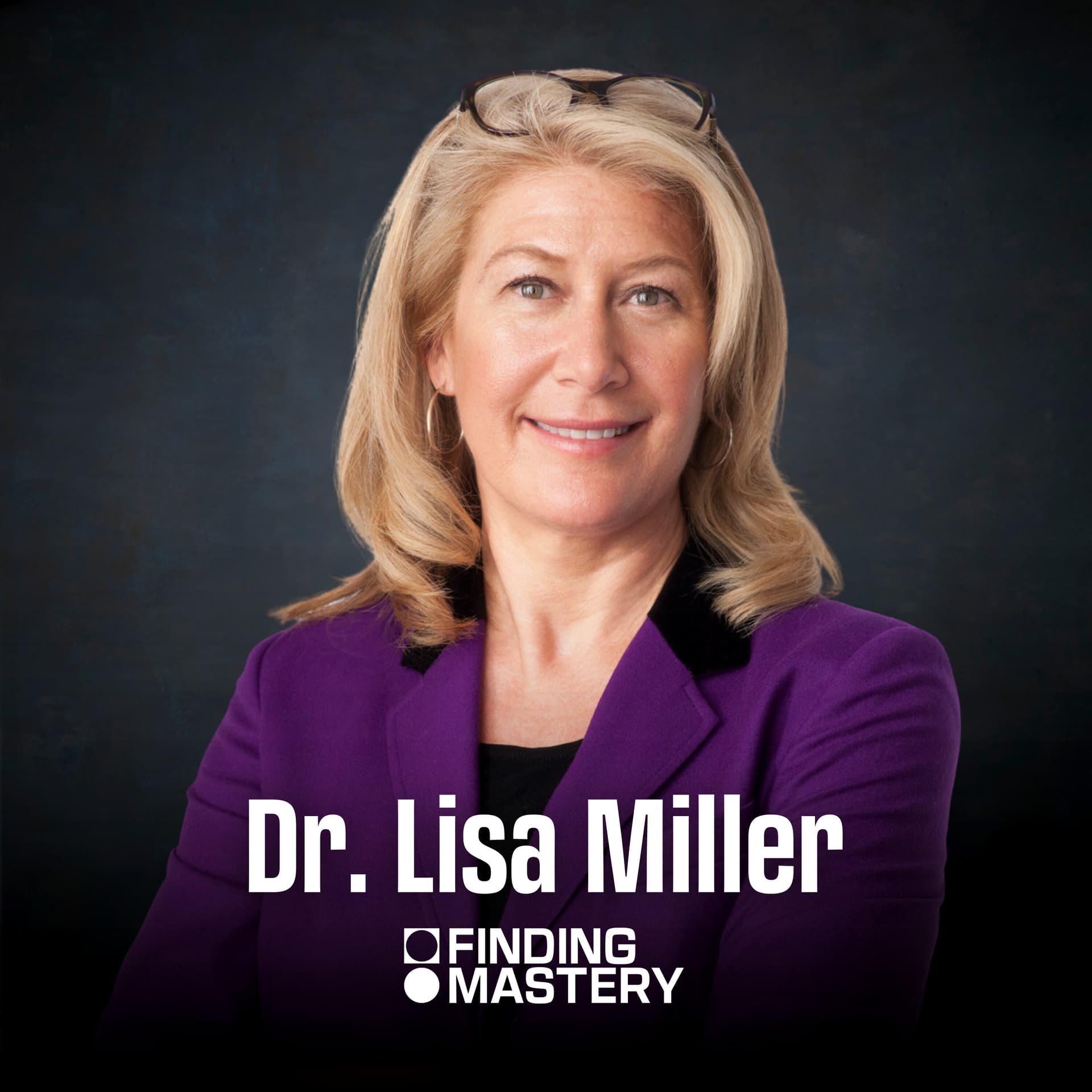
Dr. Lisa Miller, clinical psychologist, Columbia University professor, and author of The Awakened Brain. Her 30-year research and clinical work began after she saw severe depression and bipolar patients not improving on inpatient treatment models.
Key claims
- Strong personal spirituality is protective against addiction (reported 80%) and completed suicide (reported 82%).
- Spirituality is a capacity for transcendent perception present at birth; religion is environmentally transmitted.
- “Awakened awareness” can be studied in MRI-based narratives and is associated with three perception circuits: “loved and held” (bonding network), “guided” (ventral attention shift), and “never alone” (parietal boundaries/oneness).
- Spiritual practice is drug-free in her studies; psychedelics are discussed as potentially helpful for connection but not the focus.
Notable examples
- Yom Kippur service on an inpatient unit: patients with bipolar and severe guilt showed immediate behavioral and emotional shifts; a woman later reminded Miller “you can always be forgiven.”
- Children’s “implicit spiritual cognition” and the idea that parenting should support natural spiritual awareness.
Written by AI. May contain mistakes. Listen to the episode to check what was said.
Chapters
Tap a time to open that second in VOThe Awakened Brain Concept
0:03 to 1:04
Dr. Miller explains her concept of the awakened brain and its significance.
“Mastery because we know one great hire can change everything.”
The Awakened Brain Concept
3:05 to 6:05
Dr. Miller explains her concept of the awakened brain and its significance.
“Lisa, your book did something really important.”
Personal Experience in Psychiatry
6:05 to 7:40
Dr. Miller shares a transformative experience during her early career.
“They're home with their families on the high holidays.”
Impact of Spiritual Practices
7:40 to 10:00
Explore how spiritual practices can influence mental health and recovery.
“So when I, one, as you're telling this story with an insight, you're a good storyteller and it emerges through the book.”
Designing the Study on Spirituality
10:00 to 12:20
Dr. Miller discusses the study she designed to explore spirituality and mental health.
“Yeah, and I think that this was a sparked moment for you to say, wait, what is happening, right?”
Findings on Spirituality in Youth
12:20 to 14:01
Discover the findings related to spirituality in youth from Dr. Miller's research.
“let's say, are privately or not so privately struggling.”
Understanding Spirituality vs. Religion
14:01 to 16:50
Explore the differences between spirituality and religion through a scientific lens.
“Just an interesting way to think about an epicenter of technology and kind of affluence with that as a variable.”
Exploring Spiritual Fitness
19:18 to 28:06
Discuss the concept of spiritual fitness and its importance in holistic health.
“Just as we have a physical core for physical fitness, and so many of your clients are high-performing athletes, there is a spiritual core for spiritual fitness.”
The Impact of Psychedelics on Connection
28:06 to 29:50
Exploration of how psychedelics can foster deep connections in therapy.
“roots and legs in for an integrated spiritual life.”
Practices for Spiritual Connection
29:50 to 31:35
Discussion on personal practices to enhance feelings of connection and love.
“And I fill my sense up with loving kindness energy.”
Show all 30 chapters
Exploring Relational Spirituality
31:35 to 33:16
Understanding the importance of relational spirituality and its impact on well-being.
“There is actual love and kindness, energy, spirit, consciousness.”
The Importance of Community in Personal Growth
33:16 to 35:16
Examining how community and relationships play a critical role in personal development.
“Mike, what I think you might love is that we can then pivot and with 85 % overlap, use the same awakened awareness, the same awakened brain to be loving and guiding and never leave anyone alone.”
The Importance of Community in Personal Growth
35:19 to 36:33
Examining how community and relationships play a critical role in personal development.
“For so many in our community, travel is part of the rhythm of doing meaningful work.”
Navigating Spirituality and Religious Practices
37:47 to 42:00
Discussion on the relationship between spirituality, religion, and personal experience.
“What does the relationship with yourself mean?”
The Flame of Spirituality
42:00 to 51:52
Explore the concept of spirituality as an internal flame and its significance.
“is to be able to stay connected to the flame no matter what.”
The Flame of Spirituality
51:55 to 53:20
Explore the concept of spirituality as an internal flame and its significance.
“And I want to come back to something a little more personal.”
The Flame of Spirituality
53:23 to 54:28
Explore the concept of spirituality as an internal flame and its significance.
“Days are longer, pace picks up, and there's this sense of momentum that comes with the season.”
The Flame of Spirituality
54:37 to 54:47
Explore the concept of spirituality as an internal flame and its significance.
“Again, that's drinkag1.com slash finding mastery.”
The Innate and Environmental Influence on Spiritual Awareness
54:47 to 56:04
Discuss the balance of innate and environmental factors in spiritual awareness.
“One third innate, two thirds cultivated or environmentally influenced.”
The Impact of Sustained Spiritual Life
56:04 to 57:29
Discover how sustained spirituality can protect against depression through MRI studies.
“And Mike, we even track this in MRI studies.”
Exploring Perspectives on the Afterlife
57:31 to 58:23
Engage in a dialogue about beliefs surrounding the afterlife and its implications.
“But if I anchor into that narrative, it's like, look, religion was formed because it's too damn hard to believe that there's nothing else.”
Healing Practices and Spiritual Connections
58:23 to 1:01:18
Learn about a study demonstrating the healing effects of spiritual practices and connections.
“So the actual target of that connection is immaterial.”
Consciousness as an Antenna
1:01:18 to 1:03:18
Explore the concept of the brain as a conduit for consciousness and intuition.
“the MRI, functional MRI, tracking blood flow.”
Awakening Awareness vs. Achieving Awareness
1:03:18 to 1:07:22
Understand the distinction between achieving awareness and awakened awareness in decision-making.
“Yeah, so that's pulling on one of your first principles would be free will, not deterministic, right?”
Awakening Awareness vs. Achieving Awareness
1:07:30 to 1:08:34
Understand the distinction between achieving awareness and awakened awareness in decision-making.
“Anytime you feel the pull to reset, to zoom out, to refocus and ask, am I moving toward the person I want to become?”
Awakening Awareness vs. Achieving Awareness
1:08:50 to 1:09:55
Understand the distinction between achieving awareness and awakened awareness in decision-making.
“nearly 95 % of us are not getting enough fiber.”
The Union of Awakened and Achieving Awareness
1:10:12 to 1:11:17
Exploring the integration of spiritual and achievement-driven aspects of life.
“Awakened awareness allows us to ask, what is my higher power revealing to me?”
Balancing Spirituality and Achievement
1:11:17 to 1:11:51
Discussing the journey of finding balance between spiritual calling and personal achievement.
“You perfectly summed up what I am trying to do in my life.”
Book Recommendation: The Awakened Brain
1:11:51 to 1:12:04
Encouragement to purchase Dr. Miller's book and its significance.
“And thank you for the way you move our world.”
Upcoming Episode Preview: Coach Mike McDonald
1:12:04 to 1:12:41
A sneak peek into the next episode featuring Coach Mike and insights on leadership.
“Next time on Finding Mastery, we're joined by close friend and colleague of Dr.”
Transcript
Automatic transcript. May contain errors.0:00Dr. Michael Gervais:Finding Mastery is brought to you by LinkedIn. We use LinkedIn Hiring Pro here at Finding Mastery because we know one great hire can change everything. One bad hire, it can cost you a lot, way more than time. It can cost you momentum and culture and real dollars. And that's why how you hire matters just as much as who you hire. And it's why I've become a big believer in the power of LinkedIn Hiring Pro. Here's what I appreciate about it. When you're running lean, you don't have hours to sift through a pile of resumes hoping to find the right person somewhere in the stack. Hiring Pro is built exactly for that reality.
0:32Dr. Michael Gervais:You describe the role and it screens candidates for you, surfacing the people who are a best fit so that you can spend your time and conversations with those folks rather than in the weeds of the applications. And the results back it up. Those hiring with LinkedIn are 24 % less likely to need to reopen a role within 12 months compared to the leading competitor. So join 2.7 million small businesses already using LinkedIn to hire. Host your job for free at linkedin.com slash mastery. Terms and conditions apply. Again, that's linkedin.com slash mastery to post your job for free. A strong, high personal spirituality, with or without religion, turned out to be 80 % protective against addiction.
1:14We now know 82 % protective against completed suicide.
1:19Dr. Michael Gervais:Could we be overlooking one of the most important drivers of mental health? A strong personal spirituality is more protective against addiction, depression, and suicide, the diseases of despair, than anything else known to the clinical sciences. Welcome back, or welcome to the Finding Mastery podcast, where we dive into the minds of the world's greatest thinkers and doers. I am your host, Dr. Michael Gervais. A high-performance psychologist named Michael Gervais. Who head coach Mike McDonald and former head coach Pete Carroll brought into work with the Seahawks. Famous for his work with Felix Baumgartner when he jumped out of space in the Stratos Project.
1:55Olympic athletes depend on something more than just training and talent. They have to stay mentally tough.
2:01Dr. Michael Gervais:Today's guest is Dr. Lisa Miller, a clinical psychologist, a professor at Columbia University, and author of The Awakened Brain, whose research challenges something many of us have been taught to overlook, that spirituality isn't optional. And it isn't just religion. It's a core part of how we're wired. Spirituality is not a belief. It is an inborn capacity for perception to be able to feel and know the presence of the deeper nature of life. Some people say the higher power. Some people say the force of nature. My word is God. Whatever our conceptualization, what we know through science is that we are all born with the same neural correlates of what I call awakened awareness.
2:43Dr. Michael Gervais:In this conversation, we explore the science behind the awakened brain and how reconnecting to something deeper may not be a luxury, but a necessity. Our achieving awareness is essential to execution, but execution alone is insufficient for a full and meaningful life because there's no amount of anything, money, fame, glory, that can fill the spiritual hole in the heart. With that, let's jump into this week's conversation with Dr. Lisa Miller.
3:14Lisa, your book did something really important.
3:18Dr. Michael Gervais:It introduced a concept that I know to be true, but didn't have language for it. And then you grounded it in research and science and an academic position that allowed me to feel safe in both the felt experience that I've had and the way that you named it, and also the way that you scrubbed, you know, in to really discern and think deeply about what does it rest on and the research to support your idea. So the awakened brain is what you introduced to me. And it's something that I have understood, but didn't have language for. And I have thought deeply about the difference between being and doing, and it's the being me and the doing me.
3:57Dr. Michael Gervais:It's the close I could get to it, but I didn't have research to support it. And now I think I do. And so one, welcome to the Mastery Lab. Thank you for being here. Thank you for the spirit in the way that you wrote the book and the research to support your ideas and also the loveliness of the way that you enter a space. And so thank you for being here. Mike, I am so honored to be here and I'm so delighted by your passionate inquiry. I mean, you just keep expanding. That's great. Yeah, fun. Your reach just grows. There it goes. So maybe let's just start with your training and what led you to want to write this book.
4:39Dr. Michael Gervais:And so maybe we can just give a flyover for that first so people can ground themselves in where you come from. The book, The Awakened Brain, is really the culmination of a 30-year journey. I didn't write it in two years. I experienced it over three decades. And effectively, when I started out as a clinical psychologist, so a therapist, I was also trained as a clinical scientist. I found myself on an inpatient unit with tremendous amounts of suffering and lost feelings. Very tremendous frustration, people with deep, severe major depression, people with bipolar. And it occurred to me very quickly as a new psychologist that in our darkest, most painful, excruciating moments, our models were not helpful.
5:24People were not getting better. And the therapist could not have been nicer and full of integrity, but simply treatment at that time was not doing the job. And we know that because people kept coming back three months later. The same person who'd been discharged was back worse, suicidal. But then it so happened that on this very intense inpatient unit, the rotation fell during what for Jewish people is the holiest day of the year, Yom Kippur. And they said, hey, you know, patients in our community meeting said, what will we be doing for Yom Kippur? Who's coming? When is the service? And the kind sort of feeling badly, unit chief said, I'm sorry, we don't have any clergy.
6:07They're home with their families on the high holidays. What? No Yom Kippur? In their most painful moment, no forgiveness. In their most guilty, excruciating moment, we're visiting all the things I feel I've done wrong. no Yom Kippur to alleviate the sense of horrible guilt. Yom Kippur, of course, is when we ask for forgiveness. So as a new psychologist, I raised my hand and said, you know, I'm not a rabbi. I'm a psychologist, but I do have my grandmother's prayer book and I'd be happy to come in on Yom Kippur.
6:36Dr. Michael Gervais:How old were you? 26. This is at Columbia? Yeah. One of the hospitals in the system. Okay. Well, I showed up with my grandma's prayer book and that day, which really was different, Mike, than all other days. The people who had been so despairing and chaotic, the bipolar gentleman who'd been explosive and the woman who'd felt so guilty and low and depressed, all sat up with brightness in their eyes for our Yom Kippur service, which of course was held in the back hall in the linoleum kitchen under the fluorescent lights. But it was a sanctified space. It really was, meaning it felt special and whatever one's word might be, it felt godly.
7:17There we were, called home and got in beautiful clothes. They weren't wearing their open gurneys. And as we started to say the prayers that all of us hear every year in the practice of a faith tradition, whatever that may be, it was the gentleman with bipolar who normally was so explosive and disruptive, who was carrying in the cadence of the depth of the prayers our service. He was actually the magnetic center. And the woman who had been so shameful and slumped and feeling unworthy sat up bright and said, I always knew that on Yom Kippur we could ask to be forgiven, but sitting here in our service now, I know that God will forgive you.
7:58And she was bright. and so there was a radiance like a beautiful brightness and illumination that outshined anything that had happened in the months and months of treatment as usual and in fact what I was witnessing was that whatever the real hit to their life whether it was the explosiveness of bipolar being in fact intact whether it was the shame and guilt of depression feeling worthy equal and opposite was their immediate, for the moment, spontaneous transformation. Okay.
8:32Dr. Michael Gervais:So when I, one, as you're telling this story with an insight, you're a good storyteller and it emerges through the book. Thank you. And the thing that I want to just push against, this is one classically trained to another classically trained psychologist is how do you know that you were not imbued in the experience and interpreting it based on your own hopes and desires that this practice that you were leading would be of benefit to them? And then seeing what you had hoped for. Yeah. So through rosy eyes, oh, they look so lovely to me. Yes. A few ways. One is their behavior, right? So the unit chief came up and said, you know, so many of the patients have come up to me and they said it was a very meaningful, beautiful service.
9:20The next piece of data is that in our morning report, we hear how everyone was doing last night and people who weren't doing well were now at peace and able to sleep through the night. And then the third, perhaps most touching story is that the woman who'd struggled with tremendous guilt and unworthiness knocked on my door mic three days later. Dr. Miller, do you have a minute? I said, well, sure, come on in. She said, I just want to remind you, Dr. Miller, you can always be forgiven.
9:50Dr. Michael Gervais:Oh. So it really stuck. It really stuck. And she went from being, if you will, one who so needed it to one who was sharing it. She wanted to help me out. Yeah, and I think that this was a sparked moment for you to say, wait, what is happening, right? Yes. And did it initially lead you to design the study? Well, I don't know if it was your study that you designed, But you were studying depression, and I'll remind you, I think this was kind of the next on effect it would have. You designed a study on depression, and maybe you added or it just happened to have an added question that said, are you religious slash spiritual?
10:28It's such a delight that a scientist read the book. Thank you, Mike, for the fine-grained read. I appreciate that, truly. So what I saw clinically was something I could tell in story form. That's right. But to change the field, it was need to be the language of science to really get peer review articles, to redefine the standards of good practice, to really paint a new empirical portrait of what mental health and recovery looks like. And so it was in part out of wanting to serve these patients, but it was also part out of this deep hunger and curiosity to understand what I'd witnessed.
11:02Dr. Michael Gervais:Whether biased or not, there was something that happened in you and potentially in them. Sounds like it did. And you said, I want to understand it more. I want to witness this. So I went on a 30-year scientific quest. That's all. I mean, what have we signed up for here? Well, my poor husband, I'm so obsessed with this, that we'll be at dinner. And he's like, are you thinking about a number? Morning, noon, and night, this is what I'm passionate about, to understand through the lens of science. So let's go back probably 29 years ago or something when this first began for you, is that when you were waiting for the MRI report to come out of the machine, right?
11:38Dr. Michael Gervais:Like the printer or whatever it was. And the way you described almost with bated breath, like the two categories of people that you were interested in. Before I give the punchline, can you walk through the design of the study? Because I think it's materially important to the outcome and what set you down the path for 30 years, of which I think every person in our community needs to pay attention to your findings. And the reason I say that is because I don't know, we'll make up broad strokes here. One in three people are depressed or anxious, right? In the US. Right. So that means - And even more of our kids, right?
12:13Dr. Michael Gervais:Oh yeah, it's closer to 50, right? Our kids, you know, teenagers. Half of the kids on a playground in high school, let's say, are privately or not so privately struggling. Yes. Right? Depression and anxiety are disordered ways of working in the world. And while it's true nationally, it's even more true of kids from highly resourced communities. I knew that, but I don't know the numbers. May I share a bit? Yeah. That'd be great, yeah. So I had a very dear colleague, the late Dr. Sunia Luthor, who had started working with kids in poverty simply as a control group. She went to highly resourced communities on the coasts.
12:49So outside New York, outside of San Francisco, very highly resourced communities. And to her shock, found higher rates of depression, inner pain, addiction, and even suicidality. in highly resourced high schools than in the inner city.
13:05Dr. Michael Gervais:Do you have a sense of why? Well, I teamed up with her. And having looked at national samples, I said, you know, Sunya, let's put in a spirituality measure. Let's see how they're doing spiritually. So Mike, the national rate at which a high school student raises his or her hand and says, yes, my spirituality is highly important to me is about 70%. So what might we imagine in highly resourced communities is that rate? 15, less than a quarter of the national rate. So let's do two things. One is anecdotally, I came across this, I don't know, kind of throwaway fact. It was probably 10, 15 years ago that in San Francisco, which this is not, we're in Los Angeles, so people can just geographically locate us.
13:50Dr. Michael Gervais:In San Francisco, there is per capita, it would be one of the larger cities that has the lowest number of temples, synagogues, churches per capita. Just an interesting way to think about an epicenter of technology and kind of affluence with that as a variable. So I cannot call that number up, but it was, yeah, it just stuck with me, whether it was accurate or not. That being said, this is not an assault on San Francisco, but this is a reinforcing thought that I've had that you are confirming with some data. Okay. So the data mirrors what you've observed and known and seen. Yeah, yeah, that's right.
14:29Can I fill in a tiny piece? So people often say, you know, am I spiritual? Am I religious? Well, what's the difference? And science has one answer for that. Science doesn't define spirituality, but we can identify threads of lived human spirituality that are absolutely game-changing onto the rest of our lives. And science can also take a look at religion, our beautiful world faith traditions. And here's how we do it. The first lens of tremendous help to a scientist is a twin study. A twin study can determine, as you know, as a scientist, the extent to which any human capacity is inborn versus environmentally formed.
15:08So you're very smart. You are always smart because IQ is two-thirds inborn, one-third cultivated. Temperament is half and half if I'm introverted or extroverted. The capacity through which we experience spiritual life is one-third innate, which means we are born naturally spiritual beings. and yet two-thirds environmentally formed means that there's great consequence as to whether we cultivate that. Religion is entirely environmentally transmitted. Whether I am Catholic, Hindu, Muslim, whatever my faith tradition may be, it is in the texts, the sacred texts, the ceremonies, the community, all the vital, often beautiful, transformative components of religion are a gift of the environment.
15:56They're environmentally transmitted.
15:58Dr. Michael Gervais:I often see them through the lens of sport in one way, which is a weird way of thinking about the most powerful forces on the world are the gatherings of people around these ideas, right? Let's take some of the biggest religions, Christianity, Islam, Hinduism, Buddhism, Judaism, as an example. They're training grounds. So there's a set of ideas. There's a set of practices and principles that are aspirational. And there's a whole tenet of practices to help you get closer to that lived experience. That's beautiful. Yeah, right. I love that because that explains how the one-third natural spiritual core is cultivated by the two-thirds embrace of environment.
16:41Dr. Michael Gervais:Yeah, which is culturally and historically and relevant to the upspringing of those best practices. But sorry, go ahead. We have so much to say. No, no, please keep going. We love this, which is... Finding Mastery is brought to you by Rag & Bone. I've been a big fan of Rag & Bone for a number of years. I just love what they do. It's a go-to for me when I'm choosing clothes. I've been wearing their infused denim for a while now. They've done just a really nice job with this product. For me, I am really intentional about what I invest in. In clothing, it's no different. I want things that are well-made, that stand the test of time, that don't distract me, that support my focus on the things that matter most.
17:17Dr. Michael Gervais:And that's exactly why these deliver. And they look sharp, full stop. They've spent 20 years obsessed with getting this product right. And that kind of long-term commitment to craft, that's something we talk a lot about here at Finding Mastery. Quality compounds. The right inputs may consistently over time show up in everything. And you can feel that the moment you put these on. If you're ready to upgrade your denim with something that's genuinely built to last, it's time to upgrade your denim with rag and bone. For a limited time, our listeners get 20 % off their entire order with the code FindingMastery at rag-bone.com.
17:49Dr. Michael Gervais:That's 20 % off at rag-bone.com with the promo code Finding Mastery. And when they ask you where you heard about them, please support our community and this show and let them know that we sent you. Finding Mastery is brought to you by David Protein. Nutrition is foundational to high performance and well-being. And being consistent with whole food choices is really important. Sometimes that's tricky, especially when you're on the go. One small practice that helps me on those types of days is having a smart, reliable nutrition option ready when I need it. And that's why I'm a big fan of David Protein Bars.
18:23Dr. Michael Gervais:The Gold Bar is their flagship product. High protein density, great texture, and flavors that make it easy to stick with. The team here at Finding Mastery, they love it. They're just ripping through them in the Finding Mastery lab. Chocolate chip cookie dough and peanut butter seem to be their favorite go-tos. and for those who don't want to compromise performance just because you're on a short time or in between meals, this is a solution that's worked incredibly well for me and the team here at Finding Mastery. They've built something with rigor and alignment that really stands out in a crowded, sometimes ambiguous space like nutrition.
18:56Dr. Michael Gervais:David bars are now available in major retailers like Walmart and Target. And if you'd like to try them directly and get a special offer for being a Finding Mastery listener, head to davidprotein.com slash finding mastery, where right now, if you buy four packs, you'll get the fifth for free. Again, that's davidprotein.com slash finding mastery. I hope you'll check them out. Just as we have a physical core for physical fitness, and so many of your clients are high-performing athletes, there is a spiritual core for spiritual fitness. And the Pentagon came to me. We did three years of intensive mission.
19:32I served the chief, the vice chief, and the secretary of the army on the Spiritual Readiness Initiative to strengthen the spiritual core of every soldier. The army holds five pillars of holistic health and fitness, sleep and nutrition, physical health, mental health, and spiritual health. But how do you do? Well, physical fitness, mental fitness, and spiritual fitness. How do you do spiritual fitness? And that's where the science is so tremendously helpful and as a roadmap. I like your analogy so much. the practice, the cultivation, the strengthening of our natural spirituality known through time and our many faith traditions is something that humanity has known all along.
20:16Dr. Michael Gervais:Oh, yeah. Right. The power of people, the power of practice, the power of asking for forgiveness to whomever or whatever, the power of hope, you know, and there's also a power of corruption imbued through them as well, which... Those are the messengers. I have a hard time with some of that. Like I have a real hard time with any organized structure that engages in criminal behavior that is of the most vulnerable people. I have a real hard time with that. But that does not corrupt the spiritual. The spiritual is innate. The spiritual is everybody's. And nobody's left out. So how do you discern that one third of...
20:55Dr. Michael Gervais:Our capacity. Okay, that's the word. One third. Say it one more time, the working definition of spirituality and how you came to know that. Through the view of science, spirituality is not a belief. It is a capacity, an inborn capacity for perception. Just as we have a system of visual perception and a system of auditory perception, Every one of us is born with a capacity of transcendent perception to be able to feel and know the presence of the deeper nature of life. Now, what we call that can change, but the seat in the brain is universal through which we can experience a transcendent relationship.
21:36Some people say the higher power. Some people say the force of nature. My word is God. whatever our conceptualization, what we know through science is that we are all born with the same neural correlates of what I call awakened awareness. And how does your research help unpack the pineal gland, you know, and like that, the God gland, if you will? Right. So our work has not focused so much there. We've focused on the neural correlates of perception that are fluid. So for instance, we would invite you into the MRI machine to tell us a time in the flow of your experience where you have felt a deep connection to how you understand the source of life.
22:18And very often these stories might start with struggle and suffering. People will say, you know, I was feeling so low. I'd just been turned down at five out of seven jobs I'd applied to, or my partner had just left me and I felt so unattractive and unlovable. But then, you know, I saw light in the leaves and I knew that God would find the work that was my calling. Or then I was sitting in the pews by my family and I felt loved. I felt my family's love and I felt God's love. And I knew I love again. There's a shift at a moment in the narrative where suddenly we go from being mired in a ruminative sludge over and over again to a breakthrough.
Read the full transcript
22:59The aperture widens, light comes in. And this process of connection to the transcendent relationship is universal. It looks the same, whether I'm Hindu or Muslim or Jewish or Catholic or spiritual and not religious. And it's characterized by three circuits. Yeah, this is great. So we become aware in these moments that we are loved, we're not worthless, but there's something inherently worthy in our very being. Whatever our words may be, that we have inherent dignity, we're divine beings, but we feel loved. We perceive guidance and we feel that we are not alone. Each of those core components to everybody's narratives has a distinct circuit.
23:45Loved and held is the bonding network. Guided is a shift from the narrow dorsal to the bottom up ventral attention network. And never alone does the parietal that puts in and out hard boundaries. so we all have the capacity to perceive that we're loved held and guided hit me with those sure so loved and held is the bonding network the same bonding network that's up online when we're babies in our parents arms okay guided is a shift in attention from the achieving mind i've got to have it the bowling alley the rigid bowling alley it's that and only that how did i not get it, what did I do, right?
24:23That's top-down dorsal attention to bottom-up floodlight ventral attention. And many people say, I'm sure you may know this well, a new door opens, a new direction pops. So loved-held bonding network, guided shift in attentional network. And the never alone is, I find this is one of the most profound and prominent findings in the neuroscience of spiritual awareness, the parietal. You know, a lot of people talk about a lot about the frontal lobe and the executive, but the parietal is in the back of the head. The parietal is effectively our capacity to feel unique, you know, that you're Mike and you're fit, you know, physiology in LA, right?
25:03And I could be in New York sitting in my backyard, right? Two different GPS coordinates, two different bio body suits, but part of one unit of reality on some level, some fabric of life. The parietal puts in and out hard boundaries. So we know we're a point and we're a wave. We are unique and distinct.
25:21Dr. Michael Gervais:It's cool. I've never heard anyone talk about the parietal. It's so fabulous. In that way. Yeah. I want to make sure I've got this right. There's three. Love and held is one experience. Well, they're concomitant. They move together. Okay. And this all happens at once, but I'm telling you the components. The components, yeah. Like the way a car runs all at once, but the carburetor's running it right. Yeah. Okay. Okay. Transmission, engine, da, da, da. All at once. Yeah. Feeling guided. Yes. Is it feeling guided or a sense of being guided? Perceiving. Perceiving guidance. Yes, these are all perceptions.
25:52But the perception can be both sort of cognitive visual and some people are quite kinesthetic in their pickup. They know it in their -
25:59Dr. Michael Gervais:And the third is never alone. Okay, this is like - Synchronicities, other people show up. Yeah. Everything counts. When I am in a, it was the last three-day meditation, noble silence, 16 hours a day of meditation. All three of these come online for me. Wow. Right? And again, go back to training. So there's a quieting that takes place, a connecting that takes place, a observation, a fatigue of refocusing that takes place, an agitation, an irritation, a struggle, and then a letting go. And when I can get to that place, I haven't heard them structured in this way or related to the brain regions you just did.
26:37Dr. Michael Gervais:But all three come online on a good training. And then I become more connected to them subsequently. So there's a glow after the intense training that takes place for weeks, whatever. And then when I'm feeding that glow, that kind of aliveness that took place or that this connectivity across the three that we were just talking about, I'm able to palpate it more frequently. Right. So when I go to the deep training and then I stay with some training, subsequently, I'm more connected in this way. Re-enter the perceptual zone. Yeah. And then I feel like I need to get retuned up, you know, every so often.
27:11Dr. Michael Gervais:And I think that people also speak to, let's call it different drug capabilities to open up these three functions as well. And so you're not suggesting in your research that drugs would do the same as spiritual training. All of our research has been drug free. So the people who have contributed to our studies have had spiritual experiences, if you will, endogenously versus exogenously. But, you know, there is a body of research to be done to see if perhaps things like psilocybin open the perceptual capacities that we can then through meditation, prayer, spiritual practice, deepen and sustain. And I think it's very helpful when people are stuck in some cases to, for those whose path seems to call for psychedelics, to then move from an exogenously induced awareness to putting deep roots and legs in for an integrated spiritual life.
28:09Dr. Michael Gervais:Yeah. And the research, I think, is pretty clear right now that it's emerging, it's fun, it's exciting, there's a lot going on. I am not participating in any way in that. But the idea that when some psychedelics, what they're finding is that their main impact or effect is that people feel safe enough to share their stories with a safe person. So they're more connected, if you will, in therapy, or they go to therapy and actually feel the depth of that potential. And so that is pretty promising, interesting in and of itself. May I share one little bit of science that is kind of new around that. Yeah, please.
28:46So I'm very appreciative that our lab at the Spirituality Mind Body Institute is in collaboration with a team at the University of Michigan who have over 5 ,000 cases of ecologically valid community use of psychedelics. And what the early findings seem to suggest is that when the experience itself includes a sense of deep connection and vastness, there is less depression on the other side. But if the experience is not one of really the parietal being engaged, of entering the unit of reality.
29:20Dr. Michael Gervais:So if the parietal region of the brain doesn't light up, is not engaged. Well, we have yet to get to put them in the scanner to know that for sure. Okay. But the trace of what we have seen in other studies as living through the parietal, which is the capacity for unit of awareness, the oneness. I see. Okay. Is essential to opening the gate. So it's not little me and I'm not no more than what I have. I want to share a practice. I travel a bunch. I'm traveling less now, which is a good thing for me. And when I'm away, this is a practice I do every night, is that I'm in bed, getting ready to shut her down.
29:54Dr. Michael Gervais:And I fill my sense up with loving kindness energy. Okay. You might call it God, call it loving kindness for just this moment. And then my heart shoots to my wife, to her heart, wherever she might be geographically in a different place. And then it shoots to my son. And then if I kind of have some more energy, I'll send it to some folks that I know would benefit from a little ping. But what you just did, so that's a nice little practice for me to be connected when I'm on the road, you know, in a different way than a phone call does. But I think what you just described was I was lighting up my parietal region of the brain for the never alone piece.
30:32Dr. Michael Gervais:Is that right? Yes, yes. Yes. Which is a simple little practice, which maybe helps me feel more connected the next morning, you know, or even in that moment, probably. So my question is, do you ever get a call or the next time you see someone who you pinged with love and kindness? Well, she calls or I call every day, you know, at some point, but you're taking out of that conversation. Beyond the immediate family. You know, it just happened two days ago that I was thinking about calling. It was a coach that I worked with in the Paris Olympic Games. We hadn't seen each other for a while. Marcia, what's happening?
31:03Dr. Michael Gervais:And I was thinking about Marcio and then he texts me the next morning. And I was thinking about him in a reverence and a loving kind, like just how much I miss him and how much fun we had together and how important he has been in my understanding of human capability. And the next morning he texts me, he says, Misha, I can't wait to get together. Let's find a window. And so I think that's what you're asking, right? Yes. So I think that takes us from knowing that the brain is capable of this awareness to, well, the proof's in the pudding. You got a call out of the blue, so-called blue, right after you'd send him love and kindness.
31:40So it's real. There is actual love and kindness, energy, spirit, consciousness.
31:46Dr. Michael Gervais:When you say it's real, I experienced that to be luck. I experienced it maybe to be something else. I don't know. There's lots of reasons I could come up with. Have you studied that? There are beautiful studies, yes. Yes. Yeah. Okay. I don't know the studies on it. Okay. So let's do this. How does one train spirituality without a religious practice? Well, as you were suggesting, for some people, their faith tradition has this embedded already in the sacred text and practice. So there are, for about two-thirds of people in the United States, it's through my Catholicism, Hinduism, Judaism, that I strengthen natural spiritual awareness.
32:22That's what two-thirds of people are effectively doing. But one third of people are every bit as much spiritual, but not religious. And it's oftentimes through practices in the language of life, in the language of lived experience of nature, that we can strengthen our spiritual awareness. But whatever the form, the deeper catch in the catcher's mitt is the deep transcendent connection. What we call it and shape it is downstream.
32:49Dr. Michael Gervais:Can you define transcendence or the transcendent experience? Thank you. So the people at our table are real. They are in a lived relationship with us. And they may be embodied or they may have crossed over. They may be pure spirit. But if your word is consciousness or spiritual consciousness or spirit, they are real. And we are built to be able to perceive them and know in a lived relationship their guidance, their love. Mike, what I think you might love is that we can then pivot and with 85 % overlap, use the same awakened awareness, the same awakened brain to be loving and guiding and never leave anyone alone.
33:30That relational spirituality is both how we experience those at our table and then how we pivot and behave towards others.
33:37Dr. Michael Gervais:This is the problem with self-help, that it misses what you just said. But so in the 80s, the self-help industry was booming and it was about you being better for you. And I find it to be repulsive because it's about you alone. Okay. So if you're going to invest in yourself for what aim, it's so that you can be there to help others. Okay. And so just go back into the world of transactional sport for a minute and think about business. Nobody does it alone. Roger Federer didn't do it alone. Kelly Slater, one of the greatest surfers ever, you know, 11 time world champion. He didn't do it alone. Nobody does the extraordinary alone.
34:19Dr. Michael Gervais:Even if they're alone on the wave or alone on the court, there's always a connection between people that are supporting and challenge them. Okay. Nobody does it alone. That means we need to be great teammates in the corporate world, in the entrepreneurial world, religious, nobody does it alone. We need to be great teammates to each other if we really want to understand our capacities. and that's why you invest in yourself so that you can be buoyant and you can be present and you can have a way about yourself that you have something to give. That's what a great teammate does. Hey, can I help you?
34:54Dr. Michael Gervais:Hey, that's not good enough. What is that? Come on now. I love that. That's great. Keep going. Hey, can you show me how to do that? Teammates, relationships are running the whole thing and emotions are running the relationships. And so if you think about the relationship with yourself, what does that mean? Finding Master is brought to you by ProtonVPN. For so many in our community, travel is part of the rhythm of doing meaningful work. Boarding flights, hopping between cities, working out of hotel lobbies and coffee shops. It's all part of what it takes for some of us to lead and build at a high level.
35:32Dr. Michael Gervais:And one thing that's easy to overlook in that rhythm is digital security. Because the moment you connect to public Wi-Fi in a hotel or airport or cafe, your activity is suddenly a lot more exposed than most people realize. Logins, emails, financial information, sensitive work, it's all in the open in a way that doesn't match the standards we hold for the rest of our lives. That's where ProtonVPN comes in. ProtonVPN is a secure service designed for people who want to prioritize their digital privacy and security. It lets you access the internet the way it should work. Open, secure, and on your own terms.
36:06Dr. Michael Gervais:If you take your work seriously, take the conditions you work in seriously too. Right now, ProtonVPN is offering you 70 % off a two-year plan when you go to protonvpn.com slash mastery. That's proton, P-R-O-T-O-N, vpn.com slash mastery for 70 % off your two-year plan. Again, that's ProtonVPN.com slash mastery. Finding Mastery is brought to you by Sunlighten. I'm really excited about a new partner of ours. Something that I've come back to again and again is when I invest in recovery with the same intention that I bring to my work, everything gets better. My energy, my focus, my ability to show up fully for the people that I'm with and the work that I care about.
36:52Dr. Michael Gervais:That's why I am so bought in on the Sunlighten M-Pulse Intelligent Sauna. I was first introduced to their team a few months ago and was so impressed by what they've created. This is one of the most advanced infrared saunas that they've built in over 25 years of pioneering this technology. That's right. They've been at this game for 25 years. I had one installed in my home a few months ago and it's made a real difference. I feel more refreshed, more grounded, more relaxed, and it's become a consistent part of how I recover, how I reset every day. I'm using it to support muscle recovery, for improved oxygen delivery, and for nervous system recovery.
37:28Dr. Michael Gervais:And what I love most, I don't have to leave my home. They're offering the Fonny Mastery community up to$2 ,100 off. Simply head to sunlighten.com and use the code mastery for this great discount. Again, that's sunlighten.com and use the code mastery for up to$2 ,100 off. What does the relationship with yourself mean? And before we think about relationship with others, your relationship with experience, what does that mean? And where does the relationship with the unknowing take place? Is that with yourself? Is it through experience? Is it separate? I don't think it is. So the unknowing is what I'm doing a placeholder for the energy that some might call or the nature or God or the unexplainable.
38:08Dr. Michael Gervais:And so that piece is totally trainable. I'm so convinced, you know, in my own life, but I didn't have the research around it that you have pointed to. And you found it. Well, I think lots of people have, you know, and that's why people are attracted, one of the reasons people are attracted to formal religious studies, beyond the fact that they might have a difficult time to discern and think for themselves. But that's a different narrative, I think. So people will sometimes ask me, you know, how do you understand the things that don't go right within some religious communities? And I'll say, well, as a scientist, I simply ask the question, here's the truth and the light the flame.
38:49And down the long, long torch at the bottom is the human torchbearer.
38:55Dr. Michael Gervais:That's a good image. Yeah. Yeah. And the human torchbearer could be a teacher or a coach. The human torchbearer could be a clergy person. But when a young person sees a torchbearer, they say, are they walking the walk? Are they keeping with the light of the flame? And if the torchbearer indeed walks the walk, then the young person says, wow, oh, there's really something to that flame. But if the torchbearer does not walk the walk, is perhaps foibled or egregiously harmful, there's a tendency for the young person to throw out the flame. And that's called spiritual injury. When we give up our own direct connection to source because we met a bad messenger, it can be fixed.
39:35Dr. Michael Gervais:Yeah, I think that that's really difficult depending on the level of injury. Painful, very painful. Very painful. But the level of betrayal for some and the observed betrayal for others and the second order understanding of betrayal. People can be very harmful, but that's not spirituality. Those are human foibled bad messengers. A hundred percent. And I think that's a distinction that can be helpful to people. I think that you're pointing at something that has been a source of tension for me is to try to have a set of practices that keep me connected to a source that I don't understand but know to be true and not be mired by my disdain for the behaviors of some that have, I think, corrupted an industry.
40:23Dr. Michael Gervais:Bad torchbearers. Or an institution. There's been good torchbearers. There's been bad torchbearers. That's right. And, you know, there's just something that gets triggered. When I was in high school, my family was deeply connected to a religious practice. We had my seniors and priests over for dinner on Fridays and Saturday nights. And like, we were in it. And it was great. And then I walked downstairs one day and our priest was being massaged by his girlfriend. The priest is not supposed to have a girlfriend. Okay. Like maybe it was more than a massage. I'm not sure. So I was like, whoa, what is going on?
40:55Dr. Michael Gervais:One, two bad actors, if you will. Well, you saw hypocrisy. I saw the hypocrisy and I was like, I wanted to overlook it because this man was awesome. He challenged me at our dinner table on a regular basis. I'd say, what is God? And he goes, well, why are you asking like that? You know, and I said, well, I need to understand, like, what's your take on it? And he says, well, okay, let me ask you this, Mike. So he's got a chip on his shoulder back and, you know, with a glistening in his eye. And he'd say, well, is God inside the sunset or is the sunset inside God? You tell me. I go, I don't know.
41:27Dr. Michael Gervais:He goes, well, why don't you figure that out and come back? They challenged me. It was fun. And then to see the behavior, that's only one behavior. There was the worst of behaviors in our small community. the worst of predators. So that is something that really kind of spun me out. So that's a very important, profound story because the foibled, very egregiously foibled predator was not the flame. Not the flame. Not the flame, was not pure spirit, was not divinity. And so to - It was a foibled human. And to reinforce your appropriately set challenge is to be able to stay connected to the flame no matter what.
42:06No matter who may have misrepresented the flame. That's correct.
42:09Dr. Michael Gervais:And I'm less interested in who's misrepresented it and who is great with it and more interested in what it feels like for me to do the work. How to get back to the flame. Yeah, that's right. To be connected to it. I'm not sure I need to get back to it. I feel like it's always there. And I need to just be connected. I don't feel like it's outside of me. It's inside of me. Yes. I would say it's both. I'd say it's in us, through us, and around us. It's God in the sunset of sunset in God. Yes. The answer is yes to both. Okay. I do want to understand that. Yes. Let's go back to the original study that really lit me up when I knew that this was your origin story, is that you were studying depression and there was a question on it, which is like, are you religious or spiritual?
42:54How personally important is spirituality or religion to you?
42:58Dr. Michael Gervais:To you. And you check the box or not? It was high, moderate, low, no, not at all. And then the findings that you found while you thought you were studying depression, what did you find? So Mike, when I started out, there were very few studies, as in count on one hand, on spirituality, depression, addiction, really the whole field had yet been built. And there was nothing on the first two decades of life, our kids, our teenagers, our college students. And so I was looking at the time at data sets, the very creators thought had no measures of spirituality or religion, but somehow as I plowed through, you know, 50, 100 pages of questionnaires that were the backbone of these studies, way in the back, there was one question, one item, you know, thousands of items, one, how personally important is spirituality or religion to you?
43:48Personal spirituality. So I was thrilled because of what I'd witnessed on the inpatient unit. And I just had the deepest intuition that that single item may carry insight. So I ran the numbers. And sure enough, a high, meaning high, medium, low, not at all, a strong, high personal spirituality, with or without religion, turned out to be 80 % protective against addiction. We now know 82 % protective against completed suicide. that single notion of knowing in our heart if spirituality is important to us, living this. We don't have to be perfect, living it is associated with recovery from trauma.
44:32Post-traumatic spiritual growth is associated with the real struggle. Some people call it dark night of the soul, the tough times that just beset us out of nowhere. I mean, yesterday everything was fine, same family, same job. But suddenly today I feel this lurking existential dread developmental depression, which often then we are so designed gives way to an awakening.
44:57Dr. Michael Gervais:This is such a radical finding because those numbers, the percentage of protective benefits is greater than classical CBT. In other words, let me be more grounded in this. You're finding that spirituality has a better impact on mental health than classically trained cognitive behavioral training. Or anything else known to the clinical sciences. It's more important than any other single variable we've examined. It's more important than external resources. It's more important than whether my family is this, that, or the other. A strong personal spirituality is more protective against addiction, depression, and suicide.
45:42the diseases of despair than anything else known to the clinical sciences.
45:46Dr. Michael Gervais:Do it one more time, just for recency. The definition of spirituality is? Spirituality is a capacity to perceive a transcendent relationship. It is not a belief. Spirituality is a capacity to perceive the spiritual nature of life. And double click, transcendence means? The loving, guiding, real conscious presence in us, through us, and around us. Okay, so when somebody says, I have a strong value for spirituality, they have a stronger protective factor for all things that, let's say, eat away at mental health. The most prevalent ones, depression, addiction, anxiety, and now in this epidemic, suicide.
46:32Dr. Michael Gervais:So if somebody was a clinician and they're hearing this numbers, it would almost be negligent at some point if they read your work and understand it to say, oh, wait, I need to talk about spiritual practices, spiritual connection, spiritual practices is one of the best practices to help somebody heal, to be better, to whatever. And at very least, may I ask you about your spiritual life? Would you be interested in exploring your spiritual life? The clients, the authority, do you perhaps sometimes have feelings of spiritual connection or struggles? Oftentimes we found that when people come, they do want to talk about spirituality, but don't know that they're allowed to here.
47:15Dr. Michael Gervais:For the folks that did not indicate that they were religious. And I know the question was more about spirituality, right? How personally important, this is the item as it existed, right? How personally important is spirituality or religion to you? There are some people who have a deeply spiritually infused religion. So when they say my religion is very important, it is often indeed a spiritually infused religion. And I like the item because it also holds people who are spiritual and not religious. That's right. Yeah. And for those that would not normally click that box, what do you say about that?
47:51Dr. Michael Gervais:Or how do you think about that? that group of people. If they were coming in the depths of depression or if they were coming struggling with a trauma, I might invite them to explore where spirituality has been a point of illumination, love, where oftentimes people in childhood felt a great spiritual presence. In my course at Columbia, we start with a spiritual autobiography and nearly everyone can remember a time in the first decade of life where they felt a great presence of love or the numinous or where they had a very specific spiritual experience. Children are naturally spiritual beings. We're innately spiritual.
48:28And without a child, unless socialized out of it, a child will spontaneously express knowing continuity of spirit or consciousness after death. You know, I felt grandma's presence or I knew great grandma was here today. Science has identified what we call implicit spiritual cognition. I call it natural spiritual awareness, which is characterized time and time again by children perceiving continuity of consciousness or spirit after death, by children perceiving that we can know without necessarily having been told. When children are then socialized out of what we might call direct knowing, they quickly take the cue, oh, that's not real.
49:12As parents, in my view, based on 30 years of science, our most important parenting contribution is to support the natural spiritual awareness of our children. Three decades of science tells me the most important thing I can do as a parent is to support my children's natural spiritual awareness.
49:30Dr. Michael Gervais:Cool finding. How does one go about doing that? One-third innate, two-thirds environmentally formed is our natural spiritual awareness. We as parents and grandparents are tremendously impactful on the two-thirds environmental embrace. How do we do it? We don't need to be great experts, and we certainly don't need to be theologians to live out our own authentic spiritual life and then pull up the blinds, open the window, and share, be transparent with our children where we are in our own spiritual path, our own heart. So I'll give you an example. When we choose to pray out loud before a meal or in a time of struggle or in a time of gratitude, when we meditate and invite our children to sit by our side, when we use a language that says, thank you, God, for this glorious sunset, or I feel the great blessing of all life in nature, when we speak in sanctified ways, openly, in a forthright way, our children learn four tremendously formative, life-saving impactful dimensions.
50:38First, the child learns that the spiritual realm is real. Why? Because you said so, dad, and you are the authority on earth. The spiritual realm is real because you gave it voice. Two, the child learns there's a way in. I just watched you meditate. You invited me to sit by your side. I got to finish the prayer. there's a way in. Three, there is a roadmap to the spiritual reality. In times of suffering, we can turn and hand it over to our higher power. In times of doubt, there's a guidance, a golden thread. So the first is it's real. The second is there's a way in. The third is there's a roadmap.
51:16The fourth is perhaps the most important of all, which is our family goes to that depth. Our family is divine. Our family is sanctified. And with or without religion, our family is sanctified. So it's not just the three of us, it's the four of us.
51:31Dr. Michael Gervais:Very cool. You are the most important person in their life in terms of spiritual formation as a father, as a mother, no one can take your place. Now, if you're not there, there can be someone who steps in, but you are the most important person in the spiritual formation of your child. And by far 30 years of science says it's the most important work we do. Finding Mastery is brought to you by LinkedIn. Earlier, I mentioned LinkedIn hiring pro, And I want to come back to something a little more personal. We talk a lot about the people who make extraordinary things possible. And I want to take a moment to acknowledge some of ours.
52:06Dr. Michael Gervais:Janelle, Taylor, Alex, Emma, and our newest teammate, Chelsea. Every single one of them came to us from LinkedIn. And every single one of them has raised the bar of how we operate here at Finding Mastery. Our relationship with LinkedIn, it also runs a lot deeper than just using their tools. We also work with their teams on the corporate side, helping them build the kind of high-performance culture where great people want to stay. They want to grow. I've been building businesses for over two decades now, and I'll tell you, the right team, that matters so much. It's the difference between grinding and flowing.
52:39Dr. Michael Gervais:So this partnership, I believe in from the inside out. When you hire through a platform like LinkedIn Hiring Pro that surfaces people who are genuinely aligned with what you're building, you get a different quality of candidate. Not just in skills, but in fit and values. The kind of energy someone brings to a team. So if you're thinking about your next hire, I want to strongly encourage you to be intentional about where you look. The right person is out there and LinkedIn Hiring Pro helps you find them faster with a lot more confidence. Post your job for free at linkedin.com slash mastery. Terms and conditions apply.
53:15Dr. Michael Gervais:Again, that's linkedin.com slash mastery. Finding Mastery is brought to you by AG1. Summer is right around the corner, at least for those of us in the Northern Hemisphere. You can just feel it, though. Days are longer, pace picks up, and there's this sense of momentum that comes with the season. For me, that also means more travel. It's more early mornings, more late nights, and it's just really a schedule that isn't consistent as I'd like it to be. That's exactly when having a simple, reliable, daily foundation, it matters. AG1 has been that foundation for me for over a decade now. One scoop and a glass of cold water in the morning, and I know I'm supporting my gut health, full stop.
53:57Dr. Michael Gervais:Filling the nutrient gaps that are hard to cover through food alone. And what ends up happening is I'm giving my body what it needs to keep showing up. And that really matters to me. What I love about AG1 is that it doesn't ask a lot of me. It's one habit, one scoop, and it travels easily. The AG1 travel packs are something I genuinely rely on this time of the year. I throw a few in my bag before a trip and the routine stays intact wherever I am. If you haven't tried AG1 yet or you've been planning to think about getting back into it, now's a great time to start. Visit drinkag1.com slash finding mastery to get an AG1 flavor sampler and a bottle of vitamin D3 plus K2 free in your welcome kit with your first AG1 subscription.
54:39Dr. Michael Gervais:It's a$72 value. Again, that's drinkag1.com slash finding mastery. One third innate, two thirds cultivated or environmentally influenced. What else is around one third innate that I could have? You know how sometimes you go, it's 700 feet tall and you go, well, how big is that? Well, it's as big as the Eiffel Tower or something. I don't know. Like, what else do you compare that is more pedestrian that it has like a one third innate capability? Do you have anything to compare it to? So one third is actually kind of on the lower end, which means it's very sensitive to our practice. Very sensitive.
55:19I mean, as I shared, you know, IQ is two thirds innate. And temperament, whether I'm introverted or extroverted, whether I'm laid back or tightly wound, that's half innate, right? So one third innate means we are built with these neural circuits, every one of us. The brain is built to awaken, But two-thirds environmentally formed means that our choices, both as parents and grandparents, but even our inner choices for our inner environment, your profound 16-hour meditation practice is a choice of environment that shapes the natural spiritual brain. That's right. How I speak to myself, whether I engage in deep connection to the transcendent relationship each day, all weigh in to shape the spiritual core.
56:04And Mike, we even track this in MRI studies. I shared with you the functional MRI study that tracks our use of the brain. We also did a structural MRI study that looks at the architecture of the brain. And when we sustain, the study found, published in JAMA Psychiatry, good, solid peer review. Well done. You know, not Dr. Miller's favorite opinion, but peer review, right? Scientific fact is so far as the system makes it, right? When we sustain our spiritual life over eight years in this study, we found cortical thickness processing power across the regions of the awakened brain, which means sustained spiritual life strengthens our natural spiritual awareness.
56:43And we then are neuro protected against recurrence of depression.
56:48Dr. Michael Gervais:When I read that in your book, I thought, my goodness, like this has to be celebrated because it's not Mike's opinion on how to live a great life. But there is real research that is observable, repeatable, that points to one of the greatest protective factors that my training in graduate school did not bring this forward. But we did not talk about this. We talked about environmental conditions. We talked about behavioral choices. We talked about cognitive behavioral interventions. We talked about the importance of feeling connected. We did not talk about the spiritual strategies to increase spiritual capacity as one of the greatest protective factors for illness, mental in this case.
57:28Dr. Michael Gervais:Well done. Really well done. I'd be remiss if I didn't ask or poke around your understandings of the afterlife. And I'm not a cynic. But if I anchor into that narrative, it's like, look, religion was formed because it's too damn hard to believe that there's nothing else. And it's a nice way to gain wealth. By whom, you say? By the people in power of the religion. This is a cynical view. Okay. The other benevolent side is like, no, this is a great community of people that are practicing to awaken the awakened brain or to strengthen the awakened brain. What is your position on the afterlife? Do you have any thoughts and or any research that you would point to?
58:08Dr. Michael Gervais:And I'm not suggesting you need to have research here. Mike, when we did the council practice, the first chair was filled with people who have your best interest in mind. And very often there's a grandparent there or someone who's crossed over, someone who is in the afterlife. What we found through the lens of systematic science was that when we do maintain a relationship with a grandparent, someone who's crossed over, an ancestor, we are protected against depression at the same level as when we feel a connection to our higher power. Whoa, really? Yes. So the actual target of that connection is immaterial.
58:46Well, what we actually found was that it tended to be people oftentimes from Asian ancestry who felt that the first chair was tremendously important. And those people who we've invited into our study from Asia, who had a strong connection with an ancestor, derived as much protective benefit against depression as people who from the United States derived protective benefit in relationship to their higher power.
59:13Dr. Michael Gervais:Very cool. I get the finding. Yeah. Do you want me to restate it? No, I got it. I totally have it. Yeah. Okay. So afterlife. So afterlife. Yeah. So I have not personally done studies on continuity of consciousness after death, but there are studies that look at the capacity of consciousness to be non-local. And there's an interesting study that was done not specifically on death, but on as we are alive, our capacity at remote distances to be in spiritual connection with one another. It's a beautiful study. Do you want to hear it? Yeah. And we did have a scientist, USC trained neuroscientist that had studied near-death experiences and remote viewing.
59:55Dr. Michael Gervais:And so like really interesting kind of on the fringe stuff, grounded in science was really remarkable. And Bruce Grayson at UVA does that. Yeah. Is that right? Yeah. At Virginia, University of Virginia. Yes, yeah. Okay. Bruce who? Grayson. Grayson. Oh, good. Yeah, please share the study. So, Ackerhoff worked in a community hospital. Ackerhoff saw many, many patients come in and out of a community hospital in Hawaii. And some of the patients had a refractory illness. They just weren't getting better in the mainstream medical model. But Ackerhoff started to notice that some of these patients who seemed, you know, had been really told you don't have much longer to live, were sort of a lost cause in the eyes of the mainstream medical model, started to get better in their work with a traditional Hawaiian healer.
1:00:43Ackerhoff wanted to understand how, why, how is it that the traditional healer is working? The healer didn't often even touch the patient and could have even been working at a distance. How does this work? So Ackerhoff invited the healer and the patient into the hospital for an MRI study. In one MRI, the healer started to do his or her work. In the second MRI, often at a great distance in another building, the patient was there to receive the healing. As the healer did their traditional spiritual practice, a consistent pattern came up on the MRI, functional MRI, tracking blood flow. Mike, within an instant, the same pattern was seen in the patient's MRI at a distance.
1:01:27superposition one thing healing consciousness in two places expressed through the landing pad of the brain so increasingly we come to see the brain not as a factory that makes consciousness but as an antenna that receives consciousness and this vision that the brain can be a conduit to consciousness is an understanding of the brain that holds intuition gut instinct prayer and meditation realizations. The catch and the catchers met mystical experiences, even the voice of God.
1:02:00Dr. Michael Gervais:The intent is a really cool way to think about the brain as opposed to the, it's an emergent expression. It is actually a collective antenna that is collecting signals. Yes. So consciousness, I don't want to go down too far down the rabbit hole because I think it starts to spin me out, you know, but awareness exists and my job is to tap into awareness. Okay, so that's the first principle I have. And I think what you're saying is that consciousness exists and you can tap into consciousness. It's not something that is unique to you. Is that a collective consciousness? Yes, yes. And so memory is not something that's stored in my brain, but instead my memory is my ability to reenter, to tap back into the consciousness field.
1:02:49Dr. Michael Gervais:It's wild, isn't it? I start to get wrapped around an axle pretty quickly. Well, I haven't done a study on life after death. There are people who have. And the Ackerhoff study is a lovely example of who we really are to one another. We are healers and guides and ambassadors. We are what I call trail angels. We are people helping each other out in the most foundationally spiritual way. If we choose to, we have the capacity. Yeah, so that's pulling on one of your first principles would be free will, not deterministic, right? The choice to cultivate. Choice to cultivate is what you call. Okay. If leaders knew what you knew, how would they lead differently?
1:03:30Oh, Mike, it's such a beautiful question. I worked for three years with the Pentagon because when we worked with the very top four stars, the commanding generals, all the way through the chain of command to the company commanders, leaders, as you know, as a leader, very often count on spiritual awareness to make the most profound, challenging decisions. And in fact, I've spoken for many YPOs, Young President Organization, New York, Connecticut, Miami, Shanghai. I'll say to the room, I'd like you to all consider the most important decision of your life. How did you make the most important, often a moral decision of your life of tremendous consequence to your family, to your company?
1:04:13Was it narrowly and exclusively through achieving awareness, tactic, strategy, research? Of course, course you needed that. But bottom line, did you weigh out 18 pros and cons or was there a deeper seat of awareness, intuition, maybe something that came to you in a prayer or synchronicity where you knew in your deepest inner wisdom, an awakened form of knowing. 90 % of leaders made the most important decision of their life through an awakened form of knowing. Hands are up, 90%. who in this room was misguided? Almost everyone puts their hand down. It's a sure form of knowing that leaders themselves use, but can we authorize this for those with whom we work?
1:05:00That's right.
1:05:01Dr. Michael Gervais:And can we create in the rhythm of business practices for them to be more tapped into that stream, if you will, that intuitive being on a more regular basis so that decisions are informed by both tactics, strategy and the awakened brain. Yes. Yes. It's very important. You're so wise because just as, yes, they may have organically, leaders may have organically made an awakened decision, to be aware of the possibility that every decision could be an awakened decision, could be a spiritually grounded decision, widely expands the range of possibilities. and the nature of the decision often moves from something that looks a little bit more like a zero-sum game to something which looks more like kerosene on the fire yeah right yeah that really fuels something can you speak to the difference between the awakened brain and the achieving brain and what you think is a ideal model between those two brains we all have two forms of awareness we have achieving awareness which we need research strategy tactic how to plan a plus B plus C.
1:06:07This is absolutely essential. Our achieving awareness is essential to execution, but execution alone is insufficient for a full and meaningful life. And you as the world leader know this better than anyone.
1:06:20Dr. Michael Gervais:I need to embrace it more in my own life, but yes, I'm nodding my head and smiling. Yeah. I could hop on the A train and even maybe get there. But when I disembark, where am I? That's right. Why am I here? You hear this all the time from people of enormous accomplishment. What have I done? And why do I still feel empty inside? Because there's no amount of anything, money, fame, glory that can fill the spiritual hole in the heart. So alongside achieving awareness, very important, we have awakened awareness. And awakened awareness, built into every one of us, is our capacity for mystical perception, prayer and meditation, life, what we receive and perceive, intuition, gut instinct.
1:06:58Awakened awareness doesn't tell us how to get from A to B to C, awakened awareness built into every one of us is the capacity for mystical awareness, intuition, gut instinct, the receptive knowing that comes through the practice we shared of counsel or our prayer and meditation life. Awakened awareness answers the question, what is life showing me now? It is a receptive form of perception.
1:07:26Dr. Michael Gervais:Finding Mastery is brought to you by our flagship mindset training course, finding your best. Anytime you feel the pull to reset, to zoom out, to refocus and ask, am I moving toward the person I want to become? It helps to remember this. Lasting change comes from training, not resolutions, not short-term sprints, but deliberate practice of the skills that shape how we show up in work and relationships and in the moments of great intensity as well. That's what finding your best is all about. It's a science-backed framework for training your mind. And it's the same set of tools that we've taught to Olympic athletes, top executives, elite military teams and artists at the peak of their craft.
1:08:00Dr. Michael Gervais:In this course, you'll learn the foundational psychological skills to be your very best. Full stop. And the best part is you can start anytime. Right now, we're running a limited time offer on finding your best. Simply head to findingmastery.com slash course and use the code RENEW100 to get$100 off your registration. If you've been waiting for the right moment, this is a good one now to lean into. Spring and summer, they are powerful seasons of momentum. It's a great natural time to step into growth, to refocus, to recommit to who you want to become. And this discount will not be around for long.
1:08:35Dr. Michael Gervais:So go to FindingMastery.com slash course code RENEW100 for$100 off today because your future is not shaped by what you intend. It's shaped by what you train. Finding Mastery is brought to you by Momentus Fiber Plus. Here's a stat that surprised me when I first came across it. nearly 95 % of us are not getting enough fiber. And the thing is, most people think that they are. That used to be me. I eat well, I'm intentional about whole foods, and I still wasn't hitting it consistently. And fiber matters. It's one of those quiet, unglamorous fundamentals that shapes how the rest of your system runs.
1:09:10Dr. Michael Gervais:Your gut, your energy, how well you absorb, everything else you're putting in. So when Jeff Byers and the team at Momentus reached out about Fiber Plus, I paid attention. I've been using their products for years. And the reason I keep coming back to them, it's pretty simple. They don't chase trends. They go deep on the fundamentals and they build it to a high standard. And the same holds true for Fiber Plus. It's clean, no artificial flavors, no unnecessary additives. The cinnamon flavor uses real cinnamon bark powder and it tastes great. And I don't usually say that about fiber supplements. I mean, they built this thing right.
1:09:41Dr. Michael Gervais:Like everything they make, Fiber Plus is NSF certified for sport, which is why it's trusted by over 200 professional teams and athletes. That's the momentous standard. And that's why it's been part of my routine. If you want to upgrade one of the most overlooked foundations of your health, head to livemomentous.com slash finding mastery and use the code finding mastery for up to 35 % off your first order. Again, that's livemomentous.com slash finding mastery. The code is finding mastery for up to 35 % off. Awakened awareness allows us to ask, what is my higher power revealing to me? It is a form of deep guidance, knowing, and love.
1:10:20Awakened awareness alone would have us on the top of a mountain forever. Achieving awareness alone would have us in a life without any deep meaning. Can we wed the two? And indeed, we are meant to. We were built to have a moment of deep inspiration and figure out, wow, that was an awakened moment. I felt this calling. How do I execute achieving awareness? Or be grilling, just drilling on a problem in our achieving mind, working through achieving awareness and suddenly feel, wow, I didn't have the answer for four weeks. And then I got on the bus and the guy next to me spit it out of his mouth, a synchronicity.
1:10:59When we can unify both forms of knowing, our lives are one of quest. We are on really a great adventure where we ask questions and the universe guides us and provides an answer. Or God taps you on the shoulder and you figure out how to go do the job. Awakened and achieving awareness hand in hand is a deeply sacred, purposeful life of quest.
1:11:17Dr. Michael Gervais:You perfectly summed up what I am trying to do in my life. Early on, my path was going to be a spiritual path. And I was attracted to the monk life. And I thought, no, no, no, no, no. I've got another part of me. I need to be honest. Like I like the building and the achievement piece. I really like it. And then the pendulum swung like really far out of whack in that direction. And I've come back around to try to find this middle ground between the two. Look, thank you for your research, for coming in, for sharing, for the experiences that you've guided through us. It's great to know you. It's great to know you, Mike.
1:11:52And thank you for the way you move our world.
1:11:53Dr. Michael Gervais:Oh, ditto. Look, I hope if you're listening right now, if you're watching, purchase this book. It'll be worth the investment. Thank you for sharing the awakened brain. Thank you. Next time on Finding Mastery, we're joined by close friend and colleague of Dr. Mike, Seattle Seahawks head coach, Mike McDonald, whose leadership helped guide the Seahawks to their second Super Bowl win. In this conversation, Coach Mike opens up about leadership under pressure, why confidence is a skill that can be trained and the mindset that sits at the heart of how he leads, through, not around. From navigating self-doubt to building trust and helping people perform at their best, this episode offers a behind-the-scenes look at what it really takes to lead, both on and off the field.
1:12:38Join us Wednesday, June 17th and 9 a.m. Pacific, only on Finding Mastery. All right.
1:12:46Dr. Michael Gervais:Thank you so much for diving into another episode of Finding Mastery with us. Our team loves creating this podcast and sharing these conversations with you. We really appreciate you being part of this community. And if you're enjoying the show, the easiest no-cost way to support is to hit the subscribe or follow button wherever you're listening. Also, if you haven't already, please consider dropping us a review on Apple or Spotify. We are incredibly grateful for the support and feedback. If you're looking for even more insights, we have a newsletter we send out every Wednesday. punch over to finding mastery.com slash newsletter to sign up.
1:13:21Dr. Michael Gervais:The show wouldn't be possible without our sponsors. And we take our recommendations seriously. And the team is very thoughtful about making sure we love and endorse every product you hear on the show. If you want to check out any of our sponsor offers you heard about in this episode, you can find those deals at finding mastery.com slash sponsors. And remember, no one does it alone. The door here at Finding Mastery is always open to those looking to explore the edges and the reaches of their potential so that they can help others do the same. So join our community, share your favorite episode with a friend, and let us know how we can continue to show up for you.
1:13:58Dr. Michael Gervais:Lastly, as a quick reminder, information in this podcast and from any material on the Finding Mastery website and social channels is for information purposes only. If you're looking for meaningful support, which we all need, one of the best things you can do is to talk to a licensed professional. So seek assistance from your health care providers. Again, a sincere thank you for listening. Until next episode, be well, think well, keep exploring.
From the publisher
What if the reason so many of us are struggling right now isn’t a lack of success… but a lack of connection to something deeper?
Dr. Lisa Miller is a clinical psychologist, professor at Columbia University, and author of The Awakened Brain, and her research challenges something many of us have been taught to overlook: that spirituality isn’t optional, and it isn’t just religion… it’s a core part of how we’re wired. Her journey began at 26, on an inpatient psychiatric unit, where she watched the best available treatments fall short for people in their darkest moments. When the unit had no clergy for Yom Kippur, she showed up with her grandmother’s prayer book and led a service in the back hall… and watched patients who had been despairing for months sit up, brighten, and begin to heal. That day set her on a 30-year scientific quest.
What she found reframes how we think about mental health. Buried in the back of large national data sets was a single question: how personally important is spirituality or religion to you? When Dr. Miller ran the numbers, a strong personal spirituality, with or without religion, turned out to be 80% protective against addiction and 82% protective against completed suicide — more protective against the diseases of despair than anything else known to the clinical sciences. Twin studies show this capacity is one-third innate and two-thirds environmentally formed, which means every one of us is born with it, and every one of us can strengthen it. Her MRI research, published in JAMA Psychiatry, found that a sustained spiritual life builds cortical thickness across the regions of the awakened brain, protecting against the recurrence of depression.
In this conversation with Dr. Michael Gervais, Lisa walks through the difference between achieving awareness and awakened awareness, the three neural circuits behind feeling loved, guided, and never alone, and how parents and leaders can put this science to work. Mike opens up about his own path… the early pull he felt toward a spiritual life, the pendulum swing toward achievement, and the hypocrisy he witnessed as a teenager that nearly cost him his connection to what Lisa calls the flame.
In this conversation, we explore:
- Why spirituality is an inborn capacity, not a belief
- The single research finding that reframes how we think about mental health
- The difference between the achieving brain and the awakened brain
- The three neural circuits behind feeling loved, guided, and never alone
- Why a sustained spiritual life physically strengthens the brain
- How parents can support a child’s natural spiritual awareness
- Why 90% of leaders made the most important decision of their lives through an awakened form of knowing
- How to heal from spiritual injury when a bad messenger breaks your trust
If you’ve ever felt successful on paper but disconnected in your life, this conversation offers a science-backed way back to something deeper.
Links & Resources
This episode is brought to you in part by our partner, Sunlighten, the company that has pioneered infrared sauna technology. Go to https://findingmastery.com/sunlighten to see how you can save up to $2,100 on their mPulse Intelligent Sauna.
Subscribe to our Youtube Channel for more conversations at the intersection of high performance, leadership, and wellbeing: https://www.youtube.com/c/FindingMastery
Get exclusive discounts and support our amazing sponsors!
Go to: https://findingmastery.com/sponsors/
Subscribe to the Finding Mastery newsletter for weekly high performance insights: https://www.findingmastery.com/newsletter
Download Dr. Mike’s Morning Mindset Routine: findingmastery.com/morningmindset
Follow on YouTube, Instagram, LinkedIn, and X
Dr. Lisa Miller’s Books: The Awakened Brain and The Spiritual Child
See Privacy Policy at https://art19.com/privacy and California Privacy Notice at https://art19.com/privacy#do-not-sell-my-info.