
In short
Michelle Khare explains the psychology and production system behind YouTube success and her YouTube series Challenge Accepted, focusing on fear, limiting beliefs, deliberate practice, and building a sustainable creator business without burnout.
Guest backgrounds
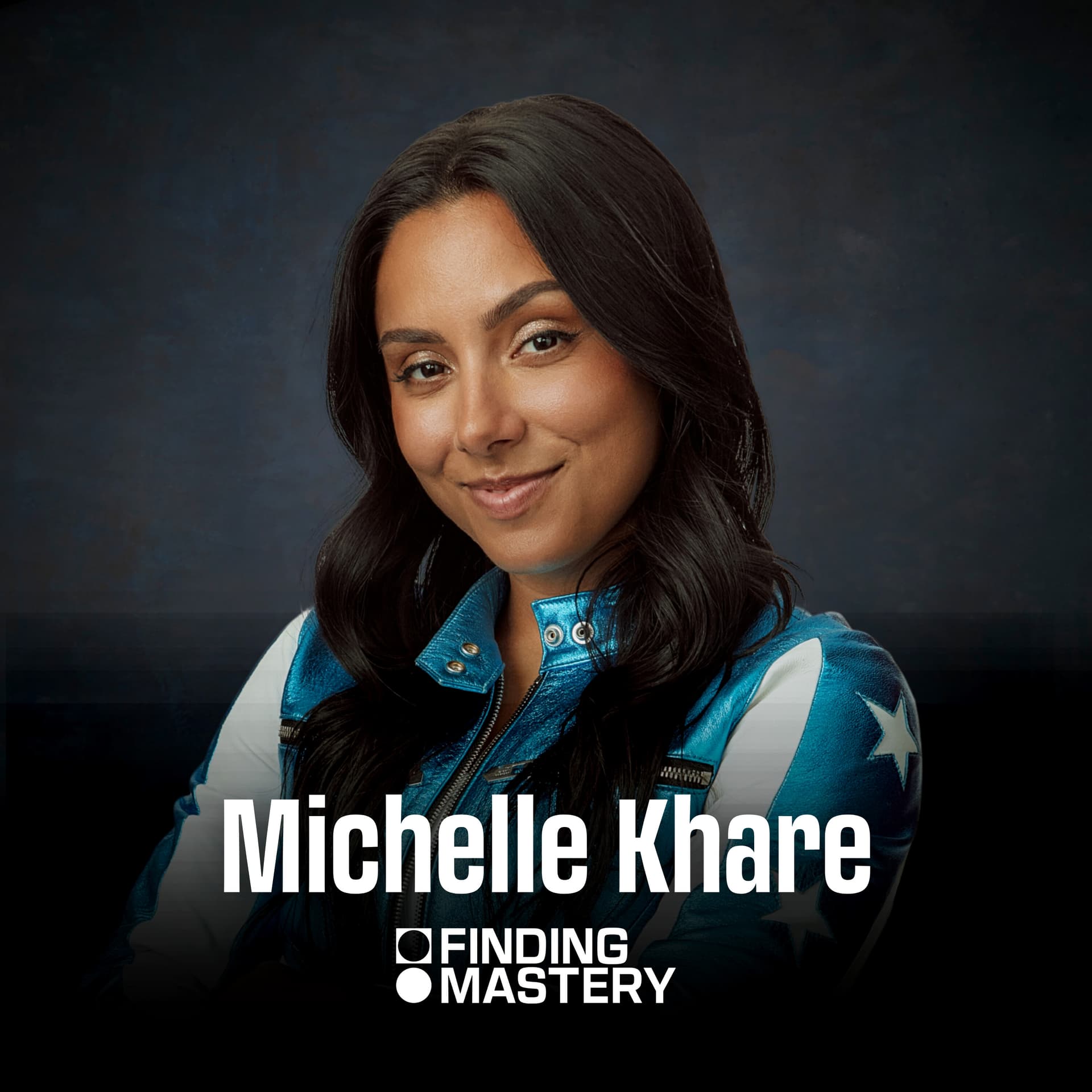
Michelle Khare is creator and host of the award-winning YouTube series Challenge Accepted. She trains with elite performers and professionals (e.g., Olympic athletes, stunt teams) and documents behind-the-scenes preparation and mental work. She previously worked in video production (including an internship at Google) and as an assistant for a director, and she was also a professional cyclist before switching to stunts.
Key claims
Fear and negative self-talk are “tools of information” for what’s missing to become brave. Psychological barriers are often more limiting than physical ones. Sustainable progress comes from willingness to fail publicly, using a “coach/mentor/cheerleader” support orbit, and switching into an ideal competitive mindset (e.g., “clap” and “let’s go”). Content success comes from iteration plus operational/logistical discipline.
Notable examples
Boxing with Olympic boxer Tony Jeffries; chess grandmaster training for a live-streamed tournament; attempting Harry Houdini’s water torture cell; becoming the second person to replicate Tom Cruise’s Mission: Impossible Rogue Nation plane stunt (FAA permissions, 50-person crew, custom scleral contacts, lens technician, bird-strike discussion). Early channel iteration included DMs to Tom Holland’s stunt double Holland Diaz to train for a week and perform Spider-Man stunts.
Written by AI. May contain mistakes. Listen to the episode to check what was said.
Chapters
Tap a time to open that second in VOMichelle's Journey and YouTube Success
0:03 to 0:58
Explore how Michelle built her series 'Challenge Accepted' and its concept.
“One bad hire, it can cost you a lot, way more than time.”
Michelle's Journey and YouTube Success
2:56 to 4:28
Explore how Michelle built her series 'Challenge Accepted' and its concept.
“What is one thing that you learned from working with Tom Cruise?”
Confronting Fears Through Stunts
4:28 to 6:13
Discover the extreme stunts Michelle undertakes to face her fears.
“circumstance where I could confront it head on.”
The Challenges of High-Stakes Stunts
6:13 to 7:45
Learn about the technical and safety challenges involved in Michelle's stunts.
“There are many that I think when you look at that stunt, you think the most difficult part is overcoming the fear.”
Balancing Creativity and Entrepreneurship
7:45 to 9:39
Michelle discusses her dual identity as a creative and an entrepreneur.
“Do you see yourself more as a creative, expressive artist or do you see yourself more as an entrepreneur that happens to be able to be an adventurer?”
The Evolution of Michelle's Career
9:39 to 11:47
Hear about Michelle's transition from a producer to a full-time YouTube creator.
“So I would work and make internet videos from nine to five.”
Trial and Error in Content Creation
11:47 to 14:00
Michelle shares how she navigated early challenges in her YouTube journey.
“Fill in the blanks on whichever part of the equation here.”
The Evolution of Challenge Accepted
14:00 to 16:21
Learn how Michelle Khare developed her YouTube channel through experimentation and audience feedback.
“And I was like, man, the only way to do this is for me to go out on my own and see what's possible.”
Sponsor: Rag & Bone
16:21 to 17:30
Discover the quality and design philosophy behind Rag & Bone's clothing line.
“Finding Mastery is brought to you by Rag & Bone.”
Sponsor: Finding Your Best Course
17:30 to 18:50
Explore a science-backed framework designed to enhance mental resilience and performance.
“Anytime you feel the pull to reset, to zoom out, to refocus and ask, am I moving toward the person I want to become?”
Show all 31 chapters
Transitioning from Cycling to Stunts
18:50 to 22:45
Michelle discusses how her cycling background helped her adapt to the challenges of performing stunts.
“But like how do you go from cycling to stunt?”
Facing Psychological Barriers in Extreme Challenges
22:45 to 28:05
Understand the emotional and psychological aspects of pushing physical limits during extreme challenges.
“You know, I've done several 20-mile runs.”
Learning Through Collaboration and Humility
28:05 to 29:59
Discover the importance of collaboration and humility in learning new skills.
“Could we do something where we exchange?”
The Role of Inner Monologue in Self-Support
30:00 to 31:54
Explore how self-talk and inner monologue influence personal challenges and bravery.
“and relatable and fun to watch is not the success at the end, but the low points throughout.”
Building a Supportive Network for Challenges
31:55 to 34:18
Learn about the crucial roles of coaches, mentors, and cheerleaders in personal growth.
“You have to have a plan and intentionality in order to feel free in the pursuit of something creative.”
Switching on Your Competitive Mindset
36:52 to 38:24
Understand the mental techniques used to activate an ideal competitive mindset.
“In cycling, I had a lot of like little phrases that I said to myself that often come back.”
Navigating Self-Doubt and Anxiety
38:25 to 42:00
Learn effective strategies for overcoming self-doubt and anxiety through community support.
“And you first have to know what it feels like.”
Navigating Self-Doubt and Identity
42:00 to 46:40
Explore how self-awareness influences personal value and authenticity.
“I am speaking with other people who have delivered those types of keynotes before.”
The Comfort and Growth Zones
46:40 to 48:20
Learn about the comfort zone and the importance of embracing discomfort for growth.
“So, but let's go back to the question, which is, how do you answer who am I?”
Facing Fears through Challenging Stunts
48:20 to 51:58
Understand the internal struggle when confronting fears through extreme challenges.
“the challenge zone, there's like a discomfort zone.”
Facing Fears through Challenging Stunts
52:00 to 53:25
Understand the internal struggle when confronting fears through extreme challenges.
“Earlier, I mentioned LinkedIn Hiring Pro, and I want to come back to something a little more personal.”
Training for the Impossible: Houdini's Challenge
54:40 to 56:00
Dive into the challenges of preparing for a complex stunt inspired by Houdini.
“You actually feel contractions and hiccups and your brain is screaming, get out of here.”
Navigating the Danger Zone
56:00 to 58:00
Explore the concept of the danger line in personal and professional challenges.
“And obviously you can't breathe underwater.”
Mastering Leadership and Craft
58:00 to 1:00:20
Understand the importance of leadership and craft in storytelling and content creation.
“And that relationship, that trust is so important.”
YouTube Growth Strategies
1:00:20 to 1:03:00
Learn about steady growth strategies for building a YouTube channel.
“And it's very different from the stereotypical expectation you have from 10 years ago.”
Monetization in YouTube
1:03:00 to 1:06:00
Discover how monetization works on YouTube and the importance of views and brand collaborations.
“but I think that that has also contributed to the brand that we've built.”
Fear and Personal Growth
1:06:00 to 1:08:20
Discuss how confronting fears can lead to personal growth and creative breakthroughs.
“We're talking about crazy emails and messages I've sent.”
Fear and Personal Growth
1:08:33 to 1:09:35
Discuss how confronting fears can lead to personal growth and creative breakthroughs.
“Nearly 95 % of us are not getting enough fiber.”
Fear and Personal Growth
1:09:58 to 1:11:12
Discuss how confronting fears can lead to personal growth and creative breakthroughs.
“Boarding flights, hopping between cities, working out of hotel lobbies and coffee shops.”
Understanding Personal Motivation and Failure
1:11:12 to 1:16:49
Michelle Khare shares her immigrant family's background and how it shapes her motivations and views on failure.
“What is your working definition of failure?”
Insightful Advice from Tom Cruise
1:16:49 to 1:17:34
Michelle discusses a memorable piece of advice she received from Tom Cruise about being competent.
“Thank you to everyone who listened all the way to the end.”
Transcript
Automatic transcript. May contain errors.0:00Dr. Michael Gervais:Finding Mastery is brought to you by LinkedIn. We use LinkedIn Hiring Pro here at Finding Mastery because we know one great hire can change everything. One bad hire, it can cost you a lot, way more than time. It can cost you momentum and culture and real dollars. And that's why how you hire matters just as much as who you hire. And it's why I've become a big believer in the power of LinkedIn Hiring Pro. Here's what I appreciate about it. When you're running lean, you don't have hours to sift through a pile of resumes hoping to find the right person somewhere in the stack. Hiring Pro is built exactly for that reality.
0:32Dr. Michael Gervais:You describe the role and it screens candidates for you, surfacing the people who are a best fit so that you can spend your time and conversations with those folks rather than in the weeds of the applications. And the results back it up. Those hiring with LinkedIn are 24 % less likely to need to reopen a role within 12 months compared to the leading competitor. So join 2.7 million small businesses already using LinkedIn to hire. Host your job for free at linkedin.com slash mastery. Terms and conditions apply. Again, that's linkedin.com slash mastery to post your job for free.
1:29Kind of got to this point where I felt like I had to choose between one or the other, and I didn't want to. So blending those two things together is where YouTube came about.
1:37Dr. Michael Gervais:Welcome back, or welcome to the Finding Mastery Podcast, where we dive into the minds of the world's greatest thinkers and doers. I am your host, Dr. Michael Gervais. A high-performance psychologist named Michael Gervais. Who Pete Carroll brought in to work with the Seahawks. Famous for his work with Felix Baumgartner when he jumped out of space in the Stratos Project. Olympic athletes depend on something more than just training and talent. They have to stay mentally tough. Today's guest is Michelle Kare, creator and host of Challenge Accepted, the award-winning YouTube series where she trains with elite performers and athletes and professionals to take on some of the most demanding physical and mental challenges.
2:13Dr. Michael Gervais:Michelle doesn't just document fear. She studies it. She prepares for it. And then she meets it head on. The limiting beliefs and the negative self-talk, the anxiety, those are all tools of information for what you are missing in order to be brave. We explore how Michelle has built a serious, sustainable business in the YouTube creator space without burning out. I really want to upend the understanding of what it means to make content online and challenge what that means. When they hear online content creator, I want them to think of the cool and incredible things that not only our team, but many teams on YouTube are doing.
2:49And it's very different from the stereotypical expectation you have from 10 years ago.
2:54Dr. Michael Gervais:This is the hard question. Are you ready? Challenge accepted. What is one thing that you learned from working with Tom Cruise? At the end of our conversation, he shook my hand, looked me in the eyes and said... So with that, let's jump into this week's conversation with Michelle Kari.
3:15Dr. Michael Gervais:Michelle. Yes. Yes. It is on. What a fun jacket. Thank you. Yeah. Thank you so much. I mean, I wanted to give the visual watchers something interesting to look at. So if you're listening on Spotify only, be sure to turn the video on, right? Yeah, that's great. Okay. For folks that might not have appreciated what you've done to date, how do you describe in your own words what you do and how you're going about doing it? So can you just put in your own words like what you do? I host a show called Challenge Accepted, and it's all about me trying the world's toughest stunts and professions, which range from attending Secret Service Academy to mastering Harry Houdini's deadliest magic trick to most recently attempting Tom Cruise's stunt from Rogue Nation.
4:04And throughout the process, we make these in-depth documentaries about everything behind the scenes that happens. My personal journey, the wins, the failures, and the successes.
4:16Dr. Michael Gervais:Well done. Can you give me an example of some of the stunts that you're doing and maybe paint a little picture for each one of them. Yeah, absolutely. So it all started by me writing all of my fears on a whiteboard and then connecting each fear to a potentially extreme circumstance where I could confront it head on. So a couple examples to confront my fear of confrontation. I trained with an Olympic boxer for several months and then boxed in a sanctioned in front of 15 ,000 people to confront my fear of looking unintelligent. I studied with a chess grandmaster for 10 months to participate in a tournament live stream to 100 ,000 people.
4:57I have also attempted Harry Houdini's deadliest magic trick. And most recently, I became the second person in the world to replicate Tom Cruise's stunt from Mission Impossible Rogue Nation, where if you're unfamiliar, he is hanging off the side of a military aircraft as it's taking off. No goggles, no helmet, no parachute.
5:17Dr. Michael Gervais:What is the toughest stunt to date and what makes it so? That's actually a surprisingly difficult question to answer because in some ways, going to clowning school was very, very challenging because for that episode, I painted my face like a clown, studied with clowns for a month, and then performed in front of an audience. So that's one example of difficulty. I mean, the chess example is a lot of studying, but I think the project I'm most proud of is definitely our plane stunt that just came out. For that project, we spent months getting permission from the FAA, from a private plane owner. We worked with the Avatar stunt team to rig me safely to the side of this aircraft.
6:00It was a crew of 50 people on the day. I'm exceptionally proud of the way that that edit came together and turned out.
6:07Dr. Michael Gervais:Was that a consequential environment? Of course, things could go wrong. Maybe drill into a consequence that we might not understand. There are many that I think when you look at that stunt, you think the most difficult part is overcoming the fear. And certainly when I was up there looking down at the earth, 2 ,000 feet below me, I was like, this is nuts. But there were many intricate details that we had to consider besides wind, weather, et cetera. One example is because you're not wearing goggles to perform the stunt. I had to get custom contacts fabricated, scleral contact lenses that I didn't really know this was a thing before I did this.
6:49And we had to have a dedicated person on set called a lens technician. And their entire job was to insert and remove these lenses before and after any rehearsals or the stunt itself. And this is to mitigate for any dust or debris in the air because you have no other eye protection.
7:06Dr. Michael Gervais:Yeah. So if you're traveling at 500 miles an hour and all of that wind drying out your eye or some sort of small debris gets in, you know, it's a, it's, we're talking about your eyesight. Yeah. Also bird strikes. Bird strikes? Bird strikes. But that's more than an eye. Yeah. You can't prepare or really do anything about bird strikes. You accept if you're out in the sky, there are birds too. luckily no bird strikes. Yeah, I know. Those are dangerous. But that was a conversation we had. And at 2 ,000 feet, right? It's not like you're at 13 ,000 where there's less birds. Correct. There are birds in the air.
7:36Bird strikes have taken down full aircraft. Yeah, right.
7:39Dr. Michael Gervais:They get an engine and yeah, for sure. I just don't like birds. And there's a creative venture and there is an absolute revenue generating venture. So you've got both. Do you see yourself more as a creative, expressive artist or do you see yourself more as an entrepreneur that happens to be able to be an adventurer? Wow. I guess I see myself as a little bit of both, which might be a cop-out of an answer. No, I don't think so. It's not a fair question. But because the answer is yes and both. Which side do you like more? I'll be honest. I think I lean more on the spreadsheet operational side of things.
8:18And that's because when I came into YouTube, I didn't go to film school. I was just a fan of television and film and storytelling through video media, I would say. And so to collaborate with other people, I didn't necessarily have the skill set of camera or sound, which I had to learn, of course. But in the beginning, I was like, you know what? I can organize a shoot schedule and keep people on task on set. And so everyone started leaning on me. And, you know, in the early days of my collaboration to do that for their own sets. And that's really how I learned was I brought skills from other jobs I had worked.
8:55Like I interned at Google and worked as an assistant for a director. And those logistical skill sets allowed me to help other creative people do their job best. Now I would absolutely say like, yes, I'm very creatively involved. I consider the physical performance of what I'm doing just as, you know, some of your clients who our Olympians go out and perform on the court. That is how I feel about set is like when I'm hosting, when I'm training, that is the physical art form that I'm doing and learning and showing up for daily. And marrying that with the logistical side, I think is what allows us to do these really grand adventures.
9:37Dr. Michael Gervais:I think you're right. So where did the physical nature, the artistic, creative, physical nature of your life design. Where did that come from? That part of my life design came from a poorly designed part of my life design in my prior life, where I was working a day job as a video producer for another YouTube channel, and then moonlighting as a professional cyclist. So I would work and make internet videos from nine to five. And then at five o 'clock, I would leave and train until like nine or 10 and do that every day. And then on the weekends, I would get a phone call about, hey, we're going to a race in Vancouver.
10:14See you there. And then I would drive to LAX, race at BC Super Week, come back and do it all over again.
10:23Dr. Michael Gervais:Was it oval or road? I did Criterium. What is that? Criterium is kind of a mix between the two, actually. So you're referring to track cycling versus like long distance road. I did do like long distance road, but my specialty was Criterium, which is you race on a road bike and it's like a carve out of a section of downtown where you do laps on a changing course. Cool. Yeah. So kind of like a mix of the two. Yeah. Okay, good. So you're hinting at that that didn't quite work out. Well, there's a point where it stops. You get diminishing returns. And I mean, as you know, you know, with the work that you do, I was sort of hitting this ceiling within my sport transparently.
11:06And to be very blunt, there were not many resources. financially or otherwise in women's road cycling at that time. And I think there's still a lot of work to be done. But I kind of got to this point where I couldn't keep doing both. And I felt like I had to choose between one or the other, and I didn't want to. So blending those two things together is where Challenge Accepted came about.
11:30Dr. Michael Gervais:That's it. I mean, that to me probably is your crown jewel. Thank you. You've got two things that are seemingly divergent, seemingly not lined up. And then you kind of push the chair back from the table. You're like, wait, hold on. I'm really good at this thing, but it's not working. I'm really good at this thing. It's not really working either. Fill in the blanks on whichever part of the equation here. How do I do both? Right. Is that how it went? Pretty much. And it was kind of like this moment. I mean, we all hear you got to be unique and do something that's that only you can do. But I think that ironically, rather than coming up with something vastly new, it was about marrying various subsets of my life that I was pretty good at and bringing them together in one.
12:17Like you said, like two unexpected things coming together to create something new.
12:22Dr. Michael Gervais:Do you work that out in your head? Do you write it or do you talk it out? Go back to the origin story of like, hey, you know, I've got this idea. And did you work it out with somebody else? Did you write it down or did you just think and use your imagination? It was a lot of trial and error in doing in the process. So if you go back to the early days of my channel, which I don't necessarily recommend, please don't look back at the early stuff. Insert real quickly before you finish. What's the name of the channel? So my channel is my name, Michelle Kare. K-H-A-R-E. K-H-A-R-E, yes. And if you go back at the early phase of my channel, so when I decided to leave my job, I did Tim Ferriss' fear-setting exercise and I made a plan.
13:05I said, you know, I'm going to save for X amount of months. I'm going to move into a studio apartment with a roommate and really like live as if I'm failing to get comfortable with that difference in lifestyle and grow a little bit of a savings. And then on the day I quit, I have a plan ready to go.
13:23Dr. Michael Gervais:Okay, go before that though. Before that. When you're kind of in that mini crisis, crisis mode where you're like, these two paths that I'm doing, I'm spread too thin. Neither are working the way I hope they would. I'm not going to edit for this other channel. I want to stop that. And I'm not going to ride my bike. I want to stop that. Yeah. I'm most interested in as a mechanism because you've done it really well. And it's more simple than it sounds like I'm asking. But do you use your imagination to see a compelling future? Do you talk it out with people to get more clear? Or do you write it down?
13:58I felt like the decision to do that was actually because I felt like there was no other option for me. I felt like I had hit ceilings in both. And I was like, man, the only way to do this is for me to go out on my own and see what's possible.
14:12Dr. Michael Gervais:But what is possible at that point? The combining of the two? The potential of the combining of the two. I knew at that point, you know, I think I need to own the work that I'm creating. I wanted to have ownership of my own IP. I wanted to have my own channel. I wanted to take the learnings I had from both things and experiment. But as I was saying, like, if you go back those early videos, it was kind of all over the place. So it was a little bit of doing before knowing. And it was several months of throwing things at the wall before I really landed on Challenge Accepted with the help of the audience helping me arrive there.
14:47It was not a perfect like pilot before it's filmed. It was not a script. It was trying many different things. And then ultimately I had this system of, I would do three videos a month that were cheaper and that I thought would perform really well. And then I would do one video for myself that I was like, this is just a cool passion project and I don't see anybody else doing this.
15:10Dr. Michael Gervais:For example? For example, going back to crazy messages I've sent, I sent a DM to Holland Diaz, who was Tom Holland's stunt double on the Spider-Man films. And I said, hey, would you train me for a week? I would love to make a video together. So he trained me for a week. And then he said yes. And we very gratefully thank you, Holland. And then at the end of that, I actually performed some of the Spider-Man stunts. So that was kind of the early beginnings. Yeah. Yes. Yeah. And those early videos, they lack, of course, the cinematography and sophistication that we have now. But you can see the bones of that early idea.
15:49But it was deep iteration. It was deep iteration and learning as I was going.
15:54Dr. Michael Gervais:And stunts are different than cycling. So bridge that gap for me. They're both physical. So how do you go from cycling to, yeah, why don't I do stunts? Why don't I do these things that are really difficult, maybe dangerous? I'm not sure how dangerous some of the stunts are. They look dangerous, but sometimes they're so well controlled that the margin for error is radically reduced. But when error happens, it's dramatic. We can get into that in a minute. Finding Mastery is brought to you by Rag & Bone. I've been a big fan of Rag & Bone for a number of years. I just love what they do. It's a go-to for me when I'm choosing clothes.
16:28Dr. Michael Gervais:I've been wearing their infused denim for a while now. They've done just a really nice job with this product. For me, I am really intentional about what I invest in. In clothing, it's no different. I want things that are well-made, that stand the test of time, that don't distract me, that support my focus on the things that matter most. And that's exactly why these deliver. And they look sharp, full stop. They've spent 20 years obsessed with getting this product right. And that kind of long-term commitment to craft, that's something we talk a lot about here at Finding Mastery. Quality compounds.
16:57Dr. Michael Gervais:The right inputs may consistently over time show up in everything. And you can feel that the moment you put these on. If you're ready to upgrade your denim with something that's genuinely built to last, it's time to upgrade your denim with Rag and Bone. For a limited time, our listeners get 20 % off their entire order with the code FINDINGMASTERY at rag-bone.com. That's 20 % off at rag-bone.com with the promo code FINDINGMASTERY. And when they ask you where you heard about them, please support our community and this show and let them know that we sent you. Finding Mastery is brought to you by our flagship mindset training course, Finding Your Best.
17:34Dr. Michael Gervais:Anytime you feel the pull to reset, to zoom out, to refocus and ask, am I moving toward the person I want to become? It helps to remember this. Lasting change comes from training. Not resolutions, not short-term sprints, but deliberate practice of the skills that shape how we show up. Work, in relationships, and in the moments of great intensity as well. That's what Finding Your Best is all about. It's a science-backed framework for training your mind. And it's the same set of tools that we've taught to Olympic athletes, top executives, elite military teams, and artists at the peak of their craft.
18:04Dr. Michael Gervais:In this course, you'll learn the foundational psychological skills to be your very best. Full stop. And the best part is you can start anytime. Right now, we're running a limited time offer on finding your best. Simply head to findingmastery.com slash course and use the code RENEW100 to get$100 off your registration. If you've been waiting for the right moment, this is a good one now to lean into. Spring and summer, they are powerful seasons of momentum. It's a great natural time to step into growth, to refocus, to recommit to who you want to become. And this discount will not be around for long.
18:38Dr. Michael Gervais:So go to findingmastery.com slash course code renew100 for$100 off today because your future is not shaped by what you intend. It's shaped by what you train. But like how do you go from cycling to stunt? Again, very slowly. Like if you look at the Spider-Man episode, it's like really basic stuff. A lot of the things I was doing were just slow and steady. And I would go to these gyms, like if you like joining all movement or Tempest in the Valley where all these like Red Bull parkour athletes are training. And I just watch them and try. And I was terrible in the beginning. In fact, I was like, gosh, dang it.
Read the full transcript
19:16Why didn't I choose like Taekwondo instead of cycling? Because that would translate way more to this. But what I did have an edge in was because of the cardiovascular background, I was able to try and fail a ton. So I might not have the prettiest back handspring, but man, I could sit there for three hours and just keep going and going and going past the class time, past even when other people were training. And so though the repetitive motion of powering a bike has very little translation, it's definitely given me the understanding of sports mindset, how to prepare for training, recovery, operating within a team, all of those things that you know very intimately.
20:00Right now, I'm training for this thing called the Great World Race, where I am going to, in six weeks, run seven marathons on all seven continents in seven consecutive days. Yeah.
20:16Dr. Michael Gervais:Yeah. So your motor is going to pay dividends there. Hopefully. Now, it's been a while since I've been a professional cyclist. So seven continents. Yeah. North America starting or ending? Antarctica is the first one. Antarctica, of course. And then, so you'll run a marathon. That's about how many hours for you? The fastest marathon I've run, which isn't anything crazy was three 30. But I think for this, I'm probably going to end up in like, like in Antarctica. It'll be probably over five hours potentially. Yeah. So you wake up, run a marathon, get on plane, get on a plane. So sleep, lots of recovery kind of mechanisms optimized throughout it.
20:52Dr. Michael Gervais:Sleep as well as you can. And then you punch to where? Africa, South Africa. Yeah. So that's, that makes sense. Yeah. And then morning run again, run, get on plane, go to Australia. So the whole, this whole thing will be marked by how well you recover. Exactly. Yeah. Right. Exactly. Yeah. And how well you can manage the psychological stress of it. Well, I think you'll do fine on the psychological stress. I I think managing the physiological toll on resources does create a whole different thing. Yeah. When humans are at their edge, it's usually not a physical edge. It's usually emotional. Most people that I know do not run up against their physical potential.
21:40Dr. Michael Gervais:They run up against their emotional potential. So the barrier is psychological more than it is anything else. And so when resources are thin, like if you're a highly anxious person, you're still trying to sort out some early childhood traumas that took place or adulthood traumas that took place. And, you know, you're just kind of in that fight or flight mode or you're just depressed or you got stuff going on. And look, most of us do. The numbers are staggering of like who's carrying pretty heavy bags, if you will. It's not that they don't have the resources. they're just thin because they're tired from like the day-to-day go.
22:18Dr. Michael Gervais:So you're going to run right up against that edge. And it will be really important that you extend that edge as much as you possibly can with all the recovery practices. And then it'll be really important that when you are in your edge, that you've got some tools to be able to manage those moments as efficiently, as compassionately, and as togetherness as you possibly can. Exactly. Yeah. Relational is the piece there. So, okay, great. So seven in seven days. Yeah. I'm excited to watch that. When does that kind of happen? That will happen in November. Are you in shape for that right now? I mean, I've been training my ass off.
22:52Yeah. Yeah.
22:53Dr. Michael Gervais:Hopefully. Yeah, I did. I did. You know, I've done several 20-mile runs. Did one on Friday. Then hiked three hours Saturday. I have a 20-mile hour tomorrow. And you've got a high volume. Do you have a coach that's helping you with that? I'm working with Coach Gareth Thomas. He's worked with a ton of professional triathletes, cyclists, runners. Okay, so here's your crown jewel again, is that you pull your assets that you have and you bring them to this whatever new venture is. So it's showing up again, and it shows up in even a small way when you went into a climbing gym or a parkour gym and you're like, oh goodness, I'm not very good.
23:34Dr. Michael Gervais:But you work it out. you bring one of your assets forward. You bring one of your strengths forward, but you don't leave. You don't not go. That's where, again, there's like edges that happen for all of us is that we make up stories. Maybe that's not a good fit for me. Wow, this is really uncomfortable. Oh my God, what are they thinking of me? Fill in the blanks. Can you go back to the first time you were in one of those gyms and you're like a fish out of water? Yeah. Yeah. How do you work with your thoughts and your emotions in those moments? In the beginning, something I learned very quickly with Challenge Accepted is you go much further in general with any goal when you have, like, more willingness to fail in front of other people.
24:25Maybe that's a sweeping generalization. Maybe that's super obvious to people. But it's in moments like that, going back to my first time going to the parkour gym, I'm thinking about, you know, when I went with a few friends who are professional stunt people who are world champion martial artists and watching them, it's about having immense patience in that pursuit. Like I would just sit there. I would repeat the motion over and over again. And I have to think about like, what are the strategic advantages that I have in general that may not even touch parkour stunts type stuff? And yes, as you mentioned, one of those for me was the cardiovascular background I had to just repeat things over and over and over again.
25:11And that helped me learn faster. Another thing I had was just from making videos, the ability to know how to film something and watch tape back and understand it and study it.
25:23Dr. Michael Gervais:Wait, before you go any further, you said, what are my strategic what? Like, what are the strategic advantages that I have that may have nothing to do with this? That's how I'm going to capture the crown jewel. That's exactly it. What are my strategic advantages? Like, how can I take the resources that I have, external and internal, and pour them into something that is really interesting to me? I don't know if it's going to work. I don't know how it's going to go, but how can I pull the best of my resources into that thing? All right. Sounds super simple, but I think this is what you probably are exceptional at.
25:57But I want to make this even more simple.
25:59Dr. Michael Gervais:Bring me into when you walked into that gym. Okay. Okay. Like go as far as like what you were wearing and what the temperature was, like as much as you possibly can invite that part of the story forward so that I can get a sense of how you navigated your psychology when you were at your edge. Okay. And like, what did you do to do that? Because that's no different than somebody that's going to go walk up five steps and do a keynote. The five steps to get to the platform. It's no different than somebody that is going to pitch a billion dollar idea in front of a bunch of people that don't think people like me can pull off things like that.
26:34Dr. Michael Gervais:Or walking up to a beautiful person across the hallway that you're super attracted to that you want to have a conversation with. you're like, it's all the same stuff. Yes. Yeah. Business ideas, relationships, whatever. So I would love if you could tell that story. So the first time I'm walking into Tempest to train with Hollywood stunt people, I show up and I'm wearing my workout outfit. I walk in the room. You can just feel the scent of like the combination of, You know how gymnastics places have a specific smell from the spongy square? The chalk, the sweat, everything. And I'm looking out at this gym and just seeing the best professionals in the world do what they do.
27:22Roundup, back handspring, back tuck, like, you know, all these, you know, swinging swords and nunchucks and performing their world champion martial arts forms. And I'm thinking, oh, my God, what have I gotten myself into? This is so different from my world of cycling, which is show up on the group ride and hang on. You know, cycling so much. Of course, there's strategy. Of course, there's art to it. But a lot of it is, are you fit enough? And can you muscle through the pain? And I remember going to a lot of these classes and just making a total fool of myself. I mean, by the way, in LA, if you go to a beginner stunt class, be warned, it might not be beginner.
28:04they would be listed as like beginner intermediate and like people are like everyone's got a double backflip people are like yeah i like i doubled for scarlett johansson i doubled for this person this person i'm just like here hanging out today and then they get up and you know do a front flip and whip out a sword it's crazy but i i would just do something and and i would film myself i would learn from it i would even pull people aside and say hey this sounds crazy i know i am so far behind you. Could we do something where we exchange? Maybe you teach me a little bit of martial arts for an hour and I can teach you about my budgeting spreadsheet or my, or like how I made this Instagram video or how I run my YouTube channel.
28:50And we would do info exchanges. And this was back when I didn't have like hard resources to offer. And some of those people are still stunt people as part of our projects today and some of my closest friends. And what it took was me extending myself and just having a little bit of fun to learn. I think people, teachers, coaches, love coaching people who are just excited to be there and to learn. And sometimes they enjoy teaching those people far more than the 1%, you know, like super successful athlete, because that's a lot to deal with. And so I find a lot of times, honestly, the coaches we work with are like, you're just fun to be around and you're game for anything.
29:36And I get that. Like, you're just game for anything. And I think there has to be humility and willing to fall flat on your face, which is a very easy thing for me to say. But a painful thing that I deal with still in our videos today is like, gosh, I really messed that up. And we filmed it. And that has to go in the video because that is where the story is made. That is what makes a journey interesting and relatable and fun to watch is not the success at the end, but the low points throughout.
30:09Dr. Michael Gervais:Can I ask you a two-part question that's part of it's going to be hard? Okay. You can decline. Okay. Or accept the challenge. Challenge accepted. Let's go. Of course. What's part one? Yeah, part one. What do you say to yourself to build yourself? like to back yourself, to have your own back? What does it materially sound like in your own mind when you are supporting yourself? In a hard moment? Yeah, I mean, just in general. In general, my inner monologue. That's really interesting. I'll be completely honest. I do a lot of daring things, but I would not consider myself an exceptionally brave person.
30:50In fact, I consider myself quite the opposite. it. I am, I'm anxious. I mean, the most daring thing that I did before going to college was using Gil Sands font instead of Times New Roman for my backboard at the International Science and Engineering Fair. Like that was, I was like, man, this is going to be so cool. And I'll say this, it worked and we went to international. So there's that. It was a pretty baller presentation on gel electrophoresis and prostate cancer. So talk to me about that after. But like that was kind of the edge of my limitation. My limitation before challenge accepted was be brave and bold within the confines of what's supposed to work in life.
31:31It was never, it was like, go as far as you can studying for the SATs to aim for that perfect score, to get into a good school, to get the job, whatever. But it was never be bold in your own creative way. But I think that many stories reject that. It's like, if you want to be cool and brave, you got to reject everything about rigidity. And I would actually argue the opposite. You have to have a plan and intentionality in order to feel free in the pursuit of something creative. You can't just do it blindly.
32:05Dr. Michael Gervais:You know, it's really cool about, you haven't answered the question, but it's a really good answer. It's a really good answer. No, it's like, there's brilliance. Oh, what do I tell myself? Oh, what do I tell myself? Wait, wait, wait, I want to just. So you want my inner mall up? I do, yeah. My inner monologue is like, oh, no. Oh, no. No, this is when you back yourself. Yeah, when I back myself. Like, how do you support yourself? Take care of yourself when? Yeah. Like, what do you say to yourself to build you? I'll tell you exactly what happens. Turn on Beyonce. That is the inner monologue. Keep going.
32:35Turn on Beyonce. Any of the hits. Love Cowboy Carter. I think that part of what I do for Challenge Accepted is it's obviously not a solo pursuit. And to me, there are a few key roles that I need to have in place for me to feel comfortable moving forward with a crazy challenge. So this contributes to the inner monologue. The first is finding the best coach in the world to coach me for whatever I'm going to do. So like for our boxing episode, I knew I wanted to work with Tony Jeffries, bronze Olympic medalist. I just knew it. I needed to have the best coach in the world. The second is someone in your corner who is a mentor.
33:15So this is somebody who is not your coach, but who has done the thing you're looking to do. And I think it's important to distinguish these two roles. A coach is someone who has succeeded in coaching someone to greatness. A mentor is someone who's actually accomplished that. Now, the greatest mentors in the world might not be great coaches and vice versa. But then the third person you have to have in your corner is a cheerleader. And this is, I think, a superpower. This is someone who cares about you and your success, but has no real investment in the final outcome of the thing. They're just happy to be there for you.
33:52And so this could be a best friend, a family member. For me, I have a few. It's my best friend, Olivia, and my husband, Garrett. and they're the people who are going to put you first and just be excited like, hey, that was so crazy you even tried to do that. And they'll be happy for you no matter the result. But I think it's important to have somebody like that so that you can feel support that is detached from the accomplishment of the finish line. So I would say the orbit of those three entities around me really contributes to that inner monologue. And I learned this a lot through trial and error throughout Challenge Accepted.
34:26like, oh, I really want to work with this person. Like on a resume, they're the best in the world. But in person, maybe we didn't jive or their way of coaching wasn't as specific as what I needed. And so for me, the casting, if you will, of those three roles is crucial to create a safe training environment for me to fail comfortably and a place where I can have good headspace. So when I back myself, Oftentimes, it's the things I've heard those three people say to me. It's a reflection of them. It's nothing creative I've come up with. Nobody wants to hear my inner monologue. But it's...
35:04Dr. Michael Gervais:Actually. Huh? Actually. Probably not. I mean... No, I actually really want to hear it. Body Mastery is brought to you by Fatty15. Did you know that Navy dolphins helped unlock a secret to healthy aging? It's a wild story. And it's the foundation for a product that I've come to really love. Fatty15. Fatty15 is built around C15. the first essential fatty acid discovered in over 90 years. And it was discovered by Dr. Stephanie Van Watson. She's the co-founder of Fatty15. While she was working with the U.S. Navy, and based on over 100 studies, we now know that C15 strengthens our cells and is foundational for healthy aging at the cellular level.
35:43Dr. Michael Gervais:Stephanie's been on the podcast, and it was one of my favorite conversations. She's amazing. And what her and her team are building is something I'm really excited about. Head to fatty15.com slash finding mastery and use the code FINDINGMASTERY for an additional 15 % off your 90-day starter kit. Again, that's FATTY, F-A-T-T-Y, 15.com slash FINDINGMASTERY, and the code is FINDINGMASTERY. I want to take a second here to tell you about a morning routine that I've been using for years. For me, it's a great way to switch on my mind, to ready myself to take on the day. So before I check my phone, my emails, market updates, or text threads, I choose how to start my morning.
36:22Dr. Michael Gervais:That's always in my control. That's always in your control too. This is the same morning mindset routine that some of the world's top performers across sport, business, and the arts are using. The best part, it only takes about 90 seconds to do. So just head over to findingmastery.com slash morning to download the audio guide for free. Again, head to findingmastery.com slash morning to get your morning mindset routine. You really want to hear it. Like concretely, what do you say? Concretely, something very simple. In cycling, I had a lot of like little phrases that I said to myself that often come back.
37:01Like, especially at the beginning of cycling, I got dropped a lot, which for those of you who haven't cycled before, that means you get left behind. You get left behind on the group ride because I wasn't strong enough. And so I just had this little mantra of like, all right, you might drop me, but you can't stop me. You might drop me, but you can't stop me. And like that was reclaiming. Okay, I got left behind by the group. I am out here in Timbuktu by myself. And I was left in some crazy places. But I can keep going forward. I can like I have power over my legs to keep moving forward. So I have a little a few little mantras like that.
37:38But I think a really important one for me is like right before I'm about to do something crazy. I will like clap my hand. Is this crazy? I'll just go like, let's go. And I'm like, from then on, it's game face. And you can actually see, it's very bizarre for me to watch, but there's a physical change in my face when I'm in a challenge. You can see that very clearly like in the boxing challenge. I do not look like me. When I'm on the side of the plane getting ready for that, I do not look like civilian me. And that's just because I have to have so much mental focus to remain in that headspace and not allow any limiting beliefs, negativity.
38:24Yeah.
38:24Dr. Michael Gervais:So you are describing the process of switching on your ideal competitive mindset. Yes. And you first have to know what it feels like. You have to be able to describe it in some way. The words will always fall short. But the exercise of like, what am I like at my best is a worthwhile internal or shared process. Like when I'm at my best, it's like this, try to find the words, but there's a feeling that you're looking for. And then what are the one, two, three, maybe five things that you do to switch that thing on? So the clap and the let's go, that's kind of the final or maybe the only that you do.
39:02Dr. Michael Gervais:And then it's, you just said, it's like locking in to push out anything that's not useful. And I am switching on like Kobe talked about, like mama mentality. You listen to the greats and they have a way that they talk about activating their ICM, their ideal competitive mindset. Okay. ICM. You have it. But I love the formula. Again, I asked you a simple question and you appropriately created a system to get to the clarity, which is like, look, I've got three people, coach, mentor, and cheerleader. and when I'm at my best, I'm channeling the best way that they speak to me and I'm repeating it. And like if a coach one day said to me, like, you're a fucking rock star.
39:46Dr. Michael Gervais:Like I might say to myself, I'm a fucking rock star. Yeah. Like, right. So that's okay. Now let's go, this is the hard question. Oh, that wasn't the hard question. Okay, ready. Yeah, are you ready? Challenge accepted. Okay, so I think the harder question is how do you speak to yourself when you're really not helping yourself? Oh. This is the part of you that puts you on the train of thought for anxiousness, doubt, self-critique. Like literally, what are you saying to yourself if you don't – and you can say no. I don't want to go there. Oh, we're going there. We're going there. My inner monologue when I am in the fear mindset, when I am anxious, uncomfortable, I experienced a little bit of this just this weekend.
40:32So I for the first time am going to be delivering a ted talk Next month, which is really cool really exciting, but also really intimidating and I have to do a practice run of it this week And I was feeling Really behind so a lot of you know, the general limiting beliefs that come up are you know, i'm not a I'm, not a prolific new york times best-selling author. Who am I to be? Writing a keynote who am I to to draw the spotlight onto myself? I don't, you know, have an advanced degree to assess this on a scientific level. And I genuinely think that the best way for me to get out of that is to move externally.
41:13So I do things that bring me back to who I am. For me, it means, you know, going like I was like, all right, it's time. I got to go do my 20 mile run. I need to just get out and move my body and and provide value to myself in other ways. and then also reaching out to other people in my community, that coach, mentor, cheerleader role. I have that for whatever challenge I'm doing. Then I also have that in my business. So I work with a CEO coach. I speak a lot to other content creators who are further along in their entrepreneurial journey than me.
41:47Dr. Michael Gervais:Those are your mentors. Yeah, those are the mentors. And then the cheerleader role for that is many different people, including our audience. But I try to create that little orbit in anything that I'm doing. So I even have that for the TED Talk. I'm working with a speakers coach. I am speaking with other people who have delivered those types of keynotes before. And again, use the same cheerleader squad as usual. But I think I don't really have a magical solution for getting out of that headspace by myself. I think to get out of my head, I genuinely have to get out of my head and go external. I think that you're describing a brilliant strategy, which is you've got a community that you're relying on.
42:26Dr. Michael Gervais:This game that I'm talking about here, about understanding how you're speaking to yourself, begins with awareness. So you first have to be aware of what am I saying? And is this thought train working or not really? And then if it's not working, how do I move from, I don't know, the L train to the M train? How do I move from trains? And it takes time to practice it. and over time, I think it would be a next step for you to not rely on what they would say, but like, how does it work for me? And I think your answer was, it's already been shared, which is like, I have to return back to myself. And the more clear we are on our inherent value, as opposed to our performative value, the more clear we are about the first principles that we're working from, the values we're working from, the more clear we are that the purpose that I'm doing all of this for is in a noble cause.
43:23Dr. Michael Gervais:And like, I don't, there's no reason that I would expect that I need to be perfect. I need to be committed. And so if you can come from a handful of first principles, like I'm talking about right now, it gets a little bit easier to navigate that messy edge where you're like, oh my God, who am I? And I love the framing. Who am I to? Who am I to? Who am I to? And then how do you answer that? Just you and me right now. How do you answer that question. Who am I to be able to do a keynote? Who am I to get on the side of a plane that Tom Cruise is heralded? Who am I to create a new model? And my old model was that I need to be bold within the accepted confines of the path.
44:03Dr. Michael Gervais:And the new model is to break the mold and to be creative in whatever I can see, dream, and feel. And so answer it that way, maybe. Who Who are you to be able to break that foundational model in your early childhood to now? Well, I would be honest in saying that part of me feels exactly like I just reflect the question back. Okay. Yeah. Who am I to do that? But I also think that if not me, then whom? I also think. Did you add an M at the end of that? Yeah. Whom? You did. uh why'd you why'd you say whom if isn't that like grammatically correct yeah but you most people would not say that is it well okay then who yeah yeah but but that's an interesting choice too like okay it's not lost on me i'm looking for the right moment to introduce it like you've been on this path of excellence or the path of mastery for a long time and you went to one of the top five universities on the planet, Dartmouth.
45:09Dr. Michael Gervais:Your early model was to be bold inside of the confines and you got on the high performance youth treadmill. There's - I really did. Yeah. There's actually not one labeled that, but it is that high performance treadmill that I'm going to do four APs. I'm going to do this club and that club and this community service, and I'm going to get a tutor for this, that, and the other, and I'm going to get a 1580 on my SAT. I don't, you don't have to say your score, but something elevated. And I'm going to have a 4.6 and I'm going to be the captain of this, that, and the other. And then when you do that, it sounds exhausting saying it, you know, you get into the top 25 schools on the planet and that's not for everybody.
45:44You also have to be really pretty smart too, which you know you are. A little crazy, maybe.
45:50Dr. Michael Gervais:But it's the craziness that you've embraced. Yeah. You are unreasonable. Thank you. I think it's the highest compliment. Yeah. You are unreasonable with what most people would think is possible. And I think that unreasonable standard is something you had from early. You probably learned it from a family of origins kind of arc. And then you're bringing that unreasonableness into your second act, maybe third act. It's awesome. I hope you never lose the unreasonableness and create more aperture, open the aperture from the confines of the model to like something that has edges that are not even closely to be defined at this point.
46:29Yeah.
46:30Dr. Michael Gervais:Yeah. So I think I just got on a soapbox. What do you think? I enjoyed listening to it. I love listening to the wisdom you have to share. Okay. So, but let's go back to the question, which is, how do you answer who am I? Who are you to be able to push the edges? And I'd love to know how you answer that. Like you mentioned, I think for a lot of the phase one of my life, it was go as far as you can within the confines of society. And to start mixing interests and developing new things like Challenge Accepted out of those things made me uncomfortable at first because I did ask those questions. But I think after doing it so many times, I have no choice but to accept the reality of there's a pattern here and it's working and it's cool and it's exciting.
47:27And I own it, you know, it's fine to own like, hey, these are crazy things that I've done. And along the way, when you go watch each of these episodes, you're going to see some of the deepest, most vulnerable moments of my life as a part of that. I think it's fine to be true in both. I think it's more impactful and interesting to say, I'm a daredevil who makes this show. And also I'm scared while I do it. Why can't both be true?
47:58Dr. Michael Gervais:I love that. Can you teach on how you've extended your comfort zone? And if you think about three rings, there's a comfort zone, the high ground, the place that we can all dry off. For some people, it's the couch and TV. for some people, you know, like it's all different for everyone, but we all have a comfort zone. And then right out outside of that comfort zone, there's like this learning zone, the challenge zone, there's like a discomfort zone. And that's where like the deepest kind of learning takes place. And then right on the edge of that is like, there's this danger line. And that danger line is where like your panic button gets hit and it's like full fight flight mode, you know?
48:37Dr. Michael Gervais:And so what I've come to understand is that the true greats, the ones that are redefining how we understand and what we understand is possible for humans, they dance on that danger line a lot. Yes, exactly. They dance right on that panic zone. And when they touch the panic, they do their whole day is designed to see if they can get up into that panic zone and then hang there and not return to the comfort, but to drop down into the discomfort zone a little bit more and then see if they can, because they're close, get right back up to the panic zone and then pull down into the learning discomfort and then back up.
49:16Dr. Michael Gervais:And then finally, of course, hit the comfort zone, you know, towards, let's say, at the end of this day, if you will. How do you operate from the comfort to the learning zone or from the learning zone to the panic zone? I think that if I am not dancing on that line. Which line? Comfort to discomfort or discomfort to panic? Discomfort to panic. Like the one you're describing like right on the danger line. If I'm not a few clicks below that, I don't, I don't, I'm actually not having fun. For me, it's, I don't know, interesting and fun. And, and I find that that's where people become who they really are.
49:57And those are the people I want to surround myself with. And it's an interesting analogy because it's something I learned very clearly when I was training for the Houdini water torture cell. When you are free diving. Can you describe that
50:11Dr. Michael Gervais:to people first? So I did a project a couple years ago, which was a really big inflection point for our show, Challenge Accepted. And it was the first challenge I thought would truly be impossible. So I set out to attempt Harry Houdini's water torture cell, which if you're unfamiliar, is one of the original stunts that Houdini performed where he was handcuffed, bound in chains, and submerged upside down in a glass case filled with water with the task of escaping by himself. So, and this was to attempt to confront my fear of drowning. And it was a really interesting project. You literally are afraid of drowning.
50:56I think we all are, to be clear.
50:59Dr. Michael Gervais:Of course. But like this is a, it's something that's prominent for you. I would say that, you know, when I was growing up, I have a very specific memory of being on vacation and having a very close call in a hotel pool. Yeah. Do you remember how old you were? I think I was like six or seven. I was quite young. I'm comfortable swimming, but really going to the edge of a breath hold was horrifying for me. Breath hold in water. Yes. So a big component. I mean, there are so many moving parts to this stunt. You have to learn how to pick locks from a magician. I had to call a fabrication team and have a very bizarre conversation with them about, can you guys make a water torture cell?
51:39And it's for me. And it needs to—it's a very funny conversation. But then alongside all of that, the thing that I was very nervous about doing was learning how to redive and hold my breath properly. And there are phases to holding your breath in a pool.
51:58Dr. Michael Gervais:Finding Mastery is brought to you by LinkedIn. Earlier, I mentioned LinkedIn Hiring Pro, and I want to come back to something a little more personal. We talk a lot about the people who make extraordinary things possible, and I want to take a moment to acknowledge some of ours. Janelle, Taylor, Alex, Emma, and our newest teammate, Chelsea. Every single one of them came to us from LinkedIn, and every single one of them has raised the bar of how we operate here at Finding Mastery. Our relationship with LinkedIn, it also runs a lot deeper than just using their tools. We also work with their teams on the corporate side, helping them build the kind of high-performance culture where great people want to stay, they want to grow.
52:35Dr. Michael Gervais:I've been building businesses for over two decades now, and I'll tell you, the right team, that matters so much. It's the difference between grinding and flowing. So this partnership, I believe in from the inside out. When you hire through a platform like LinkedIn Hiring Pro that surfaces people who are genuinely aligned with what you're building, you get a different quality of candidate, not just in skills, but in fit and values, the kind of energy someone brings to a team. So if you're thinking about your next hire, I want to strongly encourage you to be intentional about where you look. The right person is out there and LinkedIn Hiring Pro helps you find them faster with a lot more confidence.
53:15Dr. Michael Gervais:Post your job for free at linkedin.com slash mastery. Terms and conditions apply. Again, that's linkedin.com slash mastery. Finding mastery is brought to you by Sunlighten. I'm really excited about a new partner of ours. Something that I've come back to again and again is when I invest in recovery with the same intention that I bring to my work, everything gets better. My energy, my focus, my ability to show up fully for the people that I'm with and the work that I care about. That's why I am so bought in on the Sunlighten M-Pulse Intelligent Sauna. I was first introduced to their team a few months ago and was so impressed by what they've created.
53:54Dr. Michael Gervais:This is one of the most advanced infrared saunas that they've built in over 25 years of pioneering this technology. That's right. They've been at this game for 25 years. I had one installed in my home a few months ago and it's made a real difference. I feel more refreshed, more grounded, more relaxed, and it's become a consistent part of how I recover, how I reset every day. I'm using it to support muscle recovery, for improved oxygen delivery, and for nervous system recovery. And what I love most, I don't have to leave my home. They're offering the Fonny Mastery community up to$2 ,100 off. Simply head to sunlighten.com and use the code mastery for this great discount.
54:31Dr. Michael Gervais:Again, that's sunlighten.com and use the code mastery for up to$2 ,100 off. so when you go for a max breath hold only under professional supervision you hold your breath and go underwater most of us who are you know just like civilian swimmers experience the easy phase where it's comfortable and calm and as soon as you get a little uncomfortable you go straight to the surface but that line of the struggle phase where carbon dioxide is building in your lungs and it's very painful. You actually feel contractions and hiccups and your brain is screaming, get out of here. I need oxygen. You have to dance this very, very razor thin line of living in that for as long as you can without going hypoxic and blacking out.
55:21And so part of it is trusting the team that is observing you to pull you out if needed. And part of it is also fighting that inner thing, that inner self-talk. And it was so counterintuitive to me because as an athlete, I was taught two things. When you're in the red zone, muscle through it, number one, just get it done. And number two, breathe through it. You cannot do either of those things for a breath hold because any form of tensing or like contracting your muscles or anything, that wastes oxygen. So it's counterproductive. And obviously you can't breathe underwater. So it was a very, very tough thing for me to wrap my head around.
56:07But I agree with you that like some people have asked me, well, what do you do when you're not training for a challenge? And I'm like, well, I'm bored and I'm frustrated because I'm ready for the next one. And I think that's honestly just how I get excited about life is if I'm not moving, I don't know what to do with myself.
56:26Dr. Michael Gervais:Well, there's a dark side to this. Okay. Which is think about like an X, Y axis for a minute. and the danger line is, let's call it two units up when you're early on your arc, right? And there's real consequences when you push past the danger line at some point. But at one point, like jumping, if I'm afraid of heights and I jump off, I climb a tree that's like three feet off the ground, I jump. The risk is not that great, but it might feel great, okay, if I'm kind of afraid of trees and heights, three feet. The consequences, if I fall, are not probably great. But if I move up to 10 stories or 15 ,000 feet from like an airplane or whatever, and I'm moving way up into my heights, the consequences are legit.
57:14Dr. Michael Gervais:And the danger line though is like, I don't perceive it to be dangerous because my skillset is so strong. Right. There's this other thing that takes place for world-class edge pushers in the physical world is they get so skilled. This can also be for mental and emotional too. They get so skilled at it. They're looking for that danger line, but the consequences are final. Of course. Yeah. And that's why I think that that orbit of coach, mentor, cheerleader, those are the people when I'm in the switching on mode, I accept that like I am going to be at my best, but I'm not going to have the full picture on what's going on.
57:53And so part of me switching on is giving control to other people who can call things out when needed. And that relationship, that trust is so important. And I guess what I mean is as a person who wants to be challenging myself, wants to be pushing forward and going in that, you know, up to the danger zone, I don't think necessarily that that has to be physical or a crazy stunt every time. To me, that also means within my business, within who I am as a person, like exploring relationships with friends and family. I think there are always even small ways to continue to grow.
58:32Dr. Michael Gervais:I think you're more on the money here than I express is that for most of us, it's not physical. Yeah. The danger zone is mostly emotional and it means being vulnerable of having a hard conversation your truth you know like that is your honest vulnerability with another person and not sure if how they're gonna take care of you or not you know or hear what you're having to say like the emotional danger line is the one i think most of us are working through yeah all the time definitely yeah you know the daredevil bit is interesting for me for you you're pushing up against the danger line which is what a daredevil might be known for.
59:10Dr. Michael Gervais:But you're backing it with a team and you're backing it with skills. You're not reckless by any means. I totally get that. What do you think your true craft is? My true craft. Yeah. So there's mastery of self and mastery of craft. Almost all this conversation has been about mastery of self. You like how you're doing it. What is the craft that you're working on mastering? The craft that I'm currently working on mastering is being the best leader I can be or my team because I think everything else falls into place if that's done correctly and well and I'm always learning and improving and ultimately like the product we're making which is different from the craft is like I want to make the best talkie series we possibly can and tell some of the most unique and vulnerable and interesting stories we possibly can and highlight communities in the process that haven't been highlighted in this way before and I really want to upend the understanding of what it means to make content online and challenge what that means and confuse people with what that means that when they hear online content creator, I want them to think of the cool and incredible things that not only our team, but many teams on YouTube are doing.
1:00:25And it's very different from the stereotypical expectation you have from 10 years ago.
1:00:32Dr. Michael Gervais:It's really cool. I think, you know, folks like Da Vinci, polymath, you know, there's, there's handfuls of folks that are polymath. And I love that you answered in multidisciplined way. You said leadership, filmmaking, storytelling, athlete, like there's a polymath that you're on the beginnings of like fully realizing. I'm so stoked to be able to sit with you to, to understand how you work from the inside out, how you're building your communities, what the bold ambition is. And if we spent just a little bit of time on the YouTube world for folks that want to build something. They're already down the path and you could be a mentor for them right now.
1:01:08Dr. Michael Gervais:What is a reasonable growth arc? What are some of the things the Finding Mastery team could definitely learn from you as well? Like what are some things that folks that want to grow their community can do to just be able to stay on the path a little bit longer? Wow. Well, our story with Challenge Accepted is interesting in that there have certainly been bumps of growth along the way, but it's never been like a massive J curve out of nowhere. It's been for the most part slow and steady. And I think some of that has been actually not listening to what other people have said to do. When you find a format that works, oftentimes the first piece of advice you hear is double down and make 300 of it tomorrow.
1:01:53Do it quickly. Get it out the door. Whatever it takes, you got to double click on it now. And I agree with that to a certain point of when you have found something that's working, it might not work forever. But I would caution a few things. Only do that if you love what it is, because otherwise your resume is going to be a bunch of things that you're not proud of. I would also caution on the multiplicity, the scaling of things. I mean, if you look at Challenge Accepted, we release 10 episodes a year, 10 YouTube videos a year. That's it. A bunch of short form in between two. And we've often been told you need to be releasing like 30, 40 videos a year.
1:02:37But if we did that, it would actually take away what makes it unique, which is I trained for a long time. These videos take immense amounts of effort to put together. And if we were to do more, we would lose the very thing that makes it special. So I have an extreme example of not posting very often, but I think that that has also contributed to the brand that we've built. And people know when we upload a video, it's going to be of a certain length, expectation, quality depth of storytelling.
1:03:13Dr. Michael Gervais:Where does a YouTube channel start to make money? What number of subscribers? It's subscribers that are kind of the key number or is it otherwise? I know it's changed a few times. I probably am not the best person to ask right now. I think it's actually number of total views on a channel, if I had to say. But you have to hit a benchmark of viewership on the channel, at which point you could be eligible for monetization. And there are a lot of factors that play into monetization. It's not necessarily X amount of views equals X amount of dollars, but you can start to make money through YouTube AdSense, which is like commercials on television that are auto done.
1:03:55Dr. Michael Gervais:Placed by YouTube. Yes. And you get a percentage. Yes, you get a percentage of that. And then at a certain point, depending on the brand you've built, you could also collaborate with other brands. So your own commercials in. Yes. Or have them part of the segment. Yeah, like product placement or in a spokesperson capacity. We also, you know, do category collaborations on our channel. Like we're among the first collaborators with Red Bull to be a Red Bull creator. So that's something I'm really excited about. Congratulations on that. That is a tough nut to crack. The Red Bull community is the standards really elevated.
1:04:34Dr. Michael Gervais:So when I saw that you were with the team, I was like, well done. Oh my gosh. Thank you. Well done. I feel so privileged and lucky. I side note, I actually applied to be a Red Bull athlete 10 years ago when I was a cyclist and I was swiftly rejected, but the standards are high. You know, in retrospect, I'm grateful for that because it led me on the path of challenge accepted and to do something that is actually totally different and what I want to be doing and special to me. So it's really, really cool to come back home to that. Congrats on that. That's really good. Let's project out for a couple of years.
1:05:13Dr. Michael Gervais:So you think, I don't know, let's go five to seven years. Oh my goodness. I'm thinking about for Challenge Accepted. What do you see? What do I see? I see that Challenge Accepted continues to evolve in ways that even I can't predict. Because something that's been special about Challenge Accepted is we not only evolve with what our audience is interested in, what we're watching, but also what's happening in my life. You know, as I do more of these challenges, the stakes get higher. But also I'm excited about exploring mental challenges, non-physical challenges, which we have done in the past. We did a chess challenge that was incredible.
1:05:55Something special that happened this year was we went through the independent review board. We're talking about crazy emails and messages I've sent. And we were -
1:06:03Dr. Michael Gervais:Scientific review board? Oh, we went through an independent review board with the Emmys. And Challenge Accepted has been officially recognized by the Emmys as an eligible television show. Awesome. So we were on the ballot. How do we vote? How do we help? Oh, gosh. I don't think we can. Next year, you'll be able to vote for us in - Can we? can, I don't know how this stuff works. I got to be in the Academy. You got to be in the Academy. Only Academy folks can vote on that. That's right. Yeah. Okay. But next year we'll be on the ballot for outstanding hosted nonfiction series or special. And that was really exciting to me, not because I think, you know, winning awards is fun.
1:06:41Right. But I was really passionate about this mission because I think it's bold and interesting and it's fun to do things that sound crazy like go through in the independent review board and prove that Challenge Accepted is a show and there are other content creators who are a part of that now pushing that forward and I get excited about it because I want future generations to be able to look at art and see it democratized and see, hey, if I can come up with something that other people like and that I love making, I can sit among those other shows rather than I hope I get a chance to meet someone who meets someone and then suddenly I'm in a room of suits and pitching my idea.
1:07:31I want to be a part of a future where people have the ability to go and to do.
1:07:38Dr. Michael Gervais:Is there a moment that comes to mind of something that someone said that has changed you? Before I started Challenge Accepted, I heard someone close to me say, everything you want is on the other side of fear. And at this point, I think that's a very tired quote, probably, but I really believe that. And oftentimes when I feel like I'm coming up against something, I sit with it and ask, what is the thing I'm scared of right now? What is that hard conversation? What is the thing, the elephant in the room that we're all thinking, but nobody's saying? How can I take action on it? And I think it's a really good guiding principle for opening up a dam and allowing truth to flow.
1:08:29Dr. Michael Gervais:Body Master is brought to you by Momentous Fiber Plus. Here's a stat that surprised me when I first came across it. Nearly 95 % of us are not getting enough fiber. And the thing is, most people think that they are. That used to be me. I eat well, I'm intentional about whole foods, and I still wasn't hitting it consistently. And fiber matters. It's one of those quiet, unglamorous fundamentals that shapes how the rest of your system runs. Your gut, your energy, how well you absorb, everything else you're putting in. So when Jeff Byers and the team at Momentus reached out about Fiber Plus, I paid attention.
1:09:01Dr. Michael Gervais:I've been using their products for years. And the reason I keep coming back to them, it's pretty simple. They don't chase trends. They go deep on the fundamentals and they build it to a high standard. And the same holds true for Fiber Plus. It's clean, no artificial flavors, no unnecessary additives. The cinnamon flavor uses real cinnamon bark powder and it tastes great. And I don't usually say that about Fiber supplements. I mean, they built this thing right. Like everything they make, Fiber Plus is NSF certified for sport, which is why it's trusted by over 200 professional teams and athletes.
1:09:32Dr. Michael Gervais:That's the Momentus standard. And that's why it's been part of my routine. If you want to upgrade one of the most overlooked foundations of your health, head to livemomentus.com slash finding mastery and use the code finding mastery for up to 35 % off your first order. Again, that's livemomentus.com slash finding mastery. The code is finding mastery for up to 35 % off. Finding Master is brought to you by ProtonVPN. For so many in our community, travel is part of the rhythm of doing meaningful work. Boarding flights, hopping between cities, working out of hotel lobbies and coffee shops. It's all part of what it takes for some of us to lead and build at a high level.
1:10:11Dr. Michael Gervais:And one thing that's easy to overlook in that rhythm is digital security. Because the moment you connect to public Wi-Fi in a hotel or airport or cafe, your activity is suddenly a lot more exposed than most people realize. Logins, emails, financial information, sensitive work, it's all in the open in a way that doesn't match the standards we hold for the rest of our lives. That's where ProtonVPN comes in. ProtonVPN is a secure service designed for people who want to prioritize their digital privacy and security. It lets you access the internet the way it should work. Open, secure, and on your own terms.
1:10:45Dr. Michael Gervais:If you take your work seriously, take the conditions you work in seriously too. Right now, ProtonVPN is offering you 70 % off a two-year plan when you go to ProtonVPN.com slash mastery. That's Proton, P-R-O-T-O-N-V-P-N.com slash mastery for 70 % off your two-year plan. Again, that's ProtonVPN.com slash mastery. What is your working definition of failure? Okay. So the like deep rooted, deep, deep, deep, like we're going in, deep answer, is I am from a family of immigrants. So my dad and his family moved to America without speaking English, knowing, you know, anything. And they went through it here.
1:11:40My dad moved 22 times in his childhood. Immense roller coaster, if you can imagine. And so I think a lot of my fear-based motivation, which is not the greatest source of motivation, comes from being so aware of that sacrifice and now doing something entrepreneurial in many ways, orbiting myself, that I want to make that worth it. And I think everyone needs to have a personal motivation that's not attached to anybody else. So I acknowledge this is not the best one, but that's the like deep down one for me.
1:12:18Dr. Michael Gervais:Did you hear it in your voice when you were talking about it? What? Just the respect and all of the sacrifice and the gift that they've given you. When you first started describing it, I don't, did you hear it in your voice? I feel it. Yeah. I feel it speaking about it because I believe it deeply. Yeah. And I, and again, that's not even like imposed by them or an expectation of anybody else. It's just, you know, we're talking about fear, failure. So it's self-defined. That is me placing that on myself. But I'm very aware of it. And I think about it often. I can tell. Yeah. You also did something really clever is that you took a breath.
1:12:56Dr. Michael Gervais:You gathered yourself. This is all while you're speaking. And then you lowered your voice. Yeah. And now you raised your voice. You lowered your voice to work with that emotion. It was elegant. I think your eyes are microscopes. Mine. Yes. That's my diagnosis of you, is that your eyes have microscopes in them. I'm just watching. I'm listening. Yeah. Yeah. That's so fun. All right. Two last questions. Okay. Are you ready? All right. Yeah. Relationships are? A two-way street. Beautifully said. Mastery is? Okay. I have this one. It's not a fill in the blank. Wait. You didn't have the other ones? No.
1:13:35Well, I knew you were going to ask this one. Okay. I knew this one was going to come up. I don't have an answer for mastery because I believe, and this is not a cop-out, I think it's self-defined, but something I deeply believe is we all know the poem, Jack of all trades is a master of none, but many people don't realize there is a second part of the poem that says a jack of all trades is a master of none, but oftentimes better than a master of one. I love that because I think it's surprising and unexpected. And I personally believe that the best leaders are the ones who have done every role that they are leading in some capacity, even if they were terrible at it.
1:14:17And I think that requires getting your hands dirty in a lot of things and not just putting blinders on in the one thing you're good at.
1:14:25Dr. Michael Gervais:Very cool. And did you have the chance to spend time with Tom Cruise? I did. Yeah. So what is one thing that you learned from working with Tom Cruise? What did I learn from Tom Cruise? I, you know, I was really privileged to meet Tom at the Mission Impossible premiere, which happened to be just a few weeks before I performed the Plainstine. And our interaction was short, but one thing he said to me was at the end of our conversation, shook my hand, very great handshake, by the way, looked me in the eyes and said, hey, be competent, not careful. And at first I thought he said, be confident, not careful.
1:15:12I said, okay, yes, sir. Be confident, not careful. And he goes, no, be competent, not careful. And I really think that that is such a great bookend of what I have been seeking and trying to grasp with challenge accepted as a whole, going from someone very anxious to now doing this, is that you've got to be smart in your pursuit. You've got to look at every angle of the problem you're trying to solve. And in fact, use the limiting beliefs and the negative self-talk, the anxiety. Those are all tools of information for what you are missing in order to be brave. but at the same time, you can never let it make you too careful to miss out on what's on the other side.
1:16:05So it was a pretty mic drop moment. He's a baller. Shout out to Tom Cruise.
1:16:11Dr. Michael Gervais:And shout out to you. Like Michelle, what a really enjoyable, for me, this was, I say it a lot. Like, I really enjoy these conversations and I get to meet people like you. And so thank you for a discerning, difficult conversation done eloquently well with the ability to feel your way through it, to choose honesty and vulnerability when you could have not. You could have done something else. And to do it in a way that allowed me to really understand who you are and how you're working in this world and what you're trying to co-create with others. So thank you, thank you, thank you, thank you. This is wonderful.
1:16:49Oh, my gosh. Thank you so much for having me. Yeah. Thank you to everyone who listened all the way to the end.
1:16:55Dr. Michael Gervais:Yeah, how about it? And where can people follow you? Just for one more hit. You can follow me on all social media platforms at Michelle Kare. K-H-A-R-E. Yes. Two L's and Michelle. Two L's and Michelle. Yeah, it's my sister's name. Oh, there you go. Yeah, how about it? All right, thank you so much. Thank you. Next time on Finding Mastery, we're joined by Nir Eyal, bestselling author of Hooked, Indistractable, and his newest book, Beyond Belief. In this conversation, Nia and Mike explore a powerful idea. Beliefs are not truths, they're tools. And the hidden beliefs we carry quietly shape what we attempt, what we avoid, and what we think is possible.
1:17:33If you've ever known what to do but still struggle to follow through, or wondered whether you're actually stuck or simply believing you are, this one is for you. Join us Wednesday, March 18th, 9 a.m. Pacific, only on Finding Mastery.
1:17:49Dr. Michael Gervais:all right thank you so much for diving into another episode of finding mastery with us our team loves creating this podcast and sharing these conversations with you we really appreciate you being part of this community and if you're enjoying the show the easiest no-cost way to support is to hit the subscribe or follow button wherever you're listening also if you haven't already please consider dropping us a review on apple or spotify We are incredibly grateful for the support and feedback. If you're looking for even more insights, we have a newsletter we send out every Wednesday. Punch over to findingmastery.com slash newsletter to sign up.
1:18:25Dr. Michael Gervais:The show wouldn't be possible without our sponsors and we take our recommendations seriously. And the team is very thoughtful about making sure we love and endorse every product you hear on the show. If you want to check out any of our sponsor offers you heard about in this episode, you You can find those deals at finding mastery.com slash sponsors. And remember, no one does it alone. The door here at Finding Mastery is always open to those looking to explore the edges and the reaches of their potential so that they can help others do the same. So join our community, share your favorite episode with a friend, and let us know how we can continue to show up for you.
1:19:02Dr. Michael Gervais:Lastly, as a quick reminder, information in this podcast and from any material on the Finding Mastery website and social channels is for information purposes only. If you're looking for meaningful support, which we all need, one of the best things you can do is to talk to a licensed professional. So seek assistance from your healthcare providers. Again, a sincere thank you for listening. Until next episode, be well, think well, keep exploring.
From the publisher
What does it look like to bet on yourself, embrace reinvention, and build a YouTube channel that reaches millions?
Michelle Khare is the creator and host of Challenge Accepted, the award-winning YouTube series where sherains with elite performers, athletes, and professionals to take on some of the world’s toughest stunts and professions. But this conversation goes far beyond spectacle. It’s about the psychology underneath the performance: how Michelle prepares for high-pressure environments, how she thinks about failure, and how she’s built a serious creative business without losing the joy at the center of it.
In this conversation, Michelle shares how her path began at the intersection of two demanding worlds: working as a video producer by day while competing as a professional cyclist at night. Out of that tension, she created something new — a format that blends physical challenge, storytelling, and deep iteration. She talks about the early trial-and-error phase of building her channel, the importance of owning her own IP, and why many creators don’t realize they’ve already become entrepreneurs.
Michelle also opens up about what it means to fail in public. She explains why growth often depends on being willing to look unpolished in front of other people, how she identifies her “strategic advantages” in unfamiliar environments, and why the low points — not just the polished outcomes — are what actually make a story worth telling. Along the way, she offers a compelling look at how she built a YouTube channel with over 5.4 million loyal subscribers.
In this conversation, we explore:
- Why courage becomes more useful when it is systematized
- How Michelle built Challenge Accepted by blending athletics, storytelling, and business
- Why willingness to fail publicly can become a competitive advantage
- How to identify your “strategic advantages” in unfamiliar environments
- Why relationships, feedback, and team culture are essential to longevity
- How to elevate the YouTube creator space into a respected part of the entertainment industry
This is a conversation about courage, yes, but also about design. How do you build a life where courage is not occasional, but trainable? How do you stay ambitious without burning out? And how you can keep evolving while staying grounded in the people and principles that matter most.
__________________________________
Links & Resources
Subscribe to our Youtube Channel for more conversations at the intersection of high performance, leadership, and wellbeing: https://www.youtube.com/c/FindingMastery
Get exclusive discounts and support our amazing sponsors!
Go to: https://findingmastery.com/sponsors/
Subscribe to the Finding Mastery newsletter for weekly high performance insights: https://www.findingmastery.com/newsletter
Download Dr. Mike's Morning Mindset Routine: findingmastery.com/morningmindset
Follow on YouTube, Instagram, LinkedIn, and X
See Privacy Policy at https://art19.com/privacy and California Privacy Notice at https://art19.com/privacy#do-not-sell-my-info.