
In short
Why most relationships fail, framed as a cycle of attachment, fear, and reactive emotional patterns; how to break it by building “emotional strength” through meditation, self-awareness of body sensations, and learning to embrace change rather than grasp for control.
Guest backgrounds
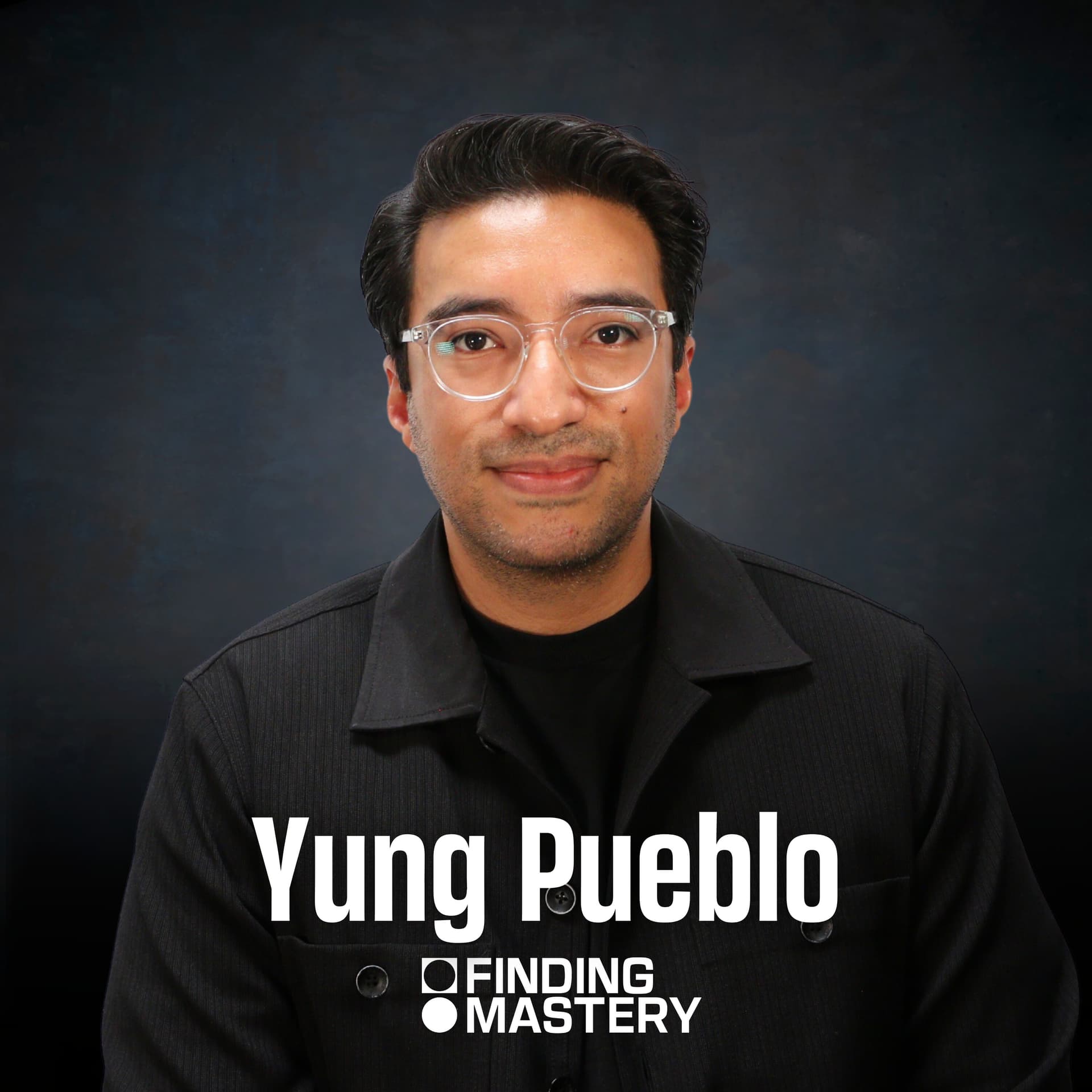
Diego Perez (pen name Young Pueblo) is a meditator, bestselling author, and modern wisdom teacher grounded in lived experience. He immigrated from Ecuador to the U.S. at age four, grew up in poverty and chronic household tension, and later used drugs and alcohol in college to escape himself. He hit rock bottom around age 23 (summer 2011), then rebuilt his life through long walks, gym/hiking, and meditation. He practices Vipassana/Guenka-style retreats (including long silent retreats) and meditates about two hours daily.
Key claims
“Healing” means reduced intensity of reactions, not being free of pain. Awareness alone isn’t enough; it requires skills/wisdom: observe sensations without suppressing or expressing, and understand impermanence so patterns “evaporate.” Attachment shows up as craving/control over identity, ego, and outcomes; embracing change creates freedom and better love.
Notable examples
His rock-bottom heart-attack-like episode; his wife as an example of transformation without a “rock bottom” moment; his meditation practice where he notices sensations (e.g., “fizziness” in the body) during vulnerability like speaking on stage.
Written by AI. May contain mistakes. Listen to the episode to check what was said.
Chapters
Tap a time to open that second in VOEmbracing Relationship Challenges
0:00 to 0:17
Learn how relationships reveal personal strengths and weaknesses.
“When you get into a relationship, you are going to see everything you're good at and everything you're not good at.”
Understanding Love
1:56 to 3:08
Explore the complexities of love and its foundational aspects.
“I've been a student of your writings, your poetry, like how you communicate.”
Young Pueblo's Journey to Self-Love
3:16 to 6:02
Discover Young Pueblo's path from addiction to self-acceptance.
“What do I need to understand to know you?”
Shifting Identity and Healing
6:10 to 7:54
Understand the process of shifting identity through healing work.
“That's so interesting because in my rock bottom moment in the summer of 2011, I remember when I was on the floor, my body was just almost like in between life and death.”
The Path to Emotional Awareness
7:56 to 10:50
Learn about the importance of emotional awareness and choice.
“Yeah, which is just like anything, like even elite athletes.”
Observing Emotions and Healing
10:55 to 14:06
Discover how to observe emotions without being overwhelmed.
“And the language that I would use is, you know that healing has happened when the intensity of the reaction has decreased.”
Understanding Black and White Thinking
14:06 to 18:54
Explore the cognitive distortions in thinking and the importance of embracing emotional discomfort.
“is a cognitive distortion, meaning it's a distorted way of using your mind.”
Understanding Black and White Thinking
18:57 to 20:10
Explore the cognitive distortions in thinking and the importance of embracing emotional discomfort.
“Some of the most important work we do happens in conversation.”
Understanding Black and White Thinking
20:28 to 21:40
Explore the cognitive distortions in thinking and the importance of embracing emotional discomfort.
“It's the time that you lose when the fit is off, the momentum that stalls when that fit doesn't work.”
The Value of Embracing Change
21:40 to 28:00
Discuss the importance of accepting change and how it can lead to personal growth.
“You and I could sign a contract that as an athlete, you are guaranteed at the highest level to win every game that you ever played moving forward.”
Show all 35 chapters
Awareness and Skills in Meditation
28:00 to 29:10
Learn about the importance of combining awareness with practical skills in meditation.
“I think it's because, so this is, I spent a lot of time meditating.”
Impermanence and Emotional Management
29:10 to 30:20
Explore how recognizing the impermanence of sensations can help manage emotions.
“Yeah, and I would call it awareness plus wisdom.”
Understanding Meditation and Its Misinterpretations
30:20 to 32:45
Discuss the nuances between Western psychology and Buddhist teachings on meditation.
“I have so much experience of observing so many sensations over time.”
Training the Mind for Success
32:45 to 35:04
Find out how training the mind is essential for achieving goals and personal peace.
“when somebody says, oh God, they're talking about meditation again.”
The Role of Tension in Growth
35:04 to 36:55
Discover how embracing tension can lead to personal growth and performance improvement.
“And I found that there's just like way more opportunities for success by moving in this like sort of subtle little gray field.”
The Role of Tension in Growth
39:04 to 40:06
Discover how embracing tension can lead to personal growth and performance improvement.
“Here's something I come back to with almost every high performer I work with.”
Meditation Styles and Personal Experience
40:06 to 42:00
Delve into different meditation traditions and their personal significance.
“Do you think we need to define or describe your meditation style?”
Embracing Change for Personal Growth
42:00 to 44:10
Learn how embracing change can lead to peace and personal growth.
“But like these people are up there with like the point like, oh, 1 % of meditators because of how hard they can go.”
Meditation as an Investment in Self
44:10 to 46:03
Discover how daily meditation can transform relationships and personal well-being.
“This is also for you and also for the listener is that if you, you are your most amazing investment you can make because when you are tuned, you are the pebble in your pond that can have radical ripples.”
The Importance of Inner Work in Relationships
46:03 to 48:16
Understand how personal growth through meditation can enhance relationship dynamics.
“and she did her first course March of 2013.”
Three Key Elements for Loving Better
48:16 to 50:25
Learn about kindness, compassion, and growth as vital components of successful relationships.
“It's hard to disagree with any of the, it's really tough to disagree with your anchor.”
Meditation's Role in Relationship Skills
50:25 to 55:15
Explore how meditation supports personal growth and enhances relationship skills.
“Can we start with the three characteristics that are important for you that you hope the readers will get to be able to love better?”
Meditation's Role in Relationship Skills
56:09 to 56:36
Explore how meditation supports personal growth and enhances relationship skills.
“Spring and summer, they are powerful seasons of momentum.”
Navigating Relationship Challenges
56:36 to 58:34
Understanding the dynamics of arguments in relationships and the importance of communication.
“Yeah, I just can't believe how in tune we are.”
Emotional Awareness in Conflict
58:34 to 1:00:55
Learning how to remain composed and understand emotional triggers during conflicts.
“It's hard to switch over from trying to win or from trying to defend to just trying to understand.”
Practices for Healthy Communication
1:00:55 to 1:03:50
Exploring ways to communicate effectively and prevent misunderstandings in relationships.
“You know, you can listen and be with them, but you don't necessarily need to join them.”
Self-Love and Personal Growth
1:03:50 to 1:10:00
Discussing the significance of self-love and habits for personal development.
“Like I is like, I is a very sort of, you know, a conventional level understanding of reality.”
The Importance of Preventive Communication
1:10:00 to 1:14:44
Learn how open communication can create harmony in relationships and personal growth.
“Like highlighting that, that is really, really vital.”
The Importance of Preventive Communication
1:14:48 to 1:15:17
Learn how open communication can create harmony in relationships and personal growth.
“I want to take a second here to tell you about a morning routine that I've been using for years.”
Self-Mastery and Delegation
1:15:36 to 1:21:04
Explore the concepts of self-mastery, letting go of control, and the journey of personal development.
“I think real self-mastery would be extinguishing craving.”
Embracing Impermanence and Change
1:21:05 to 1:24:00
Understand how to use impermanence to motivate presence and appreciation in life.
“And that flood of emotions that you're with was the animation of love.”
Embracing Impermanence in Relationships
1:24:00 to 1:25:41
Learn how to appreciate present moments and the inevitability of change in life and relationships.
“If there's one thing maybe, you know, that you hope somebody experiences and carries forward, what would that be from our conversation or your writings, your book?”
Quick Insights and Personal Reflections
1:25:41 to 1:27:35
Explore thought-provoking insights on success, mastery, and personal purpose.
“I thought that it was going to be exactly what it was, could be.”
Following Young Pueblo's Journey
1:27:35 to 1:28:49
Discover where to find Yung Pueblo's writings and the meaning behind his pen name.
“On Instagram, of course, you'll get more of like the minimalistic writings there and in bookstores.”
Gratitude and Presence in Daily Life
1:28:49 to 1:30:16
Learn to cultivate gratitude for small things and be present in every moment.
“for, you know, the ability to travel, to move around the world.”
Transcript
Automatic transcript. May contain errors.0:00When you get into a relationship, you are going to see everything you're good at and everything you're not good at. And it's going to be devastatingly clear. You kind of have to embrace the journey.
0:08Dr. Michael Gervais:What are the three things that you need to know to love better? I think if you feel like you're in a rut, especially within yourself and your relationship, you need to figure out a way to break the pattern. And I think in the act of doing something new, you can see yourself a little bit differently and see hopefully the thing that you've been ignoring that you know you probably should do. Welcome back or welcome to the Finding Mastery podcast where we dive into the minds of the world's greatest thinkers and doers. I am your host, Dr. Michael Gervais, by trade and training a high-performance psychologist.
0:37Dr. Michael Gervais:Now, the idea behind these conversations is simple, to sit with the extraordinaries and to learn, to really learn about how they work from the inside out. So the key to solving any argument is a very specific type of compassion where you can step outside of your perspective to see the perspective of another person. Diego Perez, known as the pen name Young Pueblo, is a meditator, bestselling author, and modern day wisdom teacher whose work is grounded in lived experience. In this conversation, he opens up about hitting rock bottom and the journey of rebuilding his life from the inside out. When I got to college, I started just using drugs and alcohol as a way to get away from myself as fast as possible.
1:18But I was also slowly killing myself.
1:23Dr. Michael Gervais:We explore what the work really looks like and how emotional strength is built through repetition and honesty. When you start really paying attention to your emotional history, there's going to be a lot of things in there that you like and that you don't like. So moving into that with self-acceptance feels really important. As you listen, the invitation here is to reflect on your own patterns. What are the things that you need to let go of? And what are the things you need to learn? Now with that, let's jump into this week's conversation with Young Pueblo.
1:55All right, Young Pueblo.
1:59Dr. Michael Gervais:Can I call you Diego? Diego's just fine. I know you as Young Pueblo. I've studied your work. I've been a student of your writings, your poetry, like how you communicate. It's beautiful. Thank you. Thank you. It's an honor to be here. I've been looking forward to this because I've been watching your clips. I've been watching what you've been giving to the internet. And it's been wonderful. So I've been looking forward to this moment. Am I feeding the beast, the monster? Or are we creating a nice little corner of positivity? Honestly, you're giving me moments of deeper thought. So I'm appreciating that.
2:33That's good.
2:34Dr. Michael Gervais:Coming from you. And I do want to celebrate your book, the title, How to Love Better. The number of times that you say love is, it's cool. So I'd love to start a little bit with just your high note on what love is. And I think it's almost an unfair question because of how dimensional you've captured love. And then, but you've been extraordinarily concrete on ways to build the way that we love. That's right. Self and other. And so I'm looking forward to all that. So maybe before I ask you this big question about love is, can we go back and like understand how you got here? Happy to do so. What do I need to understand to know you?
3:21So I could think to first understand I was really far away from love, especially from loving myself. I felt like a foreigner in my own body. How old are we talking about? I think from probably from like 13 to 23 when I hit rock bottom. It was a time where I was so just lost. Like I didn't know why I was feeling what I was feeling. And now when I look back on it, I can see that, you know, I was originally born in Ecuador. My family immigrated to the United States when I was about four years old. When we got here, it was challenging because we were stuck in this poverty trap. My mom, she cleaned houses.
4:03My dad worked in a supermarket. And it was honestly just a constant struggle where they were trying to figure out how to pay for the rent. And I was confused by the constant tension in the home. Like I didn't know if my parents really loved each other because they were always fighting. Now what age are we talking about? We're talking about from, you know, from four to 13. So all these patterns are being imprinted in me, you know, over that time.
4:31Dr. Michael Gervais:were watching is this is this what adulting looks like is this the tension right is this home is this what everyone's going through like are we all like in this struggle and um it was challenging to see how much um fear my parents had because every month it was the same thing over and over like putting food in the fridge paying for the rent and unknowing to me i just you know all these patterns of a scarcity mindset, a, you know, this fear, this anxiety kept building over time. And this was, you know, very like we're talking the 90s, we're very pre wellness. So therapy wasn't as popular as it is now.
5:12You know, I didn't know anybody who was meditating. So I had no, no concept of mental health. And as I got older, what it sort of snowballed into was these really unhealthy patterns, especially when I got to university.
5:25Dr. Michael Gervais:Even before that, right? Like in the high school years? Yeah, in the high school years too, there was, I think it would come out as a very sort of like rough outer shell where I would have my friends, but I think I would just be too rough with the people who were near me in the sense of like, you know, jokes were too heavy or there was just no kindness in the way that I was sort of moving through. And when I got to college, that became this like, you know, I started just using drugs and alcohol as a way to get away from myself as fast as possible. And, you know, it worked. I was very far away from myself, but I was also slowly killing myself.
6:03Dr. Michael Gervais:You give me hope in that way about reminding us when you do the work, you can become, and I don't say this loosely, this is not a bumper sticker, but when you do the work, quote unquote the work you can become whoever you want to become truly yeah right and i'm not saying you become a rock star i don't mean that because maybe your music isn't amazing yeah but you can you can definitely play rock music yeah you know you i feel like you play jazz i'm using metaphors here but you can become whoever you want to become if you want to be a kind person that comes from a hard exterior shell, you can return back home to a place of innocence and strength and kindness if you wanted to.
6:52That's so interesting because in my rock bottom moment in the summer of 2011, I remember when I was on the floor, my body was just almost like in between life and death. I had filled myself with so many drugs that I could feel my heart losing it. But I remember in that moment, my mind kept going to how I had not only wasted the opportunity my parents had worked so hard to give me, but I wanted to switch my identity. I wanted to be a helper. And I was thinking back to the moments where when I was in the nonprofit world and I had a job when I was a teenager and how I was helping organize schools and helping empower people.
7:36And I was like, why am I so far from that right now? How can I go back to not necessarily the same work, but helping people in some way? And it's funny because you mentioned that identity shift because I was like, well, before I can even do that, I need to help myself. And I need to start going on long walks. I need to stop doing all the drugs. I need to start paying attention to my emotions. Just like the basics, literally.
7:58Dr. Michael Gervais:Yeah, which is just like anything, like even elite athletes. I think like the higher up you go in performance worlds, the more connection to the basics those performers are. Yeah. So because they understand you need to have the foundations tuned. Right. And then you can artistically play jazz on whatever canvas is yours. But you knew at that moment, I have to create some foundations. Yeah. And as you're speaking and bringing me back into that part of your life, I hear it in your voice. Do you feel it in the way that you're expressing it? Yeah, I feel like it's in some ways it almost feels like a second life, but it also still feels tender because I remember like being in that moment and literally like crying for another opportunity, crying for another chance because I felt like I was dying.
8:53I mean, I talked to a doctor later and she, after I described what I was feeling to her, she was like, oh, it sounded like a mild heart attack. And, you know, I was 23.
9:02Dr. Michael Gervais:And so what is the emotion that's under the surface for you right now? It's just how bloody close I was, you know? So is that a fear or is that a sadness? Is it something else? It's more like a wake-up call. Like it feels, it's sort of like an empowered fear. It's like, whoa, like you skated so close. and fortunately I was able to just make a hard turn, you know, a hard turn away from this life and to me, some people sometimes ask me like, how did you know what to do? Well, I didn't know what to do. I just knew what got me there. I knew that lying to myself was a major problem. I knew that running away from my emotions was why I was using drugs and I knew that I had to start becoming friends with my body.
9:47I needed to start going on long walks, signing up to a gym, going hiking in the Blue Hills Mountain in Boston, these simple little things. And over time, this new set of habits that I was building just started opening a door to a new chapter.
10:02Dr. Michael Gervais:I think the part that I just want to circle around one more time is that you're not just telling a story right now and I'm listening and it feels surgical or clever or celebratory of your pain, like you still have it embodied. You're connected to the pain. And a big effort that you took in your writings of your most recent book is commit to healing. And so I think what I just wanna circle around is that healing doesn't necessarily mean I'm free from it. It means that I'm on a path and it holds less charge and it doesn't force me towards blinded decisions and choices. It's not as gripping. My pain and trauma or whatever is not gripping me in a way that my choices feel invisible or immutable.
10:54Dr. Michael Gervais:You're still connected to it. Totally. And the language that I would use is, you know that healing has happened when the intensity of the reaction has decreased. Yeah, that's it. It's like, and I think a cool way to think about that it's like have you lost anyone in your life yeah a few people yeah and so when you go to when i go to a funeral like i'm flooded with the emotion and then you know like a year goes by or whatever then there's no there's no number of days where yeah you know and then it's like i think of them in more of a um full-hearted way as opposed to like a grief only way right yeah so that's the way i think about it it's just so interesting because um in the past it didn't really feel like I had an option.
11:37Like it felt like the impulsiveness, those reactions would just be so quick where, you know, the mind would roar into anger, roar into fear or anxiety, whatever it was. But over time, when I, you know, a year after I had that rock bottom moment, when I started meditating, I started seeing that there was a new space for choice that was slowly appearing in my mind. And also simultaneously over time, not only was I able to pick new sort of routes of action, but I also started seeing that the fear that I once used to run away from, I would still feel it from time to time, but it just wasn't as big of a storm as it used to be.
12:17Same thing with anxiety and all the other sort of like heavy emotions that used to feel quite debilitating.
12:22Dr. Michael Gervais:And that's why I'm circling around it one more time here because I'm listening to your story and experience and I'm feeling how you are choosing your words right now and the embodied emotions that are coming with it. so how are you not overrun by the emotions that you're feeling in this moment? Is it because they're just like smaller because you've done all the work? Or are you making some choices that are below the surface to manage your feelings and emotions? No, that's a really good question. I think, you know, I mean, whenever I hear the term doing the work, it's so, it's a good term, but it's also very vague.
12:58Dr. Michael Gervais:Yeah, I feel like you and I need to say what does work mean to you? Yeah, I think, well, there's a few things that I do. So whenever I feel, you know, heightened sensations in my body, like I'm just very aware because I've spent so many hours meditating, like I try not to lose touch with what I'm feeling. And that will literally be at the sensation level. So, you know, I can be aware of my breath, I can feel, you know, just like everything that's happening in my skin or my hands. And even if I'm, you know, if I'm about to go on stage or talk or something like that, I'll have a few moments where I can just feel myself.
13:33And in the act of feeling myself, it recalibrates my equanimity. It almost like helps recalibrate my mind to a sense of balance. So, you know, some anxiety may be there, some fear may be there, and I feel it. But there's, this is a thing about the black and white thinking that a lot of people sort of experience is like, either you suppress it or express it. But what I've learned over meditating is you can just observe it.
13:55Dr. Michael Gervais:Yeah, cool. Black and white thinking is considered a cognitive distortion. There's about 11, 7 to 11, depending on the researcher that you might follow. So black and white thinking is a cognitive distortion, meaning it's a distorted way of using your mind. So I don't know anything that's actually black or white. There's all these shades. So your point about if I observe it, you get in tune with the actual shades of whatever. Yeah, let me see what's happening in there. Yeah. And then over time, do the work. Once you observe, you don't have to critique it. you can just kind of go with it and i think the fear is that and it's showing up in this conversation that you could have been overwhelmed by the going back to trauma experiences in your life and like or hard times in your moment or your life and feel like oh i don't want to go all the way there because i might open up the the chasm and then just kind of fall into a thousand pieces can i actually manage the emotions in this conversation yeah you if you're if you practice it yeah you can just do just fine with them yeah you know there's also this um there's a little bit of joy that I've learned over time to just be able to feel what's uncomfortable.
15:01It's like, oh, I don't want to talk about this all the time, right? It's like a really hard moment in my life, but it's part of the story. It's why I've been able to write a few books. It's why I even sought meditation. So it makes sense to be able to give people a more holistic picture of where I'm coming from. But there's a little bit of joy in building that strength to be able to say, this is what happened. It was dark. It was bad. And I wish that upon no one. And fortunately, I'm still here to talk about it.
15:30Dr. Michael Gervais:Why do you wish it upon no one? I think because sometimes people get a little confused in the wellness world where they think they need to have a rock bottom moment to be able to sort of like wake up and be a new version of themselves. But I've seen people transform such a vast, you know, like just a wide variety of experiences. Like I think my wife is a perfect example where she got into this meditation journey and was very interested in, you know, cultivating her mind and taking herself to the mental gym, but she didn't have a rock bottom moment. She just felt like, you know, she could learn some more skills.
16:04Dr. Michael Gervais:Yeah, that's cool. I think when I'm reading your work, I'm like, oh, this is Buddhism, you know, philosophy, cleverly and deeply and richly tuned to loving relationships, self and others. Totally. You hit it on the dot. And I credit the Buddha oftentimes in all of my works, like the basis. I try to understand life in the sort of the little micro moments of life and relationships and just like how you're moving about through life from this perspective of understanding how are attachments making things quite difficult for me. And then so much stems from that when you look at it from different lenses.
16:45Dr. Michael Gervais:What were your core attachments that you were working on? Actually, pause my question and go to just clarifying what attachment means. Yeah, because I think, you know, when I write about attachments and talk about attachments, I'm talking about like old school attachments. I'm talking about, you know, when the Buddha was understanding his, what was holding him back from liberation, it was this deep craving to have things exist in a certain way. and this, you know, almost this control that would, that's the way attachments manifest in daily life is through this, you know, craving to control. So you can be attached to anything.
17:21And I think that's what I notice in my mind is like, when I think about what am I attached to, it's just whatever my mind is grabbing. My mind can grab so many things and then build tension, build agitation, build stress, build anxiety. And in the act of doing the opposite, you know, the opposite of attachment is embracing change.
17:38Dr. Michael Gervais:change then you get some freedom there you go and so you can attach to identity you can ego you can attach to clothes and cars and watch and a thing and you can you can get attached to thinking you're the best person ever you can get attached to thinking you're the worst person yeah it can go in a lot of different ways good news bad news yeah zen parable good you know this one the monk says to the student um good news or bad news bad news is like falling through the sky without anything to grasp or hold on to. Yeah. Good news, there's no bottom. I actually haven't heard that one. That's really good.
18:10Dr. Michael Gervais:So that to me sums up attachment. Yeah. You want to grasp because you're falling and that falling is like an unpredictable, unknown moment that's always emerging. Like if there's just something I can hold on to that feels sturdy and safe to allow me to be a little bit better in what might unfold in this next moment. And I get it. Me too. And what I've learned from best in the world, and I hear it from you, is that there's a love affair with me not knowing how this is going to go. And if I can be totally excited and in love with like embracing this unknown excitement, as opposed to being terrified of this unknown thing that could happen in a negative way, that is a tuning of the mind.
18:54Dr. Michael Gervais:Bodymaster is brought to you by granola.ai. Some of the most important work we do happens in conversation. It's in the meeting. It's in the one-on-one connection. It's the moment someone shares an idea that could shift the direction of everything. And the greatest gift you can offer in those moments is your full attention. That's exactly why I love Granola. Granola is an AI notepad. You take down the notes that matter to you and Granola transcribes the entire conversation right beside them. So what does that mean for me? It means that I get to be fully present, to listen deeply, to give real attention to the details and the nuances, the thing behind the thing, knowing that Granola is there taking notes for me behind the scenes.
19:33Dr. Michael Gervais:And the best part, it works right through your device's audio, which means it integrates seamlessly into your video conferencing tools that you already use. No big setup, no awkward bots. All I do is let folks know that Granola is transcribing in the background. Happy days. We're off and running. I use it every day. And what's remarkable is how it helps turn a conversation into something useful. When we're done, I've got a clear, organized recap of what's said, along with a clean list of action items and clear next steps. Nothing slips through the cracks. That is the gift of Granola. I think you're really going to like what they're doing.
20:05Dr. Michael Gervais:If meetings are eating up your day, Granola is a no-brainer. You can try it totally free. Just head to granola.ai slash mastery. That's G-R-A-N-O-L-A dot A-I, granola.ai slash mastery to get your time back. Try it for free at granola.ai slash mastery. Body Master is brought to you by LinkedIn Jobs. If you've ever hired for a small business, you know the real cost isn't just the salary. It's the time that you lose when the fit is off, the momentum that stalls when that fit doesn't work. And that's the pressure of having to get it right while you're still running everything else. That's why I'm paying attention to LinkedIn Hiring Pro.
20:43Dr. Michael Gervais:It's built for the reality of hiring when you're operating lean. You describe the role in playing language, and then Hiring Pro helps you draft the job post, surface the right candidates, and then narrow to a short list without turning hiring into another full-time job. And when applications start coming in, it doesn't leave you buried in resumes. It streamlines screening, including AI-powered interviews for initial conversations. How about that? so that you can spend less time searching and then more time connecting with the people who match what you need. With Hiring Pro, you can hire with confidence knowing you're getting the best talent for your business.
Read the full transcript
21:16Dr. Michael Gervais:In fact, those hiring with LinkedIn are 24 % less likely to need to reopen a role within 12 months when compared to their leading competitor. Join the 2.7 million small businesses using LinkedIn to hire. Get started by posting your job for free at linkedin.com slash mastery. Again, that's linkedin.com slash mastery. Terms and conditions apply. Let's play along that you're an athlete, you know, or maybe a musician. You and I could sign a contract that as an athlete, you are guaranteed at the highest level to win every game that you ever played moving forward. And I've asked this question to scores of athletes.
21:53Dr. Michael Gervais:What's your first response? What's the catch? Yeah, right. Yeah. Okay. And that's what they kind of look at. And they go, well, yeah. And then I go, okay, let's play it out. Because there's a lot of good that comes from that. And let's play it out. every time you touch the ball, you're guaranteed to win. And they go, oh man, hold on. That shit sounds boring. Yeah, yeah. So in other words, you like the unknown, you like that. And they go, I guess I do. It's this light bulb moment that comes on when you frame. And so I think you like the unknown now. Yeah, I think that's what I saw was one of my struggles throughout my whole life was really not being aware that the mind is craving a very static and pleasurable reality.
22:44And it's always looking for things that I like to always be the same. And, you know, I like this person, my mom and dad, and never want them to die. And, you know, all the, you know, sort of keeping all the pieces of the pleasurable life together, but reality will never give you that. Not only does that create tension in my mind to try to just grab and hold and, you know, sort of live in this very attached mode. But when I try to do the opposite and over the years I've been training myself to do the opposite, what happens is that you unlock vast new potentials. What is the opposite? The opposite is literally embracing change, to truly embrace and flow with the changes that are happening.
23:27Dr. Michael Gervais:And that means framing change as something that I'm looking forward to as opposed to something that is driving me nuts. Or just simply something that you accept. Okay, so not looking forward to, but accepting that change is part of it. Yeah, this is true. Okay, so now we're going to get into the work. So you can have an idea. Let's call it an intellectual idea, right? Like, oh, I get why that makes sense. And then like, oh, I get that I should hold my hands this way to catch a ball more consistently. I get it intellectually. Now it has to get embodied. It has to get into the system. And don't you do it through repetition?
24:02Dr. Michael Gervais:Yeah, that's exactly. So that's where I'm going. So what is your quote unquote work that you've done that you can point us to? This is so funny. So that's why I'm so glad that we're having this conversation because you're going to get it more than others. And I've been slowly over time, when I talk about meditation, I've been using this sort of, this idea of taking yourself to the mental gym. Yeah, I heard you sneak that in. You have all these qualities. These qualities are embedded in your mind, right? But specifically the quality of non-reaction, the quality of compassion, the quality of awareness, you can make them stronger over time if you intentionally build them.
24:40And that's what I've learned to do. You know, I've been meditating seriously. I did my first silent 10-day course in 2012. I started meditating two hours a day in 2015. and I've been going to many, many retreats in the same tradition, in the Guenka Vipassana tradition. And it's helped me profoundly, but I've noticed that it's like literally built these muscles over time where it becomes just so much easier for me to feel what's true, to be able to feel that change that's happening in my body. And that's why it's not just like an intellectual understanding, like, yeah, I know change is happening intellectually, but now let me feel it so I can feel that truth And now I can distinctly tell when I'm becoming attached because I can feel the tension and when I'm just embracing change because I'm connected to it.
25:28Dr. Michael Gervais:So let's do kind of the math of it. So intellectual idea, I'd like to live this way. Happier, more joyful, more peaceful. Yeah. Whatever the language. I don't think people, when you ask people like, what do you want? And they go, I just want to be happy. I don't. Yeah, let's unpack that. Yeah, I can't. It doesn't work for me. Like, yeah, there's way more to it. Okay, let's say you've got some sort of language on how you want to quote-unquote be or do something even. And then for you, Vipassana meditation is the practice of becoming one, more aware, so observing, and two, practicing how to work with that sensation that comes with emotions.
26:08Exactly. Exactly. I think the Buddha, when he became enlightened and understood reality, one thing that he mentioned was that everything that arises on the mind arises with sensations. And it's really, really true. You think of something, it creates sensations on the body. You think about the future, think about the past, you have a dream. Sensations are always connected to the entirety of the mind.
26:36Dr. Michael Gervais:and let me just pause because the sensation that you're talking about is like your heart might beat a little bit faster your yeah your breathing right might change your skin might feel a little more dewy we're talking about like mundane sensations yeah yeah nothing nothing nothing special or magical but with a lot of those sensations you now you're in like this high pressure sympathetic dominant fight or flight experience but there's the mundane little subtle shifts and then there's that kind of big flood yeah there's a there's a wide range of sensations some of them very intense others less so some of them more subtle some of them more gross and what you learn over time is to instead of just immediately reacting to them just let me let me observe let me watch them so when you and i were having the conversation about revisiting your imagination is rich.
27:29Dr. Michael Gervais:You create beautiful movies that have lots of nuances and details. So people that have that, when they go back into hard moments, the movie is so vibrant and real that you will feel something. So I was listening. So there was very subtle changes in pupil, skin tone, and voice. So how did you go back to, this is now pointing to the evidence of your work, is that you are managing yourself in that moment to not be run by the emotion, but to work well with it. What were you doing? I think it's because, so this is, I spent a lot of time meditating. So I've probably meditated somewhere between 13 and 14 ,000 hours.
28:11And even when we're in conversation, I'm listening to you, but there's enough space in my mind where I can also feel myself. I'm just feeling what's happening in my body. And when I look at my hand, My hand looks static, but it doesn't feel static to me. It feels like wavelets. It's like changing very quickly. It almost feels like if you were to pour a very fresh glass of Coca-Cola and you look at the fizzy bubbles right at the top, that's what most of my body feels like.
28:40Dr. Michael Gervais:Yeah. Yeah. Amazing. And then with that awareness, you're just observing, ooh, I've got a bunch of fizziness going on. You're like, wow, what's happening here? I feel the heat. I feel all of it. And then what do you do with it? Because, okay, I'm going to say something unpopular and probably jarring to you, okay? Is that awareness alone is not enough. No, of course not. Okay, not jarring. I feel like the mindfulness slash meditation world can get a little jarred. I say you need awareness plus skills. Yeah, and I would call it awareness plus wisdom. Okay, there you go. Okay, so then I'm just pointing to the skill here.
29:16Dr. Michael Gervais:How are you managing yourself? because if one of the great public fears is going on stage and then sharing your ideas, because there's a deep vulnerability to be kicked out of the tribe, to be rejected, not accepted, to be not good enough in the eyes of others. Great, great, great fear for people. And so we activate, and then it becomes almost overwhelming to access the thoughts and feelings that we want to convey. And so it's like this snake eating its tail experience for so many people. I'm aware that my heart is pounding. I'm sweating under whatever. I'm aware. It's not enough. Actually, that could be problematic.
29:52Dr. Michael Gervais:So just go one more time to the skills. How do you manage when you feel your body switching on? Yeah, I think what I'm really is, I'm not just aware of the tone of the sensation, but I'm aware of that truth, whether it's at the intellectual level or the body level, that all of this is impermanent. So I'm like feeling everything that's happening with this deep understanding that like, this is going to change. So yeah, it's hard right now, but it's not going to last forever. I have so much experience of observing so many sensations over time. There are some hard ones, some sweet ones, some, you know, whatever they could be, but they all in time evaporate.
30:30And now what that does, I think something that Western psychology is still understanding is that these heavily rooted patterns, right? When they come up to the surface and you're like literally feeling them and your sensations, they, if you're able to hold them with this mindset of just really observing them, they evaporate. That's right. So these, there's literal unbinding that happens where, you know, you can have a pattern that's so heavily knotted and it feels so, so quickly impulsive that you don't have control over it. But over time, when you're able to just hold it as it is, like what I do is, you know, I just let it be.
31:06Like I let it be. Like I'm not fighting it. I'm not trying to make it last longer. I'm not trying to, you know, make it disappear. I'm just like, oh, that's, that's happening.
31:14Dr. Michael Gervais:Oh, there it is. Yeah. And there's ample research that I'm just observing, observing, naming, uh, an emotion diffuses the intensity of it. So, um, it's pretty cool. I mean, that's something that's been around a long time. Yeah. All right. Awesome. I love this part of the conversation. That was sick. Thank you for leading us through that. That was really cool. And the wisdom bit is your reference point for how the world and you work so with enough enough time under tension to observe non-judgmentally you get these moments of insight ah yeah wait and then enough insights you go oh wait yeah that's how this works so your backstop is wisdom totally and i think this is what we um i feel like the western psychology and the sort of the world of the Buddhist teaching, and I would sort of abstain from using the word mindfulness, they still need to, you know, better understand each other.
32:11Because I think when the Buddhist teaching came to the West, and it over time became what we now know as mindfulness, right? There is a lot of misunderstanding that happens where people think about it as just awareness, but there's so much more to the teaching. And I think, yeah, a lot can get lost pretty easily. when things are shipped around the world.
32:37Dr. Michael Gervais:Very cool. Before we get into the framework of kind of your point of view or your hope and ambition for your book, when somebody says, oh God, they're talking about meditation again. Like I want to understand it. Like I get it. I've read the research and my partner's doing it and like she's better for it, you know, or he's better for it. And, but I just can't do it. Yeah. I've got a reflexive thing that I say, but I would love to hear how you respond to that critique or that statement. Yeah, people often say, I'm just bad at it. I'm like, yeah, of course. Yeah, I'm bad at it too. That's why we train.
33:22You know, you don't just go and run a marathon. You don't just decide, oh, I'm going to learn Spanish. And then you know Spanish the next day. Now, all of it requires training. And the mind requires training too. So if you want a little more peace, if you want a little more awareness, if you want to cultivate your compassion and your non-reaction, you got to put time in. It's not just going to come out of nowhere. Like if you want happiness, you have to cultivate the mind to gear it towards that.
33:48Dr. Michael Gervais:Couldn't have said it more cleanly. It's, I think that that idea, I don't think I finished ringing the bell earlier in the conversation when I said whatever you want, whether it's happiness or peace or whatever, it starts with a beautiful idea about what you want and then go to work. And the work that you're pointing to is observing your inner life to be more clear and tuned to what's actually happening. So now you're working in reality. And when you do that sitting on a pillow or laying down, whatever it might be, then you can do it more easily in kind of the waking moments. Totally. In the rhythms of life.
34:25You know, and I'm really curious since you know this world so well in terms of like the professional athletes, So I've learned through meditating that I've developed a new sense of freedom around feeling like, okay, more is possible because my mind just feels more open. I can shoot for higher goals, but I'm learning how to be far more strategic in putting energy towards a goal without putting tension into it. there's a subtlety there so that I can like work hard towards a goal without being devastatingly attached to it. And I found that there's just like way more opportunities for success by moving in this like sort of subtle little gray field.
35:12Dr. Michael Gervais:You know, I think I was listening and nodding to everything. And then I loved when you used the word tension. I was like, wait, hold on. What does he mean by that? Because I think the tension is where the unlock takes place. and so i'm really interested in those moments of tension and but then you added it to the tension of attachment and i go oh well that's where so that's what you're working from yeah so the attachment like in this example i am what i do and if i don't do it well yeah i am not anything i know yeah so that that part is obviously problematic totally you know it is the water that young performers drink.
35:51Dr. Michael Gervais:Because the community creates a well of conversations around, hey, your upcoming performance, how you doing? Or, oh, I caught you in that whatever game or that other performance like last week. You were amazing. And it's not about, hey, I saw how kind you were to somebody or, wow, you are a really happy person. Can you tell me more? Or even sometimes it's not about grades you know as a young student it's about performance except especially when people are exceptional right so then there's identity foreclosure i am what i do and it's one of the more dangerous paths for performers you know young exceptional performers so how do i kind of like respond to it is that i love tension yeah there's something really special when i'm sitting and meditating and my hips are on fire yeah and my mind just wants to relieve from that and or like i'm just there's a civil war that's happening inside of me yeah that tension is like great it gives me something to bounce up against and then i have a choice to make and i love that tension i think that's where the unlocks happen totally so attachment problematic tension amazing Ah, yes.
37:07So yeah, that's where I like learning our different vocabulary. So I would just call it something that's unpleasant. Like a lot of times when I'm doing, there are aspects of work that are a little unpleasant and I just accept them for what they are, but I'm moving, I'm intentionally moving towards it because it just has to get done.
37:23Dr. Michael Gervais:Yeah, so elite athletes will warm up for, I don't know, call it 35, 45 times, you know, an hour to get 12 minutes of real work in. Wow. You know, and I'm being dramatic in there, But sprinters, it's not uncommon that most of their kind of warm up is to get to sometimes seconds of intense work. Finding Mastery is brought to you by David Protein. Travel a lot at Finding Mastery. And sometimes travel makes it tricky to eat well. Best intentions, and then you're at the airport. And then suddenly the only options around you are the ones that you'd rarely choose at home. Something I come back to often is that discipline isn't really about willpower in the moment.
38:02Dr. Michael Gervais:It's often about choice architecture. setting up your environment ahead of time so that the easy choice and the good choice are the same one that's the role david plays for me on the road the gold bar it's their flagship high protein density great texture flavors that make it easy to stick with so when i throw a few in the bag before my trip i've already made the decision the hard moment later takes care of itself and the team here at finding mastery they love the bars as well they are ripping through them in the finding mastery lab salted peanut butter and fudge brownie seem to be the fan favorites right now.
38:31Dr. Michael Gervais:They have built something with real rigor in a crowded, sometimes ambiguous space like nutrition. That matters when it's something that you reach for again and again. David bars are now available in major retailers like Walmart and Target. And if you'd like to buy them directly and get a special offer for being a Finding Mastery listener, head to davidprotein.com slash finding mastery, where right now, if you buy four packs, you'll get the fifth one for free. Again, that's davidprotein.com slash finding mastery. Finding Mastery is brought to you by Oslo Sleep Buds. Here's something I come back to with almost every high performer I work with.
39:07You can do everything right during the day, but if the night consistently falls apart,
39:13Dr. Michael Gervais:so does recovery. That's exactly the problem Oslo set out to solve, and that's why I invested in the company. I love what they're doing. They just launched Sleep Buds 2. This is the next generation of the world's smallest earbuds built for one thing, sleep. And once you're out, once you fall asleep, they switch to built-in sleep sounds on their own. Over time, the app even shows you personalized sleep patterns so you can see what's actually helping you recover. Sleep is a skill. You can train it. And the right tools make it easier to protect. Protect your sleep. It matters. Do not leave your recovery up to chance.
39:50Dr. Michael Gervais:Right now, you can get$20 off with the code FINDINGMASTERY at oslosleep.com. Again, that's findingmastery at oslosleep.com for$20 off.
40:06All right.
40:07Dr. Michael Gervais:Awesome. Do you think we need to define or describe your meditation style? Do you think that's useful before we get into the structure of love? I think just that it's a tradition that I really respect. respect i think one thing that i try to be really consistent about is letting people know like i i really benefit from meditating i think what's wonderful about the time that we live in is that there are just so many different modalities that can give you a ton of help that can just meet you where you're at meet your conditioning where it's at because the style that i meditate in it's powerful but it's also quite difficult so it's not necessarily for everybody it's for a lot of people but do you want to describe it quickly i come from a Zazen or Soto tradition.
40:52Dr. Michael Gervais:Yeah, so this is, so the tradition, the Vipassana tradition I meditate in, it's from the Ubakken lineage and it originates from Burma, you know, comes from the Buddhist teaching, but it was kept in Burma for thousands of years. And it's really sort of focused around the body sensations and you go away to these silent 10-day retreats to learn the technique. And since then, you know, I've gone to many of the 10 days and I've done, you know, 20, 30, 45 days. I have a 60 day retreat coming up. The first one I'll do of those. 60 day consecutive? Yeah, consecutive, silent, no phone. 60 day noble silent retreat.
41:29Dr. Michael Gervais:Yeah, totally. There you go. You're gonna go meditating 11 hours a day. That's a training camp. It's training, man. And it's funny because I was just with a bunch of my fellow meditators in Idaho, all these people who put so much time into cultivating their minds. And they're such kind, sweet people. They don't have podcasts. They don't write books. They're just like good people living their lives. But these guys are professional meditators. You know, like there's a lot of people meditate. And I'm glad that there is such a wide range of sort of the entry point for people. But like these people are up there with like the point like, oh, 1 % of meditators because of how hard they can go.
42:08Dr. Michael Gervais:So let's go back. You're looking for peace in your existence? I started looking for peace. Or is it love? I don't know. I look for wisdom. I think that's my driving force is more like deepening. Like the main thing that I'm learning in this life is change. I'm learning how to embrace change, learning where I fight change, and learning how I can just better move with it over time. Okay, brilliant. And just to be uber concrete, that's what quote unquote high performance looks like. You living a great life. The model that you have in your mind is like, I'm eloquent with change. Yeah. I think that's just like the, not only the key to success in terms of like writing and letting whatever happens flow out.
42:57And also just like the key to peace in life is like, it's like, oh, what I wanted to happen isn't happening. That's okay.
43:04Dr. Michael Gervais:Yeah. So I love that. Like when I set a goal and it doesn't work or I've got plans and it's not going according to plan. And now I'm upset because I didn't get what I wanted. Like, hold on. Let's pivot and adjust and be eloquent. And like, let's be our, we're nodding our heads. No, 100%. And that's what I was trying to sort of get to earlier was when you are able to sort of work towards a goal with energy, with flow, you don't get what you want sometimes, but then you just, you don't cry about it. You just go back to the drawing board. You re-strategize and you're like, how can I do this better?
43:36And you keep going.
43:37Dr. Michael Gervais:If it was that easy, we'd probably get bored. Back to that other, okay. And then, so your training is meditation. Yeah. You also probably have some form of training to write. So you've probably got a technical training and you've got a mental training. Yeah. Set of practices. And we don't need to get into the details of the writing bit, but is it a daily practice for technical training for writing and a daily practice for psychological mental wisdom practices? It's a daily training for meditating. Like I do two hours a day no matter what. And meditating every day is literally the best investment that I've ever made.
44:13Yeah. better than the S &P 500. Yeah, right. Like the returns are massive. Yeah, a thousand percent.
44:19Dr. Michael Gervais:And think about this. This is also for you and also for the listener is that if you, you are your most amazing investment you can make because when you are tuned, you are the pebble in your pond that can have radical ripples. And if you think about you as making that investment in your quality of your family, quality of your business relationships, quality of whatever, like it it will outstrip any other financial investment or time investment that you can make it is the one no it totally is and that's that's what when i started meditating it the original focus was personal development was like i need to come out of this sadness i need to come out of this anxiety let me work on myself but then i was totally surprised that as soon as i started meditating and spending time on myself it started opening new chapters in all of my relationships And I started seeing that as I learned to embrace change, I was understanding, okay, previously my relationship was a fearful one with change, where I was scared of it taking things away.
45:21but now I'm starting to understand that change is inspiring me to appreciate to be more present to notice okay how can I better flow in this relationship with my wife so that I can be supportive of her so that we can meet our goals together so that we can just have a much more nourishing home and all of that really stems from that sort of inner work and building that relationship with change and it's sort of helping me see things from different perspectives like oh, I can do better in so many of these different areas.
45:52Dr. Michael Gervais:Did you begin meditation with your wife or were you already on a practice or doing the quote unquote work? And she was like, this is cool. Yeah, I started July of 2012 and she did her first course March of 2013. So she had to wait a little bit because she was working as a scientist at the time and her schedule was quite strict. So it took a while for her to get 10 days off to go. Yeah. And then but we both picked it up and we both found it, which was nice that we separately found it interesting. You know, it wasn't like you guys were not married at that time. We weren't married yet, but we were together.
46:33Dr. Michael Gervais:Yeah, that's yeah. I think there's something really cool about that, which is I remember when I first started to do some of the inner work. One of my mentors said to me, hey, just make sure because my wife, Lisa, and I married really young. yeah make sure you guys are together because there's a trap in here somewhere if one grows and investing in this and the other's like not interested like it just might be unfortunate if you guys and i am not suggesting that um if you the listener are listening like oh i want to meditate that the other person has to i'm not saying that at all right and that would be a mistake yeah that if you're interested that the other person has to be interested but how fun that you guys were on a similar path.
47:18Dr. Michael Gervais:Okay, so I listened and read your book. I went back and forth between listening to it and reading it. Wow, thank you. Yeah, and my wife and I were listening. So I jumped in the car and I put it on and I was really excited and nervous to listen to your book with my wife. So we've been married 30 some years. I was really excited because it's just rich, it's wonderful, and I love the idea of you guys doing the work together and it's like all of it was amazing and the nervousness was like you know i don't want to give away uh the three variables that you point to for better loving and um and i was nervous that she was going to be like well you think you're doing good on those well wow that one's for you mike you know like oh yeah um but like and so i pressed play and i said i'm really excited about what diego's writing here and so she's like oh good so we just had this wonderful kind of just passive it was a 45 minute conversation just like it felt like um it was just like this really refreshing kind of reminders of how we want to be oh that's so nice because that's that's literally the point of the book is like you know especially if you're in a relationship while you're reading it to just like open up conversations and just see it's like whether you agree with what I'm saying or not.
48:36It's hard to disagree with any of the,
48:38Dr. Michael Gervais:it's really tough to disagree with your anchor. So what I wanted to do in this conversation is see if you're really about it. Right, those words, the words you wrote are good. They are wisdom, profound, and clear. Thank you, I appreciate it. And I wanted to see if you were about it. Yeah, I mean, I don't know what to tell you. Like, I don't try to be impressive. Like, I'm not trying to like, I don't walk around my life trying to impress people. dude I just meditate and I write you know so I'm like I think there are interesting times where people have been following my writing for a long time and then we may meet in person and they expect so much but usually if you and I are just hanging out I just want to laugh you know like we're just hanging out and so I keep like the I spend a lot of time meditating so I don't need to like put on a performance you know it's just like I like doing that but then i also like have other aspects of my life yeah so it reminds me of nike's mission statement to bring innovation and inspiration to every athlete in the world and athlete has an asterisk next to it and so the way they define it is if you have a body you're an athlete and then i talk about performance the aspiration of being um reaching your potential and then you know when i use the word performance in my mind there's an asterisk which is the highest performance is being fully present with the unfolding unpredictable unknown.
50:00Dr. Michael Gervais:So being, and then if you have a certain set of qualities or qualities or characteristics that you want to make sure are part of the unfolding you, then that's the work. And then if you want technical skills that are important for capabilities, that's the work. So there's two streams of work to do. That's so good. The craft and the inner skills. So anyways, I don't want to get stuck there. I want to go to love. How to love better. How to be better at loving. Can we start with the three characteristics that are important for you that you hope the readers will get to be able to love better? Yeah.
50:41So I arc the book around these three core elements of what helps make relationships successful. One sort of key aspect is kindness. It's very simple, but it's when we're in proximity to people, they will see the best of us and they'll see the worst of us. Part of that is because if we're in proximity to them, there is some degree of comfort. So vulnerability can open up. But one thing that happens, especially with long-term relationships, is that you can very easily get into a rut and just forget that kind element that you should be treating your partner with a certain degree of sweetness. So I'm not saying hide anything.
51:20I'm saying make sure there's balance where you can share the tough moments, but you're also intentionally creating sweet moments with them. The other element that is really, really critical is compassion. So the key to solving any argument is a very specific type of compassion where you can step outside of your perspective to see the perspective of another person. Now, if you can really see where they're coming from and they can see where you're coming from, then the argument is going to evaporate over time. The last element is growth. When you get into a relationship, you are going to see everything you're good at and everything you're not good at.
51:59And it's going to be devastatingly clear. So you kind of have to embrace the journey. I remember when I first started being with my wife, we got together quite young. She was 18 and I was 19. We got married when I was 27. So we'll have 10 years married this summer, this July. but I knew pretty quickly I was like I'm not a good listener like I need to like intentionally work on listening I also need to work on patience there were so many qualities that were lacking and um and I've had to work on them over time and it's not something that I have perfected but I just know that if you want to love it means learning how to care for someone because you're not going to automatically know how to care for someone and part of learning how to care for them is you have to embrace your growth and sort of hone out your emotional skill set.
52:50Dr. Michael Gervais:Compassion, kindness, and growth. That's right. And meditation is your one bucket for all three? Meditation is more so like the backdrop of like where I'm coming from, how I maintain my personal growth. And really is sort of the inspiration that's given me this like framework of understanding how to show up in relationships. I don't want to miss something that I think you're doing as an maybe equally potent, and I don't want to take away from the potency of meditation for you. But when you, so I think there's three practices of awareness that are materially important. Some sort of internal meditation, mindfulness work, journaling, and conversations with people of wisdom.
53:36Dr. Michael Gervais:so you are doing the internal work where you're examining with radical honesty which is a word you and i both love yeah radical honesty that's why i'm so attracted to environments of consequence you must be honest and if you're not consequences are of the utmost yeah and we don't necessarily have that sharp pointy stick in our back in everyday mundane living right to be radically honest, but we're both, you and I are both ringing the bell for the value of being radically honest. When you're talking with someone of wisdom, there's a forcing function of radical honesty because they know, you know, they'll feel it and tune it.
54:12Dr. Michael Gervais:When you're journaling, you, you know, and when you're meditating, you also know. So you're writing, you're not maybe journaling, but you're writing a lot. So you've got two of those three. And I think probably talking to your wife is the third. Yeah. I mean, she's very wise, man. And it's not just my wife too. It's like my wife and I have these two teachers that I really look up to who've meditated a lot more than I have in the same tradition. And, um, they like, you, you, you can't lie to them, even if you tried, it's like their, their vibration is so clean. It's like, they're, they're just like, you know, embodying wisdom.
54:52Yeah. And they can just like, you know, see right through you so clearly. So it's honestly nice being around someone where there's, you just, You can't perform even if you tried. So all you can do is just put your guard down and you just, you know, they see what's there.
55:07Dr. Michael Gervais:Yeah. If nothing else, it's a great practice of forcing you to be whatever is you. Yeah. Yeah. Finding Mastery is brought to you by our flagship mindset training course, Finding Your Best. Anytime you feel the pull to reset, to zoom out, to refocus and ask, am I moving toward the person I want to become? It helps to remember this. Lasting change comes from training. Not resolutions, not short-term sprints, but deliberate practice of the skills that shape how we show up. In work, in relationships, and in the moments of great intensity as well. That's what finding your best is all about. It's a science-backed framework for training your mind.
55:43Dr. Michael Gervais:And it's the same set of tools that we've taught to Olympic athletes, top executives, elite military teams, and artists at the peak of their craft. In this course, you'll learn the foundational psychological skills to be your very best. Full stop. And the best part is, you can start anytime. Right now, we're running a limited time offer on finding your best. Simply head to findingmastery.com slash course and use the code RENEW100 to get$100 off your registration. If you've been waiting for the right moment, this is a good one now to lean into. Spring and summer, they are powerful seasons of momentum.
56:15Dr. Michael Gervais:It's a great natural time to step into growth, to refocus, to recommit to who you want to become. And this discount will not be around for long. So go to finding mastery.com slash course code renew 100 for$100 off today, because your future is not shaped by what you intend. It's shaped by what you train. So there's a first principle that I have is everything we need is already inside of us. Yeah, I just can't believe how in tune we are. The way you appreciate impermanence, the way you keep coming back to what's happening inside, not just to the outer self, but inside your mind and heart. That's the key to opening up a new life and the key to opening up optimal performance.
57:04Dr. Michael Gervais:That's cool. yeah that's it optimal performance is a word that i'll you know asterisk as well okay so let's do this though everything you need is already inside you there's the lower version of me you know that shows up and just just it was i think it was two weekends ago my wife and i were let's call it an argument yeah yeah right yeah where i instantly wanted to defend myself yeah i was and i was kind in the thick of reading your book. And I said, hold on. I said, babe, we're not enemies here. And she goes, I know. So she started laughing. And then I was like, okay, just give me a moment. Like I'm in the defensive mode.
57:44Dr. Michael Gervais:Just give me a moment. And then she's Latin as well. And she goes, no, we're gonna solve it now. I was like, I need a moment. And she's like, no, we're gonna solve it right now. And so it was that idea that everything's in me, but sometimes I need more space. And, you know, the idea, so you say it a bunch in your book. That's why I was referencing it. We're not enemies. We're teammates. We're partners. We are quote unquote lovers. Like, let's get this thing, you know, back on track to like that spirit or that tone. So I think you would appreciate that. I love, I love hearing that. Cause I think that's like the, those moments of arguing with your favorite person in the world.
58:24Yeah. It's like, that's where all like, let's see where you're really at. That's right. What skills have you built? Like what challenges do you still have to face? And it's really hard. It's hard to switch over from trying to win or from trying to defend to just trying to understand.
58:41Dr. Michael Gervais:It's more defend for me, unfortunately. Yeah. And it's really challenging because the mind is just like, oh my gosh, am I going to get kicked out of the group? You know, it just goes real quickly back to like hunter gatherer mode. like, you know, the fear just wakes up. And I think over time, you know, the two of us have been training ourselves to see, they're like, okay, something's here. There's tension arising, but what, like, when did the tension start for you? You know, and literally taking the time to listen to her story as selflessly as I can, and then going back and sharing my story as selflessly as I can, and as clearly as I can, without just pointing a finger to her, but saying, what's happening how did my emotions move for me and it's cool that that so you're doing two things you're listening deeply and you're really curious about what's happening her state you're also curious about the tripwires for this current state right she's in right and then so that's kind of 1a 1b and then two is like whoa what's happening to me what are my tripwires exactly 2a 2b and then bringing forward like some sort of reminder that we are let's solve this together right I think you'd be great to be in an argument with.
59:50Dr. Michael Gervais:No, really. I think that you'd be great. Yeah, I try my best. That's one of my big, big goals for the past two years is to not fall into other people's tension, but instead to invite them into my piece. And you can't do it, though, in a way that dismisses. No. Because there's a subtle little trap in there, which is invite you into my piece. I am above. No, yeah, it's not that. It's really about like, I want to hear what you have to say. Like, I want to see what's going on for you. And through seeing them and also maintaining your equanimity without trying to manipulate them at all. It's like, you know, both invitations are open.
1:00:31I can go into this tension. Or if I'm not deciding to go into the tension, then over time will sort of the new equilibrium will be more peaceful.
1:00:41Dr. Michael Gervais:Yeah, if done, let's say too early, I believe you. but it done too early it it makes my it makes every part of me like nails on a chalkboard like hold on i'm not gonna say this to you but like what is this righteous shit here like you can't get down into the mess with me like come on now it's much more like you know what when people come and they show up with their anger whether it's about you or about something else, you can offer really good listening. You know, you can listen and be with them, but you don't necessarily need to join them. And that's something that's been really hard to learn because that's one of the ways that we sort of share.
1:01:25And when we're in proximity with other individuals where it's like, you know, this big anger, let me tell you why I'm angry, what happened with my coworker, and then join me in my anger. But I think there's something that I'm learning where it's not like, I don't need to stress myself out to show you that I love you.
1:01:42Dr. Michael Gervais:That's dope. And you know what? So here's what mistake I made. I do want to get where people make mistakes and kind of setting like early mistakes maybe or loving mistakes, if you will. Is that early on, let's say, Lisa, my wife, is so much better at this than I, like I'll say I'm frustrated with something, I bring it home and I'm like, there's something I'm working on is what I'll usually say. Hey, there's something I'm working on. you know, this, that, and the other. And she'll go, Oh yeah. Yeah. And she's in it with me, but she's not like getting sucked in and she's not all of a sudden spinning out of control, you know, in that way.
1:02:18Dr. Michael Gervais:But she's like, yeah, that, that sounds hard. Then, well, have you thought about this? Or like, so she gets on like trying to think about solutions with me rather than kind of commiserating. And I don't, I have not historically done that well. She will say something that's frustrating her or whatever and then i go to this kind of well hold on you don't know that if that person cut you off they're just in a rush to get to the hospital you don't you don't like there's lots of there's lots of things that could happen here and because and they'll say like maybe you're taking that too personally and that like boy did i miss the mark on that yeah like yeah like what am i doing i'm trying to go upstream to solve something because there are i I appreciate how many multiple choices that people could be making for the one thing that's actually being expressed.
1:03:05Dr. Michael Gervais:And I appreciate all of those nuances that happened well before the choice was actually made. Yeah. And the actual frustrating response that's, you know, being expressed. And if I don't tune correctly to the state or the experience of anybody, my wife included, I'm like, what am I doing? I'm like. Yeah. And I think that's why like leaning back on the, you know, when we go back to the basics, right? Like clear communication, not just in the moment of difficulty, but preventive communication. And that's just been one of the most helpful things in our relationship. It's been, before my mind even tries to find something to feel even more tense about or, you know, more agitated about, I want to let you know what's happening inside of me.
1:03:49So the language my wife and I use will be like, you know, I feel a lot of like anger moving through me or I feel a lot of like, you know, heaviness moving through me, even if it doesn't have a name.
1:03:58Dr. Michael Gervais:Moving through is the key point here. Yeah, moving through. I'm angry. I'm not angry. I don't even exist. Like I is like, I is a very sort of, you know, a conventional level understanding of reality. But something's moving through. I feel this emotion moving through. The reality of the emotion is quite real, but it's not permanent. But I think in the act of letting each other know, like, you know, when she tells me that she doesn't feel great, I'm like, oh, that's like the best information because then I know to give you your space, to support you, to, you know, to just help you out. Because what we would do in the past is when we didn't have that information, the mind will look for more things to be agitated about and we're standing right next to each other.
1:04:39So it's very easy for us to just start picking at each other or pick up old arguments and rehash them and just fall into an argument that may not necessarily have needed to happen.
1:04:50Dr. Michael Gervais:Commiserating around a frustration of the day is a false connection. But it's a desire to want to be tuned with the other person. Can you believe? And then now you and I are going, yeah, and now we're like close. But that's not, it's not the greatest way to be close. Yeah, but even like what you said, I think what Lisa is doing is really cool. It's like, I'm hearing you out, but I'm also like you know fully honoring this moment that you're going through and I'm also acknowledging that it sucks and it's yours yeah not mine yeah exactly in a beautiful way totally yeah I think that's real maturity right there thank you I'll share that to Lisa she is the one for me yeah you also talked about self-love and you've got a couple practices there for self-love which I really appreciate.
1:05:40Dr. Michael Gervais:Can you open up those best practices for loving self and why that's important? Yeah. So I wrote about this in my other book, Lighter, and I think self-love, that's what I really learned that year before I started meditating and after my rock bottom moment, right? So like after my rock bottom moment, and then there was a whole year there. and when I was sort of reformatting my life, it became clear that I had to be radically honest with myself. I needed to just, and this was between me and myself, like I had to tell myself the truth because what I was running away from in the past was just admitting that I didn't feel good.
1:06:18Like that was really hard for me and I think it was hard because I had no clear way to fix it, right? It was like this big like amorphous problem that didn't have an immediate solution. So being radically honest with whatever it was that I was feeling. And this was, you know, pretty like intuitively I knew, you know, even before meditating, I was like, okay, I'm feeling anxiety. And what I would normally do is roll up a joint. But instead I'm going to sit on my bed and I'm just going to feel it. And I would do it for a small amount of time, like five, 10 minutes. And I'm like, okay, like I feel -
1:06:55Dr. Michael Gervais:Would you still roll the joint after that? sometimes in the first year yeah before i started meditating but i would give myself the time to just like let me just feel it before i run yeah and i would feel it and i'm like okay like that that sucks doesn't feel good but it's not as bad as i thought it was going to be like literally just giving myself that space so that's what radical honesty looked like a lot for me the other element of that was when you start exploring your inner force when you start really paying attention to your emotional history, like looking at, you know, what's happened to you, what's helped shape your character, there's going to be a lot of things in there that you like and that you don't like.
1:07:33So moving into that with self-acceptance feels really important because then you don't want self-exploration to become cannon fodder for negativity where you're just like super negative towards yourself, right? What happened, happened, the mistakes you made, the hard things that have happened, learn from them. a double arrow yeah second arrow which is i'm really sad the double arrow is i'm always going
1:07:57Dr. Michael Gervais:to be sad or what if i'm going to be so sad all the time or i deserve it yeah i deserve it so it's a second arrow that's being shot that is where suffering lives yeah and so you're saying wait just accept that just accept radical honesty this is what is yeah second is like this is okay yeah it's gonna it's gonna pass exactly so you're banking it or the backstop is impermanence yeah And then your third? The third is positive habit building. I think this is when you take a look at your life. And that's what I mentioned earlier. Like at the time when I hit my rock bottom moment, I was so unhealthy.
1:08:29And I knew that I needed to start drinking more water. I needed to start going on long walks. I needed to sign up to a gym. I needed to keep telling myself the truth. These all felt like habits that I was building as pillars in my life. and over time they've really made big changes even before the meditating you know i started seeing that um just like the way that i can show up could be a bit better okay so um you've also
1:08:56Dr. Michael Gervais:got like nine it's not strat i think it's strategies to build some habits to be great to do love better maybe is a better way to say it can you which ones of those kind of strategies are coming to the surface for you that you think would be important to talk about? I don't want you to list all nine. Yeah, yeah. I think some of the really important ones, understanding that you can be with the best person in the world and things are still not going to be perfect, right? You have to embrace the fact that there's still going to be misunderstanding. Like perception is not accurate. Like it's very easy for your perception to get confused and someone's well-intentioned words can get twisted by a mood that you have and create some tension, some friction between the two of you that needs to be resolved.
1:09:46So expect imperfection, even from the most well-meaning person who cares about you more than anybody else in the world. The other aspect of that is, the other thing I want to add to that is the preventive communication. Like highlighting that, that is really, really vital. like you want to be open with your partner about how you feel before it becomes even bigger because one it's good for you to name it you want to know you want to be aware of it yourself and you want to let them know like if something heavy is moving through you that just helps them support you through the day and this this can just create so much harmony in a relationship and i think the other element that is really important to highlight is that the growth just doesn't stop like it doesn't matter.
1:10:35Like, you know, you've been with your partner for such a long time. I've been with my partner for such a long time. I am still constantly seeing where I could improve a little bit. And that doesn't make me like, I don't feel sad about that. It's kind of like, oh, good. Like it's a, you know, it's another like healthy project to have where I am simultaneously accepting myself as an imperfect person. Like I know I'm going to make mistakes, but it's fun to keep working on myself and keep expanding my skill set.
1:11:03Dr. Michael Gervais:So this is cool because this is the way, what I found people are committed to the path of mastery, call it athletes or otherwise, is that they don't say I'm imperfect. They say, I want to be my very best. That might be the world's best. I don't, you know, that'd be great. But there's this fundamental commitment on the path of mastery to be my very best. And when I reach and bump up against something that I'm not proficient at yeah oh this is great hold on like this is a whole unlock here and then there's this near obsession with like moving towards like unlocking a little bit more of that thing that they had a taste of it's like i didn't even know this existed yeah i didn't even wait if i put my foot this way or hold my hand this way or whatever the physical technical cue might be like are you kidding me or sometimes a mental you know like oh wow if i speak this way and breathe this way holy shit like yeah i'm in a way better ideal state for me to capture or meet a moment and i love i love i don't hear i'm an imperfect being that's that's it that's more of a wisdom language but it's more like there's so much to learn so much to learn so much learn when i started um when my writing career started picking up and i knew that i was getting busier i was wrapping up a retreat and I had a conversation with the teacher of that retreat and was telling him that, you know, work is getting bigger.
1:12:28I've been working on writing and, um, and it's going to, I'm going to have a little bit less time for retreats because I'm just, you know, busier out in the world. And he looked at me and he told me, be the best, not in the sense of competition. you don't care about what's happening with other people but you be the best and it was so clear it was like one of the biggest inspirations of my life where it was like i don't i don't yeah i don't i don't care what other people are doing they have we can have we can all have very different styles of success but it was more so to just focus in on myself as an individual like am i putting
1:13:08Dr. Michael Gervais:out am i being as clear as possible okay so that's what i was gonna ask what does it mean so for you the best does that mean your best yeah it means like am i really showing up as best as i can in this moment in this book in this talk in this you know where wherever i'm showing up am i really putting in the work to put out really good material radical honesty yeah yeah that's cool and it was it was nice and i think that just like gave me this fuel that helped me okay right being the best is not about being number one. It's not about the competition. But if you just focus on, okay, how can I optimize my output while maintaining my peace?
1:13:49You know, you can get really far. And that's something that I've seen in myself and a lot of other meditators who, you know, whether they're architects, whether they're doctors or lawyers, it's just that as they do some of that healing work and they decrease that intensity of the reaction of the mind, their capacity increases and they're just able to do more.
1:14:09Dr. Michael Gervais:How are you doing in this conversation? I'm having fun. Reference to that standard that you're holding. I think, I mean, I feel like what I'm doing the best at now is letting, you know, because I do a lot of interviews. So this one, I feel like when I walked in, you just invited me to have a very open experience, which was very different from like, you know, you do a lot of podcasts and you have books come out and then you just kind of, you know, go through the media tours. But here I'm like, okay, being the best is just like, let's just wrap, let's talk. Let's like, just let whatever happens, happens.
1:14:43And that feels really good.
1:14:45Dr. Michael Gervais:Yeah. I appreciate that. I want to take a second here to tell you about a morning routine that I've been using for years. For me, it's a great way to switch on my mind, to ready myself to take on the day. So before I check my phone, my emails, market updates, or text threads, I choose how to start my morning. That's always in my control. That's always in your control too. This is the same morning mindset routine that some of the world's top performers across sport, business, and the arts are using. The best part, it only takes about 90 seconds to do. So just head over to findingmastery.com slash morning to download the audio guide for free.
1:15:23Dr. Michael Gervais:Again, head to findingmastery.com slash morning to get your morning mindset routine. Okay, and then what does it mean for mastery of self for you? Oh man, that's so nice. I think real self-mastery would be extinguishing craving. No longer living within the framework of ego, but living within the framework of compassion for myself and others. And your number one practice for that? Oh, Vipassana. Vipassana meditation. Yeah. Yeah. And if there was a subscript to that practice? I mean, just like listening to my wife. It'd be pretty clear. Yeah. And then if you're stuck in a relationship and the patterns are, you're like, what are these two talking about?
1:16:10Dr. Michael Gervais:Or like, man, I would love that. But I'm in a rut. It is not even close to the way I want it. There's a lot of places you could go here. right so i'm curious where who you're speaking to and where do you point to yeah for some the change that the person's looking for i think if you feel like you're in a rut especially within yourself and your relationship you need to figure out a way to break the pattern so you need to you know do something different during a weekend don't you know if you're just used to like playing video games being on the couch during the weekend or whatnot like go hiking go go do go do something different so that your mind can have just sort of new things to process.
1:16:55And I think in the act of doing something new, you can see yourself a little bit differently and see hopefully the thing that you've been ignoring that you know you probably should do. I feel like that pulling yourself out of your like hardened pattern, like it was so valuable for me to go away to a retreat. I remember when I was having a difficult, when I was in a rut and trying to change my life, I was like, I need to go live on a farm in Portland. And that those three months that I lived on that farm have been so formative. They helped me see like, oh, actually, instead of, you know, no, instead of not being with my wife, I need to ask her to marry, to marry me.
1:17:32Like I need to really solidify and like hunker into this relationship because she means so much to me. But sort of breaking out of that rut, literally physically meant like changing locations and then realizing, oh, I can really build something here.
1:17:46Dr. Michael Gervais:It's cool. Okay. Two questions. One is, um, this hinge idea of learning and letting go. And so what are you looking to learn right now? And what are you looking to let go of even deeper? Um, what I'm definitely looking to learn and that's, um, I think something that's been helpful, but I have a ways to go is just delegating. I think delegating has been, um, you know i've i've written five books i'm going to write at least two more um but i'm also working at um you know i helped co-found a venture capital company called wisdom ventures that's been really successful congratulations on thank you you did it with a friend of mine yeah with soren yeah all good things so many good things stem from soren yeah that that's been a lot of work in and of itself and i'm also building other companies but i'm learning i just can't be in all these places at once.
1:18:46Even though my capacity has grown over the years, I need to be able to trust and let go and just, you know, work with good people and let them run things.
1:18:55Dr. Michael Gervais:Yeah. So it's interesting. You went on the learn side of that, not the let go. So like, I think you could have answered that and I need to let go of control. Yeah, totally. Is that? I think, and it's, it's part of, part of, which is funny that you're. Yeah. And it's a mixture of control and having a better understanding of my capacity, having a better understanding of like, how much can I really do? Because ideally I'd want to pour a hundred percent of my time into all of these things. I love them all, but I'm one person, like get a grip, you know, like you can only do so much. Yeah. And is that control stuff stemming back to pre breakdown, breakthrough?
1:19:33Dr. Michael Gervais:I think it's, um, like where did the control stuff come from? yeah i think i think when i'm a part of something i like to really be a part of it and the past has shown me that if i really focus my energy into something i can do a pretty good job and what are you afraid of if you if you delegate i think if i like the vision gets skewed i think that's one thing is like when i sort of go into something as a co-founder um you know we're molding a vision that will set up the company so i think that's that's one of the fears is like that the thing that we start ends up becoming something totally different and but that's a risk that i have to take because it may become something totally different why try to do so much i think i um i don't know i have i have the energy for it yeah it feels like i listen really closely to my intuition and when soren told me about this idea for wisdom ventures i felt i was like oh this is so right.
1:20:37You know, trying to, like literally the mission is trying to prove that compassion is good business. That you can build companies and have them have products that are meant to help people and that you can make a return. You know, to me it was like, oh, we should try to prove that. And that felt important to be a part of. So now what I'm learning is like, you know, say yes to what feels right. But if I'm saying yes to too many things, then nothing's going to get done well.
1:21:01Dr. Michael Gervais:And no might be a better act of compassion. Totally. yes might be a serve you better but not maybe you know the partnership yeah yeah so okay so how are you doing work to let go and learn i do like the hinge idea i'm trying to learn a bunch of things they're a b and c and i'm really still trying to let go of that um this is probably the same idea for you so i think it's the same i think it's what you said so it's like learn learn to delegate and let go of control yeah it's that yeah and what suffering does this rest on for you i think um responsibility so like i you know my parents spend so much time taking care of me so i feel like i've been really fortunate to have success in your voice again yeah yeah to have success you hear it yeah yeah and i feel it i feel it in the body what's happening huh heat yeah yeah but um wait wait stay with it for a minute what what is this
1:22:02It's being like wanting to be able to be there, to be, to care, to care for them the way they care for me feels really important. and I think that's where like if my energy is too divided and I'm not really you know oh that's it's so it's so much clearer now so it's like you can say yes to things that feel important that could end up helping my family a lot helping other people as well but if I say yes too much then nothing's going to get done well so I think in the act of letting go of that control it actually opens much more possibility for me to be able to take care of my family.
1:22:44Dr. Michael Gervais:And that flood of emotions that you're with was the animation of love. Yeah. Not guilt. Yeah. And it's, the word that I keep coming back to is care. It's like, because I love them. They're very important to me. But I feel a sense of responsibility. You know, I think sometimes I wonder like if I were born wealthy, I probably would have never written anything. I probably would have just been meditating. But it felt important to me. Like I'm learning a lot while meditating and I know that I don't know everything. I know that I'm not fully wise, but it felt valuable to reflect and see if other people were like, you know, thinking in similar ways.
1:23:30and I remember having this conversation with my wife. I was like, you know what? I should try to write a book. Like, even though I don't know how to write, even though I don't know everything, I'm learning. But maybe if I hit a home run, this could totally change things for us. And it did.
1:23:47Dr. Michael Gervais:Yeah. I now, remember when I asked, are you really about it? Yeah. This is it. Like everything has been tuning correctly in my, like, oh yeah, that's real. Oh, that's real. Like, and there's no judgment about it, but like how does it feel to bounce up against you it feels safe and sturdy and honest and that's the way i feel in this conversation and then when that just happened where you like the care for your parents and yeah the all of the feeling i was like yeah there's the source code yeah there's the source code yeah man that's awesome thank you for sharing on multiple levels No, thank you for being such a clear mirror.
1:24:24It's really, really helpful.
1:24:27Dr. Michael Gervais:Thank you. Yeah. If there's one thing maybe, you know, that you hope somebody experiences and carries forward, what would that be from our conversation or your writings, your book? I think, and we touched this in the middle of the conversation, but let impermanence inspire you. let impermanence inspire you to be ever more present with the beautiful moments of your life because we really do have a combative relationship with change and we fight change change is going to happen no matter what like we're we're always going to you know like change is going to win so instead for the people that you really care about for the the things that you really get a lot of joy from be present be with the people that you love because they're not always going to be there and that's just part of life when i say goodbye to people and now when you and i will say goodbye you'll know what i'm doing is that um i don't know if i'll see you again yeah and this is with my wife my son my yeah my staff here and you know and i always like when i say goodbye like really take a moment to mean it um and so i love what you're saying it's a it's a practice for me to be more present with that.
1:25:42And so what a fun conversation.
1:25:44Dr. Michael Gervais:I thought that it was going to be exactly what it was, could be. Thank you for the laughter that you also brought to it. Can I hit you with a couple quick hits? Yeah, sure. Okay. It all comes down to... It all comes down to change. Success is... Peace. Mastery is... Repetition. My purpose is... is? Service. Damn, these are all clear for you. Yeah. My vision is? Oh my gosh. Just more compassion, but structural compassion for the world. My tripwire is? Oh, there's a bunch. I think like just meanness, like when people are mean, I think like it's totally fine to set boundaries, but when people are like in unnecessarily unkind to each other, that's, it's hard.
1:26:42Dr. Michael Gervais:Relationships are? I mean, the path to learning. Money is? Um, it's just like a, like a tool. It's a, like an energy, a tool. It's not. Yeah. I think we need to like lower what money is. My heart aches for? aches for i think nothing i think i would be lying if i try to put something there it's a cool answer yeah it's a really cool answer i wondered how you do that because it's aching and craving are yeah i was like my wife but i just saw her yesterday she's fine you know i'll see her soon okay good yeah all right too fun where where can people follow you and your insights and readings and writing?
1:27:28I'm on Substack, which is really fun. I've been really enjoying writing longer articles on Substack, youngpueblo.substack.com. On Instagram, of course, you'll get more of like the minimalistic writings there and in bookstores.
1:27:46Dr. Michael Gervais:Why your pen name Young Pueblo? It means young people. It just means that in this arc of humanity that we're in right now, we're really growing up. When I think about what we try to teach children, like the basics, like, you know, this common thread, how to clean up after yourselves, how to be kind to each other, how to not hit each other, how to tell the truth. These are basics that we try to teach children, but humanity as a whole has not mastered these fundamentals. Very cool. And if you could, I don't think this is your style, but if it isn't just pass, if you could challenge our community in one way, how would you challenge them?
1:28:30I think it's the same challenging challenge that I'm giving to myself. And it's not, it's so easy to overlook and it sounds so mundane, but like really being grateful for the little things, like being grateful for a clean cup of water, like being grateful for food, being grateful for, you know, the ability to travel, to move around the world. Like these things, I'm trying to keep myself grounded, you know, as I, you know, release another book and moving around the world. I had this conversation with my wife, like we were in London, I was doing a bunch of promotion and my mind was just going towards work.
1:29:09And then I was like, wait, I was like, snap out of it. you're in London. This is a historic city. Why are you acting like, you know, like enjoy it. And then we just started taking these huge long walks through Hyde Park and everything. And, you know, it was like waking back up into presence.
1:29:25Dr. Michael Gervais:Awesome. Emma, our producer is now even more in love with what you stand for because she's British. Okay. Look, thank you so much, Diego. Thank you for the deep investment you've made in yourself to show up the way you've shown up in the world and to be able to put pen to paper and express eloquently ideas that are just beyond the ability to capture with clarity. And so you've done that so, so wonderfully. And so thank you for that. Thank you for the entertainment that you brought into this conversation, paralleled with wonderful wisdom. Really appreciate you. Yeah, thank you so much. And thank you for designing this so intelligently.
1:30:07It's so easy to just ask questions, but to like create an experience that I'm not going to forget it. Yeah. Thank you. Awesome.
1:30:16Dr. Michael Gervais:OK, thank you. Next week on Finding Mastery, we're joined by Emmy Award winning choreographer and dancer Derek Hough. In this powerful conversation, Derek opens up about the childhood challenges that shaped his resilience, the life altering journey alongside his wife, Haley's illness and how creativity, discipline and love continue to guide his path. join us on Wednesday July 23rd for this incredible conversation all right thank you so much for diving into another episode of finding mastery with us our team loves creating this podcast and sharing these conversations with you we really appreciate you being part of this community and if you're enjoying the show the easiest no-cost way to support is to hit the subscribe or follow button wherever you're listening.
1:31:04Dr. Michael Gervais:Also, if you haven't already, please consider dropping us a review on Apple or Spotify. We are incredibly grateful for the support and feedback. If you're looking for even more insights, we have a newsletter we send out every Wednesday. Punch over to findingmastery.com slash newsletter to sign up. The show wouldn't be possible without our sponsors and we take our recommendations seriously. And the team is very thoughtful about making sure we love and endorse every product you here on the show. If you want to check out any of our sponsor offers you heard about in this episode, you can find those deals at findingmastery.com slash sponsors.
1:31:40Dr. Michael Gervais:And remember, no one does it alone. The door here at Finding Mastery is always open to those looking to explore the edges and the reaches of their potential so that they can help others do the same. So join our community, share your favorite episode with a friend, and let us know how we can continue to show up for you. Lastly, as a quick reminder, information in this podcast and from any material on the Finding Mastery website and social channels is for information purposes only. If you're looking for meaningful support, which we all need, one of the best things you can do is to talk to a licensed professional.
1:32:16Dr. Michael Gervais:So seek assistance from your health care providers. Again, a sincere thank you for listening. Until next episode, be well, think well, keep exploring. Come on.
From the publisher
What are the three things you need to know to love better?
This week, we’re joined by Yung Pueblo — a meditator, poet, bestselling author, and one of the most impactful modern-day wisdom teachers whose work is grounded in lived experience.
Diego shares his deeply personal journey: from hitting rock bottom in his early twenties to rebuilding his life through Vipassana meditation, emotional honesty, and the daily discipline of inner work. Together, we explore what it means to heal, how to let go of reactivity, and how real love is shaped through compassion, kindness, and growth.
In this powerful conversation, Yung Pueblo reveals:
- The 3 things you need to know to love better
- How emotional maturity is built through repetition and presence
- Why meditation changed his life — and how it can support yours
- What “letting go” really means
- How to build relationships rooted in healing, not pain
This one’s for anyone on the path of self-discovery, deeper love, or emotional transformation.
Subscribe to our Youtube Channel for more conversations at the intersection of high performance, leadership, and wellbeing: https://www.youtube.com/c/FindingMastery
Get exclusive discounts and support our amazing sponsors!
Go to: https://findingmastery.com/sponsors/
Subscribe to the Finding Mastery newsletter for weekly high performance insights: https://www.findingmastery.com/newsletter
Download Dr. Mike's Morning Mindset Routine: https://findingmastery.lpages.co/morningmindset!
Follow on YouTube, Instagram, LinkedIn, and X
See Privacy Policy at https://art19.com/privacy and California Privacy Notice at https://art19.com/privacy#do-not-sell-my-info.