In short
Good Company’s shift from “sustainability premium” marketing to a mass-market circular proposition, plus how they restructured marketing around revenue channels and clarified myths about biodegradable/recycled claims.
Guests
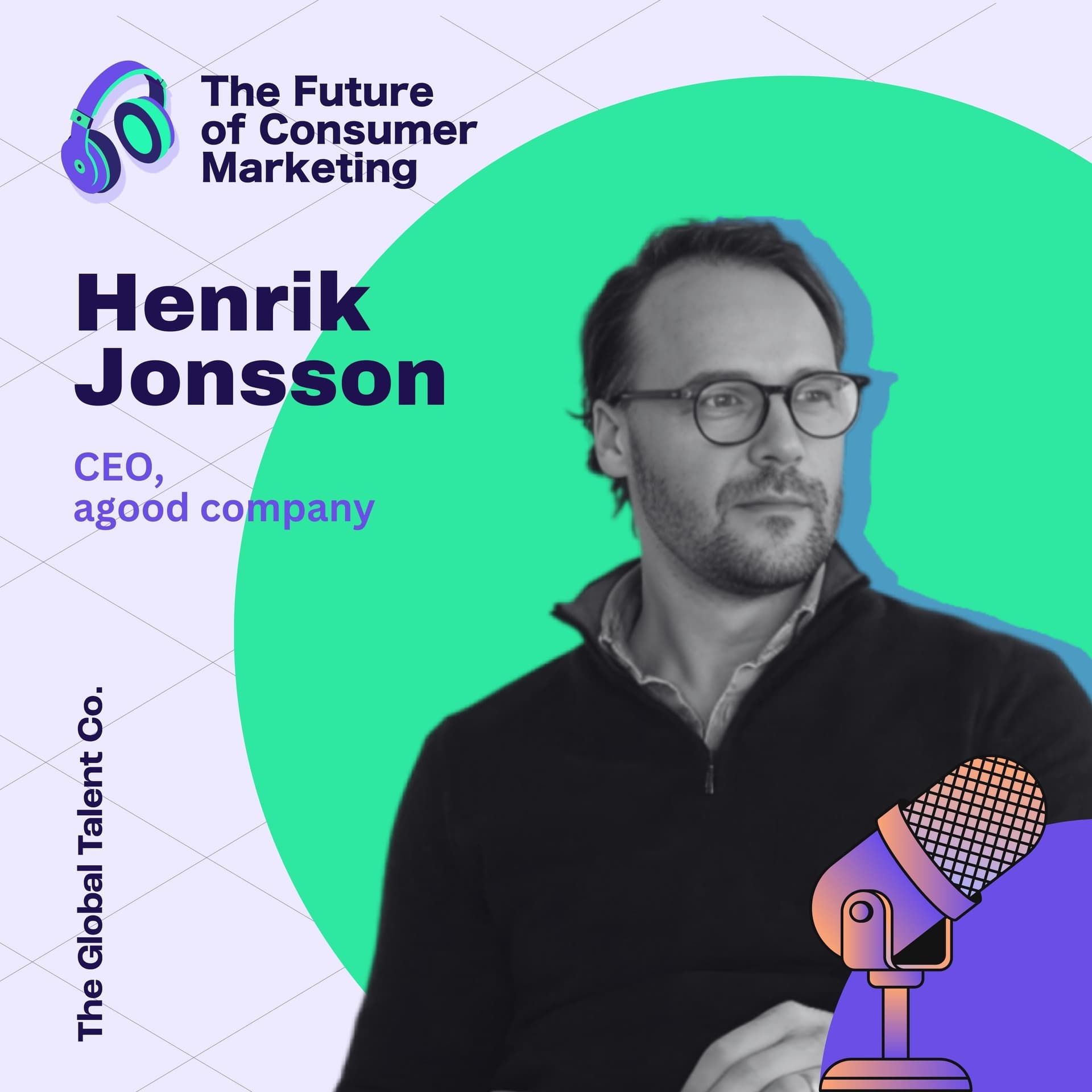
Henrik Jonsson, CEO of Good Company (joined 2020; company founded by Anders and Ramquist brothers, commercial launch 2019). No other guests mentioned.
Key claims
Consumers largely won’t pay a premium for circularity; circular products must compete on price, quality, design, and brand. “Biodegradable” isn’t enough if it can’t be recycled; “recycled material” only matters if it stays in a circular loop. Profitability is a “hygiene factor” to sustain circular partnerships.
Notable examples
A provocative social post about a US factory opening was pulled after backlash. Product focus: phone cases (core), plus drinkware/water bottles (recycled steel), coffee towels, and stone-paper notebooks/brass pens. Revenue mix: D2C 15%, retail 60%, B2B/corporate gifting 10%, collabs 5–7%, ODM (e.g., co-branded Motorola cases) remainder.
Written by AI. May contain mistakes. Listen to the episode to check what was said.
Chapters
Tap a time to open that second in VOInnovating Consumer Products
0:35 to 1:12
Discover how Good Company focuses on innovation and sustainability in consumer products.
“So tell me, what's so special about a good company?”
Product Portfolio and Market Focus
1:12 to 2:26
Explore Good Company's product offerings and their target market strategies.
“Yeah, so the company was established by Anders and two brothers named Ramquist in 2019.”
Consumer Misconceptions and Pricing
2:26 to 3:58
Understand the myths about sustainable products and consumer pricing expectations.
“So basically, from the beginning, we thought that consumers were going to be quite educated within this.”
Transparency in Sustainability
3:58 to 5:31
Learn about the challenges of marketing sustainable products and the importance of transparency.
“But I mean, first of all, mass market, I mean, the whole market is our customer segment because more or less everyone uses a phone case.”
Marketing Strategies and Challenges
5:31 to 7:45
Find out effective marketing strategies and the importance of brand positioning.
“And I think we just need to be aware, I mean, first of all, biodegradable material.”
Profitability and Sustainability Balance
7:45 to 10:25
Explore how Good Company balances profitability with sustainable practices.
“What we wanted to say with that is that, I mean, we established our local production in the U.S.”
Team Dynamics and Recruitment
10:25 to 12:52
Gain insights into Good Company's team setup and recruitment strategies.
“So is that something that you proactively communicate to customers or do you feel that this is something that you shouldn't be talking too much about?”
Marketing Team Structure and Channels
12:52 to 14:00
Learn about the structure of Good Company's marketing team and their distribution channels.
“And then both of you, both the employee and ourselves, can we add if they're a good match or not?”
Marketing Team Structure and Strategy
14:00 to 14:42
Learn how the company structures its marketing team and identifies revenue channels.
“The marketing team, that was another question, right?”
Revenue Channels Breakdown
14:42 to 17:08
Discover the five different distribution channels and their revenue contributions.
“So what we did do about one and a half year ago, we were kind of zooming out to say, okay, which channels for us?”
Show all 15 chapters
Market Differences and Sustainability
17:08 to 18:44
Explore the variations in market maturity and consumer attitudes toward sustainability.
“And that will mainly come from kind of market expansion geographically.”
Changing Consumer Perceptions
18:44 to 20:54
Understand the challenges of converting skeptical consumers to sustainable products.
“And we can compete on price, lead time, anything.”
Personal Motivation and Business Impact
20:54 to 21:45
Hear about the founder's motivations for creating a sustainable business model.
“Like talking about your motivation to build this business?”
Technology Trends and AI in Marketing
21:45 to 24:14
Learn about AI's impact on marketing and the importance of sustainable practices.
“Let's briefly talk about technology and some of the big trends that you see on this intersection of marketing and technology.”
Advice for Entrepreneurs
24:14 to 25:32
Gain insights on the emotional resilience needed for entrepreneurship.
“But I think every entrepreneur needs to be aware that it is, everyone tends to say, oh, it's a tough journey to start a company or to run a startup.”
Transcript
Automatic transcript. May contain errors.0:00This show is brought to you by the Global Talent Co, a marketing leader's best friend in these times of budget cuts and efficient growth. We help marketing leaders find, hire, vet and manage amazing marketing talent for 50 to 70 percent less than their U.S. and European counterparts. To book a free consultation, visit globaltalent.co. Hi, everyone, and thanks for listening to the Future of Consumer Marketing podcast today with Henrik Jonsson, CEO of Good Company. Henrik, it's a pleasure to have you. Thank you. And thank you, Roman. And thanks for having me. Yes, of course. So tell me, what's so special about a good company?
0:38Yeah, it's a very good question. So I think, I mean, basically what we're trying to do is innovate consumer products that we tend to consume or that is a kind of unnecessary products that we need to have in our lives. And we try to innovate them or replace non-sustainable. I would try to avoid to use the word sustainable because I think it's misused sometimes. But we focus on producing a circular product. That's the kind of the main agenda we have when it comes to innovate new consumer products. And what kind of products are you kind of doubling down and focusing on? Yeah, so the company was established by Anders and two brothers named Ramquist in 2019.
1:22or actually 18, but had a commercial launch in 2019. And I joined them in 2020. So it was a very early stage. By that time, I mean, the portfolio was quite or became quite wide as it was a kind of a trial and error mindset. So we have done everything, but we still have some left. T-shirts, we have done underwear, socks, we have done toothbrushes. But the core products since start and definitely now is mobile accessories. mainly phone cases. It's a drinkware, coffee towel and water bottles made of recycled steel. And then stationery, which consists of stone paper notebooks, brass pens, etc. So right now, three categories is core and the rest is a kind of a legacy.
2:10What we have been through kind of your ideal customers, why are they excited about, you know, buying your products? Is it more out of the sustainability, guilty, guilty, cautious, or are there other things that you kind of emphasize with your products as well? Yeah, I will give you a long answer on that. I hope that's okay. You have to cut. So basically, from the beginning, we thought that consumers were going to be quite educated within this. I mean, what is sustainable and what is not? And what is greenwashing? And also, by that time, in early 2020, all the surveys you could get were saying that consumers are willing to pay a premium price for a sustainable or a circular product.
2:52And we went into that trap, I would say. We spent a lot of money to innovate, develop products, and they become a bit more expensive than a non-circular or non-environment-friendly product. And that also resulted that we needed to charge a higher price. Then, for a couple of years ago, we realized that this is just bullshit. Consumers don't pay attention to, I mean, some do pay attention to sustainability or circularity, but the mass market are not willing to pay a premium price for that. And we also realize that we're actually competing in the same play field as anyone else in the same categories or same industry.
3:30That might sound a bit silly, but I think most of the industries or companies have tried to do something innovative when it comes to circularity, product innovation, etc. They might be kind of thinking inside the box. And I think there was kind of a wake-up call when we realized that that is not the case. We can't charge a premium price. So basically, our mission is to introduce circular consumer products in a seamless way. And that kind of sentence adds for a lot of things, at least for us. But I mean, first of all, mass market, I mean, the whole market is our customer segment because more or less everyone uses a phone case.
4:09So everyone should be using recyclable or stainless steel water bottle instead of using single-user plastic bottles. But we can't charge a premium price just because of its circular or because of the phone cases made in Sweden for the European market. It doesn't work like that. And especially with the macroeconomic situation we are experiencing around the world. So we managed to kind of improve our production process and also managed to introduce much lower price points where we actually can charge up a higher price if the products and the product quality features are much better than the competitors.
4:46But you can never charge a premium price just for the sake of that is a more kind of a circular product. Yeah, that's a great point. So it needs to be circular, but also, you know, the value for money needs to be there without the circularity as well, right? So I think that's a big thing, generally, with sustainable products. What are other big myths that you feel you want to clarify about also marketing sustainable products? Yeah, I mean, before I do that, I have to say, I mean, we are not perfect. And if you try to go after us, you will probably find mistakes. We do mistakes every day. But I think what we are doing is being as transparent as we just can.
5:22We're trying to tell everywhere we produce the products, why we produce it, what raw material we're using, how we ship, etc. But we also do mistakes, and we are not perfect. But with that said, I think there are several challenges when it comes to established companies trying to transform their non-sustainable product or production into sustainable. And I think we just need to be aware, I mean, first of all, biodegradable material. In general, when you see compostable phone case of biodegradable, I think that's one of the most obvious ones. Everything more or less in the world is kind of biodegradable, even a fossil plastic phone case.
5:59but it shouldn't stay in the environment. That should be recycled. But normally you can't recycle a phone case that is made of fossil plastic. So I think that's the top one. Another thing tend to be products that state that is made of recycled material. That might be good, but it's not 100 % sure that it's a good choice. Because when you produce a product, if it doesn't make sure it's circular, so if you take our phone case, for example, That is partly made of upcycled material, this transparent case. But it doesn't really matter because even though it's made of that, we need to make sure it's circular, that we can actually bring back this phone case, regrind it and produce a new one.
6:40Then it's starting to make sense. If we were just producing a phone case made of recycled material, and then when it's used, it will go to waste, then it doesn't make sense, right? So one place number two is the kind of the statement of using recycled material. It needs to be recycled material, but in a circular loop. So you can bring the product back, regrind it or melt it down and produce a new one. Okay, got it. And in terms of kind of focusing on the marketing side of things, what are some of the things that you figured resonate in terms of marketing strategy, in terms of marketing tactics that you wouldn't have expected to resonate?
7:20It's a very good question. I mean, sometimes to be kind of provocative is good for getting a kind of viral spread. And we just had, we did just experience something yesterday where we were making a big fun of all that. They do a quite big thing on that they were opening up a factory in the US and they were kind of giving away a gold in the glass thing to dollar prop. We actually made a post to make fun of that yesterday, and it didn't come out that well. What we wanted to say with that is that, I mean, we established our local production in the U.S. like five months ago. That was a project started like 18 months ago.
7:59So we have our third factory. Our third factory is placed in the U.S. and Texas. But what I wanted to say with that is that, I mean, you need to be provocative, but you also need to be aware that there's a lot of consumers that want to go after you and kind of. So, I mean, that post we did, we needed to take it off because we got so much critics because we were kind of resonating or bootlicking on Donald Trump, which was absolutely not the case. We just wanted to highlight that actually you can have local production in the US without mentioning it. So I think back to that, I mean, it's a very traditional quarters 4P, price, placement, product, promotion.
8:41All this needs to be allowed. And you don't think that the true sustainability message or USP is a USP. It might be something that can tip over and be the reason to purchase a product, but that's quite low in the hierarchy. I mean, still at the top, you have the pricing, the brand recognition, the positioning, etc., etc. product quality, not least design. These are still the kind of the most important features. Okay. And how do you balance kind of the authenticity and kind of the profitability? Because that's obviously also kind of a lot of times a challenging contradiction, at least from a consumer perspective, right?
9:20Where people say, oh, you know, you shouldn't be too profitable and Patagonia has gone a certain way, but how do you balance that? Or is that not an issue at all for you? No, I think for the mass market, it's a very relevant question. To be honest, we haven't been profitable. This year might be the first year we're actually profitable. But I think what everyone needs to be aware of, I mean, we need to do this transformation globally. We need to stop consuming single-use product and we need to reduce our CO2 footprint. We also need to be aware that we are all existing in a market economy around the world, right?
9:52Well, that means that we need to support companies that do profit. I mean, that's part of the whole kind of circular proposition. A circular proposition or a sustainable proposition is just not about the product itself. It's about how you produce it, that your company is actually profitable so you can pay salaries in a fair way that you hopefully can give back in terms of charity. But this is a kind of a balance, but definitely companies need to be profitable and consumers need to allow sustainable companies to be profitable. It's a hygiene factor. Okay. So is that something that you proactively communicate to customers or do you feel that this is something that you shouldn't be talking too much about?
10:35No. In the beginning, we were a bit more shy about talking about profitability. We don't really talk about profitability in our market communication, but we are very obvious to our partners that we say we need to be profitable. But otherwise, first of all, we will not be a sustainable partner for you because we will sooner or later die. But also to be profitable means that we can reinvest also in kind of further invent or redevelop products that are not sitting in our product portfolio, but that might need to be placed by a sustainable product. And tell me a bit about kind of your team setup. What are the things that you feel are working well when recruiting talent?
11:16Yeah, I mean, we are still a small company. We are about 20 people employed. We're trying to mix the culture and get the inspiration for as many different kinds of countries as possible. I think we have more than five, six, seven countries represented within the company, background-wise. We have half of the team based in Stockholm, and the rest of the team is spread around Europe and Asia. I think when it comes to recruiting the right type of people, I mean, one trend that is Coming stars, and what I mean by that is kind of very, I mean, attractive employers or skilled employers. They need to be attracted by, I mean, the business and how we operate and the positioning of the brand.
11:58I think that is becoming more and more important than it has been ever. I mean, just looking to Spotify or whatever it could be. I mean, these employees, they're super proud to be employed by Spotify. They dress, I mean, it's a new kind of fashion brand, right? They are dressed in Spotify clothing or merch because they are proud of being with them, right? And I think that's kind of a philosophy we just need to adopt to. And that will be so important to be able to recruit, I mean, skilled people going forward that your company is authentic and is not just attractive from, I mean, compensation point of view, also from a kind of purpose driven point of view.
12:38Okay. We have been very lucky when it comes to this. We have a very clear kind of positioning of where we're heading, what we want to do, and a kind of global growth. But still, you know, try to offer as many as possible to come and join you. And then both of you, both the employee and ourselves, can we add if they're a good match or not? No, that makes sense. So how is your marketing team unstructured these days? Like what are some of the channels that you kind of, when you went in, you doubled down on what are some of the channels that haven't been working that well from your point of view? Yeah, I think one thing that we kind of need to embrace is that this was actually coming from an article I was reading about the HR director from Netflix.
13:20And her kind of philosophy was that they are kind of re-evaluating the organization every year and that it's kind of a football team. You need to optimize the team based on what the purpose are, what stages the company are. And I think that to some extent it makes sense. On the other hand, you also need to look after the team for sure. But we shouldn't be that nervous to make sure we always can kind of feed our employees that they are kind of attracted by growing within the company. If you can't offer that, then it might be a mismatch, right? And I think that we just need to embrace. So that's one part of that.
14:00Yeah. Okay. The marketing team, that was another question, right? Yeah, exactly. So how you structure the team, basically. Yeah. So the marketing team is led by our marketing director, which are actually coming from a more of a creative background. He's been working for Klarna in the past and also for different kind of agencies. And he's operating the marketing team, which are then consisting of asset creation and also online asset creation. I think we have managed to mix that team with experience from our director point of view but as well with a very, very skilled asset production. And that tends to work well for us.
14:41But that's a quite new constellation since like one and a half year ago. So what we did do about one and a half year ago, we were kind of zooming out to say, okay, which channels for us? Because we're operating in five different type of distribution channels. Which are those five distribution channels? Yeah. So obviously it's D2C, our web page, which stands for about 15 % of our total revenue. Then we have retail, which stands for the majority, which stands for about 60%. Then we have something what we call B2B or corporate gifting, which stands for about 10%. Then we have collabs. So collabs we do with, for example, factor brands like Saint Laurent, Chloé, Ghani, Kulamabhiret, whatever.
15:24That stands for about 5-7%. And the remaining is for ODM. So, for example, we worked directly with Motorola globally. We reproduced their phone cases, co-branded Motorola and a good company. What we did do by that time was zooming out and say, okay, where is the revenue coming from? Where do we have right now the best potential of growing? And then we identified that and said, okay, but then the organization by that time need to reflect how we are going to support these revenue streams. So if 60 or 70 percent of our revenue coming from retail, then we need to make sure that we have the resources to support that distribution channel in a proper way.
16:05And that did have a quite tremendous shift in terms of how our organization was kind of made. So, yeah. Okay. And what's an indication of the growth and the size of the business where it is now? And what's your ambition level kind of zooming out for the next three, five years? Yeah, so 2023 was kind of hard for us. We were actually losing and decreasing revenue. We came back to growth last year. We had a growth of about 25%. And also, we were not profitable, but we stopped the bleeding. And this year, we are most likely coming in on a growth of about 20 to 30%, but with profit. So we are coming in with a result that most likely going to be about one and a half to two million euro better than last year with just 20 to 30 percent growth.
16:53We have a very decent five-year plan, which we have four years left on that five years plan. And we are pacing very much according to that, which where the targets are to reach about 50 million euro revenue in 2029. And that will mainly come from kind of market expansion geographically. Okay. Do you see big differences between the markets at the moment when you do the research in the markets that you're active when it comes to the embrace of sustainable products or in terms of demographics, in terms of consumer? Yeah, I mean, definitely. I mean, some markets are much more mature than others. But still, I would say the lion part of the consumers.
17:40I mean, if you take Sweden or Spain or East Europe or US, I mean, if you are a bit provocative, I would say 80 % doesn't really care of the consumers. And I would say the percentage is more or less the same across everywhere, right? But for us, it's more like a hygiene factor. That's what I did say earlier in our conversation. Our mission or vision is to do the kind of introduction of circular consumer products in a kind of seamless way. So even though some markets are more mature than others, I mean, every market consumes phone cases. We want to replace them with other products, but with the same price or even a lower price, but a much more attractive proposition and much more environment healthy from a circularity point of view.
18:26But definitely, there are definitely differences from a matureness. Okay. What's the one thing about just generally the market and the market circumstances that you would want to change if you could? Certain things that bother you in terms of dynamics in terms of where the market is going? Yeah, it's a very good question. I mean, if we would be able to change something, that would be to get everyone to understand that, I mean, we have a proposition that can replace any other phone case, and we are the only one that's managed to produce a 100 % circular phone case proposition, either it's a transparent case or a solid color case.
19:06I mean, for me, it's a no-brainer. And we can compete on price, lead time, anything. We are, I mean, equal or better. So if I could change something, that would be an instant replacement of single-use phone cases, for example. Okay, interesting, interesting. You know, how do you turn, because obviously there is, as we've talked about different markets, there is already a certain share of the consumers that understands the value and the benefit also for society as a whole of kind of, you know, buying sustainable, recyclable products. How do you capture the skeptics? I don't know what the percentage is.
19:41You have the numbers. is like 30, 50, 70, but there are people who are skeptical. How do you capture those? For that, I think it's coming back to the kind of seamless transition. We don't have time to convince skeptical people, right? We know that it's fact. The CO2, we will not wake up tomorrow and say, fuck the CO2, it's fine. We can increase the consumption of that, or we can increase the consumption of fossil plastic. I mean, that will unfortunately not happen. So we can't wait on people that is skeptical on that fact. So we as a company need to be innovative enough and make sure that the products we are introducing are attractive to the skeptical people or attractive to people that don't really care.
20:26Because, I mean, sooner or later, they will consume a phone case that is transparent or solid color or wallet for a phone case. We need to make sure that that kind of transition happens seamless. That's how we can boost this because we don't have time to wait, right? It needs to happen now. The common generation will suffer a lot if we don't really take our responsibility as an innovative company and make this transformation or transition seamless. Yeah. Is that what's driving you? Like talking about your motivation to build this business? What is that motivation? That is the motivation. Two things.
21:01First of all, I mean, when I joined a good company, before that, I was a global sales director for an international company and kind of visiting two countries a week. And I realized that, I mean, if my kids will ask me, what did you do to make the world slightly better? I couldn't say that, you know, I was trying to sell fossil plastic phone cases around the world. I mean, that wouldn't make sense, right? So this is a way for me to try to be slightly better, to invest my time, my effort, and some of the money into something that will not change the world, but hopefully it will kind of support other companies, other entrepreneurs to go this path because we don't have another way to go.
21:44Yeah, makes sense. Let's briefly talk about technology and some of the big trends that you see on this intersection of marketing and technology. Obviously, AI is a big thing. Maybe you can say a word or two about how you use AI in your context, but also what are some of the other undervalued and underappreciated trends that you've seen in the market? Yeah, I mean, first of all, when it comes to AI, I think I personally are a late adopter to some extent, but I'm shocked by how impactful AI are. And I'm definitely aware that the AI and every search or task I give to ChatGPT is consuming a lot of energy.
22:25So we need to be aware of that. I think there are a lot of critics around that. And I think it makes sense because it's consuming a lot of electricity. We need to make sure that electricity are sooner or later, as soon as possible, becomes renewable resources for even the AI facilities. But I mean, AI is here to stay, right? And we're trying to incorporate as much as we can and where we think it really makes sense, but in a cautious way, because overconsumption of AI right now is not sustainable. So I think it's a balance, but we need to try to be smart and incorporate where it really makes sense, save time, and hopefully save, becomes a bit more efficient.
23:11I think otherwise, when it comes to trends from a technology point of view, as I said, I'm a late adopter, so I might not be the right guy of answering that. But I think in general, when it comes to the protection facilities we have, they are very much up to date. But it's also a lot of things that are happening in the protection facilities. How we can further improve, be more efficient, consume less electricity or heat in the mold injection machines, make sure that the factories we're using are only using renewable energy resources. I think all of that we just need to pay attention to and we need to embrace that even though it might be a long way to go or a bit harder, but you need to kind of demand that from your partners of using these trying to be as kind of sustainable as possible.
24:05And renewable energy is definitely one of these sources that can reduce the CO2 consumption, at least for us when it comes to production ones. yeah no 100 makes sense if you could give kind of one piece of actionable advice that's a question we like to ask in the end you know for entrepreneurs and for people who want to break into this whole sustainability category what kind of advice would that be what would you like to have known five years ago yeah i tend to say this is not connected to the sustainability proposition or circularity. But I think every entrepreneur needs to be aware that it is, everyone tends to say, oh, it's a tough journey to start a company or to run a startup.
24:48Yeah, it is. But I think the hardest thing is the kind of emotional up and downs. I mean, one day... Mental resilience. Exactly. You need to be prepared of that. That's part of this journey. And also, when you get a new problem, just be aware, the larger the problem are, is when you're out from them or when you have overcome them, you're closer to the big breakthrough. And that's natural. I mean, that's how it is, right? And there will be days you think you are the king of the world. Next day, you will think, okay, shit, I have to close my laptop and go back home and find something new. That's the kind of emotional rollercoaster you will experience.
25:27And that's normal. That's part of the journey. But don't give up. That's the thing. Is there any advice from your career of how you kind of, you know, still come through? Because I see a lot of entrepreneurs and also CEOs kind of at some point in time, either burning out or, you know, just giving up too early. Yeah, I think, I mean, as we started off saying that I'm starting to be old, but one of the glories of being 43 and have had a lot of different type of challenges during my life so far. I've also learned how, I mean, what tools do you have to try to become a bit more stable? Like we know, for example, sleeping eight hours, that's very good for me.
26:07It might be good for a lot of other humans as well. Physical exercise, gym, running or sports. I mean, that really, really helps you to reduce the stress levels. Alcohol, for sure, that is not something good that helps you to reduce stress. Try to avoid that as much as possible. and then be a good guy or a good girl. I mean, don't be an asshole. Yeah, that's a very good general rule of life, I guess. Yeah. Think so, be nice. And also people tend to do business with, I mean, nice people. No, that's, I think, such a nice way of closing the conversation. Plus, you know, belief in karma. So, Henrik, it's been a pleasure having you on the show.
26:47Thank you, Roman. And thanks for good questions.
Read the full transcript
26:55you
From the publisher
In this episode of The Future of Consumer Marketing, host Roman Kirsch interviews Henrik Jonsson, CEO of agood company. Henrik shares the brutal reality of marketing sustainable products in a mass market that claims to care about sustainability but refuses to pay premium prices for it. Through painful lessons learned over five years, agood company discovered that circular products must compete on traditional value propositions—price, quality, and design—rather than relying on sustainability as a differentiator. Operating across five distribution channels and generating revenue through D2C, retail partnerships, corporate gifting, brand collaborations, and ODM partnerships, the company has evolved from a trial-and-error startup to a focused business targeting 50 million euros in revenue by 2029.
Topics Discussed- Debunking the myth that consumers will pay premium prices for sustainable products
- Building a "seamless transition" strategy to replace non-circular products at competitive prices
- Operating across five distinct distribution channels with different marketing approaches
- Scaling from startup losses to profitability while maintaining circular production principles
- Managing provocative marketing campaigns and handling social media backlash
- Recruiting purpose-driven talent in competitive markets
- Balancing transparency about imperfection with authentic sustainability messaging