In short
Future of Consumer Marketing: Breaking Through LinkedIn's Noise
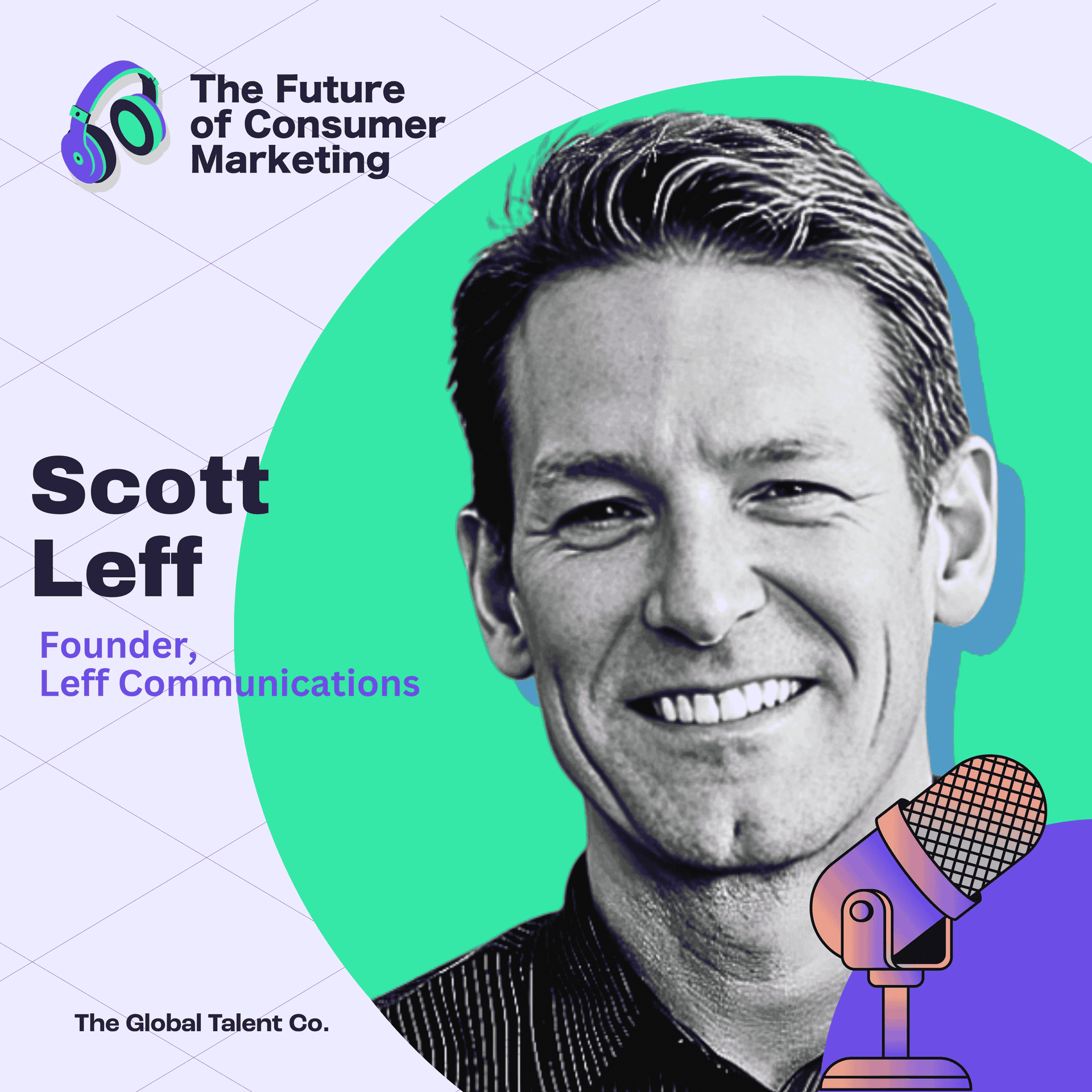
Episode Overview In this episode of *Future of Consumer Marketing: Masterclass Edition*, host Andres Figueira interviews Scott Leff, the founder of Leff Communications, a content marketing agency that has grown from a solo operation to a 30-person team serving global B2B clients. Scott shares insights on building authority through content, overcoming algorithmic noise on platforms like LinkedIn, and adapting to the AI-driven content landscape.
Key Topics Discussed
- Building a content marketing agency from freelancer to a 30-person team
- Navigating market positioning without fitting into traditional agency categories
- Rapid scaling during COVID-19 and adjustments in a post-pandemic world
- The evolution of LinkedIn and challenges in breaking through algorithmic noise
- Systematic experimentation with generative AI tools across various departments
- The tension between AI-generated content and authentic human connection
- Utilizing video content as a differentiation strategy on social platforms
Summary of Key Insights
- Building a Content Marketing Agency
- Scott leveraged experiences from his work at McKinsey and the Chicago Olympic bid to launch Leff Communications.
- Initially started as a freelancer, Scott emphasized the importance of networking and understanding market demands.
- Market Positioning
- Leff Communications differentiates itself by not being a traditional marketing or PR agency but positioning as subject matter experts.
- Defining a niche is crucial for growth, especially in a crowded market with established competitors.
- Growth During COVID-19
- The pandemic resulted in a surge in demand for digital content as clients shifted from in-person to online communication.
- However, rapid growth posed challenges, necessitating a balance in managing client expectations and resources.
- LinkedIn's Algorithm and Noise
- LinkedIn's platform has evolved, making it challenging to connect with target audiences amid excessive content.
- Companies struggle to cut through the noise due to an influx of unsolicited marketing content.
- Experimenting with AI
- The agency has been conducting systematic experiments with generative AI tools to explore their applications in content creation.
- AI is found to be strong in research but lacks in creating nuanced, longer-form content, underscoring the importance of human input.
- Importance of Authentic Connection
- There is a growing tension between AI-generated content and the need for authentic human engagement.
- Video content is emphasized as a powerful tool for establishing personal connections on social media platforms.
- Future Considerations in Marketing
- Scott raises the idea that a return to more personal, face-to-face interactions could be beneficial as digital channels become saturated.
- The discussion suggests a potential revival of "analog" experiences as consumers seek more genuine connections.
Conclusion Scott Leff's insights highlight the complexities of modern consumer marketing, particularly in the B2B space. By focusing on authenticity, strategic content creation, and leveraging technology, businesses can navigate the challenges posed by evolving platforms like LinkedIn and the rise of AI.
Contact Information
For more on Scott Leff and Leff Communications
- Website: [lefcommunications.com](http://lefcommunications.com)
- LinkedIn: [Scott Leff](https://www.linkedin.com/in/scottmleff/)
Final Thoughts This enlightening conversation underlines the evolving landscape of consumer marketing, emphasizing the need for businesses to adapt while maintaining genuine connections with their audience.
Written by AI. May contain mistakes. Listen to the episode to check what was said.
Chapters
Tap a time to open that second in VOIntroducing Scott Leff: Background and Motivation
1:14 to 2:30
Scott Leff shares his background and what motivated him to start LEF.
“And today, with me here, I am speaking with Scott Leff, founder of Leff, a content marketing company that creates content that moves a needle and strategies that move audiences.”
Establishing LEF: From Concept to First Client
2:30 to 4:42
Scott discusses the journey of starting LEF and acquiring the first customer.
“He said, we have an opening on the quarterly, why don't you join us?”
Defining the Niche: Marketing Strategy
4:42 to 7:30
Scott explains the process of defining his agency's market niche.
“I think like a lot of people, when they're finding their way through it, for me, reaching out to people and having conversations was informative.”
Growth During COVID: Challenges and Adjustments
7:30 to 7:56
Discussion about the rapid growth of LEF during the COVID pandemic.
“We understand the topics that you're writing about.”
International Expansion: Serving Global Clients
7:56 to 10:40
Scott talks about expanding LEF's services to international clients.
“And we were, things really grew quickly once COVID hit because a lot of our clients couldn't travel anymore.”
Growth Philosophy: Balancing Size and Client Needs
10:40 to 12:13
Scott reflects on his growth philosophy and future aspirations for the agency.
“mentioned that you're 30, are you looking to expand or have you found a sweet spot where everybody is working appropriately with the workloads and how much you're receiving as demand?”
B2B Marketing Strategies: Understanding Client Relationships
12:13 to 14:00
Scott discusses B2B marketing strategies and the importance of client relationships.
“And Scott, I just got to know, how many clients do you have at the moment?”
Navigating Multi-Channel Marketing Strategies
14:00 to 15:00
Learn how to effectively engage clients across various channels.
“to ensure that the investments they make are going to be the right ones.”
Understanding Client Needs on LinkedIn
15:00 to 16:00
Discover the importance of understanding clients' business challenges on LinkedIn.
“And then they need to be able to present solutions to them that are going to move the needle for that client.”
The LinkedIn Dilemma: Balancing Networking and Promotion
16:00 to 18:30
Explore the challenges companies face in using LinkedIn for effective outreach.
“If you want to reach, say, the CIOs of the Fortune 500 companies, You can figure out a way to reach them on LinkedIn.”
Show all 15 chapters
Experimenting with Content: The 30-Day Challenge
18:30 to 22:00
Hear about a firsthand experience of posting regularly on LinkedIn and its effects.
“straight, then the algorithm is going to take notice and it's going to start boosting your content in people's feeds.”
Integrating AI in Marketing: A Double-Edged Sword
22:00 to 26:20
Understand the role of AI in content creation and the human connection needed.
“And so I think it's something that lots of companies should be considering.”
The Return of Analog: Personal Connections in Marketing
26:20 to 28:00
Discuss the potential resurgence of tangible experiences in a digital world.
“For example, if LinkedIn is given priority to user generated content or more do it yourself videos and selfies, I feel that's the replacement to what we used to live in the older ages.”
The Resurgence of Analog in a Digital World
28:00 to 28:52
Explore the growing appreciation for analog products as a counter to digital convenience.
“And it may look completely different than what a lot of companies are doing right now.”
Closing Thoughts and Gratitude
29:18 to 29:56
Reflect on the episode's discussions and express appreciation to the guest and listeners.
“We can share the best practices that we've accumulated from serving top global clients.”
Transcript
Automatic transcript. May contain errors.0:00Scott Leff:We serve global companies from top consulting firms and B2B companies to some work with large non-profits.
0:06Andres Figueira:How much time did it pass until you got your first customer?
0:09Scott Leff:Three or four months. Part of that was understanding where the market was at the time. At a certain point, you have to narrow your focus, and then that's where I think it starts to become more of a business. How did you market yourself to be able to get those customers that you wanted? We had to define ourselves in the marketplace as we're not a traditional marketing agency. We don't do PR necessarily, but we are subject matter experts. We understand your business. We understand your audience. We understand the topics that you're writing about.
0:41Andres Figueira:Hey, everybody. Thank you for tuning in. My name is Andres Figueira, and I'm going to be your host for the day. This show is brought to you by the Global Talent Company, helping fast-growing teams hire exceptional remote talent from Argentina, South Africa, and beyond. We connect companies with world-class professionals who bring skill, reliability, and a global perspective to every role. And just for our listeners, we're offering an exclusive 10 % discount on your first hire. All you need to do is visit GlobalTalent.co, click Start Hiring, and mention the podcast listener discount when we reach out.
1:14Andres Figueira:And today, with me here, I am speaking with Scott Leff, founder of Leff, a content marketing company that creates content that moves a needle and strategies that move audiences. And with that said, Scott, how's it going? Welcome to the show, man. Hey, good to be with you. Thanks for having me on. Oh, no, it's a pleasure. It's a pleasure. And Scott, just so that we can get the audience a bit more in context as we start the episode, would you be able to tell us a bit more about your background, what created you and motivated you to found LEF, and in your own words, what LEF does? Sure.
1:46Scott Leff:It really all started with music. I was a musician in a former life and moved to Chicago to pursue that. When I was focused on music, I took a two-day temp job at McKinsey & Company in the mailroom and ended up getting hired on in the mailroom. And I figured I'm going to stay there until my music career takes off. It should only be, what, six months or so. and I stayed there for a while, made my way to different jobs and actually music took me to the publisher of the quarterly, the McKinsey Quarterly at the time, which was the Journal of Management and Economics. He was a musician, so I got to know him through music.
2:23Scott Leff:We played guitar together in the office and when I was ready to make a shift to more of a business career, I said, can you give me any advice? He said, we have an opening on the quarterly, why don't you join us? Very serendipitous and I spent seven years with the McKinsey Quarterly, learning about business publishing, professional services, a range of industries that they cover. And I eventually made it to managing editor of the Quarterly, left McKinsey to go work for Chicago's Olympic bid. The city was bidding for the 2016 Olympics. You might remember Rio 1, no hard feelings, but that exposed me to a whole different kind of marketing and communications.
3:02Scott Leff:I'm trying to reach a variety of audiences from general population to businesses to the Olympic movement. And to do that required reaching out to people on different channels with different formats, live presentations, official bid submissions, more of a campaign style environment. So when Chicago unceremoniously lost in the first round of the competition, I had to think about now what am I going to do? And I wanted to take what I learned at McKinsey about business publishing and combine it with the type of communications and marketing to different segments that I'd been exposed to in the Olympic bids.
3:38We've grown to about a 30-person agency.
3:41Scott Leff:We serve global companies from top consulting firms and B2B companies to some work with large nonprofits. The through line there is that they all have audiences they want to communicate with. They have stories to tell. They have experts who have great insights. And our company's job is to be a translator, really, for them to ensure that the audiences they want to reach understand what they're selling, why they have something compelling to say. And so then that spans everything from writing and editing to graphic design, to multimedia production, to some content strategy. And so it keeps things interesting for sure.
4:19Andres Figueira:I love how the different experience that you gathered along the way was what ended up motivating you to create. And Scott, in terms of once you decided and conceived the idea to go just branch out on your own. And until you got your first client, how much time spanned in that segment of your life? Like you decided to create left. How much time did it pass until you got your first customer?
4:42Scott Leff:That's a good question. I think like a lot of people, when they're finding their way through it, for me, reaching out to people and having conversations was informative. So I started to tap into my network, the people I've worked with at McKinsey, the people I knew from the Olympic bid. And as I was talking with them, some doors opened. And so I think it was probably about three or four months of having these conversations. Part of that was understanding where the market was at the time. This was early 2010s. And I started the company at a fortunate time because there were lots of potential clients who were reaching beyond their in-house staff.
5:23Scott Leff:and they were looking for additional writing help or design help. Whereas previously they might have preferred to hire people internally, they became much more comfortable with reaching out to freelancers. I started as a freelancer for a couple of years until I got busy enough that I realized the math doesn't work anymore. I need to bring on people. And then it was a slow roll from there. I think any founder who suggests they have a master plan for how this is going to go is probably changing what actually happened because there are so many twists and turns. You just don't know how to talk about yourself initially, what people are going to pay you to do.
6:01Scott Leff:So you say yes to everything. Okay. And at a certain point, you have to narrow your focus. And then that's where I think it starts to become more of a business because you have to be thoughtful about who your audience is, what their needs are, how you communicate that instead of being all things to all people, which I think at a certain point is no longer a recipe for growth.
6:22Andres Figueira:I understand what you mean. And that actually leads to another question that I have is that once you began and you started, when you determined what you really wanted to be like your niche industry or with whom you wanted to work, how did you market yourself to be able to get those customers that you wanted? It was definitely a process.
6:40Scott Leff:And I think that it probably took three or four years of a little bit of trial and error to start to understand where we were playing in the marketplace and how we fit in. One of the things that was challenging for us is that most companies of a certain size have a marketing agency that they've retained. Many of them have a public relations firm that they work with regularly. And as you probably know, when a company has a trusted vendor, they'll go to them for more than just their expertise. They were starting to go to marketing agencies for content creation or public relations firms for some thought leadership.
7:20Scott Leff:And so we had to define ourselves in the marketplace as we're not a traditional marketing agency. And we don't do PR necessarily, but we are subject matter experts. We understand your business. We understand your audience. We understand the topics that you're writing about. And so that took some time just because anytime there's not an existing niche in the market or a definition or a point of reference for people, it can take a little bit more time for them to understand what you do and why they need it.
7:46Andres Figueira:Scott, you mentioned that right now the whole endeavor that you have with the agency, it has become into a 30-person team, the one that you're managing.
7:55Scott Leff:Yeah, yeah, that's right. And we were, things really grew quickly once COVID hit because a lot of our clients couldn't travel anymore. the way that they were going to communicate with their current clients and prospective clients was through digital media. So lots of reports and articles and white papers and videos and things like that. And so we grew quickly. Anybody who's run an agency and has grown quickly understands that there are benefits and then there are some challenges that come with that. And I think like a lot of companies, Peloton comes to mind. During the pandemic, they grew very quickly, right?
8:32Scott Leff:And And they were scaling to please the shareholders and investors, thinking that the habits of COVID were going to continue indefinitely. And obviously, once people started getting outside again, they didn't want to spend time at home on their stationary bike if they didn't have to. And so the market changed. I think a lot of companies that we serve and a lot of agencies like ours then had to adjust a bit to say, OK, we are scrambling to take care of this huge spike in demand. And that was a challenge. Now that's receded a bit. We have to build different muscles and think about where those both areas are.
9:07Andres Figueira:The confinement that COVID created, it really, it created this bubble in which remote work and things that you did at home, everything saw a spike in how much it was used and bought and consumed. But then after the doors opened and everybody was free again, I totally understand how that just dropped because it's only natural that people are going to want to go outside. And Scott, my question is then during COVID, when everything spiked, when you had more demand, and now that some time has passed, are you just working with companies inside the U.S.? Or are you guys expanding or have you expanded outside of the United States and are working with international companies?
9:47Scott Leff:The big clients we have are international to begin with. So they'll have teams around the world. And so we expanded during the pandemic as well. we have a small team in Europe. And so that helps us. Obviously, sometimes time zones are your friend. Other times are a real challenge. I've been on calls at one in the morning to accommodate clients in Australia or in Asia. So that's a challenge. Having people in Europe obviously helps just because it elongates the day a bit. And what's interesting, I think, is for international companies, the ones we serve are focused primarily on North America and in Europe.
10:28Scott Leff:But some of the big growth areas are the Middle East region and Asia. And I think they're looking for ways to ramp up their marketing. And so we're trying to figure out ways to serve them in that way.
10:39Andres Figueira:And also, Scott, another question that I do have is in terms of your team right now that you mentioned that you're 30, are you looking to expand or have you found a sweet spot where everybody is working appropriately with the workloads and how much you're receiving as demand? Are you okay with 30 or are you planning on getting bigger?
10:58Scott Leff:When early in my career with this company, about five or six years in, I was talking to a former client, really smart and experienced and thoughtful. He'd started an investment fund. And I said, what are your aspirations? And he shared those with me. And he said, what do you think of your company? I said, it's all about growth, isn't it? And he said, maybe you want a six or eight person agency because that's a good lifestyle for you and you can serve clients and be really hands-on in the way that you want to. And it made me take a step back. That was the first time I'd ever considered, why are we growing?
11:34Scott Leff:Why do we want to grow? And for me, it's always been about growth isn't just progress, but it opens up the types of clients you can serve, the types of engagements you're involved with the skills and capabilities that you're learning or bringing to it. And ideally, I think our next goal would be a 50-person agency. And then as you get to these different milestones, then it changes your perspective a bit. Things that you hadn't considered as being a possibility all of a sudden are, or you have a different vantage point, or the size of your company allows you to have different kinds of conversations with clients.
12:12Scott Leff:And so that's why I'm excited about Versillian.
12:14Andres Figueira:And Scott, I just got to know, how many clients do you have at the moment? Like, what's your demand that you're managing?
12:21Scott Leff:Like a lot of agencies our size, you have your handful of core clients, and then you have a number of other clients that may have started as a one-off project, but you're trying to nurture into more regular clients. I'd say we generally run between 15 and 20, but with a core of six to eight major clients. And then, as I said, others that we're developing at any given time. And in this business, a lot of it is your network and referrals. You do good work for a client and maybe somebody on that team moves on to another business. They remember you and they realize they need the support you can offer.
13:00Andres Figueira:And in terms of when you're working with your clients and you're creating these campaigns for them and strategies? What have you found that are channels that work for you or that you feel nice talking about and the fact that you really appreciate how they function for your guys?
13:15Scott Leff:Yeah, the difference in B2B marketing as opposed to straight consumer marketing would be the sales cycles are longer. It's a lot of relationship-based selling. Many times these companies, they may be selling a product. If you're, say, in healthcare or med tech, You're selling equipment, but at a certain point, it's the trust that you're building with your current and prospective clients that matter. And so that requires time and it requires consistent communication and outreach. And when we're thinking about working with clients and the audiences they're trying to reach, we're considering where are they in that decision journey?
13:55Scott Leff:Are they early on in interest? Is it about awareness? is a consideration where they're looking for a specific product or service and they need to ensure that the investments they make are going to be the right ones. And so when we create content, we're supporting those conversations. And one of the challenges is that it necessarily has to take place across a bunch of different channels, not just a company website, not just one-on-one sales or attending conferences or forums or things like that. But then it's also the typical digital channels you'd assume, like LinkedIn is obviously big for B2B marketing.
14:32Scott Leff:And what can be a challenge is that there are so many touch points involved in that. Say, if it takes from initial contact to closing the sale or booking engagement, it may be 18 months. And so then trying to determine what contributed to that sale, What was the tipping point, really? It can be difficult, but from our experience, we know that people need to establish credibility and authority with people. They need to show that they understand their client's business and the challenges they're facing. And then they need to be able to present solutions to them that are going to move the needle for that client.
15:10Scott Leff:And the content we create highlights all of those things. But I can answer your question another way, which is that we think about anything we produce as part of an ongoing conversation campaign. If a client is just putting out a, they're writing an article and they want to put it out there, that's not a campaign. That's not really going to have the impact that they want. They need to be thinking longer term, how do I support each point of this conversation? How do I start to move a prospective client into that area where they're going to convert? And so we've found obviously LinkedIn gets a lot of focus because in theory, everybody you want to reach is on LinkedIn.
15:52Scott Leff:And you can tell what their job title is. They have lots of analytics so that you can create targeted campaigns. If you want to reach, say, the CIOs of the Fortune 500 companies, You can figure out a way to reach them on LinkedIn. The challenge is that what a lot of people use LinkedIn for is not necessarily, they don't want to be over or flooded with solicitations from people they've never met. They don't want it. It's not really for cold calling. It's for networking and reputation building. And so one of the things we see companies struggling with is that apparent contradiction of LinkedIn has everybody you want to reach and they have tools where in theory you can reach them, but a lot of companies are not able to break through and actually make those connections and have those conversations with prospective clients.
16:45Scott Leff:And so we've done some research. We're getting closer to how to solve some of those things, but it's a recurring challenge that we're seeing.
16:52Andres Figueira:No, I can only imagine. And what you mentioned is so true because LinkedIn has everybody in their database. Everybody has a LinkedIn profile to demonstrate their achievements, everything they've done, and just to have visibility. But nobody really wants to be receiving a dozen emails or in-mails from LinkedIn just trying to sell you something or show you or a service. And Scott, have you found a way in which you and your company have been able to cut through the static of so many people trying to do cold calling and cold outreach? And how are you able to really get through that and get people to actually bite and contact you?
17:27Scott Leff:Yeah, I have to credit a friend I have who I worked with in a former position, but who is at LinkedIn now. And I had lunch with him because I said, we're fielding all of these questions and calls from clients. We understand they're struggling. And I said, a lot of people think that with AI generated content flooding LinkedIn and people on LinkedIn posting less about business and more about personal things. Here's my work anniversary. Here's a conference I went to. That kind of thing. He said, a lot of people feel LinkedIn is as bad as Facebook now. It's basically turned into Facebook. And he said, no, I disagree.
18:05Scott Leff:It's far worse than Facebook. He said, and part of the problem, again, is that people aren't using it the way that it was intended. They turned it into a tribute to my son on his 16th birthday, which is nice, but that's not business, really. And so he said, there are a few things that you can do. if you're going to post, you need to post on a more regular basis with insights that matter. It can't just be personal announcements. And he said, I guarantee you, if you post for 30 days straight, then the algorithm is going to take notice and it's going to start boosting your content in people's feeds.
18:42Scott Leff:And so one of my colleagues said, I think you should do the 30 day challenge. I'm like, oh, I didn't sign up for this. 30 days, that's a commitment. Not sure I want to do that. But I said, okay, if I'm going to talk about this, then I should probably roll up my sleeves and actually do the experiment. And so I didn't post, I started in November, I posted for 20 days. 30 started to be far too many because I went from posting rarely to all of a sudden, every day, putting something out. And my son actually reached out to my mom and said, is dad okay he keeps posting about dinner today my daughter who's in college said all my friends keep seeing your posts in their feeds what's going on and so i explained to them so that they knew that i hadn't completely gone off the rails but what i found at the end of this 20 days it actually worked impressions were up and engagement was up but because of those things the algorithm was starting to feed my posts into people's or put my posts into people's feeds not when it was the day it was published, but sometimes a couple days after or a week after.
Read the full transcript
19:49Scott Leff:So there's a longer tail effect. And it was encouraging to know that, all right, if you use LinkedIn in the way it was intended, then you can actually reach people, get engagement. Now, there's much more work to do because anybody who's been involved in social media campaigns knows it's not a one-time thing and it's not a, you do it for a month and then you stop and you hope that you accomplish what you want to. What it has done is given us enough insight to then be able to put into place a more enduring campaign, which we're getting ready to launch next month. And then that will be the steady drumbeat with some senior people.
20:28Scott Leff:One was because it's social media, you can't completely outsource it. If you're a senior person trying to establish authority, you can't have somebody ghostwrite all your stuff and post it for you and just set it and forget it. You have to be engaged. And that can be difficult for senior leaders because they have a day job. And lots of times the platform is the barrier. They don't want to do that. They don't want to be self-promotional. So we have some ways that I think we can make that process a bit more palatable while still putting people at the forefront. Yeah. And the second thing is that both my LinkedIn contacts said LinkedIn is really emphasizing video right now because it's different than the AI generated content that a lot of people are putting out.
21:17Scott Leff:It also shows that human side of people. They're not looking for the most produced videos, but the algorithm is, is prioritizing videos as a content type. And that means that you could do a selfie video. You could do something that's very DIY. It doesn't have to be high production, but it puts you at the center. It gives you a platform to show the experience and the knowledge that you have. And I think that's really effective in a channel like social media because as especially in B2B, people want to get a sense of who they're working with and what they have to offer. And so video is a way to do that.
21:56Scott Leff:And because of technology, the barriers have come way down for getting at least a baseline level of quality. And so I think it's something that lots of companies should be considering. And we're definitely going to be following our own goals there.
22:10Andres Figueira:I love the fact that you went ahead and tried it out first and you did your whole challenge for 20 days, which is also amazing. I haven't been able to pull concurrently for 20 days. So I'm now feeling inspired to try it out and see how it goes. But the cool thing is also that you're able to extrapolate it and find a way to apply this methodology to different customers and clients and explain even if they don't want to why it has value. and so I really believe that is a very smart way to look at LinkedIn because I have seen what you mentioned that it's turned into this Facebooky type of thing where they're celebrating their son's 16th birthday and that's a milestone since they started working 16 years ago as well.
22:49Andres Figueira:That's exactly right. But I totally see that and Scott now another question that I have is that besides the like I know generative AI is something that is now producing the do-it-yourself videos as you mentioned gives it more value. But does your agency and are you guys leveraging AI in any weird or different ways that might not be the usual customer service or just having it analyze the metrics? Have you found any use case that is quite peculiar?
23:18Scott Leff:Like a lot of companies, when GPT dropped in November 2022, it was existential dread. What does it mean for us? I guess we're all, it was a good run, but we're all finished. We're out of business. We're not going to be need it anymore. And over the past few years, obviously things have evolved quite a bit. Companies have started to grasp that this isn't a silver bullet or a magic tool that addresses everything. But there's a ton of lingering confusion, misperception about what these tools can do, where they can be plugged into your day-to-day process, how they can be used to support content creation from writing to design to video production.
24:00Scott Leff:Similar to my LinkedIn challenge was for the past six months, we've had all of our departments on a weekly basis conducting experiments based on the tasks that they do and how generative AI tools can help. We did all different, all of the different tools that are out there. And what we found was In general, when it comes to content creation, generative AI is excellent for research and learning and getting a better sense of where the conversation is now so that you can ensure that you're creating something new. it's still not as effective at actually writing copy or drafting longer form content.
24:43Scott Leff:And so we've cataloged a bunch of use cases of where it can plug in. And we realized that this is a little bit of a moving target because these tools are always... Being updated and changing, it's true. I think if nothing else, we've developed a curiosity for wanting to understand how to use them. When it comes to things like video, I was just talking with somebody yesterday who had used generative AI tools to do a podcast. And it was impressive what she was able to produce in that short period of time. But I think there is still a desire for people, especially when it comes to video or podcasts, to be able to feel like there's a human connection there, that you're hearing from somebody who has knowledge that you don't have.
25:25Scott Leff:And I know that when I see an AI-generated video on YouTube, I turn it off immediately. And I think these tools can help accelerate parts of production. I'm not scared about that because taking it back to music where we started, Pro Tools in the 90s completely revolutionized how music is recorded and edited. You didn't have analog tape, so you can move much more quickly. You cut and paste sections. It had a bunch of plug-ins, so you didn't need all the equipment. But you still needed good ideas, interesting ideas and stories to tell and performances, right? And so I think the challenge for people would be using these tools that can do more than we ever imagined, but still keeping humans and that novel perspective at the center of it.
26:11Andres Figueira:No, and I totally agree with the fact that when you see AI nowadays, it causes like a disconnect in how you feel about the brand you're seeing or if you wanted to buy that product. For example, if LinkedIn is given priority to user generated content or more do it yourself videos and selfies, I feel that's the replacement to what we used to live in the older ages. and the fact to close a meeting, you'd have to go and shake the hand of the person you were going to partner with. And they'd see you and understand you at a personal level before you actually did business. And now that gap has been, what's it called?
26:45Andres Figueira:It's been covered a bit and it's getting closer in the fact that we bridged it thanks to being able to know people online and digitally. And if you start getting AI into that, then you lose that connection that you were trying to create. So I totally see what you mean there. To pick up quickly on something you said,
27:01Scott Leff:how do we keep people at the center while still benefiting from the technology? I was talking with a friend who's been in B2B marketing and thought leadership for 30 years recently. And he said, what if companies are going about it all wrong right now? What if they're using digital channels to try to chase engagement, but those digital channels have become so clogged with stuff that it's hard for people to find what they need and to have that kind of real experience? I said, what's next then? And he said, it may be going back to personal experiences, being in the room and hearing ideas and conversation.
27:39Scott Leff:Could be print pieces coming back, which I guess, again, the music analog would be vinyl is back. So do people want something premium and tangible? I don't know if that's the case, but I like that question of if we're doing it all wrong and we had to blow it up and start over, what machine would we build to reach people? And it may look completely different than what a lot of companies are doing right now.
28:03Andres Figueira:I do believe as well that analog is coming back. So it's more so having the vinyl of the original copy or the artist that you like rather than having it downloaded on Spotify or creating a song with the Suno AI that right now is crazy. And now it just makes songs from scratch. But I'm also seeing it in things as simple as watches. People are stopping buying Apple watches, but they want their old analog, their arrowed watches back in the wrist. And it's like people are starting to value again. the human touch and the human effort that is put into creating things rather than just having a whole empire built out by ai in five minutes it's like it's getting too easy so i do feel that there's a certain value there to and a takeaway from this lesson because i do believe
28:47Scott Leff:that it's coming back as well man yeah it'll be interesting to see i'm sure that we'll see it
28:51Andres Figueira:through and scott i noticed that we're almost at time now but before i do close out the episode i did want to give you the chance to let anybody in the audience who's hearing us and if they're interested in what you're offering and your methodology and in what LEF is, how could they go about contacting you guys and seeing if it's a proper fit?
29:09Scott Leff:You can always go to our website. That's lefcommunications.com. Really original, I know, but easy to remember, hopefully. You can find me on LinkedIn, where I will be posting more regularly starting in February. We can share the best practices that we've accumulated from serving top global clients. And that's what still gets me excited and enthusiastic about this job.
29:32Andres Figueira:Amazing. So anybody who is interested, you just heard it here first. It's leftcommunications.com, right? If they want to check that out or even just look up Scott Left on LinkedIn and that way you'll be able to communicate and find out if it's a proper fit. And with that said, Scott, thank you so much, man, for hopping on the episode, for providing your insights and for having such an interesting conversation with me. Really appreciate it.
29:54Scott Leff:Hey, it's been a pleasure. Thank you for having me.
29:56Andres Figueira:And to anybody who's here with us listening still, we really appreciate you staying on the episode for coming on each different time to learn about all the personalities that we're talking to and all the different industries that we're learning about. So with that said, have a good one.
From the publisher
In this episode of The Future of Consumer Marketing: Masterclass Edition, host Andres Figueira interviews Scott Leff, Founder of Leff Communications, a content marketing agency that has scaled from a solo freelancer operation to a 30-person team serving global B2B clients. While Leff Communications primarily operates in the B2B space, Scott shares universal lessons about building authority through content, cutting through algorithmic noise on platforms like LinkedIn, and adapting to the AI-driven content landscape that applies across both consumer and enterprise marketing contexts.
Topics Discussed:- Building a content marketing agency from freelancer to 30-person team
- Navigating market positioning when you don't fit traditional agency categories
- Scaling rapidly during COVID and adjusting post-pandemic
- LinkedIn's evolution and the challenge of breaking through algorithmic noise
- Conducting systematic experiments with generative AI tools across departments
- The tension between AI-generated content and authentic human connection
- Video content as a differentiation strategy on social platforms