
In short
Podcast Notes: Future of Consumer Marketing
Episode Title
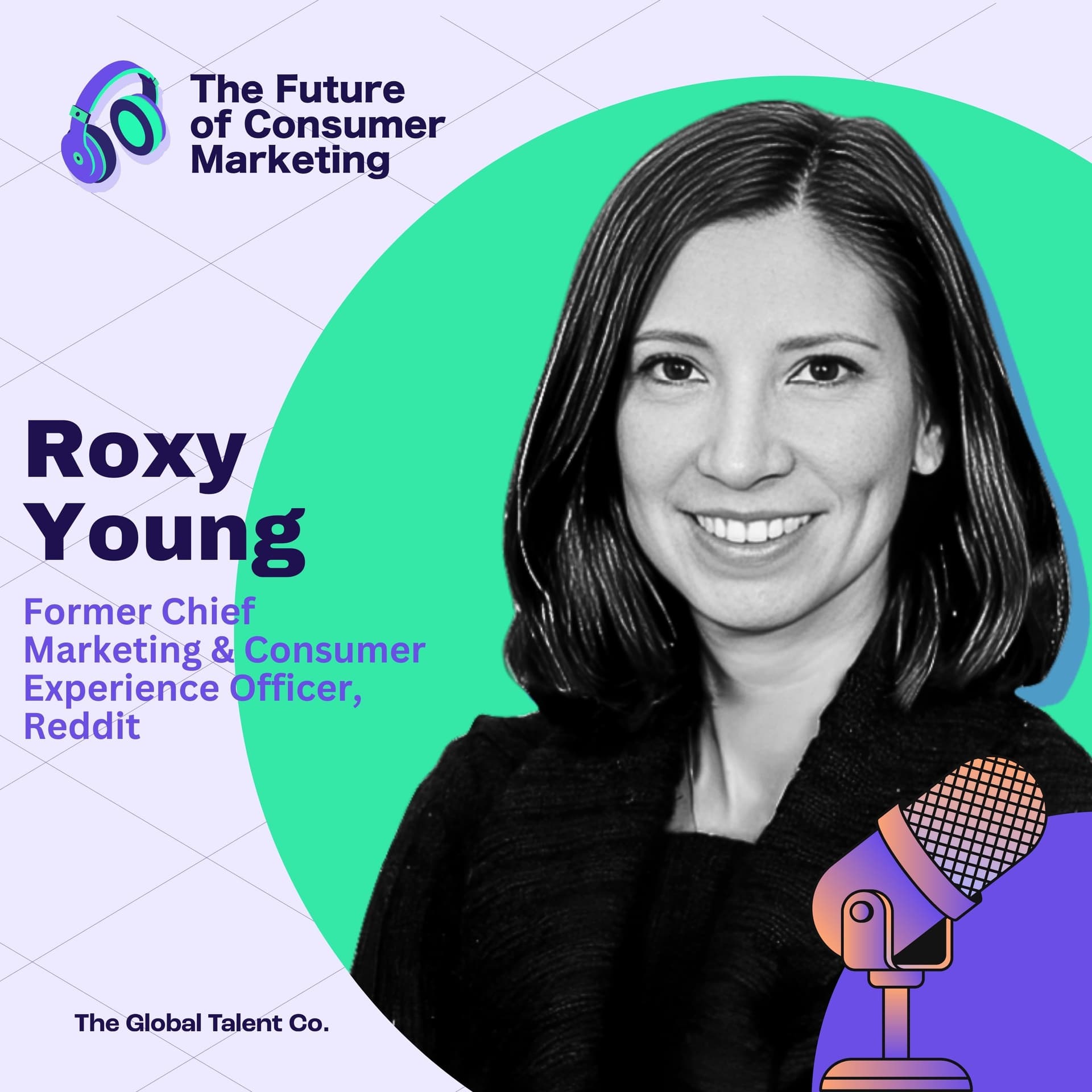
Building Mainstream Appeal While Maintaining Community Authenticity Host: Brett Stapper Guest: Roxy Young, Former Chief Marketing & Consumer Experience Officer at Reddit
---
Episode Overview In this episode, Brett Stapper interviews Roxy Young, who shares her extensive experience in consumer marketing. With a unique background in finance and a pragmatic approach to brand management, Roxy discusses her journey and insights into building mainstream appeal without losing the authenticity of community-driven brands.
---
Key Topics Discussed
- Building Mainstream Appeal and Community Authenticity
- Transitioning Reddit from a niche community for gamers and programmers to a mainstream platform.
- Importance of finding a balance between broad appeal and staying true to core community values.
- The Evolution vs. Rebrand Framework
- Distinction between branding evolution and rebranding, emphasizing the need for continuity and gradual change.
- Roxy's preference for the term "evolution" to suggest growth rather than fixing something broken.
- Quantitative Approaches to Brand Marketing
- Roxy's background in finance and data-driven marketing.
- Focus on understanding consumer behaviors through quantitative analysis.
- Navigating Consumer Backlash
- Strategies for managing feedback and criticism during brand evolution.
- The significance of listening and adapting based on consumer insights.
- Timeless Marketing Skills
- Deep understanding of consumer needs as a critical skill for marketers.
- Emphasis on ensuring that products and services effectively meet customer demands.
- Managing "The Internet" as a Stakeholder
- Recognition of the internet as a significant entity with its own opinions and reactions.
- The necessity for marketers to engage with online communities and feedback.
- Foundations of Direct Response Marketing
- Roxy’s experience with direct response marketing as a way to drive measurable results.
- Understanding how data can inform strategic marketing decisions.
---
Insights and Lessons
Roxy's Marketing Philosophy
- Identifies as a "pragmatic brand marketer" who combines creativity with quantitative analysis.
- Values the importance of developing a brand identity based on deep consumer understanding.
Iconic Brands and Consumer Connection
- Successful brands know their identity and stand firmly behind their values, ensuring all messaging aligns with that identity (e.g., Netflix and Reddit).
- The relationship between brands and consumers is built on shared understanding and consistent communication.
The Importance of Listening
- Engaging with consumers through focus groups and market research is vital for understanding their experiences and perspectives.
- Brands must adapt based on feedback while retaining conviction in their brand evolution.
Advice for Early-Career Marketers
- Focus on understanding consumer needs as the core of marketing success.
- Stay adaptable to changing marketing channels while keeping the customer at the center of all efforts.
---
Conclusion This episode provides a deep dive into the nuances of consumer marketing, particularly in the context of evolving brands like Reddit. Roxy Young emphasizes the importance of data-driven decisions, community engagement, and the need for authenticity in branding. Her insights serve as valuable guidance for marketers navigating the complexities of modern consumer expectations.
---
Follow Roxy Young For those interested in following Roxy Young's journey, she can be reached on [LinkedIn](https://www.linkedin.com/in/roxyyoung/).
Written by AI. May contain mistakes. Listen to the episode to check what was said.
Chapters
Tap a time to open that second in VOFirst Steps in Marketing at The Gap
0:46 to 3:08
Discussion on the host's early marketing experiences and challenges.
“I want to ask you about the first product that you ever had to market.”
From Finance to Marketing: A Career Transition
3:09 to 5:45
Exploration of the transition from finance to a marketing career.
“Yeah, I was working out of the HQ in San Francisco.”
The Pragmatic Approach to Brand Marketing
5:46 to 7:39
Insights on balancing quantitative analysis with brand marketing creativity.
“And there are a lot of quantitative aspects to marketing.”
Reddit's Evolution into Mainstream Communities
7:40 to 9:48
Discussion on how Reddit transformed into a platform for diverse communities.
“So I'm not going to spend the whole episode here.”
Building Iconic Brands with Strong Identity
9:49 to 14:00
Exploration of the common traits among iconic brands and their marketing strategies.
“And I'm happy to say that there's a lot of conversation around, what's happening with the royal family on Reddit.”
The Importance of Brand Identity
14:00 to 16:48
Learn how understanding and maintaining a brand's identity is crucial for longevity.
“And those are two really different brands.”
The Evolution of Branding
16:48 to 21:44
Discover the significance of evolving a brand and communicating its story effectively.
“But I think most importantly, you have to have conviction as well.”
The Role of Consumers as Stakeholders
21:44 to 22:59
Understand how consumers' opinions shape brand strategies and marketing approaches.
“This is wrong and this is the new way and the new way is better.”
Timeless Marketing Advice for Young Professionals
22:59 to 24:59
Gain insights on building a successful marketing career by focusing on customer needs.
“Because I did wonder that is like, are the people who are freaking out on like, you know, Twitter or just all over, like, do they actually go to Cracker Barrel?”
Transcript
Automatic transcript. May contain errors.0:00Roxy Young:When most people think of marketers, they assume that they're thinking in color and storylines. I'm here to tell you, I am not that kind of marketer.
0:09Brett Stapper:Was that love at first sight for you in terms of marketing?
0:12Roxy Young:What I loved is that there are so many different facets of marketing, and I could see myself continuing to grow in many different areas, some of which would be more quantitative.
0:25Brett Stapper:That's what's so fascinating to me about Reddit is everyone uses it for completely different purposes. They would tell you the value they get from it is completely different. We have become
0:34Roxy Young:much more of a mainstream product where no matter what you're interested in, you can find a community for it on Reddit.
0:46Brett Stapper:Proxy, hello. How are you? Welcome to the show.
0:48Roxy Young:Great. Hello. Thank you for having me.
0:51Brett Stapper:I want to ask you about the first product that you ever had to market. What was that first product?
0:56Roxy Young:My first role as a marketer was at The Gap. My little secret is that I actually got a degree in finance. I went to college thinking that I was going to be in science and biology and really wanted to be a genetic engineer. And, you know, I don't know, a couple of years into it, I had a professor tell me that I would probably be much more suited to something where I was interacting with people more instead of working in a lab and got a degree in finance. And then after a few years working in finance, realized that while I loved finance, it wasn't very dynamic. You forecast a few times a year. You do annual planning.
1:40Roxy Young:You close the books. and so went to business school. And then my first job as a marketer was at The Gap. I think during this time, Gap was in its heyday. And one of the most interesting things that I was working on at that time was, I don't know if you remember, but I'm dating myself here, jeans were like$40. And And there was this new trend where there was this premium denim,$100 pair of jeans. It was kind of, you know, taking the fashion scene by storm. And my first job was figuring out how is a brand like The Gap that was known for quality at a good price? How were we going to market a more premium line of denim to align with this trend that was going on?
2:32Roxy Young:And it was very hard. And what we decided is that we were actually going to have to put a different label on it. You know, if you just put the same label, the same Gap jeans and charged$100, people probably weren't going to buy too many pairs. And so we actually had to put a more premium label, talk about where the fabric came from, what the process was to create the look and the feel and the wash. And so it was my first job as a marketer was trying to figure out how The Gap could sell a$100 pair of jeans.
3:07Brett Stapper:And were you working out of the HQ that they have in San Francisco?
3:10Roxy Young:Yes, I sure was. Yeah, I was working out of the HQ in San Francisco. I had spent the first year and a half in a strategy job using my finance skills and had moved into a marketing role shortly after that. And I was like, oh, wow, this is, yeah, this is tough.
3:32Brett Stapper:How epic is that office? I always take my dog there in front. They have like the arrow. I always look over and I've heard it's very awesome.
3:38Roxy Young:The office is amazing. I actually started at the building next door, which is much older and not nearly as cool. And then that new building opened and the roof deck and the cafeteria, totally amazing.
3:55Brett Stapper:And was that love at first sight for you in terms of marketing, like marketing, you know, tackling that challenge where you're like, this is it. Like, I'm going to be a marketer for like forever. Or is it more of a slow burn, slow interest?
4:06Roxy Young:Yeah, great, great question. Yeah. So, you know, I think when most people think of marketers, they assume that they're, you know, just these highly creative people that are like, you know, thinking in color and storylines. I'm here to tell you, I am not that kind of marketer. You know, I'm a super quantitative person. I need validation through data. I want to do analysis. I want to project things. And so stepping into that first marketing role, it was direct response marketing, which, you know, for people who aren't familiar with all the different types of marketing, direct response marketing is the most quantitative type of marketing.
4:50Roxy Young:You have a list of people in a database. You can see all of these interesting characteristics about them. You can figure out where you think their propensity is to buy that next product. And so it is the most quantitative data-rich areas of marketing. And I think what I knew and what I loved is that there are so many different facets of marketing. And I could see myself continuing to grow and evolve in many different areas, some of which would be more quantitative. I surrounded myself with people who are much more creative, much more bold in terms of like how they were thinking. And over time, you know, I've had a long career in marketing, working on it, you know, for over 20 years.
5:45Roxy Young:I think I have gained more creative skills, become more bold, become more comfortable with risk, but still, you know, very much rooted in the quantitative side of marketing. And there are a lot of quantitative aspects to marketing.
6:01Brett Stapper:And is that how your coworkers or colleagues would describe your marketing philosophy? Like if we did a poll and said, yeah, how would you describe Roxy's philosophy of marketing? Like what would they regurgitate back, do you think?
6:13Roxy Young:People often refer to me as a pragmatic brand marketer. When I first started my career, there was a group of, there was a whole team of brand managers. And I remember I always was like in awe of them. but I was a little afraid. I was like, oh my gosh, am I ever going to become a brand manager? These are people who have amazing instincts and they go with their gut and they kind of have a vision and a sense of where the brand should go and how it should evolve. I'm over here and I've got all this data to make my decision. And I think I have evolved into a brand marketer. I think if you asked anyone, they would say, yes, Roxy has worked on some of the world's largest and most iconic consumer brands.
6:58Roxy Young:She's a brand marketer, but still incredibly pragmatic in terms of how I approach growing and building a brand and thinking about a brand. And I think a lot of that goes back to my quantitative roots and how my marketing career grew and evolved. I didn't start at an ad agency developing funny lines of copy and pitching radical ideas. I started in a much more quantitative space and have kind of grown to become a brand marketer, but very pragmatically. So I think pragmatic brand marketers is how people would characterize me.
7:39Brett Stapper:You mentioned iconic brands there. So I'm not going to spend the whole episode here. We talked about we'll do a different episode about Reddit. But as a very active user, like I do screen time tracking, I present to my wife. I'm at like 10 to 15 hours per week on Reddit. So I spend a lot of time on Reddit. What was your experience like? Because you were there for eight years almost?
7:59Roxy Young:Yeah, eight and a half years. I'm so fortunate in that I've had phenomenal experiences in many different brands. You know, I started at The Gap. I worked at Netflix very early on, you know, Sephora, which if you're into fashion and beauty and makeup, like, you know, Sephora is definitely up there in terms of a beloved brand. But most recently was at Reddit. And, you know, when I when I think back to that experience, you know, I would be lucky to have another experience as amazing as as my experience at Reddit. I started at Reddit in 2017. 2017, we were a few hundred people with really big dreams and aspirations about what Reddit could become.
8:43Roxy Young:And I remember one of the questions that I asked shortly after I got there, you know, is, do we want Reddit to be mainstream? At that point in time in 2017, you know, Reddit was really well known for gaming communities, programming communities, some politics, memes. But we had a long way to go if we wanted everybody to be able to find their home and find their community on Reddit. And that was one of the first questions that I asked that we talked about as a leadership team, which is, you know, what is it going to take and do we want for Reddit to be a mainstream product where anybody, no matter what they're interested in, no matter what language they speak, no matter where they are in the world, can find their home.
9:38Roxy Young:And it was a long journey. But I think, you know, when you fast forward to today, Reddit is a far more recognized brand around the world and so many different interests you can find now on Reddit. We had this running joke early on that if there was communities talking about the royals and the royal wedding and the royal gossip, then we would know that, you know, that was a sign that we had made it to a mainstream product. And I'm happy to say that there's a lot of conversation around, what's happening with the royal family on Reddit. So I think over that eight years, through so many different things and the work across so many different teams, we have become much more of a mainstream product where no matter what you're interested in, you can find a community for it on Reddit.
10:32Brett Stapper:That's what's so fascinating to me about Reddit is like my wife uses it, my mom uses it, my sister uses it. Everyone uses it for completely different purposes. They would tell you the value they get from it is completely different, but it's just awesome to see. If you look at, you mentioned a lot of iconic brands there. Are there any similarities that you see or you can say, well, all these iconic brands that I was part of, they all do this when it comes to money?
10:55Roxy Young:Yes, yes, definitely. You know, I think that the through line there is if you want to be a brand that stands out and has deep meaning and connection with consumers, you need to know who you are and what you stand for. And you need to have a lot of conviction around it. And you need to act it out and bring it to life every day through all of your different touch points. You know, I remember when I was at Netflix, we were trying to create this category of online movie rental. If you probably don't remember, maybe you're too young, but the way that people got movies was they would go to a blockbuster on a Thursday or a Friday and they would go into the store.
11:45Roxy Young:and nine times out of ten, the movie that they wanted was not there. It had already been checked out. And so you were, you know, ending up coming home. It was a disappointing experience with some movie that you probably didn't want to watch, but it was the only thing that was available. And Netflix was trying to completely change the category. And the proposition was you can have a subscription. And with this subscription, you can have unlimited movie rentals and we'll just mail them to you. And we're never going to be out of stock. Whatever you want to watch, you will always have it on hand because you can have multiple DVDs at home and you can just be sending them back to us.
12:24Roxy Young:And then we'll replace it with the next one in your queue. And so early on, we knew that we wanted to stand for high quality service with a broad selection of merchandise, which in this case was movies, at a reasonable price. and we explored all of these different propositions, like which one was the most important? Was it price? Was it always having the movie that you wanted? Was it really fast returns and shipping? But we knew that we wanted to be this high quality, ever-present utility in your life. and we were very clear about it in all of our communications, in all of our messaging. We were very thoughtful about the look of the brand, the mark of the brand, the red color.
13:33Roxy Young:If you remember those envelopes that people would send, this red color stood out so you would always be able to find it, you know, in your stack of mail. And so if you contrast that with, you know, a brand like Reddit, we had these brand values where we wanted to be candid. We wanted to be brilliantly absurd in terms of the way that we communicated. And those are two really different brands. But they were true to who they were. They knew who they were and they were true to who they were. And so, you know, I think the through line there is knowing who your brand is and why and being very thoughtful about how you present it is one of the key ingredients to creating this everlasting, meaningful brand for consumers.
14:31Brett Stapper:And what was the journey like or the process like to get to that point? Was it just like, hey, with like a small team and then the next day it's done? Massive discovery process. Like take us behind the scenes on, you know, the iconic brands here. How do you do it?
14:46Roxy Young:It's a lot of work and it's very thoughtful and very deliberate work. And what it usually looks like is it's usually a marketing team paired with research, either internal or external research, and then a group of cross-functional people who are going to help ensure that the marketing team, you know, isn't going totally out in left field. And so behind the scenes, what that looks like is you're sitting in focus groups and you're listening. You have to be a really good listener. I mean, I remember back in the early days of Netflix, you know, we were traveling around the country and we were sitting behind the two-way mirror and focus groups were happening.
15:36Roxy Young:and you're sitting there and you're just listening to what people are saying about your product, your experience, your product, their experience, the look, the feel, and you're trying to connect all of the dots on what are the commonalities, what are the most important things that we're hearing. And you take all of that and you put it together and then you test it again. And then you see, okay, is this resonating? And you can see today, I mean, in the last year, we've seen several examples of brands trying to rebrand or reimagine themselves and consumers are having a really strong opinion about it.
16:23Roxy Young:So the behind the scenes on listening, identifying common patterns, developing new things that then you're going to test, ensuring that your cross-functional business partners are validating the things that you're doing. All of those things take a lot of time. But I think most importantly, you have to have conviction as well. Consumers are always going to have opinions. Sometimes they're going to be a little different. You're going to do a lot of research and you're going to recalibrate and retest and you're going to try and address those things and anticipate those things. But you also have to have conviction.
17:11Roxy Young:I did a rebrand. I hate even to use that word rebrand because it implies that something is wrong and you're redoing it. I prefer to use the term evolution, but we evolved the brand when I was at Reddit. And Reddit was 18 years old. And a lot of people become very accustomed to the way that Reddit looks when they're using the product. And we evolved it and we had to evolve it because the analogy that I like to give is like, imagine if you opened your sock drawer and like you couldn't find two matching things. You know, our brand after 18 years had become really disjointed. We had all these different things that looked a little different.
17:54Roxy Young:We didn't have a whole cohesive system. And, you know, we embarked on a year-long project to evolve and build a stronger foundation that could carry us internationally around the world and could take us into the future and could adapt and evolve for 3D. and it was a scary process because ultimately you're going to put it out in the world and people are going to have opinions, but you definitely have to have conviction that all the things that you've done and the reasons why you're doing them and the decisions that you made were right for where you want to go.
18:32Brett Stapper:What do you think? And we can name them, we can not name them, but that too, you mentioned them.
18:36Roxy Young:I'm going to expect them to find it to be automotive company and that tried to do a rebrand and then a restaurant.
18:42Brett Stapper:What do you think they got wrong in those efforts?
Read the full transcript
18:46Roxy Young:Yeah, I think there are two. You're correct. An auto and then definitely a restaurant. I'll talk about the Cracker Barrel one because I followed this story and I would find myself at the end of the day thinking if I was talking to the CMO of Cracker Barrel, here's what I would say. But I think that how you communicate what you're doing and why is as important as the actual changes that you're making. And I think right out of the gate, when you say, I'm redoing something, I'm rebranding it, it implies that the existing approach isn't good. And that right away, you know, sets people off. And so, you know, I think one of the things that could have benefited that particular process is telling the story of the evolution and connecting the dots with here's how it started, here's how it's evolved.
20:01Roxy Young:It probably has evolved, you know, over the brand's history. And here's some of the continued evolution and where you're going to see it first and how it might show up in the future. I think the hello everyone, it's Monday and this is the new thing. We've redone it. And I'm not suggesting that they did that, but I think even just the terminology that you use and if you don't connect that story, then change is just inherently hard for people. And the communicating the how and the evolution and then the expectations that the consumer should have is probably a better approach. I have to hand it to them because I think they came out and they said, nope, we've researched this.
20:58Roxy Young:We stand behind it. It is the right thing. And it probably was. I really liked what they did. But I think there was a lot in that communication piece and just really helping that the consumer understand because they weren't in the room and they weren't doing all the research and, you know, I think it's a little hard for them. And so you really have to connect those dots and tell that story and help them understand how this evolution is going to take the brand into the future.
21:27Brett Stapper:I love just that framing alone of, you know, it's not a rebrand, it's a evolution. That just makes a lot of logical sense. And yeah, I've never thought about that in that way, but That's so true, right? It's like you think rebranded means this is totally broken.
21:39Roxy Young:That's right. It just sets off in the mind of the consumer. This is wrong and this is the new way and the new way is better. And I think if you if you call it an evolution and then you tell a story around the evolution, it just makes it a little bit more palatable. And I know that every marketer wants to be able to just flip the switch and turn everything over at once. But even if you roll this out over the course of a 12 months, you may have a few disconnected pieces, but it might be easier for the consumer.
22:17Brett Stapper:That makes sense. Yeah, my takeaway from that was just like the impressive power of consumers. Like they made their voices very well known. Yeah.
22:26Roxy Young:I talk a lot with just my peers and the internet, the collection of people that is the internet is now a new stakeholder and a stakeholder just like your investors, your customers. Or is just, you know, the internet is going to have an opinion and recognizing that they are a stakeholder is definitely a new skill that marketers need to have.
22:57Brett Stapper:That's fascinating. Think about that as a stakeholder. Because I did wonder that is like, are the people who are freaking out on like, you know, Twitter or just all over, like, do they actually go to Cracker Barrel? Because like most of them, like, you just go on like a random road trip, you know, every now and then. Like, it's not this like diehard customer thing. So it did, you know, it's like the internet. That's fascinating. Now, I know we're getting close to being up on time here, so I want to be mindful and respectful of that. So let's just focus on some advice. So there's a lot of consumer marketers that are listening in.
23:23Brett Stapper:Imagine that you're speaking to those who are early in their career. Let's say they're early 20s, mid-20s. What advice would you have to them to build a successful career and just really have an iconic career like you've had?
23:34Roxy Young:Yeah, I think the one piece of advice that I would share is marketing channels are going to come and go. I started my career and it was at the beginning of search engine marketing. And now search engine marketing kind of feels like a dinosaur. And everyone is talking about Answer Engine or Generative AI becoming the new place for discovery. So channels are going to come and go. Social media wasn't a thing when I started my career. But the one thing that stays consistent and what companies depend on marketers for is having a deep understanding of how you're meeting customers' needs, how your brand, your product, your service is meeting customers' needs.
24:28Roxy Young:And so, you know, my recommendation is never lose sight of that. You will be successful in your role if you always remember that at the end of the day, the product and the service is there to meet the consumer's needs in the best way possible and to always have that front and center and to be asking yourself, you know, why are we meeting a customer's needs and why are we the absolute best at it? And I think that is a key to success that's timeless.
25:03Brett Stapper:Amazing. That's where we're going to end it. Before we do wrap here, if there's anyone that's just listening in and wants to follow along with you and your journey and whatever's coming next, where should we send them? Where should they go?
25:14Roxy Young:You can reach out to me on LinkedIn.
25:17Brett Stapper:Amazing. We'll make sure to link to that. Thank you so much. It's been a lot of fun.
25:20Roxy Young:Thank you. Appreciate it.
From the publisher
In this episode of The Future of Consumer Marketing, host Brett Stapper interviews Roxy Young, Former Chief Marketing & Consumer Experience Officer at Reddit. Roxy brings a unique perspective to consumer marketing - she's a self-described "pragmatic brand marketer" who started her career in finance and built her expertise through the most quantitative side of marketing before evolving into brand leadership. Over eight years at Reddit, she helped transform the platform from a niche community for gamers and programmers into a mainstream product used by hundreds of millions globally. Her career spans iconic consumer brands including Netflix, Gap, and Sephora, where she learned that great brands aren't built on creative instinct alone—they're built on deep consumer understanding, conviction, and the discipline to evolve thoughtfully.
Topics Discussed:- Building mainstream appeal while maintaining community authenticity
- The evolution vs. rebrand framework for brand transformation
- Quantitative approaches to brand marketing
- Navigating consumer backlash during brand evolution
- Understanding consumer needs as the timeless marketing skill
- Managing "the Internet" as a key stakeholder
- Direct response marketing as a foundation for brand thinking