In short
How Coterie (premium baby diapering and baby care) wins paid social by generating demand, then capturing it via Google—plus how AI improves CX, conversion, and lifecycle personalization.
Guests
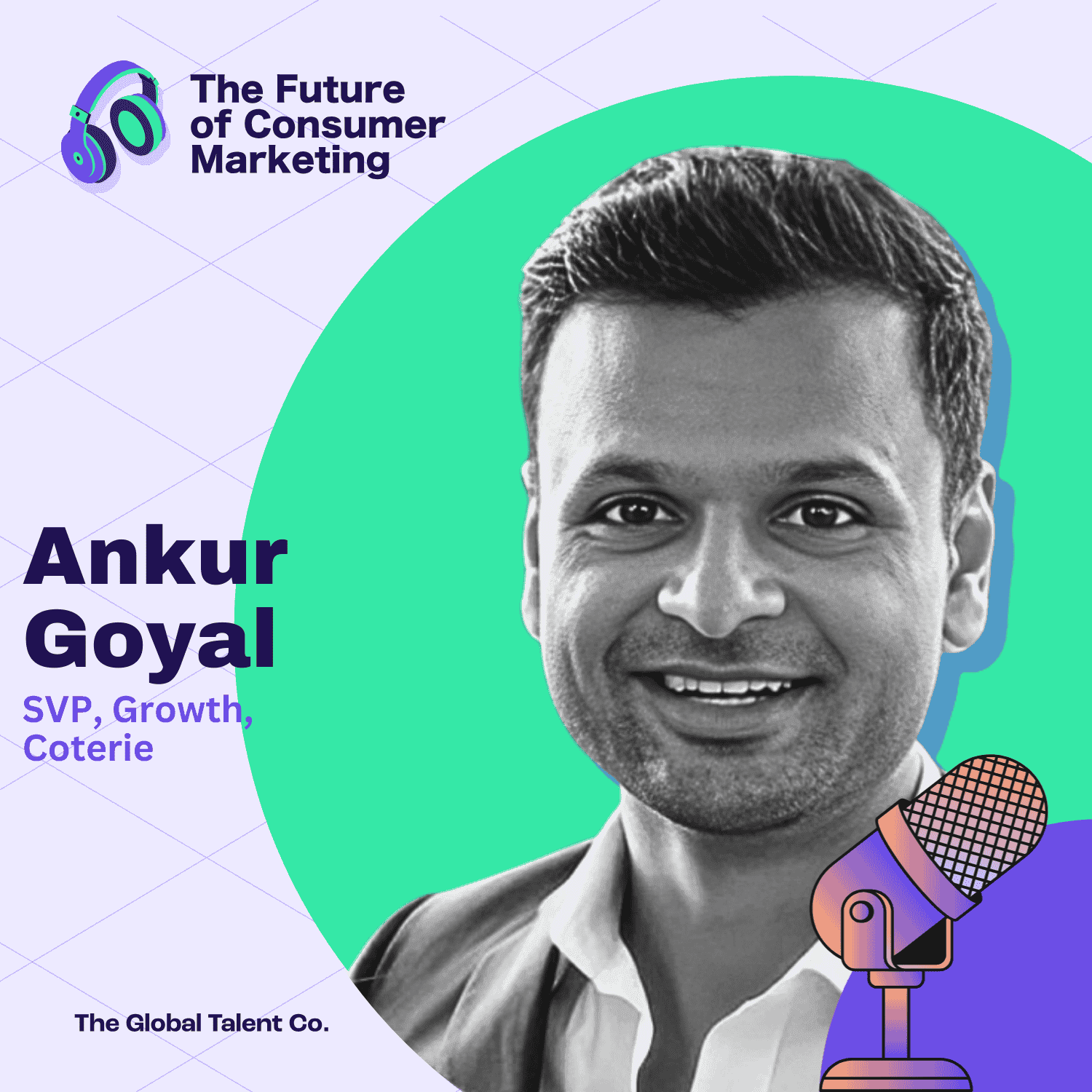
Ankur Goyal, SVP of Growth at Coterie. Background in consumer scaling for 10+ years; started in big CPG, then moved to digitally native brands; joined Coterie ~4 years ago; scaled company 15x, moved from unprofitable to profitable, acquired by Mammoth Brands (valuation undisclosed).
Key claims
Disrupt legacy brands with demonstrably better product and pointed communication; premium pricing requires better experience; focus on demand generation (paid social/TV/influencer) without turning it into “domain capture”; creative can make channels demand-generating.
Notable examples
Messaging tied to real reviews about sleep; “Size Assist” dynamic notifications for when to size up; AI for CX automation (order changes), sentiment/topic tagging, on-site PDP chat to lift conversion, and AI-driven customer segmentation for email personalization.
Written by AI. May contain mistakes. Listen to the episode to check what was said.
Chapters
Tap a time to open that second in VOIntroduction to Coterie and Its Products
0:00 to 1:04
Learn about Coterie's product offerings and their market positioning.
“Coterie makes super high-performing baby care products.”
Host Introduction and Episode Overview
1:04 to 1:50
Meet host Andres Figueira and today's guest, Ankur Goyal.
“My name is Andres Figueira, and I'm going to be your host for the day.”
Ankur Goyal's Background and Coterie's Mission
1:50 to 3:57
Ankur shares his journey and Coterie's mission in the market.
“And, Ankur, just so that we can make sure we provide the audience with the proper context, would you be able to tell us a bit more about your background and in your own words what Coterie actually does?”
Disrupting the Baby Care Market
3:57 to 6:06
Discussion on how Coterie disrupts established brands in the baby care space.
“How have you been able with this company to disrupt a category that's been dominated by legacy brands for so long?”
Demand Generation vs. Demand Capture
6:06 to 8:14
Exploration of Coterie's approach to demand generation and capture strategies.
“I mean, I think we've all as a team at Coterie gotten smarter and more sophisticated on how we're executing against that.”
Messaging Breakthroughs in Marketing
8:14 to 11:19
How Coterie leverages emotional connections in their marketing.
“And by the way, paid social, linear TV, and influencer can become demand capture channels.”
Leveraging AI in Marketing and Customer Experience
11:19 to 14:01
Insights into how Coterie uses AI to enhance customer interactions and marketing.
“Would you be able to also tell us a bit more and shed some insight in how Coterie is leveraging AI to help you guys out with these different processes?”
Leveraging AI for Customer Segmentation
14:01 to 15:06
Learn how AI is enhancing customer segmentation and personalized communication.
Building Community Through Engagement
15:06 to 17:14
Discover strategies for creating a community around a brand through engagement and events.
“Ankur, about how you plan to create community with these customers that are coming back each time.”
The Importance of Continuous Personalization
17:14 to 19:06
Understand how ongoing personalization creates a competitive advantage in marketing.
“So taking advantage of those things and understanding what's simple and really impactful for you that your creditors cannot do, that done every week in four years, that creates a very big gulf in that arena.”
Show all 13 chapters
Differentiating a Premium Product
19:06 to 21:20
Explore how to position a premium product in the market while enhancing customer experience.
“Ankur, in terms of also like I feel that what you guys sell is a very premium product, like a lot better than what is found in the market.”
Innovative Features in Customer Experience
21:20 to 23:31
Learn about innovative features that enhance customer experience in product usage.
“And also, I was checking out Coterie's website and I did see, I believe what you're mentioning is like the sizing 101 thumbnail that you can choose to see how to measure your baby size and understand all that.”
Creative Strategies in Marketing
23:31 to 26:51
Delve into the importance of separating creative strategies for ads and product design.
“And that is something that I feel it feels obvious, but not everybody is paying that much attention to doing it right.”
Transcript
Automatic transcript. May contain errors.0:00Coterie makes super high-performing baby care products. Our diaper is our hero, but we now have pants, wipes, and we just, as of September, have a whole skincare line. How have you been able with this company to disrupt a category that's been dominated by legacy brands? One, it really is about product. You really need a demonstrably better product and then communicate that benefit in a really, really pointed way to people. And then also use your unfair advantages to create an experience that is leaps and bounds ahead of what competitors can do. Do you guys try to compete with the legacy brands by matching their prices or do you differentiate yourselves as well by being a premium product that you've got to pay a little bit more?
0:42Exactly. It is the latter. You are paying more. And if we're asking for more of your money, we need to deliver you a better experience. And that comes from the product experience. But even the sensory experience and like how quilted our diaper looks is very different. Sure. But then the digital experience on top of that is something that we're really proud of.
1:04Hey, everybody. Thank you for tuning in. My name is Andres Figueira, and I'm going to be your host for the day. This show is brought to you by The Global Talent Company, helping fast-growing teams hire exceptional remote talent from Argentina, South Africa, and beyond. We connect companies with world-class professionals who bring skill, reliability, and global perspective to every role. So if your team's looking to grow with proven remote talent, head on over to theglobaltalent.co and see how we can help. And with me here today, I am speaking with Ankur Goyal, SVP of Growth at Coterie, a company that is engineering clean, high-performing diapering essentials to make your journey into parenthood a little bit easier.
1:44So, Ankur, how's it going, man? It's a pleasure to have you here. It's going great. Thanks for having me. No problem at all. And, Ankur, just so that we can make sure we provide the audience with the proper context, would you be able to tell us a bit more about your background and in your own words what Coterie actually does? Coterie as you said makes super high performing baby care products. Our diaper is our hero but we now have diapers, pants what a lot of people call training pants, wipes and we just as of September have a whole skincare line. So it's just really high performing in case of our diaper, super absorbent, really, really great for nighttime and all day, but also taking a clean materials approach, making sure that everything that's being put in our diapers or skincare or wipes, ultra clean and very tested and embedded.
2:37My background has been in consumer and scaling consumer brands for over 10 years. I started, so my academic background is computer science and marketing, which you can probably see how that works into data driven and digitally native brands pretty nicely, but it wasn't super, it wasn't a straight line. I actually started in big CPG. So a lot of these traditional brands that are selling in stores and either at those CPGs or consulting for them and kind of learned a little bit about how they approach things, but then pivoted into these digitally native, more upstart brands about eight years ago, figuring out how to scale those and really scale those aggressively.
3:17um and so after did that a couple of years agency side was embedded into a beauty box a well-known beauty box and then kind of uh went to coterie four years ago and it's been incredible um we've scaled the company uh over 15x gotten it from unprofitable to very profitable and it was just announced three weeks ago or four weeks ago that we've sold to mammoth brands and have been acquired. Valuation not disclosed, but some articles are speculating. Just so that we can also then go into more of the marketing that you've been doing for Coterie. You mentioned that it was unprofitable. Now it's profitable.
4:00How have you been able with this company to disrupt a category that's been dominated by legacy brands for so long? And I feel parents have actually trusted these for generations. So how have you been able to place Coterie in their minds as an option versus all the other big brands that have always been around. So yeah, so I think I'm happy to share more about that. But you know, coming in, I mentioned I have some of that bigger CPG background. And I think that was, it helped me at least not be afraid to go after larger increments. I think when you're inside, you see a lot more of the weaknesses or the opportunities.
4:35So that's helpful. But fundamentally, it's about a couple of things. One, it really is about product, at least from my point of view, you really need a demonstrably better product as the foundation. And I say demonstrably because we live in a world where so much, I mean, it's always been true, but so much of our advertising and the way that we communicate to people is visual. So showing that benefit becomes really, really important. So that's uh that's the foundation of it and then it becomes communicate that benefit in a really really pointed way to people so they understand like why their life is going to be better and how um how this is going to uh you know make their lives and be a better option than those other incumbents and then also it use your unfair advantages to create an experience that is leaps and bounds ahead of what competitors can do and really fight to preserve that.
5:39And when I say experience, I do mean both the brand kind of experience and also that like the actual usage of the product and how you interact with the brand all the time. So I'm happy to go into more about what that looks like. Okay. I like that. And in terms of, I hear that overall strategy, like from top view and you've been at Coterie for four years now, right? Yeah. And has that always been your approach and your strategy, or has it evolved from the beginning to what it is now? It actually largely has stayed very consistent. I mean, I think we've all as a team at Coterie gotten smarter and more sophisticated on how we're executing against that.
6:15But that's been at least my thesis, and I think a lot of those people around me at Coterie. um yeah and there are a lot of tough decisions though on how to preserve that and like the it seems simple but you know there's some like forks in the road that you have to say well do we make this decision or not and how is this going to make our experience better is this going to make our like is this going to play off our unfair advantages that we have or is actually going to blunt them and so that's kind of where the rubber moves the road on that front okay and And in terms of marketing channels, are you guys using like all the usual ones that we know, like just social media platforms, television, paid ads?
7:01Or are you just specifically relying on one that has most or better conversions or something like that? I think our advertising stack looks like a lot of what you would see in the industry. So very much a like the way we're thinking about it again, nothing that to say here is going to be revolutionary to anyone listening. It just might confirm your beliefs already. Demand generation versus demand capture. What is and what's generating demand? It's going to be like paid social TV and influencer. And then what is capturing demand largely is going to be Google. And that would that would be the bulk of our stack.
7:43There's a little bit more nuance there. But I do think how much we focus on demand generation versus demand capture is a unique or less common than what I've seen throughout the industry. But I think the rigorous focus on demand generation has been what allowed us to succeed. Okay. So you've been able to place yourself in the minds of people and have them want the product and then just literally go to Google and find out how they can buy it and convert. Exactly. And by the way, paid social, linear TV, and influencer can become demand capture channels. It really depends on your creative. The channel is kind of irrelevant.
8:25Brand search is inherently demand capture in my point of view. Non-brand search, different story. But your meta TV influencer or whatever else you're doing for doing YouTube, they can become very demand generation channels. And I think a lot of the, I did the trap that I was very intent on voiding was turning them into domain capture channels. But if you think, if you use your creative well, your job, it becomes, how do I use those channels to take someone that has never heard of this thing? And by the end of hearing about it, they're like, whoa, this thing exists and I need to check this out.
9:05and what kind of messaging do you need to put in front of them to get them there? And you can do that in, like, you don't need a lot of time to do that. Or that's the challenge that you can, I mean, think about, I don't know how much you're on TikTok or I don't know how much you're on social channels, but there are a lot of times where you've probably seen an incredible commercial on TV or an incredible TikTok and you're like, wait, this exists? Like, I need something like this, right? You don't need the 10 million, like the over-engineer, the touchpoints. Like a really, really compelling messaging can get people excited in one or two touchpoints.
9:40I've lived that, like in my usage of social platforms and TikTok and all that. And Ankur, do you have any example of a specific campaign that exemplifies what you're mentioning and that it was an example of a successful one? If you look at any of our communication, this will be very obvious to you. And I'm pretty sure Pampers has done this because now they've come out with a campaign that's very similar just four years after we started doing it um so we we noticed early on looking when or at least early on in my tenure uh at coterie was that um a lot of our reviews were was organically talking about how this diaper and a diaper that had the kind of qualities and focus on performance that we had was actually resulting in like sleep for the baby and the parents um and i was like that's compelling like that that is interesting and that's that's the kind of message that if you you hear it once you're you're you're in like you're you're you want to hear some more um so drawing those drawing that connection and actually making like the emotional and functional benefit of this product related to those kind of testimonials and real consumer anecdotes.
10:54That was one big messaging breakthrough that I think was specific and compelling and was one of that first big wave of improved acquisition. And by the way, the retention of those customers is fantastic. So if they were false promising, then the retention would be awful. It's just that's that's what our product seems to do for people. Would you be able to also tell us a bit more and shed some insight in how Coterie is leveraging AI to help you guys out with these different processes? And like, I'm not sure if you're using it in any novel way, maybe the same way as everybody else is, but just want to know how it's helping you guys out.
11:34Yeah. So I I'm actually really proud of the entire how the entire org has is is using it and we're using it in a couple of different ways. And so, you know that, okay, everyone's talked about this, like MIT, 95 % of AI pilots, so companies didn't go anywhere. I'm proud to be in the 5%. So our ops and CX team, which is not under me, but I'm going to brag on their behalf, I think is bleeding edge and leading on this. um they're doing so your baseline is we were able to take a lot of our inbound cx we have sms um well although we have email and sms and for so some of that inbound a lot of them are quite simple um changing orders or changing order dates or whatever and so to improve response times and just to get customers like those simple things done very quickly um we actually have ai do a lot of those and improve response times there.
12:35Now, anything that's more complex will get routed, but you can take a lot of volume by having AI do it. That's step one, and that's great. But then step two is they are now using, because this is understanding natural language, this is a fantastic application of AI and not asking AI to do more than it really can just yet. um so extracting information from those conversations and helping like tag like sentiment analyze tag topics a lot better makes much better analytics on like how our cx operation is doing and then also um then extracting better information to be like hey we can log information about the customer that will help us serve them better in the future um that's been like what we're working on now from a marketing point of view though i think we're ai so we've similarly we've i'm going to shout out some partners here we uh tested an on-site chat um on the pdps and like i think this is a very very different personality than a support agent because a support agent wants to tell you when your order's coming all that kind of stuff but on their site you kind of want someone's going to help sell your product and actually improve conversion rate so we used a different a different personality different bot for that the partners called nvive and we tested it and um resulted in this that sig conversion rate lift and we're gonna keep iterating there um and then we're really excited about how all that customer tagging that we talked about from a cx perspective we're doing the same thing for life cycle marketing reasons and saying like what we can now we're now using ai to more intelligently segment customers and then personalize the comms that they see because what good are 10 segments pre-ai if i had 10 or 15 segments i couldn't do anything with that because i i could barely make one email flow let alone 15 different email flows now that i can actually have personalization being done by ai as well give me 50 segments until I like hit diminishing returns so um we're now putting that into place and we've already seen some really great lift on like how our emails are working okay that is so cool and I'm loving how you guys are exactly just like leaning into that with AI and getting all the the proper personal information or details about the customer so you can give a personalized experience and talking about personalized experiences would you be able to also tell us Ankur, about how you plan to create community with these customers that are coming back each time.
15:19Do you guys have a certain plan of, I don't even know, like if they join this club on this platform, then they get some discounts or free. Not even sure if you have any ideas like that. But are there any plans in the future for? Yeah, the way we think about community. So yes, because our user base is highly, highly engaged and significantly large chunk is just returning customers that have been here for months, years, whatever. Yeah, we know their size, so we can estimate kind of, we know that size they're ordering, right? So you can kind of estimate how big the baby is at that point. For us, community is still very human.
16:06And so our organic social, our owned channels is kind of where we foster community and events. So we are doing events to kind of activate our community in different cities. um we are sending out really great uh campaign emails that um because like the role that we play in people's lives we're not parenting experts we're not the best parent out there that's not like who we are that's you for your child but like we are diapering experts so we're kind of like we're providing information about diapering and diapering products and how different materials and ingredients and all that kind of stuff plays out we have this really great series of like ask an expert um where we have our like expert panel or even the diaper like scientists that we have on on staff like answering questions about diapering and diapers and baby care and that kind of stuff and that's what i think our community is looking for and where where we play um as well as our organic social presence so that's our thing about community um and it's definitely again we're talking about unfair advantages and it seems so simple a lot again for i think a lot of the people listening here might be digitally um in digitally native kind of contexts but like imagine how much work a large cpg brand has to do to create community um because i just said something simple yeah we email our people like really great um like really great content and information about our like where we're where we are the experts in the room or we actually when we do a product launch we know that some people like have been writing in asking for that product so when we finally launch it we make sure that they get a custom email to like you know because we care about each of our customers so we do that kind of stuff it's simple for us that will take a very very long time and a lot of purchasing of a lot of data for someone that does not have that direct relationship with their customers because they're a different business model.
18:14So taking advantage of those things and understanding what's simple and really impactful for you that your creditors cannot do, that done every week in four years, that creates a very big gulf in that arena. Okay, I love that. And I understand what you mean. It's like a compounding effect of always doing it right and having this differentiator from all these other brands that aren't paying attention to it, that with time, it's like the real difference that is being made because it's consistently there. Exactly. Because like three years ago, sure, the level of personalization that we could do was what we talked about.
18:48Okay, these people were actually really like, they were asking for larger sizes. When we launched size seven, these people will hear about it. Cool. But then two years later, we're now talking about AI tagging all of these people because we have such like rich user profile and everyone to give even better information. it just kind of compounds exactly. Ankur, in terms of also like I feel that what you guys sell is a very premium product, like a lot better than what is found in the market. And do you guys try to compete with the legacy brands by matching their prices or do you differentiate yourself as well by being a premium product that you got to pay a little bit more but to get a better experience?
19:29Exactly. It is the latter. You are paying more. And if we're asking for more of your money, we need to deliver you a better experience. And that comes from the product experience. Again, performance materials, clean materials, and just the sensory experience. We're in an audio context right now. I don't have a diaper on me, but I'm on hand, not wearing one. But even the sensory experience, how quilted our diaper looks is very different. Sure. But then the digital experience on top of that is something that we're really proud of. been part of the thing i want to talk about today as well um we've layered on all these really unique digital services that are completely free for our users that make diapering just a different league than what you can do if you're buying your diapers in them from not from coterie so uh for example if you if you would if you want one we just launched this year uh a service called size assist.
20:27As far as I can tell, we're the only brand that tells you when you should probably size up. Wow. Because that's a major concern for parents and a lot where they just don't know when they realize CX in bounds. And I get it. Like I'm now a parent for the first time as of this July. So like, I understand where that's getting a little bit confusing. So basically, Again, a hard problem for our consumers, a easy problem for us. We know exactly when customers typically size up and we know exactly where you are in your journey. And so we can deliver notifications to you when, hey, you should think about adding one pack of the next size just to make sure you're okay in case it size up and when you should really, really be sizing up because you're probably going to size up right now.
21:15A great feature, differentiation on product, but that's not the diaper. It's the experience. And also, I was checking out Coterie's website and I did see, I believe what you're mentioning is like the sizing 101 thumbnail that you can choose to see how to measure your baby size and understand all that. It's actually beyond that. That is a basic size chart and we've done that for a long time. Now this is dynamic notifications in your account management screen. So like if you log in to see your next shipment and you should be sizing up, we will now have a notification. It's like, hey, listen, like most people at this point in size three will be sizing up to size four.
21:59You know, you can check this on your baby or just add a pack of size four. That way you have it just in case, you know, they grow throughout the month and they need size fours by the end of it. that that is so cool and so thoughtful like it really feels and it and and it makes me understand how important the customer experience is to you guys and and really for a parent who i'm 100 % sure might not have in their head the prioritization of the sizing of the baby because they have so many other things they need to take care of um that they might just let that slip for a while and and coterie is there just making sure that it's always the best experience for the baby with the diaper so that is pretty cool of course and again this is a kind of podcast for operators right so like part of i mean this is this stems from a very commercial place but it ends in a very like positive user experience because like we also don't want people because like when parents have the wrong size they get a leak and when parents get leaks then they think that that's the diaper so like it comes from a place of let's be very commercial and very logical about like what are the opportunities or problems that we can solve but then when we figure that out sizing let's you let's let's be creative and brainstorm and create a really really great experience around that of course no no and and that's what why i really liked how you made the distinction in that it's not a differentiator or something specific about the diaper but it's just the experience that makes it all better.
23:32And that is something that I feel it feels obvious, but not everybody is paying that much attention to doing it right. So that's that kudos to you on that because I do feel the creativity behind it is very nice. This is also a solution that, you know, no other, like I don't know of any other product where you size up throughout it. Maybe I'm like, it's just a very weird nuance of our current thing. So it's not like, oh, okay, XYZ brand did this. like we can do that too it was kind of like you had to bottoms up first principles like finger out what that solution looks like so that's one more thing here like the just copying and pasting from different brands like i don't think any other brand should have a size assist um frankly or like that's not a maybe a maybe a baby shoe brand or something yeah maybe baby clothing or something but like yeah um exactly i i get i get that it's very specific to the industry and like the niche product you guys have.
24:29But Ankur, could you also then give me some insight and tell me a little bit more about your team and how that's looking like? Because with Coterie being four years old, well, at least you being four years at Coterie, how many people do you have helping you out with all your campaigns and in marketing specifically? And then general, just how big is Coterie? Yeah, so Coterie, we're about 70 people. I think we've structured pretty lean teams from an uh from a growth perspective um again i'm a very very lean team i think what's really really important to me is that we have a paid acquisition little pod um an organic acquisition pod um and then a growth creative pod as well a ltv and retention kind of pod and i think the two things that are like unique there are the organic acquisition piece and the growth creative piece um because i think a lot of what i hear from a lot of different like a lot of people i talk to is that like create i mean creative is such a big deal there's so much creative activity happening at coterie like our packaging design is amazing and our like the mailers that we ship to influencers are amazing and then our ads are also like very strong um but i think you can i think you can and should decouple uh ad creative and other types of creative because it's it's completely different mindsets and very different skill sets so like even something as simple as packaging design you should take forever on it you should iterate the crap out of it you should see how it feels and looks and what people think and whatever because you can't like change packaging you can't be like oh whoops never mind and then change it easily i mean you can and we have but like that's not the process exactly but for ad creative it's the complete opposite thing Like actually the faster you get stuff out and just see what works or how customers react and then change it, the better you will be.
26:28Now, I'm not saying that one person that can't do both of these things, but it's like context switching between those two environments is difficult. And like. If it was me, I would start being a little bit iterative on package design and I would start being a little bit like precious about ad design. And so, again, decoupling these things is a very natural thing to do. And we found it was very, very helpful for Coder. Awesome. No, and I do understand what you mean in the fact that the feedback you get with ad creativity, you need it to be quick. You need to respond quickly and then just pivot to make sure it's always optimizing for the algorithm.
27:04But like with something as packaging, it does take a little more time. And it is a lot more of a commitment to choose a type of packaging and then just leave it on the shelves. because that's what the consumers are going to remind us, are going to remember. And it's going to stay in their heads as well. So I get the difference in how we should separate those. Anchor, before I do let you go, because we're almost at the end of the episode, I did want to give you the moment to let anybody in the audience who's hearing us know who could be a new parent or who have kids that need diapers, how they can go about and learn what you guys are offering and how they could purchase some of your products.
27:43Yeah, for sure. You can check us out at Coterie.com and hope that you have a great time and enjoy these diapers. Amazing, amazing. So in Coterie.com, you'll be able to find all the products that Ankur has been telling us about. And Ankur, thank you so much for hopping on the episode. It has been a pleasure and we really appreciate you taking the time to come and tell us your story. For sure. Thanks for having me. No problem at all, man.
28:14Thank you.
From the publisher
In this episode of The Future of Consumer Marketing, host Andres Figueira interviews Ankur Goyal, SVP of Growth at Coterie. Coterie is disrupting the baby care category dominated by legacy CPG giants through a relentless focus on product superiority, demand generation marketing, and leveraging direct-to-consumer advantages that traditional competitors simply cannot replicate. In four years, Ankur has scaled the company 15x while taking it from unprofitable to highly profitable, culminating in an acquisition by Mammoth Brands. Through sophisticated use of AI, hyper-personalized customer experiences, and creative that prioritizes demand generation over demand capture, Coterie has proven that even in commodity categories, digital-native brands can command premium pricing and build defensible moats.
Topics Discussed:- Disrupting legacy-dominated CPG categories with demonstrably superior products
- Building a demand generation-first paid acquisition strategy
- Leveraging AI for customer segmentation, personalization, and CX automation
- Creating digital product experiences as competitive advantages in physical product categories
- Structuring lean growth teams with specialized creative pods
- Extracting customer insights to drive messaging breakthroughs
- Balancing premium positioning with accessible brand communication