In short
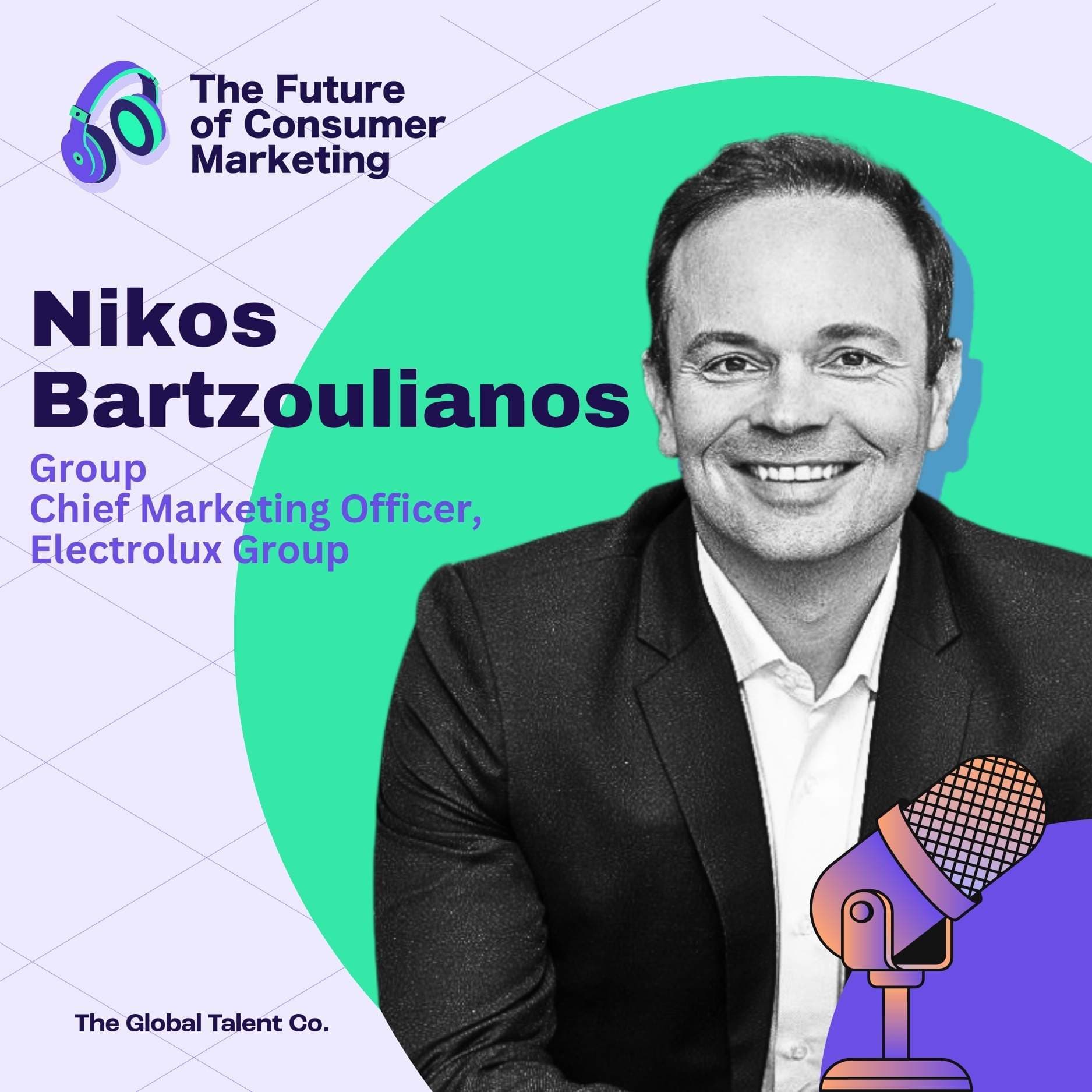
Nikos Bartzianos, Group CMO at Electrolux, argues that marketing should not over-index on performance/low-funnel tactics at the expense of brand building. He says campaigns must start and end with consumer needs, and that bold brand moves can be justified with consumer research plus ROI and brand KPIs.
Guest backgrounds
Nikos has mechanical engineering training, an MBA, and ~15–20 years in marketing. He previously worked at Samsung (2015–16), Procter & Gamble, and other brand organizations. He also served in Greek special forces (paratroopers/green beret).
Key claims
performance marketing shouldn’t be isolated; mission/values prevent “inauthentic” branding; consumer testing can miss “unknown unknowns” (Steve Jobs example); hire for attitude, directness, diversity of experience, and collaboration; protect time and resilience.
Notable examples
Electrolux campaigns “Wash Life Balance” and “Being Beautiful” (scratch-resistant, super-fast washing machines); Samsung brand shift from specs to emotional benefits; P&G training model (“mini CFO/CMO/GM”).
Written by AI. May contain mistakes. Listen to the episode to check what was said.
Chapters
Tap a time to open that second in VOIntroduction to Consumer Problem Solving
0:00 to 0:35
Exploring the importance of solving consumer problems in marketing.
“Solving consumer problems through your products, services or what your brand stands for.”
Marketing Truths and Career Path
1:01 to 2:06
Nikos discusses early career lessons and the hype around performance marketing.
“Thank you so much Roman the pleasure is mine.”
Electrolux's Mission and Heritage
2:06 to 4:10
Exploring Electrolux's mission to shape living for the better and its brand values.
“yeah yeah so i did i did mechanical engineering and then i did an mba but um for me what i discovered as a human, as a consumer, was the impact some brands had in my life.”
Navigating Change in Marketing
4:10 to 5:54
Nikos shares insights on adapting to market changes while preserving brand heritage.
“Wellness series, where in five minutes we tried to summarize what is this impact that has been documented and championed for more than 100 years.”
Campaign Strategies and Consumer Testing
5:54 to 8:10
Discussion on Electrolux's recent campaigns and the role of consumer feedback.
“You might notice that we elevated the sweetness, the heritage of the brand, not in the spirit of topography, where is Sweden and the flag, but more about the lifestyle values that this represents.”
Measuring Campaign Effectiveness
8:10 to 10:06
Nikos elaborates on the metrics used to evaluate marketing success.
“Because Scandinavia is an amazing place in the world, and Sweden specifically.”
Lessons from Past Experiences
10:06 to 14:00
Nikos reflects on lessons learned from Samsung and Procter & Gamble.
“But of course, there you need to also be ready with a backup plan in case things go wrong.”
Brand Transformation Insights
14:00 to 15:00
Learn about the shift from communicating product features to emotional benefits.
“and obviously I'm not taking credit for a huge marketing organization work, but I think Proutoo have been part of that journey.”
Lessons from Entrepreneurs
15:00 to 17:20
Explore what larger companies can learn from tech startups and entrepreneurs.
“Obviously, you've been always with more established companies, but I'm sure that you had a lot of opportunities to kind of exchange with tech companies, with founder CMOs of grownups and fast growing companies.”
Building a Strong Team Culture
17:20 to 19:40
Understand the importance of direct communication and diversity in teams.
“And earlier today, I had a chat with a very good team member and we had a similar chat.”
Show all 18 chapters
Skills vs. Attitude in Hiring
19:40 to 22:20
Discover the difference between hiring for skills and hiring for attitude.
“for the future and um you know other skill sets that you feel are overrated for marketeers but that people focus on yeah yeah they i had many mentors who told me you you train for skills you hire for attitude, right?”
Embracing Change in Loyalty
22:20 to 24:40
Learn about the evolving nature of employee loyalty in the modern workplace.
“So that has advantages and disadvantages.”
Managing Stakeholder Opinions
24:40 to 26:50
Hear strategies for aligning teams and managing diverse feedback effectively.
“So I try to protect the morning exercise.”
Leadership Lessons from Military Service
26:50 to 28:04
Gain insights into leadership skills developed through military experience.
Lessons from Military Experience
28:04 to 29:09
Learn how military and scouting experiences shape resilience and teamwork.
“I was actually a Boy Scout for many years since I was 10.”
Trends in Consumer Marketing
29:10 to 30:25
Explore the evolution of content creation and the risks of social media.
“What are some of the trends that you're most excited about?”
Balancing Brand and Performance Marketing
30:26 to 31:46
Understand the necessity of balancing brand and performance marketing efforts.
“Our future generation shouldn't be zombies.”
Advice for Aspiring CMOs
31:47 to 32:57
Gain insights on the importance of resilience and dreaming big in marketing careers.
“If there's someone in the young generation that wants to become also CMO of a big company, what would be your advice on what to do?”
Transcript
Automatic transcript. May contain errors.0:00Nikos Bartzoulianos:Solving consumer problems through your products, services or what your brand stands for.
0:04Roman Kirsch:I think that was key. The one marketing truth that you learned early on in your career that turned out to be completely wrong.
0:11Nikos Bartzoulianos:Performance marketing. It's all about performance marketing, right?
0:14Roman Kirsch:Yes, it's important, but it shouldn't be done in isolation. The company has been around for over a century, right? So what excited you about the role there?
0:22Nikos Bartzoulianos:Electrolux has a fantastic group vision, which is shaping living for the better.
0:26Roman Kirsch:How do you select the right talent for your team?
0:29Nikos Bartzoulianos:A diversity of experience, of thoughts, of thinking is absolutely needed. What did you learn kind of in the process of running campaigns? It starts and ends with a consumer. I think marketeers and brand builders need to have a strong gut feeling to do what's best for the brand. Identify big ideas, but at the end of the day, those need to land well with consumers.
0:52Roman Kirsch:Hi everyone and thanks for listening in. Today I'm speaking with Nikos Bartzianos, a group CMO at Electrolux Group. Nikos it's a pleasure to have you. Thank you so much Roman the pleasure is mine. And we try to start always with an interesting intro question and maybe let's start with with the following one what's the one marketing truth that you learned early on in your career that turned out to be completely wrong?
1:16Nikos Bartzoulianos:Performance marketing it's all about performance marketing right and I wouldn't say I have a long career meaning the last 15-20 years but there is a lot of hype about performance marketing and i think today it has come at the expense of pure brand marketing and brand building uh so i i always have a critical thought when somebody says we we we need to boost our performance marketing we need to invest in low funnel activities we need to boost the d2c i mean yes it's important but it shouldn't be done in isolation yeah i mean looking at your
1:54Roman Kirsch:cv early on you started mechanical engineering you kind of went to mckenzie it's not a cv that screams oh this is going to be a cmo market here so what made you kind of go down that route
2:05Nikos Bartzoulianos:absolutely i think that's a question i'm still asking myself yeah yeah so i did i did mechanical engineering and then i did an mba but um for me what i discovered as a human, as a consumer, was the impact some brands had in my life. And I don't want to be very here materialistic, but there were some brands that were motivating me. There were brands that were actually making an impact, that they stood for something that I could relate across different stages of my life. And I got fascinated by the power and the art or the science behind it so i i was curious so i said let's let's do marketing and of course you cannot have marketing without proper understanding of the consumer so being close to the consumer applying common sense solving common sense solving consumer problems through your product services or what your brand stands for i think that was key and that's why i've been always been associated with brands organizations that have very solid extremely solid missions and value system
3:15Roman Kirsch:i mean that that's a good kind of transition to your current role at electrolux so so what's kind of the mission of the business the company and also the brands behind that because the company has been around for over a century right so what excited you about about the role there.
3:32Nikos Bartzoulianos:Absolutely. Well, Electrolux has a fantastic group vision, which is shaping living for the better. I think starting with that, there couldn't be a better selling point, right? Shaping living for the better. And then I started to understand more what it means and discovered that it stood for something else. One of the most sustainable, consistently recognized sustainable companies in the world for more than 100 years, offering bespoke experiences in taste, care, and well-being. This brand, this group of brands, this house of brands were making a difference in the world. And we told a story actually recently in BBC Studios in Pursuit of Wellness series, where in five minutes we tried to summarize what is this impact that has been documented and championed for more than 100 years.
4:23Nikos Bartzoulianos:It starts with air. If that is not there, I don't think it's easy to put your heart into that.
4:30Roman Kirsch:Okay, interesting. And I mean, you've been before with Samsung, you've been with Pogta and Gamble, but even by those standards, Electrolux is probably way older and has more heritage. So, you know, how do you navigate kind of this ever-changing, quicker way of, you know, being on top of trends, you know, social media, AI, a lot of tech with the preservation of kind of the heritage. And, you know, how is that limiting you and how is that enabling you to kind of make the right decisions?
5:03Nikos Bartzoulianos:Just one note, I think P &G is older. It's almost 200 years old, depending on the brand. But your point is absolutely fair. Basically, you need to constantly challenge yourself. You need to constantly challenge yourself. And the marketeers or any executive or team who feels complacent, they will be surprised. Because the world changes, consumer behavior changes. The headwinds the industry is facing today is different than the headwinds that were present 20 years ago. How do you adapt? How do you remain valid? it, I think you need to be very clear on the things you change and the things you keep.
5:45Nikos Bartzoulianos:So what you stand for, your mission, your values, those I think are fundamental for the existence of a brand, of a company. And unless you are true to the brand promise, immediately you become inauthentic. So I can give you an example, right? If you noticed recently, this year, we made a major brand transformation with Electrolux with two campaigns that we launched, Wash Life Balance and that being beautiful behind our scratch-resistant hub and our super-fast washing machines. You might notice that we elevated the sweetness, the heritage of the brand, not in the spirit of topography, where is Sweden and the flag, but more about the lifestyle values that this represents.
6:30Nikos Bartzoulianos:Because in today's world, where you have way, way more competitors, those are the things that differentiate you and make the brand distinctive. So I will tell people always don't be shy. In the case of Electrolux you can take Sweden out of it. The challenge is how do you interpret Sweden around the world? How do you make it locally relevant?
6:52Roman Kirsch:You made those initial two bold campaigns leading into Swedish heritage once after you joined right? So um and there is a third one
7:00Nikos Bartzoulianos:coming up completing the trilogy very very soon but you will soon hear.
7:05Roman Kirsch:So tell me a bit more about the thinking there why did you decide to double down on that you know what did you learn kind of in the process of running campaigns maybe share kind of one or two success metrics how you also defined if that campaign has been successful or not.
7:20Nikos Bartzoulianos:I'll try to be as descriptive as possible without giving away too much, I think it starts and ends with the consumer. So I think marketeers and brand builders need to have a strong gut feeling to do what's best for the brand, identify big ideas. But at the end of the day, those need to land well with consumers. So I have to say that there was some resistance on the big ideas as it always, because when it comes to marketing and creative, there are many different schools of thoughts, many stakeholders, and that's absolutely normal. But what I was pleased to see was that there was a common understanding and blessing all up from the CEO that if consumer research validates the findings and the key metrics of a campaign, then it's good to go, even if they disagree.
8:10Nikos Bartzoulianos:And I have to say, we used a new tone and manner in the brand, a more heroic one, which I thought is more applicable and relatable to the brand heritage and superiority and innovation history, which was weird to many people, especially in the Nordics. Why? Because Scandinavia is an amazing place in the world, and Sweden specifically. And one of the core values is humility, humbleness, which is an amazing trait. Me as a Greek also, I could use a little bit more of that. But jokes aside, you can be humble yet confident at the same time. So sometimes you need to push the boundaries and tell your story.
8:48Nikos Bartzoulianos:So that's what we did.
8:49Roman Kirsch:And just in terms of how you measure kind of the effectiveness of the campaign, what are some of the metrics you would be generally looking at?
8:58Nikos Bartzoulianos:I have a very strong army of CFOs, financial controllers. So I need to challenge you, chase you.
9:07Roman Kirsch:You have to justify every single thing.
9:09Nikos Bartzoulianos:Day and night, of course. And I think that's something that every marketeer, every CMO is facing, right? It's the polar opposite, the CFO versus the CMO, which is a healthy tension, I have to say. So I always start and challenge my team and ask for their help, of course, to demonstrate ROI, return on investment, return on marketing investment. And that needs to, of course, to have a short-term impact. but we also try to model medium to long-term impact, specifically around brand building. KPIs, I mean, I'm not going to surprise you there. Top of mind awareness, top three consideration, purchase intent.
9:52Nikos Bartzoulianos:Those are key metrics we try to measure. And of course, in line with the strategy of the company, drive profitable market share growth. and you could argue also how you mix up and how you premiumize the brand and there are some kpis there i cannot disclose all of them but um there is a lot of science behind it um and last but not least of course consumer testing versus competition versus previous campaigns to ensure that we're heading the right way but here i want to take a pause if steve jobs did consumer testing of the
10:30Roman Kirsch:iphone without a keyboard probably would have failed that testing so sometimes you need to
10:37Nikos Bartzoulianos:take a leap of faith when you make a big jump because consumers might not know what they don't know until they have it yeah so i think great brands great products make the difference when they are ready to take bold steps. But of course, there you need to also be ready with a backup plan in case things go wrong.
11:03Roman Kirsch:How much of what you kind of learned, for instance, at Samsung, which is obviously also a high ticket value products, how much is really applicable? How much is different? And the same question for your Procter and Gamble time, because there you have less concentration for products, I would argue, right? And probably just buy quicker because the ticket price is lower. Of course, there's a lot of other differences and similarities, but maybe you can talk a bit more about what you always can reapply and where you kind of need to start from scratch when coming in to a new company and brand.
11:43Nikos Bartzoulianos:I feel privileged because all of these institutions we're talking about and organizations have made their mark in their respective industry. Electrolux has been the number one home appliance manufacturer for many decades with consumer at the epicenter for many, many, many years. Samsung at the same time has been associated with the highest ever growth, economical growth of a country. And I'm talking about Korea. They've been part of that tremendous journey. P &G, I mean, where can I start? I mean, I have huge, tremendous respect of the fundamentals of marketing and brand building. And I think it's a fantastic school, Procter & Gamble and other FMCG companies.
12:29Nikos Bartzoulianos:From P &G, I would keep definitely the obsession with consumer. There's no way you can ignore the consumer. I would also highlight this institution as one of the best companies for marketeers and managers and leaders. because from day one, regardless of your level and all of the P &G employees, except R &D, they start at entry level and walk all the way up in the company. You've been given true responsibility. No sugar coating. You have a responsibility, big or small, but it's you. You are the mini CFO. You are the mini CMO. You are the mini GM, CEO. And marketing specifically, it's a leading function, which in other companies you don't see that often.
13:13Nikos Bartzoulianos:They ultimately control the full portfolio of the four Ps, place, price, promotion, and product. How you innovate. You don't see that everywhere. A lot of times, some companies, especially in the appliances industry, have R &D and product at the epicenter in the steering wheel. And a lot of GMs and general management come from that function. So when it doubts, organizationally, I always look back at the P &G times. Now, looking at Samsung, the winning mindset, the speed to market, the obsession with winning, of becoming number one, regardless of the industry or field they play, is enormous. Marketing-wise, when I joined Samsung in 2015-16, I think at Indie Brands, Best Global Brands ranking, they were ranked 17.
14:04Nikos Bartzoulianos:When I left, they were number five. and obviously I'm not taking credit for a huge marketing organization work, but I think Proutoo have been part of that journey. And I observed from a first row, front row seat, the brand transformation. I can give an example there of moving away from communicating specs, features, but communicating emotional benefits and becoming a more human brand. And that's what I keep from Samsung, which, of course, is also a competitor of Electrolux when it comes to home appliances. With Electrolux, of course, what I've observed is the, and it's been fantastic, the love that people have for the brands, the passion, especially the marketing community, their eyes are full of hope of telling that story, waiting to unlock the right way or medium to tell the true story of Electrolux as a brand.
14:59Nikos Bartzoulianos:And I think that is something exceptionally motivating for working with so much talented and fashionable people.
15:07Roman Kirsch:Obviously, you've been always with more established companies, but I'm sure that you had a lot of opportunities to kind of exchange with tech companies, with founder CMOs of grownups and fast growing companies. So what are the things that you feel bigger established companies can learn from those tech companies and vice versa? What are the things that some of those, you know, consumer tech businesses can actually learn from bigger established companies that they don't really have as part of their DNA?
15:37Nikos Bartzoulianos:Yes, Roman, and by the way, I have to say here, I have huge respect and admiration for entrepreneurs around the world. I have many friends, many classmates, ex-college who have went on and ventured pursuing their dreams. It takes guts and not everybody has a financial pillow below them and there is a major, as you know better, life decision with huge implications right in your personal life to go that way, the entrepreneurial way. So huge admiration for that and I hugely respect everybody. If I could keep something, if I can see something very common across all the founders and entrepreneurs, they have a very clear vision, a very clear passion and tremendous drive to make this work.
16:31Nikos Bartzoulianos:In most cases, it's all in and it's a make it or break it. Can we apply that mentality in the corporate workplace? I think it's absolutely needed. A lot of my team members are asking me what it takes me to become an executive, a VP. a CMO, what it takes for me to become a people manager, a leader. So that was a lesson for me across my career. And of course, I had my fair share of failures. But the moment you start feeling that you own part of the company, and I'm not referring to shares, I'm referring to truly, truly own your work stream, your area of responsibility. The moment you start realizing that in order to do magic, you might need to go above and beyond what your job description says.
Read the full transcript
17:19Nikos Bartzoulianos:That's when you create magic. This is the difference. And earlier today, I had a chat with a very good team member and we had a similar chat. I mean, he was asking me, how do we add value here? I was telling him, you know, treat it as if it was your company and then you have my trust because I know I'm in good hands because you're gonna drive this end to end the statement transition also to kind of the
17:48Roman Kirsch:question around how to build the right team how to build kind of the right culture and obviously the type of talent that you would probably see in your organization is somewhat different than you would see applying for us early stage startup but you know how how do you select the right talent for your team? And what are also the things that you now hire for differently than at the start of your career?
18:14Nikos Bartzoulianos:I truly believe in healthy conflict. I like to be direct and I want people to be direct. We don't have time to hide. I also believe in the power of diversity and not diversity for the sake of diversity because there are some quotas that people need to fill out, but diversity of experience, of thoughts, of thinking, is absolutely needed. Today's world is diverse. Whatever aspect you see, you cannot have a homogenous group of people serving the world. You can become a local niche brand or you can become a global brand. There's no in-between. So in order to serve the world, you need to capture that diversity somehow.
18:59Nikos Bartzoulianos:So this is the second element after directness and openness. Last but not least, as a third attribute and value that I seek is people that are true problem solvers. People that are true collaborators that can work above and beyond, sideways, inside and outside the organization. These are the connectors. These are the people that are going to make this work. Especially when it comes to marketing, we should never work in silos. so unless you are able to work very well with somebody and collaborate it's not gonna work
19:37Roman Kirsch:and in terms of just general skill sets is there things that you feel are more important now and for the future and um you know other skill sets that you feel are overrated for marketeers but
19:51Nikos Bartzoulianos:that people focus on yeah yeah they i had many mentors who told me you you train for skills you hire for attitude, right? So the attitude is difficult to be trained or changed. So that's something I always look. If somebody doesn't know digital marketing or performance marketing or all the hard technical skills, this is the easy part. The difficult part is to find the right partner who can actually challenge the status quo, drive change, collaborate with people, be trusted.
20:28Roman Kirsch:it that's what I'm looking for there's also kind of this point of loyalty because obviously employee retention is on average going down right um and you know like kind of the generation before was uh was kind of staying 20 30 years with the company I think the millennials a bit shorter um kind of the next generation is probably even even shorter more having like gig jobs so how does that square with the idea of having kind of this loyalty towards the heritage brand and really building for the long term and the same goes by the way to executives right executives also don't
21:06Nikos Bartzoulianos:don't uh of course of course um i mean executives need to be empowered to drive chains you cannot drive chains if you want if you're asked to drive change without willing to change anything so um that's very important to keep in mind when it comes to loyalty and i've stayed almost 10 years at Samsung 5 at PNG. I'm in general very loyal to the brands and the companies I serve. But there is one constant thing in life besides death and taxes. Change. Everything will be changing all the time. And we need to make peace with that. So don't be afraid of the change. Embrace. Embrace the change. And it can be painful sometimes.
21:50Nikos Bartzoulianos:So loyalty for the good reasons? Yes. Absolutely. Loyalty because you enjoy working at the workplace. Loyalty because you value what your company stands for. Absolutely, 100%. Loyalty because you are happy with your life and you don't want anything else to go wrong. Yes, absolutely. But loyalty, for the sake of loyalty and fear of the unknown, no.
22:17Roman Kirsch:The other question that I have is you are working in a highly metrics organization with electronics, right? So that has advantages and disadvantages. I mean, one of the disadvantages is that there's so many opinions and kind of, you know, hard or extended decision making processes. How do you get cross functional teams aligned instead of just, you know, having one meeting for the sake of meetings?
22:46Nikos Bartzoulianos:Yeah, I mean, that applies not only in Electrolux, in every company. big companies usually have matrix organizations very simply put you can ignore stakeholders you need to manage all stakeholders even stakeholders who don't understand marketing i remember a funny my first creative review creative review and i'm not gonna i'm not gonna name the organization but in my first creative review they were 15 executives in the room having an opinion on a piece of creative maybe two or three are closely associated with the project the business but i found myself in a corner not knowing how to manage all conflicting and diverse piece of feedback what is this what is this flying object oh why do we use this color why do which is fantastic everybody's entitled to an opinion but i think what you need to be very aware is that there is science behind creativity, there is art, there are metrics, and testing is your friend when you want to escape this kind of difficult meeting.
23:54Nikos Bartzoulianos:Pick your audience. However, having said that, do invest the time to walk people through their journey. Maybe not in the same room everybody, because that can become unmanageable, but invest the time. Walk them through, capture their feedback, think about but you are only going to win. And also from a personal point of view, it shows respect and it enhances the relationship. So it's part of the job. If anyone thinks they can work by themselves, well, they might be surprised because that wouldn't work in a corporate environment, at least at higher managerial levels.
24:29Roman Kirsch:Let's talk a bit more about the future and obviously some of the things that you spend most of your time on. Maybe as an intro question, how do you usually kind of structure your week now what do you focus on what do you try to avoid
24:42Nikos Bartzoulianos:i try to protect my precious time and precious time saying i always try to have my mornings protected and when i say mornings i'm not gonna tell you those crazy 5 a.m book clubs or i cannot do that i cannot do that but i do want to start my day exercising or running in the morning I live in London so Hyde Park is great or when I'm in Greece I run by the waterfront in Thessaloniki because that keeps my mind that sets me up for success because then I'm really happy you know you get the runners high after 40 45 minutes of running you feel really energized and pumped up and that energy actually transcends to the teams to the organization and when you don't have pleasant conversations, when you have difficult conversations, still you are in your Zen mode.
25:36Nikos Bartzoulianos:So I try to protect the morning exercise. And of course, most of us have loved ones in our lives, whether it's kids, partners, families, pets, right? Spending, protecting that quality time with them, either in the morning or after work or during the weekend. It should be sacred. I have an excellent relationship with my executive assistant who I try to empower her to be my gatekeeper. In terms of priorities, of course, I delegate much of the decision of the meetings and I try to ensure whether you have an EA or not, to prioritize which are the absolute meetings I need to attend versus which are the nice to have.
26:31And some things need to go later.
26:34Nikos Bartzoulianos:I always try to have some focus time through the day so I can think, I can connect. I have some open time for team members to reach out to me. In many of the companies I've worked at, when they gave us those amazing trainings about productivity hacks, you know blocking some time in the calendar early in the day late in the day or Monday morning or Friday evening that helps that helps plan properly I think you also one of the I don't want to say
27:03Roman Kirsch:a few but I mean you you did have your military service right unfortunately probably a lot more people will have to do that in in the future and Greece I think always had had mandatory military service but are there certain and lessons on leadership that that you took took out from that both positive and maybe not positive yeah yeah yeah yeah that's a that's an excellent question and yes military service in Greece is mandatory but I chose the hard way so I was at the special
27:32Nikos Bartzoulianos:forces like green beret paratroopers so I served one year there and I'll tell you some of the learnings first of all I came to reality with the true composition of society I was privileged to study in higher education. This is not guaranteed for everyone. You get to interact with people of different educational levels, social, socioeconomic levels, people of different beliefs than perhaps the environment you grew up and you have to learn how to coexist. I was actually a Boy Scout for many years since I was 10. So that also helped me with teamwork and team building. So collaboration, team building, even with diverse groups is key.
28:18Nikos Bartzoulianos:And then the other thing that the military experience taught me was resilience. And that's absolutely needed. There were some very, very difficult moments. I was like, wow, how do we get out of this situation? And some were just simple, but just difficult. And some were really, really tough, right? Especially on some sensitive parts around the world. So that gives you resilience and perspective. And I think that's much needed even in the corporate world, because sometimes it can become a jungle of challenges, of headwinds. Sometimes you might have some strong disagreements, which is the best way to deal with them is to convert them into something constructive.
29:03Nikos Bartzoulianos:And I've been lucky to experience many of those cases.
29:07Roman Kirsch:Back to marketing. What are some of the I mean, you're talking about obviously the future of consumer marketing. What are some of the trends that you're most excited about? What are some of the trends that you kind of are paranoid about or a bit scared and concerned about?
29:20Nikos Bartzoulianos:What I'm really excited about is the evolution of content creation. You don't necessarily need to do those expensive productions, which, by the way, we're still doing because there is merit to that. Because you might see that a post from an influencer or a content creator might have more impact for a brand perception than a TV campaign that most people might not see. Because why? Because they are multitasking on their tablet or phone. I see this is happening. Digital becomes and social becomes even more and more important. But that's also the danger here. The more you rely on this new media, the more AI is coming into play, the more we risk authenticity and connection to reality.
30:12Nikos Bartzoulianos:So that's a risk. What I'm also very concerned is this phenomenon of people getting more and more addicted to social media or the use of technology. Advertisers shouldn't take advantage of that, but act responsibly. We don't want zombies. Our future generation shouldn't be zombies. There should be people and I find myself to be a millennial. So I've experienced both analog and digital life during my teenhood. So I see this as a major risk factor. And I think there might need to be more controls or responsibility in terms of content consumption.
30:54Roman Kirsch:You started initially by saying performance marketing is not everything and you need to square it with brand marketing. so marketing allocation and the budget mix is kind of in the future what challenges are overrated where do you rather want to double down on and focus on in terms of kind of your spend over the
31:13Nikos Bartzoulianos:next years i will strongly advise every marketeer facing this question how much lower funnel versus upper funnel how much brand versus performance it's not a debate it's not a dilemma you need both And depending on the maturity of the market, your product category, you need to do the due diligence and the necessary research. There are fantastic agencies, fantastic media partners who all have the data. They can quantify what's the right mix. I'll give you an example from Samsung Times. Before a groundbreaking brand campaign, Ostrich was launched, obviously product salespeople questioned, why should we show and invest media behind the brand campaign and not versus put all the money into product so without disclosing anything confidential we tested the impact test it don't be afraid to test pick a market do an a b testing get the data prove your case and then you will be surprised positively about the results and how important brand is again not easy to digest when you talk to product people and to sales people who have very demanding short-term targets, but there is a clear impact in purchase intent when these two are combined.
32:30Roman Kirsch:Last question. If there's someone in the young generation that wants to become also CMO of a big company, what would be your advice on what to do?
32:38Nikos Bartzoulianos:Be ready to fail. Be ready to fail and learn. It's an exciting journey. You cannot predict your career. I never thought I would be a CMO. My other advice would be dare to dream and chase your dreams because that is absolutely needed. We need more of that.
32:56Roman Kirsch:Amazing. Amazing final words. So thanks a ton for coming on the show. My pleasure.
33:03Nikos Bartzoulianos:Absolutely, Roman. Thank you.
From the publisher
In this episode of The Future of Marketing, host Roman Kirsch interviews Nikos Bartzoulianos, Group Chief Marketing Officer at Electrolux Group. Leading marketing for a 100+ year-old home appliance manufacturer, Nikos is orchestrating a brand transformation that balances Swedish heritage with contemporary consumer expectations. From challenging the performance marketing orthodoxy to navigating creative decisions with 15 executives in the room, he shares tactical insights on building brands in matrixed organizations, measuring ROI beyond short-term metrics, and knowing when to trust consumer research versus when to take bold leaps of faith.
Topics Discussed:- Balancing performance marketing with brand building in high-consideration categories
- Executing brand transformations in century-old heritage companies
- Leveraging cultural assets (Swedish design values) for global brand differentiation
- Managing stakeholder alignment in matrixed corporate environments
- Measuring marketing effectiveness across short, medium, and long-term horizons
- Building diverse marketing teams that challenge status quo
- Adapting marketing strategies across FMCG, consumer electronics, and home appliances