In short
Future of Consumer Marketing - Episode Summary
Episode Title
From Fashion to SaaS: Humanizing Technical Products
Host
Andres Figueira
Guest
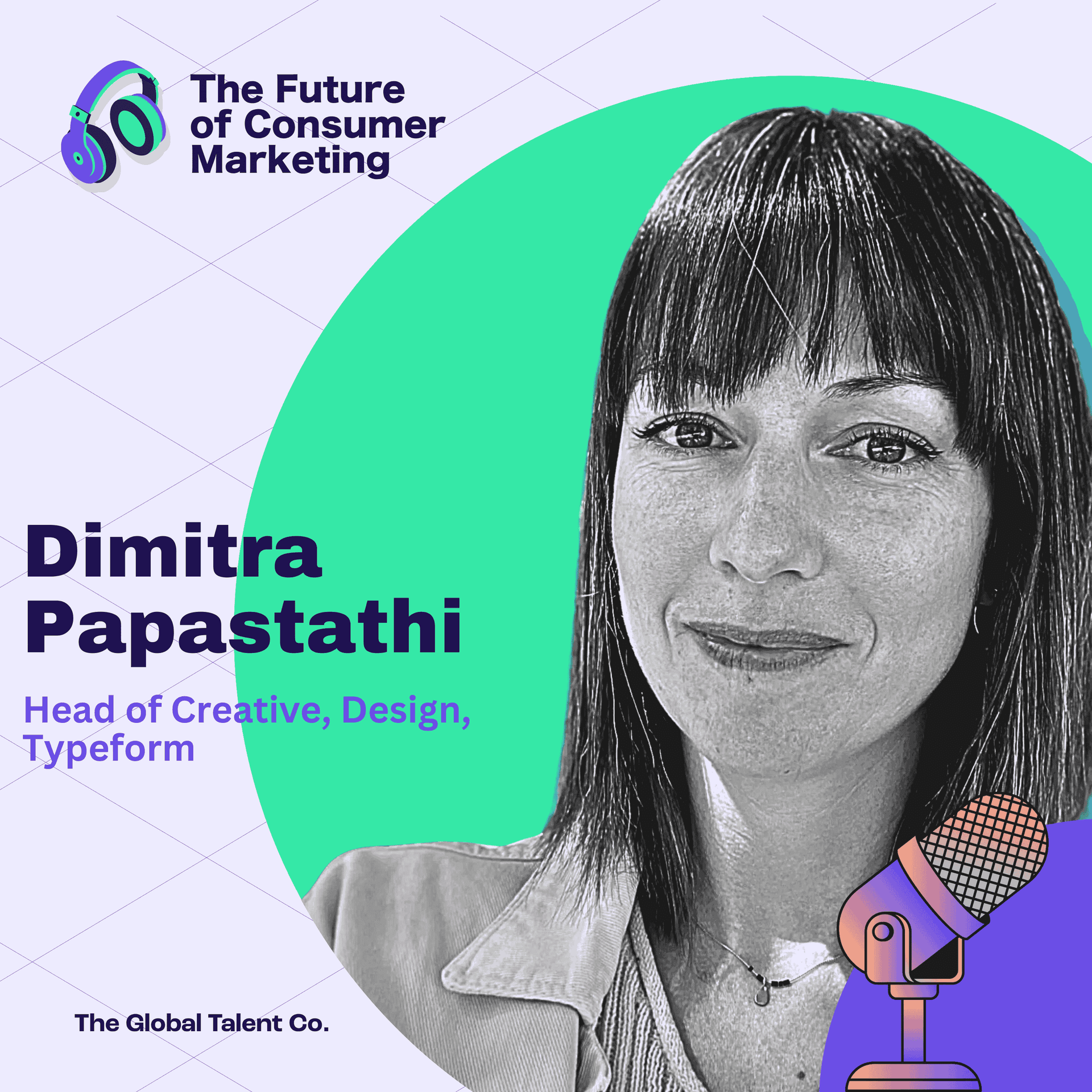
[Dimitra Papastathi](https://www.linkedin.com/in/dimitra-papastathi/), Head of Creative Design at [Typeform](http://typeform.com)
Episode Overview In this episode of the Future of Consumer Marketing, host Andres Figueira interviews Dimitra Papastathi, who discusses her role at Typeform, a company that has transformed data collection into an engaging experience for businesses. The conversation explores the intersection of design, technology, and the importance of humanizing technical products.
---
Key Topics Discussed
- Fashion and Culture in Tech Branding
- Dimitra's background in fashion informs her approach to tech branding, introducing more human elements.
- Tech startups often have generic aesthetics; Typeform aims to create engaging visuals.
- Evolving Brand Aesthetics
- Shift from generic startup visuals to personalized and humanized brand experiences.
- Importance of adapting visual identity to cultural moments and technological advancements.
- Creative Team Structure
- Managing a hybrid team of four designers and an extended creative agency.
- Collaboration between marketing and creative teams to maintain brand consistency.
- Strategic Use of AI
- Incorporating AI into creative workflows for brainstorming and enhancing design processes.
- The ethical dilemmas and challenges of using AI in creative work.
- Measuring Creative Impact
- Using qualitative and quantitative metrics to gauge the success of creative initiatives.
- Balancing brand consistency with the need for creative experimentation.
- International Audience Considerations
- Maintaining brand coherence while adapting communications for different demographics.
- The "AI Kitchen" Concept
- A collective approach to explore and evaluate various AI tools within the team.
---
Insights from the Conversation
- Creative Process
- Creativity is not linear; Dimitra describes their process as a "creative funnel" that filters ideas down to viable solutions through brainstorming, exploration, and feedback.
- Impact of Design on Business
- Design should serve a purpose aligned with the company’s goals, balancing clarity with creativity.
- Designing for emotional response while ensuring clear communication is crucial.
- Adapting to Change
- Brands, like living organisms, must evolve with their offerings and external factors influencing perception.
- Consistency builds trust, but brands must also surprise their audience to keep engagement alive.
---
Key Takeaways
- Understanding Company Goals
- Designers should deeply comprehend the objectives of their company to create impactful designs.
- AI's Role in Creativity
- AI can enhance creative brainstorming but should be used thoughtfully to avoid ethical pitfalls.
- Brand Evolution
- Brands must adapt visually and strategically to remain relevant in a fast-changing technological landscape.
- Creative Experimentation vs. Consistency
- There will be instances where consistency may need to be sacrificed for impactful creative experimentation.
- Cohesion Across Platforms
- Ensuring a consistent brand voice while adapting the tone of messaging based on the platform and audience is essential.
---
Conclusion Dimitra Papastathi's insights into humanizing technical products through engaging design highlight the critical role of creativity in consumer marketing, particularly in the tech industry. Her blend of experience from fashion and culture informs a fresh perspective on branding that resonates with today's audiences.
To explore Typeform and its offerings, visit [typeform.com](http://typeform.com).
Written by AI. May contain mistakes. Listen to the episode to check what was said.
Chapters
Tap a time to open that second in VOThe Evolution of Typeform
0:00 to 0:48
Learn about Typeform's engaging approach to data collection.
“Typeform is not just a blank form, it's not just a blank canvas.”
Dimitra's Journey to Typeform
1:20 to 3:33
Explore Dimitra's background and her role at Typeform.
“And with that said, Dimitra, welcome to the podcast.”
Humanizing Tech Through Design
3:33 to 5:55
Understand how design from fashion impacts tech branding.
“Do you feel that your background in culture and fashion has kind of like changed the way you approach design in the tech industry?”
Typeform's Global Reach
5:55 to 7:58
Learn about Typeform's accessibility and team structure.
“No, and also I believe in type form, which is a product, even though it's tech, it's not the most enticing thing.”
The 'Get Real' Campaign Insights
7:58 to 11:43
Discover insights from Typeform's recent campaign on AI.
“how big is the team that is managing Typeform?”
Using AI in Creative Processes
11:43 to 14:10
Explore how AI is utilized in design and creative workflows.
“And Dimitra, do you have any other ways that you yourself are using AI in your daily processes, in your workflow?”
The Role of AI in Creative Processes
14:10 to 16:41
Explore how AI impacts creativity and asset production.
“And adding to that, I think when we use AI and AI, a creative asset that has AI has a bit of a wismical feel to it.”
Understanding Creative Workflows
16:41 to 20:44
Learn about the creative workflow and how ideas are developed.
“And just to add to that, we created a ritual last year, which is called AI Kitchen.”
Measuring Creative Success
20:44 to 22:59
Discover how to measure the impact of creative work on business objectives.
“Even when we, you know, make this pot with the references, we're trying to add notes on why every reference could be useful.”
Evolving Brand Consistency
22:59 to 25:17
Examine how branding evolves while maintaining consistency.
“The way we're dressing up a brand needs to evolve according to how things are changing around it and also according to how the offering of the company is changing.”
Show all 12 chapters
Balancing Creativity and Brand Consistency
25:17 to 28:00
Discuss the challenges of balancing creativity with brand guidelines.
“Have you ever reached or do you ever find yourself in the position where you need to decide between prioritizing the brand consistency or actually experimenting with the creative work you're doing.”
The Role of Design in Business Growth
28:00 to 29:46
Learn why understanding company goals is essential for designers.
“But at the same time, you know, you need to keep the sparkler alive and you have to also surprise your audience.”
Transcript
Automatic transcript. May contain errors.0:00Dimitra Papastathi:Typeform is not just a blank form, it's not just a blank canvas. It's an interactive, engaging experience where someone can apply their brand, their own imagery, and they can customize according to their use case and according to the brand.
0:12Andres Figueira:Do you feel that the image for our Typeform since you arrived has evolved?
0:17Dimitra Papastathi:The brand essence hasn't changed drastically throughout the years, but then in terms of actual visual applications, like yes, the visual identity has evolved.
0:25Andres Figueira:Do you ever find yourself in the position where you need to decide between prioritizing the brand consistency or actually experimenting with the creative work you're doing?
0:34Dimitra Papastathi:We're trying to keep consistent because consistency is building trust over time. We all know that. But at the same time, you need to keep the sparkler alive and you have to also surprise your audience.
0:48Andres Figueira:Hey, everybody. Thank you for tuning in. My name is Andres Figuera and I'm going to be your host for the day. This show is brought to you by the Global Talent Company, helping fast-growing teams hire exceptional remote talent from Argentina, South Africa, and beyond. We connect companies with world-class professionals who bring skill, reliability, and a global perspective to every role. And just for our listeners, we're offering an exclusive 10 % discount on your first hire. All you need to do is visit GlobalTalent.co, click Start Hiring, and mention the podcast listener discount when we get in touch.
1:20Andres Figueira:And today, with me here, I'm speaking with Dimitra Papastathy, Head of Creative and Design at Typeform, a company that's helping over 150 ,000 businesses collect the data they need with forms, surveys, and quizzes that people enjoy. And with that said, Dimitra, welcome to the podcast. How are you doing today?
1:40Dimitra Papastathi:Hi, everyone. I'm really glad to be here. Thank you for the invitation, Andres.
1:44Andres Figueira:No worries at all. We're very happy as well to have you hop on with us. And just to get people a bit more in context, Dimitra, would you be able to tell us in your own words a bit of your background, your experience, how you got to Typeform and in the end, what Typeform is?
1:58Dimitra Papastathi:So like you just mentioned, I am the head of creative design at Typeform right now. I help shape the creative vision of the brand and I'm leading a team of four there. I have a very strong background in brand design. everything started years ago in London where I gained my experiences in well-known branding agencies and studios and my background is really rooted in fashion and culture I've always loved shaping brands creating brand systems and then at some point I was very attracted by the tech by the new products and particularly the tech in Barcelona. So I joined Typeform, which is a really, really interesting product.
2:53Dimitra Papastathi:It has been really reshaping how people experiencing forms, forms such as feedback forms, surveys, quizzes. so TypeRom has done it in a very different and engaging way comparing to other companies the product keeps evolving since I believe 2013 if I am not wrong I think this is when TypeRom was founded and for the last few years I'm helping the product with creative narratives to showcase all the capabilities to the world.
3:37Andres Figueira:Do you feel that your background in culture and fashion has kind of like changed the way you approach design in the tech industry? Because I feel people could be in tech for a long time and then they just have this mindset of how it should be. But coming from a different area, maybe that has really shaped how you decide to take things on.
3:56Dimitra Papastathi:I believe so. I I believe it has added a specific flavor to it. Traditionally, startups, you know, if you remember the first startups, they were all following similar visual language. Blue was the color to be in all the CTAs and, you know, illustrations. And then everything was looking pretty dry, I have to say. The human element was missing from the scene. So I would say coming from a different background really helps create engaging visuals that people can relate to. And they can really, our audience can really imagine the product in their real life.
4:42Andres Figueira:In your background from culture and fashion, do you feel that there's any design principle that tech brands should be using but they aren't? like in any way that you feel, hey, this is something I learned that works really well in fashion, but in tech, it's being completely ignored.
5:01Dimitra Papastathi:It's been quite a while now that the many startups they have, they're trying to create a distinct brand image for themselves. So many of them, they are detaching from these original emerging patterns, these blue buttons and illustrations and dry visuals. they want to inject more of the human element in their brand story so this is a common practice that we see more and more obviously it depends the sector, it depends the industry, it depends the audience not all of the tech products can adopt the same brand image but I would say that I have been seeing more and more an editorial feel in the tech industry that we weren't really observing in the past.
5:55At the same time, because everything needs to be systematized
5:59Dimitra Papastathi:and everything needs to be designed for scale, it's hard to balance creative expression with functionality, but I believe that brands, they tend to have this more human aspect in their brand assets and particularly in assets creating, connecting as it's called connected to content and campaigns.
6:21Andres Figueira:I understand that. No, and also I believe in type form, which is a product, even though it's tech, it's not the most enticing thing. Like, hey, go do a form, go do a survey, go just do a quiz. And proper branding and creative design behind that should make it a bit more fun and actually just something that is better to look at. Because if you're going to be just staring at a blank form with blank spaces to fill out, you could make it a bit more entertaining to the user and that way just make them enjoy your brand even more. That's how I would also think about the creative design behind a brand like Typeform, just because I do believe it needs a bit more flair, if that's anything I could actually interject with.
7:07Andres Figueira:But also, Dimitra, would you also be able to tell us a bit more about Typeform? And to you guys, this is a company, a tech company that works with countries all around the world. Users anywhere can use your website to just create forms and send them inside their companies and everything like that, right?
7:26Dimitra Papastathi:Yes, that's right. Yeah, yeah. You can access Typeform from anywhere in the world. 100%. This is an international company, an offering. and anyone can share with their audience this engaging product. Because like you just said, Typeform is not just a blank form. It's not just a blank canvas. It's an interactive, engaging experience where someone can apply their brand, their own imagery, and they can customize according to their use case and according to the brand.
7:57Andres Figueira:And then if Typeform is that international, how big is the team that is managing Typeform? Like how big is the company?
8:05Dimitra Papastathi:The company, so we're about 300 people right now.
8:08Andres Figueira:Okay, that's a bunch. That's a bunch. And how many people do you have in your team helping you with the creative design?
8:14Dimitra Papastathi:So I have four people in my team. And then we're also collaborating with a small creative agency that is helping us. It's our extended creative team, if you want, that is really helping us to produce as much as we can and tell all these creative stories to the world. and we're really lucky to be collaborating with them. So it's a bit of a hybrid moment.
8:37Andres Figueira:Okay, and does what you do with creative design, does that permeate into the marketing of Typeform and how they take their campaigns and how they talk to the audience? Is this something that is connected between both of those departments?
8:51Dimitra Papastathi:So yeah, absolutely. Our team is called Creative Studio and we're part of the marketing division. and our responsibilities, they are separated into two categories. So on one side, we help shape the foundation, we help shape the brand, you know, the colors, typography, everything that the people really need to use in order to produce all those marketing assets. And on the other side, we are supporting the marketing team with the request that come our way, whether this is a product campaign, a content campaign, paid assets, anything that really needs to communicate the great functionality of our product.
9:36Andres Figueira:Okay. And do you have any example of a campaign that you helped out with that was very successful or that you did something that really caused a spike in more users or in more acceptance from the audience? Is there any story behind that that you could tell us?
9:52Dimitra Papastathi:We have very recently announced a new campaign, which is called Get Real. And we launched a survey and questioned more than 1 ,000, I believe, something between 1 ,000 to 2 ,000 marketers and creative to take their perspective on the use of AI, on the use of generative AI. So we would like to know what people think about AI. Do they use it in their day-to-day work? Do they use it to produce content? Do they disclose that they use AI? Are they positive about the future? So we're going to share a very complete report about the use of AI and what AI can bring to marketing very, very soon. Creative has helped this campaign by producing proper identity for the assets, very particular graphics, and the whole report, which has, I believe, three sections in total.
11:03Dimitra Papastathi:Creative has been really behind this big effort led by the content in the team, the content social in the team.
11:14Andres Figueira:Okay, I love that. So now then you're trying to just get to understand how people can use generative AI in the marketing and then showing those results to the audience just so that it creates more education within your users?
11:27Dimitra Papastathi:Yeah, we're trying to show to people how AI can actually be a lever and not just something that we need to fight. It turns out that the results are more positive than negative. And this is what people would like to read, to understand why the audience thinks AI can be a powerful tool for their work.
11:50Andres Figueira:And Dimitra, do you have any other ways that you yourself are using AI in your daily processes, in your workflow?
11:58Dimitra Papastathi:This is a really interesting question and something that I have been questioning myself as well. Like, where can AI help me? When can AI bring real value without putting me in dilemmas? Because, you know, there are all these ethical dilemmas. There are also dilemmas about should I use AI in such way or in such way? And would people be offended or would people think, oh, this is not real, should I use it or not? I believe there is a moment for using AI depending, like you say, on the intention behind it. We definitely use AI in order to support creative brainstorming. So AI can shape some rough ideas that we later on can take and polish.
12:49Dimitra Papastathi:So it can be our creative assistant. This is one case where we can use AI. We can use AI to replace stock photography. So I believe that using AI in a much more illustrative way doesn't offend anyone. I would say, you know, when you're trying to tell a story and it's very evident, very obvious that you're not trying to cheat or to fool anyone, you can use AI. Everyone knew that stock photography is not real people, right? Everyone knew that stock photography is used just to carry a message across. And everyone was okay with that. Like no one ever said, oh, you know, this is not a real person working the computer.
13:32Dimitra Papastathi:Everyone knew that that was just an actor pretending they were going to computer just to associate with the audience. So I think there is nothing wrong in using AI to generate similar imagery there. It could be maybe wrong if I was trying to use AI to create my avatar and fool people with a capability that I don't have. I would say like completely replacing a human and trying to fool the audience doesn't sound right, but using AI in a much more illustrative way, just to tell the story, just to be creative. I believe there is nothing wrong there. And adding to that, I think when we use AI and AI, a creative asset that has AI has a bit of a wismical feel to it.
14:26Dimitra Papastathi:It's even more evident that we're not trying to pull anywhere. We're using it in a way to create engaging visuals, not to fool. So this is another way I believe AI can be useful and another way we would like to explore as well.
14:43Andres Figueira:And now talking about AI, have you felt that the team with Typeform has been able to get faster, leaner, and a lot better with the help of these LLMs that are around now? Or do you feel that you, if Typeform keeps expanding, that you will need more people to help you out? Or is AI taking that slot?
15:04Dimitra Papastathi:I would say that AI gives us more power to go deeper into creative ideas. We haven't reached yet that moment where we will say, AI really helped us produce X amount more assets, or AI has really helped us create these linear processes. We haven't really reached this point because there has been such a fast evolution in the AI tools throughout last year that we were not able to commit to one solution and come up with a long-term plan. So if you think of the same moment, you think of today, one year ago, there was just one or two AI tools to generate images, right? And the question was, who's going to be the leader?
16:01Dimitra Papastathi:Okay, let's have an exploration and decide if we're going to get a subscription with the first tool or with the second tool. Since that moment, there have been maybe 10 different solutions. So we have been constantly trying to catch up with the features and the capabilities of every new tool that popped up in the market. So as you understand, it has been very challenging for us. in order to define a clear methodology and to say, okay, now we use AI in such a way and it has really helped us scale productivity. We have made some progress, but I can't say with certainty that this is the way to go.
16:49Dimitra Papastathi:Of course. Yeah. And just to add to that, we created a ritual last year, which is called AI Kitchen. Okay. There was an opportunity to consolidate all the tools that we found and do some live testing together as a team and understand really the capabilities of all the tools instead of having individual efforts and, you know, individual exploration that would create all this fragmented information. We came all together and we tried to make this collective discovery in order to maybe come up with a decision and, you know, decide on a tool that will help us on what you just said.
Read the full transcript
17:35Andres Figueira:I love the term AI kitchen. I just feel it sounds so nice and so elegant.
17:40Dimitra Papastathi:Yeah, we're cooking.
17:41Andres Figueira:Exactly. You're cooking and you're getting all these different tools. You give me this knife, give me a spoon. It sounds beautiful. and Dimitra I do know and I understand that yeah AI once you get comfortable with it a new feature comes out and you're like wait how do I use this how do I go about making this work for me and work for me even better it's it's it's a never-ending story with AI and I feel it's really exciting but Dimitra would you be able to maybe walk us through your team's process from when you first conceive an idea and to when it's finally executed like how would that work between you guys?
18:14Dimitra Papastathi:It really depends according to the nature of this project. I wouldn't say that it's the same for every challenge that we take. I would also say that, you know, creatives don't have a linear thinking. Every creative, they follow their own process, but we are trying. We are trying to respect the methodology for certain cases. For example, when it comes to produce their direction for a campaign, like the one I just mentioned earlier for the Get Real campaign, we would always start with a team brainstorming. We will collect as many ideas as possible. This is the moment as well to welcome ideas from the marketing team, not just from the designers or from the copywriters.
19:01Dimitra Papastathi:So it's good to receive all these references and understand where the mindset is. And after this moment, we try to filter and understand how these references would work in our context, in our case. Then the creatives involved with the project, they would take their time and they would go and explore. They would go to do some designs and, you know, come back with some ideas that we would then again take and filter down even more. And as we reach towards the deadline, we will be able to come up with this one solution. Obviously, throughout this process, there are creative reviews that happen. And so we receive feedback from the driver of the project and then we go back and apply this feedback to make sure we respect the goal and the message that we want to transmit with any project.
20:08Dimitra Papastathi:But yeah, I would say I could maybe call it creative funnel where at the beginning, you know, there are so many things. and as we approach towards the end, we filter and filter and filter in order to reach a solution. There are some moments that, you know, you can open up again, like you come up with an idea and then, you know, you're like, okay, but maybe I didn't think of this earlier. Let me try.
20:38Dimitra Papastathi:But the goal is to try and keep focus and narrow down. Even when we, you know, make this pot with the references, we're trying to add notes on why every reference could be useful. Is this because of the visual style? Is it because of the content? Is it because of the animation? So try to understand exactly what is the interesting elements that would help us shape our result. otherwise we can easily get lost you know there's so much creative energy out in the world if someone goes on instagram or on linkedin they they would see how much is getting produced and it's so easy to um get overwhelmed and get lost if we don't really focus on the exact goal that
21:29Andres Figueira:we want to achieve right of course now and i can only imagine because creativity i do believe that is the thing. You can have so many ideas and you can feel so passionate about a bunch of them that you really need to just be able to nail one down and make sure it follows what the business wants as well. And then just like lean into it and make sure it comes out the way you like it. But I do understand that there can be a broad scope of possibilities that really takes some time to really decide on. But Dimitra, do you have or do you know how you measure whether your creative work is actually working to drive the business?
22:08Dimitra Papastathi:Sure. Again, it depends. It depends. There are indicators that we can set according to the project. It could be brand affinity. It could be brand awareness. It could be more of those like much more qualitative that we might have to sort out by running a study, or it could simply be performance. Did people convert? Did people sign up, which is also something much more straightforward. Again, according to the project, the indicators might change. Obviously, the qualitative ones are much more challenging, much harder to measure, and we need to have the willingness to wait and see the results.
22:54Andres Figueira:I understand, and I believe that's also where the marketing team, like you guys are in the marketing department but that's where the the kpis and all these metrics come in to see how people are reacting to what you guys are doing and do you feel that the image for type form since you arrived has evolved uh very much since you began working with them or have you tried to maintain it kind of the same i know i know when we started you mentioned that yeah startups used to all be blue and you've tried to humanize the brand a bit more but do you feel that actually has been
23:26Dimitra Papastathi:able to to be reflected in the work you've done um i would say that the brand essence hasn't changed drastically throughout the years i believe that typhoon still communicates the same message when someone lands on our pages and see the ads in terms of the overall essence of the brand but then in terms of actual visual applications like yes the visual identity has evolved obviously there are cultural moments, there are trends. The way we're dressing up a brand needs to evolve according to how things are changing around it and also according to how the offering of the company is changing. So Typeform, one more time, Typeform right now, it's evolving to something much more powerful with AI.
24:19Dimitra Papastathi:The product is not going only to be a form builder. So again, we have to think how we want to transmit this through the brand to our audience. Yeah, a brand is a breathing living organism. It's not something static. We have to really catch up with the offering, with the product, and also with any external factor that is affecting how people perceive. brands, how people perceive the visual language and how the trends as well are shaping the industry. So I would say it's an amalgam of different factors that affect the brand. And Typeform is an exception. We have been evolving and, you know, trying to catch up with all of those.
25:17Andres Figueira:now that I hear you Dimitro this also raises a question in my mind that like it just popped up and it's do you make sure that Typeform keeps the branding consistent like around the world and wherever it's accessed or do you actually try to change it depending on the demographic of the country that's going to be accessing Typeform or Jotform or anything like that
25:38Dimitra Papastathi:no we we are trying to keep as much consistent as possible we might we might have to alter slightly the tone of voice or the messaging in certain cases i mean typhoon won't speak won't speak the same way on the website won't speak the same way um if we need to explain some pictures of the product for example or won't speak the same way um if we need to create content for social, right? It's like different channels have different requirements, but overall, I would say, yes, the brand keeps consistent and we try to create and maintain brand systems so that we can scale and we can track this consistency as well.
26:25Andres Figueira:Have you ever reached or do you ever find yourself in the position where you need to decide between prioritizing the brand consistency or actually experimenting with the creative work you're doing. And I believe your team must have a million ideas. So do you ever reach the spot where you need to choose and say, like, hey, let's keep this as it is or let's actually allow us to create something new?
26:47Dimitra Papastathi:So there have been cases where, you know, we might design something that is not as consistent as it should be. Or there might be cases where we are stretching a bit the brand because we are doing particular brand campaigns where the theme stretches a little bit from the usual visual language that we are doing throughout the corporate materials. There are also some other cases where, you know, I read something recently that design finally might not be only about consistency, but it's also about impact, right? So there are cases where you might want to test something new in order to see what is going to have the biggest impact.
27:33Dimitra Papastathi:So there might be some cases where we will sacrifice consistency in order to take the next step and to see if another idea will really bring us something much more. We will invest in something that will really bring something more to the brand. So yeah, I would say we're trying to keep consistent because consistency is building trust over time. We all know that. But at the same time, you know, you need to keep the sparkler alive and you have to also surprise your audience. So you can't just be predictable in all the cases. So for sure, there will be some cases that you need to break this pattern and propose new ideas.
28:22Andres Figueira:And Dimitra, we're almost reaching the end of the episode, but I do have one final question for you. And that one is, if you could give one piece of advice to a creative designer or a marketing about the role of design in the business growth, what would that be?
28:37Dimitra Papastathi:So I would say, make sure you really, really understand the goals of the company that you are designing for.
28:46Andres Figueira:Okay.
28:46Dimitra Papastathi:Don't design just for the sake of design. Definitely have fun because you don't want to lose your soul, right? You are a designer. You want to remain creative. but make sure you understand why and what are you designing for because design is not art. Again, we all know that. Design is carrying a message. You need to get emotional response from your audience but at the same time you shouldn't sacrifice clarity over creativity. so make sure your design has purpose and this purpose will always come from the company goals
29:28Andres Figueira:that you are working for i i love that that is beautiful and i do believe that you need to have fun and not lose your soul so guys you just started here first and you must understand that so in order to keep your creative soul alive just make sure you understand the purpose of the company but also have fun with it and make sure you design things that you like and dimitra if If anybody here in the audience, if they want to use Typeform, if they want to create some forms or maybe suggest their company to adopt this product, how would somebody go about doing that? I do also want to give you the space to let the audience know.
30:00Dimitra Papastathi:Well, simply visit our website, typeform.com, and click on the sign up button. It's free. You can try it for yourself.
30:08Andres Figueira:Dimitra, thank you so much for hopping on the show. Really appreciate your time, your insights, and we really value all the experiences that you shared with us. So thank you very much once more.
30:18Dimitra Papastathi:Thank you for having me. And I really hope our conversation has been useful. That was a great time. Thank you.
30:24Andres Figueira:It really was. And to everybody here that has been listening to us, thank you for staying on the show. Thank you for always hopping on to learn about the different personalities that we talk to, all the industries that we're learning about, and to all the businesses that we are also bringing onto this podcast. So thank you once more. Everybody have a good one.
30:47Thank you.
From the publisher
In this episode of The Future of Consumer Marketing: Masterclass Edition, host Andres Figueira interviews Dimitra Papastathi, Head of Creative Design at Typeform. Typeform has transformed the mundane task of data collection into an engaging experience for over 150,000 businesses worldwide. Leading a lean team of four designers plus an extended creative agency, Dimitra shares how she's evolved Typeform's visual identity while maintaining brand consistency, navigated the rapidly changing AI landscape in creative work, and balanced the tension between systematic design and creative experimentation. From her background in fashion and culture to shaping tech brand narratives, Dimitra reveals the strategic thinking behind building trust through design while keeping audiences surprised.
Topics Discussed:- Bringing fashion and culture design principles into tech branding
- Evolving from generic startup aesthetics to humanized brand experiences
- Building and managing a hybrid creative team structure
- Strategic use of AI in creative workflows and content production
- Measuring creative impact through qualitative and quantitative metrics
- Balancing brand consistency with creative experimentation
- The "AI Kitchen" approach to collective tool evaluation
- Designing for international audiences while maintaining brand coherence