In short
Perfood’s digital therapeutics go-to-market for lifestyle-driven diseases, using personalized ketogenic/lycemic-stable nutrition and continuous glucose monitoring, sold via a B2B2C “market access” model (insurers pay, doctors prescribe, patients use).
Guests
Dominik Murcioda, CEO of Perfood. Background: leads a company developing regulated digital therapeutics; previously positioned as a healthcare/medical-digital commercialization expert (worked with scientists and medical doctors).
Key claims
~90% of healthcare costs relate to lifestyle diseases; personalization targets the “20%” changes that drive “80%” outcomes; digital therapy can achieve type 2 diabetes remission in 12 months–2 years; avoids lifelong drug use.
Notable examples
oatmeal causing high glucose spikes for him vs white bread with Nutella staying stable; “false friends foods”; use of CGMs, Apple Health/Google Fit/wearables, and AI nutrition diary photo recognition to tailor recommendations.
Written by AI. May contain mistakes. Listen to the episode to check what was said.
Chapters
Tap a time to open that second in VOUnderstanding Perfood's Mission
0:36 to 2:08
Dominik explains Perfood's approach to digital therapeutics.
“Yeah, Perfood develops digital therapeutics and we use personalized local lycemic diets, so a nutritional ketogenic glucose level stable to treat a variety of diseases amongst others, type 2 diabetes and migraines.”
Personalized Lifestyle Adjustments
2:08 to 4:23
Discussion on the importance of personalized lifestyle changes for health.
“So we have to target all these three different groups.”
Using Technology for Health Tracking
4:23 to 6:15
Dominik covers how Perfood utilizes technology for monitoring health.
“What's the involvement of the customers?”
Business Model and Market Access
6:15 to 7:43
Exploration of Perfood's business model and its market access strategy.
“So it's much more economically viable to prescribe an app.”
Branding and Marketing Challenges
7:43 to 11:12
Dominik discusses the challenges of branding and marketing in consumer health.
“and consumers but also to the insurance provider so how would you go about creating the brand what What are some of the elements that you made sure are included?”
Building a Marketing Team
11:12 to 13:20
Insights into the skills needed for building an effective marketing team.
“to avoid any kind of things that you say, ah, that hasn't worked at all for us?”
Future Trends and International Growth
13:20 to 14:03
Discussion on trends in digital therapeutics and plans for international expansion.
“What are some of the big trends that you see kind of in your industry, both from a consumer behavior and also marketing perspective?”
Navigating International Opportunities in Digital Therapeutics
14:03 to 15:59
Learn about the challenges and opportunities in expanding digital therapeutics internationally.
“So it's really driven by a lot of legal considerations.”
Shifting Focus to Lifestyle Interventions
15:59 to 17:47
Discover the importance of lifestyle changes over medication in disease prevention and treatment.
“So if you were able to kind of build up the whole category, healthcare and prevention from scratch, What would you do differently than the curing system?”
Transcript
Automatic transcript. May contain errors.0:00This show is brought to you by the Global Talent Co, a marketing leader's best friend in these times of budget cuts and efficient growth. We help marketing leaders find, hire, vet and manage amazing marketing talent for 50 to 70 percent less than their U.S. and European counterparts. To book a free consultation, visit globaltalent.co. Hi and welcome to a new episode of the Future of Consumer Marketing podcast. us today with Dominik Murcioda, CEO of Perfood. Dominik, it's a pleasure to have you. Thank you so much for having me. Great to meet you, Roman. Thanks. So Dominik, first and foremost, tell us about Perfood.
0:39What does the company do and why? Yeah, Perfood develops digital therapeutics and we use personalized local lycemic diets, so a nutritional ketogenic glucose level stable to treat a variety of diseases amongst others, type 2 diabetes and migraines. Okay, amazing. And why did you feel that How is the right timing for that type of business? And obviously there's a lot of ways how to enter the market. You could go full D2C, you could go full on with practitioners. So how was your thinking around that? Yeah, look, so our society in healthcare has a huge problem. About 90 % of all healthcare-related costs are attributed to lifestyle-associated diseases.
1:19So these diseases could be prevented, but also treated if we adapt our lifestyle. But as everybody knows, lifestyle changes are incredibly difficult. So our goal is by personalization to make it as easy as possible and to really identify the 20 % of lifestyle adjustments you have to make to get 80 % of the gains in terms of health outcomes. And we are doing that with regulated products because in many jurisdictions, you have a centralized healthcare system where people require a prescription and a reimbursement from health insurances. So people in general are not happy to pay for therapeutics.
1:56And that's why we are taking this B2B market access route where we have insurance groups as payers, medical doctors as prescribers and patients as users, so to speak. So we have to target all these three different groups. That makes it really interesting from a market access and commercialization perspective. Okay, amazing. And in terms of, you know, the majority of changes are actually lifestyle changes. So are there certain common themes that you feel work the best or is it like hyper-person-wise and it's different for every single individual? Yeah, I mean, you have two layers, right? First of all, you know, if you eat well, if you do a lot of activities like sports, then you will be healthier for sure.
2:42So it's not as in drugs. If you take a drug, you may respond to it or may not respond. You may have side effects, but maybe you won't. in lifestyle changes. If you eat well, and if you are active, then you will be healthier. That's for sure. But what you should eat is completely individual. So to give you an idea, if I eat oatmeal, I'm talking to like a protein powered oatmeal for breakfast, I get a really high blood sugar spike. If I eat white bread with Nutella, my blood sugar remains stable. So you wouldn't think that, right? Usually everybody in every nutritional in the world would recommend the oatmeal.
3:18But in my specific case, it's a bad recommendation. So I'm not eating oatmeal for breakfast. And if you have these, what I call false friends foods that are considered to be healthy, but actually they worsen your condition, then you have a problem. You really need to figure out whether you should avoid those. And then there are also unhealthy foods that you might be trying to avoid, but you don't have to avoid them because they might not be as bad for you. So So you have to make these sacrifices. In my case, chocolate, right? I can eat chocolate and my blood glucose remains fairly stable. So those are all tiny changes.
3:53And you have similarities if you talk about activities. Some people should focus on strength, some others on flexibility or coordination. And so you need to tailor all these things to the individual to get the best outcomes. Okay, just you already mentioned all the information that you need. So how do you go about accessing those information? Like walk us through the process that perfectly, are you working with third parties? There's dozens of variables around. How do you kind of make sense of those information in an automated way? What's the involvement of the customers? So help us understand the process that you usually go through.
4:31Yeah, great question. So what we do is we use a continuous glucose monitor to collect blood glucose information. Then we link our products with Apple Health, Google Fit and all wearables that users might be wearing. We have a nutrition diary. So patients record stuff. And in our case, our nutrition diary recognizes based on meal on photo image recognition using AI what ingredients are in the food. We then link that to a food database and get all the micro and macro nutrients from food. So we really have a lot of information when people use the app. You can track medication, symptoms of disease.
5:12That's all what the patient would track. So that gives you a very accurate image of the patient. Who is the patient and what is the physique of the patient? And with that, then you can provide these individualized recommendations. Okay. And I should kind of double down on your business model. Like what is your business model and how do you decide that this is going to be a business model? Yeah, it's great. So for us, we are kind of like a pharmaceutical company, but we are not pressing pills, but providing a digital therapy delivered through an app to adjust the lifestyle. But it follows the same principles because what we do is we develop a product.
5:50We do clinical trials. We prove the clinical outcomes with these clinical trials. We then adhere to all regulatory requirements. We need to file for reimbursement. If we get approved, then all health insurances have to reimburse, so they have to pay for our product. And medical doctors can prescribe it to patients and patients can use it to get better. We deliver a couple of benefits for everyone in the system. So it's much more economically viable to prescribe an app. If you use our diabetes product, for instance, the patient can expect to be in full remission within 12 months to two years. So patients really have the opportunity to get rid of the disease, whereas if they take drugs, they will take them until the rest of their lives.
6:40So from a health economic perspective for the insurance, that's great value. For the medical doctor, it's great value because it's just a better result for the patients. Plus, there is no budget. In Germany, if you go to a doctor, maybe you've been at the doctor at the end of a quarter, sometimes they don't prescribe you the drugs that you actually need until you back to come in a few days later because they've consumed up all the budget. So what you want to do is freeze the doctor from that and our products don't have that kind of budget. So they can just prescribe it. And for the patients, obviously, it's great because, I mean, if you are 65 years old, you have type 2 diabetes, you are on track to get a stroke, cancer, heart attack or kidney failure within the next 10 years.
7:23If you want to see your grandchildren grow up, you can still do something about it so with our products these people can be free of disease within two years and add type to 10 years to their lifespan probably and a substantially healthier life okay i mean that's really the one interesting thing that you also said is you know different types of you know stakeholders because you kind of have to create a brand speaks to practitioners to the you know and consumers but also to the insurance provider so how would you go about creating the brand what What are some of the elements that you made sure are included?
7:57What have been some of the challenges? Yeah, that's a great question, because in consumer health, people tend to overpromise. So and consumers generally, they like strong promises. I mean, we have a better grasp, right? It's more optimistic. It's what you want to have. But if you overpromise too much, then medical doctors won't take you for serious partners. So you need to manage this a little bit. So you need to be optimistically honest and give a clear message to patients, but also be scientific and serious when it comes to your communication regarding medical doctors. And you have to balance that a little bit.
8:38That's probably the biggest challenge you'd have, I'd say. Okay. And what are some of the restrictions? Because obviously there's tons of restrictions when it comes to what you can actually say and what you cannot say. So how is that the challenge for your team? Yeah, in Germany, I mean, you have some laws that prohibit you from making certain claims. So you always have to check whether you're in line with this law and you have to check your marketing messages, your ads. Also, if you look at Meta and Google ads, then it's much more difficult to advertise healthcare products, right? So there you're a little bit more limited.
9:10That means that sometimes you have to build up your funnels slightly different. You work with free e-books or invite people for an info session, for a call with a nutritionist, for instance. Then you make sure you're sticking to all these rules and help patients to understand that. Plus, these products are super complex and that makes it also difficult to promote them. So you have a tendency for longer sales funnels when you acquire your user and drip campaign follows. it might take four to six months until you really convert that user into a patient user. Okay, interesting. So focus through some of the kind of marketing campaigns that have been successful for you, some of the kind of mistakes that you've done.
9:53How do you think about kind of building the brand? How do you think about also digital marketing with your business model? Well, for us, what works well is an e-book, I think is great. If you do that, then you really give the patient to understand the scientific concept. Also, you equip them to have conversation with his doctor, right? After all, the patient needs to go to the doctor and ask for a prescription. The doctor might have questions. So you really want to make sure that the patient knows what he's talking about once he's in this office, right? I do think that the platforms such as Meta, Google Ads, but also SEO is working pretty well.
10:28In our case, influencer marketing has also been working well reasonably. Can you give specifics of what type of campaigns work or what kind of messaging and especially for kind of more the marketing driven campaigns and channels? Yeah. So, I mean, after all patients, if you have a patient with migraine, they want to get rid of the migraines, right? So you have to make sure that the patient understands here's a product where you can get rid of your migraine. You don't have any side effects such as in drugs. You don't have to take drugs for the rest of your life, but you can really do something about it.
11:01And it's easy to use. You don't have to really work that hard for it. So those are the messages that you have to bring across. Okay, got it. So are there any mistakes on the shifting side that you kind of went through and urged to avoid any kind of things that you say, ah, that hasn't worked at all for us? Yeah. So if you come from history working with a lot of scientists and medical doctors, then people tend to make it too complex, right? As one of my friends and marketing advisors for us once said, Stumpf ist Trump in German. And so you have to keep it simple. Back to the basics. Yeah, and that's what you have to solve, right?
11:42So you have to explain a complex medical and scientific product in a really simple way. Make sure that you make it as easy as possible, but not wrong. Don't exaggerate, but also promise a little bit, obviously. That's very important. And so in many cases, the tendency to write too much, to communicate too much, to explain too much. And you don't want to do that because it kills your conversions. Okay, got it. So coming back to kind of building the marketing team and, you know, what are some of the skills and talents that you feel are required for kind of building the team? And, you know, what are some of the learnings in building the team there?
12:23That's a great question. Frankly, I do believe that drive and energy is by far the most important thing. So if you have a person that's willing to get up at 7 a.m. in the morning, start working at 7.30 and get off the desk 12 to 14 hours later, it's very, very likely that this person will deliver great results, right? They might make mistakes. They might not know things as well from the beginning. But these guys will just outwork and outlearn any other peer that's not willing to do that. obviously it's a good thing if people are reasonably smart and curious so if you have a person with high curiosity high energy and drive and solid horsepower then i think that's good enough i don't think that you need that much of formal training i don't think that you have to have studied medicine or anything like that you will figure that out right and also i don't think that you need to have really a marketing training to begin with you'll figure it out once you start working and start learning.
13:20So that's for me. Okay. What are some of the big trends that you see kind of in your industry, both from a consumer behavior and also marketing perspective? How important is kind of measuring everything? How important is AI in that context? I believe AI is great because you also have great process gains, right? Creation, delivery of ads, the workflows behind the drip campaigns and so forth, right? There, I think AI delivers incredible benefits. In terms of the industry, yeah, you really need to balance your messaging because you have to make sure because you're always talking to various stakeholders that are always also represented by other stakeholders, right?
13:58If you have medical doctors, they will be organized in organizations. And so if your messaging annoys these organizations, then you also get into trouble. So it's really driven by a lot of legal considerations. Okay, got it. And, you know, what are your plans for the future with Perfect Life? What are your kind of growth? Do you want to go international? Is that tricky in that space? What are some of your ideas there? Yeah, internationalized, we are already working on it. I believe that for migraine, we have great opportunities in many countries in Europe, but also in the US. Diabetes is a huge problem, right?
14:34There are 400 million patients with diabetes globally, and it's growing. So you have a lot of international opportunities there also in the Middle East. The challenge is a little bit that you have to pick the jurisdictions wisely and have to really understand what is the healthcare system, how does it work. You have to really understand the dynamics in the healthcare system. And that's buried it from country to country. For instance, France has established a reimbursement scheme for digital therapeutics, such as we have it in Germany, but they have an exit upon it. So there are no products in the market so far.
15:10And because in France, they were being too French about it and were complicating things way too much. So there, you might think it's a great idea because it looks great from the outside, but from the inside, it's actually really bad. And so that's what you need to do. Also, I think you can add other indications in Germany. Our technology delivers results in a variety of disease areas. We've seen great results for psoriasis, for acne, for obesity, for skin and bone diseases. We used to have a research project for colon cancer. So you really have this wide range of opportunities that you can act on.
15:51And so we will go deeper with more indications in Germany and then internationalized and broadly. Okay, interesting. So if you were able to kind of build up the whole category, healthcare and prevention from scratch, What would you do differently than the curing system? Well, I believe that you should have lifestyle intervention first. My daughter is now one and a half years old, and I do believe that in 20 years, she will ask me, hey, dad, if someone was diagnosed with type 2 diabetes, you knew that it was because the person was eating unhealthy and not moving enough. And you really just gave them a pill, even though you knew that this person would have cancer for sure in a couple of years.
16:34Why didn't you just try to change his lifestyle and make him get rid of the disease to begin with? I mean, why didn't you send him to a boot camp or whatever? I really believe that in 20 years it will be like that because it's just ludicrous what we are doing. I mean, if you now would have these problems or if you have back pain, what would you do? I mean, if you have back pain, you need to start exercising, right? It's quite obvious. But what we are doing, we are sending people to surgery after surgery, give them drug after drug. And there are no long-term benefits for it. So I really believe that this will change.
17:06If I was responsible for it, I'd be lifestyle first would be my credo if I was the minister of health. Okay. And I would ask you to act, right? Because to be honest, if I go skiing, it's fair that I pay a premium because I'm getting injured more likely. So it's fair that I have an additional insurance for that and pay for it. But if someone smokes or doesn't do anything to lose weight and improve his health, I think it's also fair that these people pay a premium. Yeah. Cool. Dominik, thanks a ton for coming on to the show. It's been a pleasure and good luck with Pergut. Thank you, Roman, so much.
17:44It's been a great pleasure. Good speaking to you. Thank you.
From the publisher
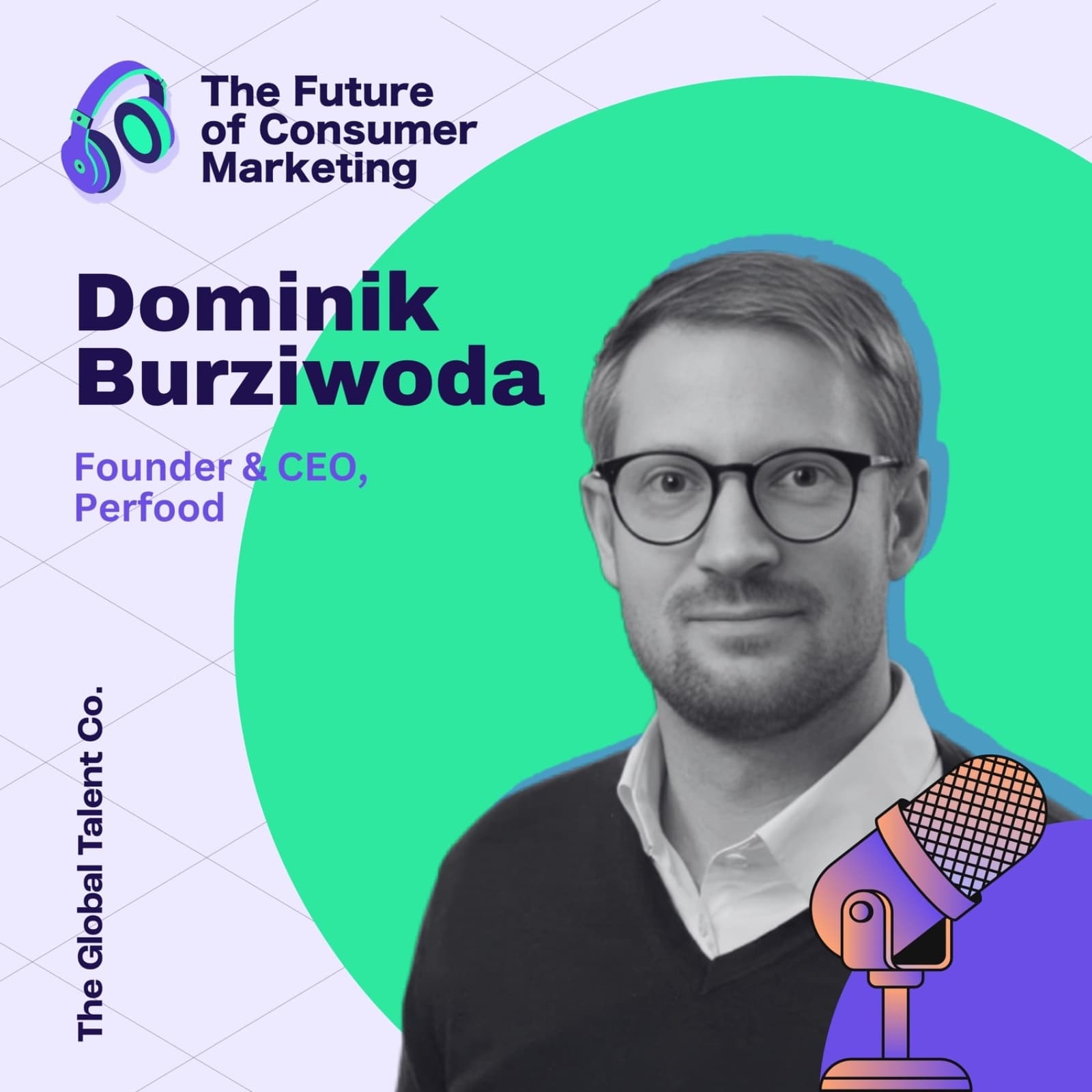
In this episode of The Future of Consumer Marketing, host Roman Kirsch interviews Dominik Burziwoda, CEO & Founder of Perfood. Perfood develops digital therapeutics using personalized low-glycemic diets to treat lifestyle-associated diseases like type 2 diabetes and migraines. Operating in Germany's regulated healthcare system, Perfood must navigate the complex challenge of marketing to three distinct stakeholders: insurance companies as payers, medical doctors as prescribers, and patients as end users. Through their B2B market access approach, they've created a pharmaceutical-like business model that delivers digital therapy through an app, achieving patient remission rates that traditional drug therapies cannot match.
Topics Discussed:- Building a regulated healthcare product that serves multiple stakeholder groups simultaneously
- Navigating marketing restrictions and compliance requirements in the digital therapeutics space
- Creating personalized health solutions using continuous glucose monitoring and AI-powered food recognition
- Developing longer sales funnels for complex healthcare products (4-6 months conversion cycles)
- Balancing scientific credibility with consumer-friendly messaging
- Scaling digital therapeutics across multiple disease indications and international markets