In short
Crafty Ramen’s pivot from COVID-era restaurant closures to scaling restaurant-quality ramen into grocery retail, reaching ~1,600 Canadian retailers, plus lessons on product-market fit, distribution, and retail marketing.
Guest
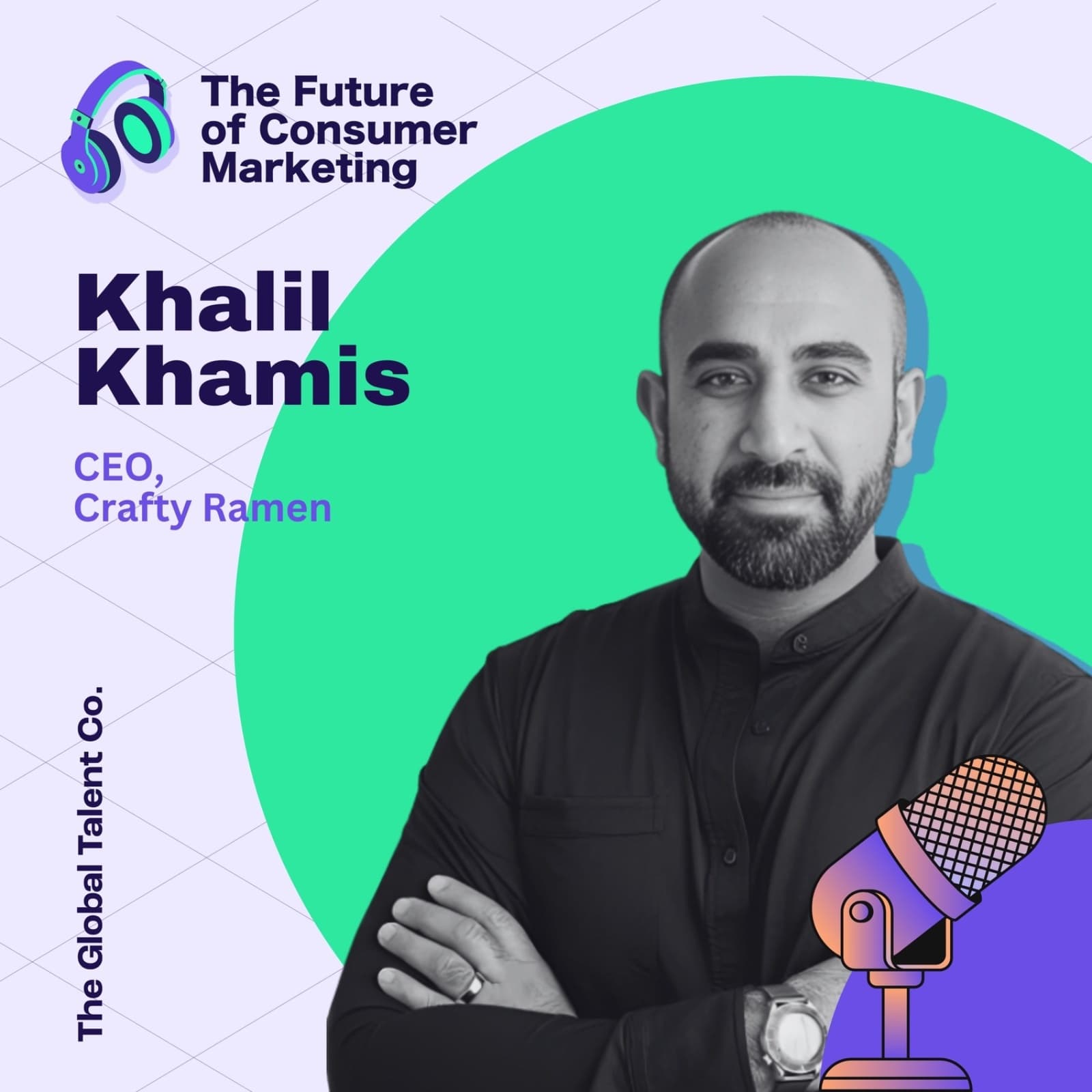
Khalil Khamis, CEO of Crafty Ramen. Background in the restaurant world (parents owned a restaurant in Guelph, Ontario). Investor/leader role after co-founders Jared and Mickey; focuses on “perfect hospitality” (the overall feeling of a meal).
Key claims
At-home ramen took off because no one offered true restaurant-quality ramen you could assemble at home; early fresh meal kits sold out quickly and went viral. Frozen “puck” format preserved taste/quality while improving grocery convenience. Retail growth came via trade shows, bright yellow booth presence, and in-store sampling (100 samples → ~30 same-day sales). DTC was wound down due to higher price and fulfillment/logistics.
Notable examples
Sourdough craze parallels; Alinea (Chicago) as best overall experience; Walmart Canada national push; HelloFresh marketplace partnership (two-pack meal kit); Instacart ad testing; US expansion pending USDA/CFIA export license.
Written by AI. May contain mistakes. Listen to the episode to check what was said.
Chapters
Tap a time to open that second in VOKhalil's Restaurant Journey
0:36 to 1:04
Explore Khalil's early experiences in the restaurant industry during COVID.
“let's talk a little bit about your story and your background.”
Innovating Ramen During COVID
1:04 to 2:22
Discover how Crafty Ramen adapted its business model during the pandemic.
“Carvering with Jared and Mickey with the original intention to slowly grow restaurants, maybe franchise one day.”
The Magic of Perfect Hospitality
2:22 to 3:30
Understand Khalil's concept of perfect hospitality and memorable dining experiences.
“So we launched e-commerce with a frozen meal kit because shipping fresh food is even more challenging than shipping frozen food.”
Evolving the Ramen Market
3:30 to 4:50
Learn about the evolution of ramen and Crafty Ramen's unique offerings.
“I don't like to ask guests hard questions, but I'm going to ask you a really hard question.”
Transitioning to Frozen Meals
4:50 to 7:01
Follow the steps Crafty Ramen took to transition from fresh to frozen meal kits.
“If we just look at the ramen category as a whole, like what evolution has there really been in the product?”
Navigating Retail Marketing
7:01 to 9:10
Explore how Crafty Ramen successfully entered the retail market.
“What have you learned from going through that process of taking this dry goods to a frozen day?”
Trade Show Strategies
9:10 to 11:10
Learn how Crafty Ramen stands out at trade shows to secure retail partnerships.
“Like, were you nervous to wind down that part of the business?”
Future Plans and US Expansion
11:10 to 14:00
Discuss Crafty Ramen's plans for expansion into the US market.
“We A-B test on email because you can do it on email, but really like, yeah, on shelf with the retailers and they have, you know, 3 ,000 vendors and 30 ,000 SKUs and we're one vendor with three SKUs.”
Expanding to the US Market
14:00 to 14:38
Learn about the company's plans for expansion into the US market and the regulatory hurdles involved.
“There was a soup dumpling company that as soon as like they were in Costco, Canada, we all ran out to buy them because we're like, oh, this was so good.”
Building an Advisory Team
14:40 to 16:29
Discover how the founders built a strong advisory team to support their growth.
“Luckily right now, food has been carved out of all the conversations that it's reverted back to the previous trade trade agreement that was negotiated in President Trump's first term.”
Show all 13 chapters
Marketing Team Structure and Evolution
16:30 to 17:35
Explore the structure of the marketing team and how team members evolved with the business.
“She's read, I'm up in Gladwell's Outliers.”
The Future of Consumer Marketing
17:37 to 18:20
Understand the shift towards organic content and personal storytelling in consumer marketing.
“So of course, we have to ask you, what is consumer marketing from your perspective?”
Vision for the Future
18:21 to 18:47
Hear about the company's mission to become a household name for quality ramen.
“I know you've touched on it a little bit, but just to have it in one clear answer, three, five years from now, what does this company look like.”
Transcript
Automatic transcript. May contain errors.0:00Brett Stapper:This show is brought to you by the Global Talent Co, a marketing leader's best friend in these times of budget cuts and efficient growth. We help marketing leaders find, hire, vet, and manage amazing marketing talent for 50 to 70 % less than their U.S. and European counterparts. To book a free consultation, visit globaltalent.co. Hey, everyone. Welcome back to the Future of Consumer Marketing. Today, we're speaking with Khalil Khamis, CEO of Crafty Ramen. Khalil, how are you? Hey, I'm great. Welcome. Thank you for having me. Yeah, I'm really excited to have you here. Before we go in and talk about Crafty Ramen, the product, everything that you're doing, let's talk a little bit about your story and your background.
0:38Brett Stapper:So I understand you're a restaurant guy. What was it like being a restaurant guy in COVID? Well, being a restaurant guy in COVID was a crazy amount of unknowns. I actually grew up in the restaurant world. My parents used to own a little restaurant here in downtown Guelph, Ontario, and got paid 10 cents dish rack to push dishes through the dishwasher when I was way too young to be working in a restaurant. So I grew up in it. And yeah, our journey with Crafty Ramen really took a crazy turn for the better during COVID. Carvering with Jared and Mickey with the original intention to slowly grow restaurants, maybe franchise one day.
1:14And we opened our second location four months before the pandemic. And we're like, oh my God, empty restaurant, big bank loan, brand new equipment. What do we do? So we started to do those at-home ramen experiences. They just really took a life of their own.
1:27Brett Stapper:Why do you think they took off in the way they did? Was it the times? I remember sourdough, everyone I knew was starting doing sourdough all of a sudden. Was it part of that, of just people were at home and looking for something to do or something different? Yeah, I think there's a couple reasons. There isn't still today other than us, anybody really doing restaurant quality ramen that you can put together at home. So we actually started with a fresh meal kit. So give some people things to do at home and package all the components separately. We could only make about a hundred a day at a time.
1:58Back then there was only two or three of us putting them together and making them and they started to sell out. We would do it just for local pickup and they would sell out online within a few minutes. It was weird. It was like almost like concert ticket-esque. People were getting upset after like four minutes when they were sold out. And through that, we caught a ton of virality online and started to get customers from really all over the world saying like, can you ship this to me? Can you ship this to me? So we launched e-commerce with a frozen meal kit because shipping fresh food is even more challenging than shipping frozen food.
2:29And through that, we just continued to slowly grow our e-commerce and really gain a huge following for the product.
2:36Brett Stapper:Going back to your story in e-commerce as well. So you're the investor, obviously now you're CEO. Yael, what did you see, you know, putting on your investor lines? Like, what did you see in these two founders to want to make the bet and invest in them? Great question. I saw really good food with a cool brand behind it. I have this thing that I call perfect hospitality. And for me, it's the feeling that you get when you have a certain meal. So I always say you can have the same feeling at a three-star Michelin restaurant, or you have that hot dog cart or a ball game on a sunny Sunday in the summer or the empanada on the side of the street while traveling to Columbia.
3:16The feeling that you get from all those experiences is the same. And that's how I felt when I ate as the customer at Crafty Ramen. I lived an eight-minute walk away from the Guelph restaurant. I was always sitting at the bar, just interacting with the chefs. And how I met Jared and Mickey, we kind of kicked it off like that.
3:32Brett Stapper:I don't like to ask guests hard questions, but I'm going to ask you a really hard question. What's the best dining experience you've ever had? Not food quality, but kind of the overall experience. Oh, yeah. Grant Atkins, Alinea in Chicago was incredible. Absolutely blown away in every single moment. And then my favorite thing to do is to have that sausage before the ball game on a sunny summer day. Amazing. I love it. I think mine would be Central in Peru. I don't know if you've been there yet. You went to that and I absolutely... Still the most insane. And like the food I thought was not very good, but the experience.
4:06Brett Stapper:Interesting. Yeah, I've heard of it, but no, we haven't made it there. Yeah, I highly recommend that one. It's fun and it's very, very different experience. What else when it comes to experiences? Like, how do you think about experiences? Yeah, I always go back to what you feel, right? I think in this very crowded world, you know, constant content and you can get entertainment it anywhere all the time. I think the world is continuously looking for new experiences, something different. And I think that's one of the reasons why we've had a lot of success in a really sleepy part of the grocery business, if you will.
4:41Single serve frozen meals have been relatively boring for a long time. So injecting some new fun quality into that world, I think, is one of the reasons why we're seeing success.
4:52Brett Stapper:If we just look at the ramen category as a whole, like what evolution has there really been in the product? Like I just picture like the exact same packaging that I've been seeing for like 35 years of my life. Like has there been a lot of evolution or is that still the dominant player in the space? Yeah, the evolution has really come in the dry space. So you had your OG noodles fried, cheap and dirty, for lack of a better word. And then we've seen some entrants coming out with better for you instant ramen, high protein instant ramen. But we hadn't really seen any. And that's where we realized there was a big white space in the market.
5:27So you have like the normal instant ramen, you have these better for you players. And then there was a couple meal kits where you just got needles and broth, but then nothing until you go out to a restaurant. And we kind of give you a bowl of restaurant ramen all frozen together. So you have a layer of broth, layer of noodles, protein topping. You just put it on the stove or in the microwave and it's ready at home in minutes.
5:49Brett Stapper:Talk to us about the early days of how you brought this to market. Yeah. So COVID, we're like, oh my God, we got to do something. So we started to do a fresh meal kit for local pickup and we could only make about a hundred of them at a time. So we gave you all the components separate brown takeout box, eight and a half by 11 piece of paper with instructions printed off our computer, like super elementary and started posting it on our social medias. And they started to sell out in minutes. Like we would put a batch of a hundred online for sale for pickup the next day and it would be gone. and once guests started picking it up and sharing it out themselves they started to catch virality online and guests were like can you ship this to us can you ship this to us we're like okay let's figure what's coming we don't have anything better to do let's figure out how to ship food so we launched e-commerce and just within like four or five cities around us and through that we had independent retailers reaching out saying this is really cool nobody's doing this we want to sell it.
6:46So we've reformulated the product from a meal kit to a frozen puck to fit the convenience levels that the grocery consumers want to see, especially in the frozen aisle. And we've had a ton of success since then in doing that. It's been a lot of fun, a lot of challenges, a lot of mistakes, but a lot of fun.
7:03Brett Stapper:What have you learned from going through that process of taking this dry goods to a frozen day? It's like, what was that like? That doesn't sound easy. I'm not in the space. Oh, it's not easy. Yeah. We truly believe in the way to learn is make mistakes and we've probably made every mistake along the book. My joke to the team is I think we all have three MBAs in different parts, like, you know, lived experiences. But what we were really lucky is as we transform the product from a fresh meal kit to a frozen meal kit to a frozen cup, our consumers stayed with us because the quality of the product didn't change and the taste and flavor profiles didn't change.
7:38How you heated it up or made it was the thing that changed. And we got, I think the product is one of the real reasons why where we are. Like there's tons of examples of the best marketing teams in the world with a bad product and it doesn't go anywhere, right? So you could have all the skill set in the world, but if you don't have something that's delicious in food, it's really hard to be successful.
8:00Brett Stapper:You keep saying frozen puck. That's something to say. It's very Canadian of you. Yeah, yeah, yeah. We need to get some content like with the hockey stick on the rink with the ramen flying around. At what point did you make the decision to not go the direct-to-consumer route and go the retail route? Yeah, actually very recently. So we had a plan to wind down our direct-to-consumer business. The price point was getting higher than we wanted for our consumer. We now have wide distribution. So almost every Canadian can jump on Instacart, get our ramen to their house cheaper and faster than going through our website.
8:37So we had a plan to start winding it down and our hand actually got forced. We got an email from our third party fulfillment partner one day. And it was like, you have 48 hours to come pick up your product. We're no longer in the business and we're stopping our services. We're like, oh man. Well, so we basically had to do three months of work that we had mapped out in like a week, like changing the website, letting all our consumers know, like all the different things that you had to do to wind down that part of the business. had to happen very, very fast.
9:08Brett Stapper:Did that make you nervous? Like, were you nervous to wind down that part of the business? Or did you feel like it was relief to not be, not have all those logistical headaches that I'm sure you were dealing with? Yeah, it was really bittersweet because it was the reason why we were able to build this part of our business and really focus in on consumer packaged goods. But we needed to continue to find focus and having our team's focus split between direct-to-consumer and brick-and-mortar retail was starting to get taxing. And how, even though the product is the same, how you market e-com and how you market in retail are two very, very different worlds.
9:45So continuing to buy and focus was very important for us.
9:48Brett Stapper:How have you summarized the approach that you take to marketing in retail? Yeah, so a lot of retail is at shelf, right? Where the consumer is. So, you know, price promos with the retailers. Getting food and mouth is super important for us. When consumers try it, they love it, they buy it. So when we do a demo in-store, if we hand out 100 samples, we'll sell 30 units that day. We convert about 30 people to purchase in the moment. And then the nice thing about e-commerce is you get a really rich data. So we can see the repetition of purchases and we can see how sticky the product was. And we were able to take that data and show it to the retailers.
10:24It's one of the reasons that really helped us get into retail. And then the different flyers that you would do. You're in the Walmart flyer. You're doing a Walmart blade. So I think that opportunity doesn't exist in e-com. And if you do it well, I feel like it's easier to get discovery, product discovery, once you have a decent amount of distribution in CPG than it is on e-com. And I think you get a higher level of trust because really at the end of the day, brands are about trust. And when you're on shelf in a national retailer versus some website selling food that I've never heard of before, that conversion to purchase becomes a bit easier.
11:01Brett Stapper:How do you go about split testing in retail? I understand from the e-commerce side, very easy to see, you know, black, white, what works. How do you do that in retail? Yeah, that's a good question. We A-B test on email because you can do it on email, but really like, yeah, on shelf with the retailers and they have, you know, 3 ,000 vendors and 30 ,000 SKUs and we're one vendor with three SKUs. So like even having productive conversations can be difficult because the category managers and the desk are busy people with huge portfolios. So we just try and scratch it and claw our way into whatever promos that we can to drive sales.
11:37But Instacart has been really great. So we're able to do some cool ad testing on Instacart and see what resonates with the customer. So that's our little bit of e-com where we do get some conversion data, which is nice. How many retailers are you in today? Yeah, so we're in about 1600 retailers across Canada. We do sell a version of our OG meal kit through HelloFresh. So they approached us and said, hey, we've kind of been really good ramen for a while. We love yours. Like, do you want to add it to our marketplace? So we brought back our meal kit in a two-pack form because that fits their consumer really well.
12:10And then we have about another 900 gig in new tailors confirmed to turn on this fall.
12:15Brett Stapper:What have you learned throughout that process so far of getting into that many retailers? It's hard. Yeah, it is not easy. I think anything worth having does not come easy. But for us, the route to market was really trade shows and again, getting food and milk. So buying a booth at a trade show, getting in front of the buyers, getting them to try the product. And when they try the product, like, oh my God, okay, I get it. And we show them the value proposition. We have a large heat for single serve frozen for about 18 ounces or 500 grams, which is about double the size of the average single serve frozen meal.
12:52So we're really shaking up what the consumer is normally used to getting. And Walmart Canada actually came to us and said, they had identified a gap in restaurant hall and these single-serve brozins and came on to us and said, we need your product. We're going national right away. And we're like, whoa, that is so cool. Okay, let's do this. Wow. So they've reached out to you. Yeah. And that was just our CFO, Bill, was like, I've been part of a whole bunch of product companies before and I've never seen this happen. He's like, can I invest?
13:21Brett Stapper:What are you doing at those trade shows to stand out and not get lost in the noise? Obviously, everyone's there. I'm sure everyone says, you know, our product's great. Our food's great. How do you stand out other than having the outstanding product? Yeah, bright colors. We lead with bright yellow. So we stick out in the show. And yeah, it's a really good question because we are the shows that we've done in Canada are a lot smaller than, say, Expo West. and we got the opportunity to walk the floor at Expo West in Anaheim last year. And it took us three days to get through it. And it is hard to remember what you saw.
13:57And for us, our biggest reflection after was, we remembered the really, really delicious products. There was a soup dumpling company that as soon as like they were in Costco, Canada, we all ran out to buy them because we're like, oh, this was so good. We were dying to eat that product again.
14:11Brett Stapper:What about expansion to the US? When is that coming? specifically, when could I buy the product in San Francisco? Let's cut it. Yeah. Well, hopefully very soon. We're just about done our export license with the USDA and the Canadian Food Inspection Agency. And we actually have samples out to a few retailers that have shown strong interest. So we hope to be making some shipments later this year, early next year. What will tariffs do to that whole plan? Does that not have an impact? Great question. Yeah. Yeah. This is one my investors love to ask. Luckily right now, food has been carved out of all the conversations that it's reverted back to the previous trade trade agreement that was negotiated in President Trump's first term.
14:57Everything's being renegotiated between the two countries right now. President Trump are working hard on that world. So luckily, one of the individuals on our team as an advisor. Randy is the ex-head of contract manufacturing for Nestle North America. He works with our team a few hours a week and has been started to line up potential manufacturing partners in the US if we do need to manufacture stuff.
15:23Brett Stapper:And how did you go about just finding so many amazing advisors? I guess it started with you, right? The founders found you as an advisor and an investor. How did you build this just amazing team? Yeah, there's a lot of very sanded up in his moments here along our journey and our story. So in university, me and three friends had an event production business. We used to bar promote, do concerts, trade fashion shows, all kinds of event type stuff. And one of our partners ended up selling frozen food for Nestle for 11 years. So when we organically ended up in that 100 or so independent retail location, I called Adam and I said, I think we're on with something.
15:58Do you want to come join startup life? I think you should leave the big corporate world and come join us. And he's like, honestly, I love your food. And we chatted for a while and he made the leap of faith and came and joined us. And he's been extremely pivotal in our growth and our ability to really learn and understand the world of retail and CPG. And then through him and his contacts at Nestle, we met Randy. Randy had just retired. He was looking to do something and give back to the industry and help start up. So it was a really nice timing moment. A lot of outlier moments. She's read, I'm up in Gladwell's Outliers.
16:32Of course.
16:33Brett Stapper:What about the marketing team? How big is the marketing team and what's the structure of the team? Yeah. So the marketing team is me. We have a marketing manager. We have a content social media person. Jonathan Joannis, our marketing manager. And then we have a fractional performance marketer. Vino is just a rock star. He does all our meta, Google. So like super lean team. Pretty like Vino has a lot of experience. The rest of us are pretty elementary, if you will. in the world of marketing teams, Jonathan, who does all of our content social, actually started as helping us launch our kitchen and restaurant training our front of house scheme.
17:09And then when we started to go in the world of COVID and doing the meal kit thing, we hired a photographer. And Jonathan saw the bill and he's like, I think I can do this myself for cheaper for us. So he grabbed a camera, started taking pictures. And his first round, I was like, I think he knew a bit better. And he just has evolved into this absolutely incredible photo, video, content, social. So we've all just grown with the business and it's been really fun.
17:34Brett Stapper:Now, final couple of questions for you. This is the future of consumer marketing. So of course, we have to ask you, what is consumer marketing from your perspective? Where's this world headed? Yeah, I believe organic content, personal storytelling. I think brand pages are quote unquote dead. I don't think the audience and the consumers really care about the brand anymore. We care about the people behind the brand. And there's some awesome examples in our world companies that are doing this really well. But our focus is like tell the Jared and Nikki story, like David Ricker, a few couple that just works their butt off to help build this thing.
18:08And what we need to do better is use our personal pages a bit better. And that's where we see the world really shifting to is strong storytelling that people want to follow along and watch.
18:19Brett Stapper:And final one, what's the big picture vision? I know you've touched on it a little bit, but just to have it in one clear answer, three, five years from now, what does this company look like. Yeah, our mission is to become the household name for restaurant quality ramen across North America. So when you think of quality ramen one, you think crafty. Amazing. I love it. Man, it's been a lot of fun. Really enjoyed the conversation. I look forward to trying the product as soon as it's available for order in San Francisco. I really appreciate you taking the time. Amazing. Thank you so much for having us.
From the publisher
In this episode of The Future of Consumer Marketing, host Brett Stapper interviews Khalil Khamis, CEO of Crafty Ramen. When COVID-19 forced restaurant closures, Crafty Ramen pivoted from a small Canadian restaurant chain to a frozen meal kit phenomenon that caught fire online and now sits on 1,600+ retail shelves across Canada. Their journey from selling 100 local meal kits that sold out in minutes to becoming Walmart Canada's go-to solution for restaurant-quality frozen ramen reveals critical lessons about product evolution, retail expansion, and marketing in the CPG space. Khalil shares how they transformed consumer demand during lockdown into a scalable retail business while maintaining product quality through multiple format changes.
Topics Discussed:- Pivoting from restaurants to CPG during COVID-19
- Building viral demand with limited inventory and local pickup
- Transitioning from fresh meal kits to frozen products for retail scalability
- Strategic decision-making around direct-to-consumer vs. retail channels
- Trade show strategies for breaking into major retail chains
- Building distribution relationships and managing 1,600+ retail partnerships
- Team structure for lean marketing operations in CPG
- Personal branding vs. corporate brand pages in modern consumer marketing