
In short
Podcast Episode Notes: Future of Consumer Marketing
Episode Title
How Bala Got Kim Kardashian Without Spending a Dollar
Guest
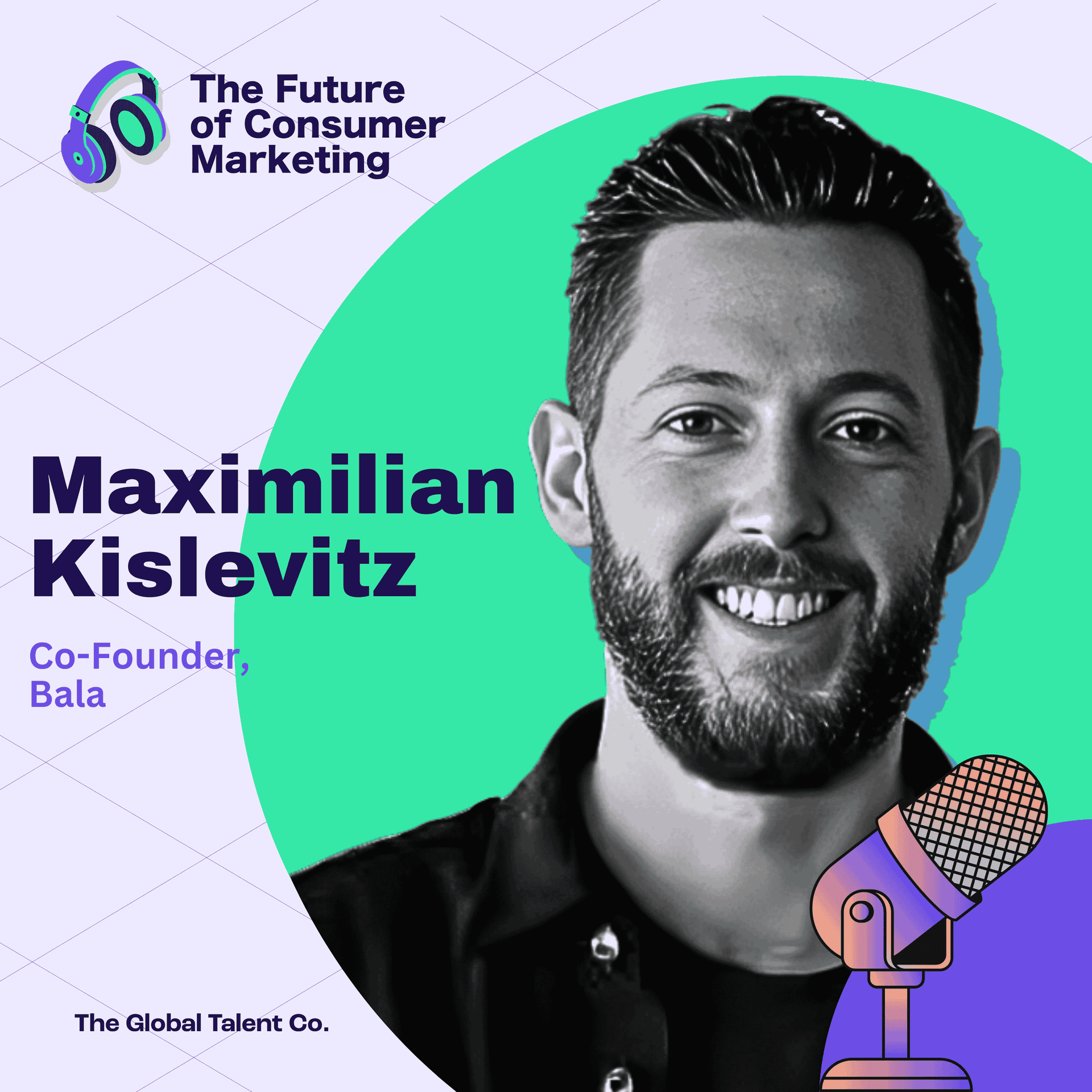
Max Kislevitz, Co-founder of Bala
---
Episode Overview
In this episode, Max Kislevitz, the co-founder of Bala, shares the journey of building a design-led fitness brand from scratch, including how they gained celebrity endorsements without significant marketing spend. The discussion covers the inception of the brand, the philosophy behind its products, and future expansion plans.
Podcast Description
- The episode explores how Bala evolved from a $40,000 Kickstarter campaign into a successful fitness brand selling over 4 million pairs of their signature Bala Bangles.
- Topics include the Shark Tank experience, organic celebrity endorsements, and the innovative marketing strategy that integrates various channels without relying heavily on paid advertisements.
---
Key Topics Discussed
- Conception and Launch
- Origin of Bala: The idea for redesigned wrist and ankle weights emerged during a vacation after Kislevitz left a 12-year advertising career.
- Funding: Launched via a Kickstarter campaign to raise $40,000, which they lacked initially.
- Design Philosophy
- Bala aims to bring color and aesthetic to traditionally uninspired fitness equipment.
- The brand is positioned as female-first, catering primarily to women while still appealing to a male demographic.
- Organic Growth and Marketing
- Achieved early growth through authentic endorsements from celebrities like Kim Kardashian and Adam Levine, without any paid marketing during the initial years.
- Emphasized the value of word-of-mouth and organic social media exposure.
- Shark Tank Experience
- Participated in Shark Tank in 2020, resulting in a deal with Mark Cuban and guest shark Maria Sharapova.
- This exposure significantly bolstered the brand’s visibility and credibility.
- Marketing Ecosystem
- Discussed the ecosystem approach to marketing, integrating paid social, email, search, and retail strategies.
- Noted the importance of collaboration with various agencies to handle different marketing aspects effectively.
- Brand Partnerships
- Collaborated with well-known brands like Ralph Lauren, Pucci, Spanx, and Dunkin' Donuts, emphasizing the mutual benefits of these partnerships.
- Offline Events
- Engaged in offline-to-online events, including curated lunches and workouts, that enhance brand visibility through social media amplification.
- AI Utilization
- Currently exploring AI for customer service (e.g., chatbots) but avoiding its use in customer-facing content due to perceptions of inauthenticity.
- Future Growth Plans
- Plans for heavier products (dumbbells, weighted vests) and international expansion.
- Focus on maintaining growth momentum after doubling revenue in 2025.
---
Key Takeaways
- Embrace Authenticity: Building a brand based on genuine endorsements and community engagement can yield substantial growth without heavy reliance on paid advertising.
- Design Matters: Differentiating in a crowded market with a strong design philosophy can attract a dedicated customer base.
- Collaborative Approach: Leveraging partnerships and a network of agencies can help maintain a lean operational structure while maximizing market impact.
- Adapt to Market Needs: Continuously innovate and respond to customer feedback to ensure product offerings remain relevant and in demand.
---
Conclusion
Max Kislevitz's story emphasizes the power of authentic marketing, the importance of design in product development, and the potential for small startups to achieve significant growth without extensive financial resources. The episode serves as a valuable case study for entrepreneurs looking to innovate in the consumer marketing landscape.
For more information or to check out Bala products, visit [shopbala.com](https://shopbala.com) or follow them on Instagram.
Written by AI. May contain mistakes. Listen to the episode to check what was said.
Chapters
Tap a time to open that second in VOIntroduction to Bala's Origins
0:00 to 0:40
Learn how Bala began with innovative fitness products and their design philosophy.
“We started with wrist and ankle weights.”
Bala's Unique Approach to Fitness
1:35 to 2:52
Discover how Bala redefined fitness equipment with a focus on design.
“We're really happy we were able to make this work.”
Growth and Product Evolution
2:52 to 3:56
Explore the evolution of Bala's product offerings and its business growth.
“Okay, so it's wrist and ankle weights 80s style, but with a new design then?”
Marketing Strategy and Team Dynamics
3:56 to 4:49
Understand how Bala markets its products with a small, lean team.
“We'd started with wrists and ankle weights and we'd really only thought it would ever be a side project.”
Target Demographic and Brand Identity
4:49 to 7:58
Learn about Bala's target demographic and brand identity in the fitness space.
“pass since you conceived that idea until you actually sold your first unit uh it was probably about a year and a half and we launched the business on kickstarter because we didn't have any money whatsoever.”
Authentic Marketing Through Influencers
7:58 to 10:32
Discover the power of authentic endorsements in Bala's marketing success.
“definitely sort of a female first brand.”
Bala's Experience on Shark Tank
10:32 to 11:58
Hear about Bala's unique experience and results from being featured on Shark Tank.
“There was just some genuine love for the brand because there weren't a lot of brands at the time speaking to this consumer.”
Current Marketing Mix and Campaign Success
11:58 to 13:23
Explore Bala's effective marketing mix and a successful campaign example.
“Having Mark Cuban's endorsement and Maria Sharapova, who is, if I'm not mistaken, she's like this super famous tennis player, right?”
Engaging Customers Through Offline Events
13:23 to 14:01
Learn how Bala creates meaningful customer engagement through events.
“Do you have any stories that you would be able to tell us?”
Engaging Offline Events for Brand Connection
14:01 to 15:34
Learn about how Bala connects with customers through curated offline events.
“And so, you know, over the last year, Ball has partnered with Ralph Lauren, Pucci, the fashion brand, Spanx, and most recently, Dunkin' Donuts.”
Show all 16 chapters
The Role of AI in Modern Marketing
15:34 to 16:46
Explore Bala's cautious approach to using AI in customer interactions.
“And it's just like marketing has become a lot more polluted by not so many honest ideas.”
Growth Strategies and Product Expansion
16:46 to 18:46
Discover Bala's strategy for growth through product development and innovation.
“We're, we're dipping our toe in just cautiously optimistic.”
Navigating International Markets Authentically
18:46 to 19:52
Understand the challenges of expanding Bala's brand into international markets.
“We grew, we nearly doubled last year in 2025 and And we're seeing more growth on the horizon this year.”
Balancing In-House Marketing with Agency Support
19:52 to 21:08
Learn how Bala utilizes both in-house and agency resources for marketing.
“but in those 10s, you have a marketing team included or are you using an agency or anything like that to help you with the marketing of all the products and the brand?”
Innovating in Fitness Products
21:08 to 22:37
Hear about Bala's focus on launching innovative fitness products for customers.
“But what are your main plans for this year and what would you love to accomplish?”
Connecting with Bala's Brand and Products
22:37 to 23:52
Find out how consumers can engage with and learn more about Bala's offerings.
“If they want to go and check one out in person, what would be like the best method they could do that?”
Transcript
Automatic transcript. May contain errors.0:00Max Kislevitz:We started with wrist and ankle weights. To date, we've sold more than 4 million pairs of those bangles. People actually had an appetite for design in their fitness lives. And what is your repertoire of products that you have now? Everything. We make yoga mats, we make resistance bands, we're making dumbbells, weighted vests. If it's in a gym, we're thinking about it. How much time did it pass until you conceived that idea until you actually sold your first unit? It was probably about a year and a half. And so the first production run was going to be about$40 ,000 that we did not have. How have you been able to market your product?
0:34Max Kislevitz:There was a lot of like authentic endorsement of the product from trainers and influencers. We'd never done any sort of meaningful paid promotion.
0:47Hey everybody, welcome to the show. My name is Andres Figueira and I'm going to be your host for the day. This show is brought to you by the Global Talent Company. helping fast-growing teams hire exceptional remote talent from Argentina, South Africa, and beyond. We connect companies with world-class professionals who bring skill, reliability, and a global perspective to every role. And just for our listeners, we're offering an exclusive 10 % discount on your first hire. All you need to do is visit globaltalent.co, click Start Hiring, and mention the podcast listener discount when we reach out.
1:20And today, with me here, I am speaking with Max Kislevitz. co-founder of Bala, a company that reimagines fitness with beautifully designed wearable weights and accessories. So with that said, welcome to the show, Max. How are you doing? I'm doing well. Thanks for having me. No problem at all, man. We're really happy we were able to make this work. And Max, just so that we can hit the ground running and get the audience a bit more in context here, would you be able to tell us a bit about your background, how you came to found Bala, and what the company does in your own words?
1:55Max Kislevitz:Yeah, absolutely. So I spent the first 12 years or so of my professional life working in advertising at big advertising agencies. And agencies tend to be kind of anonymous because they're making ads for, you know, household name brands. But, you know, folks aren't otherwise familiar with the agency that made them. But, you know, as a result, you can feel a little bit like a cog in a big marketing wheel. And after those 12 years, I met my then girlfriend, now wife and co-founder, Natalie, who went on an extended vacation with me when I maybe had one too many glasses of wine and said we should quit and travel.
2:37Max Kislevitz:And it was actually on that trip that we conceived of, you know, redesigning and reintroducing wrists and ankle weights from the 80s. but making meaningful design improvements. And, you know, it was on that trip that Bala was born. Okay, so it's wrist and ankle weights 80s style, but with a new design then? Yeah, so what Bala's ultimately become is a design-led approach to fitness equipment and accessories. And if you think about like 10 years ago, you know, you could walk into any gym in the world and it would feel like any other gym in the world. And the products that you use to work out with were all hyper-masculine, really black, could be quite intimidating.
3:18Max Kislevitz:And there was really no design consideration whatsoever. So you think of a very cool and chic Pilates studio, for example. Once upon a time, that Pilates studio would be beautifully designed, and yet the products within it are quite ugly and uninspired. So we've sort of brought design to fitness equipment and accessories. But yeah, it started with wrists and ankle weights. Okay. And what is your repertoire of products that you have now? Because wait, also just so I can know, how about how long ago did you found Bala? How old is the company? It's about eight years old. We'd started with wrists and ankle weights and we'd really only thought it would ever be a side project.
4:02Max Kislevitz:And, you know, our opening order was 3000 units. We lugged the weights up to our Brooklyn apartment, you know, carrying them one by one. Uh, and I think to date, we've sold more than 4 million pairs of those Bengals. Um, and it was the realization was that people actually had an appetite for design in their fitness lives, right? That not everybody was interested in working out at a CrossFit, for example, in a really intense way that there was like room for color and design. So now we're making everything. We make yoga mats, we make resistance bands, we're making dumbbells, weighted vests. you know if you if it's in a gym we're we're we're thinking about it how much time did it pass max from when you conceived the idea on the trip with your then girlfriend um what how much time did it pass since you conceived that idea until you actually sold your first unit uh it was probably about a year and a half and we launched the business on kickstarter because we didn't have any money whatsoever.
5:04Max Kislevitz:You know, we went on the strip spending our life savings to do so. And so the first production run was going to be about$40 ,000 that we did not have any amount of. And so we were able to successfully raise that via Kickstarter. And the first pair of Bala Bangles were sold about, you know, 18 to 20 months after that initial idea. And now eight years later, I understand, as you mentioned, you have more products. And how has the company grown with you guys? Is it still just both of you or how many people do you have helping you with this endeavor nowadays? Yeah, it's interesting because, you know, we made a decision a few years back to try to have a lean and mean team and rely on vendor partners for key sort of services and disciplines.
5:54Max Kislevitz:So the team today is about 10 people, but there's probably hundreds that touch the business on any given day. They just sit at our marketing agency or our Amazon agency or with our 3PL or with our supplier. So the sort of corporate team is quite small, but there's lots of folks helping to make Bala what it is today. And is the 10 people that you mentioned that you have like directly with Spala, are you guys working in a remote first environment or do you have like a headquarters where you all meet up and make sure you strategize from there in person? Yeah, we probably meet up in person maybe a month, a day a month.
6:34Max Kislevitz:Otherwise, it's completely remote. You know, and I think because we're just 10 folks, you know, everybody has quite a bit of autonomy, you know, and there's not a lot of like group think, you know. So when we need to make key decisions, it's oftentimes a group of like two, three, four people making those decisions. But yeah, it's largely remote. And, you know, I think we've found some success that way. It's nice to get in person, obviously, but it's not a requirement. From how you like have described it to me, I feel that Bala is a product that is more tailored and designed for women. women could that be a thing or or do you feel that you also serve the male demographic as well with your bala products because they're liking it too yeah i mean overwhelmingly um bala is a like a kind of female first brand um and you know i it shouldn't be terribly shocking but i think the opposite was true in fitness more generally right you know i think what lula lemon did in the early 2000s was bring sort of color and design into fitness apparel, right?
7:46Max Kislevitz:And we've taken a similar approach with fitness equipment and accessories. So by no means are we excluding men. You know, I use our products on a regular basis and I know quite a few men do, but it's definitely sort of a female first brand. Awesome. Now, I do understand that. And I kind of tried to check the page out a little bit before I hopped on the show. And I did notice that the designs, They like, they look so cool. They look like from the future or something. It's, it's really weird because I feel there are no edges. There's no edges anywhere. No, I mean, look, you know, fitness equipment tends to be really like technical and industrial.
8:24Max Kislevitz:Right. And we've all just sort of taken for granted that that that's just what it needs to look like. Right. And so, you know, even in beautiful gyms, like an Equinox, it's still the same sort of technical design. And what we found is by bringing design to this otherwise utilitarian space, it actually changes what it feels like to work out. Right. It's still effective. You're still sweating. It can still be exhausting. But you're a little bit more excited to do it than, you know, you would be when you're just in this incredibly sort of like uninspired environment. I know everything is gray or black and it's just a bunch of metal clanking against each other.
9:04So it's totally, totally.
9:05Max Kislevitz:Yeah. And that can be great too. But, you know, ours is just a bit of a different approach. Well, I like it. I like it. I respect the idea as well. And Max, how have you been able to market your products and what Bala is in like in, it's not an opposition, but like contrary to regular gyms, how have you been able to differentiate yourself and rise above the noise? Yeah, I think what was very cool and something we didn't necessarily expect with Bala was that there was this sort of like untapped need and potential for the sort of basic idea of like beautiful fitness equipment. And so that there was a lot of like authentic endorsement of the product from trainers and influencers to, you know, kind of A-list celebrities that were all using the product.
9:56Max Kislevitz:So, you know, I think for the first few years of Bala, we'd never done any sort of meaningful paid promotion. But meanwhile, the likes of Kim Kardashian and Adam Levine are, you know, using Bala on their social feeds in some capacity. Right. And so there became this sort of cool factor associated with the brand. And it sort of buoyed all of our other marketing efforts. Okay, so it was more of like an organic exposure by people who have a high profile within the audiences. And that way, you've been able to get Bala's name known a bit more? Yeah, yeah, totally. Especially early. There was just some genuine love for the brand because there weren't a lot of brands at the time speaking to this consumer.
10:48Max Kislevitz:And so, yeah, we had famous people that loved the brand talk about it and that helped quite a bit. Well, that natural way of marketing a product, I feel it's the best way to go because it's just organic. And people really, when it's an honest review and somebody that is famous is actually doing that review from their own kindness of their heart, because I bet they weren't winning anything from it. It just feels so honest. And people tend to really fall for that because it's the truth. So I totally get how that helped. And when I was reading about Bala, did I read correctly that you guys appeared on Shark Tank?
11:27Is that right?
11:27Max Kislevitz:Yeah, we went on Shark Tank back in 2020, which was the weirdest experience of my life. But also quite cool. It's just you're on set with a whole bunch of billionaires that are peppering you with questions. And meanwhile, it's all being recorded. So a strange but amazing experience. And we ultimately did do a deal with Mark Cuban and Maria Sharapova, who was a guest shark at the time. So they're still involved with the company. Wow, that is so cool. Having Mark Cuban's endorsement and Maria Sharapova, who is, if I'm not mistaken, she's like this super famous tennis player, right? Yeah, correct.
12:06Max Kislevitz:She's like one of the winningest tennis players of all time. And she's also incredibly fashionable. So she's kind of the perfect balance of what we're trying to achieve from a brand perspective. You know, like awesome athlete and, you know, tastemaker as well. At the moment, Max, what do you feel is working best from your marketing mix for Bala at the moment? Do you have any channels that you feel are working best for you guys at the moment? I think the thing that we've always, you know, fundamentally believed in is this sort of ecosystem mentality, right? that it's not necessarily about single channels in isolation from one another, but, you know, the ways in which they work together.
12:48Max Kislevitz:It's one of the reasons that even though Bala, you know, has a beautiful website and, you know, like a healthy social following that we also sell to studios and, you know, traditional retailers, because we find that, you know, the whole ecosystem kind of works together. You know, I think like, you know, paid social, email, you know, search all crush for us. But again, we're not kind of evaluating those things in isolation of one another. It's the sum of all the parts that really helps out and provides the true results. I understand that completely. And also, do you have, Max, any example of maybe a campaign you guys ran that went really well and doesn't have to be on a certain platform, but maybe an in-person meetup for people to try out Bala's products or something like that.
13:39Do you have any stories that you would be able to tell us?
13:42Max Kislevitz:Yeah, I suppose there are two things that come to mind. One of which is Bala's done a lot of great partnerships with brands that tend to be much bigger than we are. And what we find is that, you know, the bigger brand gets a cool sort of fitness association with Bala. And then we get sort of meaningful exposure from that partnership. And so, you know, over the last year, Ball has partnered with Ralph Lauren, Pucci, the fashion brand, Spanx, and most recently, Dunkin' Donuts. And so those have all been incredibly fun and awesome. We do a lot of offline events as well. And those are, I suppose to your point, great ways to connect directly with customers and get them excited about the brand.
14:28Okay. And how do those offline events, how do they work? Would you be able to dive a bit deeper into that?
14:34Max Kislevitz:Yeah, I suppose like, you know, it's sort of offline to online, right? Like, so they're like incredibly well curated events. And sometimes it'll be, you know, just a lunch or a lunch and a workout or some combination thereof. But we, we invite folks, you know, that are brand advocates, you know, whether they're influencers or trainers, or, you know, just folks that are passionate about the brand. and then you know inevitably there's people posting about it and it's kind of amplified right so even if there's just 20 people at the event you know we're benefiting from the exposure that those 20 folks generate and again it's just fun it feels authentic to the brand we're trying to create which is playful and irreverent and kind of you know inviting you know we want people to feel like they're a part of it because because they are of course it's it's not like creating any any boundaries between the bala consumers and other audiences it's inviting everybody to feel a part of the brand which i feel is super important and also get that that keeping it authentic it just makes the brand a lot more real and people identify with real because in this age of nowadays it's AI deep faking images and images that are generated by Sora.
15:58And it's just like marketing has become a lot more polluted by not so many honest ideas. But this this leads into my next question, Max, and is are you guys leveraging AI in any peculiar or curious way for Bala?
16:11Max Kislevitz:The honest answer is probably not. We're probably behind the AI curve. I know that we're starting to explore the use of AI in like our chat bot, for example, you know, obviously we have a real life CX team, but we're exploring ways where we can just help the customer find the product they thereafter more quickly and seamlessly. But from a content perspective, we're not using AI at all. I think at the moment you can feel when a brand does that and it doesn't feel all that good. So we're trying to avoid the use of AI in any like customer facing way for for okay no I totally get that and I've I've talked with a lot of companies that also have that same feeling as you do which is the fact that yeah consumers aren't taking well to AI being used for advertising just because it's so noticeably fake and it just it causes distrust with the brand once they start using that.
17:08Max Kislevitz:Yeah. Yeah, absolutely. We're, we're dipping our toe in just cautiously optimistic. I think honestly, the less sexy stuff is what we'll start with, which is, you know, it tends to be process driven things. Um, but you know, like I'm still writing product description copy because, you know, chat GPT just feels really inauthentic, you know, even if it sounds good, it's not saying all that much. You know, I'm confident in that, like in the next six months, it'll outpace us, but we're not quite there yet. And Max, in terms of, I also want to know, you mentioned that right now, Vala is 10 people. Are you guys planning to expand?
17:49Is it, and this could be internal with your team or are you planning on creating new products soon? How does that work when you feel that it's time to keep growing?
17:57Max Kislevitz:From our side, just given that we started with a single product. And now we have, I think I've lost count, but 30 plus products, you know, we're, we're, we're aggressively developing new product, right? And so for us, that's maybe the, the best lever for growth because we have an existing audience that's passionate about the brand that likes the product we have, and we can develop product of comparable quality that we can, we can sell and grow as a result. You know, there's not an immediate intention of building the team all that much, but you know, those things change on a weekly, monthly basis where, you know, we might land a new account that needs more support and we're hiring for it before we know it.
18:43Max Kislevitz:So the good news is we're growing. We grew, we nearly doubled last year in 2025 and And we're seeing more growth on the horizon this year. So exciting times ahead. Amazing, man. Congratulations on the growth. And this leads to my other question. Are you guys only available and do you sell to the United States? Or do you also cater to markets in other countries or maybe in Europe or Asia or something like that? Yeah, I think international expansion is definitely something we're thinking about. We have a distributor that we work with in Western Europe. So, you know, there is a retail presence by by way of that distributor.
19:24Max Kislevitz:We have a distributor relationship in the Middle East. And then, you know, we're going to stand up some other markets in the in the year ahead. But, you know, every market's unique. And so given that we've tried to build a brand authentically, we don't want to go to a new market and, you know, kind of not understand the cultural nuance and, you know, represent ourselves in a way that feels inauthentic. I understand you're 10 people at Bala, but in those 10s, you have a marketing team included or are you using an agency or anything like that to help you with the marketing of all the products and the brand?
20:02Max Kislevitz:Yeah, so it's a little bit of both. We have three folks in-house that are dedicated to marketing in some capacity, two of which are more focused on brands. So I talked a little bit about partnerships. They're the folks that are kind of responsible for those partnerships and bringing them to life. And then one of whom is more growth oriented, you know, is more of a performance marketing expert. And then we work with a ton of agencies. And, you know, for the most part, we work with specialized agencies. So we have like an email agency, we have a paid search and social agency. I mentioned we have an Amazon agency.
20:37Max Kislevitz:So, you know, the three folks in-house ensure that everything we do is on brand and is as efficient as it can possibly be. But we're relying very heavily on agencies as well. Okay, okay. No, I get that. And it's cool that you're able to get the help with all the legwork that is required from agencies, but you have three people designated to really make it sure it aligns with who you are as a brand and how you speak and how you want to portray yourself to the consumer. So I get that completely. Now that we're already in February, so Q1 is flying by in 2026. But what are your main plans for this year and what would you love to accomplish?
21:16Max Kislevitz:I think the big one and, you know, my orientation on the business is I'm the product designer, you know, amongst some other more administrative things. So, you know, my biggest priority is launching new product that the customer is excited about. so what that practically means is like getting into new kinds of fitness modalities so we're doing heavier weighted products we're doing a weighted vest we're doing dumbbells and bringing those to market in as impactful a way as possible is this kind of number one for me i think more broadly it's just to continue the momentum from a growth perspective so uh yeah that's kind of two priorities, but they're related to one another.
22:01I like that. I personally, I'm very into calisthenics, so I'm always using weighted vests. If Vala creates one that I can wear under my shirt that doesn't even look like a weighted vest, you have at least one customer that'll be super happy. Amazing.
22:17Max Kislevitz:That's the goal is to do a weighted vest that doesn't look like a weighted vest. And it's, you know, it's kind of easier said than done. Oh my God. I know I've gone to jog like 10k with a 10kg weighted vest and it just bounces against me and I'm like we should find one that is made with neoprene and that is it's good to the body and that it looks nice right it's they all look so clunky it's awkward you feel like a military man yeah yeah no exactly exactly that's the problem we were actively solving stay tuned love that love that and Max I'm noticing that we're almost at time with the episode but before I do let you go and I close this out, I did want to give you the chance to let anybody who is hearing us know what would be the best way for them to get to know the products that Bala offers.
23:04If they want to go and check one out in person, what would be like the best method they could do that? And yeah, any type of advice you could give to people who are interested.
23:14Max Kislevitz:Yeah. Shopbala.com, B-A-L-A.com is our website. I think if you want to get to know the brand, I would check out at Bala Instagram. I think it kind of reinforces a lot of what we talked about today because we use our social to kind of like share stories and anecdotes from customers. and you'll get a real feel for what it is we're trying to do there. So, you know, and increasingly we're selling to, you know, studios and gyms. So you might stumble across the product in real life as well. Okay, amazing. So shopbala.com if they want to check it out online. And if not, add Bala on Instagram for them to see what all the brand is about.
24:02To anybody who is interested, you just heard it here first. Make sure to go check them out. Max is super cool, and I bet their products are even cooler. So just give them a chance. And with that said, Max, thank you so much, man, for hopping on the show, for telling us your story and your learnings and insights with Baila. Really appreciate it. Thanks for having me. No, no problem at all. And to anybody who is here listening with us, thank you so much for also being here, for coming on every time to learn about the different personalities that we're talking to and all the different industries that we're learning about.
Read the full transcript
24:32Max Kislevitz:So with that said, have a good one.
From the publisher
Max Kislevitz co-founded Bala after quitting a 12-year advertising career to travel with his then-girlfriend Natalie — and conceived the idea for redesigned wrist and ankle weights on that trip. What started as a $40,000 Kickstarter campaign shipped out of a Brooklyn apartment has grown into a 30+ product design-led fitness brand that has sold over 4 million pairs of Bala Bangles and nearly doubled revenue in 2025. Max unpacks how Bala built a brand without any meaningful paid marketing in its early years, how the Shark Tank deal with Mark Cuban and Maria Sharapova came together, and what it actually looks like to run a 10-person company doing serious volume with a lean-and-mean operating model.
Topics Discussed- Conceiving Bala on vacation and launching on Kickstarter with $40,000 and no money of their own
- The design philosophy behind Bala: bringing color and aesthetic to fitness equipment that had never received design attention
- Why Bala is a female-first brand and what that means for product and marketing
- Organic celebrity endorsements (Kim Kardashian, Adam Levine) that drove early growth without any paid spend
- The Shark Tank appearance in 2020 and the deal struck with Mark Cuban and Maria Sharapova
- The ecosystem approach to marketing — paid social, email, search, retail, and studios working in concert
- Brand partnerships with Ralph Lauren, Pucci, Spanx, and Dunkin Donuts and the asymmetric value exchange
- Offline-to-online events: how a 20-person lunch generates outsized brand reach
- AI at Bala: cautious exploration limited to chatbot, deliberately avoided for customer-facing content
- 2026 priorities: heavier products (dumbbells, weighted vest), international expansion, continued growth