In short
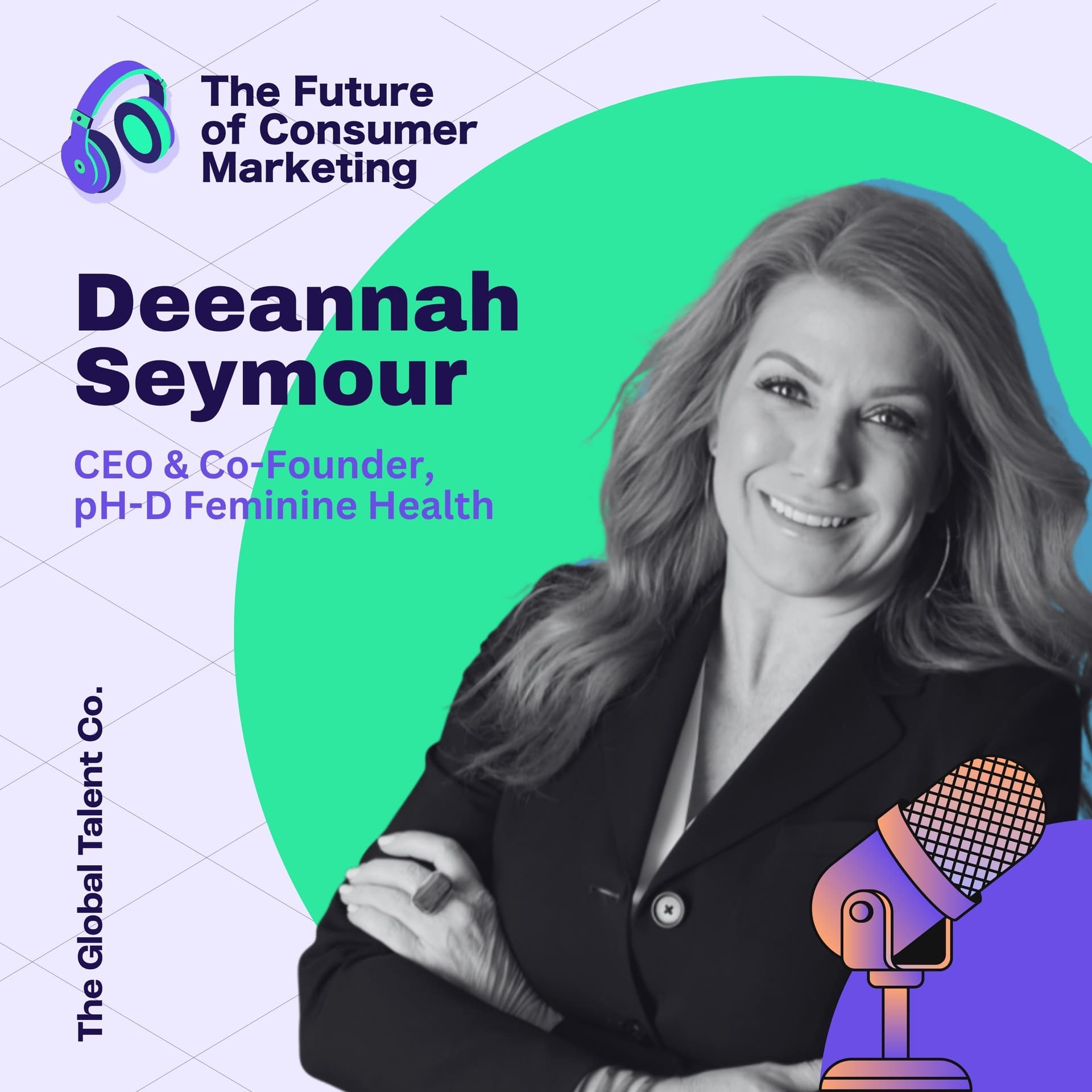
Deeannah Seymour, CEO/co-founder of PhD Feminine Health, explains how she mainstreamed boric-acid vaginal care by removing stigma, using healthcare-professional marketing, and expanding from Amazon to major retail while navigating censorship and country-specific labeling rules.
Guests
Deeannah Seymour (CEO/co-founder of PhD Feminine Health; 20 years in pharma; biology background; launched product in 2014; bootstrapped; woman-owned company). Host: Brett (Future of Consumer Marketing).
Key claims
Boric acid suppositories address vaginal odor (US) and are marketed as yeast infection treatment (Canada); it can be preventative; doctor recommendation drives purchase; healthcare providers recommend because solving recurrent issues improves patient satisfaction; stigma reduction and education (“Raise Your Vagina IQ”) boosts dialogue.
Notable examples
Amazon best-seller within six months; Target and CVS chain-wide in 2018; retail scale to 55,000+ locations; ad campaign denied for saying “vagina,” leading to euphemisms and late-night reruns; TikTok/Meta bans/shadowbans; planned clinical studies for underfunded women’s health.
Written by AI. May contain mistakes. Listen to the episode to check what was said.
Chapters
Tap a time to open that second in VOFrom Pharma to Feminine Care
0:34 to 2:36
Dee discusses her journey from the pharmaceutical industry to founding PhD.
“So looking at your background, I see you spent 20 years in pharma before moving into this world.”
Breaking Into a Sleepy Market
2:36 to 4:25
Dee explains how she disrupted the feminine health market with boric acid products.
“It sounds like you just nailed it in 2014, six months on Amazon, you're just dominating.”
Healthcare Professional Marketing
4:25 to 5:38
The importance of healthcare professionals in marketing PhD's products is discussed.
“And truthfully, Brett, like for the first many years, healthcare professional marketing was probably 80 % of the marketing that we did.”
Retail Launch and Growth
5:38 to 8:00
Dee shares insights on transitioning from online to retail and expanding distribution.
“Yeah, I do whatever my doctor says, generally speaking.”
Navigating Retail Challenges
8:00 to 10:34
Dee recounts the challenges faced while launching products in retail stores.
“Well, we were on Amazon from, we launched in 2014.”
Women-Owned Business Impact
10:34 to 14:01
Discussing the significance of being a certified woman-owned company in marketing.
“One thing I'll have to add, because we've been bootstrapped, a lot of brands can't afford that heavy lift of that initial inventory to launch at retail.”
Empathy in Marketing Strategy
14:01 to 14:48
Learn how empathy shapes marketing strategies by removing stigma.
“product, marketing, all across the board, you have empathy because you're the target customer, you understand.”
Education and Body Literacy
14:48 to 15:46
Discover the importance of education in women's health marketing.
“I'm doing something wrong for this to happen.”
Navigating Market Differences
15:46 to 16:47
Explore the complexities of marketing across different countries.
“to see a number of women who will tag their friends in our ads, which is amazing.”
The Challenges of Advertising
16:47 to 17:44
Understand the challenges faced in advertising feminine health products.
“We have to be very careful about that and monitor it all pretty closely.”
Show all 15 chapters
Creative Solutions to Censorship
17:44 to 20:39
Learn about creative strategies to navigate advertising restrictions.
“So we worked with an agency, Curiosity, out of Cincinnati.”
Advocacy for Women's Health
20:39 to 22:30
Hear about advocacy efforts to improve women's health discussions.
“Because she was talking at the irony, talking about the banning and the shadow banning that's occurring.”
Building a Marketing Team
22:30 to 25:12
Gain insights into building a marketing team in a startup environment.
“if we normalize saying the word, then hopefully it will be transformational and go all the way up the line and up to the censors at some point.”
Vision for the Future
25:12 to 26:28
Explore the future vision for clinical studies in women's health.
“Moving into our final couple of questions here.”
The Role of AI in Marketing
26:28 to 27:19
Discuss how AI is poised to transform consumer marketing.
“This is the future of consumer marketing.”
Transcript
Automatic transcript. May contain errors.0:00This show is brought to you by the Global Talent Co, a marketing leader's best friend in these times of budget cuts and efficient growth. We help marketing leaders find, hire, vet, and manage amazing marketing talent for 50 to 70 % less than their U.S. and European counterparts. To book a free consultation, visit globaltalent.co. Hey, everyone, and welcome back to the Future of Consumer Marketing. Today, we're speaking with Dee Seymour, CEO and co-founder of PhD Feminine Health. Dee, how are you? I'm wonderful, Brett. How are you? I'm doing great, and I'm really excited for this conversation. So looking at your background, I see you spent 20 years in pharma before moving into this world.
0:38So talk to us about that jump and making that leap. Yeah. You know, they say necessity is the mother of invention, and that's never been more so than in my case. I spent 20 years working in the pharma industry and ended up being on a lot of antibiotics or sinus infections. And as women, we know what happens to our flora when we're on a lot of antibiotics. And it disrupted my vaginal flora. And I was looking for a holistic alternative for my own feminine care issues. But it had to be backed by science. A journey in biology and spending 20 years in the industry, that was really important to me. And I came across this ingredient, boric acid, in the form of vaginal suppositories.
1:19And I tried it. It really just worked wonderfully. It was life-changing. and I was just so curious of why is nobody making this commercially? The only way it was available was through a compounding pharmacy and doctors talked to dozens of OBGYNs and they loved it, frequently recommended it for the patients. It just wasn't easy to obtain. So as fate would have it, my daughter's coach, she played ice hockey and she was the only girl and only 300 boys, which is crazy. He actually had a manufacturing facility that made holistic products. went to him with my idea and he has a science background too and he loved it so we launched the product in 2014 early 2014 on amazon and within six months it was the best seller in its category so we knew we were onto something not only because of velocity but mainly because of the evangelical reviews and the women who were using it that's what mattered so fast forward three years it took me to leave my corporate job because I was a single mom with my two kids, but I took the leap of faith and knew I needed to devote my time full-time to running PhD.
2:33And here we are today. It sounds like you just nailed it in 2014, six months on Amazon, you're just dominating. What do you think you got right? Was it just solving was unsolved with the branding? Like, what was it? Yeah, great question. I think it was combination of things. It was a very feminine health hygiene. It was a very sleepy category. And it has been. It's been those legacy brands that have been on the shelf forever. You know, your big behemoths like Modestat and Vecisole and all companies that are not woman-owned, not a lot of innovation happening there. And the category was so ripe for disruption because it was the same products that had been around forever.
3:15And we were really meeting just that unmet need of women. Boric acid is so unique that it works actually two ways. In Canada, we're required to market as a yeast infection treatment. In the U.S., we're required to market for vaginal odor. So it does work for both. And both of those issues are two of the top reasons a woman will visit a doctor. So we had that going for us. in that too, women can use it preventatively unlike any other product on the market. All the other products are really treatments for those issues, which ours can be a treatment, but it also can work preventatively. And then on top of that, I mean, right for disruption, we also, what I knew from my 20 years in pharma was the power of healthcare professional marketing.
4:04And that's what I leaned into from day one. And I knew having the healthcare providers be your influencers was, you know, the greatest victory a brand could have. So that's how we started marketing right away was directly to healthcare providers and going to the healthcare conferences and developing a sampling program. So that's how I built the brand. And truthfully, Brett, like for the first many years, healthcare professional marketing was probably 80 % of the marketing that we did. But what a foundation. And as a result of that, because the concept of Bork Acid Suppositories wasn't patentable, which I think is why those legacy brands never brought it to market.
4:47I didn't care because I just wanted to help improve the lives of women. I really felt morally obligated to bring it to market that there's this saying, you know, there's no replacement for first to market. Even though all these other brands have come out with boric acid products and suppositories now, we still by far have the greatest market share, the number one selling brand, and the number one doctor recommended brand as a result of the foundation that we've laid. And just to double click on that. So healthcare professional marketing, I obviously don't come from this world. I think a lot of people don't.
5:19Is the idea there that you're marketing to healthcare professionals and they recommend the product to their patients? Yeah. Yeah, it's them pointing their patients to whatever said retailers carry the product to them purchase the product. And, you know, I think there's a statistic, you know, consumers are 65 percent more likely to buy a product if their doctor recommends it. Yeah, I do whatever my doctor says, generally speaking. I'm not going to question them. Exactly. Is there an incentive for the health care professionals? Is there a financial incentive in any way or it's more that that's their job is to help their patients?
5:52Well, you know, it's interesting that you ask that because I've talked to thousands of healthcare providers now at this point, and they're in competition, you know, with their peers. And they want patient satisfaction is a huge metric for them. And one thing about these issues, particularly vaginal odor, it's recurrent 50 % of the time in women who have it. And it's a very deeply personal issue that affects nearly every aspect of a woman's life. And because it's recurrent and it affects so many women, you know, these are frequent flyers in the practice and the traditional offerings that they had, you know, they would treat them.
6:33And then, you know, four to six weeks, maybe eight weeks later, they'd be back in their office. So the fact that they're able to solve these problems with their patients means their patient satisfaction rates are going up, which means they retain their customers. Right. So it's a win-win situation. and, you know, I've had healthcare providers, customers, and even men, partners, spouses, come up to me with tears streaming down their face because it has been so life-changing for them because it does affect so many aspects of their life. Wow, that has to make the hard days of entrepreneurship just a little bit.
7:08It's our why, they're our why, for sure. What advice would you have for other founders, other marketers who are going down this path? You know, they want to build these partnerships or I should say relationships with doctors. They want to be a doctor-recommended product. What advice do you have for others? Yeah, I would say make your messaging crystal clear and how it's that with them, what's in it for me. So looking at it through the lens of the healthcare provider, like why would I recommend your product? What is in it for me as a provider? How would it benefit me and my practice and really bringing it home and back to the patient and how you can be a problem solution brand for their practice.
7:47I think is really important and just make that crystal clear. Now, I know you mentioned you started off the first six months on Amazon. At what point did you make the jump into retail? Because I think I read online, you're dominating retail, right? 50 ,000 locations? Over 55 ,000 now, yeah. Well, we were on Amazon from, we launched in 2014. And then I didn't actually come over to jump, ship and run PhD until 2017. and I ended up, I don't know if you're familiar with ECRM, but it's like a speed dating session for brands and retailers. So we scraped together seven brand to attend this ECRM, this conference, which was a whole lot of money for us back then.
8:28So I sat at my table every 10 minutes, a new retailer would come at my table and I would give them my shield. And it was like everything, my whole entire experience in sales and my passion for this product and for women's health just all collided at that point. And at that event, I ended up landing Target, chain-wide in CVS. And that was in 2018. So we didn't launch at retail until 2019. We were in some specialty pharmacies before then, but really that was our major launch in 2019. So the end of 2019, we were around 6 ,000 doors. And now fast forward to the over 55 ,000. But Amazon is very different than 2Brat Prime was not what it is today.
9:16It was only really available in LA and New York, the major metropolitan area. So you still had to wait a couple of days, two or three days to get the product. And when you're a woman who has one of these issues, you want it solved immediately. So that was one of our goals to decrease our dependence on Amazon. And also to meet the customer where they were at the stores where they could easily obtain the product. So$7K well spent then, it sounds like. Absolutely. What was that like doing that rollout then in 2019? I've talked to a lot of other founders. They say it's very, very intense. Oh my gosh.
9:52Okay, even more so because truthfully, when I got the award letter from Target, I didn't even know what it meant. Because there were so many acronyms. I had no retail experience whatsoever other than, you know, in high school, I worked at a clothing store. Okay. So we ended up having to hire a consultant to help us navigate that process. And the Target vendor hotline knew me by name. They were very patient with me, but it was a very, very steep learning curve for us. And looking back, I marvel at how we were able to navigate that without any knowledge of the retail industry. but we did it. And everything, I guess, is figureoutable, if you will.
10:37One thing I'll have to add, because we've been bootstrapped, a lot of brands can't afford that heavy lift of that initial inventory to launch at retail. And because my business partner had developed and was so intentional about developing relationships with the banks, that was how we were able to finance that initial push into retail. That was going to be my next question. So you beat me through it. I tell, it's advice that I give founders now. Don't wait to develop a relationship with your banker until you need money because you need to be fostering those relationships from the get-go. And like sending them PR or just things that updates on your brand and what you're up to so that they can really get to know you as a person because ultimately they're banking on you as a founder.
11:30So being bootstrapped, I have to imagine that you've probably had some investors cloud that do or I would have to imagine with the growth that you're seeing that you're probably getting contacted all of the time. How do you stay strong? How do you avoid taking on outside? Well, we are so flattered by a lot of the attention that we're receiving. And, you know, it's rare that I turn down an opportunity to meet with someone from private equity or an investment bank. Because again, going back to investing in the founder, life is, a lot of it's just about relationships and the people you meet along the way.
12:06And there may come a time, you know, that we are really going to pursue funding at some point. Not likely right now, but who knows what can happen. So I always like to keep those doors open that I've made some incredible relationships and friendships with some of those folks, which have led me and us to, that's actually how we found our CMO, our chief marketing officer, was through someone in private equity. So grateful. Thank you, Jeremy. So just, you know, using people's networks. I'm a connector too. So I love, you know, if I have other founder friends who are looking for capital, I love connecting others in private equity or what have you.
12:48So it's been very rich to develop those relationships, even though we haven't needed it yet. And another important thing for us too, Brett, as far as marketing, we are a certified woman-owned company. And a lot of people don't really understand what that entails, but it means that 51 % or greater of your company has to be owned and run and controlled by a woman. So I've been very intentional because we put that on all of our packaging. because the statistics say that 83 % of women would prefer to buy from a woman in company if they knew it was a woman in company. And that's powerful. So it's been important for us to maintain that woman logo and micro-owner packaging.
13:33So that's been another reason, too, that we haven't wanted to dilute the shares on my side. Yeah, I can imagine that from the perspective of a potential customer or a customer. If they go to the About Us page and it's a bunch of old white dudes in suits,
13:49Exactly. We really are. I mean, it's women making, developing, innovating products for women. Yes. And it does make a difference. Yeah, it has to make a difference. I think you have just extreme empathy, right? Down from the product, marketing, all across the board, you have empathy because you're the target customer, you understand. Right. Amazing. When it comes to the marketing philosophy, the marketing strategy, how would you describe it? We are one of the part of our ethos is removing the stigma that is associated in our category. And creating a safe space for dialogue is really how another area in which we've won.
14:24It has been amazing to see like no one in the industry was talking about vaginal over before us. And it's not something that most people think about, but it is so common. And part of that marketing has also been like remembering the shame and it's not your fault because that's the misconception that a lot of most women have. I'm doing something wrong for this to happen. So many things can cause that. And a huge part of our marketing too is education because a lot of women lack the body literacy to really even know their body parts, much less what's happening with their body. We actually have started a campaign called Raise Your Vagina IQ, and it's helping women understand that there's a difference between the vagina and the vulva.
15:18And so when they're educated on their body parts and we can speak openly about what our body parts are, we can then have educated conversations with our healthcare providers so that we can then, you know, search the right solutions for, you know, that we can provide for their needs. So a lot of our marketing has centered around that. We're moving the shame and stigma, creating a conversation with these consumers that it's safe. And it has been phenomenal to see a number of women who will tag their friends in our ads, which is amazing. So they're really, it's become this community of women, like supporting women throughout this journey, because there's so many different cycles that we go through in our lives.
16:04We also leaning heavily into menopause and creating a conversation around problem solution in that as well. And that's been another thing too. We're really a problem solution brand that has really benefited us greatly. Something you touched on a few minutes ago, you said the product has to be kind of positioned one way in Canada, another way in the US. How frustrating is that? I think most marketers, for the most part, we have, you know, a wide open line of you. You can go any way you want to get restrictions. It sounds like you're operating under height restriction. Oh my goodness. Yeah. So even down to having two separate websites, two separate Instagrams, you know, all because of what we can and can't say in each country.
16:48We have to be very careful about that and monitor it all pretty closely. And even when it comes down to influencers and campaigns, we have to be really buttoned up about what they're scripting, what they're saying, what's being put out there that is paid for by us. So it does create a little bit of operational turmoil, if you will, even with our separate packaging, right? Because it's for a different need state, But it has been worth it. Absolutely worth it. We have greatly expanded our presence in Canada. We're in every major retailer there as well. And we're meeting the needs of those women equally.
17:32So it's important for us. It's part of our mission to make sure that we continue to do that. In the pre-interview, you were telling me about an ad campaign you recently did that got banned, or it wasn't a lot to go through. Can you talk to us about that? Oh my goodness. Yeah. So we worked with an agency, Curiosity, out of Cincinnati. He does a lot of P &G marketing. And they also, I was just told last week that we won an Addy for this campaign that I'm going to talk to you about, a national Addy. They also handled the Dude Wipes account, who I admire greatly. Sean and those guys are great. But yeah, we have faced this on multiple occasions and multiple scenarios, inability to say the word vagina.
18:15So much so, I'll get to our conversation, but this is a great example. A news station on their daytime show was focusing on women-owned brands as part of the segment they were doing. and they were highlighting Kate Somerville Cosmetics and then we were next to them. They were going to highlight our vaginal moisturizing gel. That's the name of the product. Well, it came time, seconds before they were to air, the producers were like, you can't say the name of that product on the air. And the hosts were like, what are you talking about? Like, we can't say vaginal moisturizing gel. No, you can't say that word at noon or anytime.
18:52So it was really ridiculous when it came time, they aired it or they showed it. They're like, well, they wouldn't even zoom in. And the host was like, well, if you know, you know. Here's this product. If you're in menopause, well, no, you don't know. So that's kind of a preference for where I'm going with this next campaign. So like, okay, so we can't say the word vagina, vaginal, whatever. Okay, let's use euphemisms. So we said beaver, taco, hoo-ha, cutie cat. And so we decided to go that route. We'll use euphemisms. you know, to talk about vaginal odor, vaginal moisture. And the spot turned out phenomenal.
19:31It's such a great spot. But when it came time for us to air it, we kept getting denied over and over and over again, even by, you know, streaming connected TV platforms, which we were really shocked about. So we would wind up very late at night, you know, with the infomercials. And so we had to punt because we were wanted to run this ad during the Oprah menopause special and in order to do so we had to completely rejigger that whole entire commercial to just like a skeleton of what it originally was meant to be we had to remove all the supers and really call back a lot of the language and anyway it was incredibly frustrating but that is kind of a snapshot of where we are right now.
20:22And it's incredibly frustrating, you know, being a founder of a feminine health company and healthcare space for women. You know, we can talk about ED, you know, all day, all night long on TV, but we can't even say beaver or kitty cat or, you know, we can't say the word vagina. So what are we supposed to say? Help us out here. So incredibly frustrating and not to mention TikTok and Meta all have had issues and we've been our ads have been taken down routinely it actually happened last week it happens very frequently but I was on a podcast interview in LA a couple weeks ago and talking about our newest campaign the raise your vagina IQ and so the podcast host who has a substantial following did a post on her TikTok about interviewing me and the Raise Your Vagina IQ, her entire account got banned.
21:19Because she was talking at the irony, talking about the banning and the shadow banning that's occurring. So it's incredibly, incredibly frustrating as a founder in this area to constantly have to battle these things. It's going to be strange when I get banned from LinkedIn, when I do a post about this, I'm going to say, my vagina, done. LinkedIn account's gone. You're going to be calling like, gee, what have you done? How do I navigate this? You have experience, it sounds like. That's great. I'm curious, how do they justify that? Like that seems just sexist and wrong and like a lot of other things come to mind.
21:55How do they justify that? No one has provided a reason. No one. But I really feel like, and it's part of the reason we're doing, again, this Raise Your Vagina IQ to normalize the conversations around these words. Like, okay, let's say the word because it's your body part, right? I mean, you wouldn't go to your doctor and be like, you know, this thing right here, whatever you want to call it, we need to be educated. There's a statistic that's ridiculous that women who graduate from high school know more about the anatomy of a frog than they do their own bodies. Crazy. So we just have to do better.
22:30And that's part of what we're doing. if we normalize saying the word, then hopefully it will be transformational and go all the way up the line and up to the censors at some point. But yeah, at some point, I spent a lot of time in advocacy within Washington and actually in the state of California, getting a law amended there that likely I will pursue that route next to really open up the doors for women and women's health so that we can be more educated. You mentioned, I believe it was Jeremy. So P.E. Jeremy referred you to your CMO. How's the marketing team today? So we, goodness, let's see here.
23:08We just, we have a new digital director starting on Monday. So one, two, three, seven, eight. I'll say between eight and 10. Yeah, probably closer to 10. Yeah. What have you learned from building out that team? Because it sounds like in your previous life, you didn't have a lot of experience in marketing. Is that right? No, I have a degree in biology and never had a business class in my life. I was adjacent to marketing, having spent 20 years in sales. And we constantly have marketing folks spend time with me at Abbott. So I spent a lot of time learning about marketing. But it has been fantastic to build off that team.
23:48And the way we've done it, being bootstrapped especially, is we've hired a lot of consultants or part-time employees along the way. And it's kind of been one of the things that's worked so well. We hire someone as a consultant until that pain point gets so great. We're like, oh my gosh, we're paying so much money. With this person, we really need to bring it in-house. And that has worked very, very well for us with so many different roles that we have now. I would say we have around 10 full-time, but there's probably four roles right now that we're using on a contractual basis. And I'll say one of the biggest mistakes we've made is not investing in marketing studio, without a doubt.
24:29What was the trigger that made you say, all right, now's the time to spend? Having not invested in the people with the experience that we needed earlier on and expecting really too much out of them when they had never, you know, had the experience of marketing in a company our size. So we love the people that have been with us. And sometimes it's just you outgrow someone or maybe they just aren't equipped to handle also the entrepreneurial fast-paced environment. The company like ours that's growing so quickly. But yeah, realizing that we really need the horsepower behind someone with that rich experience.
25:12Moving into our final couple of questions here. So let's talk about the vision. you know, let's go out maybe three years, five years. What's the big picture vision? Where do you go from here? You're obviously winning is probably an understatement. You're dominating in your category. What's next? Where do you go? Yeah, we are investing in something that I absolutely love, and that's clinical studies. Back to my being a science nerd and wearing that hat. And I'm so grateful that we have the resources to do this because women's health is so underfunded. and we're being also, in addition to the research that we're catalyzing doing on our own, we're now being introduced and considered for intellectual property and other things that are out there on the market because people are noticing what we're doing.
26:00So they're bringing us opportunities, which is fantastic. So in the next three to five years, you will see PhD become even more entrenched in the clinically proven ingredients at a much greater scale than we've done currently. But it is taking a lot of our investments. Every penny that we make is going back into the business, into research and into these clinical studies. Final question for you. This is the future of consumer marketing. So I have to ask you, what is the consumer marketing? Oh, goodness. You have to talk about AI, right? and agentic AI and, you know, learning, seeing the videos from China where people are selling products, you know, via video and it's an avatar.
26:48I really feel like AI is going to completely disrupt marketing in ways that we can't comprehend just yet. But I don't know what that is. I've just seen bits and pieces, but it'll really transform. And it's someone, I was at a conference, you know, last Friday and like, if you're not using AI, it's like you're fighting a sword against a nuclear bomb. So like, okay. So that's my take on it. Amazing. I love it. I really love this conversation. You're an inspiration to female founders. You're an inspiration to male founders like myself and all founders. You're an inspiration. And this has just been an amazing conversation.
27:24Really appreciate you taking it. Thank you, Pratt. So thank you so much for having me. Of course.
Read the full transcript
27:34you
From the publisher
In this episode of The Future of Consumer Marketing, host Brett Stapper interviews Deeannah Seymour, CEO and Co-Founder of pH-D Feminine Health. After 20 years in pharma, Seymour launched pH-D in 2014 to commercialize boric acid vaginal suppositories - a product that existed only through compounding pharmacies despite being frequently recommended by OB-GYNs. Within six months of launching on Amazon, the product became the bestseller in its category, driven by evangelical customer reviews and a healthcare professional marketing strategy that established pH-D as the #1 doctor-recommended brand. Today, pH-D operates across 55,000+ retail locations while maintaining its woman-owned certification and bootstrapped status.
Topics Discussed:- Transitioning from healthcare professional marketing to mainstream retail expansion
- Navigating regulatory restrictions and advertising censorship in feminine health
- Building a problem-solution brand in an underfunded category
- Scaling from Amazon to 55,000+ retail locations without outside funding
- Creating safe spaces for stigmatized health conversations
- Maintaining woman-owned certification as a competitive advantage
- Developing clinical studies and IP acquisition strategy