In short
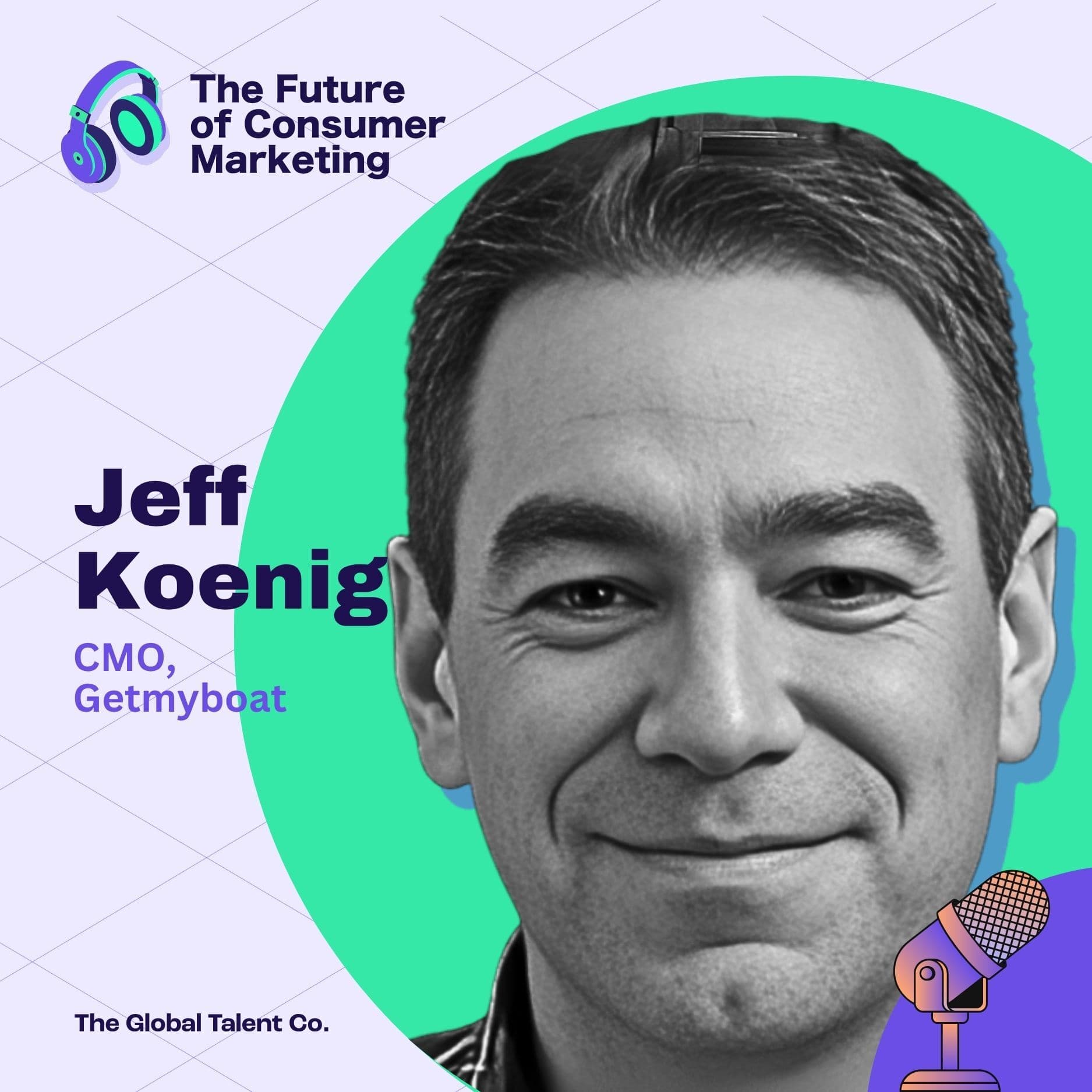
Jeff Koenig, CMO of GetMyBoat, explains how the marketplace captures demand mainly via Google while using a lean team, focusing on “need states” (birthdays, anniversaries, bachelorette parties) and seasonal market liquidity.
Key claims
supply recruiting is less active now (about 85,000 boats globally, mostly North America); demand capture is the priority; Meta and paid social target event planners; affiliates and TikTok haven’t worked; AI helps scale long-tail blog content.
Notable examples
“Made Perfect” Miami out-of-home campaign (e.g., “dance party, but made perfect”) and streaming audio via a large radio network.
Guest backgrounds
Jeff Koenig previously worked in agency media buying/planning, Amazon (Prime Video/Amazon Channels), Zillow, and Chewy before joining GetMyBoat.
Written by AI. May contain mistakes. Listen to the episode to check what was said.
Chapters
Tap a time to open that second in VOJeff Koenig's Background and Get My Boat
0:45 to 2:29
Discover Jeff's journey and his experience with Get My Boat.
“But we went out on a boat trip a couple of years ago, and it was just an awesome experience.”
Marketing Strategy at Get My Boat
2:29 to 4:25
Explore the marketing strategy that helps Get My Boat thrive.
“And, you know, as I was telling the audience there, I've used the platform, but for those who haven't had the joy and the honor of using the platform yet, what does it do?”
Demand Generation and Customer Targeting
4:25 to 7:43
Insights into how Get My Boat captures and educates demand.
“Now I'm most impressed when you're not just marketing teams, but organizations in general.”
Successful Marketing Channels and Challenges
7:43 to 10:34
Discussion on effective channels and the challenges faced.
“So when you couple like, what do we need is the business to do, starting with the numbers with what is this user or customer need from us?”
Navigating the Competitive Landscape
10:34 to 13:54
Understanding the competition faced by Get My Boat.
“So we try to take that down just at least one click to who's the most likely to be in the market for it, even if they're not directly looking for a boat at the moment.”
Navigating Viral Content on TikTok
14:03 to 14:31
Explore strategies for creating engaging and viral content on TikTok.
“I, you know, myself and my social media manager, we say that all the time.”
Understanding Competitive Dynamics in Boating Market
14:39 to 16:10
Learn about the competitive landscape in the boating industry and marketplace dynamics.
“How do you think about the competitive landscape then?”
Leveraging AI in Content Creation
16:12 to 17:46
Discover how AI can enhance content creation and deepen audience engagement.
“How are you using it or how do you plan to use it in the coming months and years?”
The Future of Consumer Marketing
17:54 to 19:29
Discuss the potential future trends in consumer marketing amidst privacy concerns.
“I'm seeing that we're almost up on time.”
Transcript
Automatic transcript. May contain errors.0:00Brett Stapper:This show is brought to you by the Global Talent Co, a marketing leader's best friend in these times of budget cuts and efficient growth. We help marketing leaders find, hire, vet, and manage amazing marketing talent for 50 to 70 % less than their U.S. and European counterparts. To book a free consultation, visit globaltalent.co. Hey, everyone, and welcome back to the Future of Consumer Marketing. Today, we're speaking with Jeff Koenig, CMO of Get My Boat. Jeff, what's going on? I'm having a great day looking at the water outside my window, ready to be on the boat after we're done. Amazing. I love it.
0:33Brett Stapper:I'm really excited whenever I get the chance to speak with a CMO, but I'm especially excited when they have a product and a company that I've used before. Now, I've used your platform. I'll pull up a picture here to show. That's my girlfriend at the time. Now she's my wife. We have a child together. But we went out on a boat trip a couple of years ago, and it was just an awesome experience. It was so easy to book and just had such an amazing time. So it must be very fun, must be very enjoyable to work for a company and to market a product where it's delivering experiences and joy to people. Yeah, you said it exactly right.
1:02We see pictures like yours come in every day from every trip we have, pretty much. And you just see the joy in people's faces, all the reasons they're out on the boat to celebrate. And we get to be a small part of that. We're entrusting our captains and owners with a lot and getting our renters out on those boats. But they have an amazing time. And we see it every day with all the photos we get back.
1:21Brett Stapper:Yeah, I would imagine. It must be very fun. Now talk to us about some of the other products that you're marketing before joining Get My Vote. Yeah, so I'll just go back real quick in my past. So I started out as an agency person way back before the internet days. So I did a lot of broadcast media buying, media planning, moved into the digital space around the turn of the century and did digital media planning and buying. morphed into an agent account management role there. That's an agency out here in Seattle, where I am. Then flipped over to the client side to Amazon, worked both on their physical movies, like DVDs, the actual discs way back in 2010 era.
1:58And then when they launched their Prime Video Service and Amazon Video Service, I joined the marketing group there, helped grow that business, did a little bit of a stint with a thing called Amazon Channels, which is sort of a subset of front video. So we did that. Then jumped to Zillow, which was home selling and renters. So that was super fun too. Very obviously relevant to everybody. Everybody needs to live somewhere. Did a short stint at Chewy with great, great brands there and worked on a couple of different areas of marketing at Chewy and then landed here at Get My Boat a few years ago. It's been a fun ride.
2:29Brett Stapper:And, you know, as I was telling the audience there, I've used the platform, but for those who haven't had the joy and the honor of using the platform yet, what does it do? How does it work? Yeah. So, you know, we have a supply of about 85 ,000 boats. I think the last number was in pretty much all over the globe. So whatever kind of boat in whatever place you are, if you want to get out on the water, we make it super easy to do. Getting, you know, they say the two best times in a boat owner's life is when they buy a boat and when they sell the boat. We just skip all of that. You don't need to own anything.
2:56You trust our owners. You go out with them and have a great time. What we typically see is people buying or renting a time on those boats for something that's meaningful in their life. We do get people that just want to go out on a trip because it's a nice day or they're in a great place. But largely what we see is people have a birthday, they're celebrating an anniversary, they're on a vacation and they want to explore a new place. So there's always something that goes along with the boat that really makes the boating experience just elevate that other celebration even to that next level. And that's what we love to participate in.
3:29Brett Stapper:And when you joined, what did the marketing team look like? How big was that marketing team? Well, we're a small marketing team anyway. And when I joined, we were, gosh, about four or five people. Very small. We're still about that size today. In the last couple of years, we've been lean, I would say. But the team's been great and their capacity for taking on work, for better or worse, is high. So we've got a lot of dishes in the air. There's been in plates all the time. But we are also a very seasonal business, as you might imagine. While we have an international footprint, most of our business is in North America.
4:00And so we follow the North American season. You know, Memorial Day to Labor Day, mostly some shoulder seasons in places like Miami or Southern California or Texas. And we do have actually quite a lot in Mexico and the Caribbean for the winter vacationers. So the team is able to handle a lot of that as the seasons move through.
4:20Brett Stapper:You mentioned the lean marketing teams. I feel like lean is cool now. Maybe three, four or five years ago, it was cool to have big teams and people were excited by big teams. Now I'm most impressed when you're not just marketing teams, but organizations in general. I feel like lean is now cool. Yeah, I would agree. I mean, you know, looking back at what the career I just described, these are all very big companies with all very big marketing groups that had a lot of dependencies with other large groups, and it just slows everything down. Now, you do need more people to do more and spend more and get my boat.
4:51It's certainly a much smaller organization in general, but I have definitely found that the agility we have with a small team, removing many layers of decision makers and just being able to take action. And also understanding that we're not in the marketing world. We're not in a super high risk scenario. So if somebody makes a mistake because they're moving fast, well, then we correct the mistake. And so speed matters a lot. Taking out some of the red tape matters a lot. And we learn a lot faster that way. So I totally agree. And hopefully those large companies start to learn that lesson as well.
5:25So move quickly.
5:25Brett Stapper:Yeah, it seems to be going that way. Even when I just speak with founders, it's been very, very similar to what I was describing on the marketing team side, where now it truly is, you're impressed when you meet someone and they're like, oh yeah, I have a five-person team and we're doing 10 million in ARR or whatever it is. You're so much more impressed than before. You were kind of measured on like, how big's your team? Everyone wanted to know how can it work for you? But it's been cool to see that shift. And I think that being lead, it really is just being celebrated right now, which is good.
5:51Yeah, and I love it here. So it keeps me much closer to what the team is working on and a lot of the detail that I really drive on.
5:57Brett Stapper:And when it comes to the marketing strategy, how do you describe your marketing strategy today? So my marketing strategy is, well, when I approach marketing and the way I approach it here at Get My Boat, you know, it's a bit of art and science, I would say, but I always start with the science and think about the numbers and the goals and what we're trying to achieve. Because I find that that largely tells me what my strategy then needs to be. You know, I'm an extreme example, if you needed to get a million people to rent a boat versus you need 100 people to rent a boat, your marketing strategy would be entirely different, you know, from a broad-based broadcast type approach to a direct marketing super niche type approach.
6:36And so I always start with the numbers just to understand where my strategy needs to show up. And then, you know, from there, you want to consider who the customers are. So you start getting to the art of how and what to say to the customer you're trying to influence. So I'm a real big believer in thinking about need states. What does a customer need from us? You know, I have a lot of background in product marketing. So that's where I kind of try to step into the shoes of the customer and think about what it is that we provide and what challenges they have. The interesting thing on our end that I think about a lot is, you know, the person that's renting the boat is really a event coordinator.
7:12They're a party planner. And the amount of tasks they have to do is a mile long. It's not just coming on, get my boat to book the listing. It's coordinating time with everybody who's paying, how to get that money, making sure the weather is good, who's bringing the food, those, the boat pick dogs, like all the things that have to get figured out is all on the shoulders of this one person. So when we think about our marketing and messaging, we try to channel that person's challenges and see if we can't give them an inspiring message or to help at the right time to get through some of that challenge.
7:45So when you couple like, what do we need is the business to do, starting with the numbers with what is this user or customer need from us? That sort of starts to build out how we message to them, where we message to them and what we're saying. So I try to come at it with the sort of art and science to make sure that we're in the right place with the right message, which is, you know, cliche, but trying to dig a little deeper on the message side. So we're really seeing something useful to a customer.
8:09Brett Stapper:Now, you mentioned that there's 87 ,000 boats on the platform. In terms of the marketing program, how much energy, time and resources do you spend trying to get more boats on the platform versus trying to get more users to actually rent those boats? Yeah, yeah. I think so. The company was founded in 2013 and probably for the first eight to 10 years, they spent almost all their time on supply, getting the boats. So we don't do a ton of that anymore. We actually have quite a lot. We're really starting to get into understanding of the liquidity of an individual market. Like how many boats do you need to satisfy the demand in those places?
8:42And so we don't anymore really go out actively and recruit new boats. We get our fair share organically. We are out there. We're in the boating communities. People are always looking for additional ways to grow their revenue. So we still have a good steady stream of supply coming in. But in terms of a proactive approach on the supply side, we feel pretty good in most markets that we've got the right amounts and the right types of boats. So really what we've been focused on the last couple of years that I've been here is on the demand side for sure. And we try to break that down into markets because markets do matter for us in particular.
9:13And we have to consider things like weather, which is just an innate challenge for an outdoor activity, especially on the water, where it can wreak havoc on our demand. So we think a lot about the demand side and we get really granular in terms of which markets and what we're doing in those markets.
9:31Brett Stapper:Now for you, how much time do you spend thinking about, okay, there's people searching for boats. We need to capture that demand versus trying to just educate the market to know that they should go rent a boat and they have options to go rent boats. Yeah, I would have to say at the moment, we're definitely leaning more on the former. So the capture demand part of our strategy is really the leading thing. You know, going on a boat for fun is not a new idea. And enough people have that idea for us to run the business. But to your other point, yes, we're always trying to see how we can introduce the idea of a boat to somebody that might not have thought about that.
10:05So as I mentioned at the top, we think about people with birthdays or anniversaries or bachelorette parties, actually one of our bigger categories. So we have programs that target people in those moments of their life that maybe aren't even thinking about a boat, but are, we know, having some kind of celebration that would be awesome on a boat. So we try to reach into, you know, where it can be relevant rather than maybe just a straight up broad awareness program, which would go to probably too broad of an audience for the kind of budgets and seasonality we see. So we try to take that down just at least one click to who's the most likely to be in the market for it, even if they're not directly looking for a boat at the moment.
10:42And that's sort of been our approach to the demand generation side of the strategy.
10:46Brett Stapper:What channels are working when it comes to demand gen today? In terms of demand gen, well, demand capture, it's still largely Google, which is not a very sexy answer, but that's what works a lot. So we are very focused there on the paid and the organic side. On the demand generation side, it's a lot of paid social. I'd say that's primarily what we do. It gives us that ability to target some of those life events, which would be pretty difficult elsewhere. We actually also found some success in streaming audio. So we've been working with one of the large radio networks in their streaming platform.
11:18And that's actually worked pretty well for us as well. We've dabbled a little bit in streaming video or TV. Haven't really found the right solution there yet, but we know as we grow, we'll have to find ways in those mediums. We did try a little bit of out of home in Miami in particular, one of our top markets. Super hard to measure, but the market overall, we've seen some good progress in. So, you know, we like to take credit for that with some of the outdoor advertising we did in Miami.
11:44Brett Stapper:What did that outdoor advertising look like? Was it near standard messaging? Was it something super fun, creative? What did that look like? Yeah, we tried to, I mean, of course, have fun. We're a fun brand. So we came up with this idea, as I was saying before, you've got this renter that is very nervous. And if you think about what they're trying to accomplish, they're imagining in their head this perfect day. It's like a very romantic idea to go on a boat and bring your party with you and elevate this thing that you could have at the back of a restaurant. But you're going to do it on a boat. It's going to be awesome.
12:13So we came up with a concept that was titled Made Perfect. And we took sort of these common activities like going dancing there. We actually had a great customer picture of this group dancing on their boat. We said dance party, but made perfect. So it's the idea of taking the ordinary and elevating it to a thing that you just can't replicate anywhere else and then making it that perfect day. So that was our out of home. We replicated that in our digital assets, too. So it was a bit more surround sound for customers in Miami. But that was the concept and it tracks back to how we think about those need states and what people are looking for from us.
12:47Brett Stapper:Are there any channels that you tried and just didn't see work at all? Yeah, there's a couple. We've tried the affiliate channel, which I've used successfully at other companies. But here at Get My Boat, it's just been a frustrating channel for us. It's just not the right kind of business. It works really well for deal sites and coupons and those kinds of promotional programs, which we're not a super promotional company. it worked better for just straight up e-commerce retail where you're trying to you know have a customer shop with you versus somebody else for the same to the toothpaste but for us we have such a unique product and you could rent boats lots of places but the specific boat you want like you're not going to take or leave for a five percent discount so we just haven't found that to work for us i'd say the other is tiktok we just again haven't figured out the right formula there we've tried it here and there.
13:37Like Meta is working great for us. But TikTok, we just haven't cracked the code. But it's almost one of those too big to ignore programs. And so we're going to continue to be stubborn about what we do and how we figure that out. But it's been a frustrating ride because nothing we've done seems to drive what we were hoping for. Have you tried to hire any children?
13:55Brett Stapper:I tried to figure out TikTok and I can't crack it. And that was my takeaway the other day is maybe I need to hire like a senior old high school kid to try this because like, I don't get it. And I'd feel frustrated. I, you know, myself and my social media manager, we say that all the time. Like when things do go viral or just have any kind of reach, you're just like, why did this work? And it's just mostly because it's super weird. So we're trying to figure out how do you get weird enough to be successful on TikTok? So I'm sure there are people out there. You're right. I'm like, my kids might be the right path there.
14:25Brett Stapper:Let me know if you pursue that strategy and if it works out. Yeah, I'll credit you for it. It sounds good. Yeah, I want to shout out. But if you're ever on a podcast doing a victory lap, how you crack the code on TikTok, like Brett Stapper, podcast host, it'll be the idea. It'll be all you. Yeah. How do you think about the competitive landscape then? Is it other platforms like yourself or is it just people going to Google and just trying to write votes? Yeah, it is both of those. Of course, we certainly have competitors as a marketplace platforms in our space. There's some that are stronger in either a specific country, like in North America.
14:58There's a couple that are specialized in Europe. And then locally, there are some just have good supply in X, Y, or Z city and maybe not elsewhere. So we have a whole group of other marketplaces that we compete with. But I would say the real competition, and it's sort of a, you know, it's some of them are partners and they're also competitors when you are talking about the local charter companies. I think one of the misunderstandings of what we do at our site is it's not so much a peer to peer company where like just some owner has a boat that they want to make some extra cash on. We do have those owners, but I would say predominant owner customer for us is a charter company, you know, a business, a boating business that is looking for ways to increase their revenue and their customer base.
15:44So that's primarily who we work with and who we send out on the water. But of course, you know, they're marketing their business on their own. They're also on Google. they're trying everything they can do to their customers and bring people to their site. And so we tend to see that's the larger challenge for us is how do we both compete with them, but not in a way where we're negative or aggressive against our own partners, but in a way where we're bringing them good, solid traffic, great leads, and obviously revenue at the end of the day.
16:12Brett Stapper:How do you think about AI? Obviously, AI is everywhere today. How are you using it or how do you plan to use it in the coming months and years? We plan on using it as much as we can. So, you know, we've used it recently on our blog, which we call the journal. We still have quite a bit of human written content on our blog. But, you know, one of the things that AI affords us is to go really deep in the long tail of content. So, you know, for example, we've written articles in the past about like the best lakes to visit at a state or near a city. And you can do that for a few cities, you know, with a human researching and writing and making sure that the audience is big enough to even consider writing an article like that.
16:51But with the cost, you know, of writing those kinds of articles with the support of AI, you can kind of go as deep as you want to go. You know, there's a couple of people searching for a hundred different locations. You know, all of a sudden you've got large traffic. Maybe they're looking at one or two articles at a time, but you've got so many of those that it actually pays out. So we try to keep the content still high quality. We believe that regardless of who's writing it or what's writing the content, it still needs to be helpful content. So we spend a lot of time thinking about what needs to be included and how that will help.
17:24But in terms of production, we can speed that process up and go a lot deeper than we probably ever would. So that's a place where we've definitely tried it. I'm still a little hesitant on the creative side of things, you know, creating videos or AI driven photography. I don't know that they're quite where they need to be yet. If we were to use them at all, it would be more tongue in cheek or like purposefully showing off the AI feature of that creative, but passing off AI creative as an authentic, you know, piece of creative. We haven't gone down that road and I would be probably a little more hesitant there.
17:54Brett Stapper:And final question for you. I'm seeing that we're almost up on time. So because this is the future of consumer marketing, we always have to end here with the big question. What is the future of consumer marketing in your eyes? Well, I don't know the answer to this. I certainly think AI will be a big part of that. But the thing I think about quite a lot is, you know, this era of the internet marketing, which I was, you know, around with at the very beginning and all of the data that it affords you and all of this targeting that you get and the ability to measure, you know, everywhere from an impression all the way down to a purchase and their next purchase.
18:26and that entire funnel is digitized at the user level. And that's all been fantastic. But, you know, recently with a lot of the privacy sections, digital security, you know, what Apple and others have advanced with those things and keeping data private, you know, it gets harder and harder to trust a lot of that internet data, that digital data that you're acquiring, and it gets harder to deploy. And so one of the things I wonder is if we'll go back to the, you know, quote unquote, good old days. I only know half of my marketing works, but I don't know which one. You know, we might be back at that point at some point, you know, certainly a little better than that, given all the advances we have made.
19:02But a lot of the traditional tactics and methodology that we may have used in the past with, you know, qualitative feedback, some match market testing, some other, you know, cross-channel media mix modeling, you know, some of those things might be in vogue again if we can't rely or shouldn't rely on a lot of the private data that we do collect today. So not necessarily a prediction, but it's something I certainly wonder about as sort of the data accessibility goes, you know, up and down in terms of what we can use, what we can't use.
Read the full transcript
19:31Brett Stapper:I love it. Love that prediction. Now, Jeff, we're going to wrap here. Before we do, obviously, we'll send people the website if they want to get an amazing boat and have an incredible experience. But if people just want to follow along with you, where should we send them? Where should they go? Yeah, you can find me on LinkedIn. That's probably the best place to reach out, DM me. Always available there. Amazing. Jeff, Thanks so much for taking the time. All right. Thanks, Brad. I appreciate it.
From the publisher
In this episode of The Future of Consumer Marketing, host Brett Stapper interviews Jeff Koenig, Chief Marketing Officer of Getmyboat, the world's largest boat rental marketplace with 85,000 boats globally. After spending a decade building supply, Getmyboat has shifted entirely to demand-side marketing—a transition that reveals hard lessons about marketplace liquidity, seasonality constraints, and the strategic tradeoffs between demand capture and generation. Jeff explains how his four-person team navigates the complexity of marketing to event coordinators (not boat renters), competing against their own charter company partners, and operating in a business where weather can devastate quarterly results. From finding unexpected wins in streaming audio to the stubborn reality that TikTok remains unsolved, Jeff shares the unglamorous truth about marketing a category where the product sells itself—but only if customers know to look.
Topics Discussed:- Transitioning from supply-side to demand-side focus after market maturity
- Marketing to event coordinators versus product purchasers
- Demand capture economics in seasonal, weather-dependent categories
- Life event targeting as a middle path between capture and awareness
- The complexity of competing with marketplace partners
- Channel performance in niche travel: what's working and what's failed
- Long-tail content strategy using AI for local SEO dominance
- Privacy degradation and the return to imperfect attribution