
In short
How June’s growth marketing uses “human-sounding” email automation, experimentation, and targeted partnerships to convert renters—plus broader lessons from AI, remote team management, and reducing content noise.
Guests
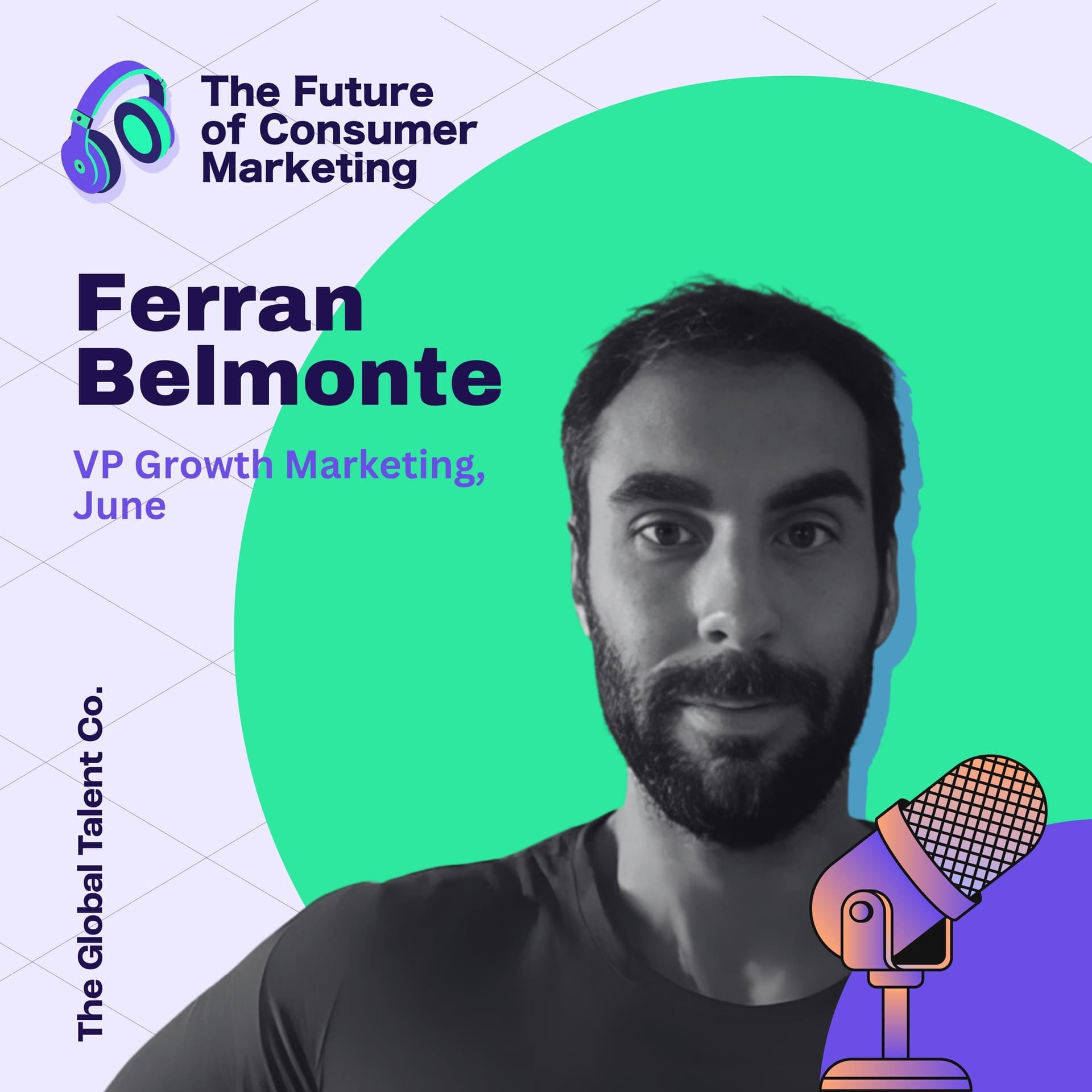
Ferran Granel Belmonte, VP of Growth Marketing at June (proptech for furnished/non-furnished rentals and leases in major US metros). Background: Barcelona hotel/tourism work across 6+ countries; retail fashion store launch in Ireland; performance/advertising budget management at Kayak; marketing roles at Education First; ~4 years at June.
Key claims
Automated emails that look human outperform branded/corporate templates; adding an optional phone-number step increased both phone capture and downstream conversion; virtual renderings outperform empty-apartment photos; focus on value over “making noise.”
Notable examples
A/B test adding optional phone number during web registration; exit surveys for lost leads; pixel-based “soft emails” for high-intent site visitors; AI-assisted virtual renderings for thousands of units.
Written by AI. May contain mistakes. Listen to the episode to check what was said.
Chapters
Tap a time to open that second in VOFerran's Journey into Marketing
0:45 to 4:11
Ferran shares his unique path into the marketing industry, from tourism to prop tech.
“Hi, and thanks a lot for the introduction.”
Influence of Airbnb on Marketing
4:11 to 6:07
Discussion on how Airbnb has transformed marketing strategies and brand recognition.
“And then when my daughter was born with my wife, we decided to move back to Barcelona.”
Impact of Books on Marketing Philosophy
6:07 to 8:24
Ferran discusses the influence of books like 'Extreme Ownership' on his marketing approach.
“like these guys do an outstanding job at communicating and building their brand and their product that's even embedded in the language itself, right?”
Target Audience and Flexibility of June
8:24 to 12:30
Ferran explains June's target customers and the flexible rental options they offer.
“And this book is pretty much about this.”
Marketing Approaches at June
12:30 to 14:00
Ferran outlines his three pillars of marketing strategy focused on automation and data testing.
“And I empathize with like your cause because I just moved into this apartment about two weeks ago and I have the whole process of moving my own stuff.”
The Importance of Automation and Data Testing
14:00 to 18:06
Learn how automation and testing improve marketing processes.
“So automation is key, especially when you want to scale.”
Building Partnerships and Relationships
18:06 to 21:08
Discover the value of trust and collaboration in marketing.
“It's like the multiverse of brands and companies when they join and they start working together.”
Managing Remote Marketing Teams Effectively
21:08 to 23:40
Explore strategies for leading remote teams across time zones.
“So keeping it simple and connecting with people, I think that is going to be something that leads on.”
Overcoming Marketing Challenges
23:40 to 25:11
Understand how to remain relevant in a noisy market.
“Like I go to my CEO and chase him because I need him to approve something or to discuss something with him.”
Leveraging AI in Marketing Strategies
25:11 to 28:00
Learn how AI is transforming marketing approaches and user behavior.
“that your team has faced up till this day?”
Show all 14 chapters
Leveraging AI for Targeted Marketing
28:00 to 29:16
Learn how AI tools enhance marketing strategies by targeting potential leads.
“And that for SEO community, of course, like zero click search, it's a hot topic at the moment.”
The Power of Virtual Renderings
29:16 to 31:02
Discover how virtual renderings improve conversion rates in property listings.
“So you could say, hey, I only want to have these people on my list that have spent more than 30 seconds on the web or that have visited this and these URLs only.”
Emerging Trends in the Rental Market
31:02 to 33:00
Explore the impact of AI on rental platforms and changing consumer expectations.
“I literally just took a picture of my apartment.”
Evolving Email Marketing Strategies
33:00 to 35:36
Understand the shift in email marketing towards more subtle and helpful communication.
“And I think the other element is people's attention spans are shrinking.”
Transcript
Automatic transcript. May contain errors.0:00This show is brought to you by the Global Talent Co, a marketing leader's best friend in these times of budget cuts and efficient growth. We help marketing leaders find, hire, vet, and manage amazing marketing talent for 50 to 70 % less than their U.S. and European counterparts. To book a free consultation, visit globaltalent.co. Hey everyone, thanks for listening. Today I'm speaking with Ferran Granel Belmonte, VP of Growth Marketing at June. With over a decade of international experience from living across more than six countries, he's currently leading marketing strategies in the prop tech space, where they're revolutionizing how both property owners and renters connect.
0:42How's it going, Ferran? It's a pleasure to have you here. Hi, and thanks a lot for the introduction. Yeah, everything's cool. Super excited to be here. Thanks for having me. It's great. I'm so glad that we were able to get you on the episode, Ferran, because we really value the experience that you have. And we have seen your journey from living across all these countries in Europe and now being the VP of Growth at June. We really want to know more about what you have learned of your experience and especially why marketing. Could you be able to tell us your story? Yeah, it's an interesting one because as a matter of fact, I didn't plan a career in marketing.
1:16It kind of like happened naturally. I started tourism in Barcelona. I'm from Barcelona. So after I graduated, started working in the hotel industry, worked for a bunch of different hotels across different countries. I did everything in hotels, like from cleaning streaming pools to, you know, running errands for diplomats and you name it. And after a while, I got the opportunity, a brand new opportunity to take a role in an industry, which was a big step into the unknown for me. retail fashion so there's this company in Barcelona called Munich they were opening their first store abroad then that was in Ireland I got the opportunity to actually run it and basically set it up from scratch I decided to take it so I was there for a couple of years and this is like my first indirect approach to marketing because there wasn't a marketing team to help me push sales so I was running the store hiring training folks running inventory everything but the brand was totally and known to the market.
2:12Irish market was new. No one knew anything about Munich, about our colorful designs. And there was like a lot of grind to try to get those sales in. And because I had no team to back me up and to push, I had to basically like get my brain working like, hey, how can we make a dent into this market? So I started like figuring out, hey, I'm gonna talk to the shopping mall operators. What opportunities can we leverage from them? They actually introduced us to some people that basically connected us with the Irish national rugby team. So I actually went to Dublin and delivered super big shoes to these guys in person.
2:48I started talking to stores next door, like, hey, can we put our shoes on your windows so people get to see and put a little signs, like guerrilla marketing. And yeah, all school, yeah, everything offline, no Google Ads, no nothing. Me against the storm. And after two years, unfortunately, we had to close. It was a big hit on a professional level and also personal level. I mean, I was at such a great place, but I took massive learnings from that. And I also learned that running on the operations side is not what interested me the most. I was more interested actually in the other side of things, like how can I get people to know more about the company, get those sales in, understand the processes, and not so much like daily operations of the store.
3:30went back to Barcelona and I got an opportunity to move to Switzerland and join Kayak and basically I moved there that was like a position in account management and basically we were doing sort of running advertising campaigns for OTAs and airlines that were like buying traffic from Kayak and I was managing those budgets looking at those CTRs trying to maximize their spend so they could renew it wasn't a marketing position but there was like a strong like marketing and performance component. And that's where everything kind of started to click, getting more into the reporting, copies, understanding like the user journeys, conversion rates.
4:07So, you know, it was like a pivoting moment that was happening over the course of these years. I spent there like five years. And then when my daughter was born with my wife, we decided to move back to Barcelona. And that's where I landed like my first hardcore real marketing role. I joined Education First. It's a big company. And those two brands that I was running, they were operating as a startup within this huge company. And that gave me a lot of flexibility and freedom to test things, try new things, and basically own the entire cycle. So I got really exposed to SEO, blog, Google Ads, everything.
4:42And yeah, after a while, moved on back to the travel industry. And a few years later, I joined June, where I'm right now. And yeah, it's been almost four years now. Wow. No, and I was investigating also June and June on their side has a very interesting angle for the market. I understand that you are your prop tech. So you're making it easier for renting apartments that are furnished, non-furnished, even selling them or leasing them. If I'm not confused, would you be able to do rental? Yeah, correct. Oh, okay. Very nice. Very nice. And Ferran, what brand has inspired you the most on your own approach to marketing?
5:19Yeah, I think one of the brands that inspired me the most is Airbnb. When I think about what these guys did, it's pretty impressive, to be honest. They created a category-oriented zone, right? Back in the day, if you want to travel, there were hotels, hostels. That's it, pretty much. They understood there was a need for something more flexible and more close to the ground, where people could rent a rule or could rent an apartment and have more flexibility and not fall into like this more rigid category of hotel, one to five stars, everything like kind of set. And with their marketing and product, like the quality was so great that people like just took that in.
5:56And to the point where these days you hear people say like, yeah, my Airbnb, it became a word, it became a thing, right? Like you actually have an environment, like people would call it my Airbnb. And to me, that's an outstanding, like these guys do an outstanding job at communicating and building their brand and their product that's even embedded in the language itself, right? That's super true. And now that I think about it, it's something as simple as also people saying, yeah, I could just call my Uber. You don't say a taxi. Correct, correct. Like that. So I don't even... Like my phone, like my iPhone, my Uber, my Airbnb.
6:28And yeah, I mean, the North are... I love it. That has become a Canadian North language. It's super interesting. Yeah. I hope one day we'll get this thing and say, yeah, someone uses the same for June Home. Like, hey, I rented my June, but that's, you know. That's the goal? Okay. So I'm at my June. He's come to my June, man. Correct. Correct. Yeah. Oh, I love it. I love it. Very interesting brand that follow on. Yeah. I mean, by the way, we simply started tapping into the activities vertical. I don't know on your side, but you're in Spain where I'm right now. They're spending like decent amount of budget on ads to promote this on TV, on YouTube.
7:04So they're, you know, picking up some very well positioned players in that space. It will be interesting to see how that works. Yeah. Okay. And June, do you have a region where you guys lease and rent apartments? Or is it like something that you want to do worldwide? Or do you want to specialize in a certain place? For now, we operate in the U.S., in the major metros. Eventually, we might expand to new cities within the U.S. and maybe further down the line going international. But right now, it's not the plan. But, you know, we'll see. It's going to be right. Exactly. If you expand to Argentina, just let me know and I'll start saying, hey, just rent your June.
7:38Yeah, exactly. Yeah, yeah, yeah. Yeah, I'll sign you up on our ambassador program. For sure, for sure. And Ferran, tell me something else. What book has had the greatest impact on shaping your approach to marketing? So there's this one book that it's not like a marketing book, but that really made a big impact on me. And it's called Extreme Ownership, written by former Navy SEAL, Jocko Willink and Leith Babin. This is, to me, working at startups. For example, challenges come from all sides all the time. You never have enough resources to tackle all your to-do list. So you got to stay hyper-focused and take ownership of things, right?
8:18It's up to you to make those things happen. It's up to you to keep raising the bar. It's up to you to keep self-improving. And this book is pretty much about this. And it really changed the way I operate and the way I operate with my team, the way I tackle when we make mistakes, when I make mistakes. To me, it's been like an eye-opening experience, to be honest with you. I also listen to their, Jocko has a podcast as well. And it's very interesting because they kind of like pick different history moments, like from Sun Tzu to Normandy to jungles in Vietnam type of battles and situations. And they tell them to like specific leadership challenges that occur and that are many times exportable to business.
9:03So yeah, definitely very interesting. but actually on more like marketing front so marketing communication and influence is a key component right of what we do not only to influence like prospects but also to influence and match internal stakeholders and getting your items pick up in the next it sprint so i have this book that i actually just purchased should land soon influence the psychology of persuasion by dr robert celdini and if there is any italian folks around apologies for my pronunciation i think i got it right so i'm really looking forward to starting getting into this one okay okay no no that sounds interesting i honestly just wrote both titles in my notebook just to keep an eye out for those books because they do seem very interesting and yeah that's what check them out yeah extreme ownership is by bronco williams if i heard joko willing ah joko joko okay yeah and late button yeah okay now i love it i love them using battles of history as allegories or metaphors to business situations and how it relates.
10:04It just makes us feel that business is a battlefield. We must not forget it sometimes. I agree 100 % of that statement. It must be like that, really. Yeah, everything happening, like moving pieces and technology changes and all of that, like it does feel like a battle. Yeah, no, no. It is a game of chess where you have the different pieces and your strategy and you have to get something to work first in order to move this other one. So you do have to keep eyes on everything. And I do understand the appeal. So awesome, man. I love that. I'm going to check those out just because I love to keep learning stuff.
10:36So that is very interesting. Yeah, I agree. Okay, Ferran. And also, let me know, we've been talking about Juno, so I have an idea of what you sell, but who is your target customer? Yeah, so our target customer folks that want to live in the US, in major cities, and we operate only like 39 or more. We're not like a short-term operator, right? Basically, two major segments, I would say, that we tap into. One's like student, and many come from overseas, like Asian students going to Boston, for example. You can imagine, right? Going to MIT and things like that. Young professionals, so also like U.S.
11:14citizens that either recently graduated and they're landing their first job in Manhattan, for example, and things like that. People that need an accommodation for the mid to longer term. And what we do is we try to match their needs, right? Like traditional rental market is very, very rigid. Like, hey, at least 12 months, no changes whatsoever in the day. It's take it or leave it. We come in and we say, hey, look, we'll do whatever you need, right? If you need to be in New York for three months or for 76 nights or 59, whatever random number you can think of based on your life situation and your challenges and your projects, we'll do that, right?
11:49We'll do that for you. So it's super flexible. And the same goes for furniture. Like, hey, you want the unit for this? You have it for you. You want it unfairly because you're moving from your parents and you have some stuff already. That's also a possibility, right? So we'll just match what you need. And we're trying to simplify these transition moments for people that are very tricky, right? And especially if you think about non-US citizens going to the US, if you have to go through the standard process with no credit score, no nothing, it's very complicated. With that, we'll try to be super simple for you.
12:20You can then move in. You have a lot of flexibility. you can move out and come back in later and decide again, like your length of stay and everything. So yeah, that's how we operate and who we target. Okay. Now, I really like that. And I empathize with like your cause because I just moved into this apartment about two weeks ago and I have the whole process of moving my own stuff. I wanted it furnished because I don't have the furniture for an apartment. So looking for that, it's a bit more difficult. And if Juno provides the solution, like in one place for people to find that, I think there is something there because it really does help the whole process and how it's so stressful.
12:58You know, moving is just stressful. So if you can help people be at peace while they move, it doesn't even have value for me. Yeah. And the other component to this is that because we operate both like rooms and entire apartments, it makes it more affordable for people, especially young people that they may not be able to afford like a studio in Manhattan for themselves. So they may just move into one of our apartments and share a room with another two or three students or two or three young professionals working in the city. So yeah, it opens the door for people to start having those experiences in very high demand areas.
13:32It's very complicated and would likely imply a lot of long-term units and things like that. That's true. That's true. That's true. And okay, Ferran, what is your marketing approach or philosophy? I'd say my philosophy is based on three pillars. One is automation. And again, like working at startups with limited resources, that's a critical aspect because we don't have massive human power to like tackle all like these manual steps. So automation is key, especially when you want to scale. As a matter of fact, I have an inside job with my team. I sometimes tell them like, guys, be lazy. When you think about a process that you're like, it's a recurring process.
14:11Like we do it several times. Like, first of all, do we even need that process? Chances are that we don't anymore. Maybe we needed this back in the day and now things have changed and that's no longer valid. If we still need it, then the next question is, again, like be lazy mentality. Like, can we automate this? Can we put like some technology here to take care of that process that's very time consuming right now, that is distracting, that may be deciding like room for error. And then we can pass this on, have it sorted by technology. And we, the humans, focus on the other areas where technology cannot reach it, for example.
14:41So that's automation, one of the areas for sure. The second pillar would be data and testing, right? Like we have assumptions and we all have like ideas on, hey, I think this is going to work. But oftentimes like we're wrong, right? Like your own experiences from the past that they lead you to think like, this is a great idea. Then you actually put in like some scientific method and you test it and it turns out that it was not a good idea, right? And the other way around, you're testing and you feel like, well, I'm not sure. And then it's a clear win. So this is one. And just to give you an example, we got some feedback from sales not long ago.
15:16Like, hey, for a lead that we received that do have a phone number, we see better performance, but it wasn't quantified. It was just feedback that you get from the sales team directly, like these guys on the ground. So we set up an A-B test where as part of the web registration process, we would add an optional step. We didn't want to force it. So we start with optional, provide your phone number. And then we A-B tested this. Half of the people would get that step. how the people would skip it, the control. And after a while, we realized that not only did we get more phone numbers, but also conversion rate from that moment all the way down to the funnel were indeed higher.
15:52So the sales feedback and the sales proposal to get those was actually like a very valid point. And of course, we rolled this out 100 % because it was a clear win. So yeah, basically, the more you test, the more you learn. And that's definitely the second aspect. The third one would be partnerships and relationships are key. and I think this goes for internal stakeholders but also external when I was at kayak at all your other companies I've worked for like I was exposed to account management like very much and I got to experience like how hard it is to be like solid and trust long-lasting relationship with trust from someone that's across the table that they're spending like significant amount of budget with you and they're giving you this confidence that it starts like hey manage this correctly for us and then the other way around.
16:37Now, at June, we are buying placements, right, to list our units. And we still build this relationship with those platforms that allows us to basically go from a more transactional type of relationship where, like, hey, I'm purchasing this product from you to I'm still running this on your site. But because we've been running them for a long time, we have regular calls where we address conversion issues, we address challenges, we do QA together, trust increases and that opens the door for other corporations and collaborations that happen, right? And we did some, for example, with a platform specialized in overseas students.
17:15The relationship started as a more pre-transactional where we were listing our units and then evolved over time because there was distrust. Hey, can we do an email campaign to your subscribers with our product? Can we do something on the blog, like posting some things here and there to basically get exposure? It became more collaborative with the other companies and brands that you work with due to the trust that they created with you. Correct. And to be honest, to me, although I'm getting to approve and pay the bills, right, that we're just on these guys, I don't see this as a client provider relationship where they send me the inbox to pay for the service.
17:53I do see this as we're partners and we're working on this because if it goes well for us, it's going to go well for you and the other way around. And that's going to be like fundamental component of this relationship and the way we are. I loved it. It's like the multiverse of brands and companies when they join and they start working together. It's really nice because you see this cohesiveness and this kind of community that creates within the companies that, you know, if it's Juno, I trust them. And if Juno trusts them, then I'll trust them as well. So it's like acknowledging who you're with and people will know who you are.
18:24That's right. Yeah, it generates, as you pointed out, like it does generate this like snowball type of effect where like you got the two names together and this connection happening that people get to see. It's like, oh, these guys are cooperating, right? Like it means like solid people. And yeah, so partnerships and relationships for sure are a key component in my view. No, no, I love that. And Ferran, okay, so you mentioned that you've been through a lot of trial and error, and that way you have found the best approaches to certain aspects of this industry, issues you've led, even managing your team.
18:55What do you believe is what works most today when it comes to marketing for Juno? And what do you think is not working? Yeah, so we did a bunch of tests. Basically, at June, we have a rather complex ecosystem of email automation. Basically, depending on what step of the funnel you are, you're going to get a certain type of communication. And we realized that people respond better to emails, even if they are automated, that seem to come from a person, right? Like from a real person. So basically, we were already testing the exact same copy. One, it seemed like written by the agent. And the other one was the more classical, traditional email with, you know, header and logo and footer.
19:37And the difference was big in the sense that emails supposedly coming from humans outperformed clearly on all levels, not metrics, the more automated ones, automated looking ones, reprinted ones. And I think the reason is because those seem closer to like human to human interaction. I feel like Andres is reaching out to me to help me with my rental apartment search in New York, as opposed to someone like some company sending me. Also, the fact that today Andres might have already received 15 from your software and subscription providers, Netflix and all of these big guys sending regular communications like super branded and corporate.
20:17And then I think it's very easy that those get lost. So that was definitely one. So having this human point, yeah, one of the big learnings we've got recently. Okay. Okay. Now, that sounds amazing as well, because I do, like me personally, as a consumer of different brands, companies, and when I go into a website, when I'm received with just AI, which is the fashionable thing right now, I don't love it too much when they make me speak with a bot, because I don't get that personalized side of me knowing that Ferran is helping me out. he knows I'm traveling with my wife in two weeks because we got married.
20:54So he knows the importance of it. And that human aspect, I think it does add a lot of value to the user experience. And yeah, it's very cool that you're trying to maintain that approach because I feel it's something that's getting lost in these times. Like everybody's trying to optimize, automize. So keeping it simple and connecting with people, I think that is going to be something that leads on. Yeah. Okay. Okay, Ferran, we would love to know, how do you maintain team performance when you manage remote marketing teams, even if they're across different time zones? Do you have a special strategy or way that you manage that?
21:30Yeah, I mean, Juni is a fully remote company, so we know about that. And at some point, I got people in India, I mean, Spain, people in the UK, in Russia, in Brazil, like really all over the place, which I think is a lot of fun. It comes with its own challenges too. The way we handle this, I would say a few things key to that. First of all, communication. There needs to be open communication channels available anytime, right? And we use Slack. There are other systems out there that do the same, where you can quickly shoot messages and have conversations going on on a daily basis and on a regular basis.
22:05We have some touch points as well, like more formal, weekly by weekly, depending on the topic where we address all of these things. But Slack is a key element of tool. like we run all sorts of project discussions on Slack. So that's communication is one part. I think sometimes you need to, especially at the beginning, if you're stepping into like leadership role or you just get into a company that doesn't have that remote aspect yet or they're building it, you need to transmit the message that, hey team, not because we have a bi-weekly meeting, you need to wait until that official meeting to happen to address things, right?
22:40Like you want to act today and you want to ask this question today to get this blocker removed today. So app today is another element that's key to this remote type of relationship. And last but not least, I think in our culture at June, it's fundamentally like take ownership is one of the core values that we have. And that's what allows for teams to run efficiently, right? Because you are not waiting for your manager to tell you what to do. You have your targets. You know what we need to keep, what's important as a company and as a team. We need to do A, B, C because we want to get on that. is want to win this fight, right?
23:14Going back to the fighting analogy that we did before. So it's not me going to say, hey, ABC, this needs to happen. Like the expectation is the other way around. Like teams expected to come up with solutions to these complex challenges that happen in the marketing world, the marketing universe. And basically you're expected to run with it. And that means chasing your colleagues, chasing IT, chasing your manager as well, right? But you were very open about this and very flat. Like it's totally fine. Like I go to my CEO and chase him because I need him to approve something or to discuss something with him.
23:45And I think like all these things combined allow you to be efficient in a remote setting and trust. Of course, you need to trust. I agree with you completely. I've been working remotely since pre-pandemic or as soon as the pandemic started, like 2019, 2020. And I do value a lot of proactivity in the remote workspace because in an office, Sometimes you could not be doing that much, but as soon as your boss gives you a glance, you'll get back to work. But since in the remote setting, nobody is actually on top of you, the workers I value the most are those that are proactive, that are meeting deadlines, that they do communicate via the different channels we have.
24:26Because what makes a company work, in my opinion as well, is the communication. Because if you're not talking in between the departments, then what are you really doing, right? Yeah, yeah, correct. I mean, there's only one caveat, I would say, or one point to be considered there. Like, all of these words, as long as you have, like, a very good team, right? And, you know, solid performers. This level of productivity, sometimes you don't see it when someone's like, hey, not getting to the standard. And then you need to, like, step in a little bit more. But for the most part, like, teams are great about this.
Read the full transcript
24:57And they know when they join the company, like, we're very clear. Like, this expectation is this, right? Like, you're not going to have anyone telling you what to do. You're expected to run with it. It's your project. It's your baby. make it happen, make it grow. So biggest marketing challenge that your team has faced up till this day? And how were you able to overcome it? Well, I think biggest marketing challenge that we have, and I think that probably speaking like beyond June and more of a general situation, is like there's a massive amount of content being produced, a lot of noise, a lot of competition, right?
25:30So the question is, how do you stay relevant in such aggressive environment and not fall into this trouble like, hey, would you want to produce something real quick? Again, like talking about AI, put a prompt, generate something, just make noise. And what's the value, right? How can you provide value to your prospect leads, to your future tenants or whatever you're selling? And I think, first of all, is understanding who your clients are. By the way, we did something recently as well on that front. We set up an exit survey. So we have like a bunch of people and they become lost leads. So we're hitting them with like one question.
26:06Like we have set up like subsets of people and then they only get one question to make. It's super easy to answer on the reasons why they decided not to rent with us. So we can learn more about what happened, right? Like we not meet your expectations, where there are some issues in the communication, the service. So that helps us get into this continuous process of fixing and learning. And then I would say that's more like the understanding who these people are. Like cutting a little bit of the fluff and try to provide value with every communication that you send, that it's something that's going to be relevant for us.
26:43I'm not just like a placeholder for content. I need to send them something because we have a calendar that says we need to send something. Does it really make sense to send this to these people in this particular stage? What stage are they in? Like, are they about to sign the agreement? They just actually enter the funnel to make it very relevant and not that like carpet bombing and like more precise touch points. Like they need a touch point only, right? Like don't overdo it. Okay. Okay. And Ferran, with all this that you're telling me in terms of challenges, how you've overcome it, have you or are you guys using AI or any interesting tools in tech that you might think of?
27:20Yeah, I mean, we do use AI, sentiment analysis. we do spin like some copies to check the differences and you know ai has changed the way that we work i think everybody and if you haven't everybody's exactly late you're late to the party so yeah ai for sure i mean i think another big thing we're seeing with ai is that it not only changed the way we work but it also changed user behavior right and if you think about it we see a very clear trend of people no longer going to google no longer going to yahoo to being to run their searches and to ask their questions. They're ditching the traditional search engines and going straight to their preferred AI to get those questions resolved.
28:03And that for SEO community, of course, like zero click search, it's a hot topic at the moment. It will continue to be. Everyone's trying to figure out how to work with that and optimize marketing strategy for that. I think this is going to be like battlefield for future. It already is in a way. So yeah, that's more on the AI. And then to your second question about tools, I'd say, yeah, two interesting tools we're using. One is like a pixel discovery, a tool that we use for basically when we acquire traffic, right, on different channels, these people land on our website and through these like massive networks.
28:37And there is a pixel that we have on the web and these like network providers have the same pixel. They're able to match this person with an email address. And with that email address, then we can hit them with a soft email because we don't want this to be too intrusive. and it's like, hey, notice you're like looking for accommodation for a home in ABC City. Check us out. This is people with high intent, right? Because they've been on your website already. So what we're trying to do is like get them back again and have them start the process, like become a lead officially because these are people that only made it to the website.
29:11And what's interesting about this is that you can target based on behavior. So you could say, hey, I only want to have these people on my list that have spent more than 30 seconds on the web or that have visited this and these URLs only. You can make it very, very much relevant and targeted to who you think these people are and their needs are to make it more relevant. So that's something that we're testing recently. Very interesting. And another one that we have been using for longer is for virtual renderings. In our business and at our scale, we manage thousands of units, right? And when I say units, I mean like apartments and rooms.
29:46and if you think about the cost of getting a professional photoshoot for a thousand units you quickly realize the significant amount of money that's to be spent on that and not only the money but yeah money time to the chd grid you know have someone there like organize a place spend the time with the photographer it's a big headache right and for a company like ours we can't afford this and we don't think it's the best way to spend that money so we found a solution that we have virtual renderings. Because again, like back to the testing point before, we did notice that when you compare two listings that are the same, exactly the same listing, and one has pictures of the empty apartment, right?
30:24Like the four walls and the window, and the same unit with virtual renderings that shows like a table of it, even if it's virtual, and it does say clearly it's a virtual rendering, so we don't want to like mislead anyone. The performance and the conversions are radically different, right? So we realized like, hey, we better show virtual rendered pictures as opposed to empty ones. And we've been using, well, a combination here, like an AI tool for some of the units, but some of the other units that are a bit more competent, we still rely on a designer to help. But yeah, I mean, those AI tools are getting smarter and better.
30:55And I do expect that over time, the share of listings that we'll be able to manage directly with AI are going to be increasing. And the cost impact is massive. Again, like... Yeah, no, that's true. Like AI is going crazy. I literally just took a picture of my apartment. like you're mentioning and sent it to the AI. And he said, could you maybe redesign this a bit more modern that makes it look like I'm in space? And then AI does its thing and it works so well. What I do have my doubts is with facts and fact checking, sometimes it spits out stuff that isn't that accurate. But yeah, you still need to have a human take a look at it because sometimes you see like massive couches that got like oversized and it does require like a little bit of tweaking.
31:37But the end of the world, for the most part, it's pretty satisfactory. factory. And again, as we pointed out, it's getting better by the date. So yeah, huge opportunities there. This has been very impactful for us. Okay. Okay. And well, now that we're talking about the AI trend, what other trends do you think Ferrand will define 2025 the most? Yeah. I mean, something else still within the AI realm that we're seeing. It's interesting because when I joined June, we wanted to partner up with people. It was only us having to reach out. But recently, because we've been in the market for long, now we also get a new focus of a partnership type of request.
32:15People reach out to us to get access to our inventory. And in the recent month, we did receive a few requests like that, like brand new companies being built from scratch based on AI, that they want to disrupt the entire rental platform ecosystem, like zero apartments and all of this, and building a new setup that's basically guiding you, helping you run those searches so you don't have to actually scroll through. We'll see where that will lead. I'm sure not everyone will succeed. And there's definitely some big players out there that historically are very well positioned and they're going to be very defensive.
32:51But I think some folks might be getting a bit nervous with the search of these new companies that they may break a few things. So we'll see how that goes. That's one. I'm kidding. And I think the other element is people's attention spans are shrinking. We want everything ASAP, no matter what. And it doesn't matter if it's like$10 purchase you're doing for, I don't know, any random item you can think of, or thousands of dollars transaction like renting an apartment. People expect that if I have a question, I want to get an answer right now. That's why you mentioned the entire bot ecosystem exploding to try to match this demand.
33:31We also did a first iteration on this last year. We're seeing when you're on the listing page now, you can shoot a quick question like, hey, is there a subway station nearby or whatever? You'll get a quick answer. We'll still capture your email. So you can reach out to us with more if you want to have this personal connection and discussion as you pointed out important to you. And it is for many people still. We're thinking about like version two of that, like to make it smarter, to make it more efficient. So I think like this immediate type of service is going to be more and more important going forward.
34:02And lastly, and I touched upon this briefly before, people don't want to be targeted as such. I feel like people want to be more like help, like just reach out to me when you can provide something for me and not just like ask me to do certain things, right? Like push me, push me. Okay, I get that. I feel like I think it's important that as a company, like you push people and send reminders and hey, you left your application halfway through type of thing. But it seems to me like there's a bit of a change in people's mentality that they respond better when even though it's like gentle pressure, but it's not like that obvious.
34:37I'm pushing you very hard. It's more like accompanying you down the process. So, yeah, we'll see. Now that you say that, Ferran, like I also think back into like history and I'm like, yeah, email marketing isn't dead per se. but it needs to shift in the way it's done because before it was like that. It was targeted ads to the consumer directly in their inbox. It's like, hey, this is us. Come and buy us. Come and do this for us. Like it was a bit violent or aggressive per se. And you mentioning that it should be a little more subtle, just reminding when they can help you, when the user needs you.
35:10That has a lot of value as well because it provides that type of wholesome experience that isn't so energy draining. because when I see ads asking me to do stuff, like I can literally just close the computer and not watch it anymore because it just gets me so tired. I agree. Yeah, yeah, yeah. This concept, right? About getting, I don't know exactly the word in English, but like advertising fatigue type of thing where like at some point your brain will just disconnect because you've been like receiving too many messages, input from like YouTube ads, you name it, emails and everything. Yeah, we see.
35:46Something less is more. That's what they say. And I think this is a bit of a... That's completely true. Minimalism is very elegant. Yeah, exactly. I think this is a step into that direction. We'll see. Maybe time will prove me wrong, but we'll see. Okay, okay. Yeah, just wanted to say then, Ferran, that it has been a pleasure having you on the podcast. And we really hope that everything with June and with your own personal experience and career goes very well and it keeps going well. And other than that, if you ever want to hop on another episode, with us if new things happen. Just know that you're always welcome here and it has been a pleasure.
36:20Cool. Awesome. Thanks a lot for having me. Really enjoyed having the conversation. Next time we'll meet face-to-face somewhere in Argentina or but yeah, really appreciate you guys having me on board and yeah, look to be part of a second episode potentially at some point. Sounds great. Sounds great then, Ferran. So without further ado, we'll close this episode and then let you go. Cool. Have a good one. Bye.
36:46Thank you.
From the publisher
In this episode of The Future of Consumer Marketing, host Andres Figueira interviews Ferran Belmonte, VP of Growth Marketing at June. June is revolutionizing the rental market in major US metros by creating a flexible, technology-driven platform that serves students and young professionals seeking mid-to-long-term housing solutions. Through innovative approaches to automation, data-driven testing, and strategic partnerships, Ferran has built a marketing machine that addresses the complex needs of international students and young professionals navigating America's rigid rental market. His journey from hotel operations to retail marketing to prop tech showcases how cross-industry experience can drive breakthrough marketing strategies in traditionally stagnant sectors.
Topics Discussed:- Building automated marketing systems with limited startup resources
- Leveraging A/B testing to validate sales team insights and optimize conversion funnels
- Creating human-centered communication in an increasingly automated world
- Developing strategic partnerships that evolve from transactional to collaborative relationships
- Managing remote marketing teams across multiple time zones and cultures
- Using AI and virtual rendering technology to scale visual content cost-effectively
- Implementing pixel discovery tools for high-intent user retargeting