
In short
Podcast Summary: Future of Consumer Marketing - How Pluto TV Wins Niche Communities Without Ad Spend
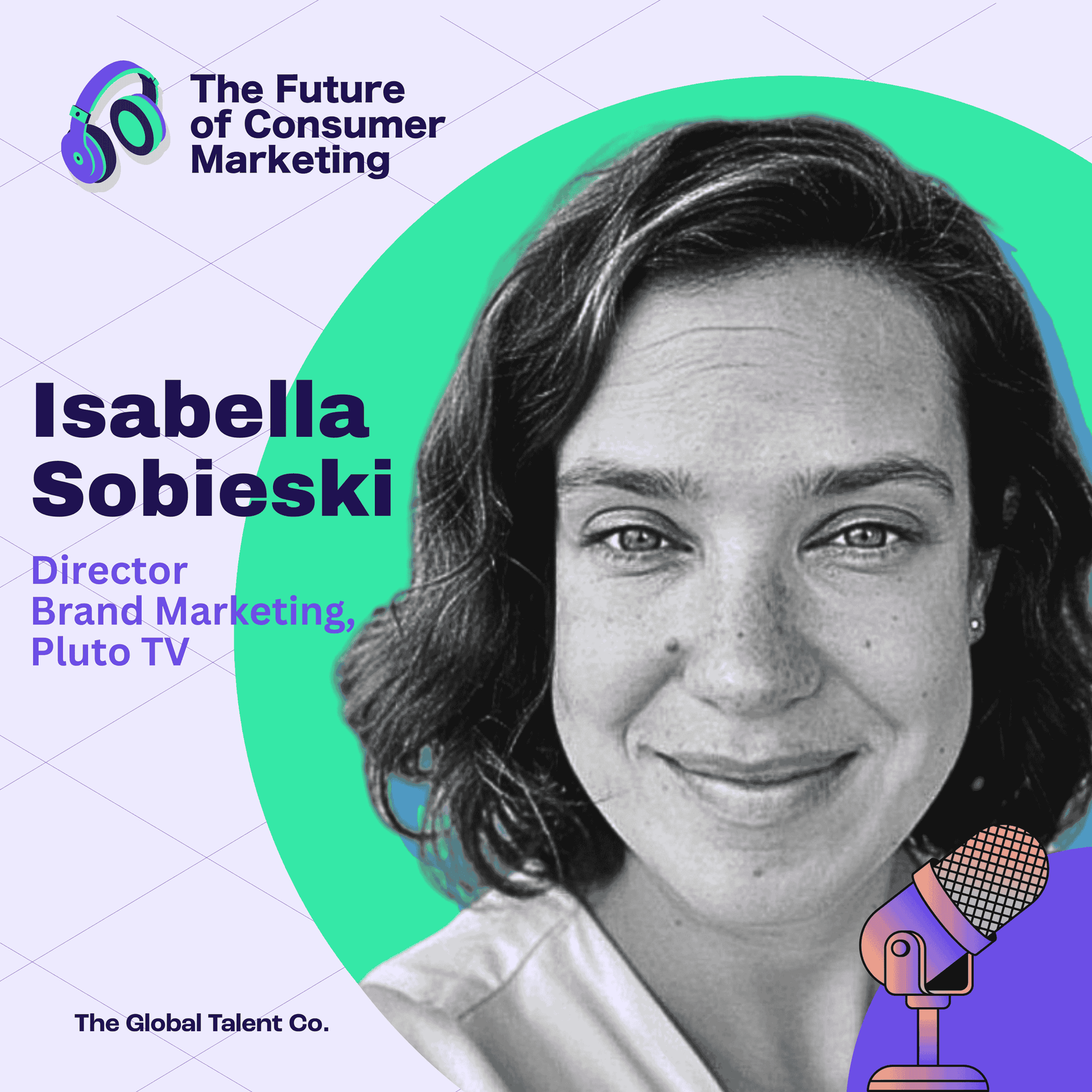
Episode Overview In this episode, host Andres Figueira interviews Isabella Sobieski, the Director of Brand and Marketing at Pluto TV, a free streaming service competing in the crowded entertainment space. Pluto TV differentiates itself by positioning as an anti-subscription service, offering content without any subscription fees. The conversation delves into their strategies for engaging niche communities, leveraging nostalgia, and operating within diverse cultural markets.
Key Topics Discussed
- Free Streaming Service in a Subscription-Dominated Market
- Pluto TV operates without paid subscriptions, focusing on free, ad-supported content.
- The company targets specific audience segments through niche content rather than competing directly with subscription services like Netflix.
- Niche Content to Build Loyal Audiences
- Pluto TV capitalizes on niche content markets to cultivate dedicated viewers.
- Example: Darts has emerged as a popular genre, with Pluto positioning itself as a primary source for dart-related content.
- Psychological Triggers: Nostalgia and Recognition
- The design taps into viewers' nostalgia, recreating the experience of traditional TV without the need for decision fatigue common with on-demand services.
- This "lean back" viewing experience allows users to engage with content passively, making it less mentally taxing.
- Competing for Attention Without Traditional Marketing Budgets
- Isabella discusses how Pluto TV leverages influencers and content creators to act as distribution partners.
- The emphasis is on building community-driven marketing strategies rather than relying on conventional advertising.
- Diverse Marketing Strategies Across Regions
- Marketing approaches are adapted to fit culturally diverse markets, recognizing different consumer behaviors in places like the US, Latin America, and Europe.
- The conversation highlights the challenges and learning experiences from various regions.
- Lean Marketing Operations Through Agency Partnerships
- Pluto TV utilizes small, agile marketing teams complemented by strategic partnerships with external agencies.
- This allows them to operate efficiently across multiple markets without resource strain.
Key Takeaways
- Pluto TV's Unique Positioning: By focusing on free access and niche content, Pluto TV stands out in a landscape dominated by paid streaming services.
- Value of Nostalgia: Nostalgic content plays a crucial role in attracting viewers who seek a familiar TV-watching experience, thereby enhancing user engagement.
- Community Engagement Through Content: Building relationships with niche communities creates loyal audience segments, which is essential for growth without substantial ad spend.
- Cultural Adaptation: Understanding regional consumer behavior is vital for effective marketing and product positioning, especially in diverse global markets.
- Influencer Partnerships: Utilizing influencers to promote content can be a cost-effective way to reach targeted audiences, enhancing engagement through trusted voices.
Conclusion The episode provides insights into how Pluto TV successfully navigates the competitive streaming landscape by prioritizing free access, community engagement, and the use of nostalgia. The discussion emphasizes the importance of cultural sensitivity in marketing and the role of strategic partnerships in maintaining a lean operational model.
Listeners are encouraged to explore Pluto TV's offerings, which are available for free, reinforcing the message that quality content does not always come with a price tag.
Written by AI. May contain mistakes. Listen to the episode to check what was said.
Chapters
Tap a time to open that second in VOGuest Introduction: Isabella Sobieski
1:19 to 3:06
Isabella shares her background and role at Pluto TV.
“And with that said, Isabella, it's a pleasure to have you on the show.”
Understanding Pluto TV's Unique Offering
3:09 to 4:52
Isabella explains how Pluto TV operates and its competitive edge.
“and Pluto is a streaming live TV and VOD service, which is for free and will always be for free.”
The Nostalgia Factor in Streaming
4:55 to 6:04
Discussion on how Pluto TV evokes nostalgia through its programming.
“No, no, that makes, that makes a lot of sense.”
Positioning Against Traditional TV
6:06 to 8:12
Isabella outlines how Pluto TV competes with traditional TV in Europe.
“And in Europe, it's a little bit different because the public TV is for free.”
Evolution of Marketing Strategies
8:14 to 11:28
Isabella discusses the shift in Pluto TV's marketing strategies over time.
“And we always kind of said that we are not in direct competition with the other streaming services because we don't do originals and we don't have paid subscriptions.”
Targeting Niche Communities for Growth
11:30 to 14:00
Strategies on how Pluto TV targets niche communities to expand viewership.
“So I think, you know, it's all about, I think that the changes has not only been within the companies themselves, but within the content, like within the behaviors of the consumers, like how, how are we watching?”
Episode Discussion
14:00 to 28:00
“And they were, of course, really happy to do it because it's for free.”
Global Collaboration at Pluto TV
28:00 to 30:28
Learn how Pluto TV facilitates global content distribution and collaboration.
“It has a lot of people who are like, you know, focusing on certain areas and certain territories.”
User Experience and Features of Pluto TV
30:58 to 33:16
Understand the features and user experience of Pluto TV.
“And I'll check out the Argentinian region selection to see what you guys have to offer here.”
Transcript
Automatic transcript. May contain errors.0:00Pluto is a streaming live TV and VOD service which is for free and will always be for free. Our slogan is Stream Now Pay Never. Pluto is actually trying to compete with live TV and not the regular modern streaming services that we have. We are not in direct competition with the other streaming services because we don't do originals and we don't have paid subscriptions. We are actually wanting to always offer something for free. And in that, we can go for some other niche content that might have a very specific audience segment. But if you multiply that by 10, then you already have a really big percentage of an audience that can find something interesting for free on Pluto.
0:46Hey, everybody. Thank you for listening. My name is Andres Figueira, and I'm going to be your host for the day. This show is brought to you by the Global Talent Company, helping fast-growing teams hire exceptional remote talent from Argentina, South Africa, and beyond. We connect companies with world-class professionals who bring skill, reliability, and a global perspective to every role. And just for our listeners, we're offering an exclusive 10 % discount on your first hire. All you need to do is visit theglobaltalent.co, click Start Hiring, and mention the podcast listener discount when we reach out.
1:19And today with me here is Isabella Sobieski, Director of Brand and Marketing at Pluto TV, which is the leading free streaming television service delivering hundreds of live linear channels and thousands of titles on demand to a global audience. And with that said, Isabella, it's a pleasure to have you on the show. How are you doing? I am good. Thank you so much. It's a pleasure to be here and excited to be here. No problem at all. And Issa, just so that we can get the audience a bit more in context, would you be able to tell us a bit about your background and maybe in your own words what Pluto TV really is?
1:55Yes. So I'm Isabella. I am located in Berlin and right now leading the Pluto brand and marketing business for the German-speaking countries and the UK. So that is my focus areas. And I've been living here for some time. I have a background in advertising, actually. That's where I started. And then I kind of slowly built myself up to the client side. So I became the client and then I hired the agencies because I had a little bit more creative control in that sense. And yeah, and then I got into marketing. And since I moved to Berlin, I've been working for Nickelodeon previously. I worked for Spotify.
2:36I've been a freelancer. I've done a lot of startup work, consulting and everything around brand and marketing. I think that the brand part became more kind of like prominent the past years because I think it was a shift within marketing. So it became a little bit more brand focused within the marketing sector. It was about like, you know, positioning the brands, making brands more prominent, building the brand awareness and stuff like that. So I kind of took that on. And yeah, now that is a very big part of what I do. and Pluto is a streaming live TV and VOD service, which is for free and will always be for free.
3:19So our slogan is stream now, pay never. We exist in 36 countries. Among that is the US as a leading country, Latin America, Europe, yeah, and many countries within those continents. So it's super exciting. it's basically a product that is ad sponsored. So, you know, we can, you can watch the content and we specialize on like library content. So like content that is not entirely new, it's not original and it's, it is exclusive, but it's more like a selection. So it mirrors the TV experience, but in a streaming environment. So it's an application that you can have on any kind of CTV. So smart TV and also your phone or your tablet anywhere and it's all for free.
4:07So that's what I do. Or that's what Pluto is. I must say that I have used Pluto before and I was very excited for this interview because I think the idea behind Pluto is kind of genius. Because, correct me if I'm wrong, but I feel that there's a big aspect of nostalgia in the way that Pluto works and how people use it. Because it just reminds me of when I used to like not be able to control what I watched, but just have to change channels and find whatever I liked in the moment. And I think that aspect is something that was lost because if I tell you about how many hours I have spent deciding what to watch on Netflix or any other streaming service that you need to just go through the catalog, Pluto is something that I watch when I don't want to think about what I need to watch, if that makes sense.
4:54Yeah. No, no, that makes, that makes a lot of sense. And I think that the nostalgia aspect is part what we at Pluto or like, you know, maybe call the library content. So it is content that has been available on TV, but it's now kind of like customized to also, you know, you, you, you watch like the behavior has shifted, right? So the product, like the company actually started in 2014 in the U S and it was mainly to serve like the cord cutters. So cable became really expensive. And that's what when Pluto TV came in. And then it was acquired by then Viacom, now Paramount in 2019, as their kind of like free to air model.
5:41So it was a good transition from like, you know, the linear TV landscape kind of like, you know, fading out because the online presence, like the internet became stronger and the smart TVs took over. And that's why the behavior for the consumers also shifted. So Pluto has the same kind of like lean back experience. You put it on, you zap through the channels and it's all for free. And that's also why they decided that it will always be for free because they wanted to have that strong competing factor against the traditional TV that like in US example was very costly because the cable networks, they needed the money to survive, I guess, or just to expand.
6:22And in Europe, it's a little bit different because the public TV is for free. It's incorporated into the taxes. So of course, here, the competition is much stronger. So you have to kind of fight for a different type of positioning because in the UK, you have such companies as BBC that is very well positioned. And with, you know, taxpayers money, they have always funds to do really great things. and the same like similar in Germany and similar to the other countries in Europe. So it's a bit of a different setup, which makes it, of course, like very interesting and also very challenging in so many aspects because the consumer behavior is also so much different.
7:02So you have to onboard the consumer to something that, you know, hey, watch the free live TV in a streaming environment, whereas they are already watching traditional live TV in another free environment. So it's a but it's I think that at the end of the day, it's about, you know, the conveniency. Pluto is very innovative. It's like the technology is amazing. It's very it's a seamless experience. You know, it's like you put it on, you can find everything. It's very intuitive. It looks great. And of course, as a as a technology product, it really delivers. OK, and like from what I'm taking out of what you just mentioned is then that Pluto's actual company, It's actually trying to compete with live TV and not the regular modern streaming services that we have.
7:48It is live TV in a modern aspect of streaming. But then you did this or Pluto began just to make it easier and cheaper to watch television as we used to know it. Yeah. And then also making sure that you could get other types of offerings or other types of content actually on Pluto that might not be on the S-Vlog services. Right. So the subscription-based services that you pay for, such as Netflix or HBO. And we always kind of said that we are not in direct competition with the other streaming services because we don't do originals and we don't have paid subscriptions. We are actually wanting to always offer something for free.
8:28And in that, we can go for some other niche content that might have a very specific audience segment. But if you multiply that by 10, then you already have a really big percentage of an audience that can find something interesting for free on Pluto. So it's about catering to different needs of the consumers and then making sure that we would fit in the behavior. So if you mentioned earlier that I really go to Pluto because I just want to like shut off my brain and I just want to like, you know, disconnect and just watch, just, you know, have something on in the background to probably keep your company, you know, like some background noise, then that is also fine.
9:08because for us that counts as usage, right? And then that is a behavior that we are then looking for from the consumer, that their behavior is that you decide that you want to go to Pluto. And then if something gets your attention, then that's even better, right? So it's about where does Pluto right now fit? Because there's so many streaming services, and there's this choice fatigue. So you go to all of them, and as a consumer, you end up being overwhelmed and you might actually end up either choosing only a couple or you choose the content that you already watched several times. And Pluto is there to kind of offer a similar experience, but without you paying for it.
9:54And then another question I have is then in terms of Pluto, when it came out versus to nowadays, how has the marketing for the brand changed from the beginning to this moment? Because I believe that when Pluto came out, it must have been like, hey, this is cheaper. This is free. This isn't live television that you need to pay for. You can just have it. Is that the same angle that you're still using for Pluto TV? I mean, I think that right now the free aspect is, of course, something that we will always use, because I think that the I think what has shifted it's I think that there are two things.
10:30There's one thing that has shifted within like, you know, the overall kind of entertainment segment for consumers that you as a consumer, you have more choices and you are sometimes conscious about if you're paying or not. And like in a couple of years, we've seen like the streaming services, like the subscription based services also introducing the ad based models in order to lower the prices and introduce ads. right and Pluto has always have ads and that has not been a problem for the consumer because when a product is for free then that's it so there's that thing that has shifted and people are now really consciously selecting what they are paying for and probably you know we are end up then with either people going to tv still as a as a one of the sources or going to other free products or going to YouTube.
11:23And YouTube has become like, of course, like a go to platform for free content that is like catered to the person who's actually using YouTube. So I think, you know, it's all about, I think that the changes has not only been within the companies themselves, but within the content, like within the behaviors of the consumers, like how, how are we watching? How are we consuming content? And all of a sudden, all these companies, they have so much content, but very difficult to understand where to put it. And then you have a platform like YouTube where a lot of content is like, is and everybody finds it and then it just accumulates and it becomes one of the biggest streaming services that is used in the world.
12:08Of course. So, and nobody can really compete with that because it's a behavioral thing. So it's like, you know, people go to Google or how people probably will end up using AI. So the question is, how do you like I think for us, it's more how do we as a company understand our like why what is the demand for people using us, you know, as a service? Is it to shut off their brain, to have some kind of like, you know, lean back experience? Or do we find these opportunities where we take a genre or like a niche thing and we build it up? So we cater to communities and we kind of like build to these communities because the beauty of our product, same as YouTube probably, is that it's for free.
12:53So we can go and we can say like, hey, you know, we want to try to we did it recently now in Europe. Like we want to try to grow darts as a sport and darts as a sport in Europe has been trending for the past years. And we went and we said like, OK, so it's a niche sport, you know. and it was available on a couple of platforms, but not so many. And throughout these past two, three years, we really like positioned it to be the number one watch channel in Pluto because we catered to the community and we offered them something for free. And since we built up the consistency, we really told the story that like, hey, but watch this for free on Pluto.
13:37So we took the content that we had. We were very lucky with darts because they have a lot of competitions. like every weekend. So, you know, we could say like, watch this competition live now on the weekend. And we could go to these darts players that were, you know, semi creators, influencers, and we could ask them, hey, could you just tell your community that you can watch this on Pluto for free? And they were, of course, really happy to do it because it's for free. So why wouldn't like they tell their community that like, hey, you can also watch me play darts for free on Pluto. And I think that these types of models right now as a form of marketing works really well.
14:18So you only have to kind of find the narrative that drives the message and then goes out to the community and gives them the incentive to understand and recognize your platform. And then since we built up this consistency, because we had this channel, we could really position ourselves as like, you know, the home of darts with quotation marks, you know, a home of darts. There's also other outlets, but it's a very interesting story. And I think Pluto, the free services right now, and, you know, YouTube as well, they're very, they're very niched. And people, there's so many people who have, they have the accessibility to find what they want to watch.
14:58So it's like the curation and everything is what we can benefit from. So we can go and say like, okay, but we can find, maybe we don't go for the super mainstream, but maybe we go for the mainstream that has a specific interest, you know, and we build on that interest. Right. So, so, and I think that for us in a, in competitive times where like, you know, you have to have high, like very high marketing budgets in order to create some noise and, and sometimes traditional marketing, it doesn't really work. So you have to kind of figure out like, okay, you know, what do I want the consumers to get out of my product that I might not like that they might not find somewhere else?
15:45Or what do we do better than some other product, you know? And if we are better in creating and catering and curating to a niched segment, then this niche segment becomes quite big and prominent and we can duplicate that into other segments, right? And all of a sudden they can then like understand that like, okay, Pluto actually gets it. They have this because yeah, it's for free. Something like that. I love it because it sounds totally logical. And I do understand that what Pluto, the biggest offer Pluto has is the fact that it's free. And since you're a platform that isn't just being controlled or concentrated in creating original content or the next biggest thing, You can hop on these minor trends that really do have a lot of people following them, and it can even hype them up a bit more and get more people on Pluto.
16:36But it is easier for an influencer to tell their audience, like, hey, go watch me for free in this channel, rather than, oh, you need to pay a small fee just of this subscription so that you can watch me play in ESPN or something like that. And I do understand it's a bit of a friction point in the conversion of having people go to the platform. so I understand that Pluto makes it easy because that's how I felt when I downloaded the app it was like is it is this all and I was already watching television the other thing I like about Pluto which is because I'm gonna shill it as much as I can it's the fact that the ads you guys have is it feels like when you used to watch commercials on the tv it's not like an ad for the show that feels a bit intense it actually when the show was supposed to cut for an ad it does and that's normal it feels like a regular flow in the watching moment um but when when i when i use pluto that's what i like it's it's just such a nostalgic and a throwback to when in venezuela um direct tv was very popular a bunch of years ago and and it just reminds me of that it reminds me of the little menu that you saw with all the channels and just going down and saying oh i remember this i want to watch that and it's just a it's different bursts of nostalgia that i feel with the whole application.
17:53Yeah, I mean, and that's exactly what it is, right? Even though, like, I mean, we, of course, say that it's, like, you know, very new technology and we have won a lot of Emmy awards for, like, whatever, Grammy Emmy Awards for technology and product development and stuff like that. So, I mean, it is still new and refreshing and very, like, you know, modern. No, my intention is not to make it feel like Pluto is old, but it does create that sentiment. So it does. I think that it's because it's, yeah. And I think that what you are feeling is actually the ease and the recognition. And I think that right now as consumers, if you tap into like the more psychological behavior, the recognition and like the triggers emotions and the emotions then makes you feel kind of like, you know, calm and soothed because it's something that your subconsciousness recognizes and you feel more kind of prone to that, right?
18:52And I think, you know, anything that is also related to, like within consumer facing products or services, these things are also very important because we are always triggered by our subconsciousness, you know, like, I mean, there's things that are stored in our subconsciousness that we cannot control. So I think that, and I think that this is why if you work in marketing and if you work in branding, like building on consistency and building on repetition is not always bad you always you don't have to reinvent everything in order to make sure that you're that whatever it is that your marketing is actually going to work you just have to make sure that it it is consistent so that the person who's perceiving it actually can like something gets triggered you know and if the repetition is triggered, then something else happens.
19:46And if the, yeah, like there's so many of those psychological things that we tend to forget about. And I think when you are working for like a, with a company like Pluto, for example, you're, you know, in an environment that is very highly competitive, where you compete for the consumer's attention, you compete for the behavior, you compete for the position, then you really tend to remind yourself that like, okay, you know, how would I want to experience this as a consumer? Like, how would I want this to be presented to me? Like, I don't, I wouldn't care if I saw an advertising about this on the bus station, or like, you know, somewhere online in a banner, I would care if it would be more a storytelling or part of my, whatever I see every day, right?
20:34And I think that that's the difference and i think that that is like it's a challenge but it it's a lot of fun no and i imagine and i believe pluto is actually doing really well because honestly in between all the different streaming services that i understand that exists like pluto is still there and i believe you mentioned that pluto is going on since 2014 was that when the company yeah in the u.s yeah and then when when they were acquired they were acquired in 2019 then that's when the expansion in Europe happened so like then that's when the expansion to like Latin America to Europe because that's when we also utilize the content from Paramount to open up like a wider kind of you know offering because there are so many Nickelodeon shows on yes yes Pluto right okay now it's all making sense because I was like I know when I was younger and it's like I found all the shows i used to watch there and it's yeah how did these guys get it okay i understand yeah that's yeah so that's and that was you know and that was a smart move from from paramount going more into like the the modern kind of like you know free tv then they still had their linear channels which of course like are still also existing and stronger but because of the tv environment changing they were like okay why not we can you know tuto is a great streaming opportunity to leverage like you know we can cross promote everything we can work within like an ecosystem and in the u.s they've done a great job with this you know they do a lot of promotions for whatever it is on p plus and and vice versa so so so it just it it it really works you know because people who i was not aware of that of that um well the fact that paramount practically owns pluto but it's the fact that there's this alliance in between both brands that that is so cool and isa do you have a a statistic of of which continent or which country watches pluto tv the most just this is out of my curiosity because i feel latin america must be pretty pretty representative there yeah i think i think that there's i think actually yeah i definitely love that us of course like in latin america and you know very high uh very high up but i would say that there's different kind of like statistics for different countries.
22:51So we have, you know, it's hard to compare such like continents like US and Latin America to Europe, which is like significantly smaller. But even in Europe, we have a really high watch time, you know, so we do have a very high time spent. Same in all the things. We have a very good and loyal base. You know, we don't have any like significant declines and stuff like that. So the product is really like stable and growing very, very well, which is even more exciting because I think in the US and I think in Latin America and even in South of Europe, the behavior is a little bit different. It also comes with culture.
23:33So something that is for free and something that is like, you know, accessible is people jump on it. They're like, okay, I'm in in Europe. People are a little bit more like, what do you mean for free? There is, there must be a catch there must be something here watch the catch and literally like when we sometimes like there was some kind of incident in the nordic when we launched like in the nordic countries like sweden denmark norway when we launched and they were like this is uh you know they thought that it was like a scam and we were like it's not a scam it's like it's true because people they were like oh i don't want to click this because what if it's not for real and it's like if you're introducing a brand of course like some it's just like a cultural behavior then people are more cautious and in some cultures they don't care they're like it's for free count me in yeah even if my computer gets a virus I don't care like I'm in I'm interested and I think that that's a very interesting it's a very interesting when you work in an international environment that you learn so much about each territory and you understand like okay you know there's different success factors in in in different things you know like so and and i'm not gonna talk about this like so long and in detail but there are there's a lot of factors that go into like every model of pluto in every country right so the content models the technology models the accessibility models they're right the licensing the rights it's it's a whole it's a whole ecosystem around the content i was going i was going to ask about that because like when you mentioned that darts is number one in pluto in europe that darts then the sport is in it's rising and and the people are trending and watching it then is that available for me for example here in argentina can i watch it or will that not be like the number one uh genre or or priority in pluto when i put the app on here in my tv no so pluto is completely local so it's like geo targeted so you cannot watch it in any other territory where it's not so you have the if it's in argentina then it's argentina or brazil or us and and such if you don't use a vpn of course but uh but yeah i mean so theoretically you could watch it if you use a vpn but i mean it is catered to be as local as possible um also because of the mirroring of like the tv experience and stuff like that so it is um it is it's not the same it's completely different and also that's why the content models are different the content is different it's just it's just different but it's but it's very interesting no no no like honestly after this interview i'm just gonna pop pluto tv on and i'm just gonna pop it on for the rest of the day and see what i find because it's been a while since i used it but now i want to use it again yeah you know i hope you find something i'm sure i will i'm 100 and i will um and i want to shift the perspective because we've talked about where pluto works um who uses it what it is but i want to also talk about the company and how big is pluto tv because i feel you guys have a really big operation going on for such a long time now because 12 years is a bunch um how big is your marketing team and how big is the company as a whole i mean so pluto as a part of paramount you know it's quite significant it's quite big i think in we have different local teams in in each territory i think in europe in general we have smaller marketing teams we work a lot with agencies So, you know, we work with PR agencies, with ad agencies, with social media agencies, but like the core teams are quite small.
27:09So, you know, it might be just me and another colleague doing like all the German speaking countries in the UK. But then we have, of course, all the other departments and stakeholders from content to programming to, you know, and in the US, we have a very, we have the whole tech team that are working on the back end, the technology of the product and stuff like that. So it is, I mean, it's a huge operation. It's a huge operation. But it is, and it's very international. So I wouldn't be able to say exactly how many people work, but a lot, a lot of people. I can't imagine. And that's why I wanted to ask, because like it's so many different countries.
27:46And when you mentioned specifically that the content is locally tailored, then I believe there must be people from each region that are making sure that it's feeling local, because if not, yeah, for sure. A general branding. Okay. Okay. No, no, for sure. For sure. It has a lot of people who are like, you know, focusing on certain areas and certain territories. I think what Paramount does really well is that they know how to hire really good people that are very, you know, great and efficient. And then they work really well. Even though that we're might be a few, but, but it, it, it still, it still works really well.
28:26So, and, we have colleagues all over the world and we share like stories and learnings and stuff with each other and we try to always wherever but the interesting part is also that now more and more we can also do these kind of global deals so for example we can work with a partner that has the content and then we can say like okay this is relevant for a global release and then we launch it like in all of the countries like so we can we can also do that because the technology like is the same. So once you upload a content to something, then and you have the rights to do it in all of the territories, then you can just do it.
29:05And which is like more and more interesting for a lot of partners who are international as well. And they like, okay, so we want to, like, for example, we work with NBC, and they're like, oh, we want to show like a range of top chef for real housewives or whatever. And we want to do it in all the European countries and in the U.S. and then that's for us it's really easy and seamless to do so and then we can share they can just share everything with us and we share everything with them so it is very easy like we do the same with like CNN which has like a fast channel on Pluto globally and then they have it in English and whoever wants to watch it can access it so yeah so that that's also possible.
29:47I love that okay I did not know that either I'm learning a bunch of stuff about Pluto today those are those are the things that you of course don't really think about when you watch it because you don't know exactly how it operates in other territories but but yeah i mean being an international product always has its benefits sometimes when like the back end is the same and everything works the same and then you can just mirror it to to to enable it for other territories as well of course no because i know i understand now that you guys have the tech to make it work everywhere you just need like the legal rights and the permissions to be able to post it and have it running in the different territories that you work yeah okay okay exactly all right and anisa i'm noticing that we're almost at time this these 30 minutes flew by honestly yeah definitely so much so much talk about pluto yeah i feel like i should have brought like a tech colleague to this call but if before before we close out the episode i did want to give you um the the chance and the moment to tell anybody in the audience who's listening to us how they can gain access to pluto how they can download it how they can watch something um how would they go about doing so if they wanted to well i mean i think that the best experience is to download it if you have a tv to download it on your smart tv but if you only want to use it on your phone that's fine you know like if you're a millennial and you don't have a tv at home you might want to watch it on your phone no but you just search for Pluto TV in the app store and if it's available in your territory you download it all for free then you set it up all for free you don't have to register you can register and then you get our lovely newsletters filled with tailored information about upcoming news and content and and stuff which is always fun but it's not forced and and then you just kind of like you know zip through the the whatever channels so it's very easy it's like a category interface with channels the channels work exactly like tv so they showcase like what's on right now and then what's coming and then you can see what's on in the next couple of hours like in a schedule and then we have a vod collection and there of course everything is like on demand okay so yeah so that's pretty much that's pretty much it it's very it's very easy okay so anybody in the audience who does want to download pluto you heard it here first it's very simple just go to the app store and google play store as well right everywhere yeah like all the stores yeah i don't know and also on the yeah and on the on the like fire tv like on the on the ctv ctv devices as well right so if you want to search like then we're also there so the ctv is connected tv that's what we in the in the business called smart tvs because it's a connected tv so that's why i keep saying ctv nice okay okay no i've learned so much new stuff that i'm gonna have to write it down yeah just wanted to also say thank you so much for hopping on the episode with us it really has been super interesting and i'm very excited to see everything that Pluto will keep on doing in the future.
33:00And I'll check out the Argentinian region selection to see what you guys have to offer here. Thank you so much for having me. It was really nice to be able to talk a little bit about it. And yeah, just check it out. You know, it's for free. That is the most beautiful thing. And I believe anybody who's watching out of curiosity is going to download it because it's not going to cost you anything. So just go ahead and give it a try. Let me know what you think about it. Exactly. There's no hidden. It will always be for free. I know that's super cool but once again thank you so much Isabela for being on the show and I hope that anybody who is here listening to us still we really appreciate you being on and listening to the different industries we bring to the to the show and the different guests that we are showcasing as well and with that said goodbye.
From the publisher
In this episode of The Future of Consumer Marketing, host Andres Figueira interviews Isabella Sobieski, Director of Brand and Marketing at Pluto TV. Pluto TV is competing in one of the most crowded entertainment landscapes by positioning itself as the anti-subscription streaming service - completely free, always. Operating across 36 countries since being acquired by Paramount in 2019, Pluto TV faces a unique challenge: convincing consumers accustomed to Netflix's on-demand model or traditional TV's familiarity that there's a third way. By treating content curation as community building, leveraging nostalgia as a psychological trigger, and finding white space in niche content markets, Pluto has carved out a sustainable position in an oversaturated streaming market.
Topics Discussed:- Building a free streaming service in a subscription-dominated market
- Using niche content verticals to create loyal audience segments
- Leveraging psychological triggers like nostalgia and recognition in product design
- Competing for attention without traditional marketing budgets
- Adapting marketing strategies across culturally diverse markets (US, Latin America, Europe)
- Converting influencers and content creators into distribution partners
- Operating lean marketing teams through strategic agency partnerships