In short
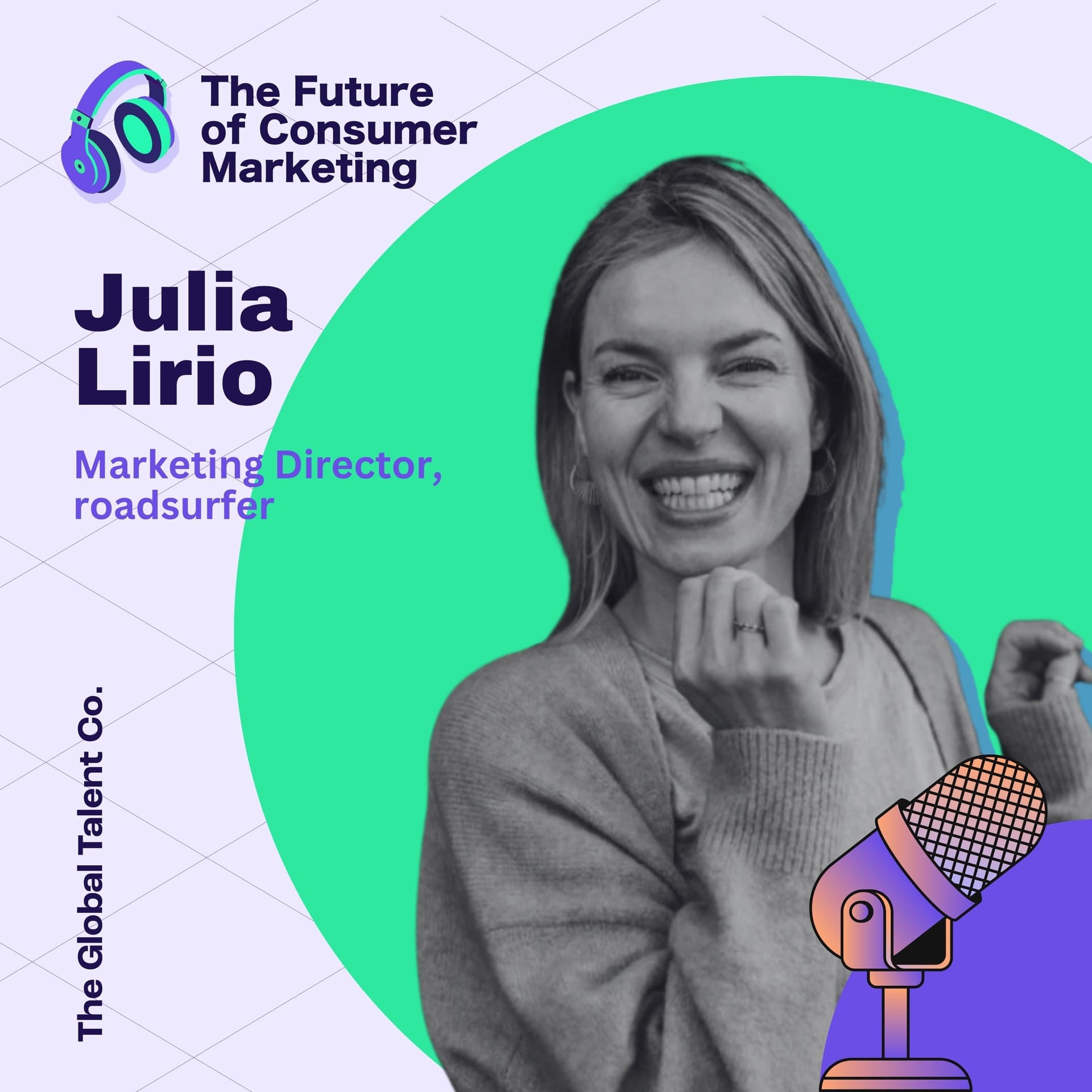
Julia Lirio (Roadsurfer Marketing Director) discusses how Roadsurfer markets a global, asset-heavy “van life/camping” rental business across 14 countries, balancing brand and performance, managing a 35-person marketing team, and preparing for AI-driven search and GEO.
Guest background
Julia Virio/Lirio is Marketing Director at Roadsurfer, a company offering camper van rentals, camping spots, long-term rentals, and van sales. She joined around Roadsurfer’s pre-internationalization growth phase and built channels and team structure.
Key claims
Brand and performance can’t be separated; top-funnel can be tracked. Universal emotions enable one campaign across countries, with localization in messaging/product details. “Less is more” to protect core channels. AI’s biggest bottleneck is resources to implement it properly.
Notable examples
A Father’s Day video campaign (baby crying + emotional father) as a turning point in her career; influencer barter deals (“give you a van, you give content back”); core channels include Meta, Google, and (earlier) MailChimp.
Written by AI. May contain mistakes. Listen to the episode to check what was said.
Chapters
Tap a time to open that second in VOExploring Roadsurfer's Offerings
0:45 to 1:40
Julia discusses what Roadsurfer offers and their mission.
“And in some countries, we also offer long-term rentals and we also sell our vans.”
Camping's Revival Post-COVID
1:40 to 2:46
Discussion on how COVID-19 has changed perceptions of camping.
“And that's also something that we consciously want to do, position camping in a different light, that it's fun, it's young.”
Evolving Camping Preferences
2:46 to 3:24
Julia shares insights on diverse camping options and consumer preferences.
“I mean, you could sleep just on the meadow, but you could sleep in a tent or you can sleep in the camper.”
Consumer Expectations in Camping
3:24 to 4:16
Exploration of how consumer expectations have evolved in the camping sector.
“It depends a little bit also on the countries.”
Global Marketing Challenges
4:16 to 5:11
Julia discusses the challenges of localizing marketing across different countries.
“And that is definitely something that is challenging, especially if you're in a heavy asset business like ours.”
Marketing Channel Evolution
5:11 to 6:40
Julia outlines the marketing channel journey and key learnings over time.
“And would you say you localize specifically for certain markets or certain countries more than others?”
Brand versus Performance Marketing
6:40 to 8:06
Discussion on the integration of brand and performance marketing efforts.
“What are some of the things that worked?”
Successful Campaign Examples
8:14 to 10:41
Julia shares examples of effective campaigns that resonated emotionally with consumers.
“So what I can say, we've always, or the team has always invested a lot in brand, also plays into performance.”
The Power of Emotional Marketing
10:41 to 12:16
Julia reflects on the impact of emotional storytelling in marketing.
“And I worked in an environment which was, you know, the consumer was male, between 40 and 60, very business environment.”
Team Structure and Management
12:16 to 14:00
Discussion on managing an international marketing team and its structure.
“I mean, I was a lot younger just to be courageous enough to do these things.”
Show all 18 chapters
International Marketing Teams Overview
14:00 to 14:39
Learn about the structure and roles of international marketing teams.
“So the growth teams or the international team, they are generalists.”
Evolving Hiring Practices in Marketing
14:40 to 15:34
Discover how hiring needs have changed in the marketing landscape.
“I mean, I think that was also a transformation that we had to go through as a company.”
Challenges and Opportunities with AI in Marketing
15:35 to 16:40
Understand the challenges faced in leveraging AI for marketing.
“There's also a lot of other things happening.”
Building a Think Tank for Marketing Innovation
16:41 to 18:05
Explore the importance of cross-functional collaboration for marketing.
“So I'm focusing right now with my team very much on the low-hanging fruits and they really evolve, as I said, the whole search behavior and how do we optimize the website, the app to make sure that we tap in early.”
Experimenting with AI for Marketing Automation
18:06 to 19:34
Learn about the use of AI for workflow and content automation.
“But now the question is, how do you upskill people?”
Leveraging Influencers and Content Creators
19:35 to 22:03
Discover effective marketing strategies using influencers and creators.
“segment models and TV plot and so forth.”
Navigating New Marketing Channels and Strategies
22:04 to 24:24
Gain insights into marketing channels that are gaining traction.
“which influencer, which kind of content creator works also in social media itself, as in from the engagement, etc.”
Advice for Future Marketing Leaders
24:25 to 24:45
Key advice on focusing on the emotional aspect of marketing.
“It is in itself, trust me, challenging enough.”
Transcript
Automatic transcript. May contain errors.0:00This show is brought to you by the Global Talent Co, a marketing leader's best friend in these times of budget cuts and efficient growth. We help marketing leaders find, hire, vet and manage amazing marketing talent for 50 to 70 percent less than their U.S. and European counterparts. To book a free consultation, visit globaltalent.co. Hi everyone and welcome to a new episode of Future of Consumer Marketing. Today with Julia Virio, who is the Marketing Director at Roadsurfer. Julia, it's great to have you. Thank you so much for having me. Tell us about Roadsurfer. What is Roadsurfer doing? Roadsurfer, I mean, we have been operating for some years now.
0:39We are offering campers for rental. We are offering spots as in places where you can camp overnight. And in some countries, we also offer long-term rentals and we also sell our vans. And our mission really is to enable people to make great outdoor memories, make camping cool. So maybe you've seen our vans driving around many countries now. They're colorful, they're fun, they're hip. So yes. Amazing. And I mean, camping almost had like post-COVID a bit of a revival, right? So I'm super fashionable. So walk us through also your, as a company, your brand position, how you think about how camping now is also perceived differently than maybe five years ago or 10 years ago.
1:25Yeah, I think Corona has definitely fueled that sense or that wish for, you know, camping or being in the outdoors, being far away from people. I think also now being far away sometimes from hectic daily life. So it definitely has broadened in terms of the audience. And that's also something that we consciously want to do, position camping in a different light, that it's fun, it's young. It's not something that only old people do who stay in their camper van or in their trailer with their box of pavioli. That's not what we are and that's not how we position ourselves. So I think generally it's an industry that really has been going through a lot of momentum in the last years.
2:07It's an industry that is still growing and there's still a lot of excitement around it. But yeah, it doesn't really stop that people long for that feeling of the outdoors and being far away from things, whatever that is, right? And so that's really the niche that we are tapping into. Amazing. And I mean, in hotels, for instance, in hospitality, you have so many different segments, right? You have five-star hotels, two-star hotels, family focus, like camping sites. Is that something that you see as well? or is it still one size fits all almost? Because you provide just a camping ground and you go with your camper and that's it.
2:40No, I mean, it's very different types of campers, right? There's also different ways of going camping. I mean, you could sleep just on the meadow, but you could sleep in a tent or you can sleep in the camper. But for us, obviously, we have different types of models, smaller ones, bigger ones, new ones, older ones, etc. I think it's still going to evolve a lot simply because also the market in itself is maturing. Our fleet is maturing, etc. But yeah, what we have seen, we started off with a smaller campus and we very quickly noticed that people also want the bigger ones. So they do want some comfort.
3:15They do want a little bathroom. They do want a little living room and the bedroom upstairs. So yes, definitely our fleet now is 50-50. So we have bigger models and smaller models. It depends a little bit also on the countries. What's the biggest camper I can rent? it's like those typical rvs especially rent with us in the us you will see it's those typical big rvs that you know with the big roof on the top yes and the smallest ones are probably our ports and volkswagen bullies like california okay but now like how many people would i be able to fill into an rv like four for five or six four usually oh okay it depends a bit on the model So there are some that are better for two.
3:58We have a couple that fit maybe a family with three kids. But yeah, four is kind of the norm. Well, what do you feel are kind of some of the biggest changes on the consumer preference, consumer habit side that impacted the business over the past periods? I think, I mean, expectations in any consumer product are always high. So product has to deliver. And that is definitely something that is challenging, especially if you're in a heavy asset business like ours. So I think it's very much matching up brand and consumer expectations and meeting those expectations on the one side, but then also educating on the other side.
4:40So I think especially throughout Corona, there's this dream of what this camp or van life should look like, but it's not always close to the reality, right? You never see the mosquitoes that fly into your van with those Instagram posts. So it's very much matching up an image that has been created with the reality on the ground. Yeah, you're in 14 countries. I'm not sure if that's still correct. How are also expectations different across countries from your point of view? And would you say you localize specifically for certain markets or certain countries more than others? That's a big question that comes.
5:21I mean, there's so many aspects there. So first of all, simply by the size of the company and also my team, etc., we really try to make sure that one fits all. And I'm speaking obviously from my perspective in marketing. So we try to come up with universal emotions, I would call it. So if we have a campaign, it's usually we trigger an emotion and it doesn't matter whether you're Spanish or American. but of course we do have to localize like we do see different expectations from an American customer for example and that's definitely one of our challenges sorry first of all understanding these expectations differences and then also cater to them so again I mean there will be changes or certain changes in itself in the product but also in the way that we talk to them so for example we know it's just an example because there's so many aspects but like in the UK we are a lot more diverse, have a lot more diversity in our influences, etc.
6:17And that's something actually that we didn't have so much in other countries. It's also nice because we learn, we can copy it, you know. So that would be one example. I mean, you've been with the company now for quite some time, right? Walk us a bit through the marketing channel journey that you kind of developed because you probably when you came, it was very different than where it is now. So what are some of the learnings? What are some of the things that worked? What are some of the things that didn't work? Yeah, so I mean, I came at a very exciting time just before we were internationalizing, just before a really big growth spurt, so to speak.
6:52What I found was not very much if we think about, you know, what a marketing team or setup should look like, but that's exactly what I found. Product was selling itself, right? Basically. But I have to say the one thing and the most important thing that was there when I came was a really deep understanding of what the brand should be and what the essence of the brand or the soul of the brand is. So that's easier for me in the beginning because I didn't have to build all that on top. You know, I was really able to focus on building the team, building the channels, using that brand that we had and really translating it into campaigns, etc.
7:29yes and i think that was also my biggest learning or my biggest takeaway is just how important the brand is okay and then in terms of channels walk us a bit through how much you know you did an upper funnel and lower funnel what were kind of some of the channels that work for you now versus you know people years ago i think one thing compared also to the you know previous steps in my career we always had enough courage to also do top funnel and i get to it later what i mean with top funnel because I have a very firm opinion that you can't really separate brand and performance. It's not separable.
8:07And so it's sometimes hard for me to speak about what is top funnel and what is lower because it interweaves so much, at least in my opinion. So what I can say, we've always, or the team has always invested a lot in brand, also plays into performance. So of course, when I first started, it was key for me to set up the performance campaign, set up, you know, like communication, emails, etc. Just making sure that the basic channels are set up. And they were for me, Meta, Google, and at that time, actually MailChimp. That three things are set up quickly. And I mean, this is six or five years ago now, just to make sure that they work.
8:49Obviously, since then, we have evolved a lot more things, more channels came to it. But I would still say that those are the three that really have a core with us. And although we try many different things, these are the ones that I really always say, let's focus, let's make sure that they work and continue to work well and that we optimize the hell out of it. So, yeah. I mean, you started out by saying something very interesting is that you don't really separate between brand and performance. What's your definition then of, you know, Apple funnel brand and what's your definition of product marketing?
9:21And how do you kind of manage awesome budgets? because a lot of times it's different teams. A lot of times it's different teams, right? Yeah. So I think I'm very much led from the creative aspect, right? So there will be messages that are very top of funnel and then there will be messages or creatives that are very down in the funnel. But it's not necessarily that you can divide that by channels, in my opinion. So you could argue, you know, you have a TV and some say it's very top of funnel. TV is top of funnel. Not necessarily. if you play it very performance driven with a very clear call to action to buy now is actually quite at the end of the funnel.
10:00Whereas you could use Meta, Instagram or Facebook for a very inspirational message that is in our case, not even about the camper or anything. It's more about that feeling of going into the outdoors, but you could really optimize it for performance. So I think that's where I sometimes have a hard time separating the two. So if it comes into where do I invest, then I would still always prefer the channels where I can see some sort of traction and some sort of results. But it may be top funnel because I can still track the results later on. Are there specific campaigns that from your point of view stand out or that you have in mind that really made a difference?
10:42Yes. I mean, it's usually, it's actually what I just mention it's the very top of funnel that sometimes really work it's because you capture something in the consumer you capture feeling you have an example of where you kind of really succeeded with that we had several funny campaigns at road surf that you know made people smile that worked i mean like early bird campaigns that were just sweet i think there's one campaign and it's not with road but something that happened early in my career but it still sticks with me so much because it was kind of a turning point for me. And I worked in an environment which was, you know, the consumer was male, between 40 and 60, very business environment.
11:25It was all about jobs. How much could you earn and et cetera. And I came up with this idea, which everyone was laughing at at that time, was like, let's do a Father's Day campaign. And we basically had this video with a baby crying and the father, like, you know, being all emotional, et cetera. and it just absolutely went off. It went off because it just triggered an emotion. People watched it. And I mean, I get goosebumps just talking about that video because it really touched. And that's when I realized it doesn't matter. I don't have to talk about salary, jobs, men or whatever. I just have to talk about the child in this case and the feeling that it works in my consumer or target group, in this case, fathers, right?
12:10Yes, I think that is the example that sticks with me the most because it had such a turning point and encouraged me at that time. I mean, I was a lot younger just to be courageous enough to do these things. Yeah, I mean, that's a common theme of a lot of great marketers that are here is that they think about, you know, especially now with all the doom scrolling that you have on video together, how do you elicit some emotions? How do you make sure that people can stop scrolling and have an intention and you can have, you know, different products to capture? And maybe let's briefly talk a bit more about your team setup.
12:44So how do you manage your team? How do you set up your team? So obviously now we're quite international, operating in many different countries, yet I have my team very much around me. I used to come, or my opinion used to be to always have a centralized team and not have like local reps or marketeers in the local countries. I've kind of changed my mind since Corona because I see that remote working works absolutely fine. So I don't actually have to physically have them with me, although I like that, by the way, but I don't have to. It also works different, but it's more that idea of having one centralized team.
13:21Because, yes, you do need local market knowledge. So I do have my growth team, I call it, and they're country marketing managers that really focus on certain regions. And they bring in the know-how, they know the competitors, they do know the market, etc. But they still sit in my central team, so to speak. The team is built up like two ways. So I always say I have the vertical team and they're like mini agencies, I call them. So I have somebody who's very specialized in performance. I have a team specialized in SEO or now GEO. I have a team specialized in CRM, etc. So they act almost like mini agency to the growth team that I just mentioned.
14:01So the growth teams or the international team, they are generalists. They know a lot, but not everything and not so deep. And they really rely on working with the channel managers, I call them, with those little agencies to really optimize the hell out of their countries in this case. Yes. Okay. Creative team also, that's also a big brand team with obviously the designers, video team, campaigns team. So they are kind of responsible to come up with the great creative ideas. And has your hiring changed now, obviously, with your focus on remote and also with kind of the different requirements? Because, you know, you probably are looking now for different skill sets than five years ago when it comes to marketing.
14:46Absolutely. I mean, I think that was also a transformation that we had to go through as a company. I mean, when I started, it was like, what, 50 people? They were all in Germany and it became apparent very quickly that, A, we have to change our language to English because we cannot find the talent in German necessarily. And also thinking beyond in this case, right? So, yes, we are also in marketing, definitely, especially for the kind of tech roles and marketing performance used to be very difficult to also find. It got a bit better now. But yes, so thinking across borders, across languages. And I mean, my team is truly international.
15:26Some of them work remote. We also have an office in Barcelona now, so it works. Yes. Okay, cool. You know, talking about trends, I mean, obviously AI is all over the place. There's also a lot of other things happening. So are there certain trends that you feel are still underestimated or that you focus on other companies, other marketeers are not focusing on? and more to be honest i mean it's obviously top of my mind it's a big focus at the moment also big project now driven from marketing is really how do we see search evolving and how do we move the focus more to geo compared to ceo that's a big focus right now but there's so many other aspects that we are looking into i think the biggest challenge that i currently face and I'm sure many other people feel the same is we know that there's a lot that we could do and should do with AI.
16:21For example, content creation or localization or whatever it may be. I mean, so many different aspects, but it's actually getting the resources to setting it up properly to be actually able to use it. Building that bridge is the biggest challenge, at least for me. So, you know, you still need tech resources. You still need product resources to implement those. So I'm focusing right now with my team very much on the low-hanging fruits and they really evolve, as I said, the whole search behavior and how do we optimize the website, the app to make sure that we tap in early. Well, it's not even that early.
16:55And then also all around automizing assets and localization quickly so that we can scale. Okay, cool. And in terms of skill sets, are you now hiring for different things with marketers than maybe five years ago? To be honest, I started first looking beyond marketing or beyond my team to see what skill sets we already have in the team. I mean, you know, we're over a thousand employees. There's a lot of SWAT teams in the company. So that was my first initiative now is to have for the marketing topics really a think tank. And it doesn't matter where the person comes from. So it's actually built up with people from marketing, but also tech.
17:35And we work together to really drive it forward. build a roadmap, slice it into steps on what we can do next, think of how do we actually measure it, how do we measure success, et cetera, of the work that we're actually doing in that regard. So I'm not actively hiring right now. I'm literally in the process now of thinking of what do I need for next year, but really using existing brains that we have. That's an interesting question because obviously a lot of organizations have the same situation where they have amazing people that are great for the non-AI world of marketing. But now the question is, how do you upskill people?
18:14How do you have their roles? So are there any initiatives that you do in the marketing team or that you do company-wide? Are there any considerations that you're having there at home? So we do have like two or maybe even more working groups that really focus on specific AI topics at the moment. So the one that I am leading is the whole GEO. And as I said, it's a super colorful group of people. And it's a lot about sharing. So researching, sharing, listening, going out, talking to people, reading blogs, podcasts, et cetera, and bringing that knowledge together. That's where we are right now. I mean, it's early starts, but I already see just by creating that space.
18:54I mean, that's a group that we chat and, you know, post and daily updates that we have, but then we also regularly meet to update each other. I think that was the first big step. The second step is slicing it in small steps because it's just so huge. It's like, where do you start? So really slicing it. OK, these are the three things that we want to tackle and we will tackle, you know, and then going forward. So I feel like that works best for us right now with the resources that we have to really refine it on something that is manageable, achievable, yet ambitious. And for me, important, trackable as in, can we see the results coming in?
19:31And if yes, how? I mean, you talked about obviously the new opportunities around optimization for segment models and TV plot and so forth. The other thing that I've been seeing is people using the genetic AI to do a lot of marketing automation, workflow automation. Is that something that you're experimenting with without the internal upside, be it on the creative processes? So as I mentioned earlier, we are close to implementing something for the creative part, but not so much in actually creating the assets. We are also in a position that we have a lot of wonderful content. I mean, if you look in our Instagram, it's, you know, a million times of what we have in our internal database.
20:17It's not like we are lacking, but what we are lacking is really to multiply it into different languages and being quick in adapting. And especially for performance marketing, which I told you earlier, for me, that brand And it is so important, but we need to be quick. And that's something that we are working on right now because, I mean, localizing manually, creating banners manually, that's just not efficient anymore. So that's a big focus in that regard. The other thing from a marketing side that is also something that we are experimenting with is more the data that we are using. So building, you know, customer segments based on AI, et cetera.
20:58That's, yeah, we're taking first steps there. to use these segments, test these segments, etc. I mean, one thing that we haven't really talked about, but obviously you just mentioned the content that you have and obviously the campers that you have are branded with water. So how do you just leverage the community, but also, you know, the content that they have? How important is that? And are there any loops in terms of networking, actual virality that have worked specifically for you. I mean, you know, I'm grateful we have such a great product because it's very easy to create nice content when you're in the outdoors.
21:40So there's two things that work really well for us and are still working really well for us. And that is really working with influencers, working with content creators. We give you a van, you give us the content back. I mean, it's simple and it works really well. also in terms of, by the way, in terms of performance optimization in that regard. So, you know, we have a much better understanding now knowing which influencer, which kind of content creator works also in social media itself, as in from the engagement, etc. That's one thing I also have in my team photographers, videographers that read and targeted content themselves because they can use the product.
22:21So we hardly use any agencies. I would say 99 % of our content is either produced by barter deals with content creators and influencers or ourselves. And in terms of new channels, what are some of the most exciting new channels that you're looking into? I mean, obviously it's such a big, perfect product for Instagram, but of course, search is a big thing, but those are barely growing in terms of overall traffic. And what are some of the channels that are growing and work for you? I mean, the most exciting one I talked about already, I think it's search or continues to be search But in the other way, it evolves.
22:56I think that is the biggest opportunity that we have and something that I want to focus on. Having the balance of stopping the team and not discouraging them or the other way, encouraging them to focus on the right thing. I'm very convinced that less is more. Yes, we try new things. And yes, we try it on Pinterest or we try it on TikTok now quite a lot. But I always say we should not compromise on really focusing on our core because we know it works. Yes, there's always time and budget reserve to try new things, new channels, but also new targeting, new kind of creative formats, etc. But not at the expense of the core.
23:34So I think because we were growing so fast, we tended often, at least in marketing, oh, let's do this. Like so over optimistic that I just put a lot of value on doing less and doing it. And doing the things, the few things that you do exceedingly well. Yeah. So, you know, the sentence, I think my team can't hear it anymore, but I often simply have the answer, less is more. They ask me. I mean, that's a nice cost to have, right? Better than the opposite, more and more and more. We get enough of that. So by the nature of the business and the fast way we're growing. So it's always a lot. And, you know, it's not that big of a team.
24:18I mean, we are 30, 35 people on the marketing team, but we're managing four different products in many different countries now. It is in itself, trust me, challenging enough. Yeah. Yes. And your last question, if you could give just one piece of advice to a marketing leader, you know, what it takes to be successful when he's younger than you, what would that be? If I look back at my career, etc., if I could turn back time, I would really focus more on the groundwork. And what I mean with that is to really understand the need for the product, but also the need that the customer has. And especially, as I mentioned earlier, what is the emotion that it evokes?
25:01Because it has always been important. Maybe I personally didn't put enough importance on it in my career, but I think it is even more important in the next coming years. is to really touch that emotion. So translating the need into the emotion that is evoked within the person, the consumer, and then really build brand around that. Having a brand that is, you know, clear, has an opinion. I see many startups often doing marketing very quickly and they're not doing a bad job, but the essence is often missing, right? And I think that essence of a brand, what a brand really stands for, that will make the difference.
25:38Because as you said earlier, You overload it anyways. You get so many messages. And even with AI, I mean, I think a lot about that. You know, how much of the creative part can be taken over by AI? Maybe it will one day, but it will be later on. So in the next years, yeah, having that brand essence is absolutely key. Having an opinion, yeah, stirring up emotions that is often disregarded, especially from early stage startups, I think. and sometimes laughed on because you can't really measure anything. And it's kind of this vague emotional thing, but it's important. Such a great advice. Thank you a lot, Julia.
26:19Thank you so much for having me. It was fun. It's been a pleasure.
From the publisher
In this episode of The Future of Consumer Marketing, host Roman Kirsch interviews Julia Lirio, Marketing Director at roadsurfer. roadsurfer is transforming the camping and van life experience across 14 countries by positioning camping as a hip, young lifestyle choice rather than a niche hobby for retirees. Operating in the fast-growing outdoor recreation market, roadsurfer offers camper rentals, camping spots, long-term rentals, and van sales through a brand that makes outdoor adventures accessible and Instagram-worthy. Julia shares how her team navigates the challenge of matching elevated consumer expectations with the reality of van life, while scaling marketing operations across diverse international markets with a centralized approach.
Topics Discussed:- Repositioning camping from niche hobby to mainstream lifestyle brand
- Building marketing operations across 14 international markets
- Balancing brand storytelling with performance marketing measurement
- Managing consumer expectations vs. reality in experience-based products
- Scaling creative content production through influencer partnerships
- Implementing AI for content localization and customer segmentation
- Transitioning from CEO to GEO optimization strategies
- Building centralized marketing teams for international operations