In short
Udemy’s content and consumer marketing playbook, led by a “business leader” CMO/Chief Marketing and Content Officer, covering philosophy, team structure, AI/GEO/AEO, organic vs paid shifts, and the future of consumer marketing.
Guest
Jennifer Murphy, Chief Marketing and Content Officer at Udemy. Background: started as a consultant, became a product manager, then moved into marketing; frames herself as a business leader/product manager first, not a “career marketer.”
Key claims
Value is measured by customer impact; execution beats endless plans; experiences differentiate; transparency fuels trust; “brand vs performance” is a false binary—brand storytelling and demand generation are one system.
Notable examples
Udemy’s UGC ads delivered 5x ROAS vs standard creative; social team grew from 2 to 12 people; localization uses AI + human review; third-party agency brought in for McLaren Racing partnership; GEO includes AI assistants (ChatGPT/Perplexity/Chord), while AI Overviews/AI Mode affects Google results. Future: hyper-personalized, authentic, visual, interactive, social commerce (e.g., TikTok Shop).
Written by AI. May contain mistakes. Listen to the episode to check what was said.
Chapters
Tap a time to open that second in VOPhilosophy of Marketing
0:45 to 2:14
Explore the guest's beliefs about brand, performance, and customer-centric approaches.
“I do actually see it as a blessing, but sometimes it can feel a little bit heavy.”
Role of a CMO and Team Structure
2:15 to 4:14
Understand the responsibilities of a CMO and how their team is structured.
“just vary from organization to organization?”
Working with 85K Instructors
4:15 to 6:37
Insights into managing a large community of creators and the feedback culture.
“What I would say is that my team and my leadership team as well would think that I embody these.”
Marketing Philosophy in Practice
6:38 to 10:55
Delve into the guest's guiding principles for effective marketing.
“And the world of AI, that changes a whole bunch of things.”
Adapting Marketing Strategies
10:56 to 12:38
Learn how the guest has shifted marketing focus and strategies since joining Udemy.
“And so sometimes you can't, you know, you can't stop.”
Leveraging AI in Marketing
12:39 to 14:00
Discuss the role of AI in marketing and its impact on team structure.
“So introducing new product lines and introducing new messaging and packaging with them.”
Shifts in Search Behavior and Marketing Strategies
14:00 to 17:41
Explore the transition from paid to organic search and the impact of AI on user behavior.
“And so for me, that was an area that we really shifted was the shift from pay, dependency on paid to growing the organic and in particular on social.”
Best Practices in Brand vs. Performance Marketing
17:42 to 19:32
Discuss the interconnectedness of brand and performance marketing and best practices.
“I think it's easy to like skip over the basics oftentimes, right?”
The Future of Consumer Marketing
19:33 to 20:23
Insights on hyper-personalization and the evolving landscape of consumer marketing.
“This is the future of consumer marketing.”
The Future of Consumer Marketing
20:24 to 20:46
Insights on hyper-personalization and the evolving landscape of consumer marketing.
“Now, before we wrap, if there's anyone listening that wants to follow along with you, where should we send them?”
Transcript
Automatic transcript. May contain errors.0:00I started as a consultant, I went into being a product manager and then I got into marketing.
0:05Brett Stapper:Are there any best practices that you see people talk about that you don't agree with necessarily? I think brand versus performance as a binary. You're actually like trying to educate CEOs, CFOs. How would your team describe your philosophy? I'm a firm believer that value is measured by customer impact, right? I've got expertise in marketing, but I thrive in the business. Were there any major changes that you made in terms of how the team was structured? Was bringing in third-party agencies. What is the future of consumer marketing? So from your view, where is this headed? It's hyper-personalization.
0:38It's authentic. It's visual. It's interactive. And it's social. I have 85 ,000 people who want to tell me how to do my job and give me an opinion. I do actually see it as a blessing, but sometimes it can feel a little bit heavy.
0:59Brett Stapper:Neva, how are you? Welcome to the show. I'm good. Thank you, Brett. Thanks for having me. Of course. Really excited to have you here, especially given that you work at such an iconic brand. So before we jump into everything you're doing there, can you just tell us a bit more about your background, your journey, and what led you to do? Sure. Definitely. So whenever anyone asks me that question, I always say I'm not a career marketer. And I say that for two reasons. I think first is my path to marketing was through product. I started as a consultant. I went into being a product manager and then I got into marketing.
1:29I also don't necessarily think of myself as a marketer. Yes, marketing is my discipline. It's the skill. It's the craft. But at this point in my career, I've spent most of my time looking at myself as a business leader. I've got expertise in marketing, but I thrive in the business. Plus, I'll be honest, I think marketing can sometimes get a bad rap. And I think to be a good marketer, you're best served by actually operating in a different discipline first. It's going to give you a different perspective and it will build your credibility in a different way. So yes, I'm a chief marketing and content officer right now, but I'm a business leader and I'm a product manager at heart.
2:09Brett Stapper:And obviously you're a CMO today. What does your role entail? I speak with a lot of CMOs and my founders that all of them have some shared responsibilities, but a lot of them have different responsibilities and the role just vary from organization to organization? When I think about my role, I think about it in three parts, method, message, and making it work. Method is how we partner with our sales and technical teams on the B2B side of the house of what's the methodology of go to market. Then on the messaging side, it's all the things you would associate with marketing, brand, positioning, packaging, value prop.
2:42And then making it work is everything we do with demand gen, whether that's working with industry analysts, whether that's working with media, social, lead gen, pipeline builds. And then at Udemy, I have a pretty unique opportunity that I'm not just the CMO, I'm the chief marketing and content officer. So I have the privilege of also inspiring, I hope, a community of 85 ,000 instructors to come and teach on the platform and to keep their content fresh and relevant.
3:10Brett Stapper:Wow. What's that like working with that volume and that stick creators? It's actually, it's really fun. But at the same time, I have 85 ,000 people who want to tell me how to do my job and give me an opinion. And I always say to them, you know, keep the feedback coming, whether it's positive, whether it's areas for improvement. So I do actually see it as a blessing, but sometimes it can feel a little bit heavy. Do you have a favorite course that you recently took or any examples there for us? Yeah, I think the recent courses being, you know, on trend at the moment, a lot of our courses are around vibe coding.
3:48And also as well, I recently took a course by one of our instructors on facilitation of workshops. So making sure that you can keep the team engaged, whether it's five people or whether it's 15 people. So those have been my two most recent courses.
4:04Brett Stapper:Let's zoom out here and talk a little bit about your general marketing philosophy, and then we'll dive into your marketing playbook. what is the philosophy area? A fun way I like to describe this or think about this is how would your team describe your philosophy or the CEO, how would they describe your philosophy if they were telling a friend about it? That's a super interesting one. So I think there are a few principles. What I would say is that my team and my leadership team as well would think that I embody these. So the first one is customer first, ego last. I'm a firm believer that value is measured by customer impact.
4:34Solving the real problems. It's not about HIPPO, the highest paid person's opinion in the room, right? It's not who shouts loudest. It's real problems. So every activity, campaign, experience needs to be centered on how we're bringing value to the customer, bringing value to each other, bringing value to the business. The next one is execution beats endless plans. I love a good plan. Don't get me wrong, but it's a fast paced market and marketing today is changing so much. So you got to go. You got to stay flexible. You got to ship fast, you've got to learn faster. The third one is I'm a big believer in experiences.
5:13My team know that I do sweat the details. If we're having an event, do we have the flowers the right colour that we're going to have on the welcoming reception, as an example? So I'm a big believer in experiences and building connecting journeys. The last two, data and gut over convention. Love data, but sometimes marketers need to rely on their gut instinct. And I think that can be hard when you've got a multi-generational team, because sometimes you've got, you know, I have an expectation that if you say you're a career marketer for 20 years, you just know some things, you don't have to test everything.
5:53If you're early on in your career, then use that data to be able to support your decisions and build up your profile. And then the last one is I'm a big believer that transparency fuels trust, right? So that's within the team, shared accountability outside of the team. I think most people think that they can be a marketer and most people don't actually know the depth of marketing. And so I think it's our job as marketers to educate and inform all of those people that we work and partner with.
6:22Brett Stapper:It's amazing that you're able to articulate that so clearly. Obviously you have thought about these five principles. I have them written down. I have them documented. And it started several years ago, actually. And every now and again, like maybe every six months, I go back to them and I'm like, does this still apply? And I tweak them and change them. And the world of AI, that changes a whole bunch of things. But I look at them and I'm like, actually, you know what? Yeah, these principles are foundational and they still apply. Has there been anything that you heavily removed where you looked at it and said, I don't know if that was a principle of past times, like it's no longer relevant, or has it just been like the small kind of tweaks and updates or evolutions as you've done it?
7:03I think there are definitely things that I would say I'm steadfast in, right? So I'm steadfast in that belief of experience as a differentiator. I think it's less to do with the principles themselves. And I think it's more to do with the operationalization of it. So in recent years, I've become a big fan of a 10x versus 2x mentality. right bigger bolder moves versus incrementality if you would have spoken to me a couple of years ago i probably would have quoted uh 212 the concept of like at 211 degrees what is hot at 212 degrees it boils it produces steam and with steam you can power a locomotive right the idea that one extra degree can really make all the difference i still believe in that but i in today's marketing landscape it's so noisy that sometimes you have to 10x the idea because if If you start at 10x, you're probably going to execute a 5x idea.
7:58But if you started a 2x idea, you're going to end up operating flat.
8:04Brett Stapper:What about the team size? So you mentioned the team there. How big is the team and then roughly how is it structured? Yeah, so my current team is about 140 people. It covers a few different functions. So we have what we call shared functions. And those are functions that support our consumer and our B2B business at Udemy. And they're things like brand and design, product marketing, analyst relations, media relations, and also the content team, right? That's pretty unique for Udemy, our content and instructor team. And then we have a dedicated, within my group, a dedicated B2B team. And they leverage the shared functions, but they also have some unique characteristics.
8:44Things like account-based marketing, field marketing, event management. So that's how the team's structured. We also have regional teams as well. I'm a big believer in localizing things as much as possible. If you're going to show up in Japan as a US company, try and show up as a Japanese company. Think about that in the ads that you put out there, the copy you put out there, the images that you use, the language you use. It's really important. So, yeah, that's a little bit about how the team is structured right now.
9:16Brett Stapper:With AI obviously being a big topic of discussion right now, how is that impacting how you're thinking about growing that team? Right now, I think we're in the try and experiment with everything. So, you know, when I think about, as an example, that the tech stack, the marketing tech stack is currently a little bit crazy, I would say, because we're experimenting, we're looking at how do we use AI in different functions. I think we haven't necessarily paused roles, but we're putting an extra layer of diligence and questioning. So I'll give you an example. Localization is really important for us.
9:54And we use a combination of AI and human. And when the team came to renew that contract, I was very adamant to say, hey, before we do that, I want to see how much of this or how much more can we do with AI? and is it really still necessary for us to continue to invest in the human in the loop it is especially when it comes to language it's very very important that ai technology is great but there are nuances in local language that ai still can't pick up i think it's been less about pausing for us more about just being extra diligent before we do move ahead because we don't want to lose momentum as well i think that's the other thing is we're trying to keep the momentum going Now, in the future, do I envision that I, as a CMO, will be managing humans and agents?
10:44100%. Do I expect my team to be thinking about how they can agentify workflows? 1000%. But, you know, it's also trying to do that as we're keeping the business running too. And so sometimes you can't, you know, you can't stop. You have to sort of keep going with it and do both in parallel.
11:05Brett Stapper:When you joined and took over as CMO, were there any major changes that you made in terms of how the team was structured? And I'll ask that again for the playbook and the actual strategy of some of the changes that were made there. You know, one of the things I remember when I joined Udemy is like, hey, I'm going to bring stability to the team. And it feels like we've actually gone through a lot of changes, but each of them have been for the right reason. I think one of the key things that I did when I joined, which can be a little bit controversial, and I'm sure some of my team are happy about it and some of my team are still unhappy about it, if I'm honest, was bringing in third party agencies.
11:41In particular, we did a partnership with McLaren Racing and we needed to launch that partnership differently. Udemy had never done that before. They'd never done that scale or size of partnership or that type of partnership. So I brought in a third party agency. And the reason for it was not because I didn't trust my team, but because sometimes you need that outside perspective, that extra jolt of energy to show like, hey, here's where the bar could be and we can all get there together. And I think that sometimes is, you know, sometimes people will see that as a negative. I see it as actually having the humility to know that there's always going to be someone out there who can do things better than you, smarter than you, has a more creative idea than you.
12:26So that was one of the things was a bit more of a focus on brand. Definitely a restructure in terms of how we approach our instructor community, getting more one-on-one and closer with them as well. I'm thinking about how we shift this perception of Udemy from not just online courses, but to learning experiences. So introducing new product lines and introducing new messaging and packaging with them.
12:52Brett Stapper:And anything else specifically on like the playbook side or any big changes on how you've been focused on growing the business? Yeah. So I think the big thing is, and this sounds odd, but I would say there was a lot of focus when I came in on paid channels, right? Especially for our consumer business. And so I put a lot of time and effort into the organic side of the house, in particular with social. So I'm a big believer in social and influencer. And we saw actually when we ran, when we started doing this last year, again, this was new for Udemy. It wasn't new for me. But when we started running UGC, so user generated content ads, the ROAS on them, the return on investment was five times more than the standard creative.
13:38And, you know, the social team when I joined was two people. The social team is now 12 people. Wow. Right. And the reason for that is because with all the changes then have since happened with things like AI mode and AEO and GEO, SEO, all these different pieces, the organic channels are just critically more important. And so for me, that was an area that we really shifted was the shift from pay, dependency on paid to growing the organic and in particular on social.
14:09Brett Stapper:on the search side, you mentioned GEO, AEO. Are they the same thing? Are those different things? That's one clarification that I would have. I see those terms thrown around a lot. Yeah. So I think with the GEO, I think that it's where you're looking at different pieces. So one is being able to like show up in the chat GPTs, the perplexities, the chords of the world. The other one is like just thinking about AI mode with Google, right? So you're going to Google to do your search but now you've got the ai mode which takes up half of the page for most searches um so it's about hitting both of those so the new inputs i would say the new places that people are going to search and then it's hard to call google the old school given how much they still have volume on search they're still the dominant player um but yeah impacting the ai mode with google in particular that seemed very overhyped when everyone was saying like that's the end of google as if they weren't going to evolve and adapt like this nasa company was going to just you know call it quits oh yeah i i literally i i had spent um i went and did a three-hour meeting with the google team and i was like listen don't get me wrong our strategy has to change but you are 100 i mean as a marketer as an advertiser of course google is still going to be in your strategy i mean look at their search volume.
15:30Their search volume outranks any of the AI engines by far. But the reality is, I think about me as a user, where do I go today? Sometimes chat GPT is my first port of call. It's not Google anymore. You got to build a plan for both.
15:47Brett Stapper:Which is such an interesting shift. I think in my brain, which I guess I hadn't spent a lot of time thinking about it, but I just assumed that Google was going to always just be the default for life. My daughter is going to grow old and like still be using Google. But it is interesting how like there's an alternative now. I had something similar, you know, different industry, obviously, but like with Waymo here in San Francisco, like my default mode of transportation now. It's like, I don't think about taking an Uber. I first do a Waymo and then, you know, if you have to go to the airport, you can't use Waymo.
16:13Brett Stapper:But like the default is Waymo, which is, that's crazy to me as well. I mean, I look at, but you say, okay, you know, when people think, oh, Google are going to go away. I mean, Google do have a diversified strategy. My kids, they do everything on YouTube. YouTube Thoughts is their, you know, their ultimate. They just search everything on YouTube. Who owns YouTube? Google, right? So yeah, I think the default might change in people's mind as we, you know, continue with the multi-generational workforce, but they're always going to be at presence. Yeah, I don't think it's going anywhere. What percentage of search traffic would you say comes from LLMs versus Google search?
16:53Brett Stapper:Like just roughly, I'm sure you don't know that off-putter. Yeah. And right now for us, I would probably still say it's 60-40. So 60 % Google, right? 40 % across the different LLMs. I think that is growing every single week, every single month, every single quarter. And also as well, I think the important thing for marketers is to look at, you know, where those engines are getting their data from, right? So things like Reddit, things like G2, you know, Wikipedia, you know, that's always an interesting one. I said to my team, like the other day, I went on our Wikipedia page. I'm like, guys, we've got to update the Wikipedia page.
17:30Like, okay, come on, people. You know, but sometimes, you know, you think it is a marketer, all of these sophisticated things. And sometimes it's the core basics that you also need to get right.
17:41Brett Stapper:Yeah, makes a lot of sense. I think it's easy to like skip over the basics oftentimes, right? Yes, for sure. Now, we're going to end with one final question. I'm seeing that we're almost up on time. So let's talk about hot takes as it relates to best practices. Are there any best practices that you see people talk about that you don't agree with necessarily? I think brand versus performance as a binary. I think in the marketing community, it's well understood. I think the challenge comes when you're actually like trying to educate CEOs, CFOs, you know, CROs. So brand versus performance as a binary, yet brand, product storytelling and demand, they're ultimately one interconnected system.
18:23So Preston Rutherford, who's the co-founder of Chubbies, I think has got some great perspectives on this. He does this awesome series on LinkedIn where he has these conversations between a CMO and a CFO. And there are so many times where I have seen it on Twitter or LinkedIn or wherever it is, and I've sent it to my team and I'm like, OMG, he is listening to our conversations. I still see leaders thinking that you can win the game with one or the other. You can't. They fuel each other. and if you have to pick one to specialize in from a career point of view I think it goes back to thinking about organic right so brand and now the metrics that you can use to look at things like brand uplift and first day user list and all of these different types of things have really come a long way so for me that's one that I always get very knocked at is the oh it's brand versus performance.
19:16And no, it's a blend. It's one ecosystem. And you will feel the pain. If you only invest in one or the other, you might not feel the pain immediately. But if you're looking at this as a one year or two or three year plan, you will feel the pain.
19:32Brett Stapper:And final question. This is the future of consumer marketing. So I, of course, have to ask you, what is the future of consumer marketing? So from your view, where is this headed? But we're going to put you up the spot. What's your prediction? Oh, the future of consumer marketing. I mean, listen, it's Overhyped, I'm going to use the most cheesy words, but it's so true. It's hyper-personalization. It's authentic. It's visual. It's interactive. And it's social. Especially if you're in packaged goods, you're in physical, then things like TikTok shop, I think, just going to continue because that blends all of those pieces together.
20:09It's social. It's media. It's authentic. It's a human being. and it can be optimized, you know, through the roof with AI and algorithms and be hyper personalized. So, yeah, that's what I would say.
20:22Brett Stapper:Amazing. That's a great way to end things. Now, before we wrap, if there's anyone listening that wants to follow along with you, where should we send them? Where should they go? Yeah, so you can follow along with me on LinkedIn. So it's just LinkedIn slash Jennifer Murphy and it's G-E-N-F-A-A for Apple, I always say, because everyone always thinks with my accent that I'm saying I for igloo, but it's A for Apple. So follow along and obviously go and check out udemy.com for the latest courses and skills to help you boost your career. Amazing. Well, thank you for taking the time to chat. As I mentioned at the start, it's always fun speaking with a marketer from an iconic brand and definitely you guys have an iconic brand.
21:01Brett Stapper:So really appreciate you taking the time. Thanks, Brett. Thanks for having me.
From the publisher
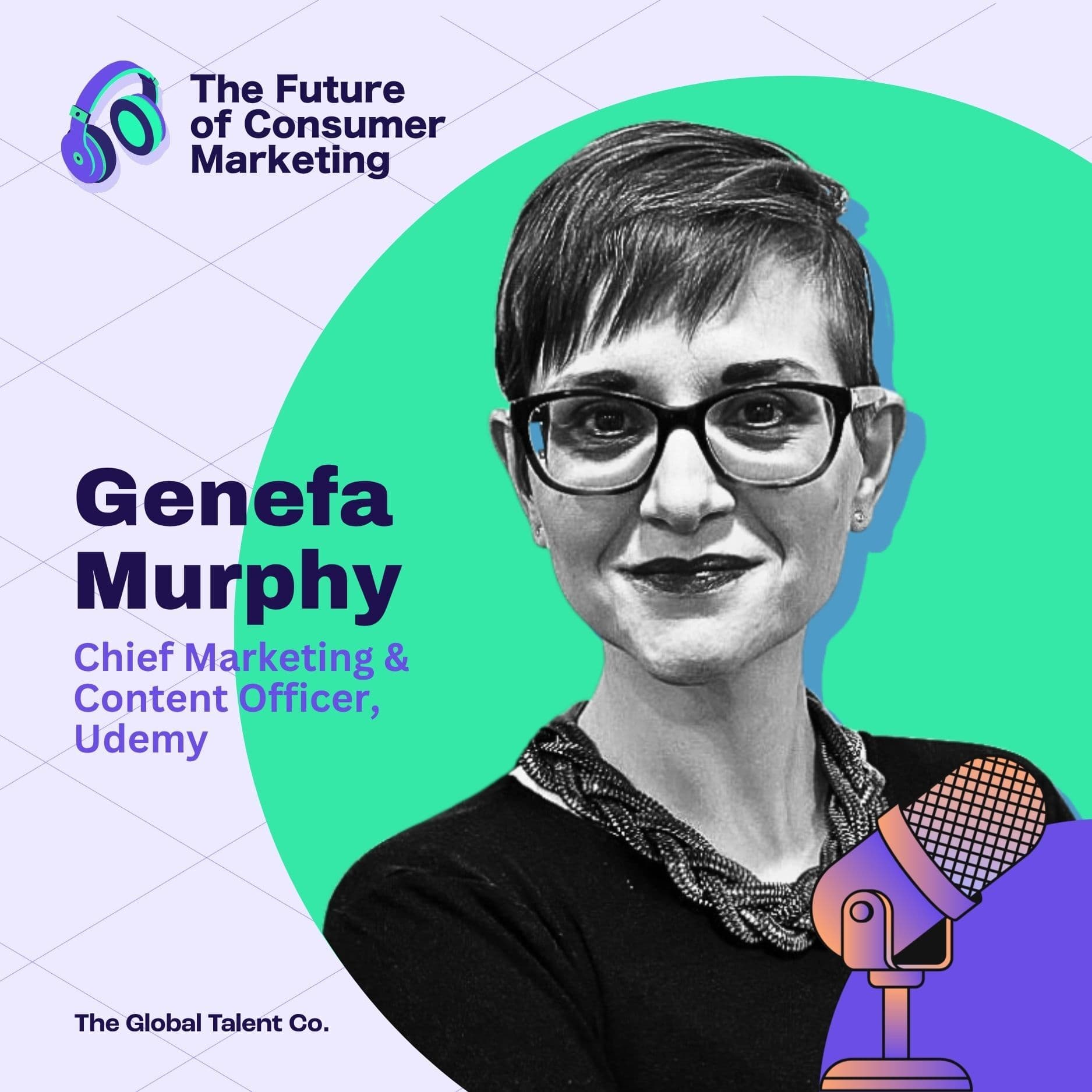
In this episode of The Future of Marketing, host Brett Stapper interviews Genefa Murphy, Chief Marketing & Content Officer at Udemy. Murphy leads a 140-person team managing both B2B and consumer marketing while overseeing a community of 85,000 instructors who create content for the platform. She shares how Udemy is navigating the shift from paid channel dependency to organic growth, adapting to the AI-driven search landscape, and building authentic experiences in an increasingly noisy market. With a background in product management before moving into marketing leadership, Murphy brings a business-first perspective to marketing strategy, emphasizing execution speed, customer impact, and the critical balance between brand and performance marketing.
Topics Discussed:- Transitioning from paid marketing dependency to organic channel dominance
- Navigating the shift from traditional SEO to GEO (Generative Engine Optimization) and AI-powered search
- Building and managing a global marketing team of 140 across B2B and consumer functions
- Leveraging third-party agencies strategically to elevate internal team capabilities
- Managing a creator community of 85,000 instructors as a marketing asset
- Structuring marketing around method, message, and execution
- Implementing hyper-localized marketing strategies across global markets
- Balancing AI adoption with human expertise in marketing operations