
In short
Podcast Summary: Future of Consumer Marketing - Episode: Marketing AAA Games: Why Positioning Beats Advertising
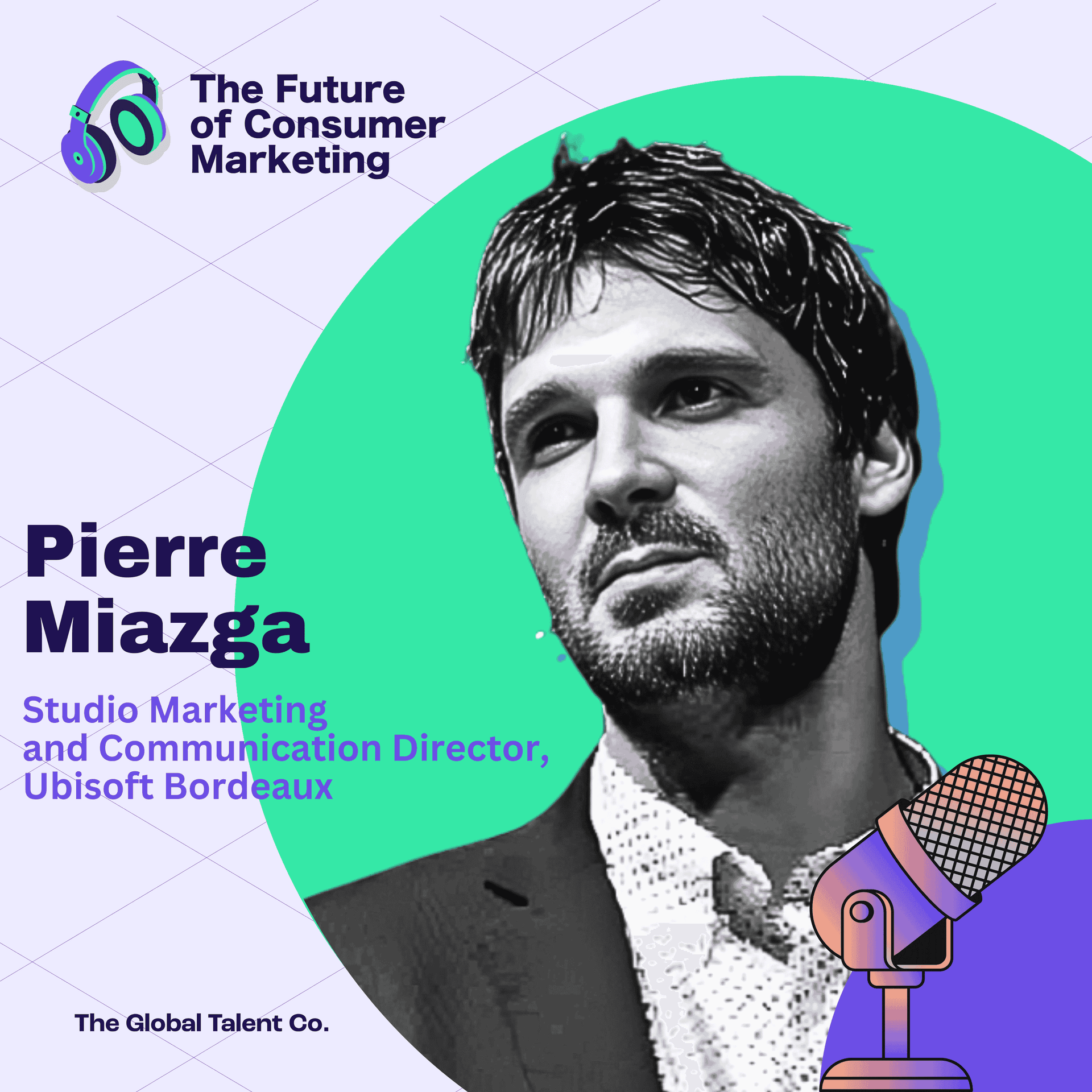
Overview In this episode of "Future of Consumer Marketing," host Andres Figueira interviews Pierre Miazga, the Studio Marketing and Communications Director at Ubisoft Bordeaux. The discussion revolves around the evolution of marketing for AAA games, focusing on how it has transitioned from traditional advertising to a more integrated approach within the game's development.
Key Themes
- Embedded Marketing
- Transition from traditional marketing campaigns to embedded marketing in game development.
- Marketers act as "enablers" who assist creative teams throughout the game development process.
- Player-Centric Development
- Emphasis on building games "from fans to fans" by involving players directly in the development.
- Marketing aims to balance player expectations with creative risks.
- Market Saturation
- Navigating an oversaturated market with approximately 20,000 games released annually on platforms like Steam.
- Competing for players’ time, not just against other games, but against various forms of entertainment (e.g., social media, streaming services).
- Collaboration and Creativity
- Importance of cross-functional collaboration between marketing, creative, artistic, and technical teams.
- Managing tone consistency and audience expectations across multi-year development cycles.
Key Takeaways
Evolution of Marketing Strategies
- Embedded Marketing vs. Traditional Advertising
- Marketing now starts at the concept phase instead of just before launch.
- Focus on positioning and understanding player needs rather than solely promoting the game.
The Role of Market Research
- Use of market surveys and player engagement to ensure the game meets audience expectations.
- Hosting sessions where players test games before release to gather feedback.
Future of Gaming
- The game market's maturity allows for niche games to thrive.
- Players are more informed and know exactly what they want, creating opportunities for diverse and innovative games.
Development Timelines
- Typical game development cycles range from 3-4 years.
- Early involvement of marketers helps align the game with player expectations.
Discussion Highlights
- Marketing as an Enabler: Pierre emphasizes that their role is to clarify audience expectations and help creative teams navigate the complexities of game development.
- Legacy Titles: The marketing approach for titles like Assassin's Creed Mirage focused on returning to the series' roots while creating a game specifically for existing fans.
- Saturation and Competition: With 52 games released daily, the competition extends beyond gaming to all forms of entertainment. Marketers must find ways to capture players' attention amid this noise.
- Balancing Expectations with Creativity: The challenge lies in meeting players' demands while also incorporating surprising and innovative elements into games.
Conclusion The episode wraps up with Pierre discussing the future of game marketing, stressing the importance of authenticity and the potential for smaller, niche games to achieve significant success. The conversation highlights the evolving landscape of consumer marketing in the gaming industry, where player engagement and innovative marketing strategies are key to standing out.
Call to Action Listeners are encouraged to explore careers in game testing at Ubisoft and check out Assassin's Creed Mirage, which is currently available on subscription platforms like PS Plus and Xbox Game Pass.
Written by AI. May contain mistakes. Listen to the episode to check what was said.
Chapters
Tap a time to open that second in VOIntroduction to Ubisoft Marketing
0:00 to 0:45
Learn about the role of a marketing director in a video game studio.
“I'm the marketing director of Ubisoft Bordeaux.”
Pierre's Background and Role
2:00 to 3:21
Explore Pierre's journey in marketing and his key responsibilities at Ubisoft.
“We're super excited to be able to talk to a studio that has worked with games that are as notable as Assassin's Creed.”
The Legacy of Assassin's Creed
3:21 to 4:49
Understand how Assassin's Creed Mirage was designed for its 15th anniversary.
“Because, you know, creating a video game is incredibly project.”
Listening to Gamers
4:49 to 5:34
Learn about the importance of player feedback in game development and marketing.
“And the objective of the project was really to be positioned as a legacy title.”
The Balance of Expectations and Surprise
5:34 to 7:20
Discover how Ubisoft manages player expectations while delivering surprises.
“So it was important for us to really listen to the players and talk from players to players to feel very authentic in the project we were releasing.”
Timeframe of Game Development
7:20 to 9:21
Gain insights on the development timeline and marketing strategy of video games.
“I would say that a video game is usually between three to four years to be built, but you see other games inside and outside Ubisoft taking less time and even more time to build.”
The Competitive Video Game Market
9:21 to 11:09
Examine the growth of the gaming industry and the competition for players' time.
“It's an internal document that helps us know what we're crafting.”
Engaging Gamers through Testing
11:09 to 14:02
Learn how Ubisoft tests games with real players to ensure quality and engagement.
“You're talking to all age and demographics, to all kinds of games.”
The Relationship Between Game Creators and Gamers
14:02 to 14:20
Understanding the symbiotic relationship between game developers and players.
“that's what enables us to always know we go in the right direction.”
Pierre's Journey into Game Marketing
14:20 to 15:30
Learn about Pierre's path from intern to marketing director at Ubisoft Bordeaux.
“I was looking anywhere that somebody would allow me to play games that haven't come out.”
Show all 21 chapters
Transition from Publishing to Development Marketing
15:30 to 17:00
Exploration of the shift in marketing focus from finished games to early development stages.
“So I forced myself to take a second internship into consumer goods.”
The Importance of Early Marketing in Game Development
17:00 to 19:44
Discover the role of marketing during the game's development phase and its impact on success.
“And what have you noticed or could you be able to provide some insight in the differences between marketing a game that's almost ready to be published and one that is more in the development strategy?”
Building a Diverse Marketing Team
19:44 to 21:56
Insights into the composition and collaboration of Pierre's marketing team at Ubisoft.
“I will go back to my 20 ,000 games released every year.”
Studio Size and Future Growth Prospects
21:56 to 23:08
Discussion on the current size of Ubisoft Bordeaux and its plans for future growth.
“And Ubisoft, Berdo, if I'm not mistaken, you mentioned that the studio is about 400 people big, right?”
Managing Multiple Game Projects Simultaneously
23:08 to 24:44
Exploration of how Ubisoft Bordeaux balances multiple game developments at once.
“of course of course no I totally get that I totally get that and Pierre does Ubisoft Bordeaux So do you guys work on a certain amount of games at the same time?”
The Impact of Video Games on Skill Development
24:44 to 26:15
Understanding how video games foster soft skills and global connections among players.
“or thrown out in a conversation like that, you've got to stop, play pause and say, what did you say?”
The Evolving Landscape of Game Marketing
26:15 to 28:01
Pierre discusses the future of game marketing as technology and player expectations evolve.
“due to the online functionalities that games now offer.”
The Evolution of Player Engagement in Gaming
28:01 to 29:19
Discover how player expectations and game design have evolved.
“Recently, we've announced that Rainbow Six Siege gathered more than 100 million players over all its existence.”
The Role of Authenticity in Marketing Games
29:20 to 30:34
Learn about the importance of authenticity in game marketing strategies.
“It was designed for the fans of Assassin's Creed.”
How Gamers Can Get Involved with Ubisoft
30:35 to 32:01
Find out how gamers can participate in testing and shaping new games.
“Thank you so much for that insight, man.”
Closing Thoughts and Gratitude
32:02 to 33:14
Reflect on insights shared during the podcast and express appreciation.
“please register to that and work, of course, in secrecy with us, but that's possible.”
Transcript
Automatic transcript. May contain errors.0:00Pierre Miazga:I'm the marketing director of Ubisoft Bordeaux.
0:02Andres Figueira:So that is a video game studio of 400 people. I like to call me not a seller, but an enabler. If it doesn't go in the direction that players would like or that they were imagining, sometimes it might not meet their expectations. So I feel it's a high pressure environment. It's a balance.
0:17Pierre Miazga:Selling a video game is not just about building storytelling around the marketing campaign to the consumer. It's about selling a storyline. It's about selling already a project that has a story, emotional depth.
0:28Andres Figueira:How are you guys able to cut through all the static of so many games being available to players? Do you have any actual way that you know that makes players choose you guys over other games each time?
0:40Pierre Miazga:I would say it's even more complex than that because we are not only competing against other games. We are competing for players' time. But I would go back to my initial statement. You want to give players what they want, what they are looking for, but you also want to surprise them.
0:59Andres Figueira:Hey, everybody. Thank you for tuning in. My name is Andres Figueira, and I'm going to be your host for the day. This show is brought to you by the Global Talent Company, helping fast-growing teams hire exceptional remote talent from Argentina, South Africa, and beyond. We connect companies with world-class professionals who bring skill, reliability, and a global perspective to every role. And just for our listeners, we're offering an exclusive 10 % discount on your first hire. All you need to do is visit GlobalTalent.co, click Start Hiring, and mention the podcast listener discount when we reach out.
1:31Andres Figueira:And today, with me here is Pierre Miasga, Studio Marketing and Communications Director at Ubisoft Bordeaux, a studio that was inaugurated by Ubisoft veterans that is and has worked on some of Ubisoft's biggest AAA games, such as Assassin's Creed Mirage, which was initiated and directed by the Bordeaux Studios creative and production team, as well as co-developing on Beyond Good and Evil 2. And with that said, Pierre, welcome to the show. It's a pleasure to have you here, man. Thanks for having me, Andres. Very nice to meet you. No problem at all, man. We're super excited to be able to talk to a studio that has worked with games that are as notable as Assassin's Creed.
2:13Andres Figueira:Because I'm going to be really honest, I have played Assassin's Creed a lot and I love it. This hits home as well. But Pierre, just in order to get the audience a bit more in context here, would you be able to provide us a bit more about your background, your experience, and how you ended up at Ubisoft Bordeaux?
2:31Pierre Miazga:So yeah, as you said, I'm the marketing director of Ubisoft Bordeaux. So that is a video game studio of 400 people that is recently known for Assassin's Creed Mirage. And my job is essentially, I'm talking to creative people and engineers and tech people. I'm very much inside the development team. And my job is to assist them. I like to call me not a seller, but an enabler. As soon as the concept phase of the game is kicked off, I know that the idea of marketing being involved early in development, it can feel like it risks turning games into products designed by spreadsheet. But that's not my job.
3:11Pierre Miazga:What I like to say is that bad marketing in development tells the team what to build. But good marketing helps the team understand for whom they are building. And that is the key thing that I try to do is clarify the audience expectation, protect the tone, consistency and help the team survive complexity. Because, you know, creating a video game is incredibly project. You start, you have just a few people talking behind themselves and great ideas are fragile. So you want to be helpful. You want to be listening to the creative people and help them feed them with players' expectations in order for the great ideas to survive the complexity of a video game development that can last for four years, four years of uncertainty, four years of discussion.
4:03Andres Figueira:I can only imagine. And furthermore, with legacy games such as Assassin's Creed, I believe it also it's intense because Assassin's Creed has gone all around. I believe I've played from pirates to being in what's it called, like in Baghdad, in Mirage as well. And like it goes all over the world. So I imagine there must be a certain consistency in the tone and the branding of the game that sometimes creative people need to take into account. because if not, I feel Assassin's Creed will go to space or something like that.
4:38Pierre Miazga:Exactly. And actually, it's funny that you mentioned that because Assassin's Creed Mirage was designed as the game for the 15th anniversary of the Assassin's Creed brand. So the brand was 15 years old when we released the game. And the objective of the project was really to be positioned as a legacy title. The game for the fans, the game that was going back to the roots on the initial pillars of the project. So it was also a brand project going back to what was initially Assassin's Creed before all these games, all these time periods. So the marketing tactics were very specific to that objective, talking to fans and really designing the game for them by listening to them.
5:27Pierre Miazga:So it was kind of a game made from fans to fans because very much like you, I play a lot. I think what's behind me here for those who listen to us in videos, I have a lot of Pokemon and everything behind me. So I'm a huge player as well. So it was important for us to really listen to the players and talk from players to players to feel very authentic in the project we were releasing.
5:51Andres Figueira:Now, I understand. I understand. And that is something that I believe is very important because I know the gaming industry and gamers per se are very sensitive and they hold dear to their heart those games that they love. And Assassin's Creed having been in the market for so long, I imagine it's very important to get things right. Just in the fact that if it doesn't go in the direction that players would like or that they were imagining, sometimes it might not meet their expectations. So I feel it's a very high-pressure environment, if I'm not mistaken. It's a balance.
6:25Pierre Miazga:Selling a video game is not just about building storytelling around the marketing campaign to the consumer. It's about selling a storyline. It's about selling already a project that has a story, emotional depth. What I would say is the first thing is listening. Listening to what players want. And we have a lot of tools. We have a lot of methods. And we'll be able to talk about that. to really nail down what's expected and be very careful of the eco-chamber. You're a player, you sauce. You don't want to only hear about you. You really want to cross this with a lot of players and understand what they want.
7:03Pierre Miazga:That is kind of the easy part. Understanding. The hardest part is surprising people. Because when you play a video game, you want to get what you're looking for, but you also want to be emotionally gripped and surprised. So that is the daily job that we had, walking the fine line behind being where you want to be and how you surprise people and create emotion.
7:31Andres Figueira:now i hadn't thought about it in that way but it's so true like i i'm also an avid pokemon fan and i always know what i want from a pokemon game but i want to be surprised as well it's like i don't want to just fight and catch them because that's why i'm buying it for but also please surprise me with a new story or something that i didn't expect to happen because that's just what adds a little bit more value so i totally um vibe with you there man and pierre if i may in terms of when you guys create and know that you want to develop a game, how much time passes since the conception of the idea until you actually know what needs to be marketed and how you want to market it to the gamers?
8:10Pierre Miazga:It really depends. There is no rules here. I would say that a video game is usually between three to four years to be built, but you see other games inside and outside Ubisoft taking less time and even more time to build. It really depends whether or not you are creating a game inside a franchise that has already some safe line, clear ideas of the gameplay experience, of what you want to create, or if you really want to create something new, something fresh. and something new and something fresh means test, fail, retry, correct. That takes time. And sometimes you start a game and during one year, one year and a half, you're only 10 people trying stuff, prototyping stuff.
8:59Pierre Miazga:And then you actually kickstart the development of the game. Usually what I like to say is differentiating positioning from advertising. Marketing is already there from the start in working positioning with the developers in making sure we understand what we want to do, what's the game, and what kind of player needs it will satisfy. That is very much positioning. It's an internal document that helps us know what we're crafting. It's in between development and marketing. And advertising comes at the latest stage, usually approximately a year before the game is being out. Some games have tactics of longer marketing campaigns.
9:40Pierre Miazga:some other game that's what we call a shadow drop they want to catch everyone by surprise boom the game is available now that's another marketing tactic so what i would say is that it really really depends because what we you need to understand is video game is not only the first industry global entertainment industry in the world it's more than 200 billion dollars yearly video game as a whole but this also became incredibly competitive uh would you be able to guess how many games were released on steam in 2015 on steam in 2015 oh my goodness i don't know
10:24Andres Figueira:but i would i would imagine it's about in the five no in 2015 i think it was a while back so i'd say like what a thousand games a thousand five hundred something like that it was already two thousand
10:36Pierre Miazga:eight hundred oh my goodness second part of the quiz and i'll be dumb what about last year 2025
10:44Andres Figueira:10 years later so 2015 2800 to 2025 oh my god the exponential growth of video games in 10 years was crazy. So I take it to maybe 10 ,000 games or something like that?
11:01Pierre Miazga:It was 20 ,000. That means 52 games being released every day. What I'd say in that is you have everything in video games. It's a mature market. You're talking to all age and demographics, to all kinds of games. So development really depends on the game you're creating and the length and the production. ambition that you have so you pretty much have everything uh on the market today and that's what
11:30Andres Figueira:makes it incredibly exciting wow and like pierre how are you guys able to cut through all the static of so many games being available to players like do you have any any actual way that you know that makes players choose you guys over other games each time because i do understand that you You make really good games. Like Assassin's Creed is a AAA game. And it's the fact that how are you able to make sure these gamers stay focused on you guys rather than other parts of the market?
12:01Pierre Miazga:I would say it's even more complex than that because we are not only competing against other games. We're competing for players' time. We're competing against TikTok. We're competing against Spotify. In a way, not directly. I mean, we just, players only have one key budget, is they have 24 hours a day and they work and sometimes they sleep. So you're fighting for players' time. You're fighting for time of people. And if I had the magical formula on how to grasp players' attention automatically, God, I would be rich. so I can't answer for certainty what I can tell you is we have teams inside Ubisoft that are tasked to survey the markets to extract data we all are gamers so we all spend time on gaming platforms on Steam reading players reviews on other games reading comments on YouTube and we forge ourselves an opinion on what's the expectation but I would go back to my initial statement is you want to give players what they want, what they are looking for, but you also want to surprise them.
13:20Pierre Miazga:That's why I'm working in video games. That's this small risk that you take in creating something different, something that falls into expectation, a trend, a video game trend, or a kind of fantasy, sci-fi, heroic fantasy. You know these things are carried by the market or not but when it comes about the experience itself the feature you want to develop you gotta take some risks you gotta take some risks to surprise people and to forge ourselves some certainties we go as far as to invite ex-normal players to our studio before the game is being revealed we just have an undisclosure agreement but we have them play we have them share their point of view and reveal that with them video games are so much often that we think built with players that's that's what enables us to always know we go in the right direction.
14:14Andres Figueira:Of course, it's like a mutualistic relationship. You create the game, but you need the gamers to love it. And that's why you, well, I remember when I was smaller, that was a job I would have died for. It was just video game tester. I was looking anywhere that somebody would allow me to play games that haven't come out. If it would have been Pokemon, it would have been even better. But yeah, I know that is something that is so cool. and Pierre would you be able to also tell us a bit more than how you got to Ubisoft Bordeaux and a bit more about your background yeah yeah for sure for sure well fiction and video game
14:46Pierre Miazga:have always been part of me Pokemon I think helped me to build myself as a child file of fantasy build myself as a teenager and today games like Persona The Witcher Assassin's Creed Breath of the Wild they build me as an adult and as a father so video game has always been a certainty for me
15:05Andres Figueira:I started as an intern at Ubisoft a long time ago.
15:11Pierre Miazga:And I was on licensing product. It means expanding the franchise to consumer products, apparel, toys, etc. I loved it very much. I wasn't in games exactly. I was more into diversification. And I told myself, you got to be sure you want to work in that industry. So I forced myself to take a second internship into consumer goods. and I learned something very important. Consumer goods was not for me. I needed to go back to marketing. And you know, there's this legend that says good marketers can sell you anything. Well, I think it needs some debunking, right? I'm convinced that marketing shines when it truly respects and understands what it's selling, especially in entertainment.
15:56Pierre Miazga:But that was just a random thought. it was a stretch to go back to video game and I remember I was still like a very young adult I on purpose failed to submit one of my graduation school tests to fail and to still be able to do one last internship and this internship I took was on Far Cry 3 it was in 2012 and I got lucky because a job opened right after this intention and I got hired. And there I was in Paris and I was working in publishing. Publishing is really your go-to-market tactics. It can be opposed to development in a studio, what I do today. Previously, I was more in the HQ of Ubisoft and we were granted with the responsibility of a game that was almost finished.
16:53Pierre Miazga:and our task was what campaign do we build for that game to shine who do we talk to on which channels uh what's the length of the campaign etc so i started working on watchdogs then i moved to other games like the division ghost week on wildlands i don't know if it rings a bell to non-players assassin's creed and other other titles both speaking to gamers but also speaking families and I inclined the ladder from an intern to a marketing director and three years ago I told myself I want to talk to these people that build the game, I want to talk to the narrative people, I want to talk to the artists and I want to work with them and that's where I decided to move from Paris to Bordeaux and join this development studio working on Assassin's Golden Mirage so my journey brought me from publishing and go to markets to development marketing much much much earlier in the development phase involving the actual creation of the game so i i got to see the entire um marketing uh factory line if you want to say in video games and that that's that's that's quite exciting yeah wow that is so cool man so
18:10Andres Figueira:you've been since the fact of advertising and and creating that go-to-market strategy when the game is ready to be published and then you went more into the early stages of development then. And what have you noticed or could you be able to provide some insight in the differences between marketing a game that's almost ready to be published and one that is more in the development strategy?
18:30Pierre Miazga:Well, both profiles work in hand at Ubisoft. It's a mutual benefit relationship. You need marketers early in development of the game to ensure that the audience has been thoughtful when developing the game. to ensure that it syncs the ambition of a company. Let's say, for instance, a game has been worked on, is almost finished, but hasn't been connected to specific player needs or audience. You're taking an incredible risk because you have the risk for your game to simply not talk to anyone. And that is the main difference because it's more designing and promoting. They work hand in hand. that remains marketing but there is a part that is more in development in making sure that what you do has potential and the other is making sure that that potential is revealed to players but you can't do a great marketing campaign on a game that has been poorly designed when it comes to audience because you won't talk to the players and you can release a great game without a well thought through marketing campaign, it can fail to find its audience.
19:46Pierre Miazga:I will go back to my 20 ,000 games released every year. You need your game to be exceptional. You need your game to be well designed when it comes to audience needs and you need your game to be well promoted. So it reaches out the awareness of that specific audience, which is why both of these marketing collaborate in creating games and releasing them, if that makes sense.
20:10Andres Figueira:It totally does. And Pierre, also in terms of like everything you're doing, do you have a team that is backing you up with all this creative and like strategizing of how the marketing should go at the early development of the team? Like how many people do you have helping you out?
20:28Pierre Miazga:Yeah, I'm lucky to have very talented people working with me in addition to the developers and the other job titles that are collaborating with me on a daily basis. But when I was in Paris on GoToMarket, I had between five to six brand managers working with me, essentially very focused on brand and product marketing.
20:50Andres Figueira:And today I have a team that is more diverse.
20:54Pierre Miazga:I have marketing people but also artists working in my team artists, video artists and what we call static artists it means people that are building images of your game so it's a different kind of relationship and that was what I was looking for actually having an expertise that is shared with other profiles, artistic profiles tech profiles rather than talking to players that have the same background as myself because when I was in the publishing HQ, I was working with people coming like me from business college or business schools. And today it's a joint collaboration between data people, tech people, artistic people.
Read the full transcript
21:39Pierre Miazga:So essentially it depends on the stage of development of the game I'm working on, but it's between 10 to three people and a mix between pure marketing skills and artistic ones.
21:56Andres Figueira:Wow. And Ubisoft, Berdo, if I'm not mistaken, you mentioned that the studio is about 400 people big, right? It's a 400 people team in general. And are you guys planning to expand or like keep growing or is the soft bot you want right there and you're just making sure you're optimizing and working on the best projects possible?
22:17Pierre Miazga:Right now, Critical Mass is the right one, but we are blessed to have an incredible studio that can welcome more people. So I think it's really up to the future of the studio. But right now, the Critical Mass that we've reached is the right one. As an anecdote, the studio is one of the most recent at Ubisoft. It opened in 2017 and there was 37 people back then at this stage. so it's progressed very very very fast and more than bringing new people you want to make sure your culture the way you work with people is sane and grows at the same pace but yeah future is open but right now we have a lot of talents and the right one that we need
23:08Andres Figueira:of course of course no I totally get that I totally get that and Pierre does Ubisoft Bordeaux So do you guys work on a certain amount of games at the same time? Or do you take the 400 people workforce that you guys have and just focus on one game in order to have it out in three to four years? Because I know AAA games must require a lot more effort, quality and time to make it just right. But just wondering about how that works for you guys.
23:35Pierre Miazga:It really depends on the development cycle of the games. when your game is like a few months from being out, you generally have a lot of workforce working on it because the more complex your game gets, there is a lot of issues being triggered in the game itself. So you want to get people to fix them before you launch your game. So you need manpower at that time. What is important in a video game studio such as ours is that several projects can be worked on at the same time to ensure that people learn from different kinds of games, from different kinds of technologies. So to answer your question, you always have one key game that you're developing that is the main title to release in a year from now.
24:23Pierre Miazga:And you have secondary projects with smaller teams that are being worked on at the same time. Something important is creating a video game as a team. It's really a collective work. and some of the greatest ideas can arise from a coffee break. I go back to what I've said at the beginning of the podcast is you need to protect ideas. Even if they seem crazy back at this time or thrown out in a conversation like that, you've got to stop, play pause and say, what did you say? That's actually very interesting. You sure? Yeah, because we can connect that with that other functionality and you start to think, whoa, maybe we have something there.
25:03Pierre Miazga:And something we shouldn't forget is video game is very, it's the mix between creative and tech. And tech takes also a lot of headcounts. So within those 400 people, we are the third from the people of the studio that are focused on tech, research and development and online features of other Ubisoft games working on what we call Ubisoft Connect. that is essentially the tech that is monitoring all our online social games. And these people work on Transdarsol products and projects.
25:44Andres Figueira:Oh my goodness, man. Everything sounds so cool because I'm never this close to the creation of video games. And I hear you when you say that you love games and that they've molded your life because I have been a part of that as well. Like I have different titles that really shape the way I think or the way I act because I believe that really video games nowadays are something that helps people with creating soft skills for problem solving, for how to tackle issues, for teamwork, and even for being able to connect with people from another country due to the online functionalities that games now offer.
26:19Andres Figueira:I just feel that the possibilities that they provide are endless, and it is so cool to be able to learn more about how you guys work and how it all functions from the inside. but Pierre I'm noticing that we're almost at time but I did want to ask one final question before we close out the podcast and that is where do you see the future of game marketing headed as technology and player expectations like keep evolving and how everything is is constantly
26:47Pierre Miazga:changing that's a good question I think that's something that's the main thing that I would see is that video game market is now mature and you're talking to all demographics, you're talking to all nationalities and there is a lot of genre, subgenre and there is no such thing as a mainstream gamer. You know, players talk about that and marketing talk about that. That is the player that buys your game automatically if you are the must-player of the year. That doesn't exist anymore. Players are knowledgeable, they know what they want, and what we felt were niche in the future are exploding. For example, Rainbow Six Siege is one of the Ubisoft games that was released in 2015.
27:44Pierre Miazga:When it got released, it was a risk because it was very technical and forgiving in the gameplay. solely focused on competitive play with no solo campaign or just a few solo modes. And when releasing it, we had the question, is it what the market is expecting? Recently, we've announced that Rainbow Six Siege gathered more than 100 million players over all its existence. A game from competitions such as Baldur's Gate 3 that was very technical into roleplay you think it's for core players and you think it's just for a handful of players. You can't be more wrong than that. It gathered more than 15 million players.
28:30Pierre Miazga:What I say by that is... I played it. I did as well. To me, the future of video games is rich because all these niches are mature and smaller games and smaller teams can also shine. So I see that with very positive eye. whether you are from a big studio such as Ubisoft and Ubisoft Bordeaux or another company, I think the creativity of this sector has basically no limits. And the maturity of our players, the maturity of players who buy the game shows today that you can take some risks if you believe in your creative direction. You can take some risks and you can take the risk to talk to what could look like a few players and you can be surprised by the result.
29:19Pierre Miazga:Look at Assassin's Creed Mirage, for instance. It was designed for the fans of Assassin's Creed. And the most difficult thing for us in marketing was forcing ourselves to be authentic and to be true to our words. It is for the fans. So we forced ourselves not to talk to everyone. Recently, we've announced the game made more than 10 million players. There is no limit if you have an authentic, consistent, qualitative project. even if you talk to what could look like small demographics, great work can explode. And that's what I see on the market. That's what we saw last year with a lot of new great games such as Expedition 33, Ark Raiders.
30:06Pierre Miazga:These games called the market by surprise created amazing results because players are knowledgeable. And for us marketers, it's exciting because it's about listening to them and there can't be a more rich relationship between that market and their players. And us in marketing, we're happy to be in between these two populations and to have them talk between themselves in development.
30:33Andres Figueira:That is amazing, Pierre. Thank you so much for that insight, man. It just fills me with hope and of a positive expectation of what's to come because like you just mentioned, our creators, my friends right now, they're all into our creators it's the only thing they play and it's just crazy how something can come out of nowhere and just be a big hit that everybody loves and that uh that uncertainty it really is very enticing and it's super exciting so i'm very glad that that's your perspective because i hear you and i'm excited for it to be true and with that said pierre um for anybody listening to this podcast and for anybody who might be a gamer how could they go about learning the games that Ubisoft Bordeaux has created and maybe trying them out?
31:19Andres Figueira:How would they go about trying out Assassin's Creed Mirage if it's something they wanted to play? Is there a best way for them to investigate and learn further?
31:29Pierre Miazga:First, you said that you wanted to be a video game tester. Well, your dream can get true. We are hiring a lot of people. It doesn't mean it needs to be your job. We have platforms you can register on to test our games under a specific non-disclosure agreement. You can register on the Ubisoft website, you and the rest, but anyone listening to us to help us craft our future games. We work with players all the time and we interrogate players all the time. So if you're passionate about video games and you want to participate with the future of video games, please register to that and work, of course, in secrecy with us, but that's possible.
32:11Pierre Miazga:And for Assassin's Creed Mirage, it simply joined the PS Plus program and the Xbox Game Pass on both consoles. So any owner of this subscription program can play Assassin's Creed Mirage right now and meet me in 9th century Baghdad.
32:27Andres Figueira:So now I have two things I'm going to spend my Friday night doing. That's free gesturing to Ubisoft to be a game publisher and also using my PlayStation Plus to download Assassin's Creed Mirage to just give it a try, man. That is so cool. And with that said, Pierre, thank you so much, man. for providing your insight, your experience, and for spending the time here with us in the podcast to let us know your story. We really appreciate it. Thanks, Palma, for having me, Andres. Appreciate it.
32:53Pierre Miazga:Thanks.
32:53Andres Figueira:No problem at all, man. It has been a pleasure. And to everybody here who is still on with us and listening, we really also appreciate that you're listening to these podcasts, learning about all the new personalities that we bring on and all the different industries that we're talking to. So with that said, I'll see you next time.
33:13Thank you.
From the publisher
In this episode of The Future of Marketing, host Andres Figueira interviews Pierre Miazga, Studio Marketing and Communications Director at Ubisoft Bordeaux. Pierre reveals how AAA game marketing has evolved from traditional campaign-based promotion to embedded development marketing - where marketers function as "enablers" rather than sellers, working directly with creative teams from concept phase through launch. With Assassin's Creed Mirage as a case study, Pierre unpacks how Ubisoft Bordeaux navigated the challenge of marketing a legacy title to hardcore fans in a market releasing 52 games per day, while maintaining creative risk-taking and authentic player relationships. His approach demonstrates how entertainment marketing can balance player expectations with creative surprise in an increasingly fragmented and competitive landscape.
Topics Discussed:- Embedded marketing in game development vs. traditional go-to-market campaigns
- Marketing as "enabler" in creative development processes
- Navigating the saturated gaming market (20,000 Steam releases annually)
- Competing for player time, not just against other games
- Building games "from fans to fans" through direct player involvement
- Balancing player expectations with creative surprise
- The 3-4 year game development cycle and when marketing enters
- Cross-functional collaboration between marketing, creative, artistic, and technical teams
- Positioning vs. advertising in game development
- Managing tone consistency across multi-year development cycles