
In short
How Murphy’s Naturals built a high-efficacy natural insect repellent business and scaled it into a broader CPG brand, “breaking the doesn’t work” barrier through EPA-compliant formulations, testing, distribution, and mission-driven operations.
Guest backgrounds
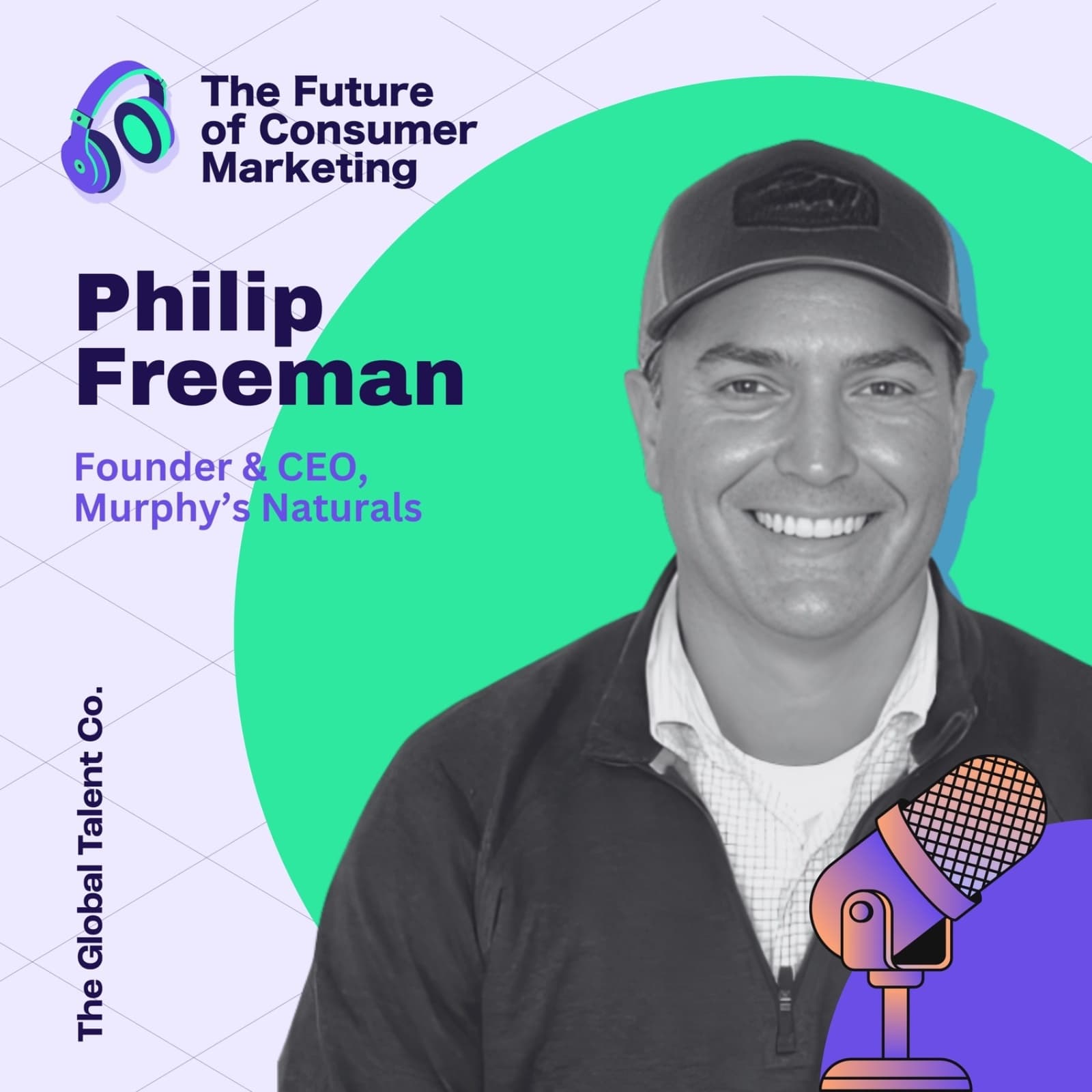
Philip Freeman is CEO/founder of Murphy’s Naturals (nationally distributed outdoor products). He grew up on a farm in Virginia, served as a U.S. Navy deep-sea diver, then spent 20+ years in the packaging industry. He says he’s not a chemist; he learned problem-solving through farm and career experience.
Key claims
Natural repellents fail because companies use EPA-approved ingredients at trace percentages due to essential-oil cost; Murphy’s tests higher concentrations to reach an efficacy threshold. Consumer trust is earned via real performance, reviews, and retailers’ vetting. The brand is B Corp and funds 1% for the Planet plus additional giving.
Notable examples
Started with insect repellent for his wife (a “mosquito magnet”), launched on Amazon with ~40,000 sales in the first month and accumulating five-star reviews, expanded from mom-and-pop stores to Whole Foods/Sprouts and then Target/Walmart/Home Depot/Lowe’s. New product: “Mosquito Dodger” nebulizer device emitting essential-oil mist (rechargeable; ~5–6 hours battery; ~30 hours coverage per oil bottle).
Written by AI. May contain mistakes. Listen to the episode to check what was said.
Chapters
Tap a time to open that second in VOThe Birth of Murphy's Naturals
0:46 to 1:50
Discover how a personal problem led to the creation of a natural insect repellent.
“And yeah, Murphy's Naturals, we were actually looking at the company and it looks so interesting.”
Philip's Background and Problem-Solving Skills
1:50 to 3:34
Explore Philip's journey from a farm in Virginia to becoming an entrepreneur.
“And how it all came from like a family setting and everything with your wife.”
From Garage to Business Expansion
3:34 to 5:28
Learn how Philip transitioned from a side hustle to a full-time business owner.
“I thought you had some type of background knowing what to put together to get these types of solutions.”
Creating a Co-Working Space
5:28 to 7:20
Understand how Philip leveraged a business problem to create a co-working concept.
“So this means that it actually came from so much volume that you guys had in terms of sales and all the boxes that it just didn't fit in your house and you had to keep on growing.”
Formulating Effective Natural Products
7:20 to 10:10
Delve into the challenges and research behind creating an effective natural insect repellent.
“And how you actually turned another problem you found in the way to another business model and idea.”
Natural vs. Synthetic Repellents
10:10 to 12:18
Compare the benefits of natural repellents with their synthetic counterparts.
“And so from what I'm hearing, then, my understanding is in the market currently, the synthetic products and some of the other ones you may find are more of a diluted version of what Murphy's Naturals is offering, right?”
Building Consumer Trust in Natural Products
12:18 to 14:01
Explore Philip's strategies for convincing consumers about the efficacy of natural repellents.
“So there are other impacts that a lot of people don't realize, and they use it out of necessity.”
Launching on Amazon and Initial Success
14:01 to 16:44
Learn how Murphy's Naturals successfully launched on Amazon and gained traction through reviews.
“And that was how you were able to convince people at work in person.”
Building a Mission-Driven Team
16:44 to 18:59
Discover the evolution of Murphy's Naturals and the importance of having a mission-driven team.
“And then having those reviews on Amazon was a great selling point when we were talking to retailers.”
Innovations in Product Development
18:59 to 20:48
Explore the innovative products developed by Murphy's Naturals, including the Mosquito Dodger.
“skin and products that you use around you, like burning products.”
Show all 18 chapters
Testing Products and Ensuring Efficacy
20:48 to 22:48
Understand the rigorous testing process behind Murphy's Naturals products and their effectiveness.
“But it looks so cool, Philip, because when I saw it in the LinkedIn for Murphy's Naturals, I was like, oh, is that like a speaker?”
Staying True to Values While Scaling
22:48 to 27:27
Learn how Murphy's Naturals maintains its core values while experiencing rapid growth.
“Because you think about it, when I was starting in my garage and doing this in our backyard, it was trial and error.”
Social Responsibility and Company Culture
27:27 to 28:03
Discover how Murphy's Naturals incorporates social responsibility into its business model.
“And we do work on the principles of respect and appreciation.”
Building Respectful Relationships in Business
28:03 to 28:33
Learn about the importance of respecting colleagues and teamwork.
“and I let everyone know who comes here is you have my respect from the day, you know, I meet you as a person, as a human.”
B Corp Certification and Business Growth
28:33 to 30:26
Understand the balance between being a B Corp and scaling a business.
“And Philip, you mentioned that Morphe's Naturals is a B Corp, but have you needed to make any trade-offs between being a B Corp and scaling the business?”
Smart Disruption in a Competitive Market
30:26 to 32:05
Explore how to disrupt established markets through innovation and culture.
“And Philip, what does smart disruption look like in a space that's dominated by big players?”
Product Development Criteria for Success
32:05 to 33:34
Learn the criteria for selecting new products that align with consumer needs.
“And now that you're mentioning the products, Philip, how do you actually decide which are the new products that will be a natural fit for your brand?”
Core Values for Successful Entrepreneurship
33:34 to 36:13
Discover the significance of establishing and living by core values in business.
“You know, what are all the things we need to do to package it and fill it, et cetera?”
Transcript
Automatic transcript. May contain errors.0:00This show is brought to you by the Global Talent Co, a marketing leader's best friend in these times of budget cuts and efficient growth. We help marketing leaders find, hire, vet, and manage amazing marketing talent for 50 to 70 % less than their U.S. and European counterparts. To book a free consultation, visit globaltalent.co. Hey, everyone. How's it going? Today, we're joined by Philip Freeman, CEO and founder of Murphy's Naturals, a nationally distributed outdoor products brand that's proving you can build effective products from plant-based ingredients without compromising performance. Philip, it's a pleasure to have you.
0:37How are you doing? I'm doing great, Andre. Thanks so much for having me on your podcast today. We're so glad that you were able to make it, Philip. And yeah, Murphy's Naturals, we were actually looking at the company and it looks so interesting. It seems that it all started with insect repellent. Would that be correct? Yeah, that's absolutely correct. And that's what our core product is. And yeah, it all really started solving a problem at home. And my wife, Pam, is a mosquito magnet. And I spend most of my time outdoors. She didn't want to come outdoors because the mosquitoes loved her too much.
1:13And she was tired of using chemical-based products as repellents. And she said, find a good natural one and I'll join you. And I really struggled to find a good natural repellent on the market. So ultimately, I did some research, created some formulations that worked well for Pam, who the mosquitoes really love. And I thought, well, goodness, you know, maybe this is the venture I actually go forward and do something with the idea that I'll launch. And so we created it, named it after our dog Murphy and started it in our garage in North Raleigh, North Carolina. Oh, my goodness. That's crazy. And how it all came from like a family setting and everything with your wife.
1:58That's so cool, Philip. And just so that the audience knows a little bit more, like I don't think a casual person could just go on and create an insect repellent based on whatever they have off the top of their head. So could you tell us a little bit more about your background? Yeah, sure. Well, my background doesn't really lend to being a chemist. I can promise you that. I hated chemistry. But I grew up on a farm in the Blue Ridge Mountains of Virginia. I was the youngest of five kids. And, you know, when you grow up on a farm, you learn how to solve problems. And so from an early age, you know, I was a problem solver, went to university.
2:37Then I became a U.S. naval officer and I was a deep sea diver for the Navy. And once again, oftentimes, you know, enjoying life outdoors, you know, with that job, but having to solve lots of problems and come up with creative solutions. And then my career I had after the military lent to doing that. And I spent over two decades working in the packaging world, solving problems, working with manufacturers. And so it was later in my years when I finally scratched that entrepreneurial itch that I had. No pun intended, actually. But yeah, so I had written so many business plans and ideas that I never did anything with.
3:22And this was the one I finally decided, hey, I think there's a real consumer need here. this is the one I'm going to do. And yeah, that's how it all started, solving a problem at home. But I am not a chemist by any means. Oh my goodness. I thought you had some type of background knowing what to put together to get these types of solutions. But I totally understand the problem solving take in it. And also, if you grew up in a farm, like I'm originally from Venezuela, and I used to go always with my grandpa to his farm as well. And having that contact with nature probably got you a little bit more understanding of what could work and what couldn't.
3:58But I'm also curious, Philip, you mentioned that Murphy's Natural started out in your garage for your wife who had this thing with mosquitoes. But what made you finally take the leap from a side hustle in your garage to going just full time with Murphy's? Was there like an inflection point? Yeah, there really was. There was a couple of years after I had started Murphy's where we were distributing through our garage, which was getting unpopular, you know, on our cul-de-sac. We had so many boxes that were being picked up at the end of our driveway by UPS or FedEx. And really, I was just at a point in my career where I had done a lot of the things that I wanted to, and I was ready for that change.
4:43And this was just a great opportunity to jump both feet in. You know, I performed well in my career and saved well. So we were in a good position to take that risk. And yeah, so the first thing we did is I was able to get a small place with a loading dock because I needed to be able to start receiving and shipping pallets and things like that. And so I got the first space and signed a lease that I personally guaranteed for multiple years. And then outgrew that space within six months. then I was kind of stuck there. And that ended up, you know, giving an idea for another business concept that I launched, you know, within a year or so of that point.
5:27Oh, wow. So this means that it actually came from so much volume that you guys had in terms of sales and all the boxes that it just didn't fit in your house and you had to keep on growing. Yeah. And we got our first location with the loading dock, but we outgrew that really quickly as well. So yeah, so I ended up having a business problem I needed to solve and thought, oh gosh, there are a lot of other people out there who need that solution. And so ended up creating a co-working co-warehouse concept. Oh, very nice. Yeah. Yeah. And we have three locations of that now and it's grown into a really nice business.
6:05And one of the locations is where our Murphy's headquarters is today. And we're in a much larger footprint. We're in about 150 ,000 square feet now. Okay. So I understand. So you actually created a new business to not have to give away, like to not have to cancel the contract for the several year lease you had, and then Murphy's moved to another place. Yeah. Well, we ran through that lease. We actually managed to get through that. And then we did this other location kind of along the way. So there was an overlap and it was this new location that allowed us to launch the other business. And I just got a bunch of square footage so other businesses and entrepreneurs could thrive.
6:45And yeah, we created this concept where there's, you know, there's no leases, there's no personal guarantees. It's month to month. You can expand as you wish. You can contract as you wish. But it's a great community of entrepreneurs and business people. And it's just so much fun to be surrounded by all that energy. I love entrepreneurialism. Like I said, I started really late. I just had the ideas, but never did anything, but finally did. And now I get to help a lot of other people grow alongside Murphy. So it's a whole lot of fun. No, that's amazing. And how you actually turned another problem you found in the way to another business model and idea.
7:26That's just some very nice out of the box thinking. Well, they always say the best solutions or the best ways to start a business are to find a solution for a problem. True. I had a couple problems to solve. And Philip, could you tell me a little bit more about your approach to formulating a natural product with limited resources at the beginning, I imagine? Yeah, so I had to do quite a bit of research. So I investigated EPA-approved natural ingredients that were acceptable to the U.S. EPA, and they're very strict on their guidelines. And I started to research, why do the natural products on the market not work well?
8:08And I realized it was really a lack of commitment and conviction, to be honest, because the essential oils that you need for repellency. The EPA closely regulates what ingredients you can use, and you have to go very strictly by their active and inert ingredient list, but they do not regulate the percentages of those active ingredients you have to put in, and essential oils are incredibly expensive. So what happens is you have a lot of these larger companies playing at naturals. They're putting the right ingredients, but they're putting trace amounts of those ingredients because they're so expensive.
8:49So guess what? If you don't put enough percentage of the ingredients, the product isn't effective. So I said, OK, let's figure out how much do we have to put in. And so I kept testing and testing with higher percentages and different types of essential oils like rosemary, peppermint, cedarwood, citronella, ones like that. and started working on those blends and higher concentrations and finally, you know, figured out, okay, here's the threshold where you have a really effective natural product. But what it does, because we use so much of those expensive natural ingredients, it elevates your costs.
9:25So you have to sell at a higher price point, which we do. And, you know, our products sometimes cost twice as much as the synthetic products, but we learned pretty quickly that there was a consumer appetite for natural solutions, especially in mosquito repellency, mosquito and tick repellency. And the consumer was willing to pay a higher price, a premium for a natural product that actually worked. And we built our business based off of that basic model and working on highly effective natural products. So, you know, much like your intro, you know, we found a way to use Naturals in a highly effective and sustainable way.
10:09Wow. And so from what I'm hearing, then, my understanding is in the market currently, the synthetic products and some of the other ones you may find are more of a diluted version of what Murphy's Naturals is offering, right? Because then you're giving us higher percentage of the active ingredients that repel the mosquitoes. Well, close. The synthetic products, you know, those are much less expensive. The synthetic chemicals that they'll use that repel like DEET and products similar to that, but they are not naturals. And, you know, DEET can degrade plastics and so forth. So it can mess up your gear and there's all kinds of different issues there.
10:46So those products are inexpensive from an input cost. The natural ingredients, the essential oils are very expensive. So some of those chemical based companies would play at naturals. So they would put out a natural product, but they weren't willing to put the amount of those essential oils in it. So they weren't doing it successfully because they weren't willing to commit to putting in the amount of those expensive ingredients to make their product work well. Okay. No, I get it. And that's what happens when you don't trust your consumers because, for example, I'm Venezuela. I used to always go fishing.
11:25I love fishing. I love river fishing. So the best fishing times are 6 a.m. and 6 p.m. when the mosquitoes are most active. Yep. And I kid you not, I would be willing to pay a hundred dollars for a repellent that actually works in the moment and then just not be that person who just wants to save a few bucks in the store because I think that's once cheaper when we really need something that works when you're out Yeah, a natural that is ineffective is just that. It's ineffective. So it doesn't bring any value to you. And, you know, you're not going to create any loyalty. But if you do have an effective natural product, the consumer, you know, and you're consistent and you're true to your mission and your values and your core values.
12:11And the consumer, you know, is going to trust you. You can't lose that trust by ever putting out a substandard product. Of course. And so, but to your point, like fishing in the morning or in the evening, I mean, if you're using a deep-based product and you have synthetic lines, that'll degrade your fishing line if you get it on it as well as other gear that you have. So there are other impacts that a lot of people don't realize, and they use it out of necessity. And I did growing up. We used chemical-based products because it was our only option growing up. Didn't love it. Didn't like the way it felt.
12:46But that's what we had available to us. But now there are natural options that we've proven are highly effective. Well, and that takes me to my next question, actually. How was it that you were able to convince people that natural repellents would actually work? That was tough because everyone was a skeptic because there were so many poor performing natural products on the market. So because there were so many poor performing products because of that low percentage of active ingredient that people were not trusting. And the first thing they would always ask us is, does it really work? And I used to give it away a lot and say, just, you know, try it.
13:26Try it and see and you will find out. And that's really how we started going to a lot of trade shows, things like that, handing product out, you know, just telling people, give it a go. You'll see, you know, and we built a lot of early loyalty based off of that. And, you know, where people come back and they're like, it really works. And they're so shocked. And I said, I know, but I didn't expect them to take my word. I mean, why would they? Everybody else has been putting out ones that didn't work. So, you know. Okay. And that was how you were able to convince people at work in person. And now we also saw that you launched on Amazon.
14:09How were you able to actually stand out in such a crowded space as the digital e-commerce place? That was really interesting. When we launched our first product on Amazon, which was, you know, it's been over 10 years now. And when we put it out, we launched it in July. We were doing some advertising on there that was all directed by me using some keywords and so forth. And we did about 40 ,000 in sales our first month. And I thought, ooh, OK, there's proof of concept. And we quickly started accumulating five star reviews. And that was really critical is we started getting so many five stars and so many people saying, oh, my goodness, it actually works.
14:53It really works. And so that built on itself. And of course, when you start getting those great ratings, it's easier to optimize on Amazon. And there wasn't a whole lot of competition back then for natural products. But we did have to overcome that price differential because, you know, the chemical competitors were much less expensive. But we started getting momentum and more and more. And that was a great way for us to launch our product, especially since I was working a really busy full-time job that was about 80 hours a week before doing the Murphys as side hustle on nights and weekends. So having Amazon as a platform to launch was critical.
15:36And then we started getting into brick and mortar mom and pops primarily. And then we started working our way into larger retailers like folks like Whole Foods, Sprouts Organic Market, ones like that. And that really helped us build our reputation because if they put you on their shelves, they've really vetted you out. And we did great in those environments and found, you know, who a lot of our customers. But now, you know, that customer base has really expanded. You know, when we're in Target, we're in Walmart, we're in Home Depot, we're in Lowe's, we're various grocers and so forth. So we've expanded out like crazy and are really on a nice growth trajectory now.
16:20Oh, that's beautiful. So it really has grown a lot. And I can understand that it was by word of mouth, by going and giving the repellent to people. And it's also the digital word of mouth, like the reviews, the five stars, everybody's just saying that it does really work. And that's what gives you the actual testimony, because as you said, your word is not going to mean anything if it doesn't actually work and they don't try it out. So that's beautiful. Well, thank you. And then having those reviews on Amazon was a great selling point when we were talking to retailers. And we say, you know, look at our reviews on Amazon.
16:54You know, we can't fake thousands of five star reviews. I said, there might be a half dozen reviews on there that are, you know, from a cousin or a sister or brother that put something on nice. But, you know, I promise you these are real. And it was a really helpful selling point for us getting into brick and mortar. Okay. Wow. Wow. And we've been talking about how Murphy's Naturals talked and was able to convince the audience that this worked. But from within, Philip, when you started growing, how was it or what were you looking for when building a mission-driven team for Murphy's Naturals? Yeah, well, at first we were having our products manufactured by third party, some overseas, some domestic, but primarily overseas.
17:40And I quickly shifted to try and start manufacturing in-house. So I built the infrastructure and we actually manufacture about 85 percent of our products in-house at our location here in Raleigh, North Carolina. We have a few third party manufacturers in the U.S. and we still have a couple overseas in Asia that are manufacturing product for us. But the vast majority of our products we make ourselves. And, you know, I've built a really incredible team here. It started with, you know, a really small group. And if you go back to 2020, we had about, I remember us bringing on employee number eight, you know, who was a finance person.
18:23And I was like, I can't believe we're bringing on a finance person. And now it got real. Yeah, now it got real. And what an incredible gift he's been to our company and is still with us. And, you know, that was in 2020 during COVID. So quite a challenge. And now we have over 50 employees. We've expanded like crazy. We have incredible manufacturing capabilities with all the equipment that we've invested into filling and pouring lines and so forth. And we've really expanded out through innovation with our products. While most of our products are repellency products that you use on you, like on your skin and products that you use around you, like burning products.
19:08and one that we just launched called the Dodger, which is actually a nebulizer device, electronic device that emits a mist of essential oils into the air. So there's no flame, no heat, and it works unbelievably well. So we've been really loving the reviews we're getting on that. So it could be like a humidifier where you put the oil and it just creates the vapor? Yeah, it actually has a compressor, a small compressor in it, and it creates this. It pulls the essential oils by creating a vacuum, and actually it goes out in a very, very fine mess. It almost looks like smoke the way it dissipates, but it's not at all smoke.
19:51And that spreads, and that repels the mosquitoes, much like a really effective candle would. But this does it even better, and you don't have the flame or the mess. It's really incredible, the devices. Yeah, I mean, if I can, I'll grab one and show you what it looks like. Do you want to see one? No, you can totally do that. All right, hang on. Yeah, this is the Mosquito Dodger, the Murphy's Naturals Mosquito Dodger. And it has actually a bottle of these oils, a special blend that we develop. It goes in here and then it drops down and you turn on the device. and the battery, it's rechargeable. And this will last for about five, six hours, the battery.
20:39And this little bottle gives you about 30 hours worth of repellency coverage. Wow. So yeah, we worked on it for years. So we're so excited, you know, I'm promoting it here. You know, totally. I'm only selling, right? It's a thing. It shall become a thing. But it looks so cool, Philip, because when I saw it in the LinkedIn for Murphy's Naturals, I was like, oh, is that like a speaker? It looks like something that Alexa would speak out of. But it's so nice that would you even say that that is what works the most of all the products you have, like the one you feel is the most effective? Or does nothing replace the actual placing the repellent on your skin?
21:19Well, so different. So this is our most effective spatial. So a product you use around you. Our lemon eucalyptus oil, that is an incredible one. So they're two different functionalities. But if you don't want to use spray and you want to have something around you, you know, the Dodger is a great way to do that. If you're not using our incense sticks or candles, you can use the Dodger. And we put so much work into the design of this product. It was very thoughtful. And we're batting way or fighting way, you know, way over our weight. with the team we have. We have a small but mighty team and an innovation, just a bunch of smart, thoughtful people who are really solutions-based, which makes it a whole lot of fun.
22:05And so we're coming up with things all the time. No, I can only imagine. And with such a tight-knit team and everything being, as you mentioned, 85 % in-house, I imagine there must be a lot of space and confidence to propose new ideas and see if something works or just even try stuff out. I imagine it gives that leeway to the employees you have. So that's very cool. Yeah. And we're growing mosquitoes right now. We have our own lab where we'll do our efficacy testing and so forth. So, you know, we make sure that our products work and, you know, it's pretty extensive what we're doing and the amount of testing that we're doing.
22:43So it's fun to have evolved to this point where we're able to do so much. Because you think about it, when I was starting in my garage and doing this in our backyard, it was trial and error. It was nothing clinical. It was just like, did it work for my wife, Pam? And if it worked for her, it's good. I'm always trying to solve that problem. So, yeah, now it's much more technical for sure. And, yeah, we have so many neat products in development. And we also have products that are for after bite. So if you get a bite and you need bite relief, because no product's perfect. And also, if you're going out to the mailbox and, you know, you're not going to put repellent on to go to the mailbox and you might get a bite.
23:26So, you know, having an itch relief product has been a really smart move for us. And we manufacture those. And it's our Murphy's Naturals Bite Relief Soothing Balms. And that's a family line that we're going to expand out quite significantly over the next several years. I just imagine somebody turning on the Mosquito Dodger, placing on some repellent, and in case the mosquito bites, they'll put on the after it. And that way, we'll be indestructible against mosquitoes. So that's cool. Well, and we don't even pretend to think our products are perfect. There is no perfect product out there. It's really, really good.
24:07And everything's really well designed and very thoughtful and sustainable. But mosquitoes find a way. Nature finds a way. And you're going to get bites. Nobody's created that perfect product. So after getting a bite and having a solution for after that bite is meaningful. Okay. No, it really is. It really is. And Philip, with Murphy's Naturals growing, creating even new products, How have you managed to stay true to your values while growing this CPG brand? I understand it's the natural component and that it should be the best product ever, but give me your perspective about that. Yeah, so how we started was really important.
24:49And I had inspiration from different companies I worked with in my professional career. One of the companies I worked with for almost two decades was The Body Shop. The Body Shop is they make shampoos, lotions, things like that. They originated out of the UK, and I worked with them globally on all sorts of different projects. And one thing that I was amazed by is Anita Roddick, the founder. She had really strong core values. She supported community fair trade. She would find means of sustainable trade for indigenous people in different parts of the world and would do that. She was very focused on natural, good for you products, good for the environment products, treated her people well.
25:36And I noticed, you know, that enthusiasm she had, I saw it here, but no matter where I went in the world, her employees had that same enthusiasm. And I love that. And I thought, if I ever create a company, I want to do it the way Anita did. I want to have employees that get it and want it. And our core values drive everything. We are a certified B Corporation, which is very difficult to achieve. As a matter of fact, both companies, Murphy's Naturals and The Loading Dock, are certified B Corporation. Murphy's 1 % for the planet member, where we commit to giving 1 % of our revenues, not profit, 1 % of our revenues to the organizations under that 1 % for the planet umbrella.
26:24And a lot of that is environmental based. But we also give another 1 % of our revenues for a total of two to other organizations, including veteran organizations. I'm a veteran. Animal welfare organizations and many of the different communities and organizations within our community. So it's a real core part to what we do. And yeah, and we have quarterly volunteerism with our team. Our team, it's a family. You know, I may be the CEO and I'm the boss, but really my most important job is people and culture and taking care of our people and also making sure we're true to our mission and our vision.
27:07Of course. Oh, and I really like how Murphy's Naturals creates a natural product to help the world by even not using like chemical ingredients and stuff, but you also maintain the social responsibility of helping out this 1 % you're mentioning that you are donating to and volunteering. So it's very nice that you have that cultural responsibility and social aspect also in regard for the company, because it's very important and more with the brand, with the image that you guys have, I believe. Yeah. And we do work on the principles of respect and appreciation. And we have a very diverse employee base, people from all over the world.
Read the full transcript
27:43And they're here, but they come from all over the world. And working on a basis of respect and appreciation, many of these people have never experienced respect in the workplace or even at home or, you know, in their communities and having a culture that is so based on it. and I let everyone know who comes here is you have my respect from the day, you know, I meet you as a person, as a human. And that can only grow as we get to know each other and we work together as a team. And to have people like that, just these incredible people who just embrace that culture, they get it and they want it. That's the most important part because you're all synchronized and just working together for one common goal.
28:32That's amazing. And Philip, you mentioned that Morphe's Naturals is a B Corp, but have you needed to make any trade-offs between being a B Corp and scaling the business? Yeah, we have to be mindful. So, you know, we've taken on some investors. And as a matter of fact, one of our first investors, he introduced me to what a B Corp was. I didn't even know it. He says, you guys are operating like a B Corp. And he goes, you know what it is? I was like, I don't know what that is. And I looked at it and he says, you should go ahead and investigate this more, take the questionnaire and so forth. And I did.
29:09And we scored very high from the get go, which is hard to do. So we qualified as fast as you can qualify. And we've been one for many years and re-qualified. And so having that as a core early investor and advisor was important. And our most recent raise was with Point King Capital out of Sydney, Australia. And they're a certified B corporation. So we're careful about who we partner with and who we work with. And we make sure that they understand our core values and they embrace them as well. And when you do that, it's a heck of a lot easier to maintain and grow, you know, that sort of attitude.
29:54Of course. And I can imagine with more money coming in with investors, different parties, there might be some kind of feeling that they have some leverage over Murphy's Naturals because they gave some money. So it's important to know that they agree to the goal that you guys have and what you want to portray as a company. So that's really cool. Okay. Absolutely. So we've not formed any partnerships that would cause us to deviate from who we are as a company, nor would we seek them or want them. we would respectfully decline. Exactly. Okay. Of course. Always respectfully. And Philip, what does smart disruption look like in a space that's dominated by big players?
30:36Yeah, I love that question. You think of disruption so much of the time being in the tech world, but there are so many ways you can be disruptive. It can be the way you run your company and how you are with your people, the culture, that can be disruptive. For us, it was, you know, quite simply finding a sustainable, natural way to create repellent products that worked for the consumer. I mean, that was disruptive in itself. And then just doubling down and creating more and more products to do that. And again, we're very thoughtful. Our innovation team is super clever. So we're always thinking about what are the gaps, what's missing, what are the consumer needs, and identifying those and being super careful about how we design the products that we're going to take to market.
31:30So again, we have guardrails. Some of them are environmental guardrails, but we also have guardrails that may have to do with supply chain and sustainability. But we may also have guardrails that have to do with margin. You know, if you don't have a suitable profit margin, you know, you can't grow and you can't do all the good things that you want to do. So it does no good to just lose a whole bunch of money. So we have to be really smart in innovation to make sure that the products we're producing are sustainable financially, environmentally, and so on. Okay. And now that you're mentioning the products, Philip, how do you actually decide which are the new products that will be a natural fit for your brand?
32:12Because I understand from repellent to the candles to the diffuser now with the mosquito dodger, how do you actually decide what goes and what doesn't? Like what is the main criteria? Yeah. So there has to be a consumer need. I mean, that's critical. If there's not a consumer need, then you're not really going to sell any of them. Ideally, it's solving for a consumer need that is unmet in the market. And we're not just being a copycat and just going to replace someone else's position in the market. So we really want to have something unique and value added. Working with our company is value added because of all the good that we do.
32:51But, you know, our products have to be effective as well. So we will look at them, see if there's a consumer need. We'll see what the challenges are, and we'll start working to solve for those challenges and then use those guardrails to see if there's feasibility. So we have ideation, which is part of it, feasibility, and then there's execution. So when you go through the feasibility stage, that's actually where you're deciding, is this something that someone needs? Is this something that we can take to market and not run the business in the ground? Does it have all the right environmental guardrails and so forth.
33:29And once you answer all that infeasibility and decide it's a go-to market product, then you start with that whole execution process of how are we going to make it? Where are we going to make it? You know, what are all the things we need to do to package it and fill it, et cetera? Okay. Yeah. Now, and I imagine that even creating those products, it's just, is this really worthwhile? Because after it has gone so well with just such a simple repellent and it being natural, I imagine there might be certain skepticism of just like, as you mentioned, just trying to bite too much out of the chunk of the market and then just running the business to the ground, which would be worst case scenario.
34:09But excellent that you have guardrails. I hadn't heard that term before and I'm loving it because it's just perfect. We have so many ideas and so many products on our innovation roadmap. There are some of them we will never do. But it was really fun thinking about them and considering them, but they're on a shelf. Some of them is we will never do it. Some of them is maybe one day, you know, we can do that. Okay. And Philip, this is more for the audience and for anybody who's listening. What would be your number one piece of advice to any founders or marketers that are building a CPG brand? Yeah.
34:50Well, oftentimes I'm asked the question of what advice would you give of someone considering doing something entrepreneurial? And I've always said, just do it. Give it a try. You know, protect your downside as best you can, but try something so you don't have those regrets. But what I would say to those who are, you know, they're in the midst of it and they're launching is establish those core values, those guiding principles for your company, make sure they're solid and then be true to them and live by them and build an incredible team that embraces those core values. Because if they don't, it can tear apart a team.
35:31They have to embrace and believe in what you are as a company. And if you establish those core values in the right way, it's going to give so much love, appreciation and respect to the team members that everyone is going to flourish and do well at the company. And it's really hard not to succeed as a company when you have people like that on your team. That makes complete sense, Philip. And exactly. Having your core values properly stated and determined is what I believe is going to help out the team be aligned and therefore go to the same objective goal and just keep on working for it because you really are right with that.
36:12And that is an excellent takeaway for anybody who's listening and who is actually in the middle of an entrepreneurial stint. So that's amazing. Well, Philip, we have reached the end of our time, so I'm going to let you go. But I just wanted to mention that this was a very fun and interesting conversation that I did not expect because Murphy's Naturals was a new company for me. But the story of where it came from, of a place of love between you and your wife, it is just amazing. And it gives the brand a lot more of humanity. And I hope everybody can see that after they hear this podcast. Yeah, that's nice, Andre.
36:47Thank you so much for having me get some Murphy. So the next time you go fishing, you're for sure. For sure. I'll make sure to add you LinkedIn and then just let you know how much it worked. They'll be like, Philip, this was amazing. Thank you so much. It's been fun. Thank you. It's been a lot of fun. It was very nice. I'll make sure to reach out to you later, Philip. We'll get connected. Okay, that's great. Thank you. That was good. Have a good one. Take care. Bye-bye. Bye-bye.
From the publisher
In this episode of The Future of Consumer Marketing, host Andres Figueira interviews Philip Freeman, CEO and founder of Murphy's Naturals, a nationally distributed outdoor products brand that's cracked the code on natural insect repellent. What started as a garage-based solution for Philip's mosquito-sensitive wife has grown into a 50+ employee company manufacturing 85% of their products in-house and distributed through major retailers like Target, Walmart, and Home Depot. Philip's journey from naval officer to CPG founder demonstrates how authentic problem-solving, uncompromising quality standards, and values-driven growth can disrupt established chemical-dominated markets.
Topics Discussed:- Building consumer trust in a category plagued by ineffective natural products
- Scaling from Amazon to major retail through review-driven credibility
- Manufacturing strategy: when to bring production in-house vs. outsourcing
- Product innovation within brand guardrails and core values
- Maintaining B Corp certification while scaling and taking investment
- Creating authentic brand narratives from genuine problem-solving origins