In short
Marine Layer’s marketing strategy—brand voice, analog channels, and “real” storytelling—plus an example digital campaign (“Pant Science”) and how AI is used mainly for back-end efficiency.
Guest
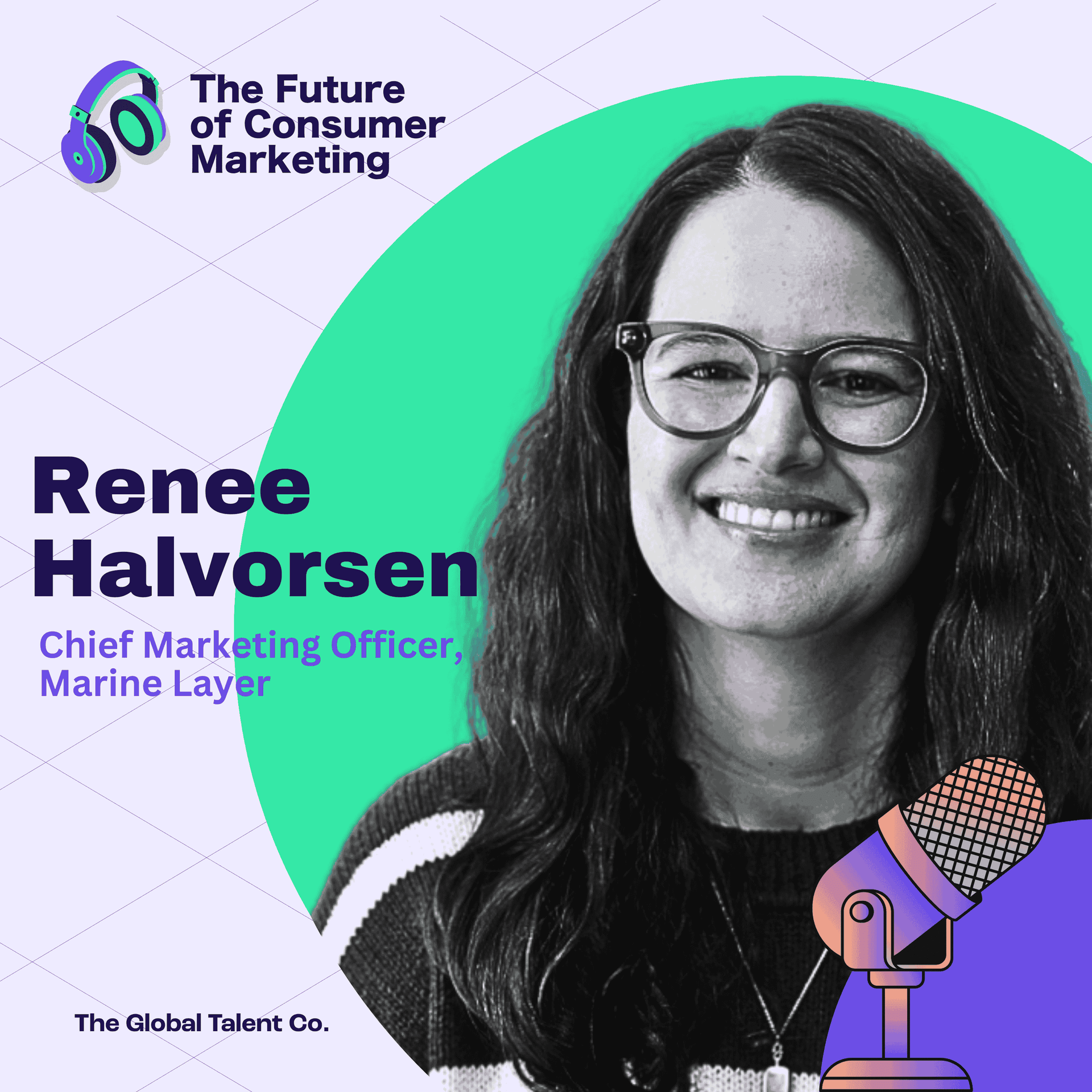
Renee Halverson, Chief Marketing Officer at Marine Layer (San Francisco). She’s been with the company ~11 years, leading marketing, e-commerce, creative, and customer service; previously worked in retail at Gap Inc. She has an economics background and grew online marketing after the brand initially focused on retail.
Key claims
Marketing should feel like talking to a trusted friend, not “someone’s marketing.” Physical catalogs (about eight mailed per year) and stores scale because they create longer-form, tactile brand trust. Consumers are craving authenticity amid saturated digital/AI content.
Notable examples
“Pant Science” Flex Terry pants campaign with comedic creator storytellers, a scientist-themed human model, and multi-channel rollout (TV, online ads, email). Pop-up personalization events in New York and San Francisco (patch/embroidery on Cloud9 fleece), with the SF pop-up as the top traffic location in their fleet. AI is used for CRM/analytics speed and internal product visualization (e.g., tools like Vizcom).
Written by AI. May contain mistakes. Listen to the episode to check what was said.
Chapters
Tap a time to open that second in VOIntroduction to Marine Layer
0:00 to 0:47
Learn about Marine Layer's unique position in casual apparel.
“We are a multi-channel men's and women's casual California cool apparel business.”
Renee Halverson's Journey
1:20 to 6:05
Hear Renee's story of growing into the CMO role at Marine Layer.
“the Chief Marketing Officer at Marine Layer, a San Francisco-based casual apparel brand for men and women.”
Understanding Marine Layer's Philosophy
6:05 to 7:20
Explore Marine Layer's core values and product philosophy.
“Like it's more of a lifestyle and a vibe and everyone's included.”
The Role of Catalogs in Marketing
7:20 to 9:20
Discover how physical catalogs contribute to Marine Layer's marketing.
“And in terms of then what Marine Layer represents, how you people are like creating this clothing, making an emphasis on the comfortableness of it, of it feeling old, but being new.”
The Comeback of Analog Marketing
9:20 to 12:20
Discuss the resurgence of analog methods in a digital world.
“we've been able to scale and grow our business and it feels really specific to us.”
Innovative Digital Campaigns
12:20 to 14:00
Learn about the 'pant science' campaign and its success.
“And so I think leaning more into editorial content and our catalogs, storytelling, really, you know, ensuring our customers feel like things are human.”
Exploring Marketing Aesthetics
14:00 to 15:00
Learn how aesthetic choices in marketing can enhance customer engagement.
“But I think, you know, aesthetically, he still looked really good.”
The Role of Influencers in Marketing
15:00 to 17:59
Understand the importance of choosing the right content creators for brand authenticity.
“I think the piece, though, is like probably focused on picking the right partners.”
Company Growth and Team Expansion
17:59 to 18:56
Discuss the growth of Marine Layer and the expansion of its teams and offices.
“We are currently in this like absolutely beautiful, iconic, like old movie theater space, which has super high ceilings and tons of exposed brick.”
Leveraging AI for Business Efficiency
18:56 to 22:43
Explore how Marine Layer uses AI to enhance operational efficiency and customer insights.
“Before Q3, that's, well, Q1 is passing by like this.”
Show all 13 chapters
The Return of Physical Retail Experiences
22:43 to 26:54
Learn about the resurgence of physical retail and experiential marketing at Marine Layer.
“But it really provides that time again for you to be able to focus on what matters.”
Engaging Customers Through Catalogs
26:54 to 28:01
Discover the importance of physical catalogs and direct customer engagement strategies.
“And I think it's inspiring us to think about all of our marketing channels differently.”
Exploring Marine Layer's Brand and Offerings
28:01 to 28:44
Discover how Marine Layer engages with customers and promotes their brand.
“Like we're able to reach much broader markets.”
Transcript
Automatic transcript. May contain errors.0:00We have 54 stores across the country. We are a multi-channel men's and women's casual California cool apparel business. We really hope that our product invites a little more ease into your life. How is the marketing for this and how have you found that you're able to communicate this to consumers and to all your audience? We care a lot about our marketing. We put a lot of emphasis on brand voice. You don't want it to feel like someone's marketing at you, but you want to feel like you're talking to a friend, someone that's trusted. And what do you feel has been the best channel? Because our product is so soft and because so much of the experience of it was tactile, we focused on stores first and probably focused on catalog first as our first marketing channel because it's just being really authentic for us.
0:46Hey, everybody. Welcome to the show. My name is Andres Figueira, and I'm going to be your host for the day. This show is brought to you by the Global Talent Company, helping fast-growing teams hire exceptional remote talent from Argentina, South Africa, and beyond. We connect companies with world-class professionals who bring skill, reliability, and a global perspective to every role. And just for our listeners, we're offering an exclusive 10 % discount on your first hire. All you need to do is visit globaltalent.co, click Start Hiring, and mention the podcast listener discount when we reach out.
1:19And today with me here, I am speaking with Renee Halverson. the Chief Marketing Officer at Marine Layer, a San Francisco-based casual apparel brand for men and women. And with that said, Renee, welcome to the show. It's a pleasure to have you here. It's awesome to be here, too. I'm excited to connect with you today. Us, too. Us, too. We're so happy we were able to make this work. And, Renee, just so that we can get the audience a bit more in context, would you be able to tell us a bit more about your background, who you are, how you came to be the chief marketing officer at Marine Layer, and then maybe just what Marine Layer does in your own words.
1:57Awesome. I love talking about those things. So I actually am just coming up on my 11-year anniversary at Marine Layer. I lead marketing, e-commerce, creative, and customer service. And when I joined Marine Layer all those 11 years ago, this business was actually more focused on our retail presence first, like retail and rent was really marketing before anything else. So when I first joined Marine Layer, I was really charged with growing the online business. And it was like light bulb moment. If we're trying to grow online, we need to do some marketing because no one just randomly shows up to a website.
2:32Of course. So kicked off some marketing focus and then my career here has evolved a ton over the years. I think what's so exciting and compelling about our space is that it's constantly evolving. So I think it really invites curious thinkers, folks that are really agile, folks that are willing to adjust and think about things differently and really respond to what consumers are up to. So it's a huge part of what I've been up to for the last 11 years. And funny enough, you know, for folks that are thinking about their own career path, I did not know I wanted to be in marketing all those years ago.
3:04I was an economics major in college. I went into banking because that's what everybody else said you should do. I feel like I got really lucky being in San Francisco. Gap Inc. is an incredible hiring force that really pulls in a lot of great talent. And so did some epic years around Gap Inc., really getting extremely versed in all different disciplines within retail. And then since then have really loved being a part of the Marine Layer team and growing this business. Wow. Yeah. And Marine Layer. So a little more about us. If you haven't been in one of our stores or you haven't received one of our catalogs, that's on me.
3:37I probably should make sure we find you. But we have 54 stores across the country. I would say we are a multi-channel men's and women's casual California cool apparel business. Really rooted in soft and fun and ease. It's probably all the stuff you're wearing on the weekend and all the stuff you want to wear all week long. And we really hope that our product invites a little more ease into your life. I love that. Like I've spoken with a bunch of like clothing brands that are a bit more, let's say premium, but I haven't spoken with one that the angle is just to be comfortable and it's to have super soft fabric.
4:14And I looked at the LinkedIn page for Marine Layer before this, and it does look like a Cali chill company that is just trying to make some nice clothing for for cool people. And my question, my question is, is the is the origin story for Marine Layer, the one that is said on the website that like the owner, his T-shirt got thrown out or something like that? Totally. I mean, the origin story is still absolutely true. So we really kind of root ourselves in like West Coast cool and that you don't really have to compromise being comfortable in order to still kind of have your own sense of personal style and show up in the world the way you want to.
4:51Our business was founded by Mike Natanshan. and he was cold in his, I want to say, main college dorm room and he had this big dream of moving out to California. I think California has always been all about optimism and ease, a little bit less fussy, a little bit more fun infused in the everyday. So he moved out to California and he was obsessed with his old T-shirt. His girlfriend, who then became his wife later on, threw it out because it was disgusting. It had like holes in the pits. It stunk. The graphic entirely washed off. And he had this epiphany like, why can't all my clothes be like my old favorite t-shirt?
5:36Something exceptionally soft and broken in. Something I feel myself in. We talk about a t-shirt attitude really applying to everything that we make. And so we sub-opt to recreate his old favorite tee, finding something that was soft and cool and comfortable at the same time and now we have an entire assortment of what we want to be your new old favorites so there's something that you're acquiring now but they have that energy and feel of something that you love that you've been obsessed with for a long time that will stand the test of time i love that i love that and and renee does uh like is the marine layer clothing what specific demographics or age groups do you feel or do you see that are buying it the most i think that's actually one of the coolest things about marine layer is that while i think like the peak of our consumer or like most uh the highest quantity of our consumers are probably millennials um mid to late 30s and early 40s we actually see our product like really spanning very widely across a lot of different demographics um in the holiday time period our store teens talk about the cross generational gifting that happens like you know 18 year olds that are buying it for their dad 40 year olds that are buying it for their dad or you know like 67 year olds that are buying it for themselves and their whole family and I think it's a brand that probably feels most relevant from a lifestyle standpoint for 30s and 40s but really appeals to everyone okay okay yeah no I would imagine and and comfort is something that everybody wants so I imagine there must it must not people must not discriminate according to their age to see if they want really or if not if it's Yeah.
7:14Age, not age. Like it's more of a lifestyle and a vibe and everyone's included. OK, OK. And in terms of then what Marine Layer represents, how you people are like creating this clothing, making an emphasis on the comfortableness of it, of it feeling old, but being new. How is the marketing for this and how have you found that you're able to communicate this to to the consumers and to all your audience? We care a lot about our marketing. And if you receive our catalogs, if you've seen any of our digital ads, if you've been in our stores, you've probably noticed that we put a lot of emphasis on brand voice.
7:49I think a huge part of our brand being about fun and optimism and ease and cool is making it feel like an authentic person. You don't want it to feel like someone's marketing at you, but you want to feel like you're talking to a friend, someone that's trusted and has a cool style point of view. and so we spend a lot of time on copywriting on image selection we love doing really beautiful aspirational like lifestyle photo shoots that kind of capture the essence of our brand a lot of them are very travel rooted or kind of focused on California or the west coast but it kind of captures a moment of like what would an awesome aspirational three days away look like that sense of escapism and I think we can do a great job telling that story through photography and video content and tons of great copy.
8:37Okay. And what do you feel has been the best channel or the ones that you're able to work with the most in order to communicate that? We love all the channels, but I actually think part of Marine Layer's secret sauce is our catalog. Catalog is similarly like kind of an analog marketing tool, but I feel like it really invites a longer form conversation with our consumers. So rather than like a flash in the pan, a moment that you're seeing on Instagram as you're scrolling your feed, if you're getting a catalog from us, you're really able to see our entire assortment. You're able to pick up on the look and feel of our business and you can kind of hear our voice and tone, understand the products that we really stand for.
9:19So for Marine Layer specifically, I actually feel like catalog has been a huge part of how we've been able to scale and grow our business and it feels really specific to us. And this is physical catalogs that you're mailing to people's homes? Yeah, totally. Yeah, old school stuff, old school stuff. We mail about, yeah, eight catalogs across the year. And they're super effective. I think they're a really effective tool for introducing ourselves to new customers. But they're also really effective to keep folks engaged with kind of what we're all about. And again, I think it lends itself to like, it's not just a one moment or one product idea.
9:53There's like a whole lifestyle brand that we're inviting customers to participate in. Yeah. I like that you mentioned that it's like an analog way of marketing that isn't that used anymore. But I do see a trend in the rise of analog methods to do stuff nowadays just because AI and deep fake images and all of this. and what's it called like all this facility for creation that allows ai is now making things made by the human hand like playing an instrument in person or reading a real book or getting a physical catalog in the mail it makes things worth so much more because it feels a lot realer so i think it's really cool that you guys are using that as a as a method of marketing i'm looking at the website right now and marie layer is giving me and i don't want to name competitors but it's giving me like Hollister vibes?
10:45Could that be something? No, I think that's fair. I think they also had like a very beachy aesthetic, very kind of laid back. I think there's always been this like iconic energy about the West and what it means to go West and to lean yourself into a lifestyle that feels more indoor outdoor that yeah, like invites a little bit more of some respite and fun into your life. And so Hollister certainly got it. I feel like probably a slightly younger demo for Hollister, but those are a lot of the same vibes that I think we're trying to capture and yeah I love what you're saying about analog marketing I totally agree Marine Layer has been around for about 15 years and you know when we first started because our product is so soft and because so much of the experience of it was tactile and best experienced person we focused on stores first and probably focused on catalog first as our first marketing channel because it was being really authentic for us.
11:45And so that was true, you know, 15 years ago. I feel like the more recent, call it seven, eight years of growth have been really focused on digital and challenging our teams to think about how do we translate that in-person digital experience or even our catalog, flipping through a catalog experience to our site. But more recently, I totally agree with you. I feel like consumers are really craving something that feels real, something that they can trust. Like the digital environment is just a little saturated with stuff. And I'm not sure you can really sense what's real or not anymore. And so I think leaning more into editorial content and our catalogs, storytelling, really, you know, ensuring our customers feel like things are human.
12:29We've been doing a lot more shooting on film. It really makes a difference. And I think consumers are really responding to it. It's also lent itself to a whole new strategy that we've been focused on around pop-up shops and really reinventing our in-person retail experience too. I love that everything's in person. It's retail, it's analog, it's physical. That's just so cool. And Renee, do you have any like examples of a digital marketing campaign that you guys ran that went really well, that was maybe a different idea to what Marine Layer is used to or anything like that, something that could provide some insight in that side?
13:03So digital marketing campaign. Yes. And then I would love to also talk about some in-person marketing campaigns as well, but of course, yeah, things that we do a little differently. I'm kind of obsessed with this campaign we did around our Flex Terry pants in fall and we called it pant science. So really inviting a lot of ease and fun into the voice of what we were doing. We partnered with some content creator storytellers that really leaned into comedy as their hook and how they share their content and really kind of like embraced them telling the story from their own lens that felt really cool and important for us and then from our own content standpoint we shot all this specific content you know with a real human model we had him dress up as like a scientist and we talked about like the magic of something that is both comfortable and stylish at the exact same time And it had a lot of like infused, just like almost campiness and fun.
14:04But I think, you know, aesthetically, he still looked really good. And we showed all the different use cases. And I think it's a nice example of like for storytelling and the Marine Layer team. It's not just about talking about the specific value props of our customer. It's kind of like wrapping it up in a way that feels specific to our business and really fun and inviting for the customer. And but also still super understandable. I love that. Okay. Yeah. Science, science. It's a thing. The pants did great. And we did a TV commercial. We did a bunch of online ads. It was in email. It was everywhere.
14:35So, yeah. I can't believe it. And like, I'm here in this podcast listening to you speak. And all I want to do is to like touch one of the fabrics that you guys have to see how soft it is. Because now I'm just curious. I can't handle it. Yeah, go into a store and do it or, you know, order some stuff online. I think I love that. I think that's the whole vibe of our marketing focus is just to get you so curious that you want to come check it out in person. and renee do you guys do any ugc or like as i'm hearing you speak i'm like i i would totally imagine influencers and people like in the fashion world just saying like oh my god this is such a soft fabric you got to try it out do you try those methods as well or do you try to keep a certain image with marine layer that doesn't like enter into that i think that's a really great question how you phrased that and i think it's an important consideration for anyone in a marketing role thinking about how to partner with content creators were super and every brand I think is in their own way.
15:31But like, I don't want to say picky, but I just like focused, focused on ensuring that the partners that we're working with are communicating a point of view around their style and their aspiration, their lifestyle that feels true to whom ReLair is. I think the piece, though, is like probably focused on picking the right partners. but then after that really giving them the freedom to explore communicating whatever feels super relevant for them okay i feel like there really is an art in how you're briefing your content partners you're not being overly specific because you really want i think the best content is when it feels like it's coming from someone and it's genuine in the same way that we really focus on our brand voice being genuine and human we want our content creators to be able to do that too of course of course yeah and that's important like when you're a brand and and whips and like Like, I feel Marie Layer has a very long trajectory.
16:2515 years is a lot. And, like, you got to make sure that what you stand for is being accurately represented by who you partner with, but not butcher their own, what's it called? Like, not butcher their own style in the process. So that way it's just a compliment that each other gives. The people are so savvy. I think they can spell out when something feels forced or when something feels like someone's getting paid to do something or it feels unnatural. And from the Marie Layer standpoint, too, right? Like we wouldn't want someone to see our content feeling like, again, it's being forced into an impression zone or any consumerism without it being super authentic and true to, you know, the content creators, POV, but also the marine layers.
17:04Now, I also have another question, which is more like let's switch in the perspective here. And you mentioned that you have 54 retail stores around the States and that you're currently moving offices because you're expanding. So that leads me to question is then how big is the upper eight-layer team and how big is the company? How many people do you have helping you out? I'm not entirely sure if we're disclosing sales numbers, but we're growing very rapidly. I can certainly share that piece of it. I can also tell you that we have about 70 employees here at HQ and we're growing really quickly. we're scaling our retail teams, our digital experience teams, our design teams, all of the teams.
17:48It's really, really fun to be at a business that has been experiencing just really consistent, sustainable, healthy growth. And I'm really proud of the business that we're building. It feels like all of us are working really closely together to really reinforce our brand positioning, but then also do it in a way that's really efficient so that we can, you know, like afford to offer all of our team members, you know, good, healthy career growth, good salary growth, all the good things so that people feel really bought into continuing to build this business with us. So all those things are awesome.
18:23I'm really pumped about our new office. We are currently in this like absolutely beautiful, iconic, like old movie theater space, which has super high ceilings and tons of exposed brick. And I feel like it's very inspirational from a creative standpoint and just reminding us to think kind of out of the box and how we approach our work. But we have definitely outgrown it. So it'll be really fun. We have a similarly interesting space. I'd be thrilled to talk more about it as we kind of release more information coming up in the pipeline. And we're hoping to move kind of before Q3. So yeah. Awesome.
18:56Before Q3, that's, well, Q1 is passing by like this. I know. Yeah, believe it. But now that you mentioned expanding teams, Renee, changing HQs and also being and growing efficiently. This leads to my next question, which is a perfect segue. And that is, how are you guys leveraging AI nowadays? Do you have you found any unique or curious or peculiar ways to use it within the marine layer ecosystem? I'll say now. For sure. I think that's a great question. And, you know, talk about things always changing. And I think as, you know, leaders in our org always having to be open to more change. I think I've been kind of grouping AI initiatives as like maybe more revenue driving, consumer facing initiatives versus more operational efficiency focused initiatives or communication efficiency initiatives.
19:54And for the most part, I think Marine Layer is more focused on the back-end efficiency driving initiatives. For the front-end side of things, I think we really want to focus on protecting and investing in trust around our comms with our customer and making sure they feel like it's coming from us. And, you know, we're shooting on real models. We're writing our own copy. All those things feel super important. From the back-end side, though, it's awesome. I was joking recently that like sometimes AI tools make me feel like a superwoman because I feel like you can do so much more. It's not like we're replacing teams or anything, but I think it's really allowing teams to do more.
20:32And one of the more recent examples I've come up with is, you know, I love customer relationship management. I love CRM. I love analytics. I think understanding what the customer is telling you is such a powerful tool. But a lot of the CRM analytics metrics that businesses like mine like to pull are like insanely time consuming to pull and really difficult to look at, like really complicated multivariate analysis, understanding like what drives higher lifetime value or what drives higher loyalty with a business. and I've been playing and demoing with a lot of tools lately that let me look at those things just so much faster.
21:12And then I think I'm able to jump into more actionable insights and collaborate with our teams. And that feels super awesome. Some other analytics tools that let us look at how folks are shopping on our website. So if they're not responding to a certain image on our product pages, maybe we consider a different image, different copy testing. It just kind of feels like all these cool things that we were already doing, we're able to do faster and more effectively, which is really powerful. I really like how you're framing it as well, because the fact is that people, a trend I hear a lot is that, oh, no, AI is here to take our jobs, but it really is here to partner with us.
21:47And if you're able to adapt and use AI to your advantage, you'll just become that much of a better worker in whatever you do. And I really feel that it's just here to help us optimize and be more efficient with whatever we do. And I've also felt - And like me, it's trying to be the curious thinker. Like I really talked a great team about that, the importance of like, I want you to be the curious person that's challenging. Is this true? Is this right? What would I ask next? Like that's the role that you get to sit in versus, I mean, for some of these data analysis things, it's like hours or days of rewriting SQL code to understand the question that you're trying to answer.
22:23So I feel like, again, it puts you back in the seat of driving the analysis versus having to actually do all the kind of very time-consuming grunt work. Exactly. Yeah, because the legwork is now more efficient and you can actually do what matters most, which is analyze the results, which is create a new strategy based on what you learned. But it really provides that time again for you to be able to focus on what matters. The other tool that I were starting to use, which I think is super fun and compelling, is when we're mocking up product and trying to understand how things are going to be outfitted together.
22:59You know, a lot of the time we're doing that earlier on and we don't have the best samples. So being able to use some AI tools just for internal comms within our team so that we can all be super clear, like, oh my God, yes, like next fall, it's going to be this vibe and this is how it's going to come together. That's actually been a really powerful tool for us as well. So yeah. Okay. So it's to like preview different sets that you might have planned for that season. And that way it's not for the public view, but more for internal uses, as you mentioned. So we can kind of get a better sense, like, is this all going together?
23:30Is this too much print? Is there enough texture? Is the vibe coming together the way that we want to? We can kind of do a little bit more of that visualization earlier on. That is so cool. And are you using Australian LLM for that? Or is it a proprietary thing you guys developed? Or where are you getting this tool from? I think right now we're using a tool called Vizcom, but I actually think that's a really interesting and important question. Like how much of it is, you know, new tools that you're embedding into your business versus building things from scratch within existing LLMs that are out there.
24:05What are your goals as CMO for Marine Layer this year? And what would you like to accomplish in this 2026 that we have upon us? I've been talking about like this year, more than years past feels like a new frontier. I feel like I'm seeing our consumers meaningfully change how they're interacting with us in all sorts of ways. Like I see more consumers going into our stores. The kind of customer yield we're seeing in stores is growing faster than online. I think people are engaging with digital channels differently. I don't think people are reading emails as much as they used to. I think we're all hanging out in Slack.
24:42I think some of the digital content stuff is getting a little saturated too. You know, the AI kind of creating some moments of distrust. So I think it's forcing us to think differently about creating really authentic content for our consumers. And it's exciting. I kind of feel like it's an invitation for us to almost approach all of our channels a little bit differently. And meet the customer where they're at. And yeah, so I feel like that's a super huge goal, but that was something I've been asking my team about lately is like there's so much momentum and inertia to keep doing things the way that you're doing them.
25:21And so for all of us to just take a deep breath for a second and stop and rethink how we're approaching all of our channel touch points and ensure that it's really speaking to what our consumer is up to in 2026 versus what they were up to in 2019. I must reiterate, analogs coming back, so physical analog, retail stores have like a touch and go thing so you see the fabric and then leave. Yeah, totally. And so we actually did these pop-ups. I feel like that's also been inspiring and fueling a lot of the shift and changing how we're approaching marketing. But we did these pop-ups in New York and San Francisco in holiday of last year, and it was really fun.
26:00It was a personalization pop-up. It really invited our consumer to place patches and embroidery all over our extremely soft, of course, selection of Cloud9 fleece. And I think it was an awesome experience. It really invited dwell time. It really, I think, leaned into this moment of shopping is entertainment. Like it's less about accumulation. It's more about the experience that you got to have with Marine Layer. And Andres, it was crazy. The pop-up in San Francisco was our number one traffic location in the entire fleet. We saw huge amounts of dwell time. We had a line around the corner. The mayor popped by.
26:40It was a phenom. I think we knew it was going to be good, but I don't think we understand it was going to be this good. And it's another, I think, data point that reinforces, yeah, like shopping is entertainment. Experience is meaningful. And I think it's inspiring us to think about all of our marketing channels differently. Of course. And it goes just right back to the whole analog conversation, like the customer is getting hands on experiences about what the brand is about. They can even even like what's it called? Embroider the different patches or just or just choose the fabric. I just feel it's inviting them to be a part of the process.
27:15And that's how you feel most identified with the brand, because you feel like you're one more of them. And it's like, of course, it's my family. It was fun too because, you know, talking about partnering with content creators, we had so many instances where we didn't even like, you know, formally ask someone to come in as a part of a partnership. People just came in and created content because there was a story to tell. So it's almost like we gave them the raw materials for them to share something. But it's funny. It's like what it ended up becoming in some ways was analog marketing, in-person marketing that was also set up to be amplified by digital storytellers.
Read the full transcript
27:50So, but like kind of a super win because nowadays, because there are so many digital storytellers, it's like that really incredible pop-up experience that we had in San Francisco isn't just reaching the San Francisco market. Like we're able to reach much broader markets. Anybody who has been hearing us and is interested in Marine Layer and wants to try something out or just check out the brand, what would be the best way for them to do that? Because I won't have you list the 54 locations of the retail store, but I believe the website, which would be? At marinelayer.com. Come check us out at marinelayer.com.
28:22Lots of roles, as I alluded to, getting posted. So come check out our job site and see what's happening. And yeah, definitely go visit our stores if we're nearby. I think you get a really great understanding of our business. And then, you know, if you're really feeling like it, I'd also encourage you to sign up for our catalog because I think it's a really nice example of our brand as well. And you can see if we resonate. Hopefully we do. And to anybody here who is still listening to us, we really appreciate you being on the show as well for coming on and seeing all the different personalities that we talk to and all the different industries that we're learning about.
28:55So with that said, have a good one.
From the publisher
In this episode of The Future of Consumer Marketing, host Andres Figueira sits down with Renee Halvorsen, CMO of Marine Layer — the San Francisco-based casual apparel brand built on California cool, signature softness, and a marketing philosophy of radical authenticity. Renee pulls back the curtain on how a brand founded on a founder’s obsession with his favorite worn-out T-shirt has grown to 54 stores while leaning hard into analog marketing at a moment when everyone else went digital. She digs into the physical catalog as Marine Layer’s not-so-secret weapon (eight per year, mailed to homes), the anatomy of the “Pants Science” campaign that turned Flex Terry pants into a multi-channel hit, and why their Holiday 2024 personalization pop-up in San Francisco became the #1 traffic location in their entire retail fleet — complete with a line around the corner and an impromptu visit from the city’s mayor. She also outlines Marine Layer’s measured AI strategy: protect human authenticity on the front end (real models, real copy, no faking it) while embracing speed and efficiency on the back end through CRM analytics, SQL acceleration, and Vizcom for internal product visualization. And she makes the case that 2026 is a new frontier — one where in-store traffic is outpacing online, email is losing its grip, and digital saturation is breeding consumer distrust. Her prescription: rethink every channel touchpoint from scratch.
Topics Discussed- Physical catalog as Marine Layer’s primary growth channel — 8 per year, mailed to homes, enabling longer-form brand storytelling that digital can’t replicate
- Brand voice engineering: what it takes to make marketing sound like a trusted friend instead of a pitch, across catalog copy, in-store, and digital
- The “Pants Science” campaign: comedy creators, a branded scientist character, TV, and email used to drive sell-through on Flex Terry pants
- Creator partnership strategy: lifestyle alignment as the selection filter, then full editorial freedom as the execution model
- AI in two lanes: protecting front-end human authenticity (real models, real copy) vs. accelerating back-end CRM analytics, SQL analysis, and product visualization via Vizcom
- The Holiday 2024 SF personalization pop-up: patches and embroidery on Cloud Nine fleece, #1 fleet traffic, organic creator amplification without formal partnerships, unannounced visit from the San Francisco mayor
- 2026 channel rethink: in-store traffic growing faster than online, email engagement declining, digital saturation creating consumer distrust, and what Marine Layer is doing about it