In short
How to market in AI-saturated markets using measurable ROI, brand touchpoints, and L&D that guarantees skill application.
Guest backgrounds
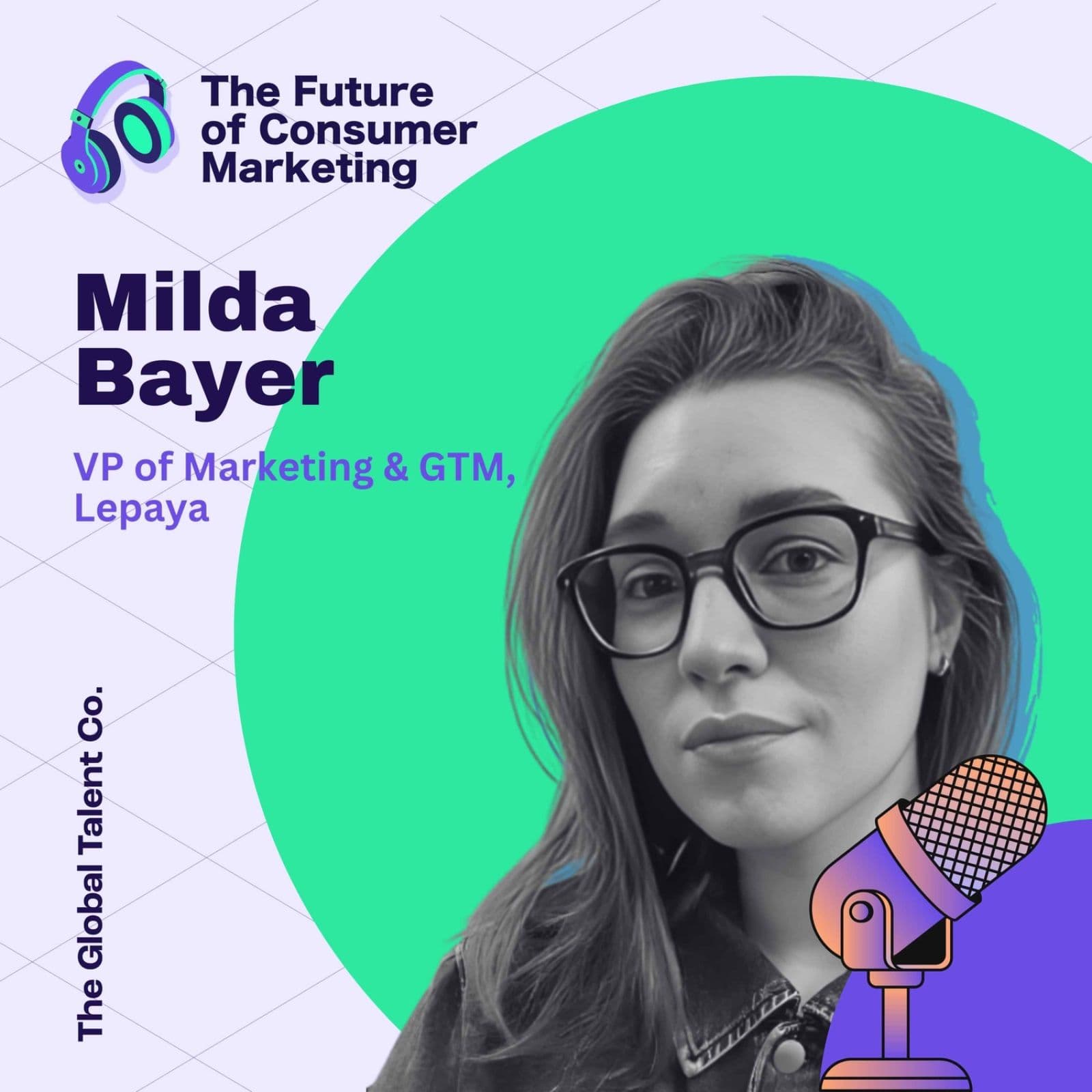
Milda Bayer is VP of Marketing and GTM at Lepaya. She’s worked across marketing roles for 12–13 years, including Achieve (lifelong learning), learning management systems, Mollie Payments (first marketeer), and HR-related work. She joined Lepaya ~3 years ago as the first marketing hire.
Key claims
Marketing shouldn’t be treated as a cost center; it should drive revenue and be measured via attribution (e.g., QR codes/giveaways). In oversaturated content environments, brand experiences and community/physical touchpoints matter more than “AI content” alone. Executives trust thought leadership when it’s backed by data and co-created with key opinion formers.
Notable examples
Revolut airport vending machines for card acquisition; Lepaya’s “learn-practice” model with small groups (6–12), actor-based breakout rooms, “moment of truth” self/peer feedback, and buddy-system follow-ups. Lepaya’s annual “State of Skills” report using anonymized employee data. Lepaya works with enterprises including ING, Maersk, and L’Oréal.
Written by AI. May contain mistakes. Listen to the episode to check what was said.
Chapters
Tap a time to open that second in VOMilda's Marketing Journey
0:45 to 2:36
Milda shares her diverse experience in marketing across various industries.
“Today I'm speaking with Mila Bayer, VP of Marketing and GTM at Lepaia.”
First Marketer Challenges
2:36 to 4:06
Discussing the challenges of being the first marketer in a company and how to demonstrate value.
“So that's how I got into this lifelong learning.”
Communicating with Executives
4:06 to 8:06
Milda explains how to engage with busy executives and stay relevant in discussions.
“So I think being super hands-on is something that convinces every stakeholder from, you know, top to bottom that marketing is worth an investment.”
La Paya's Unique Methodology
8:06 to 11:48
Exploration of La Paya's distinctive approach to learning and skill application.
“and they second and accompany and supplement the data that we're sharing and give their opinions.”
The Importance of Application
11:48 to 14:00
Milda emphasizes the necessity of applying skills learned in training programs.
“It's a huge shout out to our product team that thought of this methodology.”
Revolut's Innovative Marketing Strategy
14:00 to 15:58
Learn how Revolut leverages unconventional marketing strategies to enhance brand presence.
“Where can we put out all of our credit cards?”
The Evolving Nature of Marketing
15:58 to 19:18
Explore the shift in perception of marketing from a cost center to a revenue driver.
“Okay, no, that's going to be a takeaway for me from this episode.”
Leadership Challenges in Marketing
19:18 to 21:46
Understand the complexities of transitioning into a marketing leadership role.
“And I think the revenue sort of very clean marketeers, you know, in the CRO systems, et cetera, become really great chief revenue officers, especially if they're also very sales centric.”
Identifying Future Leaders
21:46 to 26:36
Gain insights into the traits needed to spot potential leaders in marketing.
“sort of these different responsibilities towards the business and towards the business functioning.”
The Importance of Networking
26:36 to 28:00
Discover why networking is a crucial skill for marketing professionals today.
“I had never heard those different traits that you think you need in somebody in order to actually have them become a leader if they're willing to step into those shoes.”
Show all 14 chapters
Building Authentic Relationships in Marketing
28:00 to 29:06
Learn the importance of authenticity and community in modern marketing.
“That is a great skill that will set you apart because in the age of AI, a lot of things are becoming commodity, you know, to produce content.”
Career Advice for New Marketers
29:07 to 29:45
Discover key advice for navigating the early years of a marketing career.
Embracing Change and Staying Resilient
29:46 to 31:36
Understand the significance of resilience and curiosity in a changing market.
“sorry day off that's a heavy question but you know it's i think it's rather simple and I don't think it's groundbreaking, but it won't last long.”
Exploring Opportunities with Lapaya
31:37 to 32:53
Learn about Lapaya and how it supports career development.
“always close through and and it's super important to not waver so totally agree with that advice And before we finalize the episode, Neil, would you like to tell the audience how they can learn more about Lapaya?”
Transcript
Automatic transcript. May contain errors.0:00Today I'm speaking with Milda Bayer, VP of Marketing and GTM at Lepaia. We are a people's development company that's providing trainings through a blended training platform, making sure that people can learn, practice and apply right skills, right time, right place. What do you think is something that was believed about marketing five years ago that you disagree with nowadays? Every stakeholder in the beginning always thinks marketing is just such a big investment. I'd say marketing is not a cost center. Marketing drives revenue and I think more marketing leaders should embrace data analysis and measurement of what is my ROI.
0:39What revenue do I bring in?
0:51Hey everyone and thanks for listening. Today I'm speaking with Mila Bayer, VP of Marketing and GTM at Lepaia. a L &D technology and power skill training provider that was founded by Rene Johnson and Peter Kuperus with a vision to connect people's potential to business impact. So how's it going, Milda? It's a pleasure to have you here. Andrei, yeah, thank you so much for having me. I was excited to connect with you today and it's going really well. So thank you for having me on the podcast. No, this is great. It was amazing that we were able to connect. And Milda, just so the audience gets a better feel for who you are and what Lepaya is, Could you give us a little bit more context and an intro about yourself?
1:31Of course. So I've started my journey in marketing a little bit more than 12, almost 13 years ago. And it brought me to sort of my career path because marketing for me was sort of a lifelong journey. I moved from Lithuania. I moved to the Netherlands. And the only path forward for me was, well, get a job and survive and support myself throughout my studies. or go back home. So I got my first, I landed my first marketing gig with a lifelong learning company called Achieve at that point while studying and my marketing journey started there. So then I moved on into a sort of learning management systems where I was always the first marketeer who worked with product and developers.
2:20So imagine how hard that was when you have to work directly with developers who are extremely critical of everything that you have to say about your product and product managers also almost, you know, very kindly bashing you and being very critical about how you're representing the product. So that has also been challenging. I've been there for almost four years. So that's how I got into this lifelong learning. I switched to payments, actually. So I was the first marketeer at Mollie Payments, which is one of the biggest payment providers in EMEA today, which is also really great to see. And then I've been through a little bit of a journey where I've ended up again in HR space.
2:56And I've landed in La Palla around three years ago. Again, as a first marketeer after a few failed attempts to build marketing teams. And since then, it's somewhat stick. So at La Palla, we are a people's development company that's providing trainings through a blended training platform, making sure that people who are training new skills can learn, practice, and apply right skills, right time, right place. And we work with really, really big enterprise companies like ING, Maersk, L 'Oreal, etc., etc. And of course, smaller scale apps that are looking to upskill their workforce at scale. So that's what we do.
3:33And yeah, that is my journey so far. Oh my God, that is so cool. And Mila, I had no idea that you were like such a marketing pioneer within the companies. Like, that's amazing. And when you're like the first marketing person at a company, how is it that you're able to like show your worth before you have the results to actually prove it? oh that's a really really good question and you know the answer i think is quite basic so i start by even though there's nothing there's always something to do an audit from like you can always audit something and see what works what doesn't so whether it's your ideal customer profile whether it's your product whether it's um you know sales as a channel so i think being analytical is what creates a moment for you to shine and i think every marketeer who comes in as like a first marketeer needs to first and foremost bring in their analytical and critical skills and assess what works what doesn't within that particular space and time because companies exist for a reason and the company managed to generate certain level of arr in order to hire you as a marketeer most likely so there is something that works there and there's something that doesn't and this is where you start looking for your opportunities so i think as a marketeer who comes in first, you always need to be analytical, critical, and then extremely opportunistic because in order to, you know, make sure that at one point you build up the resources that you need, you need to be able to sort of capture opportunities all by yourself.
5:05So I think being super hands-on is something that convinces every stakeholder from, you know, top to bottom that marketing is worth an investment. So that'd be my primary recommendation in how to look at it. I know. I love that. And I worked in PwC for about three to four years. And I just remember that there is always something that you can audit. Like there's always something that needs and can be reviewed where you can get and match a control or see if there's any risk and how you can make the process better. So I totally empathize with that. Totally. And when we reviewed Lapaya's profile and stuff, I saw that you work with like huge companies.
5:43You mentioned BCG and IGN. And how do you figure out how to talk to executives who think a little bit differently than you? oh yeah i like i won't lie to you even today it's a little bit of a struggle because the topics for executives change constantly so almost every three months you have to maintain this thought leadership that they trust um you know with for example we speak a lot with chros these people are extremely busy uh they don't have a lot of time on their agenda And their priorities are shifting from budgeting for the workforce to benefits to, in the end, how to strategically make sure that you can bridge all of the skill gaps.
6:32And how can you do performance cycles much better? So these topics are super various. And it means that you need to be on top of your game and know your niche. This is how I believe that we are driving the conversation. So we focus a lot on sort of merging strategy, which is for us, we know that no one knows how the future of work will look like in the age of AI. That is the reality. There is no silver bullet to solve that. Therefore, we as the brand, we choose to invest in our own data infrastructure and analyze anonymized employee data in what skills are up and coming. So like once a year, we have a state of skills report that works really, really well about informing executives on, you know, what are the skills that are up and coming?
7:15what skills are necessary to thrive in certain industries, etc. And then we make sure that we merge that thought leadership with a little bit of speculation. So we obviously look into what does Microsoft do? What does Slack do? How do they deal with these problems? And then we tend to speculate. And with that, then we utilize the tactics of working with key opinion formers. So our audience is also our key opinion former. So if they believe in the thought leadership that we are driving, they also therefore believe in the cause. And because it aligns with their interest and their job, we also give them a platform, a stage to express their opinion and share what do they see within their organization.
7:59So most of our research features five to 10 different key opinion formers who are most of the times executives that we want to work with. and they second and accompany and supplement the data that we're sharing and give their opinions. So as a brand, we make sure that we're very open, that we also don't know everything, but we're also very open that the future of work is so ambiguous that the only data that we have is the data of today. And the leaders that are driving the future of workforce in the end are the leaders that we're working with and we would want to work with. So in that, it somewhat becomes a co-creation with the executives.
8:42And the executives become also not just the target, but they become the driving force behind our brand, if that explains. Yes. Now, of course. And I get that LaPaya serves as an L &D platform for different companies. And the fact that you take your client's opinions and base that feedback on what you make and improve or how you're going to change the platform, I think that's very smart. And I just can't help but wonder, Mila, in your opinion, what is it that sets Lipaya apart from other L &D platforms that companies might use or like your competitors? What is what you believe that you bring differently than others?
9:20The answer is super simple for me. So it's our methodology. So when you think of like LinkedIn learning, you know, it's super self-paced and it's great. You know, as an individual, you want to learn, you'll go and learn and maybe you'll apply the skill. Maybe you won't. With most of our competitors as well, you can access the learning materials. You can even get trained, but the application of skills will never be guaranteed. With La Paya, that's very different because of our learn practice supply model. So before any training, you get access to the La Paya app. You get access to all the training material.
9:56You do a self-assessment. Your peers can give you feedback as well on what skills should you work on. You can reflect on that. And before coming into a training, whether it's face-to-face or online with a trainer, and it's always in pretty small groups, 6 to 12 individuals, you are also coming there to not just learn theory, but to also practice your skill because La Paya is also offering actors. So we sort of make breakout rooms where people can bring in their challenge that is related to their skill to the classroom and actually practice the skill on the spot in smaller groups. And then we also measure application.
10:37So you set your moment of truth. So before your training, you say, if I were to be able to give feedback to my peers better, it means that I've achieved my goal of acquiring the skill and I will have a better, for example, I will be better at functioning in my position at work. Okay. So you can submit this moment of truth within the Lapaya app. And because of our buddy system, after each training, you also check in on how's that going? Have you reached that moment of truth? So LAPAI also guarantees impact and skills application, which is why it's so different from any other provider. And I think the more exciting thing about it with our portal right now that we've recently launched, you can also identify what skills will this person or this group of people will need to learn in the future.
11:25so that's how so it's not just training it's really sort of predicting impactful training and learning that engages people and ensures the practicing of the skill and application because when you just go through linkedin learning yeah it's fun but it's you do it in isolation so la palla is the opposite of isolation i would say and that's how we're really really different okay no that's amazing and like me personally i'm a very kinesthetic learner so i need to actually do the task rather than just read about it or just do a test i need to like practice it a while like in the in the what's it called like during during the the office hours or what i need to do but what i do found amazing and so nice is that it walks along with the with the students or whoever's learning it goes along with them the whole way from just logging into the platform to the application i had never heard of that and it really does set you apart so nice so nice thank Thank you.
12:22It's a huge shout out to our product team that thought of this methodology. I think without the product team, the brand also wouldn't be as thought leadership driven as our product is. No, I think about how many online courses I've done that I've got it 100 % and the certificate after I completed the training, but I never actually got to apply it. And that's the key word there. It's the application. So it's lovely. It's lovely. and okay let's get a little bit more general now what do you think is the biggest marketing myth that's costing companies millions right now all right so it's the opportunity cost that i'm going to be talking about because it's the under investment in brand activities i think a lot of companies are still looking into how can we invest in like ai sdrs how can we get performance marketing going paying the google tax as i call it sometimes how can we make sure that we rank better etc so however today in today's world where it's like we are oversaturated with content like if you're on linkedin or anywhere else and lll marketing it's all just content content content of course being i wouldn't say you know spat out at a user at the end but it is it just out so much content where we're competing for the digital you know space almost and brand marketing is what a lot of brands sort of a lot of companies don't invest in effectively because they think well there's still so much to do on youtube marketing there's still so much to do on influencer marketing and yes there is but when you think of brand marketing campaigns and even looking at like older playbooks.
14:06And I think utilizing those, I think Revolut is doing that really, really well today where they thought, look, when do people want to use Revolut is when they travel because they don't charge any extra charges when people pay abroad. Where can we put out all of our credit cards? So they did vending machines at the airports. That is not typical marketing. That is brand presence at international airports where people can simply acquire a Revolut card, which means Revolut acquires a user. And there's so many of these sort of old school methods that many companies are under investing. And that's why I think we should see opportunity costs rather than like simply missing out on revenue.
14:54I think that's why I find that in the age of AI, when everything's so oversaturated with comment on my LinkedIn post GTM and I'll send you a landing page about it. It doesn't create that sort of community feeling, doesn't create the brand experience. And I think today, anything that creates a brand or community experience, especially community events, gatherings, and sort of old school marketing. I think people, until today, people really love merch. If it's well executed, people love merch and they will always wear it. So it is a walking, talking marketing for you, which we today still tend to underinvest in.
15:36And I wish that more companies would find the Revolut ways in how can we sort of understand our users so well and their pattern and behavior so well that we can create a brand experience at the touchpoint where it matters most. So I think that's an opportunity that companies should not forget about. Okay, no, that's going to be a takeaway for me from this episode. The brand experience and the touchpoint that matters the most. That is amazing. And I do imagine it, like have you used Revolut as an example? Like if I needed to really pay for something and I found a way to get a card, I'm going to love that brand.
16:13It's going to be like, oh my God, guys, you guys saved me when I needed you. So it really does make it a lot more personal. And I totally vibe with the community aspect of what you're talking to because I see that a lot of companies who I feel are doing it well, they're creating this just like they're creating just that for example there's here the polenta in it's a party uh company in argentina and they're creating not just parties at night but they're making these coffee rage and they're getting into all these new trends that make people get together they give you the little um what's it called it looks like the stanley cup they give you your own polenta cups when people carry it around so it's all about that merge and i feel that i feel that it sounds very nice exactly exactly we have the same thing actually in Berlin, I would like every people are even making the business, not the communities, but making newsletter out of communities and getting communities to sponsor newsletters today, because we have so many community goers that could recommend the community event that it's becoming its own sort of business opportunity to even have a newsletter and visit all of the community events for the brands.
17:21It's crazy. It is. It really is. And Mila, now that you were mentioning that, you've looked at old playbooks and you feel that something like that has been lost in this new age of marketing that we're entering with AI and everything else. What do you think is something that was believed about marketing five years ago that you disagree with nowadays? That it's a cost center. Okay. I think everyone, every stakeholder in the beginning always thinks, well, marketing, it's just such a big investment. You need a big marketing team and you need to invest so much money in order for marketing to work. And you also won't always be able to quantify it.
18:02It comes back again to the brand experiences. How can you quantify someone's experience at an event? But I do think today with the attribution models, it's getting easier and easier. For example, today, I know exactly how much marketing at La Paya brings in as revenue and pipeline. And that can be done really well with attribution, with little QR codes, with little giveaways. It can be really, really, really well quantified. So I'd say marketing is not a cost center. I'd say marketing is not also, it's not a sales overhead cost. Marketing drives revenue. And I think more marketing leaders should, I think, embrace the data analysis and measurement of what is my ROI?
18:52What revenue do I bring in? Because I think marketing, as any other department, should own their own profit and loss analysis and should understand of, you know, my euro in, how many euros back do I get for that? And I think some marketing leaders sometimes shy away from this, but I see that more and more marketing leaders even become CROs at one point, because I think marketing operations also leads to revenue operations. And I think the revenue sort of very clean marketeers, you know, in the CRO systems, et cetera, become really great chief revenue officers, especially if they're also very sales centric.
19:31So I say marketing is not the cost center. Marketing drives a lot of revenue and marketing always needs to embrace their collaboration with sales, no matter how hectic it is, no matter how critical it can get sometimes between the teams. Embrace the chaos and drive this together. okay okay and now that i'm hearing you how you talk about the marketing leaders and how sometimes they are even passed on into cro's i see that you've been the first marketing person at several companies and when you went from being on a team to being the one leading the team that i imagine you kind of created with time what's the hardest part of that jump that you felt nobody warned you about oh i think the hardest part is that you'll be alone in the beginning just feeling alone because marketing is a little bit of a mixture of art and science okay so and i think when you're talking to like revenue leaders sales leaders it's all about like spreadsheet you know what is in the spreadsheet and marketing is also like it's somewhere in between product and sales it's also sits a lot with the in the founder's head or in the founding team's head where where do you want to take the brand where do you want to take the company what are your investor expectations etc so marketing is that sort of mixture between art and science and in that gap in the beginning you always feel quite alone which is challenging because you're trying to be the sparring partner for so many different profiles which have completely different ways of communicating completely different ways of documenting the outcomes and how they want to work together.
21:13Because to be honest, like from the beginning, I've always experienced that a sales leader always want to have a conversation. How many MQLs did you generate? How many sales qualified opportunities did that bring? And what revenue, what pipeline are we bringing there? And that's always sort of like a CRM and spreadsheet exercise. When you're talking with a visionary product leader or a founder, they want to see something visual. They want to be wowed. They want to hear a story. So it's very different to how you need to work with these leaders. And overall, they're all sitting together. So you are always that bridge and you're always bridging the gap between sort of these different responsibilities towards the business and towards the business functioning.
21:52And you always feel alone in the beginning. And my recommendation here always is, you know, it takes a village. So you need to have your external people that you can have a conversation with you need to get inspired and i would always recommend for everyone like you need to listen to podcast read connect have a digital coffee real coffee you know invest in your network because that what what will help you sort of stay not just saying but also really on top of your game because it can be in marketing it can be quite lonely no i i can imagine and marketing more so even when you started being the first person at the company it's like it's all on you and as you started creating the team then i imagine it's what you're saying it does take a village but it does provide a lot of support and when you say it takes a village it just makes me laugh so hard because i have the latino heritage and i'm actually from venezuela and you know it it takes a village type of raising is something that is very popular here in latin america so i totally i totally sympathize with that as well.
22:59And talking about that, about how you've grown teams at different stages, how you've helped them to understand and get better with their skills, their marketing, how do you spot when somebody's ready to become a leader? I have to say, I want to be very grateful here for a few founders that I've worked with in the past. I've worked in the recruiting company, actually, where I was the head of marketing called accelerate and i want to give a huge shout out to isabel striland and uh and uh michael farley two founders that really taught me in how to spot as they always call it a players so they always said you need to either hire or within your team spot people that have the energy the potential and sort of the the depth so people that want to get deeper all the time so energies it matters because when push comes to shove and when things get hard, you need to step back up and you need to be able to not just carry yourself, but you might need to also carry other teams and their opinions and their challenges.
24:05And you might need to help other people solve problems. So that energy is really, really important. The potential is something, it's almost like your curve, your learning potential, your ability to take feedback, your ability to give feedback, like your ability to almost operate in ambiguous spaces, but also, you know, maybe very direct spaces, maybe very, you know, volatile. So that potential is really important because that's your growth curve. That's how you are going to respond to whatever is happening around you. And death, I think, happens through these analytical skills, through being able to understand and analyze of what impact do I have and what impact does what I do have on the end goals and end outcomes.
24:54And I think that people who are reflected and are capable of receiving and giving feedback constantly, and they want to know more, so curiosity, and also shout out to Jim, our current fractional cpo he always said people who are curious will always win and that's true um because with curiosity you'll never stop learning um and you'll always bring that potential that energy and that depth with you so i think if a person is showing these qualities and i even like you might ask why i'm not mentioning expertise of course instead of jobs expertise is crucial you know like I wouldn't want a lawyer doing a surgery for me.
25:41That's not something that I would want. But in some jobs, it's really about learning. Like we human beings were born to learn. So that's something that, you know, as long as you're curious, as long as you have potential energy and depth, you can like the sky's the limit. And I think then you can become a leader. And I also want to maybe give a shout out to all individual contributors because in order to lead a business, You don't have to be a team leader. You can also be an extremely strong principal and individual contributor who's steering the company direction. And these people are very, very, like, overlooked.
26:20And I even sometimes tell myself, how fun would it be to go and be, again, you know, that one person who can advise, who can help, who can steer direction? Because individual contributors are very often overlooked and we shouldn't. And so also shout out to all individual contributors out there that are steering and leading the organizations with their indirect force. Okay. I know that's beautiful. I had never heard those different traits that you think you need in somebody in order to actually have them become a leader if they're willing to step into those shoes. Them feeling that they're ready because they have all that.
26:59but Milda if you were to start over and once again you're the first person in the marketing team what is a skill right now that you know you have or that you've learned along the way that you wish you had learned earlier in your path networking today it's networking today it's really networking It is the value of your network that can bring you the best opportunities. And it shouldn't be sort of overlooked because while we think that networking is an activity, it's also a skill. Networking requires super effective communication. It requires sort of impactful influencing, which is one of the skills that we have at La Paya and we train at La Paya where your focus is to make sure that you connect with people authentically.
27:50you provide value to them they provide value to you and hopefully you have a very nice authentic relationship that is bringing not just mutual growth but really prosperity to both of you and I think today I would have maybe been a bit less shy when I was a bit earlier in my career and I would have went out there more today I for example go to two to three community events a week if you know that allows and I believe that building those authentic relationships workshops, following up with people, checking if you can support them in any way. That is a great skill that will set you apart because in the age of AI, a lot of things are becoming commodity, you know, to produce content.
28:32It's almost a commodity. It's, I think like five, seven years ago, I was thinking, you know, content marketing was so big and I've invested so much time in building content teams first. And today I would say events, networking, community leaders, those are becoming true sort of pillars of where marketing is going. Marketing needs to be your most authentic foot forward as a business because otherwise you'll disappear in like a sea of homogenous brands and you don't want to be that. it's true there is a lot of static and excessive noise nowadays where it's like if you don't set yourself apart you'll just you'll drown in between so many things that are just so similar that's that's completely true completely true and okay um we're almost at the end of the episode and i know it's your day off so i don't want to take more time but the last question i want to ask you it's more for the audience and anybody who could be listening to this um when we finally put the episode out and it's you could only give one piece of career advice to someone starting today what would completely change how they think about the next five years oh sorry day off that's a very heavy question i have to say sorry day off that's a heavy question but you know it's i think it's rather simple and I don't think it's groundbreaking, but it won't last long.
30:07No matter what you're going through, good or bad, or it's harder times, or it's times when you're struggling to get a job, or it's times when the campaign went bad, or maybe something went extremely well. And you're hoping that you'll be able to bank on that success in the very near future. never forget that things don't last long so curiosity embrace your curiosity and you know take it with you know that stride because nothing ever lasts long especially in marketing especially in commercial technology is penetrating you know our space more and more the market is getting generally quite saturated because there's also just a lot of super talented people out there let's say also not just in email like i see a lot of people from argentina for example coming to Europe here and setting up really great businesses and doing awesome things and bringing out uh yeah experiences that um you know I wouldn't have think uh like thought of because it's just so different you know in different regions so I would say you know no matter where you are in your career no matter if you're starting today or you're pivoting today whatever you're going through it won't last long and just stay curious and don't give up i think um because yeah it can be discouraging at times um but the most important thing is that you stay true to yourself and and continue staying curious okay perfect you heard it here first guys just always remember to stay curious and i totally agree with me because when times get hard resilience is something that will always close through and and it's super important to not waver so totally agree with that advice And before we finalize the episode, Neil, would you like to tell the audience how they can learn more about Lapaya?
31:52If they're a company owner, how they can investigate how to maybe incorporate Lapaya to their L &D? Is there something that you would like to tell the audience about that? Of course. Thank you so much for creating space for that. So I think you can check out LAPAYA by going to www.lapaya.com, where you will find everything about how we are supporting many, many organizations and individuals in achieving their career goals and making sure that they have the right skills at the right time, at the right place for the most impact. and whenever you want to connect find me on linkedin milda buyer or if you want to connect directly with the founding team renee jansen you can find him on linkedin as well we are super excited to connect and have a chat so let's make sure that we continue this and let's make sure that you know the workforce future gets less and less ambiguous because we know more and more by setting the trend of where it needs to go through learning and impact.
32:54So yeah, thanks for creating the space, Andrei. No, for sure, for sure. No problem at all. We exactly want people who listen to this podcast and who hear this episode, if they are and want to be curious about what Lephaya brings to the table, then just feel free to follow the directions that were given by Milda. Go to the Lephaya website, go to LinkedIn, make sure to just connect with her. Very nice team, very nice person. And without further ado, it has been amazing, Milda. Thank you so much. Thank you.
From the publisher
In this episode of The Future of Marketing, host Andres Figueira speaks with Milda Bayer, VP of Marketing and GTM at Lepaya, a people development company serving enterprise clients like ING, Maersk, and L'Oréal. As the first marketing hire across multiple high-growth companies including Mollie Payments (now one of EMEA's largest payment providers), Milda shares her playbook for building marketing functions from scratch in B2B environments. Her approach centers on transforming marketing from a perceived cost center into a measurable revenue driver while navigating the complex stakeholder dynamics that come with selling to C-suite executives.
Topics Discussed:- Proving marketing value as the first marketing hire without historical data
- Building thought leadership content that resonates with busy C-suite executives
- Creating co-creation models that turn target customers into brand advocates
- Balancing analytical rigor with creative brand-building in B2B marketing
- Leveraging old-school marketing tactics in an AI-saturated landscape
- Scaling authentic networking and community-building strategies
- Identifying leadership potential using energy, potential, and depth frameworks