
 Ask ChatGPT

 Future of Consumer Marketing
26 Jun 2025 · 37m · 14 chapters
4Ocean’s mission to remove ocean plastic, how it scaled (bracelets + B2B), and how Facebook’s content throttling in 2018 (labeled “political”) and later iOS 14 changes crushed their growth—forcing a pivot to diversified/organic marketing and a stronger B2B focus.
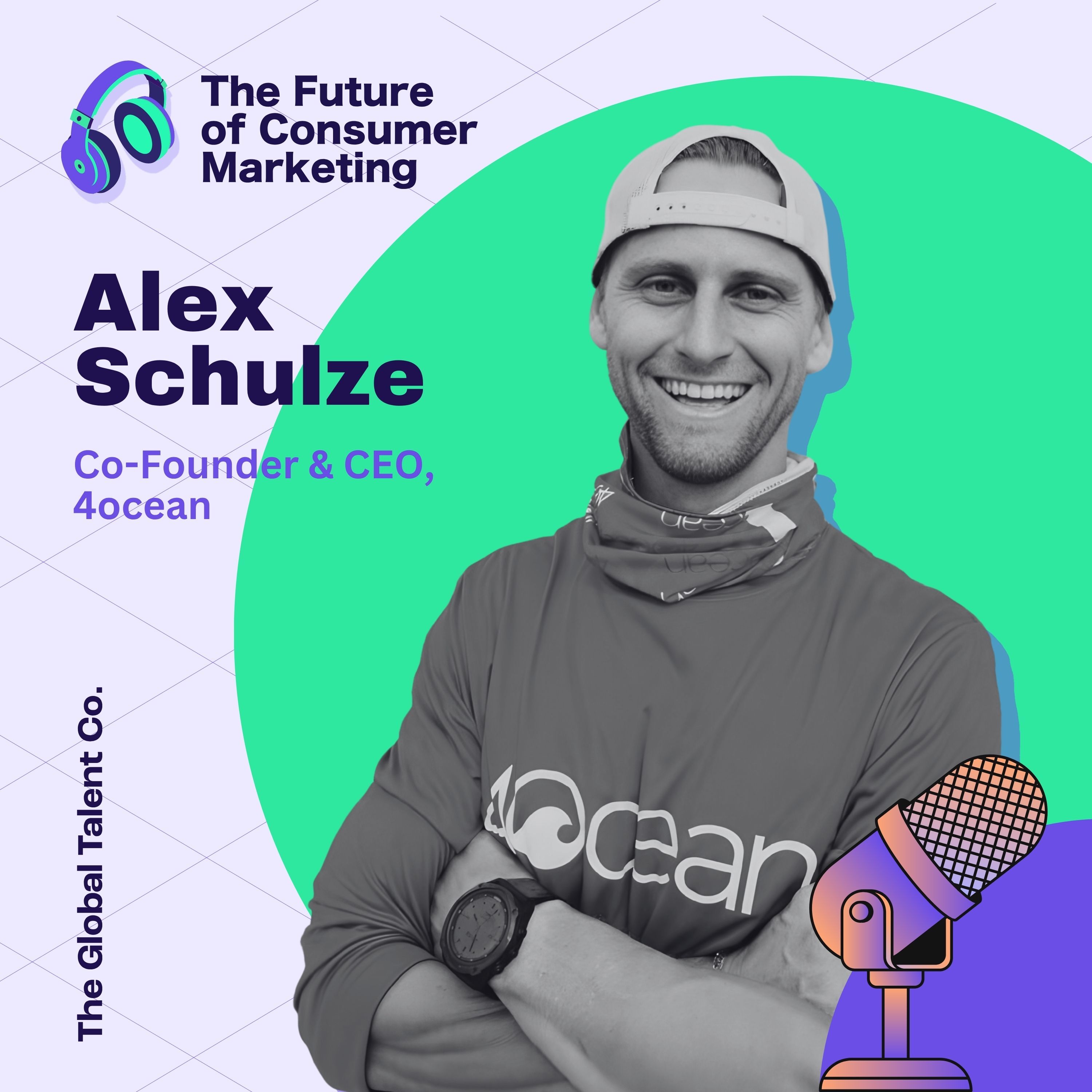
Alex Schulze, CEO and co-founder of 4Ocean. Background: started after a 2016 surf trip to Bali seeing plastic pollution and fishermen struggling; built a vertically integrated cleanup operation employing captains/crews worldwide.
4Ocean has removed 41+ million pounds of trash; 34 billion pounds of plastic are estimated to enter the ocean each year; “can’t clean your way out” without stopping plastic at the source; Facebook suppression dropped reach/exposure ~95% and cleanups stalled.
four ocean bracelet “one-for-one” (pound removed per bracelet); viral Facebook pages (NowThis, Unilad, etc.); Haiti health crisis leading to Crohn’s/ulcerative colitis and later type 1 diabetes.
Written by AI. May contain mistakes.
Alex Schulze shares the origin story of 4Ocean and its mission.
“Where did this idea begin that you were going to go out and end this plastic waste crisis that we have in the ocean?”
Discussing the complexities of operating a plastic cleanup business.
“I have to imagine this is not easy work.”
Exploring the staggering amount of plastic waste entering the ocean.
“Maybe this will be a depressing question.”
Understanding the challenges of waste management and sustainability.
“Which of those steps is the most difficult?”
How 4Ocean marketed its products and built a community around its mission.
“So I would say, yes, that is one of the most complex things that there is going about it.”
Discussing the impacts of political designations on 4Ocean's marketing efforts.
“businesses still dominating in the way that they were in like the 2017 kind of timeframe, frame, or has it shifted more to like the individual creators and the individuals themselves?”
Learn how Facebook's labeling affected the growth of 4Ocean.
“And so what ended up happening was they labeled us as a political organization.”
Discover how 4Ocean adapted its marketing strategy after losing Facebook as a major channel.
“You know, obviously when you lose your main channel or a major channel for growth, that can be crippling.”
Understand what the current marketing mix looks like for 4Ocean and their focus on organic channels.
“And what's the marketing mix look like today?”
Explore how 4Ocean is dealing with the challenges of greenwashing in the consumer market.
“focused on building relationships and scaling our cleanups.”
Learn about 4Ocean's future plans and sustainable practices in the face of market challenges.
“Like the amount of companies that are going under, the amount of companies that have struggled.”
Learn about the challenges and motivations behind creating an impact-based business.
“we are spending so much time, energy and money on that.”
Explore the personal health struggles that come with entrepreneurship and their impact.
“This has been a long, long journey that is a legacy brand that we're trying to create the impact.”
Discover the long-term vision for expanding cleanups and promoting sustainability.
“I don't know too many founders who have literally almost died from the physical health, but you went through it.”

Get the gist, explore an idea or ask about something said.
 Claude
On Future of Consumer Marketing, what are the key points of this episode?
Searching your listeningAutomatic transcript. May contain errors.
0:00Brett Stapper: This show is brought to you by the Global Talent Co, a marketing leader's best friend in these times of budget cuts and efficient growth. We help marketing leaders find, hire, vet, and manage amazing marketing talent for 50 to 70 % less than their U.S. and European counterparts. To book a free consultation, visit globaltalent.co. Hey, everyone, and welcome to the future of consumer marketing. Today, we have a very exciting guest. We have Alex Schulze, CEO and co-founder of 4Ocean. Alex, what's going on? I'm doing great. How's everything with you? All good from my side, and I'm really excited for this conversation.
0:35Brett Stapper: I'm excited because I just really love speaking with founders, builders, entrepreneurs who are building mission-driven brands, solving big problems, and you're definitely solving a big problem. So let's talk about it. Where did this idea begin that you were going to go out and end this plastic waste crisis that we have in the ocean? I appreciate it, Brett. Thank you for having me on. The idea came in 2017 or just before that, around 2016. A buddy and I took a surf trip to Bali. And that's where we saw a crazy amount of plastic pollution on the beaches and on the coastlines there. And, you know, we saw fishermen that were really struggling to deal with this plastic.
1:06It was getting caught in their props, getting caught in their nets. And what we had, the idea was, you know, what if we could find a way to just employ these fishermen to collect plastic instead of fish? And so that's kind of the idea and concept that we came up with in 2017. You know, we had seen very successful models such as like Tom's Shoes with the one-for-one model, Patagonia with their sustainable supply chain, and just said, how do we try and find a way to fund the cleanup of this plastic material? And so we brought that idea back to Florida and we came up with our first product, which was the four ocean bracelet.
1:34And so the four ocean bracelet was made from recycled materials. And for everyone sold, we remove a pound of trash from the ocean. And so that's how we started. And things took off pretty quickly. We were scaled up in South Florida and then moved to Bali, Indonesia, and then expanded, hiring hundreds of captains and crews all around the world. And to date, we've removed over 41 million pounds of trash from the ocean. So very proud of the team's hard work and everything that we've been able to accomplish so far. 41 million pounds.
1:58Brett Stapper: That's insane. That's absolutely insane. It's pretty wild, man. It's pretty wild. And it's backbreaking work. I can tell you, we work incredibly hard, especially being out there in the sun. It's not an easy gig. And, you know, the team does such a fantastic job. And so just very, very proud of all the hard work that we've put in over the past few years. I have to imagine this is not easy work. You're just alluding to like this isn't a SaaS product. It's not software. You're not just selling T-shirts. It's heavy lift on the other side. That's correct. You know, it's you've got every component of it.
2:26And so we started out with our, you know, direct to consumer business with the bracelets. And that was the first about three years. We are solely a lifestyle brand in that sense, you know, selling products. And then we expanded and started to build our B2B model, which is where we're partnering with businesses to implement sustainability programs. And so you're absolutely right. You've got the product based component to it with e-commerce. You've got the B2B side working with brands. And then you have the entire cleanup operations, which is an entire beast in itself, right? So we have been essentially a vertically integrated organization where we are employing and helping employ captains and crew all around the world.
3:03And we're managing everything, the collection, the staffing, the safety, the insurance, the vessel maintenance. I mean, you name it, we are doing absolutely everything just to clean plastic and trash out of the ocean. So it's a very, very interesting job. And no two days are the same, I can tell you that.
3:17Brett Stapper: Yeah, I can see that. On the B2B model side, is it similar to what Plastic Bank does? Not sure if you're familiar with Plastic Bank, but I believe they take the plastic and then they sell that to companies. Is that what you're doing on the B2B side? That's correct. It is very similar to Plastic Bank. There's a few businesses in the space that, you know, people say competitors, but at the end of the day, we're all working on very similar things. And there's more than enough plastic to go around. But some of the comparable businesses are Plastic Bank, Repurpose, Global, Clean Hub, you know, know, some different organizations out there that are basically partnering with businesses to help implement plastic collection of some way or another.
3:51And so that's everything from community collection going door to door to ocean bound collection, which is collected in these different areas where plastic is at risk of entering the ocean and then even ocean cleanup. And that's where we really focus on is cleaning plastic from the ocean as well.
4:05Brett Stapper: You said 41 million, which to me, that sounds amazing. Maybe this will be a depressing question. How much plastic waste is there in the ocean? Like, what are we talking about in terms of the dent that you have to make to really solve this or end this problem? She's a doozy. She's a doozy. I can tell you that the total legacy plastic is almost incalculable, but the statistic that they have, that is an estimation, of course, but it's believed that there's 34 billion pounds of plastic that's entering the ocean every year. Every year, there will be a billionth entry. So the number is just astronomically high.
4:37It is such a problem, Brett, that has to be addressed. And so that's why, you know, all these different businesses that are popping up in the past, call it five years, six years, really. I'm so stoked. I'm so excited to see it because what's happening is that a lot of these brands are helping to, ironically enough, leverage consumer marketing to help connect brands to these different organizations that are doing plastic collection. And so that's one of the main things that we need to talk about is that majority of the plastic that's entering the ocean is coming from land-based sources. And so these different groups and all the different cleanups and everything, all of us that are in this market, in this industry, you know, we're basically implementing multi-pronged approach where we're stopping plastic at the source, through collection efforts and through waste management infrastructure, as well as cleaning it up in the ocean, in the rivers and stopping it before it has a chance to reach the ocean.
5:25So I think that's one of the main things that is so important because, you know, we can't clean our way out of this mess. You're going to be sitting on a treadmill and every single year, you're just gonna be pulling more and more trash and plastic out of the ocean. So there's a famous analogy that if you were to walk into a kitchen and the sink is overflowing, would you grab a mop and start mopping or would you turn off the tap? And so that's where we feel that there's multi-different stakeholders that have a part to play in this global issue. And that's stopping the plastic at the source, stopping it before it enters the ocean, as well as cleaning up the legacy plastic that exists in the ocean.
5:57Brett Stapper: Which of those steps is the most difficult? Is it at the source, getting people to not throw their plastic in the ocean? Is that the biggest problem there? I guess there's multiple ways to answer that. I'd say, yes, that is probably one of the most complex issues. You know, waste management as a whole is a global issue. I mean, when you think about it, between legislation, budgets within these different areas that are operating around the world, you know, the corruption that happens in some of these different places, like, it's very hard. It's very hard to implement waste management infrastructure and to properly recycle or dispose of these materials.
6:29So that's why you're finding in some of these countries, they don't have the means to. And so some of them are not ill-intentioned. They're not out just saying, you know, I don't care about the environment. I'm going to go throw my trash. A lot of them, it comes down to a health issue. And so, you know, we've traveled to many places and we've had many conversations and, you know, had open discussions with people that we've watched. Literally, we're cleaning a beach, we're cleaning up all the plastic, and someone just walks out and just dumps a big, you know, bin of plastic on the beach. And so that was an opportunity to have a conversation and say, like, help me understand this.
6:58Like, what are the motives behind that? And so when they explain, like, listen, there used to be waste management infrastructure. We used to have somebody that would come and collect our trash. That stopped. The budget ran out. Nobody comes and collects it. I have young children. Now this stuff is just going to be sitting around the house. It's going to be causing potentially diseases or viruses, or it's just, it's nasty contaminated waste that will get my family sick. I have no other choice. And it's either put it out here where eventually it does end up going away, or it has to be burned on an open fire pit, which then they get sick from inhaling the smoke and fumes.
7:30And so it really is an issue. I think that globally, it's really hard to wrap your head around because in the US and in developed countries, we're very fortunate to have the waste management infrastructure that when you throw something away, it goes quote unquote to you away. You don't have to deal with it. You don't have to see it. You're not stacking up your trash from weeks upon weeks upon weeks of materials and having dirty, decaying, you know, used diapers and all sorts of stuff just getting nastier and nastier. And so I think that's one of the things that we've really realized is that, But implementing waste management infrastructure, working with these brands and working with these businesses and doing everything we can across the board to really influence consumers to drive sustainable choices within their purchasing power, that's what's going to move the needle.
8:12So I would say, yes, that is one of the most complex things that there is going about it. When you say what's the hardest, cleaning the ocean and cleaning plasticettes in the environment is hands down the hardest out of all the approaches. And what we talk about is kind of on a scale of like community collection door to door is still hard. no doubt about it. But when you think about it, you're going door to door collecting bagged up plastic from someone's home. So there's a certain element of organization and manual labor that comes with that, that is only to a certain extent. Then the next level up is like what we call ocean bound.
8:43That's collecting in the streets and in the gutters. And then, you know, all the different areas that plastic is at risk of entering the ocean. But then you've got like actually being on the ocean and going out and tracking this stuff down that has dispersed over large distances in hot environments and you're sweating and you have to go to these very, very remote places to collect plastic. And so it can be very difficult. So each portion has its role to play. And I think that it all depends on how you go about that. But everybody is contributing in their sense and their role to help address the issue.
9:13Brett Stapper: So going back, you said first three years you were selling the bracelets. How were you selling them? How are you marketing them? How did you get the word out? So the bracelets were primarily sold online. You know, we sold online for the first year and a half. Then we started expanding into wholesale and retail and gift shops, surf shops and different stores, retail stores and things like that. But the primary source of selling our products was through e-commerce. And so videos and social media was one of our main things. So we had a lot of success and we're very fortunate in the early days to have a ton of videos go viral.
9:43You know, we intentionally told the story, you know, showed what we were doing, showed the impact, tried connecting with consumers that shared a similar passion for the ocean. And so what we did is, you know, we're always documenting our impact and trying to communicate with like-minded individuals. And so we are very fortunate. We had a bunch of videos go viral on Facebook. Things really took off. We featured on the Good Morning America Today show, awarded Forbes 30 Under 30. I mean, it took off very, very quickly. We expanded from just two people to a few hundred in a matter of about a year and a half, two years.
10:14So it was a rollercoaster ride. It has been, grabbing a tiger by the tail for sure. And so that was our main component. And I do believe that the marketing was such a crucial piece to that of connecting with like-minded individuals and giving people a tangible way to clean the ocean. Because I mean, at the end of the day, that's one of the main things. It was creating a community of people around the world. And that was our goal. It was creating a global community of people that shared a similar passion and a similar commitment to the ocean.
10:39Brett Stapper: And was the mindset that we're gonna try to go viral? Like, was that word ever used? I feel like whenever I'm in marketing conversations that always comes up from a non-marketer is like, yeah, we just need this to go viral. Like, is that the intention there or was it more accidental that that happened? I think, I mean, 2017, it was like really before the kind of term viral. You know, we never had conversations like, all right, let's go viral. But I think the intention was, how do we get as much reach as possible? I think it was just another way of saying go viral. But yeah, the goal was how do we, you know, when we sat down for a marketing campaign or for, you know, hey, we have this new opportunity, like how can we get as many people involved in cleaning the ocean as possible.
11:16That was always the goal. So yeah, I do think that some of the efforts and some of the things that we were doing, that was the main kind of focus was how do we get as many people to see this as possible so we can clean up as much plastic as possible.
11:26Brett Stapper: I think I can picture what those videos would look like. Like what was that media company called that was huge on Facebook back in the day? It was like Now Media or something. Oh, all of them. So literally there's a ton of them. Yeah, so there was Now This. Oh, Now This, that's what it was. Yeah, Now This, Unilad, Business Insider, Cheddar, higher perspective, shared. There are a ton of pages that just always like, that's what kind of happened. Like with a lot of those different pages, they were all looking for what you would call almost like feel good, really cool stories, people doing awesome things around the world.
11:57And like, just resonating with different people that like have a hope or a dream that want to start something. And so like, we occasionally would just happen where one brand ended up picking it up. And then the next thing you know, it's like, hey, all 15 of these brands picked it up and it's going wild. And now we're scaling cleanups like crazy. And so that was something that really helped out with us. And, you know, I mean, we scaled to not only do that, we were really doing every form of marketing across the board from influencer to paid media, to even running television commercials. You know, we really did it all.
12:25And that was something that helped us to grow the brand and grow the reach.
12:29Brett Stapper: Now, I could be wrong here, but are those businesses still dominating in the way that they were in like the 2017 kind of timeframe, frame, or has it shifted more to like the individual creators and the individuals themselves? Yeah, at least my understanding is that those pages and that kind of traction is almost that it's all been cyclical. I mean, I think that, you know, during that time when we started, that was like the main component of how stories are being shared. But now I think you're absolutely right. It's gone through the TikTok and the short form content type of virality. But I've seen kind of resurgence of Facebook, you know, as of recently, or at least, you know, content that's being shared that has a lot of views.
13:05Like it used to be back in 2017, like it'd be no question to see a video with 50 million views or a hundred million views. And then out of nowhere, it was like that stuff just completely died out and was non-existent. But I will tell you that now it's starting to see like Facebook is almost kind of coming back. And I have no idea what the historical stuff was there, but you know, I know there was a lot of political influence when it came to meta and things like that. Like we actually, one of the main things that we got hit with was in 2018, in the height of our growth, we got labeled as a political designation.
13:36So political organization. It was so crazy. And this actually hurt us tremendously because all of our content ended up getting suppressed. Everything went from like just scaling like crazy. We were growing cleanups like incredibly to like dropped like 95 % in reach and exposure. And so what they said was there was this random time where I think Zuckerberg was getting under, you know, he's really getting a lot of pressure across the board.
14:00Brett Stapper: in the analytical time, right? Yeah. And so what ended up happening was they labeled us as a political organization. And so everything got completely throttled down like 95%. And what they said was it's politics or worldwide issues, such as climate change, social justice, or ocean plastic. If you had any of those things in there, they just immediately just like shut things down. So, you know, that was a big hit for us. So we really struggled there, you know, for a while because we were scaling through Facebook through our reach. And then we essentially got hit with the iOS 14 update, which was like a marketing update, like two, three years before it even happened.
14:36That was like the equivalent of like everything just kind of shutting off. So, you know, like I said, we've had to deal with some various different interesting things, but that was one of the main things that was a big hurdle for us.
14:46Brett Stapper: Could you appeal it and say like, no, no, we're an e-commerce brand. Like, I mean, that seems kind of insane that those are the buckets to like, to combine these issues with politics. Like I understand the attention and the focus, especially at that time on kind of reigning in the political orgs. But to do that for like positive brand like yourself, that's crazy. It was insane. We talked to every single Facebook person. We talked to everybody and all they could do is read off a script and give us their terms and conditions. And it got to the point where I was like, guys, we're growing cleanups like crazy.
15:16And then cleanups just stopped, right? We had to like almost start backpedaling because we weren't growing and we lost so much revenue and so much exposure. So it was tough. We did everything we could, but it never bounced back from a Facebook perspective.
15:28Brett Stapper: And how'd you navigate that? You know, obviously when you lose your main channel or a major channel for growth, that can be crippling. It's probably killed a lot of companies. Like how'd you navigate that and survive and figure out something else? So I think one of the things that we did was just became innovative with our approach. You know, it's ingenuity comes out of necessity, right? And so we realized that we couldn't be so dependent upon one resource or one platform. And mind you, we were like, this is still like the early stages of starting a business. Like we are not this like super, super well-versed, super, super experienced team of entrepreneurs.
16:02Like we're still figuring everything out as we go. It was just like, Hey, this Facebook thing is working really well. Let's rock and roll and let's grow it and grow their cleanups. And so when it got to that point where things changed on a moment's notice, we had to pivot and adapt. And so what we did is we realized that our mission didn't go stale. Like it's not like overnight, the everything that we represent just didn't resonate with potential customers or different people out there in the world. We just knew we needed a different approach. And so what we did was we looked at different channels.
16:29So we just diversified. So looked at influencer marketing, started looking at different platforms to market on. We started testing out television commercials. I mean, we just tested everything. And that's how we created that kind of diversified marketing approach that really helped us to continue to scale and really continue to grow.
16:45Brett Stapper: And what's the marketing mix look like today? if we look at where the majority of the money is going and spend's going, where are you investing? I think today is also a whole nother animal. I mean, you have to play the game for all the different platforms, but our spend is significantly down. You know, we are now primarily focused on a lot of organic channels. So as you know, organic has been one of the main things that everybody has been really successful with across the board. And I'd say that paid channels are a lot less, but, you know, still dabbling with some of the different platforms, but it's a whole different landscape than it was, you know, a few years ago.
17:15Brett Stapper: For organic, how are you thinking about, I'm hearing a lot of different terms, like GEO, AEO, I don't know the terms, like for optimizing for AI. What's the term that you're using? Are you doing that? And what's the term that you're calling it? I mean, to be candid with you, I'm not even sure. You know, there's so many things that are happening with AI so quickly that one of the main reasons to be fully transparent with you that I've been primarily focused on our B2B business model is because I got so sick of having to stay up to date on the newest trend. You know, like we are an ocean cleanup company, first and foremost.
17:47One of our core values is ocean first, product second. And so for us, when we're going through all that stuff with Facebook and all the changes, it was such a rollercoaster ride that, you know, yes, you could have explosive growth and you could have incredible success, but just as fast as it could come, it could disappear overnight. And so there are countless times that it's like you wake up and it's like, hey guys, Google or Facebook just changed their algorithm. We're in an absolute free fall. It's code red, you know, the building's on fire. And it's just like a lot of stress of trying to manage that and just being so constantly up above the trends.
18:17What I didn't like is the amount of capital, but also human capital that goes towards trying to sell a widget. And so I think that's something that we've really slowed down with and why we haven't been as focused on the product side of the business is just because the amount of margin, like I can't tell you how much it frustrated me, the amount of money that we would have to spend on agencies and marketing fees and Google and platforms and Facebook and television. It's like, before you know it, it's like, guys, this is insane. Like, I want that money to go to our cleanups, you know? And so for us, the B2B side has been something where we've been able to work with brands and build relationships, right?
18:52Just one-on-one relationships, get them out in the field, get on a cleanup, spend time together, spend time with their team, help move the needle by implementing these sustainability programs and assist them on their journey in terms of producing their plastic footprint and really trying to get rid of plastic as a whole. So like that's been where it's like, okay, we don't have to be experts at digital marketing to the highest degree just in order to survive. It's a matter of let's stay focused on building relationships and scaling our cleanups. Because at the end of the day, that's the goal. We want to scale cleanups as much as possible, hire more captains and crews, get more vessels on the water and just remove more plastic and trash out of the ocean.
19:28So that's been one of the main focuses that we've had. So like to your question, that's a great thing that actually I feel very good about my answer that like, you know what? I don't know what the best AI marketing thing is for organic. And I'm actually stoked that I don't have to right now. So like, that's one of the things that I think is just in this world is there's so many things going on and happening in the digital space that are constantly evolving that it can be exhausting. And if you have a mission and that's like your goal, like for us, it's clean the ocean. That to me is the right move, like to stay focused on the mission.
19:56But you know, if your product, a consumer products business, and it's like you have to live that space and you need to do that. And that is your world. then by all means, you know, that's fantastic. I just, I'm at a different point right now. And, you know, the fire drills and the constant evolution of things, it's pretty difficult to deal with. And it's nice to really focus in on cleaning the ocean.
20:13Brett Stapper: Yeah, I know a lot of direct-to-consumer founders and that's their life. They're just kind of like walking around all day waiting for the next Google update or meta update that's going to not wipe them out, but dramatically change from what they knew yesterday, which is a very stressful life because you just have zero control. Like that would freak me out about that. It's just not having control. You were placed in an incorrect category and nothing you could do. Like that scares the shit out of me as a founder. 100%. And I think that's one of the things too. Like, I mean, you look at what's happening in the e-com space.
20:42It is a bloodbath out there. Like the amount of companies that are going under, the amount of companies that have struggled. I mean, you know, take here for example, Allbirds. Allbirds when we started was like, they were the dream business. Like, oh my God, dude, sustainable materials. They just built a billion and a half business. They're scaling like crazy. They were the poster child for like building an impactful based business and kind of restructuring and rethinking about supply chain. And I could be wrong, but I think their share price was like over 500 some odd dollars. Now they're down to five dollars.
21:12And it's like, it's just these companies like there's so many, all the mattress companies, all the startups, everything that like was the dream for, you know, e-commerce and direct to consumer are now like almost non-existent. And so that's one of the craziest things that you're seeing nowadays. It's just, it's wild to see the e-commerce space. And I think it's factor-based in by so many things, right? You look at the customer acquisition costs rising, the shipping and fulfillment costs rising, margins, tariffs, like everything that's factoring in, it's just like just constant headwinds that just keep popping up.
21:40Brett Stapper: Yeah, I was curious. I checked their market cap. All birds is 86 million, which is just insane. That's like probably like a series A for an AI startup right now. But what do you think about the brand? Like, I don't even understand how it can be that low because everyone knows them or maybe I'm in like a tech bubble, but it seems like everyone knows them and everyone uses them. That's shocking it can be that low. So crazy, right? Got to be a brutal time. Very crazy. I mean, honestly, like even you want to talk about another crazy thing, look at Pira Vita Bracelets. Pira Vita Bracelets was the company very similar to us in a similar space, similar consumer.
22:13You know, I think that they sold in 2019 for like a hundred million. And just a month ago or so, Vera Bradley divested their company for$1 million. It's insane. It's just wild to see what has happened in the consumer space. And, And, you know, it's really not a lot of these companies' faults. There's so many things that's happening out there that are just factoring into it, making it harder and harder for businesses, especially the e-com world, to survive. Like, if you're not a subscription-based business or a consumable-based business, it's pretty tough to survive, I got to tell you.
22:40Brett Stapper: Now, early on, you're doing the bracelets. Did you have in the back of your head this idea of, like, there's a B2B model here? Or did that come later in the journey with that Facebook ban or categorization? Like, when did that start to become an idea you really were considering? So actually, ironically enough, I have an entire idea and vision for 4Ocean ever since the get-go. You know, the goal is primarily to leverage the product-based business as almost like a Kickstarter campaign. So really looking at that as a stepping stone to the bigger picture. And so starting out with the consumer product-based business, eventually scaling into the B2B brand and working with businesses and partners, and also looking at where we're going with our materials.
23:16So leveraging the plastic that we're collecting from the ocean to be used as feedstock for brands. So think of like Gore-Tex, that type of material, right? hey, this product is made with four ocean plastic. That's another component. And then we have a bunch of other options that we're actually, we have a few different things, but like we have government contracts for cleanups. They're small, but we do have a few of them that we tested that business model out. We've looked at it and said, hey, this is an amazing opportunity for the long-term play. And so there's so many different areas of expansion that you can go with four ocean where I love the idea of starting these different verticals and having this entrepreneurial-based approach to figuring these models out.
23:49But basically it's just finding ways to continue to fund ocean cleanup. You know, as well as having a foundation, which we do have a 501c3 as well, but looking at attacking this from every single angle. There's so many industries that have the available means to help scale and drive the impact. And at the end of the day, we're trying to create this lifestyle brand just around ocean conservation and really be able to connect with consumers around the world.
24:12Brett Stapper: You mentioned that marketing spend is way down. What about the marketing team? Is that way down? What does the marketing team look like today? Oh yeah, marketing team's way down. You know, we used to have a very, very large marketing team and it's significantly down. But to be candid, it's the way I like it. Like, I like being focused on what we do. Like, so our focus now is more on brand stories and telling the stories of our captains and crew and, you know, doing all these things. It's not day trading ads and worrying about algorithms and doing all sorts of other crazy stuff, right? Like, I think it's a much better approach in my opinion or at least the utilization of resources, right?
24:43If I get the opportunity to talk about our captains and crew, I'm going to take that every single day. And if it's that or sitting in day trading performance marketing ads and having to obsess over which color made the better click, I'm going to go for telling the story of Captain's Cruise every single day because I think they're doing such amazing things. And that's the goal at the end of the day is really just to be able to drive the impact and share the stories.
25:04Brett Stapper: I mean, that feels like soul crushing work, especially with that comparison of like, tell the captain's stories or sit on Facebook and like, look at the numbers. Makes sense why you'd rather tell the captain's stories. It's a necessary evil for a lot of brands. like I was saying, like it's, I don't necessarily know if it's soul crushing. I just think that certain people get fired up and are passionate about different things. And so for me, like, hey, we're going to go talk about our captain and introduce our fan base and our following to his family and introduce the why behind why he did this and his history as being a fisherman.
25:33And then when he got the job at the four ocean and what he does now and how he used to consume a ton of plastic, but after working with us realizes that he needs to stop that. So he's actually influenced his local community. It's like, those are the stories that give you hope. Those are the stories that I think that like are just awesome to hear. And when you're out there working, you know, shoulder to shoulder with our captains and crew, it's just incredible to be able to connect with them on that level. So it's like, for me, when you talk about a marketing budget, that to me is where it should be going, not necessarily day trading and obsessing over data and analytics and numbers.
26:03Brett Stapper: This is just maybe like an outsider view, but it seems like the industry kind of blew up or there was a lot of attention towards doing good for the environment. And then it seems like some bad actors came in or they were kind of using it for greenwashing, I believe, was like the allegations that were floating around. And then now I don't know if that's tainted the industry, but I know a lot of people consider this greenwashing idea to be a big problem. What's that been like for you navigating that as a brand that is doing the right thing? you do have good intentions. How have you navigated all that?
26:34Brett Stapper: Has that been frustrating to see that happen? Sure, sure. We have not been immune to it by any means. We've had a ton of people try and throw shade and say that we're only in it for the money and we're doing this for other reasons and all sorts of stuff. I think everybody in the space has always come across some form of speculation. I think we've really just stood strong through all of it. We've had a lot of haters and a lot of people saying negative things, but the amount of people that are saying positive things that have interacted directly with us far outweighs it. And I think that's one of the main things is like just trying to stay true to the brand and staying true to the impact and sharing that transparently.
27:11So that's one thing that like, you know, it was a phrase that I used internally with the team. I always just said, guys, kill them with cleanups. Like that was the motto, right? People are going to hate. People aren't going to believe us. They hear 40 million pounds. They say BS, kill them with cleanups. Show them the hundreds of crews. Show them the 18 cleanups that are happening, 24 cleanups that are happening every single day all around the world. Share all the data, show the warehouse, show our recycling facilities, show everything, like show so much content that when someone says these negative things about, oh, they don't think that we're actually doing it, they don't believe it, et cetera, et cetera, or that they think that this has just been a money ploy and that, oh, we've just got stacking our personal bank accounts of millions of dollars.
27:48It's like, go see the amount of money that we're investing in everything that we do and the hundreds of captains and crews that are employed. I mean, we pay our fair living wage. We cover 100 % of health insurance and benefits for all of our cleanup crew. So like, we are spending so much time, energy and money on that. And so I think that the space has really had a lot of speculation across the board. But a lot of the brands that are doing the right thing, they shine through, right? And I think they can stand the test and they can bounce a few of the bullets off and just show like, hey, this is what we're doing.
28:16And this is why we're here. And, you know, I think we're definitely not the first, but we were a brand that was somewhat newer in the space of being an impact-based business. So we're a public benefit corporation and a certified B Corp. And so that was one of the main things that we got is everyone's like, well, you should have just been a nonprofit and you only are doing this for the money. And so that was one of the main things that we got a lot of attention for. And at the end of the day, you know, it's really leveraging a lifestyle brand and creating a business that can have an economic model across the board where we can scale far past anything that we would have been able to do with a foundation and being able to set up these different infrastructures and different economic models to really get funding from almost every aspect.
28:57Because like, you know, ocean plastic as a topic is such a big issue that you need to attack it from every angle. And so that's kind of what we're doing right now is really just expanding and scaling in that sense.
29:06Brett Stapper: It has to have been just a funny allegation to deal with that you're just in it for money. Just from what you've shared on this call so far, the operational complexity, essentially a multiple businesses in one. If you were just for trying to get rich, like there's probably like a billion other ways that you could pursue other than the path that you've taken. So definitely it has to be a deep mission there to put up with all the pain that I'm sure you go through day to day. If I was purely in this for money, the amount of struggles, the amount of health issues, the amount of everything that I've gone through with this, if I was in this for money, I would have stepped out a year and a half in and just sold to like a private equity firm or something like that and just cashed out and walked away.
29:41This has been a long, long journey that is a legacy brand that we're trying to create the impact. And so I will tell you, I think you hit the nail on the head. If it was purely for money, there's a hell of a lot of other things that I'd be doing to drive that impact versus what we're doing here. Because this is a very difficult job. I can tell you that.
29:59Brett Stapper: Every entrepreneurial journey is full of ups and downs. For you, what would you say has been like the lowest down or the most painful down? And how do you navigate that and come out the other side? Yeah, I mean, this can open up a big can of worms, you know, in terms of the time frame that we have. But I've experienced an incredible amount of issues from a health perspective. And so to give you a little bit of background on it, you know, when we first started, we experienced explosive growth, working 16 hour days, going from two to a few hundred employees in a matter of a year and a half. Just great.
30:28It was all energizing, so exciting, so fun, you know, and didn't think anything of it, but working long days. But then when we were scaling our cleanups, you know, we traveled around the world. And so one of the areas that I went was Haiti. So we had a location in Haiti for a while. And so I went there six times in nine months. I'm sorry, nine times in six months. And so I was there just nonstop and I kept getting sick. I kept getting waterborne illnesses. And so on the last time that I went, I never recovered. And so I ended up turning into developing into Crohn's disease and ulcerative colitis.
30:58And so I ended up losing 50 pounds and becoming just so sick. I couldn't be from a few feet from a bathroom. I ended up losing all this weight, became basically anemic. You know, I was deathly sick. It was so, so bad. I didn't really tell anybody about it. I just me and my wife and we were kind of going through it together. But it was a crazy, crazy journey and ended up having so many doctors tell me that I would never heal. And then I had to go on these lifelong autoimmune suppressant injections that I had to take every 12 days. And it was just, I mean, you talk about a mental battle that I went through.
31:29It was wild. And then shortly after that, I pushed through it, diet, exercise, crazy routine, you know, was able to put Crohn's disease in remission, which a lot of the doctors told me would never, ever, ever happen. And then right after that, got diagnosed with type 1 diabetes and esophagitis. And so like, you know, I've been dealing with type one diabetes. I got diagnosed at 31 years old. So it was a very random thing. But, you know, it's come up a huge level of complexity and challenges. Like I'm a pilot. And so I lost my medical for being able to fly. Scuba diving, not really able to scuba dive anymore just due to the instability in sugars.
32:02It's been a huge, huge hurdle trying to manage this across the board. And so there's just been a huge level of health issues that I've experienced and gone through. but I have been militant with my diet, exercise, routine, and just trying to work through that. And so I've been able to put Crohn's disease in remission. And then now with type one diabetes, I'm actually able to wean down where I'm able to not use insulin as a type one diabetic, just purely through by diet and exercise. And so, you know, managing that all while going through, you know, the different things that we've experienced. I mean, at COVID, we got hit for really, really hard.
32:34You know, we had a lot of things happen even around the time of COVID. And so it had been challenging, right? Dealing with the business, dealing with my health and dealing with all these struggles. But I can tell you if there's ever a time to walk, that would have been the time to do it. But still determined, still standing, still fighting.
32:48Brett Stapper: Well, I appreciate you coming on and even sharing these stories and talking about this openly because I think there's a lot of folks out there that just don't really understand the pain of entrepreneurship and certainly more painful for some compared to others. I don't know too many founders who have literally almost died from the physical health, but you went through it. So I think it's important to share because I think there are a lot that just struggle and it's a hard job. I think people like who are not entrepreneurs can never comprehend like how hard the job really, really is. I think you're absolutely right.
33:21And that's something that I always tell people is like, man, don't fall for the stuff on Instagram, right? The people driving the Lambos and the nice dinners and the, oh, I'm just going to start a little side hustle and in a year and a half, I'm going to have millions. Like I think at the end of the day, no matter what you do entrepreneurial wise, you need to be prepared to go through struggle. You know, you need to be prepared to have people steal from you, have things fall apart in the business, miss different events, miss all sorts of stuff. Like it's something that, you know, starting a business is amazing and no doubt is incredible, but just be ready to be resilient.
33:53I think that's one thing to always share.
33:54Brett Stapper: I forget just how like naive you can be in your early years and you're seeing all this stuff on Instagram about, you know, buy a business, start a business, all this stuff. Like I was chatting with my brother-in-law the other day and he's in his early 20s. He's a CPA. And he was like, I'm just going to buy an old CPA firm. And I'm just going to hire some people in India to run it. And I'm just going to have a great business. He's like, just help me understand, why doesn't everyone do this? Why is everyone not doing this? I'm like, man, you have no idea. The pain that you're going to have come your way and the complexities, all of these things.
34:23Brett Stapper: I almost miss those days when you could be that naive about entrepreneurship to think that it was so easy because it's hard. Every business that I've ever been part of, everyone I know that runs a business, they say the same thing. It's hard. It sucks. It's painful. Like those are the words that typically get used. Yes, a hundred percent. And I say that a lot as well. So it's something very comparable. I always laughed at Elon Musk's quote about it. It's like chewing on glass and staring out into the black abyss. Like, wow, that one hits. But the thing is, like, that's one of the components that's so different from starting a business versus just being a part of a business.
34:58It's like, you know, I love it. The way that it was referenced is that being the founder or the CEO, So it is your job to solve the most complex problems every single day. Like that's your job. You have to be looking at where is the biggest business struggling the most? Where does it need the most attention? What are the issues that are not moving slowly? So most of your time is not spent on all the amazing, fun, exciting, crazy growth type of things. A lot of the times it's moving through and helping to assist everything that needs the most attention and help really focus on that. So I think that's one of the things that is always tough and that you need to be ready and be comfortable with kind of, you know, dealing with the heavy stuff and trying to work through it at all times.
35:35Brett Stapper: One thing that I have to imagine helps the fact that you have such a deep mission, such a deep purpose, and I'm guessing that there's a big vision there. So let's end with the final question on the vision. What is the big picture vision here? So the big picture vision is really to expand our cleanups as much as possible. We want to grow a global brand that's employing hundreds if not thousands of captains and crews around the world, removing as much plastic and trash out of the ocean, while simultaneously leveraging a lifestyle brand and a global movement to be able to create a positive change in the amount of plastic that's entering the ocean.
36:07So really, I say it a lot, we're trying to make sustainability cool. We wanna continue to leverage the different mainstream tactics, such as social media, influencers, athletes, et cetera, to try and get as many people involved in cleaning the ocean and keeping the ocean clean. So I think at the end of the day, the biggest vision is to scale different businesses and different means through foundation on how we can have the most impact on the ocean overall and create really a better future for future generations.
36:33Brett Stapper: Amazing. I love the vision. I really love this conversation. Before we wrap, let's give a plug. Where should people go if they want to just follow along with this journey? Sure. So they can follow us on any social media channels. It's the number for the word ocean, or they can go to forocean.com. That's the number for the word ocean.com. Amazing. Alex, thanks so much. Appreciate it. Awesome, Brett. Thank you so much, buddy. Appreciate you having me on.
36:59you
In this episode of The Future of Consumer Marketing, host Brett Stapper interviews Alex Schulze, CEO and Co-Founder of 4ocean. Born from a surf trip to Bali where Alex witnessed devastating plastic pollution, 4ocean has evolved from a simple bracelet company into a vertically integrated ocean cleanup operation that has removed over 41 million pounds of trash from the ocean. What started as a direct-to-consumer lifestyle brand leveraging viral marketing has transformed into a multi-faceted business including B2B partnerships, government contracts, and a global network of cleanup crews. Alex shares the brutal realities of scaling a mission-driven company through algorithm changes, health crises, and the challenges of the modern e-commerce landscape.
Topics Discussed:

