
In short
Episode topic: Parks Project’s strategy for selling “memories, not merchandise” by using park-inspired products plus a grant-based conservation give-back model, and how their marketing evolved from documentary volunteering videos to “inspiration first” messaging and activations.
Guest backgrounds
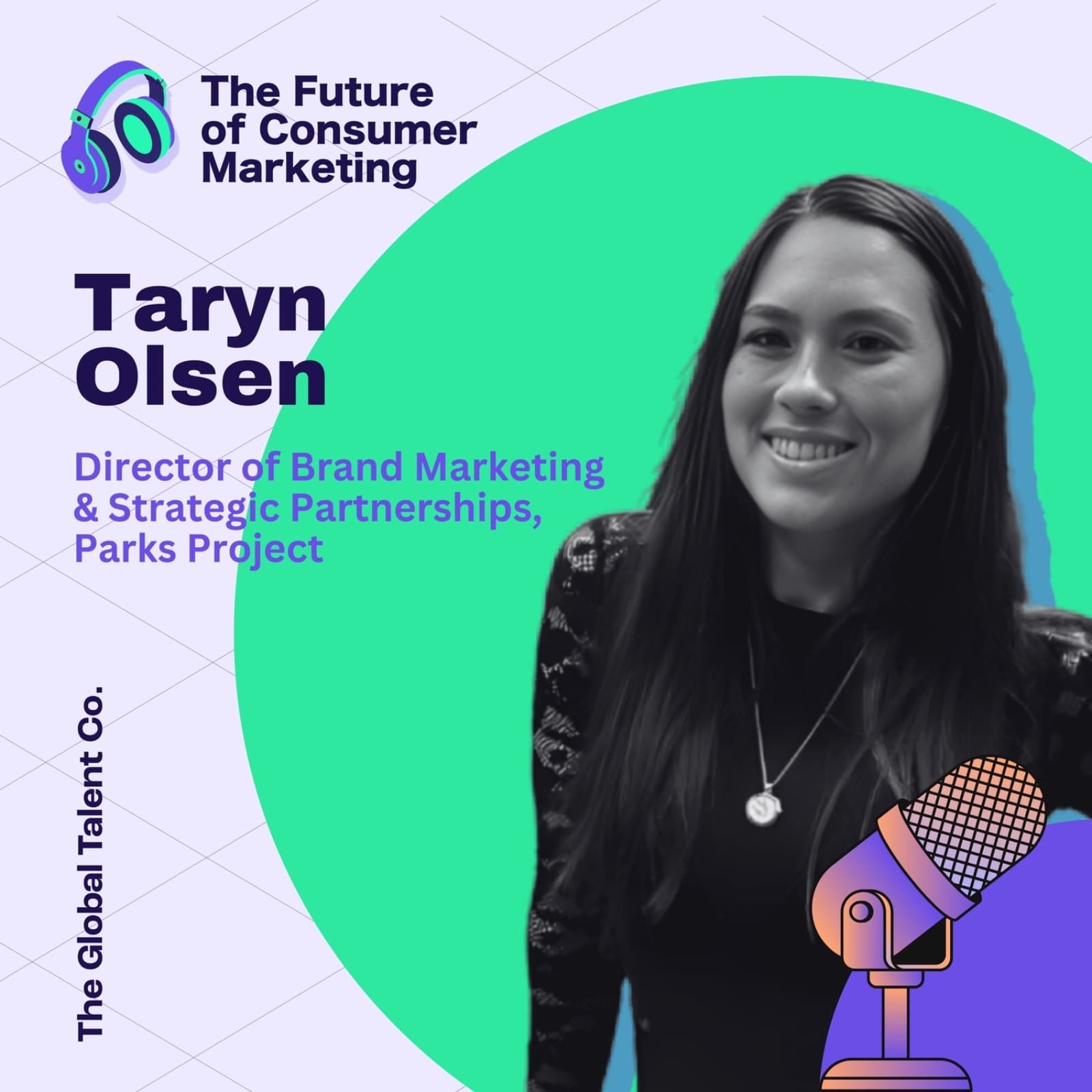
Taryn Olsen, Director of Brand Marketing and Strategic Partnerships at Parks Project; previously started her career at Lululemon in 2007, working on grassroots, experiential marketing (filling Sunday classes) and learning goal-setting/people-investment practices.
Key claims
People don’t want to watch volunteering videos; they feel guilt. Conservation messaging works better when it starts with awe and inspiration that drives emotional connection. Parks Project partners with visitor centers and treats souvenirs as partners, not competitors.
Notable examples
Yellowstone geyser fleece; Dr. Seuss/The Lorax Earth Month collab funding Glacier National Park native plant nursery; Yellowstone landscape posts outperform volunteering content.
Written by AI. May contain mistakes. Listen to the episode to check what was said.
Chapters
Tap a time to open that second in VOTaryn's Journey into Marketing
0:36 to 1:50
Taryn shares her career path starting at Lululemon and experiences that shaped her.
“Why and how did you end up in this world of marketing?”
Lululemon's Cult Following
1:50 to 3:50
Exploration of what Lululemon did right to build a dedicated customer base.
“So that was like kind of a golden era that was, you know, right before they went public.”
Transition to Parks Project
3:50 to 5:28
Discussion on Taryn's transition to Parks Project and the company's mission.
“I mean, everyone that I was around was having conversations about just, you know, not just the meaning of the brand, but like what is the impact that we wanna have on this world, basically.”
Parks Project's Unique Product Model
5:28 to 9:10
Overview of Parks Project's products and their connection to national parks.
“So we make goods that are inspired by the parks and they are designed to give back.”
Collaborations and Conservation Efforts
9:10 to 9:56
Insightful anecdotes about collaborations with conservation organizations.
“In the pre-interview, we talked about that a little bit.”
Marketing Strategy Evolution at Parks Project
9:56 to 12:18
Taryn discusses initial marketing strategies and their evolution over time.
“Now let's talk about your general marketing strategy, your marketing playbook.”
Competition with Souvenir Shops
12:18 to 14:00
Taryn explains how Parks Project views souvenir shops and their partnerships.
“And then we would do something as simple as post a landscape photo from Yellowstone and our social would go bananas.”
Selling Memories: The Emotional Connection to Parks
14:00 to 16:30
Explore how Parks Project transforms souvenirs into memories tied to national parks.
“awe and inspiration, you know, like really sitting in reverence of these places that we are so lucky to get to visit.”
The Future of Consumer Marketing Post-Pandemic
16:30 to 17:55
Learn about the evolving consumer expectations and genuine brand connections post-pandemic.
“We're selling a memory because that's really what somebody wants when they're buying something that says Big Star on it.”
Favorite National Park: Haleakalā Sunrise
17:55 to 19:19
Discover the beauty of Haleakalā National Park and why it's a must-visit.
“And, you know, you see this as Gen Z is like really turning towards this like gritty point and shoot film camera style.”
Transcript
Automatic transcript. May contain errors.0:00Brett Stapper:This show is brought to you by the Global Talent Co, a marketing leader's best friend in these times of budget cuts and efficient growth. We help marketing leaders find, hire, vet, and manage amazing marketing talent for 50 to 70 % less than their U.S. and European counterparts. To book a free consultation, visit globaltalent.co. Hey, everyone, and welcome back to the Future of Consumer Marketing. Today, we're speaking with Taryn Olsen, Director of Brand Marketing and Strategic Partnerships at Parks Project. Taryn, how are you? I'm so good. Thanks so much for having me. No problem. Really excited for this conversation.
0:35Brett Stapper:And how we like to begin these conversations is with the big question. Why and how did you end up in this world of marketing? I would say that I fell forward into it. I started my career really at Lululemon. Shout out to all those people who started at Lulu back in the day. They had a really interesting, amazing corporate culture at the time. And a great manager, Janine Bouchard, saw something in me and decided like, hey, can you help us out with what their version of marketing at the time was very grassroots? It was all about going and finding instructors and convincing them to wear the clothes and come in for a fit session.
1:12And I like to yap. So I was kind of elected that person to go out and really help with that and fill up our Sunday classes. And that was just the very start of it. And I, at the time, didn't know that what I was doing was like grassroots experiential marketing. And so from there, basically, people started seeing that, oh, you have events experience and you have some marketing experience on here. And I just kept getting like sort of raising my hand for the next opportunity. And it has led to a very interesting path to Parks Project.
1:46Brett Stapper:And I think I saw online that was 2007. Is that when you were at Lulu? Oh, gosh. Yes, 2007. That was exactly the time period. So that was like kind of a golden era that was, you know, right before they went public. And it was really a very special time there because I was one of, gosh, it really wasn't that many stores in the US yet. It was like a very like Canada heavy brand. And so it was a trip. Honestly, there are many things that I learned there about management and setting goals that I still use. I still talk about it. I probably make my team sick, actually, talking about all the stuff that I took away from there.
2:27But truly, it was like a real incubator for talent at that time, without a doubt.
2:32Brett Stapper:What do you think they got right to build such a cult following? Because I feel like, I don't know about now, I think their brand has gone through some challenges. But early on, even 10 years ago, it was a cult-like following. What do you think they did to get that right? Oh, man. You know, there's a lot of companies who say they invest in people. Lululemon invested in people more than anywhere else I've ever seen or worked for, without a doubt. Like, I mean, there were so many soft skills that they focused on that really did lead to excellence on the selling floor. But they just got at excellence on the selling floor at a completely different angle.
3:10It was about investing in you and being interested. It's the first place that I worked where we were required to post our goal boards for like the whole team to see. And they really encouraged you like, OK, in five years from now, where do you want to be working? And don't say Lululemon just because that's where you're here right now. Do you want to own a yoga studio? and they were all about like nurturing who you were because their belief really was that like, if you are a fully formed, functional human being and we've invested in you, then you're gonna show up better to work, produce better results.
3:47And honestly, I've never seen it work better than at that brand, really. I mean, everyone that I was around was having conversations about just, you know, not just the meaning of the brand, but like what is the impact that we wanna have on this world, basically. So it was a really interesting way of taking these brand manifesto propositions and really creating a lifestyle from the inside out. So yeah, I think that when you create a lifestyle like that, that's the cult following kind of follows from that.
4:18Brett Stapper:Yeah, it's one of those brands that I'm just fascinated by. I think Trader Joe's is another one. Like any of these brands that can get to that level where people like love something they normally wouldn't say, like I love, like I'm always fascinated by that. So I need to dig in. I think the founder just wrote a book, if I remember correctly. He did. And, you know, I will maybe say something controversial here, which is that, you know, I know that Chip Wilson has gone through a lot and I'll just kind of avoid those topics. But what I will say is I think there is definitely something to be said about brands and a charismatic leader who really has a vision.
4:51And, you know, I think you can see that with Yvonne Chouinard and Patagonia. There's a million examples, you know, Phil Knight and Nike. And, you know, I don't know that I would necessarily say like chips right up there. But what I certainly would say is he had his own thoughts about how a brand should be built. And he was very committed to that world that he was building. And I think when you have singularity of vision like that, it pays off and it absolutely flows down all the way to the brand. Like, no question.
5:24Brett Stapper:I'm going to skip ahead a little bit now to your current role. So Parks Project, what does the company do? Yes. So we make goods that are inspired by the parks and they are designed to give back. That's sort of the easiest way to say what we do because that encompasses a lot of things. We make home goods. We're famous for our mid layers, like fleeces and things like that. And all of those take inspiration from the beauty and awe of the national park. So one of our, you know, calling cards, the things that we've really been become known for is our Yellowstone geyser fleece, which is it takes inspiration directly from those geysers in that park and translates that into an all over print, which then now you're like sort of wearing a piece of the park when you go out.
6:09But it's not necessarily what you would find if you're going to a visitor center and you want to buy a graphic tee that just says Yellowstone across the chest. Right. So it's a little bit more nuanced and sort of fashion informed and driven, like fashion trend meets outdoor, you know, national park love, basically.
6:29Brett Stapper:So it's not like the I Heart NYC type shirts that we see in a souvenir shop. And actually, that was one of the original insights for founding the company was you go to these national parks and you want to take home a souvenir. But then so much of the time you end up with something that you probably wouldn't have bought anywhere else, you know, but because you're there. And the two founders of our company really were like, we feel like there's something here. Like people love these places, but they want really rad gear that represents them, not just like the Lisa Frank dolphin, you know? And I know that there is a specific model, a very special model behind what you do.
7:06Brett Stapper:Can you tell us a bit more about that model? Yeah. So what we do is we sell goods that then give back. And what I mean by that is we work on a grant model. And this is where you get to see a little bit of the guts and inner workings of how we have to message this. There's all kinds of very interesting legal red tape around saying things like a percentage of profits go back to. So in order to make sure everybody's happy with us, what we usually do is decide on a conservation partner that is sort of represented by particular collections. So I'll give you a specific example. We recently did a collaboration with Dr.
7:48Seuss and their property, the Lorax. I mean, it was a supernatural fit for us. And we did that for Earth Month this year. And together with the Dr. Seuss team, we decided that Glacier National Park, they have a really beautiful native plant nursery that needs funding. It's underfunded just like everything else in the parks. and they do a lot of preservation on endangered tree species in that park. So it was a really nice storytelling fit. And then also obviously just like felt really good to give back. The people at Glacier National Park Conservancy are the best. They are truly one of the best teams out there.
8:29And it was really fun to get to reward them for that work. So that's usually the way we kind of set the year out roughly a year ahead or more where we say, okay, we know these are the collections that are coming out. We know that, for example, this collection is taking inspiration from the Great Smoky Mountains or Rocky Mountain National Park. And then it's our job to connect with the people who are doing really great work out there. And I mean, it's one of the best parts of my job to pick up the phone and say, hey, I have X many thousand dollars with your name on it. And let's choose a project that you want these to go to, basically.
9:03So yeah, we make all of this really cool stuff in order to really the ultimate expression of the brand is to give back and make sure that park projects happen.
9:12Brett Stapper:In the pre-interview, we talked about that a little bit. I said, oh, is it kind of like Tom's shoes? And you confirmed, yes, and there's a tie in there. So yes, absolutely. Our two co-founders, Keith and Savag, actually met at Tom's shoes. And, you know, definitely shout out to Blake Mykowski, like he really did inspire a whole generation of people, I think, to really think about what is the power of commerce to change the world. And so Keith and Savag met there and they wanted to start their own thing. And again, like kind of it was a perfect storm of wanting to start their own thing and give back and then also recognizing that there was this hole in the national parks and they both were outdoor lovers.
9:54And here we are 10 years later, too.
9:57Brett Stapper:That's amazing. Now let's talk about your general marketing strategy, your marketing playbook. What does that look like when you joined? I think I saw it was about a year and a half ago, a little over a year and a half ago. What did you do first? Yeah, well, the first thing I did was drink from the fire hose for about six months. You know, this brand is so beloved by so many people. And it is also quite complex for the size of the business. You know, we're not just selling apparel where there's a whole accessories, home goods, you know, side to just the product. And then wrapping my mind around all of the storytelling.
10:35It's pretty big. You know, it's everything from your local city parks to these bucket list trips to Joshua Tree and Zion. And then there's this need to report back to people what it is that we're doing with the OK, yes, you are giving us funds. And then what is that working to accomplish? so the first thing I did really was get a sense of okay at that time we were on this train which was about a project a month and like capturing really great documentary style video footage of that and distributing it out to our people at the same time that we were really trying to tie the give back and the sort of leave it better mission back directly to the product And what I have learned over the course of my year and a half here, among many things, probably the thing that changed the most and has evolved over time is we learned very quickly that people don't actually like to watch videos of people volunteering.
11:40Actually, and I invite any brand who wants to contradict me on that, please like come find me because I want to know what you're doing. I've spoken to other professionals who have worked with other outdoor brands. And the number one thing is, you know, people sort of have a feeling of guilt. They feel like maybe they should be out there doing more, experiencing more. And so we pretty quickly, within the first like six to eight months, we realized like, wow, this is both an expensive endeavor to capture these projects in this way. And it's also not creating any like ripples at all. Like it was really stark.
12:19And then we would do something as simple as post a landscape photo from Yellowstone and our social would go bananas. And so I was like, something doesn't add up here. And so I think, you know my approach is particularly at parks is we believe in what we call this sort of like wheel of conservation or wheel of impact and that really starts with inspiration and the thought is you have to inspire people to get out and explore exploration in order for them to want to like be a part of any conservation right and it's super simple like if i haven't been to yellowstone before, then I may feel compelled to conserve it.
13:03But I think if I go there and I actually see Yellowstone geysers, bison, like then I really have an emotional connection to like that needs to be preserved. So the evolution really has been about, you know, I think we were coming at it very much in the beginning when I got here of like shine a spotlight directly on the conservation part. And the way it has evolved is that we've gone backwards in the wheel. And I think our job is a lot more about the inspiration part. How do we inspire people to get outside, to be curious, to ask questions, to speak to a ranger, you know, and really highlight the kind of knowledge base and things that you can have access to when you go out and explore these places.
13:50And I think now we're much more focused on how do we bring that to life in the artwork, in the go-to-market strategy, in the conversations that we're having with our customers in real life at activations, you know, and it all centers around this idea of awe and inspiration, you know, like really sitting in reverence of these places that we are so lucky to get to visit.
14:13Brett Stapper:Do you view it as you compete with like the souvenir shops? And like my example I have there is like I was just in Yosemite probably like three months ago and like you went to this little store and spent like$400 on all this like stuffed animals, all these little things. And it was like a point in time where it's like I would never have gone on the internet and like bought any of these goods. But like there, it made sense at the time. Like I couldn't say no. Like do you view it as you need to like get in there and get them to not buy the souvenirs? Or is that an irrelevant competitor for you? That's such a good question.
14:43They are our partners, really, truly. We sell into quite a few visitor centers. I mean, Joshua Tree National Park is a great example. That conservancy, we are really linked very closely to them and their needs in their stores, you know, because that at the end of the day is a way for the parks to raise money for the things that they need to do. Right. So we look at ourselves as sort of a premium offering for those stores to be able to offer. And like Yosemite is a perfect example. They've got us in Curry Village where, you know, it's kind of a little bit maybe like the hip audience, so to speak, that goes to visit Yosemite.
15:24And we're really lucky to get to partner with them and bring to life the vision of the park. And again, like coming back to those inspired by goods, you know, instead of it just saying, you know, Yosemite across the front, then we're like really trying to be creative about what's the wildlife that's there and what are the other inspiration points that we can translate into stuff that is really good for people. And I think, you know, what I would say also is what I find is that we are also a big gift giving brand. People come to us when they know that my friend really loves Zion. So like that's one of the number one questions I get asked when I'm working the store.
16:03Our store in Culver City is you have something that has fill in the blank on it. Do you have any like Grand Teton stuff or Lassen Volcanic? And that is really, really fun for me to see because it shows me that this moment of really wanting to buy something to be a souvenir is it goes beyond the time that you're in the parks. And the last thing I'll say about that is I really do believe that we're not just selling T-shirts. We're selling a memory because that's really what somebody wants when they're buying something that says Big Star on it. it's less about the shirt and more about saying I'm a person who loves this place.
16:42And also, wow, it takes like holding this shirt, thinking about it brings me back to like standing on that bridge, taking a photo with my bestie, you know. And so I think the currency that we deal in is technically products, but it's really about the emotional attachment to that park and that place.
17:00Brett Stapper:Now, final couple of questions for you. This is the future of consumer marketing. So of course, we have to ask you about the future of consumer marketing. So from your lens, what does the future of consumer marketing look like? I would say that I think the pandemic and the lockdown did a lot. And I specifically think that people are demanding about the way that you show up in real life. And, you know, when I think about all of the ways that we are trying to connect, like connect with people, but also connect with brands, the average consumer, I really think, wants to feel like you are something that they can become a part of.
17:37So I would not be surprised to see. I know that since the lockdown, the pendulum has swung all the way back to activations and getting people together and gathering and things like that. Honestly, I feel like that we're just the tip of the iceberg there. I really feel like that's going to go a whole lot deeper. And I also think that the emphasis is going to be on how do you create something that It speaks in a very genuine emotional tone because really, truly, I think that people are just getting more and more savvy with the things that are not real and especially rise of AI and all that kind of stuff and copy in images.
18:18And, you know, you see this as Gen Z is like really turning towards this like gritty point and shoot film camera style. They changed everything with TikTok and the way that that content gets built and made. So I just think that we're going to be, as brands, I really do believe that we're going to be pushed to be as genuine as possible and to also innovate and speak to people emotionally at where they are and meeting them where they are as well.
18:46Brett Stapper:Last one, and it's going to be a tough one. What is your favorite national park? So I am very lucky. My parents met and live in Hawaii. Hawaii. So I have had the pleasure of going to Haleakala, which truly Haleakala at sunrise. Anybody, please go there. That's my plea. Put it on your bucket list. It really does feel like you're seeing the earth rise over the sun for the very first time. So I'm just very lucky. I have a fancy answer to that one, but it's only because Hawaii is home. I love it. Well, this has been a lot of fun. I've learned a ton. I know the audience is going to learn a ton. Before we wrap, if people want to just follow along with you, where should we send them?
19:26Absolutely. So you can find me on Instagram at Taryn Olson. Also LinkedIn, same thing. And really, truly the best place to find me and what I'm working on, though, is at Parks Project on Instagram.
19:39Brett Stapper:Amazing. Thank you so much for taking the time. It's been a lot of fun. Thank you.
From the publisher
In this episode of The Future of Consumer Marketing, host Brett Stapper interviews Taryn Olsen, Director of Brand Marketing and Strategic Partnerships at Parks Project. Parks Project creates fashion-forward goods inspired by national parks while operating on a give-back model that funds conservation projects. After learning that traditional volunteer content performs poorly while landscape imagery drives massive engagement, Taryn has pivoted their marketing strategy from highlighting conservation work to focusing on inspiration and awe - moving backward in what they call their "wheel of conservation" to drive deeper emotional connections with parks before asking for conservation support.
Topics Discussed:- Transitioning from documentary-style conservation content to inspiration-focused marketing
- Building emotional connections through the "wheel of conservation" framework
- Leveraging partnership opportunities within national park visitor centers
- Creating premium positioning in traditionally commodity souvenir markets
- Developing grant-based give-back models with legal compliance considerations
- Using authentic storytelling to compete against AI-generated content trends