In short
Podcast Episode Notes: Studying Attention Economics: Platform Strategy for Marketers
Podcast Details
- Title: Future of Consumer Marketing
- Description: Exploring the evolution and future of consumer marketing.
Episode Overview
- Host: Andres Figueira
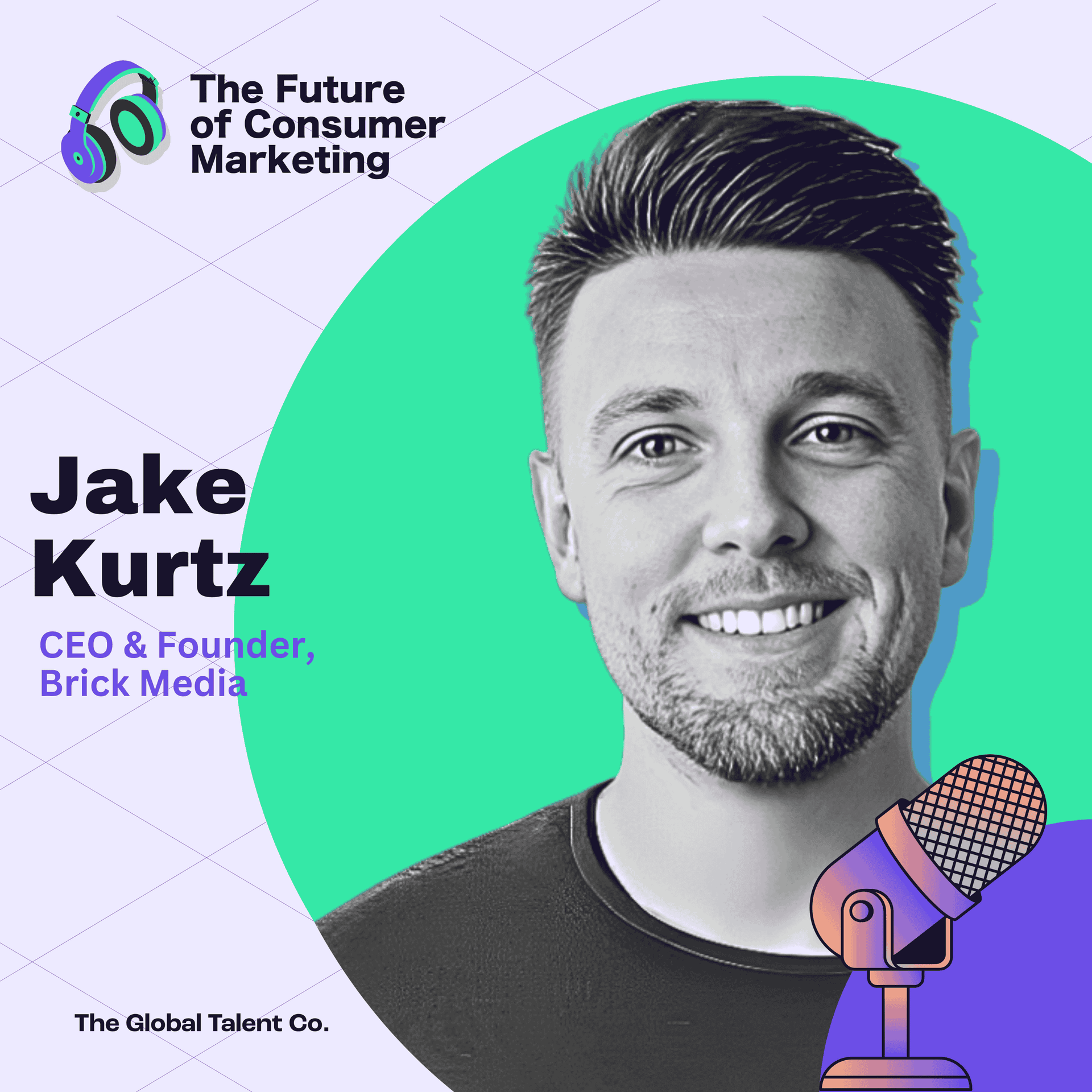
- Guest: Jake Kurtz, CEO and Founder of Brick Media Group
- Date of Episode: [Insert Date]
- Episode Description: Focuses on the transformation of Brick Media Group from a full-service digital agency to a specialized social media management powerhouse. Discusses shifts in consumer attention, the role of short-form video, and the strategic selection of marketing platforms.
---
Key Topics Discussed
- Market Shift:
- Transition from traditional marketing methods to modern social media strategies.
- The impact of TikTok and short-form video on consumer attention spans.
- Company Evolution:
- Brick Media started in 2018 offering a wide range of digital marketing services.
- The pivot to social media specialization in 2020, focusing on established brands looking to modernize their online presence.
- Attention Economics:
- Analyzing supply and demand dynamics of consumer attention across various platforms.
- The need for clarity in content amid increasing saturation on social media.
- Team Structure:
- Brick Media has grown to a team of 21 full-time employees, emphasizing an in-house model without outsourcing.
- Client Focus:
- Targeting established brands already generating revenue rather than startups needing rapid growth.
- Strategies aimed at enhancing the existing brand visibility rather than chasing instant virality.
- Content Strategy Evolution:
- Shift from volume-based content strategies to clarity and quality-focused approaches.
- Importance of hooks in videos and engaging content that resonates with the audience's needs.
- Platform Strategy:
- Selection of platforms based on audience attention patterns and content saturation.
- Current focus on LinkedIn and TikTok, given their respective demand for content in the business sphere.
- Leveraging AI:
- AI used as a tool for brainstorming and efficiency but not a replacement for human judgment.
- Recognizing that the effective use of AI relies on the marketer's skill and understanding.
---
Key Takeaways
- Modern Marketing Requires Adaptation:
- Companies must adapt to the algorithms and consumer preferences in social media, particularly the shift towards video content.
- Patience in Building Brand Presence:
- Social media success takes time; focusing on building trust and credibility is essential.
- Understanding Consumer Behavior:
- Develop content that speaks directly to the target audience's needs and mindset, rather than just promoting products.
- Navigating Social Media Dynamics:
- Regularly assess which platforms offer the best opportunities based on current user engagement and market trends.
- AI as a Collaborative Tool:
- Embrace AI to enhance creative processes and efficiency without losing the human touch in marketing campaigns.
---
Conclusion
- Jake Kurtz emphasizes the importance of modernizing marketing strategies to keep pace with shifting consumer attention. By focusing on established brands and leveraging social media management, Brick Media aims to enhance their clients' online presence effectively. The insights shared in this episode underline the evolving landscape of digital marketing and the critical role of understanding attention economics in shaping future strategies.
For more information, visit [Brick Media Group](https://www.brickmediagroup.com) and find them on social media to explore their offerings further.
Written by AI. May contain mistakes. Listen to the episode to check what was said.
Chapters
Tap a time to open that second in VOUnderstanding Modern Marketing Strategies
0:00 to 0:45
Learn about the evolution of marketing to meet modern consumer needs.
“We just make sure that brands that maybe have been doing outdated, less modern forms of marketing are active, modern, credible when it comes to their online presence.”
Introducing the Guest: Jake Kurtz
1:10 to 1:30
Meet Jake Kurtz, CEO of Brick Media Group and learn about his journey.
“All you need to do is visit GlobalTalent.co, click Start Hiring, and mention the podcast listener discount when we reach out.”
Jake's Journey to Brick Media
1:30 to 6:02
Explore Jake's transition from corporate marketing to founding Brick Media.
“And with that said, Jake, how's it going, man?”
The Shift to Social Media Management
6:02 to 10:49
Discover the strategic pivot towards social media and its implications for businesses.
“And if it's not in 30 seconds that you give me the story, the climax and how everything ended, then I'll probably just skip it because it's become very intense.”
Evolving Social Media Strategies
10:49 to 14:04
Understand how social media strategies have changed over time and the importance of clarity.
“They could try and sell you the secret formula, but I don't know if I'd buy that.”
The Shift in Attention Strategies
14:04 to 15:47
Learn how the approach to content creation has evolved in the age of short attention spans.
“not even thinking about the customer anymore.”
Choosing the Right Platform for Engagement
15:51 to 19:18
Discover the factors influencing platform preference for marketing and content creation.
“And Jake, I'm also curious, have you seen or do you have a preference on which social media platform you like to work with the most?”
Brick Media's Client Base and Growth
19:22 to 21:32
Understand the demographics and growth strategy of Brick Media's clientele.
“And then we make the best recommendation we can for them based on what we know about them, but then also what we know about the state of the union with all the platforms.”
Leveraging AI in Marketing Workflows
21:36 to 23:20
Explore how AI is utilized to enhance marketing efficiency and creativity.
“So then that's the most beautiful thing when it actually grows out of nothing and you don't have to do like much more.”
Adapting to AI's Impact
23:24 to 24:26
Learn why adapting to AI is crucial for staying competitive in the marketing landscape.
“But basically the quote was people aren't going to lose their jobs to AI.”
Transcript
Automatic transcript. May contain errors.0:00Andres Figueira:The goal these days is simple. We just make sure that brands that maybe have been doing outdated, less modern forms of marketing are active, modern, credible when it comes to their online presence.
0:10Jake Kurtz:Do you have a preference on which social media platform you like to work with the most?
0:15Andres Figueira:It's not about me liking a certain platform. It's really just I'm studying these platforms from a business standpoint and trying to see where the best opportunity is.
0:23Jake Kurtz:Is there a certain market, industry, or specific demographic that Brick Media works with?
0:28Andres Figueira:I would say we've gravitated more toward the established business that has done types of marketing before and it's already trusted by the consumer out in the market. And then social media is more so adding gasoline to the fire.
0:44Jake Kurtz:Hey, everybody. Thank you for tuning in. My name is Andres Figueira, and I'm going to be your host for the day. This show is brought to you by the Global Talent Company, helping fast-growing teams hire exceptional remote talent from Argentina, South Africa and beyond. We connect companies with world-class professionals who bring skill, reliability, and a global perspective to every role. And just for our listeners, we're offering an exclusive 10 % discount on your first hire. All you need to do is visit GlobalTalent.co, click Start Hiring, and mention the podcast listener discount when we reach out.
1:17Jake Kurtz:And today, with me here, I am speaking with Jake Kurtz, CEO and founder of Brick Media Group, a company that's helping brands get in front of their audiences using relevant consumer-centric stages. And with that said, Jake, how's it going, man? A pleasure to have you on the show.
1:35Andres Figueira:Things are going well, man. Thanks for having me. And it's a chilly day here in Tampa, Florida, where our company's at.
1:40Jake Kurtz:And Jake, just so that we can get this podcast episode started, would you be able to put us a bit more in context as to your background, how you came to found Brick Media Group, and what Brick Media does in your own words?
1:52Andres Figueira:Yeah, man. Happy to. I grew up in Pittsburgh, Pennsylvania, which is significantly colder than where I'm at now. So I'm blessed to be here in Tampa. I moved down to Tampa in 2013. So we're coming up on 13 years now, which is crazy to even think about. I was always a corporate marketer, both working in agencies and working in-house departments. and slowly but surely a side hustle turned into what is now Brick Media today. Brick Media was launched officially in 2018 as my full-time thing after really not ever having any template or path or mentors or family background in terms of entrepreneurship.
2:38Andres Figueira:It was a trial and error situation until I eventually realized that I wasn't meant for the corporate nine to five lifestyle. I'm sure you've heard a lot of similar stories where somebody feels unfulfilled and they're nine to five and then they start dabbling with some things on the side and then it eventually snowballs from there. I'm definitely one of those people. And Brick Media started originally in 2018 as a digital marketing agency where we were offering website design, search engine marketing, social media marketing, ads, emails, pretty much anything that I roughly knew how to do from my corporate career.
3:14Andres Figueira:And then I got some freelancers involved. And that was the first year or two of the company was really just a digital marketing agency based in Tampa. And then around 2020, when COVID happened, and it gave me a little bit more time to reflect on what I wanted the agency to be long term. And then also that was if you remember, that's when TikTok started to enter the scene. And really all these random people were going viral on TikTok and everybody was talking about TikTok this, TikTok that. And then with the emergence of TikTok, that's when the algorithms and the landscape of social media started to take a big shift and everything became all about short form video.
3:53Andres Figueira:And Instagram, of course, immediately jumped on Reels and started making that a primary thing on their platform. And then pretty much from there, we've seen every platform pretty much do the same thing. YouTube shorts. Facebook now has reels. LinkedIn started leaning more toward video. So what I was seeing around 2020 was social media was getting a lot more complicated for brands to actually do in a comprehensive way and do it well. Because in the old days of social media, meaning 2015 through maybe 2019, you could post a graphic or a nice photo and a thoughtful caption and pretty much get a lot of engagement on your content.
4:32Andres Figueira:You would pick up followers and things like that. But then once short form video entered the game, nobody really knew how to keep up with it. So then I decided in 2020 to cut out all of our services except for the social media related services like social media management, social media advertising. And I was also seeing at the same time in Tampa Bay, there wasn't really an agency in the area that was owning the social media space. So me just being a business person was like, why don't I just own that lane here in Tampa Bay? And then ever since 2020, 2021, when we really dialed in on social media, we've not only grown in terms of revenue and client base and employees, but we've really narrowed down our identity, which I would say now is a social media agency more so than a marketing agency.
5:22Andres Figueira:And essentially, all we do now is we manage the social media end-to-end for established businesses. So the strategy, the content creation, the video filming, the actual posting and caption writing, the engagement, the community management, the reporting and analytics, and that's all done in-house with W2 employees. We don't really outsource anything. And the goal these days is simple. We just make sure that brands that are already established that maybe have been doing outdated, less modern forms of marketing are active, modern, credible when it comes to their online presence. So that's the current state of our company.
6:01Jake Kurtz:Wow, that is so cool, man. I love how the fact that you started with digital marketing in general and then you decided to actually wean into this more niche part of what digital marketing still is, but it's mainly just then the social media management of everything because it is true that when, what's it called, like reels arrived before TikTok, it was Vine, but the attention span of the consumer, It shortened the bill a little bit when you're seeing social media. And if it's not in 30 seconds that you give me the story, the climax and how everything ended, then I'll probably just skip it because it's become very intense.
6:32Jake Kurtz:But it is a need to have somebody that specializes in that. And Jake, once you decided to pivot what the company actually did, you feel that there was. I understand that you had more clients, better revenue with time. But did you feel there was a shift in the type of client you started to receive in the company?
6:49Andres Figueira:I think so. Everybody was really coming to us then with social media in mind. And I think it was more of people realizing that, man, like the world is changing. Everybody's working from home now. A lot of people are on their social media even more so than they were before. And this whole short form video and all these creators and all these people are going viral and what's going on. And I think a lot of the smaller businesses were starting to realize that they could take advantage of that. And I would say the smaller businesses realized it first because I guess that's the closest to a creator that you could get in business terms is like a smaller, scrappy startup kind of business.
7:26Andres Figueira:Because what I've realized over the years about midsize, established, larger companies is they just take a while to finally start to embrace the new ways of doing things. Like big companies are just a lot slower and that's understandable. but but yeah we realized that a lot of the local businesses here in tampa bay and even companies that were just finding me and finding brick on linkedin instagram they were coming to us like
7:51Jake Kurtz:really wanted to take advantage of this whole short form video and modern social media movement
7:55Andres Figueira:so yeah it was less about can you build our website can you build our funnel can you build our ad campaign structure and it was really more hey can you make us look good on social media
8:05Jake Kurtz:do you feel that you are that you see a pattern in the type of companies that contact and want to work with you? Is there a certain market, industry, or specific demographic that Brick Media works with?
8:17Andres Figueira:It's a nuanced question because I feel like the type of companies that want to work with us or want to work with an agency in general is pretty much everybody because I think everybody has started to realize that social media is important. So it's not really like an industry related thing or even a company size related thing. But just in terms of the type of companies that we're actually able to help. I would say we've gravitated more toward the established business that has done types of marketing before and their company, their service offering, their product, whatever it may be, is already pretty established and it's already generating revenue and it's already trusted by the consumer out in the market.
8:56Andres Figueira:And then social media is more so adding gasoline to the fire. And that's usually the type of client that we work best with. It's not so much, whenever we're in like sales calls and prospecting calls, I always like to say that we cannot pour gasoline on something that doesn't already have a flame. So we at least need a company to already have a little flame started on their own so that we can then come in and add gasoline to it. Because if you want to do social media properly, it's really a day by day. And I like to say brick by brick. And that's one of the reasons I started the company named it that.
9:27Andres Figueira:But it really is like a day by day, one post at a time. You're building trust with your audience. you might go viral in the meantime, but we're not really selling that to our clients and saying, we're going to make you go viral in 90 days or less. It's not really like that. We're just trying to make the best content possible to make their audience interested and trust them and know who they are and what they're all about over time. And sometimes that takes six to 12 months to start to really build and gain traction. But when it does, and you probably know this from building a brand, it's like, it's really annoying and hard at the beginning because you feel like you're putting something into it, but you're not really immediately seeing something back.
10:07Andres Figueira:But then once it finally does hit that point where you have traction on the brand being built, you don't really even have to do sales as much because business is coming to you, whether it's a service or a product. So that's always the thing that we like about working with an established business is they're able to actually have the patience and they're actually able to do it properly for an extended period of time. Whereas a startup brand, And at least in our experience with the way that our agency is set up, they need things to happen so fast a lot of the time that they're overly reliant on the social media growing their business from day one.
10:42Andres Figueira:And that just typically isn't the best sort of client for us because I would say we're less about fast and we're more about doing it right.
10:48Jake Kurtz:Okay, now I love that. And I also believe that what you're doing is also setting a standard apart from the crazy virality that comes from social media, which is one in a thousand people, one in a million people could go viral and nobody knows what makes people go viral. They could try and sell you the secret formula, but I don't know if I'd buy that. So I would really appreciate if I were to work with you, the fact that you're mentioning this as a methodology to take your social media to a next level and actually provide education for your customers and your audience and maybe gather a bit more people in the process, but not just get a million views in two weeks because it is a double-edged sword to promise that since nobody's actually certain that it can happen.
11:29Andres Figueira:But that's so cool, man. Yeah, I'm all about not promising it, but it could happen still. Like you could get a 2 million view video, but I want them to view that as a bonus. Yeah, exactly.
11:40Jake Kurtz:But yeah, it can't be like the main reason why they're contacting you. But I do like I'm currently living with my own social media, what you're mentioning, which is I'm not trying to go viral. I'm just trying to create a personality online that matches and has a certain consistency in what I post, what I do. So I totally understand the way that your angle is taken here. But then I'd also love to understand, Jake, also, since you've been so long in the social media category, specifically, I believe you mentioned that you pivoted to this in about 2020, 2021, if I'm not mistaken. In these years that you've been here, have you seen any evolution or have you seen your philosophy and how you create social media for these customers change in the time that you've had and been working with that with Brick Media?
12:25Andres Figueira:I think so. I think clarity has become more important than ever. And the reason I say that is because since 2020, 2021, social media has only gotten more and more saturated. I'm like thinking back to some of the advice that I was giving to our clients and our team back in 2021, 2022. And a lot of it was like getting the volume of your content up. And sometimes it was less even about the quality of the content. And it was more about just get as much out there as humanly possible and let the customer decide what quality is. but now I think with how saturated everything is of course you still need to have a certain level of volume of content going out but I think because people's attention spans are just getting less and less over time you need to be completely crystal clear about what your brand is all about it's almost as if when you are making a piece of social content you have to picture like one specific person on the other side of it like when I'm posting for brick media or posting for myself I'm picturing a VP of marketing at a five million dollar brand where maybe their boss is used to doing something a certain way and they're sitting there like how do I convince my boss that social media is important so I'm sitting there okay this person's going to come across my post they're in this situation they're in this mindset they're dealing with this kind of boss maybe they believe in social media but their boss doesn't so I'll like completely zero in on that mindset and then I'll make the video.
13:55Andres Figueira:And I think a lot of businesses get so in their head about what they're talking about in boardrooms and in meetings that they're almost in a weird way, not even thinking about the customer anymore. They're just more so putting out messages that they want to put out because it makes them look a certain way or sound a certain way. But I think what's really changed the most over the last couple of years is if you only post consistently, but you're not really thinking about who's coming across it and what they actually need from your content or want from your content, you're going to get scrolled right past because it's all just going to feel watered down and generic.
14:30Andres Figueira:So I think volume used to be a great strategy because you would just post a lot of content. A lot of people would see it. Maybe it was like a little bit earlier and people weren't as short attention span about it. But lately, it's like you really have to be thinking, okay, if somebody comes across the video, what is in the first second? What's the hook? how do I make that hook as relevant to this person so that they stop and one one thing that I always like to say is that attention is earned in the first two seconds but then trust is earned in the 30 seconds after that so you still have to make a really good video like you can't just have a clever hook and then nothing else whereas I think that's what people were doing when TikTok first happened it was like let me just hook people in and then it almost doesn't even really matter what I'm saying or what's happening.
15:17Andres Figueira:But now it's like the content has to be so good and dialed in. But then you also still have to have those little sprinkles on top with a hook and the thumbnail and all that kind of stuff. So I think if anything, it's just gotten harder and everybody has to level it up.
15:31Jake Kurtz:So I do understand what you mean, because I love how you're formulating it and putting it in these one plus one equals two, like got into your hook and then your trust. But the truth is that rising over all the static that is within social media nowadays, that's the real challenge.
15:47Andres Figueira:It's like setting yourself apart from so much noise that's already there. It's intense.
15:51Jake Kurtz:And Jake, I'm also curious, have you seen or do you have a preference on which social media platform you like to work with the most? I don't know. Hey, I prefer TikTok or I actually prefer Instagram due to this or any type of like weird quirks that you've noticed with the different platforms.
16:08Andres Figueira:See, this is the beautiful thing about the industry that we're in is it's very much like basic supply and demand, but you have to view it as eyeballs, like the supply and demand of attention and eyeballs. So for me, I guess I'm not overly excited or overly obsessed with a certain platform. It's more so where are people paying attention now that are in my target audience and where are not enough businesses or people creating content so that I can take up more space on the feed. And for me right now, I've noticed that's LinkedIn whenever I'm talking about business, because despite how many people maybe that you and I know that like we're talking to in the corporate space, in the marketing space, of course, there's a decent amount of people like us that are posting on LinkedIn.
16:58Andres Figueira:But I think when you zoom out to like the average person, people still view LinkedIn as the place where they're going to look at job opportunities and post their resume and post their experience. People do not view LinkedIn as like Facebook the same way that I do. It's pretty much Facebook with a more professional twist on it. So for me, LinkedIn is probably the primary place that I put out content because I'm like, my target audience is there. They're in the mindset of opportunities and connection and networking when they're on there. And I think the supply and demand of eyeballs thinking about LinkedIn is in my favor right now.
17:35Andres Figueira:And of course, I still post on Instagram, but I do think that Instagram is the opposite where everybody and their mother is making content for Instagram. and less people are going on Instagram on a daily basis because of how fragmented everything is. And I think Instagram is losing a lot of people to TikTok over time. So it's almost like more content is happening on Instagram on a daily basis, but slightly less eyeballs or at least like equal eyeballs are going on Instagram on a daily basis. I've even noticed for myself in the past year, I'm going on TikTok more, not more than Instagram, but I'm spending more time on TikTok now than I was a year ago.
Read the full transcript
18:15Andres Figueira:And that is not working in Instagram's favor. So for me, I'm like maybe prioritizing Instagram a little bit less. And I'm focusing on things like LinkedIn a little bit more. And then also TikTok, I was never really a big fan of the platform. But recently, just because I've seen the potential for the supply and demand of attention on there being in my favor, I started experimenting with TikTok like maybe three months ago. And literally, I just take out the phone and start yapping into the camera when I'm like on a walk or I'm in my car or I'm in my office. And I've gained 2000 organic followers, like literally just from yapping to the camera.
18:50Andres Figueira:And I've had a couple of videos get like 100 ,000 views and 50 ,000 views. And then I'll find some people from my TikTok that then go into my bio and then find my Instagram account and they've added me on LinkedIn. So TikTok's been a pretty cool experiment. But I guess to more directly answer your question that you originally asked, it's not about me liking a certain platform. It's really just I'm studying these platforms from a business standpoint and trying to see where the best opportunity is. And same thing with our clients. It's like we figure out who their target audience is. We talk to them about what they're trying to do.
19:22Andres Figueira:And then we make the best recommendation we can for them based on what we know about them, but then also what we know about the state of the union with all the platforms.
19:31Jake Kurtz:And Jake, I'd also love to know with this whole Brick Media group and how long you've been already doing this, how big is your team, man? How big is the workforce that you have helping you with this endeavor?
19:42Andres Figueira:So right now we have 21 W2 full-time employees. So we're in like the low 20s right now, which to me feels big. It started with just me and my laptop. Of course. Yeah, then it was freelancers and then it was part-time people. But yeah, in this time period, we've been able to actually have roughly 20 full-time people on the team, which has been great.
20:05Jake Kurtz:Amazing. And do you and your team only serve clients and customers that are located within the United States? Or do you have a couple of international clients or clients from other countries that you know how to deal with and understand the algorithms of the platform in their scenario?
20:22Andres Figueira:Yeah, right now, we mostly work with people that are U.S.-based and companies that are U.S.-based. And that's not necessarily by design. I just think where we're at as a company and the season that we're in. We have so much momentum in this Tampa Bay, Central Florida area. And if you're watching the video version of this, like the office behind me, like I'm physically located here in Tampa in an office building. So a lot of the momentum that we have is based here because that's where our brand has been built over the last several years. But we also do work with some clients that are all around the country.
20:53Andres Figueira:We have a couple of clients in Pittsburgh, New York, maybe one in Texas, one in California. So we have clients that are based in other places and they maybe find out about us through my personal LinkedIn content, maybe our Instagram. We've even had people tell us they found us on ChatGPT these days. So our brand awareness is getting out there past Tampa Bay. We do have clients that sell products or services or maybe serve people globally. But yeah, currently it's mostly Tampa Bay slash other markets in the U.S.
21:24Jake Kurtz:That is amazing, man. Okay, so I understand it. It hasn't been that you haven't, like you're not looking for anything outside the States or in the States, but you've just received the majority of the clients from the country that you're in. Okay. Yeah. And Jake.
21:37Andres Figueira:It's kind of organically growing.
21:38Jake Kurtz:Yep. So then that's the most beautiful thing when it actually grows out of nothing and you don't have to do like much more. But another question I have is, are you leveraging AI in any weird way when you're working with creating content or maybe in your workflows within the company? Just wondering if there are any unique applications that you're using AI for.
21:58Andres Figueira:Yeah, we use it daily for efficiency. It speeds up thinking. I don't believe that AI is supposed to replace your thinking, but it does speed up your thinking and it acts as a brainstorming partner in the room in certain situations. A bad marketer that uses AI is still a bad marketer. So it's not like it's magically making somebody a lot better or something, but like you still have to have the right judgment, the right prompting, the right ideas to use it effectively as a tool. But yeah, I would say for the people on our team that are already really good with brainstorming, coming up with ideas for our clients, AI just allows them to supercharge their brainstorming.
22:38Andres Figueira:And of course, it's nice with some behind the scenes stuff to be able to use it for some documents and other things that used to take three hours that now take three minutes. Big believer in AI.
22:48Jake Kurtz:That is so true because people believe AI is going to come and take their jobs and it's going to generate content so cool that you won't even be able to design anymore. but without the proper mind to lead the AI in the way to get it to put out its best thing, then AI isn't worth anything. Like you can create something really bad with AI versus having the correct ideology and the image in your head to actually make a good product with it. So I do believe that it has a lot of potential and that it does like elevate your team's ability. That's what I feel AI is really there for.
23:20Andres Figueira:Yeah, I heard on a podcast, another podcast recently, I forget who said it, But basically the quote was people aren't going to lose their jobs to AI. They're going to lose their jobs to people that are good at using AI. So I agree.
23:34Jake Kurtz:I agree. It's like you better adapt to understanding the new tool that is available to us rather than just panic, run and just say that it's going to take your job because those are the people that aren't going to be able to stay at the forefront of this.
23:46Andres Figueira:Same thing happened with social media, with digital marketing, with the Internet. It was like the people that embraced it at the beginning and studied it. And, you know, maybe they didn't immediately say yes, like this is the future right away, but they at least didn't dismiss it. Those were probably the people that got ahead. And we've all heard the stories of Blockbuster and Netflix and taxi cabs and Uber and all the things where it was like the Internet's a joke, like this is never going to happen. So I would encourage anybody that is doubtful that AI is going to have a big impact on things to just go study the history of what happened with the Internet and like what people used to say about it back when the Internet was first becoming a thing.
24:25Andres Figueira:And I think the I think AI makes the Internet look like child's play. So I think it's going to be a lot bigger of a wave than even that was. At Brick Media, we're definitely trying to get ahead of it and even start to talk to our clients about it, where we feel like we have the knowledge to be able to do. I'd say we're trying to ride the wave, not get hit by the wave.
24:44Jake Kurtz:Jake, I'm noticing that we're almost at the end of the podcast. But before I do finalize the episode, I did want to give you the chance to let anybody in the audience who might be hearing us right now know if they're interested in what Brick Media is offering and what you have talked to us about. And if they have a company that they feel is a fit, but they're not sure, how could they go about contacting Brick Media Group, contacting you or just setting up a call to see if it's a proper thing?
25:08Andres Figueira:Yeah, we have BrickMediaGroup.com. And then obviously all of our social media is more of like our day to day if you want to get the vibe of our team and all that stuff. But our website explains pretty clearly who is a good fit for us. And then if you're interested in getting on a call with somebody on our new business team, there's just a little form on there that says book a call and it takes you through this little questionnaire and then you'll be right on our calendar. Would love to chat with anybody that's interested in elevating their social presence over the next couple of years.
25:39Jake Kurtz:Amazing, man. So it's brickmediagroup.com, right? You got it. Awesome. So anybody who is interested, you heard it here first. Don't be shy. just go ahead, check the website out, read the requirements or at least the characteristics of what would be a good fit. And if you feel that it's you that they're talking about, don't hesitate in contacting them because I'm sure that you'll get an excellent value out of at least one
26:01Andres Figueira:conversation that you'll have with them or even more.
26:04Jake Kurtz:But with that said, Jake, thank you so much, man, for hopping on this episode with us and for being able to provide your insights, your experience and for being so chill, bro.
26:12Andres Figueira:Super happy to, man. Appreciate you having me.
26:15Jake Kurtz:No worries at all. The pleasure has been all ours. And with that said, we also appreciate anybody here in the audience who's still with us and listening. Thank you so much for coming on these episodes with us, for hearing about the different personalities that we talk to, and all the different industries that we're learning about. So with that said, have a good one.
From the publisher
In this episode of The Future of Consumer Marketing: Masterclass Edition, host Andres Figueira interviews Jake Kurtz, CEO and Founder of Brick Media Group. Brick Media has evolved from a general digital marketing agency into a specialized social media powerhouse that helps established brands modernize their online presence through comprehensive social media management. Starting as a side hustle in 2018, Jake built Brick Media by recognizing a critical shift in the marketing landscape: the emergence of short-form video and the algorithmic revolution sparked by TikTok. By 2020, he made the bold decision to cut all services except social media, positioning Brick Media as Tampa Bay's go-to social media agency. Today, the company operates with 21 full-time W2 employees, managing everything from strategy to content creation to analytics for established businesses that need to add "gasoline to an existing flame" rather than starting from scratch.
Topics Discussed:- Pivoting from full-service digital marketing to social media specialization
- The algorithmic shift caused by TikTok and short-form video dominance
- Building a 21-person in-house team without outsourcing
- Analyzing supply and demand dynamics of attention across platforms
- The evolution from volume-based to clarity-focused content strategies
- Strategic platform selection based on audience attention patterns
- Leveraging AI for efficiency without replacing human judgment