In short
Podcast Notes: The Hyperlocal Content Gap Franchise Brands Ignore
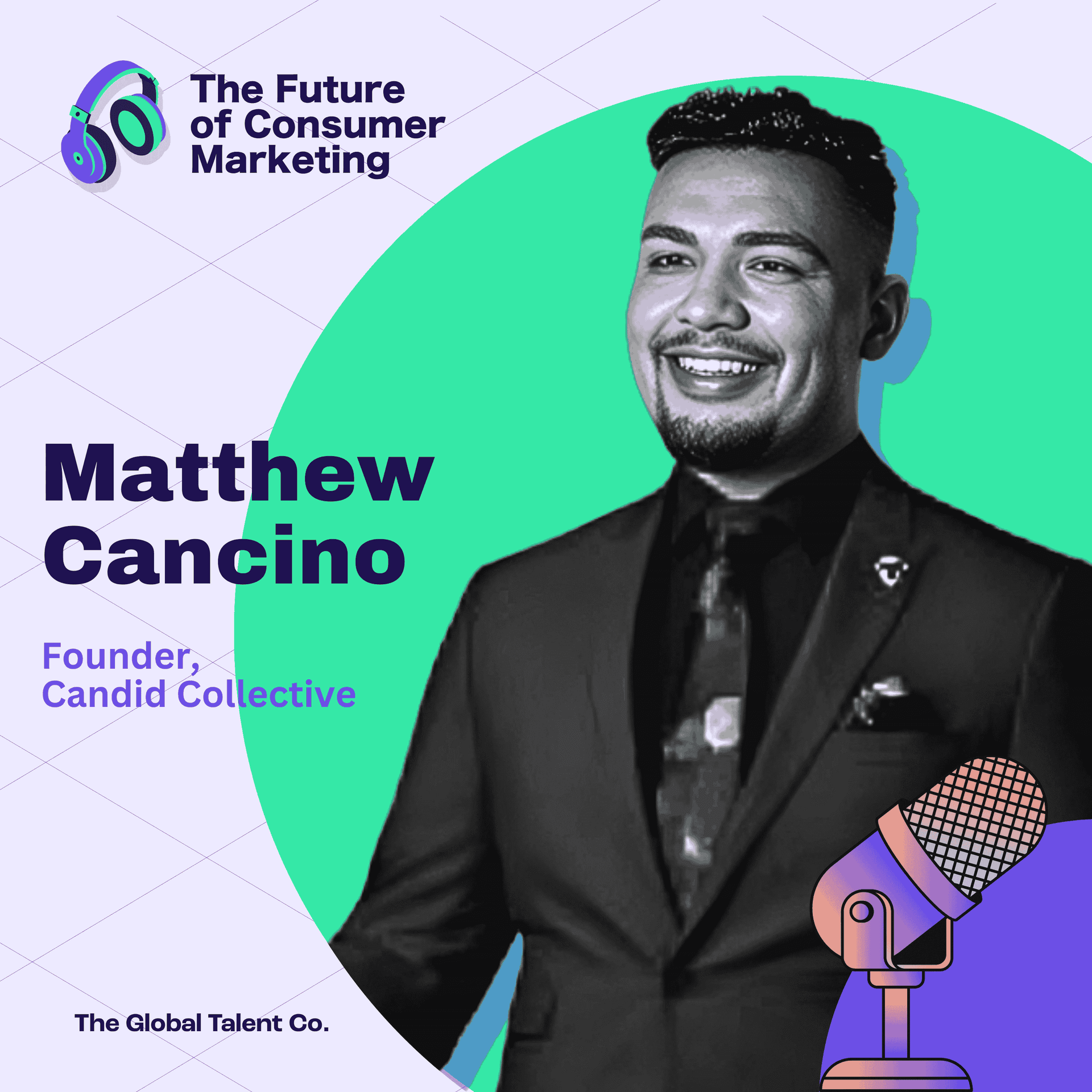
Podcast Overview Title: Future of Consumer Marketing Description: The future of consumer marketing is brought to you by The Global Talent Co.
Episode Details Episode Title: The Hyperlocal Content Gap Franchise Brands Ignore Episode Description: In this episode, host Andres Figueira interviews Matthew Cancino, founder of Candid Collective, a video content agency focused on hyperlocal content strategies for franchise brands and multi-location businesses.
Key Guests
- Matthew Cancino
- Founder of [Candid Collective](https://candidcollective.com/)
Topics Discussed
- The importance of hyperlocal content strategies in franchise marketing.
- Transitioning from a traditional agency model to a distributed creative network.
- The rebranding of Candid Socials to Candid Collective as a strategy to attract talent.
- Utilizing AI for content analysis and repurposing in video production.
- Challenges and trade-offs involved in building a business while employed.
Summary of Discussions
Origins of Candid Collective
- Establishment: Founded two years ago, with the first year being a side hustle while Cancino held a full-time job.
- Motivation: Identified a gap in providing local content for franchise brands, which often struggle to appear local due to centralized teams.
Hyperlocal Content Strategy
- Concept: The need for national brands to resonate locally (e.g., a franchise like McDonald's needing targeted regional content).
- Execution: Candid Collective focuses on creating localized digital footprints for multi-location brands, customizing content to fit regional customs and preferences.
Business Model Evolution
- Initial Idea: Originally aimed to develop an app for crowdsourced content creation (akin to Uber) but pivoted to focus on enhancing client services with existing teams.
- Current Model: Candid Collective now operates with a distributed network of creatives, focusing on delivering localized content more effectively.
Clientele and Industry Patterns
- Target Industries: Primarily works with franchise and multi-location brands; also collaborates with larger agencies.
- Examples: Collaborated with brands like a mold removal business, creating localized digital strategies for their various locations.
Team Structure and Operations
- Team Size: Currently composed of about 12 core members, with additional freelance videographers scaled as needed.
- Client Relationships: Maintains a consistent base of 20 ongoing clients, while also taking on short-term projects.
Use of AI in Content Creation
- AI Applications: Utilizes AI for data analysis, structuring planning processes, and enhancing video content through transcript analysis for better engagement.
- Mindset on AI: Cancino views AI as a tool to enhance capabilities rather than a replacement for creativity.
Future Goals
- Expansion Objective: Aim to work with 1,000 brands by 2026, focusing on meaningful impacts in digital marketing strategies.
Key Takeaways
- Importance of Localization: Brands must prioritize hyperlocal content strategies to effectively engage with local audiences and enhance brand presence.
- Adaptability in Business Models: Transitioning from initial ideas to functional business strategies can lead to growth and better service delivery.
- Leveraging Technology: Using AI and other technological tools can significantly improve operational efficiencies in content marketing.
- Networking and Collaboration: Building strong partnerships and networks can enhance service offerings and client relationships.
Conclusion Matthew Cancino's insights into the necessity of hyperlocal strategies for franchise marketing highlight a critical gap that many brands overlook. By focusing on localized content and employing innovative solutions, Candid Collective aims to redefine how businesses connect with their communities.
Written by AI. May contain mistakes. Listen to the episode to check what was said.
Chapters
Tap a time to open that second in VOMatthew Cancino's Journey
1:03 to 4:35
Matthew shares the origin story of the Candid Collective and key challenges faced.
“And with me here today, I am speaking with Matthew Cancino, founder of The Candid Collective, a company that's crafting authentic local first video content that connects and then helps its clients distribute it.”
Challenges in Local Content Creation
4:35 to 7:30
Discussion on the difficulties of creating local content for franchises.
“And thank goodness it came out right and it was the correct decision.”
Hyperlocal Marketing Explained
7:30 to 10:39
Exploration of hyperlocal marketing strategies and their importance.
“Yeah, but if the client is large enough, if the deal is right, we'll figure it out 100%.”
Client Types and Industry Patterns
10:39 to 13:30
Matthew discusses the industries they work with and the patterns observed.
“e-commerce, that kind of stuff, where you're shipping stuff out.”
Team Structure and Collaboration
13:30 to 14:02
Insights into the team composition and collaboration strategies at Candid Collective.
“It really just depends on what you're trying to do, who you're trying to get the word out to and your business.”
Scaling Creative Teams for Client Projects
14:02 to 15:10
Learn how to effectively scale a creative team based on client project needs.
“There's probably like three or four, but they're mostly in Florida.”
Rebranding and Attracting Talent
15:10 to 16:20
Discover the importance of rebranding for attracting creative professionals.
Client Relationships and Project Variability
16:20 to 17:20
Understand how client relationships and project scopes can vary over time.
“Do you have a certain amount of customers that are always set with you guys or is that a number that varies a lot?”
Leveraging AI in Marketing Strategies
17:20 to 19:00
Explore unique ways AI can enhance creative marketing strategies.
“But yeah, we do have clients that will come back for bigger projects to execute like specific things.”
Goals and Aspirations for The Candid Collective
19:00 to 20:10
Hear about the ambitious goals set for the future of The Candid Collective.
“But it definitely people rely on it too much to answer questions, which is good.”
Show all 12 chapters
The Connection Between Luck and Preparation
20:10 to 21:00
Discover the relationship between opportunity, luck, and preparation in entrepreneurship.
“And with the time that the Candid Collective has been going on, which is, if I'm not mistaken, two years, right?”
Contacting The Candid Collective
21:00 to 21:51
Find out the best ways to reach out to The Candid Collective for potential collaborations.
“And that's what the vibe I get from you, man.”
Transcript
Automatic transcript. May contain errors.0:00Andres Figueira:How you came to create the Candid Collective and what it is in your own words as well.
0:05Matthew Cancino:We work a lot in the franchise industry and with multi-location brands to execute hyperlocal strategies.
0:12Andres Figueira:Do your clients belong to a certain type of industry? Have you noticed a certain pattern with the people that you work with?
0:19Matthew Cancino:In today's age, you need to be able to meet your customers where they're at. It really just depends on what you're trying to do, who you're trying to get the word out to, and your business.
0:33Andres Figueira:Hey guys, welcome to the show. This is brought to you by the Global Talent Company, helping fast-growing teams hire exceptional remote talent from Argentina, South Africa, and beyond. We connect companies with world-class professionals who bring skill, reliability, and a global perspective to every role. And just for our listeners today, we're offering an exclusive 10 % discount on your first hire. So all you need to do is visit GlobalTalent.co, click Start Hiring, and mention the podcast listener discount when we reach out. And with me here today, I am speaking with Matthew Cancino, founder of The Candid Collective, a company that's crafting authentic local first video content that connects and then helps its clients distribute it.
1:18Andres Figueira:So, Matthew, it's a pleasure to have you on the show, man. How are you doing?
1:22Matthew Cancino:Pleasure to be here, brother. Thanks so much for the invite and the awesome introduction. It's pretty spot on. Probably better than I could have probably said it myself. So really grateful to be here.
1:34Andres Figueira:Now, we're also very happy that you were able to come on the episode, bro, and really excited to learn about all you have done with the Candid Collective. And with that said, in order to give the audience a bit more context, Matthew, would you be able to tell us maybe how you came to create the Candid Collective and what it is in your own words as well.
1:53Matthew Cancino:First of all, I think it's important to understand that we're still a young brand. So we started about two years ago now, and of which the first year I actually started it while I had a full-time job, which is non-traditional. A lot of entrepreneurs like, oh, quit your job and go all in, which I agree with. But also the first year in business is one of the hardest times for a lot of businesses. so a lot of people will quit or you're in business to make money so your first year in business you're they say you don't make money but you actually do make money but what happens is you take that money and then you use that money on personal stuff and then you're not left with a business anyway so one out of the two years i still had a full-time income i was on the leadership team of a larger marketing agency called bright pink and we were servicing multi-location franchise brands, building WordPress multi-sites for them.
2:50Matthew Cancino:So I was consulting with them and helping these franchise brands really service their local franchisees. And I noticed kind of a gap in the market where we weren't providing local content for our clients. And the reason that we weren't is because it's hard to scale. So imagine you have a business, you have a location in San Francisco, You have a location in Miami and you need a local, just a picture even of the front store somewhere. But your entire team is in is in one of the two cities. So I thought in my head, what if we could create an app that essentially would be almost like an Uber, but for the thousand dollar phone in everybody's pocket.
3:34Matthew Cancino:Right. And we could pay like people$50 an hour to go out, get like UGC content of these local areas. And then we could use that content to better serve our clients. So that was the original idea. And we actually started to invest a bunch of money into developing that when we first started out and we failed. But six, seven months into it, what we had was a team of awesome people all over the globe that were helping us and and helping us become essentially. we looked at what we had and we're like, we're going to stop developing and we're going to focus
4:06Andres Figueira:on solving the problem in a more internal way.
4:10Matthew Cancino:And then we'll go back to the tech thing later on, but let's really serve our clients. Let's get a really good offer going. Let's get a really good company and a really good brand because I'm really big on branding. And then I found out I was having a baby and instead of, so I was at a crossroads then. And instead of taking the safe route, I decided to quit my job and just go all in on Candid. That's a little bit of the origin story there.
4:34Andres Figueira:Oh, my goodness, man. And that was brave of you. And thank goodness it came out right and it was the correct decision. How long since that happened, man?
4:43Matthew Cancino:Yeah, so that was about a year ago. We've been about two years, two years in. A year in, we were developing that tech. We were figuring a lot of stuff out. And I was doing it because I'm always respectful of whatever it is that I'm doing, right? So I was literally doing this like after work, like second job, weekends, that kind of stuff. And then I was burning myself out and the baby was going to be here. So I made the decision to say that my baby is never going to be the reason that I didn't chase my dreams. You know, that dad didn't chase his dreams. So I was like, I'm going to take the I'm going to take a harder road here and I'm going to take a chance on myself and on what we've built so far.
5:22Matthew Cancino:and we've been growing ever since and figuring it out.
5:26Andres Figueira:But I do understand what you mean and that at the beginning you were like juggling your main job and pursuing this as a side hustle because you got to make ends meet at the end of the day. But I do get that when push came to shove, you must also have thought it would be better to create my own empire than live in a relationship of dependency with another company. If I'm going to have a daughter and a family and whatever else comes in the future, it's cool to also have your own thing. And my question is, Matt, I noticed then that the Candid Collective grew from a point of friction that you noticed that wasn't actually being helped or worked on for companies.
6:00Andres Figueira:And do you just work with companies inside the United States or are you able to record local content in other countries?
6:08Matthew Cancino:It's an interesting question. I could probably apply the same fundamentals of how we scale local content in the States to another country. so I do have editors and team members outside the states and we function very well just with them editing and stuff so it would only be like a little bit different mindset to fulfill on the service but I don't know if I would be comfortable doing it so I wouldn't like one of the I wouldn't even know how to invoice out of the states right now and I think that's one thing like I don't for anybody listening when you start a business that's something that you got to figure out how are you going to get paid you know who teaches you that right like how do you know how to send an invoice right and then it's like you you google it and you stumble upon these canva invoices or templates but that's just a picture that doesn't actually run a credit card number maybe for cash it's okay But what's the underlying foundational stuff for your business that's going to keep you like, so when you're thinking about scaling, especially into a new market, you have to understand how are you going to get paid?
7:22Matthew Cancino:Where are you going to get your customers? Assuming you've got a customer and that's why you're trying to solve the problem, how are you going to pay the person shooting the content?
7:29Andres Figueira:So that's another thing.
7:31Matthew Cancino:Yeah, but if the client is large enough, if the deal is right, we'll figure it out 100%. It's the same thing. If it's in South America, se habla espanol.
7:45Andres Figueira:Si hablamos, si hablamos. And Matt, another question I have is, do your clients belong to a certain type of industry? Have you noticed a certain pattern with the people that you work with? or is it just like more of a random people that just clients that come and you serve them as they come?
8:03Matthew Cancino:Yeah. So we work a lot in the franchise industry and with multi-location brands. So we also work very nicely with larger agencies like the Ogilvy's of the world and stuff like that to provide video underneath larger campaigns like that. But because that doesn't really mean anything franchising and multi-location so pretty much everybody knows mcdonald's right mcdonald's is a franchise and they have thousands of locations so everyone a lot of those locations are owned in at an individual level not necessarily by corporate so we work both with the corporate brand and then we also work with the local individual owners to execute hyper local strategies or execute national strategies that have local intent, right?
8:55Matthew Cancino:Or regional intent. So now you can think McDonald's in Super Bowl weekend, right? Probably investing millions of dollars on a national campaign. That's a national need. But let's say they wanted to target, I don't know, a regional ad that they wanted to do. They're going to need regional footage to resonate with that audience specifically or state or city. It just depends on what that is. And then when you get down all the way to like the local, that marketing is ran by that individual owner. So that's what I mean with franchise marketing and how we fit into that world. Multilocation is just the same thing, except maybe it's not owned individually.
9:42Matthew Cancino:Maybe it's owned by a private equity group or maybe it's owned by just an entrepreneur who grew their business to 12 locations. So we work with a window washing brand here in Florida. And they've grown to four locations now. And that would be an example of a multi-location client that we have. So each of those cities that they operate in, we need to create essentially a digital footprint for each of those cities.
10:11Andres Figueira:Based on the customs, the people and what you know is locally accepted and liked. So that way it's a more customized ad style, for example.
10:22Matthew Cancino:So like these multi-location businesses, right? It could be one brand that services multiple cities. You still need to have that footprint to serve your customers locally, especially service-based businesses. e-commerce, that kind of stuff, where you're shipping stuff out. Maybe it's not as hyperlocal, but in today's age, you need to be able to meet your customers where they're at.
10:49Andres Figueira:I had never thought about hyperlocality in terms of how you are implementing it, man, but I do see the value in what you're bringing to the table and how that really helps out a company that might not have this process as thought out as your agency already has. So it's a lot easier to just delegate and let the people who know how to do it just do it for you. We work with
11:10Matthew Cancino:a mold brand out of California and they probably started out with 12 locations. They've tripled that since then into different cities, into different, they've tripled their footprint. These people get thousands of clicks organically just because each of those cities is serving pages that are local for each of those things. So hyper-local digital marketing is super, super important, both on the video side, because yes, we're video experts. I can scale video, but also just your website in general, right? This is how the largest, like the McDonald's of the world, like the largest companies in the world, they already know this and they're already doing it.
11:51Matthew Cancino:So it's just the way that you have to serve your customers.
11:54Andres Figueira:Okay, okay. And Matt, another question I have is then, you also like you you take care of the creative aspect the creation of the style of the ad the recording of it and then the distribution and do you have to then follow certain guidelines by the companies or do they just give you like free reign to do a campaign that you feel is fit so i think
12:14Matthew Cancino:the short answer to that is it depends that's the honest right it just it depends on the client but in my experience every brand operates just a little bit differently every company operates a little bit differently. Every single business owner has a different way that they run their business and that's okay. So oftentimes we have to meet them where they're at. Some business owners don't have, they don't even like have more than one Google business profile for their business. So if that's not in place to do a lot of these strategies, you need to multiply that. And then we can look at your website and then we can say, okay, where's most of your money coming from?
12:52Matthew Cancino:where should we really get some of that hyper local content. But a lot of it is we treat everything. I like to think of like foundations, like building a house. Right. So you want to build the foundation first really strong. And depending on where you're building, that foundation might look completely different. Your digital footprint needs a solid foundation and that foundation might look a little bit different for your business. Right. Do you have a retail space? Do you have a store where people come in, right? That's a different type of business than let's say our business in the digital space where we can operate anywhere.
13:25Matthew Cancino:So all we need is service areas. There's always distinctions to be had. It really just depends on what you're trying to do, who you're trying to get the word out to and your business.
13:37Andres Figueira:And Matt, with this endeavor that you have, how many people do you have helping you out? Like how big is your team?
13:45Matthew Cancino:Yeah, so right now we have about 12 people on our team.
13:48Andres Figueira:And this is like the main team for the Candid Collective. And it includes also the videographers that help you.
13:55Matthew Cancino:No, so we'll scale videographers up and down as we need. So there are videographers in that team. There's probably like three or four, but they're mostly in Florida. We're happy to fly them out anywhere. It just depends on the project, the size of it, and the length of it and the scope. Like I said a little earlier, we will actively scale the team up or scale it up realistically, depending on the project. So let's say we had a client that we were going to be working with for six months in the Midwest. It's not going to make sense for me to fly out videographers every single month. So in that case, one of the reasons I'm so big on brand and transparency is because it helps to attract other professionals and say, hey, like, this is our clients.
14:44Matthew Cancino:This is who we work with. This is what we're doing. We need help with this. And just very transparently, this is our budget. And then it's a yes or no. We're happy to collab. I don't need to white label your service. I don't need you to pretend that, you know, you're part of the candid collective. unless you're going to do lots of work with us great and you want to do that but i want the people that we work with it the re so we rebranded i would say about a about a year ago from candid socials which was that original app idea to candid collective because we're really more of a collection of creatives that's what we are so like that rebranding served to help push that story forward and help us attract talent as we need it and just help with transparency all the way through which by the way is nothing necessarily new in the agency space right so like some of our biggest clients is because we've worked underneath larger giants like ogilvy so we did a video shoot for dove technically like dove wow hair brand in this day i don't know if they're in that jantina yeah
Read the full transcript
15:48Andres Figueira:like the soaps and the lotions and everything like that yeah so we did a brand we did a shoot
15:53Matthew Cancino:with them right but it's not because we're shooting with dove we're on their rolodex it's because we were white labeled underneath a larger agency who contracted an influencer who we knew from like in the network because he's friends with my partner henry so that's how all of that tied in together agencies for a long time have taken local talent and then just whitewashed it and been like oh this is our work so our difference is we work with this person if they want to be discovered because you'll be surprised how many people don't they just want to do the work man they just want to make really cool shit they want to show up they want to do a good job
16:34Andres Figueira:and then they want to go home and that's it amazing man amazing and matt do you have a what's it called do you have a consistent pool of clients that you're always working with or from how I hear you speak about how your projects go, it might be six months, it might be one month. Do you have a certain amount of customers that are always set with you guys or is that a number that varies a lot?
16:57Matthew Cancino:No. So we've scaled the business right now where we have about 20 clients that we serve month over month, every single month, doing everything from maintenance to SEO to video work for.
17:08Andres Figueira:And then of course we do have clients that will come back once a year.
17:12Matthew Cancino:we've been operating for two years. So they've came back like every year, you know what I'm saying? So it's not like year over year like that. But yeah, we do have clients that will come back for bigger projects to execute like specific things. Okay.
17:27Andres Figueira:Okay. Understood. Understood. And another question I do have is this is when I ask everybody on the podcast, because I just love to hear if there's any new or peculiar ways they're using this. And that is the trending topic of the moment, which is AI. Are you guys leveraging it in any weird or quirky way? Because I know people, companies have it for customer service and to read and see comments and stuff like that. But given the nature of your agency, I'm not sure if you guys are doing anything fun or different with it.
17:54Matthew Cancino:So AI is a tool, hardcore. And yeah, of course we use it in our business. It really helps us with planning, structuring. I use it a lot for data analysis and that kind of stuff. so you can take it and take large pools of data and then have it structure it so that way it's easier to understand you can also use ai in the video on the video side you can take transcripts and then you can have it identify uh the juiciest parts and then cut from there riverside has a baked in as well and a lot of other tools have that kind of functionality baked in so it's not as cutting edge as anything but you can really take a lot of videos and do the same thing whether it was recorded on Riverside or not.
18:36Matthew Cancino:You can take videos, get their transcripts, and then use that transcript to create content from it.
18:43Andres Figueira:It really is crazy. Like everything you can do with AI, every single day, I'm just like ecstatic about what I can find out and whatever I have in my mind that I can bring down to earth through this tool that we now have available. I'm in, I'm like, I'm all in for it. I don't feel it's going to take my job. It's just going to make me
18:59Matthew Cancino:better yeah no a hundred percent and i think that's the that's one of the biggest things with ai it really is a mindset thing you know what a lot of people don't understand about ai and chat gpt that it's built to make you happy uh-huh you're a customer exactly what does that mean so that means that even if you're wrong it's still going to make you believe that you're right It's going to definitely feed you what you want to hear unless you train it specifically to rebuke what you think and force you to think into problems. But it definitely people rely on it too much to answer questions, which is good.
19:38Matthew Cancino:That's what it's for. It helps you to answer questions. You should still have your own independent reasoning.
19:44Andres Figueira:And Matt, I do have I notice we're almost that time here with the podcast, but I do have one more question for you before I let you go. And that is, what is your goal as the founder and knowing what you want the Candid Collective to become now that we're almost we're now in February, but that we're beginning 2026. What are your goals for this year, man?
20:03Matthew Cancino:My big audacious hair goal is to like work with a thousand brands, work with a thousand companies, help them make impact with their digital marketing. Amazing, man.
20:13Andres Figueira:And with the time that the Candid Collective has been going on, which is, if I'm not mistaken, two years, right?
20:18Matthew Cancino:Yeah.
20:18Andres Figueira:Okay. Now with two years and what you've accomplished already, I'm certain that you'll be able to meet your goals, bro. And most of all, after I'm hearing the way you think and how you like to do your stuff, I know it's all based on the foundations and getting things right. And when things are done that way, I know that they're built for the long run. So I know I can only wish you anything but luck, although I don't even know if you'll actually need it, man.
20:40Matthew Cancino:I think luck is an underappreciated thing in entrepreneurship. We all need a little luck. So I appreciate that, Andres.
20:48Andres Figueira:No, no worries at all. The thing that I did after I for a long time was just saying, oh, I want to be lucky. I want to be lucky. I just ended up and I read this somewhere. And it's the fact that luck is when opportunity meets preparation. So I just always got to be prepared from where that opportunity arises. And that's what the vibe I get from you, man. So I know you'll be lucky, bro. I know you'll be lucky.
21:07Matthew Cancino:I appreciate that.
21:07Andres Figueira:I believe. Yeah. You got to believe to achieve. And Matt, as a final remark, and just so that we can let anybody here hearing us that is and may be interested in what the Candid Collective offers, how would be the best way for them to get in contact with you and maybe see if it's a proper fit if they're a company or maybe just an individual? How could that work?
21:28Matthew Cancino:Of course, it's CandidCollective.com. But if you Google my name, Matthew Cancino, my LinkedIn, and I'm probably the easiest person on planet Earth to get in touch with.
21:37Andres Figueira:Amazing. So anybody here who is interested and is listening to us, you heard it here first, thecandidcollective.com or just look or Matthew Cancino on LinkedIn and make sure to hit him up to see if it's a proper fit for what they're offering and what your needs are. But with that said, Matthew, thank you so much, man, for hopping on the show, for bringing such a good energy and for really telling us all your story and all your insights, man.
21:58Matthew Cancino:Thanks for having me, Andres. I appreciate it.
22:00Andres Figueira:No problem at all, man. And to anybody here with us as well, thank you so much for coming back to the show, for coming here with us and learning about all the different personalities that we talk to and for also learning about all the different industries that we're seeing as well. So with that said, have a good one.
From the publisher
In this episode of The Future of Marketing, host Andres Figueira speaks with Matthew Cancino, founder of Candid Collective, a video content agency specializing in hyperlocal content strategy for franchise brands and multi-location businesses. Over two years, Candid Collective has grown to serve 20+ monthly retainer clients by solving a distribution problem most national brands quietly struggle with: how do you make a national brand feel local at scale when your entire creative team is in one city?
Topics Discussed:- Why hyperlocal content strategy is the missing layer in most franchise marketing stacks
- Building a distributed creative network instead of a traditional agency model
- Rebranding from Candid Socials to Candid Collective as a talent attraction strategy
- Using AI for transcript-based content repurposing and data analysis in video production
- The tradeoffs of building a business while employed before going all-in