
In short
Podcast Notes: Future of Consumer Marketing
Episode Title
Why Outdoor Marketing's Aspirational Default Is a Trap
Host and Guest
- Host: Andres Figueira
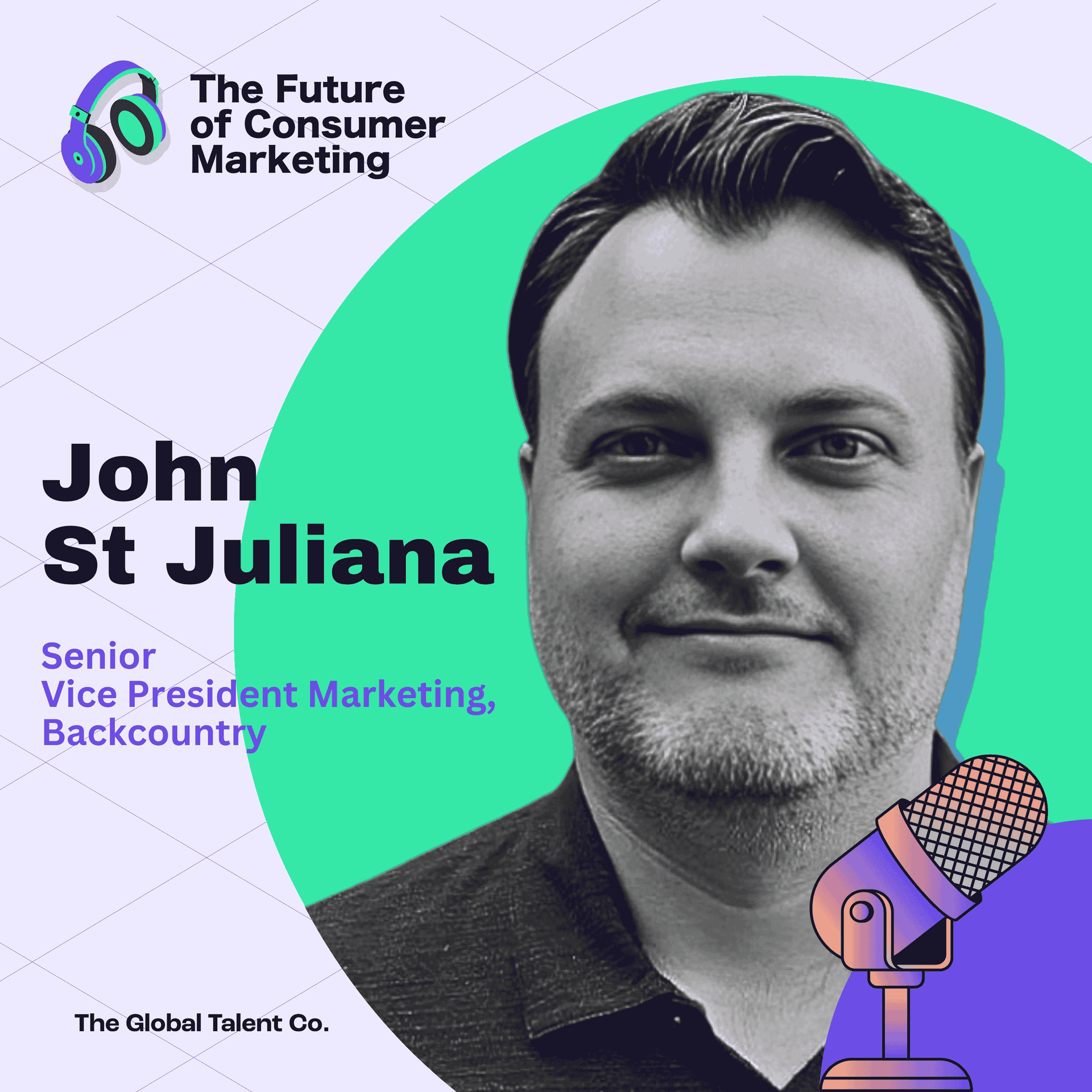
- Guest: John St. Juliana, SVP of Marketing at [Backcountry](http://www.backcountrycorp.com/)
Overview In this episode, the conversation focuses on the challenges and opportunities in the outdoor marketing sector, particularly the pitfalls of aspirational marketing. John St. Juliana shares insights from his experience at Backcountry, a premium outdoor retailer, and discusses innovative strategies for connecting with customers in a meaningful way.
Key Topics Discussed
- Aspirational Marketing in the Outdoor Industry
- The traditional approach emphasizes "top of mountain" imagery, potentially alienating everyday consumers.
- Backcountry aims to make outdoor pursuits relatable and accessible by showcasing everyday activities connected to outdoor gear.
- Multichannel Video Marketing
- Backcountry utilizes a multi-channel video strategy to maximize creative investments, ensuring campaigns resonate across platforms like linear TV, streaming TV, and YouTube.
- Loyalty Program Redesign
- John's team focuses on creating a customer-centric loyalty program that lowers barriers to participation rather than maximizing short-term profits.
- The program aims to offer real value to customers, fostering long-term loyalty.
- AI in Marketing
- John discusses how AI is leveraged as a tool to enhance productivity and quality, particularly in content creation and data management.
- The shift towards AI enables marketers to automate tasks and reduce reliance on external SaaS solutions.
- Growth Strategies in a Contraction Market
- The outdoor retail market is currently facing challenges, with many competitors downsizing or closing. Backcountry seeks to expand through both organic growth and strategic partnerships.
- Human-First Customer Service
- Backcountry differentiates itself by employing a knowledgeable customer service team, referred to as "Gearheads," who are passionate outdoor enthusiasts themselves. This approach enhances customer experience in an increasingly AI-driven marketplace.
Key Takeaways
- Rethinking Aspirational Marketing:
- The need for brands to connect with consumers on a real-life level rather than solely through aspirational imagery is crucial for building relatable and resilient marketing strategies.
- Effective Use of Video Content:
- A cohesive video marketing strategy can amplify reach and maximize the impact of creative assets.
- Prioritizing Customer Experience:
- Loyalty programs should focus on genuine customer benefits rather than short-term profit-maximization tactics.
- AI as a Transformative Tool:
- The integration of AI can enhance operational efficiency and content production while allowing marketers to take on more technical tasks that were previously the domain of IT.
- Community Building:
- By fostering a community-oriented approach through their loyalty program and customer service, Backcountry is positioning itself as a leader in the outdoor retail space.
Conclusion John St. Juliana's insights highlight the evolving landscape of outdoor marketing, emphasizing the importance of relatability, customer-centric strategies, and the careful integration of technology. The episode underscores the potential for brands to innovate and connect with consumers in meaningful ways, even in challenging market conditions.
Call to Action For listeners interested in exploring Backcountry's offerings, visit [backcountry.com](https://www.backcountry.com) for a range of premium outdoor gear and apparel, and to learn more about their loyalty program and community initiatives.
Written by AI. May contain mistakes. Listen to the episode to check what was said.
Chapters
Tap a time to open that second in VOIntroduction to Outdoor Gear
0:00 to 0:54
Learn about the outdoor gear offerings and the brands involved.
“We sell premium outdoor gear, whether it's ski, snowboard.”
John's Background and Backcountry Overview
1:43 to 3:16
Understand John's journey to Backcountry and the company's mission.
“We're so glad that we were able to make this work.”
Marketing Philosophy of Backcountry
3:16 to 4:19
Explore Backcountry's marketing philosophy and focus on quality gear.
“It really is all about getting outside and that's what we like to help people do.”
Successful Marketing Campaigns
4:19 to 6:43
Hear about an effective holiday marketing campaign and its impact.
“it could be, well, I'm going to run a 10K instead of a 5K.”
Demographics and Target Audience
6:43 to 7:53
Discuss the demographics of Backcountry's customer base.
“so consumers realized, hey, I can shop this online.”
Investment in Quality Gear
7:53 to 9:10
Understand the necessity of investing in quality outdoor gear.
“But yeah, it's typically a more affluent family.”
Critique of Industry Practices
9:10 to 11:12
John critiques the outdoor industry's aspirational marketing approach.
“And it's like, you gotta be able to invest properly in what you wanna do.”
Backcountry's Market Focus
11:12 to 14:04
Learn about Backcountry's market focus and international shipping plans.
“I hadn't seen it in that way in which you just portrayed it.”
Backcountry's Origins and Growth
14:04 to 15:18
Learn about the founding story and growth of Backcountry as a brand.
“But yeah, other than that, you know, it's very much U.S.”
Backcountry's Workforce and Operations
15:19 to 16:20
Discover how Backcountry manages its workforce and operational approach.
“That really is a long time for a brand to be in the market as to still be successful.”
Show all 13 chapters
AI Integration in Backcountry's Operations
16:21 to 19:09
Explore how Backcountry utilizes AI for efficiency and content creation.
“Our call center and customer service representatives, they're a little bit more distributed.”
Vision for 2026: Growth and Community
19:10 to 23:15
Understand Backcountry's vision for growth and community engagement in 2026.
“So you're, you know, so you kind of have that, you know, anyway, like how do you put the right controls around it and things like that?”
Customer Engagement and Gearhead Ethos
23:16 to 26:16
Learn about Backcountry's unique customer service approach and the 'gearhead' philosophy.
“I love how that is one of the things that you want to take care of and keep building on this year.”
Transcript
Automatic transcript. May contain errors.0:00Andres Figueira:We sell premium outdoor gear, whether it's ski, snowboard. We actually have a family of brands, so there's a total of like six different websites. It really is all about getting outside, and that's what we like to help people do.
0:11John St. Juliana:Does That Country, is this the brand that creates the clothing and the gear that you guys sell?
0:16Andres Figueira:We carry top brands such as Patagonia, North Face, but we also do all of the R &D and produce our own set of gear. Have you noticed any best practices that you disagree with? I think the outdoor industry in general has always gone with a top of mountain type of approach. It's always like very aspirational, I would say.
0:35John St. Juliana:What is your marketing philosophy with this type of industry?
0:38Andres Figueira:How do we just show up in everyday life and everyday activities as well, which I think will make us more relatable and I do believe is a differentiation outside of most of the competition in the outdoor space.
0:53John St. Juliana:Hey everybody, thank you for tuning in. My name is Andres Figueira, and I'm going to be your host for the day. This show is brought to you by the Global Talent Company, helping fast-growing teams hire exceptional remote talent from Argentina, South Africa, and beyond. We connect companies with world-class professionals who bring skill, reliability, and a global perspective to every role. And just for our listeners, we're offering an exclusive 10 % discount on your first hire. All you need to do is visit globaltalent.co, click start hiring, and mention the podcast listener discount when we reach out.
1:26John St. Juliana:And with me here today, I am speaking with John St. Juliana, Senior Vice President of Marketing at Backcountry, a company that is set on providing the best outdoor gear and to be the best doing it. With that said, John, welcome to the show, man. How are you doing?
1:43Andres Figueira:Yeah, hey, thanks. Thanks for having me. Doing well, doing well.
1:46John St. Juliana:We're so glad that we were able to make this work. And John, just so that we are able to put the audience a bit more in context here, would you be able to tell us more about your background, how you came to be the Senior VP of Marketing at Backcountry, and what Backcountry does in your own words?
2:02Andres Figueira:Yeah, absolutely. Background, I'm a math guy, so I actually have a math degree. So, you know, many paths in marketing for sure. And mine was all about the data. So math degree, man, I wrote six page marketing proofs in college and, you know, proving basic things with advanced theorems and stuff. Glad that's behind me. Definitely kind of found my way into business with that math background. And, yeah, started with data analytics, CRM and kind of just grew the grew the career from there. But definitely the analytic side of the brain versus the mass creative side of the brain. So I'm happy I have really strong, you know, strong teammates and team members on that side for sure.
2:48Andres Figueira:And, you know, as it relates to Backcountry, Backcountry, we sell amazing gear. So we sell premium outdoor gear, whether it's ski, snowboard, hike, climb, bike. We have it all. We actually have a family of brands. So there's a total of like six different websites, whether it's from power sports to cycling to deals, things like that. So it's a pretty big family and it's all about getting outside. It really is all about getting outside and that's what we like to help people do.
3:20John St. Juliana:That's amazing, man. And I love how Backcountry is, well, you mentioned it, it's like several brands. And my question is, in terms of what Backcountry represents, John, what is your marketing philosophy with this type of industry?
3:36Andres Figueira:Yeah, for us, one of our tags, if you will, is venture beyond. How do we help people get outside? With premium gear, we don't want to sell you something that's going to break down. So we want to make sure that it has very good quality to it. And that's that premium kind of positioning. And it comes out of more of a supporting people in the industry outside of anything else. It really is wanting to get people outside with really good gear. but then to go a little bit beyond. Our goat is part of our logo and it really just represents goats climb high and get into really gnarly places and we want people to be able to do that and whatever the next thing is, it could be, well, I'm going to run a 10K instead of a 5K.
4:23Andres Figueira:That's the next thing. It could be, I'm going to scale this amazing peak or I'm going to go backcountry skiing. Whatever it is, we want people to get out and do that.
4:33John St. Juliana:I am a fan of the outdoors and exploring and doing all different sports. But my question is, does Backcountry, is this the brand that creates the clothing and the gear that you guys sell? Or are you more of like a provider that takes different brands and sells those through Backcountry?
4:51Andres Figueira:Yes to both. So we carry, you know, top brands such as Patagonia, North Face and the like. but we also do do all of the R &D and produce our own set of gear. We call it backcountry gear and apparel. You can definitely find it on the site. We have some pretty fun ski kits, some limited edition colors, things like that. Sun protection, just like sun hoodies and sun protection in the summer is another popular product. So a little bit of both. And again, it's all in the, there's great gear out there. We think we fill a niche with the stuff we create. And it's just to, again, get people outside, get them moving and enjoy.
5:34John St. Juliana:Amazing. Amazing. And John, do you have any example of a marketing campaign that you ran for backcountry that went really well that you'd be able to tell us about and use as an example?
5:46Andres Figueira:Yeah. You know, holiday. Holiday obviously is a big deal for us. That's when people are buying. We get that. But our creative and content team, this last winter did an amazing job with really showcasing our holiday kind of gear guides and gift guides that we put together. But really that came together in a nice culmination of a 30 second spot that we were able to run on some linear TV. We also ran on streaming TV. We ran it on YouTube video. And so really utilizing that asset across multiple different platforms. One helps it scale and makes the investment worth it. But two, the campaign is typically well-received by customers.
6:27Andres Figueira:And then our creative team just knocked it out of the park this year, really connecting this idea of the world's largest gear closet that we like to think we have with you can get access to that online and it helps you get outside. So it was fun, it was playful, but it really also connected the dots so consumers realized, hey, I can shop this online. It's not just that country has this amazing stuff, but I can also go get it. So that CTA was just stronger this year and it really connected. So we took something that performed well, customers and consumers respond well, and I feel like we upped it just a little bit more this year.
7:00John St. Juliana:Amazing. And do you have or have you noticed any pattern in the demographics that you serve with backcountry? Is it like a certain age group, a certain type of person? Yeah. Obviously, you're an outdoorsy person, but uh-huh.
7:12Andres Figueira:Yeah. So, you know, the kind of, I mean, I've always ascribed to this averages are evil. So don't tell me what your average, you know, order size is. I want to see the distribution. That's kind of that math background. Right. So, so I try not to look at averages, even when it comes to demographics. but if we were to just kind of generalize the customer, it's a family. Usually there's two adults in the home with some kids, at least one kid. More affluent, I mean, we do sell premium gear, so the price points are a little bit higher and so it does generally take a level of income in order to really get into it.
7:50Andres Figueira:But again, part of that is we just wanna make sure we're selling really good gear. But yeah, it's typically a more affluent family. our male female split we skew a little bit more male but not terribly so it's close to 50 50 it
8:02John St. Juliana:skews a little more male but yeah no and i get what you mean when you mentioned that like more affluent families are the ones that are able to purchase these products but i feel that outdoor sports you need the best gear in order to do them safely and correctly and that is something that that it it's a an investment you have to do in order to be able to do these practices and these sports properly. So I totally need it.
8:26Andres Figueira:You don't want a plastic ski, right? You don't want a plastic ski, right? So there is this level of some of these sports just require a little bit more investment. That said, we're a retailer. We're running deals throughout the year and things like that. And so there's usually a point in time throughout the year that the product is attainable for everyone. It's not unattainable. And I guess I don't want to portray it as that. It's just it definitely is a little bit more affluent. But that's just because of the sport. You know, a Tahoe sun hoodie. Yeah, no problem. You can you know, that's that's not expensive.
9:00Andres Figueira:But getting skis or snowboards. Yeah, that just they cost money.
9:05John St. Juliana:So now I totally understand. And me, I'm originally from Venezuela. So I compare it to like kite surfing or wind surfing that you need this whole gear and important thing to be out in the ocean and doing a water sport that could be dangerous and even life threatening. if you're not using the proper gear. And it's like, you gotta be able to invest properly in what you wanna do. So I totally understand that, man.
9:26Andres Figueira:Yep, absolutely, absolutely.
9:29John St. Juliana:And John, have you noticed between the competitors that Backcountry may have and how the industry of outdoor sports and retail works, have you noticed any best practices or ways of marketing their products or their brands that you disagree with?
9:46Andres Figueira:Yeah, that's a great question. I think the outdoor industry in general has always gone with many times a top of mountain type of approach. And we just talked about how expensive it is. And there's this top of mountain approach of here's the epic line on the mountain that someone took from a ski or even from just the models that are shown and things like that. Right. It's it's always like this very aspirational, I would say. So like there's usually this very aspirational. and I think that inspires people but I think there's an element of being able to connect with people in reality as well and so that's something I will say we still very much show aspirational imagery and footage and things like that but that's one side of marketing as we think about events and partnerships and sponsorships and stuff that's where us being involved with something like the National Interscholastic Cycling Association, right?
10:47Andres Figueira:So like high school cycling, right? Like we're involved there. That's real. People aren't necessarily buying$10 ,000 bikes in order to compete in high school, right? And so we're very involved there, just being at the trailhead and things like that. We have work to do on the backcountry brand side of that. But like that's kind of the mission is how do we just show up in everyday life and everyday activities as well, which I think will make us more relatable. And I do believe is a differentiation outside of most of the competition in the outdoor space.
11:18John St. Juliana:Okay. I hadn't seen it in that way in which you just portrayed it. But I totally agree with that. And the fact that several brands I know that are outdoorsy, it's that. It's like a very aspirational campaign of a dude that looks like he's been climbing his whole life. And he's at the peak of a mountain and about to make it. And you're like, I'll never be there. Like, I'll never do that. So do I really need that jacket? Yeah.
11:40Andres Figueira:Yeah. Yeah. And again, like there's an element of that because I mean, and if you just work out, right, there's this element of whatever, it's a vision board or where you want to be. And so I think that is important, whether, you know, just marketing or life, like what's the objective, where do I want to be? And we really want to give people something to strive towards. So that's not going away. But I do think there's a balance that we can achieve or at least help balance the scale a little bit. And how we view that is maybe less in the videos and the imagery, but more just in how we show up in real life.
12:14Andres Figueira:And I think that's something that we're just continuing to talk about internally as well.
12:18John St. Juliana:And John, Backcountry is like our – you guys have physical retail stores, the online store. Do you guys only have and sell within the United States or do you also serve markets like Canada and South America or maybe Europe? Not sure what a country was doing there.
12:37Andres Figueira:Yeah, majority is U.S. We do ship some of the products internationally. And so we, you know, you can visit the site and we serve it. It's an opportunity, though, honestly, like just simple things. We can show currency and local currency versus U.S. currency. We don't do that today, but I think that's an opportunity. The EU is, you know, we don't sell to the EU currently, but majority of the world is available to visit the site. But it's just it's not our focus is what I would say.
13:10John St. Juliana:So your focus is to just expand within the United States and become like the leading brand in your home country.
13:16Andres Figueira:Absolutely. Absolutely. And I think, you know, balancing that a little bit, we do view international expansion as an opportunity. but it's, we still have so much room just to gain market share in the U.S. in our, kind of in our own backyard, if you will.
13:32John St. Juliana:Yeah, it's like trying not to bite more than you can chew when you're already just working on the States. So I would just try to like take up on the world later on when you've already dominated the U.S. It'll make it all that good.
13:42Andres Figueira:I mean, hey, we're trying to get the goat out there. There's a small shop in Chile that sells our backcountry gear and apparel. And so, you know, we're working on some avenues that way. So even if it's not through the website, are there wholesale opportunities or other retailer opportunities where we can distribute at least the gear that we make into those locations? So, you know, we're exploring things like that. But yeah, other than that, you know, it's very much U.S. focused.
14:09John St. Juliana:If any backcountry products arrive in Argentina, just let me know because I'm here waiting to get the best gear to go down to Patagonia every single winter. I could do snowboarding.
Read the full transcript
14:18Andres Figueira:Absolutely.
14:20John St. Juliana:Absolutely. Yeah, yeah, yeah. Absolutely. I mean, yeah, we're working on it. We're working on it. Oh, my goodness. Yeah, but like I feel like I really know you guys because I've seen that logo so many times before. Like I've gone to the States and I've seen the little goat and I'm like, I know who these people are. So I know you've been there. And that leads to another question of mine. How old is Backcountry, man? Like how old is the company?
14:42Andres Figueira:Yeah, boy, putting me on the spot. I believe it was 99 or 2000 is when Backcountry was established. It was a former Olympian and a friend, and they started with an avalanche beacon. So it was just a beacon for avalanche safety, and they started selling out of their garage. Then this thing called the internet really took off, and they just started listing products on the internet, and it grew from there. But it was literally a small single-car garage in Park City, Utah, that started this whole thing, what, 25, 26 years ago type of thing. So, yeah.
15:18John St. Juliana:Oh, my goodness. That really is a long time for a brand to be in the market as to still be successful. That's like such a cool thing, man. And how big is Backcountry in terms of the workforce you guys have and how many people do you have helping you out?
15:32Andres Figueira:Yeah, we have a pretty distributed workforce. We have two different fulfillment centers in the United States. And I, boy, man, I actually don't know total workforce. Editing guys can do a good job with this one. But, you know, I would say, you know, in in general, like the workforce is where, you know, we're several hundred, several hundred strong for sure. And it flexes across the year, depending on the needs and like our fulfillment center and our call center.
16:03John St. Juliana:Is the backcountry environment for working? Is it remote first or you guys have several headquarters or different offices in like around the United States?
16:12Andres Figueira:We have a main corporate headquarters in Salt Lake City, Utah. So we, you know, we're staying in Utah. That's our roots. That's where we are. And that's where the majority of the corporate workforce is. Our call center and customer service representatives, they're a little bit more distributed. And then we obviously have the we have two fulfillment centers, one on the East Coast and one in the Rockies.
16:34John St. Juliana:So and now that leads to, well, I always like to ask about the workforce and how that's going. And then I love to then switch it up to AI. And are you guys leveraging AI in any weird or peculiar way that you're able to tell us about?
16:47Andres Figueira:Yeah, weird or peculiar. I'm not so sure. I don't know. I don't know how to define that. But but in general, yes, I mean, we have especially over the last, I would say, 18 months for sure. we have really just, it's easy to say AI forward and AI first. What does that really mean? How we've looked at it is through a lens of automation as one lens, like where can we use it just to be faster? Like the classic manufacturing, but it applies to corporate world of just for this, you know, can I get more widgets per hour in an output, right? So like, That's a lens we've looked at it. The other lens is, can we then improve the quality of the output with same resources?
17:32Andres Figueira:So it's not only more output, but it's quality. And so, you know, because of that, we've been able to automate and scale various aspects, whether it's content, which is definitely a little bit of a, you know, debatable topic right now. It is. We've looked at it more, you know, like how do we use it to get faster with image editing, just as a very simple example. What else can we do to leverage it to help with, you know, writing long form content or at a minimum reducing the research needed to produce the long form content, right? So it's allowing us to scale our long form content that we're producing.
18:12Andres Figueira:You know, we're using it, automations and things like that, just for data transfers and stuff. So it's a really interesting landscape right now from an AI perspective. We've kind of come from this like SaaS, you know, everything was hosted. Then, you know, now you have the SaaS environment. Now you have this AI environment, which is really fascinating, just more philosophically, because certain levels of SaaS providers can now just be done in-house leveraging AI, whether it's AI coding, whether it's automation processes and stuff. And so I think the vendor landscape is going to be really interesting over the next few years, too, how that evolves, because things that were needed previously that you had to buy, you can now build so much easier.
18:56Andres Figueira:And it's added tool access to business users, not just technical experts, but business users now can do more technical, you know, higher level technical things than they've been able to in the past. And so it's starting to, you know, it's starting to shift that. And then I guess internally, you know, as a marketer, you kind of don't pay attention to this, but the IT folks do is like you kind of have the shadow IT department now within marketing because you're doing IT type things and you don't need IT out use. So you're, you know, so you kind of have that, you know, anyway, like how do you put the right controls around it and things like that?
19:32Andres Figueira:So definitely working through that.
19:33John St. Juliana:No, I love how you frame that because I really do agree in the fact that AI has lowered the barrier of entry for more technical tasks that people before needed to look for help or hire an agency or a third party to help you out with that. Now AI has allowed that the normal person or regular worker from a company can really take care of those things. And I've also noticed that with retail a lot, like with stores and brands similar to Backcountry, is that AI is being leveraged a lot for customer success as well. To handle comments, complaints, and to be able to screen a big amount of them and then delegate the ones that need human assistance and human introspection to be able to do it done properly.
20:16John St. Juliana:It delegates those. But that's also another way that I've been seeing AI be used. And I think that's really cool because it really is changing the scenario and how things work as to opposed as how they have been working. Yes.
20:29Andres Figueira:Yeah, absolutely. Absolutely. Yeah.
20:32John St. Juliana:And John, in terms of, well, I know that it's already February, but we're still beginning the year. But now that we're in Q1 of 2026, what is your vision and your goal for what you'd like to accomplish at Backcountry this year?
20:49Andres Figueira:You know, I think that the answer to that question requires like even a little reset. So COVID, the outdoor industry boomed. And then you came out of COVID and it's been a struggle, especially obviously relative to COVID. But if you look across the outdoor and even the retail landscape, you see certain iconic brands even filing Chapter 11, closing the stores, having to downsize significantly, things like that. There's a struggle in the outdoor space. And somewhat pridefully but also excitedly, backcountry's not in that position. We're in this position. And last year we added and partnered with a couple of great brands.
21:34Andres Figueira:We added a regional level nine sports that's well known in Utah, had a small national presence. We've added bike tires direct to strengthen our bike offering. And, you know, we're continuing to look right. So expansion is kind of the name of the game for us. Like, how do we grow organically and inorganically? But it really is about growth. So we're pretty bullish on what the future holds here and bullish on the outdoor industry. We think we have a lot of great brands. We're adding services to that. And how do we continue to expand our offering? We relaunched our loyalty program and have a loyalty program that is providing a ton of value to customers.
22:18Andres Figueira:It wasn't designed by the finance department to, you know, try to maximize profit in the short term. It was designed with the customer in mind first, right? And so we're passing every benefit on and we keep adding benefits to it and looking for partners in the outdoor space. Like how can people get out? How can they get a lift, you know, a ski pass cheaper by being a part of our loyalty program? How can they, you know, get access to great gear cheaper? You know, how do we lower the barriers and provide amazing benefits for a customer as part of the loyalty program? So a little bit of a rambling there, but like those are the things that really excite us is, again, kind of how do we lower the barrier to get people outside within the kind of confines of our loyalty program?
23:04Andres Figueira:And so that creates loyalty to us from a mindshare perspective. In addition to a purchase, it also gets people doing the activity more, which ultimately it definitely benefits us. But if we get more people doing the activity, it raises the tide in the outdoor space and we'll be rewarded with our share in there for sure.
23:22John St. Juliana:I love how that is one of the things that you want to take care of and keep building on this year. And it's the fact that, yeah, loyalty programs, they provide benefits to your customers and your consumers. But what really matters there is that you're creating a community that more people want to form a part of. And not just because of the benefits, but if everything goes well, if outdoor sports and those people start to do it more, it just starts to trend even more. And backcountry being positioned as such an important brand and something that is beginning to trend once more is going to be like such a nice spot to be in when everybody wants to do a winter sport when, well, you guys are right now in winter.
24:00John St. Juliana:I'm in summer. I can't wait until winter and go and hit the slopes. It's like, oh, my goodness. I count in the day.
24:08Andres Figueira:I tell you what, man, when we when we want to capture winter content in the in the summer months in the in the northern part of the, you know, of the world. yeah it's we're trekking to New Zealand or to Patagonia or someplace because that's where the snow is so and and it's been a rough snow year in in the U.S. in general we the east coast and the midwest has had snow but a lot of the big mountains in the Rockies and stuff it's it's been a low snow year so people been definitely chasing snow this year for sure all right and and well I'm noticing
24:37John St. Juliana:that we're almost at time John but before I do let you go and I close out the episode I did want to give you the chance to let anybody who is hearing us who is interested in the backcountry products and what backcountry offers how could they go about looking at your catalog seeing if they can get something delivered to where they're at how would that process look absolutely you know
24:55Andres Figueira:just kind of hit the url backcountry.com it's it's that simple i would also say you know the portfolio of brands that i mentioned earlier we have competitivecyclist.com if you're really in the cycling. We have a site called steepandcheap.com where that's where you're going to find some deals there. You'll definitely find some deals there. Biketiresdirect.com as well as we talked about. So yeah, it really is hit the URL. And if you have questions, one of the things that's part of our ethos is this concept of gearheads. We have an amazing customer service team. We call them gearheads. They don't just answer questions.
25:33Andres Figueira:They do this stuff, right? They're doing back country skiing, they're cycling, they're running marathons, they're participating in triathlons, they're doing the stuff. And because of that, you can give them a call and they absolutely will walk you through, here's how they would get set up to do the activity. That is something we're really proud of. You mentioned kind of in the age of AI, we're definitely leveraging it, but we also don't want to lose this gearhead ethos because it's a human connection, which is, I think, potentially even more important as we move forward in time than ever. And, you know, we have that.
26:09Andres Figueira:And so, you know, that's another thing you can chat with on live or give a call and they absolutely will get you set up.
26:16John St. Juliana:That is so cool. That must be the fittest customer service team that there is around there. Yeah, it's crazy.
26:21Andres Figueira:Yeah, it's absolutely crazy. Yeah.
26:24John St. Juliana:Oh, but amazing. So anybody who is here listening and is interested, you heard it here first, just hit the URL. there's for many different disciplines. So just go to badcountry.com if you're not sure. But if one of the other ones rang a bell in your head, then just go to that one. But with that said, John, thank you so much, man, for hopping on the show with us, for coming and telling us your insights and all about your experience at Bad Country. We really appreciate it.
26:47Andres Figueira:Hey, thanks for having me. It was fun. It was fun. I appreciate it.
26:50John St. Juliana:With that said, thank you so much, man. And to anybody who is here listening to us, thank you so much as well for coming on the show to listen to us, to learn about the different personalities that we talk to and all the different industries that we're learning about. So with that said, have a good one.
From the publisher
In this episode of The Future of Marketing, host Andres Figueira sits down with John St. Juliana, SVP of Marketing at Backcountry — the 25-year-old premium outdoor retailer that has quietly become one of the most resilient e-commerce brands in a category currently littered with Chapter 11 filings and store closures. While competitors chase aspirational "top of mountain" imagery, John is rethinking what it means for an outdoor brand to show up in everyday life — and rebuilding a loyalty program designed not by the finance team, but entirely around the customer. He also shares how a math-degree-turned-marketer thinks about AI not as a buzzword, but as a tool to simultaneously scale output and raise quality without proportionally growing headcount.
Topics Discussed:- Why the outdoor industry's aspirational marketing model is leaving money on the table
- How Backcountry is using multi-channel video to maximize a single creative investment
- The philosophy behind redesigning a loyalty program to lower barriers to participation — not maximize short-term yield
- Using AI to scale content production and eliminate low-value SaaS dependencies
- Organic and inorganic growth strategy in a contracting outdoor retail market
- Building a human-first customer service model ("Gearheads") as a brand differentiator in the AI era