
In short
Phoenix Rising FC’s marketing strategy for a second-division soccer team—why they convert non-soccer fans (e.g., beer drinkers) by selling a “best live soccer experience,” not just matchups.
Guest backgrounds
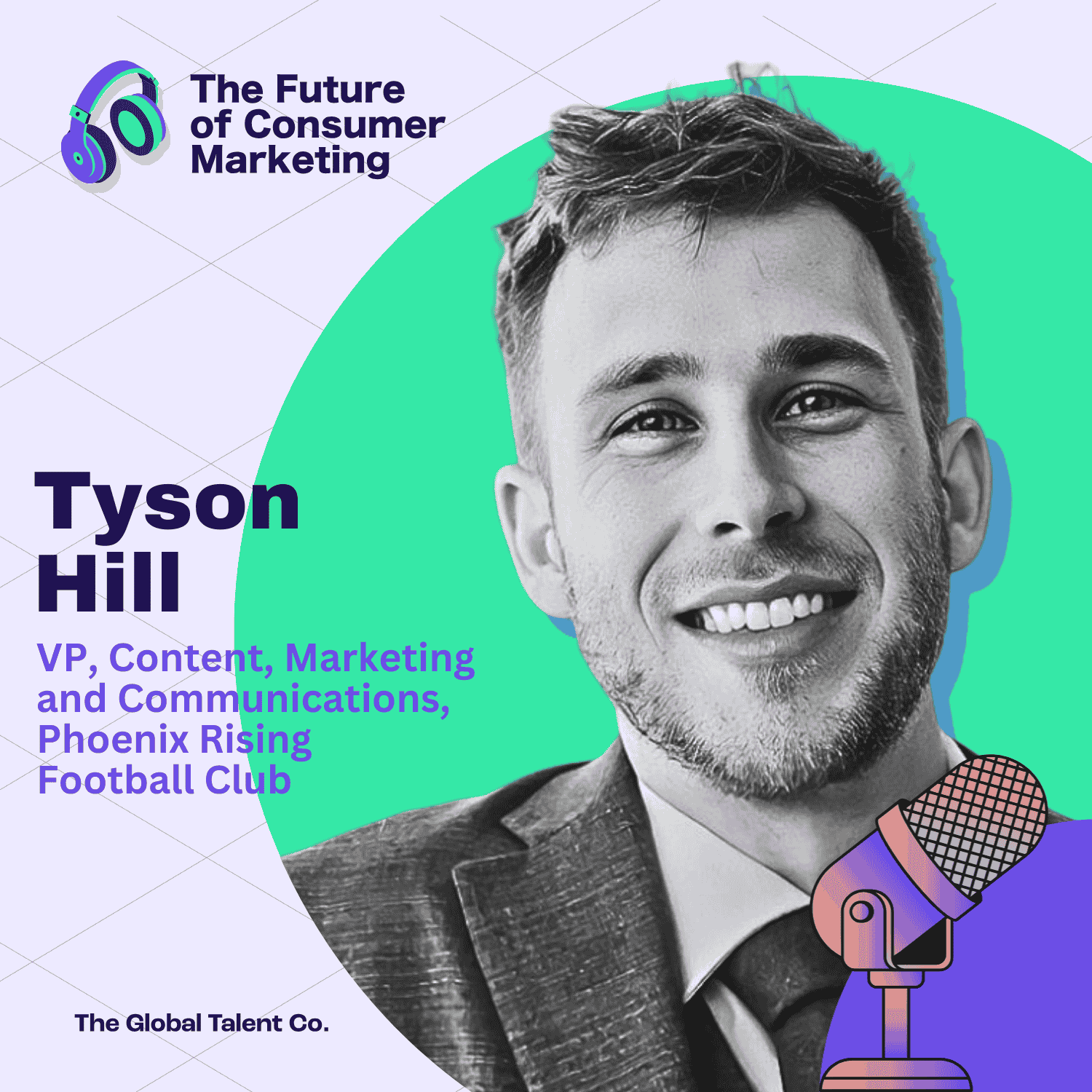
Tyson Hill, Vice President of Content, Marketing, and Communications at Phoenix Rising Football Club (Arizona’s pro soccer franchise; founded 2013; entering 10th USL Championship season). Former sports marketer/content leader at Minnesota United (started in 2013 when it was second division; helped grow to a much larger staff). Also worked in economic development after moving to Phoenix.
Key claims
Best converting audience isn’t soccer fans because there’s too much soccer to consume (Premier League/La Liga/Liga MX). Live experience is more community-driven than TV. Second division has less investment, so storytelling and targeted paid social matter.
Notable examples
Interviewed a mom of two attending for the first time; kids got field access/autographs and supporter-section singing—turned into short social features. CRM/email focuses on “what to expect” and infrequent, time-respecting messages. Broadcast accessibility via CBS/ESPN/YouTube/linear AZ Family; no paywall. Stadium perks: dollar beer night (Modelo $1), tickets starting at $10; Didier Drogba expected to appear.
Written by AI. May contain mistakes. Listen to the episode to check what was said.
Chapters
Tap a time to open that second in VOThe Unique Marketing of Soccer Teams
0:00 to 1:03
Learn about the challenges and strategies of marketing a second division soccer team.
“I think one of the interesting things about marketing a second division soccer team is that our best converting audience isn't soccer fans.”
Introducing Tyson Hill
1:37 to 2:15
Get to know Tyson Hill and his journey in sports marketing.
“They were established in 2013, and I believe the club is entering its fourth year in the United Soccer League.”
Tyson's Background in Sports
2:15 to 4:19
Discover Tyson's career path and experiences in sports marketing.
“out to our stadium to watch our games next season.”
The Impact of Sports on Community
4:19 to 7:41
Explore how sports can unite communities and create impactful experiences.
“And we moved our family down here to Phoenix about four years ago.”
Marketing Challenges for Soccer in the US
7:41 to 11:12
Understand the difficulties faced in promoting soccer in a crowded sports market.
“And it's that camaraderie and that way of just let's pause everything for a moment, watch this or live it.”
Successful Campaigns and Storytelling
11:12 to 14:00
Learn about effective marketing strategies that drive ticket sales.
“So you're seeing great steps and great strides in MLS.”
Family-Friendly Soccer Experiences
14:00 to 15:00
Learn how soccer games can be enjoyable for families and children.
“So, for example, last year we interviewed a mom of two who was attending the game for the first time.”
Targeting Diverse Audiences
15:00 to 17:00
Discover the importance of targeting beer drinkers over traditional soccer fans.
“Like we're not trying to hit you every single day with an email message that says, hey, buy tickets.”
Broadcast Accessibility and Strategy
17:00 to 19:06
Explore the strategies for making soccer games accessible to everyone.
“I just believe in making that type of thing accessible.”
The Challenges of a Small Team
19:06 to 21:12
Understand the dynamics of working in a small sports marketing team.
“We don't have a ton of brand penetration in this market.”
Show all 15 chapters
Benefits of In-Person Collaboration
21:12 to 24:20
Learn why being physically present in the office enhances creativity and teamwork.
“how big is the workforce behind Phoenix Rising Football Club and how many people do you have helping you out with all this?”
Building Relationships with Players
24:20 to 26:46
Discover how close interactions with athletes enhance fan engagement.
“I like the interaction with the people I work with.”
The Role of AI in Sports Marketing
26:46 to 28:01
Explore how AI is currently used to enhance marketing efforts in sports.
“And that's how our fans become attached to the team and the players and the stories that we're telling.”
AI in Marketing: Personalization and Efficiency
28:01 to 30:04
Learn how AI is transforming marketing campaigns through personalization and efficiency in outreach efforts.
“You can start to customize content for people.”
Phoenix Rising: Engaging Fans and Selling Tickets
30:04 to 31:28
Discover how Phoenix Rising is creating a fun atmosphere for fans and making tickets accessible.
“But I did want to give you the chance before I let you go to let anybody in the audience who is in Phoenix or who is a soccer fan and wants to watch one of your games.”
Transcript
Automatic transcript. May contain errors.0:00I think one of the interesting things about marketing a second division soccer team is that our best converting audience isn't soccer fans. How has it been marketing and creating fandom around a team that I feel the states doesn't have that deep of the roots with the soccer? One nice thing about our team versus, you know, an NFL team or an NBA team is we're far more accessible and you're going to be a lot closer to the action and a lot closer to the players. And I think that's really fun. a successful campaign or storyline that you guys come up with that really helped convert leads into ticket sales.
0:35Our goal here is to try and drive more people to an experience that's special. What we have here is we have the best live soccer experience that you can have. We're speaking to people rather than trying to sell that we have a matchup on Saturday. Our creative really focuses on the drums, on the smoke, on the broad atmosphere of the game and that feeling of community and camaraderie that you get to experience when you come here.
1:02Hey, everybody. Thank you for tuning in. My name is Andres Figueira, and I'm going to be your host for the day. This show is brought to you by the Global Talent Company, helping fast-growing teams hire exceptional remote talent from Argentina, South Africa, and beyond. We connect companies with world-class professionals who bring skill, reliability, and a global perspective to every role. And just for our listeners, we're offering an exclusive 10 % discount on your first hire. All you need to do is visit globaltalent.co, click start hiring, and mention the podcast listener discount when we get in touch.
1:36And today, with me here, I am speaking with Tyson Hill, Vice President of Content, Marketing, and Communications at Phoenix Rising Football Club, Arizona's only professional soccer franchise. They were established in 2013, and I believe the club is entering its fourth year in the United Soccer League. So how's it going, Tyson? It's a pleasure to have you on the show, man. It's great. Great to be here. We're actually entering our 10th season in USL Championship next year. So we've got a decade of rising, which is really exciting. a lot of prep for our 10th year next season and looking forward to getting more people out from this huge community that we have here in Phoenix out to our stadium to watch our games next season.
2:22That's amazing, man. Thank you so much for the correction because when I read the dates, I was like, is it the fourth year still? So it's great that you're already entering your whole decade, man. That's so cool. And yeah, just so that we can start on Tyson, would you be able to give us a bit more of your background and how long you've been at Phoenix Rising Football Club and all that? Yeah, so I've been working in sports a little bit over a decade now. I started in MLS with Minnesota United. So technically in 2013, they were in the NSO, which is the second division soccer league here in the U.S.
2:59And I wasn't really aware of people working in sports at the time. I remember going to a soccer game at the old Metrodome in Minnesota with my dad and seeing guys walking around the field in suits. And I remember talking to him and being like, how did they get out there? How did they get down on the field? Like, I want to do that. I was a journalist at the time, but I'm a soccer player. You know, I played growing up. I played in college and I played a little bit after college. So I always had an interest in the sport. And when the time came, there was an opportunity for me at Minnesota United.
3:33I jumped on that. I was, I think, one of eight people to start at that club that has grown exponentially since I was there. I think they probably have closer to 85 or 90 staff there now. Wow. Okay. And I was there for a really exciting time where we were in that second division and they were building out their marketing teams and their communication teams and growing into the first division into MLS. We opened a new stadium. We moved our home from Blaine to St. Paul, which was really fun. And I grew a lot. I grew a lot, both in the content and marketing space, but just in general as a person. And an opportunity came for my wife down here in Phoenix.
4:18She also works in sports. So she got a job with the Phoenix Suns. And we moved our family down here to Phoenix about four years ago. And I took a break from sports and moved into economic development. And it was great. I love economic development. It felt like I was doing something some good for the community. But I remember I was hosting a podcast and we had David Russo on board. And it was at the time when the Super Bowl was coming to Phoenix. So he was the head of the Super Bowl committee at the time. And he came on the podcast to talk about the economic boom that comes with major sporting events.
5:00But he told a great story that resonated with me and kind of reinvigorated me to get back into sports. And it was like this. So he was working for a PR firm at the time. And one of the principals at the PR firm was tasked with building the Iraqi national team after Desert Storm, rebuilding them. So he went out for months and was trying to find players, track them down, bring them back into the team, get everything organized after all that had happened through Desert Storm. And once he finally organized everything, they needed somebody to play. And he was looking for a team for them to play for a long time.
5:40They were trying to set up a friendly and eventually Kuwait came on board and said they'll play them. But Iraqi team didn't want to play in Kuwait. Kuwait didn't want to play in Iraq, so they had to find a neutral place to play. Finally, he found a place for them to play, so they went and they played their friendly in Jordan, but one of the stipulations that Jordan had was that they wouldn't let them play in front of fans. It had to be an empty stadium, but they broadcast the game. So everything's done. The game goes by. I don't know what the result was. I guess the result doesn't matter. The guy, the principal who set all this up.
6:18He's flying back. He's finally going to be with his family after months and months of work of organizing everything. He's tired. He's done. He gets a call from the military general that's kind of leading the efforts over there. And the guy says, you did a great job. And in the same breath, he says, so when are we doing this again? And the guy's like, man, no, I just went through this. I'm done. I'm tired. I'm getting back to my family. And the military general is like, no, you don't understand. Conflict was down in the reach an 80 % during this broadcast. We need to do this again. And I think that really speaks to the impact of sports.
6:51Like it, it's one of those universally disarming qualities that, that, that sports has about it. And I think it makes a difference in a way that isn't always clear because it's fun. You know, this is an entertainment field and people are going to events, but it does matter too. It gets, gives you the opportunity to think about things a little bit differently or just forget about like life for a little bit and enjoy an experience. So, you know, I was excited to get back into sports and excited to get to Phoenix Rising because I get to kind of tell that story and do something special for people every day, which is a lot of fun.
7:27Wow, man, that story really, really hits home. And it's a very wholesome anecdote, the one that you just shared, because conflict lowering by 80 percent. That's just some crazy statistics that I'm hearing. And that is beautiful because I really do agree that sports bring out something special within each of us. And it's that camaraderie and that way of just let's pause everything for a moment, watch this or live it. And then we can go back to whatever we were doing. But that's that's amazing, man. And I can totally see why it would reinvigorate you to get back into the sports industry. Yeah. I mean, it's really it's really the great equalizer, right?
8:02Like you don't need to have a lot of money and enjoy sports. Anybody can enjoy it. So the differences kind of get left at the door when you get into a stadium. Yeah, you may be cheering for other teams, but you're a community. And it's nice. There's this big community that's built around sports. And soccer specifically is great for that. No, for real. And like bringing it on home here from where I'm at, I'm not originally from Argentina. I'm from Venezuela, but I've been living here for eight years. And I was here when Argentina won the World Cup, the Soccer World Cup. And man, you have no idea what that feeling was like going out on the streets with everybody celebrating.
8:39And I come from a nation where every time I go out to the streets with people, it was because of political turmoil or any strange issues. And it was never for a happy reason. And this was the first time I hit the streets and went with like a million people on the road walking, just celebrating that Argentina won. And it was just like one of the happiest moments I've ever lived. And I wasn't even a part of the nation, but I was still there celebrating with them. And it was beautiful, man. So I can totally understand that. Yeah. And that kind of experience is something that we hear from people who are deeply involved with the team or just like passionate fans every single day.
9:19They come into the stadium as an individual and they really start to build this community around them. And that's what that is what brings them back to the game more so than the team and whatever happens between the lines is that feeling of camaraderie. And like, I think soccer is great in that you have the supporter section. So you have these people that are sitting on the south end line here in Phoenix and they're all singing songs together. You don't get that anywhere outside of a cathedral. I guess pretty that's pretty cool. It really is like an out of body experience. And it's even spiritual at moments because I went, for example, to the stadium of Boca Juniors.
9:53I haven't gone to a Super Clásico, but oh my goodness, the feeling and the people there, it really is. It's something that I have never lived before. And that only happens, at least it happens here with soccer, how Argentinians feel it and breathe it and live it. It's just the passion they have is unwavering. It really is. And Tyson, I'd love to know. So you've been with the team for a while. But my question is, how has it been marketing and creating fandom around a team that I feel the States doesn't have that deep of the roots with the soccer, with soccer as a sport? It's mainly baseball and basketball and American football.
10:33So how has it been changing people and bringing them into this new sport in a way that is different from marketing basket and all those other more legacy sports that are there? Yeah, and we have the added challenge of being a second division soccer team here in a crowded market. So we have NBA, we have NFL, we have major D1 university programs here, and we have a second division soccer team. And we're the best live soccer that you can watch in the state, but we're not even the best live soccer that you can consume here in the U.S. The nice thing about the sport is that it's growing really rapidly.
11:14So you're seeing great steps and great strides in MLS. They've built brand new fancy stadiums. They're driving a lot of people into those stadiums. The challenge in the second division is there's just a lot less investment. So there's a lot less money going into the league. There's a lot less money going into the teams. But I think the experience is similar. It's maybe just on a smaller scale. And the one nice thing about our team versus an NFL team or an NBA team is we're far more accessible, we're far more affordable. It's a lot easier to get through the doors here, and you're going to be a lot closer to the action and a lot closer to the players, and I think that's really fun.
11:55And then as far as the experience, like I mentioned earlier, I think soccer is second to none. You go to an NBA game, you know, you're going to a club. There's music playing during the game. You're kind of stuck in these small seats, but it's fun. It's a different type of experience. I think when you go to a soccer game, you're more a part of the community. You're more a part of this crowd that is kind of a part of the game. The singing, the chanting, everything is really impacting the play on the field. And I know players will say, I don't hear individuals, but they're certainly spurred on by what's happening in the stands.
12:32And I think that's a lot of fun. So, but yeah, I mean, we have our own challenges and a lot of it just comes down to trying to find, you know, storylines that speak to people and speak to the media here so we can get on broadcast news. Like NBA, it's a given. They're going to be on the 10 o 'clock news every night. It's not, that's not the case for a second division soccer team. So you got to think of fun and unique ways to tell your story here. Tyson, do you have any example of a successful campaign or storyline that you guys came up with that really helped convert, I want to say, leads into ticket sales?
13:07Because you bring fans into the stadium, and I think that's what everybody mostly wants. But many examples you may share? Our goal here is to try and drive more people to an experience that's special. And we're focused on getting people here for the first time because we believe that getting here for the first time, they'll come back because the experience will be good. So a lot of things that we're focused on are really hyper-targeted paid social. We're not trying to reach broad demos. We use Sharp Creative that kind of builds the atmosphere around what we are. So we change the way that we're speaking to people rather than trying to sell that we have a matchup on Saturday.
13:46We're trying to sell the experience. So our creative really focuses on the drums, on the smoke, on the broad atmosphere of the game and that feeling of community and camaraderie that you get to experience when you come here. We focus more on long form storytelling and breaking that up for the individual channels. So, for example, last year we interviewed a mom of two who was attending the game for the first time. And, you know, I don't know if you have kids. I have a kid. when you bring a kid to an event you know what you kind of expect is chaos like the kid's going to be running around there's going to be people all over the place you're trying to you know control that chaos a little bit and that was kind of her expectation going into the game but what she got was community and accessibility like the kids got to go down on the field and get autographs you know they got to go in the supporter section and sing for a little while and went back to their seats um and we turned that content into the short features that we we posted on our different social channels and it was a lot of fun.
14:45It kind of said like, you can be a family and go to these games. You know, the tickets are pretty cheap, but you're still going to have a good time. There's something for everybody at these games. And then on the CRM side and email side, you know, we really focus on respecting people's time. Like we're not trying to hit you every single day with an email message that says, hey, buy tickets. We're more like, here's what to expect at the game. Thanks for stopping by. Here's a gift that you can have if you come back. And here's what we have coming up. Because again, you really got to trust and believe in your product.
15:18And we do here. I believe if you come to a soccer game here at Phoenix Rising, you're going to want to come back and you want to experience it again. Now, and I love the fact that you're framing it in a way that this can also be a family event. You don't have to be a diehard soccer fan to actually enjoy a game at the stadium. And that's a very nice line to show that people can just go and you don't actually need to know every single score, what's the ranking or who are the players. It can just be a nice time because I've gone to perfect games where I have no idea who's playing and it's amazing.
15:49I think one of the interesting things about marketing a second division soccer team is that our best converting audience isn't soccer fans. So, and when I tell people that, I think a lot of times they're surprised because we're a soccer team. So obviously, you know, soccer fans that are the ones that convert and buy tickets. The problem with that is that there's so much soccer to consume. When you think about who you're competing against, you're not competing against US soccer teams. You're competing against Premier League, La Liga, Liga MX, international soccer, all these broadcasts that you can watch every day.
16:30And what we have here is we have the best live soccer experience that you can have. And a live experience is a lot different than the consumed experience that you might get on television. So we do well with sports fans. We do well with people who enjoy live events like concerts. I think one of my favorite audiences that we target is like beer drinkers. People that go out and have a good time. Like they're the type of people that want to go to these games. But yeah, you know, you can spend a lot of money trying to convert soccer fans but at the end of the day it doesn't it doesn't really work it really it really is true that you guys have a a whole um what's it called an international market of competition to be with all the soccer leagues that there are because i hadn't um like i hadn't put that into perspective and that is completely true um and in terms of tyson you mentioned that you have a great live experience in the stadium for people who want to go for beer drinkers families for everybody then how is it that you take care of those fans and that and those people that just want to watch your games or see a broadcast, are there any campaigns or strategies you're using to also get viewers on the streaming side or on the more digital side?
17:43I just believe in making that type of thing accessible. And we have great broadcast deals, both through the league here, but also locally. So the league has partnerships with CBS and ESPN. A lot of the games that we play are played either on Paramount or you can stream it online on ESPN. And if you're in an international market like you are, you can consume it on YouTube. So really anyone can go and experience our games. They're not behind a paywall. It's one of the challenges with MLS. If you wanted to go and watch a Minnesota United game today or yesterday, I guess, they just had their last game while they lost in the playoffs, you'd have to have an Apple TV subscription and you'd have to have subscribed to MLS soccer on Apple TV.
18:32Now they just changed that. So you won't have to have that MLS subscription, but you'd still have to have that Apple TV subscription. That isn't the case here. We're very accessible. And if you want to watch the game, you're able to watch them. We also have a linear deal. So if you want to watch over the air, you can do that through AZ Family here. So, you know, for us, the broadcast, like we're at a point where we're really focused on that high funnel marketing. At the end of the day, we need to get our brand out there. We don't have a ton of brand penetration in this market. And we don't have a lot of money to spill into that area.
19:17So we really rely on our partners and our broadcast partner is a big one in that we can put commercials on their channel to tune in. Our game is played during prime time. They give us great, we can get multi-channel broadcasts. So we'll be on the local CBS Channel 4, but also the sports channel here, both at the same time sometimes, which is great. If you're flipping through the channels, you'll see Phoenix Rising, which is good and helpful for what we're trying to do. But yeah, like our goal here is just to get in front of as many people as possible because, you know, there's still a good chunk of the market here in Phoenix that doesn't know that we even exist.
19:57Okay, so there is still a market to tap into and to have them become fans and convert it to the soccer passion that always comes with the sport. But I love that you guys don't have any paywalls and are just making it, as you mentioned, accessible. I might just catch a game from Phoenix Rising via YouTube then one of the other days when you got to play. easy enough easy enough yeah um you know we we do a really good job in our stadium too we've a lot of the the teams here in usl championship they use a centralized broadcast broadcast uh production team so they'll be broadcasting out of tampa bay but we we actually have a color commentator and a play-by-play commentator on staff here for phoenix so wow i always say our Our broadcast is a step above the rest of the league.
20:47You know, we do a good job with the production. We've got a great camera set up in the field. Always looks great. The grounds crew does a great job here. Okay. No, I'm totally going to watch a game now. Okay. Tyson, I would also love to know as well that, well, I feel you guys are really are putting a lot of effort into having this team come up. And hopefully at one point you guys will pass on to first division and stuff like that. But at the time being, what does your team look like? how big is the workforce behind Phoenix Rising Football Club and how many people do you have helping you out with all this?
21:20Yeah, one of the great myths in sports is that we have a lot of resources and that isn't the case. So we have a lot of one person departments here. We have one person who does social media. We have one person who does video production. We have one person who does PR and community relations. And we have one person that focuses on marketing. And that's all kind of under the umbrella of me. So it's a small team, but, you know, everybody that we have on our team is very, very good at what they do. And that's nice. That's helpful. Sports is a competitive industry. There's a lot of people that try and break in.
21:56So the people that do break into this industry, they're usually just experts. And it's nice because you can create a lot of stuff. I I think it's amazing watching the video producers work, especially. So they'll produce like three or four great video pieces that I couldn't even imagine in my wildest throwing all that stuff together. And they'll do that in one week, which is insane because they're shooting, they're editing, they're doing the post-production, all that stuff and planning for the productions for the next week too. So it's pretty nuts what they can accomplish in a week. But yeah, it's a small team.
22:34We'd love to be bigger. I think a lot of teams that are excelling in this league they have larger content teams built out I think that is probably leaning on the organic channels that you have is probably the best way to reach people especially in a world where a lot of people are online and on social media today I get that and for real shout out to the production teams on our side as well with the whole podcast Andrew thank you man you're amazing um but but it really is crazy how how video editors and post-production teams are have this vision of how it's supposed to turn out and they record all the angles they do everything and then they put it out and you're like when did you see this how did you even come up with this this is crazy it looks amazing so no i totally feel you on that man and in terms of how your team works tyson are you guys all working together in an office like physically at the stadium or something like that or or is phoenix rising a remote first company that you're getting help from people in different parts of the united states or maybe around the world no we're we're all in office every day five days a week uh sometimes more you know we have games on saturdays so we'll be in six days a week um and you know one thing that's really nice and convenient is our training facility our front office and our stadium are all in the same spot so we have guys working out outside right now.
23:59If we want to go get some content with a player, we're able to do that pretty easily. It's nice. I personally like being in office. I know that's probably an unpopular opinion for some people. I always say it's because I don't really have a life outside of work.
24:18I spent a lot of time at the office. I like the interaction with the people I work with. I think that's nice. I think especially if you work in a creative field, it's nice to be able to bounce ideas off one another. It's a lot easier to collaborate when you can walk down the hall and ask somebody a question versus like trying to write a Slack message and waiting for someone to respond. There are certainly benefits to being remote. Like my laundry is stacking up back home because I don't have time to do it on the weekend. But for the most part, we're in every day and I I appreciate that. I will say we're flexible, though.
24:53So if people want to, you know, work from home or have a reason that they need to be out of office, we've never had any issues where people are abusing that policy. So we'll say yes and let them do that type of thing. But no, it is nice. And I like, you know, having an office and a space where I can sit down and have meetings with people. No, I totally agree with the fact that I feel that the remoteness of things, it applies properly depending on the industry you work in. So if you're like in a company that provides a service, an online service, and it's obvious that you should be doing it remotely.
25:25But when it comes to sports teams and the sports industry, I do feel that there is a lot more value taken away from the, it's like a lot more value gained in the day by working there. It's a lot quicker to get the responses that you need, not having to wait three hours for a Slack message to be replied to due to, I don't know, time zones or something like that. and yeah when you mentioned how you work physically at the stadium or at the office and at the complex I just thought of Ted Lasso have you seen that series? I just love the vibe and how everybody's working together and it's like a little family and the whole Richmond FC so I'm imagining Phoenix Rising being something like that and I do believe that is very effective to take a team that needs to feel part of something And that makes it a lot more humanizing.
26:14Like it's the sports team. You got the departments, the people that work in the administrative tasks and everything like that. Yeah. Obviously, we'll avoid calling a family because I know that's a red flag for a lot of people, a lot of people that are coming in. But no, we are very close. And that's a nice thing. Like our coaching staff will walk by and shake our hand. I think it's nice that you're able to interact with these people like they're real people. I think like it's athletes especially they get elevated to this level where people don't see them as people and that that would make our life difficult as people who are trying to tell the stories of our fans like if we were never close to the players and we didn't get to have those conversations with the players we wouldn't be able to share those stories with our fans so So everyone being in the same place, it gives us a little bit better insight in the players as people, which we can then share with our fans.
Read the full transcript
27:09And that's how our fans become attached to the team and the players and the stories that we're telling. Oh, yeah. It creates that sentiment of you knowing who they are outside of the pitch. And that way you're like, oh, they're doing so well. And thankfully they got through whatever they were going through or anything like that. It's stories that make people empathize. Totally get that. And Tyson, are you guys leveraging AI in any way in your day to day with your task for the team? Yeah, I mean, I use AI on a day to day basis, but it's more of a tool for me to kind of clean up what I'm already doing.
27:44So, you know, if I if I'm writing a strata guide, I'll run it through to make sure that I don't misspell things or to make any grammar errors. I don't think AI is taking over anybody's job right now. I know it's evolving very quickly. I especially like it in drip campaigns. You can start to customize content for people. I think it's starting to change the way people market as well. You're able to create a lot of different ad sets and then let AI kind of figure out who should be getting each one. And I think eventually AI is going to make it so that you get personalized ads no matter who you are.
28:25So I, Tyson, will get a different ad than Andres and anyone on my team. It'll be built out specifically for me because they know that this is the story that I need to tell in order to buy tickets here. So we're not quite that involved. We don't have anybody on the BI side, the business analytics side here. So what we do is really just it's a tool that we use to kind of clean up and do more on our side. But AI hasn't broken in completely into our team. I will say we tested it for partner outreach. So trying to bring corporate partners into the team. You can feed a list to AI and it will do the initial outreach.
29:14which is kind of like an internal sales team for you. And you get warm leads back, and then you can work on those to convert. So it does take some of those menial tasks at the beginning, and then you can hand them off to a person who can kind of close the deal there. Amazing. Yeah, I know. AI helps optimize those repetitive and monotonous tasks at the beginning, which it takes. It analyzes everything, tells you what matters from what you need to actually look at, And then you can act and optimize your time to actually get something out of it instead of just reviewing and stuff. That's what I feel a lot of people are mainly using AI for right now.
29:53But it's great that you guys are starting to use it more and more. And I bet you'll find something that really fits in and helps you optimize your processes in the future. But, you know, Tyson, I'm noticing that we're almost at time for the end of the episode. But I did want to give you the chance before I let you go to let anybody in the audience who is in Phoenix or who is a soccer fan and wants to watch one of your games. How could they go about looking for tickets, watching the games, maybe following you guys on social? Yeah, all of the above are great steps to take if you're interested in just a great experience, a great family experience, a great, you know, bring out some friends, have some beers.
30:31We have we have dollar beer night at Phoenix Rising. You can get a 12-ounce Modelo at a game for$1. I don't think that exists in sports outside of Phoenix. So you don't need to even like soccer. You just need to like beer, and you can come out and have a good time. Our tickets start at$10, extremely affordable. We're in central Phoenix, so centrally located. Really, it's a 10 - to 20-minute drive no matter where you live in this market. If you're looking to learn more, phxrisingfc.com is our website, or just Google Phoenix Rising. You'll find all our social pages there. Our social team does a great job putting together content.
31:09So give us a follow. You're going to want to. There's a lot of fun things coming. And we're looking forward to celebrating our 10th anniversary with everyone next year. It's going to be a fun time. We have some fun things planned. I think even Didier Drogba is going to drop by. He's a part-time owner here and a former player. So come out, meet Didier, and let's have a good time in 2026. that's amazing tyson and then for anybody in the audience who does want to go or listen you just heard it here first make sure to look for phoenix rising on google or maybe on socials and just start following them so you can get all the necessary updates and dude if i'm ever in arizona and phoenix i'll let you know so i can watch a game with you guys because now i'm getting fomo for dollar modelos yeah yeah look me up you be my guest oh i know for sure man but tyson uh before I let you go.
32:00Just want to let you know, man, thank you so much for hopping on the episode. It really has been a pleasure and super interesting. So really appreciate your time. Yeah. Thanks for having me. It's been a lot of fun. No problem at all, man. And to everybody who has tuned in, thank you so much for coming by. And I hope that you keep on watching, listening to our episodes so you can hear the different personalities we talk to and all the different industries that we're learning about. So thank you very much.
From the publisher
In this episode of The Future of Consumer Marketing, host Andres Figueira interviews Tyson Hill, Vice President of Content, Marketing and Communications at Phoenix Rising Football Club. Phoenix Rising operates in one of marketing's most challenging environments: a second-division soccer team competing in a crowded sports market dominated by NFL, NBA, and major university programs—while also competing globally against Premier League and international soccer broadcasts. Rather than trying to convert existing soccer fans, Phoenix Rising has carved out a unique positioning by marketing live experiences to non-traditional audiences, turning accessibility and atmosphere into their competitive advantages. Through hyper-targeted creative, experience-first messaging, and a lean but highly skilled team, they're building a community-driven sports brand in a market that didn't know it existed.
Topics Discussed:- Marketing a second-division sports team in a saturated major market - Competing against global sports broadcasting for local attendance - Building community and camaraderie as the core product experience - Converting non-soccer fans through live experience marketing - Operating with lean, expert teams in resource-constrained environments - Creating accessible sports experiences versus premium league paywalls - Leveraging broadcast partnerships for brand awareness without major budgets